Comparing the differences between
  Standard English and Singlish


        By Vladislav Vlajic
I will talk about...
•    Morphology’
•   Semantics
•   Phonetics/phonology
•   Lexicology
•   Syntax
•   Describing new metalanguage of new Singlish
    words as well
Morphology
•    The main areas that Standard English and Singapore English differentiates
    in the Subsystem of Morphology is that a lot of grammatical endings that is
    compulsory in Standard English that speakers have to take into account,
•   In Singlish it is very much optional.
•   Plurals and past tenses is not needed to be taken into consideration with
    Singapore colloquial speakers.
•   An example of what you might hear when faced with Singlish speakers:
•   > What happen yesterday?
•   > You go where?
•   > Got so many car!
•   Then bicycle go first ah ( instead of “So the bicycle went first.)
•   > I just sit and everything do for me!
•   This information was found from this link:
    <http://www.hawaii.edu/satocenter/langnet/definitions/singlish.html#voca
    b-SCE> date accessed: 21/10/11 on the section under “Grammar,”
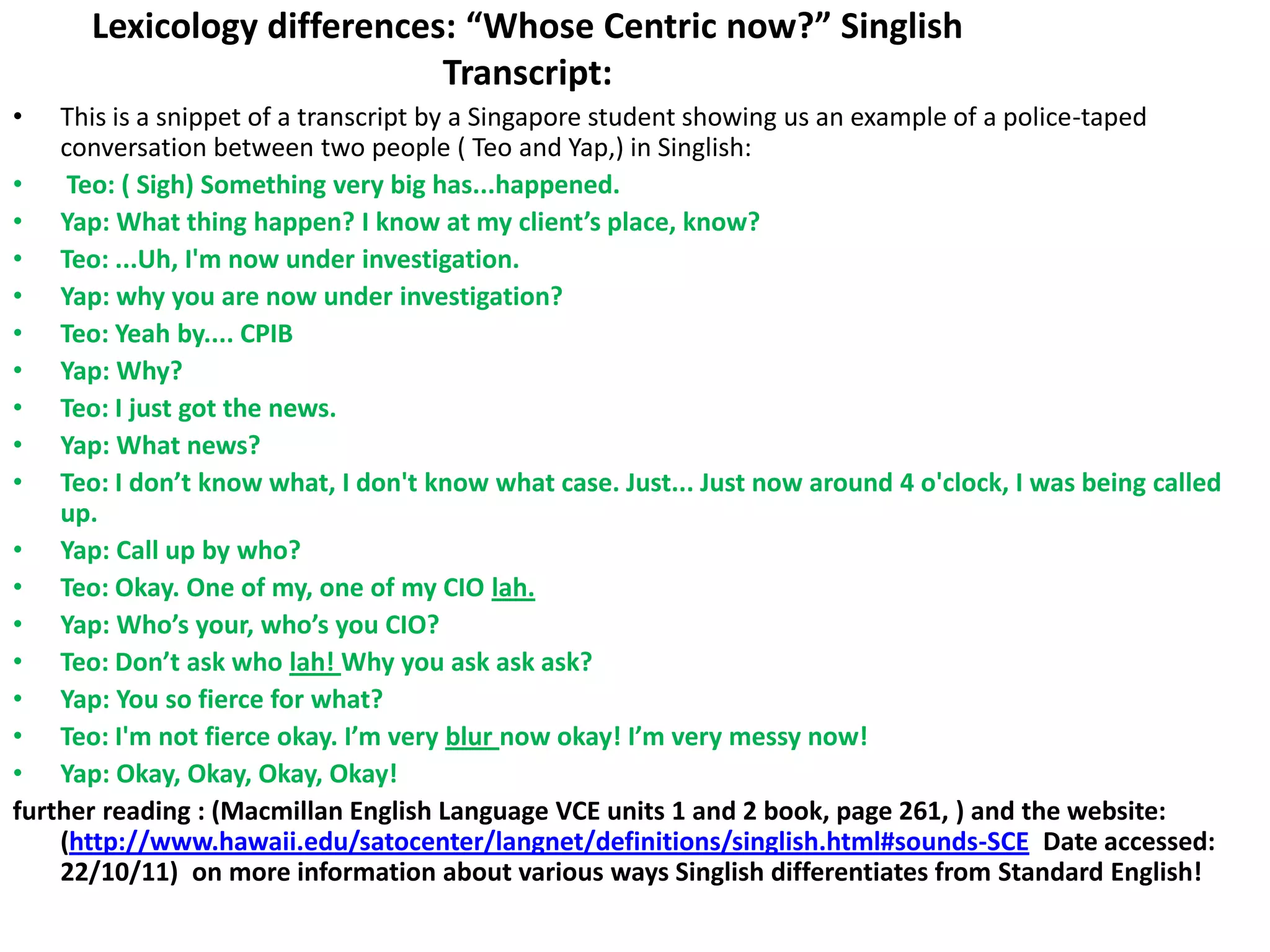
Lexicology differences: “Whose Centric now?” Singlish
                            Transcript:
•   This is a snippet of a transcript by a Singapore student showing us an example of a police-taped
    conversation between two people ( Teo and Yap,) in Singlish:
•    Teo: ( Sigh) Something very big has...happened.
• Yap: What thing happen? I know at my client’s place, know?
• Teo: ...Uh, I'm now under investigation.
• Yap: why you are now under investigation?
• Teo: Yeah by.... CPIB
• Yap: Why?
• Teo: I just got the news.
• Yap: What news?
• Teo: I don’t know what, I don't know what case. Just... Just now around 4 o'clock, I was being called
    up.
• Yap: Call up by who?
• Teo: Okay. One of my, one of my CIO lah.
• Yap: Who’s your, who’s you CIO?
• Teo: Don’t ask who lah! Why you ask ask ask?
• Yap: You so fierce for what?
• Teo: I'm not fierce okay. I’m very blur now okay! I’m very messy now!
• Yap: Okay, Okay, Okay, Okay!
further reading : (Macmillan English Language VCE units 1 and 2 book, page 261, ) and the website:
    (http://www.hawaii.edu/satocenter/langnet/definitions/singlish.html#sounds-SCE Date accessed:
    22/10/11) on more information about various ways Singlish differentiates from Standard English!
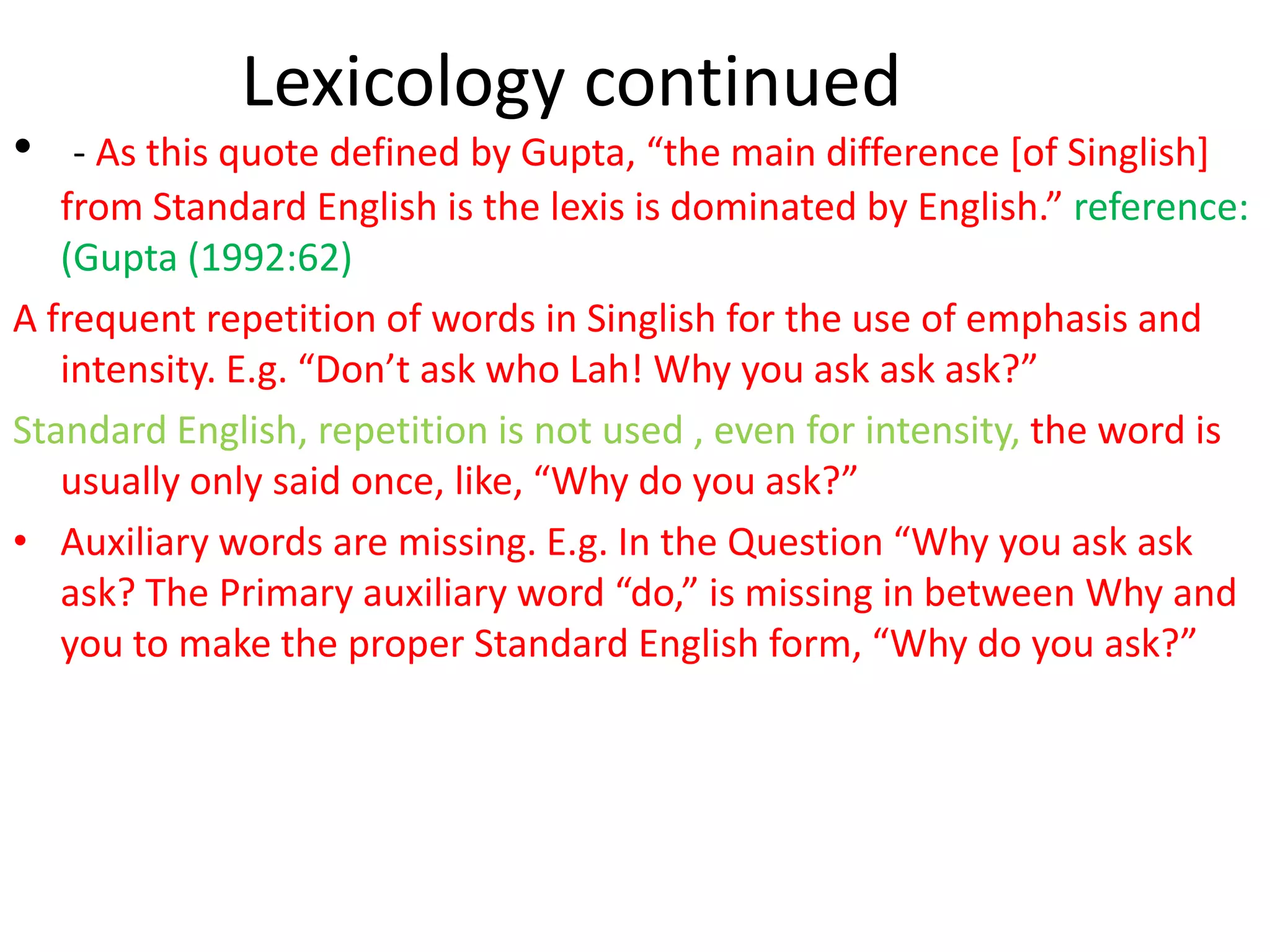
Lexicology continued
•   - As this quote defined by Gupta, “the main difference *of Singlish+
   from Standard English is the lexis is dominated by English.” reference:
   (Gupta (1992:62)
A frequent repetition of words in Singlish for the use of emphasis and
   intensity. E.g. “Don’t ask who Lah! Why you ask ask ask?”
Standard English, repetition is not used , even for intensity, the word is
   usually only said once, like, “Why do you ask?”
• Auxiliary words are missing. E.g. In the Question “Why you ask ask
   ask? The Primary auxiliary word “do,” is missing in between Why and
   you to make the proper Standard English form, “Why do you ask?”
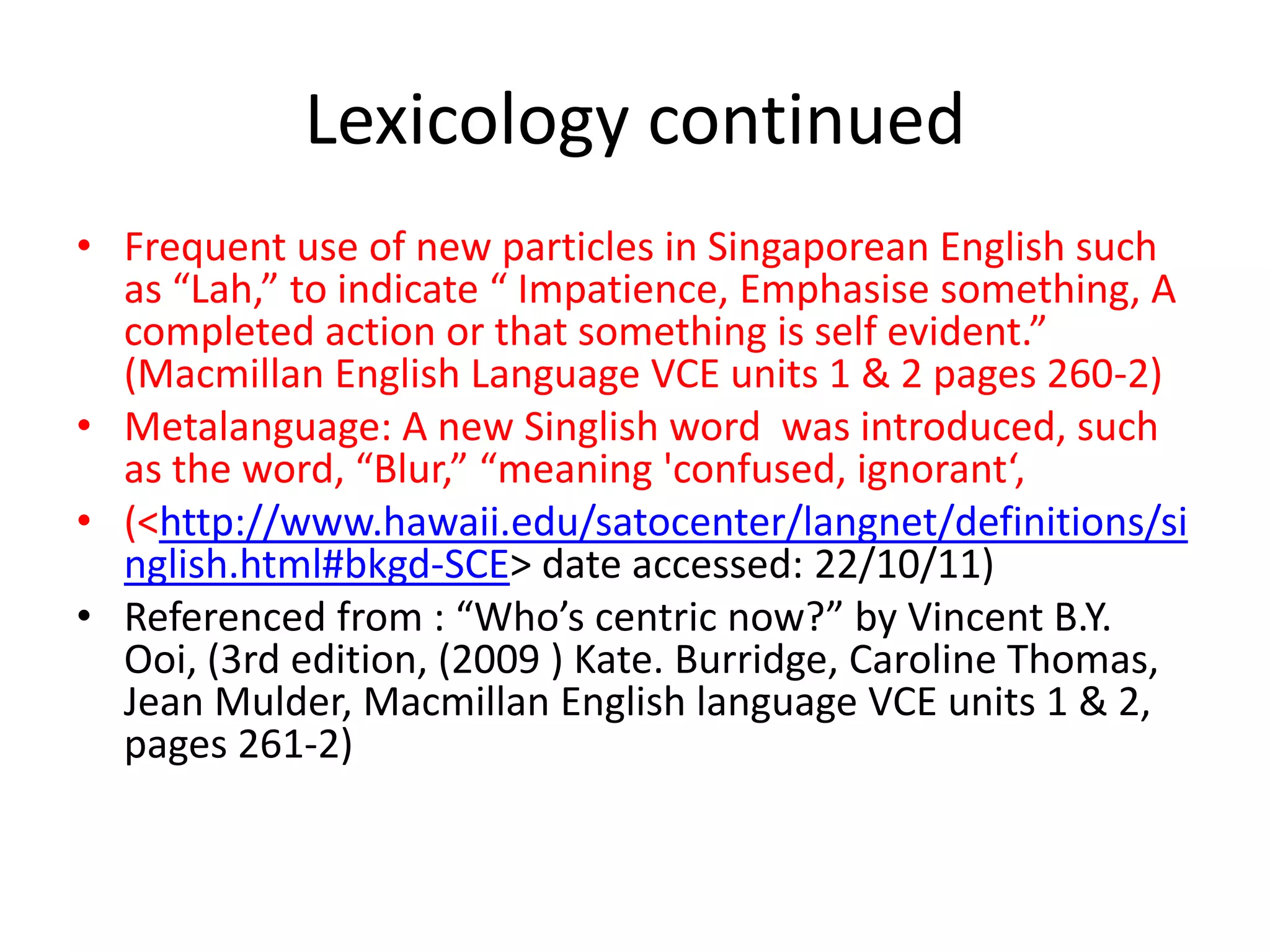
Lexicology continued
• Frequent use of new particles in Singaporean English such
  as “Lah,” to indicate “ Impatience, Emphasise something, A
  completed action or that something is self evident.”
  (Macmillan English Language VCE units 1 & 2 pages 260-2)
• Metalanguage: A new Singlish word was introduced, such
  as the word, “Blur,” “meaning 'confused, ignorant‘,
• (<http://www.hawaii.edu/satocenter/langnet/definitions/si
  nglish.html#bkgd-SCE> date accessed: 22/10/11)
• Referenced from : “Who’s centric now?” by Vincent B.Y.
  Ooi, (3rd edition, (2009 ) Kate. Burridge, Caroline Thomas,
  Jean Mulder, Macmillan English language VCE units 1 & 2,
  pages 261-2)
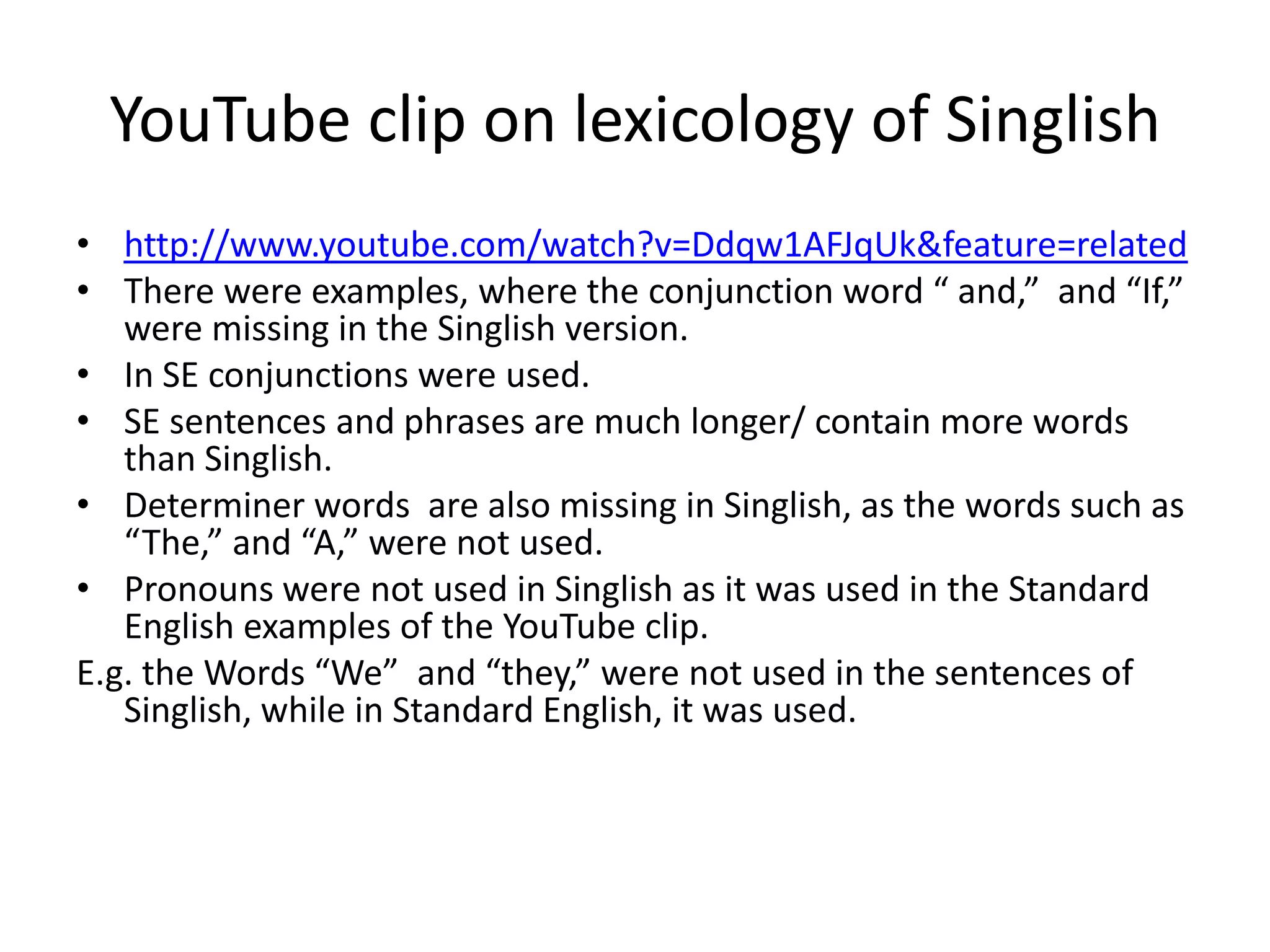
YouTube clip on lexicology of Singlish
• http://www.youtube.com/watch?v=Ddqw1AFJqUk&feature=related
• There were examples, where the conjunction word “ and,” and “If,”
   were missing in the Singlish version.
• In SE conjunctions were used.
• SE sentences and phrases are much longer/ contain more words
   than Singlish.
• Determiner words are also missing in Singlish, as the words such as
   “The,” and “A,” were not used.
• Pronouns were not used in Singlish as it was used in the Standard
   English examples of the YouTube clip.
E.g. the Words “We” and “they,” were not used in the sentences of
   Singlish, while in Standard English, it was used.
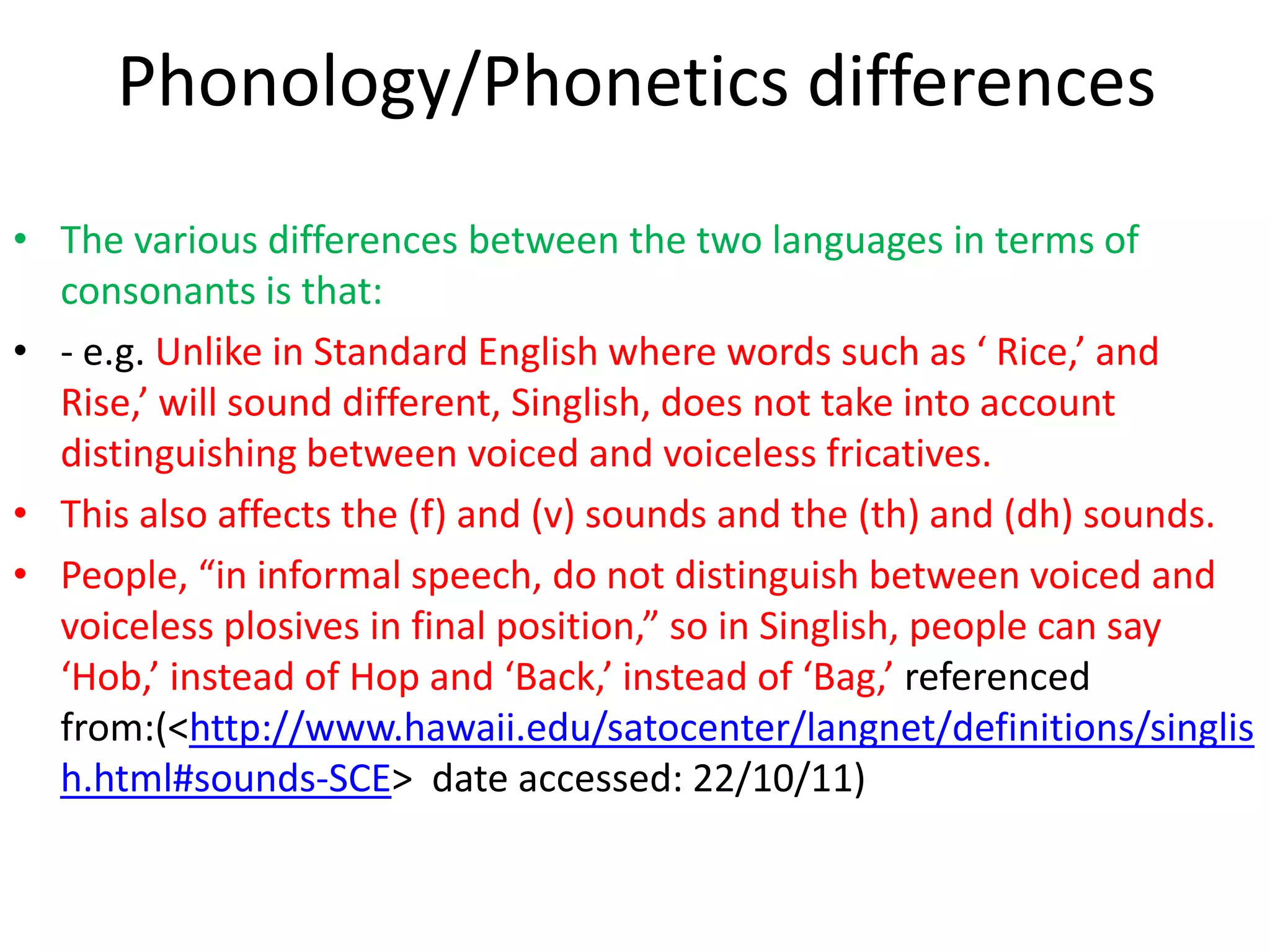
Phonology/Phonetics differences
• The various differences between the two languages in terms of
  consonants is that:
• - e.g. Unlike in Standard English where words such as ‘ Rice,’ and
  Rise,’ will sound different, Singlish, does not take into account
  distinguishing between voiced and voiceless fricatives.
• This also affects the (f) and (v) sounds and the (th) and (dh) sounds.
• People, “in informal speech, do not distinguish between voiced and
  voiceless plosives in final position,” so in Singlish, people can say
  ‘Hob,’ instead of Hop and ‘Back,’ instead of ‘Bag,’ referenced
  from:(<http://www.hawaii.edu/satocenter/langnet/definitions/singlis
  h.html#sounds-SCE> date accessed: 22/10/11)
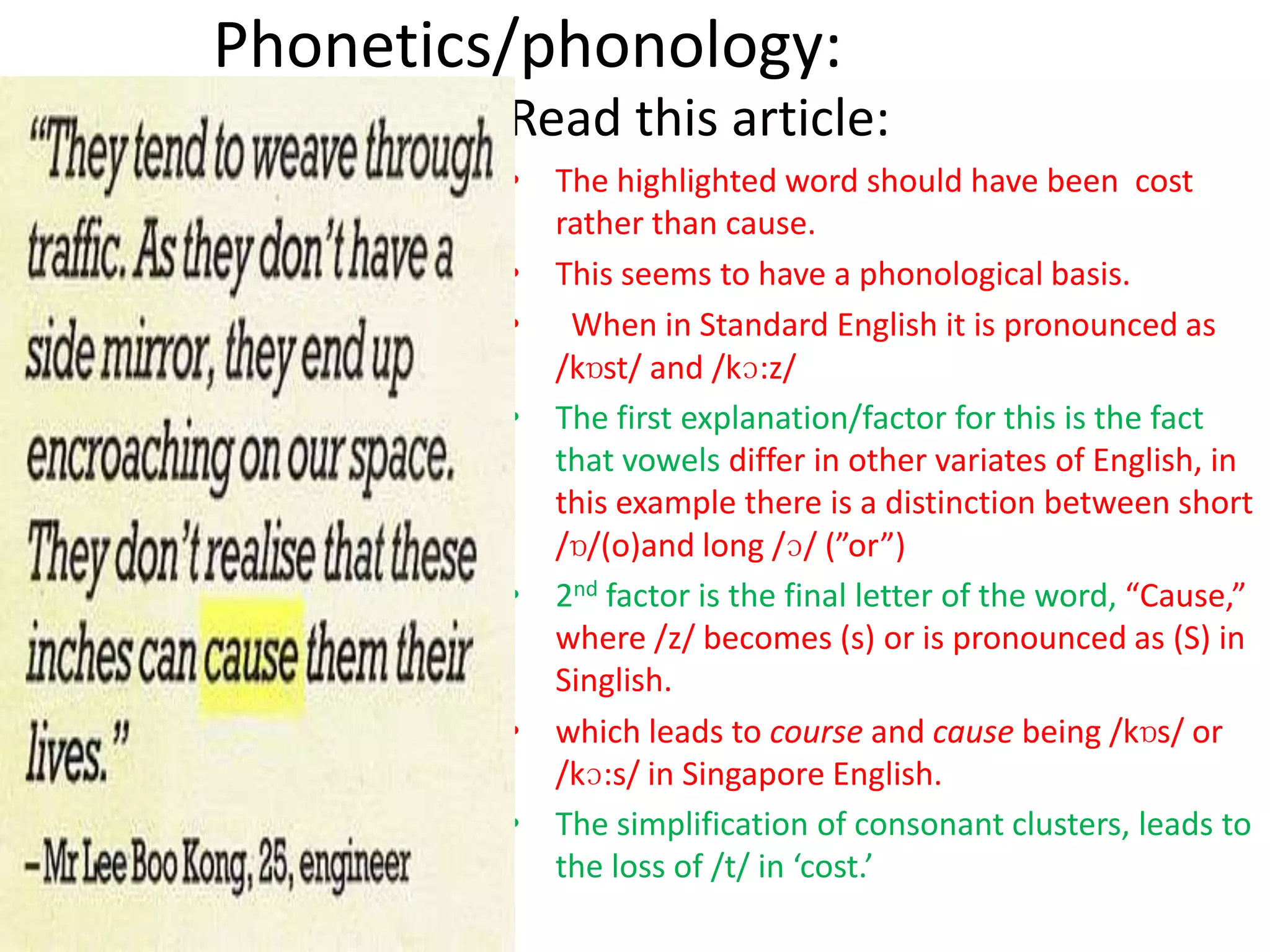
Phonetics/phonology:
         Read this article:
         • The highlighted word should have been cost
           rather than cause.
         • This seems to have a phonological basis.
         • When in Standard English it is pronounced as
           /kɒst/ and /kɔ:z/
         • The first explanation/factor for this is the fact
           that vowels differ in other variates of English, in
           this example there is a distinction between short
           /ɒ/(o)and long /ɔ/ (”or”)
         • 2nd factor is the final letter of the word, “Cause,”
           where /z/ becomes (s) or is pronounced as (S) in
           Singlish.
         • which leads to course and cause being /kɒs/ or
           /kɔ:s/ in Singapore English.
         • The simplification of consonant clusters, leads to
           the loss of /t/ in ‘cost.’
Phonetics: Intonation of Singlish
      compared to Standard English
• Singlish is known to be spoken at a very fast paced that it was quoted as a
  'machine gun' style when spoken.
  (<http://www.hawaii.edu/satocenter/langnet/definitions/singlish.html#sounds-
  SCE> date accessed: 22/10/11)
• It has its own distinctive rhythm.
• In Standard English, it is spoken slower and the words/phrases are pronounced
  more.
• The YouTube clip e.g.:
• http://www.youtube.com/watch?v=Ddqw1AFJqUk&feature=related
Comparisons of the two languages with sentence
                     structures.
• focus on the meaning of the phrase, “It is,” and how it is used to describe both of
  the languages. A sentence example:
• “That was a fantastic concert, wasn’t it?
• “That was a fantastic concert, is it?”
• In presumption, The Singapore English Tag is acceptable if the speaker is asking
  the other person whether the concert was fantastic. But if it is to state their own
  opinions then it would not work.
• Standard English can be combined with knowledge, Singlish hardly does so.
• Another example: The Standard English quote: “We were in Brighton weren’t we,
  in August, of last year?
Comparisons of the two languages
       with sentence structures.
• It would sound like a genuine question if we swap the Standard
  English phrase “weren’t we,’ with the Singlish phrase, “ It is.”
• the Singlish words, “It is,” is very different to that of the Standard
  English. Firstly, the Singlish word implies that the speaker expects
  agreement.
• A standard English phrase combines with a preposition in which
  the speaker knows its true, (e.g., We were in Brighton, weren’t
  we?”)
• (http://benjamins.com/jbp/series/P&C/16-1/art/06won.pdf>
  date accessed:23/10/11)
• But, the Singlish term does not!
• E.g. “ We were in Brighton, is it?”
• Is only used if a speaker is unsure about something.
Syntax comparisons
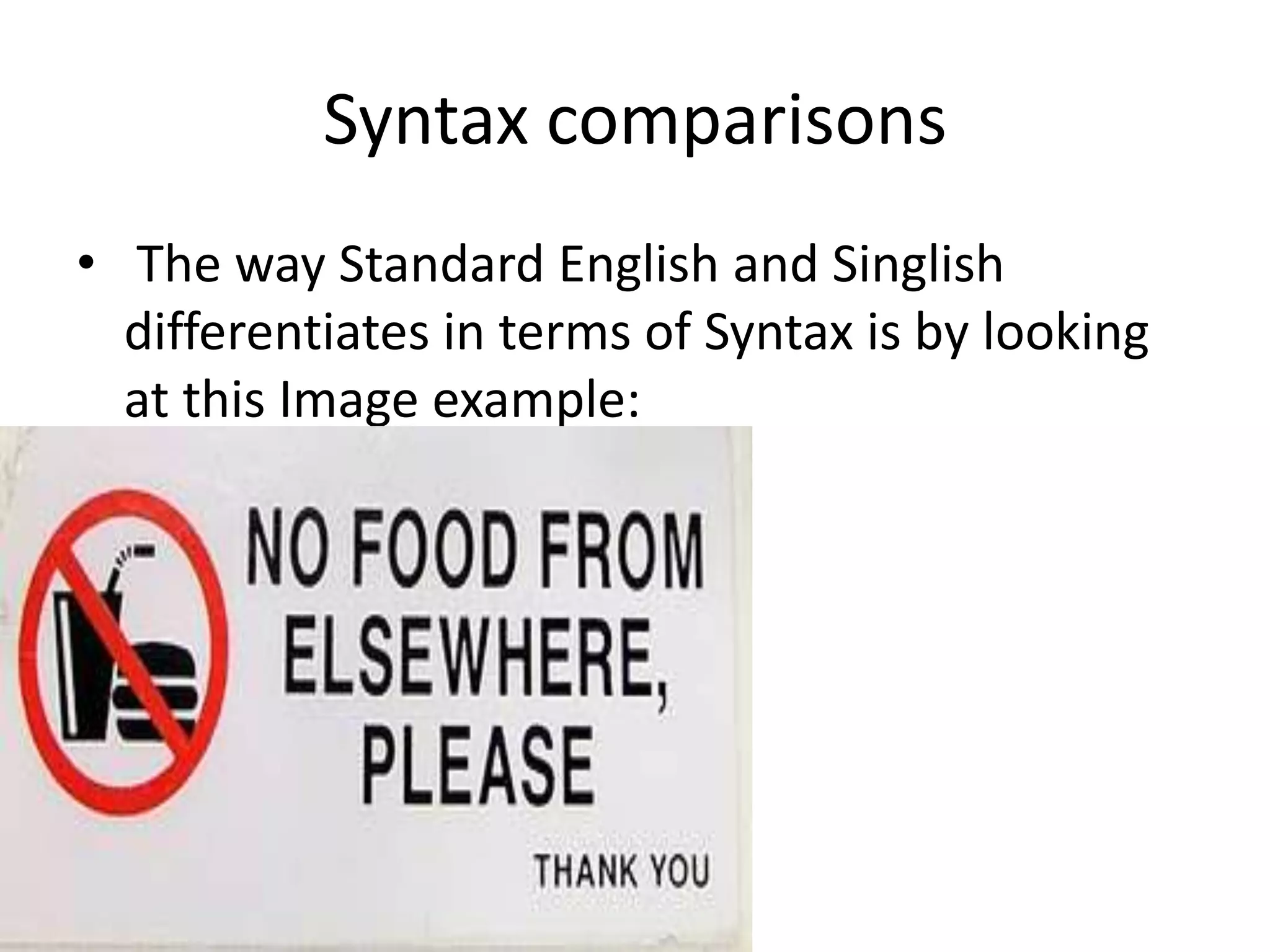
• The way Standard English and Singlish
  differentiates in terms of Syntax is by looking
  at this Image example:
•
•
     As the Syntax, The Image of an Imperative sign that says
    To do with
               previous image shows...
   “No Food from elsewhere, please!” is directing us, in Singlish
to do something.
• differs from standard English because it is not in the correct
   order,
• There are less words used that would be used in Standard
   English.
• E.g.. In standard English, This Imperative phrase would be
   correctly translated to either one of the three below:
• “Only for the consumption of food purchased here.”
• “Only for food purchased here.”
• “Not for the consumption of food bought elsewhere.”
This example was found from the link,”
   http://englishasitisbroken.blogspot.com/search/label/Singlish
   > date accessed: 23/110.11) from the Singlish section of the
   blog
References:
                          THE END
Writer: John Benjamin <http://benjamins.com/jbp/series/P&C/16-1/art/06won.pdf> writer: John Benjamin's
    publishing company)
 ( My English Language Blog: Phonetics and Phonology
    http://englishasitisbroken.blogspot.com/search/label/Phonetics%20and%20Phonology writer: Ludwig
    Tan)
 Idea, http://web.ku.edu/~idea/asia/singapore/singapore1.mp3 writer: IDEA
     Singapore English- a Knol by David Deterding: <http://knol.google.com/k/singapore-
    english#Phonology > Publishers: IDEA)
 http://www.ubd.edu.bn/academic/faculty/FASS_V2.1/staff/papers/DD/JIPA-Sing-intonation.pdf
< http://www.ubd.edu.bn/academic/faculty/FASS_V2.1/staff/papers/DD/JIPA-Sing-intonation.pdf > The
    intonation of Singapore English, writer: David Deterding
 The new Englishes http://courses.nus.edu.sg/course/elltankw/history/NE.htm writer unknown.)
 Singlish: < http://www.hawaii.edu/satocenter/langnet/definitions/singlish.html > writer unknown)
 Yoonsoonchye < http://www.als.asn.au/proceedings/als2009/yoongsoonchye.pdf > Writer unknown
 YouTube: http://www.youtube.com/watch?v=Ddqw1A FJqUk Childhoodspeech

 Further Information and reading:
 My English Language blog: http://englishasitisbroken.blogspot.com/search/label/Singlish Ludwig Tan
 Mulder, J, Burridge, K, Thomas, C, (2009) Macmillan English Language VCE UNITS 1 and 2, Published:
    Macmillan Education Australia, pp: 260-262 and 27-40)
 http://benjamins.com/jbp/series/P&C/16-1/art/06won.pdf
< http://benjamins.com/jbp/series/P&C/16-1/art/06won.pdf > Ben Johnson's publishing company)

Comparing the differences between standard english and singlish.finihed one!!!!

  • 1.
    Comparing the differencesbetween Standard English and Singlish By Vladislav Vlajic
  • 2.
    I will talkabout... • Morphology’ • Semantics • Phonetics/phonology • Lexicology • Syntax • Describing new metalanguage of new Singlish words as well
  • 3.
    Morphology • The main areas that Standard English and Singapore English differentiates in the Subsystem of Morphology is that a lot of grammatical endings that is compulsory in Standard English that speakers have to take into account, • In Singlish it is very much optional. • Plurals and past tenses is not needed to be taken into consideration with Singapore colloquial speakers. • An example of what you might hear when faced with Singlish speakers: • > What happen yesterday? • > You go where? • > Got so many car! • Then bicycle go first ah ( instead of “So the bicycle went first.) • > I just sit and everything do for me! • This information was found from this link: <http://www.hawaii.edu/satocenter/langnet/definitions/singlish.html#voca b-SCE> date accessed: 21/10/11 on the section under “Grammar,”
  • 4.
    Lexicology differences: “WhoseCentric now?” Singlish Transcript: • This is a snippet of a transcript by a Singapore student showing us an example of a police-taped conversation between two people ( Teo and Yap,) in Singlish: • Teo: ( Sigh) Something very big has...happened. • Yap: What thing happen? I know at my client’s place, know? • Teo: ...Uh, I'm now under investigation. • Yap: why you are now under investigation? • Teo: Yeah by.... CPIB • Yap: Why? • Teo: I just got the news. • Yap: What news? • Teo: I don’t know what, I don't know what case. Just... Just now around 4 o'clock, I was being called up. • Yap: Call up by who? • Teo: Okay. One of my, one of my CIO lah. • Yap: Who’s your, who’s you CIO? • Teo: Don’t ask who lah! Why you ask ask ask? • Yap: You so fierce for what? • Teo: I'm not fierce okay. I’m very blur now okay! I’m very messy now! • Yap: Okay, Okay, Okay, Okay! further reading : (Macmillan English Language VCE units 1 and 2 book, page 261, ) and the website: (http://www.hawaii.edu/satocenter/langnet/definitions/singlish.html#sounds-SCE Date accessed: 22/10/11) on more information about various ways Singlish differentiates from Standard English!
  • 5.
    Lexicology continued • - As this quote defined by Gupta, “the main difference *of Singlish+ from Standard English is the lexis is dominated by English.” reference: (Gupta (1992:62) A frequent repetition of words in Singlish for the use of emphasis and intensity. E.g. “Don’t ask who Lah! Why you ask ask ask?” Standard English, repetition is not used , even for intensity, the word is usually only said once, like, “Why do you ask?” • Auxiliary words are missing. E.g. In the Question “Why you ask ask ask? The Primary auxiliary word “do,” is missing in between Why and you to make the proper Standard English form, “Why do you ask?”
  • 6.
    Lexicology continued • Frequentuse of new particles in Singaporean English such as “Lah,” to indicate “ Impatience, Emphasise something, A completed action or that something is self evident.” (Macmillan English Language VCE units 1 & 2 pages 260-2) • Metalanguage: A new Singlish word was introduced, such as the word, “Blur,” “meaning 'confused, ignorant‘, • (<http://www.hawaii.edu/satocenter/langnet/definitions/si nglish.html#bkgd-SCE> date accessed: 22/10/11) • Referenced from : “Who’s centric now?” by Vincent B.Y. Ooi, (3rd edition, (2009 ) Kate. Burridge, Caroline Thomas, Jean Mulder, Macmillan English language VCE units 1 & 2, pages 261-2)
  • 7.
    YouTube clip onlexicology of Singlish • http://www.youtube.com/watch?v=Ddqw1AFJqUk&feature=related • There were examples, where the conjunction word “ and,” and “If,” were missing in the Singlish version. • In SE conjunctions were used. • SE sentences and phrases are much longer/ contain more words than Singlish. • Determiner words are also missing in Singlish, as the words such as “The,” and “A,” were not used. • Pronouns were not used in Singlish as it was used in the Standard English examples of the YouTube clip. E.g. the Words “We” and “they,” were not used in the sentences of Singlish, while in Standard English, it was used.
  • 8.
    Phonology/Phonetics differences • Thevarious differences between the two languages in terms of consonants is that: • - e.g. Unlike in Standard English where words such as ‘ Rice,’ and Rise,’ will sound different, Singlish, does not take into account distinguishing between voiced and voiceless fricatives. • This also affects the (f) and (v) sounds and the (th) and (dh) sounds. • People, “in informal speech, do not distinguish between voiced and voiceless plosives in final position,” so in Singlish, people can say ‘Hob,’ instead of Hop and ‘Back,’ instead of ‘Bag,’ referenced from:(<http://www.hawaii.edu/satocenter/langnet/definitions/singlis h.html#sounds-SCE> date accessed: 22/10/11)
  • 9.
    Phonetics/phonology: Read this article: • The highlighted word should have been cost rather than cause. • This seems to have a phonological basis. • When in Standard English it is pronounced as /kɒst/ and /kɔ:z/ • The first explanation/factor for this is the fact that vowels differ in other variates of English, in this example there is a distinction between short /ɒ/(o)and long /ɔ/ (”or”) • 2nd factor is the final letter of the word, “Cause,” where /z/ becomes (s) or is pronounced as (S) in Singlish. • which leads to course and cause being /kɒs/ or /kɔ:s/ in Singapore English. • The simplification of consonant clusters, leads to the loss of /t/ in ‘cost.’
  • 10.
    Phonetics: Intonation ofSinglish compared to Standard English • Singlish is known to be spoken at a very fast paced that it was quoted as a 'machine gun' style when spoken. (<http://www.hawaii.edu/satocenter/langnet/definitions/singlish.html#sounds- SCE> date accessed: 22/10/11) • It has its own distinctive rhythm. • In Standard English, it is spoken slower and the words/phrases are pronounced more. • The YouTube clip e.g.: • http://www.youtube.com/watch?v=Ddqw1AFJqUk&feature=related
  • 11.
    Comparisons of thetwo languages with sentence structures. • focus on the meaning of the phrase, “It is,” and how it is used to describe both of the languages. A sentence example: • “That was a fantastic concert, wasn’t it? • “That was a fantastic concert, is it?” • In presumption, The Singapore English Tag is acceptable if the speaker is asking the other person whether the concert was fantastic. But if it is to state their own opinions then it would not work. • Standard English can be combined with knowledge, Singlish hardly does so. • Another example: The Standard English quote: “We were in Brighton weren’t we, in August, of last year?
  • 12.
    Comparisons of thetwo languages with sentence structures. • It would sound like a genuine question if we swap the Standard English phrase “weren’t we,’ with the Singlish phrase, “ It is.” • the Singlish words, “It is,” is very different to that of the Standard English. Firstly, the Singlish word implies that the speaker expects agreement. • A standard English phrase combines with a preposition in which the speaker knows its true, (e.g., We were in Brighton, weren’t we?”) • (http://benjamins.com/jbp/series/P&C/16-1/art/06won.pdf> date accessed:23/10/11) • But, the Singlish term does not! • E.g. “ We were in Brighton, is it?” • Is only used if a speaker is unsure about something.
  • 13.
    Syntax comparisons • Theway Standard English and Singlish differentiates in terms of Syntax is by looking at this Image example: •
  • 14.
    As the Syntax, The Image of an Imperative sign that says To do with previous image shows... “No Food from elsewhere, please!” is directing us, in Singlish to do something. • differs from standard English because it is not in the correct order, • There are less words used that would be used in Standard English. • E.g.. In standard English, This Imperative phrase would be correctly translated to either one of the three below: • “Only for the consumption of food purchased here.” • “Only for food purchased here.” • “Not for the consumption of food bought elsewhere.” This example was found from the link,” http://englishasitisbroken.blogspot.com/search/label/Singlish > date accessed: 23/110.11) from the Singlish section of the blog
  • 15.
    References: THE END Writer: John Benjamin <http://benjamins.com/jbp/series/P&C/16-1/art/06won.pdf> writer: John Benjamin's publishing company)  ( My English Language Blog: Phonetics and Phonology http://englishasitisbroken.blogspot.com/search/label/Phonetics%20and%20Phonology writer: Ludwig Tan)  Idea, http://web.ku.edu/~idea/asia/singapore/singapore1.mp3 writer: IDEA  Singapore English- a Knol by David Deterding: <http://knol.google.com/k/singapore- english#Phonology > Publishers: IDEA)  http://www.ubd.edu.bn/academic/faculty/FASS_V2.1/staff/papers/DD/JIPA-Sing-intonation.pdf < http://www.ubd.edu.bn/academic/faculty/FASS_V2.1/staff/papers/DD/JIPA-Sing-intonation.pdf > The intonation of Singapore English, writer: David Deterding  The new Englishes http://courses.nus.edu.sg/course/elltankw/history/NE.htm writer unknown.)  Singlish: < http://www.hawaii.edu/satocenter/langnet/definitions/singlish.html > writer unknown)  Yoonsoonchye < http://www.als.asn.au/proceedings/als2009/yoongsoonchye.pdf > Writer unknown  YouTube: http://www.youtube.com/watch?v=Ddqw1A FJqUk Childhoodspeech  Further Information and reading:  My English Language blog: http://englishasitisbroken.blogspot.com/search/label/Singlish Ludwig Tan  Mulder, J, Burridge, K, Thomas, C, (2009) Macmillan English Language VCE UNITS 1 and 2, Published: Macmillan Education Australia, pp: 260-262 and 27-40)  http://benjamins.com/jbp/series/P&C/16-1/art/06won.pdf < http://benjamins.com/jbp/series/P&C/16-1/art/06won.pdf > Ben Johnson's publishing company)