Sales and
Distribution
    Team C2X !!
• Market ?
• What is Marketed ?
• Who Markets ?
Dimensions of Market
•   Spatial Seperation
•   Time Seperation
•   Perceptional Seperation
•   Seperation of Values
•   Seperation of ownership
Sales ??
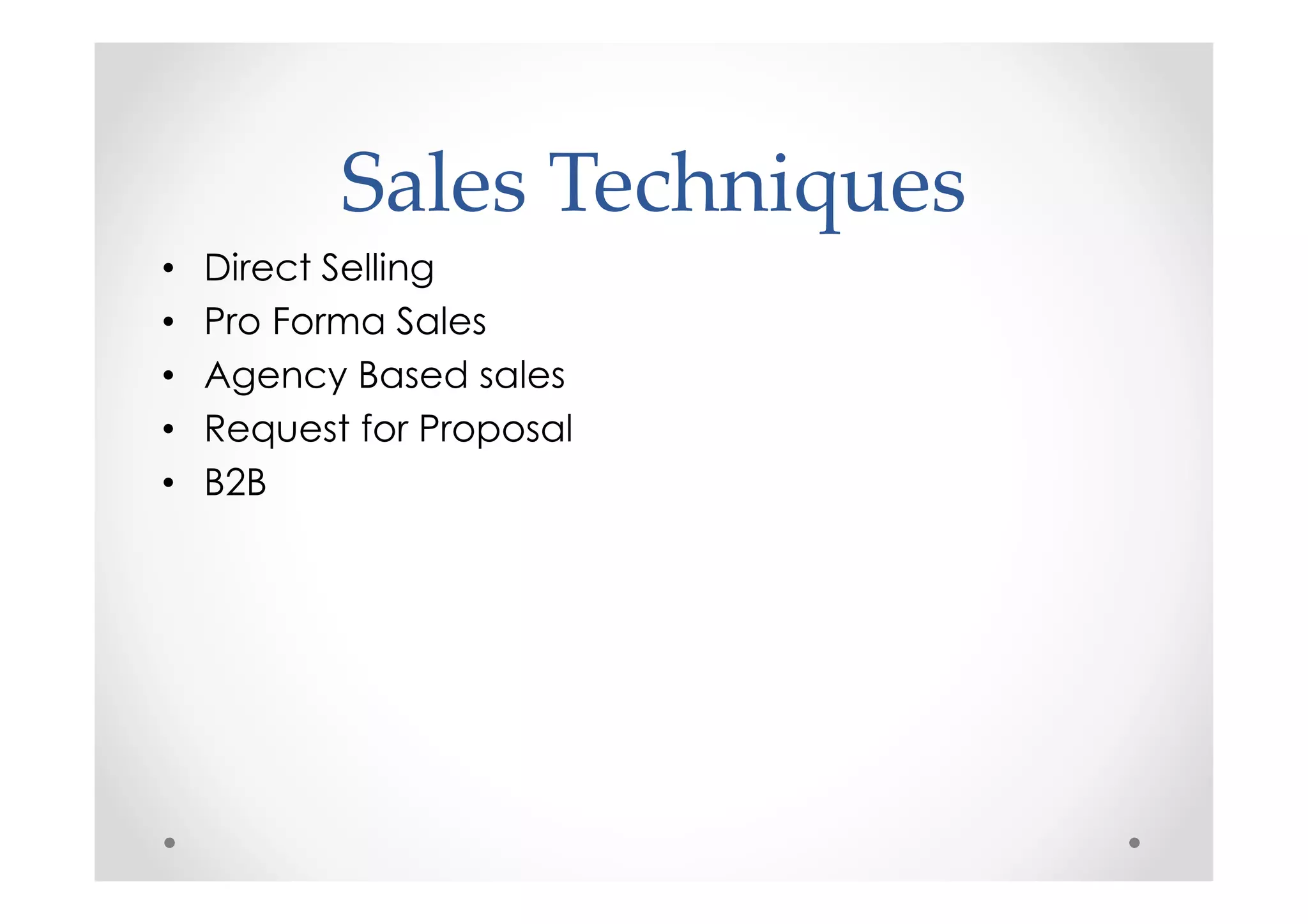
Sales Techniques
•   Direct Selling
•   Pro Forma Sales
•   Agency Based sales
•   Request for Proposal
•   B2B
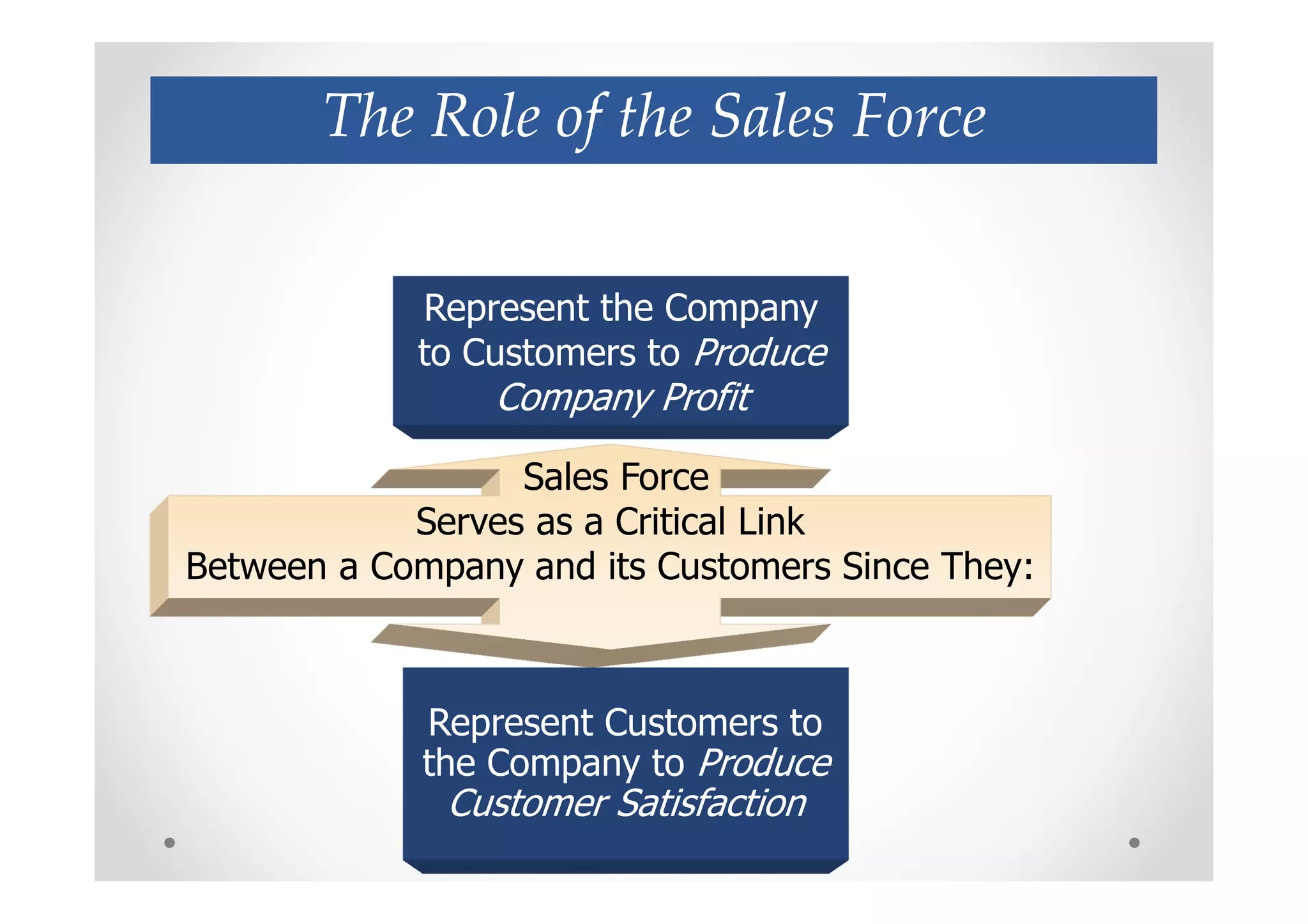
The Role of the Sales Force

            Represent the Company
            to Customers to Produce
                 Company Profit

                  Sales Force
            Serves as a Critical Link
Between a Company and its Customers Since They:


             Represent Customers to
             the Company to Produce
              Customer Satisfaction
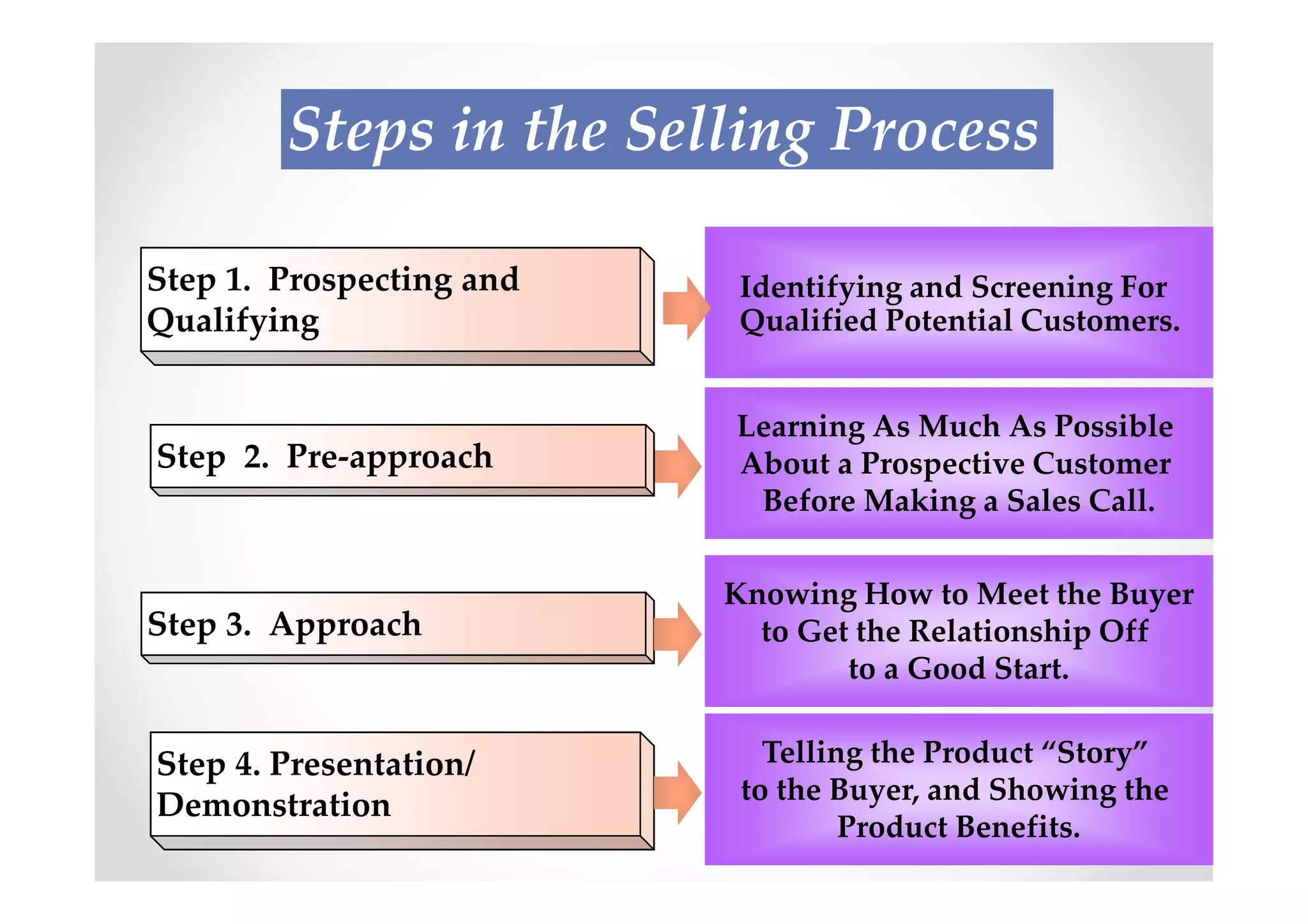
Steps in the Selling Process

Step 1. Prospecting and   Identifying and Screening For
Qualifying                Qualified Potential Customers.


                          Learning As Much As Possible
Step 2. Pre-approach      About a Prospective Customer
                           Before Making a Sales Call.

                          Knowing How to Meet the Buyer
Step 3. Approach            to Get the Relationship Off
                                  to a Good Start.


Step 4. Presentation/        Telling the Product “Story”
                           to the Buyer, and Showing the
Demonstration
                                   Product Benefits.
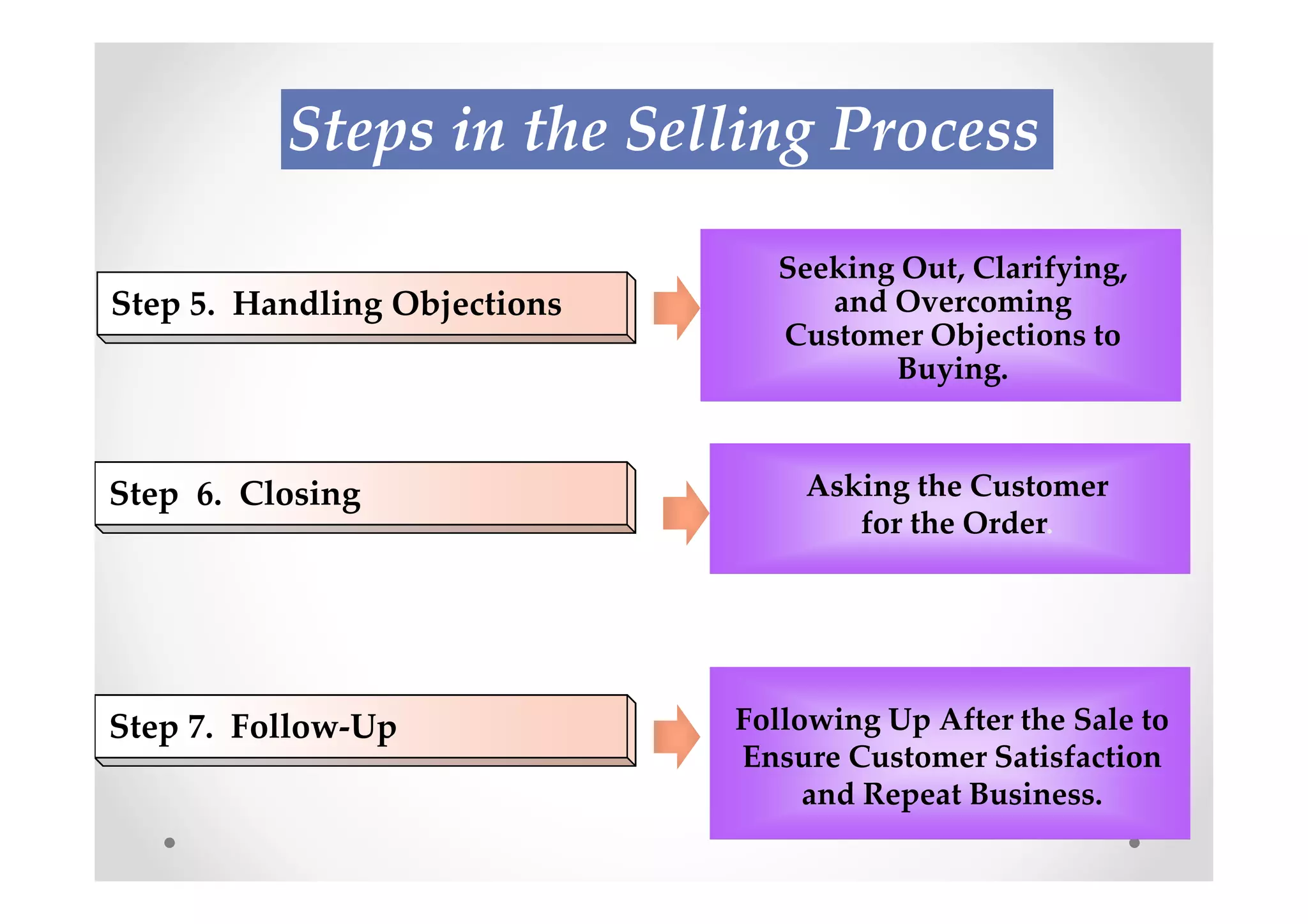
Steps in the Selling Process

                                Seeking Out, Clarifying,
Step 5. Handling Objections        and Overcoming
                                Customer Objections to
                                       Buying.


Step 6. Closing                   Asking the Customer
                                     for the Order.


Step 7. Follow-Up             Following Up After the Sale to
                              Ensure Customer Satisfaction
                                   and Repeat Business.
Distribution
Channels and
Management
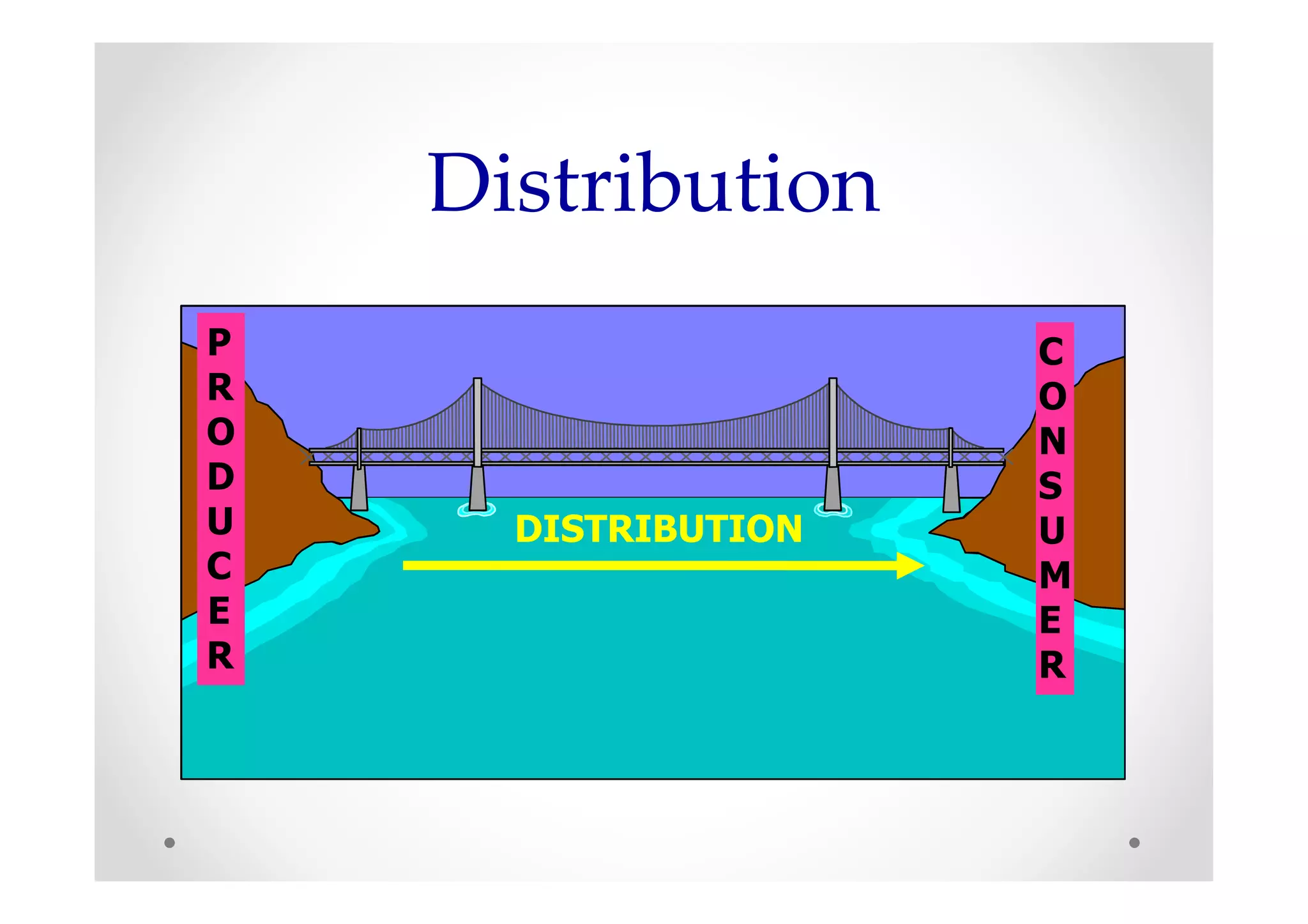
Distribution
P                    C
R                    O
O                    N
D                    S
U     DISTRIBUTION   U
C                    M
E                    E
R                    R
Distribution’s Function
• The major purpose of marketing is to satisfy
  human needs by delivering products of
  various types to buyers when and where
  they want them and at a reasonable cost.
• The “when and where” is the function of
  Distribution
Distribution Objectives
• Minimize total distribution costs for a
  given service output
• Determine the target segments and
  the best channels for each segment
• Objectives may vary with product
  characteristics
  o e.g. perishables, bulky products, non-
    standard items, products requiring
    installation & maintenance


                                             12
What is a Distribution
          Channel?
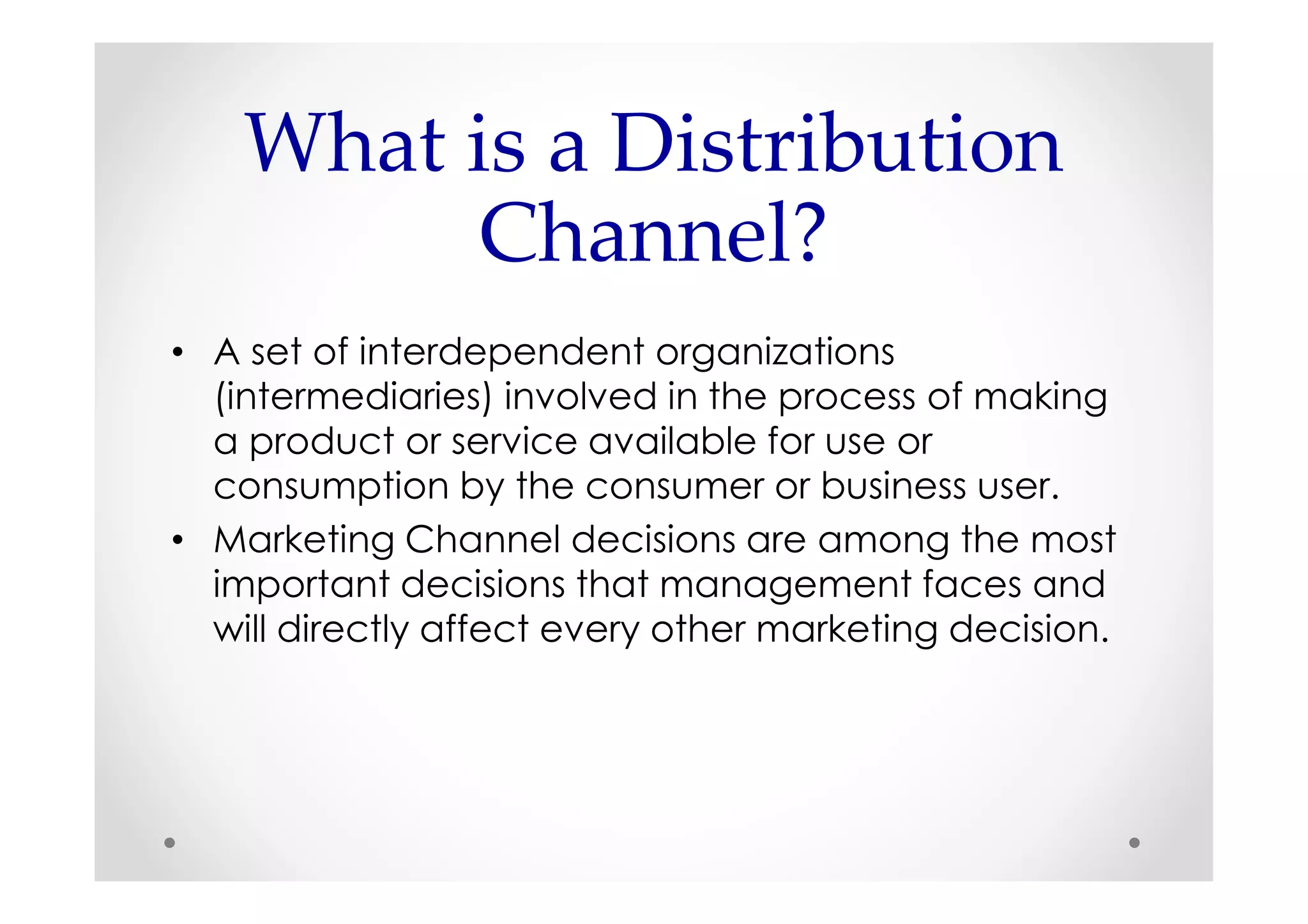
• A set of interdependent organizations
  (intermediaries) involved in the process of making
  a product or service available for use or
  consumption by the consumer or business user.
• Marketing Channel decisions are among the most
  important decisions that management faces and
  will directly affect every other marketing decision.
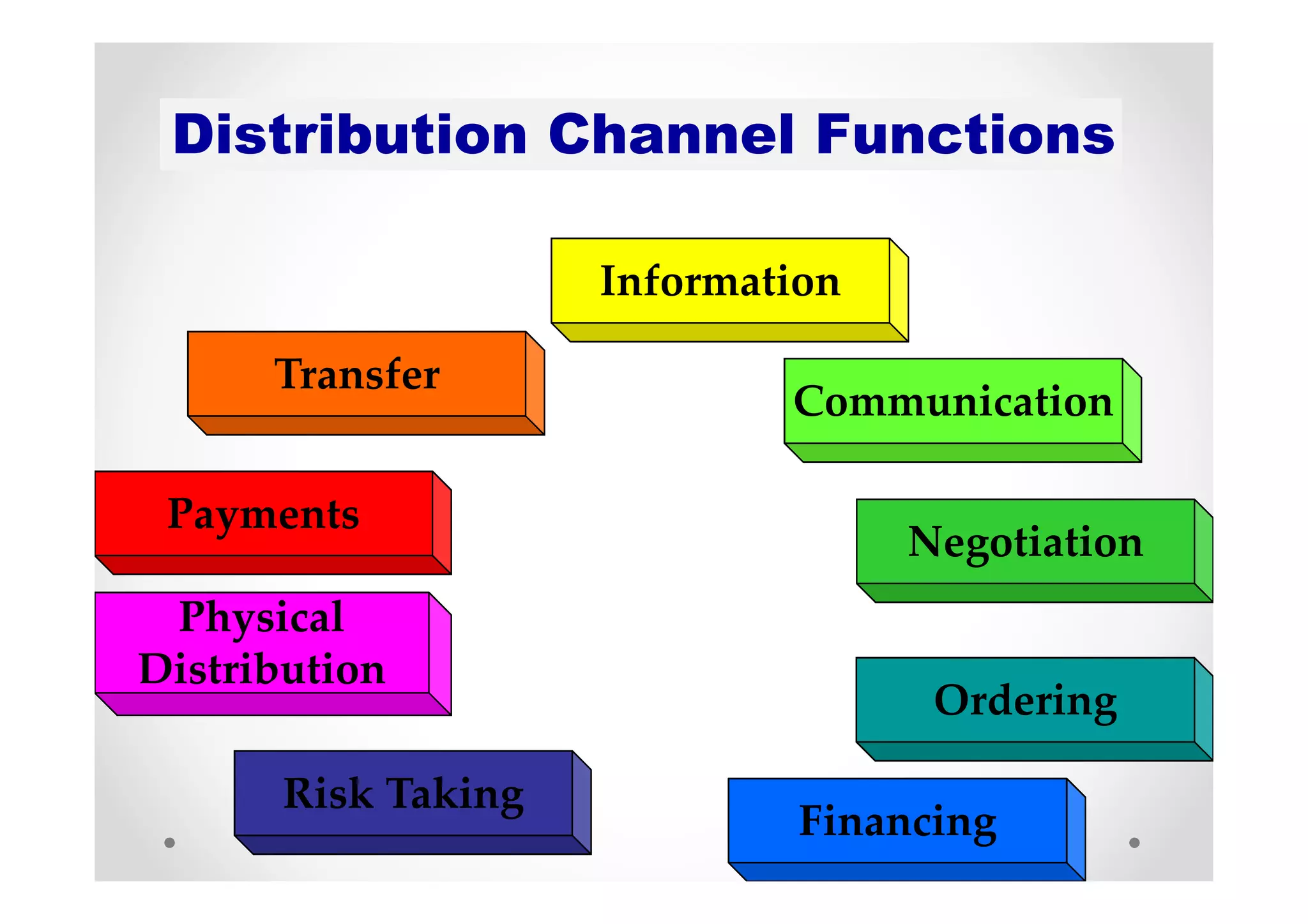
Distribution Channel Functions

                     Information

      Transfer
                             Communication

 Payments
                                   Negotiation
 Physical
Distribution
                                    Ordering

       Risk Taking
                              Financing
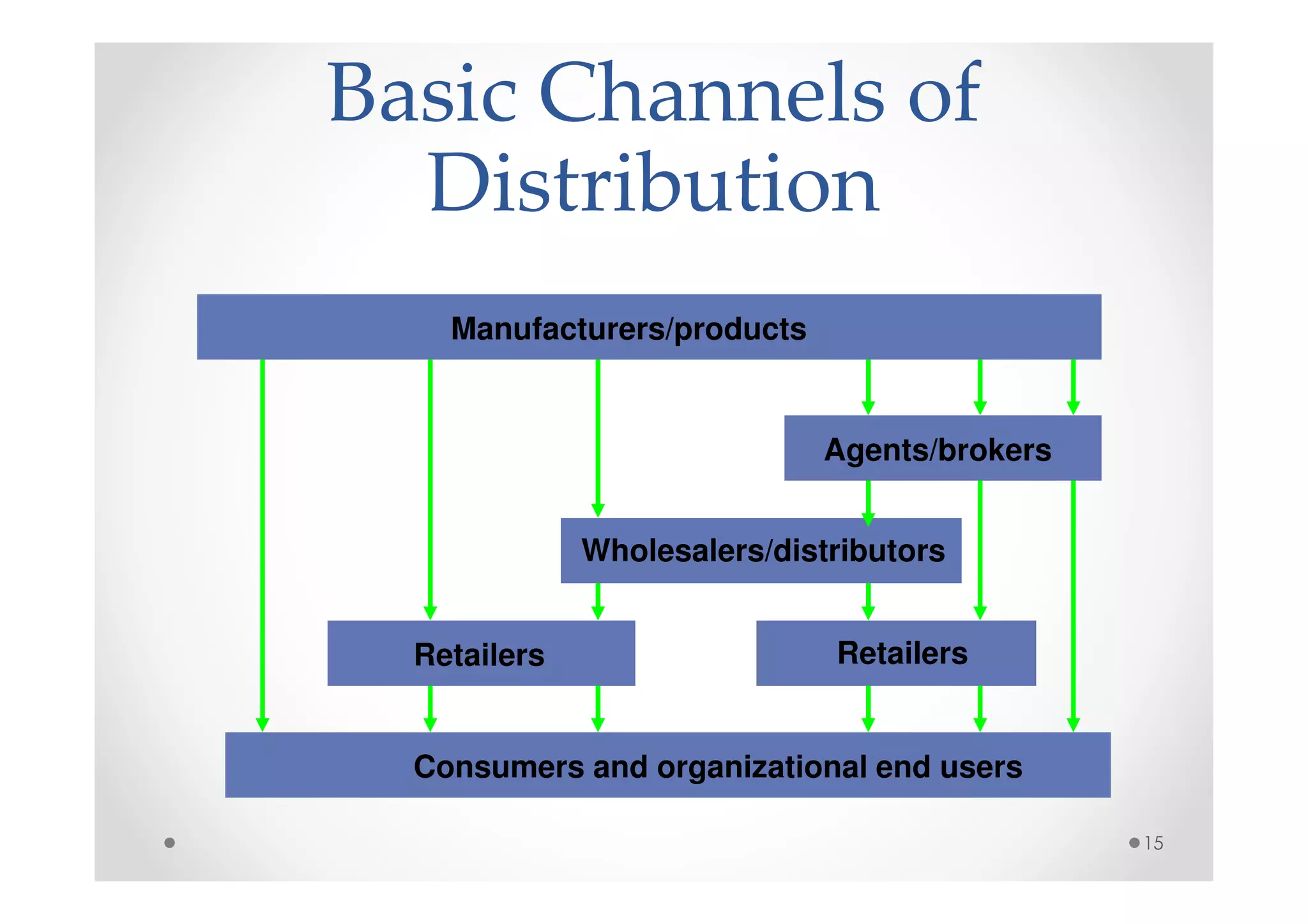
Basic Channels of
  Distribution
    Manufacturers/products


                             Agents/brokers


              Wholesalers/distributors


  Retailers                   Retailers


  Consumers and organizational end users

                                              15
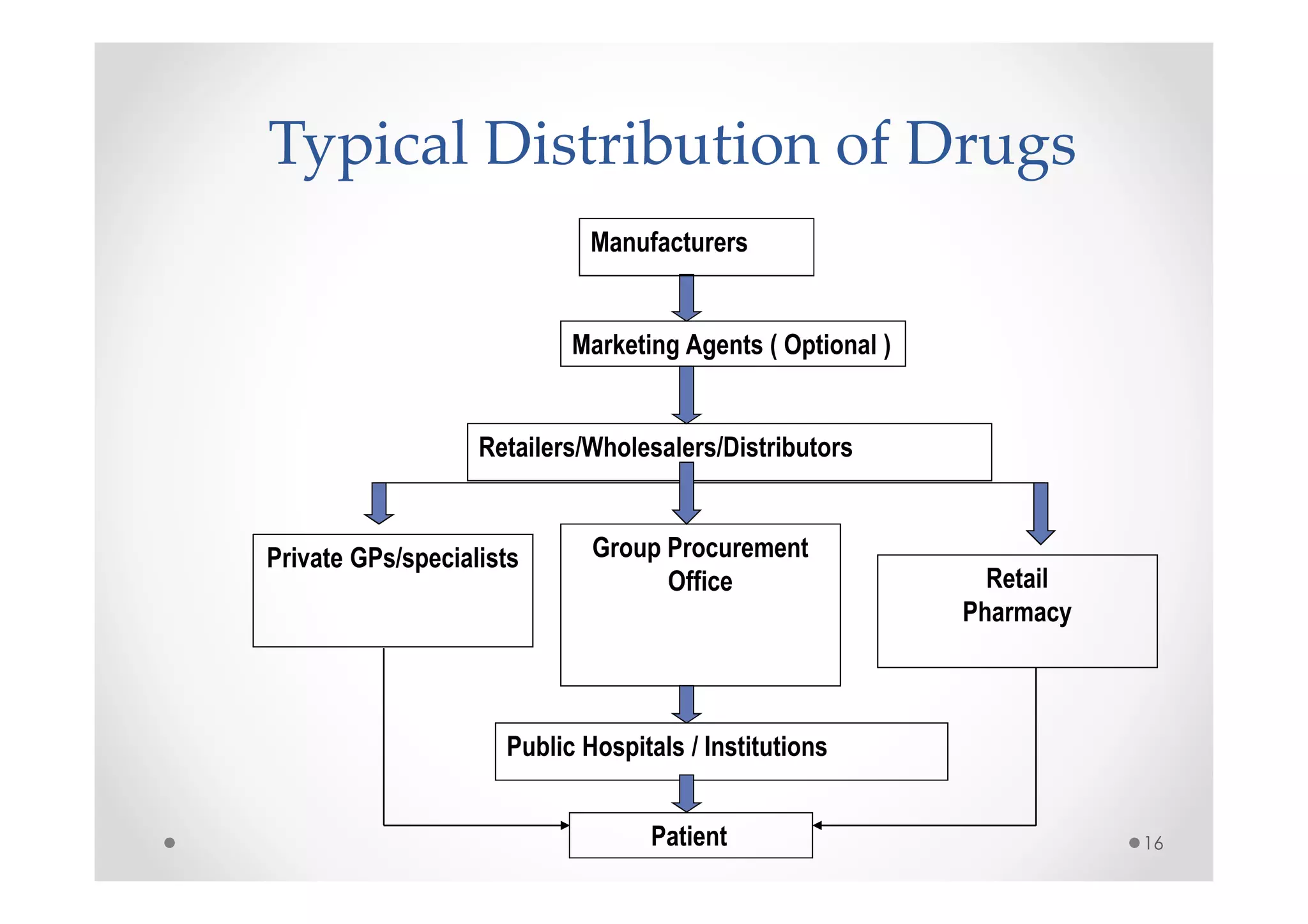
Typical Distribution of Drugs
                             Manufacturers


                           Marketing Agents ( Optional )


                   Retailers/Wholesalers/Distributors


Private GPs/specialists      Group Procurement
                                   Office                    Retail
                                                           Pharmacy


                     Public Hospitals / Institutions


                                  Patient                             16
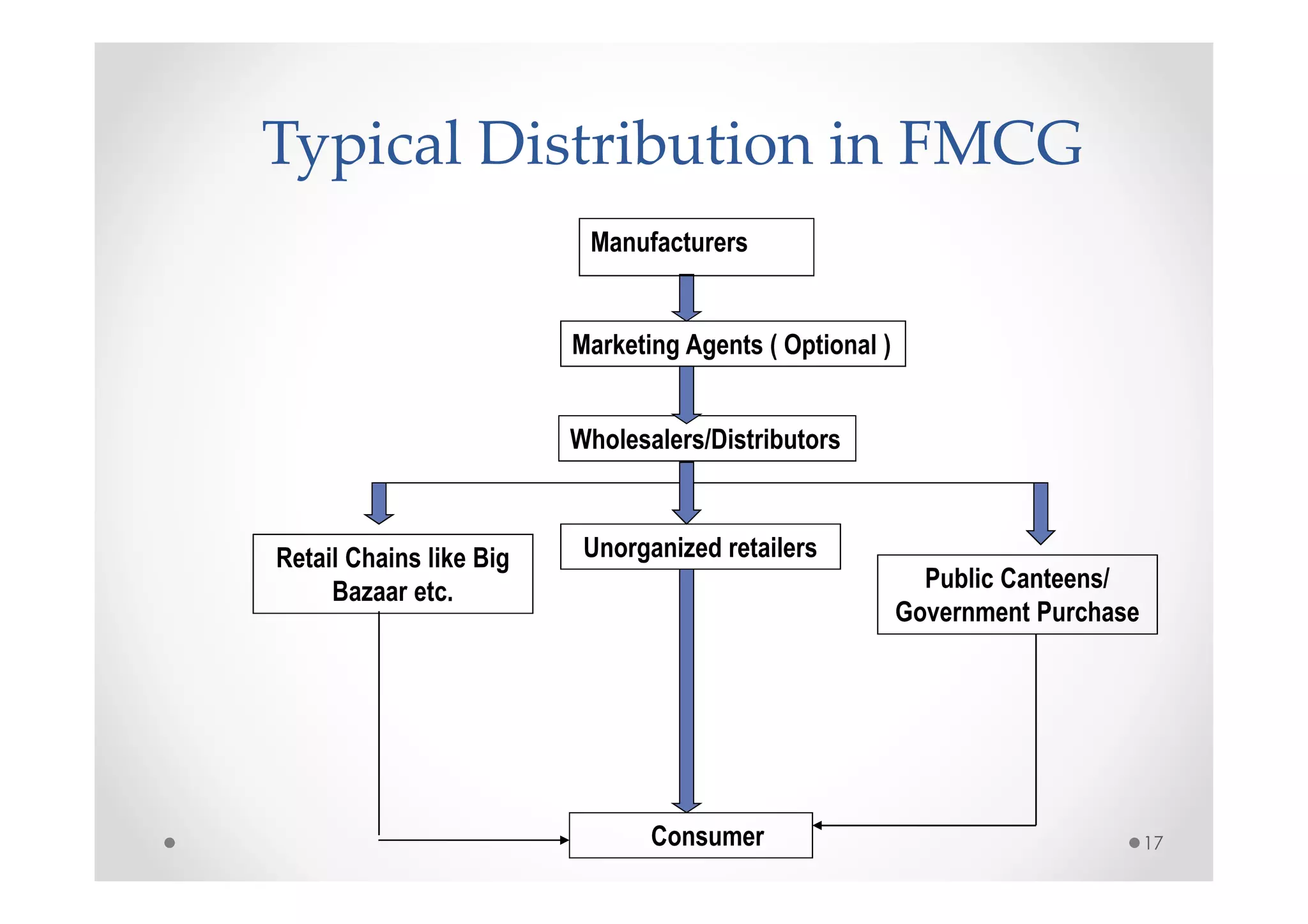
Typical Distribution in FMCG
                          Manufacturers


                         Marketing Agents ( Optional )


                         Wholesalers/Distributors


Retail Chains like Big    Unorganized retailers
     Bazaar etc.                                           Public Canteens/
                                                         Government Purchase


                                Consumer                                       17
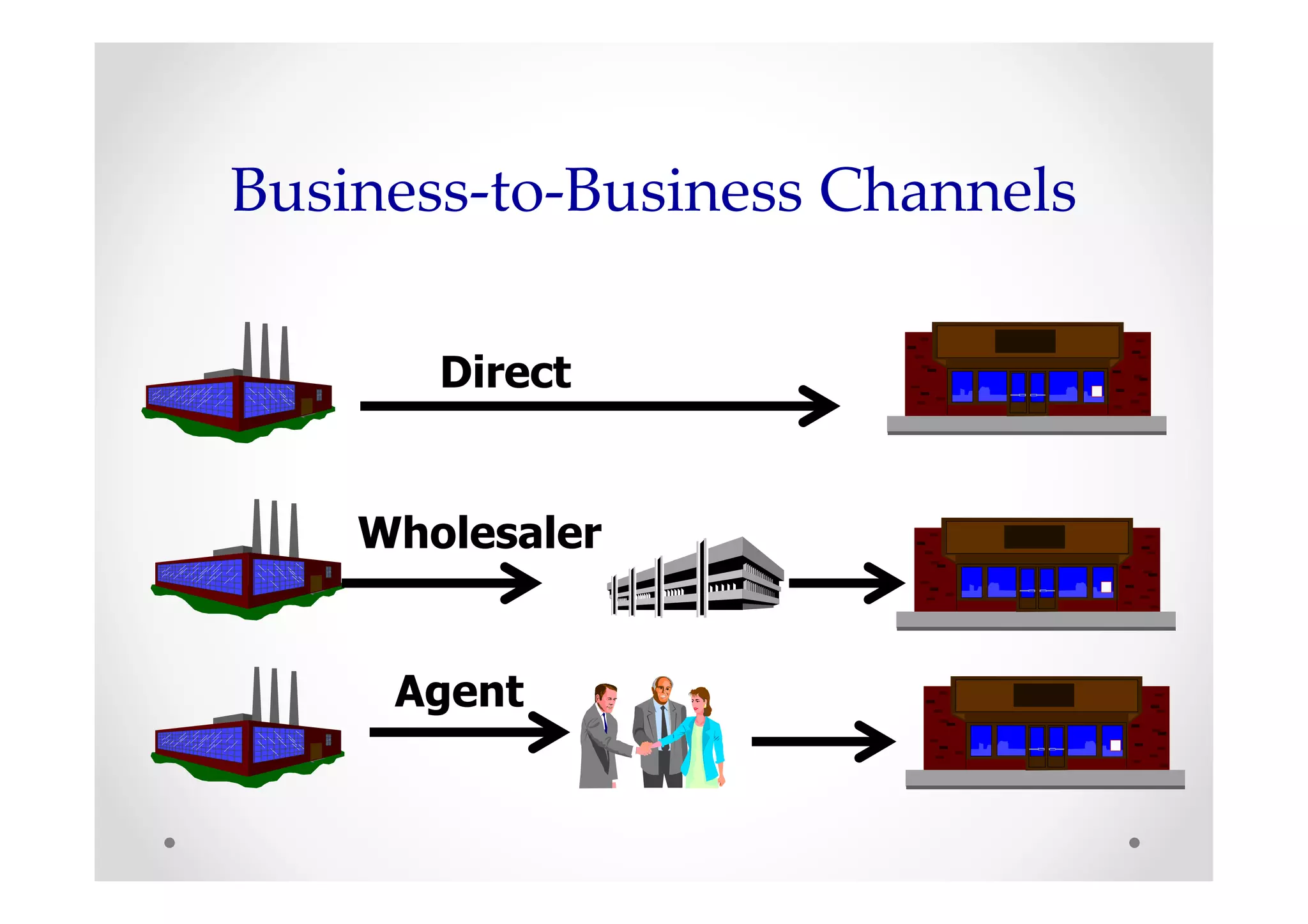
Business-to-Business Channels

       Direct


    Wholesaler


     Agent
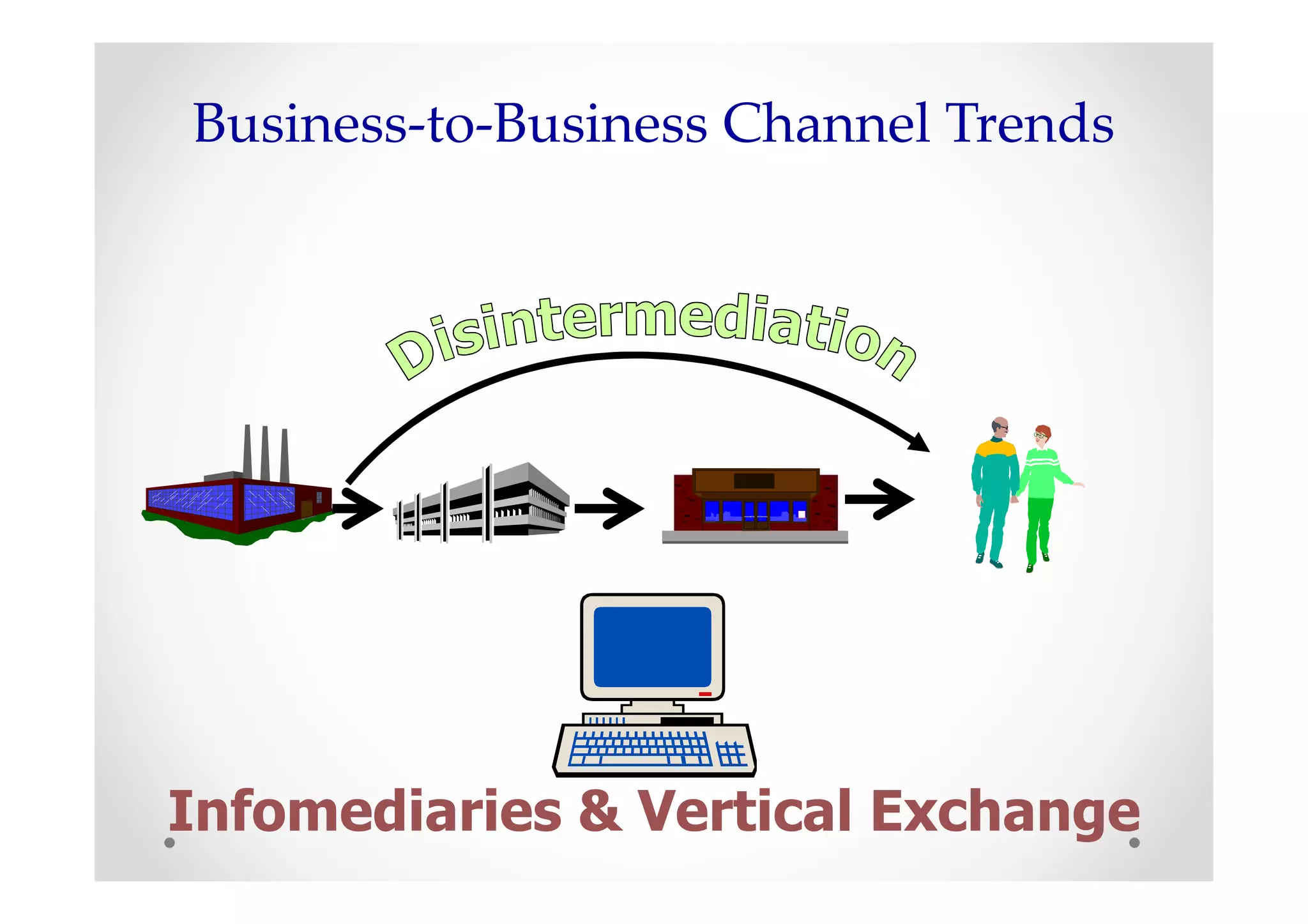
Business-to-Business Channel Trends


Infomediaries & Vertical Exchange
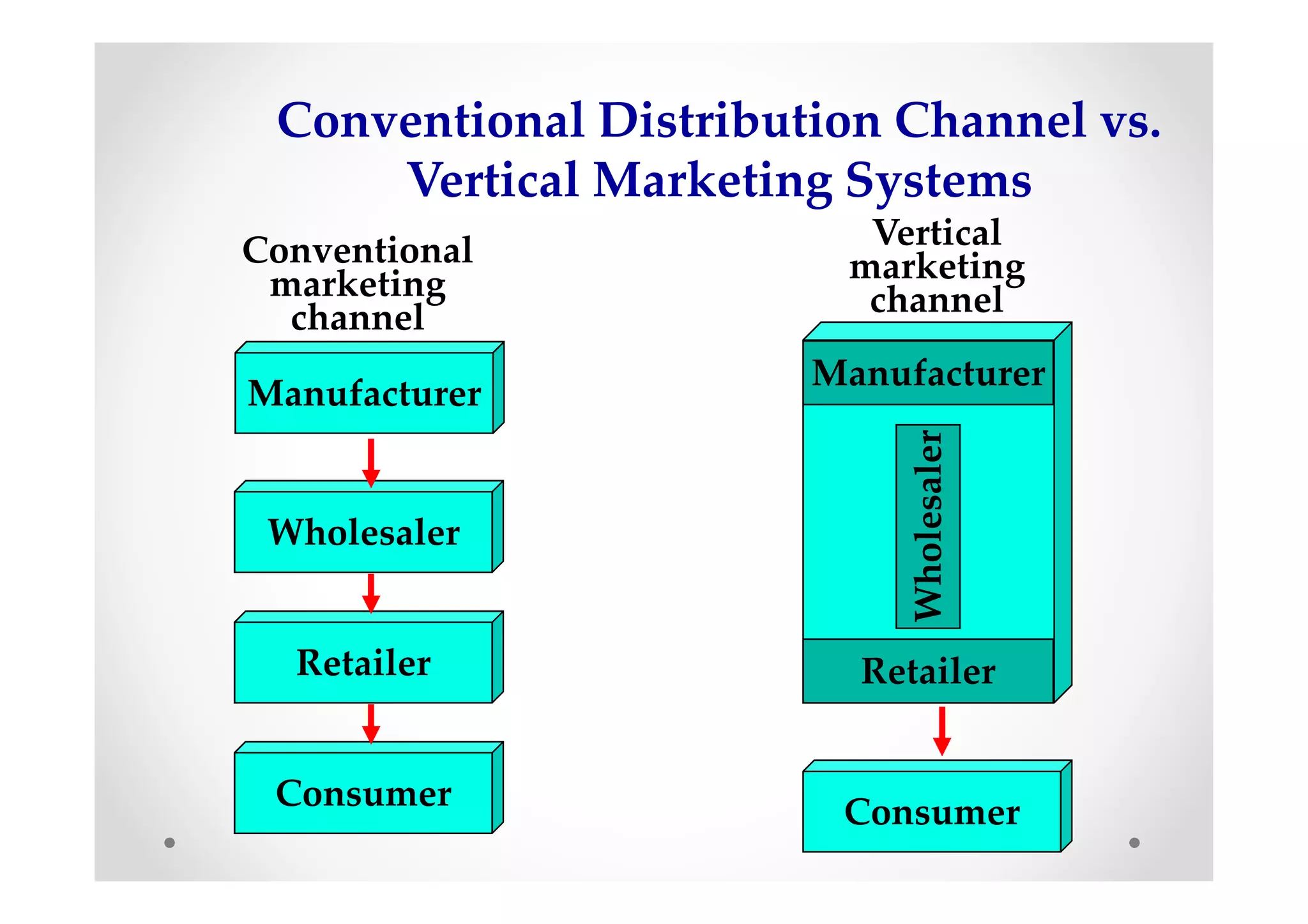
Conventional Distribution Channel vs.
     Vertical Marketing Systems
Conventional             Vertical
 marketing              marketing
  channel                channel
                       Manufacturer
Manufacturer


                            Wholesaler
 Wholesaler


  Retailer               Retailer


 Consumer
                        Consumer
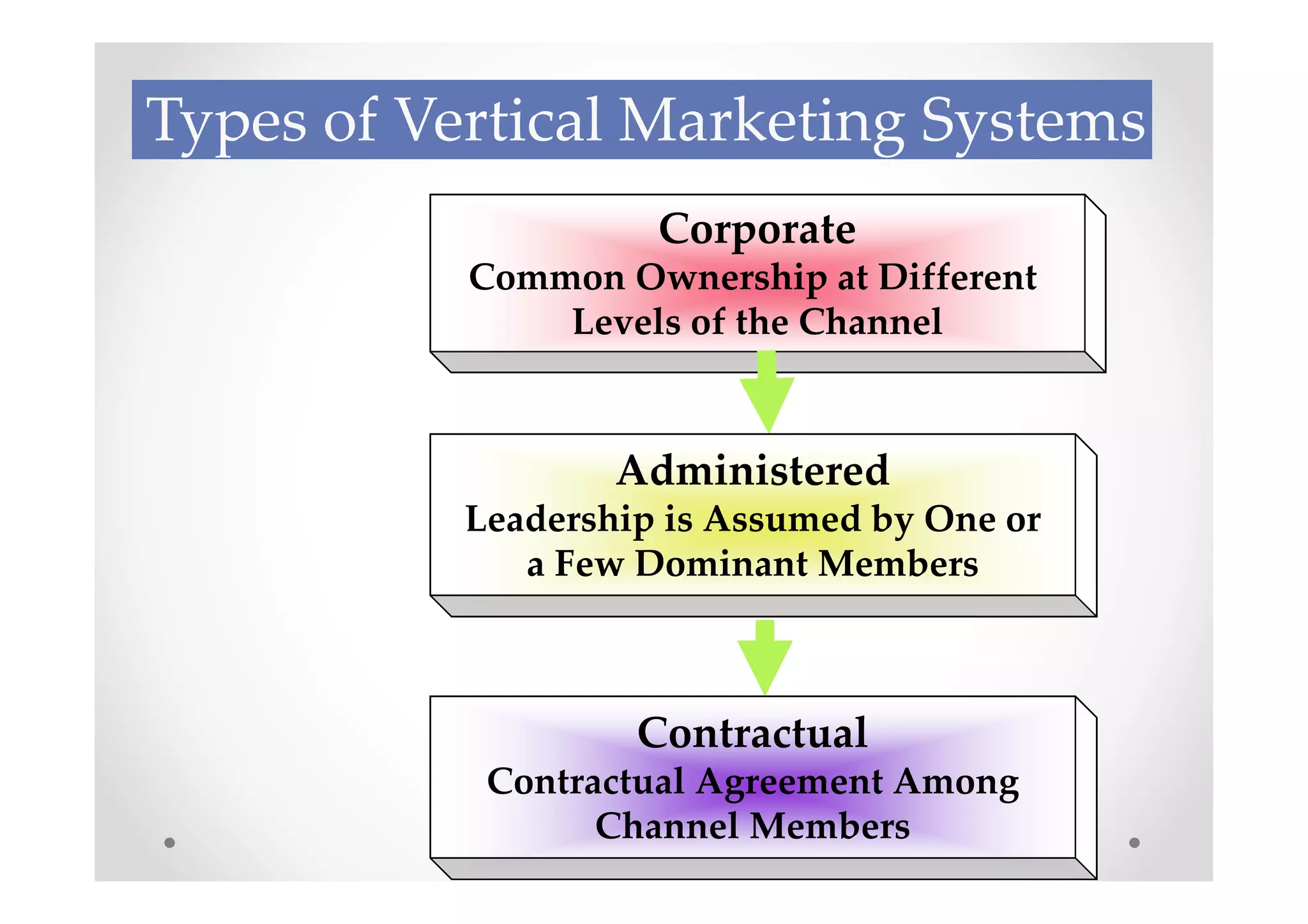
Types of Vertical Marketing Systems
                     Corporate
           Common Ownership at Different
               Levels of the Channel


                   Administered
           Leadership is Assumed by One or
              a Few Dominant Members


                    Contractual
            Contractual Agreement Among
                  Channel Members
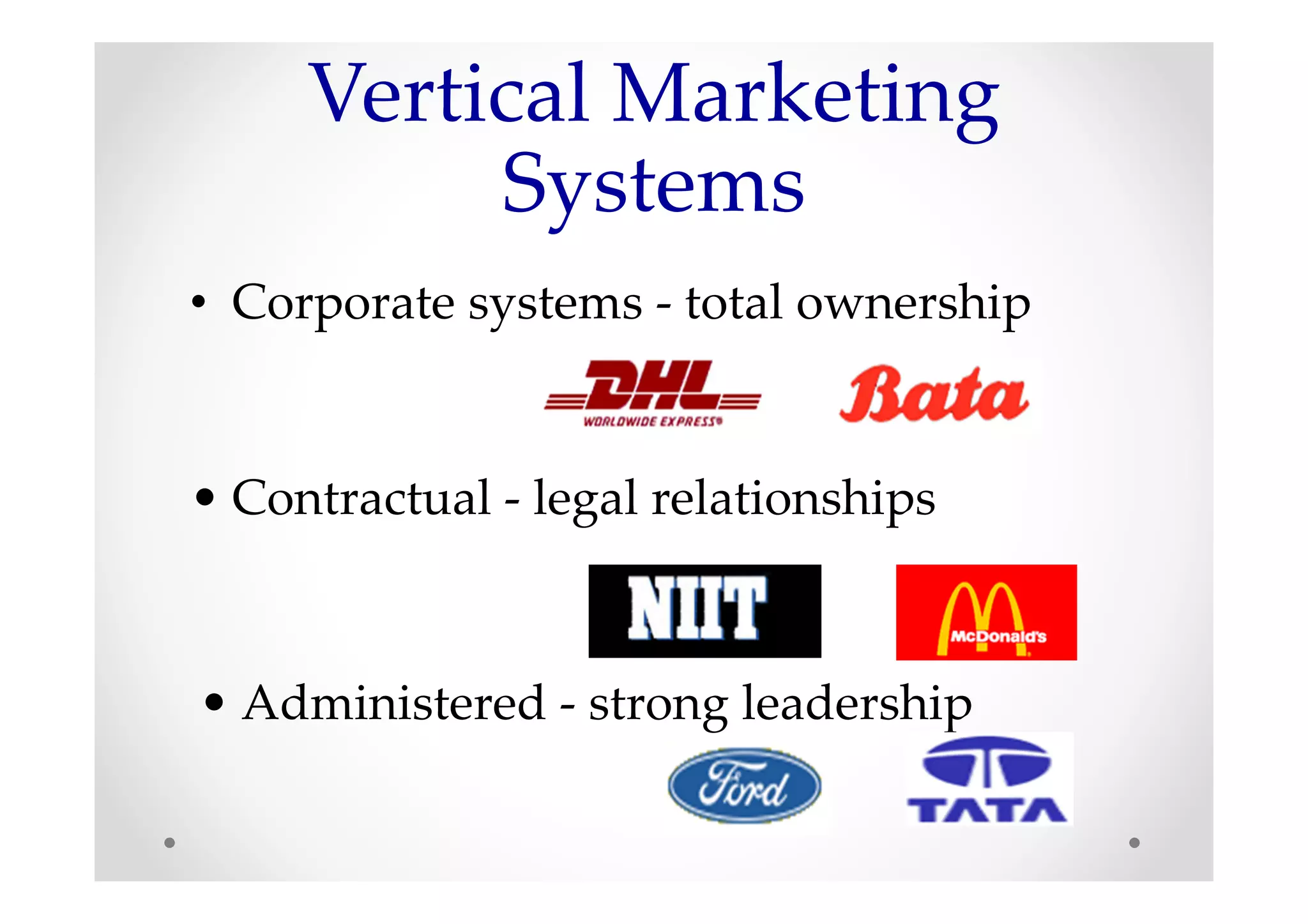
Vertical Marketing
          Systems
• Corporate systems - total ownership


• Contractual - legal relationships


• Administered - strong leadership
Horizontal Marketing
           System
• Joining of two or more corporations on the same
  level for the purposes of pursuing a new marketing
  opportunity.
• Established to make use of combined resources
• Produce synergistic effect for all the parties involves
• Example: Nestle & Coke in Europe, FIAT in India
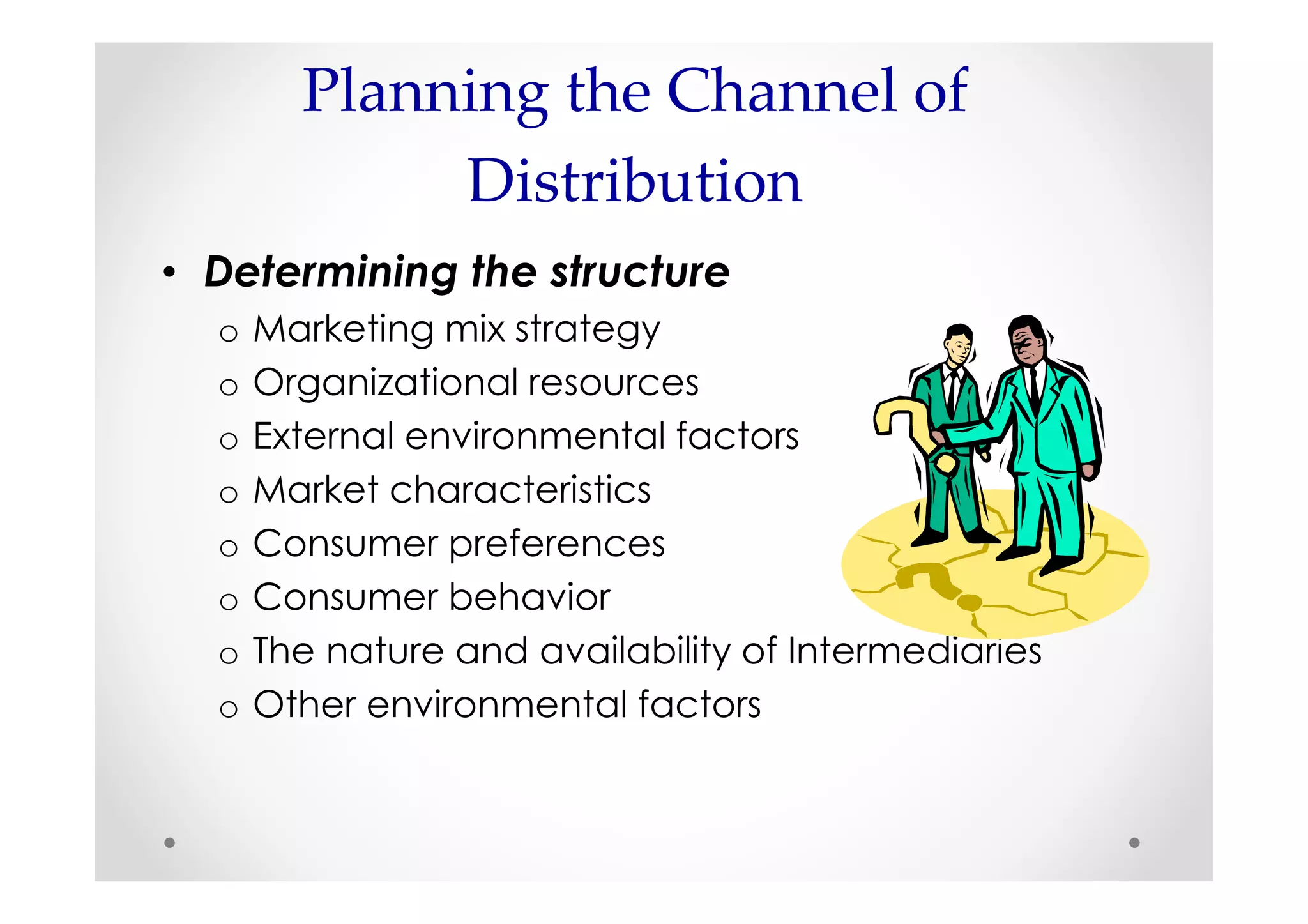
Planning the Channel of
             Distribution
• Determining the structure
  o   Marketing mix strategy
  o   Organizational resources
  o   External environmental factors
  o   Market characteristics
  o   Consumer preferences
  o   Consumer behavior
  o   The nature and availability of Intermediaries
  o   Other environmental factors
Customers’ Desired Service Levels

  •   Lot size
  •   Waiting time
  •   Spatial convenience
  •   Product variety
  •   Service backup
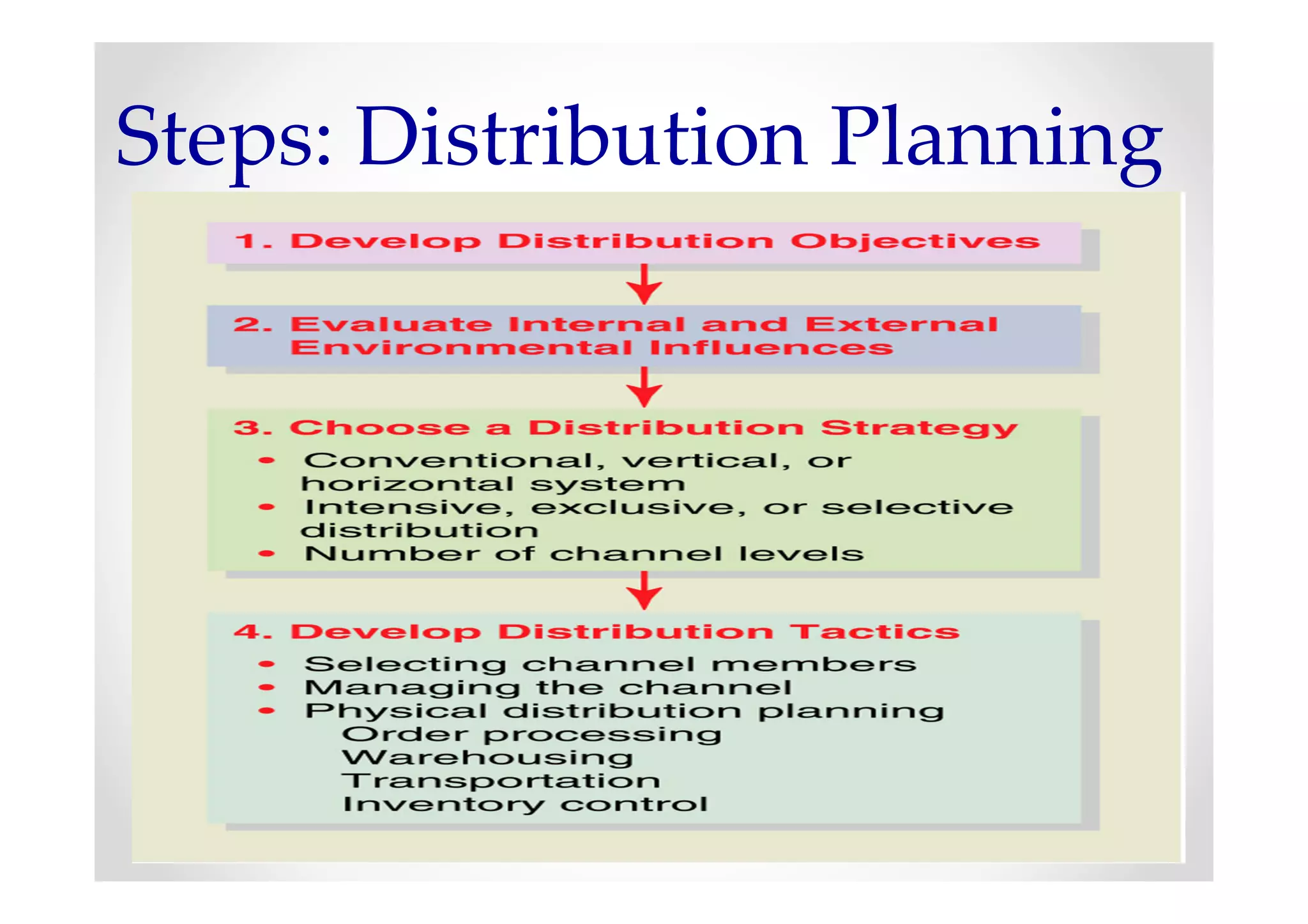
Steps: Distribution Planning
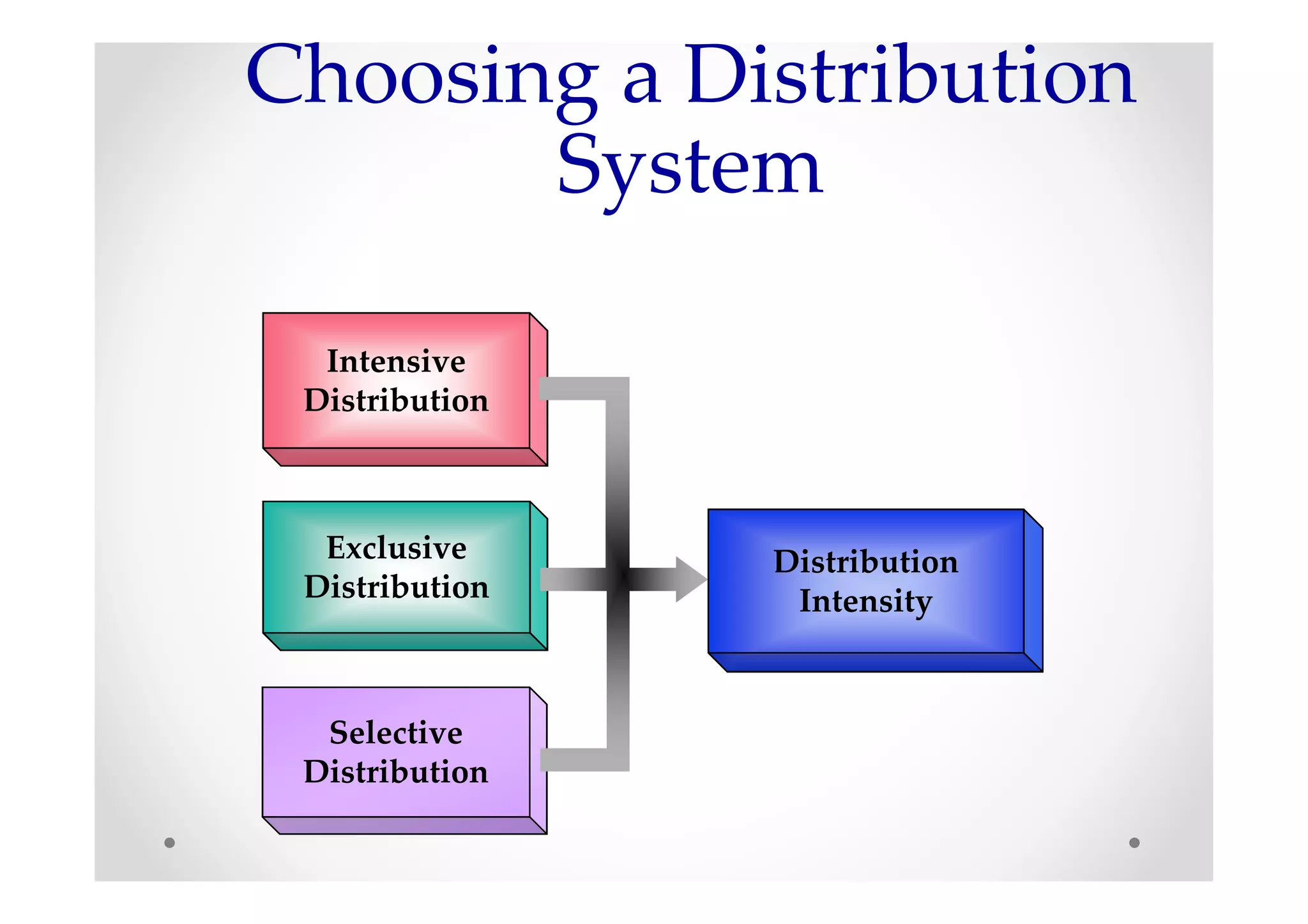
Choosing a Distribution
       System

  Intensive
 Distribution


  Exclusive     Distribution
 Distribution    Intensity


  Selective
 Distribution
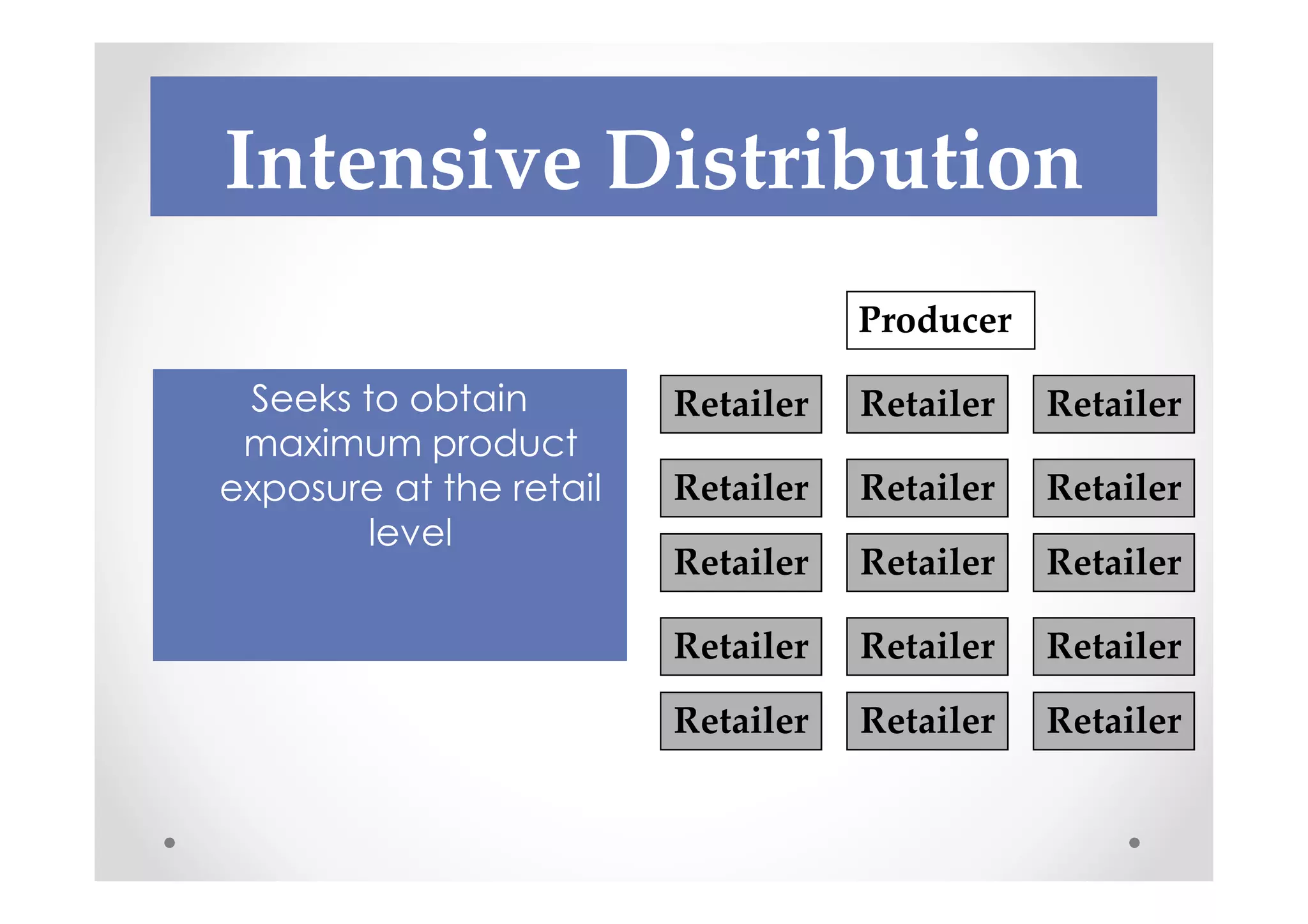
Intensive Distribution
                                    Producer

 Seeks to obtain         Retailer   Retailer   Retailer
 maximum product
exposure at the retail   Retailer   Retailer   Retailer
       level
                         Retailer   Retailer   Retailer

                         Retailer   Retailer   Retailer

                         Retailer   Retailer   Retailer
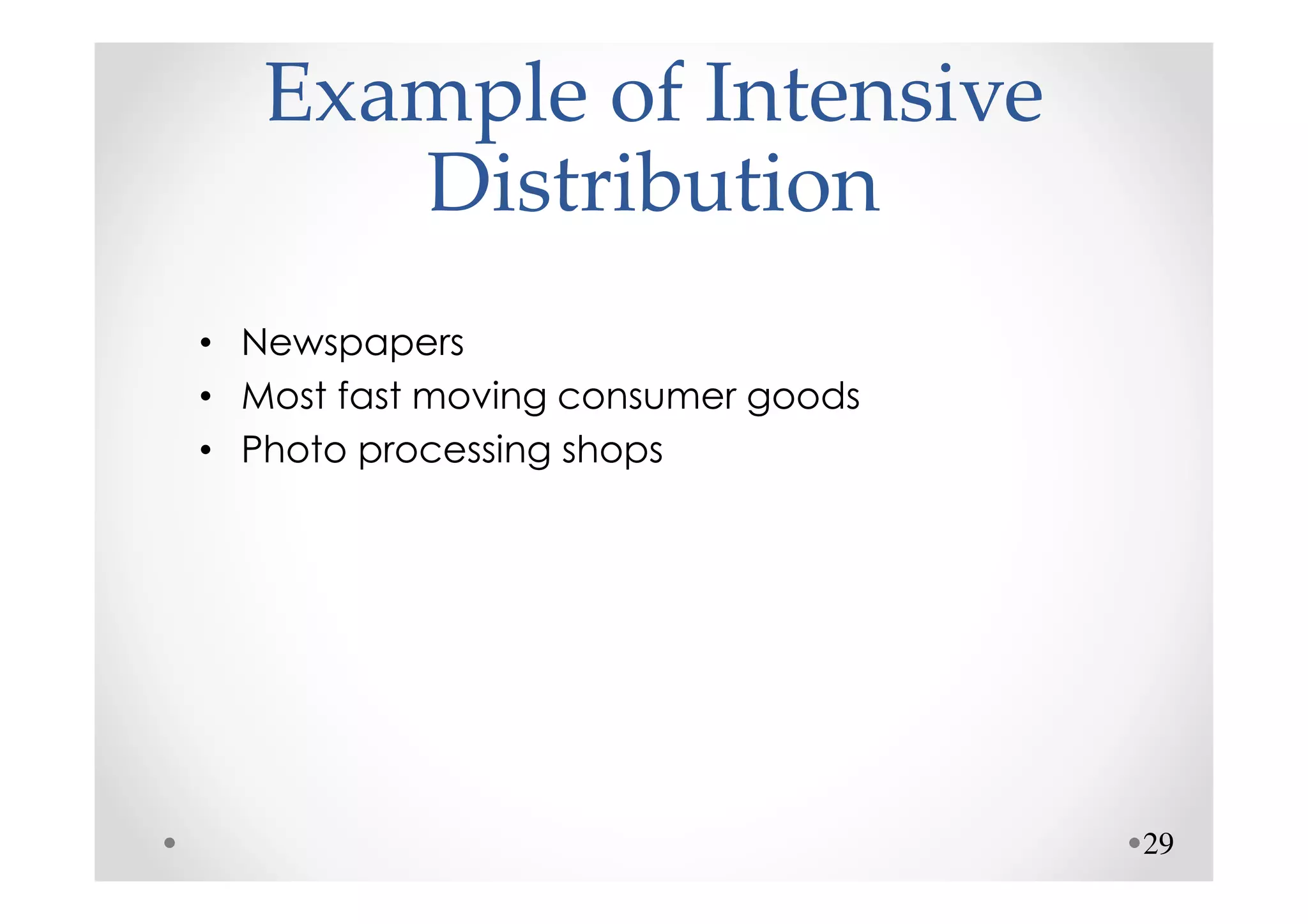
Example of Intensive
      Distribution
• Newspapers
• Most fast moving consumer goods
• Photo processing shops


                                    29
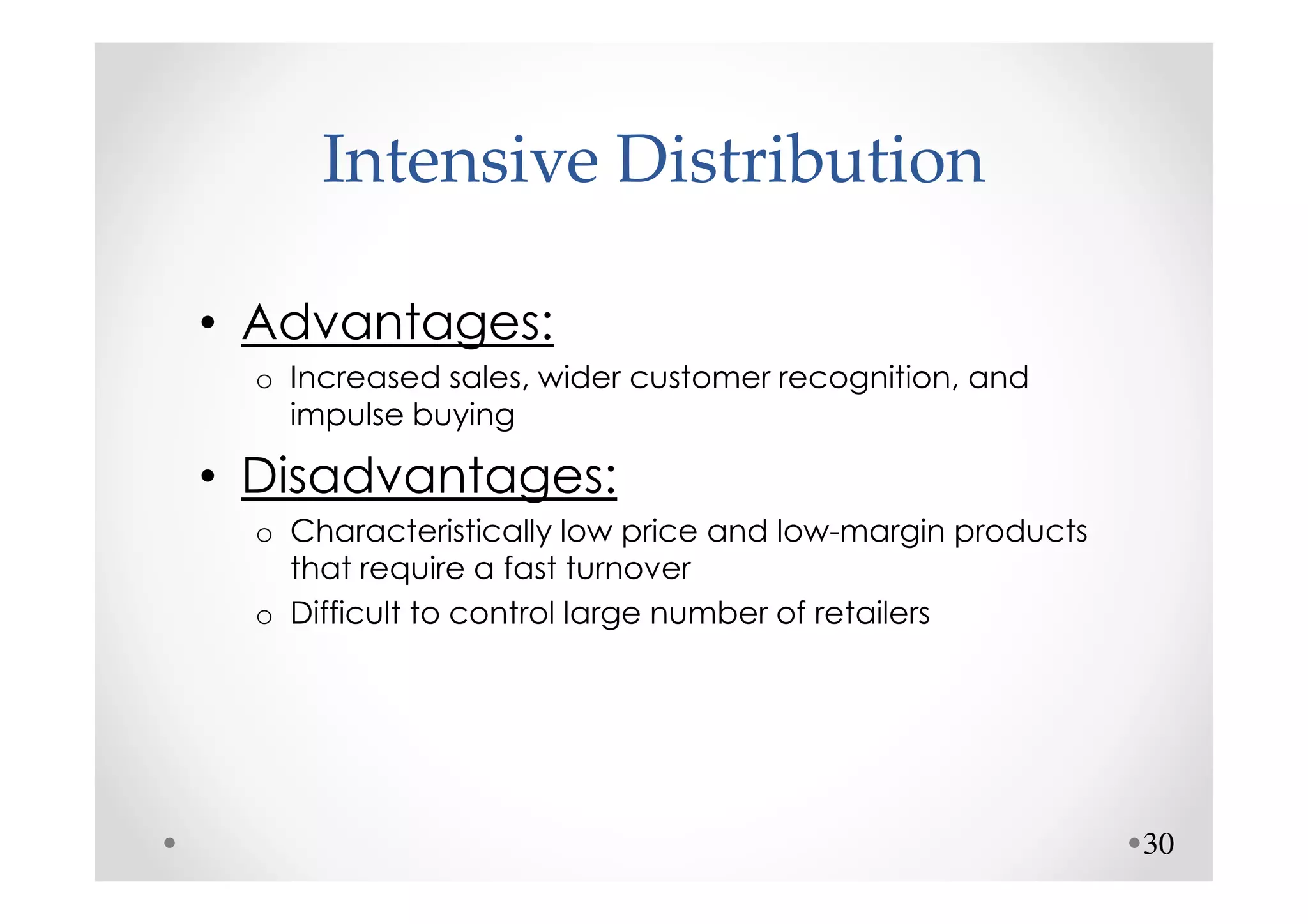
Intensive Distribution

• Advantages:
  o Increased sales, wider customer recognition, and
    impulse buying

• Disadvantages:
  o Characteristically low price and low-margin products
    that require a fast turnover
  o Difficult to control large number of retailers


                                                           30
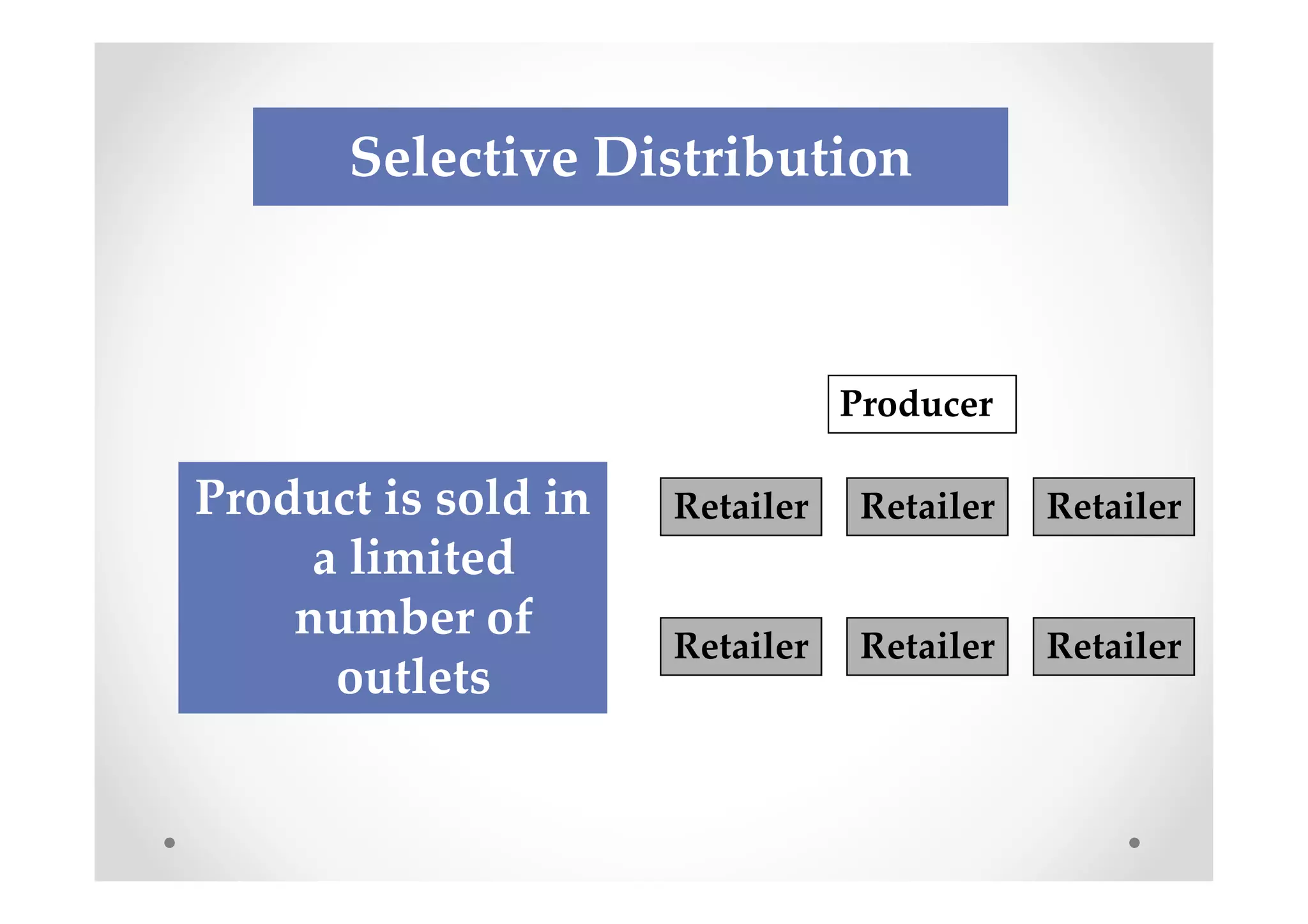
Selective Distribution


                                Producer

Product is sold in   Retailer    Retailer   Retailer
     a limited
    number of
                     Retailer    Retailer   Retailer
      outlets
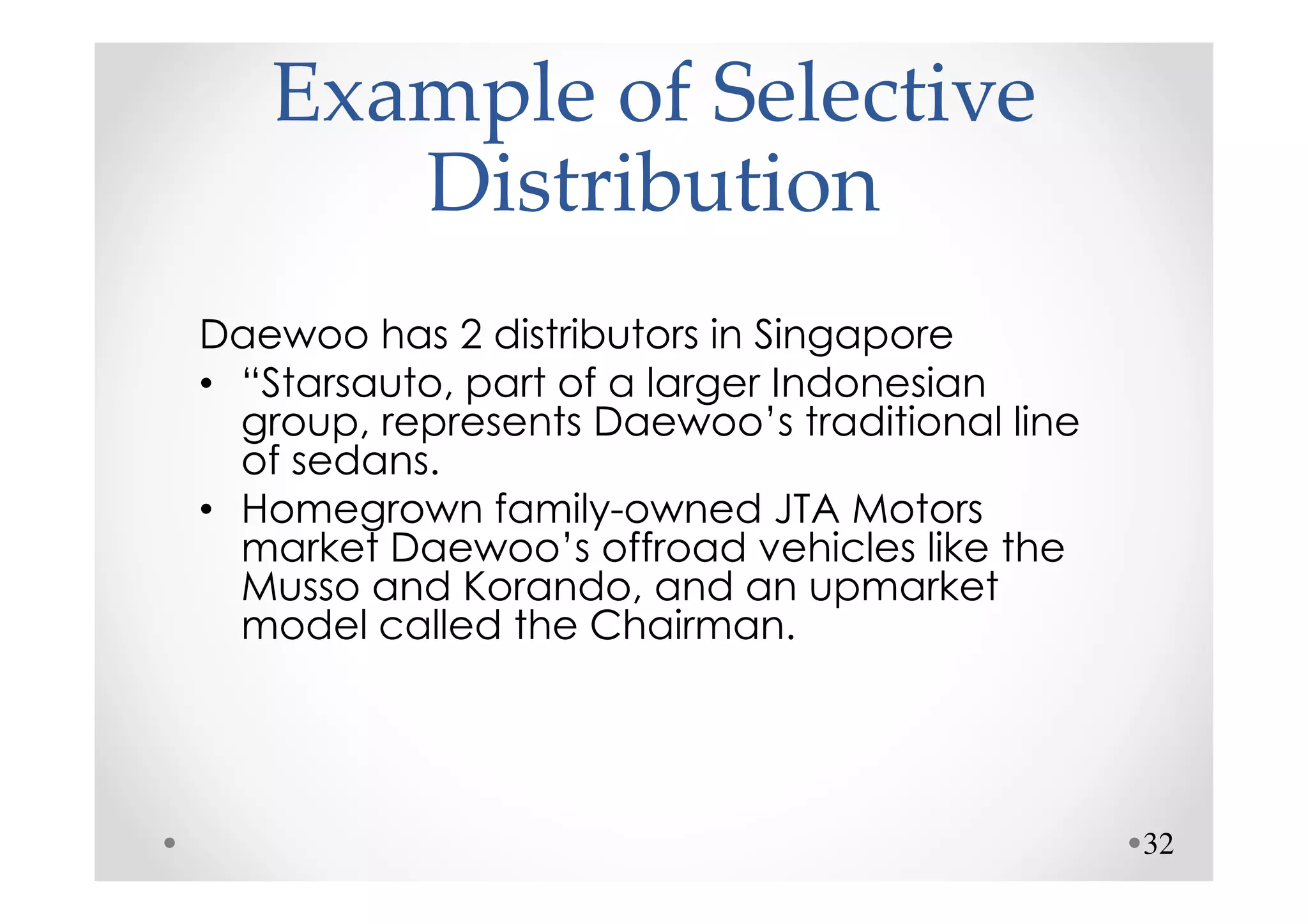
Example of Selective
      Distribution
Daewoo has 2 distributors in Singapore
• “Starsauto, part of a larger Indonesian
  group, represents Daewoo’s traditional line
  of sedans.
• Homegrown family-owned JTA Motors
  market Daewoo’s offroad vehicles like the
  Musso and Korando, and an upmarket
  model called the Chairman.


                                                32
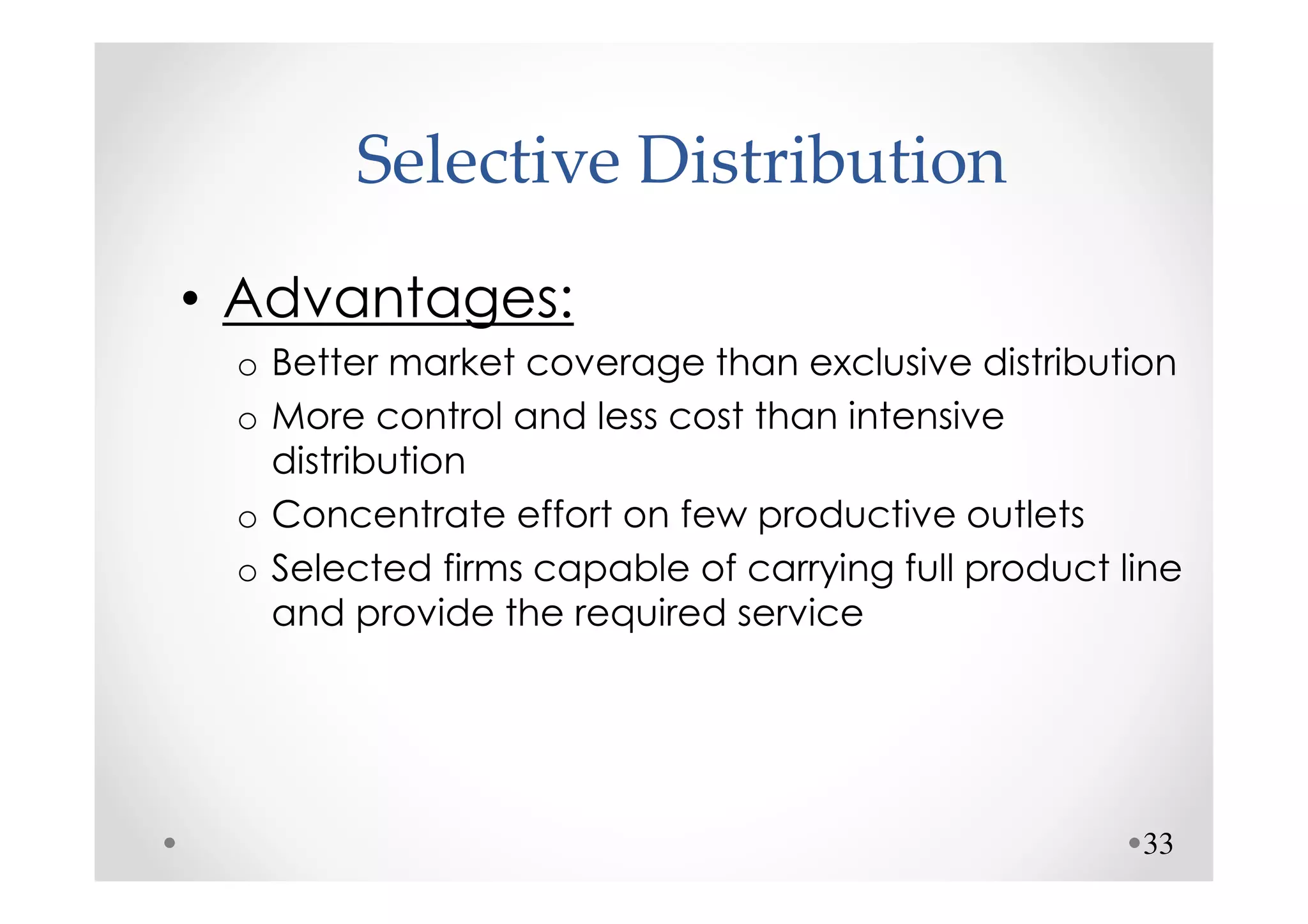
Selective Distribution
• Advantages:
 o Better market coverage than exclusive distribution
 o More control and less cost than intensive
   distribution
 o Concentrate effort on few productive outlets
 o Selected firms capable of carrying full product line
   and provide the required service


                                                    33
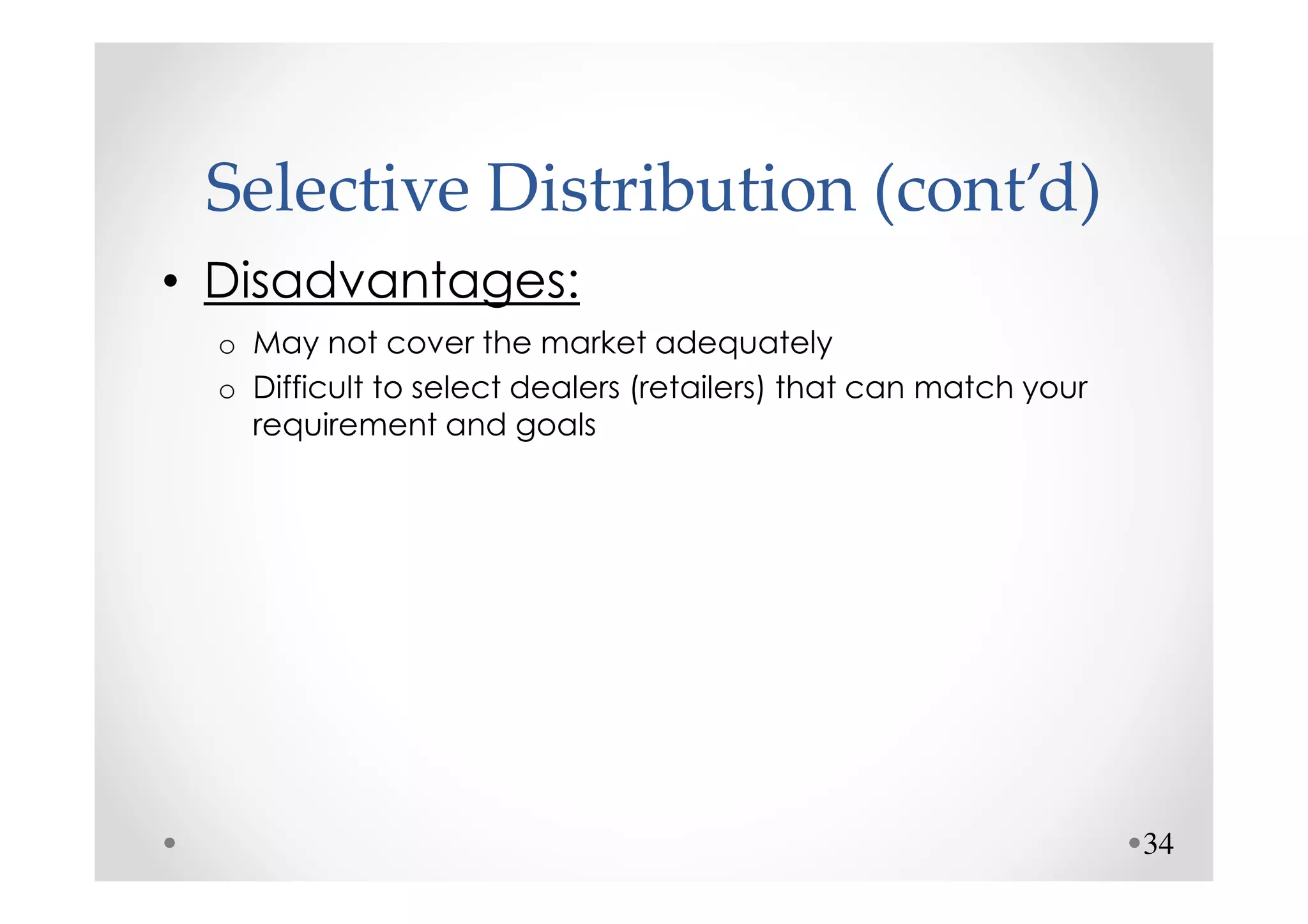
Selective Distribution (cont’d)
• Disadvantages:
  o May not cover the market adequately
  o Difficult to select dealers (retailers) that can match your
    requirement and goals


                                                                  34
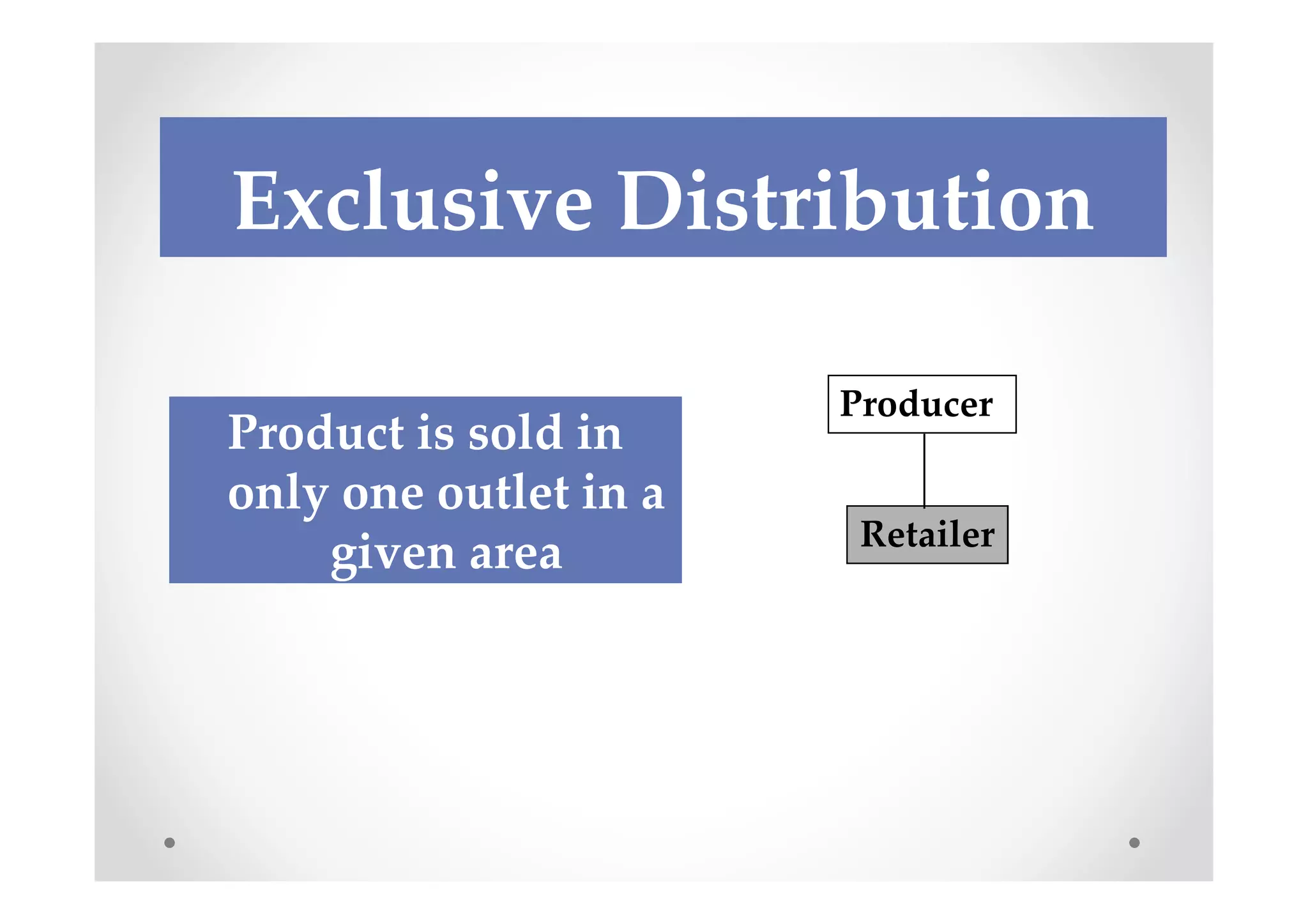
Exclusive Distribution

                       Producer
Product is sold in
only one outlet in a
                        Retailer
    given area
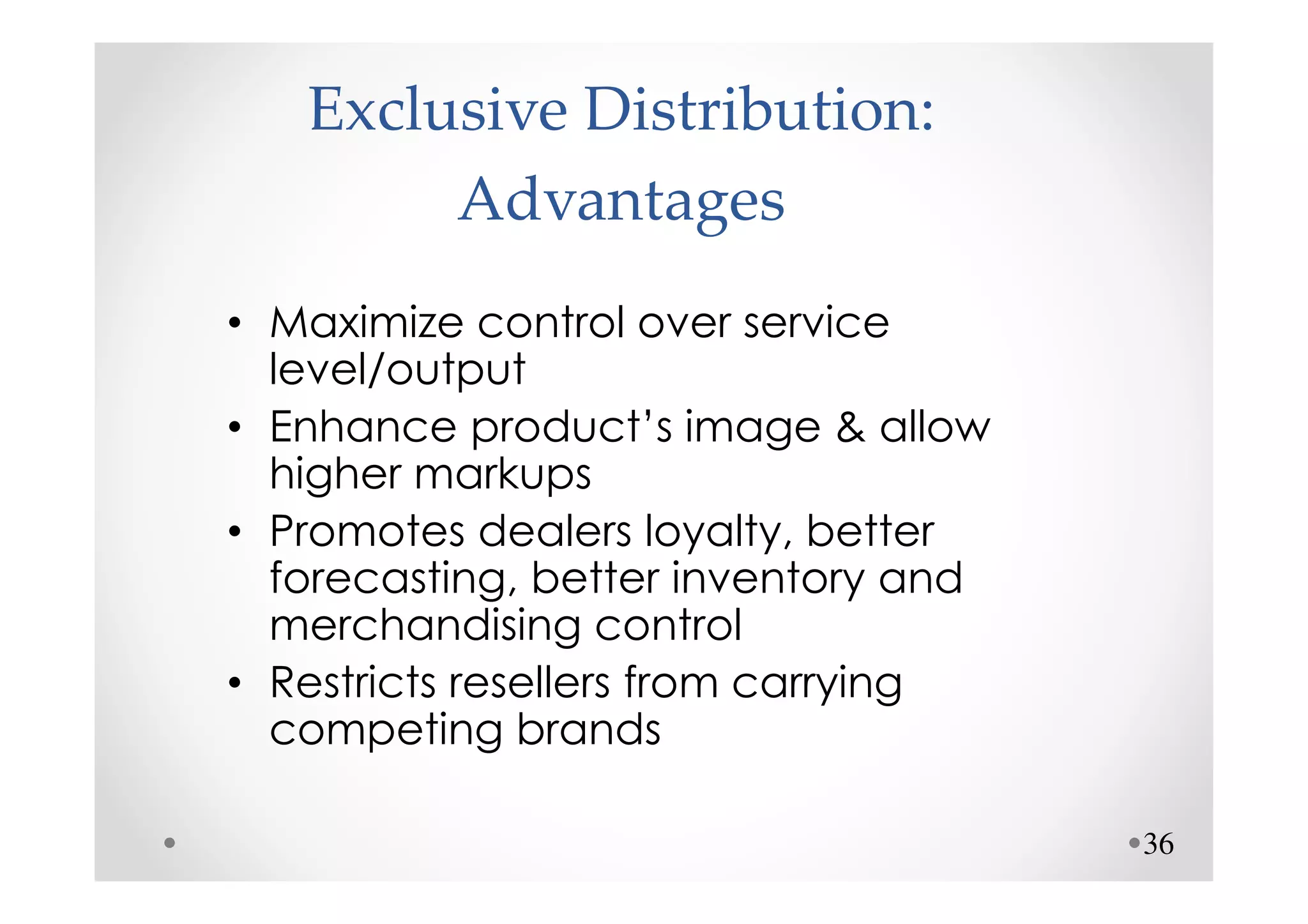
Exclusive Distribution:
        Advantages
• Maximize control over service
  level/output
• Enhance product’s image & allow
  higher markups
• Promotes dealers loyalty, better
  forecasting, better inventory and
  merchandising control
• Restricts resellers from carrying
  competing brands

                                      36
Exclusive Distribution:
    Disadvantages
• Betting on one dealer in each market
• Only suitable for high price, high margin,
  and low volume products


                                               37
Multiple-Channel Strategy
 Using two or more different channels to
   distribute goods and services
 • Why ?
   o Permits optimal access to each market
     segment
   o Increase market coverage, lower channel
     cost and provide more customized selling
 • What to look out for ?
   o More channels usually means more conflict
     and control problems
                                                 38
Complementary Channels
Each channel handles a product or segment that is
  different or non-competing e.g.
• Toyota Lexus
• Magazine distributions


                                                    39
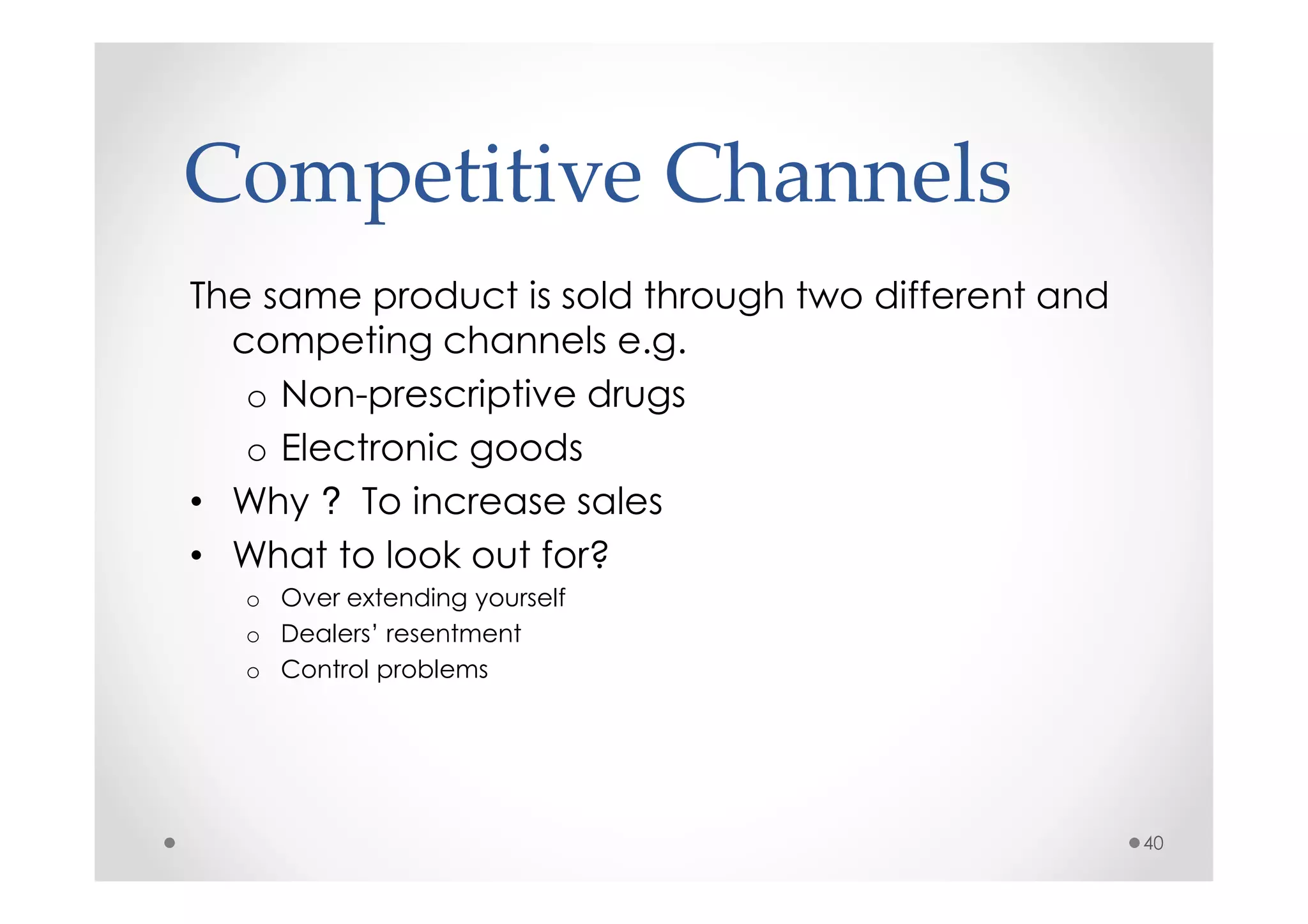
Competitive Channels
The same product is sold through two different and
  competing channels e.g.
   o Non-prescriptive drugs
   o Electronic goods
• Why ? To increase sales
• What to look out for?
   o Over extending yourself
   o Dealers’ resentment
   o Control problems


                                                     40
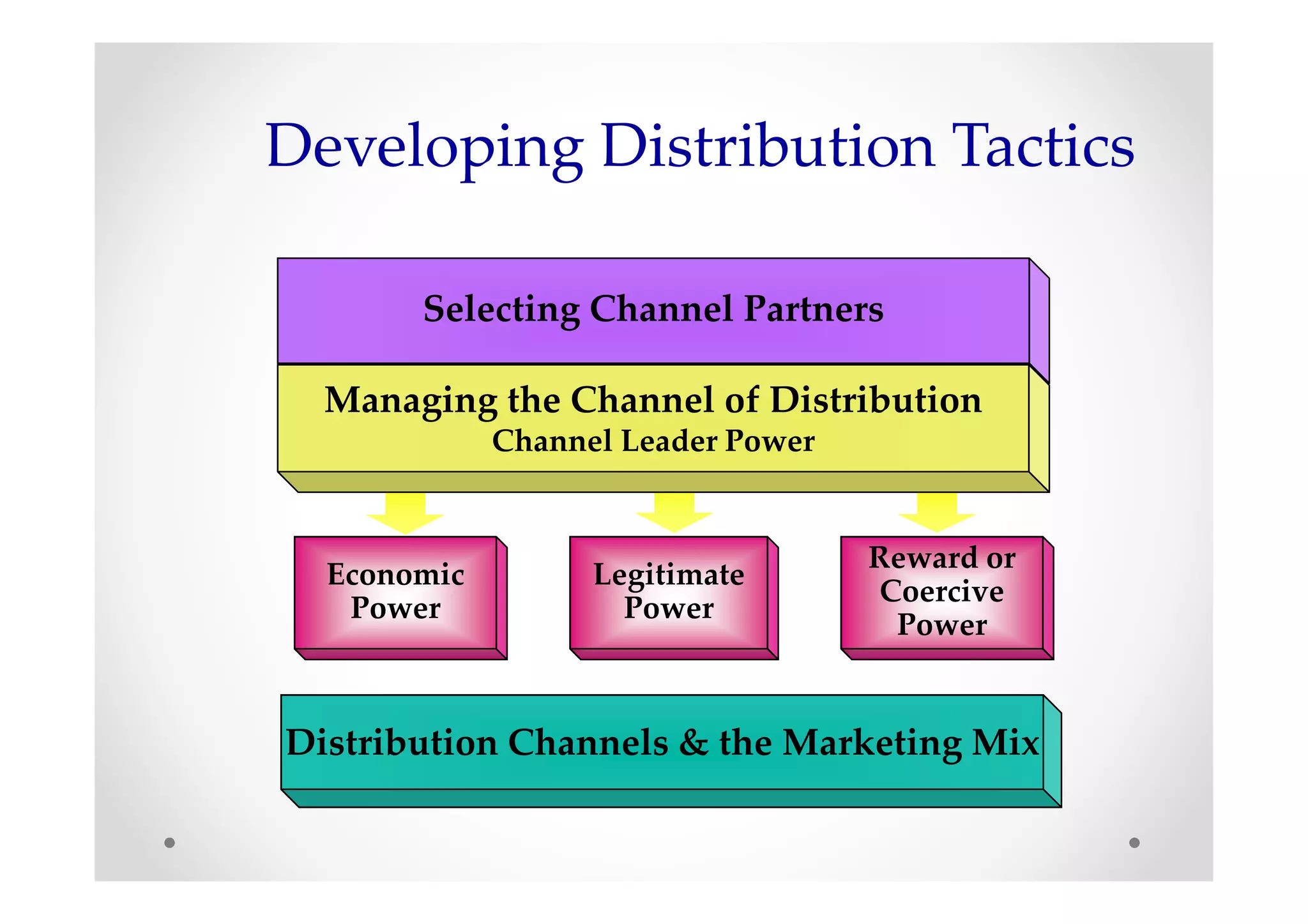
Developing Distribution Tactics

       Selecting Channel Partners

  Managing the Channel of Distribution
             Channel Leader Power


                                    Reward or
  Economic         Legitimate
                                     Coercive
   Power             Power
                                      Power


Distribution Channels & the Marketing Mix
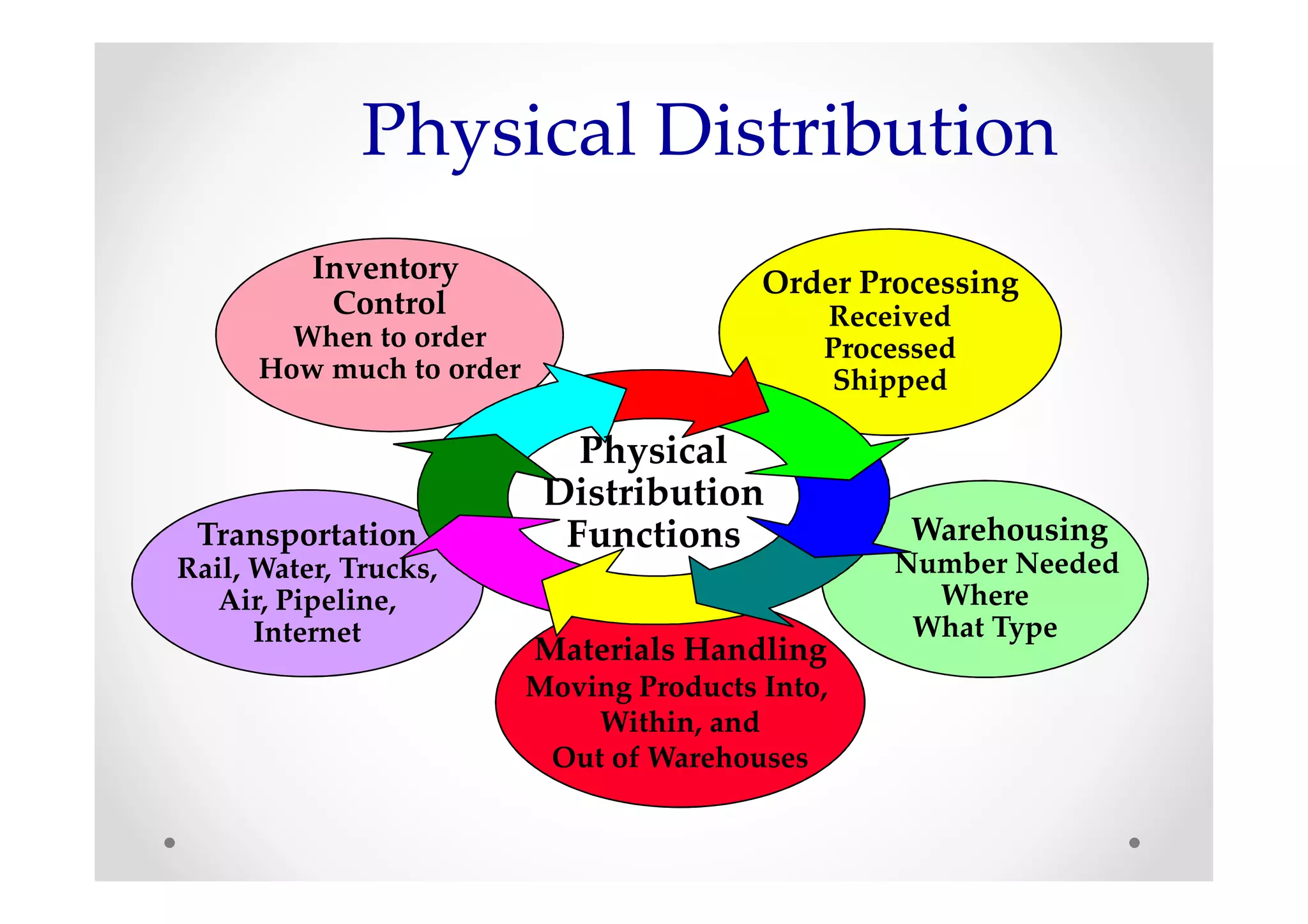
Physical Distribution
          Inventory                       Order Processing
           Control                            Received
        When to order                         Processed
      How much to order                       Shipped

                             Physical
                           Distribution
 Transportation             Functions              Warehousing
Rail, Water, Trucks,                              Number Needed
   Air, Pipeline,                                   Where
      Internet                                     What Type
                          Materials Handling
                          Moving Products Into,
                              Within, and
                           Out of Warehouses
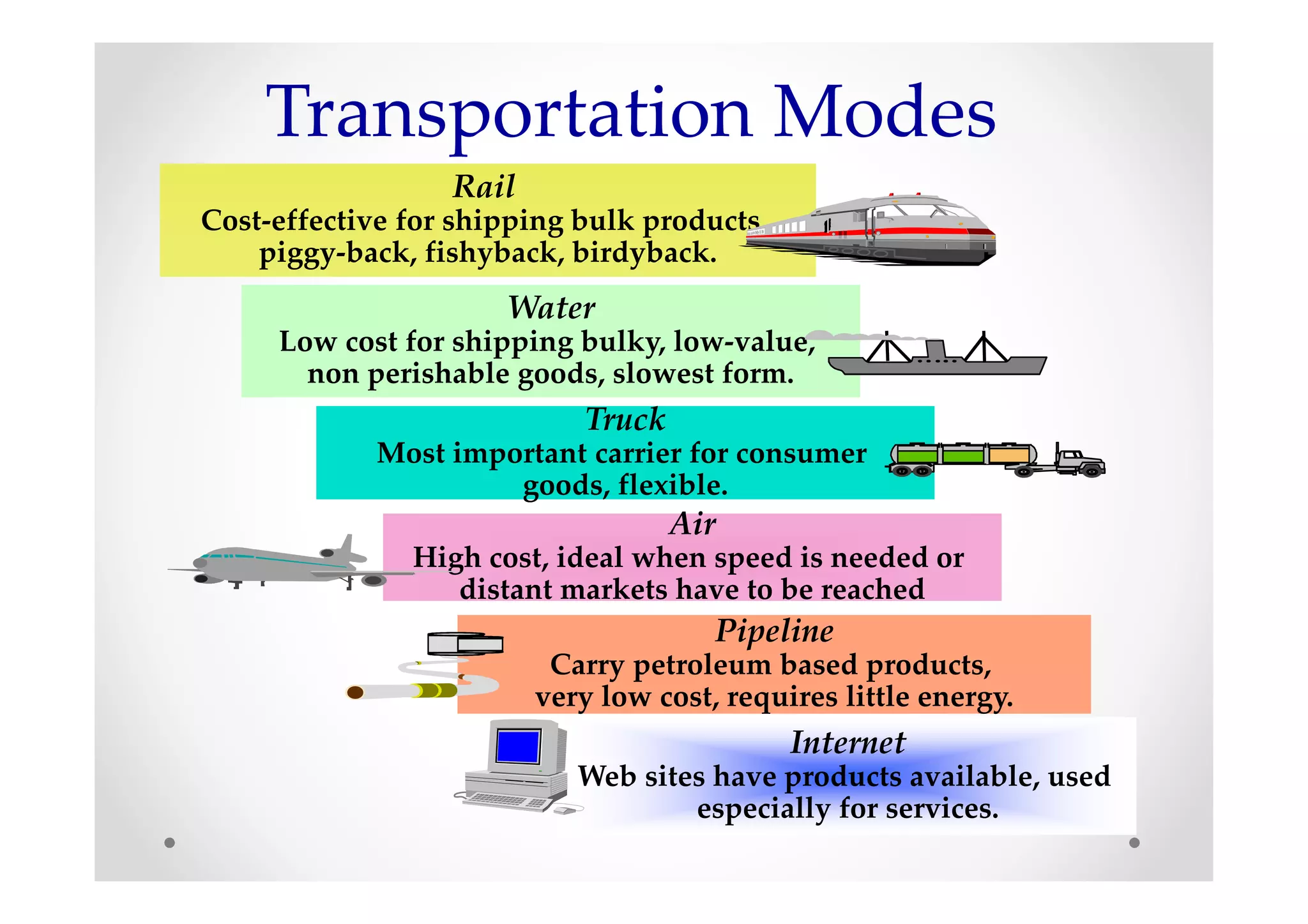
Transportation Modes
                  Rail
Cost-effective for shipping bulk products,
    piggy-back, fishyback, birdyback.
                      Water
     Low cost for shipping bulky, low-value,
       non perishable goods, slowest form.
                            Truck
             Most important carrier for consumer
                      goods, flexible.
                                    Air
               High cost, ideal when speed is needed or
                  distant markets have to be reached
                                       Pipeline
                          Carry petroleum based products,
                         very low cost, requires little energy.
                                             Internet
                            Web sites have products available, used
                                    especially for services.
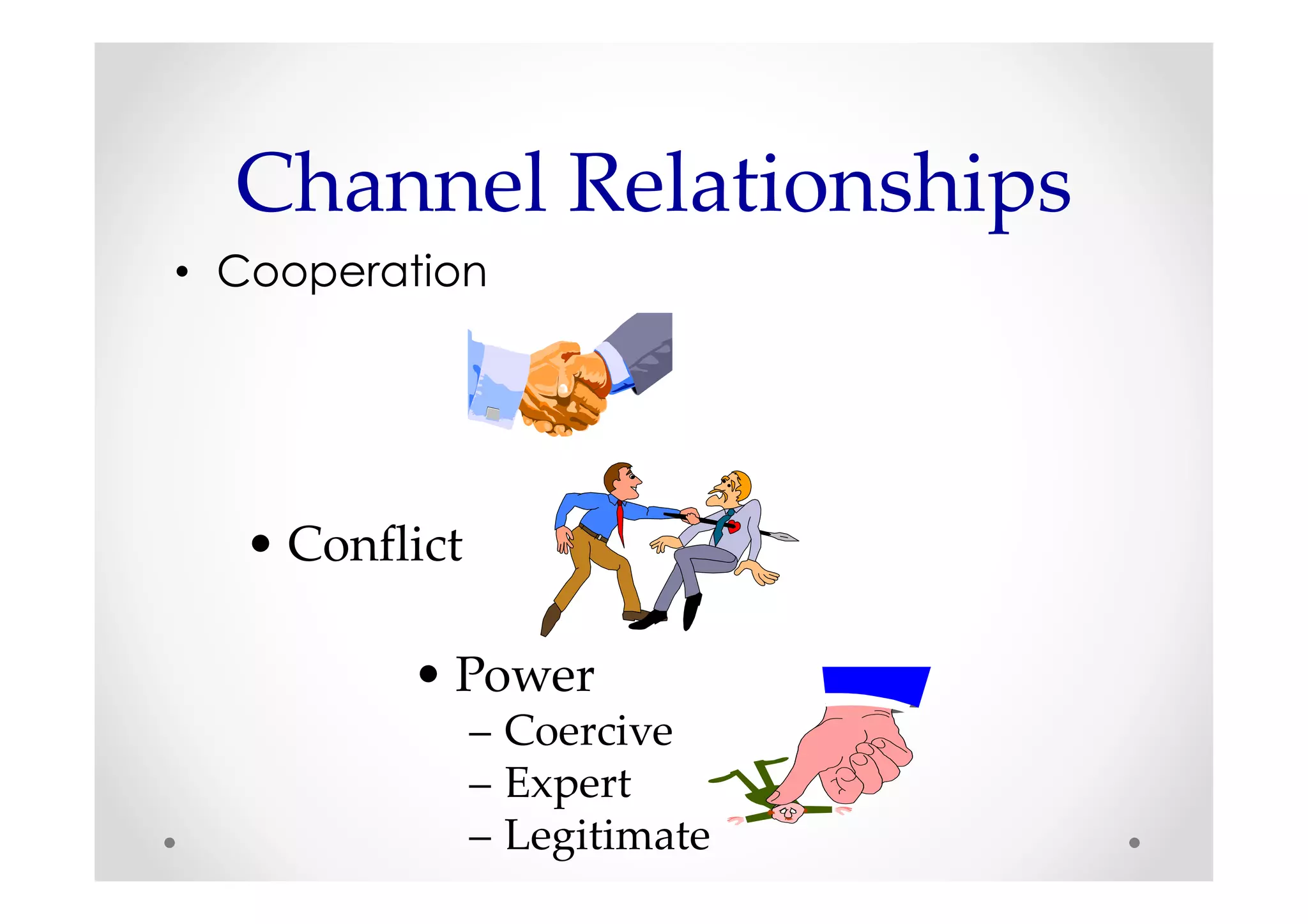
Channel Relationships
• Cooperation


  • Conflict

         • Power
               – Coercive
               – Expert
               – Legitimate
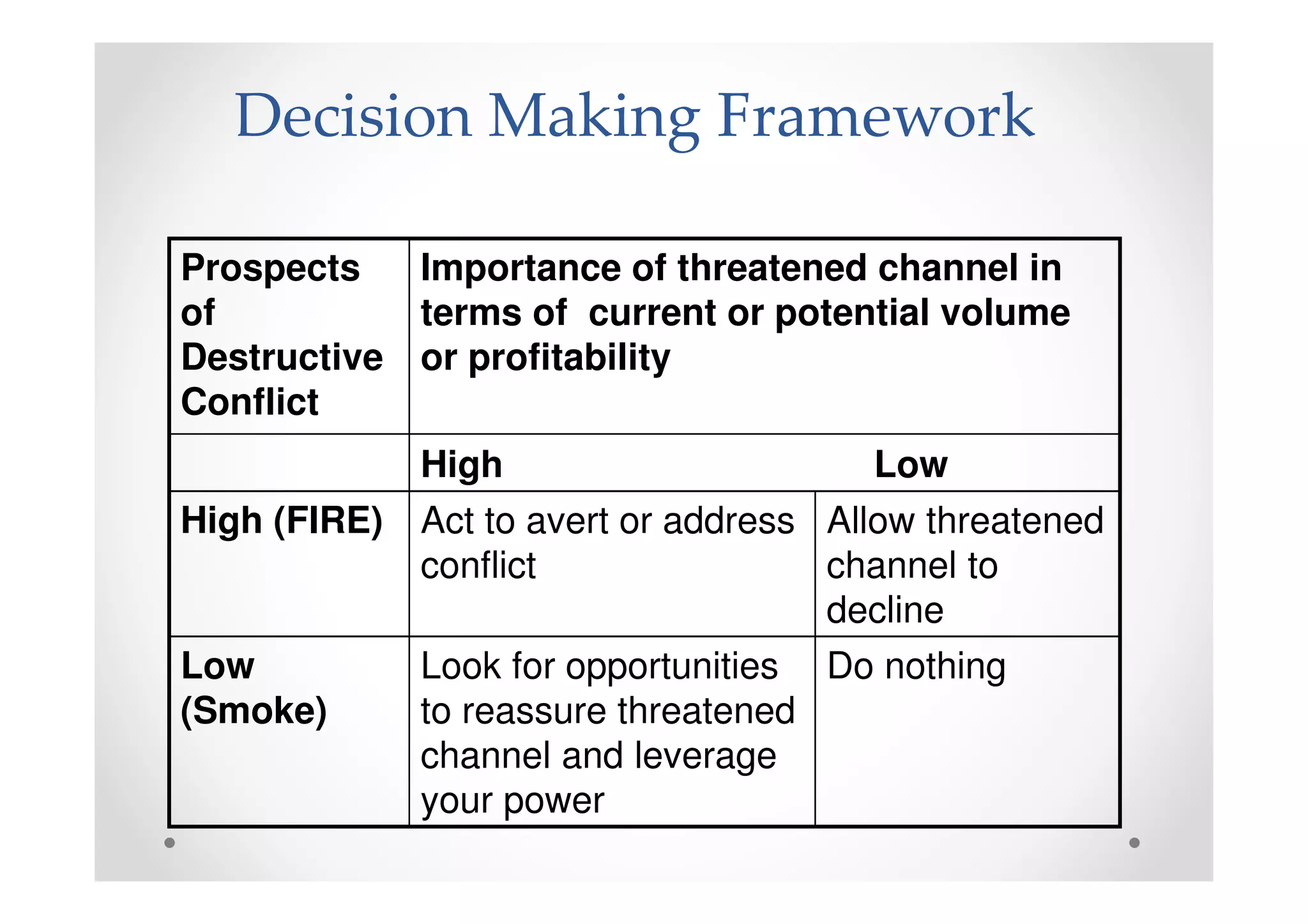
Decision Making Framework

Prospects   Importance of threatened channel in
of          terms of current or potential volume
Destructive or profitability
Conflict
              High                      Low
High (FIRE)   Act to avert or address Allow threatened
              conflict                channel to
                                      decline
Low           Look for opportunities Do nothing
(Smoke)       to reassure threatened
              channel and leverage
              your power
All the Best for Summers
            ☺

   Feel free to contact
       Team C2X
     for any query!!

Sales & Distribution

  • 1.
  • 2.
    • Market ? •What is Marketed ? • Who Markets ?
  • 3.
    Dimensions of Market • Spatial Seperation • Time Seperation • Perceptional Seperation • Seperation of Values • Seperation of ownership
  • 4.
  • 5.
    Sales Techniques • Direct Selling • Pro Forma Sales • Agency Based sales • Request for Proposal • B2B
  • 6.
    The Role ofthe Sales Force Represent the Company to Customers to Produce Company Profit Sales Force Serves as a Critical Link Between a Company and its Customers Since They: Represent Customers to the Company to Produce Customer Satisfaction
  • 7.
    Steps in theSelling Process Step 1. Prospecting and Identifying and Screening For Qualifying Qualified Potential Customers. Learning As Much As Possible Step 2. Pre-approach About a Prospective Customer Before Making a Sales Call. Knowing How to Meet the Buyer Step 3. Approach to Get the Relationship Off to a Good Start. Step 4. Presentation/ Telling the Product “Story” to the Buyer, and Showing the Demonstration Product Benefits.
  • 8.
    Steps in theSelling Process Seeking Out, Clarifying, Step 5. Handling Objections and Overcoming Customer Objections to Buying. Step 6. Closing Asking the Customer for the Order. Step 7. Follow-Up Following Up After the Sale to Ensure Customer Satisfaction and Repeat Business.
  • 9.
  • 10.
    Distribution P C R O O N D S U DISTRIBUTION U C M E E R R
  • 11.
    Distribution’s Function • Themajor purpose of marketing is to satisfy human needs by delivering products of various types to buyers when and where they want them and at a reasonable cost. • The “when and where” is the function of Distribution
  • 12.
    Distribution Objectives • Minimizetotal distribution costs for a given service output • Determine the target segments and the best channels for each segment • Objectives may vary with product characteristics o e.g. perishables, bulky products, non- standard items, products requiring installation & maintenance 12
  • 13.
    What is aDistribution Channel? • A set of interdependent organizations (intermediaries) involved in the process of making a product or service available for use or consumption by the consumer or business user. • Marketing Channel decisions are among the most important decisions that management faces and will directly affect every other marketing decision.
  • 14.
    Distribution Channel Functions Information Transfer Communication Payments Negotiation Physical Distribution Ordering Risk Taking Financing
  • 15.
    Basic Channels of Distribution Manufacturers/products Agents/brokers Wholesalers/distributors Retailers Retailers Consumers and organizational end users 15
  • 16.
    Typical Distribution ofDrugs Manufacturers Marketing Agents ( Optional ) Retailers/Wholesalers/Distributors Private GPs/specialists Group Procurement Office Retail Pharmacy Public Hospitals / Institutions Patient 16
  • 17.
    Typical Distribution inFMCG Manufacturers Marketing Agents ( Optional ) Wholesalers/Distributors Retail Chains like Big Unorganized retailers Bazaar etc. Public Canteens/ Government Purchase Consumer 17
  • 18.
    Business-to-Business Channels Direct Wholesaler Agent
  • 19.
  • 20.
    Conventional Distribution Channelvs. Vertical Marketing Systems Conventional Vertical marketing marketing channel channel Manufacturer Manufacturer Wholesaler Wholesaler Retailer Retailer Consumer Consumer
  • 21.
    Types of VerticalMarketing Systems Corporate Common Ownership at Different Levels of the Channel Administered Leadership is Assumed by One or a Few Dominant Members Contractual Contractual Agreement Among Channel Members
  • 22.
    Vertical Marketing Systems • Corporate systems - total ownership • Contractual - legal relationships • Administered - strong leadership
  • 23.
    Horizontal Marketing System • Joining of two or more corporations on the same level for the purposes of pursuing a new marketing opportunity. • Established to make use of combined resources • Produce synergistic effect for all the parties involves • Example: Nestle & Coke in Europe, FIAT in India
  • 24.
    Planning the Channelof Distribution • Determining the structure o Marketing mix strategy o Organizational resources o External environmental factors o Market characteristics o Consumer preferences o Consumer behavior o The nature and availability of Intermediaries o Other environmental factors
  • 25.
    Customers’ Desired ServiceLevels • Lot size • Waiting time • Spatial convenience • Product variety • Service backup
  • 26.
  • 27.
    Choosing a Distribution System Intensive Distribution Exclusive Distribution Distribution Intensity Selective Distribution
  • 28.
    Intensive Distribution Producer Seeks to obtain Retailer Retailer Retailer maximum product exposure at the retail Retailer Retailer Retailer level Retailer Retailer Retailer Retailer Retailer Retailer Retailer Retailer Retailer
  • 29.
    Example of Intensive Distribution • Newspapers • Most fast moving consumer goods • Photo processing shops 29
  • 30.
    Intensive Distribution • Advantages: o Increased sales, wider customer recognition, and impulse buying • Disadvantages: o Characteristically low price and low-margin products that require a fast turnover o Difficult to control large number of retailers 30
  • 31.
    Selective Distribution Producer Product is sold in Retailer Retailer Retailer a limited number of Retailer Retailer Retailer outlets
  • 32.
    Example of Selective Distribution Daewoo has 2 distributors in Singapore • “Starsauto, part of a larger Indonesian group, represents Daewoo’s traditional line of sedans. • Homegrown family-owned JTA Motors market Daewoo’s offroad vehicles like the Musso and Korando, and an upmarket model called the Chairman. 32
  • 33.
    Selective Distribution • Advantages: o Better market coverage than exclusive distribution o More control and less cost than intensive distribution o Concentrate effort on few productive outlets o Selected firms capable of carrying full product line and provide the required service 33
  • 34.
    Selective Distribution (cont’d) •Disadvantages: o May not cover the market adequately o Difficult to select dealers (retailers) that can match your requirement and goals 34
  • 35.
    Exclusive Distribution Producer Product is sold in only one outlet in a Retailer given area
  • 36.
    Exclusive Distribution: Advantages • Maximize control over service level/output • Enhance product’s image & allow higher markups • Promotes dealers loyalty, better forecasting, better inventory and merchandising control • Restricts resellers from carrying competing brands 36
  • 37.
    Exclusive Distribution: Disadvantages • Betting on one dealer in each market • Only suitable for high price, high margin, and low volume products 37
  • 38.
    Multiple-Channel Strategy Usingtwo or more different channels to distribute goods and services • Why ? o Permits optimal access to each market segment o Increase market coverage, lower channel cost and provide more customized selling • What to look out for ? o More channels usually means more conflict and control problems 38
  • 39.
    Complementary Channels Each channelhandles a product or segment that is different or non-competing e.g. • Toyota Lexus • Magazine distributions 39
  • 40.
    Competitive Channels The sameproduct is sold through two different and competing channels e.g. o Non-prescriptive drugs o Electronic goods • Why ? To increase sales • What to look out for? o Over extending yourself o Dealers’ resentment o Control problems 40
  • 41.
    Developing Distribution Tactics Selecting Channel Partners Managing the Channel of Distribution Channel Leader Power Reward or Economic Legitimate Coercive Power Power Power Distribution Channels & the Marketing Mix
  • 42.
    Physical Distribution Inventory Order Processing Control Received When to order Processed How much to order Shipped Physical Distribution Transportation Functions Warehousing Rail, Water, Trucks, Number Needed Air, Pipeline, Where Internet What Type Materials Handling Moving Products Into, Within, and Out of Warehouses
  • 43.
    Transportation Modes Rail Cost-effective for shipping bulk products, piggy-back, fishyback, birdyback. Water Low cost for shipping bulky, low-value, non perishable goods, slowest form. Truck Most important carrier for consumer goods, flexible. Air High cost, ideal when speed is needed or distant markets have to be reached Pipeline Carry petroleum based products, very low cost, requires little energy. Internet Web sites have products available, used especially for services.
  • 44.
    Channel Relationships • Cooperation • Conflict • Power – Coercive – Expert – Legitimate
  • 45.
    Decision Making Framework Prospects Importance of threatened channel in of terms of current or potential volume Destructive or profitability Conflict High Low High (FIRE) Act to avert or address Allow threatened conflict channel to decline Low Look for opportunities Do nothing (Smoke) to reassure threatened channel and leverage your power
  • 46.
    All the Bestfor Summers ☺ Feel free to contact Team C2X for any query!!