Highly Effective Sales People: From Key Challenges to Best Practices Presented by Richard E. Buehrer, PhD Director and Professor Edward H. Schmidt School of Professional Sales College of Business Administration University of Toledo Toledo, Ohio, USA Sales Management Forum, Athens, Greece September 21, 2007
Key Challenge Number One Constant downward pressure on profit margins Firms face tremendous pressure to increase outputs while decreasing or maintaining inputs To stay competitive large and small firms alike face ever increasing pressure from consumers for lower prices while the cost of goods sold increases . “ In our business we are continually asked to reduce cost while increasing our output”  Stu Hankin, VP Sales Hess Corp. Sales Management Forum Athens Greece September 21, 2007
Key Challenge Number Two  How do you find a point of differentiation in the marketplace? Your competition can duplicate your price and quality.  It is the highly effective sales person that will make the difference”   Sales Management Forum Athens Greece September 21, 2007 Howard Stevens and Theodore Kinni  Achieving Sales Excellence , 2007
Key Challenge Number Three How do you deal with the need to be faster to the marketplace? “ For over 100 years we (3M) have always been known for innovation.  Today our innovative products are copied by competition within six months.”  Robert McDonald VP Marketing & Sales, 3M Sales Management Forum Athens Greece September 21, 2007
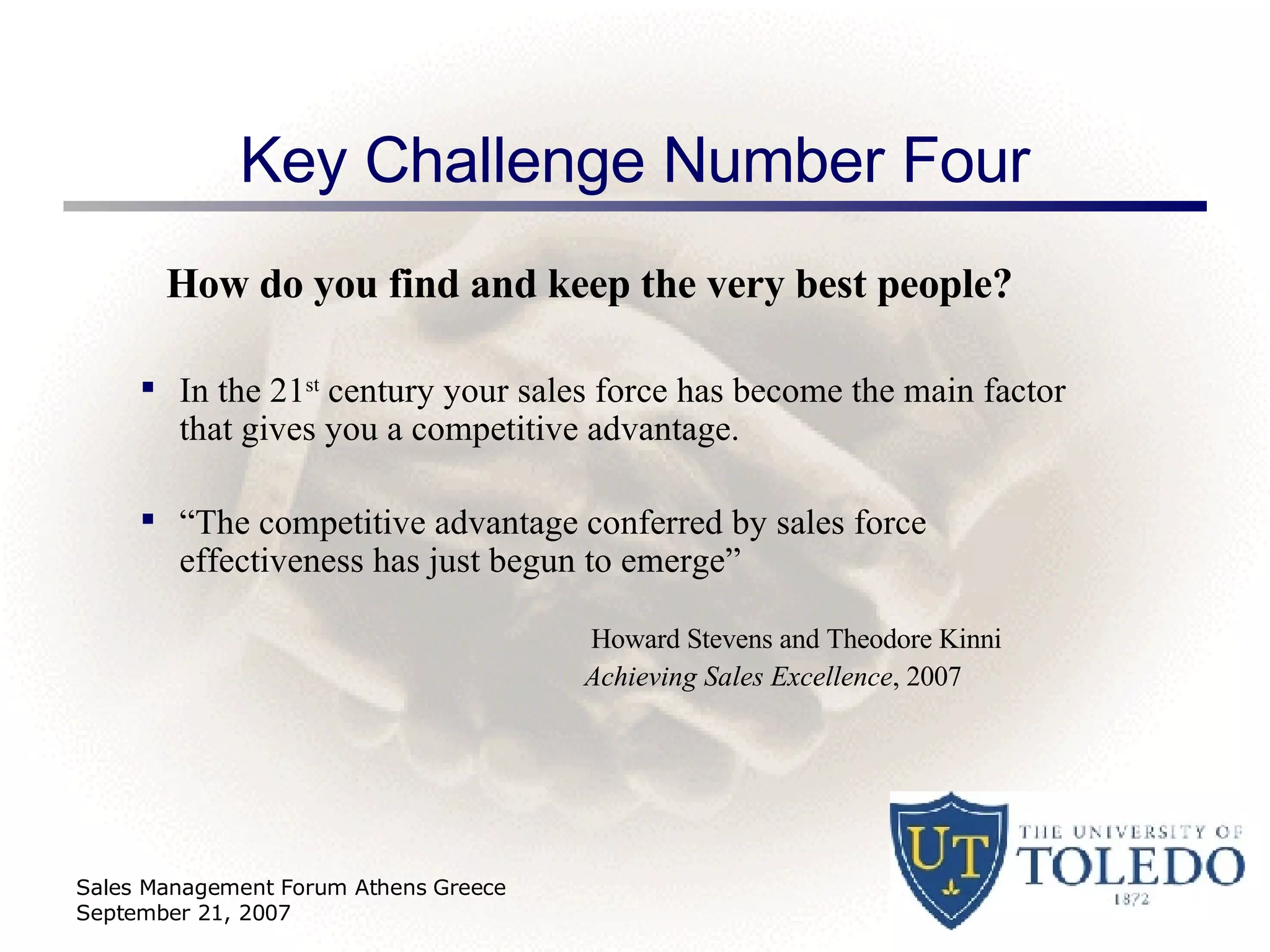
Key Challenge Number Four How do you find and keep the very best people? In the 21 st  century your sales force has become the main factor that gives you a competitive advantage.  “ The competitive advantage conferred by sales force effectiveness has just begun to emerge”    Howard Stevens and Theodore Kinni  Achieving Sales Excellence , 2007 Sales Management Forum Athens Greece September 21, 2007
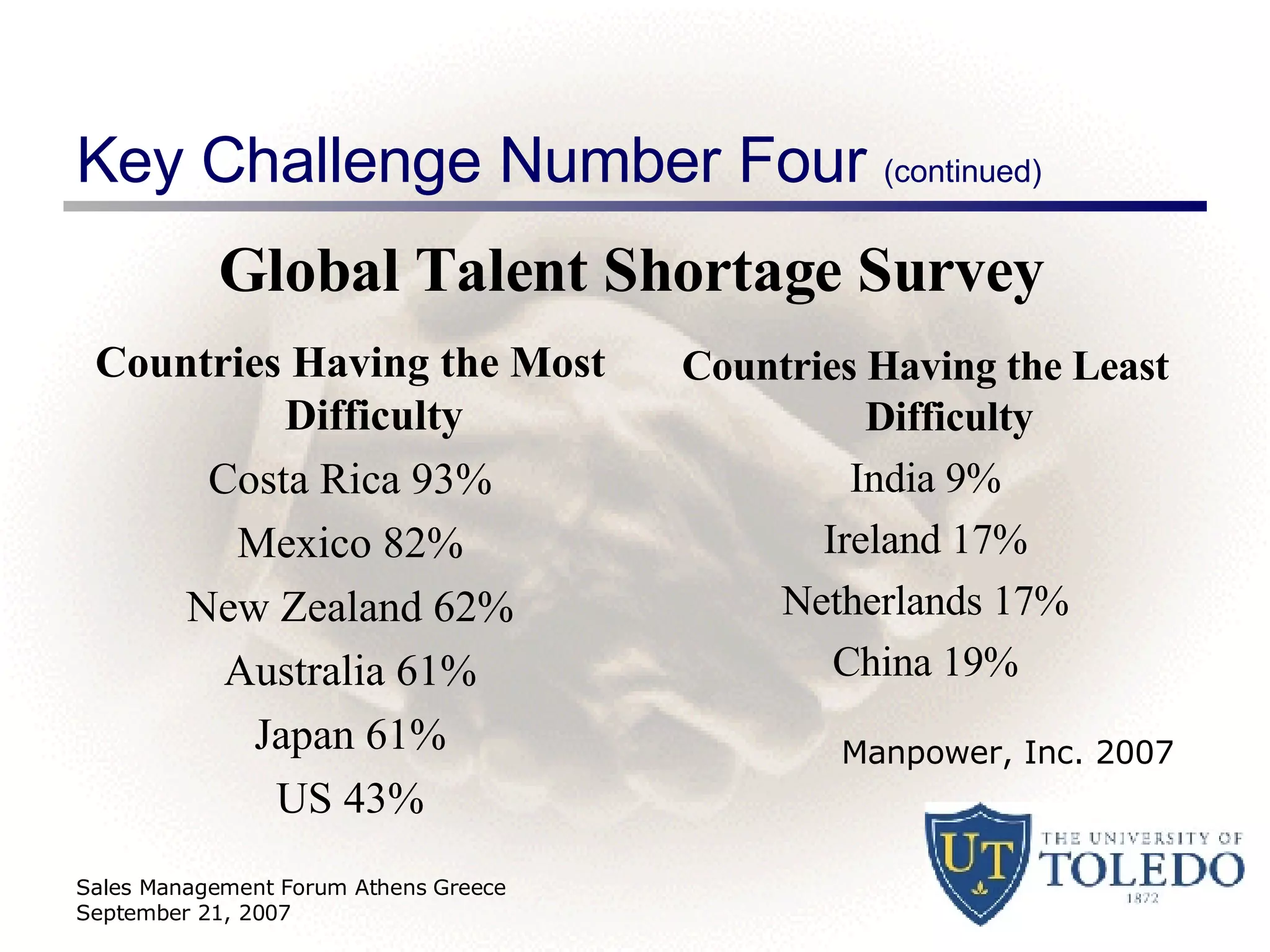
Key Challenge Number Four  (continued) Countries Having the Most Difficulty Costa Rica 93% Mexico 82% New Zealand 62% Australia 61% Japan 61% US 43% Countries Having the Least Difficulty India 9% Ireland 17% Netherlands 17% China 19% Global Talent Shortage Survey Sales Management Forum Athens Greece September 21, 2007 Manpower, Inc. 2007
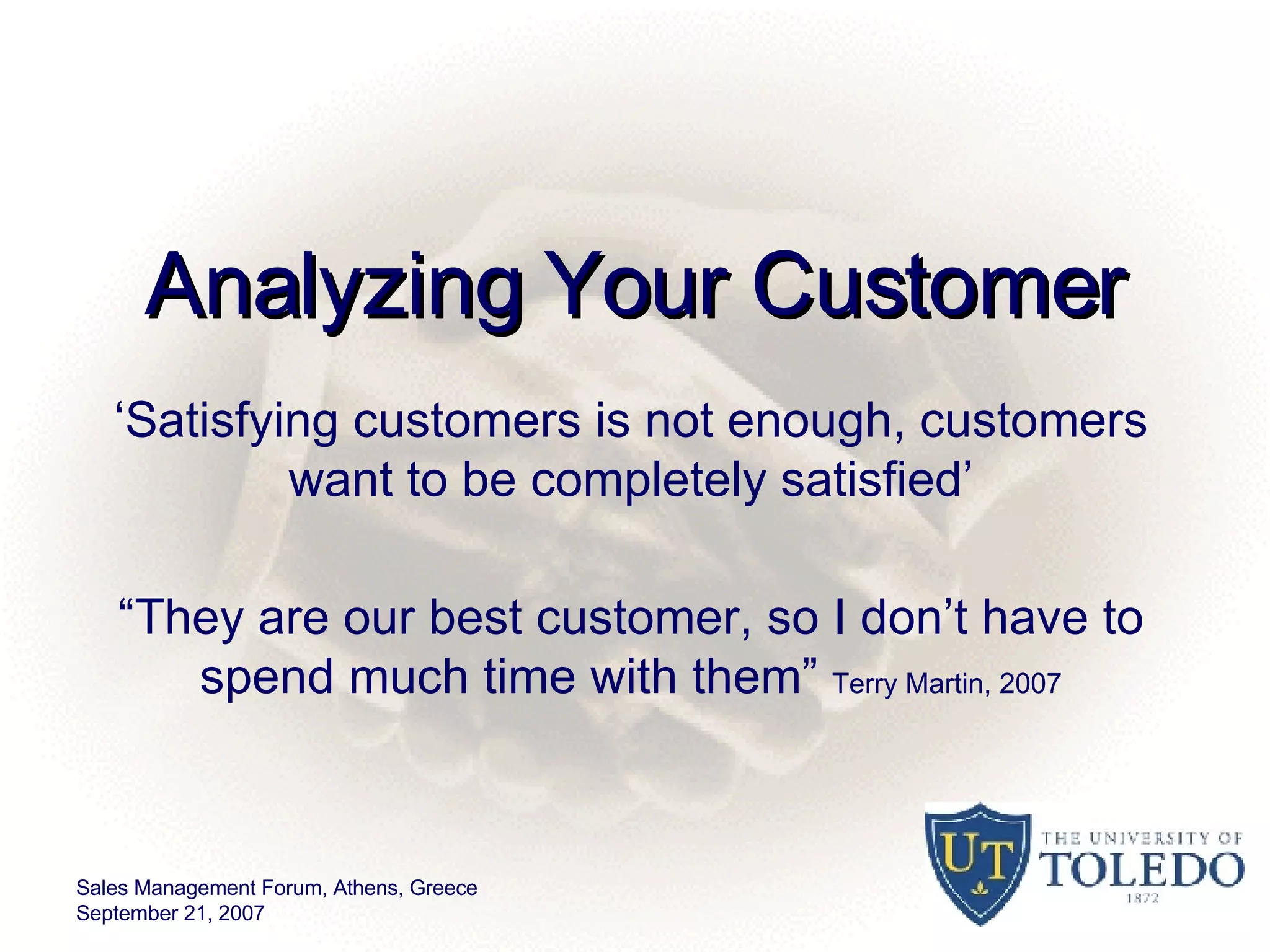
Analyzing Your Customer ‘ Satisfying customers is not enough, customers want to be completely satisfied’ “ They are our best customer, so I don’t have to spend much time with them”  Terry Martin, 2007 Sales Management Forum, Athens, Greece September 21, 2007
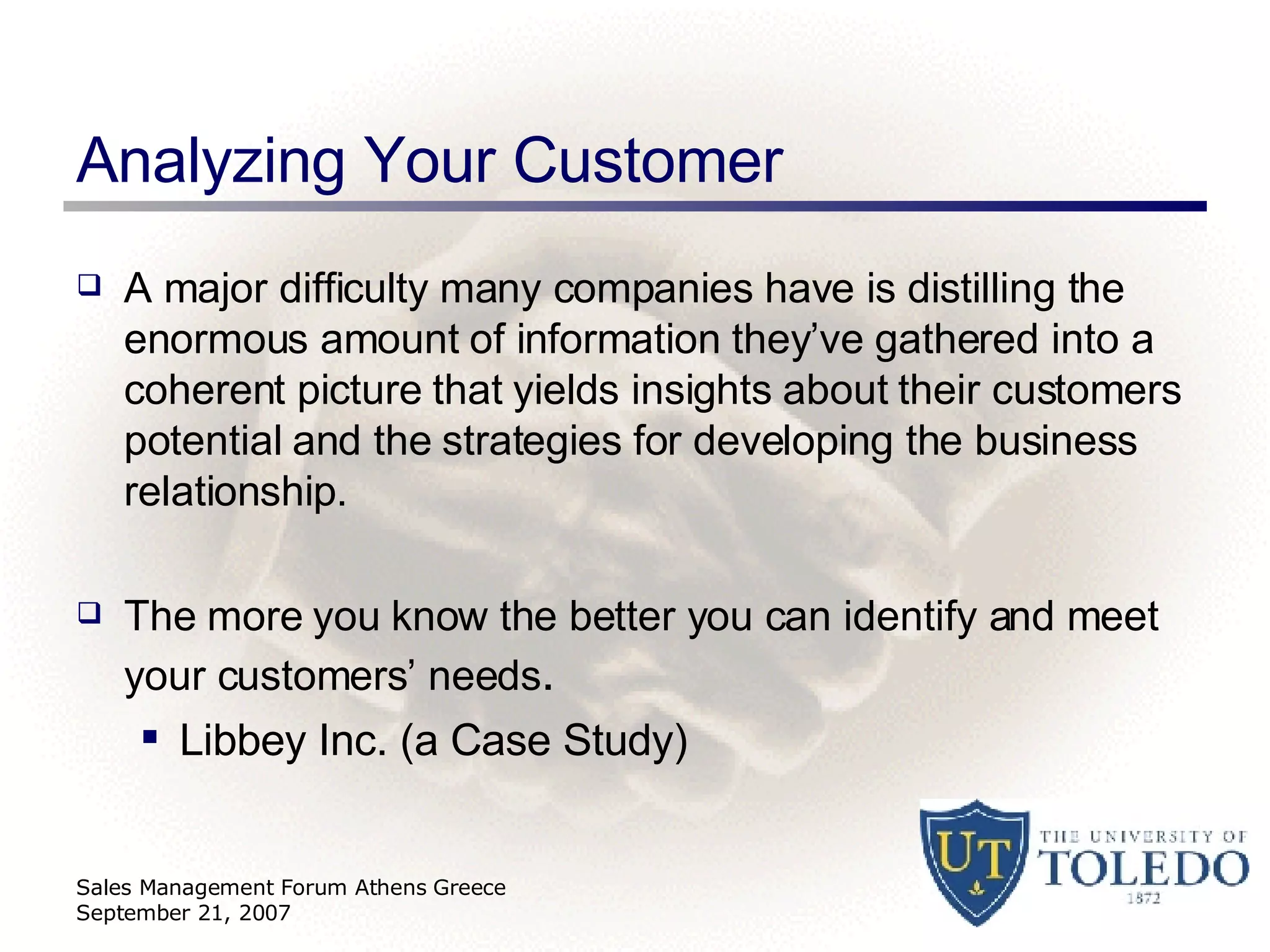
Analyzing Your Customer A major difficulty many companies have is distilling the enormous amount of information they’ve gathered into a coherent picture that yields insights about their customers potential and the strategies for developing the business relationship. The more you know the better you can identify and meet your customers’ needs . Libbey Inc. (a Case Study) Sales Management Forum Athens Greece September 21, 2007
Who is Libbey? Sales Management Forum Athens Greece September 21, 2007 The leading producer of glass tableware in North America; second largest in the world 2006 Net Sales - $568.1 million Leading brand in U.S. consumer glassware  Libbey Glass, Crisa, Royal Leerdam, Crisal, Syracuse China, Traex Leading provider of foodservice tableware
Retail Marketplace Challenges for Libbey Sales Management Forum Athens Greece September 21, 2007 Globalization Consolidation Retailer Leverage Price/Margin Pressure Consumer Knowledge Differentiation (Private-Label) Newness
Your Customer’s Industry and Market Your customers compete in a definable industries. Understanding the competitive landscape in which your customers operates is critical to understanding the decisions they make as an organization. Sales Management Forum Athens Greece September 21, 2007
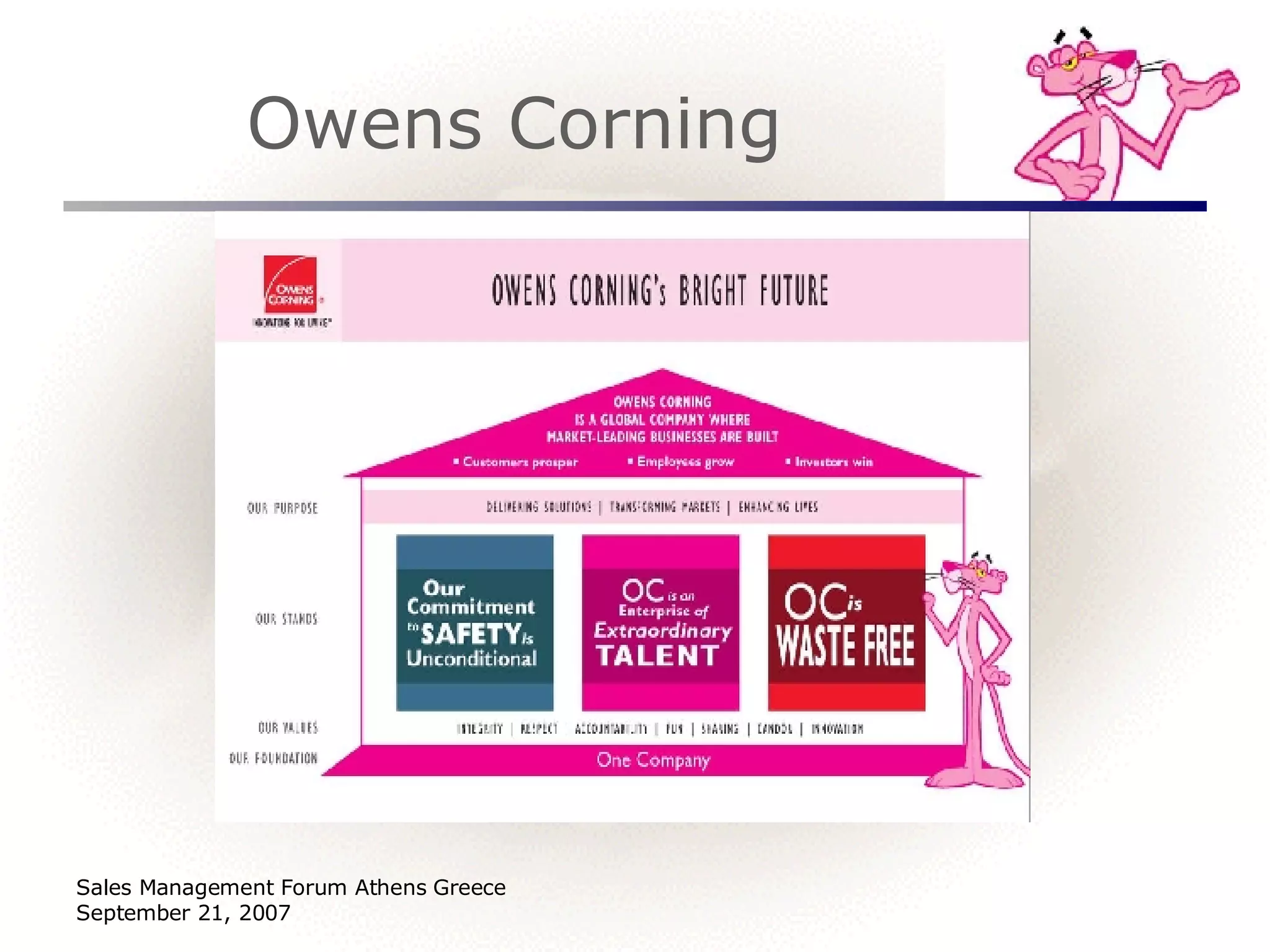
Sales Management Forum Athens Greece September 21, 2007 Owens Corning
Keys to Supplier Success at OC Suppliers to OC must: 1. Have clear expectations 2. Use their top talent 3. Have good performance metrics 4. Have good problem solving skills To accomplish these task requires a highly effectiveness sales force Sales Management Forum Athens Greece September 21, 2007
Owens Corning Supplier  Categories Strategic Sales Management Forum Athens Greece September 21, 2007 Partner Key Suppliers Emerging Suppliers Legacy Suppliers Tactical / Transactional Suppliers Non-Strategic/Transactional
As you examine an industry, ask the following questions: 1. Is your customer ’ s business in sync with developing changes in the marketplace? 2. Are  entry barriers  a powerful force in your customer ’ s industry? 3. Are your customer’s products threatened by  substitutes . 4. Are the  buyers a powerful force  in your customer’s industry? 5. Are the  suppliers  in your customer’s industry  powerful ? 6. Is there intense  rivalry among competitors ? Sales Management Forum Athens Greece September 21, 2007
Your Customer's Strategies and Synergies Your customers direction—vision, mission, strategies, plans. There intended synergies with partners, allies, and other segments of the market. As they formulate their direction they are responding to their view of their industry/marketplace and articulating the role they see themselves playing An analysis of your customer’s strategic direction is all at a high level, and it’s only meaningful if they use your products strategically or if your product have broad impact on their business Sales Management Forum Athens Greece September 21, 2007
Your Customer’s Structure and Management It is important to understand the impact of your customer’s organizational structure and management system on how they operate—specifically in how they use what you sell and how they make the buying decision for your type of product. Customer profile should describe how they are managed; how buying decisions are made, and who make them. Sales Management Forum Athens Greece September 21, 2007
Your Customer’s Buying Process How do they buy your product? How is the need for your product identified? How are the requirements and specifications identified? Do they have a process for soliciting bids? What guidelines do they have for selecting suppliers? What factors are most important in their selection decision? How do they ensure they are getting the best solution? Does their process allow access to key people? Sales Management Forum Athens Greece September 21, 2007
Your Customer’s Performance You should be aware of how your customers organization is, and has been, performing.  Key questions to ask: What are their performance goals? How do they measure performance? What are the gaps in their performance? How are they performing financially? What are their core competencies? Sales Management Forum Athens Greece September 21, 2007
Doing a Customer SWOT Analysis Allows you to identify areas where your customer is strong or weak and where they have opportunities or threats. Strengths and weaknesses consist of internal factors that make a company strong or weak. Opportunities and threats are external factors that are favorable or unfavorable towards the company. Sales Management Forum Athens Greece September 21, 2007
Building Strong Customer Relationships “ Strong customer relationships don’t just happen….they have to be carefully constructed.”  (David Shapiro) The advantage of a strong customer relationship is power. Sales Management Forum Athens Greece September 21, 2007
Sustaining Institutional Relationships Attack complacency at your company  Build a “zippered” network Note: a zippered network is the relationship between key people at ALL levels in your company and the customer’ organization.  Terry Bacon, 1999 Sales Management Forum Athens Greece September 21, 2007
Best Practices  for Constructing a Zippered Network Know how your customer is wired Informal structure, communication patterns, culture Identify the rising stars They are given the most important projects They are today’s influencers and tomorrow’s decision makers Identify the right functional and political connections Sales Management Forum Athens Greece September 21, 2007
Best Practices  for Constructing a Zippered Network  (continued) Determine who has the right chemistry Identify the best relationship builders Determine each customer executive’s expectations Build bonds with both people and positions Sales Management Forum Athens Greece September 21, 2007
Owens Corning “Zippered Network” Sales Management Forum Athens Greece September 21, 2007 Executive Sponsor Overall relationship owner Sets strategic direction for the relationship Develops the relationship Attends executive briefing sessions Acts as final escalation point for disputes Relationship Manager Point person(s) at the day to day operational level Agreement on roles and responsibilities Communicates performance and expectations Acts as a first level escalation point within OC Implements governance processes Sourcing Relationship Manager Single point of contact for all sourcing related activities  Maintains the Partner scorecard Jointly communicate performance and expectations
Building and Managing Relationships:  “The 21 st  Century Asset”  ( NIU Journal Sales & Major Account Mgt.) “ Relationships which are crucial to your business’ success need to be managed & protected as an organizational asset.” “  First and most importantly relationships as organizational assets must be seen as a high-level, cross functional initiative that is  driven from the top  and throughout the infrastructure of the company” “  In order to work, the process of building and managing customer relationships must become part of the culture.” “ The deeper the relationship goes within an organization the better.” Sales Management Forum Athens Greece September 21, 2007

Richard E. Buehrer: Highly Effective Sales People: From Key Challenges to Best Practices

  • 1.
    Highly Effective SalesPeople: From Key Challenges to Best Practices Presented by Richard E. Buehrer, PhD Director and Professor Edward H. Schmidt School of Professional Sales College of Business Administration University of Toledo Toledo, Ohio, USA Sales Management Forum, Athens, Greece September 21, 2007
  • 2.
    Key Challenge NumberOne Constant downward pressure on profit margins Firms face tremendous pressure to increase outputs while decreasing or maintaining inputs To stay competitive large and small firms alike face ever increasing pressure from consumers for lower prices while the cost of goods sold increases . “ In our business we are continually asked to reduce cost while increasing our output” Stu Hankin, VP Sales Hess Corp. Sales Management Forum Athens Greece September 21, 2007
  • 3.
    Key Challenge NumberTwo How do you find a point of differentiation in the marketplace? Your competition can duplicate your price and quality. It is the highly effective sales person that will make the difference” Sales Management Forum Athens Greece September 21, 2007 Howard Stevens and Theodore Kinni Achieving Sales Excellence , 2007
  • 4.
    Key Challenge NumberThree How do you deal with the need to be faster to the marketplace? “ For over 100 years we (3M) have always been known for innovation. Today our innovative products are copied by competition within six months.” Robert McDonald VP Marketing & Sales, 3M Sales Management Forum Athens Greece September 21, 2007
  • 5.
    Key Challenge NumberFour How do you find and keep the very best people? In the 21 st century your sales force has become the main factor that gives you a competitive advantage. “ The competitive advantage conferred by sales force effectiveness has just begun to emerge” Howard Stevens and Theodore Kinni Achieving Sales Excellence , 2007 Sales Management Forum Athens Greece September 21, 2007
  • 6.
    Key Challenge NumberFour (continued) Countries Having the Most Difficulty Costa Rica 93% Mexico 82% New Zealand 62% Australia 61% Japan 61% US 43% Countries Having the Least Difficulty India 9% Ireland 17% Netherlands 17% China 19% Global Talent Shortage Survey Sales Management Forum Athens Greece September 21, 2007 Manpower, Inc. 2007
  • 7.
    Analyzing Your Customer‘ Satisfying customers is not enough, customers want to be completely satisfied’ “ They are our best customer, so I don’t have to spend much time with them” Terry Martin, 2007 Sales Management Forum, Athens, Greece September 21, 2007
  • 8.
    Analyzing Your CustomerA major difficulty many companies have is distilling the enormous amount of information they’ve gathered into a coherent picture that yields insights about their customers potential and the strategies for developing the business relationship. The more you know the better you can identify and meet your customers’ needs . Libbey Inc. (a Case Study) Sales Management Forum Athens Greece September 21, 2007
  • 9.
    Who is Libbey?Sales Management Forum Athens Greece September 21, 2007 The leading producer of glass tableware in North America; second largest in the world 2006 Net Sales - $568.1 million Leading brand in U.S. consumer glassware Libbey Glass, Crisa, Royal Leerdam, Crisal, Syracuse China, Traex Leading provider of foodservice tableware
  • 10.
    Retail Marketplace Challengesfor Libbey Sales Management Forum Athens Greece September 21, 2007 Globalization Consolidation Retailer Leverage Price/Margin Pressure Consumer Knowledge Differentiation (Private-Label) Newness
  • 11.
    Your Customer’s Industryand Market Your customers compete in a definable industries. Understanding the competitive landscape in which your customers operates is critical to understanding the decisions they make as an organization. Sales Management Forum Athens Greece September 21, 2007
  • 12.
    Sales Management ForumAthens Greece September 21, 2007 Owens Corning
  • 13.
    Keys to SupplierSuccess at OC Suppliers to OC must: 1. Have clear expectations 2. Use their top talent 3. Have good performance metrics 4. Have good problem solving skills To accomplish these task requires a highly effectiveness sales force Sales Management Forum Athens Greece September 21, 2007
  • 14.
    Owens Corning Supplier Categories Strategic Sales Management Forum Athens Greece September 21, 2007 Partner Key Suppliers Emerging Suppliers Legacy Suppliers Tactical / Transactional Suppliers Non-Strategic/Transactional
  • 15.
    As you examinean industry, ask the following questions: 1. Is your customer ’ s business in sync with developing changes in the marketplace? 2. Are entry barriers a powerful force in your customer ’ s industry? 3. Are your customer’s products threatened by substitutes . 4. Are the buyers a powerful force in your customer’s industry? 5. Are the suppliers in your customer’s industry powerful ? 6. Is there intense rivalry among competitors ? Sales Management Forum Athens Greece September 21, 2007
  • 16.
    Your Customer's Strategiesand Synergies Your customers direction—vision, mission, strategies, plans. There intended synergies with partners, allies, and other segments of the market. As they formulate their direction they are responding to their view of their industry/marketplace and articulating the role they see themselves playing An analysis of your customer’s strategic direction is all at a high level, and it’s only meaningful if they use your products strategically or if your product have broad impact on their business Sales Management Forum Athens Greece September 21, 2007
  • 17.
    Your Customer’s Structureand Management It is important to understand the impact of your customer’s organizational structure and management system on how they operate—specifically in how they use what you sell and how they make the buying decision for your type of product. Customer profile should describe how they are managed; how buying decisions are made, and who make them. Sales Management Forum Athens Greece September 21, 2007
  • 18.
    Your Customer’s BuyingProcess How do they buy your product? How is the need for your product identified? How are the requirements and specifications identified? Do they have a process for soliciting bids? What guidelines do they have for selecting suppliers? What factors are most important in their selection decision? How do they ensure they are getting the best solution? Does their process allow access to key people? Sales Management Forum Athens Greece September 21, 2007
  • 19.
    Your Customer’s PerformanceYou should be aware of how your customers organization is, and has been, performing. Key questions to ask: What are their performance goals? How do they measure performance? What are the gaps in their performance? How are they performing financially? What are their core competencies? Sales Management Forum Athens Greece September 21, 2007
  • 20.
    Doing a CustomerSWOT Analysis Allows you to identify areas where your customer is strong or weak and where they have opportunities or threats. Strengths and weaknesses consist of internal factors that make a company strong or weak. Opportunities and threats are external factors that are favorable or unfavorable towards the company. Sales Management Forum Athens Greece September 21, 2007
  • 21.
    Building Strong CustomerRelationships “ Strong customer relationships don’t just happen….they have to be carefully constructed.” (David Shapiro) The advantage of a strong customer relationship is power. Sales Management Forum Athens Greece September 21, 2007
  • 22.
    Sustaining Institutional RelationshipsAttack complacency at your company Build a “zippered” network Note: a zippered network is the relationship between key people at ALL levels in your company and the customer’ organization. Terry Bacon, 1999 Sales Management Forum Athens Greece September 21, 2007
  • 23.
    Best Practices for Constructing a Zippered Network Know how your customer is wired Informal structure, communication patterns, culture Identify the rising stars They are given the most important projects They are today’s influencers and tomorrow’s decision makers Identify the right functional and political connections Sales Management Forum Athens Greece September 21, 2007
  • 24.
    Best Practices for Constructing a Zippered Network (continued) Determine who has the right chemistry Identify the best relationship builders Determine each customer executive’s expectations Build bonds with both people and positions Sales Management Forum Athens Greece September 21, 2007
  • 25.
    Owens Corning “ZipperedNetwork” Sales Management Forum Athens Greece September 21, 2007 Executive Sponsor Overall relationship owner Sets strategic direction for the relationship Develops the relationship Attends executive briefing sessions Acts as final escalation point for disputes Relationship Manager Point person(s) at the day to day operational level Agreement on roles and responsibilities Communicates performance and expectations Acts as a first level escalation point within OC Implements governance processes Sourcing Relationship Manager Single point of contact for all sourcing related activities Maintains the Partner scorecard Jointly communicate performance and expectations
  • 26.
    Building and ManagingRelationships: “The 21 st Century Asset” ( NIU Journal Sales & Major Account Mgt.) “ Relationships which are crucial to your business’ success need to be managed & protected as an organizational asset.” “ First and most importantly relationships as organizational assets must be seen as a high-level, cross functional initiative that is driven from the top and throughout the infrastructure of the company” “ In order to work, the process of building and managing customer relationships must become part of the culture.” “ The deeper the relationship goes within an organization the better.” Sales Management Forum Athens Greece September 21, 2007