Chapter 1
Systems of Linear Equations
感謝
大葉大學 資訊工程系
鈴玲老師 提供黃
Linear Algebra
Ch1_2
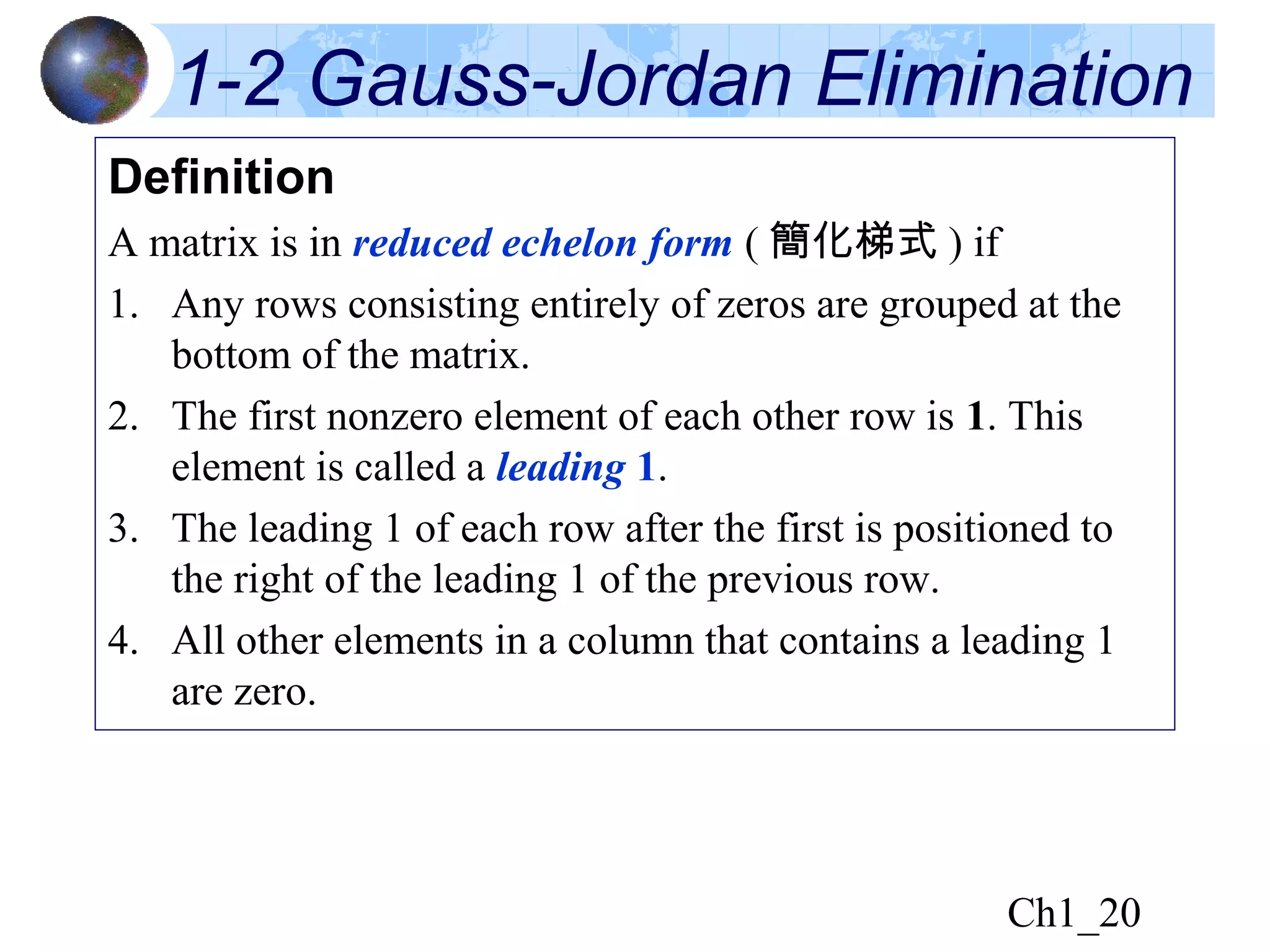
Definition
• An equation such as x+3y=9 is called a linear equation.
( 線性方程式 )
• The graph of this equation is a straight line in the x-y plane.
• A pair of values of x and y that satisfy the equation is called
a solution.
1.1 Matrices and Systems of
Linear Equations
system of linear equations ( 線性聯立方程式 )
Ch1_3
Definition
A linear equation in n variables ( 變數 ) x1, x2, x3, …, xn has
the form
a1 x1 + a2 x2 + a3 x3 + … + an xn = b
where the coefficients ( 係數 ) a1, a2, a3, …, an and b are
real numbers ( 實數 ).
常見數系的英文名稱:
natural number ( 自然數 ), integer ( 整數 ), rational number ( 有理數 ),
real number ( 實數 ), complex number ( 複數 )
positive ( 正 ), negative ( 負 )
Ch1_4
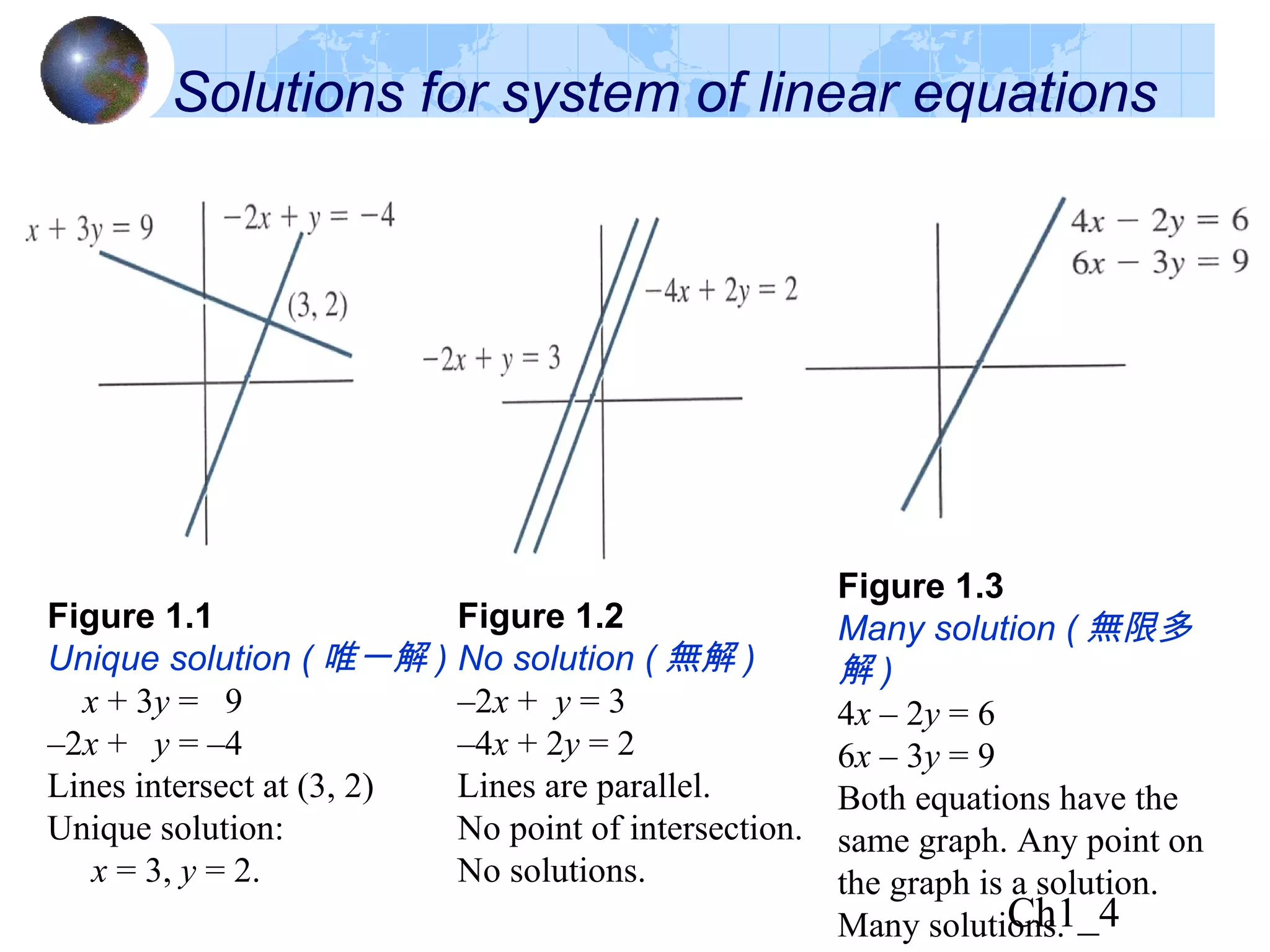
Figure 1.2
No solution ( 無解 )
–2x + y = 3
–4x + 2y = 2
Lines are parallel.
No point of intersection.
No solutions.
Solutions for system of linear equations
Figure 1.1
Unique solution ( 唯一解 )
x + 3y = 9
–2x + y = –4
Lines intersect at (3, 2)
Unique solution:
x = 3, y = 2.
Figure 1.3
Many solution ( 無限多
解 )
4x – 2y = 6
6x – 3y = 9
Both equations have the
same graph. Any point on
the graph is a solution.
Many solutions.
Ch1_5
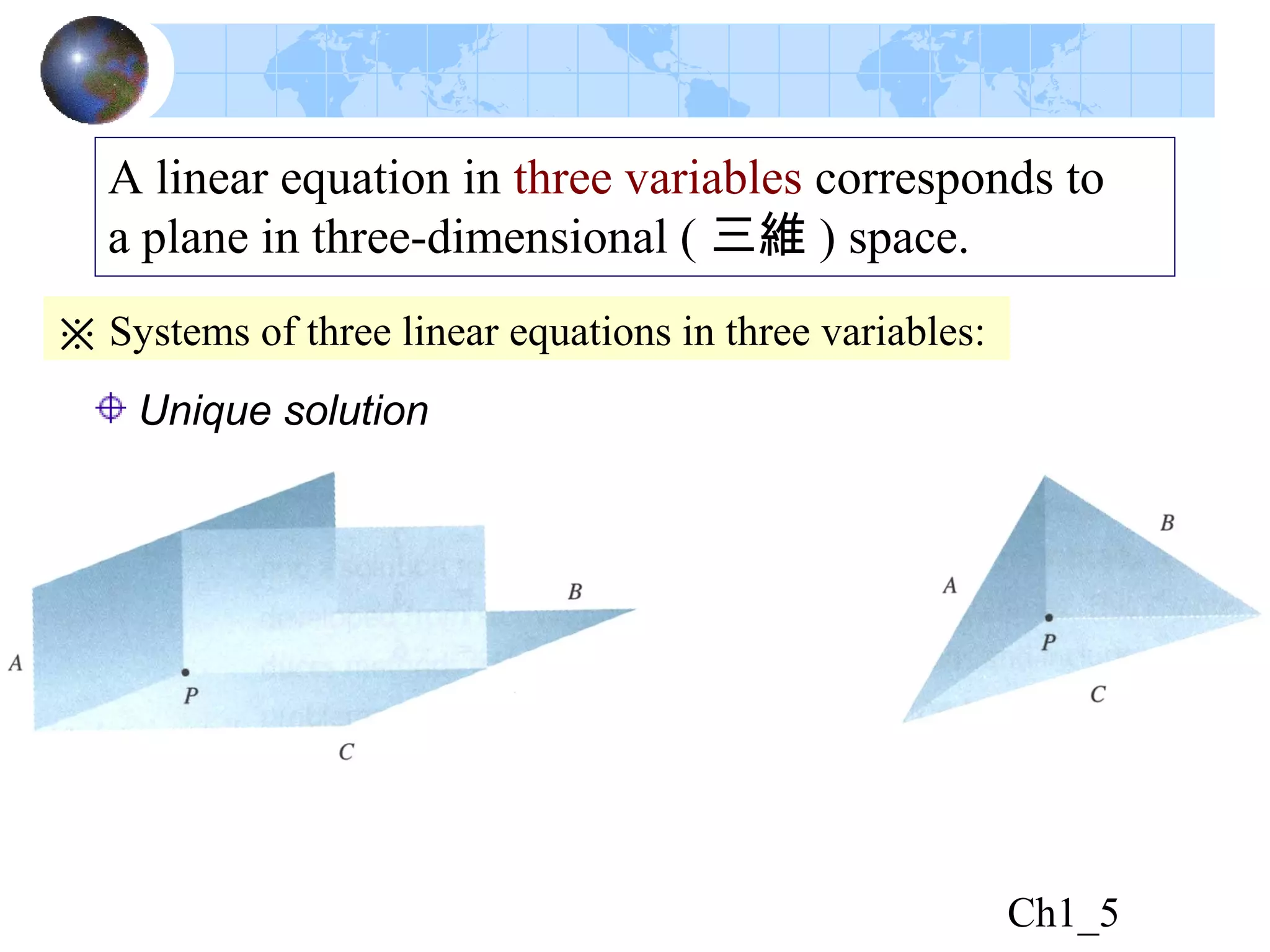
A linear equation in three variables corresponds to
a plane in three-dimensional ( 三維 ) space.
Unique solution
※ Systems of three linear equations in three variables:
Ch1_6
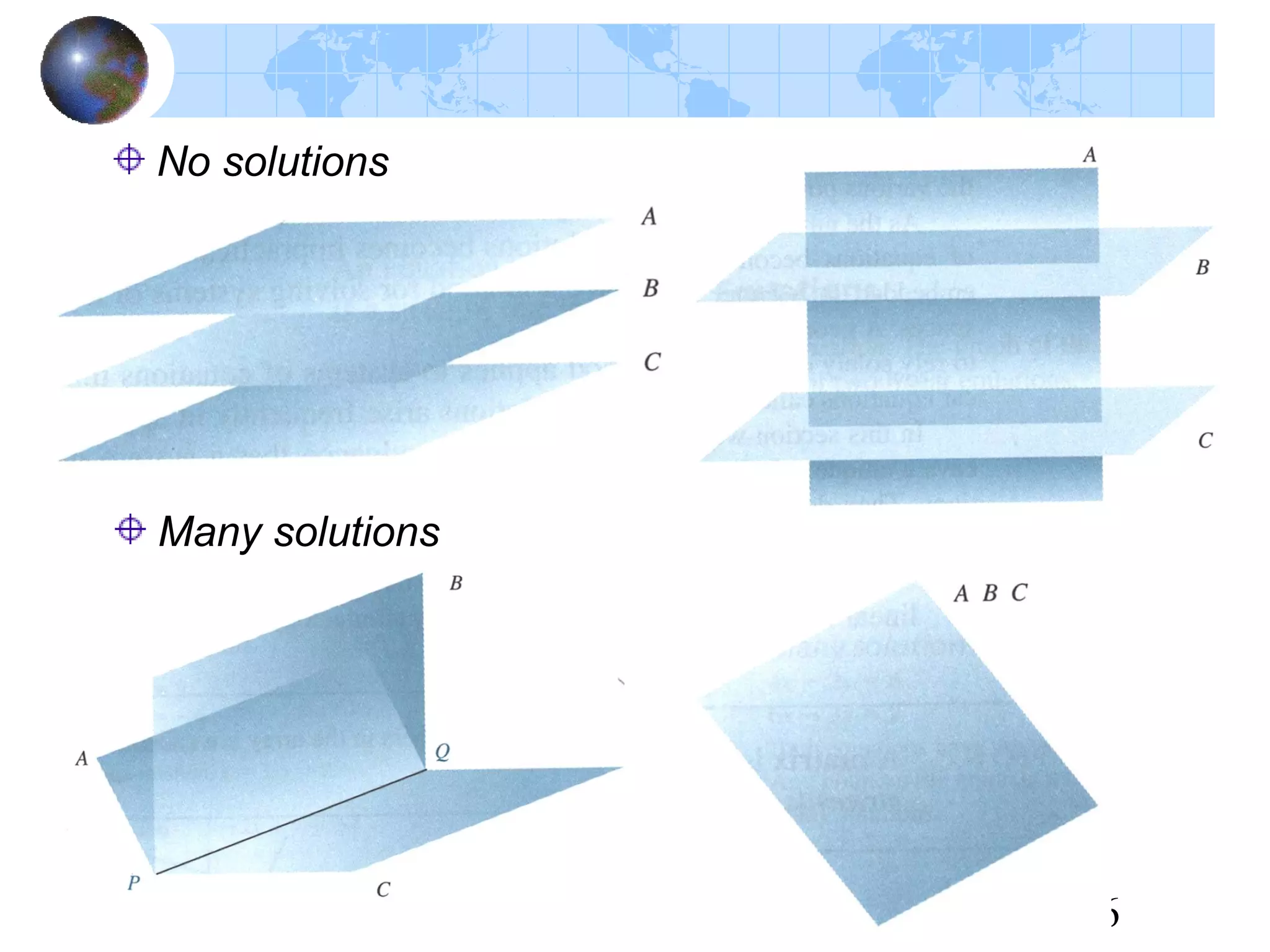
No solutions
Many solutions
Ch1_7
How to solve a system of linear equations?
Gauss-Jordan elimination. ( 高斯 - 喬登消去法 )
1.2 節會介紹
Ch1_8
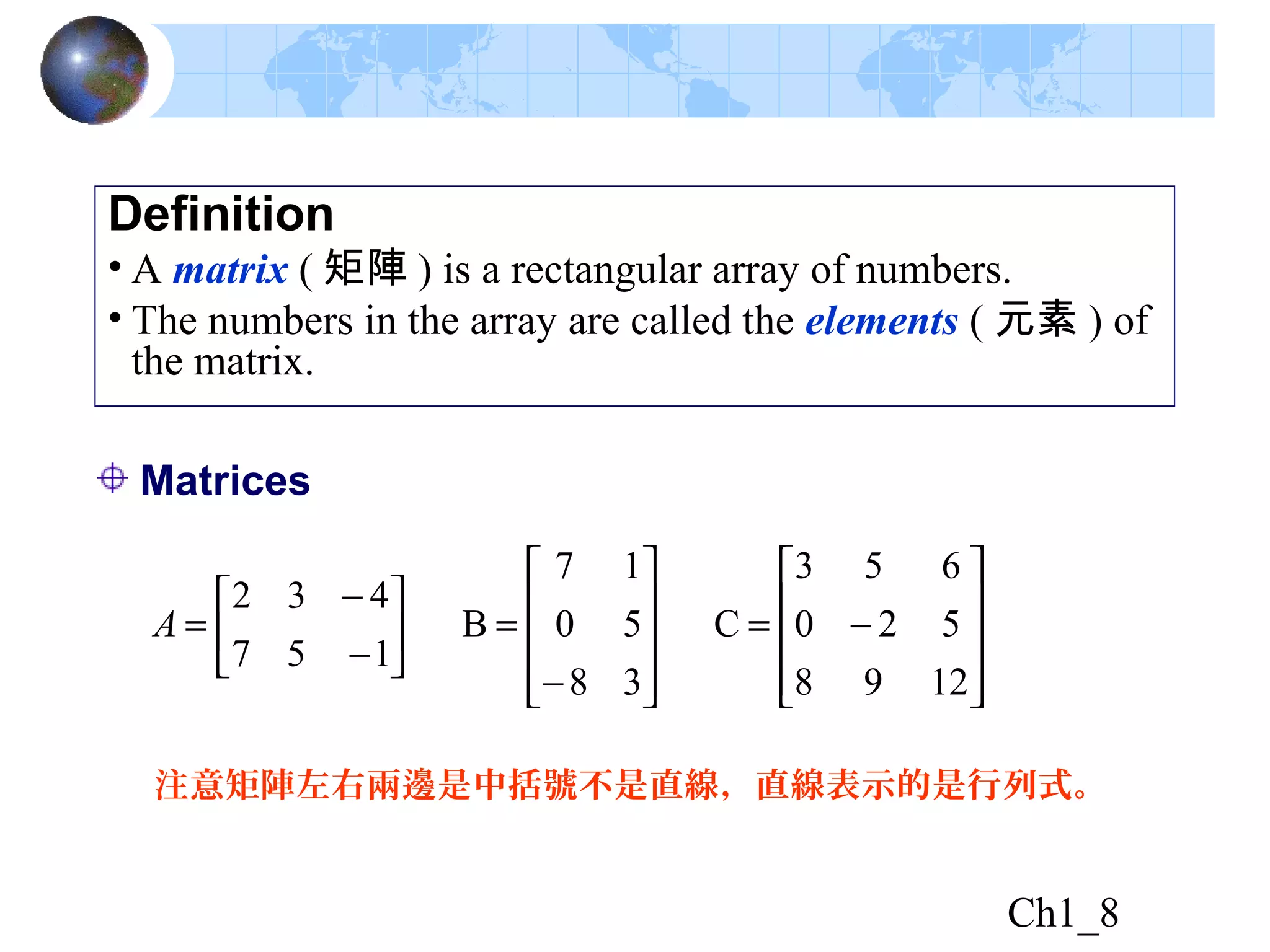
Definition
• A matrix ( 矩陣 ) is a rectangular array of numbers.
• The numbers in the array are called the elements ( 元素 ) of
the matrix.
Matrices










−=










−
=





−
−
=
1298
520
653
C
38
50
17
B
157
432
A
注意矩陣左右兩邊是中括號不是直線,直線表示的是行列式。
Ch1_9
Submatrix ( 子矩陣 )
Amatrix
215
032
471










−
=A
Row ( 列 ) and Column ( 行 )
[ ] [ ]
3column2column1column2row1row
1
4
5
3
7
2
157432 





−
−












−−
157
432






−
−
=A
Aofssubmatrice
25
41
1
3
7
15
32
71






−
=










=










= RQP
Ch1_10
Identity Matrices ( 單位矩陣 )
diagonal ( 對角線 ) 上都是 1 ,其餘都是 0 , I 的下標表示 size








=



=
100
010
001
10
01
32 II
Location
7,4
157
432
2113 =−=





−
−
= aaA
aij 表示在 row i, column j 的元素值
也寫成 location (1,3) = −4
Size and Type
[ ]
matrixcolumnamatrixrowamatrixsquarea
matrix13matrix41matrix3332:Size
2
3
8
5834
853
109
752
542
301
××××










−










−
−





−
Ch1_11
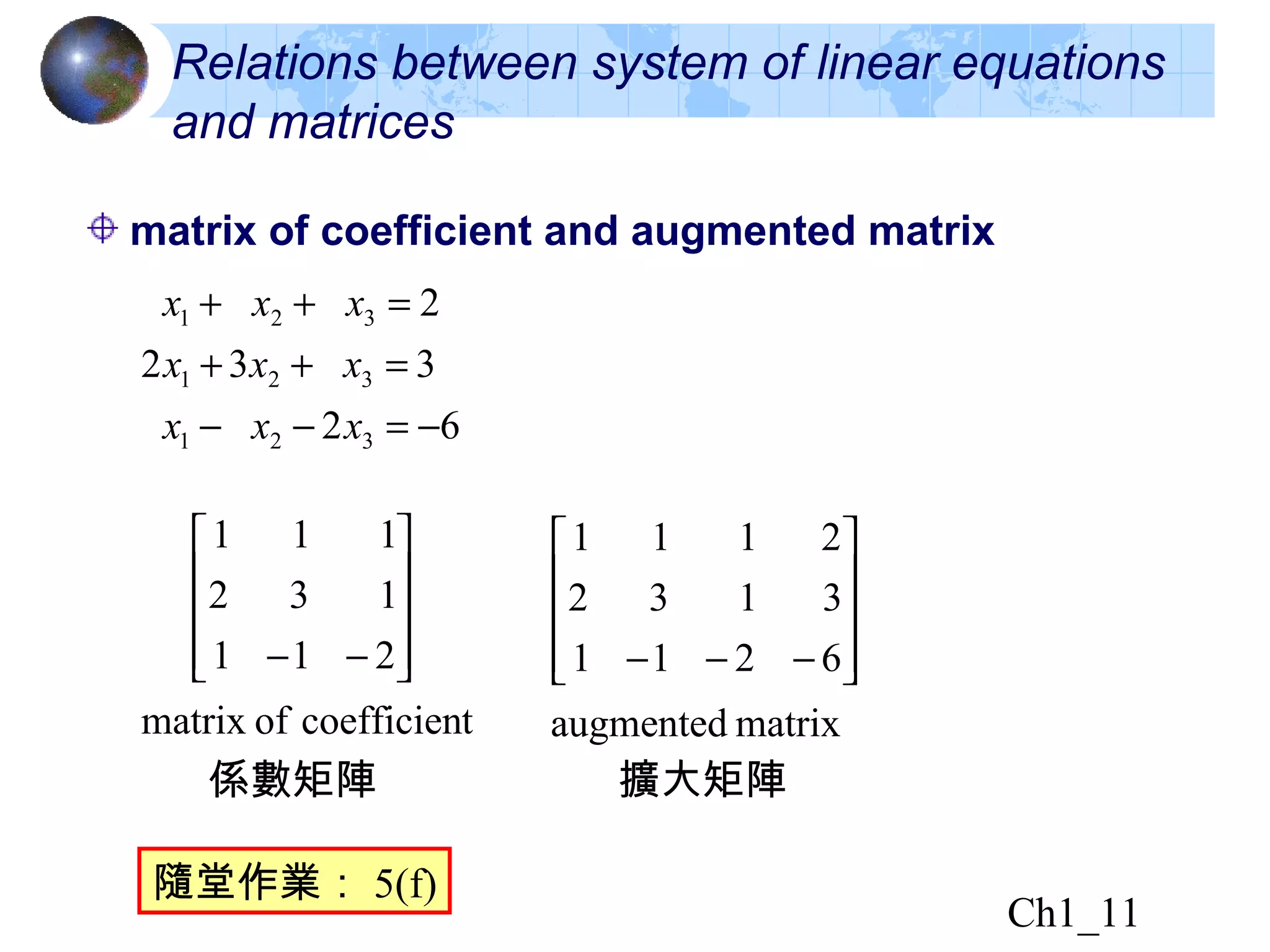
matrix of coefficient and augmented matrix
62
332
2
321
321
321
−=−−
=++
=++
xxx
xxx
xxx
Relations between system of linear equations
and matrices
係數矩陣 擴大矩陣
隨堂作業: 5(f)
tcoefficienofmatrix
211
132
111










−−
matrixaugmented
6211
3132
2111










−−−
Ch1_12
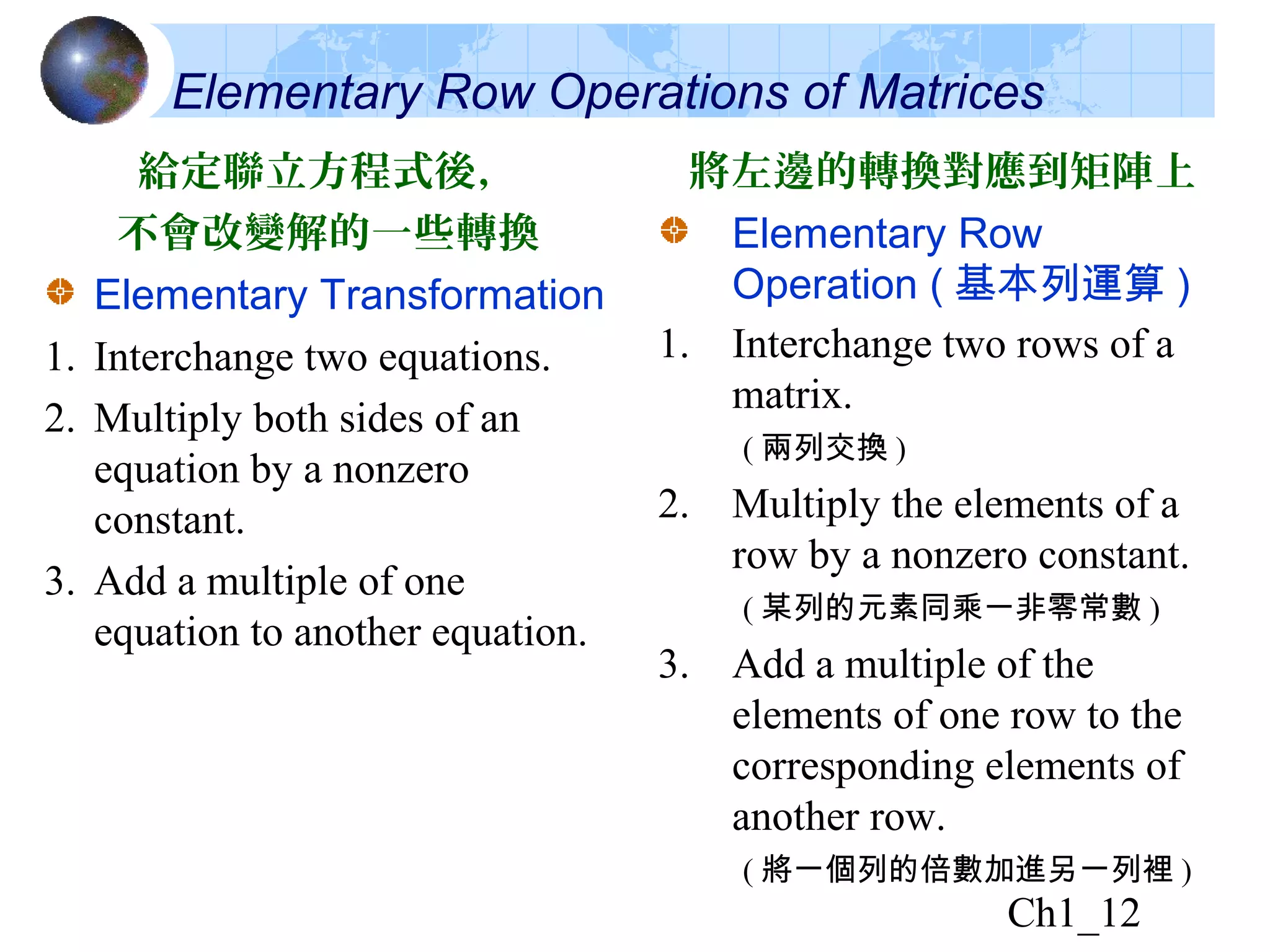
給定聯立方程式後,
不會改變解的一些轉換
Elementary Transformation
1. Interchange two equations.
2. Multiply both sides of an
equation by a nonzero
constant.
3. Add a multiple of one
equation to another equation.
將左邊的轉換對應到矩陣上
Elementary Row
Operation ( 基本列運算 )
1. Interchange two rows of a
matrix.
( 兩列交換 )
2. Multiply the elements of a
row by a nonzero constant.
( 某列的元素同乘一非零常數 )
3. Add a multiple of the
elements of one row to the
corresponding elements of
another row.
( 將一個列的倍數加進另一列裡 )
Elementary Row Operations of Matrices
Ch1_13
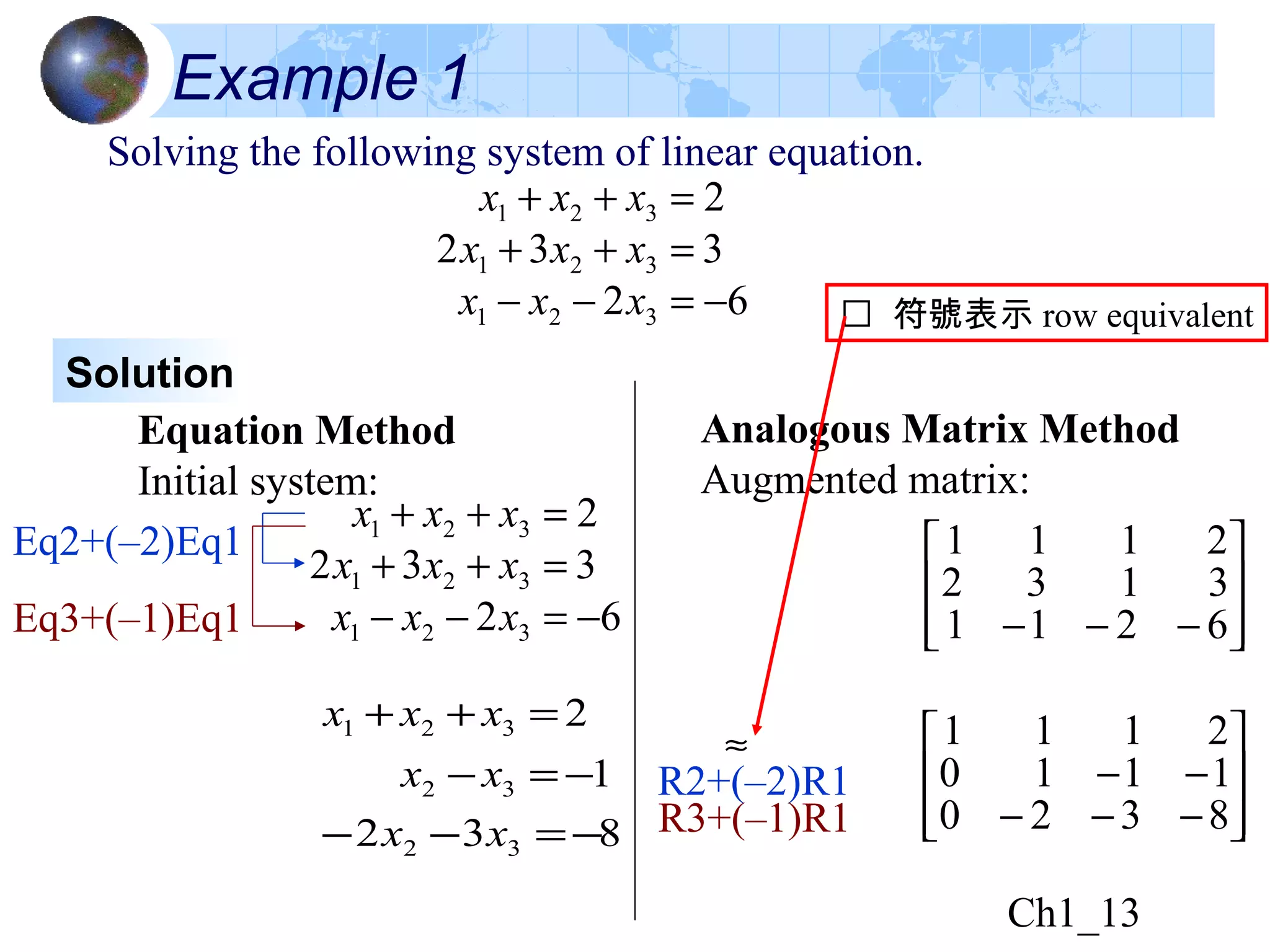
Example 1
Solving the following system of linear equation.
62
332
2
321
321
321
−=−−
=++
=++
xxx
xxx
xxx








−−− 6211
3132
2111
62
332
2
321
321
321
−=−−
=++
=++
xxx
xxx
xxx
Solution
Equation Method
Initial system:
Analogous Matrix Method
Augmented matrix:
1
2
32
321
−=−
=++
xx
xxx
Eq2+(–2)Eq1
Eq3+(–1)Eq1








−−−
−−
8320
1110
2111
R2+(–2)R1
R3+(–1)R1
≈
 符號表示 row equivalent
832 32 −=−− xx
Ch1_14
105
1
32
3
32
31
−=−
−=−
=+
x
xx
xx








−−
−−
01500
1110
3201
2
1
32
3
32
31
=
−=−
=+
x
xx
xx








−−
2100
1110
3201
2
1
1
3
2
1
=
=
−=
x
x
x









 −
2100
1010
1001
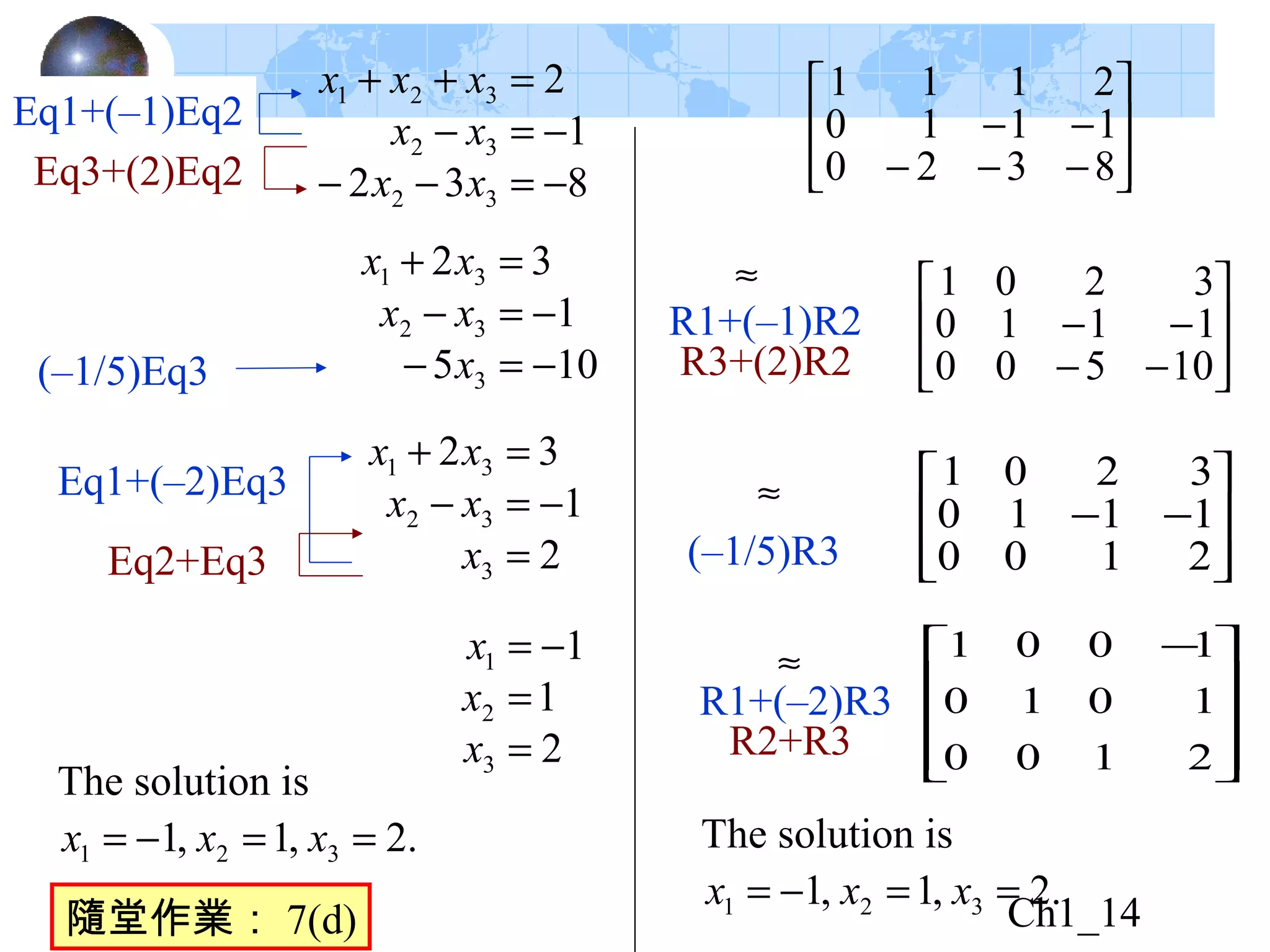
Eq1+(–1)Eq2
Eq3+(2)Eq2
(–1/5)Eq3
Eq1+(–2)Eq3
Eq2+Eq3
The solution is
.2,1,1 321 ==−= xxx The solution is
.2,1,1 321 ==−= xxx
832
1
2
32
32
321
−=−−
−=−
=++
xx
xx
xxx








−−−
−−
8320
1110
2111
R1+(–1)R2
R3+(2)R2
≈
(–1/5)R3
≈
R1+(–2)R3
R2+R3
≈
隨堂作業: 7(d)
Ch1_15
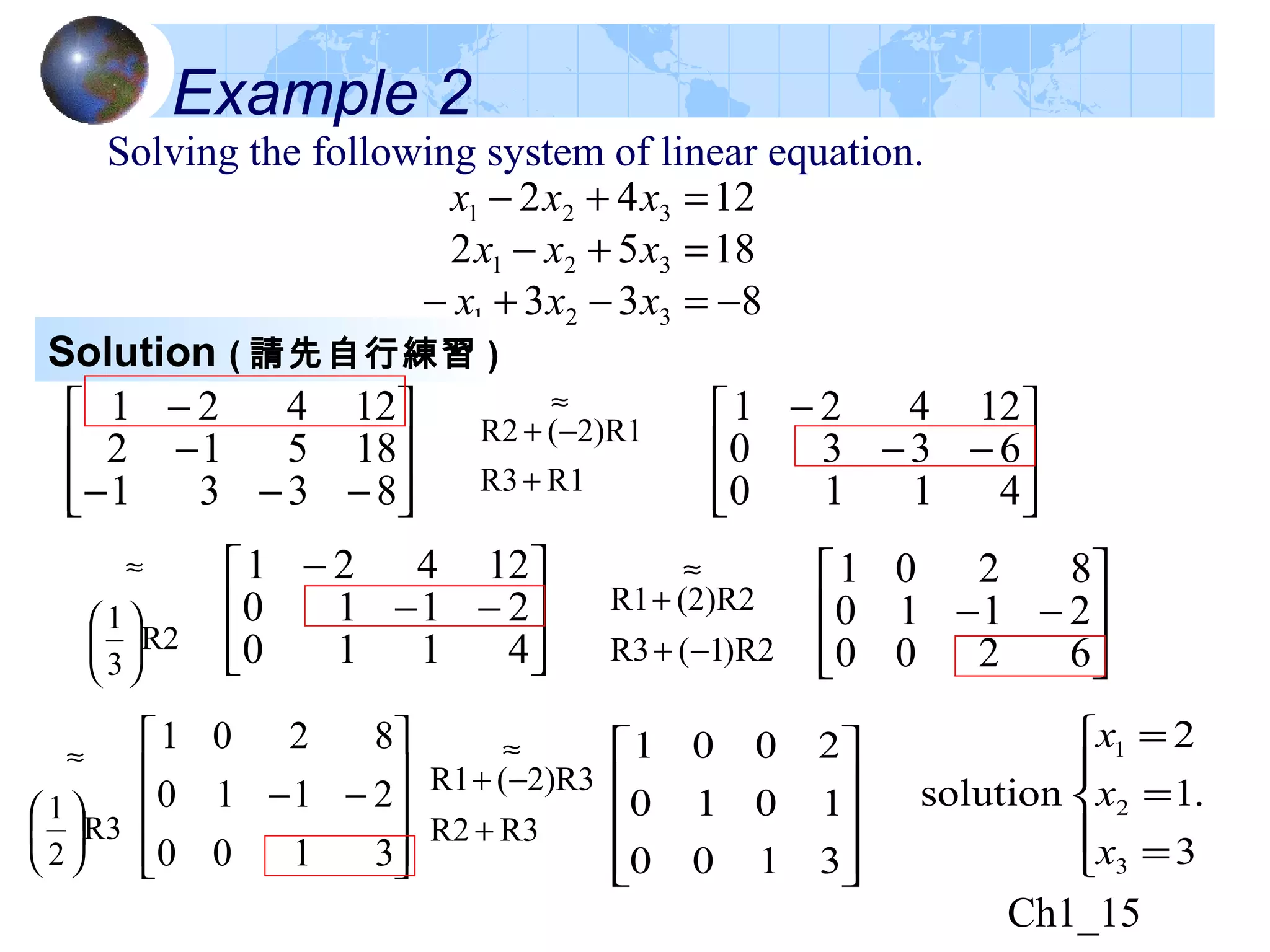
Example 2
Solving the following system of linear equation.
833
1852
1242
321
321
321
−=−+−
=+−
=+−
xxx
xxx
xxx
Solution ( 請先自行練習 )








−−−
−
−
8331
18512
12421








−−
−
4110
6330
12421
R2
3
1






≈








−−
−
4110
2110
12421








−−
6200
2110
8201










−−
3100
2110
8201
R1R3
2)R1(R2
+
−+
≈
R2)1(R3
(2)R2R1
−+
+
≈
R3
2
1






≈










3100
1010
2001
R3R2
2)R3(R1
+
−+
≈
.
3
1
2
solution
3
2
1





=
=
=
x
x
x
Ch1_16
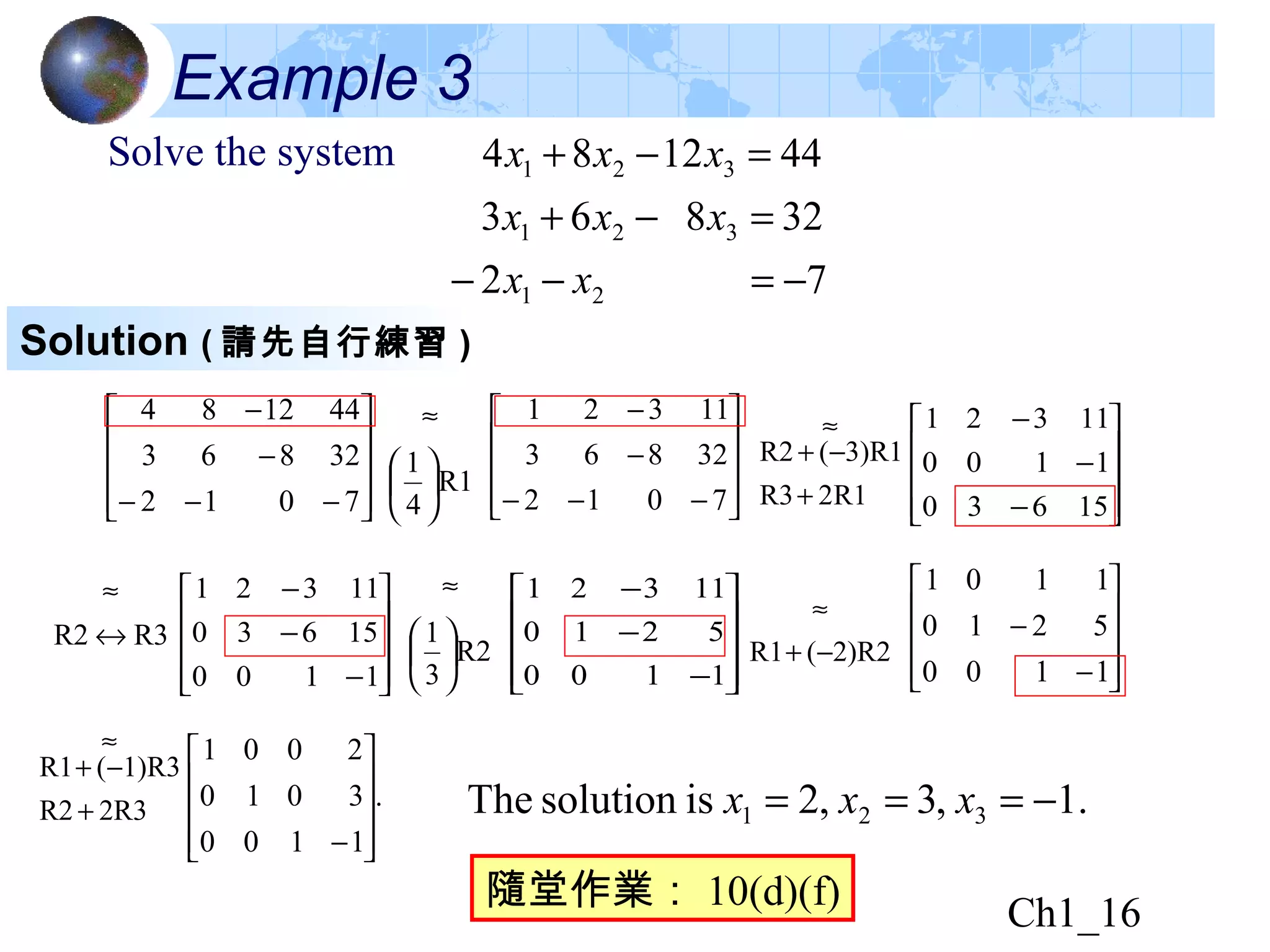
Example 3
Solve the system
72
32863
441284
21
321
321
−=−−
=−+
=−+
xx
xxx
xxx










−−−
−
−
7012
32863
441284










−−−
−
−
7012
32863
11321










−
−
−
15630
1100
11321










−
−
−
1100
5210
11321










−
−
1100
5210
1101
.
1100
3010
2001










−
.1,3,2issolutionThe 321 −=== xxx
R2
3
1






≈
R12R3
3)R1(R2
+
−+
≈
R3R2 ↔
≈










−
−
−
1100
15630
11321
R1
4
1






≈
2)R2(R1 −+
≈
2R3R2
1)R3(R1
+
−+
≈
Solution ( 請先自行練習 )
隨堂作業: 10(d)(f)
Ch1_17
Summary










−−−
−
−
=
7012
32863
441284
]:[ BA
A BUse row operations to [A: B] :
.
1100
3010
2001










−
≈≈










−−−
−
−

7012
32863
441284
]:[]:[ XIBA n≈≈i.e.,
Def. [In : X] is called the reduced echelon form ( 簡化梯
式 )
of [A : B].Note. 1. If A is the matrix of coefficients of a system of n equations
in n variables that has a unique solution,
then A is row equivalent to In (A ≈ In).
2. If A ≈ In, then the system has unique solution.
72
32863
441284
21
321
321
−=−−
=−+
=−+
xx
xxx
xxx
Ch1_18
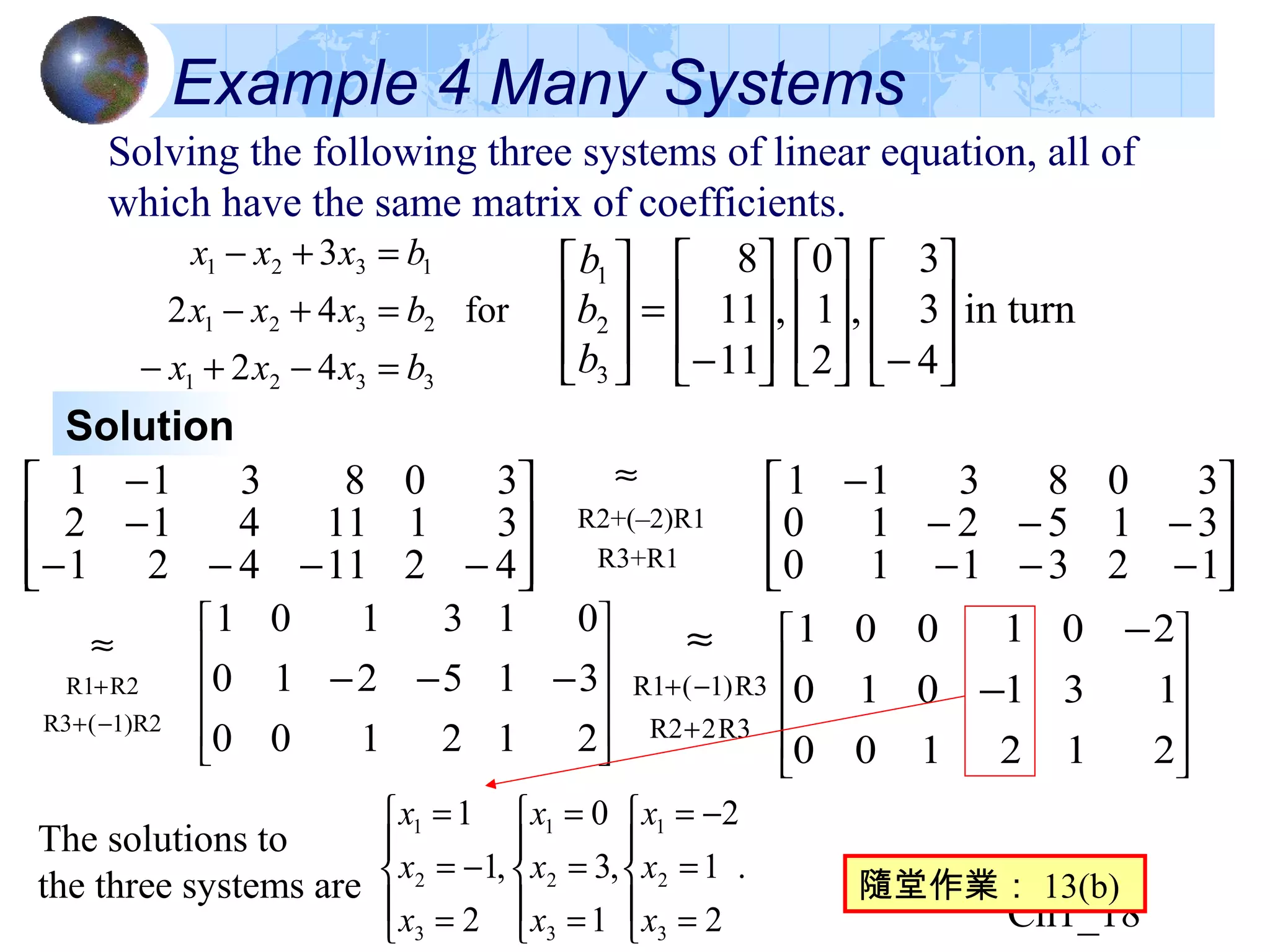
Example 4 Many Systems
Solving the following three systems of linear equation, all of
which have the same matrix of coefficients.
3321
2321
1321
42
for42
3
bxxx
bxxx
bxxx
=−+−
=+−
=+−
in turn
4
3
3
,
2
1
0
,
11
11
8
3
2
1








−















−
=








b
b
b
Solution








−−−−
−
−
4211421
3111412
308311
.
2
1
2
,
1
3
0
,
2
1
1
3
2
1
3
2
1
3
2
1





=
=
−=





=
=
=





=
−=
=
x
x
x
x
x
x
x
x
x








−−−
−−−
−
123110
315210
308311












−−−
212100
315210
013101












−
−
212100
131010
201001
R2+(–2)R1
R3+R1
≈
1)R2(R3
R2R1
−+
+
≈
R32R2
R3)1(R1
+
−+
≈
隨堂作業: 13(b)
The solutions to
the three systems are
Ch1_19
Homework
Exercise 1.1 :
1, 2, 4, 5, 6, 7, 10, 13
Ch1_20
1-2 Gauss-Jordan Elimination
Definition
A matrix is in reduced echelon form ( 簡化梯式 ) if
1. Any rows consisting entirely of zeros are grouped at the
bottom of the matrix.
2. The first nonzero element of each other row is 1. This
element is called a leading 1.
3. The leading 1 of each row after the first is positioned to
the right of the leading 1 of the previous row.
4. All other elements in a column that contains a leading 1
are zero.
Ch1_21
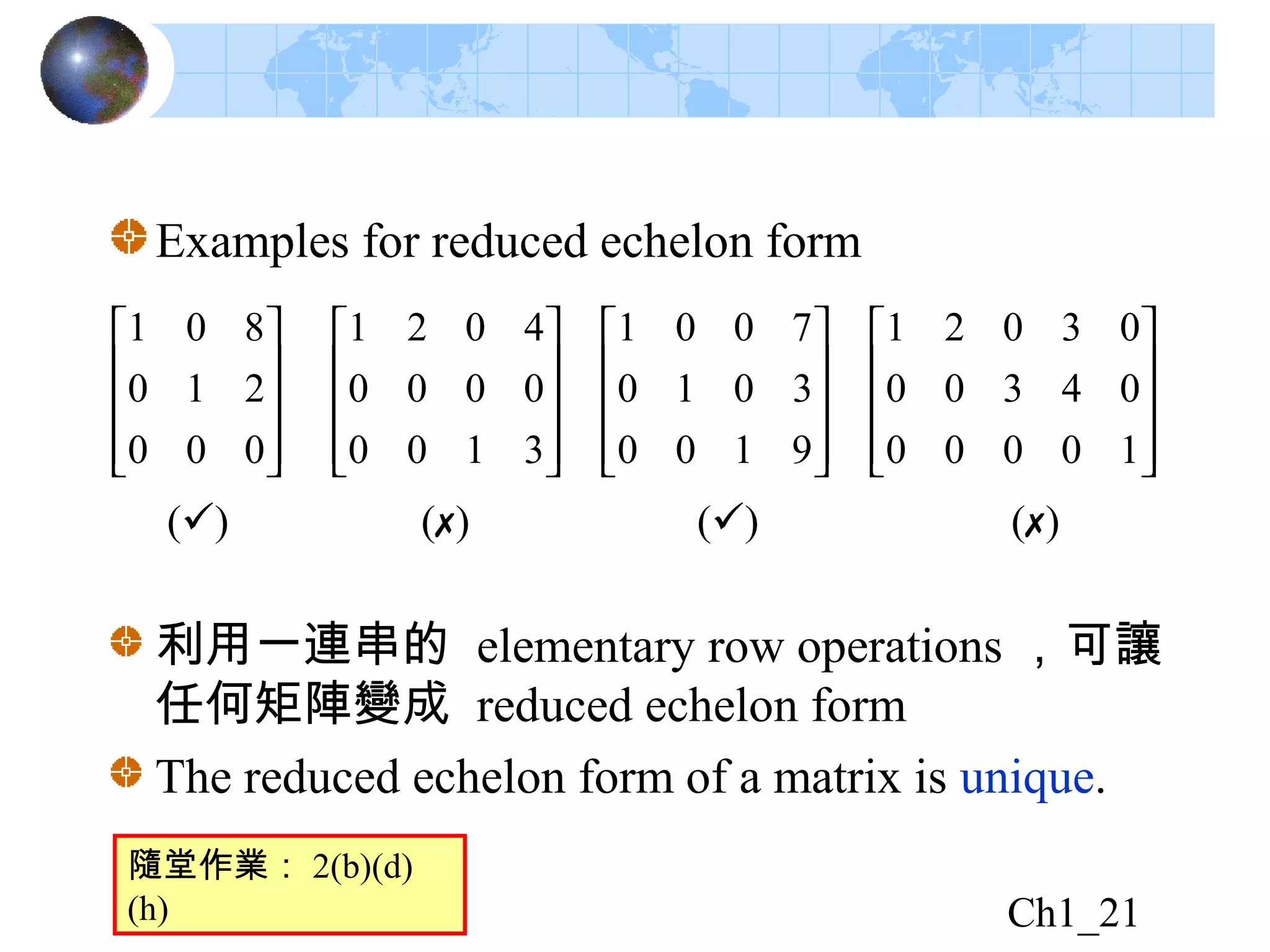
Examples for reduced echelon form








































10000
04300
03021
9100
3010
7001
3100
0000
4021
000
210
801
() ()() ()
利用一連串的 elementary row operations ,可讓
任何矩陣變成 reduced echelon form
The reduced echelon form of a matrix is unique.
隨堂作業: 2(b)(d)
(h)
Ch1_22
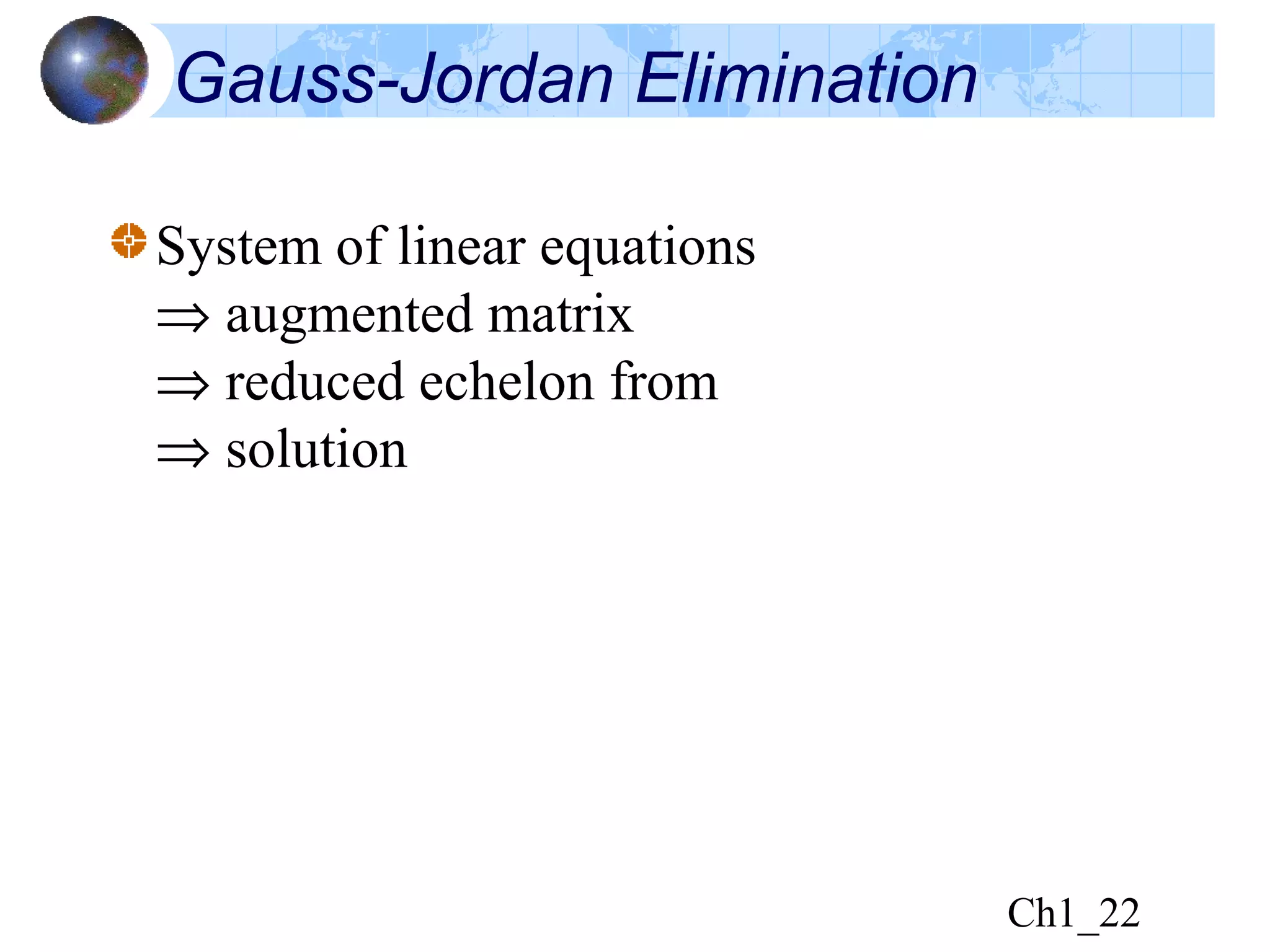
Gauss-Jordan Elimination
System of linear equations
⇒ augmented matrix
⇒ reduced echelon from
⇒ solution
Ch1_23












−−
−
−
−+
≈
41200
22200
43111
4)R1(R3








−
−
−+
+
≈
61000
11100
52011
R2)2(R3
R2R1
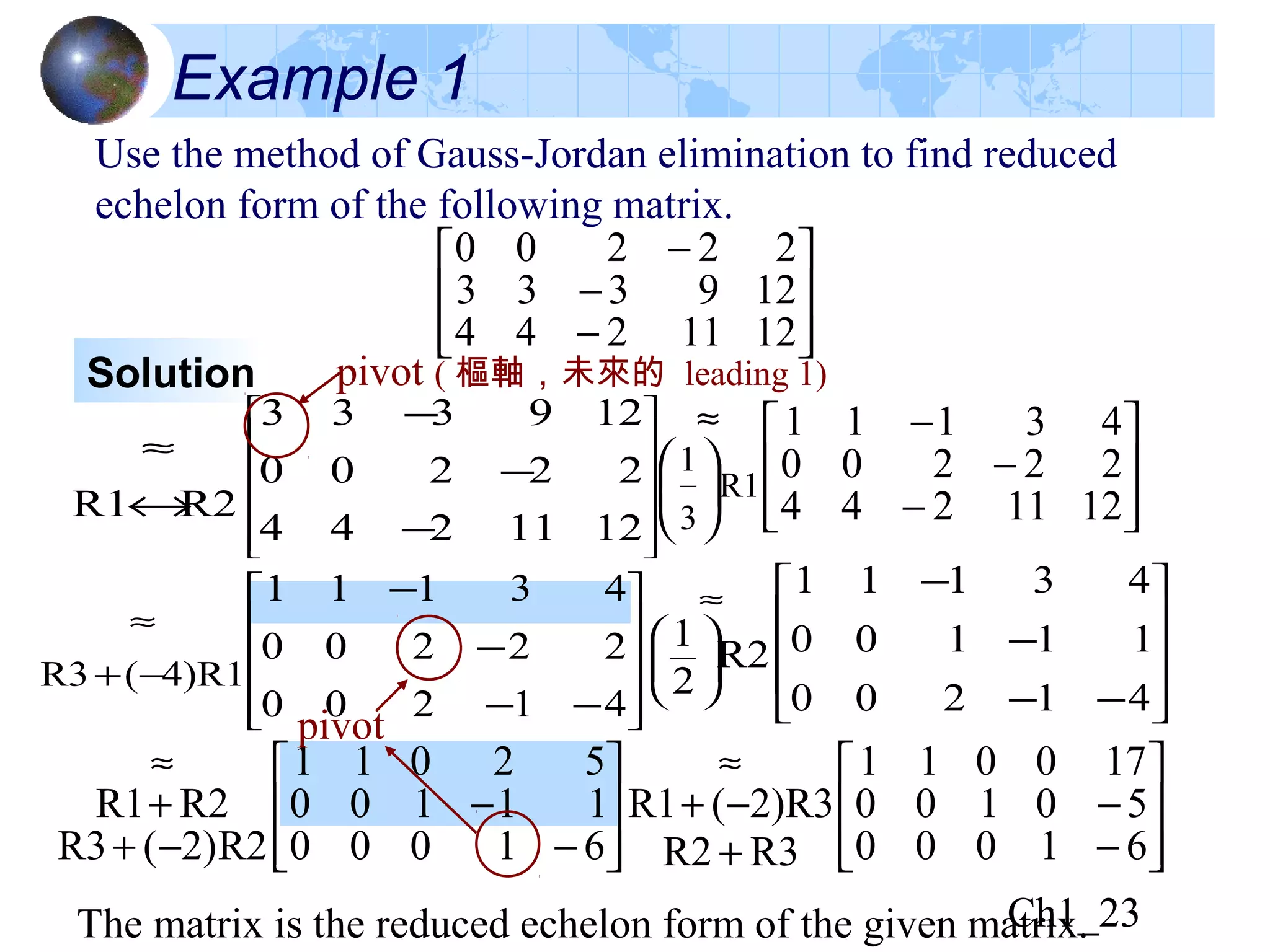
Example 1
Use the method of Gauss-Jordan elimination to find reduced
echelon form of the following matrix.








−
−
−
1211244
129333
22200
Solution
















−
−
−
↔
≈
1211244
22200
129333
R2R1
pivot ( 樞軸,未來的 leading 1)








−
−
−






≈
1211244
22200
43111
R1
3
1
pivot








−
−
+
−+
≈
61000
50100
170011
R3R2
2)R3(R1
The matrix is the reduced echelon form of the given matrix.
















≈
−−
−
−
41200
11100
43111
R2
2
1
Ch1_24
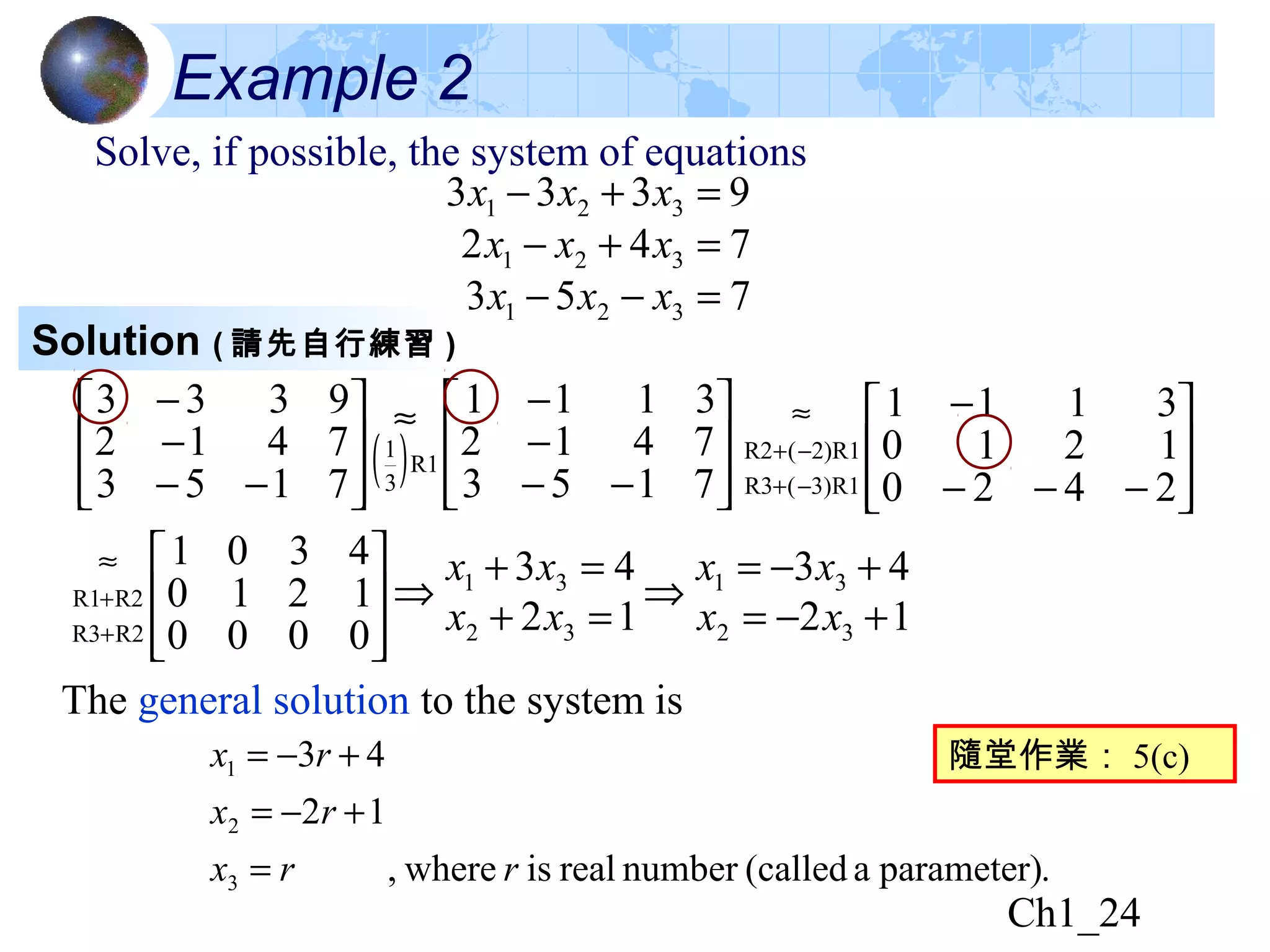
Example 2
Solve, if possible, the system of equations
753
742
9333
321
321
321
=−−
=+−
=+−
xxx
xxx
xxx
Solution ( 請先自行練習 )
( ) 







−−
−
−≈








−−
−
−
7153
7412
3111
7153
7412
9333
R1
3
1








−−−
−
−+
−+
≈
2420
1210
3111
3)R1(R3
2)R1(R2








+
+
≈
0000
1210
4301
R2R3
R2R1
12
43
12
43
32
31
32
31
+−=
+−=
⇒
=+
=+
⇒
xx
xx
xx
xx
The general solution to the system is
.parameter)a(callednumberrealiswhere,
12
43
3
2
1
rrx
rx
rx
=
+−=
+−= 隨堂作業: 5(c)
Ch1_25
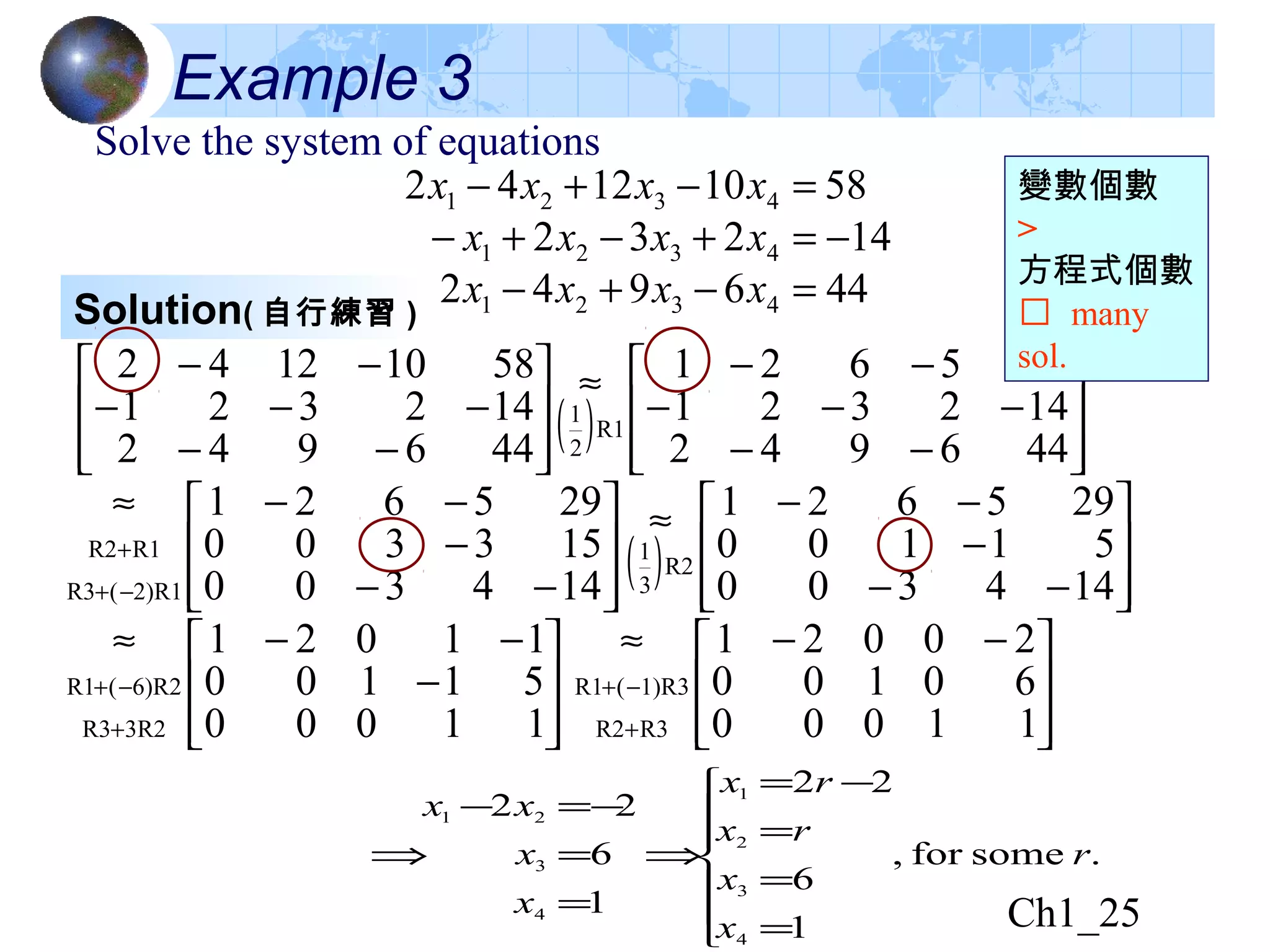
Example 3
Solve the system of equations
446942
14232
58101242
4321
4321
4321
=−+−
−=+−+−
=−+−
xxxx
xxxx
xxxx
Solution( 自行練習 )
( ) 







−−
−−−
−−≈








−−
−−−
−−
446942
142321
295621
446942
142321
58101242
R1
2
1








−−
−
−−≈
−+
+
144300
153300
295621
2)R1(R3
R1R2
( ) 







−−
−
−−≈
144300
51100
295621
R2
3
1








−
−−≈
+
−+
11000
51100
11021
3R2R3
6)R2(R1







 −−≈
+
−+
11000
60100
20021
R3R2
1)R3(R1
.somefor,
1
6
22
1
6
22
4
3
2
1
4
3
21
r
x
x
rx
rx
x
x
xx







=
=
=
−=
⇒
=
=
−=−
⇒
變數個數
>
方程式個數
 many
sol.
Ch1_26
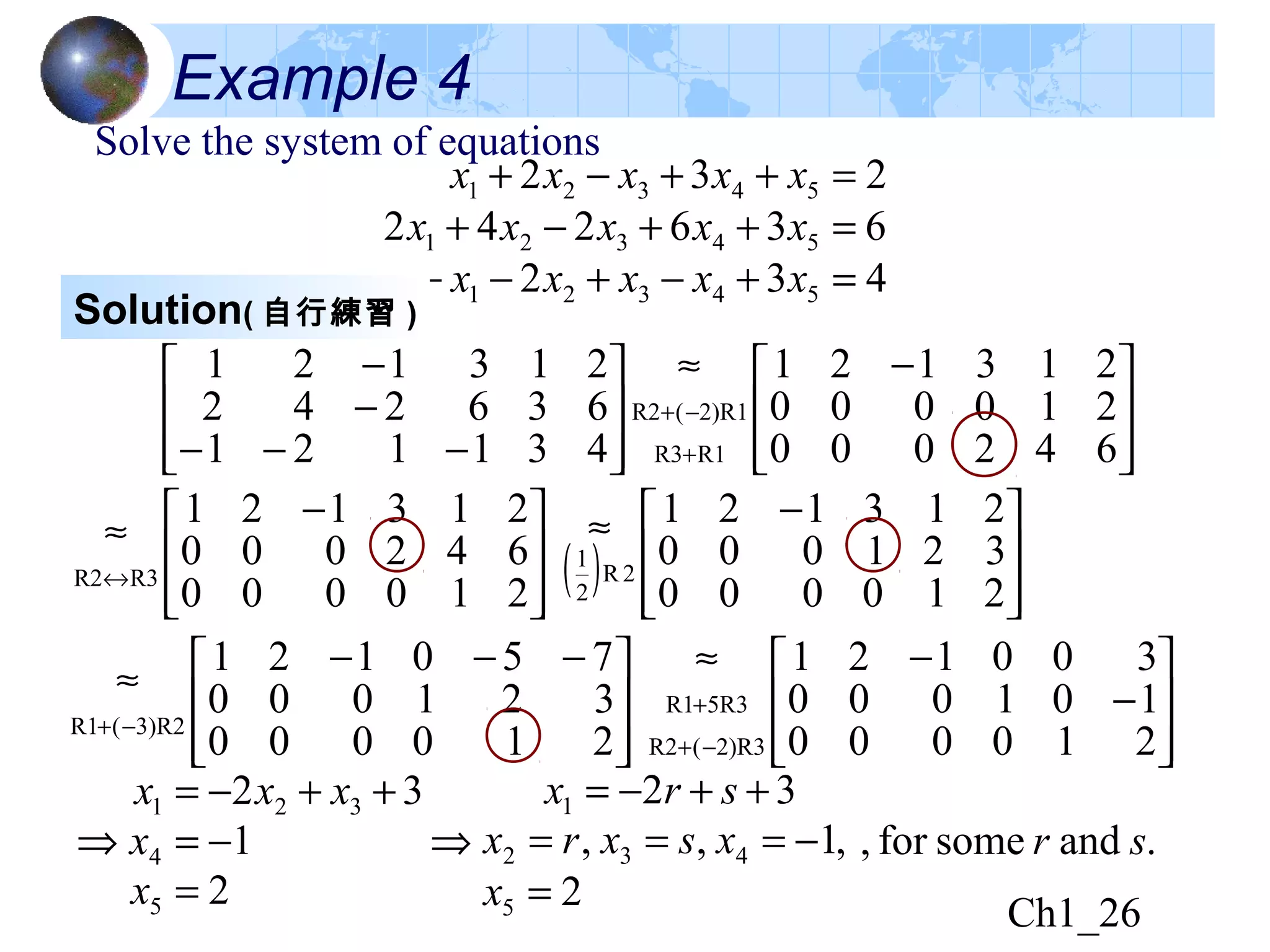
Example 4
Solve the system of equations
432
636242
232
54321
54321
54321
=+−+−−
=++−+
=++−+
xxxxx
xxxxx
xxxxx
Solution( 自行練習 )







 −≈








−−−
−
−
+
−+
642000
210000
213121
431121
636242
213121
R1R3
2)R1(R2







 −
≈
↔
210000
642000
213121
R3R2 ( ) 






 −≈
210000
321000
213121
2R
2
1







 −−−
≈
−+
210000
321000
750121
3)R2(R1








−
−≈
−+
+
210000
101000
300121
2)R3(R2
5R3R1
.andsomefor,
2
,1,,
32
2
1
32
5
432
1
5
4
321
sr
x
xsxrx
srx
x
x
xxx
=
−===
++−=
⇒
=
−=
++−=
⇒
Ch1_27
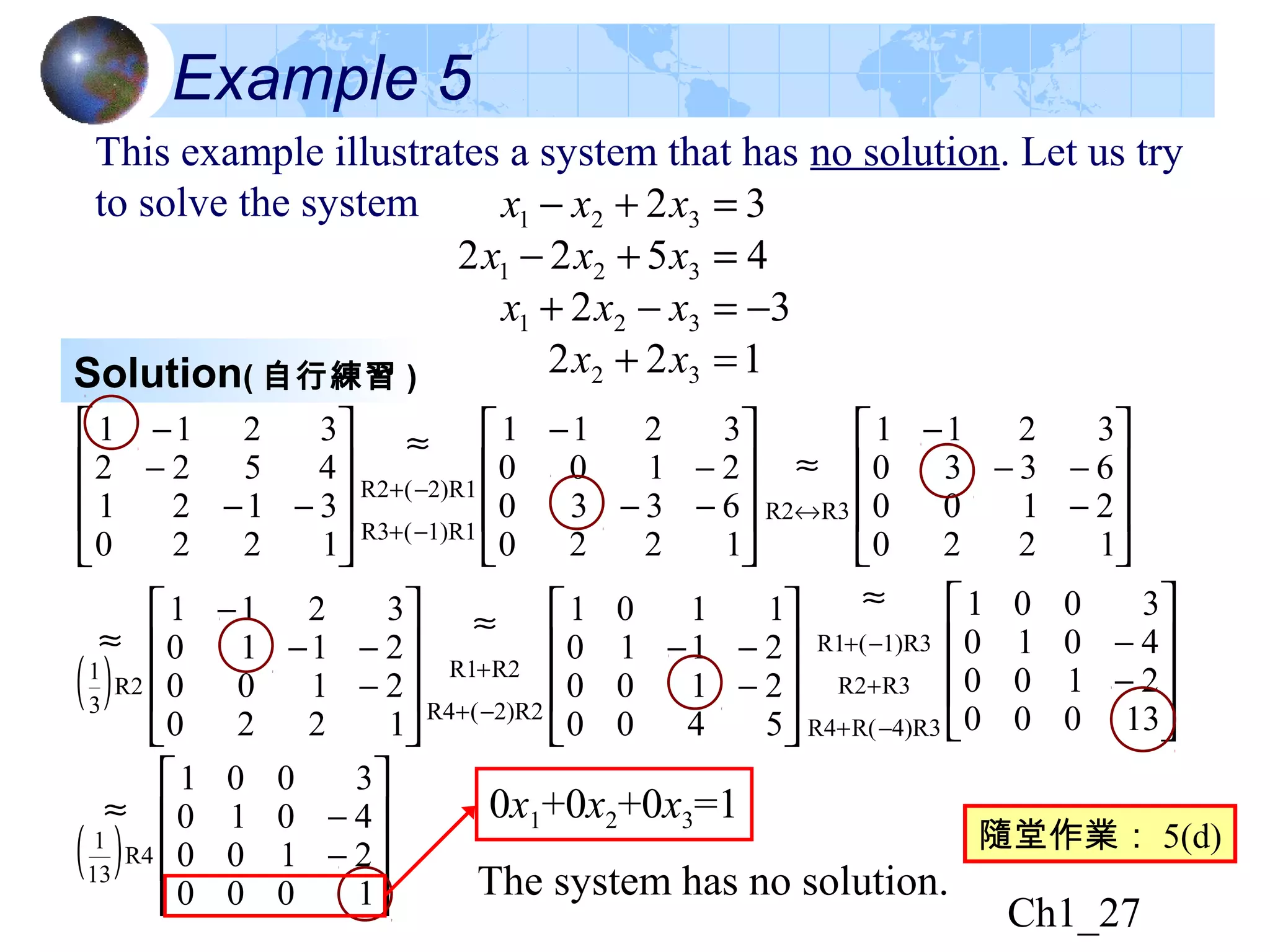
Example 5
This example illustrates a system that has no solution. Let us try
to solve the system
122
32
4522
32
32
321
321
321
=+
−=−+
=+−
=+−
xx
xxx
xxx
xxx
Solution( 自行練習 )








≈
−
−−
−
↔
1220
2100
6330
3211
R3R2
( ) 







≈
−
−−
−
1220
2100
2110
3211
R2
3
1







≈
−
−−
−+
+
5400
2100
2110
1101
2)R2(R4
R2R1







≈
−
−
−+
+
−+
13000
2100
4010
3001
4)R3R(R4
R3R2
1)R3(R1
( ) 







≈
−
−
1000
2100
4010
3001
R4
13
1
The system has no solution.







≈








−−
−
−
−−
−
−
−+
−+
1220
6330
2100
3211
1220
3121
4522
3211
1)R1(R3
2)R1(R2
0x1+0x2+0x3=1
隨堂作業: 5(d)
Ch1_28
Homogeneous System of linear
Equations
Definition
A system of linear equations is said to be homogeneous ( 齊
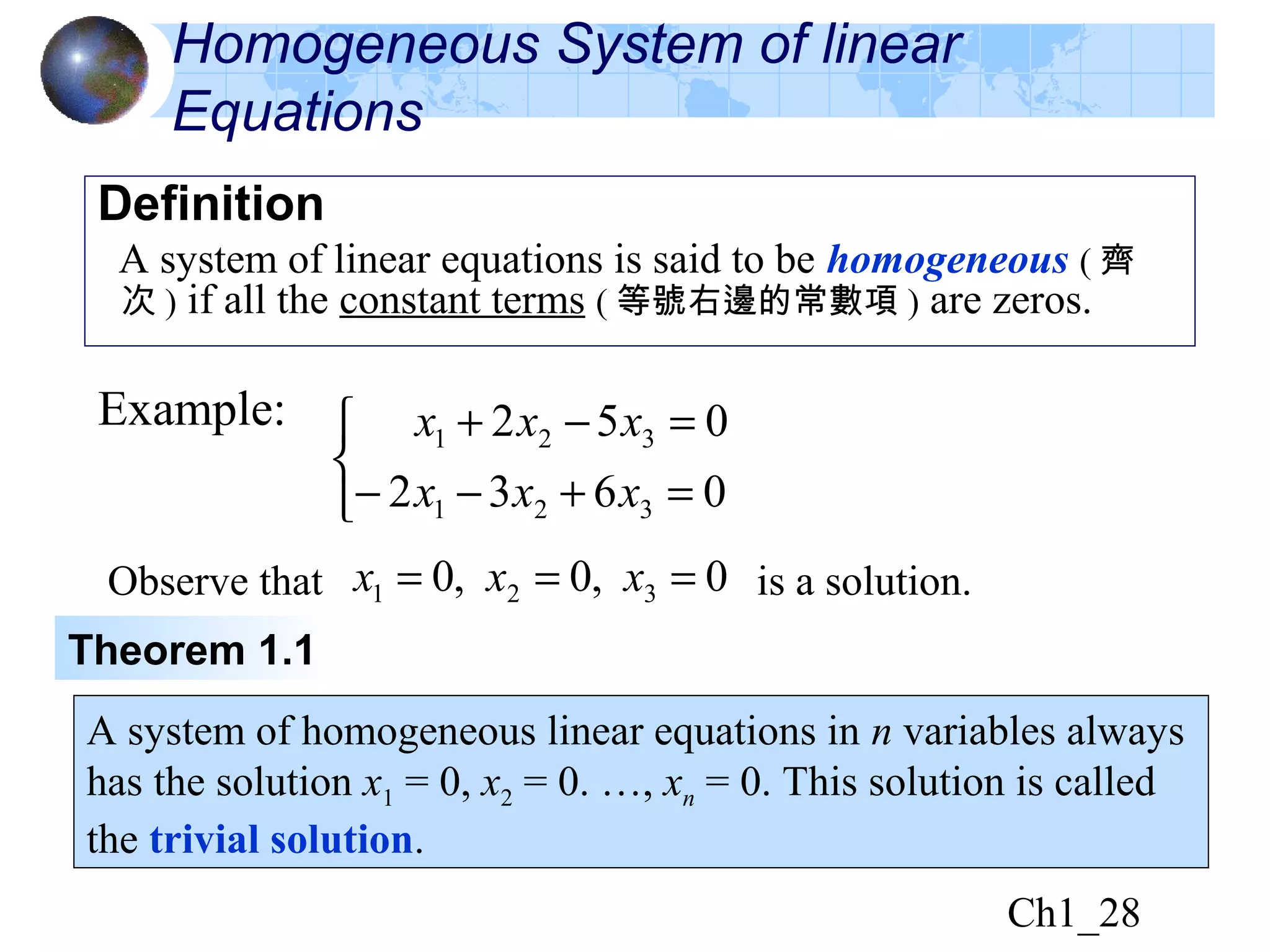
次 ) if all the constant terms ( 等號右邊的常數項 ) are zeros.
Example:



=+−−
=−+
0632
052
321
321
xxx
xxx
Observe that is a solution.0,0,0 321 === xxx
Theorem 1.1
A system of homogeneous linear equations in n variables always
has the solution x1 = 0, x2 = 0. …, xn = 0. This solution is called
the trivial solution.
Ch1_29
Homogeneous System of linear
Equations
Theorem 1.2
A system of homogeneous linear equations that has more
variables than equations has many solutions.
Note. 除 trivial solution 外,可能還有其他解。
隨堂作業: 8(e)






−
≈≈





−−
−
0410
0301
0632
0521




=+−−
=−+
0632
052
321
321
xxx
xxx
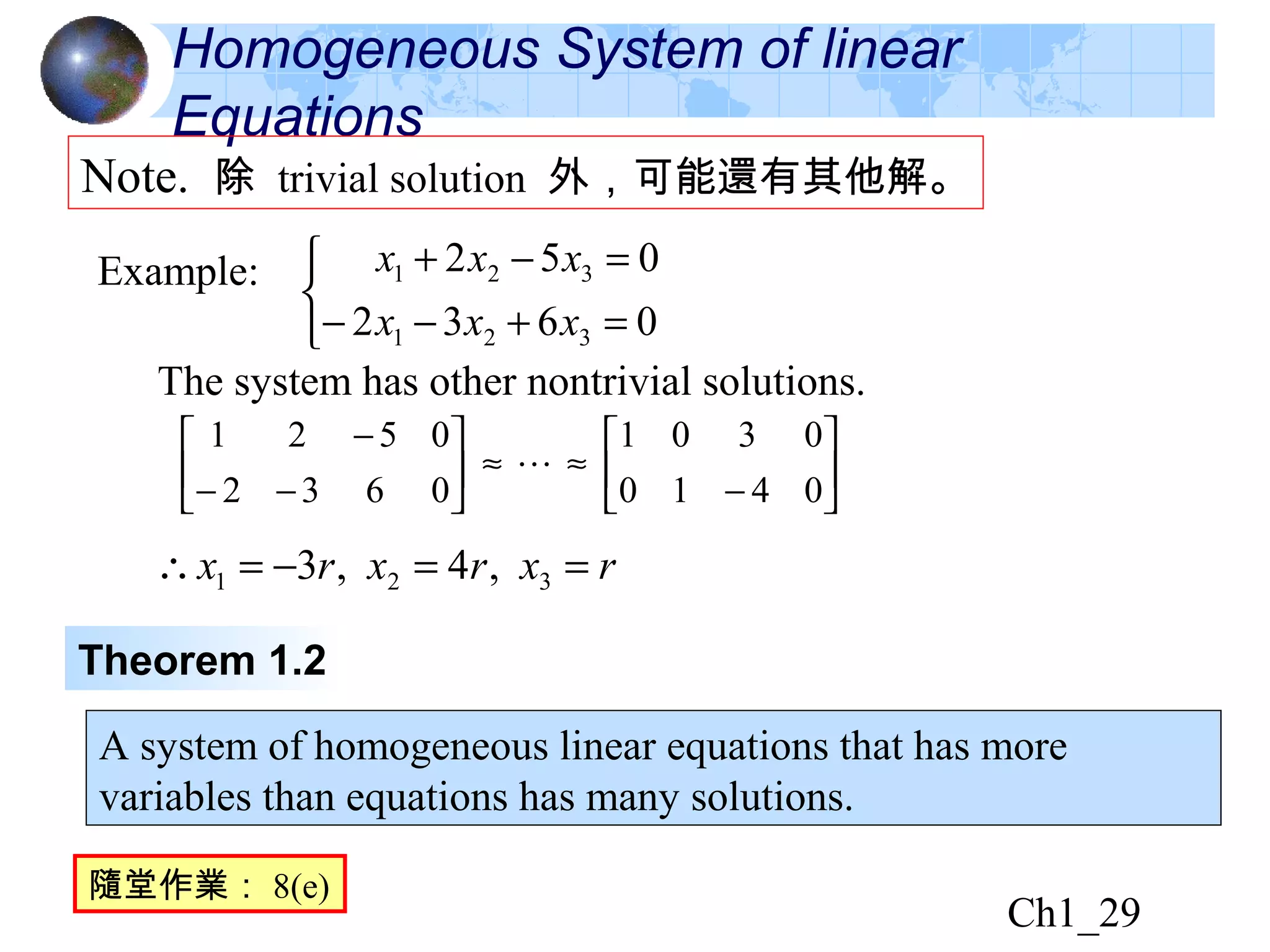
The system has other nontrivial solutions.
rxrxrx ==−=∴ 321 ,4,3
Example:
Ch1_30
Homework
Exercise 1.2:
2, 5, 8, 14
(Section 1.3 跳過 )

Linear algebra

  • 1.
    Chapter 1 Systems ofLinear Equations 感謝 大葉大學 資訊工程系 鈴玲老師 提供黃 Linear Algebra
  • 2.
    Ch1_2 Definition • An equationsuch as x+3y=9 is called a linear equation. ( 線性方程式 ) • The graph of this equation is a straight line in the x-y plane. • A pair of values of x and y that satisfy the equation is called a solution. 1.1 Matrices and Systems of Linear Equations system of linear equations ( 線性聯立方程式 )
  • 3.
    Ch1_3 Definition A linear equationin n variables ( 變數 ) x1, x2, x3, …, xn has the form a1 x1 + a2 x2 + a3 x3 + … + an xn = b where the coefficients ( 係數 ) a1, a2, a3, …, an and b are real numbers ( 實數 ). 常見數系的英文名稱: natural number ( 自然數 ), integer ( 整數 ), rational number ( 有理數 ), real number ( 實數 ), complex number ( 複數 ) positive ( 正 ), negative ( 負 )
  • 4.
    Ch1_4 Figure 1.2 No solution( 無解 ) –2x + y = 3 –4x + 2y = 2 Lines are parallel. No point of intersection. No solutions. Solutions for system of linear equations Figure 1.1 Unique solution ( 唯一解 ) x + 3y = 9 –2x + y = –4 Lines intersect at (3, 2) Unique solution: x = 3, y = 2. Figure 1.3 Many solution ( 無限多 解 ) 4x – 2y = 6 6x – 3y = 9 Both equations have the same graph. Any point on the graph is a solution. Many solutions.
  • 5.
    Ch1_5 A linear equationin three variables corresponds to a plane in three-dimensional ( 三維 ) space. Unique solution ※ Systems of three linear equations in three variables:
  • 6.
  • 7.
    Ch1_7 How to solvea system of linear equations? Gauss-Jordan elimination. ( 高斯 - 喬登消去法 ) 1.2 節會介紹
  • 8.
    Ch1_8 Definition • A matrix( 矩陣 ) is a rectangular array of numbers. • The numbers in the array are called the elements ( 元素 ) of the matrix. Matrices           −=           − =      − − = 1298 520 653 C 38 50 17 B 157 432 A 注意矩陣左右兩邊是中括號不是直線,直線表示的是行列式。
  • 9.
    Ch1_9 Submatrix ( 子矩陣) Amatrix 215 032 471           − =A Row ( 列 ) and Column ( 行 ) [ ] [ ] 3column2column1column2row1row 1 4 5 3 7 2 157432       − −             −− 157 432       − − =A Aofssubmatrice 25 41 1 3 7 15 32 71       − =           =           = RQP
  • 10.
    Ch1_10 Identity Matrices (單位矩陣 ) diagonal ( 對角線 ) 上都是 1 ,其餘都是 0 , I 的下標表示 size         =    = 100 010 001 10 01 32 II Location 7,4 157 432 2113 =−=      − − = aaA aij 表示在 row i, column j 的元素值 也寫成 location (1,3) = −4 Size and Type [ ] matrixcolumnamatrixrowamatrixsquarea matrix13matrix41matrix3332:Size 2 3 8 5834 853 109 752 542 301 ××××           −           − −      −
  • 11.
    Ch1_11 matrix of coefficientand augmented matrix 62 332 2 321 321 321 −=−− =++ =++ xxx xxx xxx Relations between system of linear equations and matrices 係數矩陣 擴大矩陣 隨堂作業: 5(f) tcoefficienofmatrix 211 132 111           −− matrixaugmented 6211 3132 2111           −−−
  • 12.
    Ch1_12 給定聯立方程式後, 不會改變解的一些轉換 Elementary Transformation 1. Interchangetwo equations. 2. Multiply both sides of an equation by a nonzero constant. 3. Add a multiple of one equation to another equation. 將左邊的轉換對應到矩陣上 Elementary Row Operation ( 基本列運算 ) 1. Interchange two rows of a matrix. ( 兩列交換 ) 2. Multiply the elements of a row by a nonzero constant. ( 某列的元素同乘一非零常數 ) 3. Add a multiple of the elements of one row to the corresponding elements of another row. ( 將一個列的倍數加進另一列裡 ) Elementary Row Operations of Matrices
  • 13.
    Ch1_13 Example 1 Solving thefollowing system of linear equation. 62 332 2 321 321 321 −=−− =++ =++ xxx xxx xxx         −−− 6211 3132 2111 62 332 2 321 321 321 −=−− =++ =++ xxx xxx xxx Solution Equation Method Initial system: Analogous Matrix Method Augmented matrix: 1 2 32 321 −=− =++ xx xxx Eq2+(–2)Eq1 Eq3+(–1)Eq1         −−− −− 8320 1110 2111 R2+(–2)R1 R3+(–1)R1 ≈  符號表示 row equivalent 832 32 −=−− xx
  • 14.
    Ch1_14 105 1 32 3 32 31 −=− −=− =+ x xx xx         −− −− 01500 1110 3201 2 1 32 3 32 31 = −=− =+ x xx xx         −− 2100 1110 3201 2 1 1 3 2 1 = = −= x x x           − 2100 1010 1001 Eq1+(–1)Eq2 Eq3+(2)Eq2 (–1/5)Eq3 Eq1+(–2)Eq3 Eq2+Eq3 The solutionis .2,1,1 321 ==−= xxx The solution is .2,1,1 321 ==−= xxx 832 1 2 32 32 321 −=−− −=− =++ xx xx xxx         −−− −− 8320 1110 2111 R1+(–1)R2 R3+(2)R2 ≈ (–1/5)R3 ≈ R1+(–2)R3 R2+R3 ≈ 隨堂作業: 7(d)
  • 15.
    Ch1_15 Example 2 Solving thefollowing system of linear equation. 833 1852 1242 321 321 321 −=−+− =+− =+− xxx xxx xxx Solution ( 請先自行練習 )         −−− − − 8331 18512 12421         −− − 4110 6330 12421 R2 3 1       ≈         −− − 4110 2110 12421         −− 6200 2110 8201           −− 3100 2110 8201 R1R3 2)R1(R2 + −+ ≈ R2)1(R3 (2)R2R1 −+ + ≈ R3 2 1       ≈           3100 1010 2001 R3R2 2)R3(R1 + −+ ≈ . 3 1 2 solution 3 2 1      = = = x x x
  • 16.
    Ch1_16 Example 3 Solve thesystem 72 32863 441284 21 321 321 −=−− =−+ =−+ xx xxx xxx           −−− − − 7012 32863 441284           −−− − − 7012 32863 11321           − − − 15630 1100 11321           − − − 1100 5210 11321           − − 1100 5210 1101 . 1100 3010 2001           − .1,3,2issolutionThe 321 −=== xxx R2 3 1       ≈ R12R3 3)R1(R2 + −+ ≈ R3R2 ↔ ≈           − − − 1100 15630 11321 R1 4 1       ≈ 2)R2(R1 −+ ≈ 2R3R2 1)R3(R1 + −+ ≈ Solution ( 請先自行練習 ) 隨堂作業: 10(d)(f)
  • 17.
    Ch1_17 Summary           −−− − − = 7012 32863 441284 ]:[ BA A BUserow operations to [A: B] : . 1100 3010 2001           − ≈≈           −−− − −  7012 32863 441284 ]:[]:[ XIBA n≈≈i.e., Def. [In : X] is called the reduced echelon form ( 簡化梯 式 ) of [A : B].Note. 1. If A is the matrix of coefficients of a system of n equations in n variables that has a unique solution, then A is row equivalent to In (A ≈ In). 2. If A ≈ In, then the system has unique solution. 72 32863 441284 21 321 321 −=−− =−+ =−+ xx xxx xxx
  • 18.
    Ch1_18 Example 4 ManySystems Solving the following three systems of linear equation, all of which have the same matrix of coefficients. 3321 2321 1321 42 for42 3 bxxx bxxx bxxx =−+− =+− =+− in turn 4 3 3 , 2 1 0 , 11 11 8 3 2 1         −                − =         b b b Solution         −−−− − − 4211421 3111412 308311 . 2 1 2 , 1 3 0 , 2 1 1 3 2 1 3 2 1 3 2 1      = = −=      = = =      = −= = x x x x x x x x x         −−− −−− − 123110 315210 308311             −−− 212100 315210 013101             − − 212100 131010 201001 R2+(–2)R1 R3+R1 ≈ 1)R2(R3 R2R1 −+ + ≈ R32R2 R3)1(R1 + −+ ≈ 隨堂作業: 13(b) The solutions to the three systems are
  • 19.
  • 20.
    Ch1_20 1-2 Gauss-Jordan Elimination Definition Amatrix is in reduced echelon form ( 簡化梯式 ) if 1. Any rows consisting entirely of zeros are grouped at the bottom of the matrix. 2. The first nonzero element of each other row is 1. This element is called a leading 1. 3. The leading 1 of each row after the first is positioned to the right of the leading 1 of the previous row. 4. All other elements in a column that contains a leading 1 are zero.
  • 21.
    Ch1_21 Examples for reducedechelon form                                         10000 04300 03021 9100 3010 7001 3100 0000 4021 000 210 801 () ()() () 利用一連串的 elementary row operations ,可讓 任何矩陣變成 reduced echelon form The reduced echelon form of a matrix is unique. 隨堂作業: 2(b)(d) (h)
  • 22.
    Ch1_22 Gauss-Jordan Elimination System oflinear equations ⇒ augmented matrix ⇒ reduced echelon from ⇒ solution
  • 23.
    Ch1_23             −− − − −+ ≈ 41200 22200 43111 4)R1(R3         − − −+ + ≈ 61000 11100 52011 R2)2(R3 R2R1 Example 1 Use themethod of Gauss-Jordan elimination to find reduced echelon form of the following matrix.         − − − 1211244 129333 22200 Solution                 − − − ↔ ≈ 1211244 22200 129333 R2R1 pivot ( 樞軸,未來的 leading 1)         − − −       ≈ 1211244 22200 43111 R1 3 1 pivot         − − + −+ ≈ 61000 50100 170011 R3R2 2)R3(R1 The matrix is the reduced echelon form of the given matrix.                 ≈ −− − − 41200 11100 43111 R2 2 1
  • 24.
    Ch1_24 Example 2 Solve, ifpossible, the system of equations 753 742 9333 321 321 321 =−− =+− =+− xxx xxx xxx Solution ( 請先自行練習 ) ( )         −− − −≈         −− − − 7153 7412 3111 7153 7412 9333 R1 3 1         −−− − −+ −+ ≈ 2420 1210 3111 3)R1(R3 2)R1(R2         + + ≈ 0000 1210 4301 R2R3 R2R1 12 43 12 43 32 31 32 31 +−= +−= ⇒ =+ =+ ⇒ xx xx xx xx The general solution to the system is .parameter)a(callednumberrealiswhere, 12 43 3 2 1 rrx rx rx = +−= +−= 隨堂作業: 5(c)
  • 25.
    Ch1_25 Example 3 Solve thesystem of equations 446942 14232 58101242 4321 4321 4321 =−+− −=+−+− =−+− xxxx xxxx xxxx Solution( 自行練習 ) ( )         −− −−− −−≈         −− −−− −− 446942 142321 295621 446942 142321 58101242 R1 2 1         −− − −−≈ −+ + 144300 153300 295621 2)R1(R3 R1R2 ( )         −− − −−≈ 144300 51100 295621 R2 3 1         − −−≈ + −+ 11000 51100 11021 3R2R3 6)R2(R1         −−≈ + −+ 11000 60100 20021 R3R2 1)R3(R1 .somefor, 1 6 22 1 6 22 4 3 2 1 4 3 21 r x x rx rx x x xx        = = = −= ⇒ = = −=− ⇒ 變數個數 > 方程式個數  many sol.
  • 26.
    Ch1_26 Example 4 Solve thesystem of equations 432 636242 232 54321 54321 54321 =+−+−− =++−+ =++−+ xxxxx xxxxx xxxxx Solution( 自行練習 )         −≈         −−− − − + −+ 642000 210000 213121 431121 636242 213121 R1R3 2)R1(R2         − ≈ ↔ 210000 642000 213121 R3R2 ( )         −≈ 210000 321000 213121 2R 2 1         −−− ≈ −+ 210000 321000 750121 3)R2(R1         − −≈ −+ + 210000 101000 300121 2)R3(R2 5R3R1 .andsomefor, 2 ,1,, 32 2 1 32 5 432 1 5 4 321 sr x xsxrx srx x x xxx = −=== ++−= ⇒ = −= ++−= ⇒
  • 27.
    Ch1_27 Example 5 This exampleillustrates a system that has no solution. Let us try to solve the system 122 32 4522 32 32 321 321 321 =+ −=−+ =+− =+− xx xxx xxx xxx Solution( 自行練習 )         ≈ − −− − ↔ 1220 2100 6330 3211 R3R2 ( )         ≈ − −− − 1220 2100 2110 3211 R2 3 1        ≈ − −− −+ + 5400 2100 2110 1101 2)R2(R4 R2R1        ≈ − − −+ + −+ 13000 2100 4010 3001 4)R3R(R4 R3R2 1)R3(R1 ( )         ≈ − − 1000 2100 4010 3001 R4 13 1 The system has no solution.        ≈         −− − − −− − − −+ −+ 1220 6330 2100 3211 1220 3121 4522 3211 1)R1(R3 2)R1(R2 0x1+0x2+0x3=1 隨堂作業: 5(d)
  • 28.
    Ch1_28 Homogeneous System oflinear Equations Definition A system of linear equations is said to be homogeneous ( 齊 次 ) if all the constant terms ( 等號右邊的常數項 ) are zeros. Example:    =+−− =−+ 0632 052 321 321 xxx xxx Observe that is a solution.0,0,0 321 === xxx Theorem 1.1 A system of homogeneous linear equations in n variables always has the solution x1 = 0, x2 = 0. …, xn = 0. This solution is called the trivial solution.
  • 29.
    Ch1_29 Homogeneous System oflinear Equations Theorem 1.2 A system of homogeneous linear equations that has more variables than equations has many solutions. Note. 除 trivial solution 外,可能還有其他解。 隨堂作業: 8(e)       − ≈≈      −− − 0410 0301 0632 0521     =+−− =−+ 0632 052 321 321 xxx xxx The system has other nontrivial solutions. rxrxrx ==−=∴ 321 ,4,3 Example:
  • 30.
    Ch1_30 Homework Exercise 1.2: 2, 5,8, 14 (Section 1.3 跳過 )