Monitoring/Evaluation
By
Sudipta Barman
Project & Project Cycle
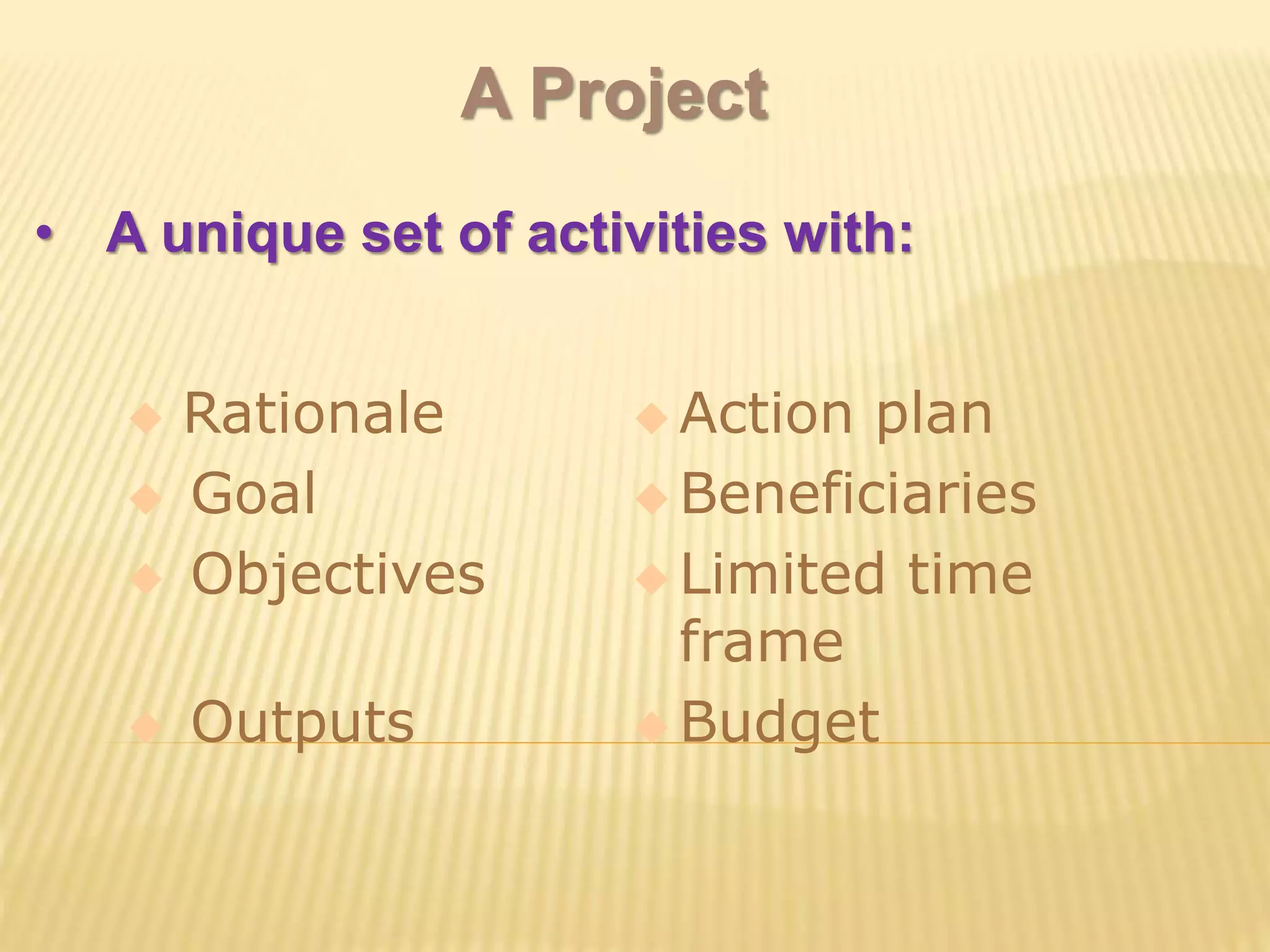
A Project
• A unique set of activities with:
 Rationale  Action plan
 Goal  Beneficiaries
 Objectives  Limited time
frame
 Outputs  Budget
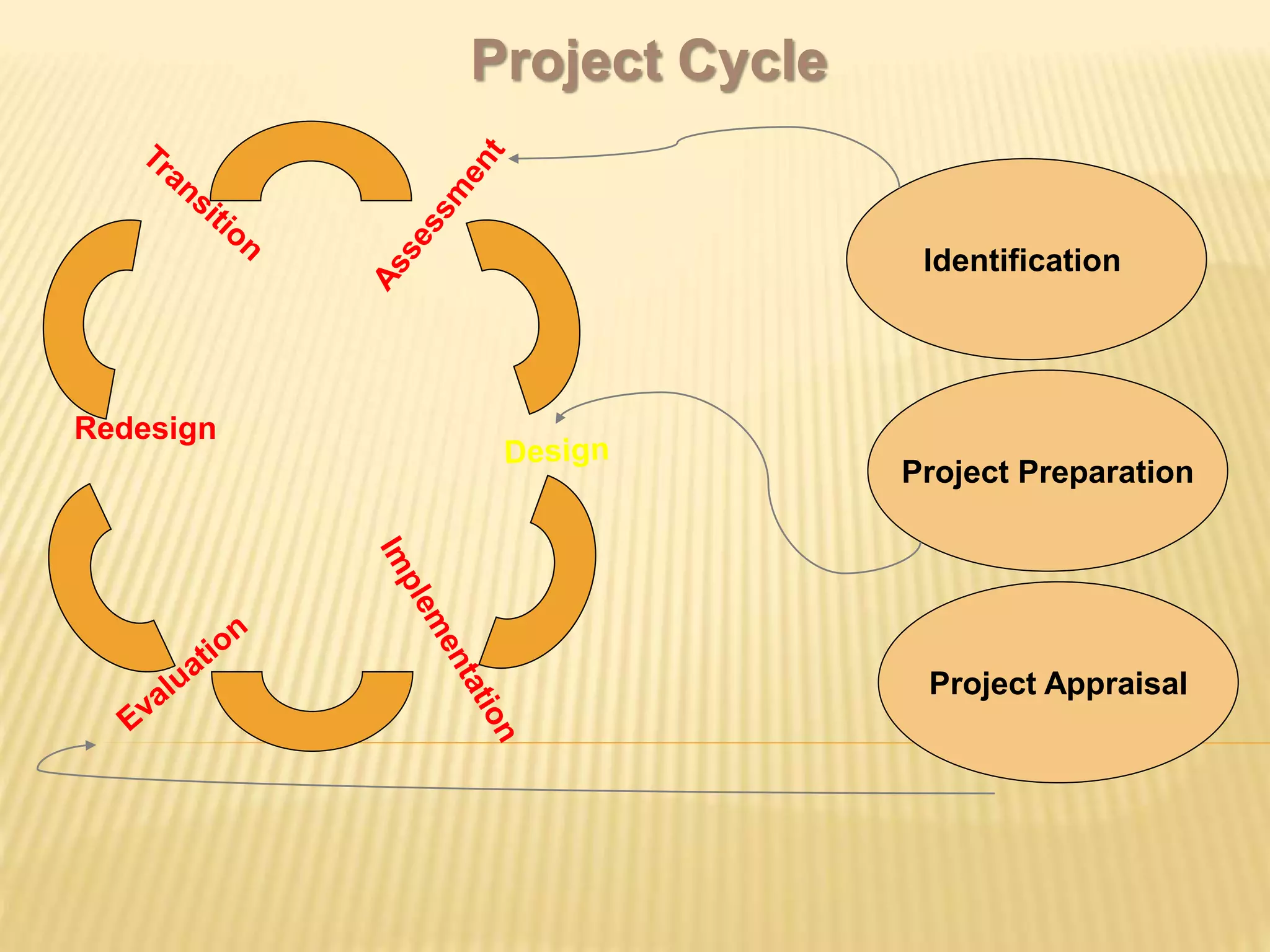
Project Cycle
Redesign
Identification
Project Preparation
Project Appraisal
Monitoring
DEFINITION
• Monitoring is the recording
“Whether right thing is being delivered to the
right people at the right time in a right way
(process)”
WHAT IS MONITORING?
• Looking into the process, going towards the
target, right selection of beneficiaries
• Procedures are being followed according to the
work plan
• Meeting our target or not (target monitoring),
activity monitoring
• Continuous info collection/analysis/reporting for
decision making
• Program is going in right direction as planned in
the project document
Monitoring
Systematic recording of :
• Observations
• Information gathering
• Analysis
• Documentation
• Reflection and
• Action………..re-planning
WHAT IS NOT MONITORING
• Policing/imposing
• Pointing out (but it is highlighting)
DON’T LET THE THINGS HAPPEN IN
THEIR OWN WAY……….
REPORT RIGHT THING AT RIGHT
TIME TO THE RIGHT PERSON!!!
DON’T JUST WRITE FOR FILES
BE THE USER OF
INFORMATION NOT THE
OWNER!!!!!
TOOLS FOR MONITORING
MONITORING TOOLS
• Staff meetings – Weekly, Monthly, Annual
• Partners meeting/Learning Forums (FGD,
Surveys)/Retreat
• Participatory Reviews – Stakeholders
• Monitoring and Supervision Mission
(Self/Donors/Joint)
• Progress reports/Statistics
»
• To ensure that inputs, activities and outputs proceed
according to plan
• Determine whether the inputs are optimally utilized
• Ensuring all activities are carried out by the right people
and in time
• To provide record of inputs, activities, and outputs
• To warn of deviations from objectives
• To assist managers in making decisions
• Monitoring should take place at and be integrated into all
stages of the project cycle
Goals of Monitoring
Evaluation
Evaluation
Judging, appraising, determining the worth,
value, or quality of a project to make
necessary decisions.
In terms of:
• Relevance
• Effectiveness
• Efficiency
• Sustainability
• Impact
Five Strategic Evaluation Questions
• Relevance: The extent to which the objectives of a
development intervention are consistent with
beneficiaries´ requirements, and partner’s and
donor’s policies.
• Effectiveness: doing right things
• Efficiency: doing things right
• Sustainability: Meeting needs without
compromising the ability of future generations to
meet their needs (project will continue after donors
intervention)
• Impact: Positive or negative, direct or indirect long-
term impact produced by a development
intervention.
Evaluation Provides Information
Strategy: Are the right things being done?
• Rationale or justification
• impact
Operations: Are things being right?
• Effectiveness in achieving expected outcomes
• Efficiency in optimizing resources
• Client satisfaction
Learning: Are there better ways?
• Alternatives
• Lessons learned
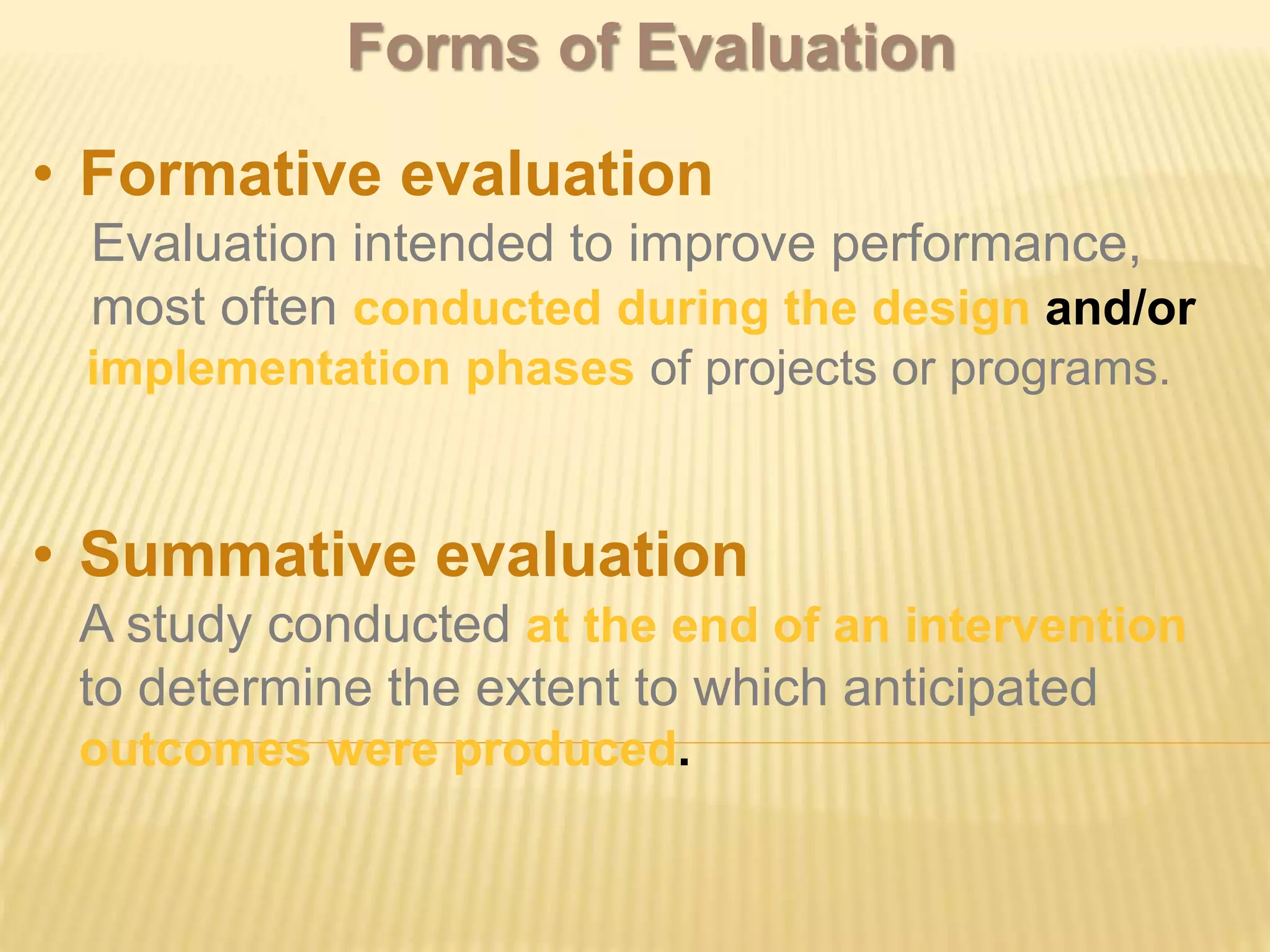
• Formative evaluation
Evaluation intended to improve performance,
most often conducted during the design and/or
implementation phases of projects or programs.
• Summative evaluation
A study conducted at the end of an intervention
to determine the extent to which anticipated
outcomes were produced.
Forms of Evaluation
• Participatory evaluation
• Process based evaluation
• Outcome based evaluation
• Self-evaluation (360 degree evaluation)
• Goal-based evaluation
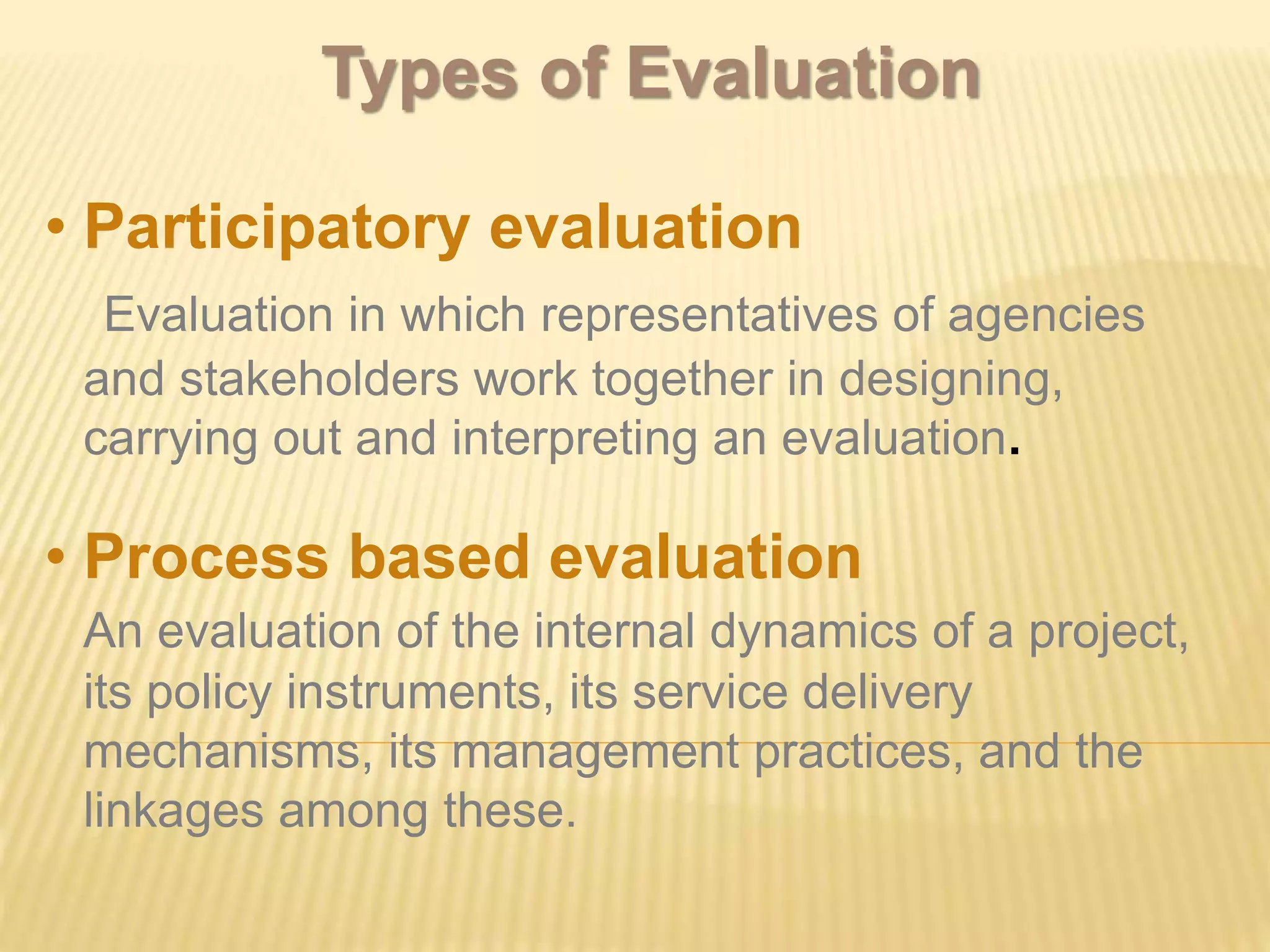
Types of Evaluation
• Participatory evaluation
Evaluation in which representatives of agencies
and stakeholders work together in designing,
carrying out and interpreting an evaluation.
• Process based evaluation
An evaluation of the internal dynamics of a project,
its policy instruments, its service delivery
mechanisms, its management practices, and the
linkages among these.
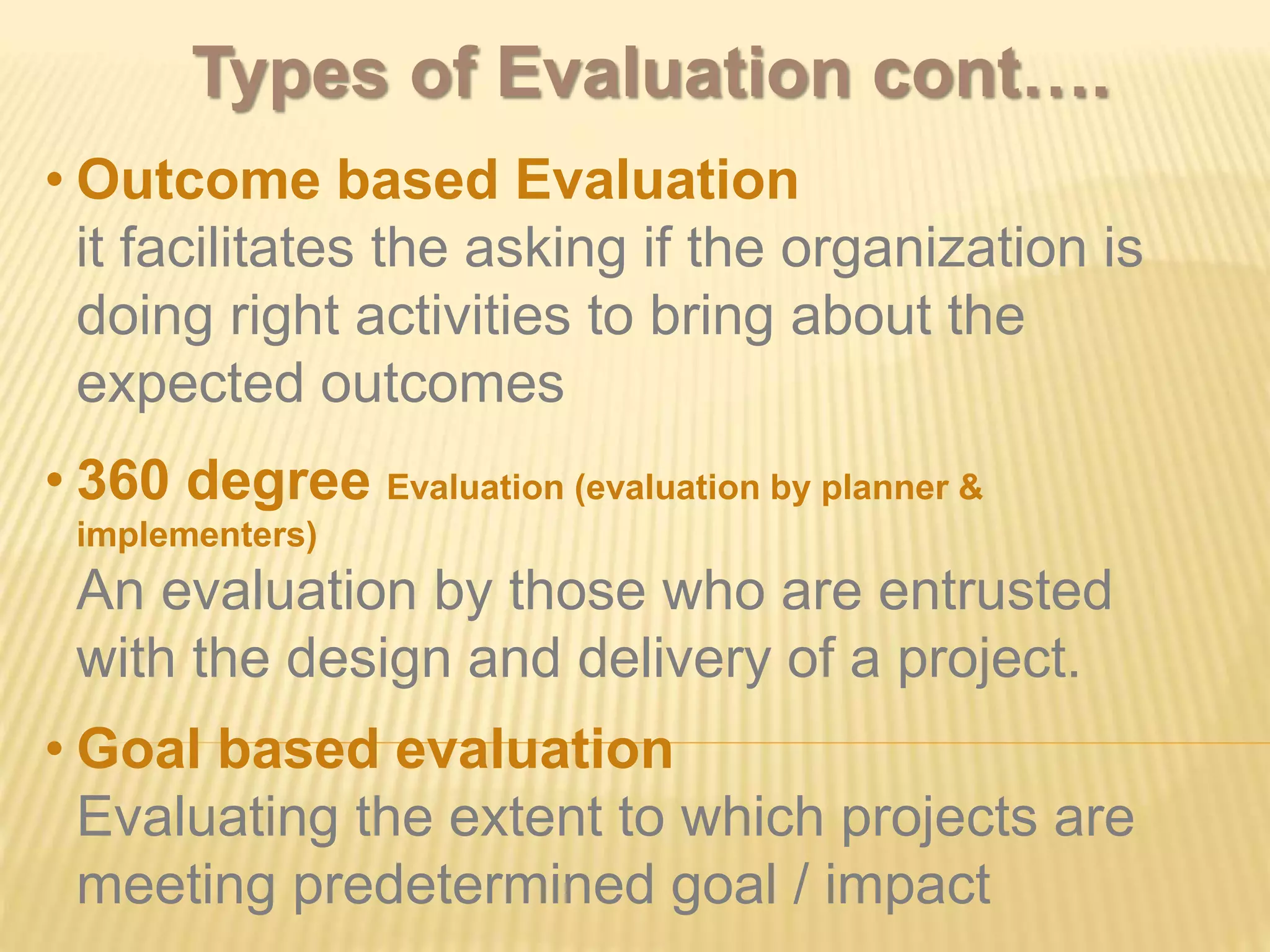
Types of Evaluation
• Outcome based Evaluation
it facilitates the asking if the organization is
doing right activities to bring about the
expected outcomes
• 360 degree Evaluation (evaluation by planner &
implementers)
An evaluation by those who are entrusted
with the design and delivery of a project.
• Goal based evaluation
Evaluating the extent to which projects are
meeting predetermined goal / impact
Types of Evaluation cont….
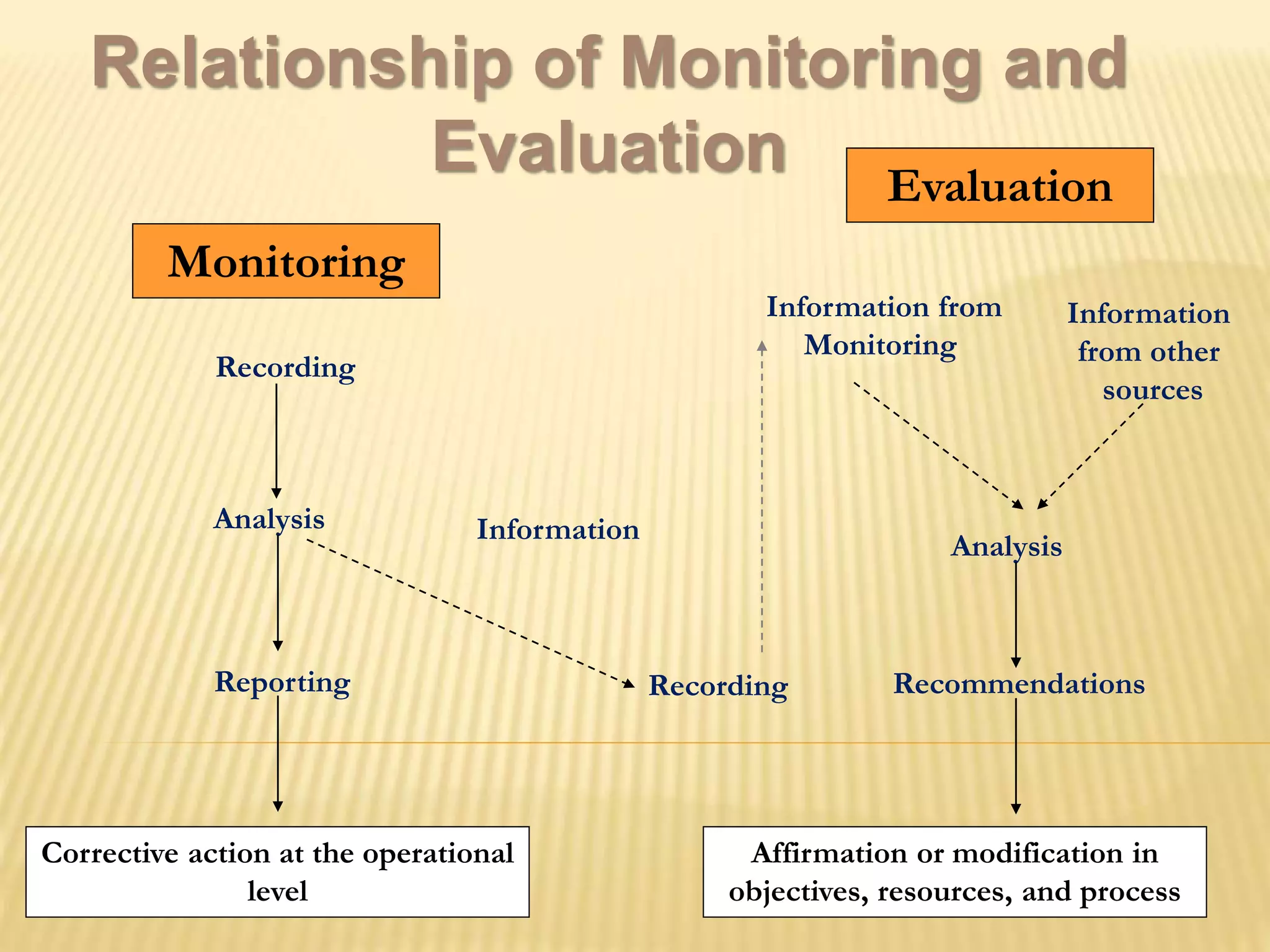
Relationship of Monitoring
and Evaluation
Monitoring
Recording
Analysis
Reporting
Corrective action at the operational
level
Information
Recording Recommendations
Analysis
Information
from other
sources
Information from
Monitoring
Affirmation or modification in
objectives, resources, and process
Relationship of Monitoring and
Evaluation Evaluation
Difference between
Monitoring and Evaluation
Object
ive
Monitoring Evaluation
To track changes
from baseline
conditions to
desired
outcomes.
To validate what results
were achieved, and how
and why they were or were
not achieved.
Metho
dology
Tracks and
assesses
performance
through analysis
and comparison
of indicators over
time.
Evaluates achievement or
outcomes by comparing
indicators before and after
the intervention.
Involves Value Judgment
Relies on monitoring data
and information from
external sources.
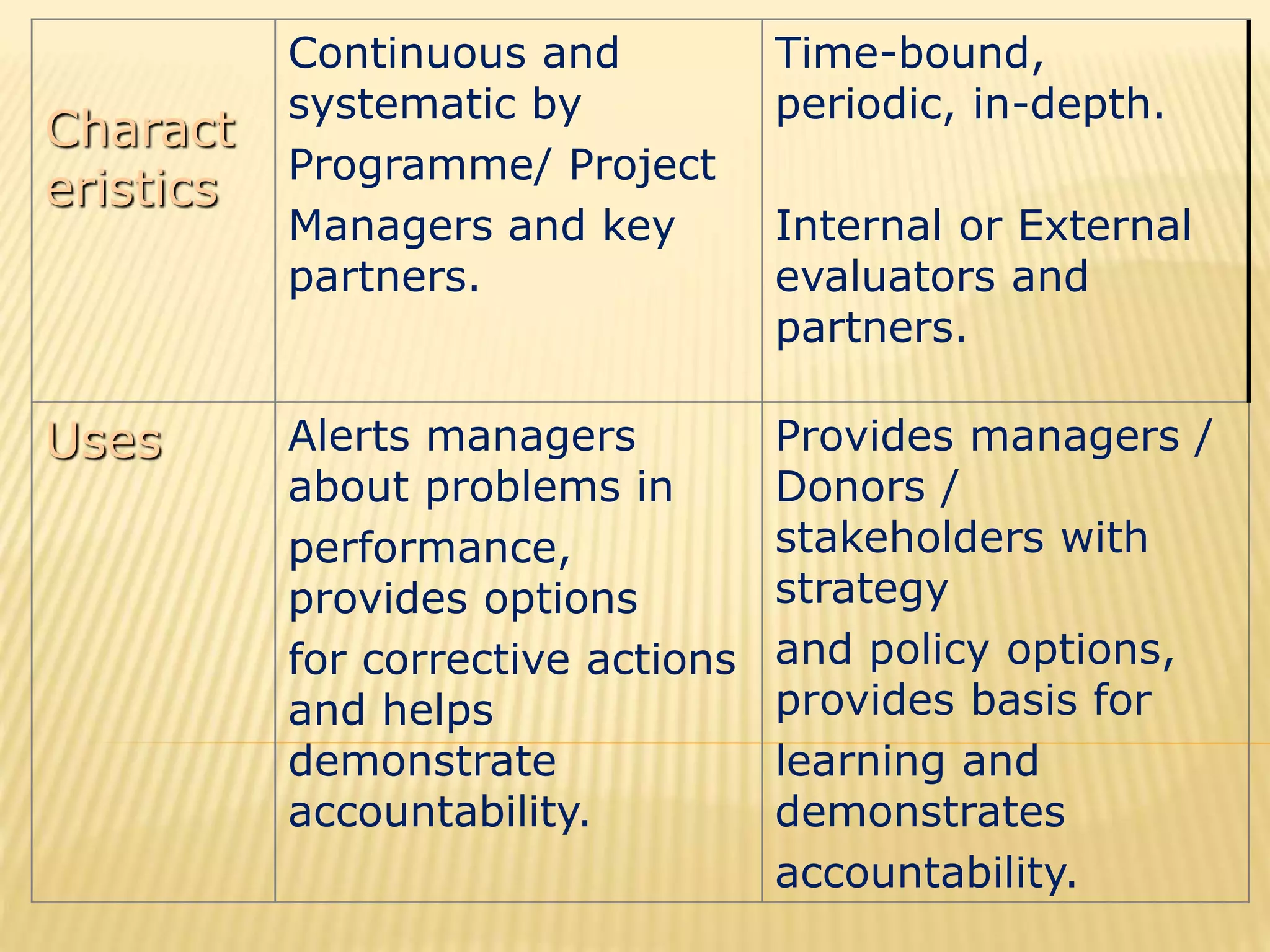
Charact
eristics
Continuous and
systematic by
Programme/ Project
Managers and key
partners.
Time-bound,
periodic, in-depth.
Internal or External
evaluators and
partners.
Uses Alerts managers
about problems in
performance,
provides options
for corrective actions
and helps
demonstrate
accountability.
Provides managers /
Donors /
stakeholders with
strategy
and policy options,
provides basis for
learning and
demonstrates
accountability.
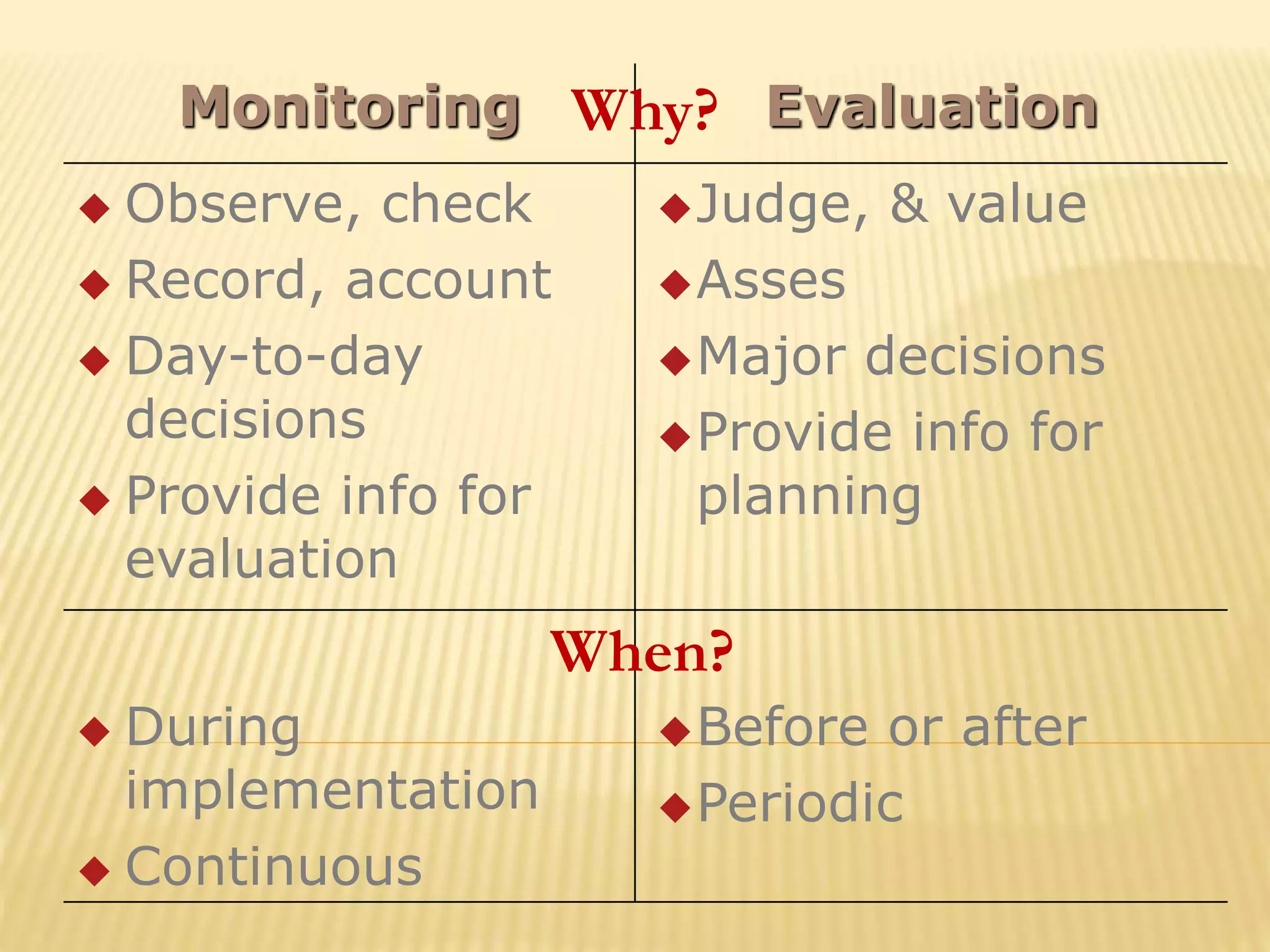
Why M & E?
Monitoring Evaluation
 Observe, check
 Record, account
 Day-to-day
decisions
 Provide info for
evaluation
Judge, & value
Asses
Major decisions
Provide info for
planning
 During
implementation
 Continuous
Before or after
Periodic
Why?
When?
Key Uses of M&E
• Improve performance of ongoing projects
• Accountability
− Warn of deviations from goals
− Review inputs, activities, and results
− Performance Reporting
• Decision making
– Improving implementation
– Periodic review
– Improving planning
What to Monitor?
• Focus on key needs of management
and different stakeholders
• Maintaining minimum accountability
and transparency standard
• Key outputs of the project and
program
LESSONS LEARNT
• There should be:
– No activities without records
– No records without analysis
– No analysis without learning
– No learning without action

Monitoring and evaluation

  • 1.
  • 3.
  • 4.
    A Project • Aunique set of activities with:  Rationale  Action plan  Goal  Beneficiaries  Objectives  Limited time frame  Outputs  Budget
  • 5.
  • 6.
  • 7.
    DEFINITION • Monitoring isthe recording “Whether right thing is being delivered to the right people at the right time in a right way (process)”
  • 8.
    WHAT IS MONITORING? •Looking into the process, going towards the target, right selection of beneficiaries • Procedures are being followed according to the work plan • Meeting our target or not (target monitoring), activity monitoring • Continuous info collection/analysis/reporting for decision making • Program is going in right direction as planned in the project document
  • 9.
    Monitoring Systematic recording of: • Observations • Information gathering • Analysis • Documentation • Reflection and • Action………..re-planning
  • 10.
    WHAT IS NOTMONITORING • Policing/imposing • Pointing out (but it is highlighting)
  • 11.
    DON’T LET THETHINGS HAPPEN IN THEIR OWN WAY……….
  • 12.
    REPORT RIGHT THINGAT RIGHT TIME TO THE RIGHT PERSON!!! DON’T JUST WRITE FOR FILES
  • 14.
    BE THE USEROF INFORMATION NOT THE OWNER!!!!!
  • 15.
  • 16.
    MONITORING TOOLS • Staffmeetings – Weekly, Monthly, Annual • Partners meeting/Learning Forums (FGD, Surveys)/Retreat • Participatory Reviews – Stakeholders • Monitoring and Supervision Mission (Self/Donors/Joint) • Progress reports/Statistics »
  • 17.
    • To ensurethat inputs, activities and outputs proceed according to plan • Determine whether the inputs are optimally utilized • Ensuring all activities are carried out by the right people and in time • To provide record of inputs, activities, and outputs • To warn of deviations from objectives • To assist managers in making decisions • Monitoring should take place at and be integrated into all stages of the project cycle Goals of Monitoring
  • 18.
  • 19.
    Evaluation Judging, appraising, determiningthe worth, value, or quality of a project to make necessary decisions. In terms of: • Relevance • Effectiveness • Efficiency • Sustainability • Impact
  • 20.
    Five Strategic EvaluationQuestions • Relevance: The extent to which the objectives of a development intervention are consistent with beneficiaries´ requirements, and partner’s and donor’s policies. • Effectiveness: doing right things • Efficiency: doing things right • Sustainability: Meeting needs without compromising the ability of future generations to meet their needs (project will continue after donors intervention) • Impact: Positive or negative, direct or indirect long- term impact produced by a development intervention.
  • 21.
    Evaluation Provides Information Strategy:Are the right things being done? • Rationale or justification • impact Operations: Are things being right? • Effectiveness in achieving expected outcomes • Efficiency in optimizing resources • Client satisfaction Learning: Are there better ways? • Alternatives • Lessons learned
  • 22.
    • Formative evaluation Evaluationintended to improve performance, most often conducted during the design and/or implementation phases of projects or programs. • Summative evaluation A study conducted at the end of an intervention to determine the extent to which anticipated outcomes were produced. Forms of Evaluation
  • 23.
    • Participatory evaluation •Process based evaluation • Outcome based evaluation • Self-evaluation (360 degree evaluation) • Goal-based evaluation Types of Evaluation
  • 24.
    • Participatory evaluation Evaluationin which representatives of agencies and stakeholders work together in designing, carrying out and interpreting an evaluation. • Process based evaluation An evaluation of the internal dynamics of a project, its policy instruments, its service delivery mechanisms, its management practices, and the linkages among these. Types of Evaluation
  • 25.
    • Outcome basedEvaluation it facilitates the asking if the organization is doing right activities to bring about the expected outcomes • 360 degree Evaluation (evaluation by planner & implementers) An evaluation by those who are entrusted with the design and delivery of a project. • Goal based evaluation Evaluating the extent to which projects are meeting predetermined goal / impact Types of Evaluation cont….
  • 26.
  • 27.
    Monitoring Recording Analysis Reporting Corrective action atthe operational level Information Recording Recommendations Analysis Information from other sources Information from Monitoring Affirmation or modification in objectives, resources, and process Relationship of Monitoring and Evaluation Evaluation
  • 28.
  • 29.
    Object ive Monitoring Evaluation To trackchanges from baseline conditions to desired outcomes. To validate what results were achieved, and how and why they were or were not achieved. Metho dology Tracks and assesses performance through analysis and comparison of indicators over time. Evaluates achievement or outcomes by comparing indicators before and after the intervention. Involves Value Judgment Relies on monitoring data and information from external sources.
  • 30.
    Charact eristics Continuous and systematic by Programme/Project Managers and key partners. Time-bound, periodic, in-depth. Internal or External evaluators and partners. Uses Alerts managers about problems in performance, provides options for corrective actions and helps demonstrate accountability. Provides managers / Donors / stakeholders with strategy and policy options, provides basis for learning and demonstrates accountability.
  • 31.
  • 32.
    Monitoring Evaluation  Observe,check  Record, account  Day-to-day decisions  Provide info for evaluation Judge, & value Asses Major decisions Provide info for planning  During implementation  Continuous Before or after Periodic Why? When?
  • 33.
    Key Uses ofM&E • Improve performance of ongoing projects • Accountability − Warn of deviations from goals − Review inputs, activities, and results − Performance Reporting • Decision making – Improving implementation – Periodic review – Improving planning
  • 34.
    What to Monitor? •Focus on key needs of management and different stakeholders • Maintaining minimum accountability and transparency standard • Key outputs of the project and program
  • 35.
    LESSONS LEARNT • Thereshould be: – No activities without records – No records without analysis – No analysis without learning – No learning without action