This document discusses using an agent-based model and social network analysis to evaluate the effectiveness of different strategies for disrupting terrorist networks. The model is based on a 271-member al-Qaeda network and analyzes how network metrics change when kinetic and non-kinetic strategies are implemented under varying levels of network morale. The goal is to determine which strategies most impact network structure and achieve disruption goals. The document provides background on using social network analysis to understand terrorist networks and their evolution. It then describes how machine learning was used to train the al-Qaeda network model and outlines different disruption strategies that could be implemented in the model.



![8
have led to further decentralization that makes targeting more difficult in the future. Carley
(2003, p. 2) explains, “finally, and critically, this approach [SNA] does not contend with the
most pressing problem – the underlying network is dynamic. Just because you isolate a key
actor today does not mean that the network will be destabilized and unable to respond. Rather, it
is possible, that isolating such an actor may have the same effect as cutting off the Hydra’s head;
many new key actors may emerge.” Strategies should not be implemented without
understanding the full effect on the network. This is a difficult task considering the varying
conditions under which strategies are implemented and while predictions are never going to be
completely accurate, a better understanding of broad tendencies will be beneficial. To
effectively combat covert networks, an understanding of how strategic options affect the
structure of a network must be considered. While some research ties SNA and agent-based
modeling to discover the structural effects of the network, the focus has been on node removal
and needs to be extended to other strategic options.
2. Terrorist Network Case Study
This model utilizes the John Jay & ARTIS Transnational Terrorism Database (2015) to access
the al-Qaeda attack network and individual attributes of terrorists. The network data provides
aggregate data representing the relations of individuals associated with 23 terrorist attacks linked
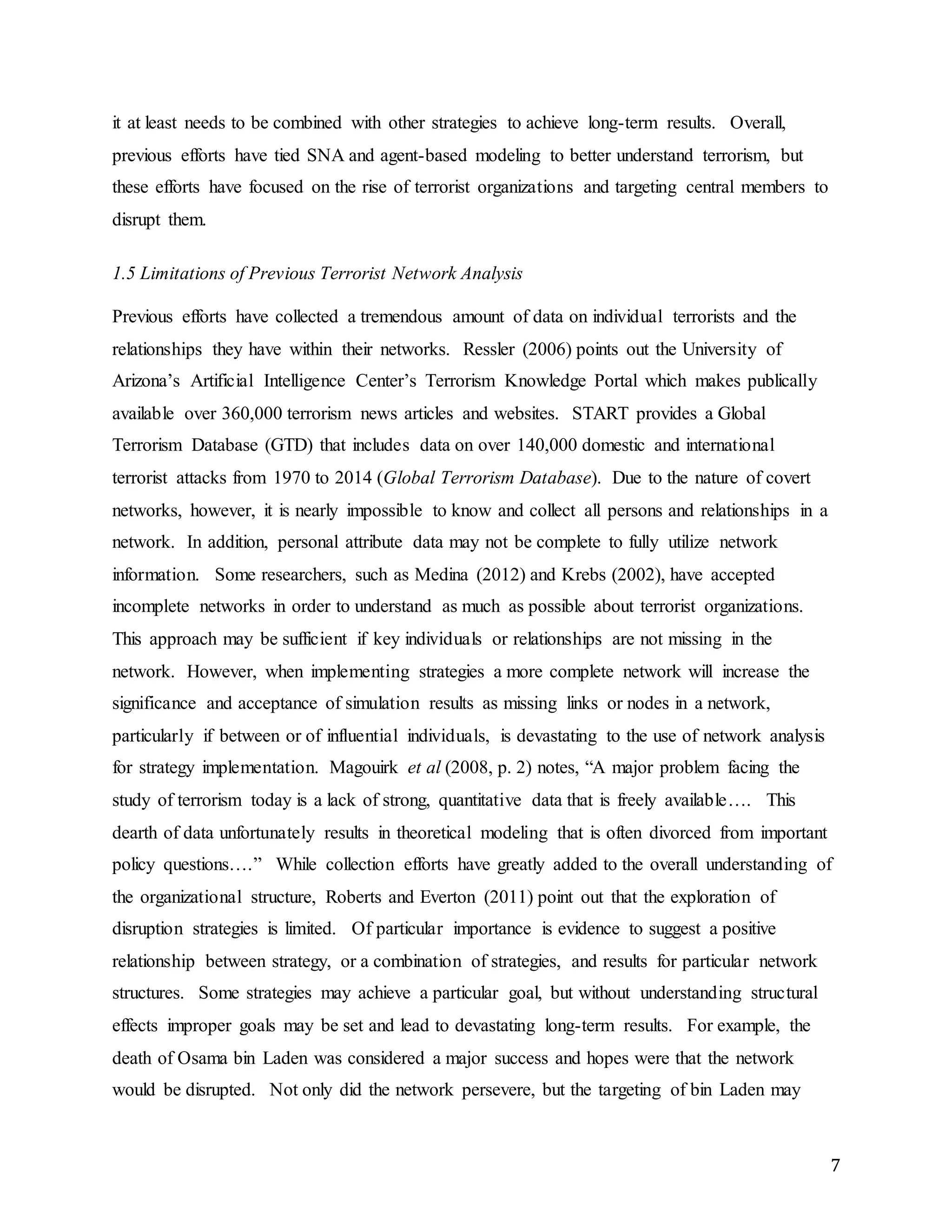
to al-Qaeda between 1993 and 2003. This network, seen in Figure 3 as a visualization generated
in Gephi version 0.8.1, represents 271 al-Qaeda members and 1,512 social ties between the
members. The provided terrorist attributes from the terrorism database used in the model include
place of birth, educational achievement, occupation, whether they are a former terrorist, the
specific al-Qaeda group they belong to, the country where they joined the organization, and the
position they hold within the organization. There is one leader, or Emir, in the network. Three
members of the religious/fatwa committee are responsible for justifying al-Qaeda actions and
preaching the al-Qaeda model of Islam. Twelve members of the military committee are
responsible for selecting targets for attacks and operatives for conducting them. Twenty-four
members raise and spend money for al-Qaeda as part of the finance committee. The logistics
committee consists of thirteen members who are devoted to executing attacks. Additionally
there are 22 local leaders, 72 regional leaders, 55 general subordinates, one central leader, and 68](https://image.slidesharecdn.com/d899ad57-3497-41a1-9958-3dd69fbf201d-151230034702/75/Thesis-10-2048.jpg)



![14
propaganda to make members motivated to fight harder. Counterterrorism strategies must also
think about morale and understand how morale affects the effectiveness of disruption strategies
and in turn how disruption strategies affect morale. For example, Hibbert (2006) explains if
morale is high and members are motivated to fight aggressively towards their cause, actions that
promote more aggressive behavior will only influence a stronger will to fight. On the other
hand, if morale is low and aggressive actions are taken towards the individual, the lack of
motivation may be enough to influence the individual to not fight back.
The complexity of moving parts in a terrorist network make this evaluation difficult for the
human mind, no matter what level of subject matter expertise the individual obtains. Thus, a
more scientific evaluation that allows for computer simulation utilizing subject matter expertise
is needed. This is not to say that all strategies will be feasible, but a better understanding of the
effects of the different options will allow for more insightful policy decisions. Krawchuk (2005,
p. 3) sums it up by saying, “…[T]he United States must know where the enemy is today,
understand what he is doing and prepare for his future moves. If not, this nation will always be
one step behind and is certain to suffer another tragic surprise.”
5. Model Framework and User Interface
Once machine learning has provided a more complete picture of the terrorist network, research
can be taken beyond the foundational case studies to apply the understanding of the network
structure to devising strategies to disrupt the network. When devising strategies, however, it
must be understood that both terrorist networks and the environment that they survive in change
and adapt quickly. Everton and Cunningham (2011) point out that both endogenous and
exogenous factors, such as recruitment and responses to counterterrorism strategies, change the
environment that a terrorist network exists within and in response to the changing environment,
the terrorist network structure adapts. Thus, flexible models must be created in order to account
for these varying conditions. Agent-based modeling offers this flexibility, as Bonabeau (2002)
explains it provides the methodology for modeling complex emergent phenomena. Given the
complexity of interactions in a terrorist network, particularly when a strategy of disruption is
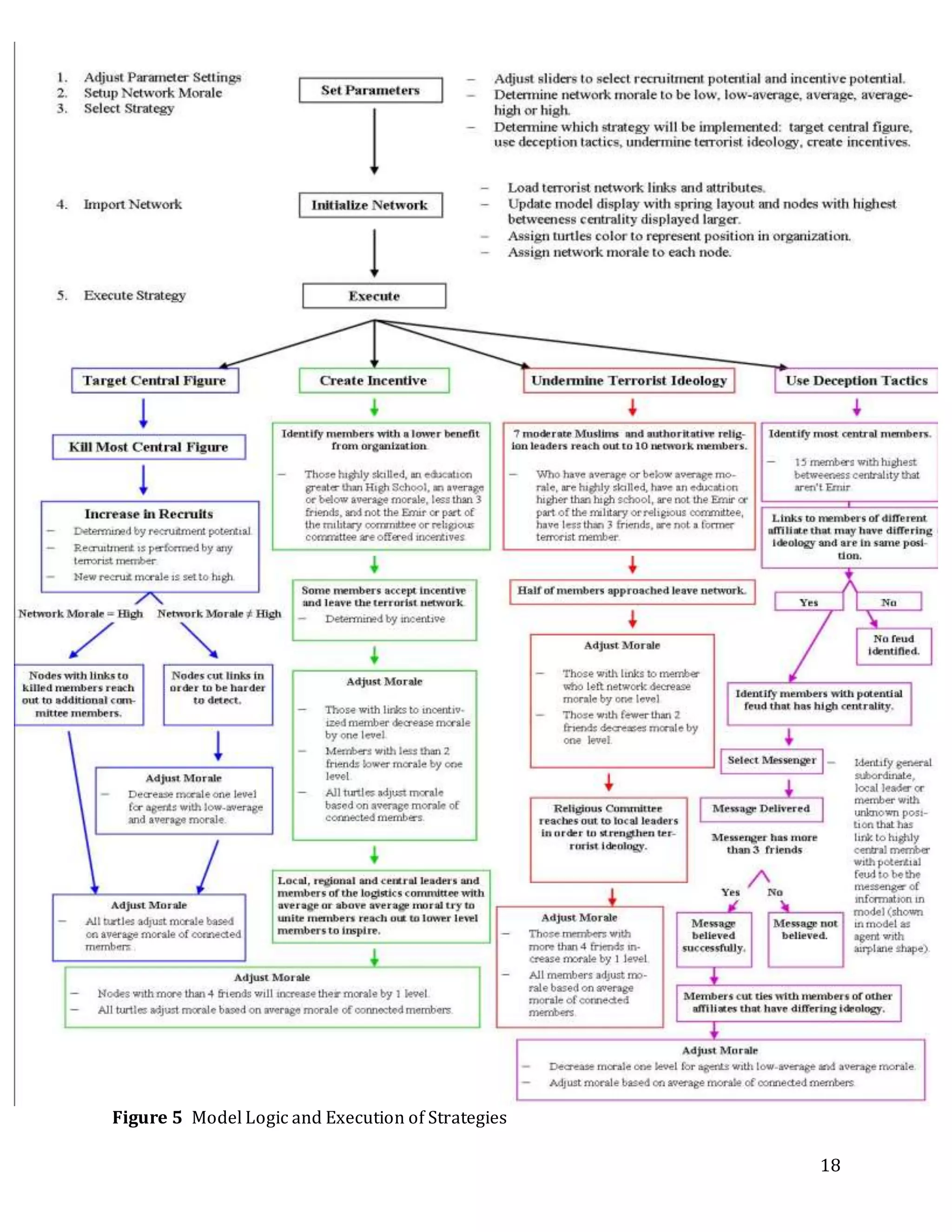
implemented, agent-based modeling offers insight about the emergence of the network to](https://image.slidesharecdn.com/d899ad57-3497-41a1-9958-3dd69fbf201d-151230034702/75/Thesis-16-2048.jpg)











![Social network analysis [SNA] is the mapping and measuring of relationships a...](https://cdn.slidesharecdn.com/ss_thumbnails/representationandclassesofproerties-241121092336-8d88e173-thumbnail.jpg?width=640&height=640&fit=bounds)


