Joel Grus
Seattle DAML Meetup
June 23, 2015
Data Science from Scratch
About me
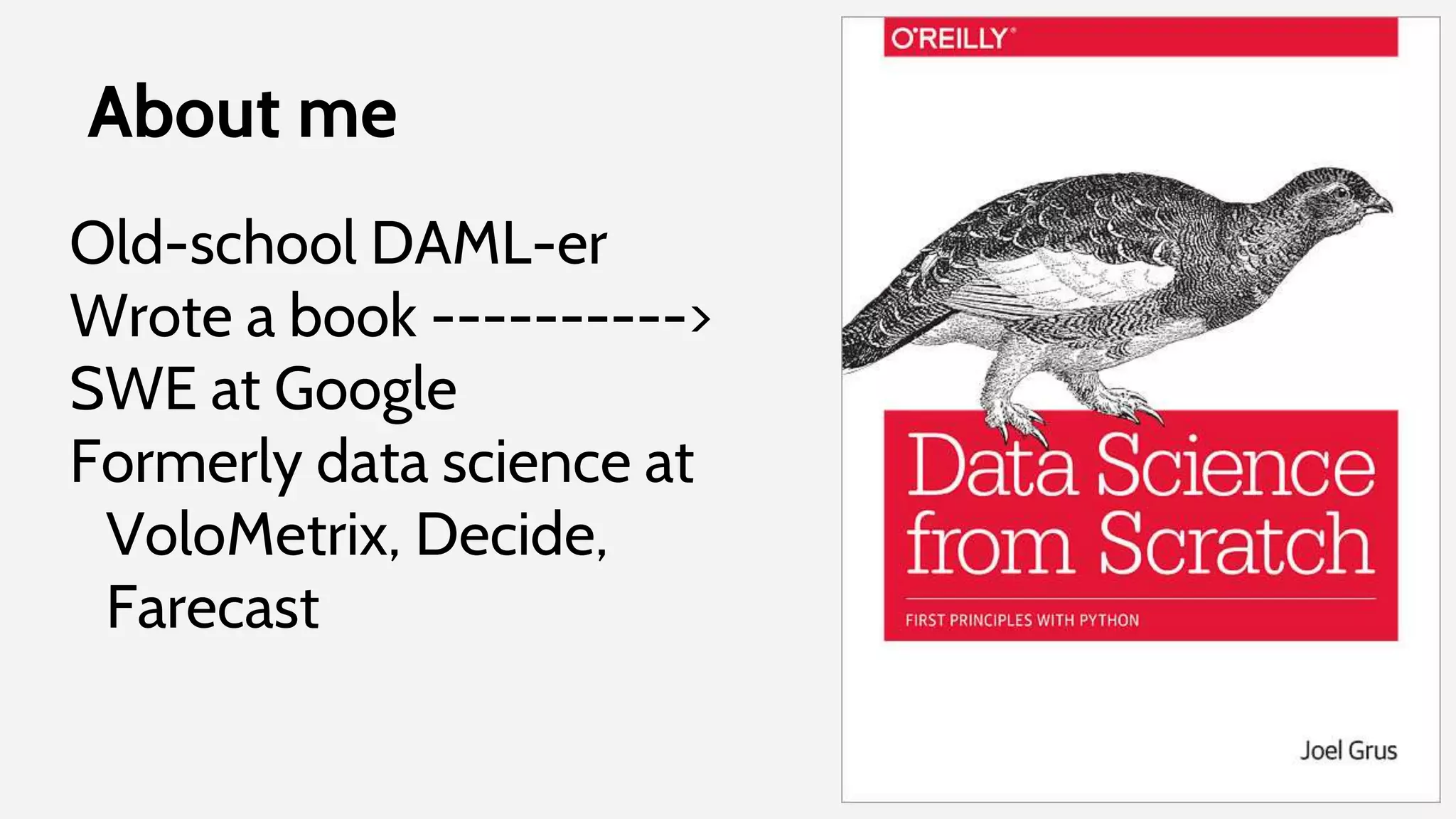
Old-school DAML-er
Wrote a book ---------->
SWE at Google
Formerly data science at
VoloMetrix, Decide,
Farecast
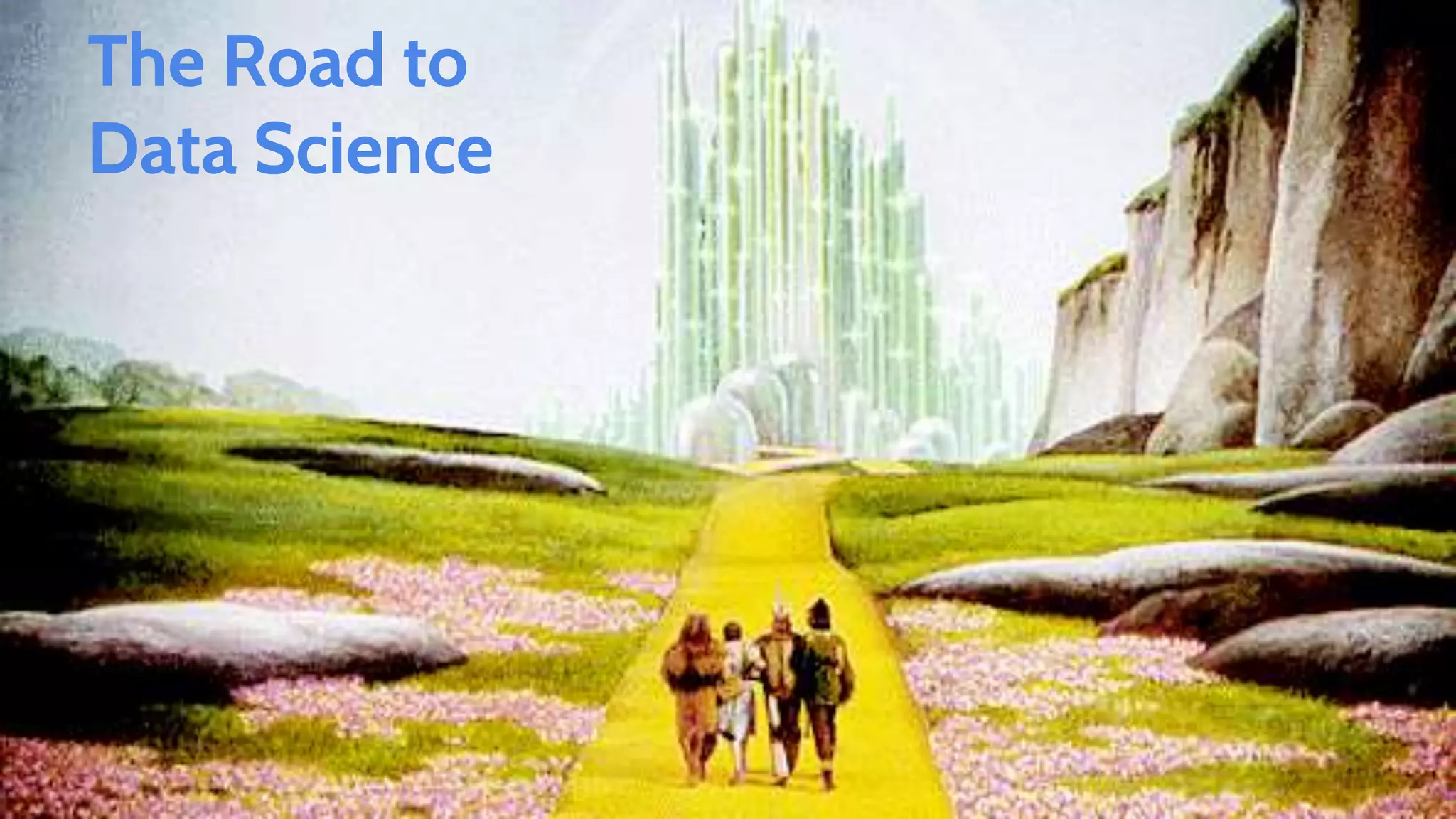
The Road to
Data Science
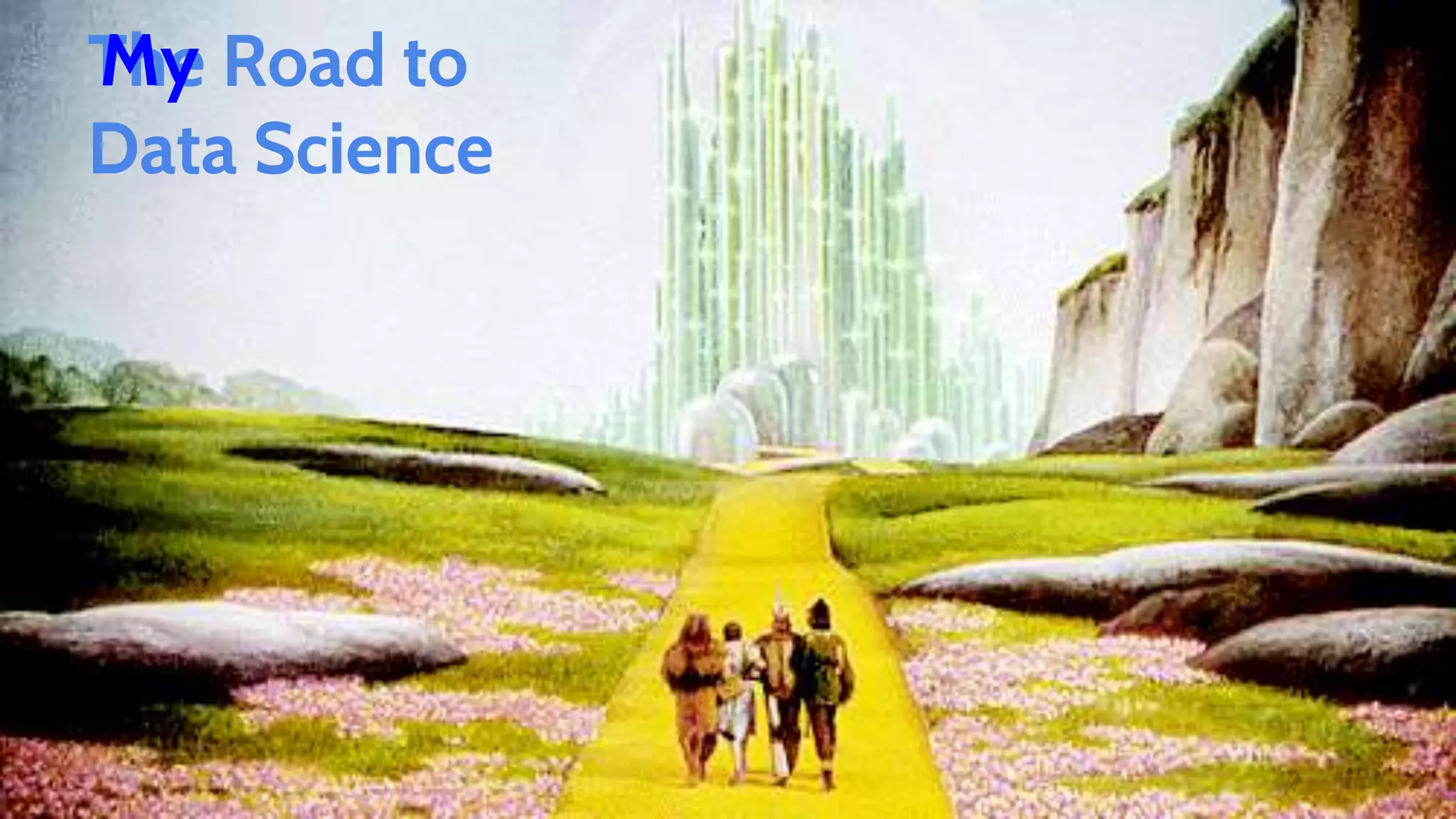
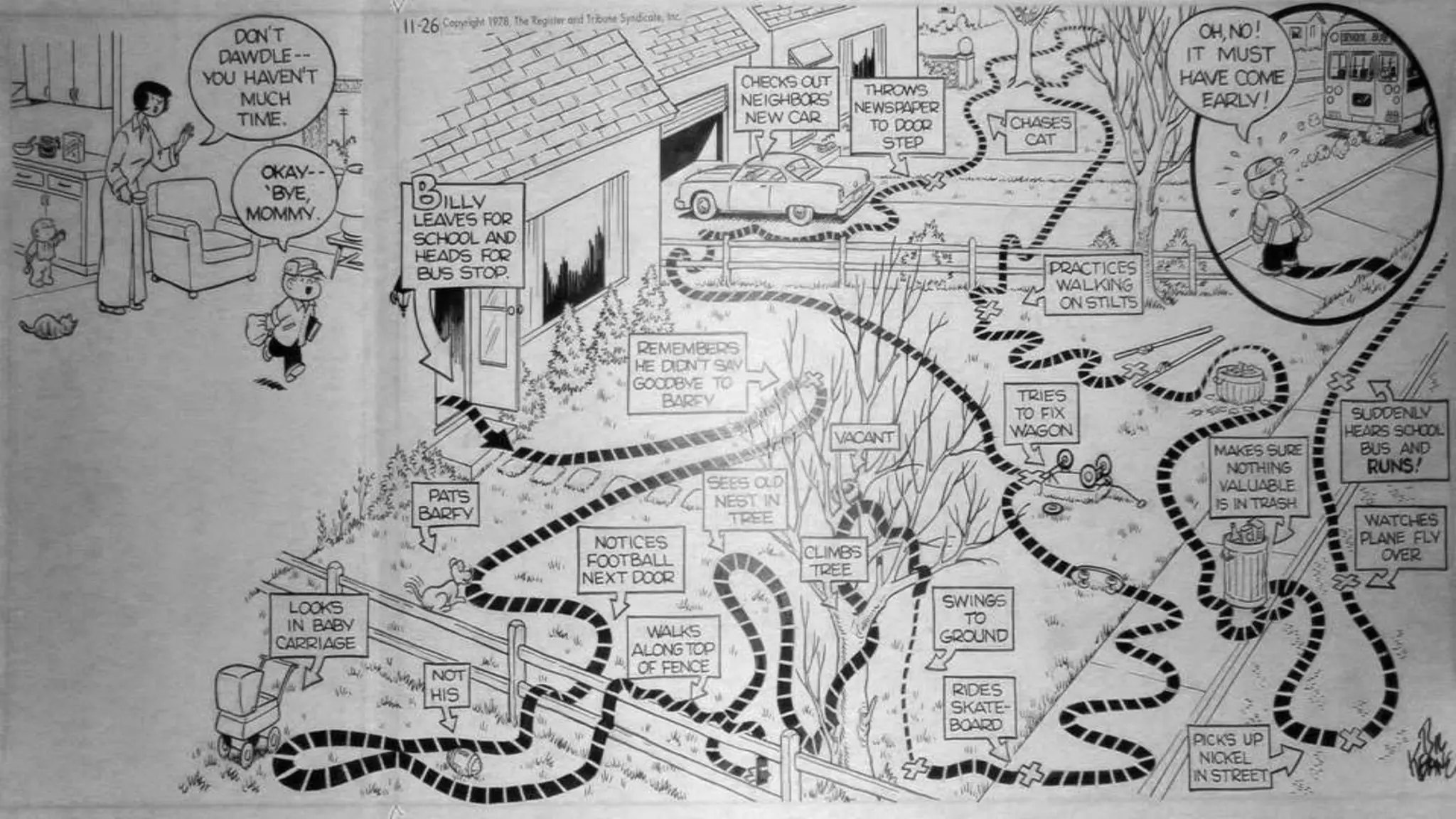
The Road to
Data Science
My
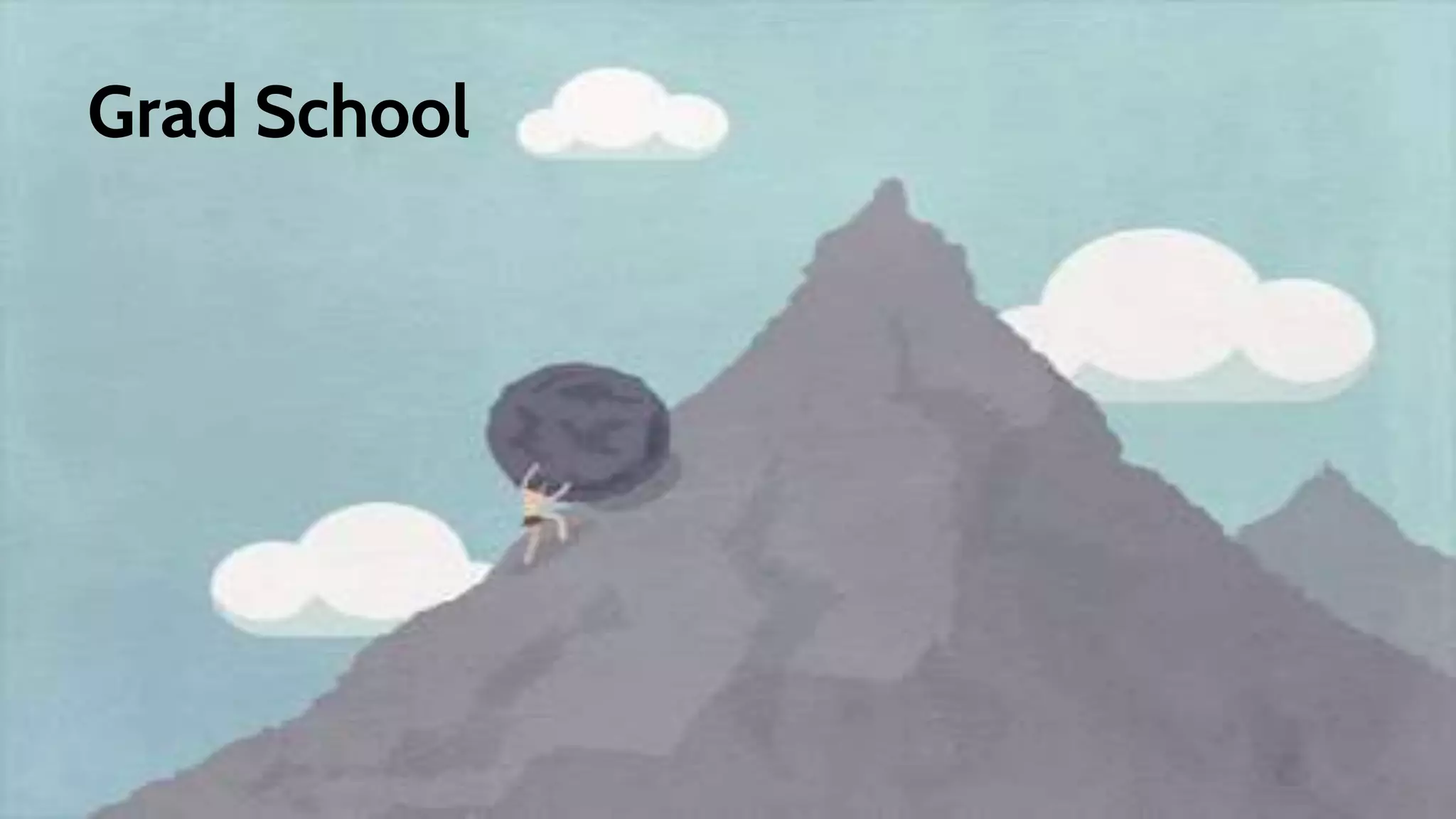
Grad School
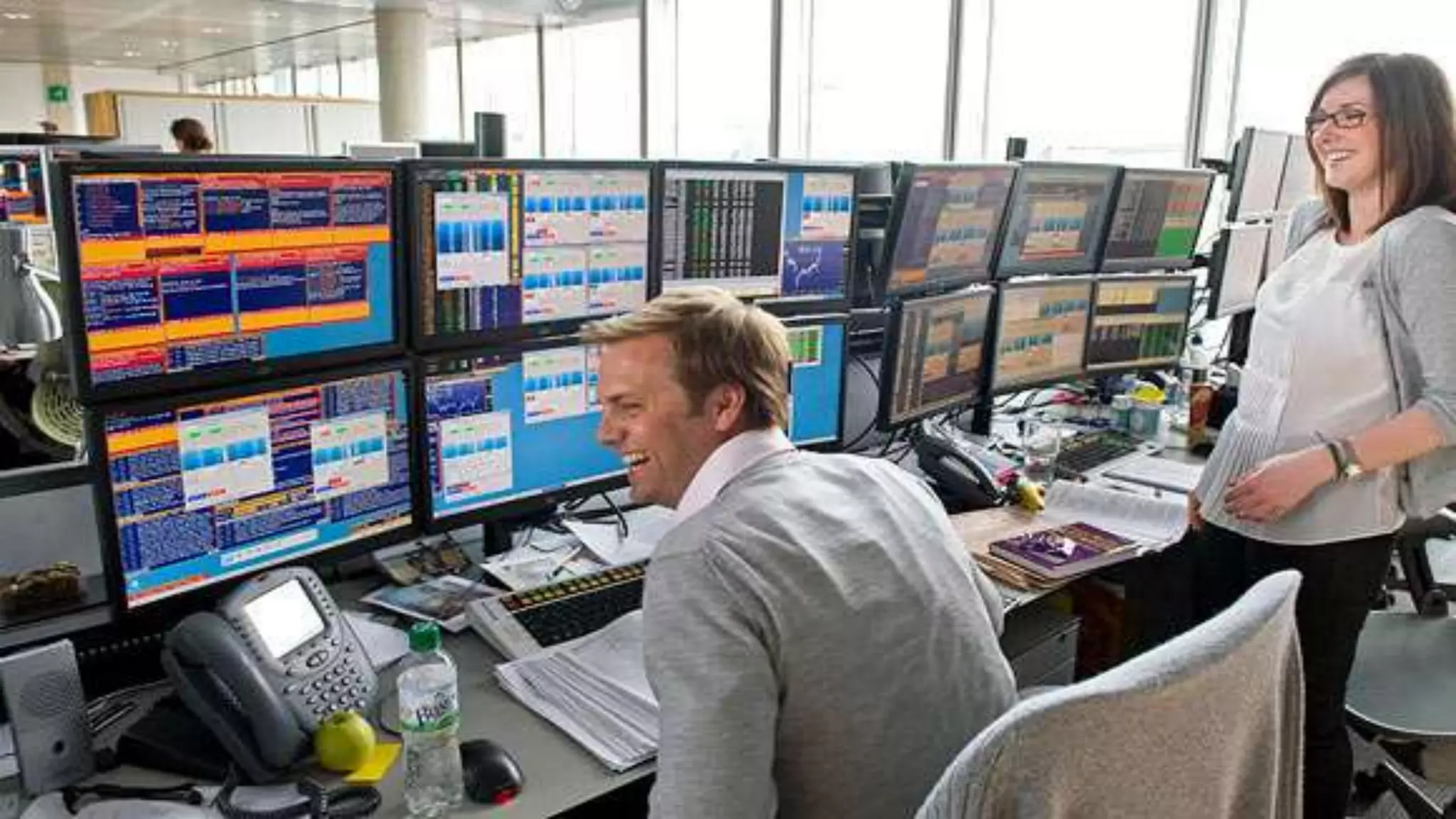
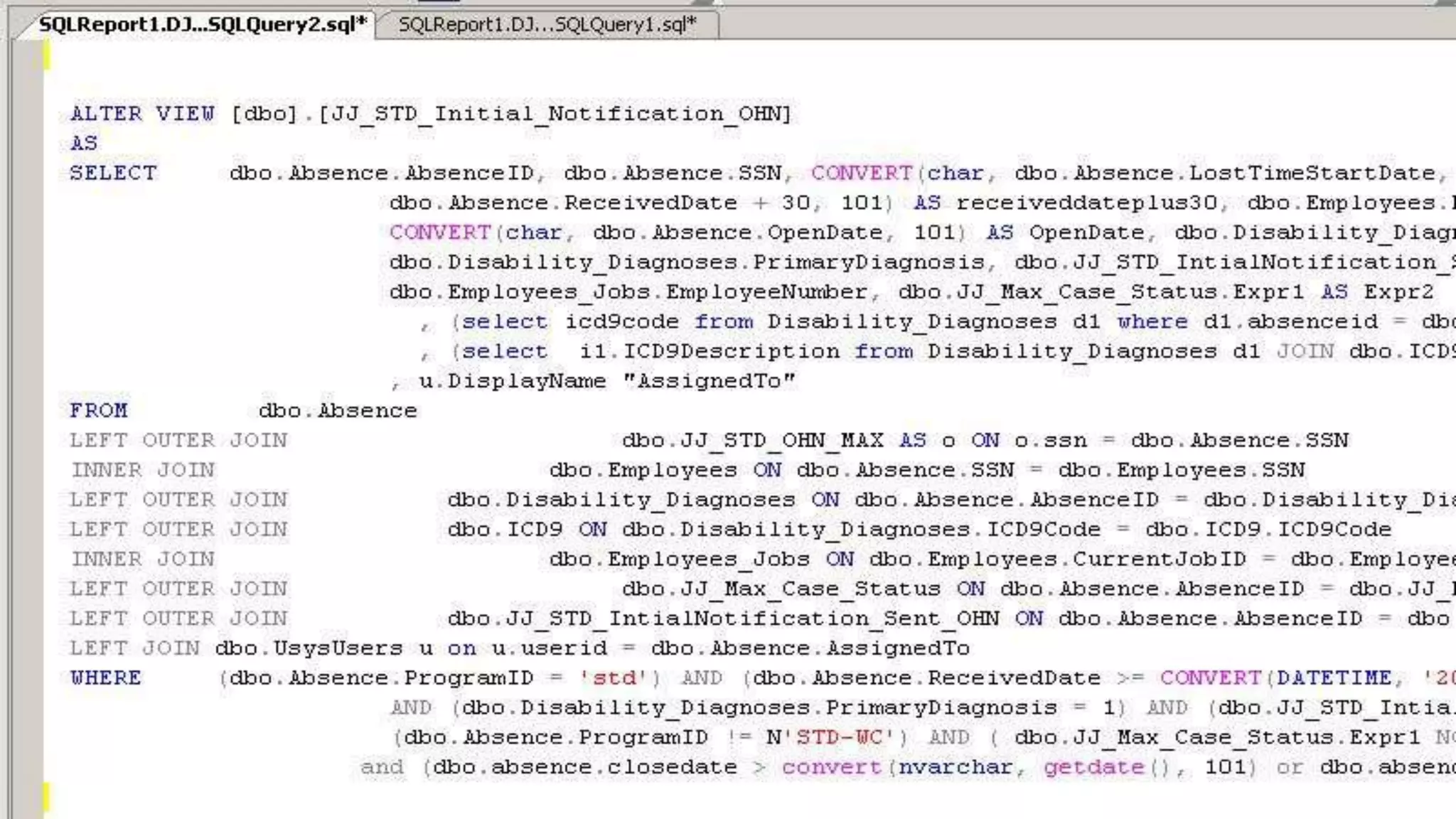
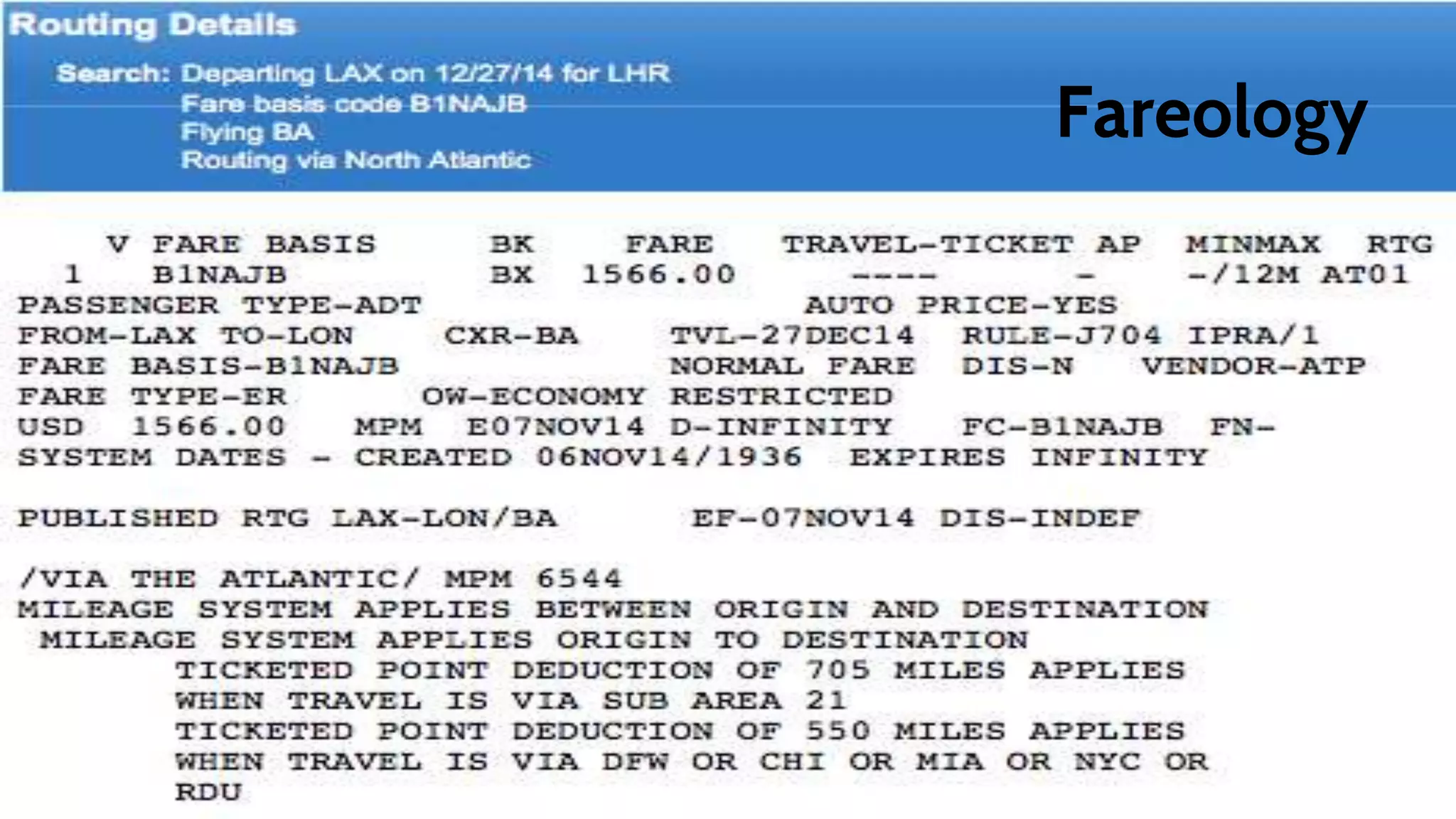
Fareology
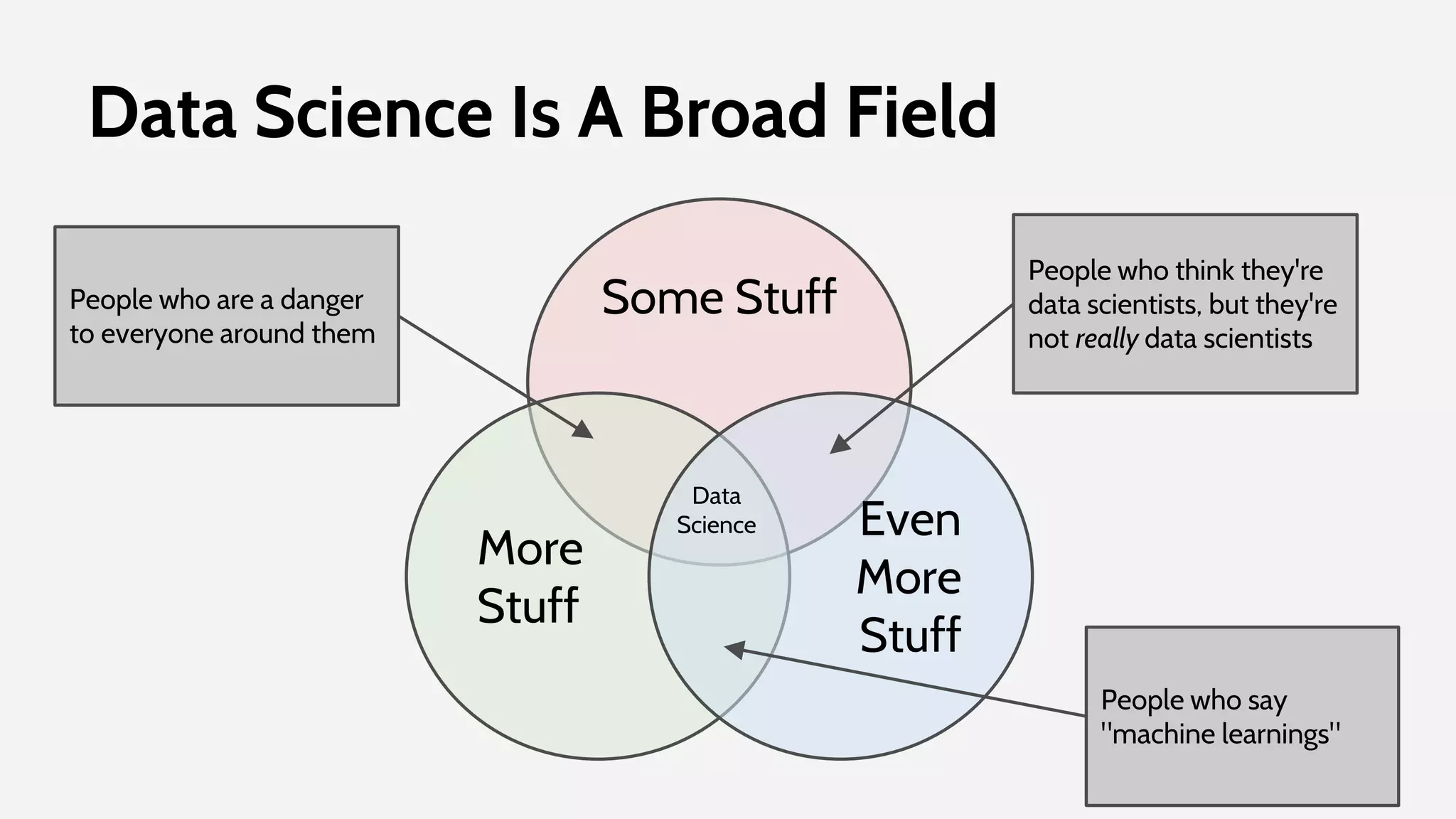
Data Science Is A Broad Field
Some Stuff
More
Stuff
Even
More
Stuff
Data
Science
People who think they're
data scientists, but they're
not really data scientists
People who are a danger
to everyone around them
People who say
"machine learnings"
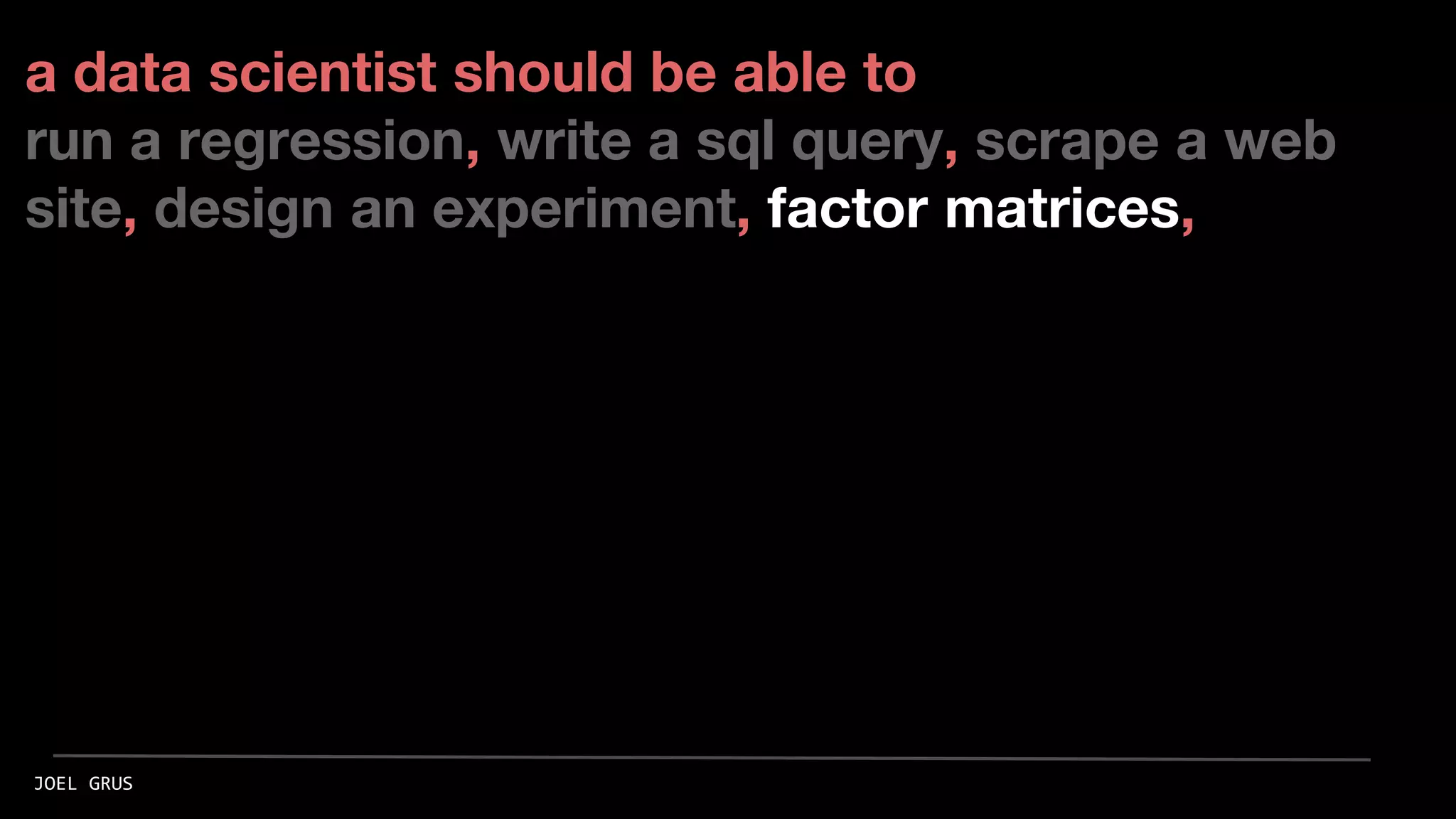
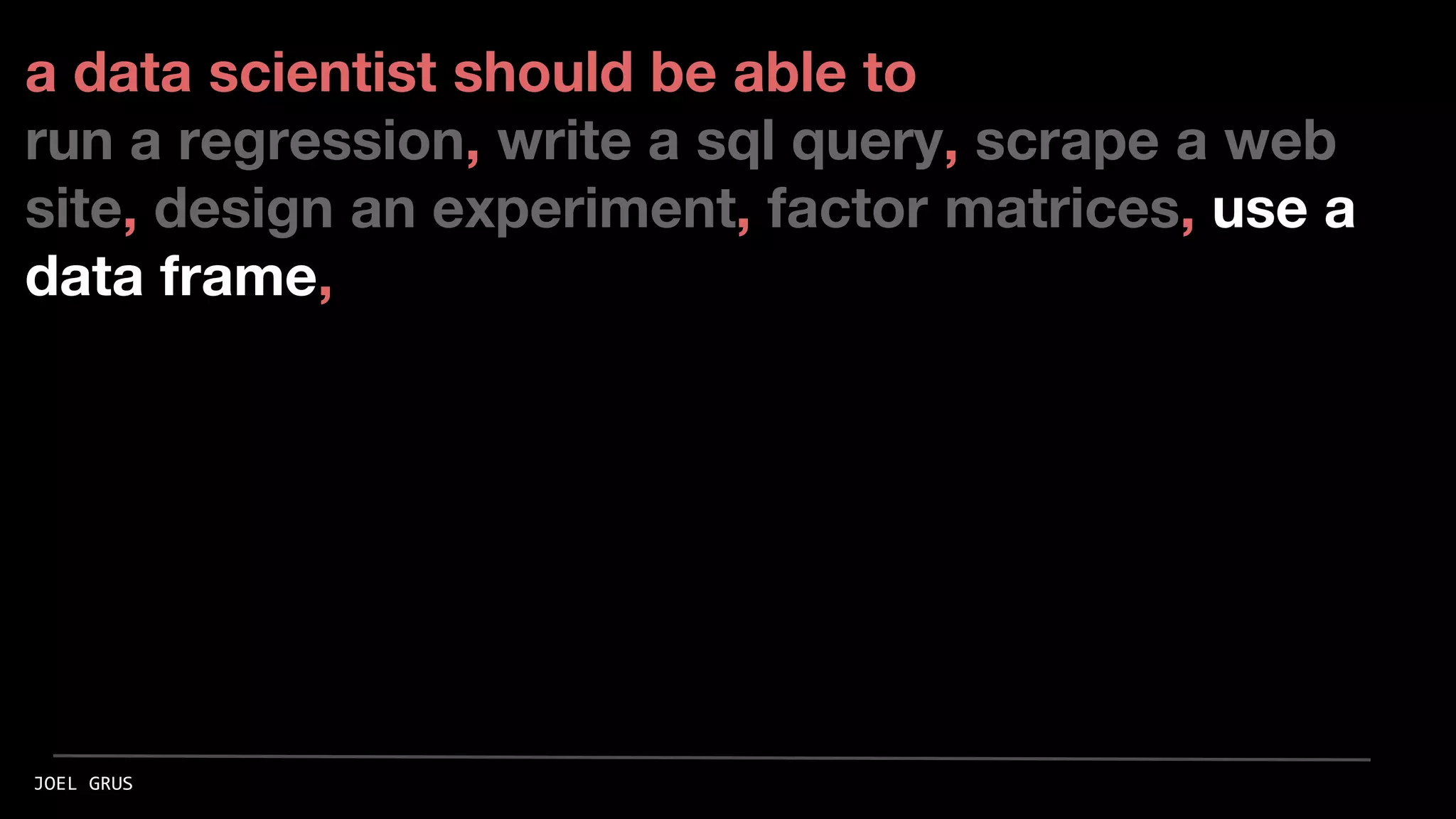
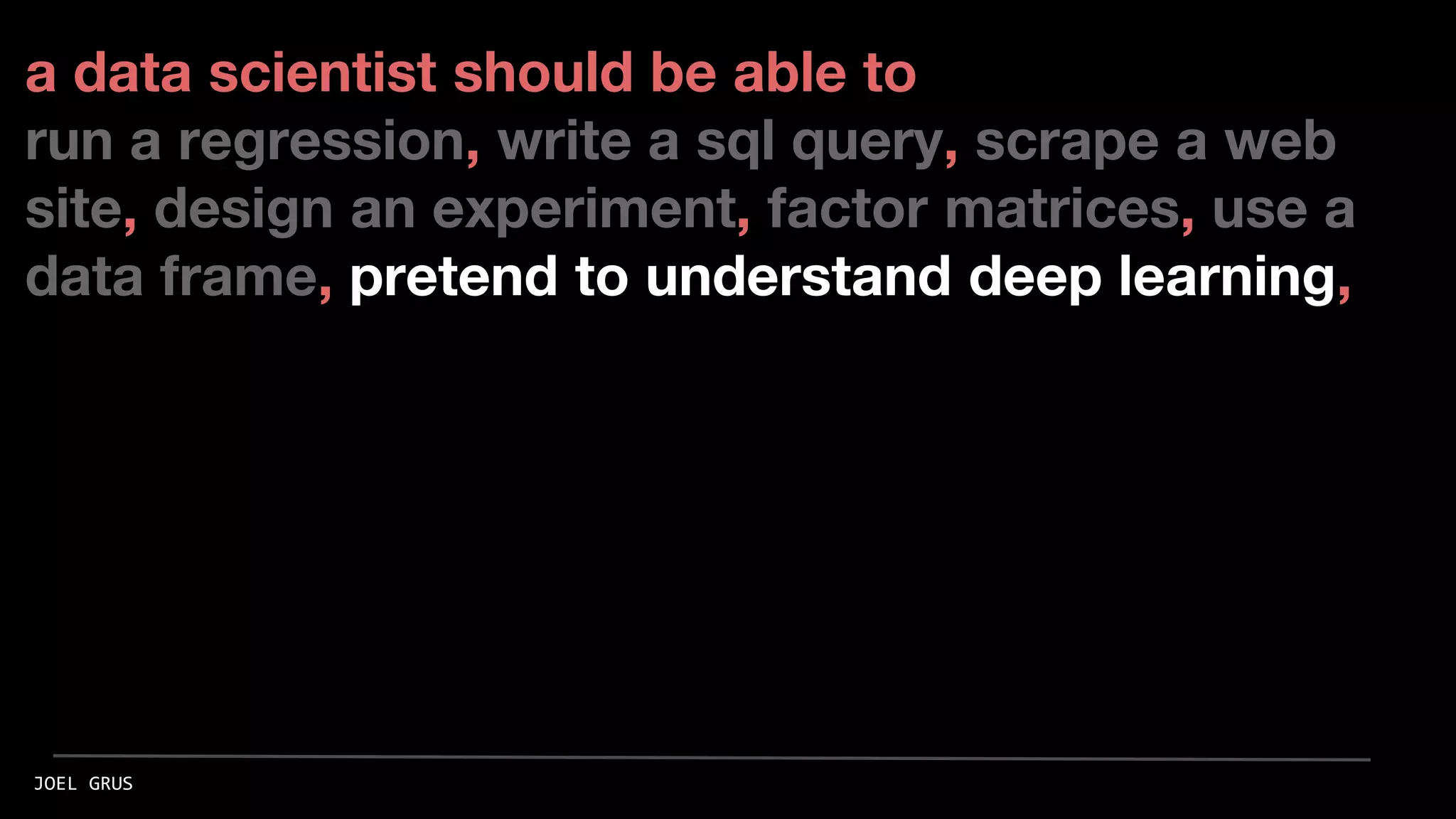
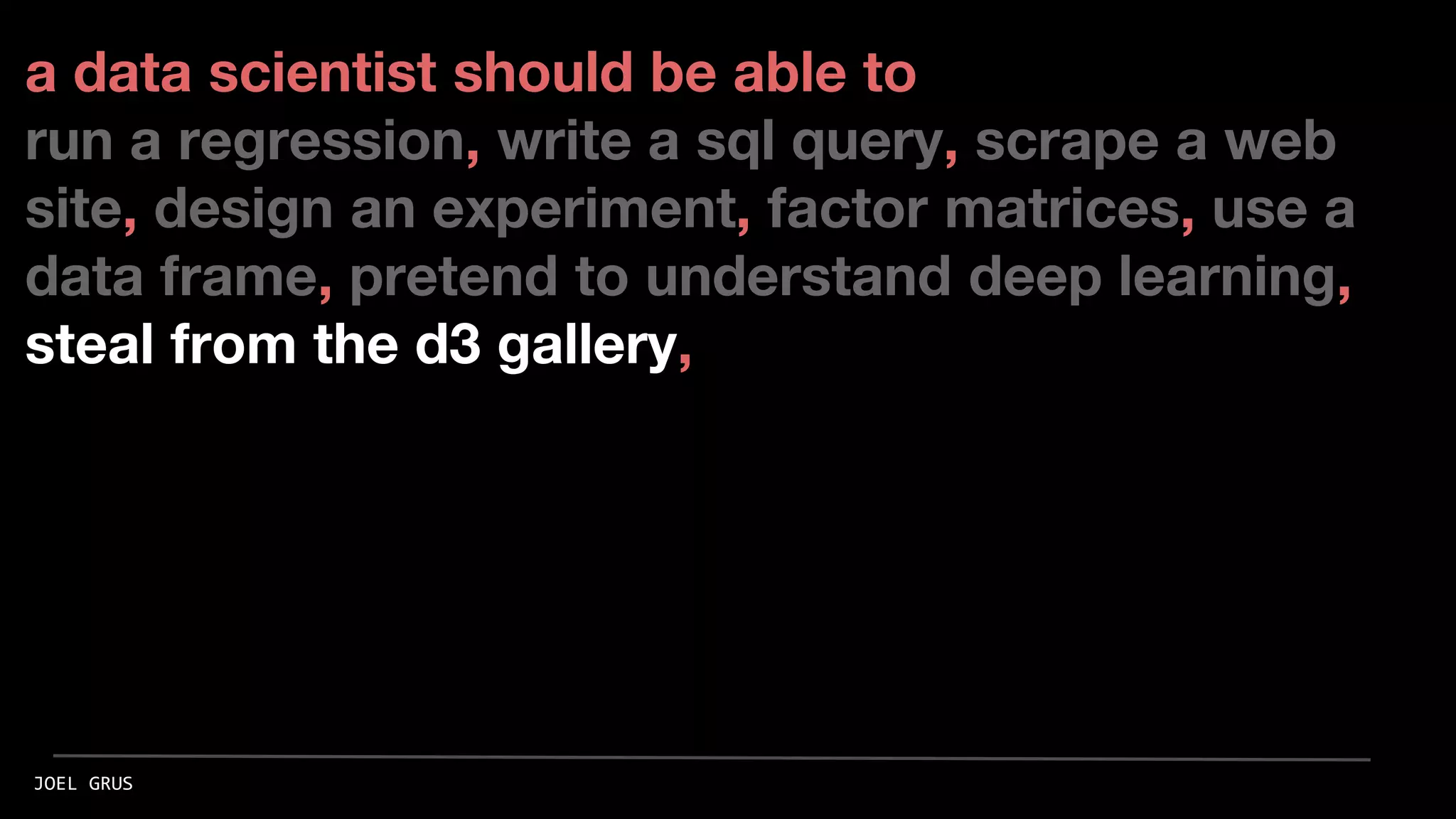
a data scientist should be able to
JOEL GRUS
a data scientist should be able to
run a regression,
JOEL GRUS
a data scientist should be able to
run a regression, write a sql query,
JOEL GRUS
a data scientist should be able to
run a regression, write a sql query, scrape a web
site,
JOEL GRUS
a data scientist should be able to
run a regression, write a sql query, scrape a web
site, design an experiment,
JOEL GRUS
a data scientist should be able to
run a regression, write a sql query, scrape a web
site, design an experiment, factor matrices,
JOEL GRUS
a data scientist should be able to
run a regression, write a sql query, scrape a web
site, design an experiment, factor matrices, use a
data frame,
JOEL GRUS
a data scientist should be able to
run a regression, write a sql query, scrape a web
site, design an experiment, factor matrices, use a
data frame, pretend to understand deep learning,
JOEL GRUS
a data scientist should be able to
run a regression, write a sql query, scrape a web
site, design an experiment, factor matrices, use a
data frame, pretend to understand deep learning,
steal from the d3 gallery,
JOEL GRUS
a data scientist should be able to
run a regression, write a sql query, scrape a web
site, design an experiment, factor matrices, use a
data frame, pretend to understand deep learning,
steal from the d3 gallery, argue r versus python,
JOEL GRUS
a data scientist should be able to
run a regression, write a sql query, scrape a web
site, design an experiment, factor matrices, use a
data frame, pretend to understand deep learning,
steal from the d3 gallery, argue r versus python,
think in mapreduce,
JOEL GRUS
a data scientist should be able to
run a regression, write a sql query, scrape a web
site, design an experiment, factor matrices, use a
data frame, pretend to understand deep learning,
steal from the d3 gallery, argue r versus python,
think in mapreduce, update a prior,
JOEL GRUS
a data scientist should be able to
run a regression, write a sql query, scrape a web
site, design an experiment, factor matrices, use a
data frame, pretend to understand deep learning,
steal from the d3 gallery, argue r versus python,
think in mapreduce, update a prior, build a
dashboard,
JOEL GRUS
a data scientist should be able to
run a regression, write a sql query, scrape a web
site, design an experiment, factor matrices, use a
data frame, pretend to understand deep learning,
steal from the d3 gallery, argue r versus python,
think in mapreduce, update a prior, build a
dashboard, clean up messy data,
JOEL GRUS
a data scientist should be able to
run a regression, write a sql query, scrape a web
site, design an experiment, factor matrices, use a
data frame, pretend to understand deep learning,
steal from the d3 gallery, argue r versus python,
think in mapreduce, update a prior, build a
dashboard, clean up messy data, test a hypothesis,
JOEL GRUS
a data scientist should be able to
run a regression, write a sql query, scrape a web
site, design an experiment, factor matrices, use a
data frame, pretend to understand deep learning,
steal from the d3 gallery, argue r versus python,
think in mapreduce, update a prior, build a
dashboard, clean up messy data, test a hypothesis,
talk to a businessperson,
JOEL GRUS
a data scientist should be able to
run a regression, write a sql query, scrape a web
site, design an experiment, factor matrices, use a
data frame, pretend to understand deep learning,
steal from the d3 gallery, argue r versus python,
think in mapreduce, update a prior, build a
dashboard, clean up messy data, test a hypothesis,
talk to a businessperson, script a shell,
JOEL GRUS
a data scientist should be able to
run a regression, write a sql query, scrape a web
site, design an experiment, factor matrices, use a
data frame, pretend to understand deep learning,
steal from the d3 gallery, argue r versus python,
think in mapreduce, update a prior, build a
dashboard, clean up messy data, test a hypothesis,
talk to a businessperson, script a shell, code on a
whiteboard,
JOEL GRUS
a data scientist should be able to
run a regression, write a sql query, scrape a web
site, design an experiment, factor matrices, use a
data frame, pretend to understand deep learning,
steal from the d3 gallery, argue r versus python,
think in mapreduce, update a prior, build a
dashboard, clean up messy data, test a hypothesis,
talk to a businessperson, script a shell, code on a
whiteboard, hack a p-value,
JOEL GRUS
a data scientist should be able to
run a regression, write a sql query, scrape a web
site, design an experiment, factor matrices, use a
data frame, pretend to understand deep learning,
steal from the d3 gallery, argue r versus python,
think in mapreduce, update a prior, build a
dashboard, clean up messy data, test a hypothesis,
talk to a businessperson, script a shell, code on a
whiteboard, hack a p-value, machine-learn a model.
JOEL GRUS
a data scientist should be able to
run a regression, write a sql query, scrape a web
site, design an experiment, factor matrices, use a
data frame, pretend to understand deep learning,
steal from the d3 gallery, argue r versus python,
think in mapreduce, update a prior, build a
dashboard, clean up messy data, test a hypothesis,
talk to a businessperson, script a shell, code on a
whiteboard, hack a p-value, machine-learn a model.
specialization is for engineers.
JOEL GRUS
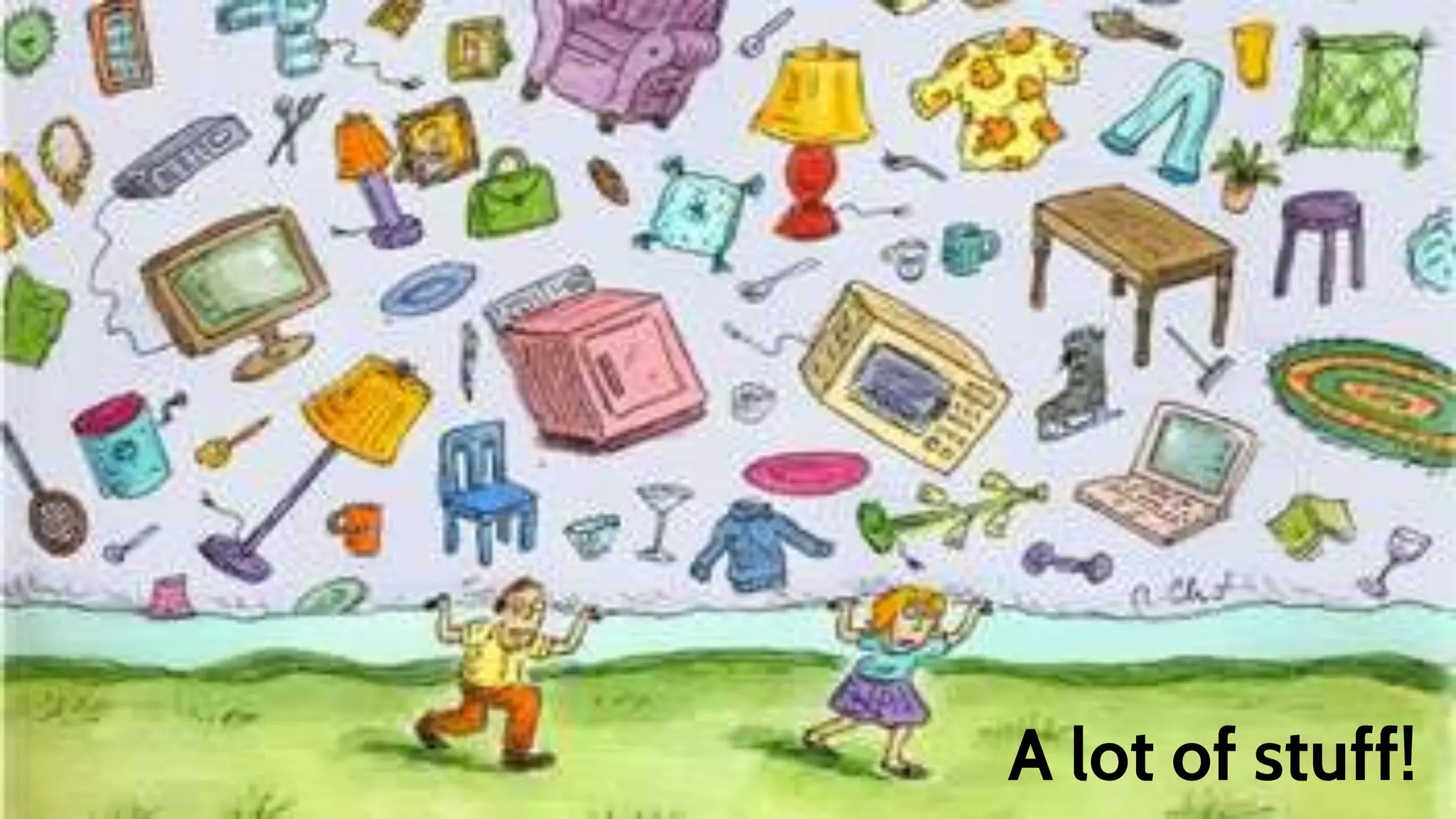
A lot of stuff!
What Are Hiring Managers Looking For?
Let's check LinkedIn
a data scientist should be able to
run a regression, write a sql query, scrape a web
site, design an experiment, factor matrices, use a
data frame, pretend to understand deep learning,
steal from the d3 gallery, argue r versus python,
think in mapreduce, update a prior, build a
dashboard, clean up messy data, test a hypothesis,
talk to a businessperson, script a shell, code on a
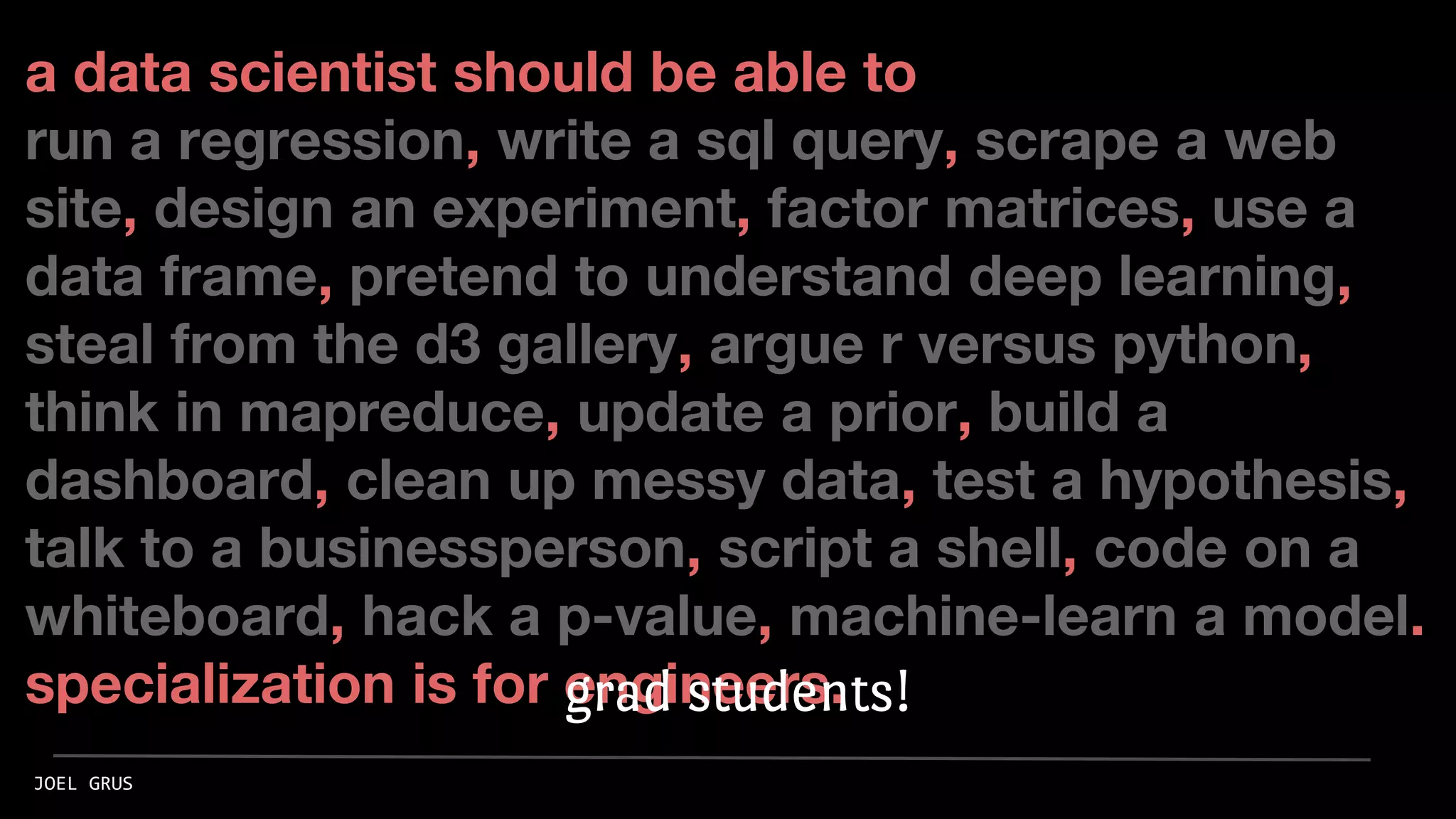
whiteboard, hack a p-value, machine-learn a model.
specialization is for engineers.
JOEL GRUS
grad students!
Learning Data Science
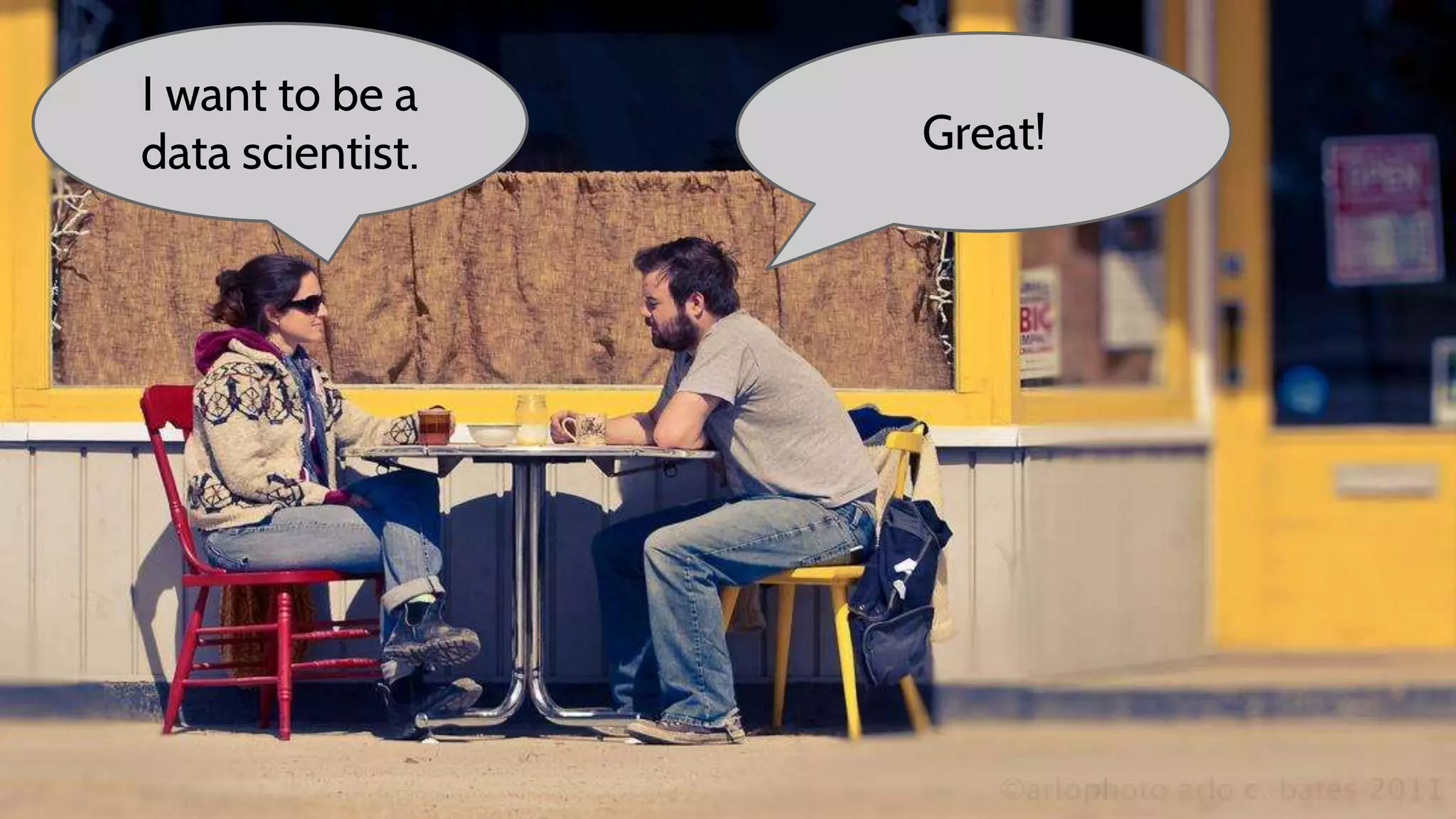
I want to be a
data scientist. Great!
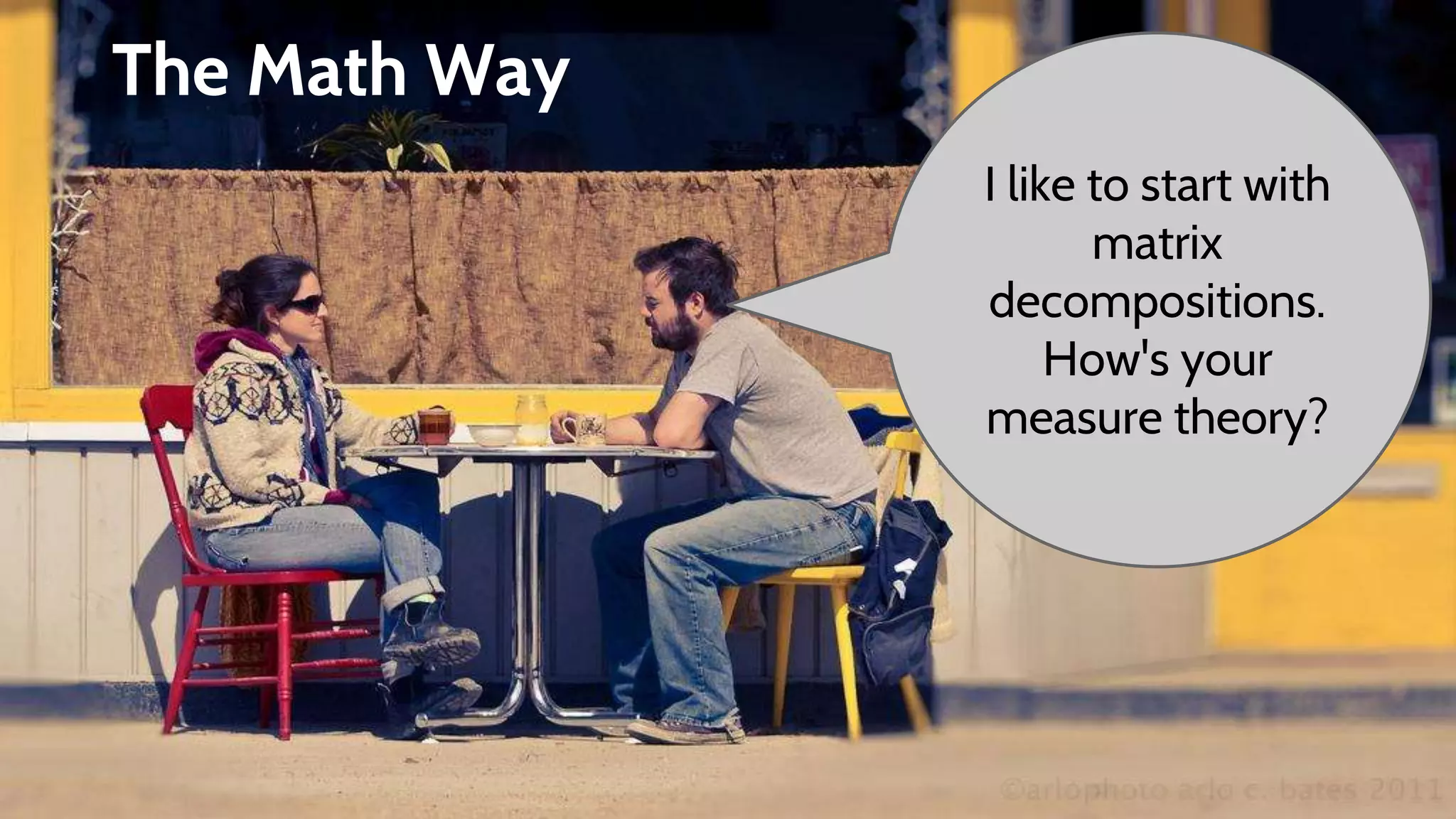
The Math Way
I like to start with
matrix
decompositions.
How's your
measure theory?
The Math Way
The Good:
Solid foundation
Math is the noblest
known pursuit
The Math Way
The Good:
Solid foundation
Math is the noblest
known pursuit
The Bad:
Some weirdos don't
think math is fun
Can be pretty
forbidding
Can miss practical
skills
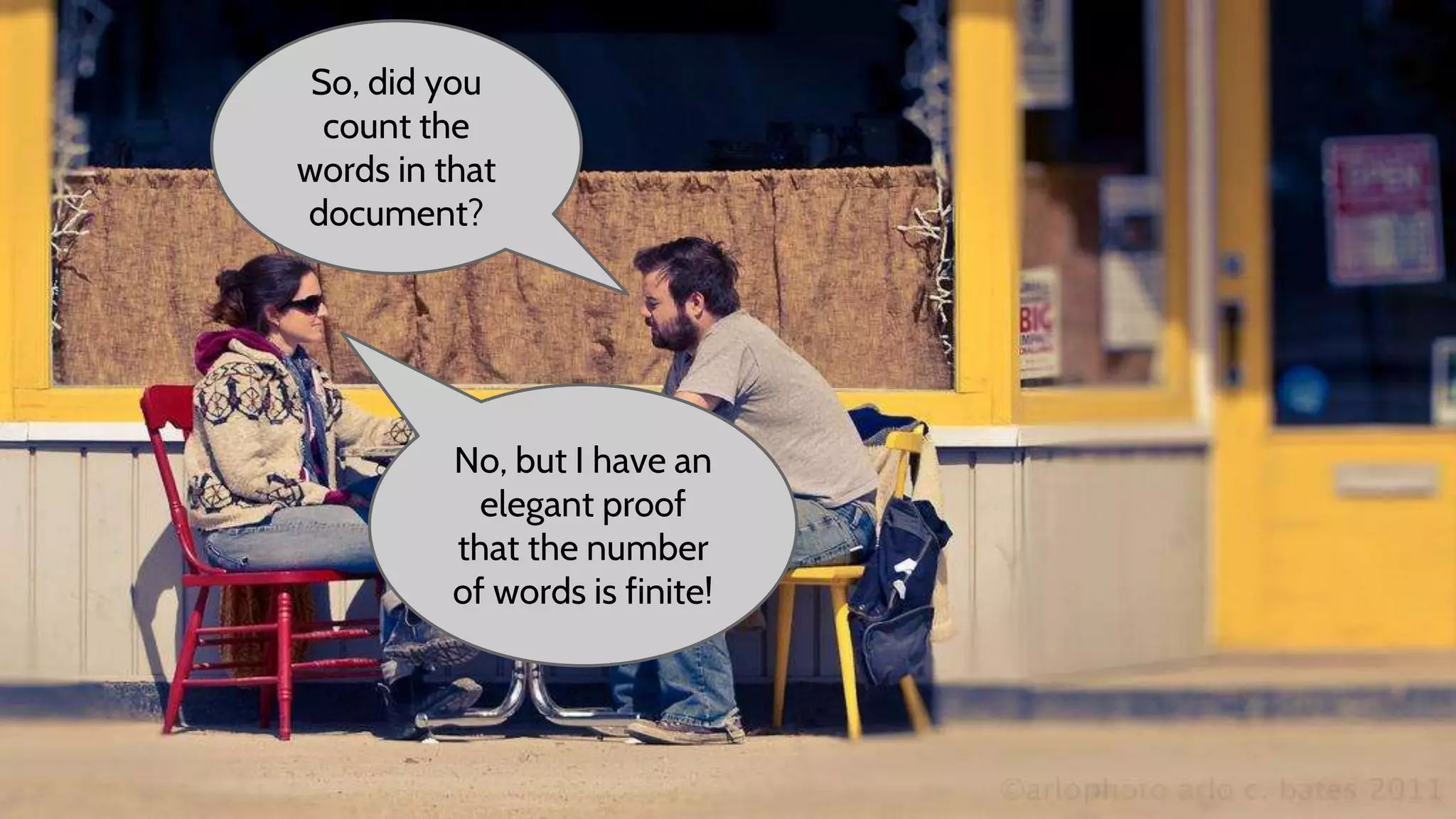
So, did you
count the
words in that
document?
No, but I have an
elegant proof
that the number
of words is finite!
OK, Let's Try Again
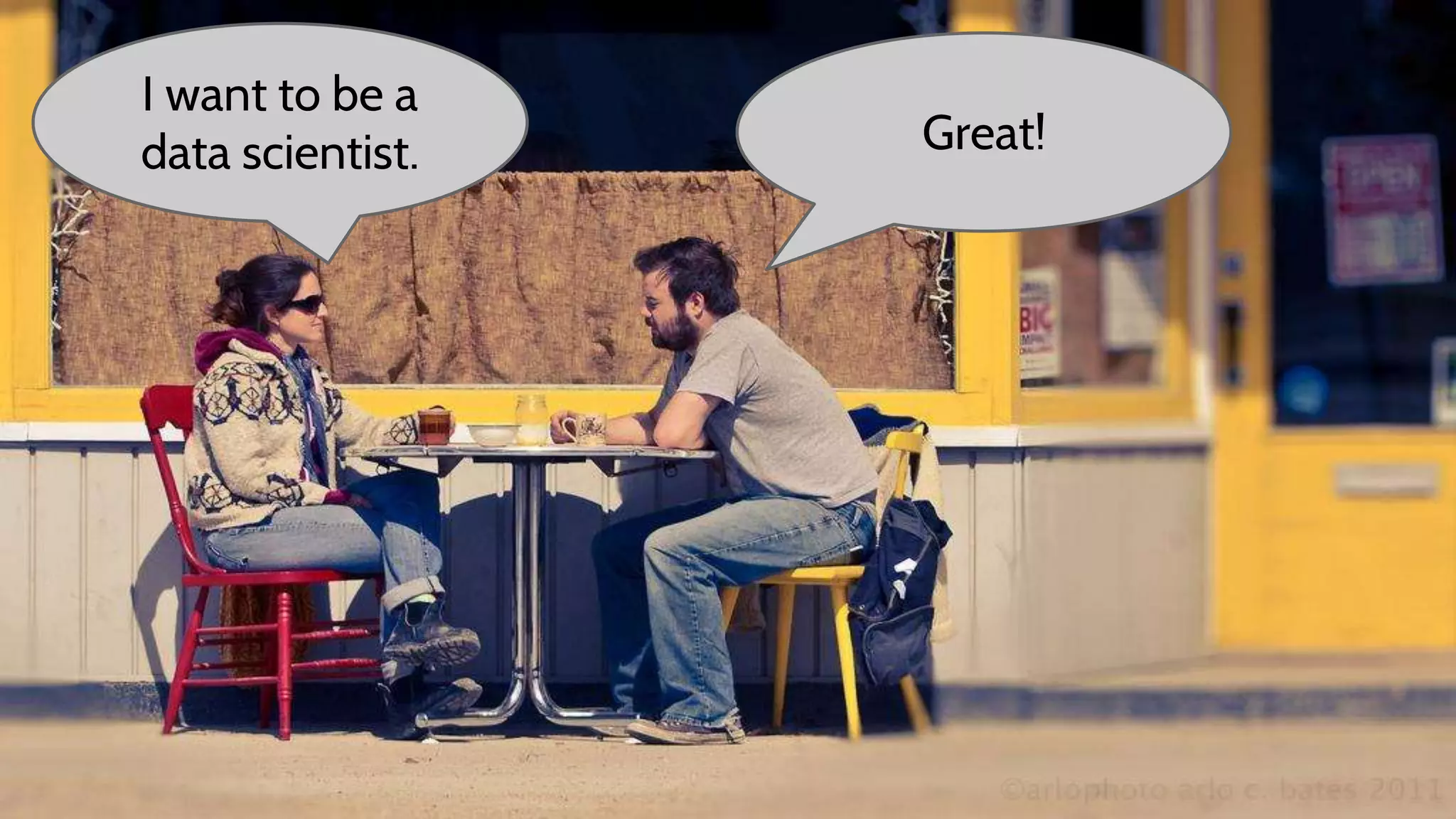
I want to be a
data scientist. Great!
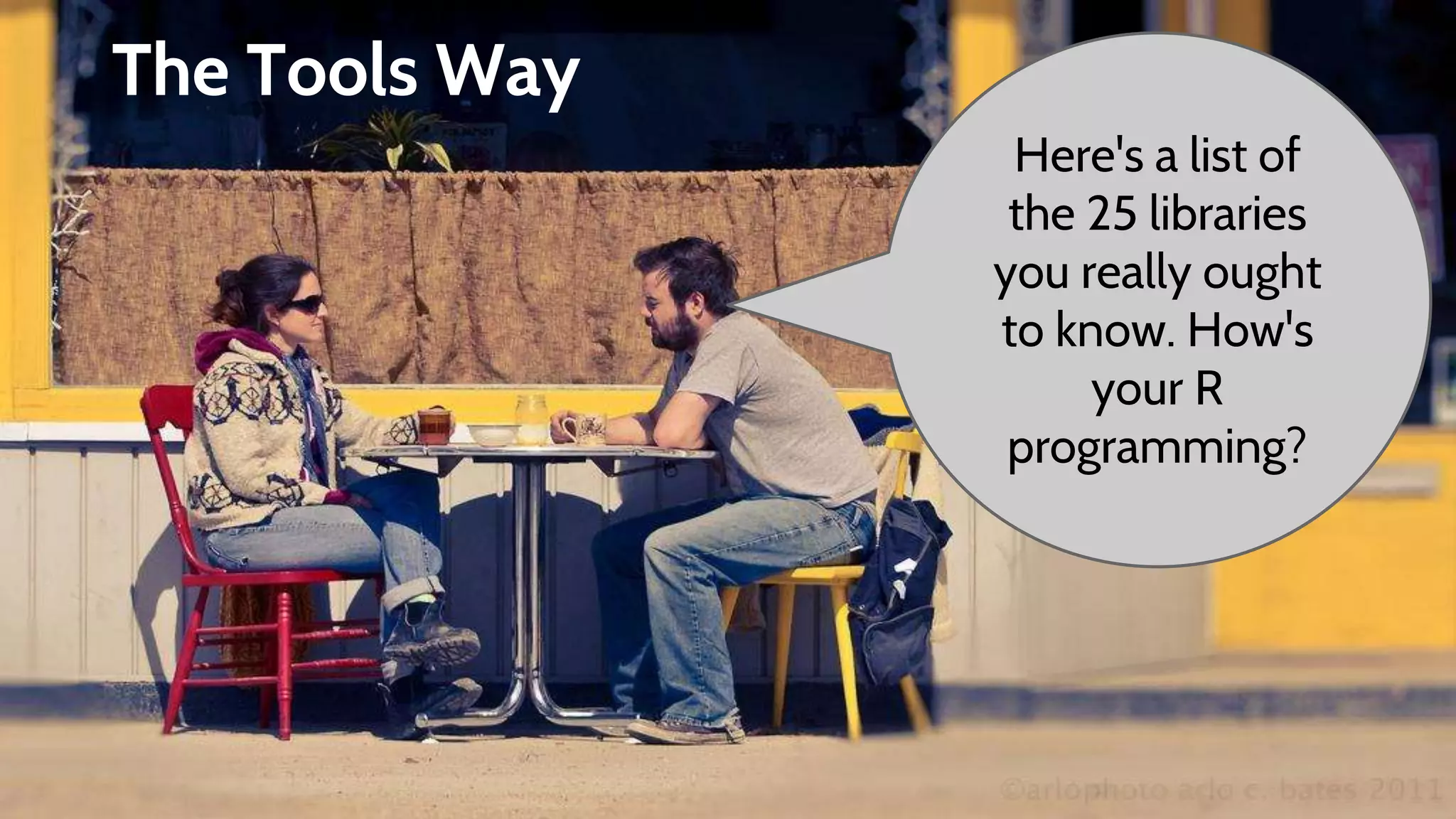
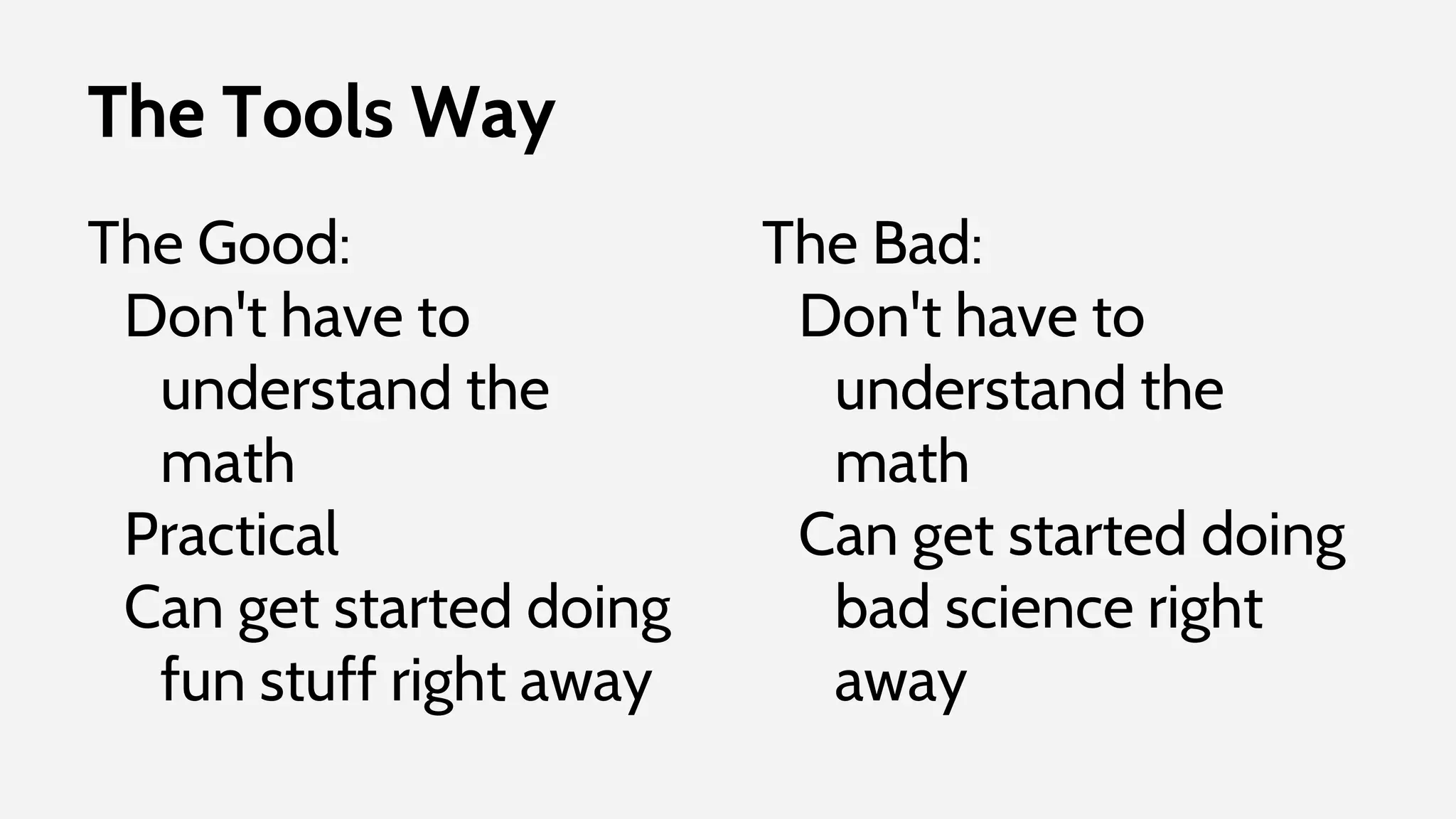
The Tools Way
Here's a list of
the 25 libraries
you really ought
to know. How's
your R
programming?
The Tools Way
The Good:
Don't have to
understand the
math
Practical
Can get started doing
fun stuff right away
The Tools Way
The Good:
Don't have to
understand the
math
Practical
Can get started doing
fun stuff right away
The Bad:
Don't have to
understand the
math
Can get started doing
bad science right
away
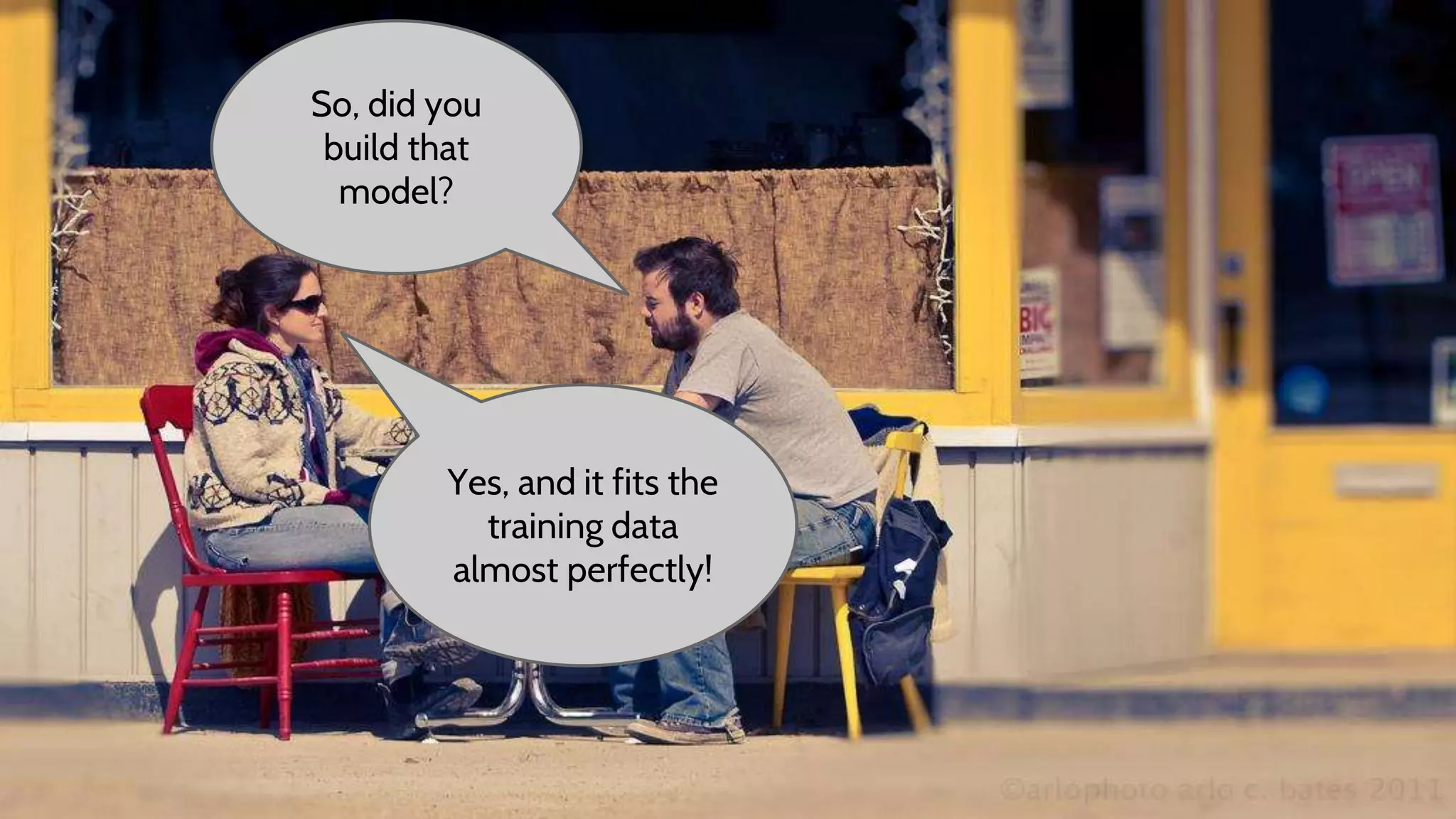
So, did you
build that
model?
Yes, and it fits the
training data
almost perfectly!
OK, Maybe Not That Either
So Then What?
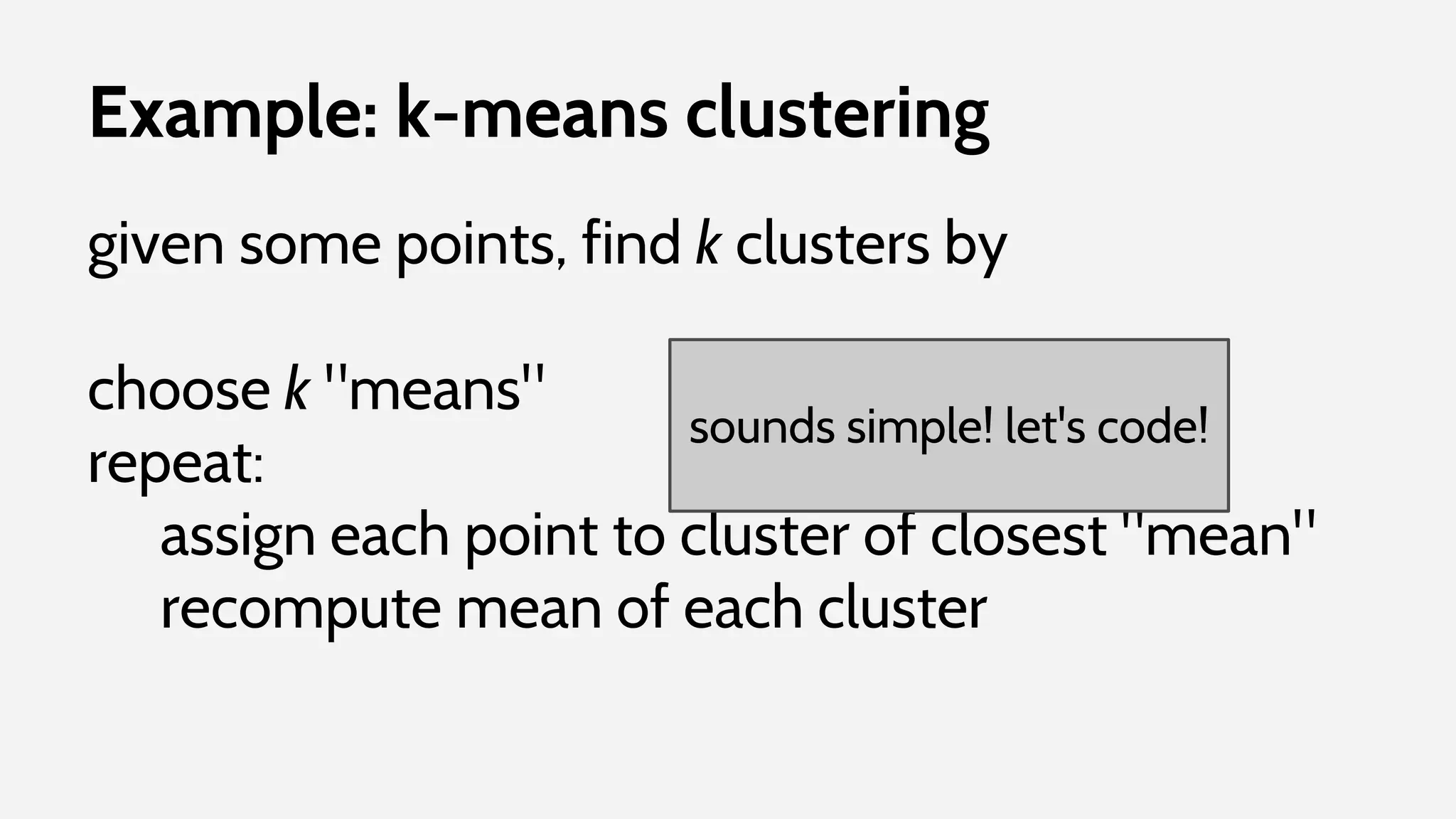
Example: k-means clustering
Unsupervised machine learning technique
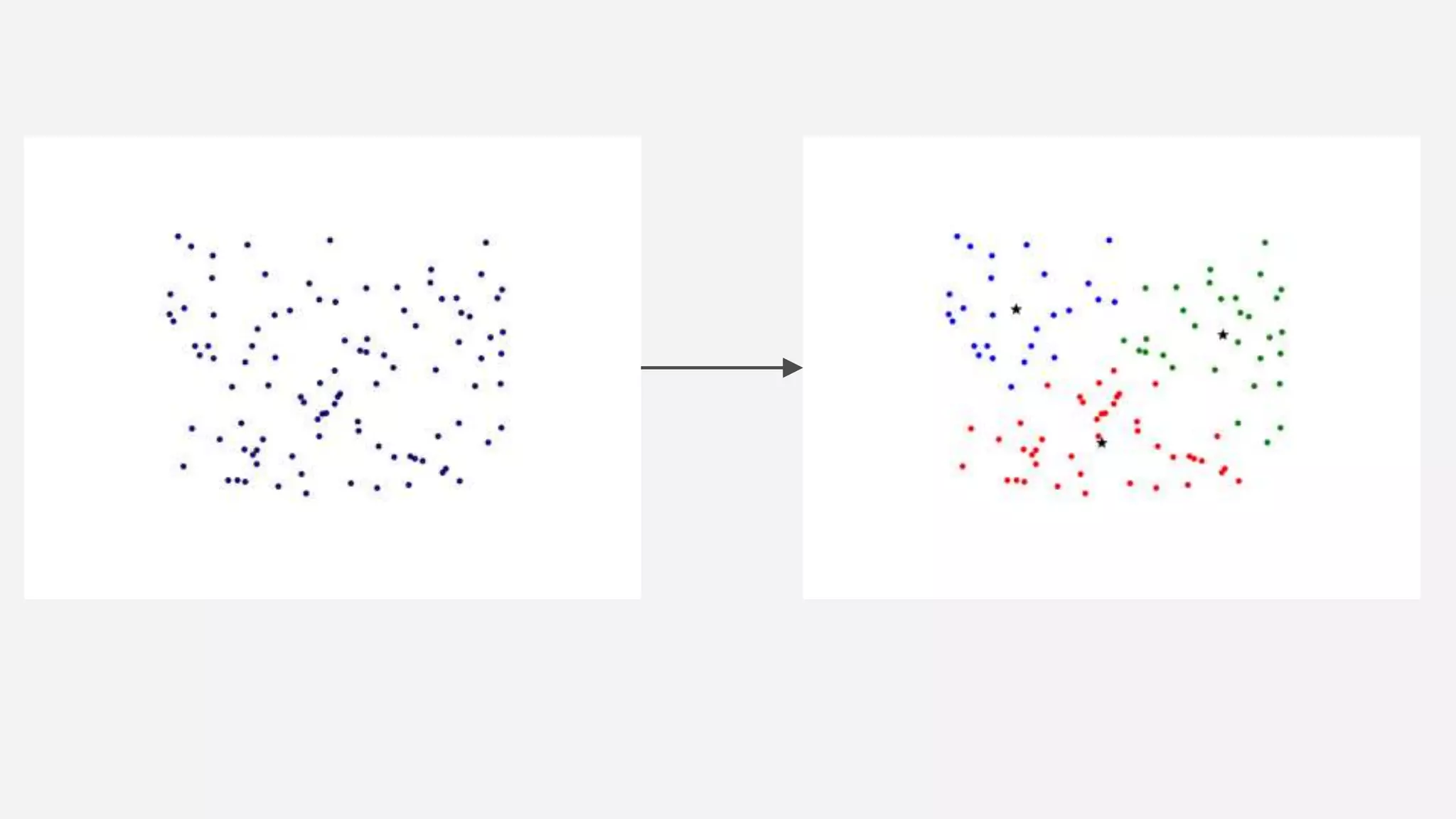
Given a set of points, group them into k clusters
in a way that minimizes the within-cluster sum-
of-squares
i.e. in a way such that the clusters are as "small"
as possible (for a particular conception of
"small")
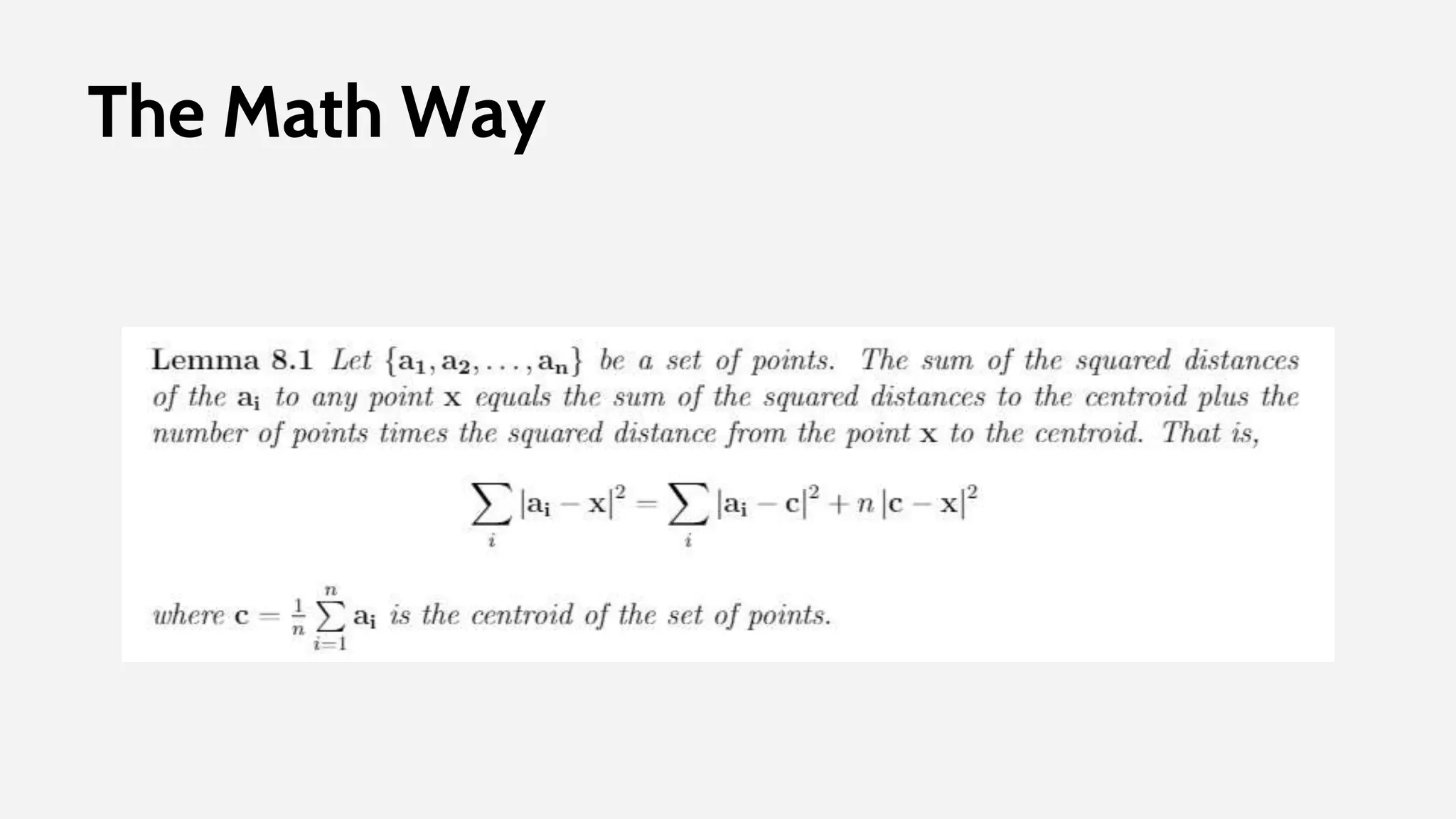
The Math Way
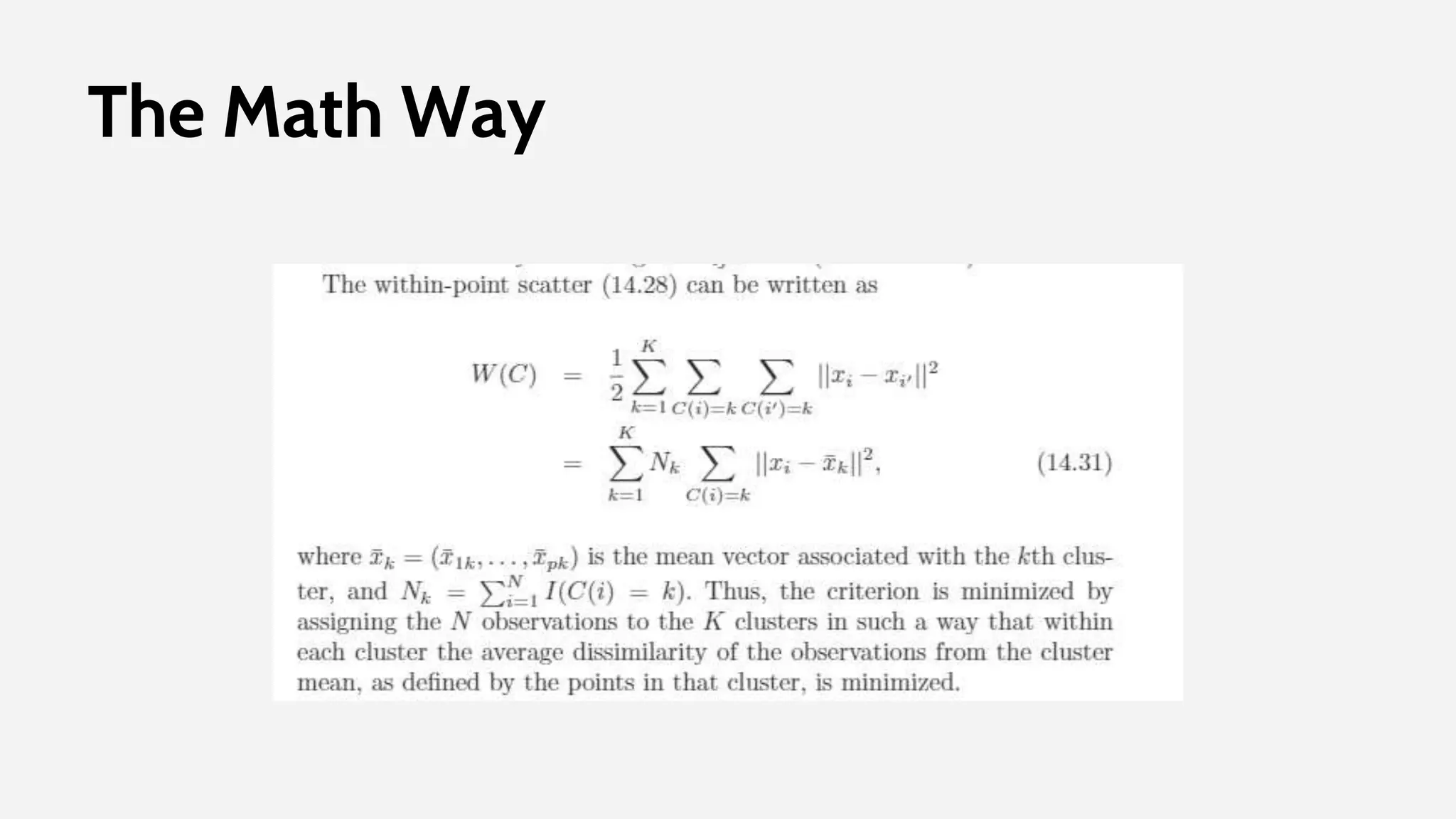
The Math Way
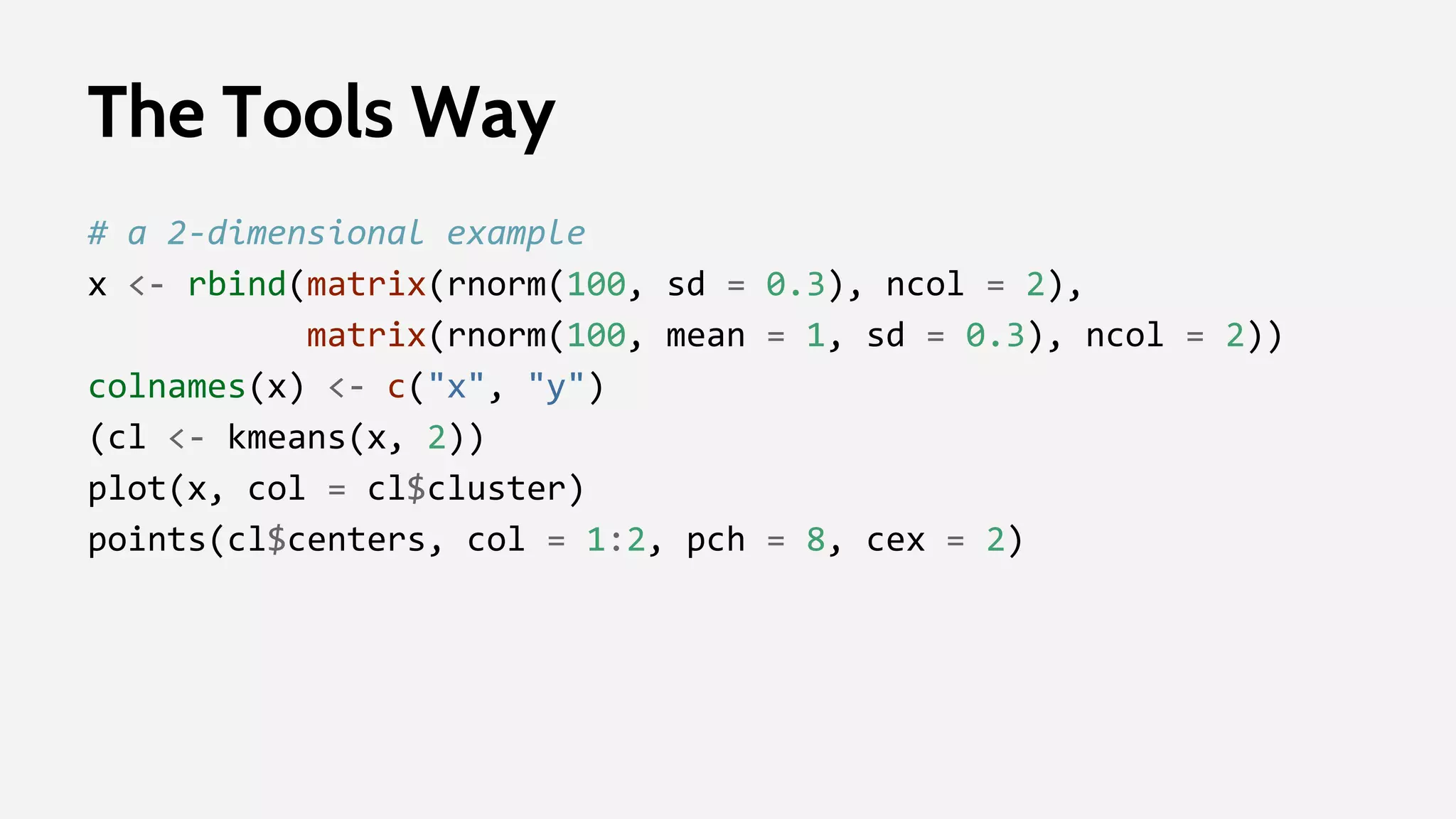
The Tools Way
# a 2-dimensional example
x <- rbind(matrix(rnorm(100, sd = 0.3), ncol = 2),
matrix(rnorm(100, mean = 1, sd = 0.3), ncol = 2))
colnames(x) <- c("x", "y")
(cl <- kmeans(x, 2))
plot(x, col = cl$cluster)
points(cl$centers, col = 1:2, pch = 8, cex = 2)
The Tools Way
>>> from sklearn import cluster, datasets
>>> iris = datasets.load_iris()
>>> X_iris = iris.data
>>> y_iris = iris.target
>>> k_means = cluster.KMeans(n_clusters=3)
>>> k_means.fit(X_iris)
KMeans(copy_x=True, init='k-means++', ...
>>> print(k_means.labels_[::10])
[1 1 1 1 1 0 0 0 0 0 2 2 2 2 2]
>>> print(y_iris[::10])
[0 0 0 0 0 1 1 1 1 1 2 2 2 2 2]
So What To Do?
Bootcamps?
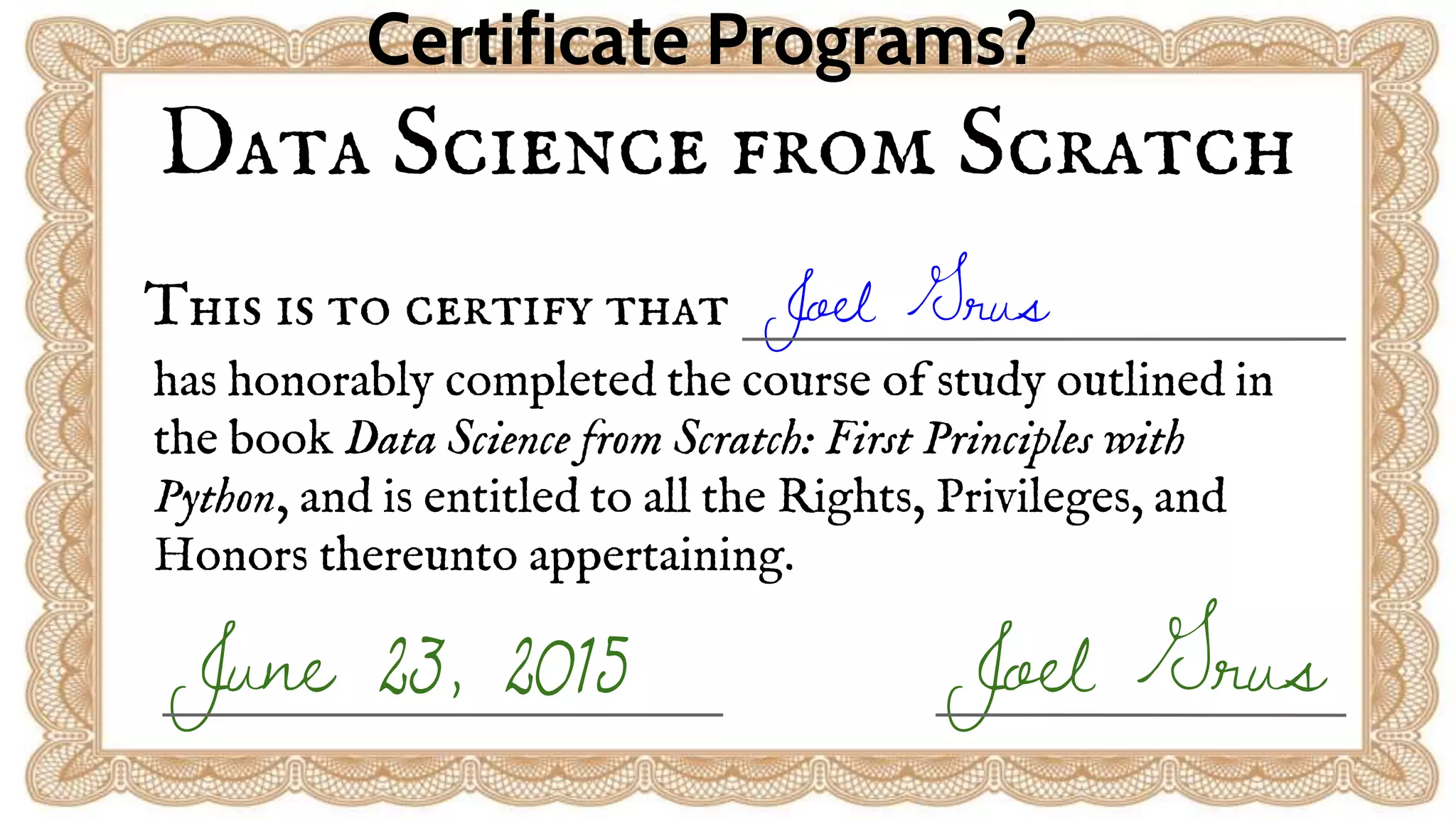
Data Science from Scratch
This is to certify that Joel Grus
has honorably completed the course of study outlined in
the book Data Science from Scratch: First Principles with
Python, and is entitled to all the Rights, Privileges, and
Honors thereunto appertaining.
Joel GrusJune 23, 2015
Certificate Programs?
Hey! Data scientists!
Learning By Building
You don't really understand something until you
build it
For example, I understand garbage disposals
much better now that I had to replace one that
was leaking water all over my kitchen
More relevantly, I thought I understood
hypothesis testing, until I tried to write a book
chapter + code about it.
Learning By Building
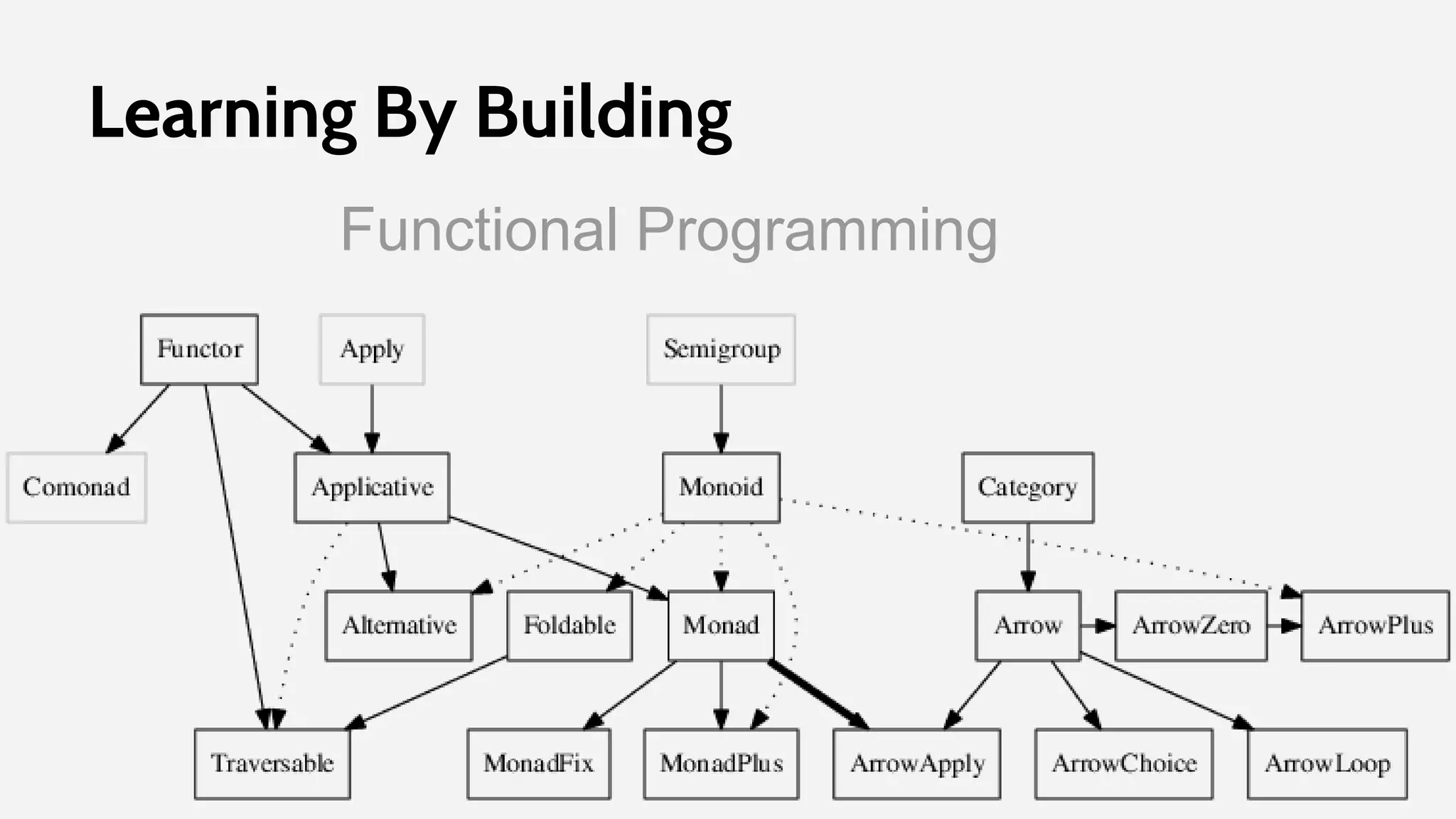
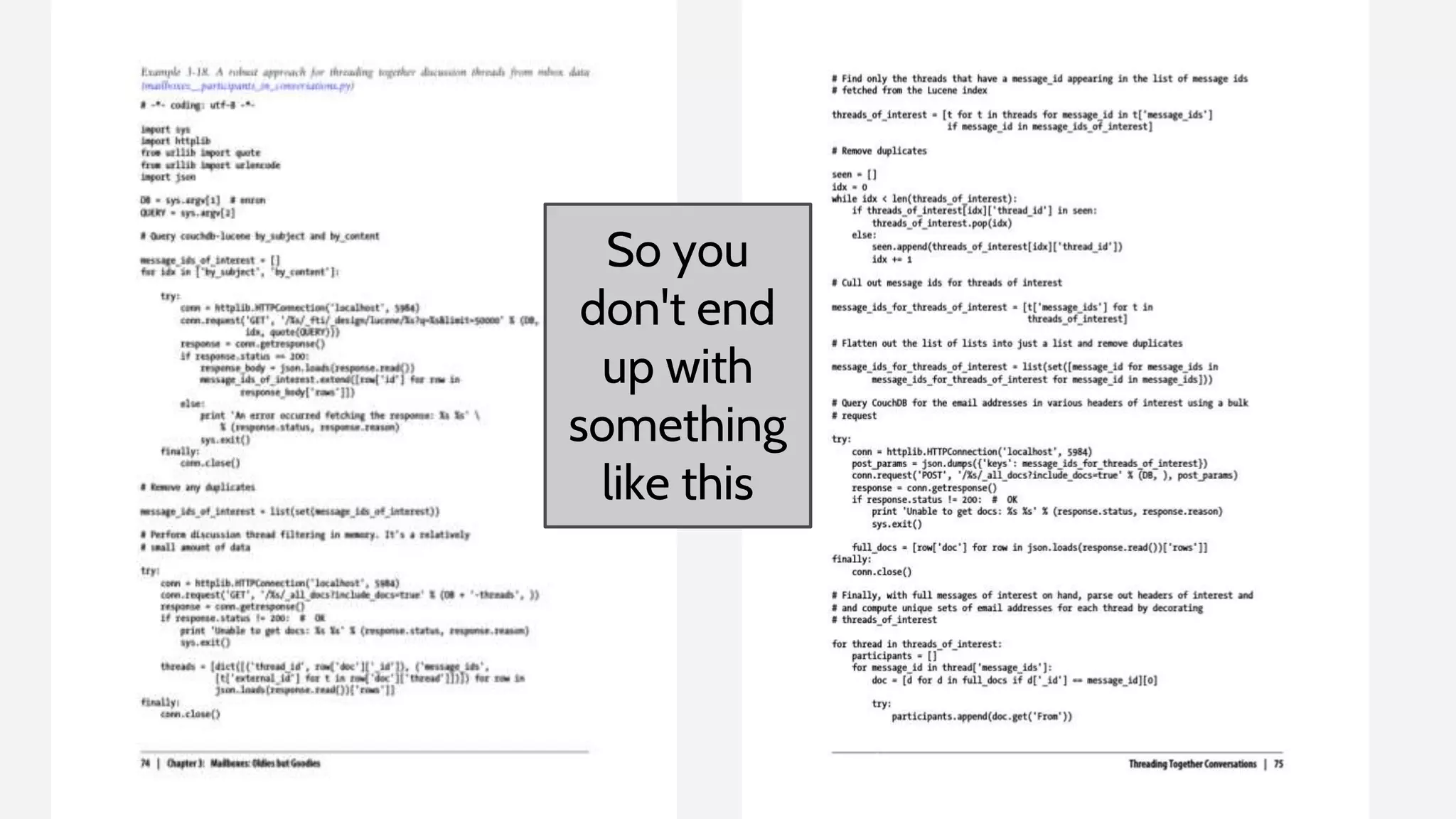
Functional Programming
Break Things Down Into Small Functions
So you
don't end
up with
something
like this
Don't Mutate
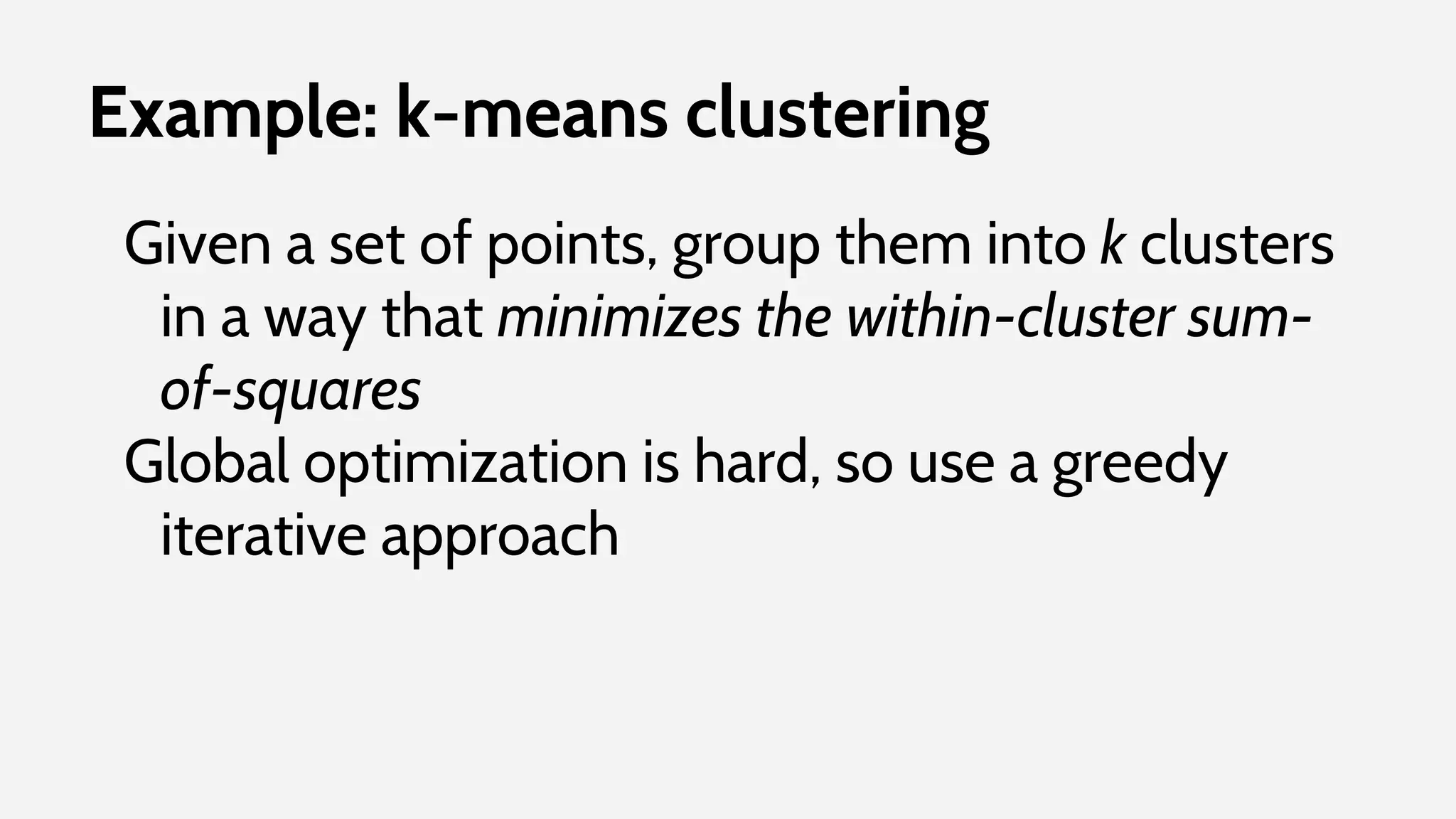
Example: k-means clustering
Given a set of points, group them into k clusters
in a way that minimizes the within-cluster sum-
of-squares
Global optimization is hard, so use a greedy
iterative approach
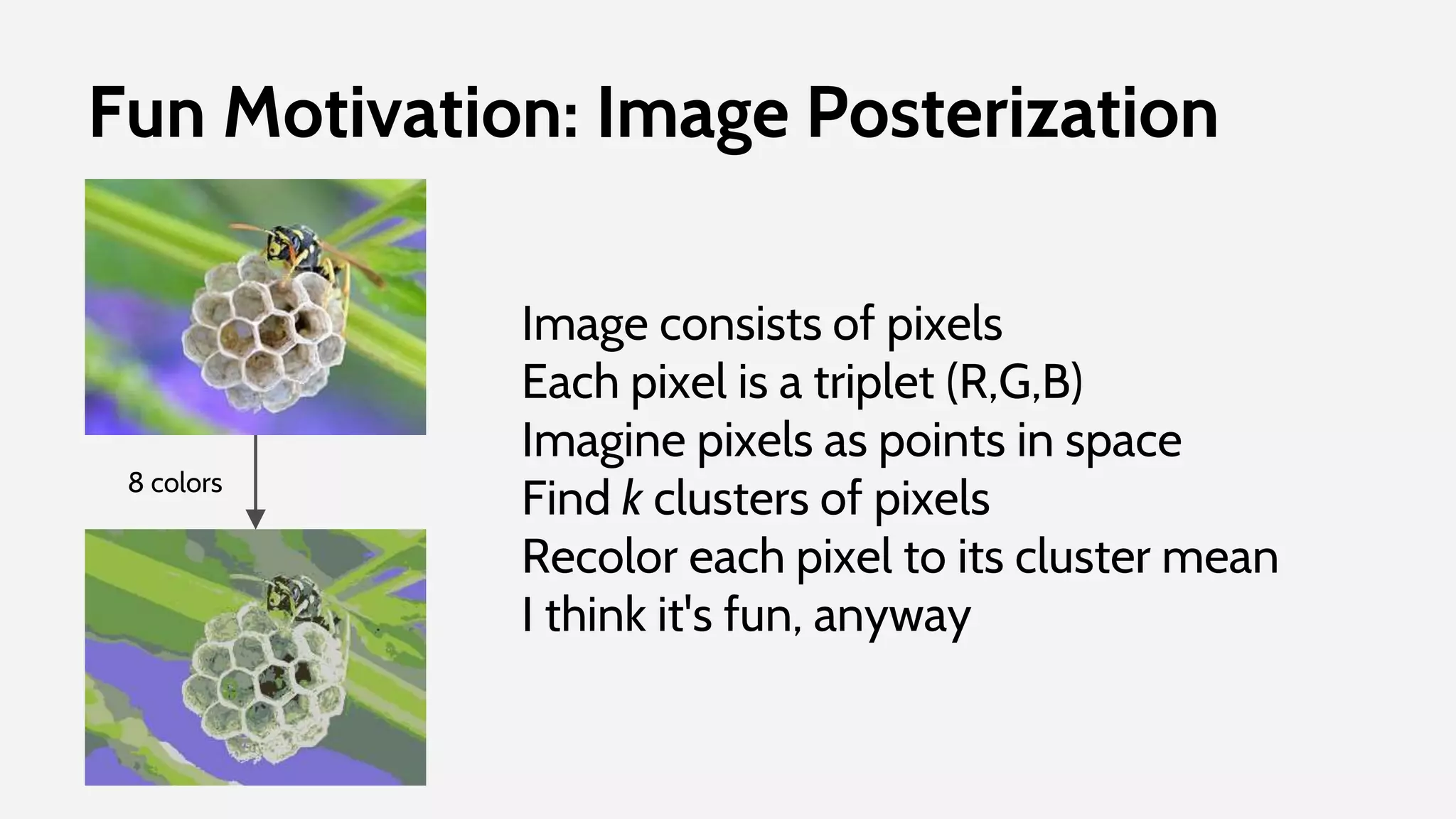
Fun Motivation: Image Posterization
Image consists of pixels
Each pixel is a triplet (R,G,B)
Imagine pixels as points in space
Find k clusters of pixels
Recolor each pixel to its cluster mean
I think it's fun, anyway
8 colors
Example: k-means clustering
given some points, find k clusters by
choose k "means"
repeat:
assign each point to cluster of closest "mean"
recompute mean of each cluster
sounds simple! let's code!
def k_means(points, k, num_iters=10):
means = list(random.sample(points, k))
assignments = [None for _ in points]
for _ in range(num_iters):
# assign each point to closest mean
for i, point_i in enumerate(points):
d_min = float('inf')
for j, mean_j in enumerate(means):
d = sum((x - y)**2
for x, y in zip(point_i, mean_j))
if d < d_min:
d_min = d
assignments[i] = j
# recompute means
for j in range(k):
cluster = [point for i, point in enumerate(points) if assignments[i] ==
j]
means[j] = mean(cluster)
return means
def k_means(points, k, num_iters=10):
means = list(random.sample(points, k))
assignments = [None for _ in points]
for _ in range(num_iters):
# assign each point to closest mean
for i, point_i in enumerate(points):
d_min = float('inf')
for j, mean_j in enumerate(means):
d = sum((x - y)**2
for x, y in zip(point_i, mean_j))
if d < d_min:
d_min = d
assignments[i] = j
# recompute means
for j in range(k):
cluster = [point for i, point in enumerate(points) if assignments[i] ==
j]
means[j] = mean(cluster)
return means
start with k randomly chosen points
def k_means(points, k, num_iters=10):
means = list(random.sample(points, k))
assignments = [None for _ in points]
for _ in range(num_iters):
# assign each point to closest mean
for i, point_i in enumerate(points):
d_min = float('inf')
for j, mean_j in enumerate(means):
d = sum((x - y)**2
for x, y in zip(point_i, mean_j))
if d < d_min:
d_min = d
assignments[i] = j
# recompute means
for j in range(k):
cluster = [point for i, point in enumerate(points) if assignments[i] ==
j]
means[j] = mean(cluster)
return means
start with k randomly chosen points
start with no cluster assignments
def k_means(points, k, num_iters=10):
means = list(random.sample(points, k))
assignments = [None for _ in points]
for _ in range(num_iters):
# assign each point to closest mean
for i, point_i in enumerate(points):
d_min = float('inf')
for j, mean_j in enumerate(means):
d = sum((x - y)**2
for x, y in zip(point_i, mean_j))
if d < d_min:
d_min = d
assignments[i] = j
# recompute means
for j in range(k):
cluster = [point for i, point in enumerate(points) if assignments[i] ==
j]
means[j] = mean(cluster)
return means
start with k randomly chosen points
start with no cluster assignments
for each iteration
def k_means(points, k, num_iters=10):
means = list(random.sample(points, k))
assignments = [None for _ in points]
for _ in range(num_iters):
# assign each point to closest mean
for i, point_i in enumerate(points):
d_min = float('inf')
for j, mean_j in enumerate(means):
d = sum((x - y)**2
for x, y in zip(point_i, mean_j))
if d < d_min:
d_min = d
assignments[i] = j
# recompute means
for j in range(k):
cluster = [point for i, point in enumerate(points) if assignments[i] ==
j]
means[j] = mean(cluster)
return means
start with k randomly chosen points
start with no cluster assignments
for each iteration
for each point
def k_means(points, k, num_iters=10):
means = list(random.sample(points, k))
assignments = [None for _ in points]
for _ in range(num_iters):
# assign each point to closest mean
for i, point_i in enumerate(points):
d_min = float('inf')
for j, mean_j in enumerate(means):
d = sum((x - y)**2
for x, y in zip(point_i, mean_j))
if d < d_min:
d_min = d
assignments[i] = j
# recompute means
for j in range(k):
cluster = [point for i, point in enumerate(points) if assignments[i] ==
j]
means[j] = mean(cluster)
return means
start with k randomly chosen points
start with no cluster assignments
for each iteration
for each point
for each mean
def k_means(points, k, num_iters=10):
means = list(random.sample(points, k))
assignments = [None for _ in points]
for _ in range(num_iters):
# assign each point to closest mean
for i, point_i in enumerate(points):
d_min = float('inf')
for j, mean_j in enumerate(means):
d = sum((x - y)**2
for x, y in zip(point_i, mean_j))
if d < d_min:
d_min = d
assignments[i] = j
# recompute means
for j in range(k):
cluster = [point for i, point in enumerate(points) if assignments[i] ==
j]
means[j] = mean(cluster)
return means
start with k randomly chosen points
start with no cluster assignments
for each iteration
for each point
for each mean
compute the distance
def k_means(points, k, num_iters=10):
means = list(random.sample(points, k))
assignments = [None for _ in points]
for _ in range(num_iters):
# assign each point to closest mean
for i, point_i in enumerate(points):
d_min = float('inf')
for j, mean_j in enumerate(means):
d = sum((x - y)**2
for x, y in zip(point_i, mean_j))
if d < d_min:
d_min = d
assignments[i] = j
# recompute means
for j in range(k):
cluster = [point for i, point in enumerate(points) if assignments[i] ==
j]
means[j] = mean(cluster)
return means
start with k randomly chosen points
start with no cluster assignments
for each iteration
for each point
for each mean
compute the distance
assign the point to the cluster of the mean with
the smallest distance
def k_means(points, k, num_iters=10):
means = list(random.sample(points, k))
assignments = [None for _ in points]
for _ in range(num_iters):
# assign each point to closest mean
for i, point_i in enumerate(points):
d_min = float('inf')
for j, mean_j in enumerate(means):
d = sum((x - y)**2
for x, y in zip(point_i, mean_j))
if d < d_min:
d_min = d
assignments[i] = j
# recompute means
for j in range(k):
cluster = [point for i, point in enumerate(points) if assignments[i] ==
j]
means[j] = mean(cluster)
return means
start with k randomly chosen points
start with no cluster assignments
for each iteration
for each point
for each mean
compute the distance
assign the point to the cluster of the mean with
the smallest distance
find the points in each cluster
def k_means(points, k, num_iters=10):
means = list(random.sample(points, k))
assignments = [None for _ in points]
for _ in range(num_iters):
# assign each point to closest mean
for i, point_i in enumerate(points):
d_min = float('inf')
for j, mean_j in enumerate(means):
d = sum((x - y)**2
for x, y in zip(point_i, mean_j))
if d < d_min:
d_min = d
assignments[i] = j
# recompute means
for j in range(k):
cluster = [point for i, point in enumerate(points) if assignments[i] ==
j]
means[j] = mean(cluster)
return means
start with k randomly chosen points
start with no cluster assignments
for each iteration
for each point
for each mean
compute the distance
assign the point to the cluster of the mean with
the smallest distance
find the points in each cluster
and compute the new means
def k_means(points, k, num_iters=10):
means = list(random.sample(points, k))
assignments = [None for _ in points]
for _ in range(num_iters):
# assign each point to closest mean
for i, point_i in enumerate(points):
d_min = float('inf')
for j, mean_j in enumerate(means):
d = sum((x - y)**2
for x, y in zip(point_i, mean_j))
if d < d_min:
d_min = d
assignments[i] = j
# recompute means
for j in range(k):
cluster = [point for i, point in enumerate(points) if assignments[i] ==
j]
means[j] = mean(cluster)
return means
Not impenetrable, but
a lot less helpful than
it could be
def k_means(points, k, num_iters=10):
means = list(random.sample(points, k))
assignments = [None for _ in points]
for _ in range(num_iters):
# assign each point to closest mean
for i, point_i in enumerate(points):
d_min = float('inf')
for j, mean_j in enumerate(means):
d = sum((x - y)**2
for x, y in zip(point_i, mean_j))
if d < d_min:
d_min = d
assignments[i] = j
# recompute means
for j in range(k):
cluster = [point for i, point in enumerate(points) if assignments[i] ==
j]
means[j] = mean(cluster)
return means
Not impenetrable, but
a lot less helpful than
it could be
Can we make it
simpler?
Break Things Down Into Small Functions
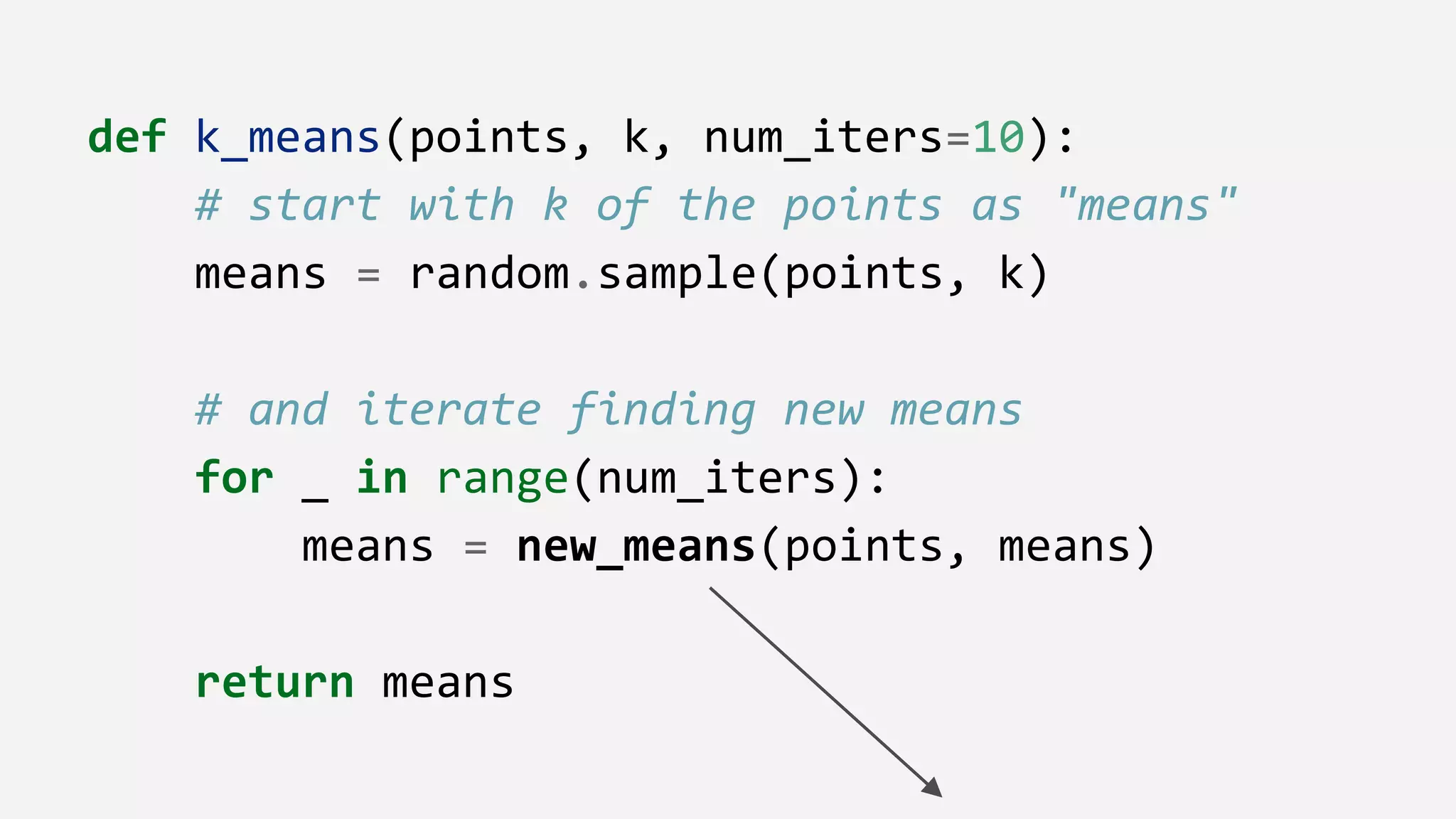
def k_means(points, k, num_iters=10):
# start with k of the points as "means"
means = random.sample(points, k)
# and iterate finding new means
for _ in range(num_iters):
means = new_means(points, means)
return means
def new_means(points, means):
# assign points to clusters
# each cluster is just a list of points
clusters = assign_clusters(points, means)
# return the cluster means
return [mean(cluster)
for cluster in clusters]
def assign_clusters(points, means):
# one cluster for each mean
# each cluster starts empty
clusters = [[] for _ in means]
# assign each point to cluster
# corresponding to closest mean
for p in points:
index = closest_index(point, means)
clusters[index].append(point)
return clusters
def closest_index(point, means):
# return index of closest mean
return argmin(distance(point, mean)
for mean in means)
def argmin(xs):
# return index of smallest element
return min(enumerate(xs),
key=lambda pair: pair[1])[0]
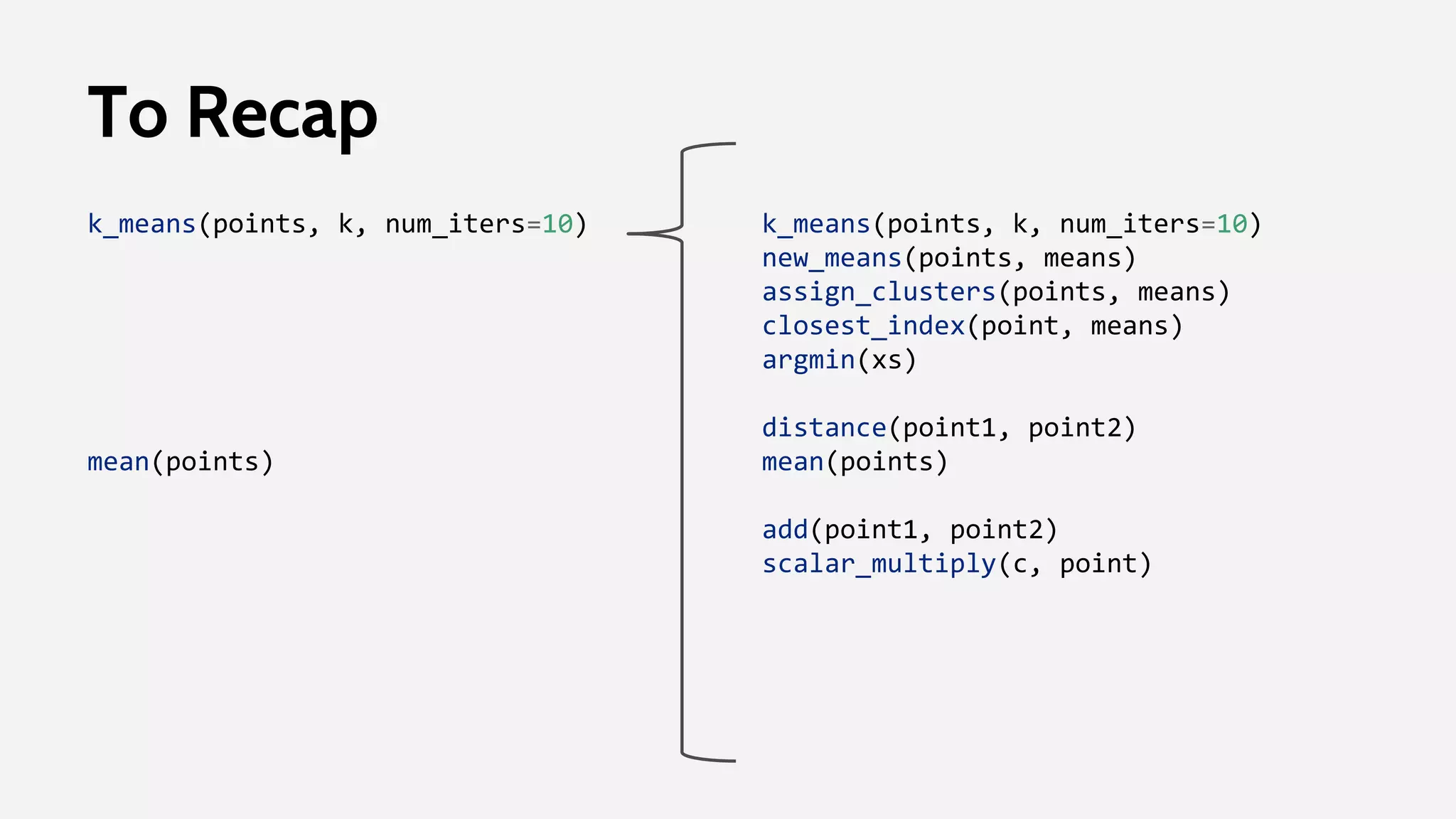
To Recap
k_means(points, k, num_iters=10)
mean(points)
k_means(points, k, num_iters=10)
new_means(points, means)
assign_clusters(points, means)
closest_index(point, means)
argmin(xs)
distance(point1, point2)
mean(points)
add(point1, point2)
scalar_multiply(c, point)
As a Pedagogical Tool
Can be used "top down" (as we did here)
Implement high-level logic
Then implement the details
Nice for exposition
Can also be used "bottom up"
Implement small pieces
Build up to high-level logic
Good for workshops
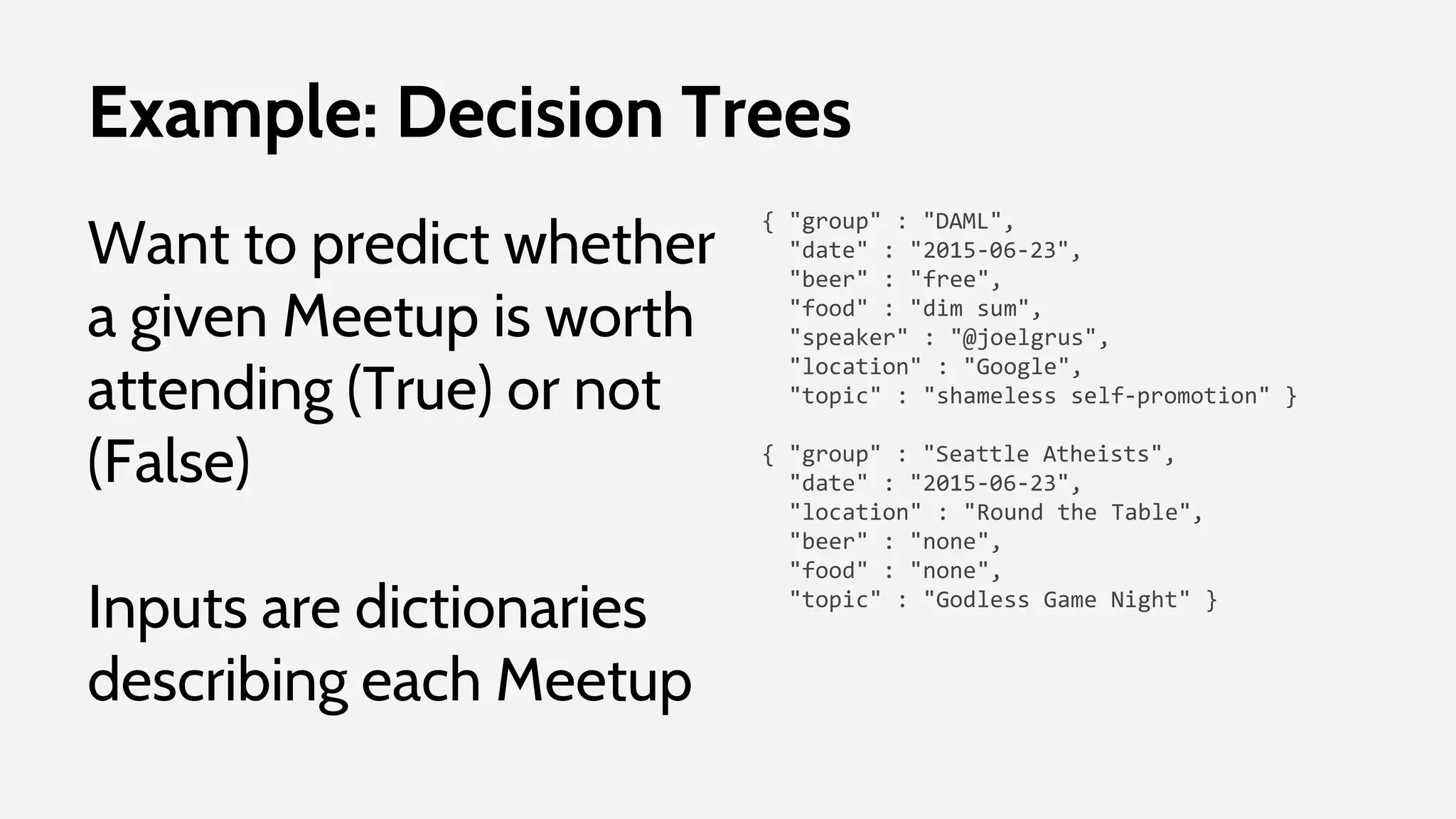
Example: Decision Trees
Want to predict whether
a given Meetup is worth
attending (True) or not
(False)
Inputs are dictionaries
describing each Meetup
{ "group" : "DAML",
"date" : "2015-06-23",
"beer" : "free",
"food" : "dim sum",
"speaker" : "@joelgrus",
"location" : "Google",
"topic" : "shameless self-promotion" }
{ "group" : "Seattle Atheists",
"date" : "2015-06-23",
"location" : "Round the Table",
"beer" : "none",
"food" : "none",
"topic" : "Godless Game Night" }
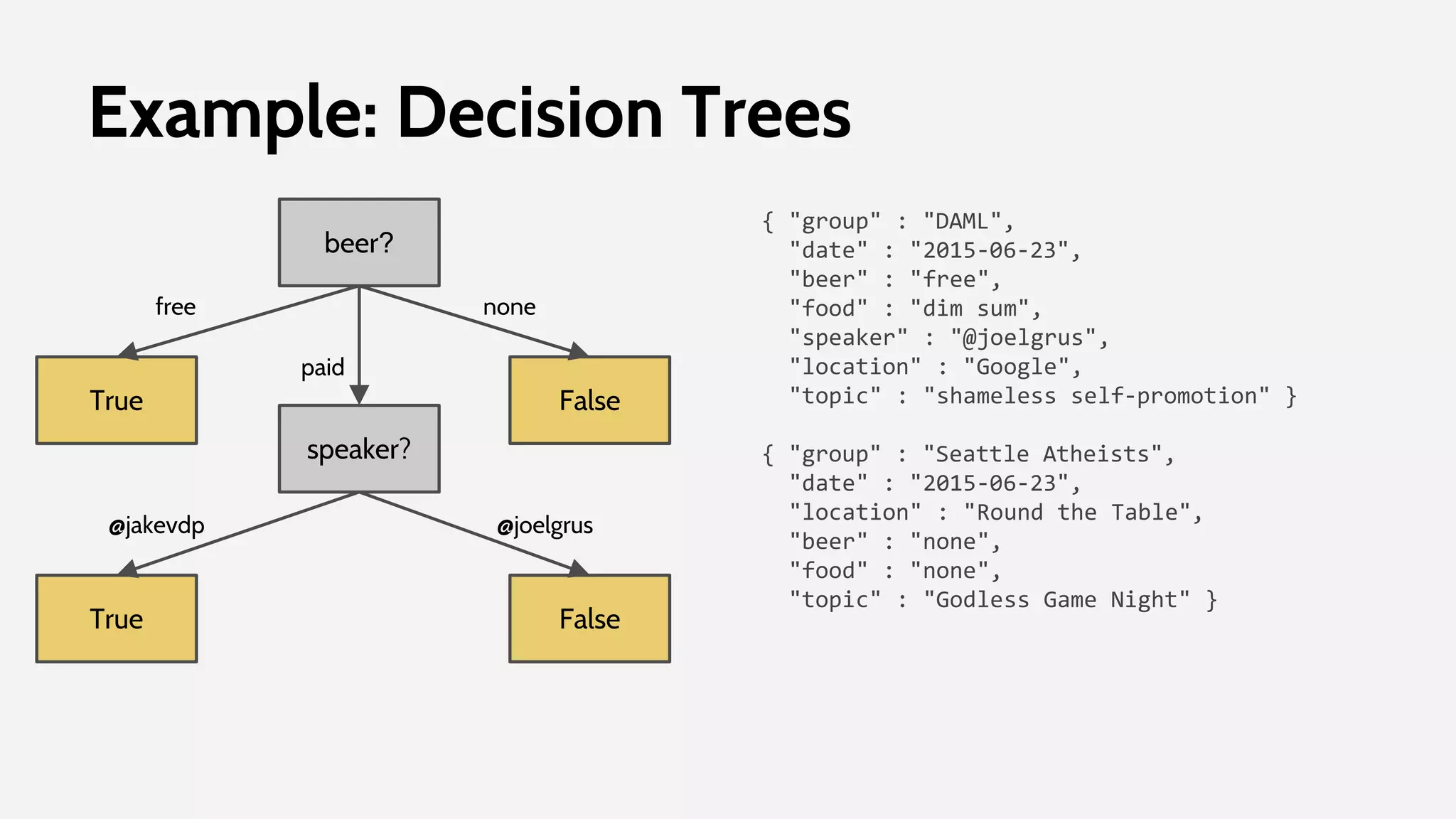
Example: Decision Trees
{ "group" : "DAML",
"date" : "2015-06-23",
"beer" : "free",
"food" : "dim sum",
"speaker" : "@joelgrus",
"location" : "Google",
"topic" : "shameless self-promotion" }
{ "group" : "Seattle Atheists",
"date" : "2015-06-23",
"location" : "Round the Table",
"beer" : "none",
"food" : "none",
"topic" : "Godless Game Night" }
beer?
True False
speaker?
True False
free none
paid
@jakevdp @joelgrus
Example: Decision Trees
class LeafNode:
def __init__(self, prediction):
self.prediction = prediction
def predict(self, input_dict):
return self.prediction
class DecisionNode:
def __init__(self, attribute, subtree_dict):
self.attribute = attribute
self.subtree_dict = subtree_dict
def predict(self, input_dict):
value = input_dict.get(self.attribute)
subtree = self.subtree_dict[value]
return subtree.predict(input)
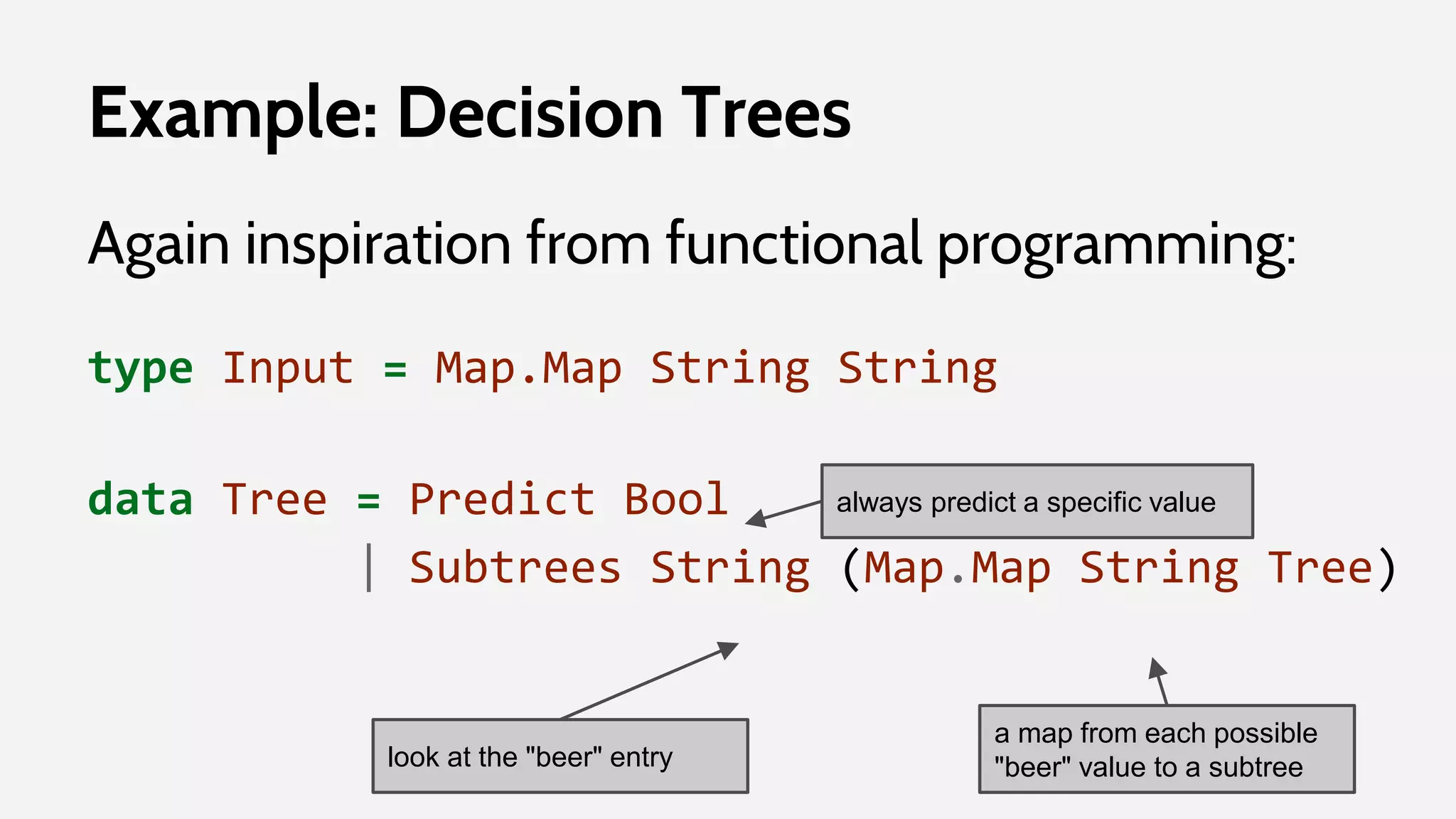
Example: Decision Trees
Again inspiration from functional programming:
type Input = Map.Map String String
data Tree = Predict Bool
| Subtrees String (Map.Map String Tree)
look at the "beer" entry
a map from each possible
"beer" value to a subtree
always predict a specific value
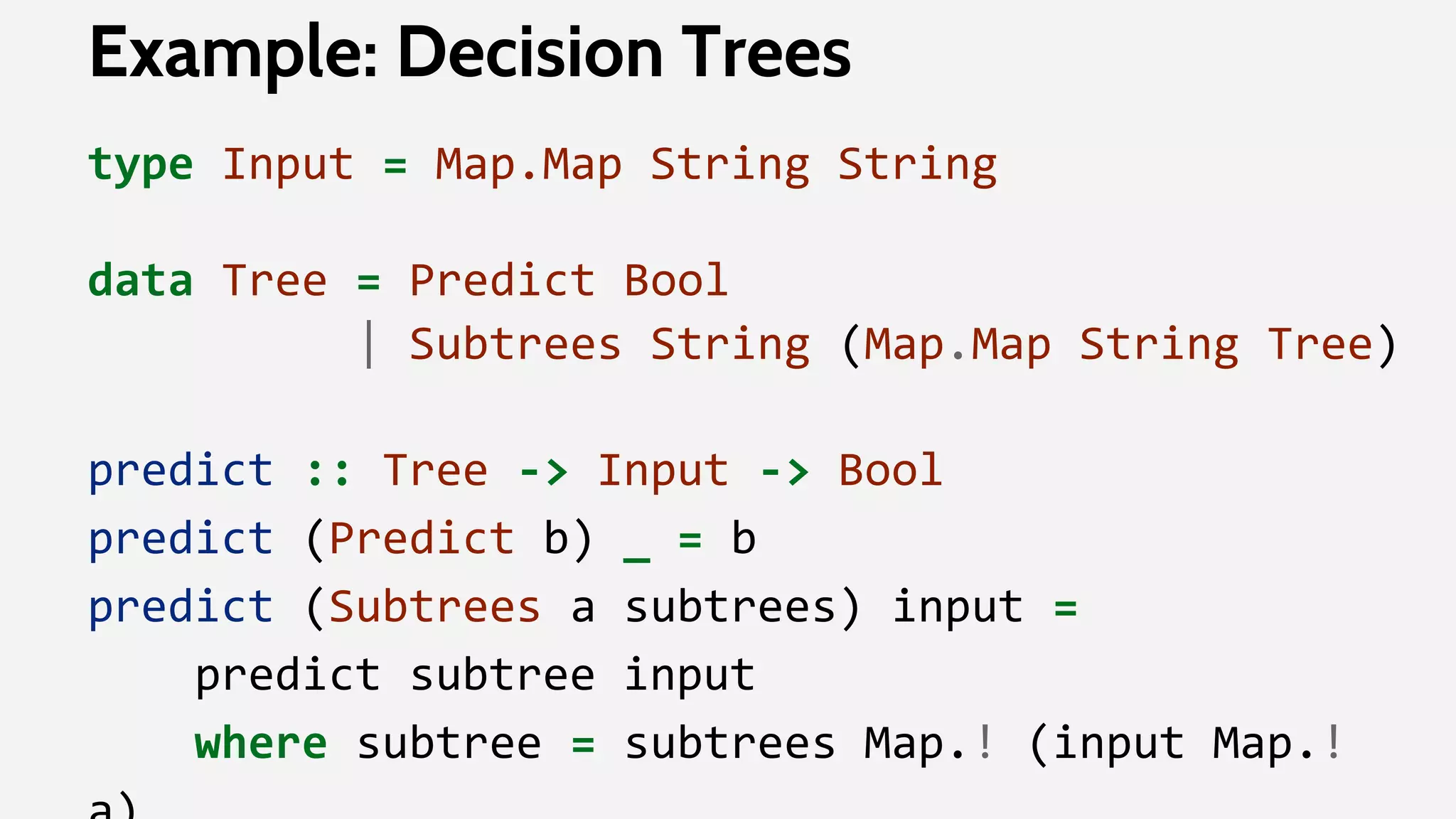
Example: Decision Trees
type Input = Map.Map String String
data Tree = Predict Bool
| Subtrees String (Map.Map String Tree)
predict :: Tree -> Input -> Bool
predict (Predict b) _ = b
predict (Subtrees a subtrees) input =
predict subtree input
where subtree = subtrees Map.! (input Map.!
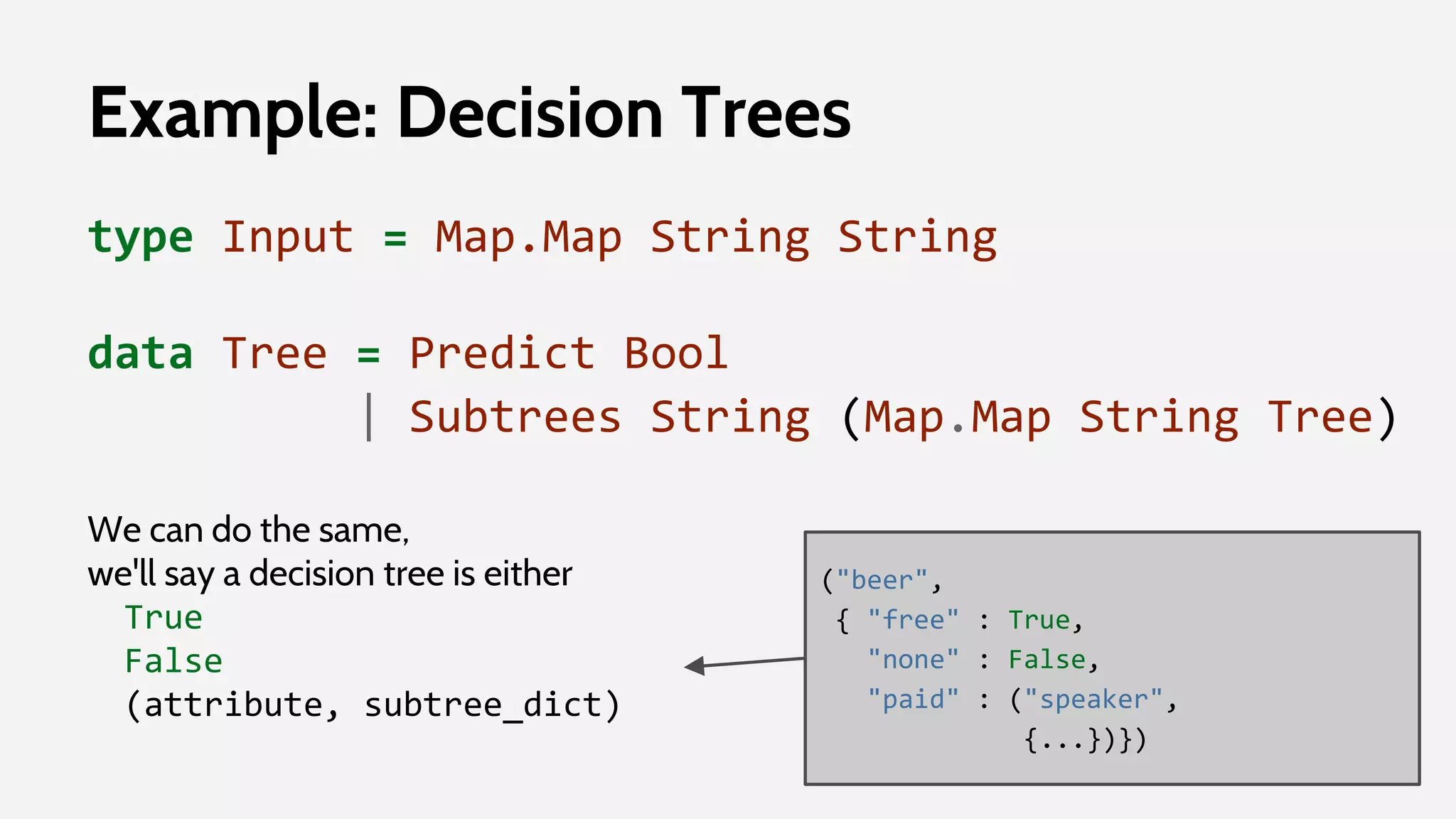
Example: Decision Trees
type Input = Map.Map String String
data Tree = Predict Bool
| Subtrees String (Map.Map String Tree)
We can do the same,
we'll say a decision tree is either
True
False
(attribute, subtree_dict)
("beer",
{ "free" : True,
"none" : False,
"paid" : ("speaker",
{...})})
predict :: Tree -> Input -> Bool
predict (Predict b) _ = b
predict (Subtrees a subtrees) input =
predict subtree input
where subtree = subtrees Map.! (input Map.! a)
Example: Decision Trees
def predict(tree, input_dict):
# leaf node predicts itself
if tree in (True, False):
return tree
else:
# destructure tree
attribute, subtree_dict = tree
# find appropriate subtree
value = input_dict[attribute]
subtree = subtree_dict[value]
# classify using subtree
return predict(subtree, input_dict)
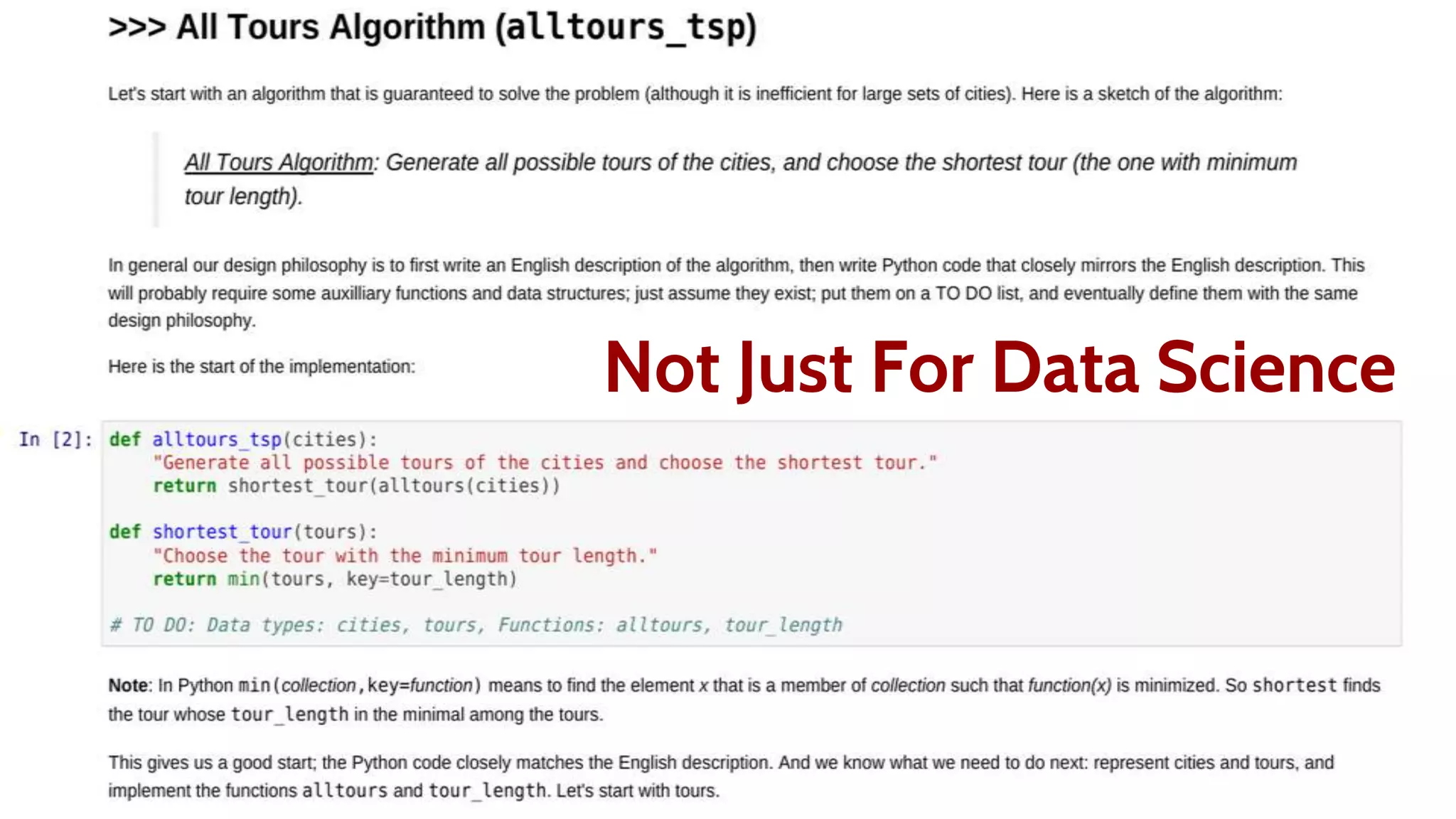
Not Just For Data Science
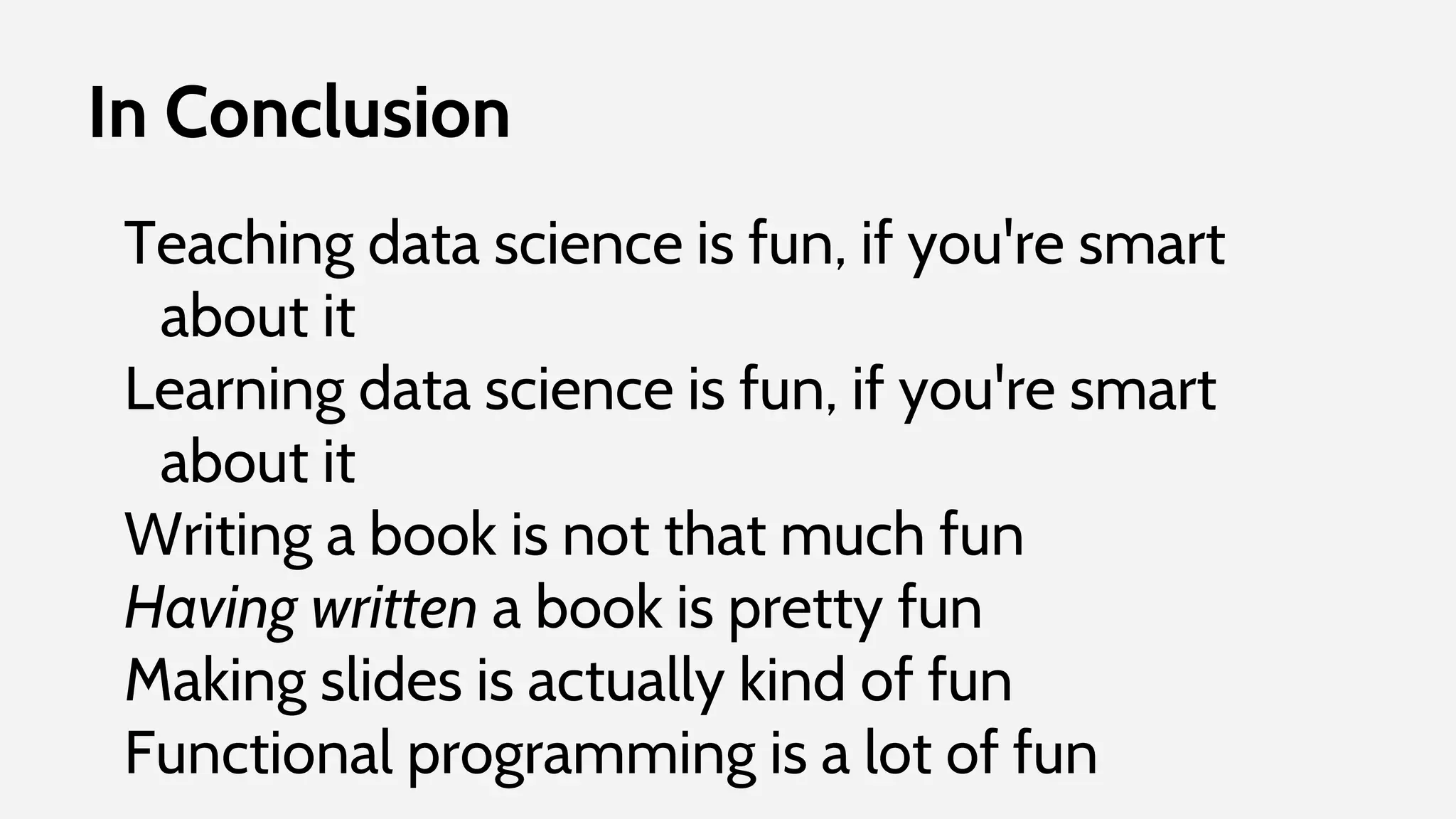
In Conclusion
Teaching data science is fun, if you're smart
about it
Learning data science is fun, if you're smart
about it
Writing a book is not that much fun
Having written a book is pretty fun
Making slides is actually kind of fun
Functional programming is a lot of fun
Thanks!
@joelgrus
joelgrus@gmail.com
joelgrus.com

The Road to Data Science - Joel Grus, June 2015

  • 1.
    Joel Grus Seattle DAMLMeetup June 23, 2015 Data Science from Scratch
  • 2.
    About me Old-school DAML-er Wrotea book ----------> SWE at Google Formerly data science at VoloMetrix, Decide, Farecast
  • 3.
  • 4.
    The Road to DataScience My
  • 6.
  • 9.
  • 10.
    Data Science IsA Broad Field Some Stuff More Stuff Even More Stuff Data Science People who think they're data scientists, but they're not really data scientists People who are a danger to everyone around them People who say "machine learnings"
  • 12.
    a data scientistshould be able to JOEL GRUS
  • 13.
    a data scientistshould be able to run a regression, JOEL GRUS
  • 14.
    a data scientistshould be able to run a regression, write a sql query, JOEL GRUS
  • 15.
    a data scientistshould be able to run a regression, write a sql query, scrape a web site, JOEL GRUS
  • 16.
    a data scientistshould be able to run a regression, write a sql query, scrape a web site, design an experiment, JOEL GRUS
  • 17.
    a data scientistshould be able to run a regression, write a sql query, scrape a web site, design an experiment, factor matrices, JOEL GRUS
  • 18.
    a data scientistshould be able to run a regression, write a sql query, scrape a web site, design an experiment, factor matrices, use a data frame, JOEL GRUS
  • 19.
    a data scientistshould be able to run a regression, write a sql query, scrape a web site, design an experiment, factor matrices, use a data frame, pretend to understand deep learning, JOEL GRUS
  • 20.
    a data scientistshould be able to run a regression, write a sql query, scrape a web site, design an experiment, factor matrices, use a data frame, pretend to understand deep learning, steal from the d3 gallery, JOEL GRUS
  • 21.
    a data scientistshould be able to run a regression, write a sql query, scrape a web site, design an experiment, factor matrices, use a data frame, pretend to understand deep learning, steal from the d3 gallery, argue r versus python, JOEL GRUS
  • 22.
    a data scientistshould be able to run a regression, write a sql query, scrape a web site, design an experiment, factor matrices, use a data frame, pretend to understand deep learning, steal from the d3 gallery, argue r versus python, think in mapreduce, JOEL GRUS
  • 23.
    a data scientistshould be able to run a regression, write a sql query, scrape a web site, design an experiment, factor matrices, use a data frame, pretend to understand deep learning, steal from the d3 gallery, argue r versus python, think in mapreduce, update a prior, JOEL GRUS
  • 24.
    a data scientistshould be able to run a regression, write a sql query, scrape a web site, design an experiment, factor matrices, use a data frame, pretend to understand deep learning, steal from the d3 gallery, argue r versus python, think in mapreduce, update a prior, build a dashboard, JOEL GRUS
  • 25.
    a data scientistshould be able to run a regression, write a sql query, scrape a web site, design an experiment, factor matrices, use a data frame, pretend to understand deep learning, steal from the d3 gallery, argue r versus python, think in mapreduce, update a prior, build a dashboard, clean up messy data, JOEL GRUS
  • 26.
    a data scientistshould be able to run a regression, write a sql query, scrape a web site, design an experiment, factor matrices, use a data frame, pretend to understand deep learning, steal from the d3 gallery, argue r versus python, think in mapreduce, update a prior, build a dashboard, clean up messy data, test a hypothesis, JOEL GRUS
  • 27.
    a data scientistshould be able to run a regression, write a sql query, scrape a web site, design an experiment, factor matrices, use a data frame, pretend to understand deep learning, steal from the d3 gallery, argue r versus python, think in mapreduce, update a prior, build a dashboard, clean up messy data, test a hypothesis, talk to a businessperson, JOEL GRUS
  • 28.
    a data scientistshould be able to run a regression, write a sql query, scrape a web site, design an experiment, factor matrices, use a data frame, pretend to understand deep learning, steal from the d3 gallery, argue r versus python, think in mapreduce, update a prior, build a dashboard, clean up messy data, test a hypothesis, talk to a businessperson, script a shell, JOEL GRUS
  • 29.
    a data scientistshould be able to run a regression, write a sql query, scrape a web site, design an experiment, factor matrices, use a data frame, pretend to understand deep learning, steal from the d3 gallery, argue r versus python, think in mapreduce, update a prior, build a dashboard, clean up messy data, test a hypothesis, talk to a businessperson, script a shell, code on a whiteboard, JOEL GRUS
  • 30.
    a data scientistshould be able to run a regression, write a sql query, scrape a web site, design an experiment, factor matrices, use a data frame, pretend to understand deep learning, steal from the d3 gallery, argue r versus python, think in mapreduce, update a prior, build a dashboard, clean up messy data, test a hypothesis, talk to a businessperson, script a shell, code on a whiteboard, hack a p-value, JOEL GRUS
  • 31.
    a data scientistshould be able to run a regression, write a sql query, scrape a web site, design an experiment, factor matrices, use a data frame, pretend to understand deep learning, steal from the d3 gallery, argue r versus python, think in mapreduce, update a prior, build a dashboard, clean up messy data, test a hypothesis, talk to a businessperson, script a shell, code on a whiteboard, hack a p-value, machine-learn a model. JOEL GRUS
  • 32.
    a data scientistshould be able to run a regression, write a sql query, scrape a web site, design an experiment, factor matrices, use a data frame, pretend to understand deep learning, steal from the d3 gallery, argue r versus python, think in mapreduce, update a prior, build a dashboard, clean up messy data, test a hypothesis, talk to a businessperson, script a shell, code on a whiteboard, hack a p-value, machine-learn a model. specialization is for engineers. JOEL GRUS
  • 33.
    A lot ofstuff!
  • 34.
    What Are HiringManagers Looking For?
  • 35.
    What Are HiringManagers Looking For? Let's check LinkedIn
  • 37.
    a data scientistshould be able to run a regression, write a sql query, scrape a web site, design an experiment, factor matrices, use a data frame, pretend to understand deep learning, steal from the d3 gallery, argue r versus python, think in mapreduce, update a prior, build a dashboard, clean up messy data, test a hypothesis, talk to a businessperson, script a shell, code on a whiteboard, hack a p-value, machine-learn a model. specialization is for engineers. JOEL GRUS grad students!
  • 38.
  • 39.
    I want tobe a data scientist. Great!
  • 40.
    The Math Way Ilike to start with matrix decompositions. How's your measure theory?
  • 41.
    The Math Way TheGood: Solid foundation Math is the noblest known pursuit
  • 42.
    The Math Way TheGood: Solid foundation Math is the noblest known pursuit The Bad: Some weirdos don't think math is fun Can be pretty forbidding Can miss practical skills
  • 43.
    So, did you countthe words in that document? No, but I have an elegant proof that the number of words is finite!
  • 44.
  • 45.
    I want tobe a data scientist. Great!
  • 46.
    The Tools Way Here'sa list of the 25 libraries you really ought to know. How's your R programming?
  • 47.
    The Tools Way TheGood: Don't have to understand the math Practical Can get started doing fun stuff right away
  • 48.
    The Tools Way TheGood: Don't have to understand the math Practical Can get started doing fun stuff right away The Bad: Don't have to understand the math Can get started doing bad science right away
  • 49.
    So, did you buildthat model? Yes, and it fits the training data almost perfectly!
  • 50.
    OK, Maybe NotThat Either
  • 51.
  • 52.
    Example: k-means clustering Unsupervisedmachine learning technique Given a set of points, group them into k clusters in a way that minimizes the within-cluster sum- of-squares i.e. in a way such that the clusters are as "small" as possible (for a particular conception of "small")
  • 54.
  • 55.
  • 56.
    The Tools Way #a 2-dimensional example x <- rbind(matrix(rnorm(100, sd = 0.3), ncol = 2), matrix(rnorm(100, mean = 1, sd = 0.3), ncol = 2)) colnames(x) <- c("x", "y") (cl <- kmeans(x, 2)) plot(x, col = cl$cluster) points(cl$centers, col = 1:2, pch = 8, cex = 2)
  • 57.
    The Tools Way >>>from sklearn import cluster, datasets >>> iris = datasets.load_iris() >>> X_iris = iris.data >>> y_iris = iris.target >>> k_means = cluster.KMeans(n_clusters=3) >>> k_means.fit(X_iris) KMeans(copy_x=True, init='k-means++', ... >>> print(k_means.labels_[::10]) [1 1 1 1 1 0 0 0 0 0 2 2 2 2 2] >>> print(y_iris[::10]) [0 0 0 0 0 1 1 1 1 1 2 2 2 2 2]
  • 58.
  • 59.
  • 60.
    Data Science fromScratch This is to certify that Joel Grus has honorably completed the course of study outlined in the book Data Science from Scratch: First Principles with Python, and is entitled to all the Rights, Privileges, and Honors thereunto appertaining. Joel GrusJune 23, 2015 Certificate Programs?
  • 61.
  • 62.
    Learning By Building Youdon't really understand something until you build it For example, I understand garbage disposals much better now that I had to replace one that was leaking water all over my kitchen More relevantly, I thought I understood hypothesis testing, until I tried to write a book chapter + code about it.
  • 63.
  • 64.
    Break Things DownInto Small Functions
  • 65.
    So you don't end upwith something like this
  • 66.
  • 67.
    Example: k-means clustering Givena set of points, group them into k clusters in a way that minimizes the within-cluster sum- of-squares Global optimization is hard, so use a greedy iterative approach
  • 68.
    Fun Motivation: ImagePosterization Image consists of pixels Each pixel is a triplet (R,G,B) Imagine pixels as points in space Find k clusters of pixels Recolor each pixel to its cluster mean I think it's fun, anyway 8 colors
  • 69.
    Example: k-means clustering givensome points, find k clusters by choose k "means" repeat: assign each point to cluster of closest "mean" recompute mean of each cluster sounds simple! let's code!
  • 70.
    def k_means(points, k,num_iters=10): means = list(random.sample(points, k)) assignments = [None for _ in points] for _ in range(num_iters): # assign each point to closest mean for i, point_i in enumerate(points): d_min = float('inf') for j, mean_j in enumerate(means): d = sum((x - y)**2 for x, y in zip(point_i, mean_j)) if d < d_min: d_min = d assignments[i] = j # recompute means for j in range(k): cluster = [point for i, point in enumerate(points) if assignments[i] == j] means[j] = mean(cluster) return means
  • 71.
    def k_means(points, k,num_iters=10): means = list(random.sample(points, k)) assignments = [None for _ in points] for _ in range(num_iters): # assign each point to closest mean for i, point_i in enumerate(points): d_min = float('inf') for j, mean_j in enumerate(means): d = sum((x - y)**2 for x, y in zip(point_i, mean_j)) if d < d_min: d_min = d assignments[i] = j # recompute means for j in range(k): cluster = [point for i, point in enumerate(points) if assignments[i] == j] means[j] = mean(cluster) return means start with k randomly chosen points
  • 72.
    def k_means(points, k,num_iters=10): means = list(random.sample(points, k)) assignments = [None for _ in points] for _ in range(num_iters): # assign each point to closest mean for i, point_i in enumerate(points): d_min = float('inf') for j, mean_j in enumerate(means): d = sum((x - y)**2 for x, y in zip(point_i, mean_j)) if d < d_min: d_min = d assignments[i] = j # recompute means for j in range(k): cluster = [point for i, point in enumerate(points) if assignments[i] == j] means[j] = mean(cluster) return means start with k randomly chosen points start with no cluster assignments
  • 73.
    def k_means(points, k,num_iters=10): means = list(random.sample(points, k)) assignments = [None for _ in points] for _ in range(num_iters): # assign each point to closest mean for i, point_i in enumerate(points): d_min = float('inf') for j, mean_j in enumerate(means): d = sum((x - y)**2 for x, y in zip(point_i, mean_j)) if d < d_min: d_min = d assignments[i] = j # recompute means for j in range(k): cluster = [point for i, point in enumerate(points) if assignments[i] == j] means[j] = mean(cluster) return means start with k randomly chosen points start with no cluster assignments for each iteration
  • 74.
    def k_means(points, k,num_iters=10): means = list(random.sample(points, k)) assignments = [None for _ in points] for _ in range(num_iters): # assign each point to closest mean for i, point_i in enumerate(points): d_min = float('inf') for j, mean_j in enumerate(means): d = sum((x - y)**2 for x, y in zip(point_i, mean_j)) if d < d_min: d_min = d assignments[i] = j # recompute means for j in range(k): cluster = [point for i, point in enumerate(points) if assignments[i] == j] means[j] = mean(cluster) return means start with k randomly chosen points start with no cluster assignments for each iteration for each point
  • 75.
    def k_means(points, k,num_iters=10): means = list(random.sample(points, k)) assignments = [None for _ in points] for _ in range(num_iters): # assign each point to closest mean for i, point_i in enumerate(points): d_min = float('inf') for j, mean_j in enumerate(means): d = sum((x - y)**2 for x, y in zip(point_i, mean_j)) if d < d_min: d_min = d assignments[i] = j # recompute means for j in range(k): cluster = [point for i, point in enumerate(points) if assignments[i] == j] means[j] = mean(cluster) return means start with k randomly chosen points start with no cluster assignments for each iteration for each point for each mean
  • 76.
    def k_means(points, k,num_iters=10): means = list(random.sample(points, k)) assignments = [None for _ in points] for _ in range(num_iters): # assign each point to closest mean for i, point_i in enumerate(points): d_min = float('inf') for j, mean_j in enumerate(means): d = sum((x - y)**2 for x, y in zip(point_i, mean_j)) if d < d_min: d_min = d assignments[i] = j # recompute means for j in range(k): cluster = [point for i, point in enumerate(points) if assignments[i] == j] means[j] = mean(cluster) return means start with k randomly chosen points start with no cluster assignments for each iteration for each point for each mean compute the distance
  • 77.
    def k_means(points, k,num_iters=10): means = list(random.sample(points, k)) assignments = [None for _ in points] for _ in range(num_iters): # assign each point to closest mean for i, point_i in enumerate(points): d_min = float('inf') for j, mean_j in enumerate(means): d = sum((x - y)**2 for x, y in zip(point_i, mean_j)) if d < d_min: d_min = d assignments[i] = j # recompute means for j in range(k): cluster = [point for i, point in enumerate(points) if assignments[i] == j] means[j] = mean(cluster) return means start with k randomly chosen points start with no cluster assignments for each iteration for each point for each mean compute the distance assign the point to the cluster of the mean with the smallest distance
  • 78.
    def k_means(points, k,num_iters=10): means = list(random.sample(points, k)) assignments = [None for _ in points] for _ in range(num_iters): # assign each point to closest mean for i, point_i in enumerate(points): d_min = float('inf') for j, mean_j in enumerate(means): d = sum((x - y)**2 for x, y in zip(point_i, mean_j)) if d < d_min: d_min = d assignments[i] = j # recompute means for j in range(k): cluster = [point for i, point in enumerate(points) if assignments[i] == j] means[j] = mean(cluster) return means start with k randomly chosen points start with no cluster assignments for each iteration for each point for each mean compute the distance assign the point to the cluster of the mean with the smallest distance find the points in each cluster
  • 79.
    def k_means(points, k,num_iters=10): means = list(random.sample(points, k)) assignments = [None for _ in points] for _ in range(num_iters): # assign each point to closest mean for i, point_i in enumerate(points): d_min = float('inf') for j, mean_j in enumerate(means): d = sum((x - y)**2 for x, y in zip(point_i, mean_j)) if d < d_min: d_min = d assignments[i] = j # recompute means for j in range(k): cluster = [point for i, point in enumerate(points) if assignments[i] == j] means[j] = mean(cluster) return means start with k randomly chosen points start with no cluster assignments for each iteration for each point for each mean compute the distance assign the point to the cluster of the mean with the smallest distance find the points in each cluster and compute the new means
  • 80.
    def k_means(points, k,num_iters=10): means = list(random.sample(points, k)) assignments = [None for _ in points] for _ in range(num_iters): # assign each point to closest mean for i, point_i in enumerate(points): d_min = float('inf') for j, mean_j in enumerate(means): d = sum((x - y)**2 for x, y in zip(point_i, mean_j)) if d < d_min: d_min = d assignments[i] = j # recompute means for j in range(k): cluster = [point for i, point in enumerate(points) if assignments[i] == j] means[j] = mean(cluster) return means Not impenetrable, but a lot less helpful than it could be
  • 81.
    def k_means(points, k,num_iters=10): means = list(random.sample(points, k)) assignments = [None for _ in points] for _ in range(num_iters): # assign each point to closest mean for i, point_i in enumerate(points): d_min = float('inf') for j, mean_j in enumerate(means): d = sum((x - y)**2 for x, y in zip(point_i, mean_j)) if d < d_min: d_min = d assignments[i] = j # recompute means for j in range(k): cluster = [point for i, point in enumerate(points) if assignments[i] == j] means[j] = mean(cluster) return means Not impenetrable, but a lot less helpful than it could be Can we make it simpler?
  • 82.
    Break Things DownInto Small Functions
  • 83.
    def k_means(points, k,num_iters=10): # start with k of the points as "means" means = random.sample(points, k) # and iterate finding new means for _ in range(num_iters): means = new_means(points, means) return means
  • 84.
    def new_means(points, means): #assign points to clusters # each cluster is just a list of points clusters = assign_clusters(points, means) # return the cluster means return [mean(cluster) for cluster in clusters]
  • 85.
    def assign_clusters(points, means): #one cluster for each mean # each cluster starts empty clusters = [[] for _ in means] # assign each point to cluster # corresponding to closest mean for p in points: index = closest_index(point, means) clusters[index].append(point) return clusters
  • 86.
    def closest_index(point, means): #return index of closest mean return argmin(distance(point, mean) for mean in means) def argmin(xs): # return index of smallest element return min(enumerate(xs), key=lambda pair: pair[1])[0]
  • 87.
    To Recap k_means(points, k,num_iters=10) mean(points) k_means(points, k, num_iters=10) new_means(points, means) assign_clusters(points, means) closest_index(point, means) argmin(xs) distance(point1, point2) mean(points) add(point1, point2) scalar_multiply(c, point)
  • 88.
    As a PedagogicalTool Can be used "top down" (as we did here) Implement high-level logic Then implement the details Nice for exposition Can also be used "bottom up" Implement small pieces Build up to high-level logic Good for workshops
  • 89.
    Example: Decision Trees Wantto predict whether a given Meetup is worth attending (True) or not (False) Inputs are dictionaries describing each Meetup { "group" : "DAML", "date" : "2015-06-23", "beer" : "free", "food" : "dim sum", "speaker" : "@joelgrus", "location" : "Google", "topic" : "shameless self-promotion" } { "group" : "Seattle Atheists", "date" : "2015-06-23", "location" : "Round the Table", "beer" : "none", "food" : "none", "topic" : "Godless Game Night" }
  • 90.
    Example: Decision Trees {"group" : "DAML", "date" : "2015-06-23", "beer" : "free", "food" : "dim sum", "speaker" : "@joelgrus", "location" : "Google", "topic" : "shameless self-promotion" } { "group" : "Seattle Atheists", "date" : "2015-06-23", "location" : "Round the Table", "beer" : "none", "food" : "none", "topic" : "Godless Game Night" } beer? True False speaker? True False free none paid @jakevdp @joelgrus
  • 91.
    Example: Decision Trees classLeafNode: def __init__(self, prediction): self.prediction = prediction def predict(self, input_dict): return self.prediction class DecisionNode: def __init__(self, attribute, subtree_dict): self.attribute = attribute self.subtree_dict = subtree_dict def predict(self, input_dict): value = input_dict.get(self.attribute) subtree = self.subtree_dict[value] return subtree.predict(input)
  • 92.
    Example: Decision Trees Againinspiration from functional programming: type Input = Map.Map String String data Tree = Predict Bool | Subtrees String (Map.Map String Tree) look at the "beer" entry a map from each possible "beer" value to a subtree always predict a specific value
  • 93.
    Example: Decision Trees typeInput = Map.Map String String data Tree = Predict Bool | Subtrees String (Map.Map String Tree) predict :: Tree -> Input -> Bool predict (Predict b) _ = b predict (Subtrees a subtrees) input = predict subtree input where subtree = subtrees Map.! (input Map.!
  • 94.
    Example: Decision Trees typeInput = Map.Map String String data Tree = Predict Bool | Subtrees String (Map.Map String Tree) We can do the same, we'll say a decision tree is either True False (attribute, subtree_dict) ("beer", { "free" : True, "none" : False, "paid" : ("speaker", {...})})
  • 95.
    predict :: Tree-> Input -> Bool predict (Predict b) _ = b predict (Subtrees a subtrees) input = predict subtree input where subtree = subtrees Map.! (input Map.! a) Example: Decision Trees def predict(tree, input_dict): # leaf node predicts itself if tree in (True, False): return tree else: # destructure tree attribute, subtree_dict = tree # find appropriate subtree value = input_dict[attribute] subtree = subtree_dict[value] # classify using subtree return predict(subtree, input_dict)
  • 96.
    Not Just ForData Science
  • 97.
    In Conclusion Teaching datascience is fun, if you're smart about it Learning data science is fun, if you're smart about it Writing a book is not that much fun Having written a book is pretty fun Making slides is actually kind of fun Functional programming is a lot of fun
  • 98.

Editor's Notes

  • #8 hedge fund jerks
  • #9 sql jockeys
  • #13 I can do some of these
  • #14 I can do some of these
  • #15 I can do some of these
  • #16 I can do some of these
  • #17 I can do some of these
  • #18 I can do some of these
  • #19 I can do some of these
  • #20 I can do some of these
  • #21 I can do some of these
  • #22 I can do some of these
  • #23 I can do some of these
  • #24 I can do some of these
  • #25 I can do some of these
  • #26 I can do some of these
  • #27 I can do some of these
  • #28 I can do some of these
  • #29 I can do some of these
  • #30 I can do some of these
  • #31 I can do some of these
  • #32 I can do some of these
  • #33 I can do some of these
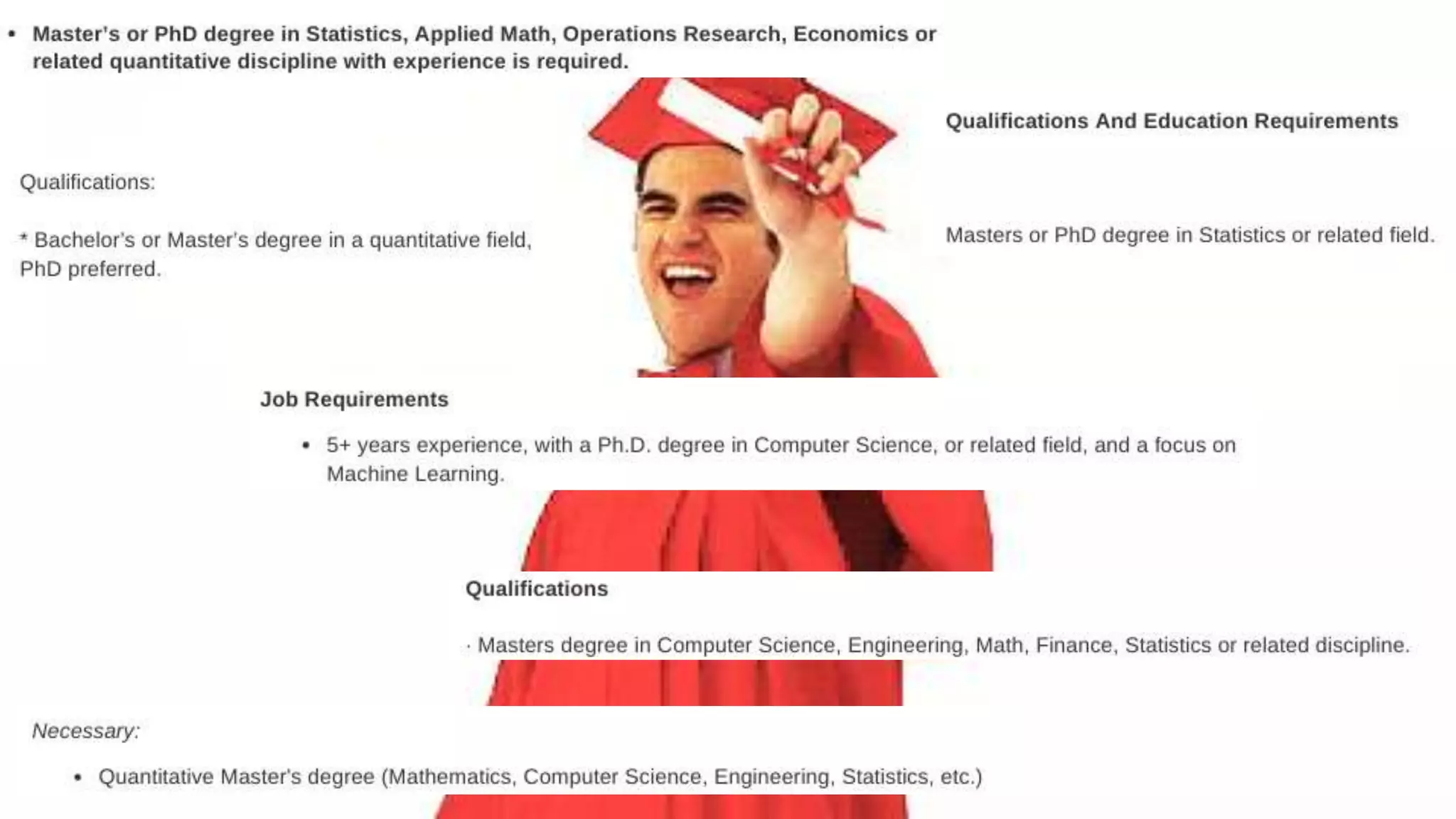
  • #37 typed in "data science" into LinkedIn Jobs
  • #38 I can do some of these
  • #39 for those of us without PhDs
  • #40 https://www.flickr.com/photos/arlophoto/5616233274
  • #46 https://www.flickr.com/photos/arlophoto/5616233274
  • #97 Norvig