F# for Startups
Joel Grus
@joelgrus
Chief Scientist,
Hello!
• About me:
– Chief Scientist at VoloMetrix
– Previously at Decide, Bing, Farecast
– Started using F# a little over a year ago, am an
enthusiast/addict but not an expert
– Also write a lot of Python, a fair amount of
JavaScript, and a tiny amount of Clojure
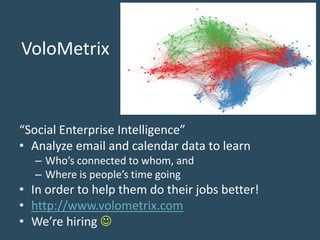
VoloMetrix
“Social Enterprise Intelligence”
• Analyze email and calendar data to learn
– Who’s connected to whom, and
– Where is people’s time going
• In order to help them do their jobs better!
• http://www.volometrix.com
• We’re hiring 
What is F#?
F# is a succinct, expressive, and
efficient functional and object-
oriented language for Microsoft .NET
that helps you write simple code to
solve complex problems.
http://research.microsoft.com/en-us/projects/fsharp/
My F# Journey
• Once upon a time the VoloMetrix application
back-end was written entirely in C#
• One day I used Ruby (ick!) to prototype very
“functional” (and slow) analytics platform
• Feel was very F#-y, so started learning and
porting
• Can develop in F# a lot faster than in C#
• Can develop in F# a lot happier than in C#
• Today application is a mix of F# and C# projects
– Analytics mostly written in F#
– Plumbing mostly written in C#
Some nice things about F#
• Conciseness
– Whitespace formatting
– Type inference
• Convenience
– First-class functions
– Interactive shell
• Correctness
– No NULLs (in the normal course of things)
– Immutable values
• Concurrency
– I don’t typically use this, so I’m not going to talk about it!
• Completeness
– Access to .NET libraries + Visual Studio
– Can mutate/iterate when necessary
I stole this list from http://fsharpforfunandprofit.com/
Functional Programming
• Is fun!
• No single definition, but some combo of
– First-class functions
– Immutable variables
– No side-effects
– Lazy evaluation
F# Basics
• Type inference
• Functions
• Combinators
• Tuples
Goal is not to teach you F# tonight, but to prime your
brains so that my examples sort of make sense
Type Inference
• F# is strictly typed, but usually you don’t have
to tell it the types
It figures them out like magic!
• If you need to specify types, they go after
val f : x:int -> int
val g : x:float -> float
val h : x:string -> string
Functions
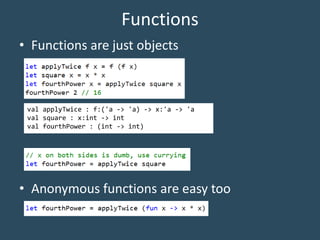
• Functions are just objects
• Anonymous functions are easy too
val applyTwice : f:('a -> 'a) -> x:'a -> 'a
val square : x:int -> int
val fourthPower : (int -> int)
Combinators
• |> pipes values into functions
• Easy to build elaborate data-processing
pipelines
• (Which are difficult to debug)
Take the array [1,2,3] Send it through an “even filter” Send that to a length function
Tuples
• Easy way of creating compound types
• Available (but wordier + less common) in C#
– var pair = new Tuple<int,string>(1,”1”)
Let’s Do Some Examples
Punchline will always be some variation of
“Hey, look how clean and safe and simple my code is
and how fast I wrote it!”
Every one of these things is nice in a start-up
Contrived Example – Discriminated Unions
• Imagine we had no bool type
• Could define one in C# using an enum:
Definition is simple
enough
You’d hope we’d
never get here
This can’t end well
Contrived Example – Discriminated Unions
• In F# would do the following:
• Punchline: F# version is cleaner and safer
Types for Business Logic
• Want to represent “meetings”
• A meeting has
– Start Date
– End Date
– Subject
– Invitees
• Each invitee is a Person, and a Response
• A Person can be have a Name or be Anonymous
• A Response can be “Accept” or “Decline”
Types for Business Logic
Given a meeting, how many Invitees accepted?
How many Invitees were anonymous?
val NumAccepts : m:Meeting -> int
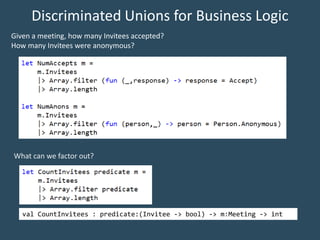
Discriminated Unions for Business Logic
Given a meeting, how many Invitees accepted?
How many Invitees were anonymous?
What can we factor out?
val CountInvitees : predicate:(Invitee -> bool) -> m:Meeting -> int
Discriminated Unions for Business Logic
Given a meeting, how many Invitees accepted?
How many Invitees were anonymous?
val NumAccepts2 : m:Meeting -> int
val NumAccepts3 : m:Meeting -> int
Use currying!
Discriminated Unions for Business Logic
• Punchline:
– Types make business logic simple to implement
– First-class functions make abstraction and
refactoring quick and easy
Contrived Example – ValueOrDefault
• Want to get a value out of a dictionary, or a
default if the key’s not there
Contrived Example - ValueOrDefault
• What if we want it generic?
Contrived Example - ValueOrDefault
• Same code in F#
Don’t have to specify types to
use generic!
val ValueOrDefault : dict:Dictionary<'a,'b> -> key:'a -> defaultValue:'b -> 'b
Punchline: Takes less code than C#, is more
readable (for me)
Fun Example – JSON Type Provider
• Want to get tweets in a lightweight way
• Sounds like a job for Python!
Fun Example – JSON Type Provider
Or for F#!
Fun Example – JSON Type Provider
• Punchline
– Easy to bang out really quick prototypes
– Get flexibility of a scripting language like Python
but with type safety
– .NET integration means easy to build your
prototypes into full-fledged applications
Useful Example – SQL Type Provider
This was the most generic database schema I could think of!
Useful Example – SQL Type Provider
• Punchline: Get to work with typed database
objects for free, great for complex analytics
(or external libraries) with no SQL equivalent
F# is not Perfect
• Life is dull without NullReferenceException
• Tooling is not on par with C#
• Hard to organize projects, file order matters
• Everyone knows C#, no one knows F#
• P(zealot | knows F#) is very high!
• Your code will be so unexpectedly good that
people will mistake you for some sort of guru
and then invite you to give talks that are way
outside of your comfort zone!
Resources
• http://www.tryfsharp.org/
• http://fsharp.org
• http://fsharpforfunandprofit.com/
• http://en.wikibooks.org/wiki/F_Sharp_Programming
• Lots of F# people on Twitter
• There are some good books out there: Expert F# and
F# Programming are two that I like
• Ask me, I know a few things

F# for startups v2

  • 1.
    F# for Startups JoelGrus @joelgrus Chief Scientist,
  • 2.
    Hello! • About me: –Chief Scientist at VoloMetrix – Previously at Decide, Bing, Farecast – Started using F# a little over a year ago, am an enthusiast/addict but not an expert – Also write a lot of Python, a fair amount of JavaScript, and a tiny amount of Clojure
  • 3.
    VoloMetrix “Social Enterprise Intelligence” •Analyze email and calendar data to learn – Who’s connected to whom, and – Where is people’s time going • In order to help them do their jobs better! • http://www.volometrix.com • We’re hiring 
  • 4.
    What is F#? F#is a succinct, expressive, and efficient functional and object- oriented language for Microsoft .NET that helps you write simple code to solve complex problems. http://research.microsoft.com/en-us/projects/fsharp/
  • 5.
    My F# Journey •Once upon a time the VoloMetrix application back-end was written entirely in C# • One day I used Ruby (ick!) to prototype very “functional” (and slow) analytics platform • Feel was very F#-y, so started learning and porting • Can develop in F# a lot faster than in C# • Can develop in F# a lot happier than in C# • Today application is a mix of F# and C# projects – Analytics mostly written in F# – Plumbing mostly written in C#
  • 6.
    Some nice thingsabout F# • Conciseness – Whitespace formatting – Type inference • Convenience – First-class functions – Interactive shell • Correctness – No NULLs (in the normal course of things) – Immutable values • Concurrency – I don’t typically use this, so I’m not going to talk about it! • Completeness – Access to .NET libraries + Visual Studio – Can mutate/iterate when necessary I stole this list from http://fsharpforfunandprofit.com/
  • 7.
    Functional Programming • Isfun! • No single definition, but some combo of – First-class functions – Immutable variables – No side-effects – Lazy evaluation
  • 8.
    F# Basics • Typeinference • Functions • Combinators • Tuples Goal is not to teach you F# tonight, but to prime your brains so that my examples sort of make sense
  • 9.
    Type Inference • F#is strictly typed, but usually you don’t have to tell it the types It figures them out like magic! • If you need to specify types, they go after val f : x:int -> int val g : x:float -> float val h : x:string -> string
  • 10.
    Functions • Functions arejust objects • Anonymous functions are easy too val applyTwice : f:('a -> 'a) -> x:'a -> 'a val square : x:int -> int val fourthPower : (int -> int)
  • 11.
    Combinators • |> pipesvalues into functions • Easy to build elaborate data-processing pipelines • (Which are difficult to debug) Take the array [1,2,3] Send it through an “even filter” Send that to a length function
  • 12.
    Tuples • Easy wayof creating compound types • Available (but wordier + less common) in C# – var pair = new Tuple<int,string>(1,”1”)
  • 13.
    Let’s Do SomeExamples Punchline will always be some variation of “Hey, look how clean and safe and simple my code is and how fast I wrote it!” Every one of these things is nice in a start-up
  • 14.
    Contrived Example –Discriminated Unions • Imagine we had no bool type • Could define one in C# using an enum: Definition is simple enough You’d hope we’d never get here This can’t end well
  • 15.
    Contrived Example –Discriminated Unions • In F# would do the following: • Punchline: F# version is cleaner and safer
  • 16.
    Types for BusinessLogic • Want to represent “meetings” • A meeting has – Start Date – End Date – Subject – Invitees • Each invitee is a Person, and a Response • A Person can be have a Name or be Anonymous • A Response can be “Accept” or “Decline”
  • 17.
  • 18.
    Types for BusinessLogic Given a meeting, how many Invitees accepted? How many Invitees were anonymous? val NumAccepts : m:Meeting -> int
  • 19.
    Discriminated Unions forBusiness Logic Given a meeting, how many Invitees accepted? How many Invitees were anonymous? What can we factor out? val CountInvitees : predicate:(Invitee -> bool) -> m:Meeting -> int
  • 20.
    Discriminated Unions forBusiness Logic Given a meeting, how many Invitees accepted? How many Invitees were anonymous? val NumAccepts2 : m:Meeting -> int val NumAccepts3 : m:Meeting -> int Use currying!
  • 21.
    Discriminated Unions forBusiness Logic • Punchline: – Types make business logic simple to implement – First-class functions make abstraction and refactoring quick and easy
  • 22.
    Contrived Example –ValueOrDefault • Want to get a value out of a dictionary, or a default if the key’s not there
  • 23.
    Contrived Example -ValueOrDefault • What if we want it generic?
  • 24.
    Contrived Example -ValueOrDefault • Same code in F# Don’t have to specify types to use generic! val ValueOrDefault : dict:Dictionary<'a,'b> -> key:'a -> defaultValue:'b -> 'b Punchline: Takes less code than C#, is more readable (for me)
  • 25.
    Fun Example –JSON Type Provider • Want to get tweets in a lightweight way • Sounds like a job for Python!
  • 26.
    Fun Example –JSON Type Provider Or for F#!
  • 27.
    Fun Example –JSON Type Provider • Punchline – Easy to bang out really quick prototypes – Get flexibility of a scripting language like Python but with type safety – .NET integration means easy to build your prototypes into full-fledged applications
  • 28.
    Useful Example –SQL Type Provider This was the most generic database schema I could think of!
  • 29.
    Useful Example –SQL Type Provider • Punchline: Get to work with typed database objects for free, great for complex analytics (or external libraries) with no SQL equivalent
  • 30.
    F# is notPerfect • Life is dull without NullReferenceException • Tooling is not on par with C# • Hard to organize projects, file order matters • Everyone knows C#, no one knows F# • P(zealot | knows F#) is very high! • Your code will be so unexpectedly good that people will mistake you for some sort of guru and then invite you to give talks that are way outside of your comfort zone!
  • 31.
    Resources • http://www.tryfsharp.org/ • http://fsharp.org •http://fsharpforfunandprofit.com/ • http://en.wikibooks.org/wiki/F_Sharp_Programming • Lots of F# people on Twitter • There are some good books out there: Expert F# and F# Programming are two that I like • Ask me, I know a few things

Editor's Notes

  • #11 currying
  • #12 Sequence expressions
  • #19 Anonymous Functions, Pattern Matching, Type Inference
  • #26 Static v dynamic typing
  • #27 Explain what the type provider does
  • #28 Explain what the type provider does
  • #30 More about sequence expressions, group by, IQueryable