Introduction
What are ‘Low resource’ languages?

Half of the world’s 7,000 languages have been
predicted to go extinct within this century
(Krauss 1992).

There is corpora for statistically none of them
available.
Introduction
• Only around thirty languages currently enjoy
  full technological resources

• Only a 100 or so have basic resources such as
  dictionaries, spellcheckers, or parsers
  (Scannell 2007; Krauwer 2003).
Introduction
Why make corpora?
• Linguistic data can be analysed by linguists
  interested in theoretical questions
• Utilised by data scientists and computational
  linguists to provide better tools and
  applications
• Archived for posterity.
Outline
•   The Tʉlʉʉsɨke Kɨlaangi Facebook Group
•   Previous work (in brief)
•   Legality of using Facebook
•   Corpus creation process
•   An XML Schema for data archival
Tʉlʉʉsɨke Kɨlaangi
Rangi:
  –   Bantu language
  –   350,000 speakers
  –   Spoken mainly in Tanzania
  –   A few linguists working on it – mainly Oliver
      Stegen (Edinburgh, SIL)
Tʉlʉʉsɨke Kɨlaangi
Facebook Group:
  –   Founded by Oliver Stegen
  –   339 Members
  –   Since February 11, 2011
  –   Created for corpora generation.
  –   For talking in Rangi – but there is often English
      and Swahili code switching.
Previous Work
• Twitter corpora: Large datasets, lots of opinion
  mining.
  – Examples: US elections, Arab Spring


• Án Crúbadán by Kevin Scannell
Previous Work
Previous Work
• Work on Facebook corpora:
  –
  –
  – Ok, there is some work, but it is very sparse. (If
    you know of any, let me know.)
Legal Issues
• Disclaimer: This is not sound legal advice, and
  I am not opening a lawyer-client relationship
  with you by telling you any of this. This is
  merely what I think I’ve figured out by staring
  at the literature and Facebook for a very, very
  long time.
Legal Issues
• Facebook’s Statement of Rights and
  Responsibilities, section 3.2 states:
  – ”You will not collect users’ content or information,
    or otherwise access Facebook, using automated
    means (such as harvesting bots, robots, spiders, or
    scrapers) without our permission.”
• Automated Data Collection Terms:
  – All automated processes on the site are
    forbidden, unless there is express written
    consent.
Legal Issues
• “You agree that any violation of these terms
  may result in your immediate ban from all
  Facebook websites, products and services.
  You acknowledge and agree that a breach or
  threatened breach of these terms would
  cause irreparable injury…” – Facebook
Legal Issues
• Work around:
  –   Use only ‘public’ information
  –   EU Directive 96/9/EC
  –   ‘Fair Use’
  –   Implied licenses
  –   Not using a crawler or scraper.
Privacy
• Facebook wants written consent from each
  user.
• Standard procedure in language
  documentation.
• Required by most universities (and often
  journals.)
Privacy
• Unnecessary here:
  –   All data is in the public domain.
  –   The data will not be shared or monetized
  –   All names and personal data are anonymised
  –   The data is being used purely for research.
  –   The group I’m looking at was set up for this
      purpose, and there has been personal
      communication confirming this by Stegen.
The Tool
• Load page into a browser normally
  – the source code has already been collected into the
    system, and automation is not necessary for
    retrieving more URLs.
• Manually click on “Display more posts...” and
  “View all comments”
  – An Ajax query is sent to the database, and the posts
    are loaded in the browser.
• Copy and save the HTML source code.
• Clean and sort with Python (Beautiful Soup).
XML Storage
• The data is massive.
• From February 11, 2011 to February 17, 2011
  is almost 300k lines of HTML.
• Mining this is not trivial.
XML Storage
• XML = extensible markup language
• Not reliant on any single, particular program.
• Widely used for data storage already.
• XML works by conforming to a schema.
• Easily converted into RDF and other useful
  storage formats.
• Easy to understand for both humans and
  machines.
• Can also be stored independently of the data.
Results
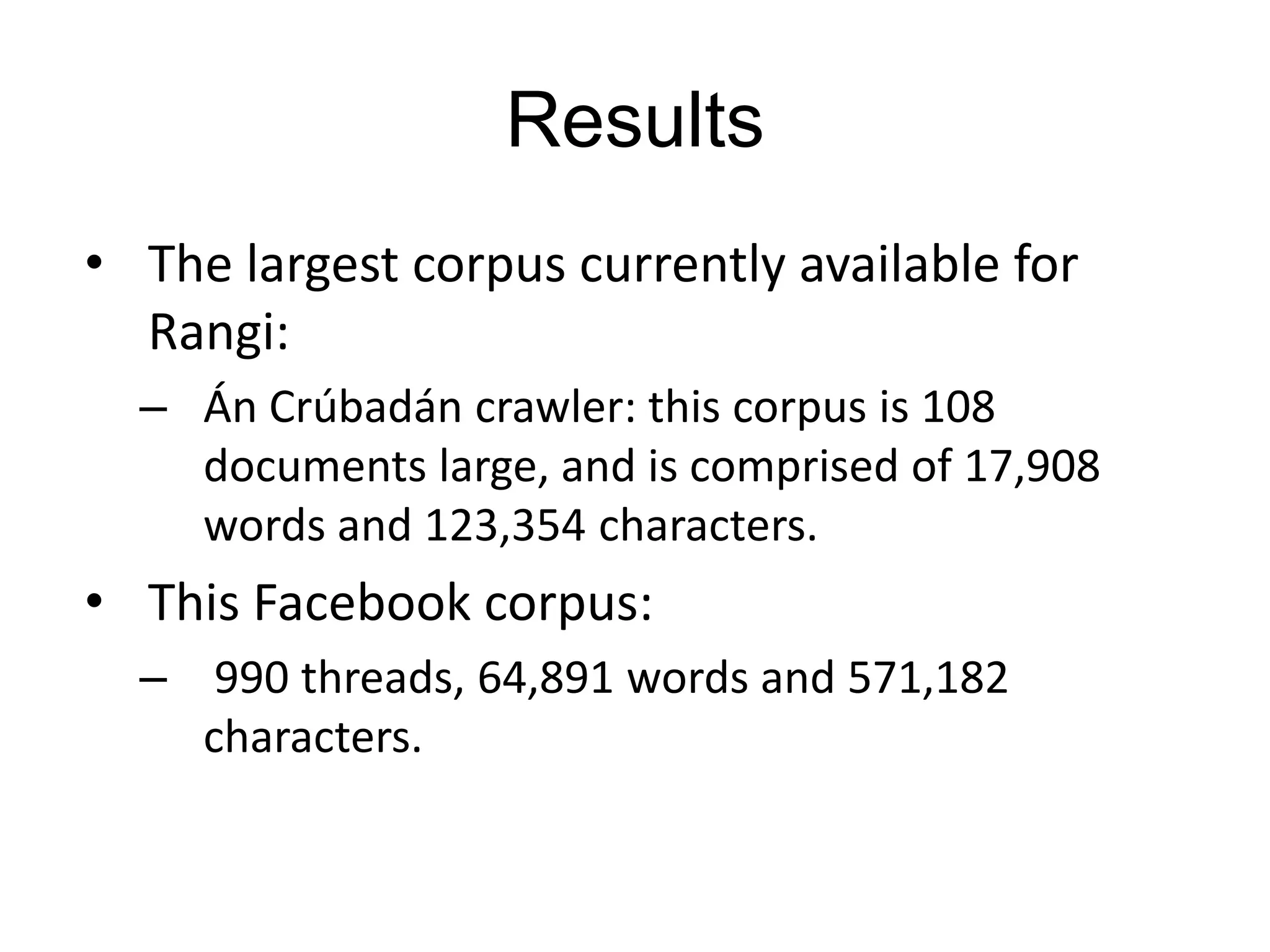
• The largest corpus currently available for
  Rangi:
  – Án Crúbadán crawler: this corpus is 108
    documents large, and is comprised of 17,908
    words and 123,354 characters.
• This Facebook corpus:
  – 990 threads, 64,891 words and 571,182
    characters.
Future Work
• Eventually, I hope to make this corpus public.


• Multilingual identification.
THANKS

  Questions?


https://github.com/RichardLitt/lrl

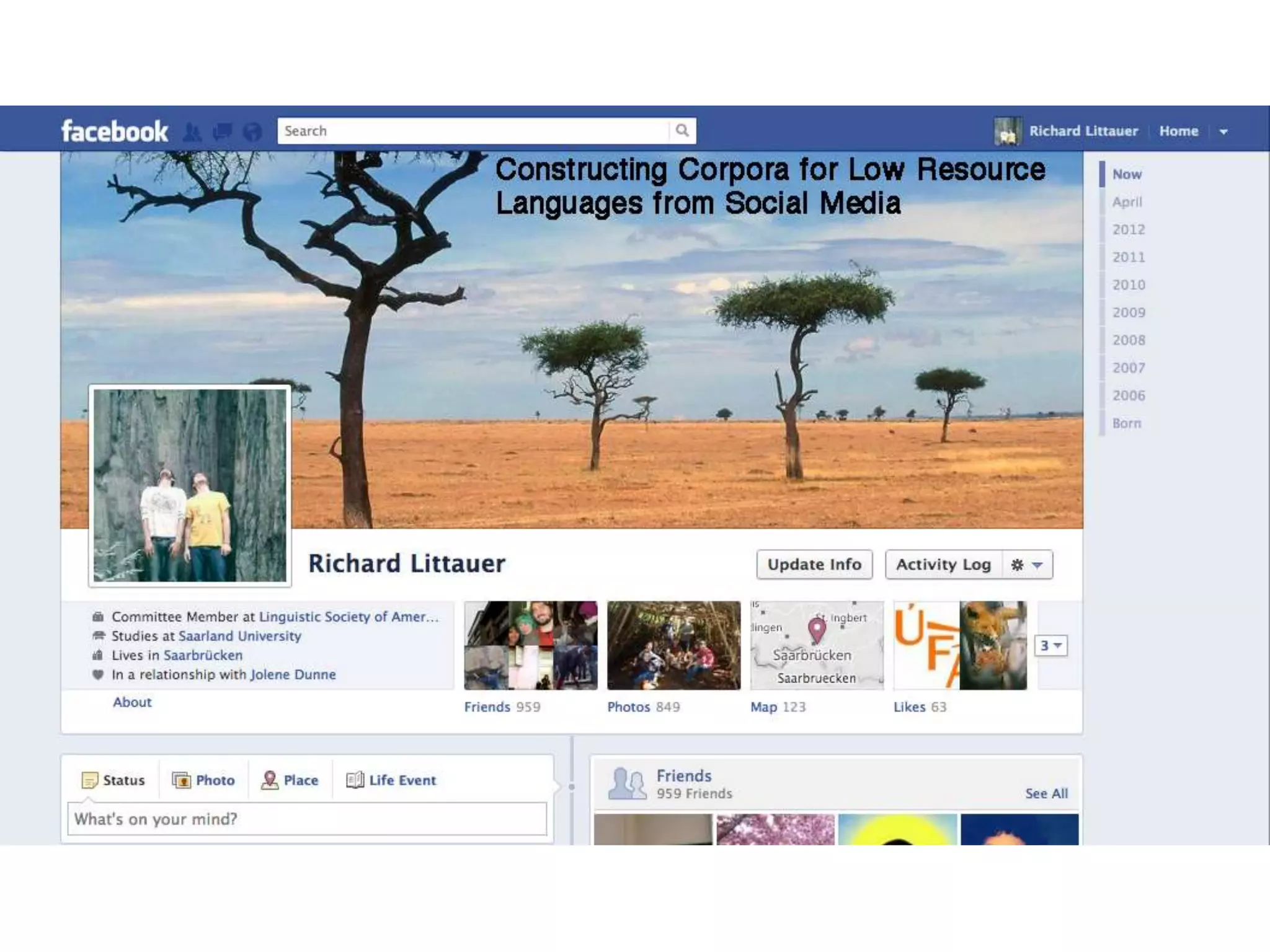
Building Corpora from Social Media

  • 2.
    Introduction What are ‘Lowresource’ languages? Half of the world’s 7,000 languages have been predicted to go extinct within this century (Krauss 1992). There is corpora for statistically none of them available.
  • 3.
    Introduction • Only aroundthirty languages currently enjoy full technological resources • Only a 100 or so have basic resources such as dictionaries, spellcheckers, or parsers (Scannell 2007; Krauwer 2003).
  • 4.
    Introduction Why make corpora? •Linguistic data can be analysed by linguists interested in theoretical questions • Utilised by data scientists and computational linguists to provide better tools and applications • Archived for posterity.
  • 5.
    Outline • The Tʉlʉʉsɨke Kɨlaangi Facebook Group • Previous work (in brief) • Legality of using Facebook • Corpus creation process • An XML Schema for data archival
  • 6.
    Tʉlʉʉsɨke Kɨlaangi Rangi: – Bantu language – 350,000 speakers – Spoken mainly in Tanzania – A few linguists working on it – mainly Oliver Stegen (Edinburgh, SIL)
  • 8.
    Tʉlʉʉsɨke Kɨlaangi Facebook Group: – Founded by Oliver Stegen – 339 Members – Since February 11, 2011 – Created for corpora generation. – For talking in Rangi – but there is often English and Swahili code switching.
  • 9.
    Previous Work • Twittercorpora: Large datasets, lots of opinion mining. – Examples: US elections, Arab Spring • Án Crúbadán by Kevin Scannell
  • 10.
  • 11.
    Previous Work • Workon Facebook corpora: – – – Ok, there is some work, but it is very sparse. (If you know of any, let me know.)
  • 12.
    Legal Issues • Disclaimer:This is not sound legal advice, and I am not opening a lawyer-client relationship with you by telling you any of this. This is merely what I think I’ve figured out by staring at the literature and Facebook for a very, very long time.
  • 13.
    Legal Issues • Facebook’sStatement of Rights and Responsibilities, section 3.2 states: – ”You will not collect users’ content or information, or otherwise access Facebook, using automated means (such as harvesting bots, robots, spiders, or scrapers) without our permission.” • Automated Data Collection Terms: – All automated processes on the site are forbidden, unless there is express written consent.
  • 14.
    Legal Issues • “Youagree that any violation of these terms may result in your immediate ban from all Facebook websites, products and services. You acknowledge and agree that a breach or threatened breach of these terms would cause irreparable injury…” – Facebook
  • 15.
    Legal Issues • Workaround: – Use only ‘public’ information – EU Directive 96/9/EC – ‘Fair Use’ – Implied licenses – Not using a crawler or scraper.
  • 16.
    Privacy • Facebook wantswritten consent from each user. • Standard procedure in language documentation. • Required by most universities (and often journals.)
  • 17.
    Privacy • Unnecessary here: – All data is in the public domain. – The data will not be shared or monetized – All names and personal data are anonymised – The data is being used purely for research. – The group I’m looking at was set up for this purpose, and there has been personal communication confirming this by Stegen.
  • 18.
    The Tool • Loadpage into a browser normally – the source code has already been collected into the system, and automation is not necessary for retrieving more URLs. • Manually click on “Display more posts...” and “View all comments” – An Ajax query is sent to the database, and the posts are loaded in the browser. • Copy and save the HTML source code. • Clean and sort with Python (Beautiful Soup).
  • 19.
    XML Storage • Thedata is massive. • From February 11, 2011 to February 17, 2011 is almost 300k lines of HTML. • Mining this is not trivial.
  • 20.
    XML Storage • XML= extensible markup language • Not reliant on any single, particular program. • Widely used for data storage already. • XML works by conforming to a schema. • Easily converted into RDF and other useful storage formats. • Easy to understand for both humans and machines. • Can also be stored independently of the data.
  • 22.
    Results • The largestcorpus currently available for Rangi: – Án Crúbadán crawler: this corpus is 108 documents large, and is comprised of 17,908 words and 123,354 characters. • This Facebook corpus: – 990 threads, 64,891 words and 571,182 characters.
  • 23.
    Future Work • Eventually,I hope to make this corpus public. • Multilingual identification.
  • 24.

Editor's Notes

  • #22 The schema above does not allow for other linguistic annotation, such as part-of-speech tagging, or morphological or syntactic annotation. It is meant primarily as a storage format, to maintain the context of each comment and all detail that may be relevant to linguists from the original page. A different annotation format would need to be used for further annotations, but that is beyond the scope of this paper.