A	
  Presenta*on	
  from	
  The	
  NewMR	
  “Advances	
  in	
  
Quan*ta*ve	
  Research”	
  Event	
  
19	
  September,	
  2012	
  
Event	
  sponsored	
  by	
  Affinnova	
  
All	
  copyright	
  owned	
  by	
  The	
  Future	
  Place	
  and	
  the	
  presenters	
  of	
  the	
  material	
  
For	
  more	
  informa=on	
  about	
  Affinnova	
  visit	
  www.affinnova.com	
  
For	
  more	
  informa=on	
  about	
  NewMR	
  events	
  visit	
  newmr.org	
  
Malleable	
  Conjoint	
  Partworths:	
  How	
  the	
  Breadth	
  of	
  
Response	
  Scales	
  Alters	
  Price	
  Sensi=vity	


Jane	
  Tang,	
  Vision	
  Cri/cal 	


Speaker Jane Tang, Vision Critical, Canada
NewMR Advances in Quantitative Research Event, 19 September 2012, Session 2
Conditioning via Broad
versus Narrow Categories:
How the Breadth of Response Scales
Alters Price Sensitivity
Jane Tang
Advanced Analytics
Vision Critical
Speaker Jane Tang, Vision Critical, Canada
NewMR Advances in Quantitative Research Event, 19 September 2012, Session 2
Respondents are often asked other questions
before the conjoint exercise begin (e.g. screening
criteria, demographic questions, current product
usage, etc...)
The response categories used in the questions
before a conjoint task provide conditioning and
affect choices made in the conjoint section,
altering respondents’ price sensitivity.
Speaker Jane Tang, Vision Critical, Canada
NewMR Advances in Quantitative Research Event, 19 September 2012, Session 2
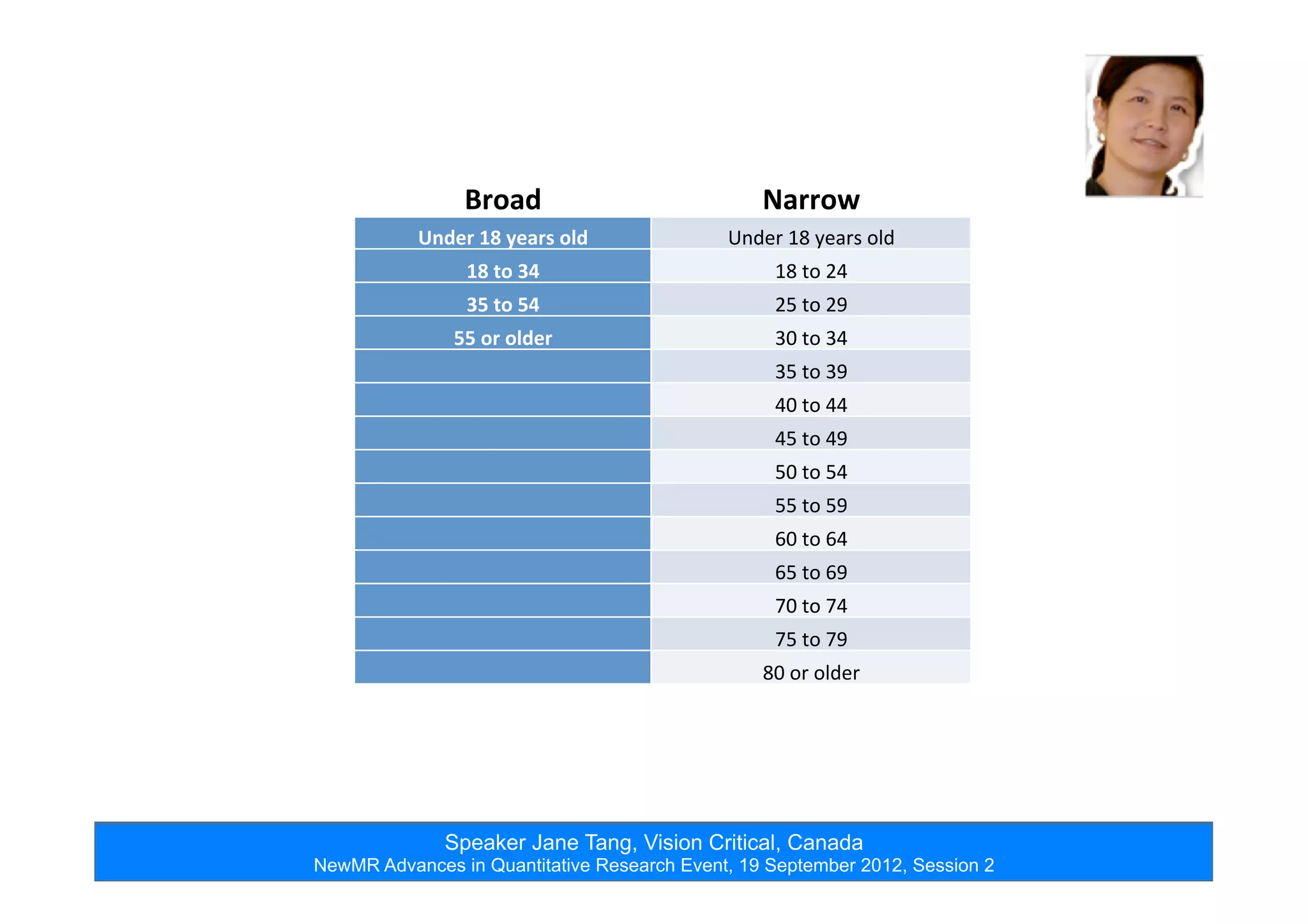
Broad Narrow
Under	
  18	
  years	
  old Under	
  18	
  years	
  old
18	
  to	
  34 18	
  to	
  24
35	
  to	
  54 25	
  to	
  29
55	
  or	
  older 30	
  to	
  34
	
   35	
  to	
  39
	
   40	
  to	
  44
	
   45	
  to	
  49
	
   50	
  to	
  54
	
   55	
  to	
  59
	
   60	
  to	
  64
	
   65	
  to	
  69
	
   70	
  to	
  74
	
   75	
  to	
  79
	
   80	
  or	
  older
Speaker Jane Tang, Vision Critical, Canada
NewMR Advances in Quantitative Research Event, 19 September 2012, Session 2
•  AMITAV CHAKRAVARTI – London School of Economics
•  VICKI G. MORWITZ – New York University
•  GÜLDEN ÜLKÜMEN - University of Southern California
•  AMITAV CHAKRAVARTI – London School of Economics
•  VICKI G. MORWITZ – New York University
•  GÜLDEN ÜLKÜMEN - University of Southern California
“Categories Create Mindsets: The Effect of
Exposure to Broad versus Narrow Categorizations
on Subsequent, Unrelated Decisions,”
Journal of Marketing Research, 2010
Speaker Jane Tang, Vision Critical, Canada
NewMR Advances in Quantitative Research Event, 19 September 2012, Session 2
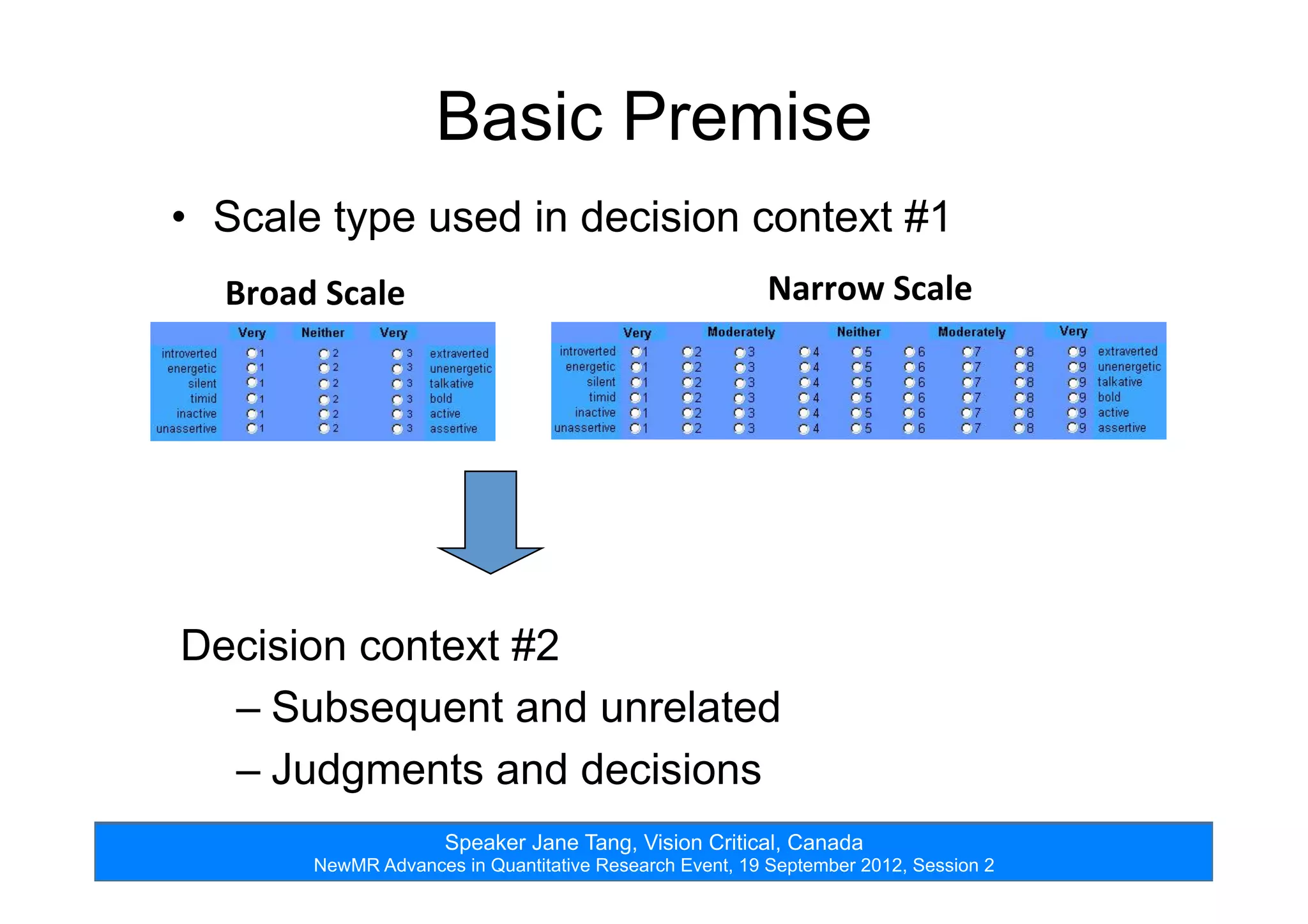
•  Scale type used in decision context #1
Basic Premise
Decision context #2
– Subsequent and unrelated
– Judgments and decisions
Broad	
  Scale	
   Narrow	
  Scale	
  
Speaker Jane Tang, Vision Critical, Canada
NewMR Advances in Quantitative Research Event, 19 September 2012, Session 2
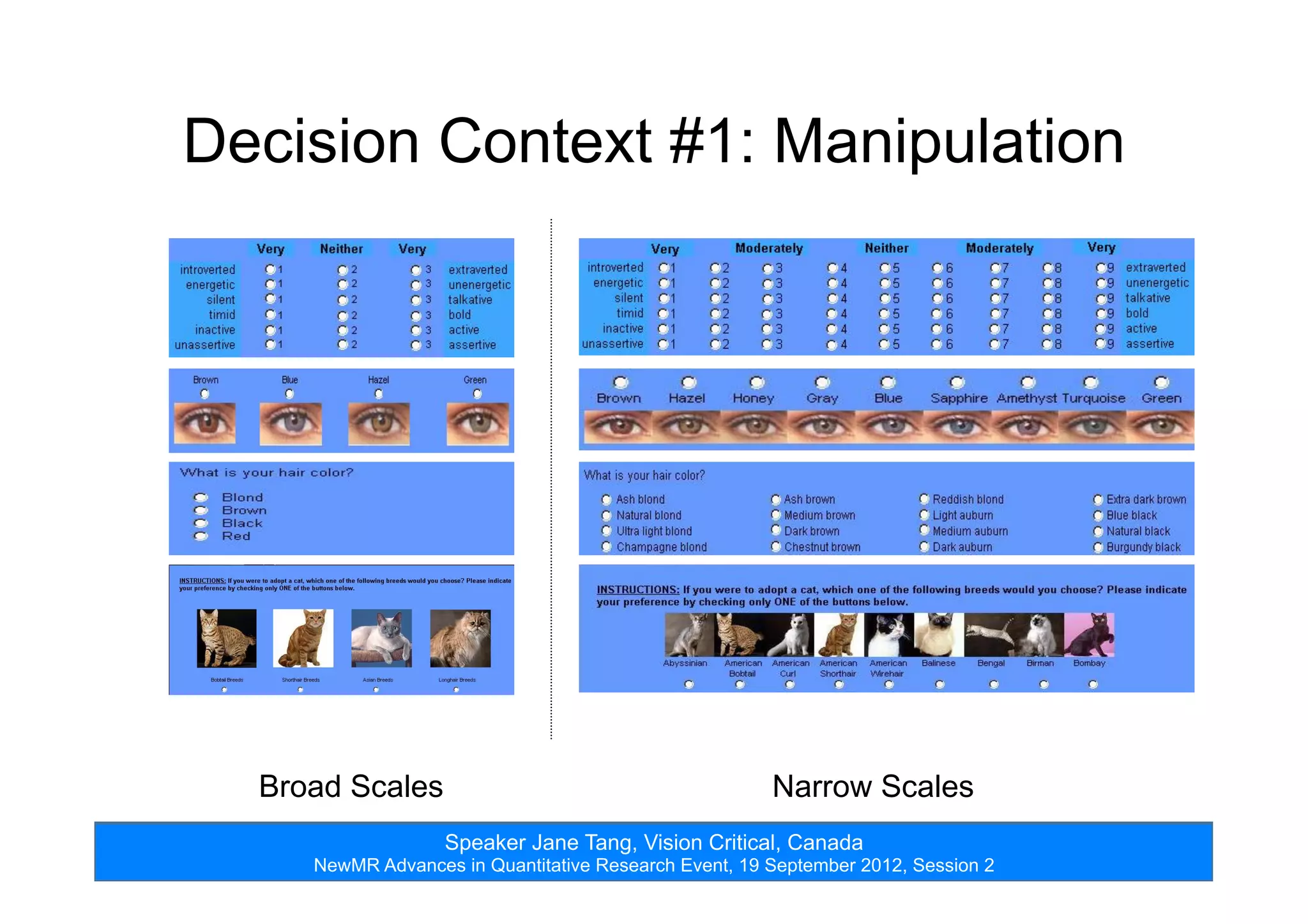
Decision Context #1: Manipulation
Broad Scales Narrow Scales
Speaker Jane Tang, Vision Critical, Canada
NewMR Advances in Quantitative Research Event, 19 September 2012, Session 2
8
Study 1: Effects on Object Sorting
Speaker Jane Tang, Vision Critical, Canada
NewMR Advances in Quantitative Research Event, 19 September 2012, Session 2
9
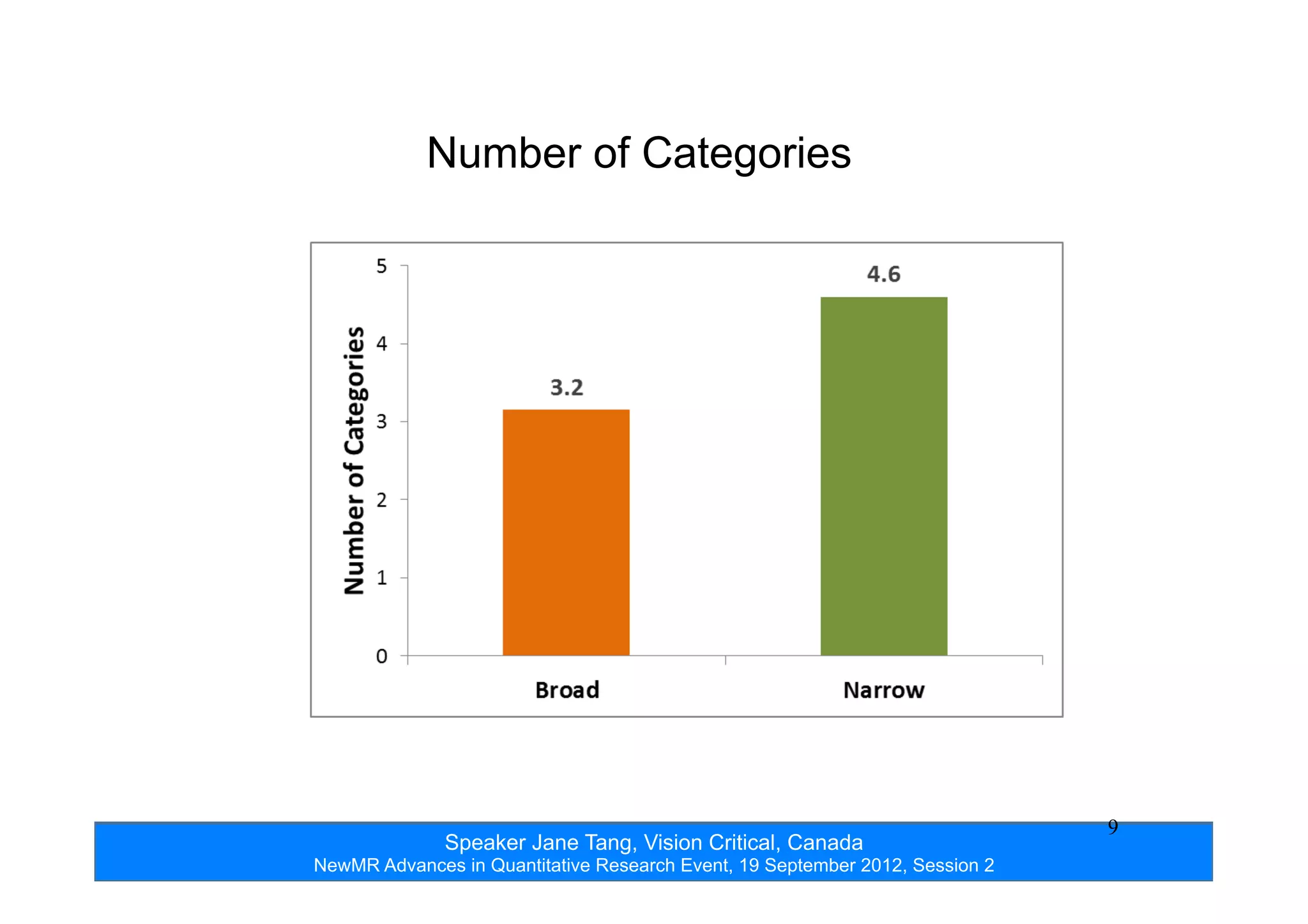
Number of Categories
Speaker Jane Tang, Vision Critical, Canada
NewMR Advances in Quantitative Research Event, 19 September 2012, Session 2
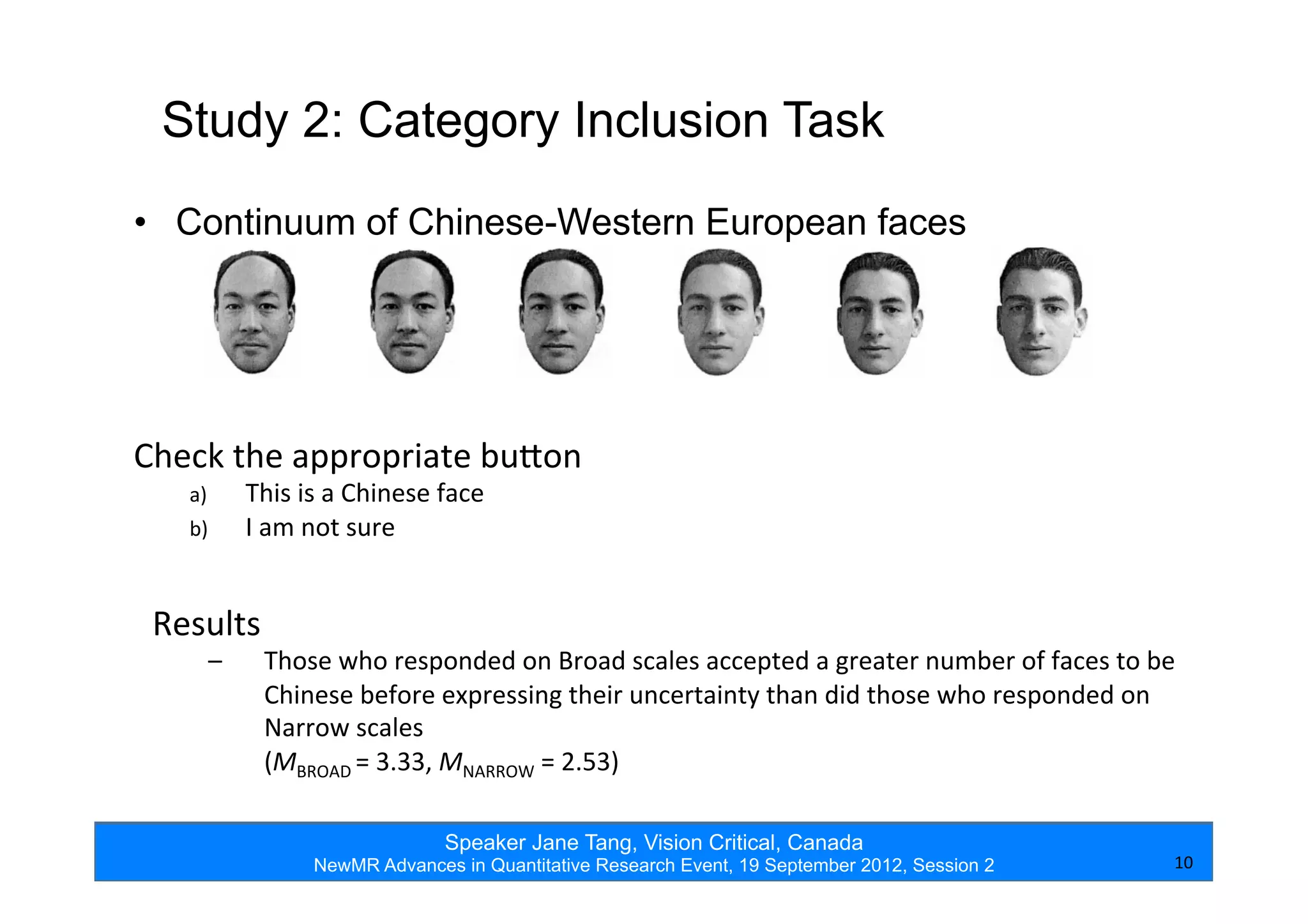
Study 2: Category Inclusion Task
•  Continuum of Chinese-Western European faces
10	
  
Check	
  the	
  appropriate	
  buTon	
  
a)  This	
  is	
  a	
  Chinese	
  face	
  
b)  I	
  am	
  not	
  sure	
  
Results	
  
–  Those	
  who	
  responded	
  on	
  Broad	
  scales	
  accepted	
  a	
  greater	
  number	
  of	
  faces	
  to	
  be	
  
Chinese	
  before	
  expressing	
  their	
  uncertainty	
  than	
  did	
  those	
  who	
  responded	
  on	
  
Narrow	
  scales	
  	
  
(MBROAD	
  =	
  3.33,	
  MNARROW	
  =	
  2.53)	
  
Speaker Jane Tang, Vision Critical, Canada
NewMR Advances in Quantitative Research Event, 19 September 2012, Session 2
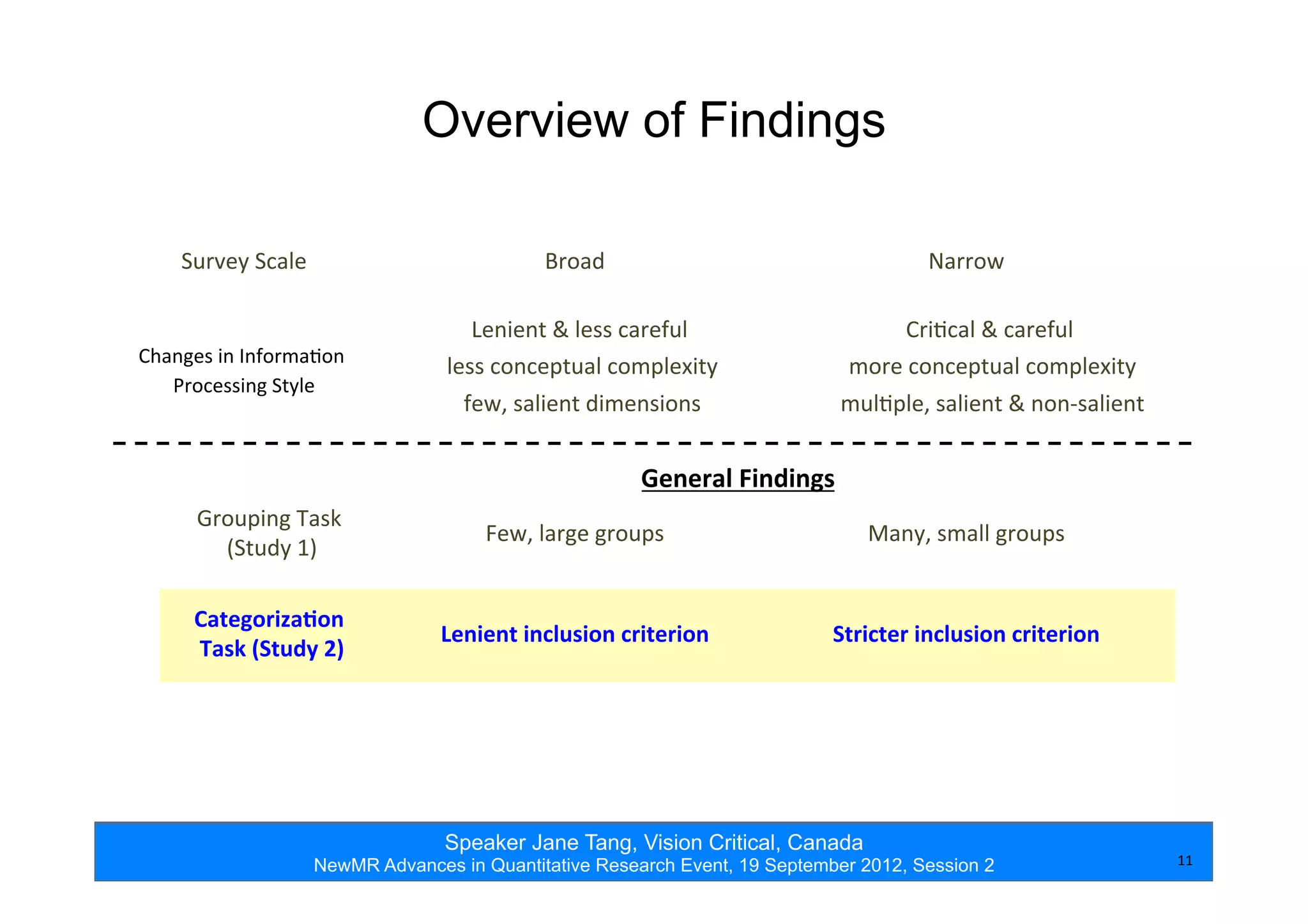
Overview of Findings
11	
  
Grouping	
  Task	
  
(Study	
  1)	
  
Few,	
  large	
  groups	
   Many,	
  small	
  groups	
  
Categoriza*on	
  
Task	
  (Study	
  2)	
  
Lenient	
  inclusion	
  criterion	
   Stricter	
  inclusion	
  criterion	
  
General	
  Findings	
  
Survey	
  Scale	
  
Changes	
  in	
  Informa=on	
  
Processing	
  Style	
  
Broad	
   Narrow	
  
Lenient	
  &	
  less	
  careful	
  
	
  less	
  conceptual	
  complexity	
  
	
  few,	
  salient	
  dimensions	
  
Cri=cal	
  &	
  careful	
  
	
  more	
  conceptual	
  complexity	
  
	
  mul=ple,	
  salient	
  &	
  non-­‐salient	
  
Speaker Jane Tang, Vision Critical, Canada
NewMR Advances in Quantitative Research Event, 19 September 2012, Session 2
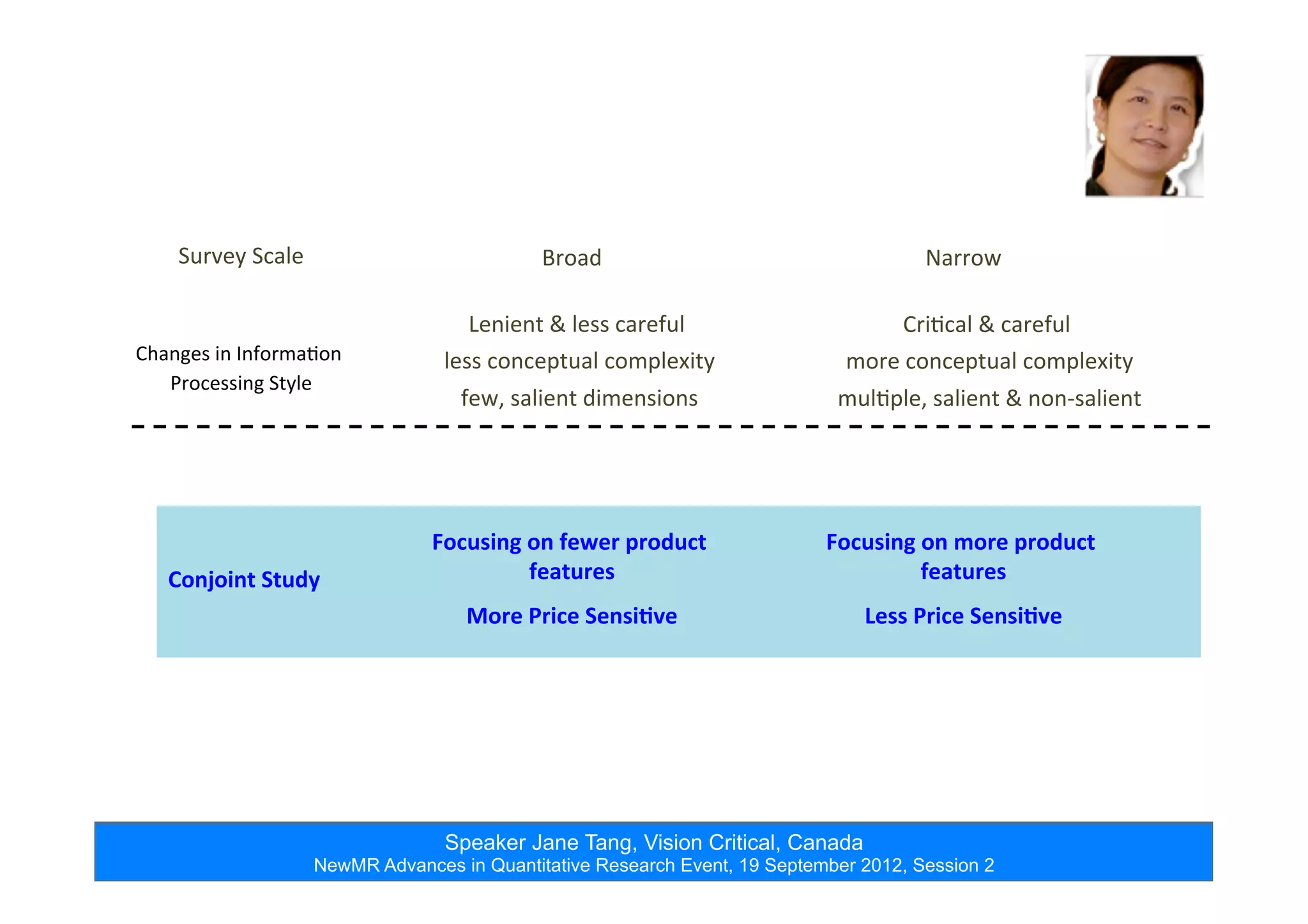
Survey	
  Scale	
  
Changes	
  in	
  Informa=on	
  
Processing	
  Style	
  
Broad	
   Narrow	
  
Lenient	
  &	
  less	
  careful	
  
	
  less	
  conceptual	
  complexity	
  
	
  few,	
  salient	
  dimensions	
  
Cri=cal	
  &	
  careful	
  
	
  more	
  conceptual	
  complexity	
  
	
  mul=ple,	
  salient	
  &	
  non-­‐salient	
  
Conjoint	
  Study	
  
Focusing	
  on	
  fewer	
  product	
  
features	
  
More	
  Price	
  Sensi*ve	
  
Focusing	
  on	
  more	
  product	
  
features	
  
Less	
  Price	
  Sensi*ve	
  
Speaker Jane Tang, Vision Critical, Canada
NewMR Advances in Quantitative Research Event, 19 September 2012, Session 2
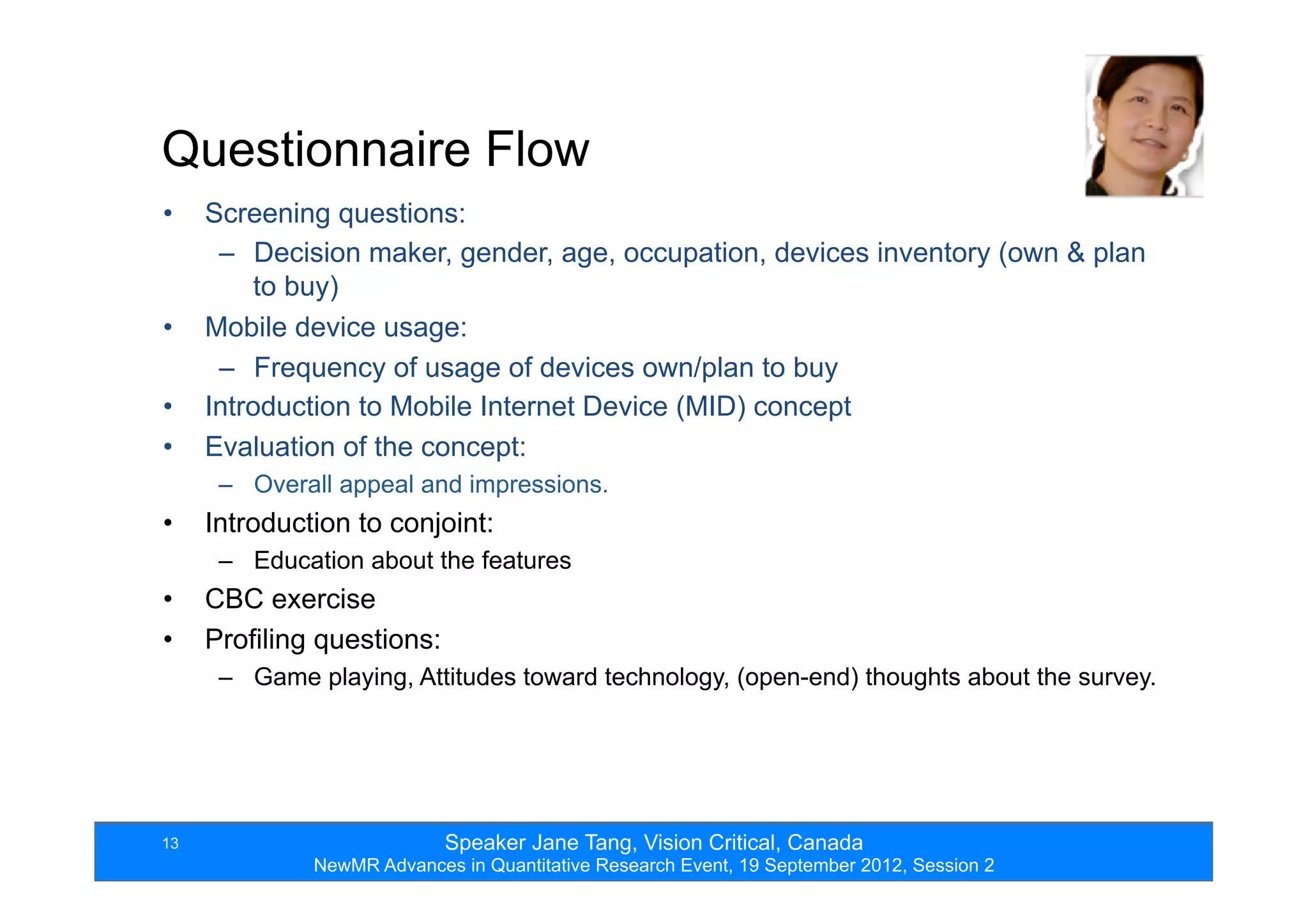
13
•  Screening questions:
–  Decision maker, gender, age, occupation, devices inventory (own & plan
to buy)
•  Mobile device usage:
–  Frequency of usage of devices own/plan to buy
•  Introduction to Mobile Internet Device (MID) concept
•  Evaluation of the concept:
–  Overall appeal and impressions.
•  Introduction to conjoint:
–  Education about the features
•  CBC exercise
•  Profiling questions:
–  Game playing, Attitudes toward technology, (open-end) thoughts about the survey.
Questionnaire Flow
Speaker Jane Tang, Vision Critical, Canada
NewMR Advances in Quantitative Research Event, 19 September 2012, Session 2
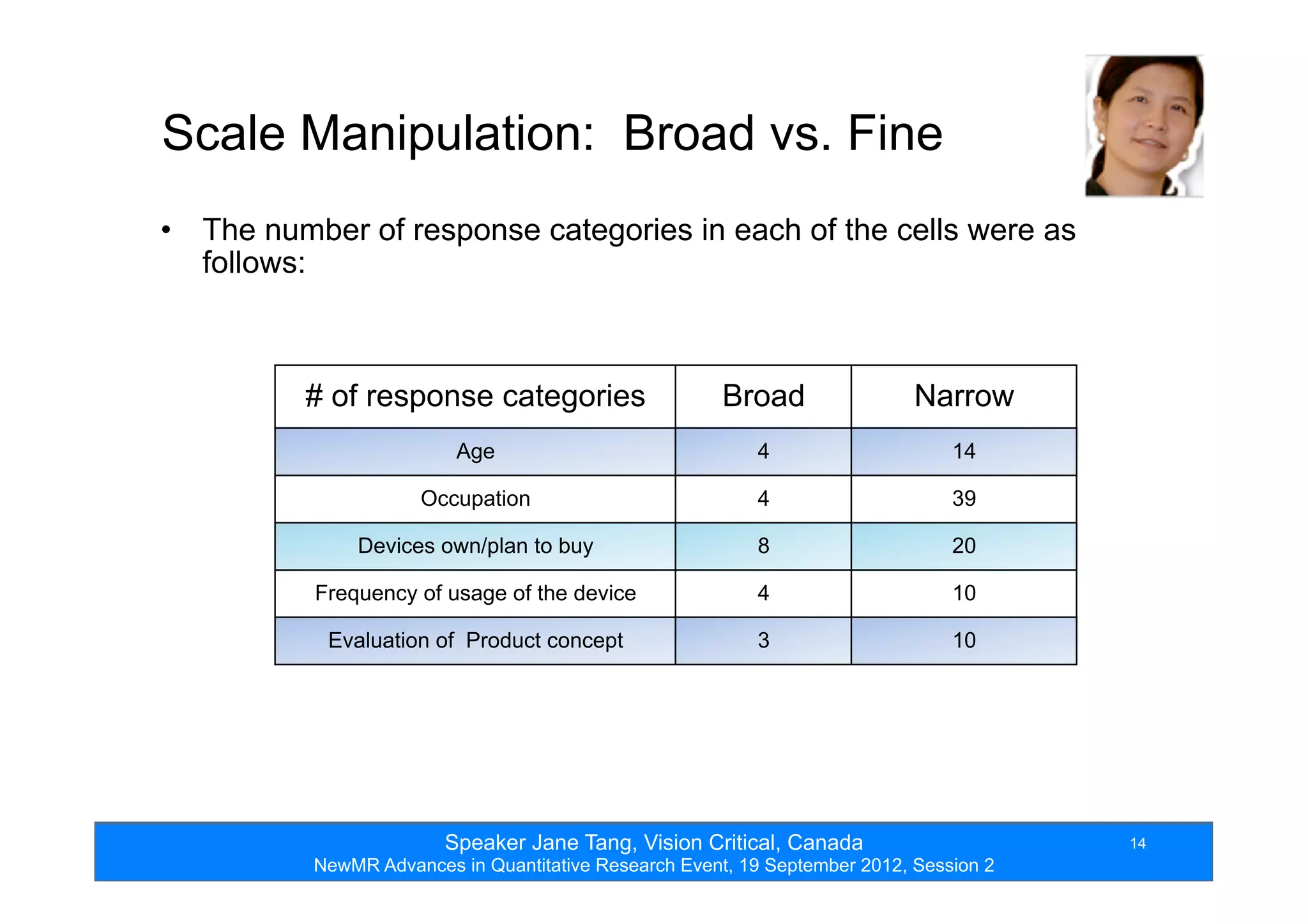
14
Scale Manipulation: Broad vs. Fine
•  The number of response categories in each of the cells were as
follows:
# of response categories Broad Narrow
Age 4 14
Occupation 4 39
Devices own/plan to buy 8 20
Frequency of usage of the device 4 10
Evaluation of Product concept 3 10
Speaker Jane Tang, Vision Critical, Canada
NewMR Advances in Quantitative Research Event, 19 September 2012, Session 2
15
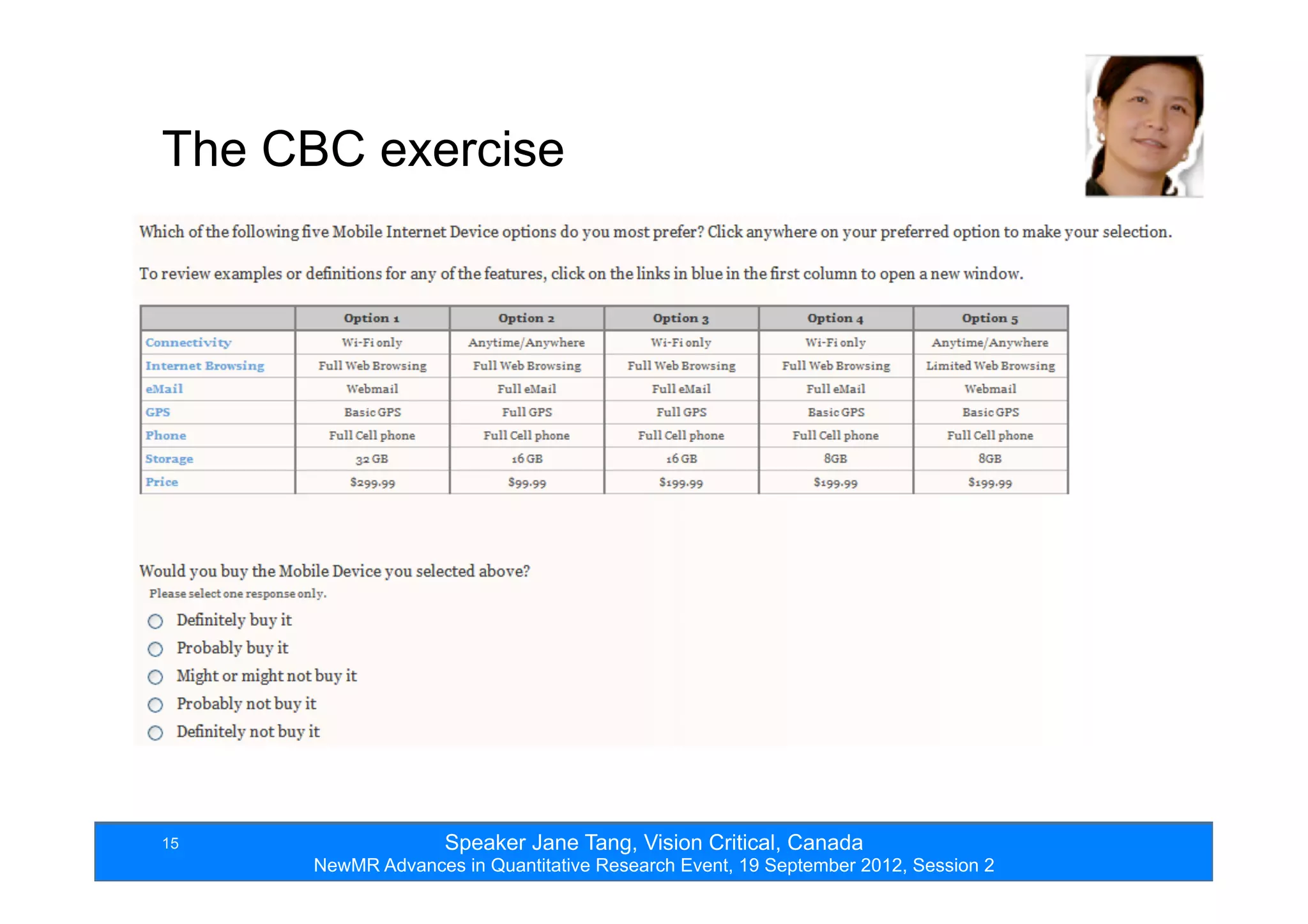
The CBC exercise
Speaker Jane Tang, Vision Critical, Canada
NewMR Advances in Quantitative Research Event, 19 September 2012, Session 2
16
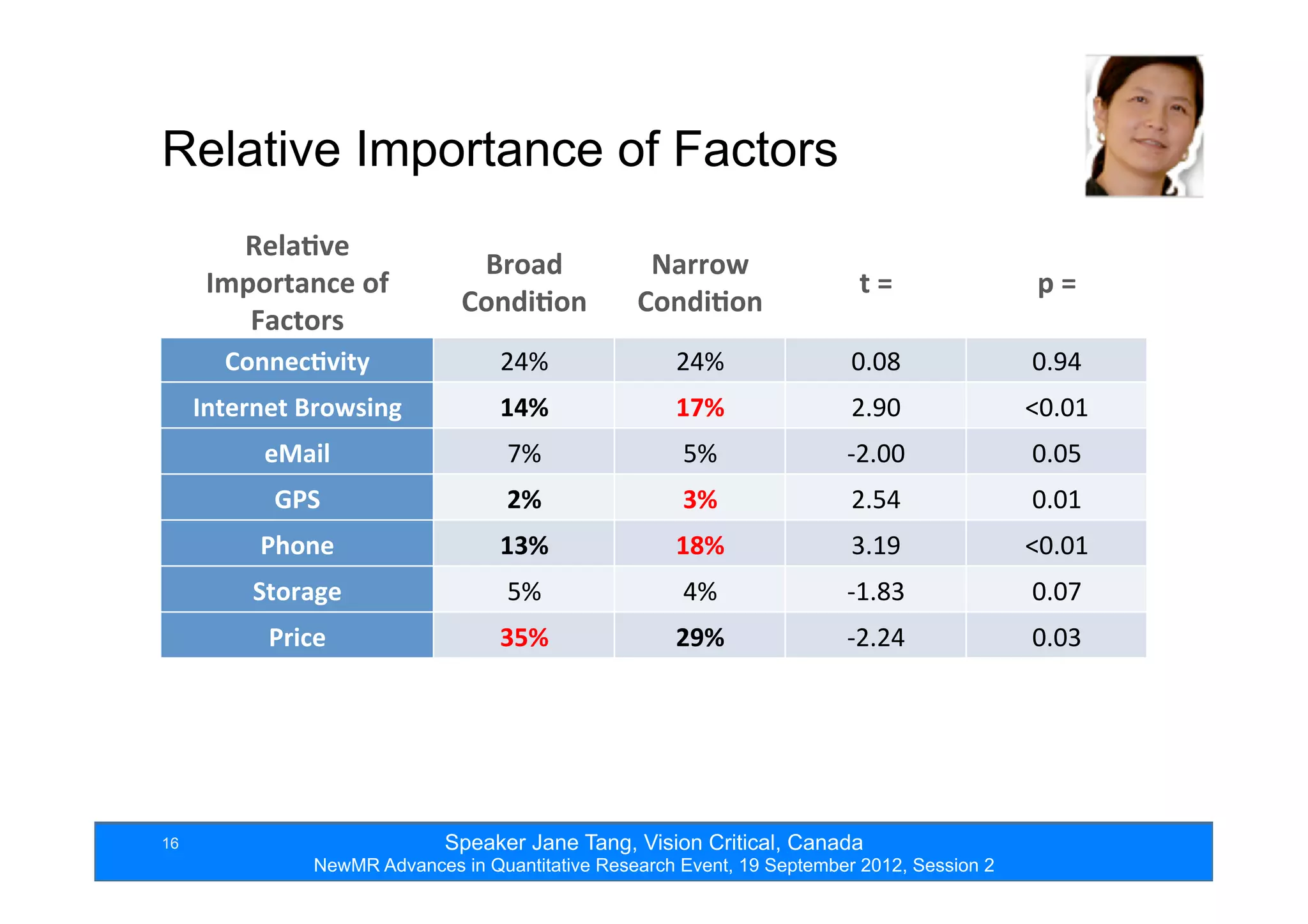
Relative Importance of Factors
Rela*ve	
  
Importance	
  of	
  
Factors
Broad	
  
Condi*on
Narrow	
  
Condi*on
t	
  = p	
  =
Connec*vity 24% 24% 0.08 0.94
Internet	
  Browsing 14% 17% 2.90 <0.01
eMail 7% 5% -­‐2.00 0.05
GPS 2% 3% 2.54 0.01
Phone 13% 18% 3.19 <0.01
Storage 5% 4% -­‐1.83 0.07
Price 35% 29% -­‐2.24 0.03
Speaker Jane Tang, Vision Critical, Canada
NewMR Advances in Quantitative Research Event, 19 September 2012, Session 2
17
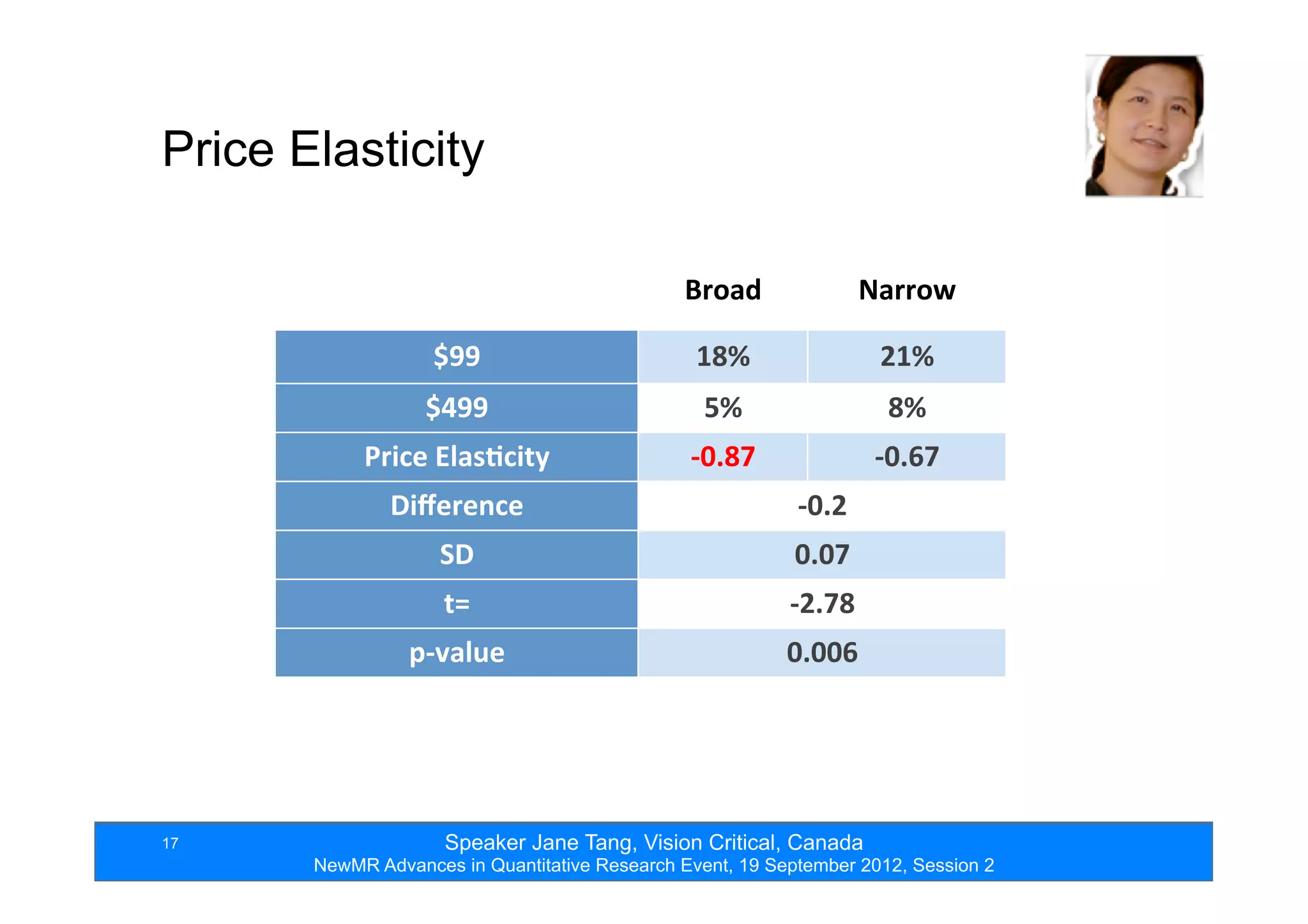
Price Elasticity
	
   Broad Narrow
$99 18% 21%
$499 5% 8%
Price	
  Elas*city -­‐0.87 -­‐0.67
Difference -­‐0.2
SD 0.07
t= -­‐2.78
p-­‐value 0.006
Speaker Jane Tang, Vision Critical, Canada
NewMR Advances in Quantitative Research Event, 19 September 2012, Session 2
The conditioning respondents receive before the
conjoint task (via the nature of the response
categories) matters.
Can we strategically make use of this conditioning
to make respondents/consumers pay more or less
attention to certain types of information?
Speaker Jane Tang, Vision Critical, Canada
NewMR Advances in Quantitative Research Event, 19 September 2012, Session 2
Jane Tang
Vision Critical
Thank you
Jane.Tang@visioncri=cal.com	
  
Speaker Jane Tang, Vision Critical, Canada
NewMR Advances in Quantitative Research Event, 19 September 2012, Session 2
Q & A
Jane Tang
Vision Critical
Ray Poynter
VCU, Vision Critical
Speaker Jane Tang, Vision Critical, Canada
NewMR Advances in Quantitative Research Event, 19 September 2012, Session 2
Jane Tang
Read	
  Jane’s	
  blog	
  @	
  hTp://vcu.visioncri=cal.com/blog/	
  
Jane.Tang@visioncri=cal.com	
  
Please	
  write	
  to	
  me	
  to	
  for	
  the	
  full	
  working	
  paper	
  
A	
  Presenta*on	
  from	
  The	
  NewMR	
  “Advances	
  in	
  
Quan*ta*ve	
  Research”	
  Event	
  
19	
  September,	
  2012	
  
Event	
  sponsored	
  by	
  Affinnova	
  
All	
  copyright	
  owned	
  by	
  The	
  Future	
  Place	
  and	
  the	
  presenters	
  of	
  the	
  material	
  
For	
  more	
  informa=on	
  about	
  Affinnova	
  visit	
  www.affinnova.com	
  
For	
  more	
  informa=on	
  about	
  NewMR	
  events	
  visit	
  newmr.org	
  
Malleable	
  Conjoint	
  Partworths:	
  How	
  the	
  Breadth	
  of	
  
Response	
  Scales	
  Alters	
  Price	
  Sensi=vity	


Jane	
  Tang,	
  Vision	
  Cri/cal 	


Jane tang advances in quant - 2011

  • 1.
    A  Presenta*on  from  The  NewMR  “Advances  in   Quan*ta*ve  Research”  Event   19  September,  2012   Event  sponsored  by  Affinnova   All  copyright  owned  by  The  Future  Place  and  the  presenters  of  the  material   For  more  informa=on  about  Affinnova  visit  www.affinnova.com   For  more  informa=on  about  NewMR  events  visit  newmr.org   Malleable  Conjoint  Partworths:  How  the  Breadth  of   Response  Scales  Alters  Price  Sensi=vity     Jane  Tang,  Vision  Cri/cal          
  • 2.
    Speaker Jane Tang,Vision Critical, Canada NewMR Advances in Quantitative Research Event, 19 September 2012, Session 2 Conditioning via Broad versus Narrow Categories: How the Breadth of Response Scales Alters Price Sensitivity Jane Tang Advanced Analytics Vision Critical
  • 3.
    Speaker Jane Tang,Vision Critical, Canada NewMR Advances in Quantitative Research Event, 19 September 2012, Session 2 Respondents are often asked other questions before the conjoint exercise begin (e.g. screening criteria, demographic questions, current product usage, etc...) The response categories used in the questions before a conjoint task provide conditioning and affect choices made in the conjoint section, altering respondents’ price sensitivity.
  • 4.
    Speaker Jane Tang,Vision Critical, Canada NewMR Advances in Quantitative Research Event, 19 September 2012, Session 2 Broad Narrow Under  18  years  old Under  18  years  old 18  to  34 18  to  24 35  to  54 25  to  29 55  or  older 30  to  34   35  to  39   40  to  44   45  to  49   50  to  54   55  to  59   60  to  64   65  to  69   70  to  74   75  to  79   80  or  older
  • 5.
    Speaker Jane Tang,Vision Critical, Canada NewMR Advances in Quantitative Research Event, 19 September 2012, Session 2 •  AMITAV CHAKRAVARTI – London School of Economics •  VICKI G. MORWITZ – New York University •  GÜLDEN ÜLKÜMEN - University of Southern California •  AMITAV CHAKRAVARTI – London School of Economics •  VICKI G. MORWITZ – New York University •  GÜLDEN ÜLKÜMEN - University of Southern California “Categories Create Mindsets: The Effect of Exposure to Broad versus Narrow Categorizations on Subsequent, Unrelated Decisions,” Journal of Marketing Research, 2010
  • 6.
    Speaker Jane Tang,Vision Critical, Canada NewMR Advances in Quantitative Research Event, 19 September 2012, Session 2 •  Scale type used in decision context #1 Basic Premise Decision context #2 – Subsequent and unrelated – Judgments and decisions Broad  Scale   Narrow  Scale  
  • 7.
    Speaker Jane Tang,Vision Critical, Canada NewMR Advances in Quantitative Research Event, 19 September 2012, Session 2 Decision Context #1: Manipulation Broad Scales Narrow Scales
  • 8.
    Speaker Jane Tang,Vision Critical, Canada NewMR Advances in Quantitative Research Event, 19 September 2012, Session 2 8 Study 1: Effects on Object Sorting
  • 9.
    Speaker Jane Tang,Vision Critical, Canada NewMR Advances in Quantitative Research Event, 19 September 2012, Session 2 9 Number of Categories
  • 10.
    Speaker Jane Tang,Vision Critical, Canada NewMR Advances in Quantitative Research Event, 19 September 2012, Session 2 Study 2: Category Inclusion Task •  Continuum of Chinese-Western European faces 10   Check  the  appropriate  buTon   a)  This  is  a  Chinese  face   b)  I  am  not  sure   Results   –  Those  who  responded  on  Broad  scales  accepted  a  greater  number  of  faces  to  be   Chinese  before  expressing  their  uncertainty  than  did  those  who  responded  on   Narrow  scales     (MBROAD  =  3.33,  MNARROW  =  2.53)  
  • 11.
    Speaker Jane Tang,Vision Critical, Canada NewMR Advances in Quantitative Research Event, 19 September 2012, Session 2 Overview of Findings 11   Grouping  Task   (Study  1)   Few,  large  groups   Many,  small  groups   Categoriza*on   Task  (Study  2)   Lenient  inclusion  criterion   Stricter  inclusion  criterion   General  Findings   Survey  Scale   Changes  in  Informa=on   Processing  Style   Broad   Narrow   Lenient  &  less  careful    less  conceptual  complexity    few,  salient  dimensions   Cri=cal  &  careful    more  conceptual  complexity    mul=ple,  salient  &  non-­‐salient  
  • 12.
    Speaker Jane Tang,Vision Critical, Canada NewMR Advances in Quantitative Research Event, 19 September 2012, Session 2 Survey  Scale   Changes  in  Informa=on   Processing  Style   Broad   Narrow   Lenient  &  less  careful    less  conceptual  complexity    few,  salient  dimensions   Cri=cal  &  careful    more  conceptual  complexity    mul=ple,  salient  &  non-­‐salient   Conjoint  Study   Focusing  on  fewer  product   features   More  Price  Sensi*ve   Focusing  on  more  product   features   Less  Price  Sensi*ve  
  • 13.
    Speaker Jane Tang,Vision Critical, Canada NewMR Advances in Quantitative Research Event, 19 September 2012, Session 2 13 •  Screening questions: –  Decision maker, gender, age, occupation, devices inventory (own & plan to buy) •  Mobile device usage: –  Frequency of usage of devices own/plan to buy •  Introduction to Mobile Internet Device (MID) concept •  Evaluation of the concept: –  Overall appeal and impressions. •  Introduction to conjoint: –  Education about the features •  CBC exercise •  Profiling questions: –  Game playing, Attitudes toward technology, (open-end) thoughts about the survey. Questionnaire Flow
  • 14.
    Speaker Jane Tang,Vision Critical, Canada NewMR Advances in Quantitative Research Event, 19 September 2012, Session 2 14 Scale Manipulation: Broad vs. Fine •  The number of response categories in each of the cells were as follows: # of response categories Broad Narrow Age 4 14 Occupation 4 39 Devices own/plan to buy 8 20 Frequency of usage of the device 4 10 Evaluation of Product concept 3 10
  • 15.
    Speaker Jane Tang,Vision Critical, Canada NewMR Advances in Quantitative Research Event, 19 September 2012, Session 2 15 The CBC exercise
  • 16.
    Speaker Jane Tang,Vision Critical, Canada NewMR Advances in Quantitative Research Event, 19 September 2012, Session 2 16 Relative Importance of Factors Rela*ve   Importance  of   Factors Broad   Condi*on Narrow   Condi*on t  = p  = Connec*vity 24% 24% 0.08 0.94 Internet  Browsing 14% 17% 2.90 <0.01 eMail 7% 5% -­‐2.00 0.05 GPS 2% 3% 2.54 0.01 Phone 13% 18% 3.19 <0.01 Storage 5% 4% -­‐1.83 0.07 Price 35% 29% -­‐2.24 0.03
  • 17.
    Speaker Jane Tang,Vision Critical, Canada NewMR Advances in Quantitative Research Event, 19 September 2012, Session 2 17 Price Elasticity   Broad Narrow $99 18% 21% $499 5% 8% Price  Elas*city -­‐0.87 -­‐0.67 Difference -­‐0.2 SD 0.07 t= -­‐2.78 p-­‐value 0.006
  • 18.
    Speaker Jane Tang,Vision Critical, Canada NewMR Advances in Quantitative Research Event, 19 September 2012, Session 2 The conditioning respondents receive before the conjoint task (via the nature of the response categories) matters. Can we strategically make use of this conditioning to make respondents/consumers pay more or less attention to certain types of information?
  • 19.
    Speaker Jane Tang,Vision Critical, Canada NewMR Advances in Quantitative Research Event, 19 September 2012, Session 2 Jane Tang Vision Critical Thank you Jane.Tang@visioncri=cal.com  
  • 20.
    Speaker Jane Tang,Vision Critical, Canada NewMR Advances in Quantitative Research Event, 19 September 2012, Session 2 Q & A Jane Tang Vision Critical Ray Poynter VCU, Vision Critical
  • 21.
    Speaker Jane Tang,Vision Critical, Canada NewMR Advances in Quantitative Research Event, 19 September 2012, Session 2 Jane Tang Read  Jane’s  blog  @  hTp://vcu.visioncri=cal.com/blog/   Jane.Tang@visioncri=cal.com   Please  write  to  me  to  for  the  full  working  paper  
  • 22.
    A  Presenta*on  from  The  NewMR  “Advances  in   Quan*ta*ve  Research”  Event   19  September,  2012   Event  sponsored  by  Affinnova   All  copyright  owned  by  The  Future  Place  and  the  presenters  of  the  material   For  more  informa=on  about  Affinnova  visit  www.affinnova.com   For  more  informa=on  about  NewMR  events  visit  newmr.org   Malleable  Conjoint  Partworths:  How  the  Breadth  of   Response  Scales  Alters  Price  Sensi=vity     Jane  Tang,  Vision  Cri/cal