 Nearly 5000 years ago geometry originated in Egypt as an
art of earth measurement. Egyptian geometry was the
statements of results.
 The word ‘Geometry’ comes from Greek words ‘geo’ meaning
the ‘earth’ and ‘metrein’ meaning to ‘measure’. Geometry
appears to have originated from the need for measuring
land.
 The knowledge of geometry passed from Egyptians to
the Greeks and many Greek mathematicians worked on
geometry. The Greeks developed geometry in a systematic
manner.
.
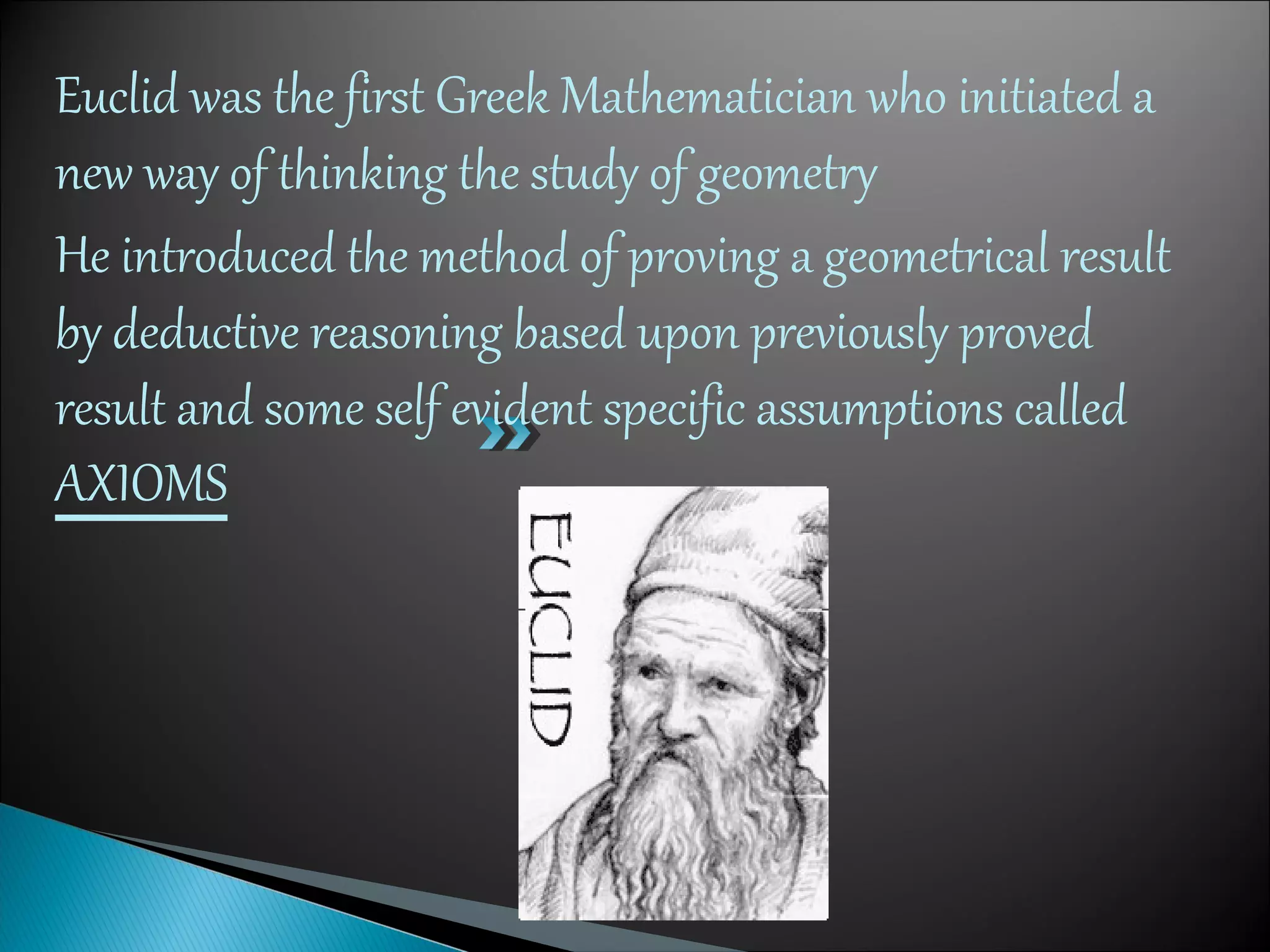
Euclid was the first Greek Mathematician who initiated a
new way of thinking the study of geometry
He introduced the method of proving a geometrical result
by deductive reasoning based upon previously proved
result and some self evident specific assumptions called
AXIOMS
The geometry of plane figure is known as
‘Euclidean Geometry’. Euclid is known as the
father of geometry.
His work is found in Thirteen books called ‘The
Elements’
Some of the definitions made by Euclid in volume I of
‘The Elements’ that we take for granted today are as
follows :-
A point is that which has no part
A line is breadth less length
The ends of a line are points
A straight line is that which has length and breadth
only.
A straight line is a line which lies evenly with the
points on itself.
The edges of a surface are lines.
A plane surface is a surface which lies evenly with
the straight lines on itself.
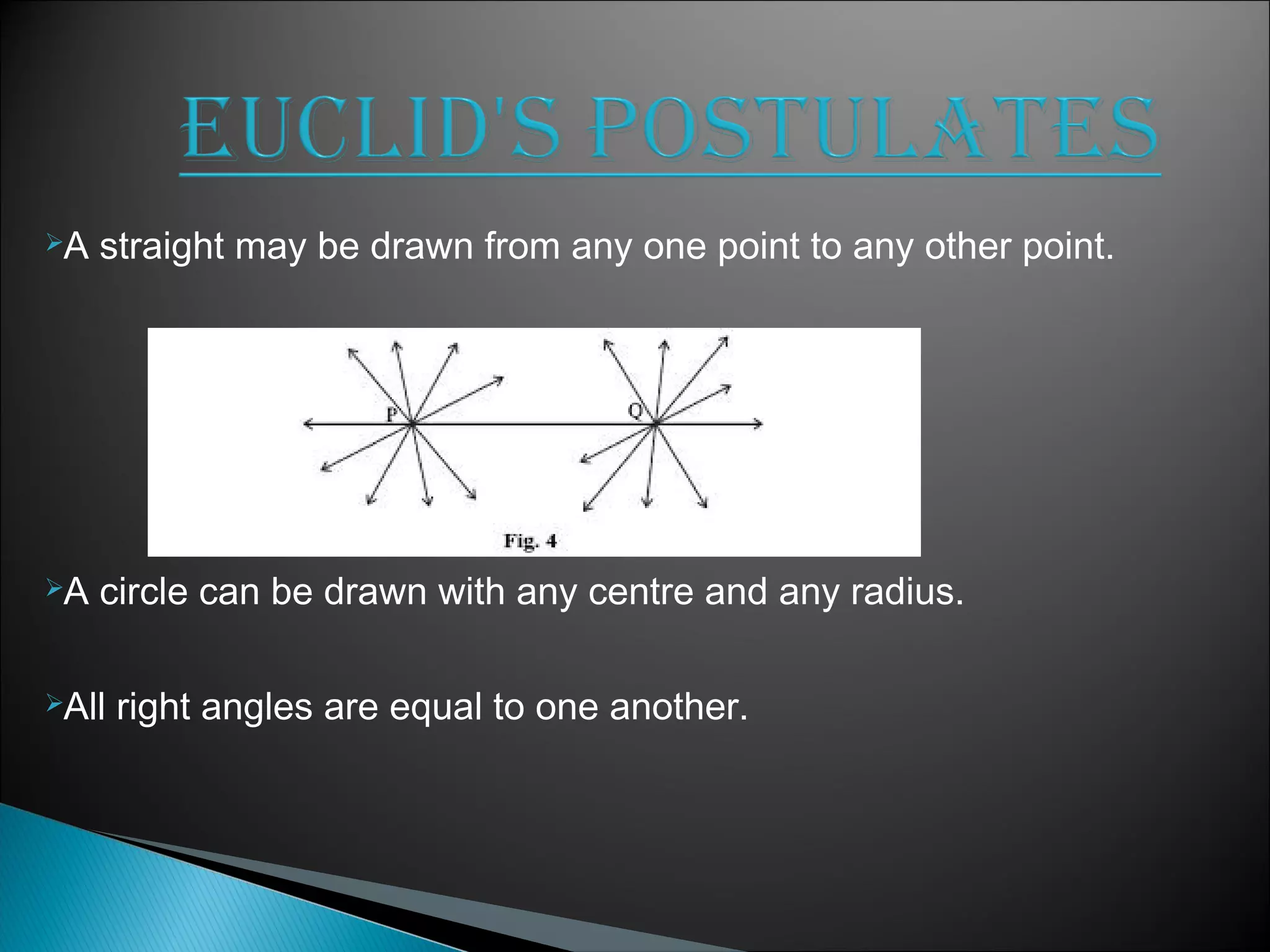
A straight may be drawn from any one point to any other point.
A circle can be drawn with any centre and any radius.
All right angles are equal to one another.
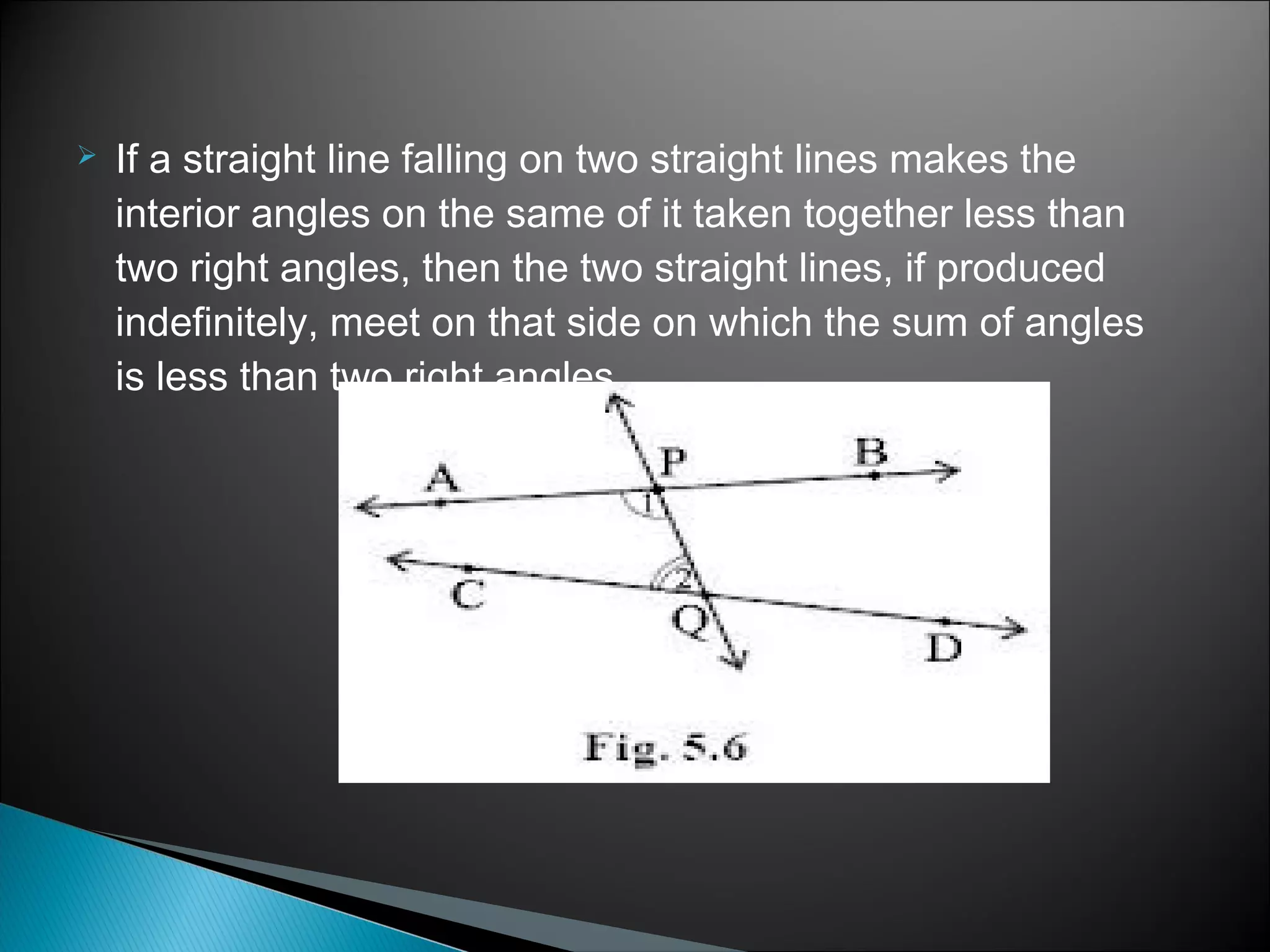
 If a straight line falling on two straight lines makes the
interior angles on the same of it taken together less than
two right angles, then the two straight lines, if produced
indefinitely, meet on that side on which the sum of angles
is less than two right angles.
 Things which are equal to the same things are also
equal to one another.
 If equals are added to equals, then the wholes are
equal.
If equals are subtracted from equals, then the remainders
are equal.
 Things which coincide with one another are equal to one
another.
The whole is greater than the part.
 Things which are double of the same things are equal
to one another.
Things which are halves of the same things are equal to
one another
i.e. if a=b and c=d, then a+c = b+d
Also a=b then this implies that a+c=b+c.
If equals are subtracted, the remainders are equal.
Things which coincide with one another are equal to one another.
The whole is greater than the part.
That is if a > b then there exists c such that a =b + c. Here, b is
a part of a and therefore, a is greater than b.
Things which are double of the same things are equal to one
another.
 Things which are halves of the same things are equal to one
another
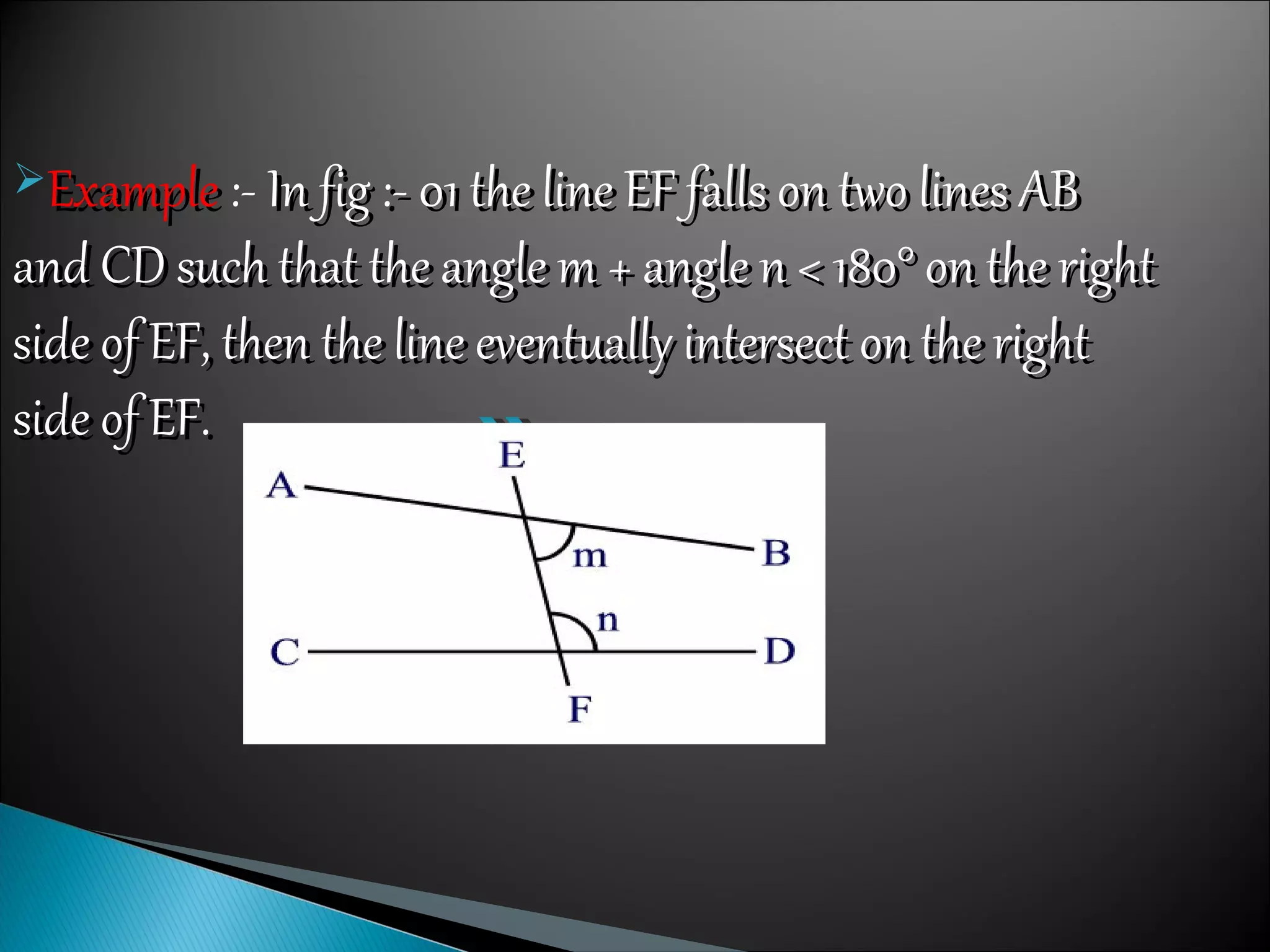
ExampleExample :- In fig :- 01 the line EF falls on two lines ABIn fig :- 01 the line EF falls on two lines AB
and CD such that the angle m + angle n < 180° on the rightand CD such that the angle m + angle n < 180° on the right
side of EF, then the line eventually intersect on the rightside of EF, then the line eventually intersect on the right
side of EF.side of EF.
To the ancients, the parallel postulate seemed less obvious
than the others. It seemed as if the parallel line postulate
should have been able to be proven rather than simply
accepted as a fact. It is now known that such a proof is
impossible.
Euclid himself seems to have considered it as being qualitatively
different from the others, as evidenced by the organization of
the Elements: the first 28 propositions he presents are those that
can be proved without it.
Many alternative axioms can be formulated that have the same 
logical consequences as the parallel postulate. For example 
Playfair's axiom states:
For every line l and for every point P lying outside l, there exists
a unique line m passing through P and parallel to l
This result can also be stated in the following way:
Two distinct intersecting lines cannot be parallel to the
same line
Presented by-Rajat Kumar
IX-A

Euclids geometry

  • 3.
     Nearly 5000years ago geometry originated in Egypt as an art of earth measurement. Egyptian geometry was the statements of results.  The word ‘Geometry’ comes from Greek words ‘geo’ meaning the ‘earth’ and ‘metrein’ meaning to ‘measure’. Geometry appears to have originated from the need for measuring land.  The knowledge of geometry passed from Egyptians to the Greeks and many Greek mathematicians worked on geometry. The Greeks developed geometry in a systematic manner. .
  • 4.
    Euclid was thefirst Greek Mathematician who initiated a new way of thinking the study of geometry He introduced the method of proving a geometrical result by deductive reasoning based upon previously proved result and some self evident specific assumptions called AXIOMS
  • 5.
    The geometry ofplane figure is known as ‘Euclidean Geometry’. Euclid is known as the father of geometry. His work is found in Thirteen books called ‘The Elements’
  • 6.
    Some of thedefinitions made by Euclid in volume I of ‘The Elements’ that we take for granted today are as follows :- A point is that which has no part A line is breadth less length The ends of a line are points A straight line is that which has length and breadth only.
  • 7.
    A straight lineis a line which lies evenly with the points on itself. The edges of a surface are lines. A plane surface is a surface which lies evenly with the straight lines on itself.
  • 8.
    A straight maybe drawn from any one point to any other point. A circle can be drawn with any centre and any radius. All right angles are equal to one another.
  • 9.
     If astraight line falling on two straight lines makes the interior angles on the same of it taken together less than two right angles, then the two straight lines, if produced indefinitely, meet on that side on which the sum of angles is less than two right angles.
  • 10.
     Things which areequal to the same things are also equal to one another.  If equals are added to equals, then the wholes are equal. If equals are subtracted from equals, then the remainders are equal.  Things which coincide with one another are equal to one another.
  • 11.
    The whole isgreater than the part.  Things which are double of the same things are equal to one another. Things which are halves of the same things are equal to one another
  • 12.
    i.e. if a=band c=d, then a+c = b+d Also a=b then this implies that a+c=b+c. If equals are subtracted, the remainders are equal. Things which coincide with one another are equal to one another. The whole is greater than the part. That is if a > b then there exists c such that a =b + c. Here, b is a part of a and therefore, a is greater than b. Things which are double of the same things are equal to one another.  Things which are halves of the same things are equal to one another
  • 13.
    ExampleExample :- Infig :- 01 the line EF falls on two lines ABIn fig :- 01 the line EF falls on two lines AB and CD such that the angle m + angle n < 180° on the rightand CD such that the angle m + angle n < 180° on the right side of EF, then the line eventually intersect on the rightside of EF, then the line eventually intersect on the right side of EF.side of EF.
  • 14.
    To the ancients,the parallel postulate seemed less obvious than the others. It seemed as if the parallel line postulate should have been able to be proven rather than simply accepted as a fact. It is now known that such a proof is impossible.
  • 15.
    Euclid himself seemsto have considered it as being qualitatively different from the others, as evidenced by the organization of the Elements: the first 28 propositions he presents are those that can be proved without it. Many alternative axioms can be formulated that have the same  logical consequences as the parallel postulate. For example  Playfair's axiom states: For every line l and for every point P lying outside l, there exists a unique line m passing through P and parallel to l This result can also be stated in the following way:
  • 16.
    This result canalso be stated in the following way: Two distinct intersecting lines cannot be parallel to the same line
  • 17.