Specific language impairment
         and the brain

     Dorothy V M Bishop
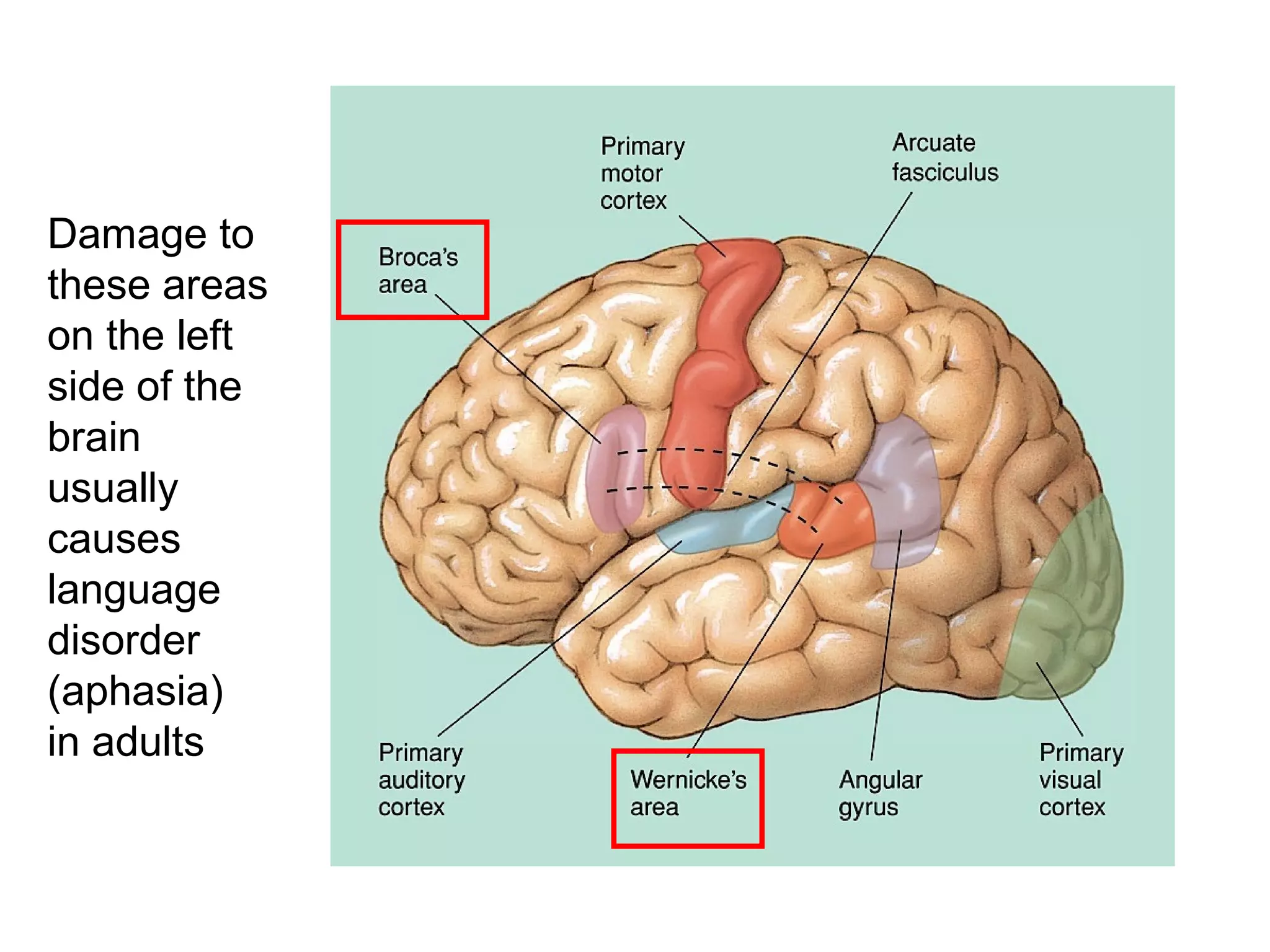
Damage to
these areas
on the left
side of the
brain
usually
causes
language
disorder
(aphasia)
in adults
Specific language impairment (SLI)
        is sometimes called
   “developmental dysphasia”
   or “developmental aphasia”

  But the causes are different from
  causes of adult acquired aphasia
Evidence against brain damage in
      children with SLI: 1.

Children who do have brain injury affecting
the language areas don’t usually develop SLI
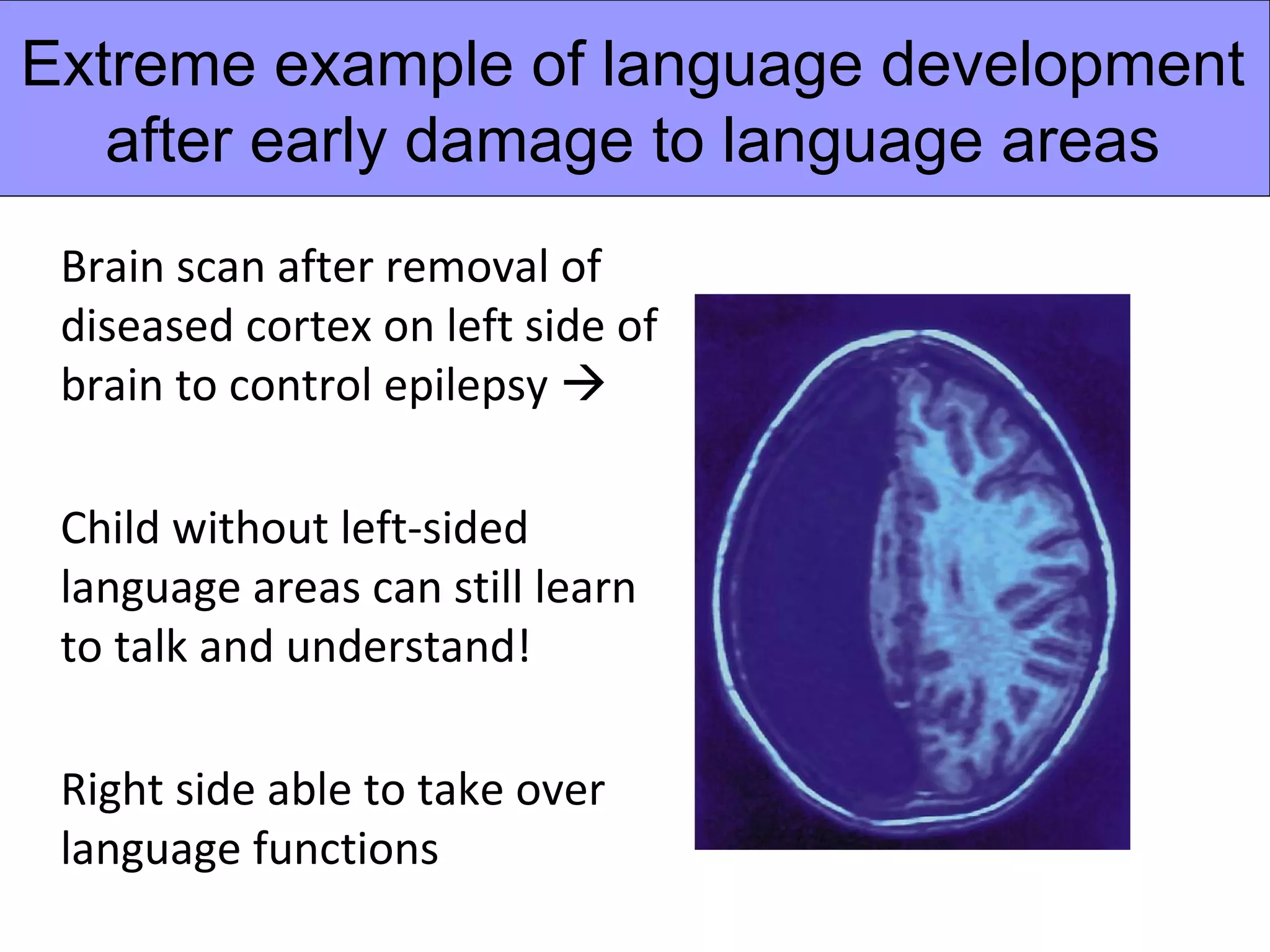
Extreme example of language development
   after early damage to language areas
 Brain scan after removal of
 diseased cortex on left side of
 brain to control epilepsy 

 Child without left-sided
 language areas can still learn
 to talk and understand!

 Right side able to take over
 language functions
Evidence against brain damage in
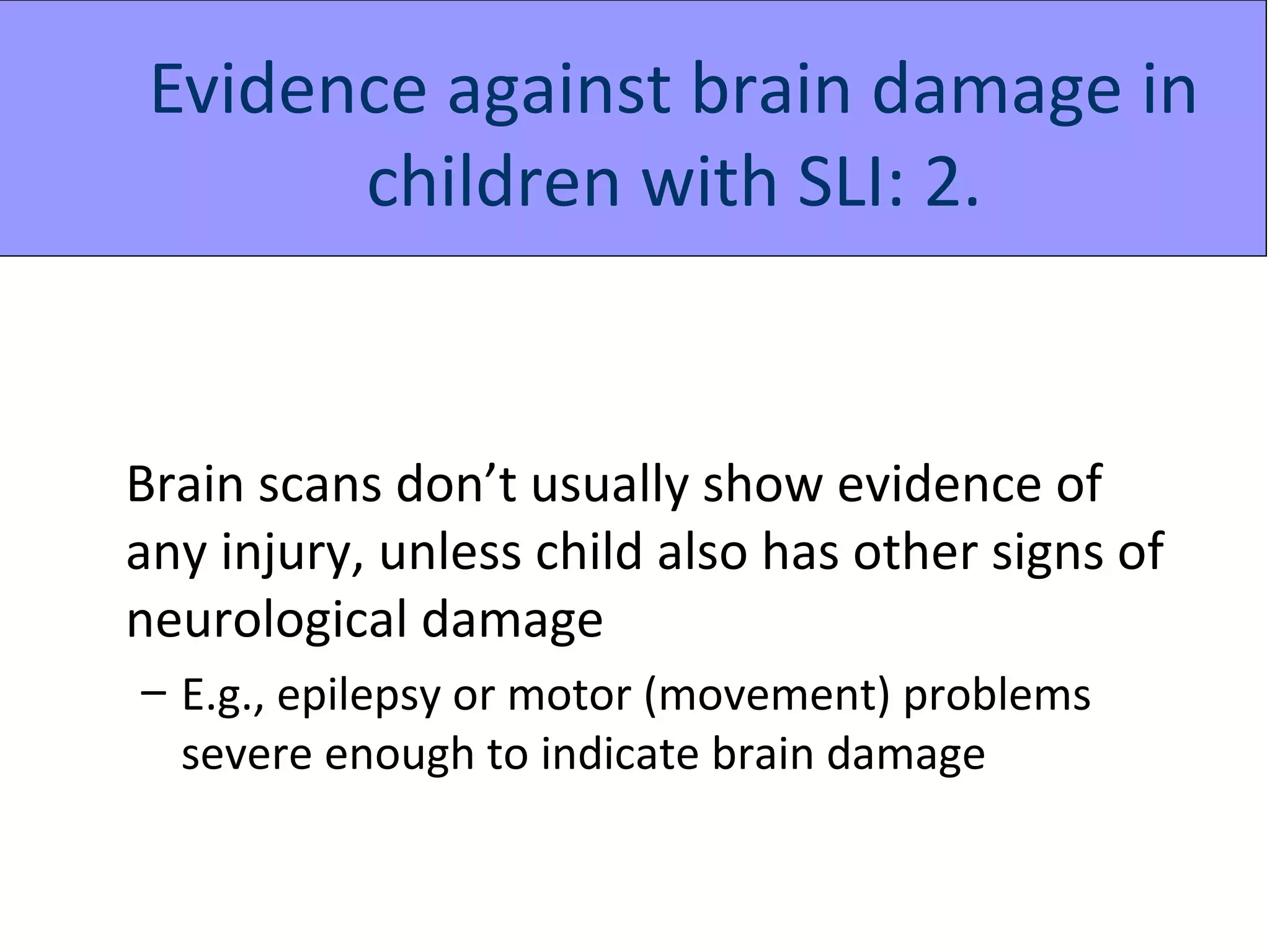
       children with SLI: 2.


Brain scans don’t usually show evidence of
any injury, unless child also has other signs of
neurological damage
– E.g., epilepsy or motor (movement) problems
  severe enough to indicate brain damage
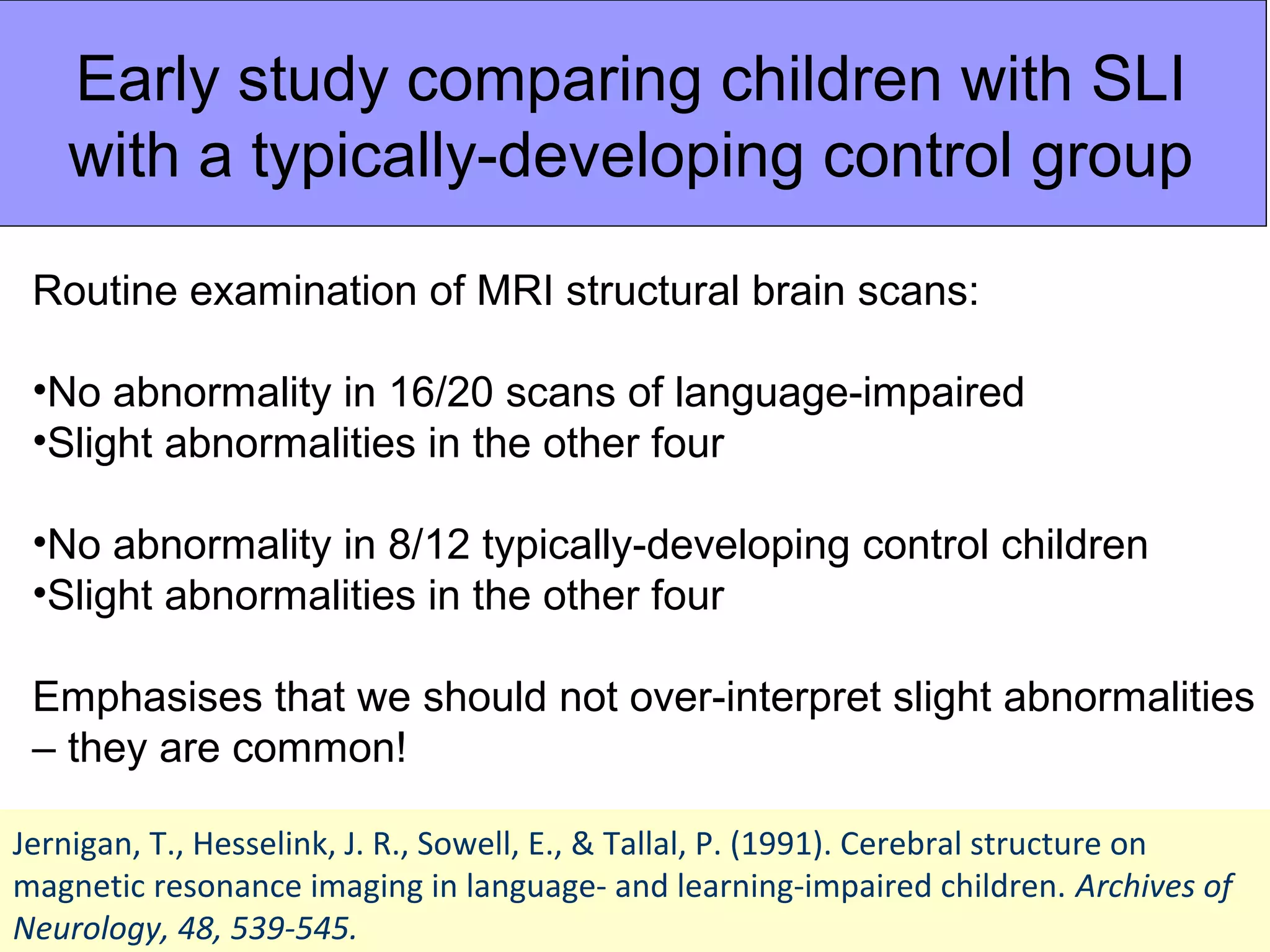
Early study comparing children with SLI
   with a typically-developing control group

 Routine examination of MRI structural brain scans:

 •No abnormality in 16/20 scans of language-impaired
 •Slight abnormalities in the other four

 •No abnormality in 8/12 typically-developing control children
 •Slight abnormalities in the other four

 Emphasises that we should not over-interpret slight abnormalities
 – they are common!

Jernigan, T., Hesselink, J. R., Sowell, E., & Tallal, P. (1991). Cerebral structure on
magnetic resonance imaging in language- and learning-impaired children. Archives of
Neurology, 48, 539-545.
“There is now overwhelming evidence
      that children with [specific] learning
      disabilities do not have “holes in the
      brain”. No ..studies have found a one-
      to-one correlation between behavioural
      symptoms and MRI or postmortem
      pathology in [specific] learning
      disabilities”C. Leonard, 1997, p 161
 Because of UK/US differences in terminology, [specific] added for clarification


Leonard, C. M. (1997). Language and the prefrontal cortex. In N. Krasnegor, G. R. Lyon
& P. S. Goldman-Rakic (Eds.), Prefrontal cortex: Evolution, development, and behavioral
neuroscience (pp. 141-166). Baltimore: Paul H. Brookes.
Abnormal brain development in SLI?
 Growing evidence that genes are important in
 causing SLI
 Genetic influence could affect early stages of
 brain development
 What would this look like?
 – Brain may be atypical in shape/size?
 – Connections between brain regions affected?
 – Microscopic differences in brain cell arrangements?
 Not many studies: still early days
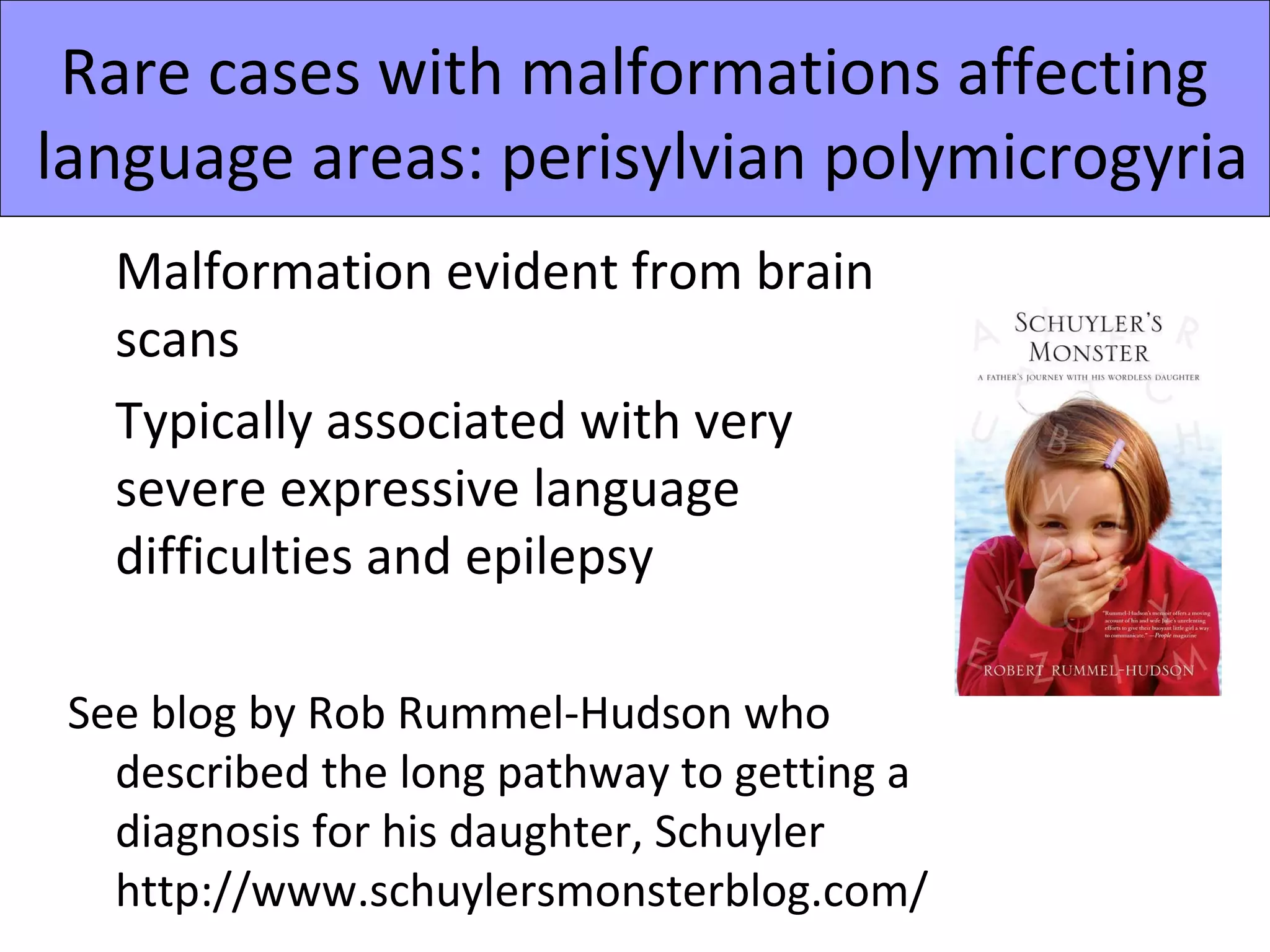
Rare cases with malformations affecting
language areas: perisylvian polymicrogyria
   Malformation evident from brain
   scans
   Typically associated with very
   severe expressive language
   difficulties and epilepsy

 See blog by Rob Rummel-Hudson who
   described the long pathway to getting a
   diagnosis for his daughter, Schuyler
   http://www.schuylersmonsterblog.com/
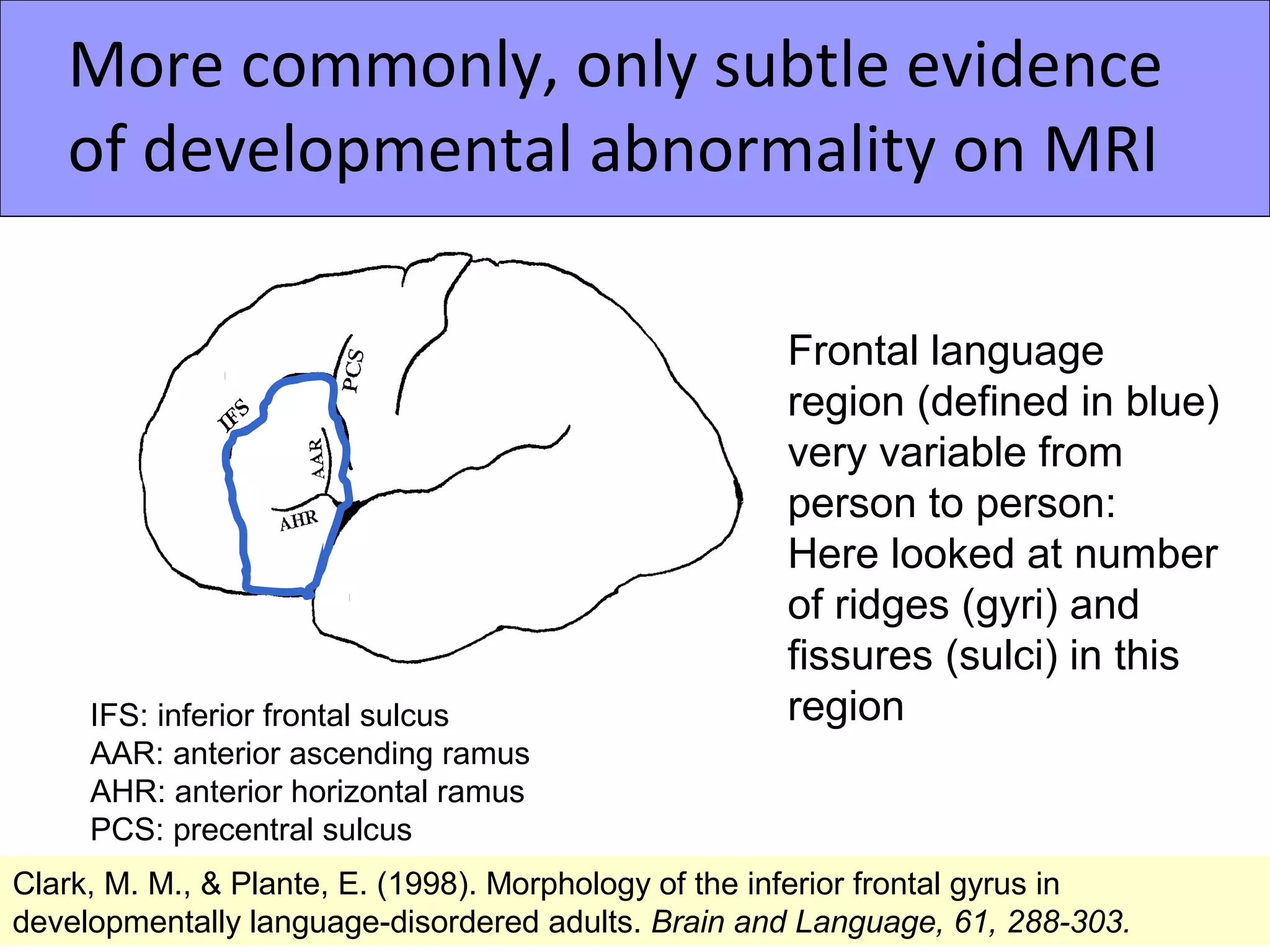
More commonly, only subtle evidence
   of developmental abnormality on MRI

                                                      Frontal language
                                                      region (defined in blue)
                                                      very variable from
                                                      person to person:
                                                      Here looked at number
                                                      of ridges (gyri) and
                                                      fissures (sulci) in this
     IFS: inferior frontal sulcus                     region
     AAR: anterior ascending ramus
     AHR: anterior horizontal ramus
     PCS: precentral sulcus
Clark, M. M., & Plante, E. (1998). Morphology of the inferior frontal gyrus in
developmentally language-disordered adults. Brain and Language, 61, 288-303.
Clark & Plante study
Number of people with extra sulcus (either side)
1. Parents of language-impaired child
    Parent with no language problems: 5/10 = 50%
    Parent also has language problems: 20/30 = 67%
2. Parents of child without language problems
    Parent has no language problems: 13/34 = 38%
    Parent also has language problems: 6/8 = 75%
Conclusion: Greater chance of extra sulcus in those with language problems,
but association is far from perfect:
•Around 1/3 of adults with no language difficulties in self or child have extra
sulcus,
•Around 1/3 of adults with language difficulies in self AND child don’t have
extra sulcus
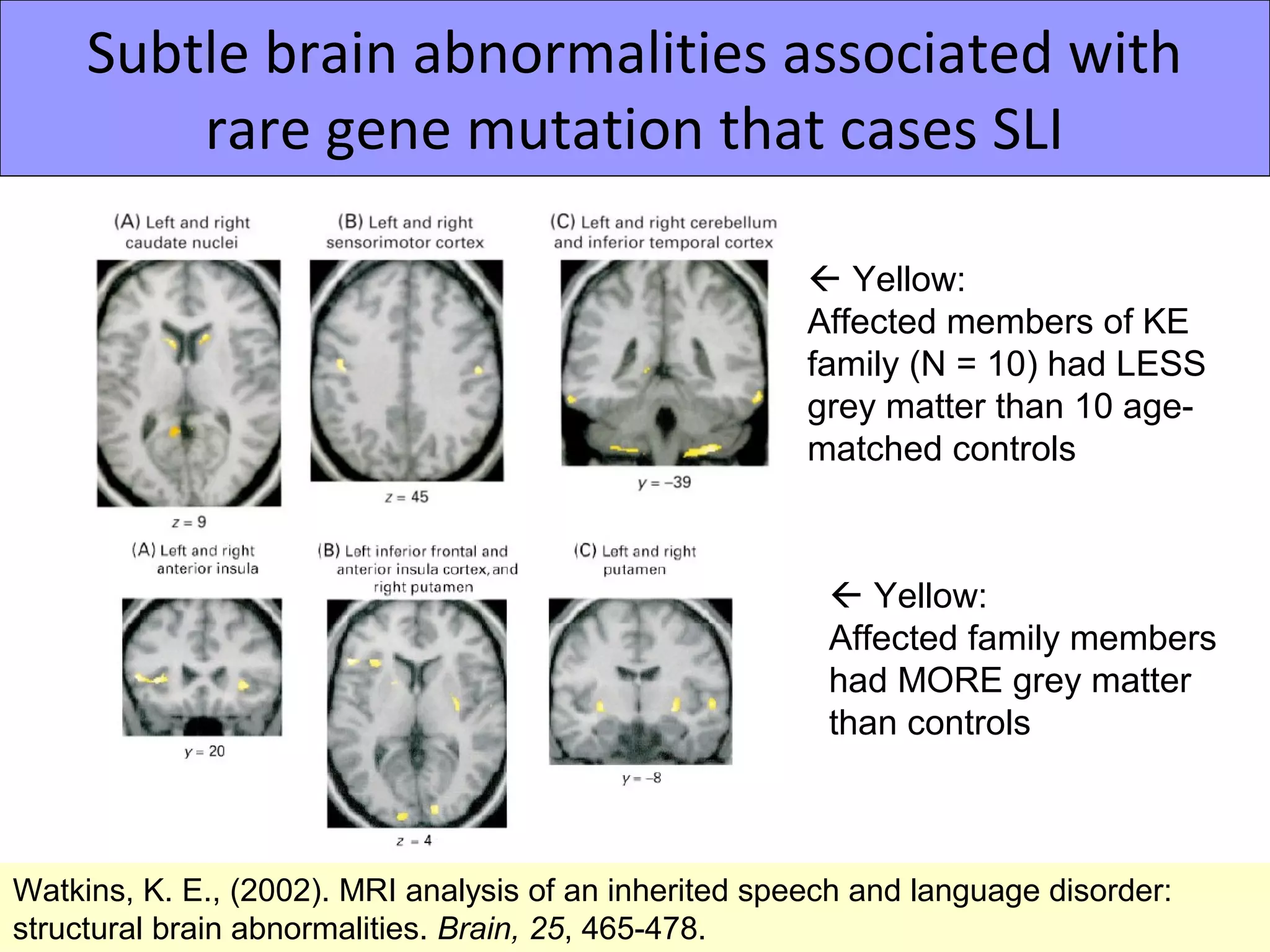
Subtle brain abnormalities associated with
         rare gene mutation that cases SLI

                                                         Yellow:
                                                        Affected members of KE
                                                        family (N = 10) had LESS
                                                        grey matter than 10 age-
                                                        matched controls


                                                          Yellow:
                                                         Affected family members
                                                         had MORE grey matter
                                                         than controls


Watkins, K. E., (2002). MRI analysis of an inherited speech and language disorder:
structural brain abnormalities. Brain, 25, 465-478.
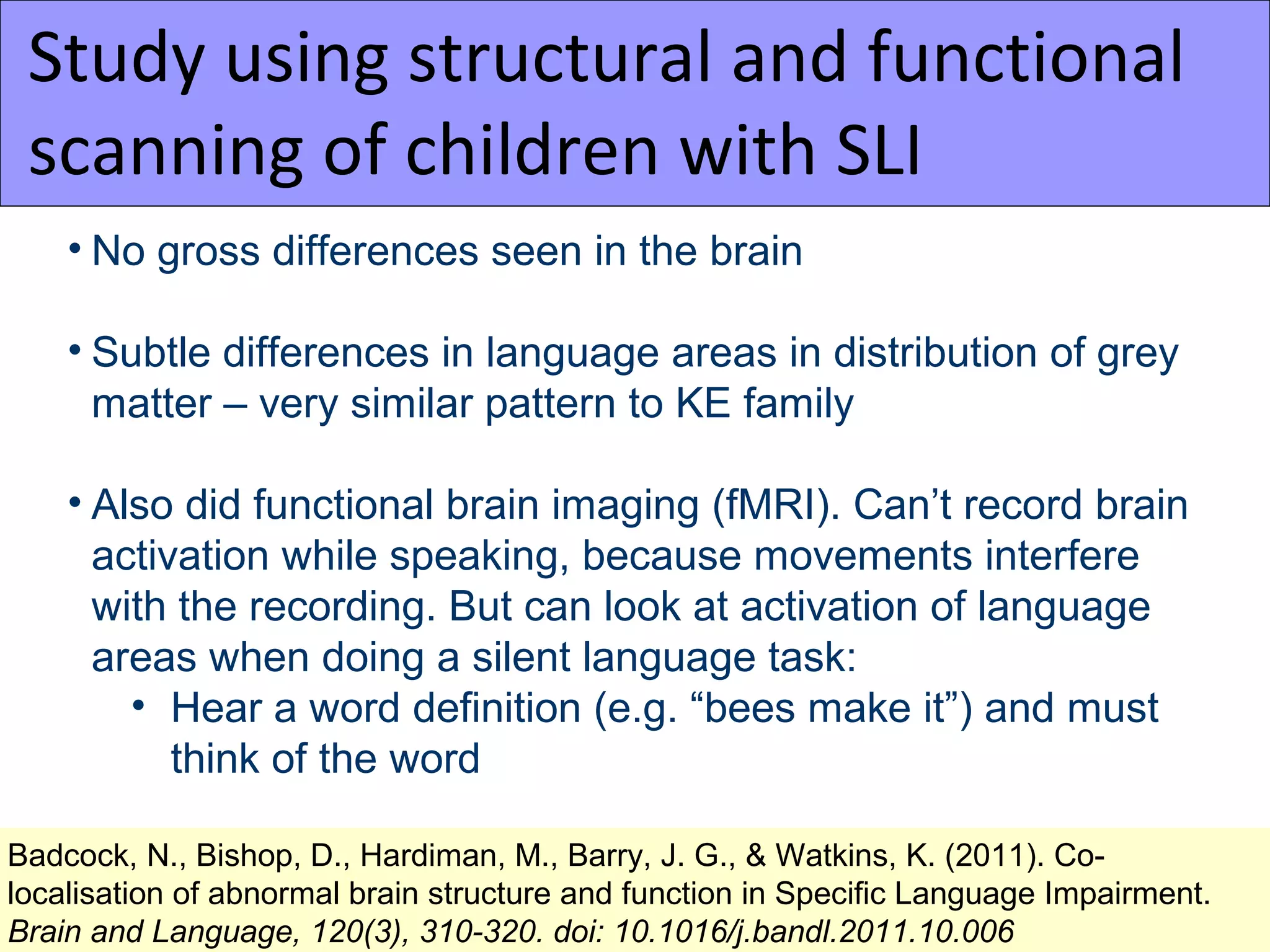
Study using structural and functional
 scanning of children with SLI
    • No gross differences seen in the brain

    • Subtle differences in language areas in distribution of grey
      matter – very similar pattern to KE family

    • Also did functional brain imaging (fMRI). Can’t record brain
      activation while speaking, because movements interfere
      with the recording. But can look at activation of language
      areas when doing a silent language task:
        • Hear a word definition (e.g. “bees make it”) and must
           think of the word

Badcock, N., Bishop, D., Hardiman, M., Barry, J. G., & Watkins, K. (2011). Co-
localisation of abnormal brain structure and function in Specific Language Impairment.
Brain and Language, 120(3), 310-320. doi: 10.1016/j.bandl.2011.10.006
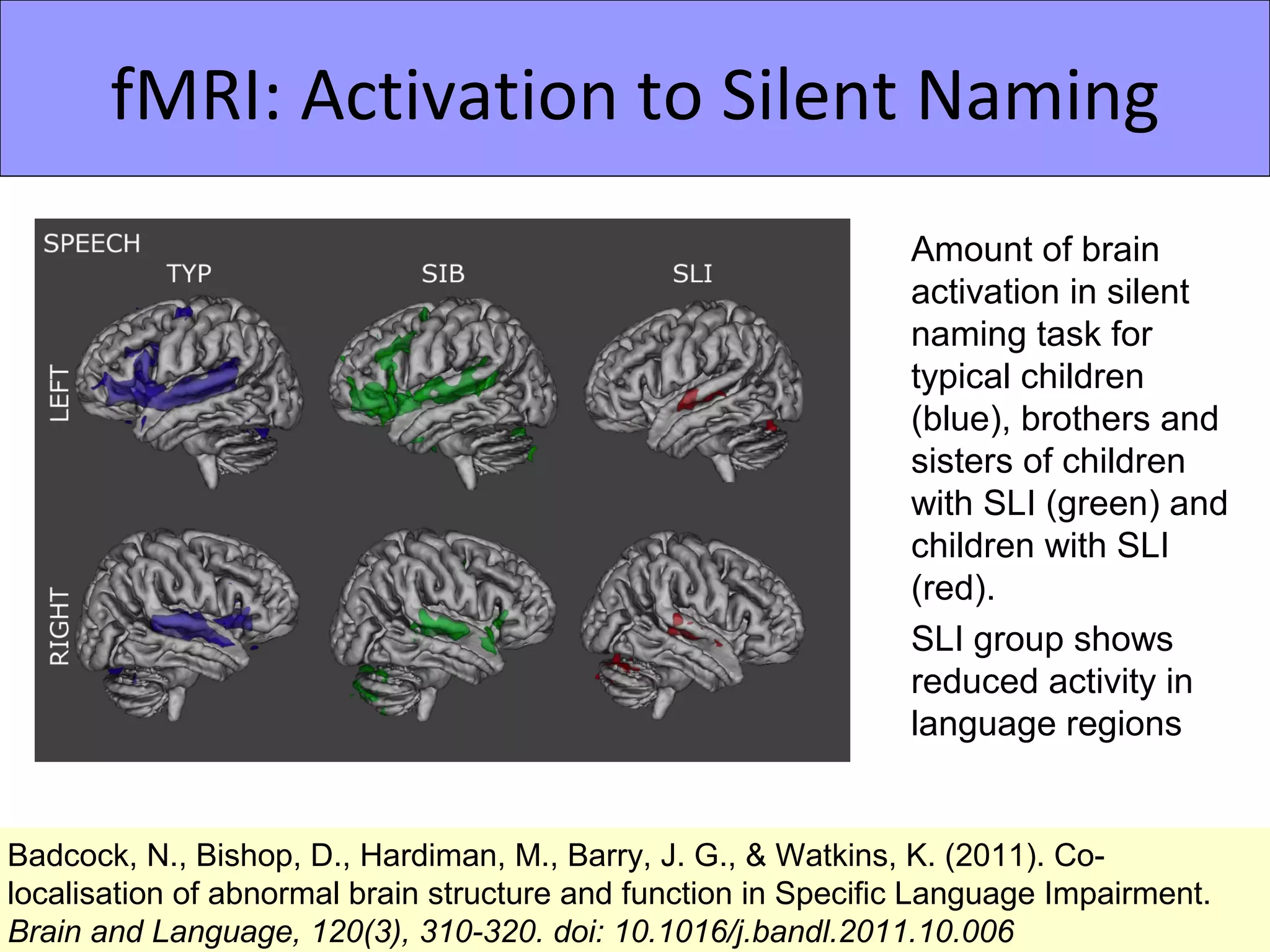
fMRI: Activation to Silent Naming
                                                                Amount of brain
                                                                activation in silent
                                                                naming task for
                                                                typical children
                                                                (blue), brothers and
                                                                sisters of children
                                                                with SLI (green) and
                                                                children with SLI
                                                                (red).
                                                                SLI group shows
                                                                reduced activity in
                                                                language regions


Badcock, N., Bishop, D., Hardiman, M., Barry, J. G., & Watkins, K. (2011). Co-
localisation of abnormal brain structure and function in Specific Language Impairment.
Brain and Language, 120(3), 310-320. doi: 10.1016/j.bandl.2011.10.006
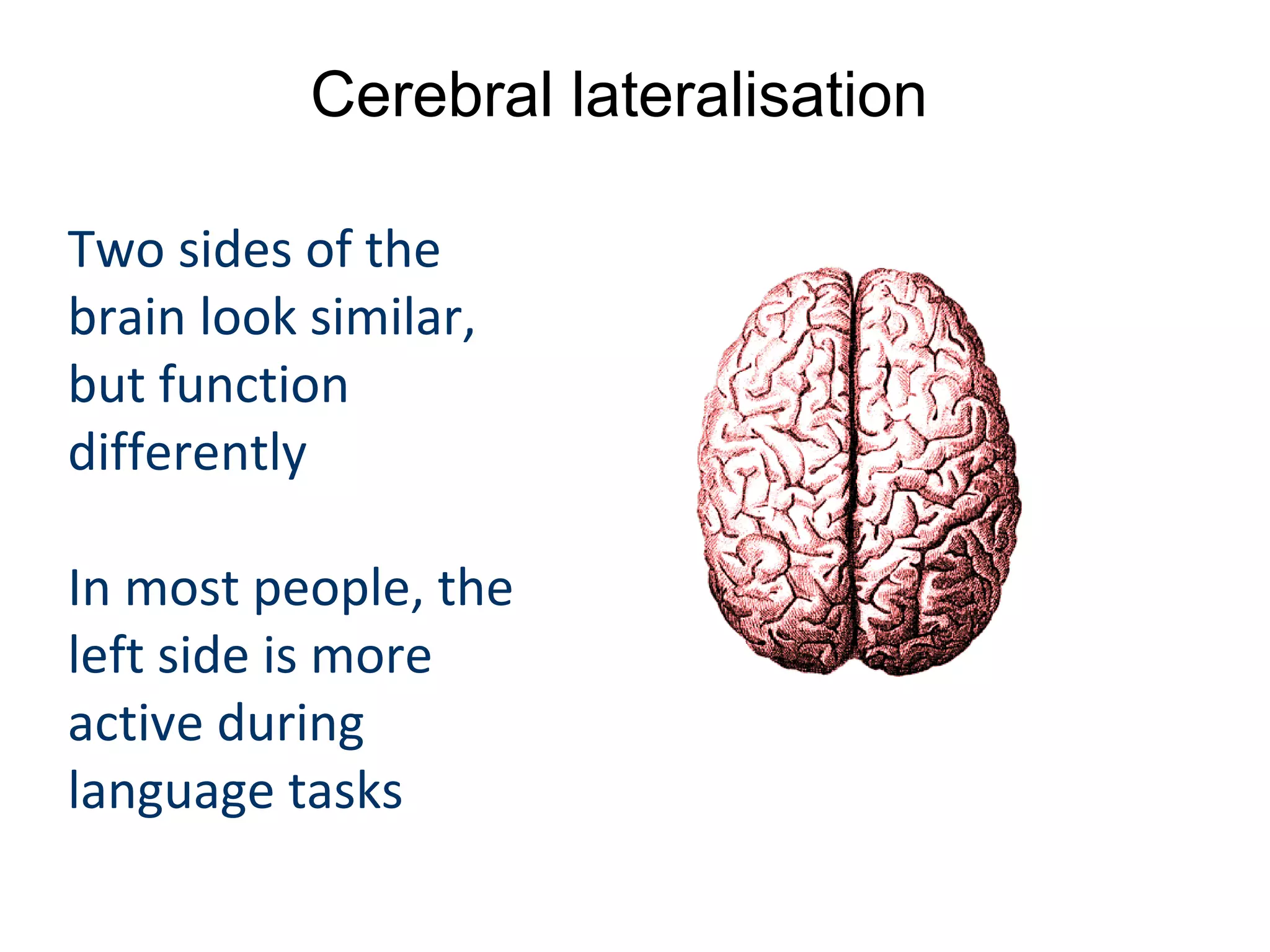
Cerebral lateralisation

Two sides of the
brain look similar,
but function
differently

In most people, the
left side is more
active during
language tasks
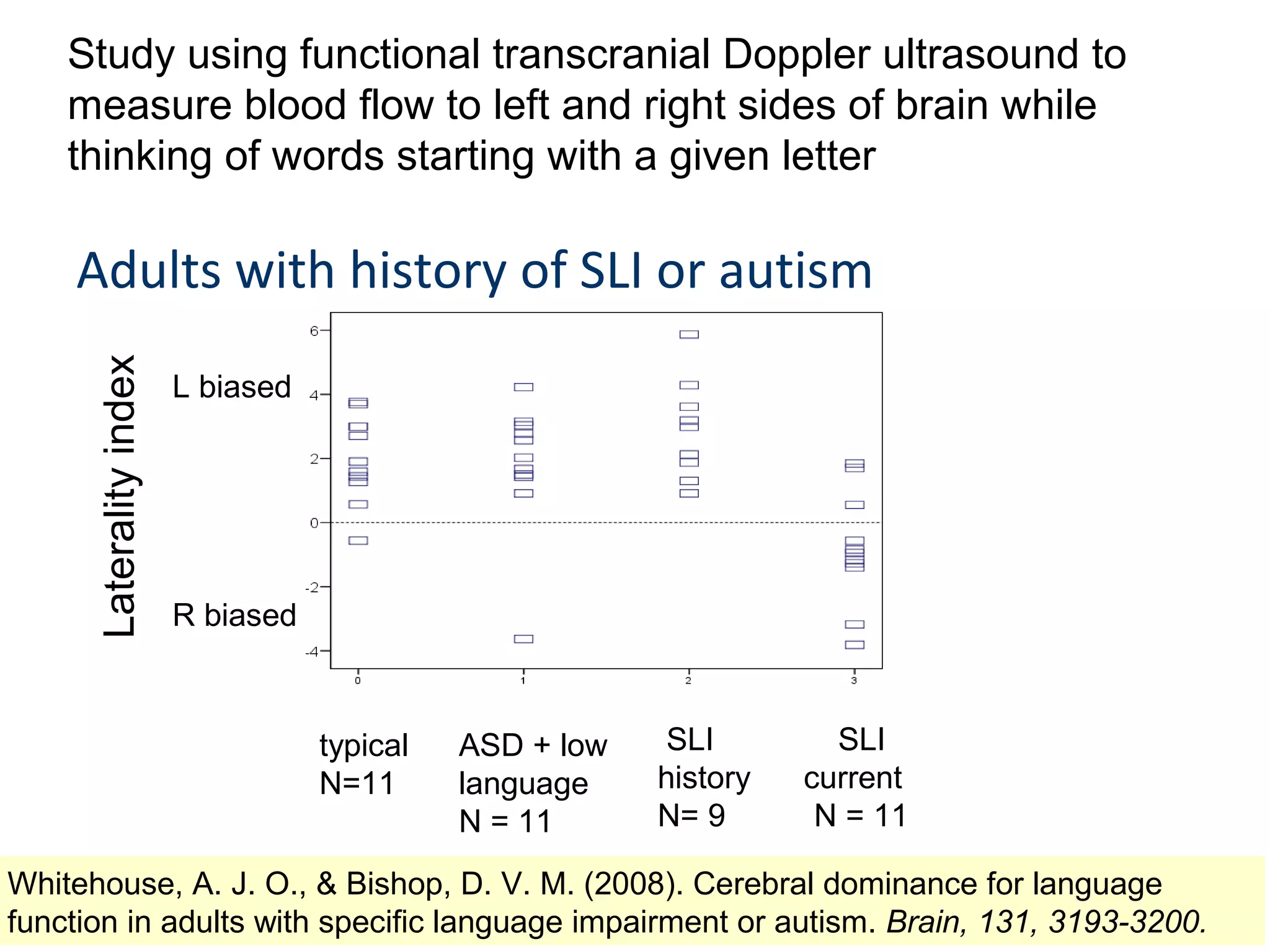
Study using functional transcranial Doppler ultrasound to
    measure blood flow to left and right sides of brain while
    thinking of words starting with a given letter

    Adults with history of SLI or autism
      Laterality index


                         L biased


                         R biased


                                    typical   ASD + low    SLI        SLI
                                    N=11      language    history   current
                                              N = 11      N= 9       N = 11

Whitehouse, A. J. O., & Bishop, D. V. M. (2008). Cerebral dominance for language
function in adults with specific language impairment or autism. Brain, 131, 3193-3200.
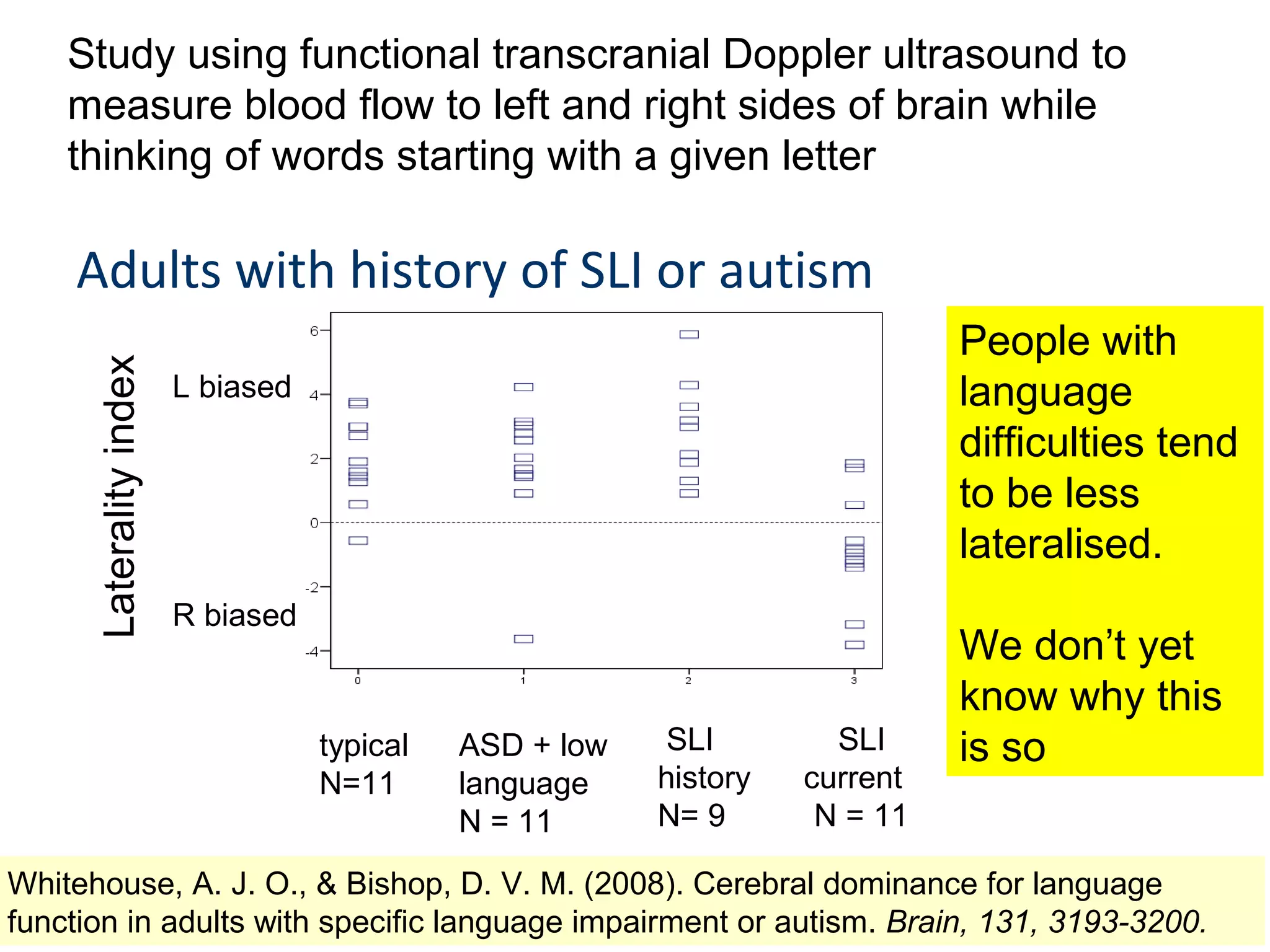
Study using functional transcranial Doppler ultrasound to
    measure blood flow to left and right sides of brain while
    thinking of words starting with a given letter

    Adults with history of SLI or autism
                                                                              People with
      Laterality index


                         L biased                                             language
                                                                              difficulties tend
                                                                              to be less
                                                                              lateralised.
                         R biased
                                                                              We don’t yet
                                                                              know why this
                                    typical   ASD + low    SLI        SLI     is so
                                    N=11      language    history   current
                                              N = 11      N= 9       N = 11

Whitehouse, A. J. O., & Bishop, D. V. M. (2008). Cerebral dominance for language
function in adults with specific language impairment or autism. Brain, 131, 3193-3200.
Overall…..
 Most children with Specific Language Impairment
 don’t have any evidence of brain damage
 They may have slight differences in the size of
 different brain regions, or in the balance of activity
 on left and right sides
 The differences are typically small and not seen in all
 children with SLI
 It’s not possible to diagnose SLI from a brain scan
 Neurological investigations aren’t usually
 recommended unless the child has very severe
 language difficulties, physical impairments (motor
 problems) or epilepsy
For further reading
see reference list on:

http://www.slideshare.net/RALLICampaign/sli-and-
the-brain

SLI and the brain

  • 1.
    Specific language impairment and the brain Dorothy V M Bishop
  • 2.
    Damage to these areas onthe left side of the brain usually causes language disorder (aphasia) in adults
  • 3.
    Specific language impairment(SLI) is sometimes called “developmental dysphasia” or “developmental aphasia” But the causes are different from causes of adult acquired aphasia
  • 4.
    Evidence against braindamage in children with SLI: 1. Children who do have brain injury affecting the language areas don’t usually develop SLI
  • 5.
    Extreme example oflanguage development after early damage to language areas Brain scan after removal of diseased cortex on left side of brain to control epilepsy  Child without left-sided language areas can still learn to talk and understand! Right side able to take over language functions
  • 6.
    Evidence against braindamage in children with SLI: 2. Brain scans don’t usually show evidence of any injury, unless child also has other signs of neurological damage – E.g., epilepsy or motor (movement) problems severe enough to indicate brain damage
  • 7.
    Early study comparingchildren with SLI with a typically-developing control group Routine examination of MRI structural brain scans: •No abnormality in 16/20 scans of language-impaired •Slight abnormalities in the other four •No abnormality in 8/12 typically-developing control children •Slight abnormalities in the other four Emphasises that we should not over-interpret slight abnormalities – they are common! Jernigan, T., Hesselink, J. R., Sowell, E., & Tallal, P. (1991). Cerebral structure on magnetic resonance imaging in language- and learning-impaired children. Archives of Neurology, 48, 539-545.
  • 8.
    “There is nowoverwhelming evidence that children with [specific] learning disabilities do not have “holes in the brain”. No ..studies have found a one- to-one correlation between behavioural symptoms and MRI or postmortem pathology in [specific] learning disabilities”C. Leonard, 1997, p 161 Because of UK/US differences in terminology, [specific] added for clarification Leonard, C. M. (1997). Language and the prefrontal cortex. In N. Krasnegor, G. R. Lyon & P. S. Goldman-Rakic (Eds.), Prefrontal cortex: Evolution, development, and behavioral neuroscience (pp. 141-166). Baltimore: Paul H. Brookes.
  • 9.
    Abnormal brain developmentin SLI? Growing evidence that genes are important in causing SLI Genetic influence could affect early stages of brain development What would this look like? – Brain may be atypical in shape/size? – Connections between brain regions affected? – Microscopic differences in brain cell arrangements? Not many studies: still early days
  • 10.
    Rare cases withmalformations affecting language areas: perisylvian polymicrogyria Malformation evident from brain scans Typically associated with very severe expressive language difficulties and epilepsy See blog by Rob Rummel-Hudson who described the long pathway to getting a diagnosis for his daughter, Schuyler http://www.schuylersmonsterblog.com/
  • 11.
    More commonly, onlysubtle evidence of developmental abnormality on MRI Frontal language region (defined in blue) very variable from person to person: Here looked at number of ridges (gyri) and fissures (sulci) in this IFS: inferior frontal sulcus region AAR: anterior ascending ramus AHR: anterior horizontal ramus PCS: precentral sulcus Clark, M. M., & Plante, E. (1998). Morphology of the inferior frontal gyrus in developmentally language-disordered adults. Brain and Language, 61, 288-303.
  • 12.
    Clark & Plantestudy Number of people with extra sulcus (either side) 1. Parents of language-impaired child Parent with no language problems: 5/10 = 50% Parent also has language problems: 20/30 = 67% 2. Parents of child without language problems Parent has no language problems: 13/34 = 38% Parent also has language problems: 6/8 = 75% Conclusion: Greater chance of extra sulcus in those with language problems, but association is far from perfect: •Around 1/3 of adults with no language difficulties in self or child have extra sulcus, •Around 1/3 of adults with language difficulies in self AND child don’t have extra sulcus
  • 13.
    Subtle brain abnormalitiesassociated with rare gene mutation that cases SLI  Yellow: Affected members of KE family (N = 10) had LESS grey matter than 10 age- matched controls  Yellow: Affected family members had MORE grey matter than controls Watkins, K. E., (2002). MRI analysis of an inherited speech and language disorder: structural brain abnormalities. Brain, 25, 465-478.
  • 14.
    Study using structuraland functional scanning of children with SLI • No gross differences seen in the brain • Subtle differences in language areas in distribution of grey matter – very similar pattern to KE family • Also did functional brain imaging (fMRI). Can’t record brain activation while speaking, because movements interfere with the recording. But can look at activation of language areas when doing a silent language task: • Hear a word definition (e.g. “bees make it”) and must think of the word Badcock, N., Bishop, D., Hardiman, M., Barry, J. G., & Watkins, K. (2011). Co- localisation of abnormal brain structure and function in Specific Language Impairment. Brain and Language, 120(3), 310-320. doi: 10.1016/j.bandl.2011.10.006
  • 15.
    fMRI: Activation toSilent Naming Amount of brain activation in silent naming task for typical children (blue), brothers and sisters of children with SLI (green) and children with SLI (red). SLI group shows reduced activity in language regions Badcock, N., Bishop, D., Hardiman, M., Barry, J. G., & Watkins, K. (2011). Co- localisation of abnormal brain structure and function in Specific Language Impairment. Brain and Language, 120(3), 310-320. doi: 10.1016/j.bandl.2011.10.006
  • 16.
    Cerebral lateralisation Two sidesof the brain look similar, but function differently In most people, the left side is more active during language tasks
  • 17.
    Study using functionaltranscranial Doppler ultrasound to measure blood flow to left and right sides of brain while thinking of words starting with a given letter Adults with history of SLI or autism Laterality index L biased R biased typical ASD + low SLI SLI N=11 language history current N = 11 N= 9 N = 11 Whitehouse, A. J. O., & Bishop, D. V. M. (2008). Cerebral dominance for language function in adults with specific language impairment or autism. Brain, 131, 3193-3200.
  • 18.
    Study using functionaltranscranial Doppler ultrasound to measure blood flow to left and right sides of brain while thinking of words starting with a given letter Adults with history of SLI or autism People with Laterality index L biased language difficulties tend to be less lateralised. R biased We don’t yet know why this typical ASD + low SLI SLI is so N=11 language history current N = 11 N= 9 N = 11 Whitehouse, A. J. O., & Bishop, D. V. M. (2008). Cerebral dominance for language function in adults with specific language impairment or autism. Brain, 131, 3193-3200.
  • 19.
    Overall….. Most childrenwith Specific Language Impairment don’t have any evidence of brain damage They may have slight differences in the size of different brain regions, or in the balance of activity on left and right sides The differences are typically small and not seen in all children with SLI It’s not possible to diagnose SLI from a brain scan Neurological investigations aren’t usually recommended unless the child has very severe language difficulties, physical impairments (motor problems) or epilepsy
  • 20.
    For further reading seereference list on: http://www.slideshare.net/RALLICampaign/sli-and- the-brain