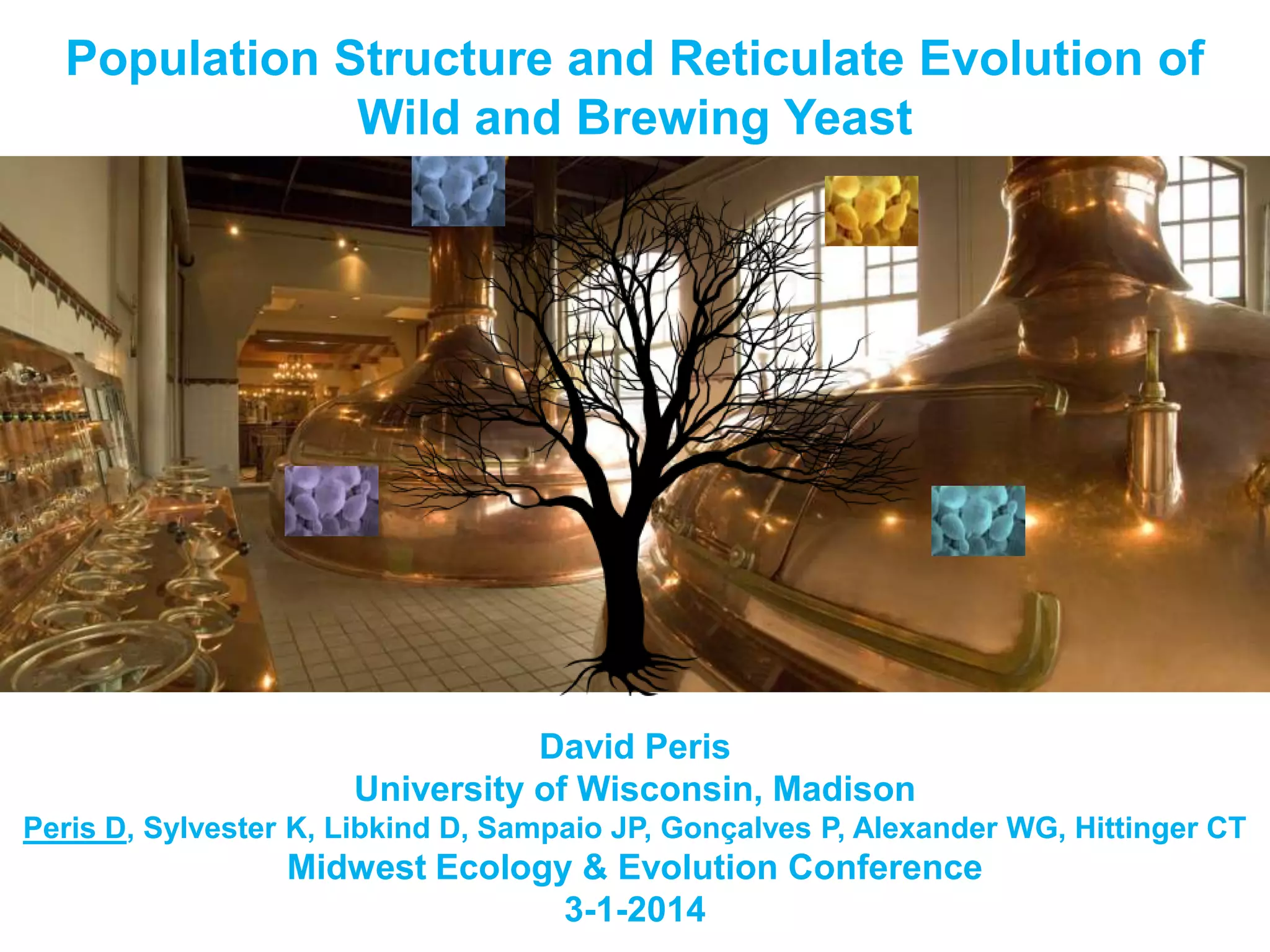

Population Structure and Reticulate Evolution of
Wild and Brewing Yeast
David Peris
University of Wisconsin, Madison
Peris D, Sylvester K, Libkind D, Sampaio JP, Gonçalves P, Alexander WG, Hittinger CT
Midwest Ecology & Evolution Conference
3-1-2014
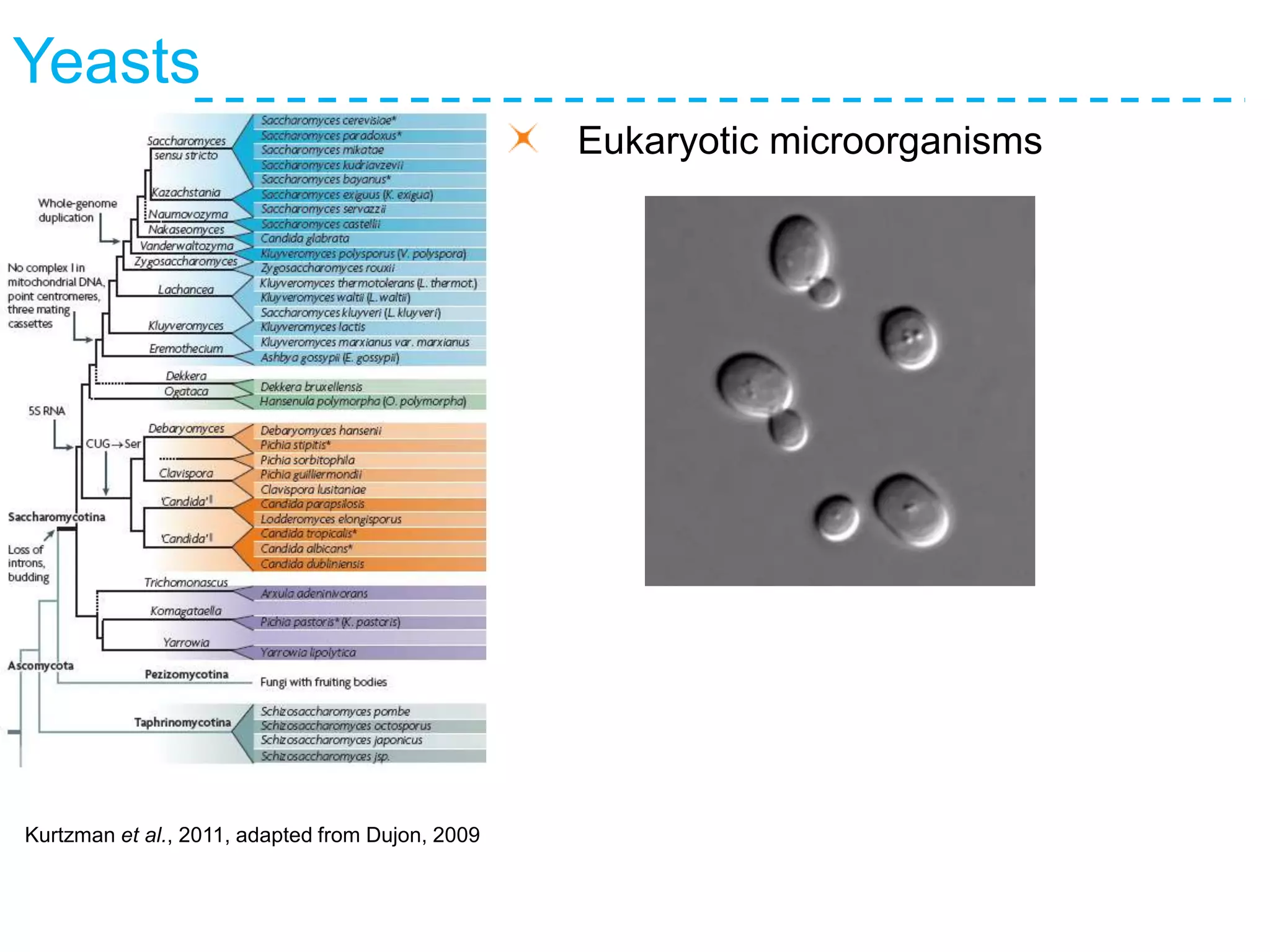
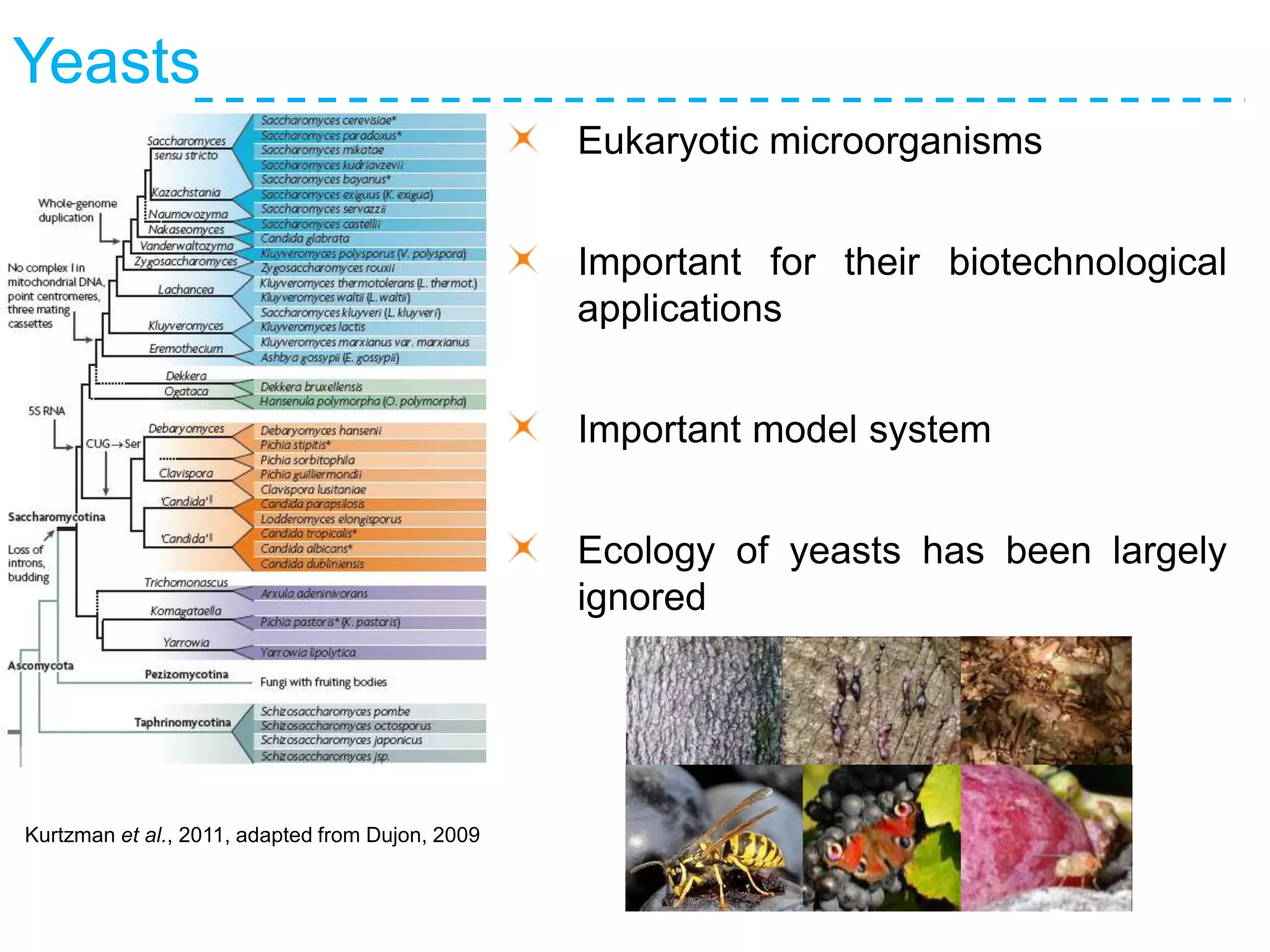
Yeasts
Eukaryotic microorganisms
Kurtzman et al., 2011, adapted from Dujon, 2009
Yeasts
Eukaryotic microorganisms
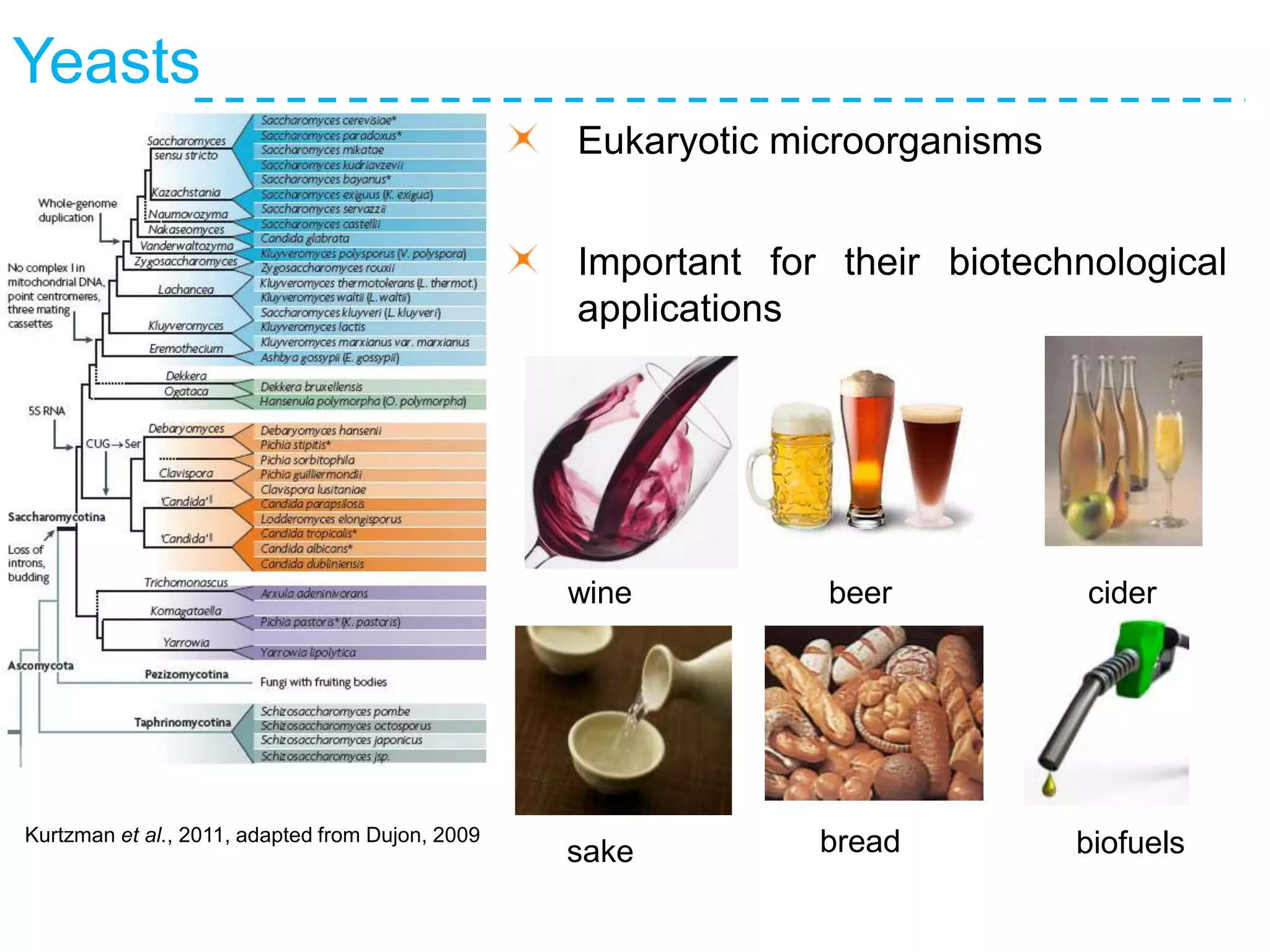
Important for their biotechnological
applications
Kurtzman et al., 2011, adapted from Dujon, 2009
wine beer
sake bread
cider
biofuels
Yeasts
Eukaryotic microorganisms
Important for their biotechnological
applications
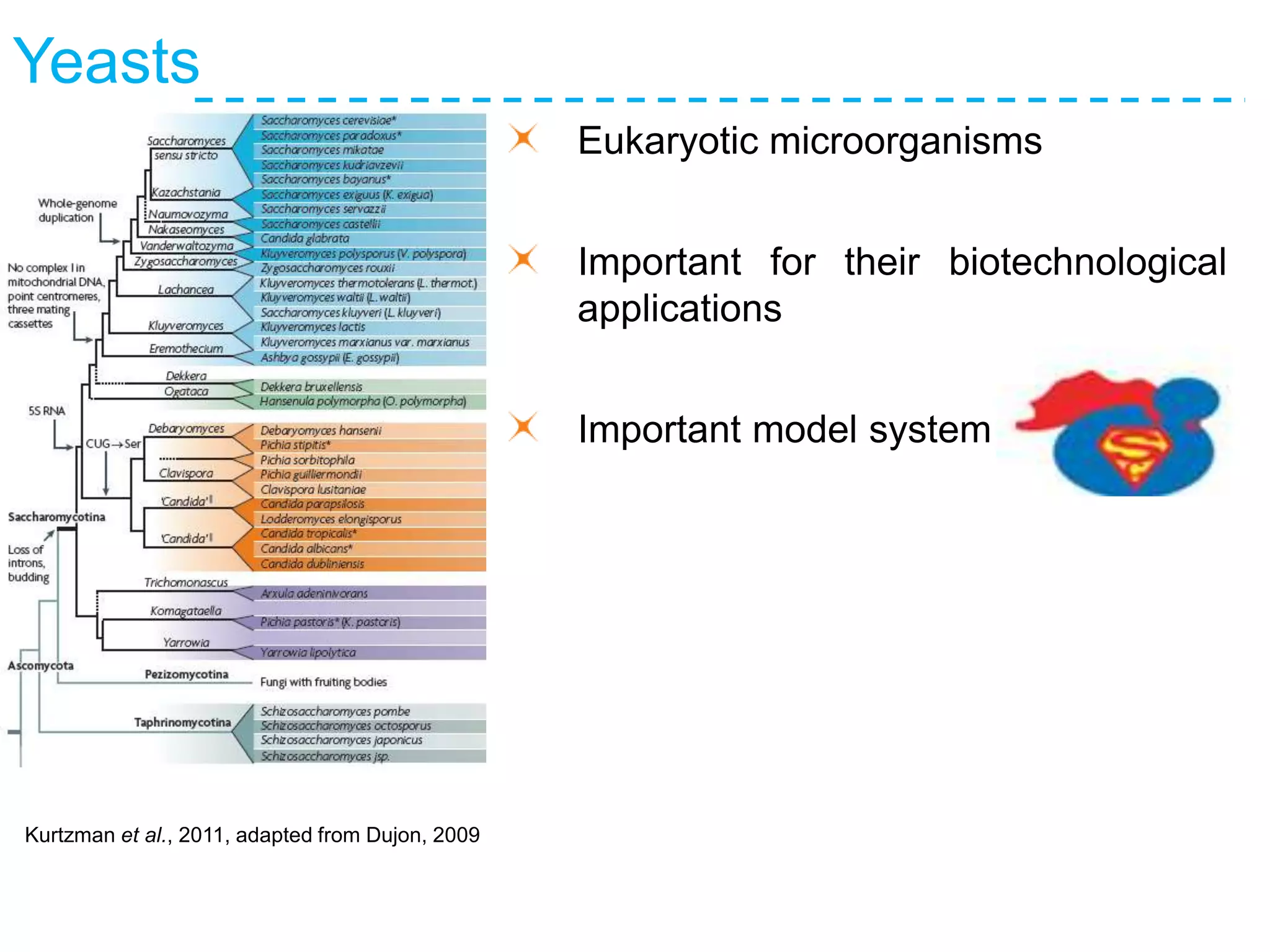
Important model system
Kurtzman et al., 2011, adapted from Dujon, 2009
Yeasts
Eukaryotic microorganisms
Important for their biotechnological
applications
Important model system
Ecology of yeasts has been largely
ignored
Kurtzman et al., 2011, adapted from Dujon, 2009
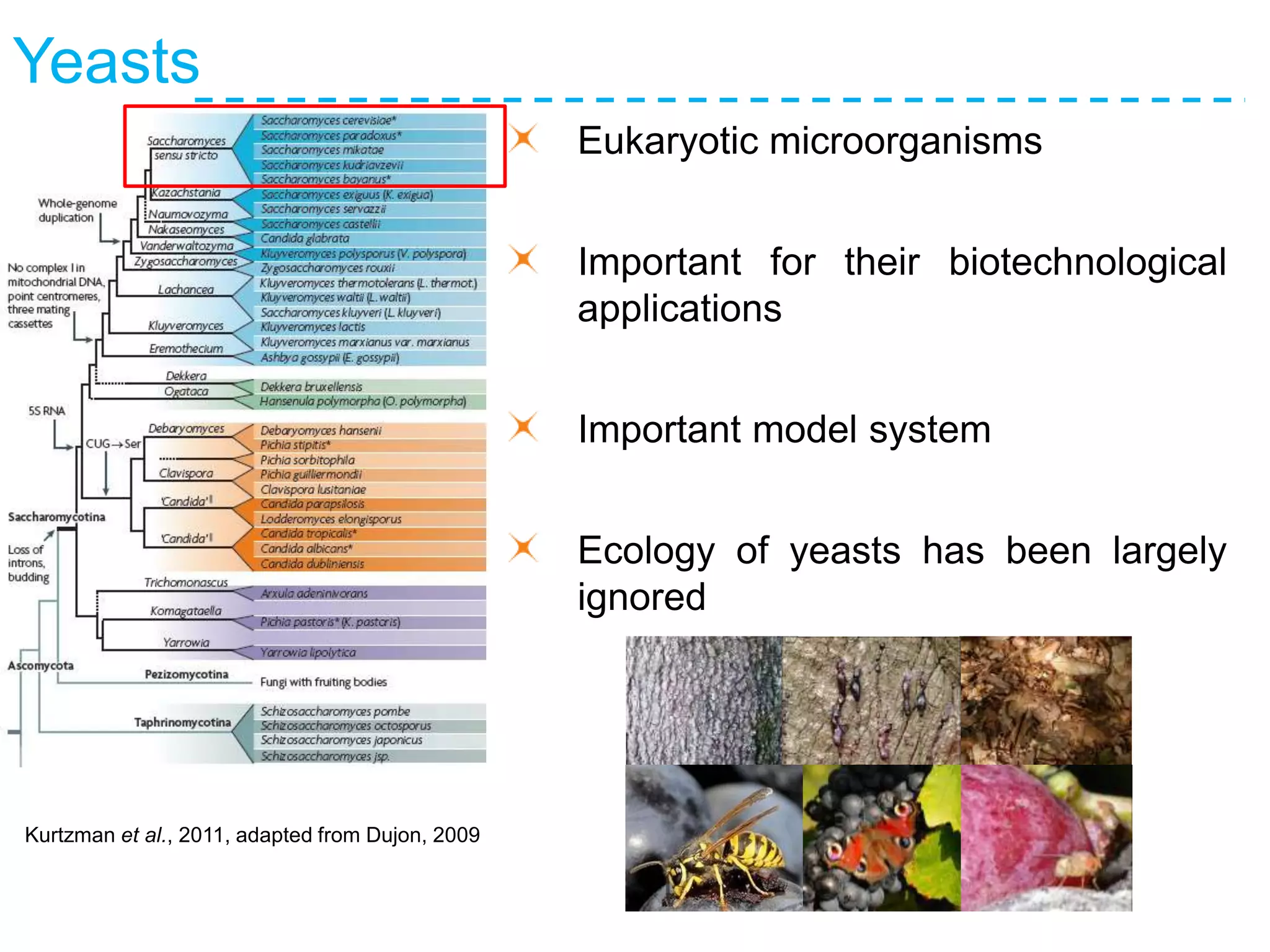
Yeasts
Eukaryotic microorganisms
Important for their biotechnological
applications
Important model system
Ecology of yeasts has been largely
ignored
Kurtzman et al., 2011, adapted from Dujon, 2009
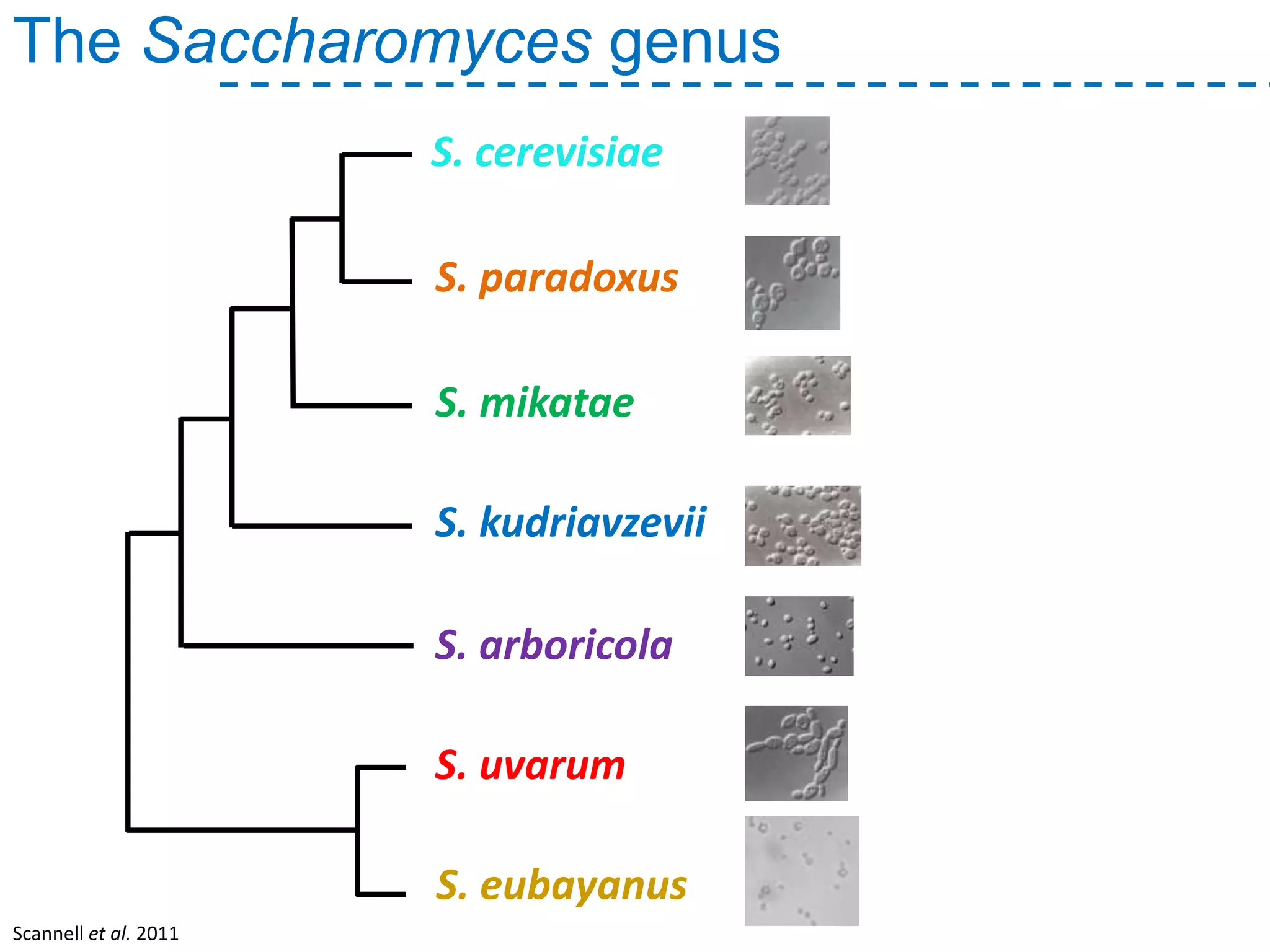
The Saccharomyces genus
S. paradoxus
S. mikatae
S. arboricola
S. kudriavzevii
S. uvarum
S. cerevisiae
S. eubayanus
Scannell et al. 2011
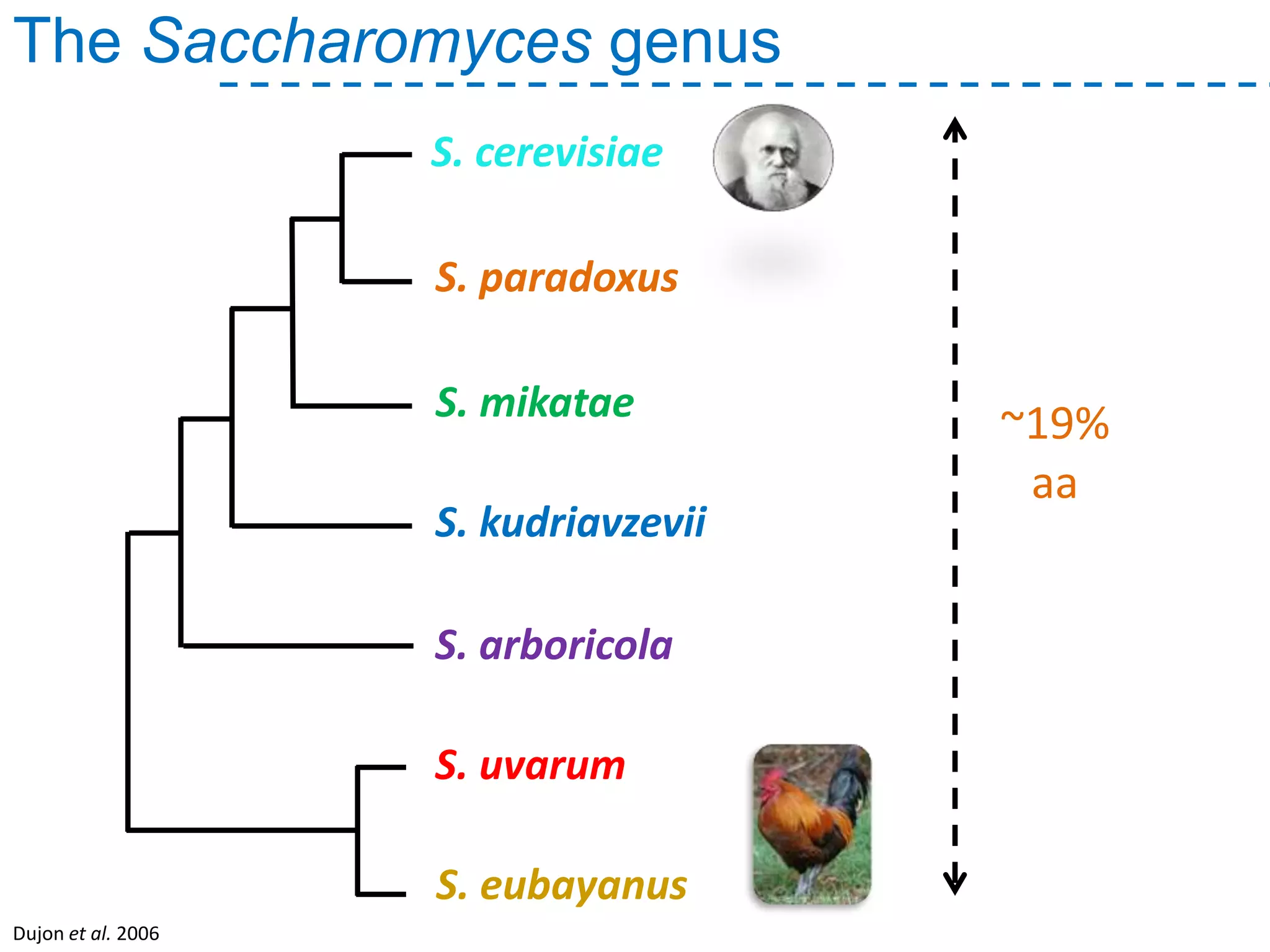
The Saccharomyces genus
Dujon et al. 2006
~19%
aa
S. paradoxus
S. mikatae
S. arboricola
S. kudriavzevii
S. uvarum
S. cerevisiae
S. eubayanus
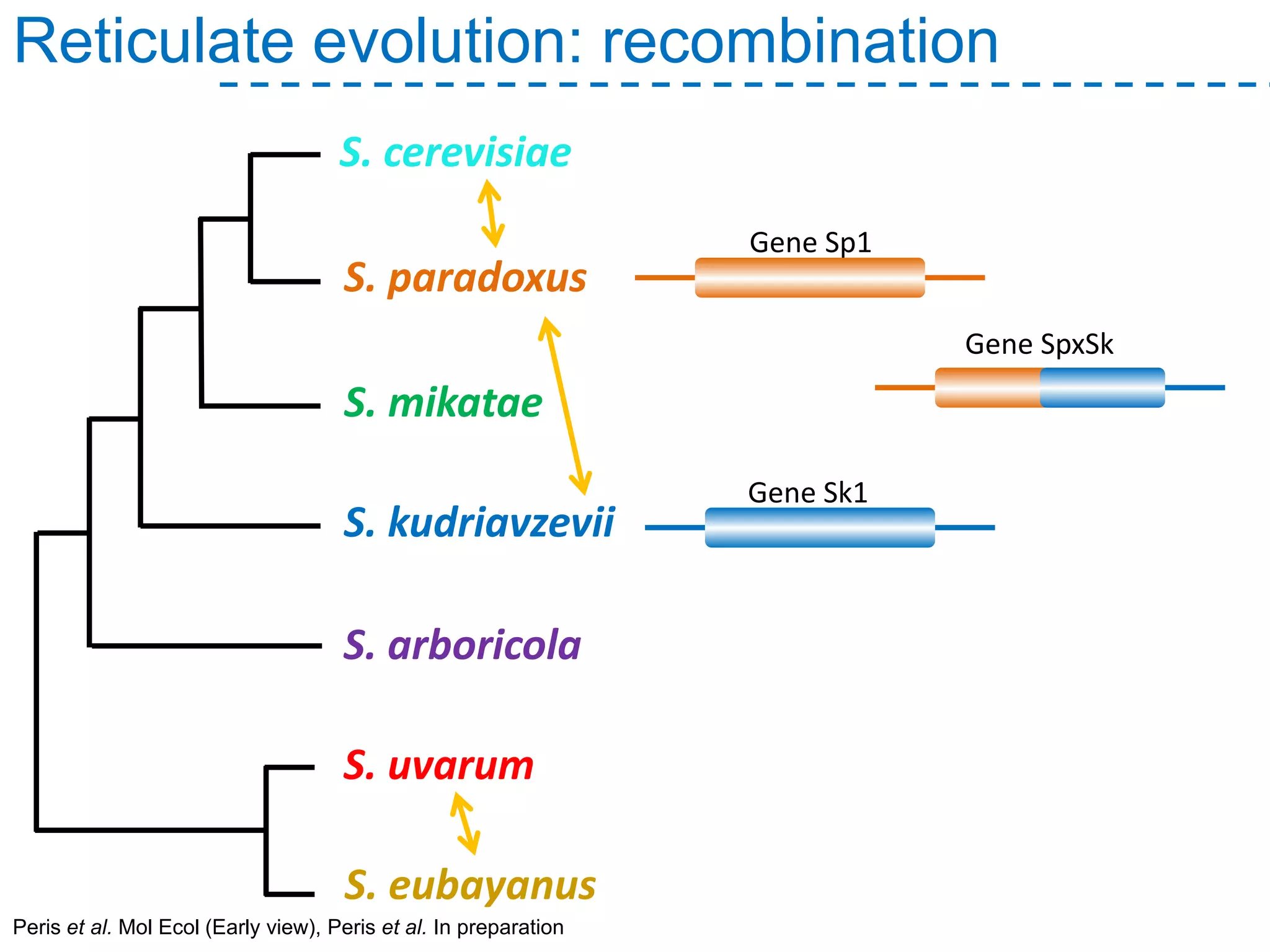
Peris et al. Mol Ecol (Early view), Peris et al. In preparation
Reticulate evolution: recombination
S. paradoxus
S. mikatae
S. arboricola
S. kudriavzevii
S. uvarum
S. cerevisiae
S. eubayanus
Gene Sp1
Gene Sk1
Gene SpxSk
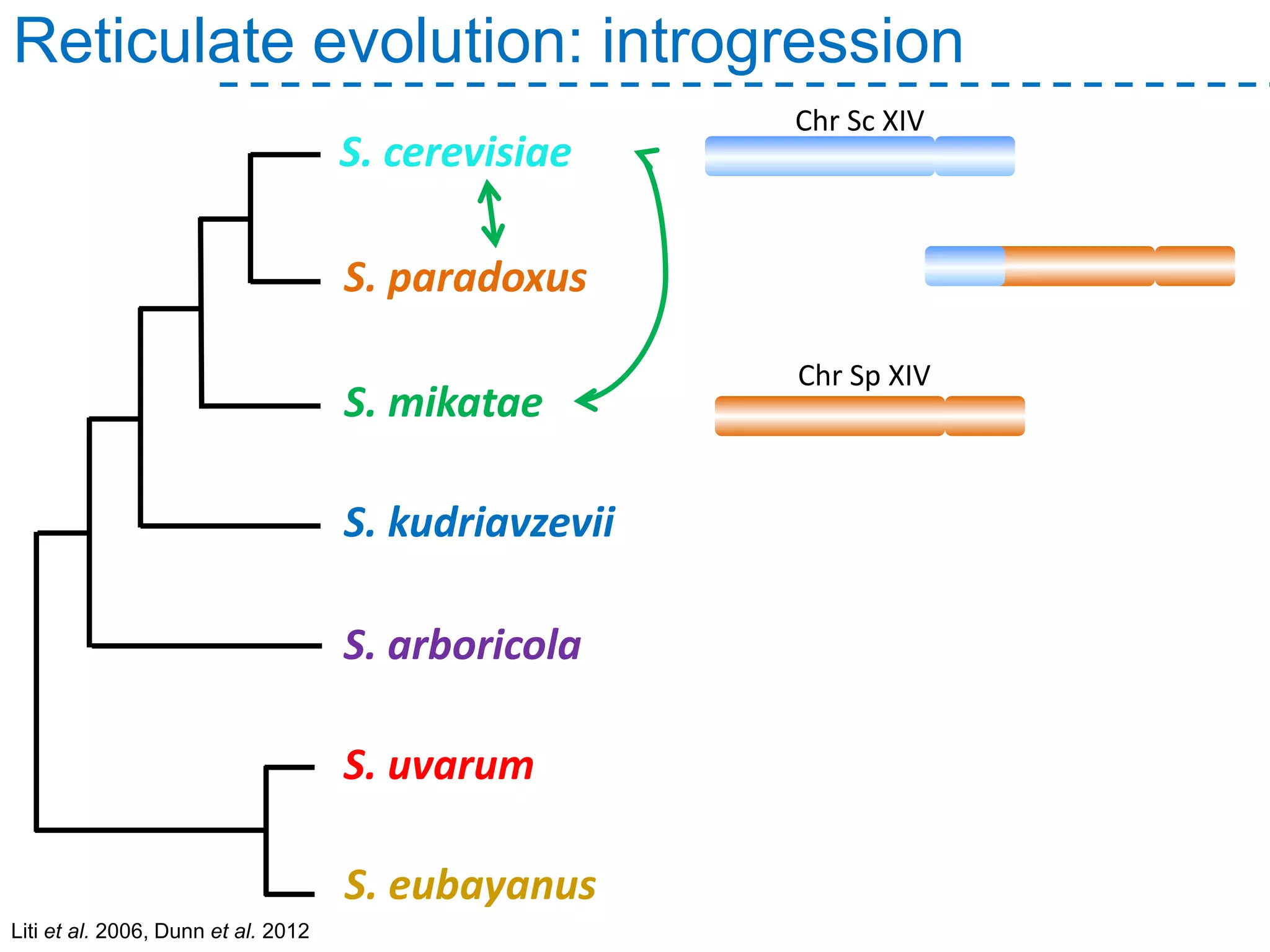
Liti et al. 2006, Dunn et al. 2012
Reticulate evolution: introgression
S. paradoxus
S. mikatae
S. arboricola
S. kudriavzevii
S. uvarum
S. cerevisiae
S. eubayanus
Chr Sc XIV
Chr Sp XIV
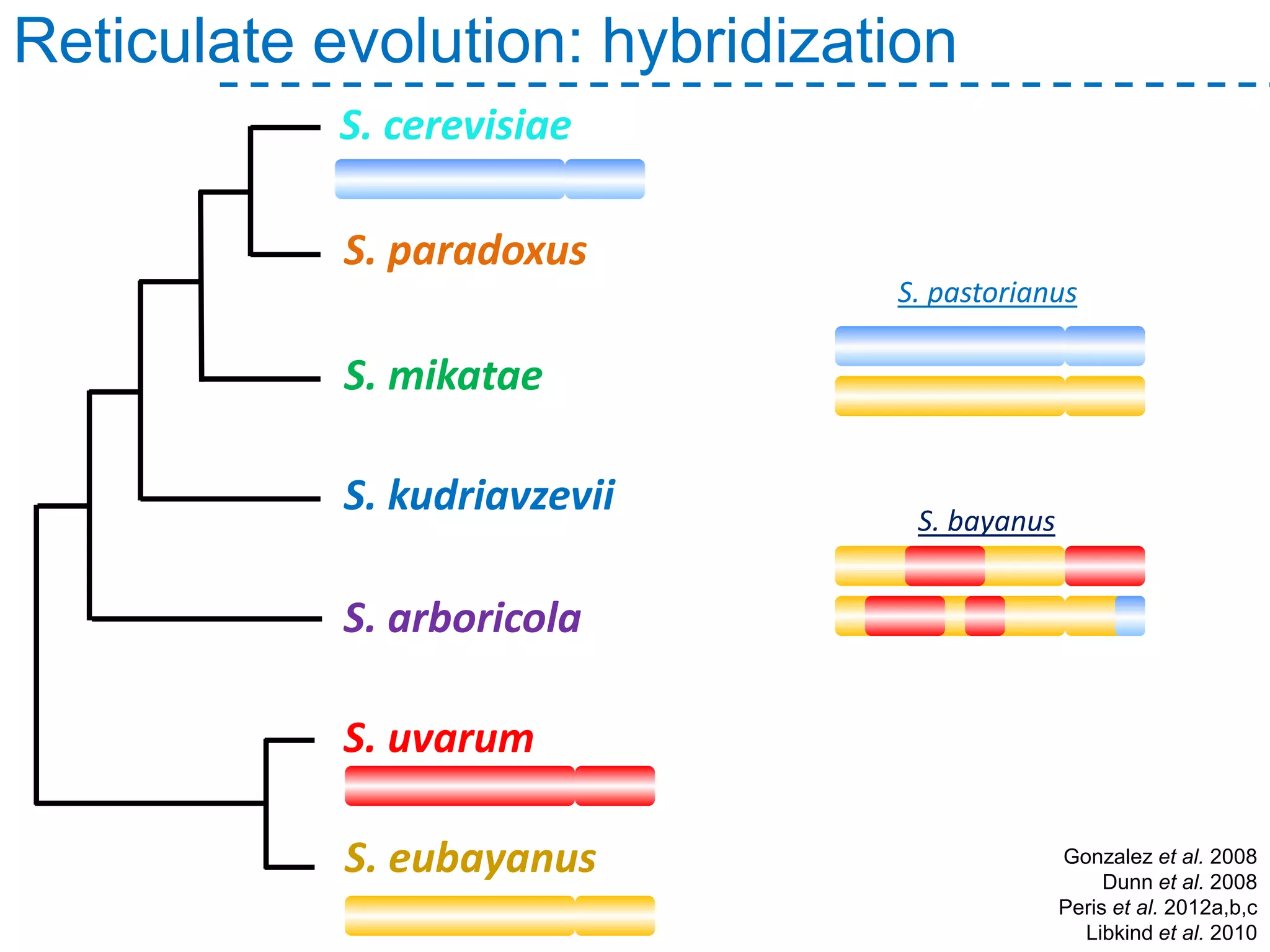
Gonzalez et al. 2008
Dunn et al. 2008
Peris et al. 2012a,b,c
Libkind et al. 2010
Reticulate evolution: hybridization
S. pastorianus
S. paradoxus
S. mikatae
S. arboricola
S. kudriavzevii
S. uvarum
S. cerevisiae
S. eubayanus
S. bayanus
How diverse is Saccharomyces eubayanus and its hybrids?
Major questions to be addressed
How diverse is Saccharomyces eubayanus and its hybrids?
Which ecological factors drive population/species
differentiation?
Major questions to be addressed
How diverse is Saccharomyces eubayanus and its hybrids?
Which ecological factors drive population/species
differentiation?
What is the role of reticulate evolution in the adaptation to
new natural/artificial environments?
Major questions to be addressed
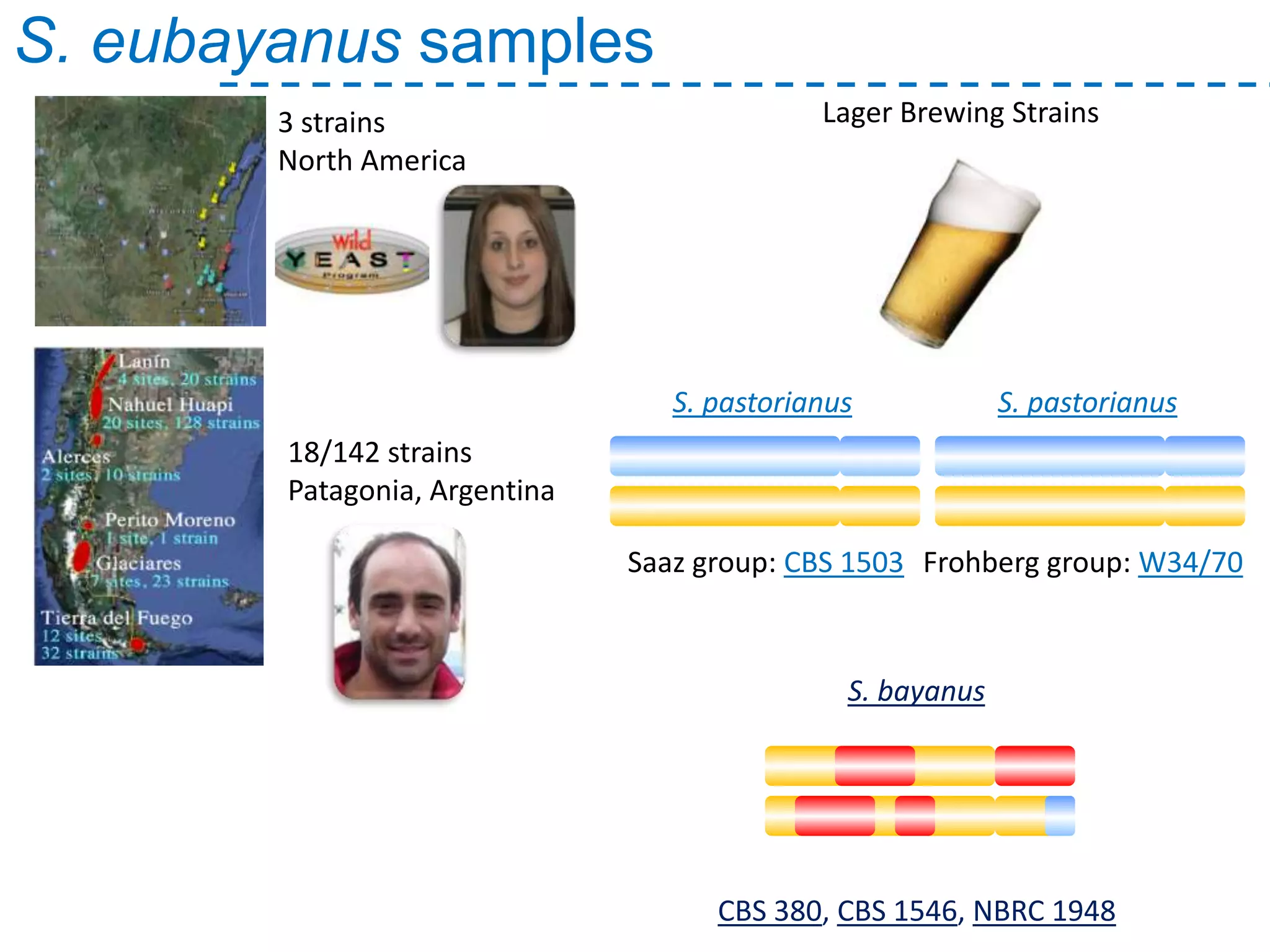
S. eubayanus samples
18/142 strains
Patagonia, Argentina
3 strains
North America
S. pastorianus
S. bayanus
S. pastorianus
CBS 380, CBS 1546, NBRC 1948
Saaz group: CBS 1503 Frohberg group: W34/70
Lager Brewing Strains
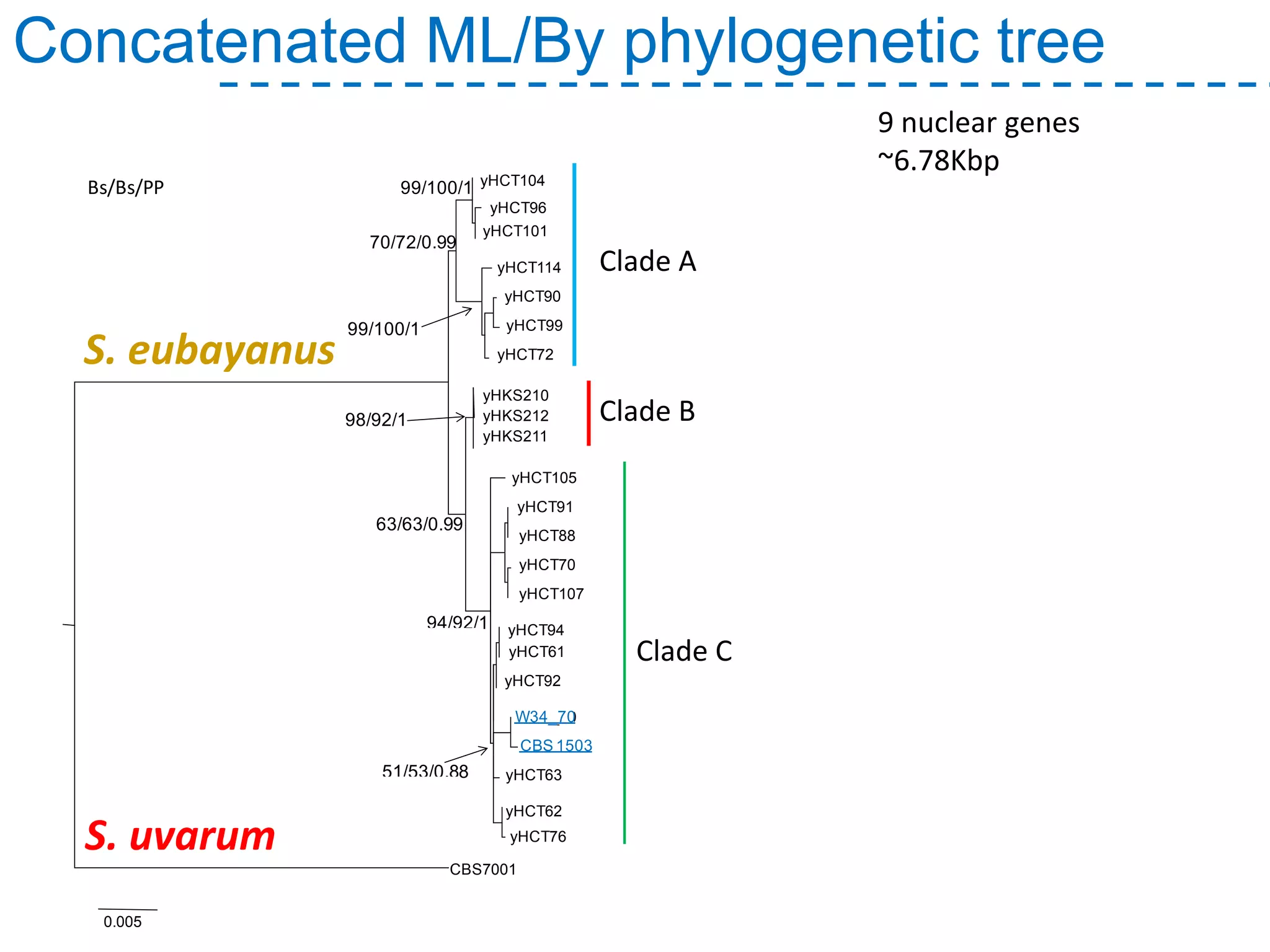
Concatenated ML/By phylogenetic tree
Bs/Bs/PP
0.8%
70/72/0.99
99/100/1
99/100/1
98/92/1
63/63/0.99
94/92/1
51/53/0.88
yHCT104
yHCT96
yHCT101
yHCT114
yHCT90
yHCT99
yHCT72
0.005
yHKS210
yHKS212
yHKS211
yHCT105
yHCT91
yHCT88
yHCT70
yHCT107
yHCT94
yHCT61
yHCT92
W34_70
CBS 1503
yHCT63
yHCT62
yHCT76
CBS7001
PATAGONIA
PATAGONIA-LAGERNORTH
AMERICA
0.410
(0.25-0.625)
0.36
(0.25-0.5)
0.31
(0.25-0.5)
0.379
(0.25-0.625)
0.364
(0.25-0.5)
0.149
(0-0.375)
0.63
(0.5-0.75)
W34_70
CBS 1503
Clade A
Clade B
Clade C
S. uvarum
S. eubayanus
9 nuclear genes
~6.78Kbp
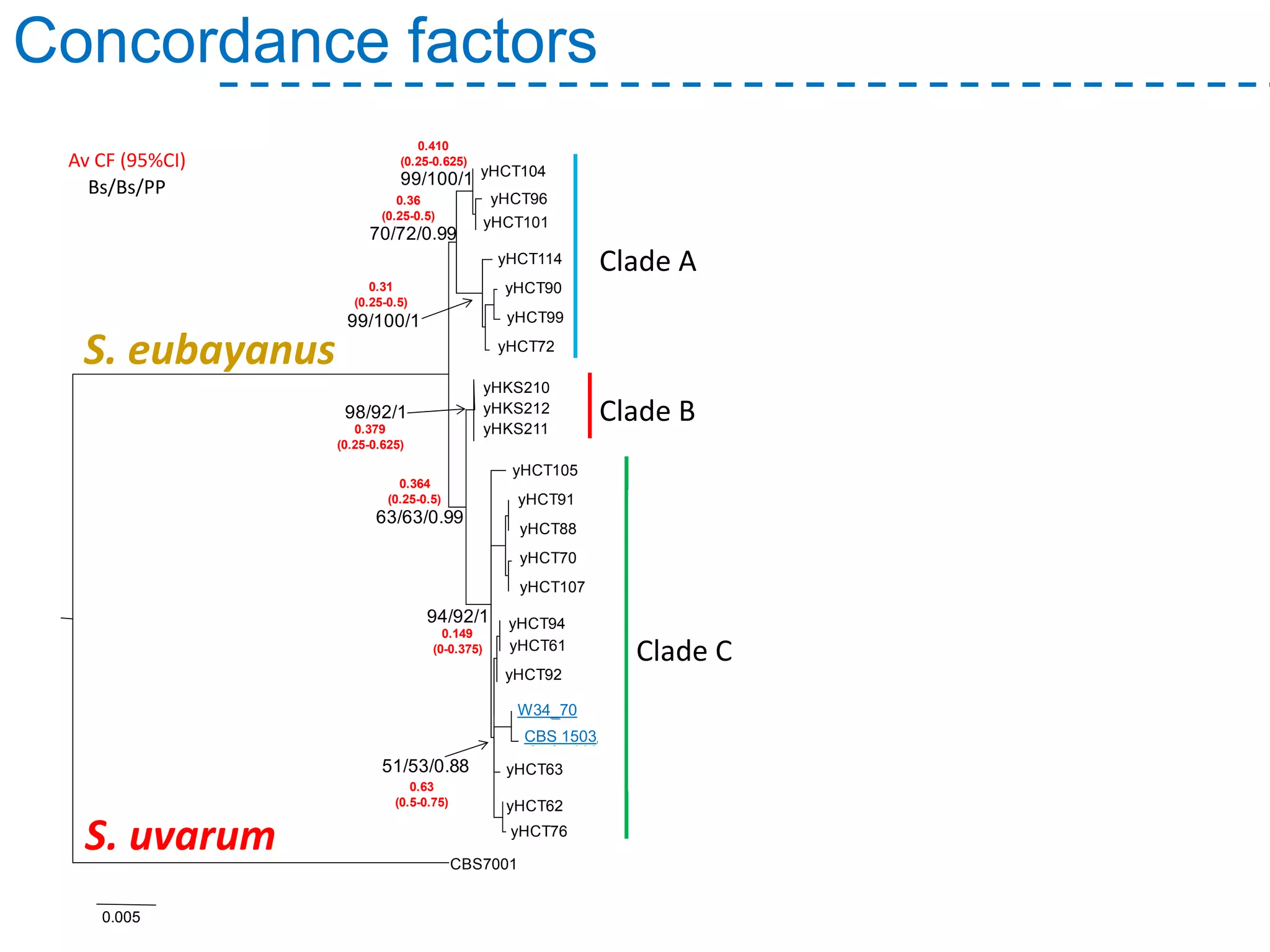
Concordance factors
S. uvarum
S. eubayanus
70/72/0.99
99/100/1
99/100/1
98/92/1
63/63/0.99
94/92/1
51/53/0.88
yHCT104
yHCT96
yHCT101
yHCT114
yHCT90
yHCT99
yHCT72
0.005
yHKS210
yHKS212
yHKS211
yHCT105
yHCT91
yHCT88
yHCT70
yHCT107
yHCT94
yHCT61
yHCT92
W34_70
CBS 1503
yHCT63
yHCT62
yHCT76
CBS7001
PATAGONIA
PATAGONIA-LAGERNORTH
AMERICA
0.410
(0.25-0.625)
0.36
(0.25-0.5)
0.31
(0.25-0.5)
0.379
(0.25-0.625)
0.364
(0.25-0.5)
0.149
(0-0.375)
0.63
(0.5-0.75)
Bs/Bs/PP
Av CF (95%CI)
Clade A
Clade B
Clade C
W34_70
CBS 1503
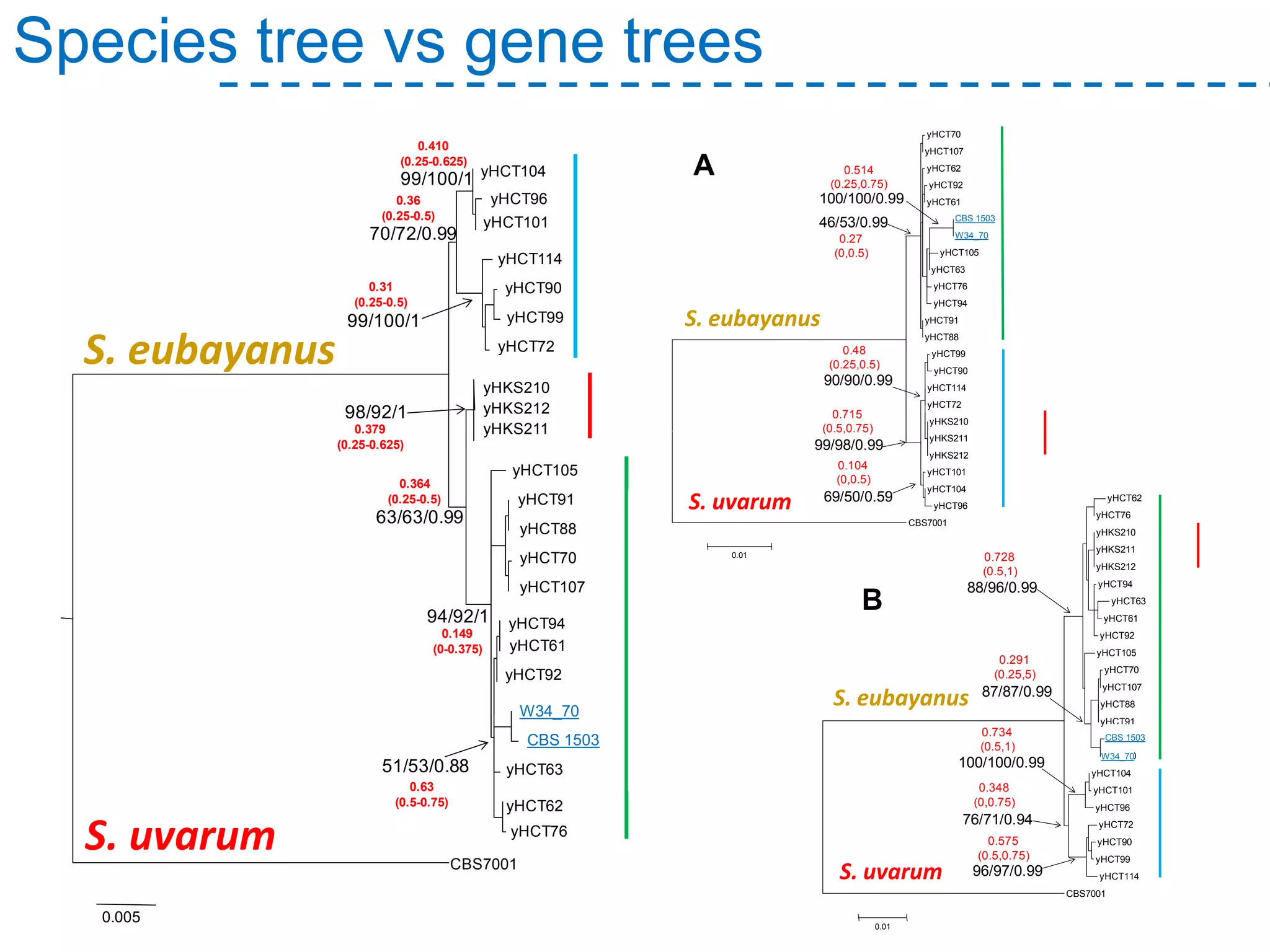
Species tree vs gene trees
S. uvarum
S. eubayanus
70/72/0.99
99/100/1
99/100/1
98/92/1
63/63/0.99
94/92/1
51/53/0.88
yHCT104
yHCT96
yHCT101
yHCT114
yHCT90
yHCT99
yHCT72
0.005
yHKS210
yHKS212
yHKS211
yHCT105
yHCT91
yHCT88
yHCT70
yHCT107
yHCT94
yHCT61
yHCT92
W34_70
CBS 1503
yHCT63
yHCT62
yHCT76
CBS7001
PATAGONIA
PATAGONIA-LAGERNORTH
AMERICA
0.410
(0.25-0.625)
0.36
(0.25-0.5)
0.31
(0.25-0.5)
0.379
(0.25-0.625)
0.364
(0.25-0.5)
0.149
(0-0.375)
0.63
(0.5-0.75)
PATAGONIA
NORTH
AMERICA
PATAGONIA-LAGER
88/96/0.99
0.728
(0.5,1)
87/87/0.99
100/100/0.99
76/71/0.94
96/97/0.99
0.291
(0.25,5)
0.734
(0.5,1)
0.348
(0,0.75)
0.575
(0.5,0.75)
yHCT62
yHCT76
yHKS210
yHKS211
yHKS212
yHCT94
yHCT63
yHCT61
yHCT92
yHCT105
yHCT70
yHCT107
yHCT88
yHCT91
CBS 1503
W34_70
yHCT104
yHCT101
yHCT96
yHCT72
yHCT90
yHCT99
yHCT114
CBS7001
0.01
PATAGONIA
NORTH
AMERICA
PATAGONIA-LAGER
46/53/0.99
100/100/0.99
90/90/0.99
99/98/0.99
69/50/0.59
0.514
(0.25,0.75)
0.27
(0,0.5)
0.48
(0.25,0.5)
0.715
(0.5,0.75)
0.104
(0,0.5)
yHCT70
yHCT107
yHCT62
yHCT92
yHCT61
CBS 1503
W34_70
yHCT105
yHCT63
yHCT76
yHCT94
yHCT91
yHCT88
yHCT99
yHCT90
yHCT114
yHCT72
yHKS210
yHKS211
yHKS212
yHCT101
yHCT104
yHCT96
CBS7001
0.01
A
B
S. uvarum
S. eubayanus
S. uvarum
S. eubayanus
CBS 1503
W34_70
CBS 1503
W34_70
W34_70
CBS 1503
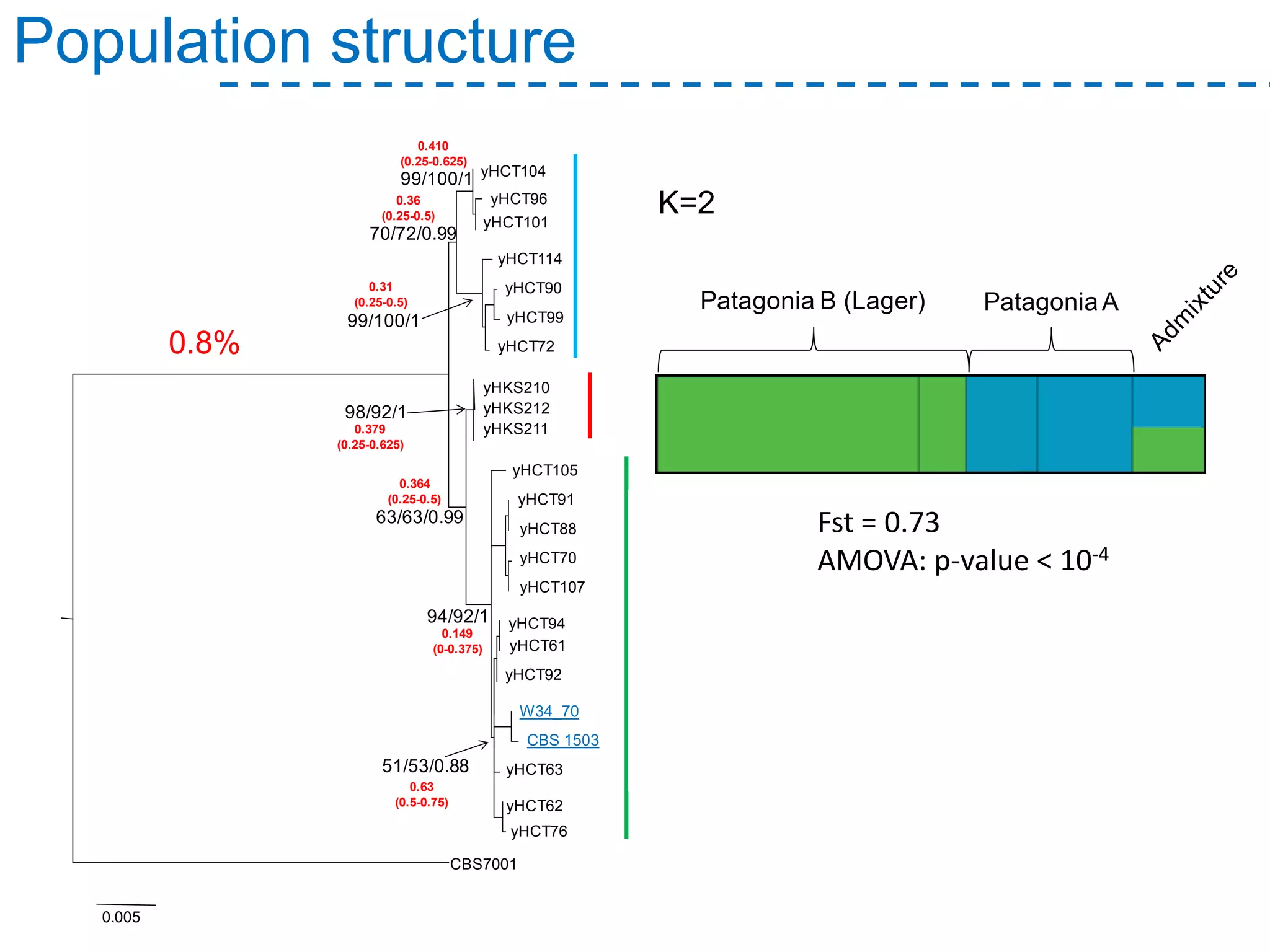
Population structure
Fst = 0.73
AMOVA: p-value < 10-4
0.8%
70/72/0.99
99/100/1
99/100/1
98/92/1
63/63/0.99
94/92/1
51/53/0.88
yHCT104
yHCT96
yHCT101
yHCT114
yHCT90
yHCT99
yHCT72
0.005
yHKS210
yHKS212
yHKS211
yHCT105
yHCT91
yHCT88
yHCT70
yHCT107
yHCT94
yHCT61
yHCT92
W34_70
CBS 1503
yHCT63
yHCT62
yHCT76
CBS7001
PATAGONIA
PATAGONIA-LAGERNORTH
AMERICA
0.410
(0.25-0.625)
0.36
(0.25-0.5)
0.31
(0.25-0.5)
0.379
(0.25-0.625)
0.364
(0.25-0.5)
0.149
(0-0.375)
0.63
(0.5-0.75)
Patagonia B (Lager) Patagonia A
K=2
W34_70
CBS 1503
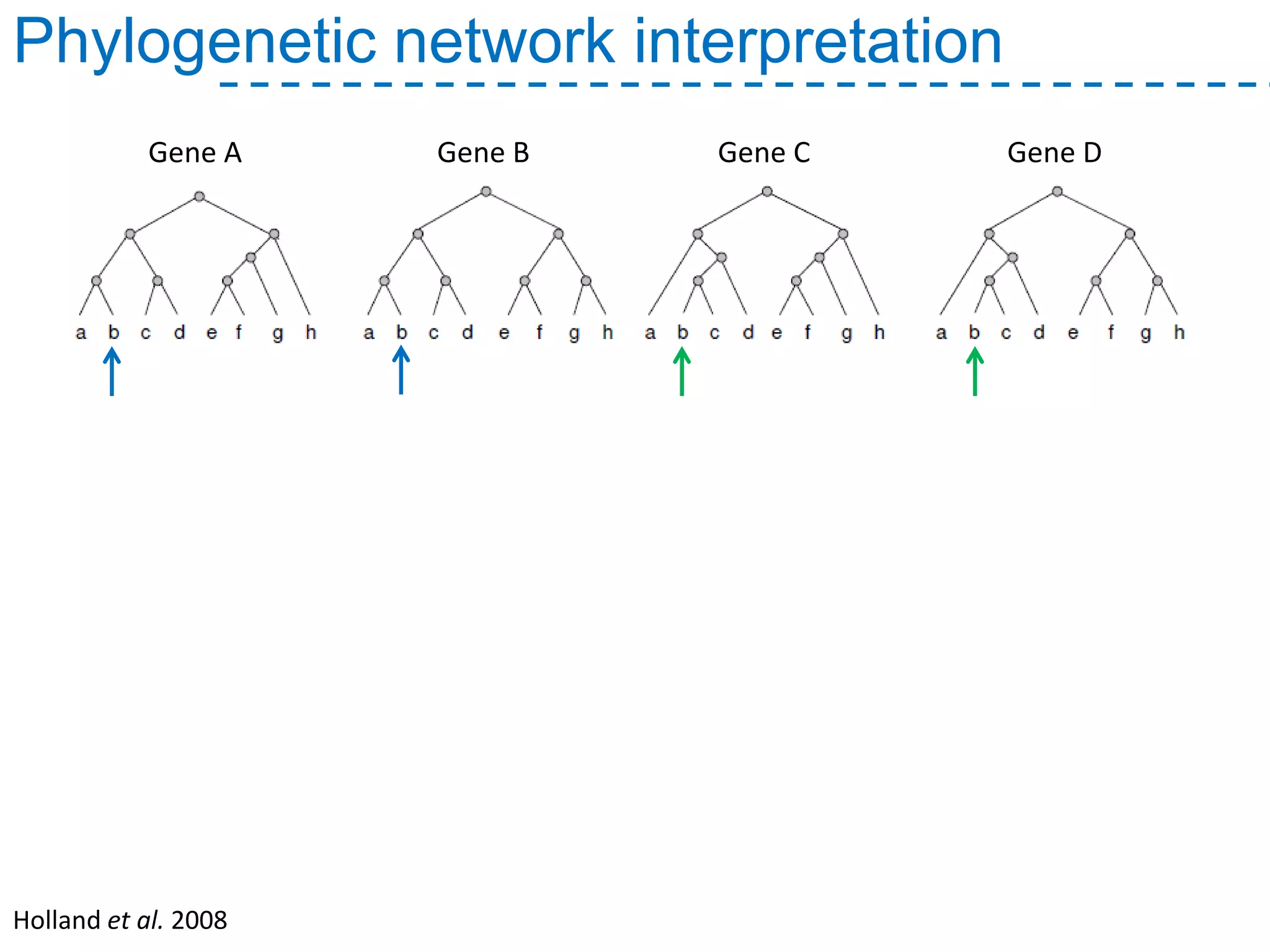
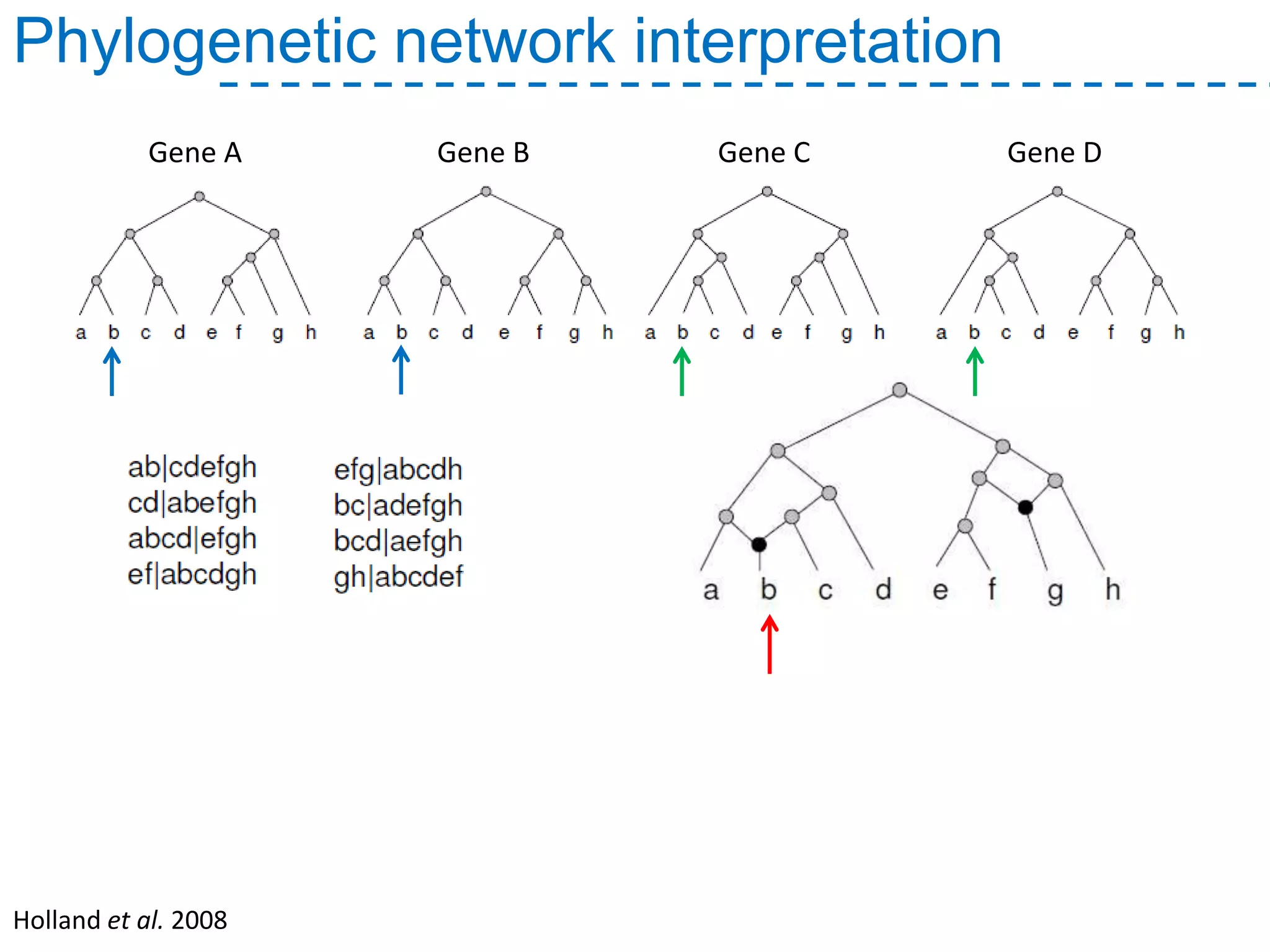
Phylogenetic network interpretation
Gene A Gene B Gene C Gene D
Holland et al. 2008
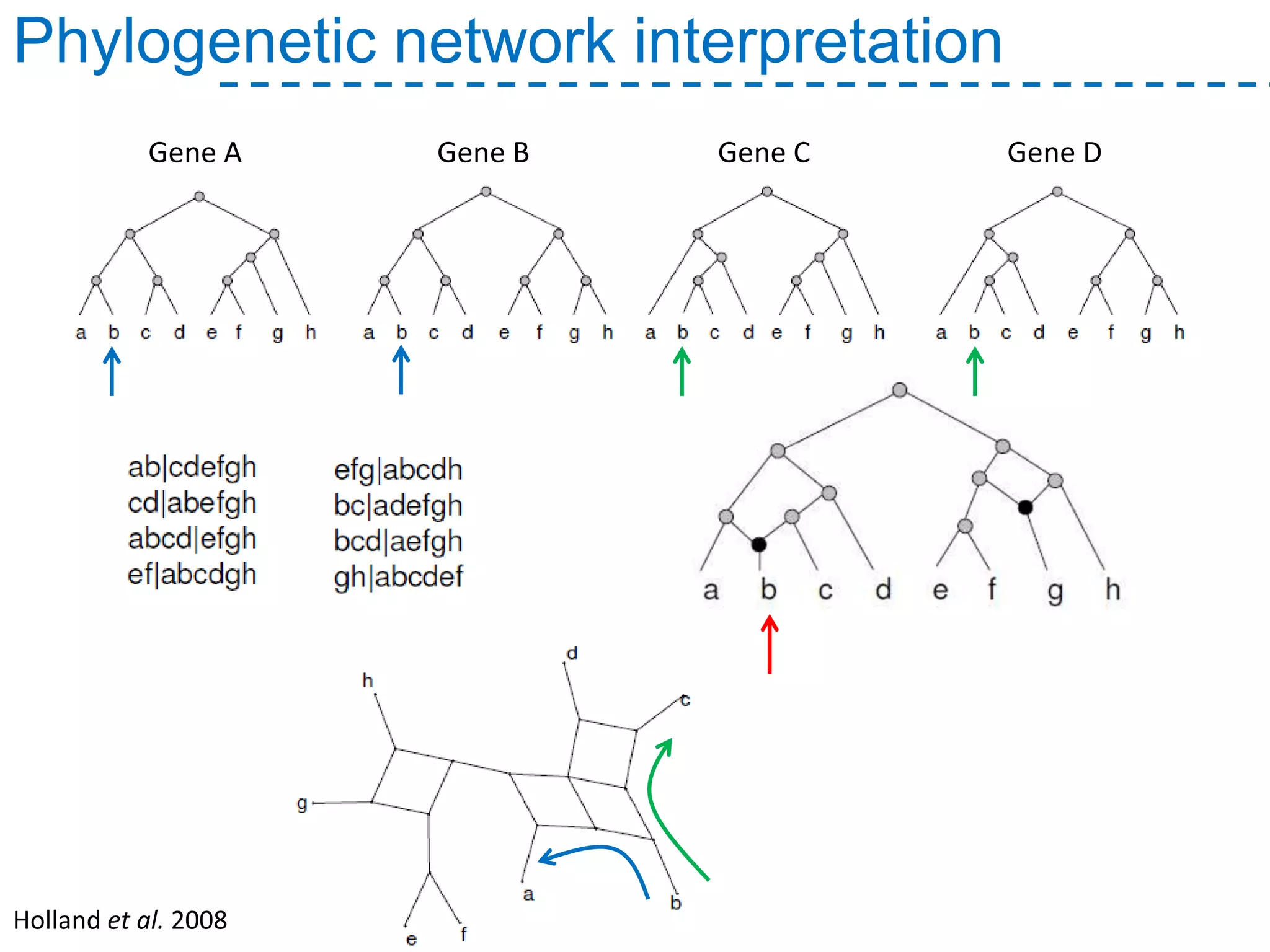
Phylogenetic network interpretation
Gene A Gene B Gene C Gene D
Holland et al. 2008
Phylogenetic network interpretation
Gene A Gene B Gene C Gene D
Holland et al. 2008
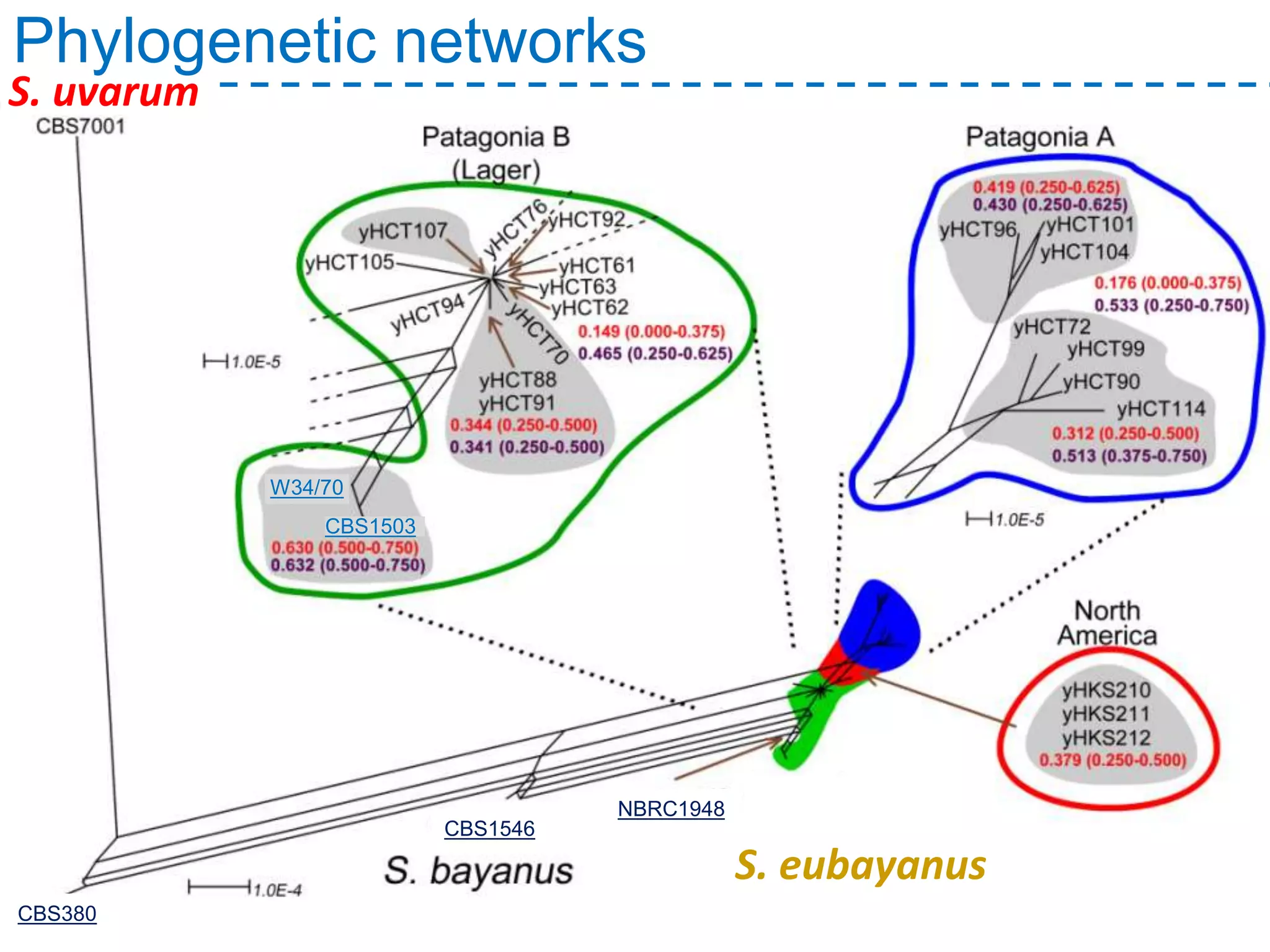
Phylogenetic networks
CBS380
CBS1546
NBRC1948
W34/70
CBS1503
S. eubayanus
S. uvarum
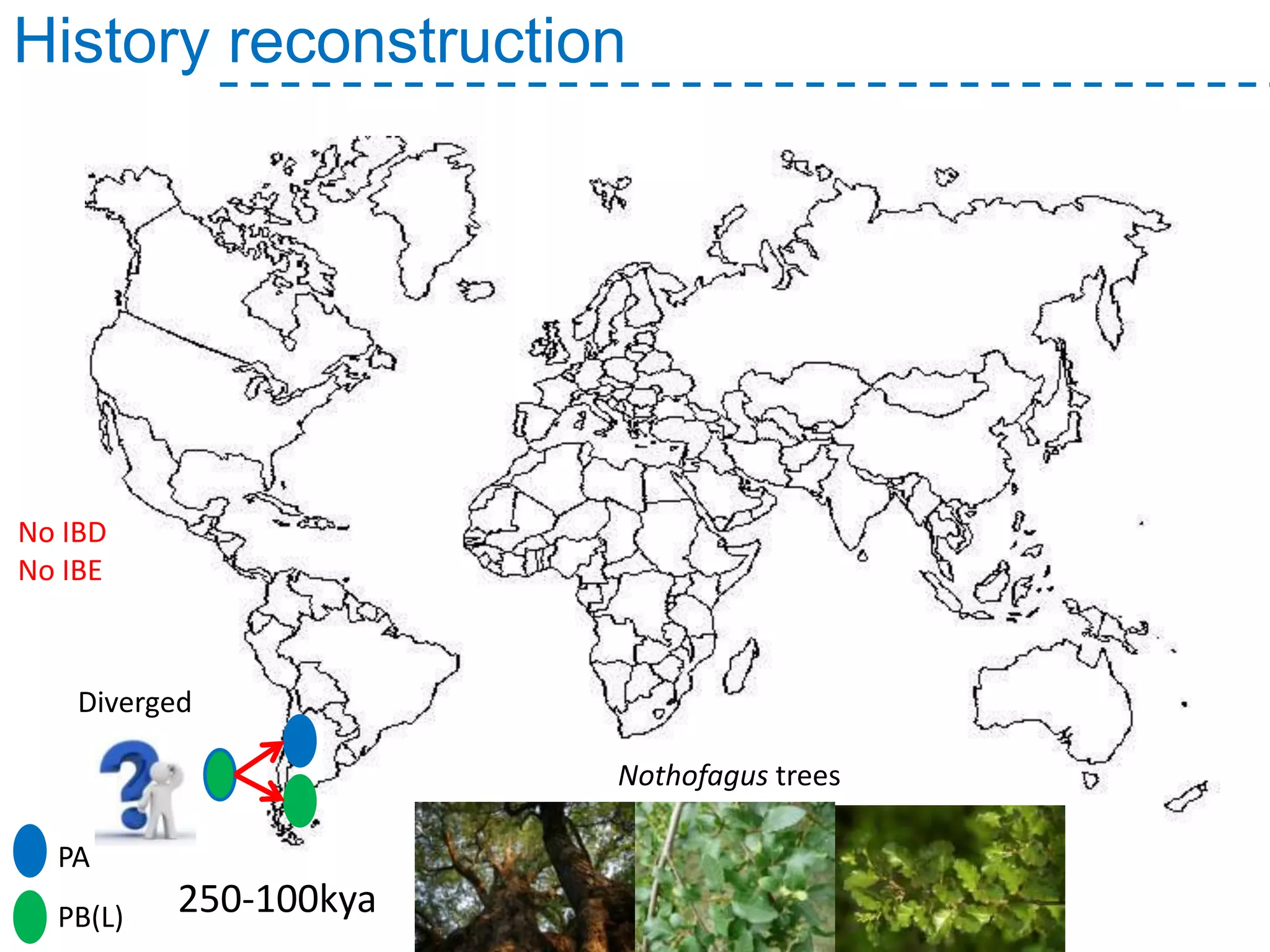
PA
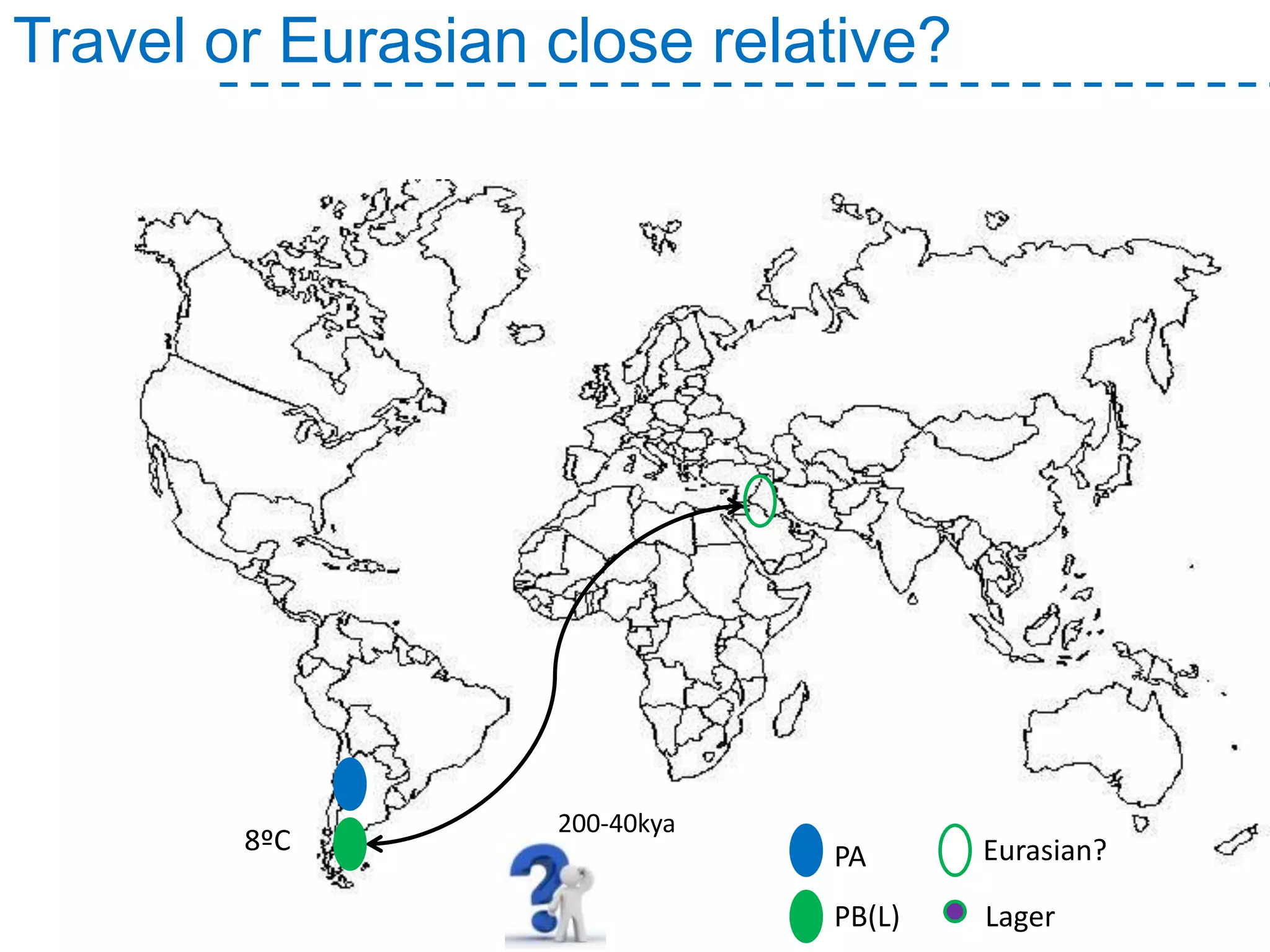
PB(L) 250-100kya
Diverged
History reconstruction
Nothofagus trees
No IBD
No IBE
Lager
Eurasian?
200-40kya
8ºC
Travel or Eurasian close relative?
PA
PB(L)
Lager
Eurasian?
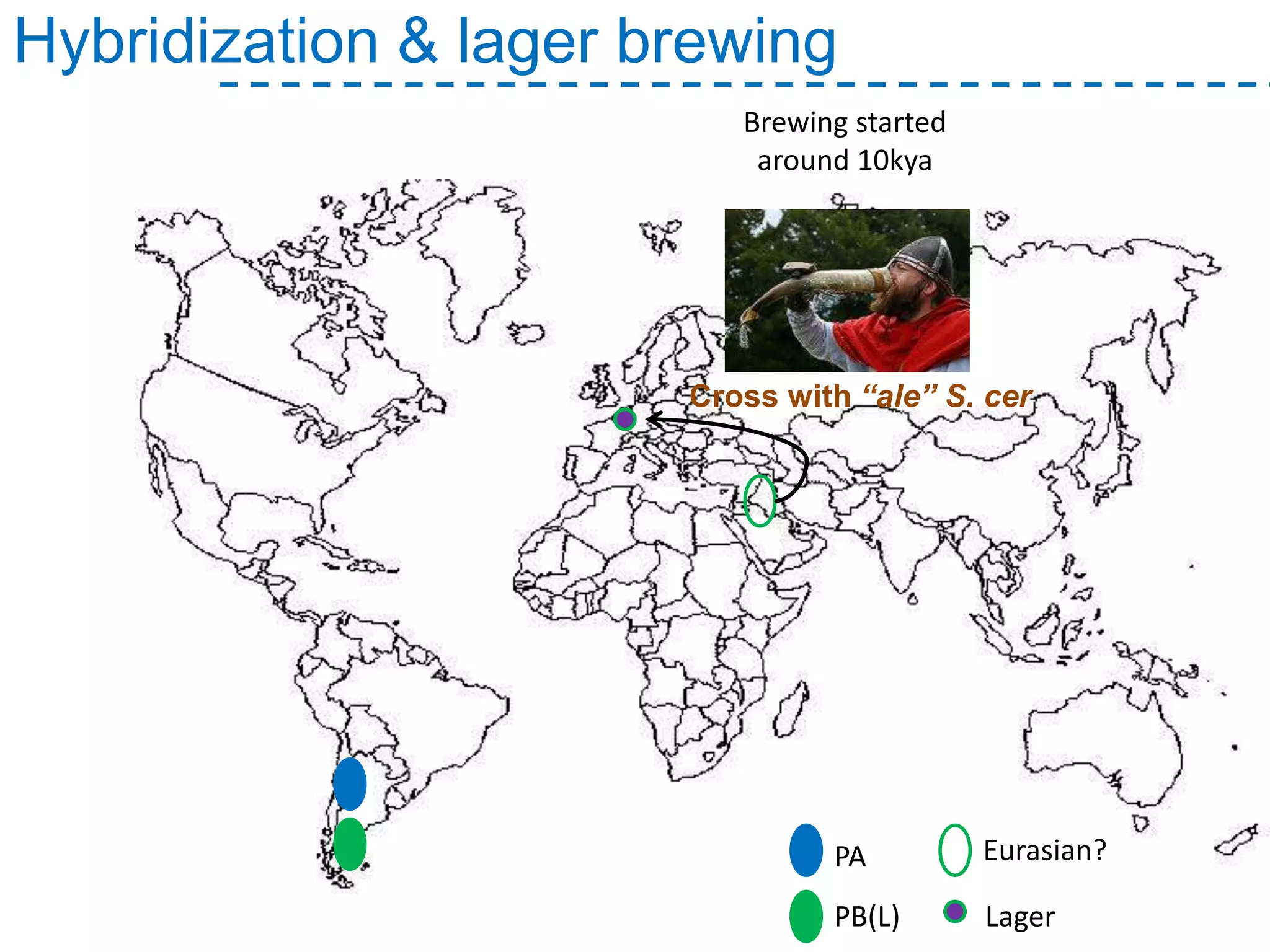
Brewing started
around 10kya
Hybridization & lager brewing
PA
PB(L)
Cross with “ale” S. cer
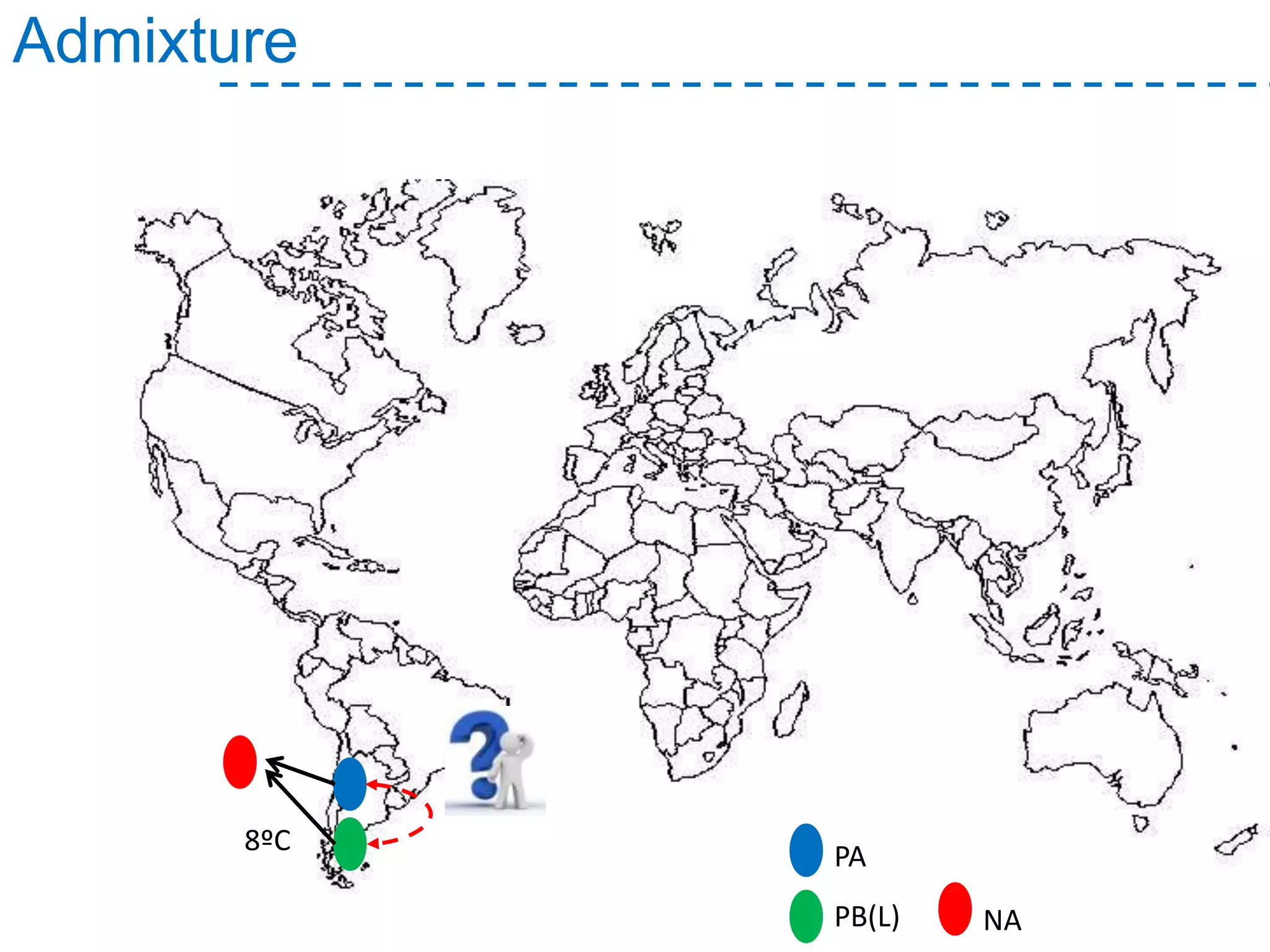
PA
PB(L) NA
8ºC
Admixture
8ºC
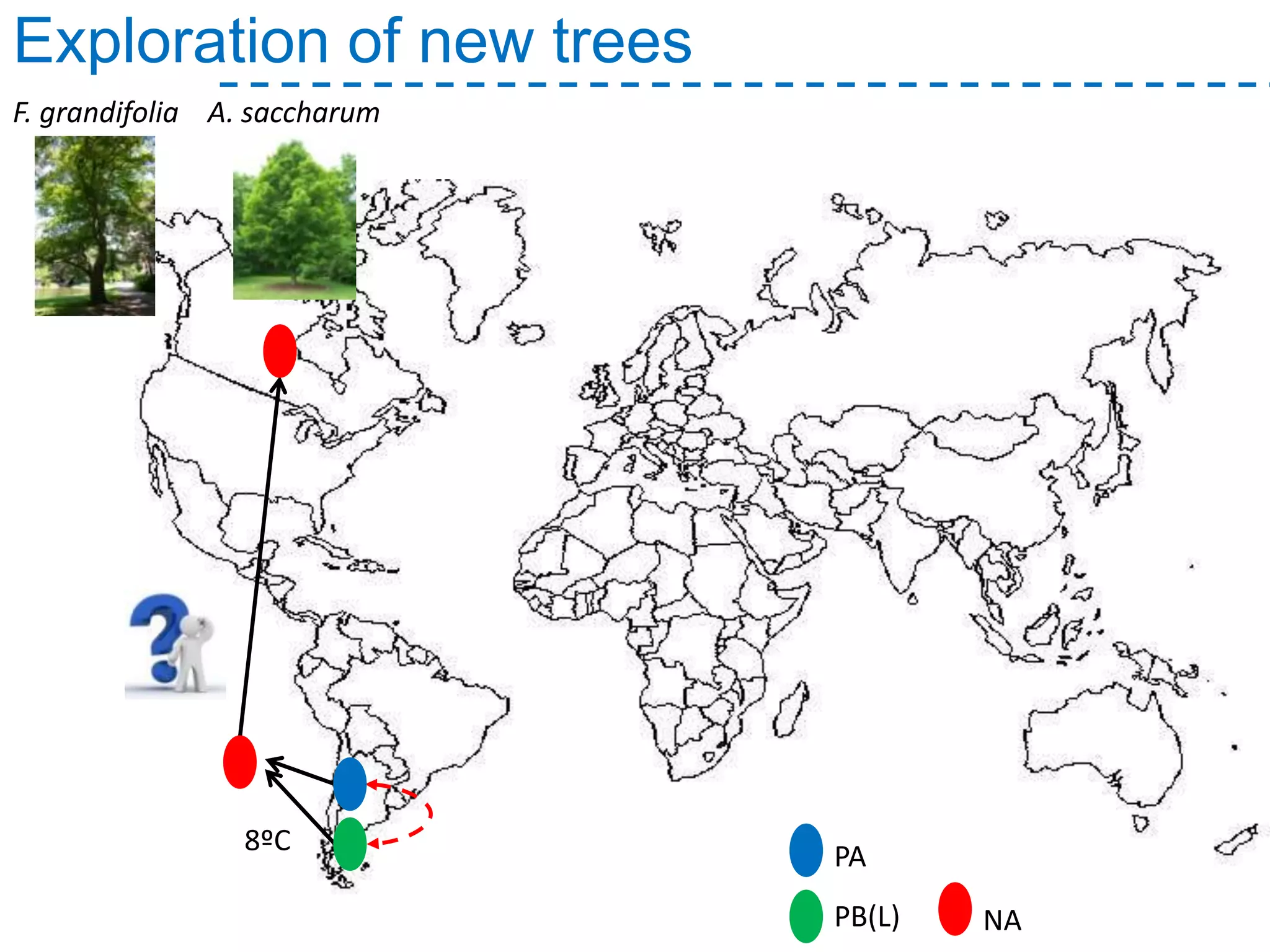
Exploration of new trees
A. saccharumF. grandifolia
PA
PB(L) NA
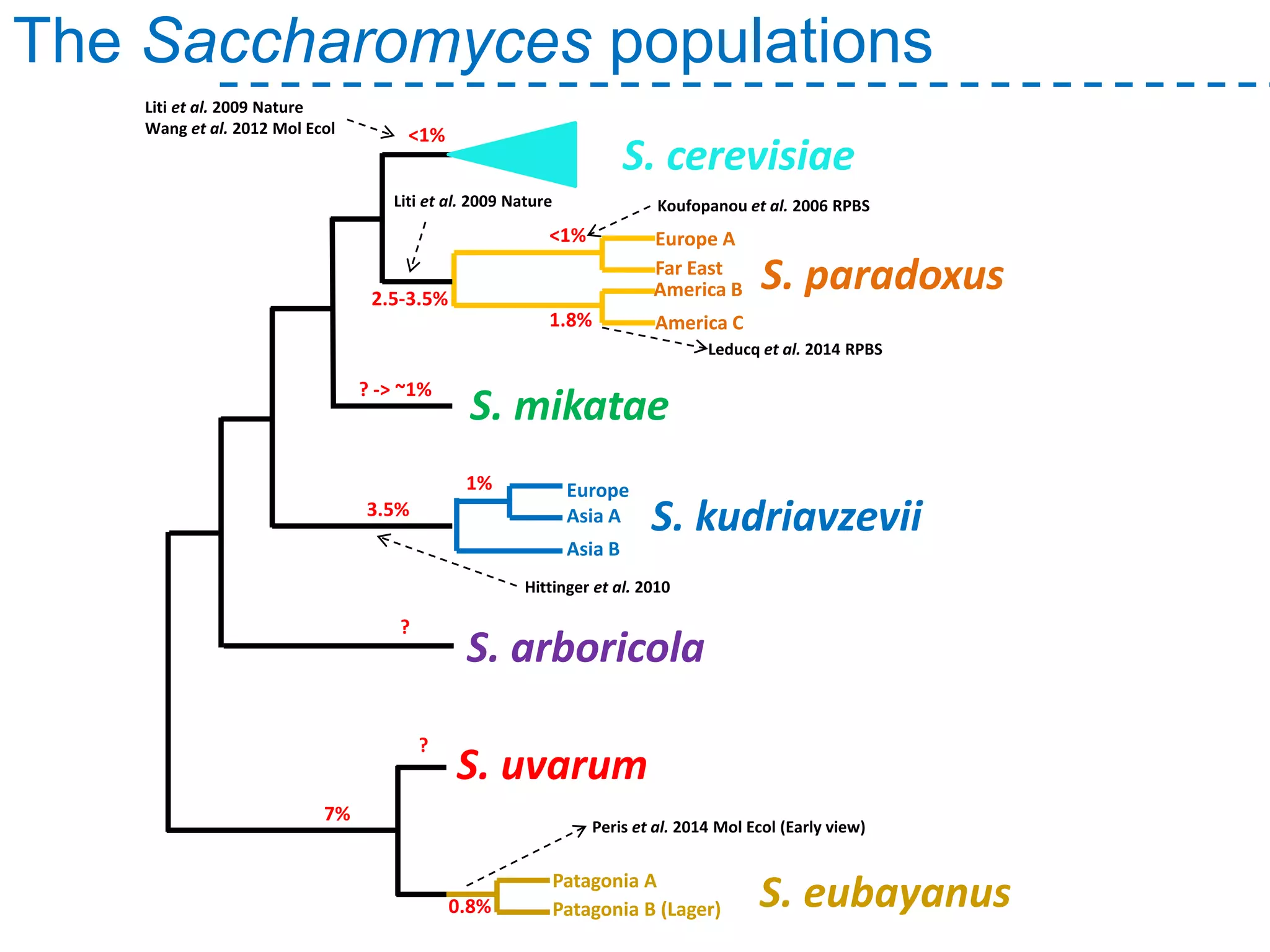
The Saccharomyces populations
S. paradoxus
S. mikatae
S. arboricola
S. kudriavzevii
S. uvarum
S. cerevisiae
S. eubayanus
Europe A
America B
America C
Far East
<1%
2.5-3.5%
1.8%
Leducq et al. 2014 RPBS
Liti et al. 2009 Nature
Wang et al. 2012 Mol Ecol <1%
? -> ~1%
?
3.5%
1% Europe
Asia A
Asia B
Peris et al. 2014 Mol Ecol (Early view)
Patagonia A
Patagonia B (Lager)0.8%
Hittinger et al. 2010
Liti et al. 2009 Nature Koufopanou et al. 2006 RPBS
?
7%
Conclusions
Concatenated data is misleading.
Conclusions
Concatenated data is misleading.
S. eubayanus are native, but not endemic to South America.
Conclusions
Concatenated data is misleading.
S. eubayanus are native, but not endemic to South America.
S. eubayanus is not diverse outside of South America, but it
is involved reticulate events.
Conclusions
Concatenated data is misleading.
S. eubayanus are native, but not endemic to South America.
S. eubayanus is not diverse outside of South America, but it
is involved reticulate events.
Reticulation events in yeast are important.
Lab members Collaborators
Acknowledgements
Yeast Exploration
and Analysis
Science Team
Kayla Sylvester
Dr. Chris T. Hittinger Dr. Diego Libkind
Dr. José Paulo Sampaio
Dr. Paula Gonçalves
Dr. William G. Alexander
Amanda Hulfachor
Thank you

S.eubayanus & reticulate evolution

  • 1.
    Population Structure andReticulate Evolution of Wild and Brewing Yeast David Peris University of Wisconsin, Madison Peris D, Sylvester K, Libkind D, Sampaio JP, Gonçalves P, Alexander WG, Hittinger CT Midwest Ecology & Evolution Conference 3-1-2014
  • 2.
    Yeasts Eukaryotic microorganisms Kurtzman etal., 2011, adapted from Dujon, 2009
  • 3.
    Yeasts Eukaryotic microorganisms Important fortheir biotechnological applications Kurtzman et al., 2011, adapted from Dujon, 2009 wine beer sake bread cider biofuels
  • 4.
    Yeasts Eukaryotic microorganisms Important fortheir biotechnological applications Important model system Kurtzman et al., 2011, adapted from Dujon, 2009
  • 5.
    Yeasts Eukaryotic microorganisms Important fortheir biotechnological applications Important model system Ecology of yeasts has been largely ignored Kurtzman et al., 2011, adapted from Dujon, 2009
  • 6.
    Yeasts Eukaryotic microorganisms Important fortheir biotechnological applications Important model system Ecology of yeasts has been largely ignored Kurtzman et al., 2011, adapted from Dujon, 2009
  • 7.
    The Saccharomyces genus S.paradoxus S. mikatae S. arboricola S. kudriavzevii S. uvarum S. cerevisiae S. eubayanus Scannell et al. 2011
  • 8.
    The Saccharomyces genus Dujonet al. 2006 ~19% aa S. paradoxus S. mikatae S. arboricola S. kudriavzevii S. uvarum S. cerevisiae S. eubayanus
  • 9.
    Peris et al.Mol Ecol (Early view), Peris et al. In preparation Reticulate evolution: recombination S. paradoxus S. mikatae S. arboricola S. kudriavzevii S. uvarum S. cerevisiae S. eubayanus Gene Sp1 Gene Sk1 Gene SpxSk
  • 10.
    Liti et al.2006, Dunn et al. 2012 Reticulate evolution: introgression S. paradoxus S. mikatae S. arboricola S. kudriavzevii S. uvarum S. cerevisiae S. eubayanus Chr Sc XIV Chr Sp XIV
  • 11.
    Gonzalez et al.2008 Dunn et al. 2008 Peris et al. 2012a,b,c Libkind et al. 2010 Reticulate evolution: hybridization S. pastorianus S. paradoxus S. mikatae S. arboricola S. kudriavzevii S. uvarum S. cerevisiae S. eubayanus S. bayanus
  • 12.
    How diverse isSaccharomyces eubayanus and its hybrids? Major questions to be addressed
  • 13.
    How diverse isSaccharomyces eubayanus and its hybrids? Which ecological factors drive population/species differentiation? Major questions to be addressed
  • 14.
    How diverse isSaccharomyces eubayanus and its hybrids? Which ecological factors drive population/species differentiation? What is the role of reticulate evolution in the adaptation to new natural/artificial environments? Major questions to be addressed
  • 15.
    S. eubayanus samples 18/142strains Patagonia, Argentina 3 strains North America S. pastorianus S. bayanus S. pastorianus CBS 380, CBS 1546, NBRC 1948 Saaz group: CBS 1503 Frohberg group: W34/70 Lager Brewing Strains
  • 16.
    Concatenated ML/By phylogenetictree Bs/Bs/PP 0.8% 70/72/0.99 99/100/1 99/100/1 98/92/1 63/63/0.99 94/92/1 51/53/0.88 yHCT104 yHCT96 yHCT101 yHCT114 yHCT90 yHCT99 yHCT72 0.005 yHKS210 yHKS212 yHKS211 yHCT105 yHCT91 yHCT88 yHCT70 yHCT107 yHCT94 yHCT61 yHCT92 W34_70 CBS 1503 yHCT63 yHCT62 yHCT76 CBS7001 PATAGONIA PATAGONIA-LAGERNORTH AMERICA 0.410 (0.25-0.625) 0.36 (0.25-0.5) 0.31 (0.25-0.5) 0.379 (0.25-0.625) 0.364 (0.25-0.5) 0.149 (0-0.375) 0.63 (0.5-0.75) W34_70 CBS 1503 Clade A Clade B Clade C S. uvarum S. eubayanus 9 nuclear genes ~6.78Kbp
  • 17.
    Concordance factors S. uvarum S.eubayanus 70/72/0.99 99/100/1 99/100/1 98/92/1 63/63/0.99 94/92/1 51/53/0.88 yHCT104 yHCT96 yHCT101 yHCT114 yHCT90 yHCT99 yHCT72 0.005 yHKS210 yHKS212 yHKS211 yHCT105 yHCT91 yHCT88 yHCT70 yHCT107 yHCT94 yHCT61 yHCT92 W34_70 CBS 1503 yHCT63 yHCT62 yHCT76 CBS7001 PATAGONIA PATAGONIA-LAGERNORTH AMERICA 0.410 (0.25-0.625) 0.36 (0.25-0.5) 0.31 (0.25-0.5) 0.379 (0.25-0.625) 0.364 (0.25-0.5) 0.149 (0-0.375) 0.63 (0.5-0.75) Bs/Bs/PP Av CF (95%CI) Clade A Clade B Clade C W34_70 CBS 1503
  • 18.
    Species tree vsgene trees S. uvarum S. eubayanus 70/72/0.99 99/100/1 99/100/1 98/92/1 63/63/0.99 94/92/1 51/53/0.88 yHCT104 yHCT96 yHCT101 yHCT114 yHCT90 yHCT99 yHCT72 0.005 yHKS210 yHKS212 yHKS211 yHCT105 yHCT91 yHCT88 yHCT70 yHCT107 yHCT94 yHCT61 yHCT92 W34_70 CBS 1503 yHCT63 yHCT62 yHCT76 CBS7001 PATAGONIA PATAGONIA-LAGERNORTH AMERICA 0.410 (0.25-0.625) 0.36 (0.25-0.5) 0.31 (0.25-0.5) 0.379 (0.25-0.625) 0.364 (0.25-0.5) 0.149 (0-0.375) 0.63 (0.5-0.75) PATAGONIA NORTH AMERICA PATAGONIA-LAGER 88/96/0.99 0.728 (0.5,1) 87/87/0.99 100/100/0.99 76/71/0.94 96/97/0.99 0.291 (0.25,5) 0.734 (0.5,1) 0.348 (0,0.75) 0.575 (0.5,0.75) yHCT62 yHCT76 yHKS210 yHKS211 yHKS212 yHCT94 yHCT63 yHCT61 yHCT92 yHCT105 yHCT70 yHCT107 yHCT88 yHCT91 CBS 1503 W34_70 yHCT104 yHCT101 yHCT96 yHCT72 yHCT90 yHCT99 yHCT114 CBS7001 0.01 PATAGONIA NORTH AMERICA PATAGONIA-LAGER 46/53/0.99 100/100/0.99 90/90/0.99 99/98/0.99 69/50/0.59 0.514 (0.25,0.75) 0.27 (0,0.5) 0.48 (0.25,0.5) 0.715 (0.5,0.75) 0.104 (0,0.5) yHCT70 yHCT107 yHCT62 yHCT92 yHCT61 CBS 1503 W34_70 yHCT105 yHCT63 yHCT76 yHCT94 yHCT91 yHCT88 yHCT99 yHCT90 yHCT114 yHCT72 yHKS210 yHKS211 yHKS212 yHCT101 yHCT104 yHCT96 CBS7001 0.01 A B S. uvarum S. eubayanus S. uvarum S. eubayanus CBS 1503 W34_70 CBS 1503 W34_70 W34_70 CBS 1503
  • 19.
    Population structure Fst =0.73 AMOVA: p-value < 10-4 0.8% 70/72/0.99 99/100/1 99/100/1 98/92/1 63/63/0.99 94/92/1 51/53/0.88 yHCT104 yHCT96 yHCT101 yHCT114 yHCT90 yHCT99 yHCT72 0.005 yHKS210 yHKS212 yHKS211 yHCT105 yHCT91 yHCT88 yHCT70 yHCT107 yHCT94 yHCT61 yHCT92 W34_70 CBS 1503 yHCT63 yHCT62 yHCT76 CBS7001 PATAGONIA PATAGONIA-LAGERNORTH AMERICA 0.410 (0.25-0.625) 0.36 (0.25-0.5) 0.31 (0.25-0.5) 0.379 (0.25-0.625) 0.364 (0.25-0.5) 0.149 (0-0.375) 0.63 (0.5-0.75) Patagonia B (Lager) Patagonia A K=2 W34_70 CBS 1503
  • 20.
    Phylogenetic network interpretation GeneA Gene B Gene C Gene D Holland et al. 2008
  • 21.
    Phylogenetic network interpretation GeneA Gene B Gene C Gene D Holland et al. 2008
  • 22.
    Phylogenetic network interpretation GeneA Gene B Gene C Gene D Holland et al. 2008
  • 23.
  • 24.
  • 25.
  • 26.
    Lager Eurasian? Brewing started around 10kya Hybridization& lager brewing PA PB(L) Cross with “ale” S. cer
  • 27.
  • 28.
    8ºC Exploration of newtrees A. saccharumF. grandifolia PA PB(L) NA
  • 29.
    The Saccharomyces populations S.paradoxus S. mikatae S. arboricola S. kudriavzevii S. uvarum S. cerevisiae S. eubayanus Europe A America B America C Far East <1% 2.5-3.5% 1.8% Leducq et al. 2014 RPBS Liti et al. 2009 Nature Wang et al. 2012 Mol Ecol <1% ? -> ~1% ? 3.5% 1% Europe Asia A Asia B Peris et al. 2014 Mol Ecol (Early view) Patagonia A Patagonia B (Lager)0.8% Hittinger et al. 2010 Liti et al. 2009 Nature Koufopanou et al. 2006 RPBS ? 7%
  • 30.
  • 31.
    Conclusions Concatenated data ismisleading. S. eubayanus are native, but not endemic to South America.
  • 32.
    Conclusions Concatenated data ismisleading. S. eubayanus are native, but not endemic to South America. S. eubayanus is not diverse outside of South America, but it is involved reticulate events.
  • 33.
    Conclusions Concatenated data ismisleading. S. eubayanus are native, but not endemic to South America. S. eubayanus is not diverse outside of South America, but it is involved reticulate events. Reticulation events in yeast are important.
  • 34.
    Lab members Collaborators Acknowledgements YeastExploration and Analysis Science Team Kayla Sylvester Dr. Chris T. Hittinger Dr. Diego Libkind Dr. José Paulo Sampaio Dr. Paula Gonçalves Dr. William G. Alexander Amanda Hulfachor
  • 35.