Fossil Hominins From Australopithecus to Homo
Model of Human Evolution: Australopithecus to Homo Australopithecus afarensis to A. africanus : Gracile Australopithecines Paranthropus robustus and boisei:  Robust Australopithecines—Dead end? A. africanus  to  Homo habilis : Rise of tool manufacture? H. habilis  to  H. erectus:  Global spread; increased tool assemblage H. erectus  to  H. sapiens:  Tool specialization and population explosion H. neanderthalensis: Dead end?
Fossil Hominins: General Trends Large bulbous cranium Short face compared to ape Vertical carriage of head Hands and Forelimbs Adapted to Tool Making and Use Bipedal Structure of Postcranial Skeleton
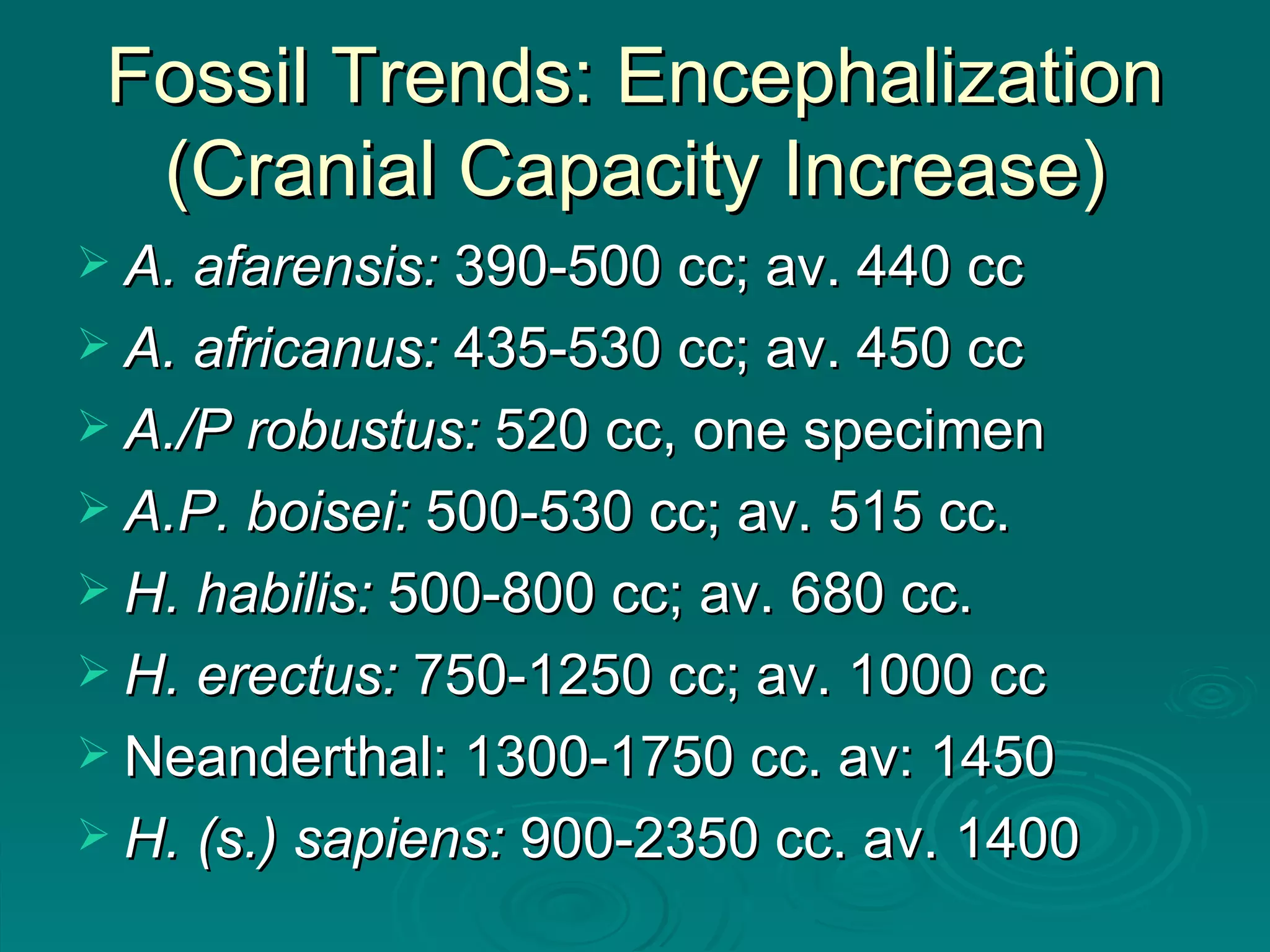
Fossil Trends: Encephalization (Cranial Capacity Increase) A. afarensis:  390-500 cc; av. 440 cc A. africanus:  435-530 cc; av. 450 cc A./P robustus:  520 cc, one specimen A.P. boisei:  500-530 cc; av. 515 cc. H. habilis:  500-800 cc; av. 680 cc. H. erectus:  750-1250 cc; av. 1000 cc Neanderthal: 1300-1750 cc. av: 1450   H. (s.) sapiens:  900-2350 cc. av. 1400
Fossil Trends: Forelimbs and Hands Shortened forelimb Hands (manipulation, not locomotion) Enlarged thumb Straight, noncurved finger Enhanced finger sensitivity
Fossil Hominins: General Trends--Bipedalism   S-shaped vertebrae (backbone) Short, wide, bowl-shaped pelvis Femoral head (ball of femur at pelvis) angled and strengthened Lengthened hindlimb Angle of knee: femur “slopes” to pelvis Platform (arched) structure of foot Nonopposable big toe; toes not curved
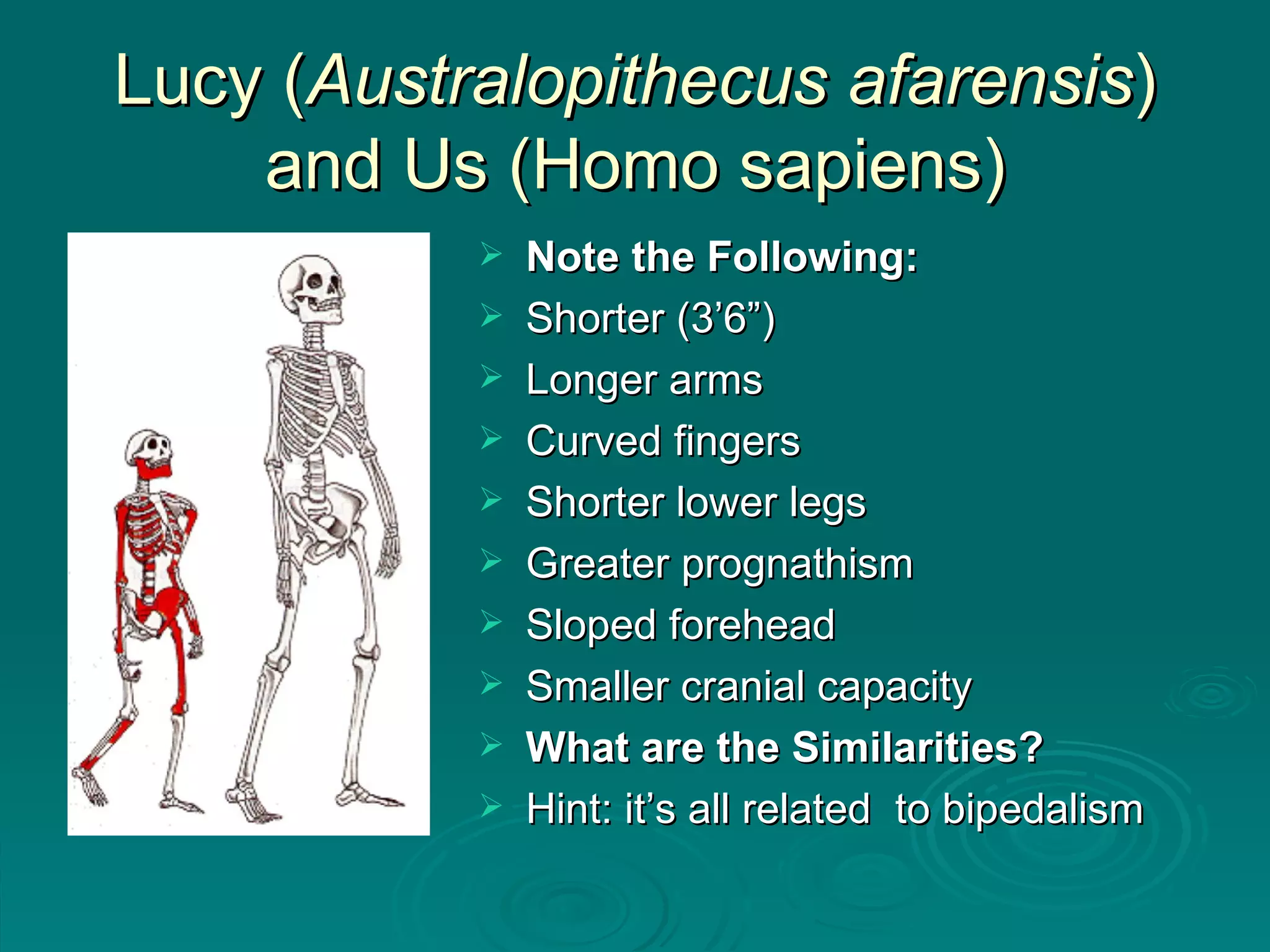
Lucy ( Australopithecus afarensis ) and Us (Homo sapiens) Note the Following: Shorter (3’6”) Longer arms Curved fingers Shorter lower legs Greater prognathism Sloped forehead Smaller cranial capacity What are the Similarities? Hint: it’s all related  to bipedalism
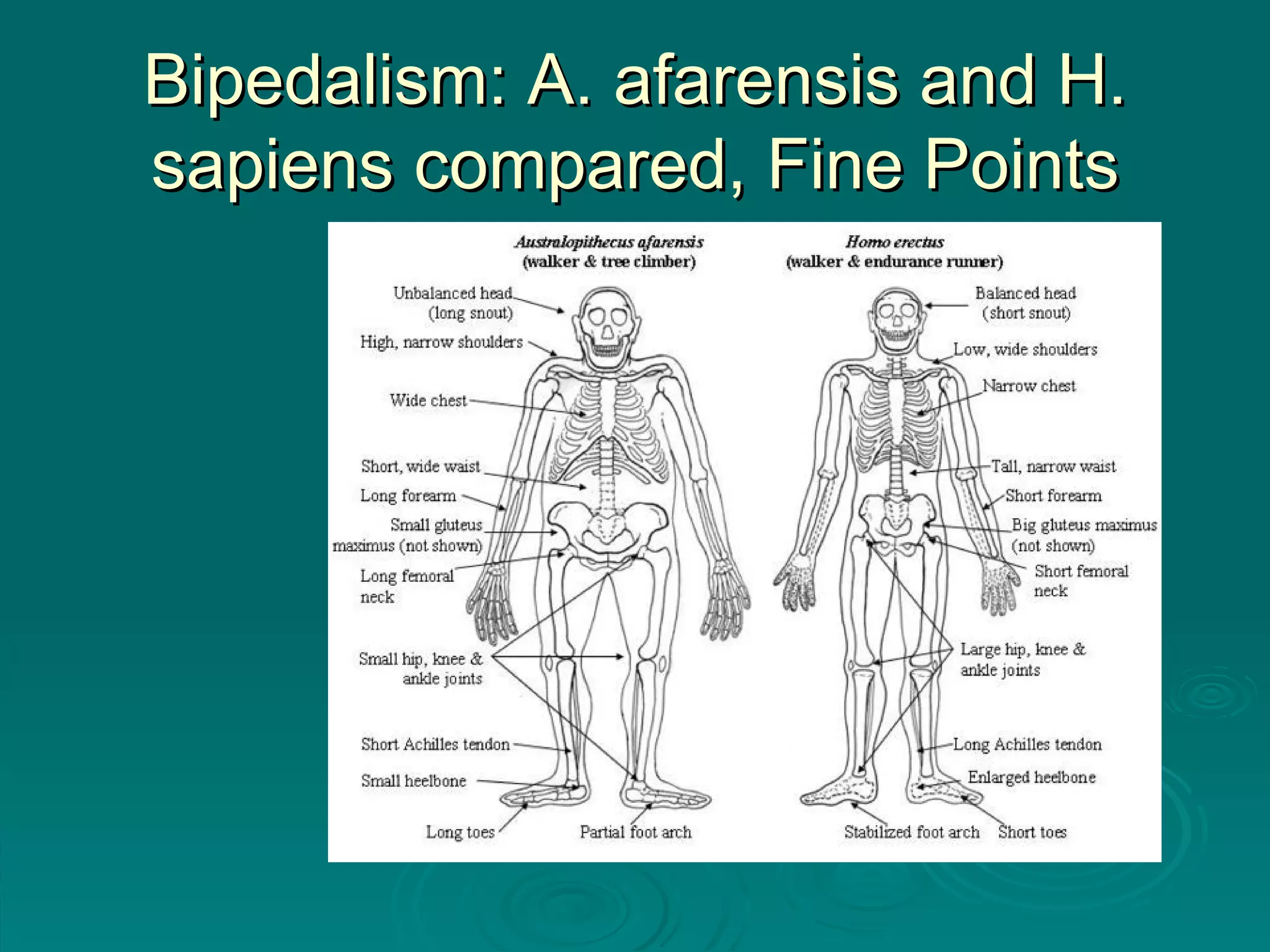
Bipedalism: A. afarensis and H. sapiens compared, Fine Points
When We Became Bipedal  (According to Gary Larson) “ Hey! Look! No hands!” (Does he look like Lucy to you. . .?)
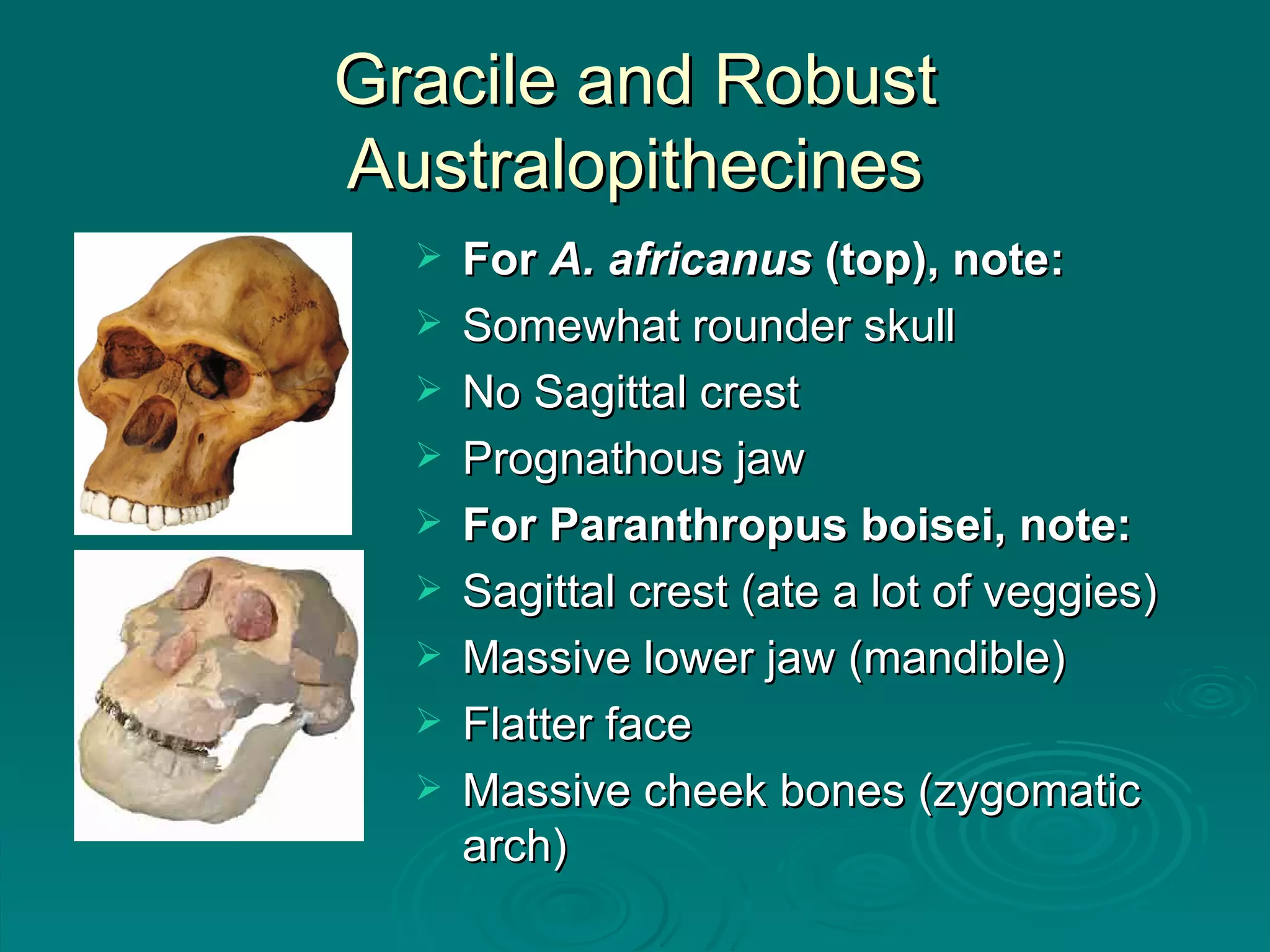
Gracile and Robust Australopithecines For  A. africanus  (top), note: Somewhat rounder skull No Sagittal crest Prognathous jaw For Paranthropus boisei, note: Sagittal crest (ate a lot of veggies) Massive lower jaw (mandible) Flatter face Massive cheek bones (zygomatic arch)
Summary of Australopithecines Cranial capacity increased marginally All australopithecines had Sloping foreheads Prominent brow ridges Prognathous lower face and jaws Bipedal postcranial skeletons Robust forms probably were dead ends   Graciles likely evolved toward  Homo .
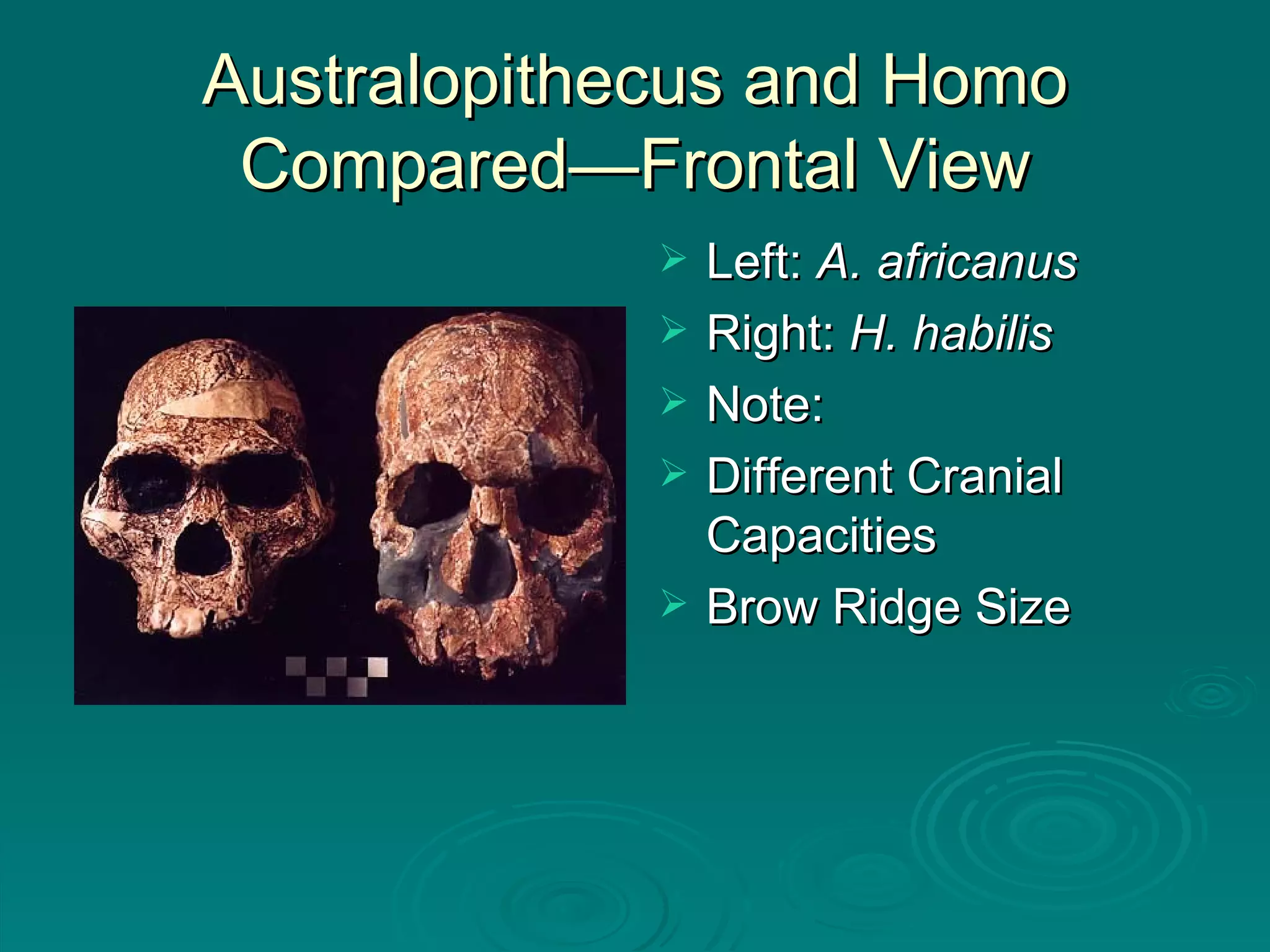
Australopithecus and Homo Compared—Frontal View Left:  A. africanus Right:  H. habilis Note: Different Cranial Capacities Brow Ridge Size
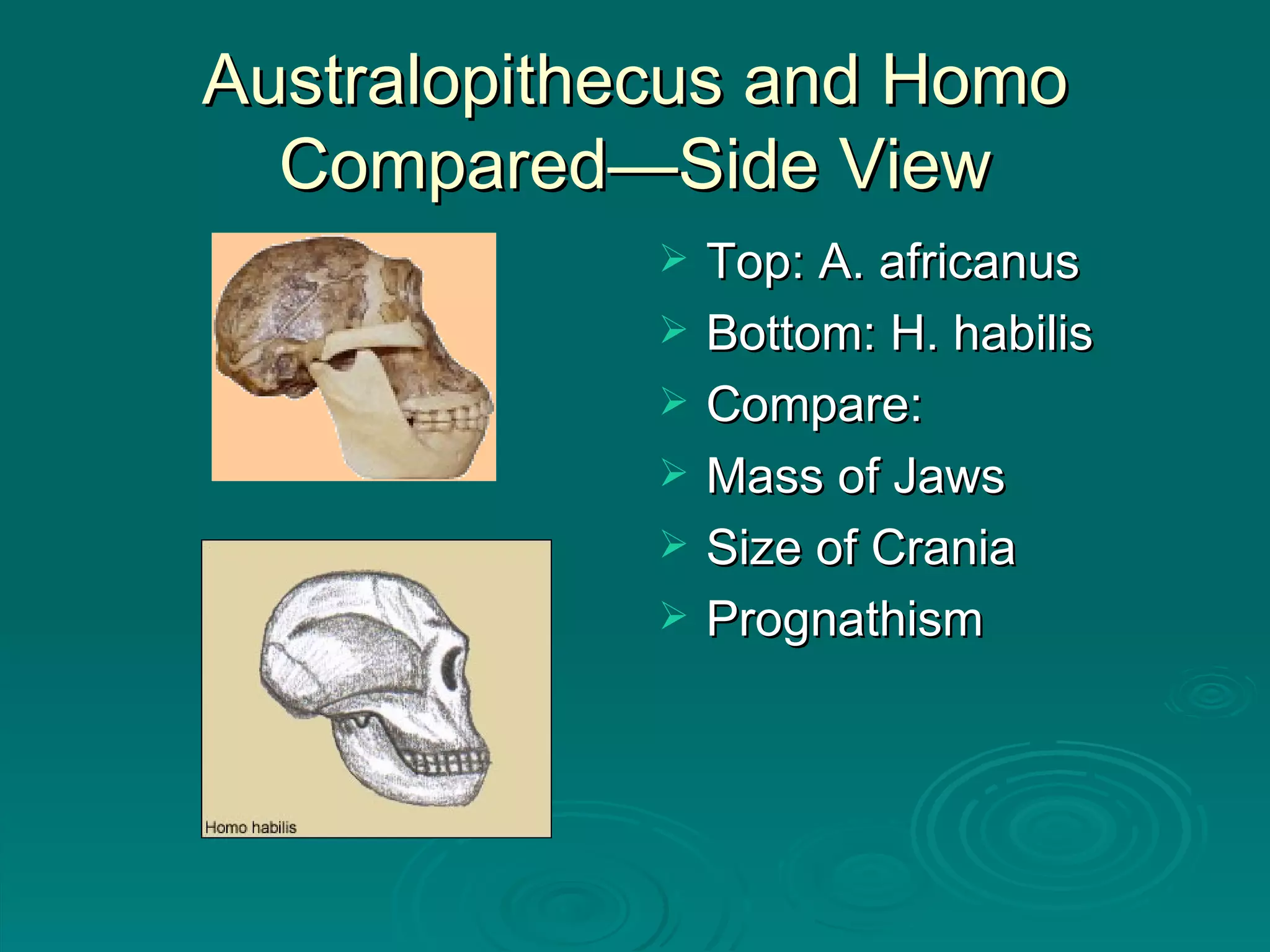
Australopithecus and Homo Compared—Side View Top: A. africanus Bottom: H. habilis Compare: Mass of Jaws Size of Crania Prognathism
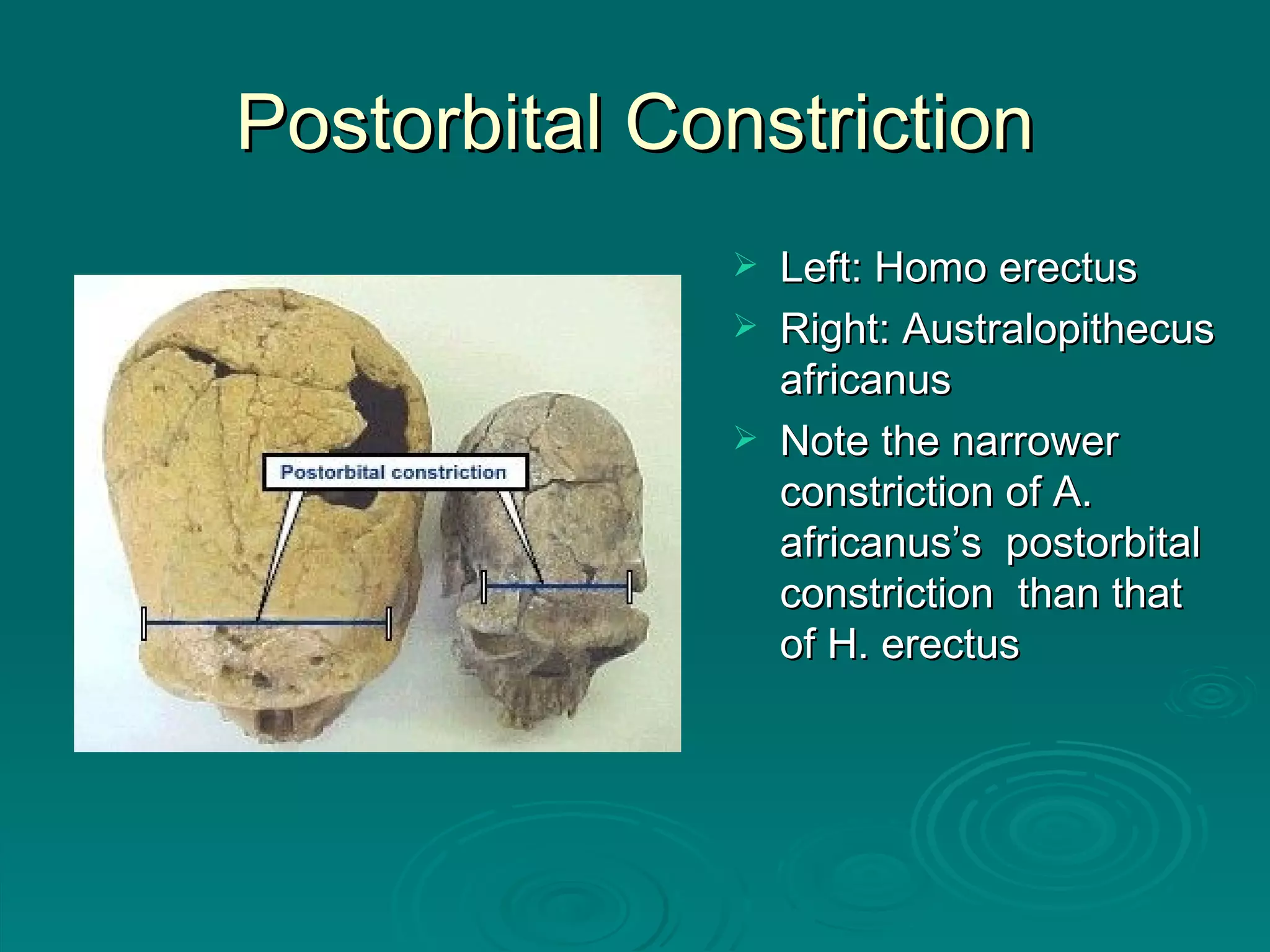
Postorbital Constriction Left: Homo erectus Right: Australopithecus africanus Note the narrower constriction of A. africanus’s  postorbital constriction  than that of H. erectus
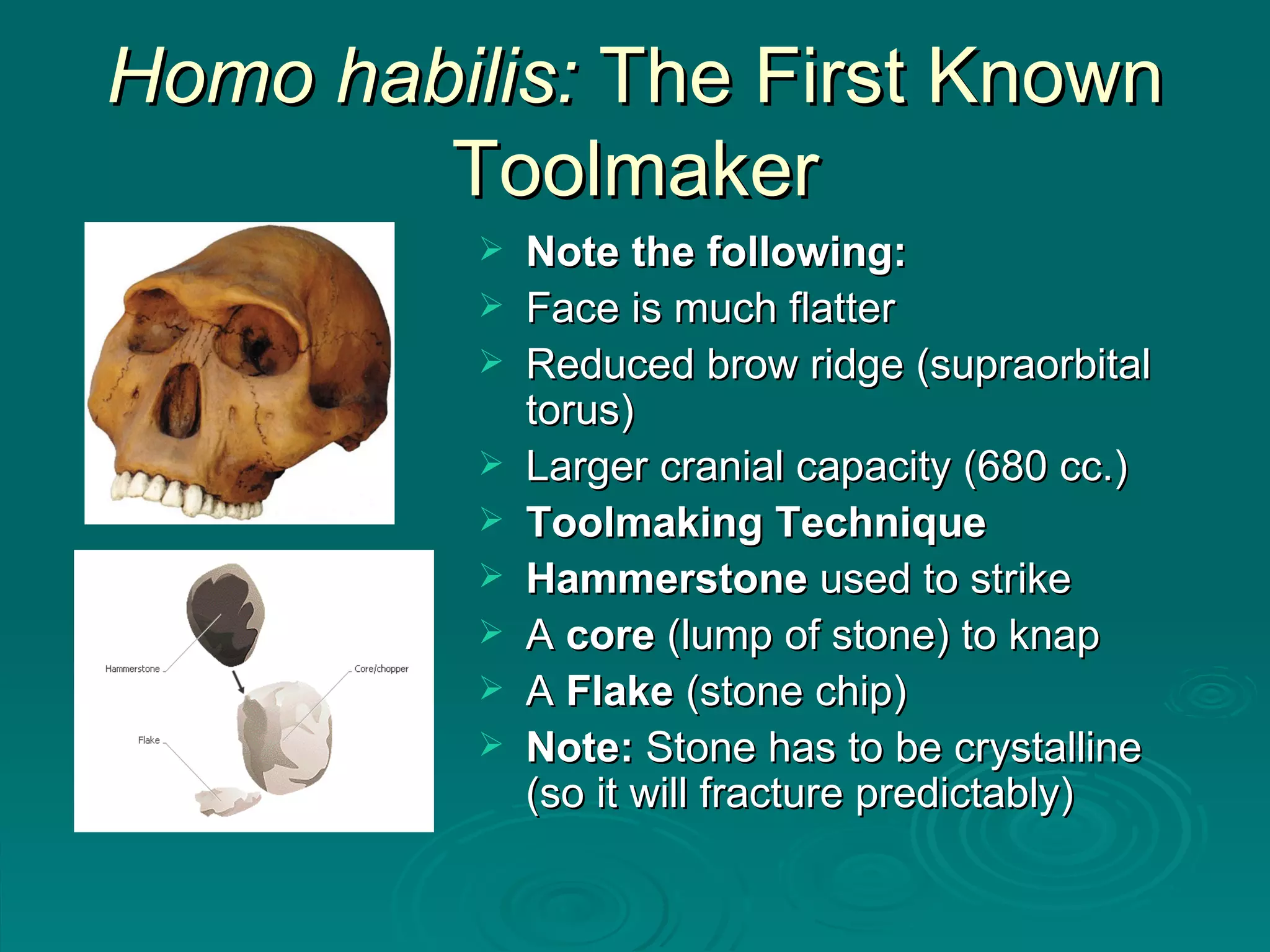
Homo habilis:  The First Known Toolmaker Note the following: Face is much flatter Reduced brow ridge (supraorbital torus)  Larger cranial capacity (680 cc.) Toolmaking Technique Hammerstone  used to strike A  core  (lump of stone) to knap A  Flake  (stone chip) Note:  Stone has to be crystalline (so it will fracture predictably)
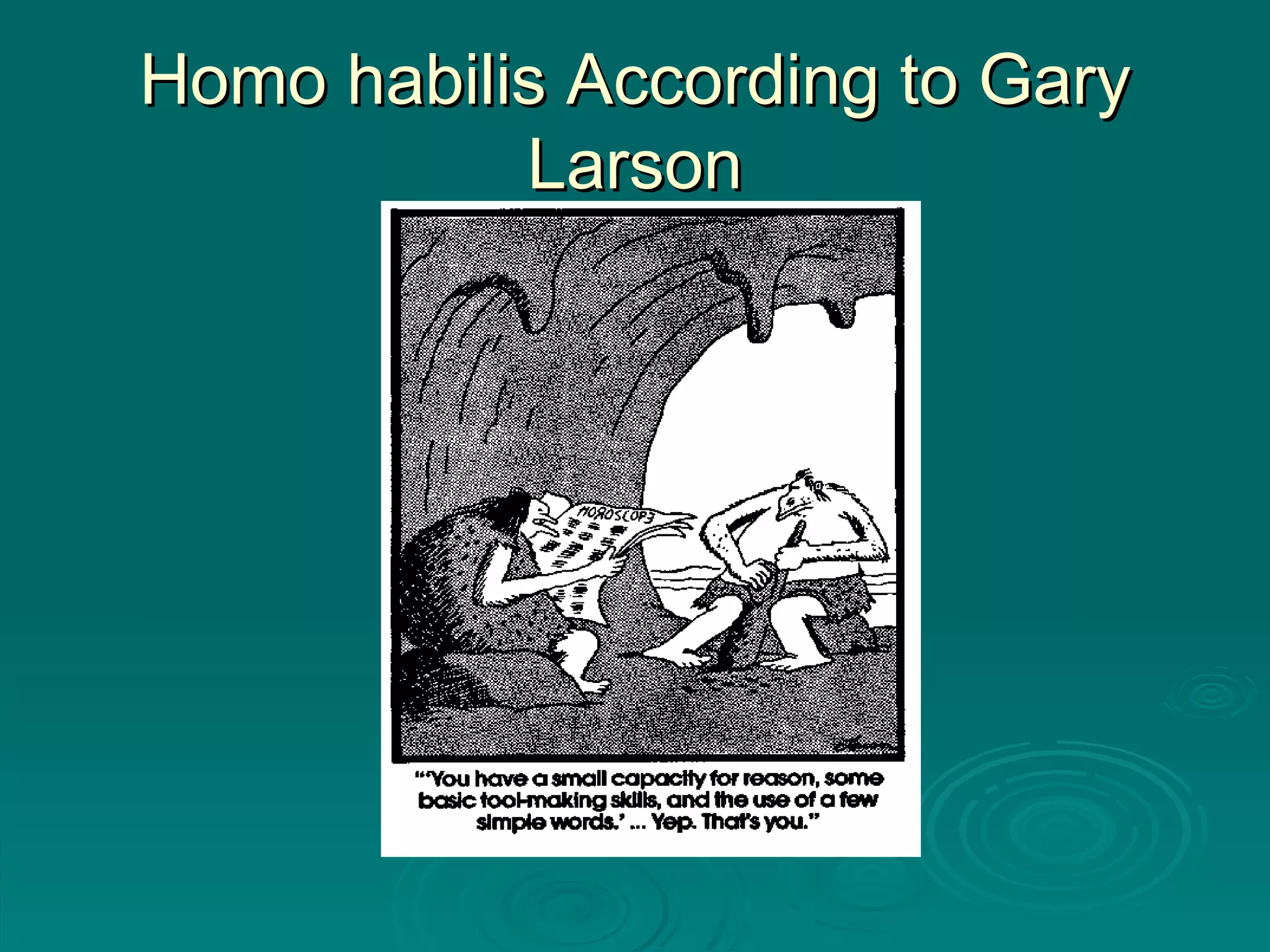
Homo habilis According to Gary Larson
Australopithecines and Homo Compared I Cranial capacity Australopithecines: 400-530 cc Homo: 500-2300 Maximum braincase width Australopithecines: low on skull Homo: near top Postorbital constriction Australopithecines: marked Homo: moderate to slight
Australopithecines and Homo Compared II Supraorbital torus (brow ridge) Australopithecines: large to moderate Homo: large to slight Zygomatic arch Australopithecines: large, flaring Homo: small, not flaring
Australopithecines and Homo Compared III Facial size relative to brain case Australopithecines: large Homo: small Jaw A: Massive and prognathic; no chin H: Not massive Prognathism slight to nonexistent; Chin present in sapients Molars and premolars Australopithecines: large;  afarensis  with diastema Homo: small
Australopithecines and Homo Habilis Compared: Skulls General trends Encephalization: Cranial capacity increases Dentition: Cheek teeth are reduced Sagittal Crest (where chewing muscles attach) A./P. robustus and boisei:  pronounced A. africanus:  sagittal keel or absent H. habilis:  absent
Australopithecines and Homo Habilis Compared: Skull/Face Braincase A./P. robustus/boisei:  less rounded A. africanus:  more rounded H. habilis:  most rounded of the three Zygomatic arch A./P. robustus/boisei: very pronounced A. africanus:  less pronounced H. habilis:  far less pronounced than the australopithecines
Homo habilis: Hands and Feet Hands Curvature of finger bones are apelike, indicate powerful grip (arboreal) Indications of greater manipulative skill Larger blood supply to hand than earlier hominids Evidence of greater nerve supply Feet: existing fragments indicate modern form: Remains lacked toes
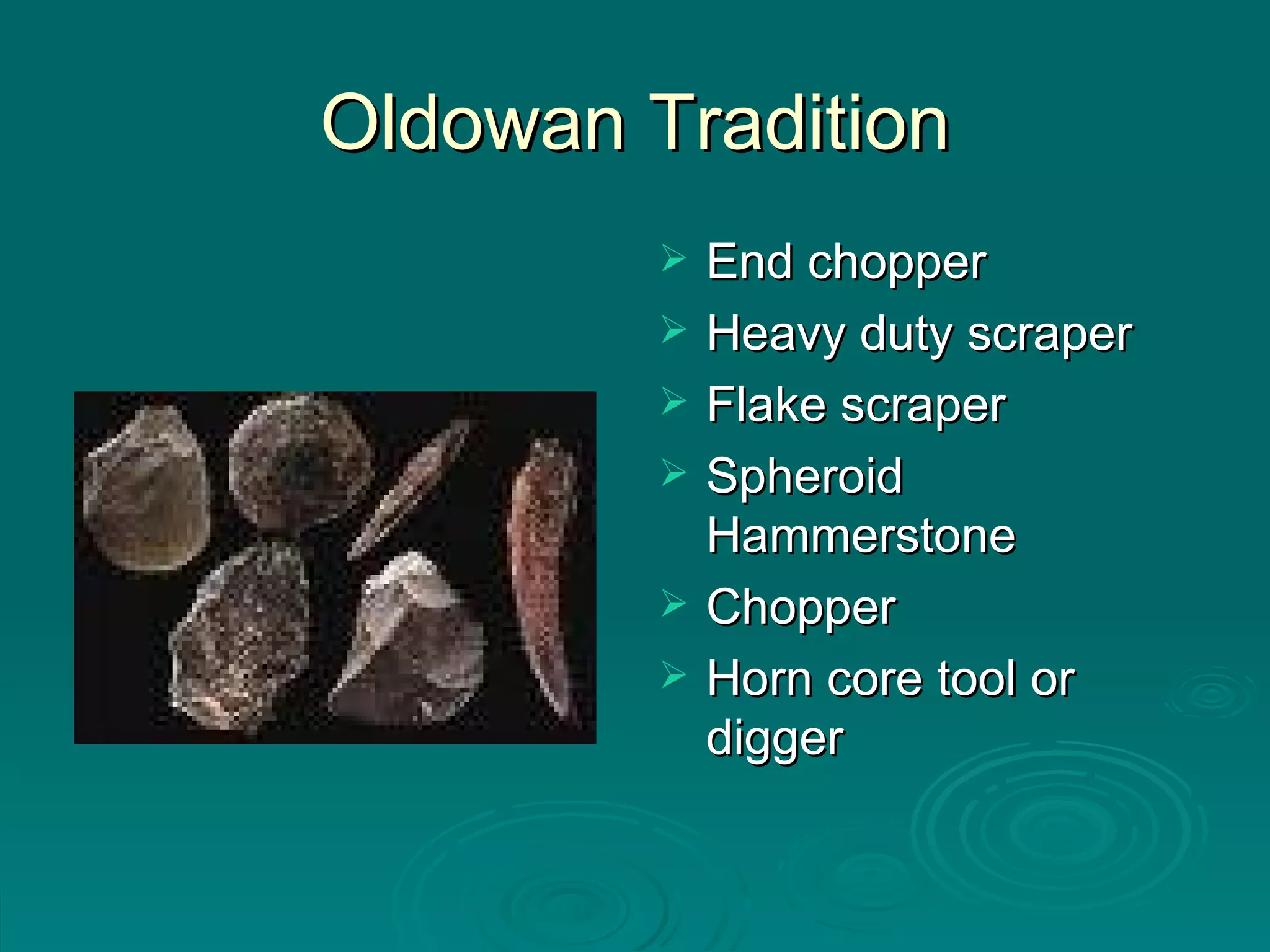
Tool Traditions: Oldowan  Named after Olduvai Gorge Among the finds at Olduvai: Side chopper, a core tool Several flake tools, including End scraper Side scraper Burin Utilized flakes of unknown function Belongs to Lower Paleolithic
Manufacturing Choppers Procedure Knapper strikes a spherical piece of stone Flake falls off opposite side Tool flipped over and procedure repeated Several blows create a cutting edge Requirements reflect Intelligence Planning and foreknowledge of design Knowledge of breakage pattern of rock Hand-eye coordination
Oldowan Tradition End chopper Heavy duty scraper Flake scraper Spheroid Hammerstone Chopper Horn core tool or digger
Homo habilis and Homo erectus Compared to  H. habilis, H erectus  had: Larger brain (1000 cc vs 680 cc average) Forehead flatter, less sloping More rounded occipital torus endocasts indicate hemispheric asymmetry Homo erectus and Homo sapiens
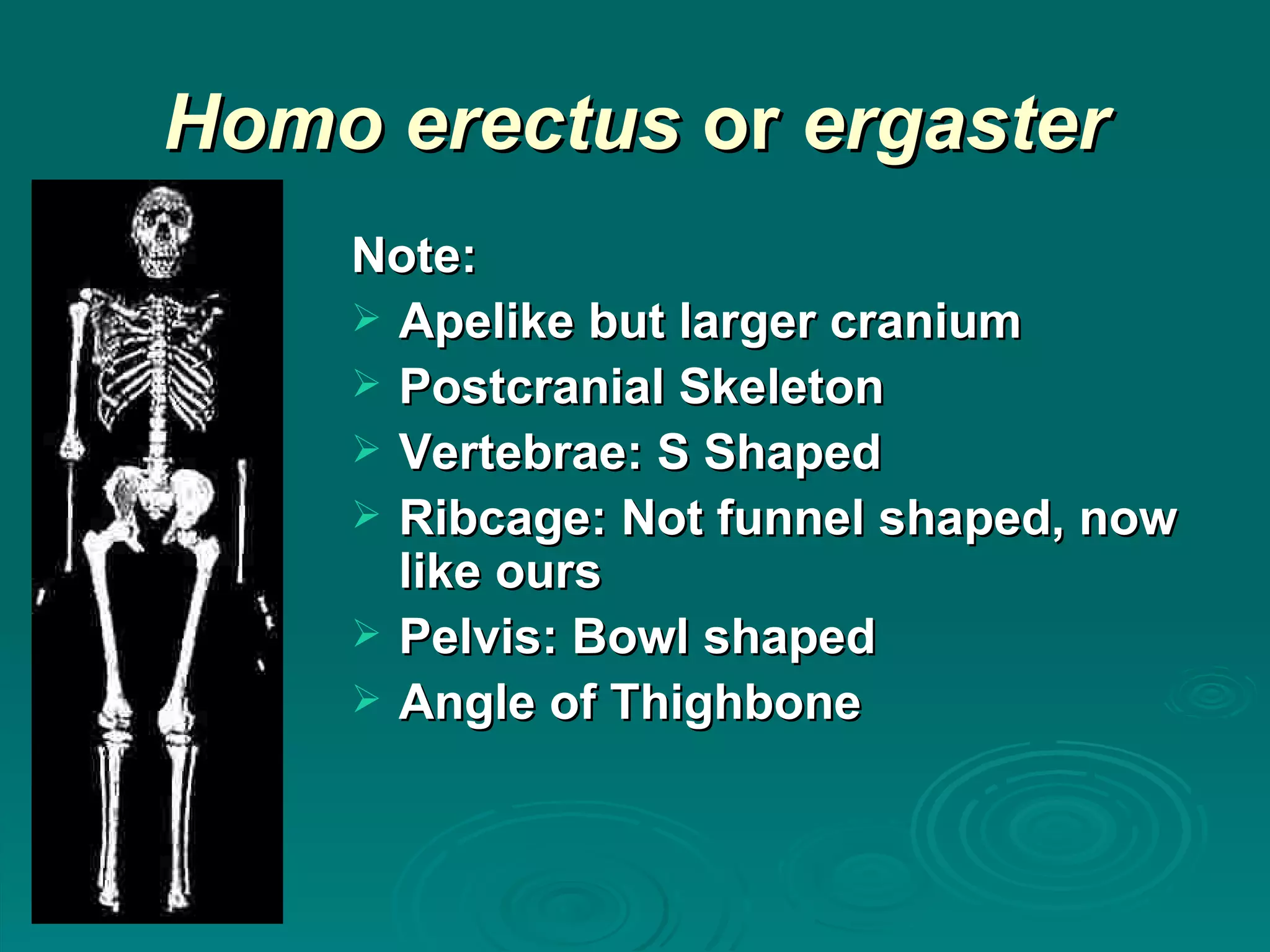
Homo erectus  or  ergaster Note: Apelike but larger cranium Postcranial Skeleton Vertebrae: S Shaped Ribcage: Not funnel shaped, now like ours Pelvis: Bowl shaped Angle of Thighbone
Homo erectus and Homo Sapiens: Cranium (Braincase) Forehead (Frontal) H. erectus:  sloping; low and flat H. sapiens:  vertical, indicating frontal lobe Supraorbital torus (brow ridge) H. erectus:  prominent--extending as a bar H. sapiens:  slight or absent Occipital torus: H. erectus:  present H. sapiens:  slight or absent
Homo erectus and Homo sapiens: Cranium and Face Sagittal keel H. erectus:  present; vestige of crest? H. sapiens:  slight or absent Postorbital constriction H. erectus:  pronounced H. sapiens:  slight or nonexistent
Homo erectus and Homo sapiens: Facial Skeleton Facial skeletion H. erectus:  Relatively large, with large orbits and nasal opening H. sapiens:  Relatively small, with small orbits and nasal opening Prognathism (jutting jaw) H. erectus:  Pronounced H. sapiens:  minimal or nonexistent
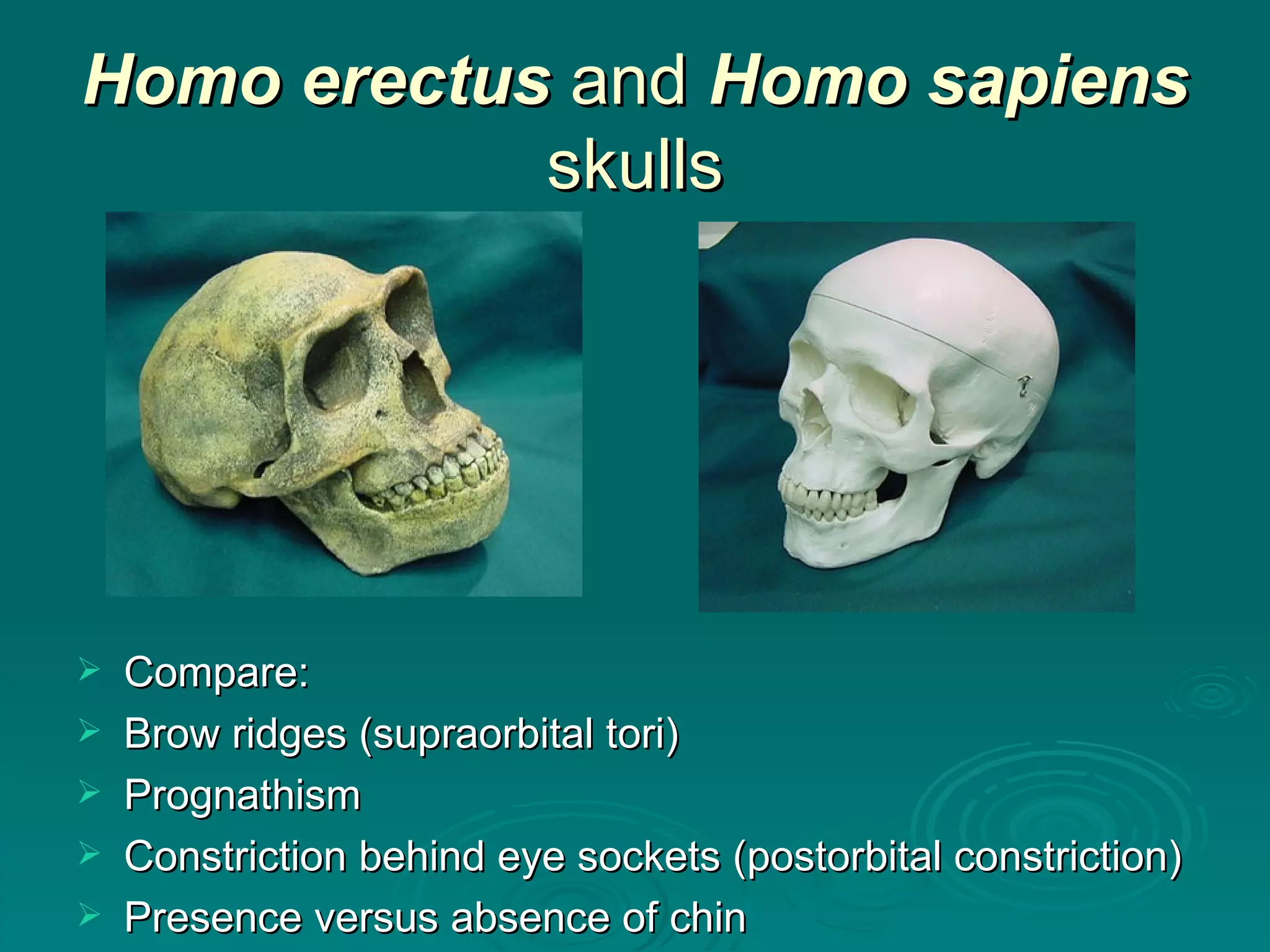
Homo erectus  and  Homo sapiens  skulls Compare: Brow ridges (supraorbital tori) Prognathism Constriction behind eye sockets (postorbital constriction) Presence versus absence of chin
Tool Traditions: Acheulean Named after St. Acheul Characteristics of Acheulean handaxe Bifacial: both sides knapped Symmetrical in breadth Shaped to a point on one end The edge is thin and sharp Broad end is curved, but edge is still sharp Part of Lower Paleolithic
Acheulean Axe as “Swiss Army Knife”; Abbevillean variation Swiss Army Rock? Sharp tip: used for piercing Thin edge: used for cutting (hide or meat off bone) Broad end: used for chopping or scraping Abbevillean Variation: Bifacial, like the Acheulean Not quite so symmetrical Olduvai specimen: transitional type?
Manufacturing Acheulean Handaxes A demanding task Symmetrical, finely shaped Dozens of flakes removed, from 25 to 75 Each flake blow must be precisely positioned Core must be turned over again and again to maintain symmetry to keep edge straight All the exterior rind ( cortex ) was removed
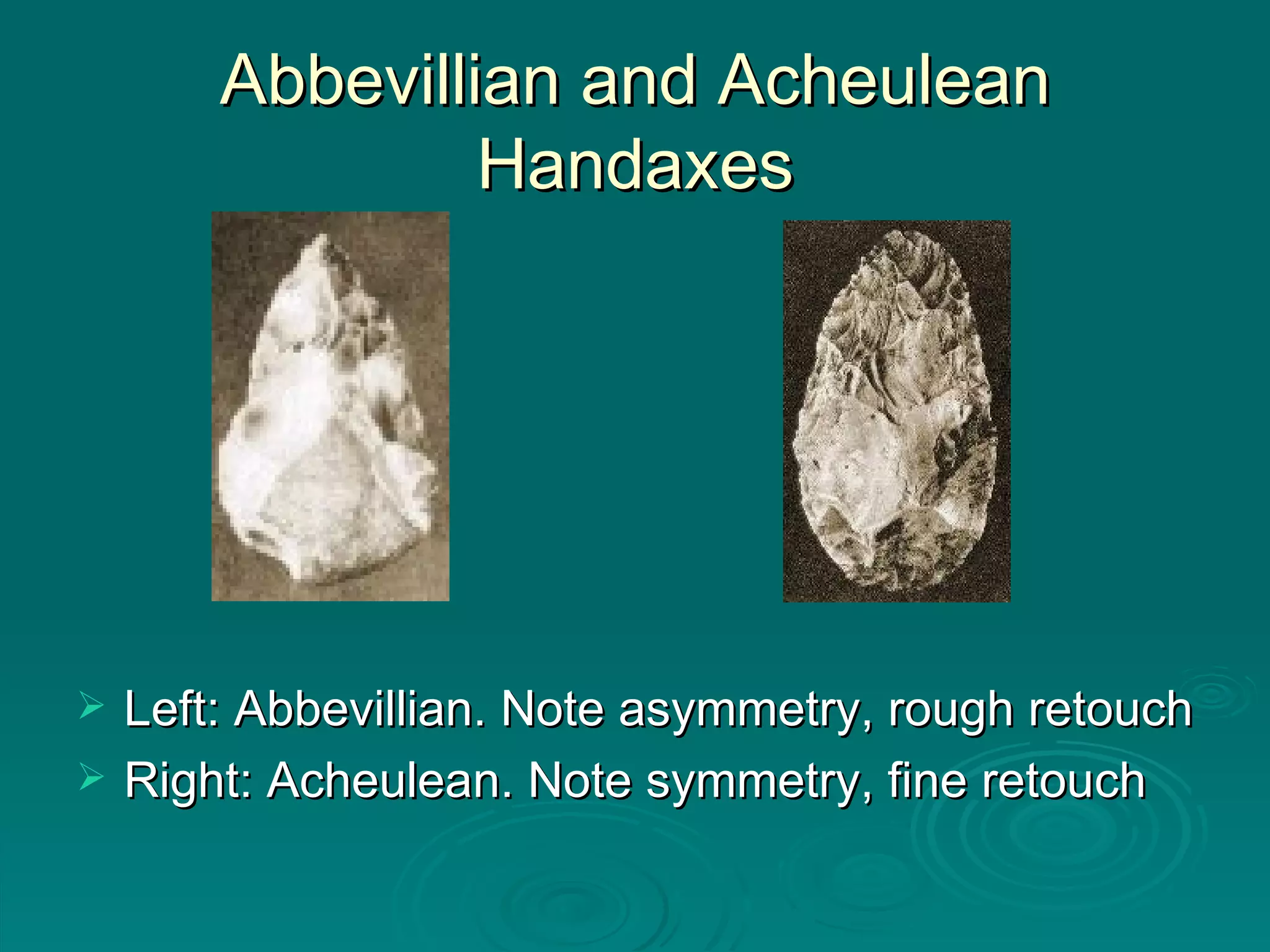
Abbevillian and Acheulean Handaxes Left: Abbevillian. Note asymmetry, rough retouch Right: Acheulean. Note symmetry, fine retouch
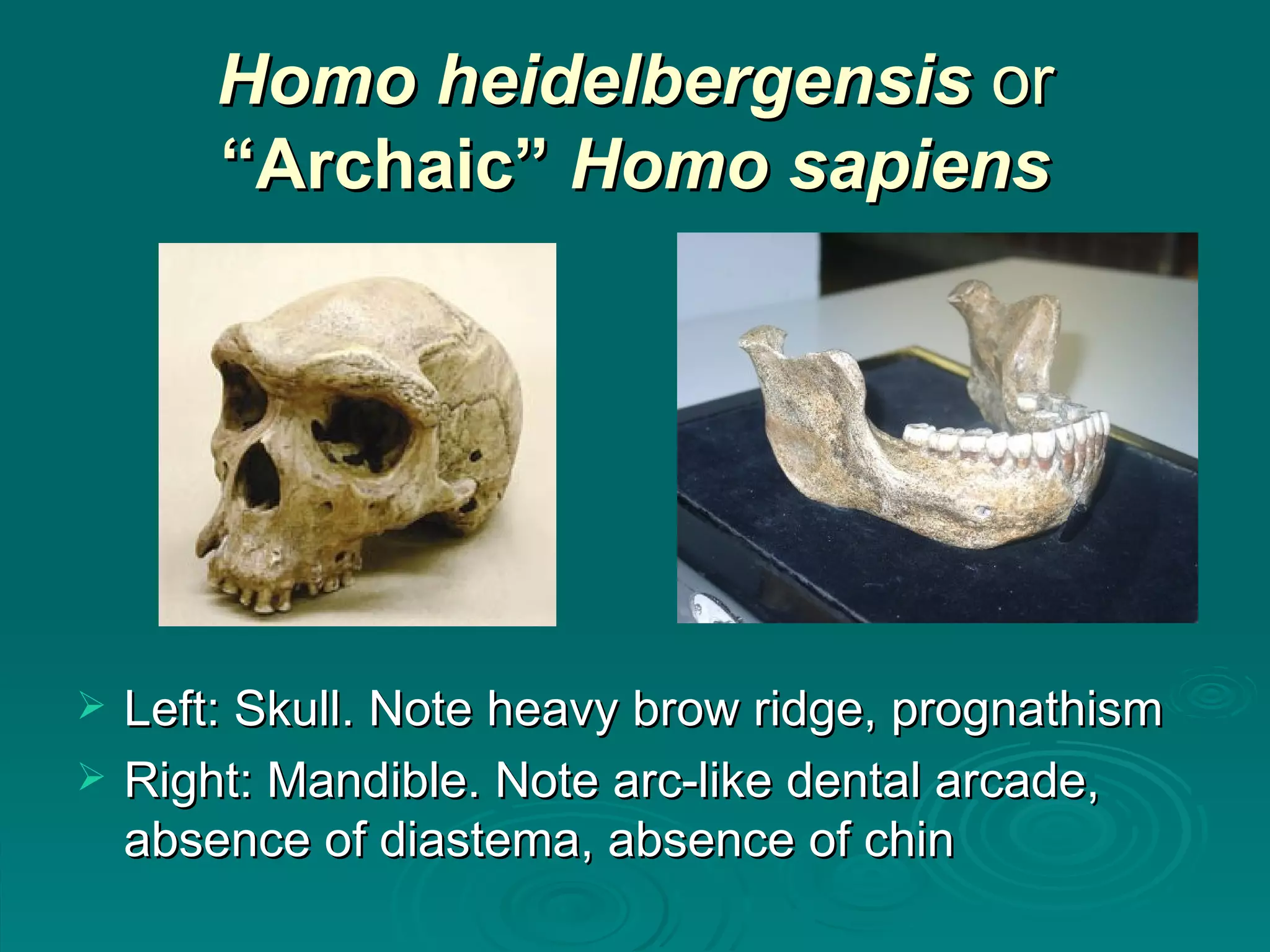
Homo heidelbergensis  or  “Archaic”  Homo sapiens Left: Skull. Note heavy brow ridge, prognathism Right: Mandible. Note arc-like dental arcade, absence of diastema, absence of chin
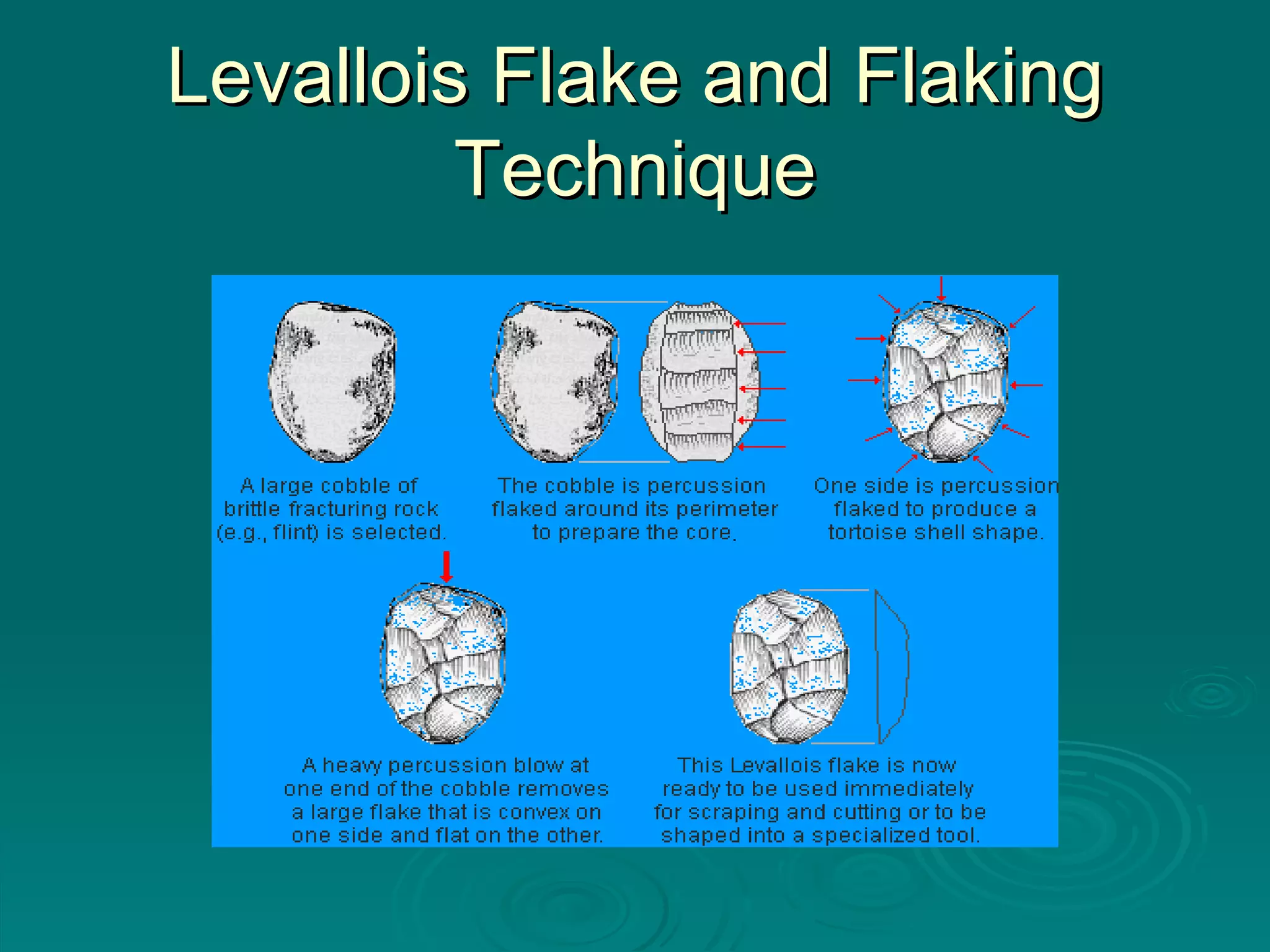
Manufacturing Levallois Cores and Flakes Knappers Draw outline of flake on stone module Strikes flake of desired shape Requires knowledge of breakage pattern of rock Prepares rock beforehand to control how rock breaks when struck Ensure right shape (e.g. cutting, perforation, piercing) is struck
Levallois Flake and Flaking Technique
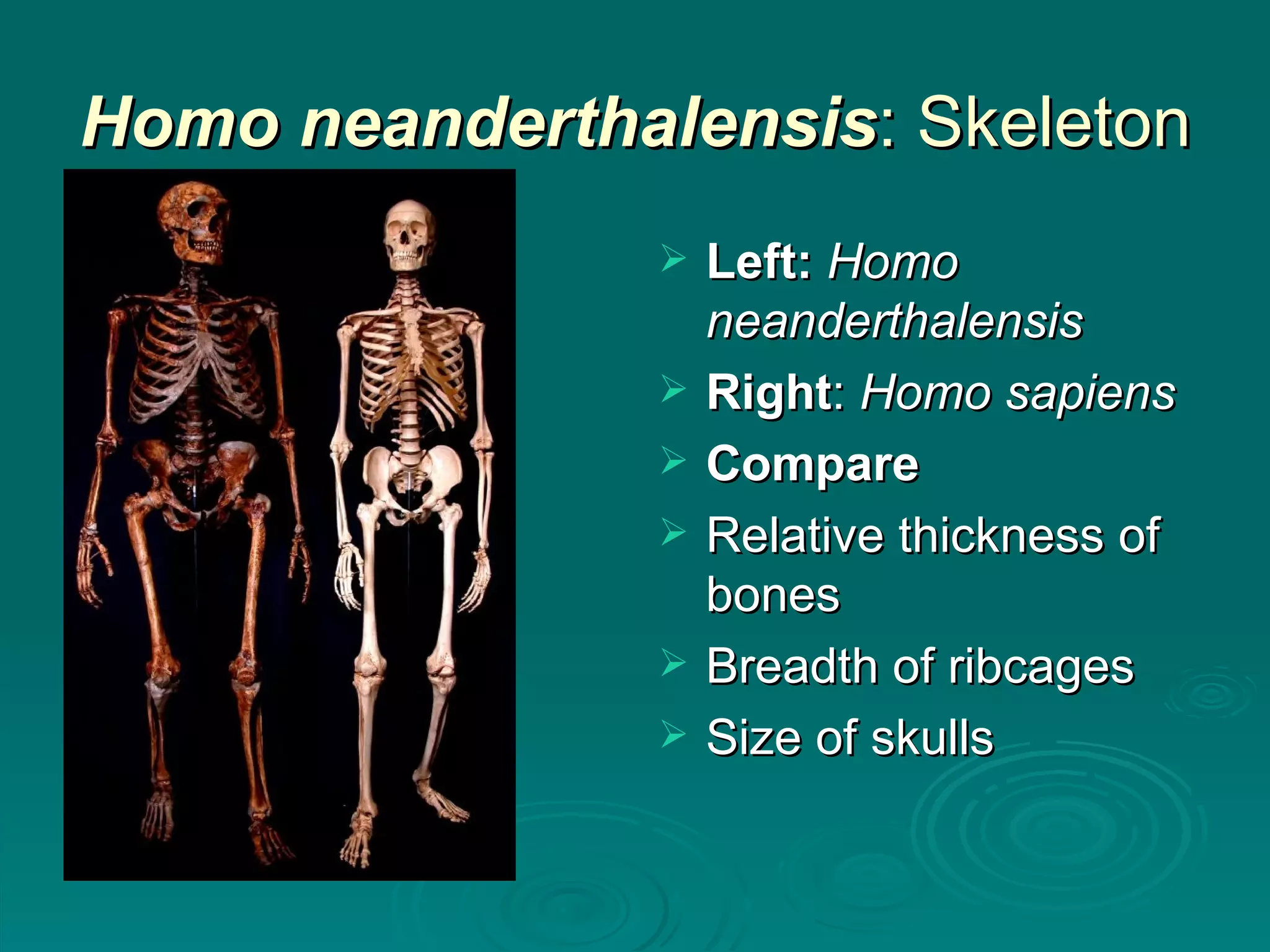
Homo neanderthalensis : Skeleton Left:   Homo neanderthalensis Right :  Homo sapiens Compare Relative thickness of bones Breadth of ribcages Size of skulls
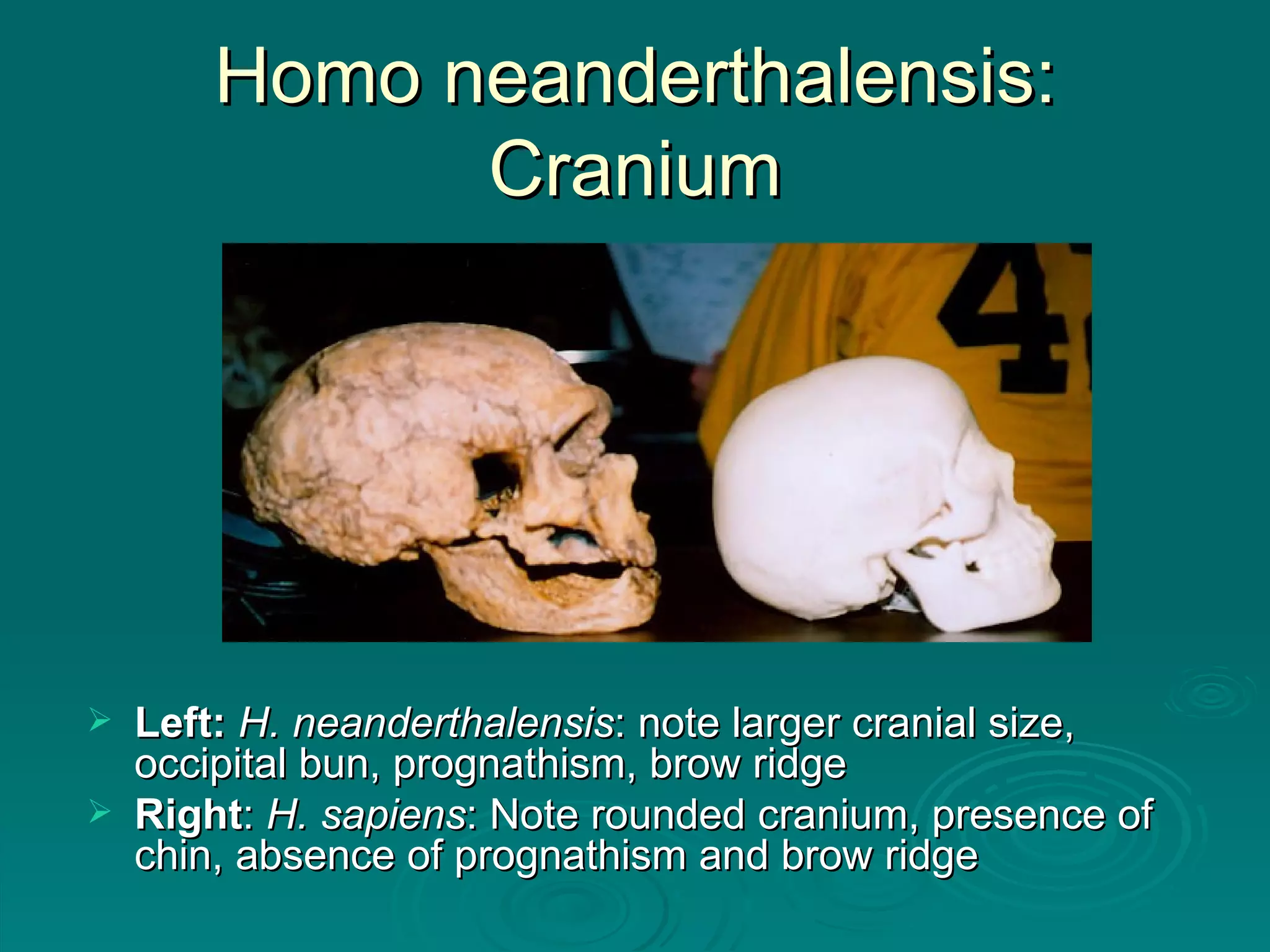
Homo neanderthalensis: Cranium Left:   H. neanderthalensis : note larger cranial size, occipital bun, prognathism, brow ridge Right :  H. sapiens : Note rounded cranium, presence of chin, absence of prognathism and brow ridge
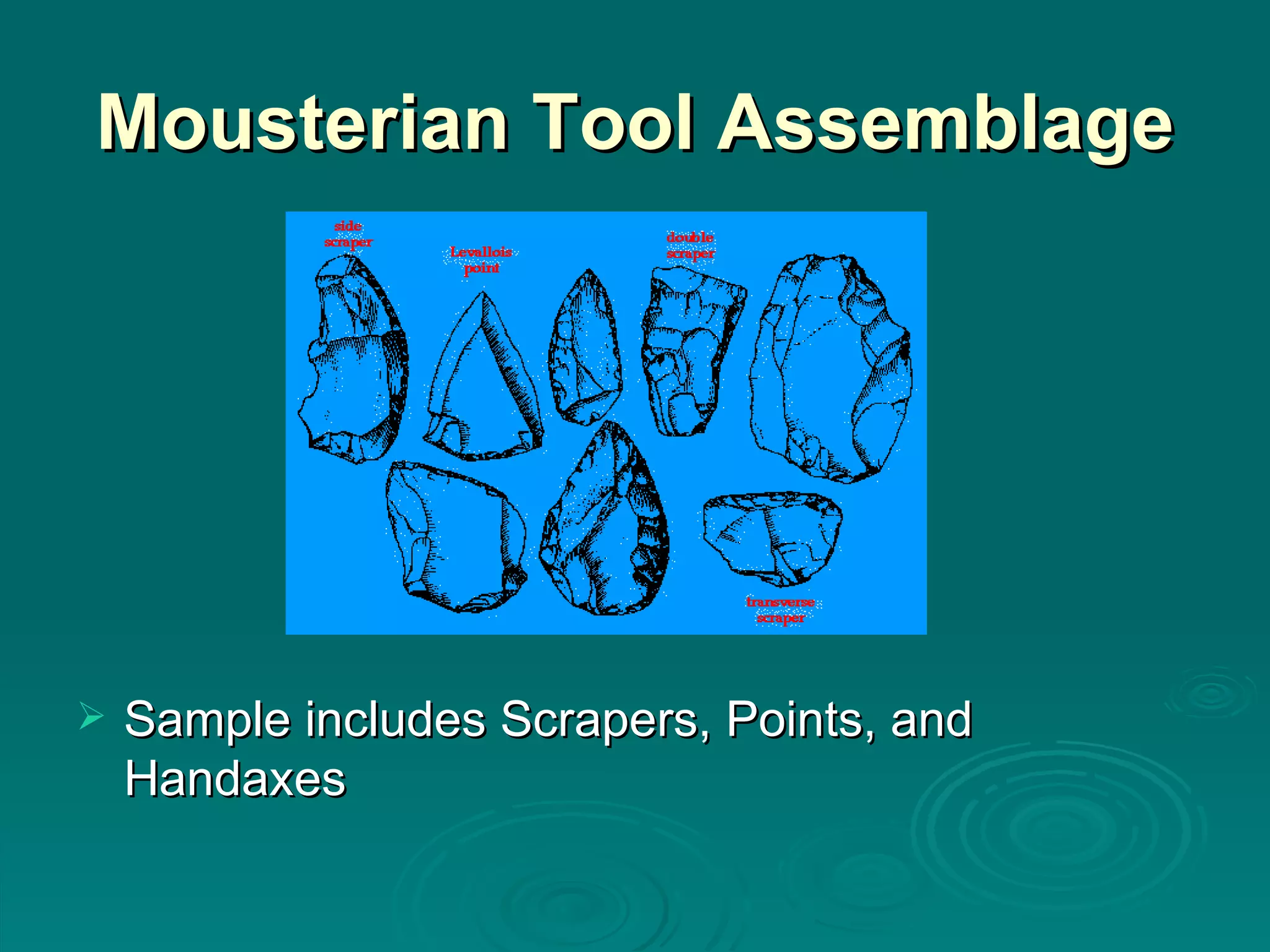
Mousterian Tradition Positively identified with Neanderhals Le Moustier, France is a Neanderthal site Belongs to  Middle Paleolithic More sophisticated than Oldowan or Acheulean, both  Lower Paleolithic
Mousterian Tool Assemblage Sample includes Scrapers, Points, and Handaxes
Upper Paleolithic: The Great Leap Forward? Probably begins about 50,000 BP Primary Attributes Shift from flake tools to blades Subsistence on greater range of animal and plant species Larger sites Increase of bone, antler, ivory, shell, and other materials for tools
Upper Paleolithic: Associated Attributes Associated Attributes Greater use of “imported” goods:  raw materials obtainable only from great distances from inhabited sites which suggests trade More elaborate burials, with grave goods Appearance and elaborate use of symbols and works of art.
Upper Paleolithic: The Blades Blades begin roughly 40,000 Years BP Comparative efficiency Levallois cores may produce 5 flakes Many more blades could be produced from same core--and with longer cutting edge Unlike other traditions, blade traditions are shorter lived Oldowan: from ca.2.5 m. yrs BP  Acheulean: from ca 1.9 m. yrs BP
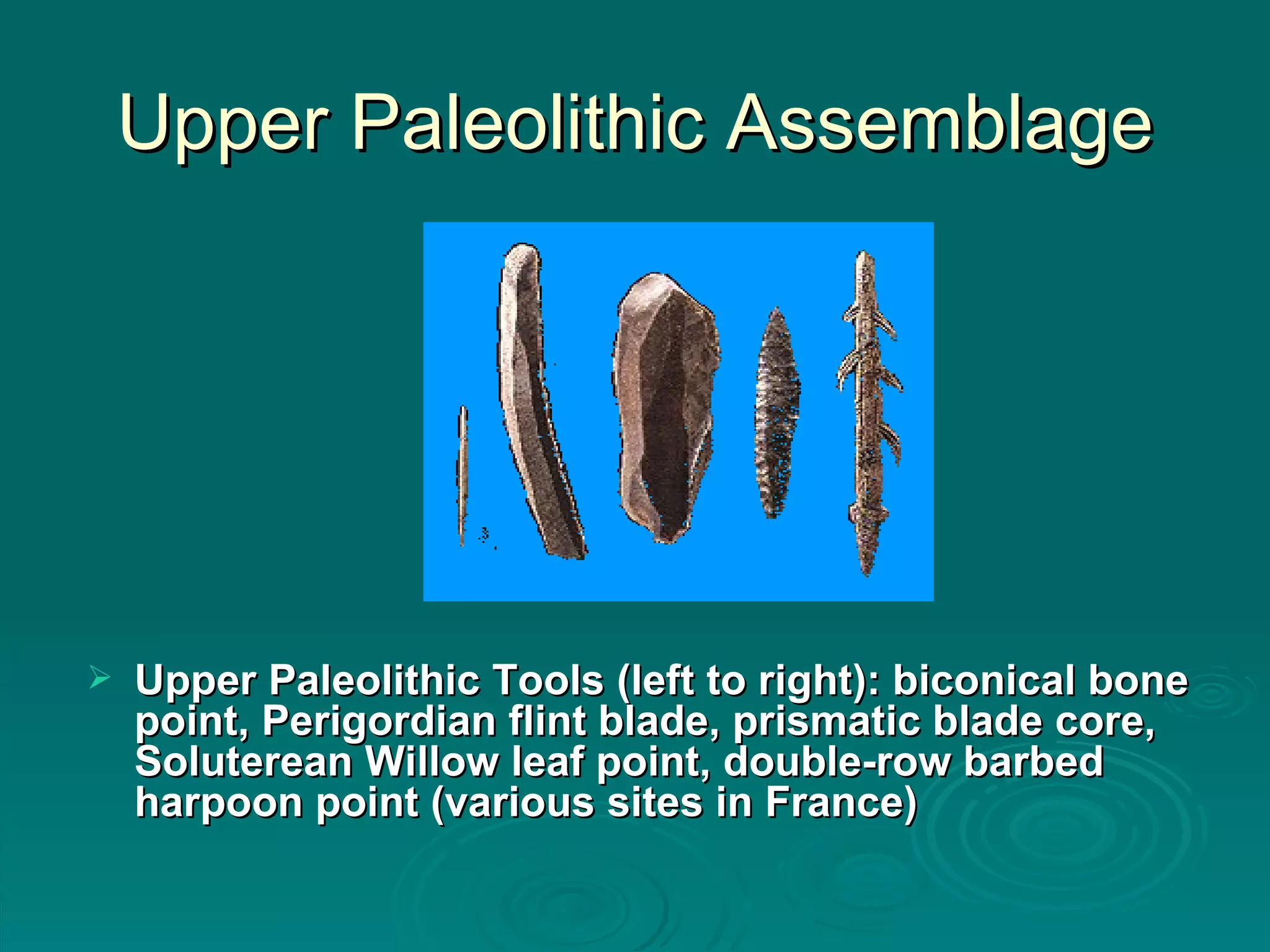
Upper Paleolithic Assemblage Upper Paleolithic Tools (left to right): biconical bone point, Perigordian flint blade, prismatic blade core, Soluterean Willow leaf point, double-row barbed harpoon point (various sites in France)
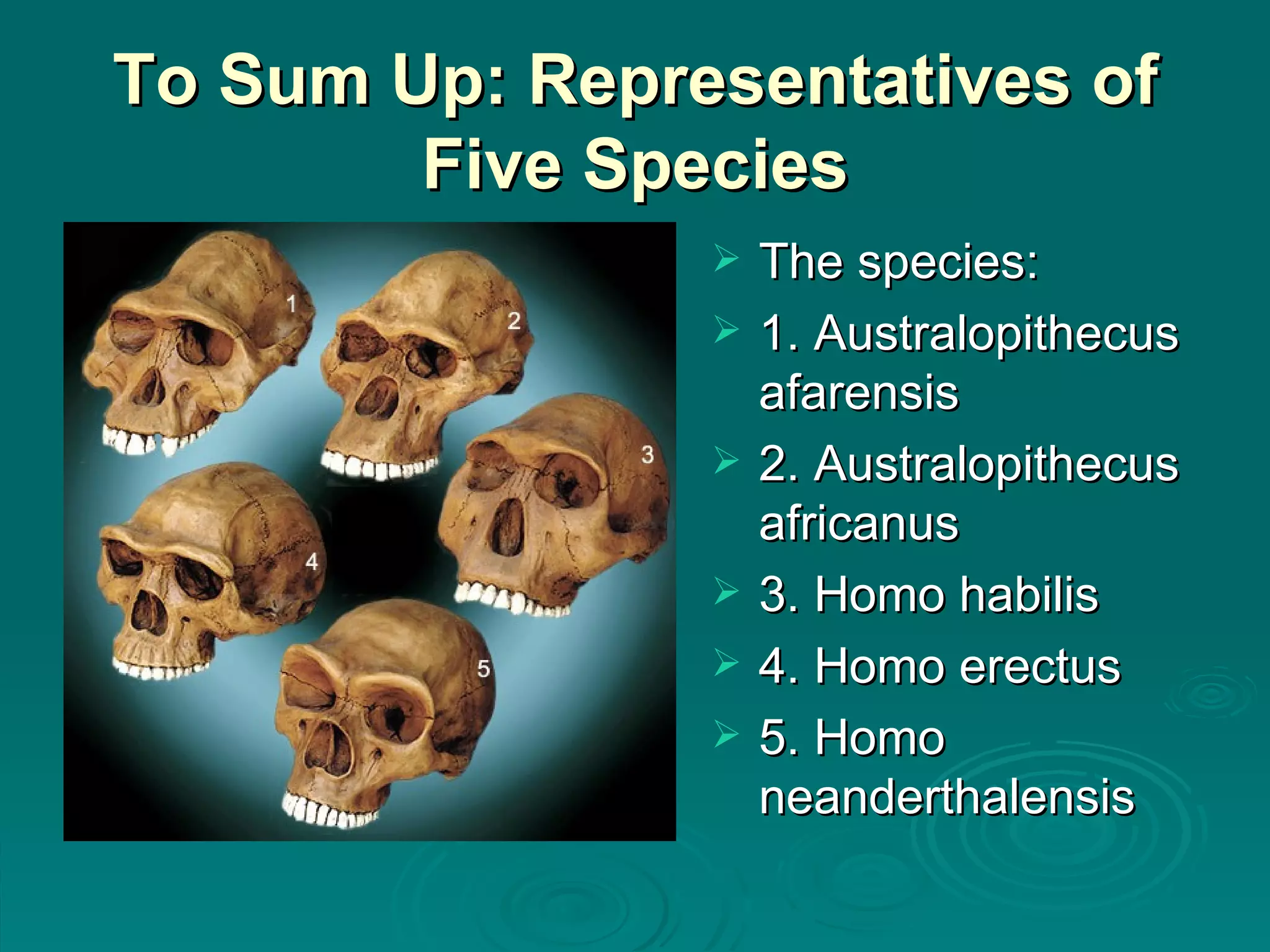
To Sum Up: Representatives of Five Species The species: 1. Australopithecus afarensis 2. Australopithecus africanus 3. Homo habilis 4. Homo erectus 5. Homo neanderthalensis

Fossil Hominins: From Australopithecus to Homo

  • 1.
    Fossil Hominins FromAustralopithecus to Homo
  • 2.
    Model of HumanEvolution: Australopithecus to Homo Australopithecus afarensis to A. africanus : Gracile Australopithecines Paranthropus robustus and boisei: Robust Australopithecines—Dead end? A. africanus to Homo habilis : Rise of tool manufacture? H. habilis to H. erectus: Global spread; increased tool assemblage H. erectus to H. sapiens: Tool specialization and population explosion H. neanderthalensis: Dead end?
  • 3.
    Fossil Hominins: GeneralTrends Large bulbous cranium Short face compared to ape Vertical carriage of head Hands and Forelimbs Adapted to Tool Making and Use Bipedal Structure of Postcranial Skeleton
  • 4.
    Fossil Trends: Encephalization(Cranial Capacity Increase) A. afarensis: 390-500 cc; av. 440 cc A. africanus: 435-530 cc; av. 450 cc A./P robustus: 520 cc, one specimen A.P. boisei: 500-530 cc; av. 515 cc. H. habilis: 500-800 cc; av. 680 cc. H. erectus: 750-1250 cc; av. 1000 cc Neanderthal: 1300-1750 cc. av: 1450 H. (s.) sapiens: 900-2350 cc. av. 1400
  • 5.
    Fossil Trends: Forelimbsand Hands Shortened forelimb Hands (manipulation, not locomotion) Enlarged thumb Straight, noncurved finger Enhanced finger sensitivity
  • 6.
    Fossil Hominins: GeneralTrends--Bipedalism S-shaped vertebrae (backbone) Short, wide, bowl-shaped pelvis Femoral head (ball of femur at pelvis) angled and strengthened Lengthened hindlimb Angle of knee: femur “slopes” to pelvis Platform (arched) structure of foot Nonopposable big toe; toes not curved
  • 7.
    Lucy ( Australopithecusafarensis ) and Us (Homo sapiens) Note the Following: Shorter (3’6”) Longer arms Curved fingers Shorter lower legs Greater prognathism Sloped forehead Smaller cranial capacity What are the Similarities? Hint: it’s all related to bipedalism
  • 8.
    Bipedalism: A. afarensisand H. sapiens compared, Fine Points
  • 9.
    When We BecameBipedal (According to Gary Larson) “ Hey! Look! No hands!” (Does he look like Lucy to you. . .?)
  • 10.
    Gracile and RobustAustralopithecines For A. africanus (top), note: Somewhat rounder skull No Sagittal crest Prognathous jaw For Paranthropus boisei, note: Sagittal crest (ate a lot of veggies) Massive lower jaw (mandible) Flatter face Massive cheek bones (zygomatic arch)
  • 11.
    Summary of AustralopithecinesCranial capacity increased marginally All australopithecines had Sloping foreheads Prominent brow ridges Prognathous lower face and jaws Bipedal postcranial skeletons Robust forms probably were dead ends Graciles likely evolved toward Homo .
  • 12.
    Australopithecus and HomoCompared—Frontal View Left: A. africanus Right: H. habilis Note: Different Cranial Capacities Brow Ridge Size
  • 13.
    Australopithecus and HomoCompared—Side View Top: A. africanus Bottom: H. habilis Compare: Mass of Jaws Size of Crania Prognathism
  • 14.
    Postorbital Constriction Left:Homo erectus Right: Australopithecus africanus Note the narrower constriction of A. africanus’s postorbital constriction than that of H. erectus
  • 15.
    Homo habilis: The First Known Toolmaker Note the following: Face is much flatter Reduced brow ridge (supraorbital torus) Larger cranial capacity (680 cc.) Toolmaking Technique Hammerstone used to strike A core (lump of stone) to knap A Flake (stone chip) Note: Stone has to be crystalline (so it will fracture predictably)
  • 16.
    Homo habilis Accordingto Gary Larson
  • 17.
    Australopithecines and HomoCompared I Cranial capacity Australopithecines: 400-530 cc Homo: 500-2300 Maximum braincase width Australopithecines: low on skull Homo: near top Postorbital constriction Australopithecines: marked Homo: moderate to slight
  • 18.
    Australopithecines and HomoCompared II Supraorbital torus (brow ridge) Australopithecines: large to moderate Homo: large to slight Zygomatic arch Australopithecines: large, flaring Homo: small, not flaring
  • 19.
    Australopithecines and HomoCompared III Facial size relative to brain case Australopithecines: large Homo: small Jaw A: Massive and prognathic; no chin H: Not massive Prognathism slight to nonexistent; Chin present in sapients Molars and premolars Australopithecines: large; afarensis with diastema Homo: small
  • 20.
    Australopithecines and HomoHabilis Compared: Skulls General trends Encephalization: Cranial capacity increases Dentition: Cheek teeth are reduced Sagittal Crest (where chewing muscles attach) A./P. robustus and boisei: pronounced A. africanus: sagittal keel or absent H. habilis: absent
  • 21.
    Australopithecines and HomoHabilis Compared: Skull/Face Braincase A./P. robustus/boisei: less rounded A. africanus: more rounded H. habilis: most rounded of the three Zygomatic arch A./P. robustus/boisei: very pronounced A. africanus: less pronounced H. habilis: far less pronounced than the australopithecines
  • 22.
    Homo habilis: Handsand Feet Hands Curvature of finger bones are apelike, indicate powerful grip (arboreal) Indications of greater manipulative skill Larger blood supply to hand than earlier hominids Evidence of greater nerve supply Feet: existing fragments indicate modern form: Remains lacked toes
  • 23.
    Tool Traditions: Oldowan Named after Olduvai Gorge Among the finds at Olduvai: Side chopper, a core tool Several flake tools, including End scraper Side scraper Burin Utilized flakes of unknown function Belongs to Lower Paleolithic
  • 24.
    Manufacturing Choppers ProcedureKnapper strikes a spherical piece of stone Flake falls off opposite side Tool flipped over and procedure repeated Several blows create a cutting edge Requirements reflect Intelligence Planning and foreknowledge of design Knowledge of breakage pattern of rock Hand-eye coordination
  • 25.
    Oldowan Tradition Endchopper Heavy duty scraper Flake scraper Spheroid Hammerstone Chopper Horn core tool or digger
  • 26.
    Homo habilis andHomo erectus Compared to H. habilis, H erectus had: Larger brain (1000 cc vs 680 cc average) Forehead flatter, less sloping More rounded occipital torus endocasts indicate hemispheric asymmetry Homo erectus and Homo sapiens
  • 27.
    Homo erectus or ergaster Note: Apelike but larger cranium Postcranial Skeleton Vertebrae: S Shaped Ribcage: Not funnel shaped, now like ours Pelvis: Bowl shaped Angle of Thighbone
  • 28.
    Homo erectus andHomo Sapiens: Cranium (Braincase) Forehead (Frontal) H. erectus: sloping; low and flat H. sapiens: vertical, indicating frontal lobe Supraorbital torus (brow ridge) H. erectus: prominent--extending as a bar H. sapiens: slight or absent Occipital torus: H. erectus: present H. sapiens: slight or absent
  • 29.
    Homo erectus andHomo sapiens: Cranium and Face Sagittal keel H. erectus: present; vestige of crest? H. sapiens: slight or absent Postorbital constriction H. erectus: pronounced H. sapiens: slight or nonexistent
  • 30.
    Homo erectus andHomo sapiens: Facial Skeleton Facial skeletion H. erectus: Relatively large, with large orbits and nasal opening H. sapiens: Relatively small, with small orbits and nasal opening Prognathism (jutting jaw) H. erectus: Pronounced H. sapiens: minimal or nonexistent
  • 31.
    Homo erectus and Homo sapiens skulls Compare: Brow ridges (supraorbital tori) Prognathism Constriction behind eye sockets (postorbital constriction) Presence versus absence of chin
  • 32.
    Tool Traditions: AcheuleanNamed after St. Acheul Characteristics of Acheulean handaxe Bifacial: both sides knapped Symmetrical in breadth Shaped to a point on one end The edge is thin and sharp Broad end is curved, but edge is still sharp Part of Lower Paleolithic
  • 33.
    Acheulean Axe as“Swiss Army Knife”; Abbevillean variation Swiss Army Rock? Sharp tip: used for piercing Thin edge: used for cutting (hide or meat off bone) Broad end: used for chopping or scraping Abbevillean Variation: Bifacial, like the Acheulean Not quite so symmetrical Olduvai specimen: transitional type?
  • 34.
    Manufacturing Acheulean HandaxesA demanding task Symmetrical, finely shaped Dozens of flakes removed, from 25 to 75 Each flake blow must be precisely positioned Core must be turned over again and again to maintain symmetry to keep edge straight All the exterior rind ( cortex ) was removed
  • 35.
    Abbevillian and AcheuleanHandaxes Left: Abbevillian. Note asymmetry, rough retouch Right: Acheulean. Note symmetry, fine retouch
  • 36.
    Homo heidelbergensis or “Archaic” Homo sapiens Left: Skull. Note heavy brow ridge, prognathism Right: Mandible. Note arc-like dental arcade, absence of diastema, absence of chin
  • 37.
    Manufacturing Levallois Coresand Flakes Knappers Draw outline of flake on stone module Strikes flake of desired shape Requires knowledge of breakage pattern of rock Prepares rock beforehand to control how rock breaks when struck Ensure right shape (e.g. cutting, perforation, piercing) is struck
  • 38.
    Levallois Flake andFlaking Technique
  • 39.
    Homo neanderthalensis :Skeleton Left: Homo neanderthalensis Right : Homo sapiens Compare Relative thickness of bones Breadth of ribcages Size of skulls
  • 40.
    Homo neanderthalensis: CraniumLeft: H. neanderthalensis : note larger cranial size, occipital bun, prognathism, brow ridge Right : H. sapiens : Note rounded cranium, presence of chin, absence of prognathism and brow ridge
  • 41.
    Mousterian Tradition Positivelyidentified with Neanderhals Le Moustier, France is a Neanderthal site Belongs to Middle Paleolithic More sophisticated than Oldowan or Acheulean, both Lower Paleolithic
  • 42.
    Mousterian Tool AssemblageSample includes Scrapers, Points, and Handaxes
  • 43.
    Upper Paleolithic: TheGreat Leap Forward? Probably begins about 50,000 BP Primary Attributes Shift from flake tools to blades Subsistence on greater range of animal and plant species Larger sites Increase of bone, antler, ivory, shell, and other materials for tools
  • 44.
    Upper Paleolithic: AssociatedAttributes Associated Attributes Greater use of “imported” goods: raw materials obtainable only from great distances from inhabited sites which suggests trade More elaborate burials, with grave goods Appearance and elaborate use of symbols and works of art.
  • 45.
    Upper Paleolithic: TheBlades Blades begin roughly 40,000 Years BP Comparative efficiency Levallois cores may produce 5 flakes Many more blades could be produced from same core--and with longer cutting edge Unlike other traditions, blade traditions are shorter lived Oldowan: from ca.2.5 m. yrs BP Acheulean: from ca 1.9 m. yrs BP
  • 46.
    Upper Paleolithic AssemblageUpper Paleolithic Tools (left to right): biconical bone point, Perigordian flint blade, prismatic blade core, Soluterean Willow leaf point, double-row barbed harpoon point (various sites in France)
  • 47.
    To Sum Up:Representatives of Five Species The species: 1. Australopithecus afarensis 2. Australopithecus africanus 3. Homo habilis 4. Homo erectus 5. Homo neanderthalensis