THE AUDIENCE IS ALWAYS RIGHT
HOW PEOPLE'S BEHAVIOUR CHANGE THE WAY BRANDS WILL DO MARKETING


                                                          T BWA
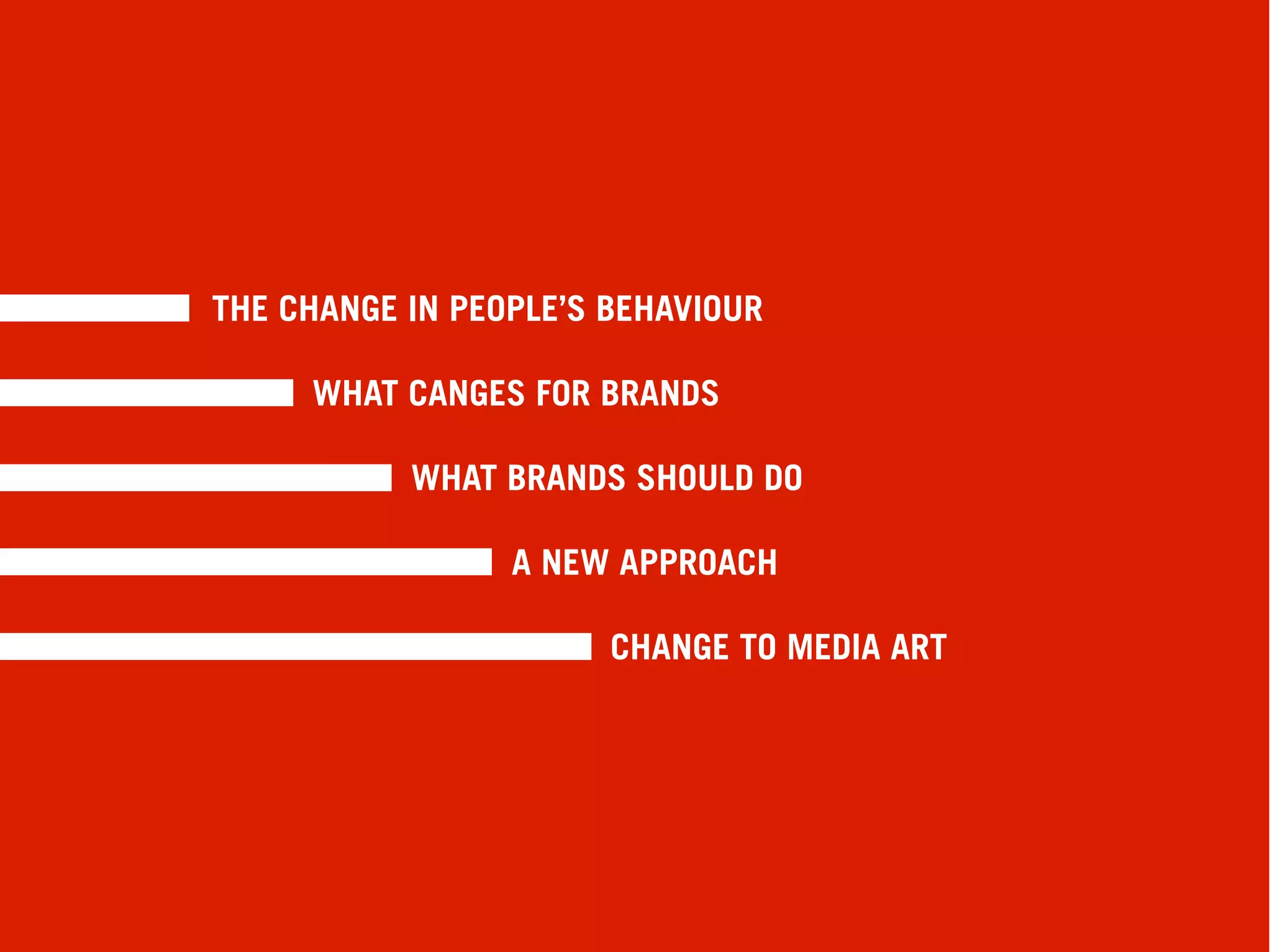
THE CHANGE IN PEOPLE’S BEHAVIOUR

     WHAT CANGES FOR BRANDS

           WHAT BRANDS SHOULD DO

                 A NEW APPROACH

                       CHANGE TO MEDIA ART
“We are at the beginning of the most
 exciting time the advertising business has
 ever seen. While lots of people are talking
   about the challenge of the multi-media
future, I believe it is the biggest opportunity
     for creative minds since the ‘60’s.”
            Lee Clow, Director of Media Arts, TBWA Worldwide
THE CHANGE IN PEOPLE’S BEHAVIOUR
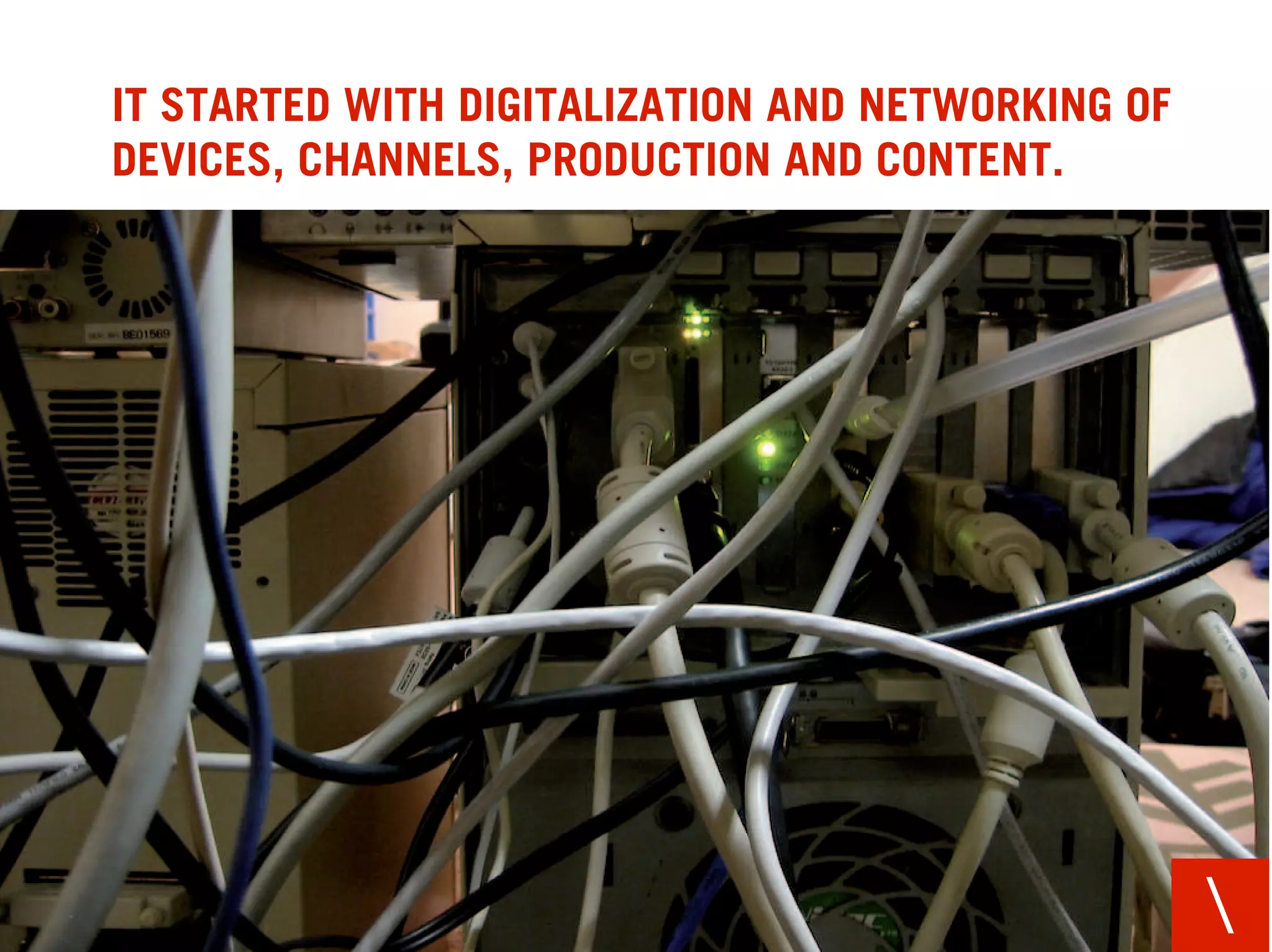
IT STARTED WITH DIGITALIZATION AND NETWORKING OF
DEVICES, CHANNELS, PRODUCTION AND CONTENT.
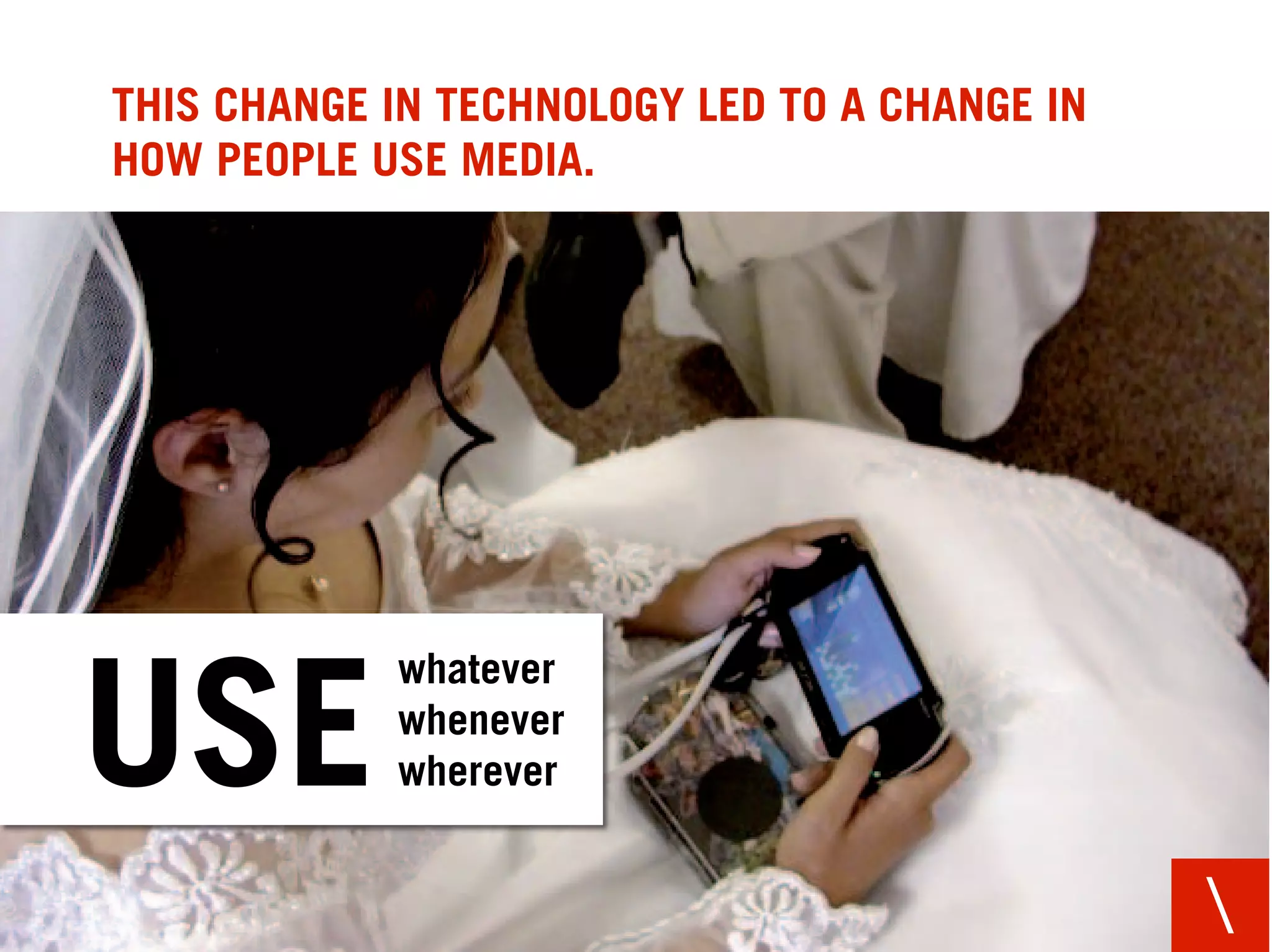
THIS CHANGE IN TECHNOLOGY LED TO A CHANGE IN
HOW PEOPLE USE MEDIA.


            whatever

USE         whenever
            wherever
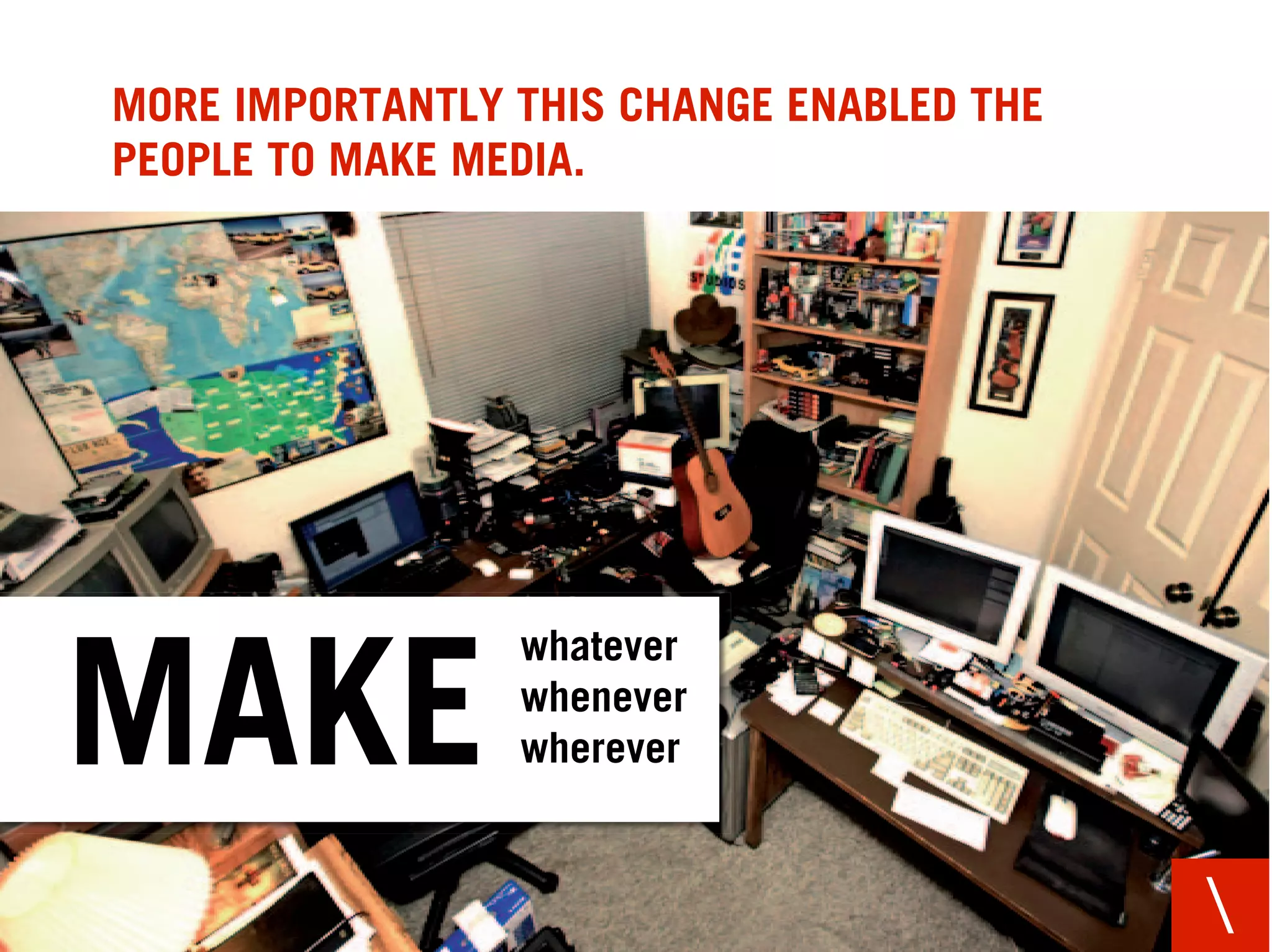
MORE IMPORTANTLY THIS CHANGE ENABLED THE
PEOPLE TO MAKE MEDIA.


                 whatever

MAKE             whenever
                 wherever
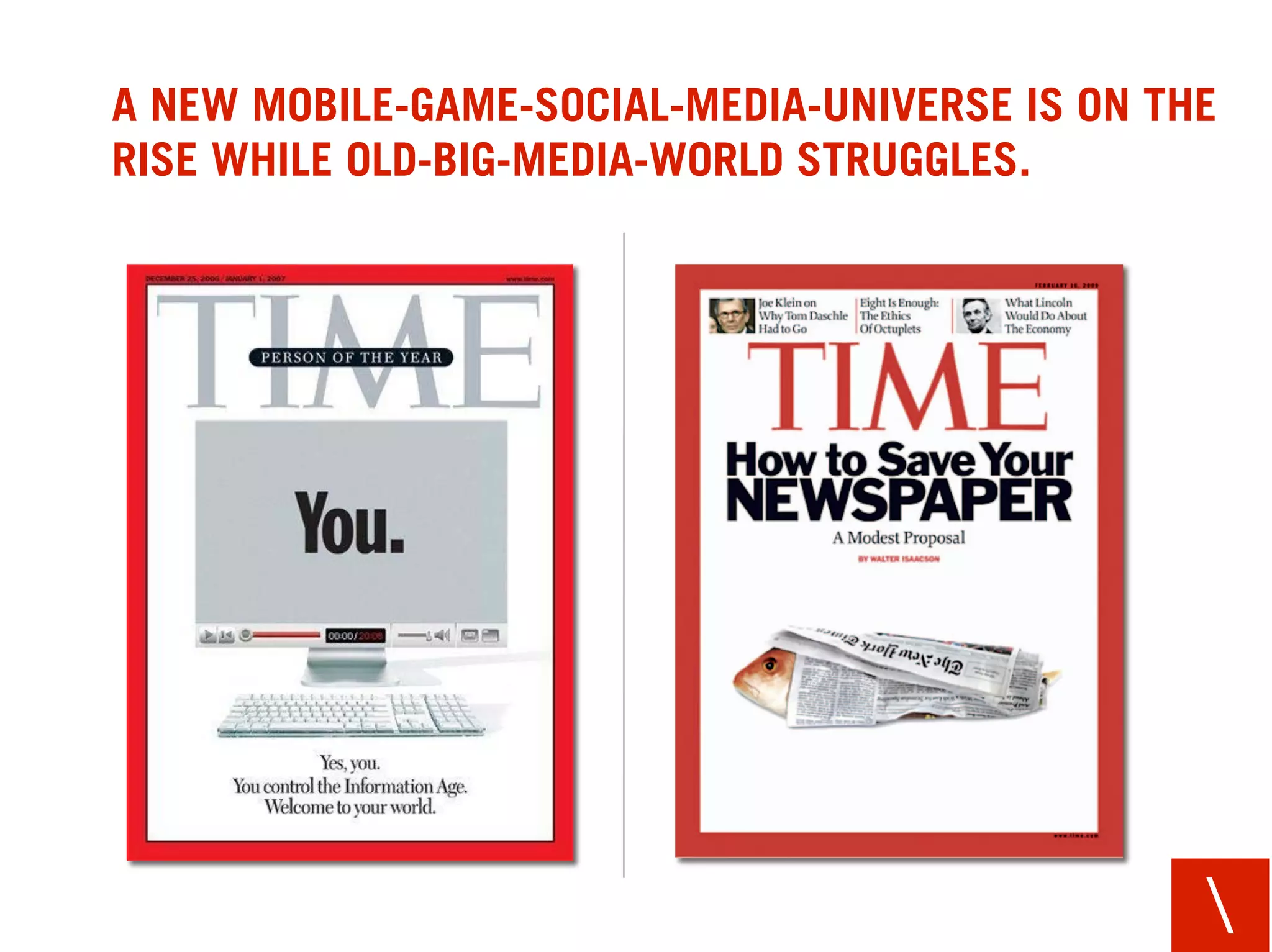
A NEW MOBILE-GAME-SOCIAL-MEDIA-UNIVERSE IS ON THE
RISE WHILE OLD-BIG-MEDIA-WORLD STRUGGLES.
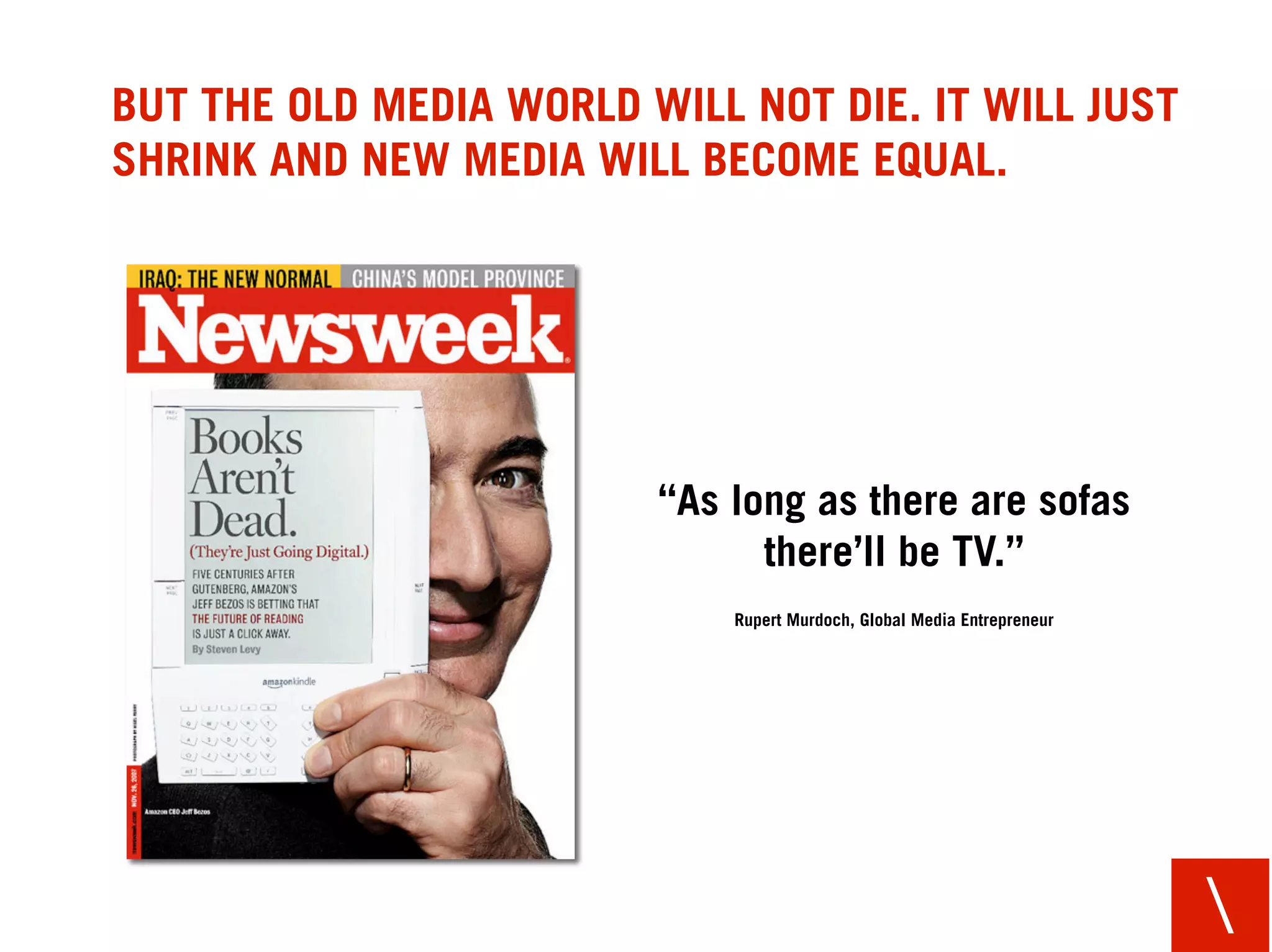
BUT THE OLD MEDIA WORLD WILL NOT DIE. IT WILL JUST
SHRINK AND NEW MEDIA WILL BECOME EQUAL.


                         “As long as there are sofas
                               there’ll be TV.”
                             Rupert Murdoch, Global Media Entrepreneur
“We will see neutral evaluation of all
 media formats. There is no primary
   role for linear TV any more.”
      “The end of advertising as we know it”, IBM Corp., 2007
“Technology is shifting the power away
    from the editors, the publishers,
  the establishment, the media elite.
Now it‘s the people who are in control.”
          Rupert Murdoch, Global Media Entrepreneur
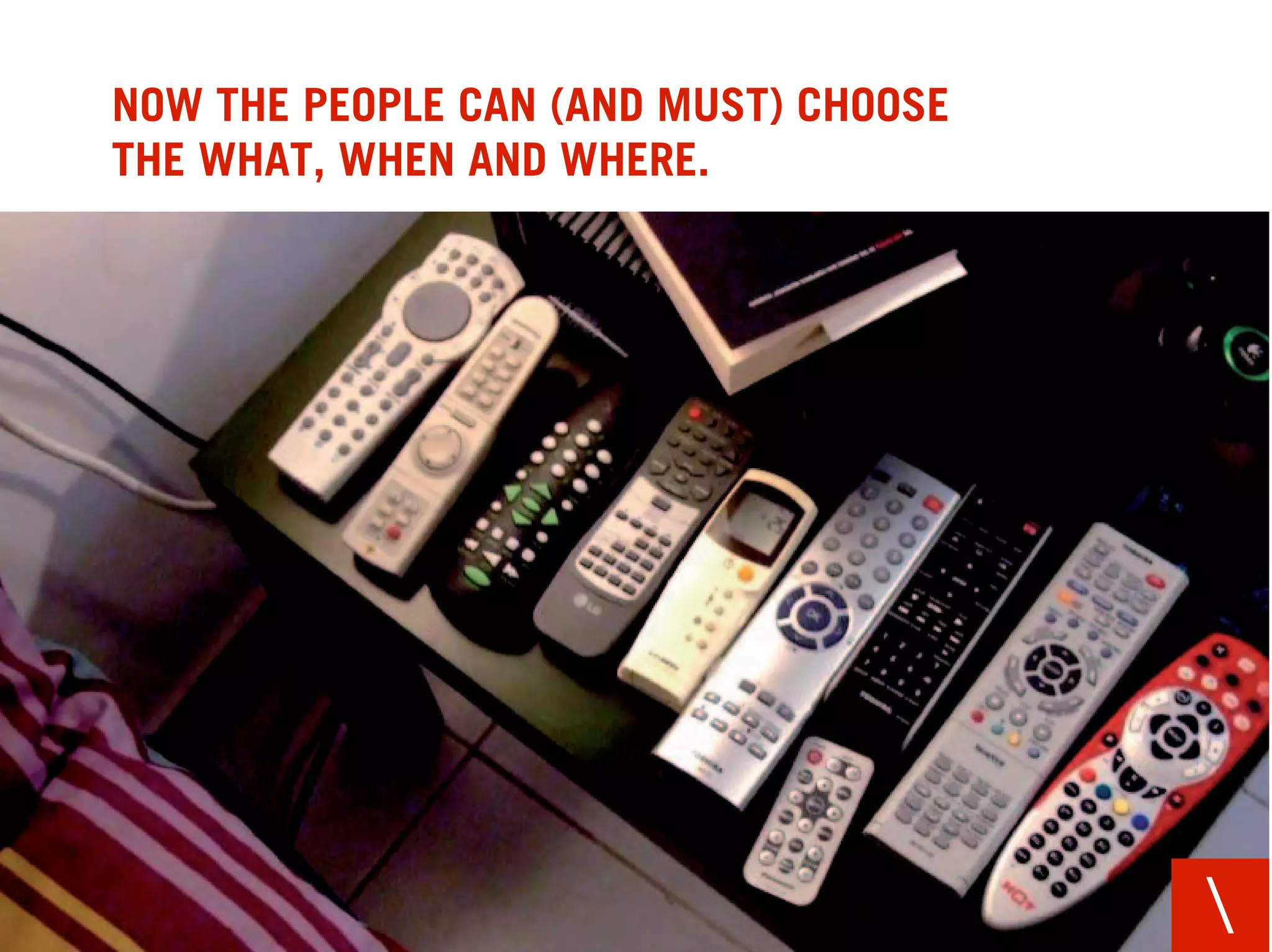
NOW THE PEOPLE CAN (AND MUST) CHOOSE
THE WHAT, WHEN AND WHERE.
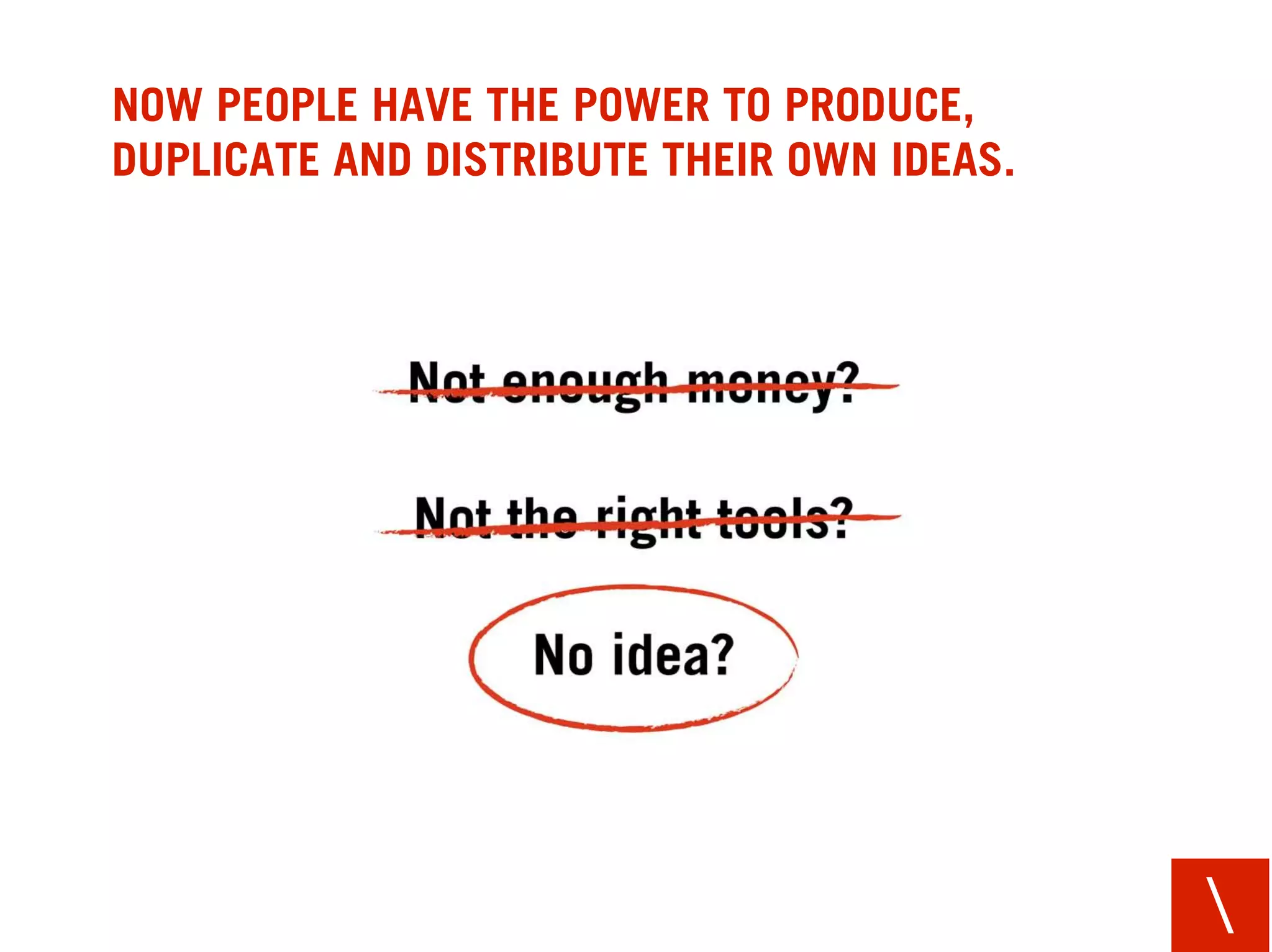
NOW PEOPLE HAVE THE POWER TO PRODUCE,
DUPLICATE AND DISTRIBUTE THEIR OWN IDEAS.
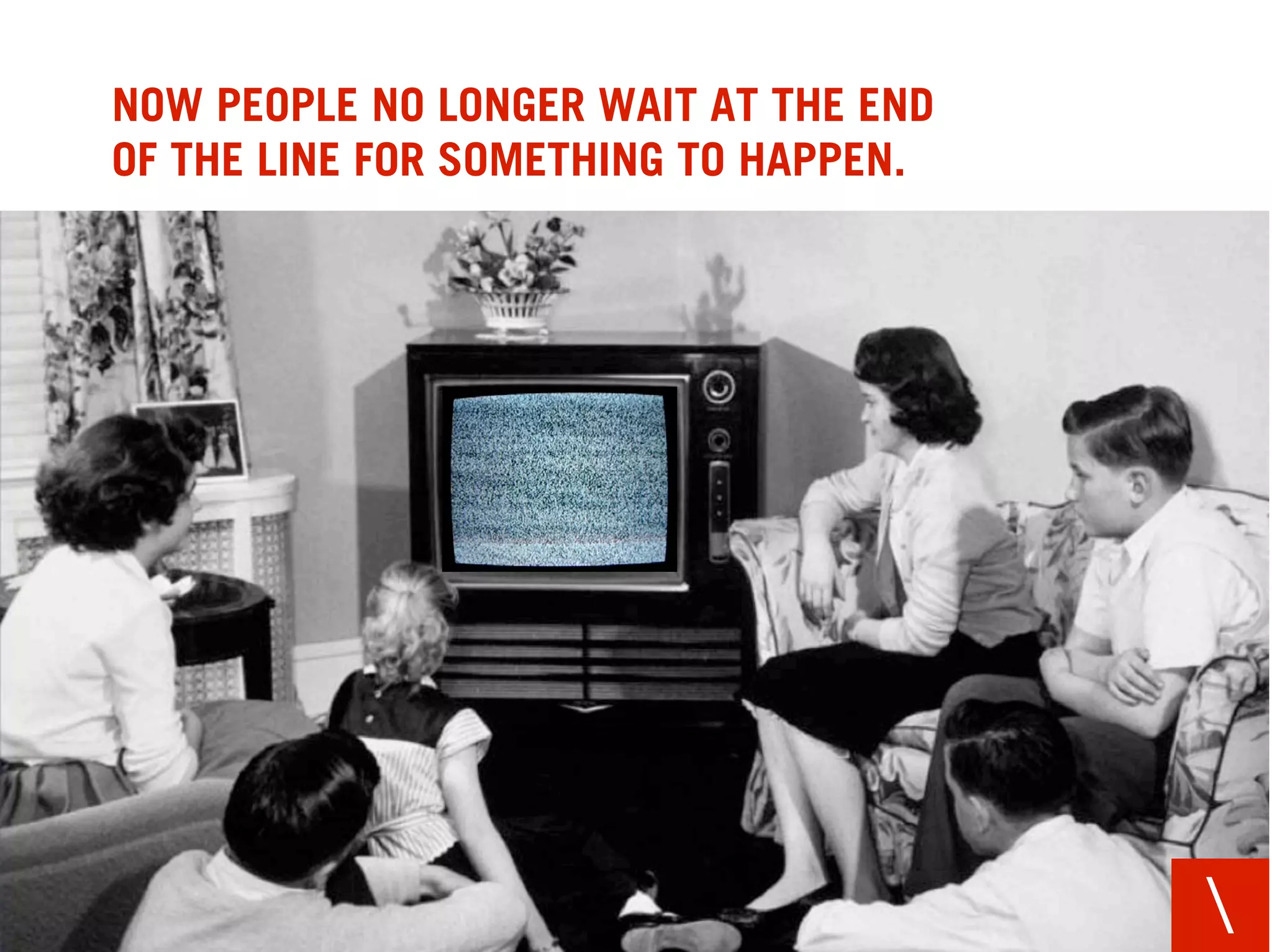
NOW PEOPLE NO LONGER WAIT AT THE END
OF THE LINE FOR SOMETHING TO HAPPEN.
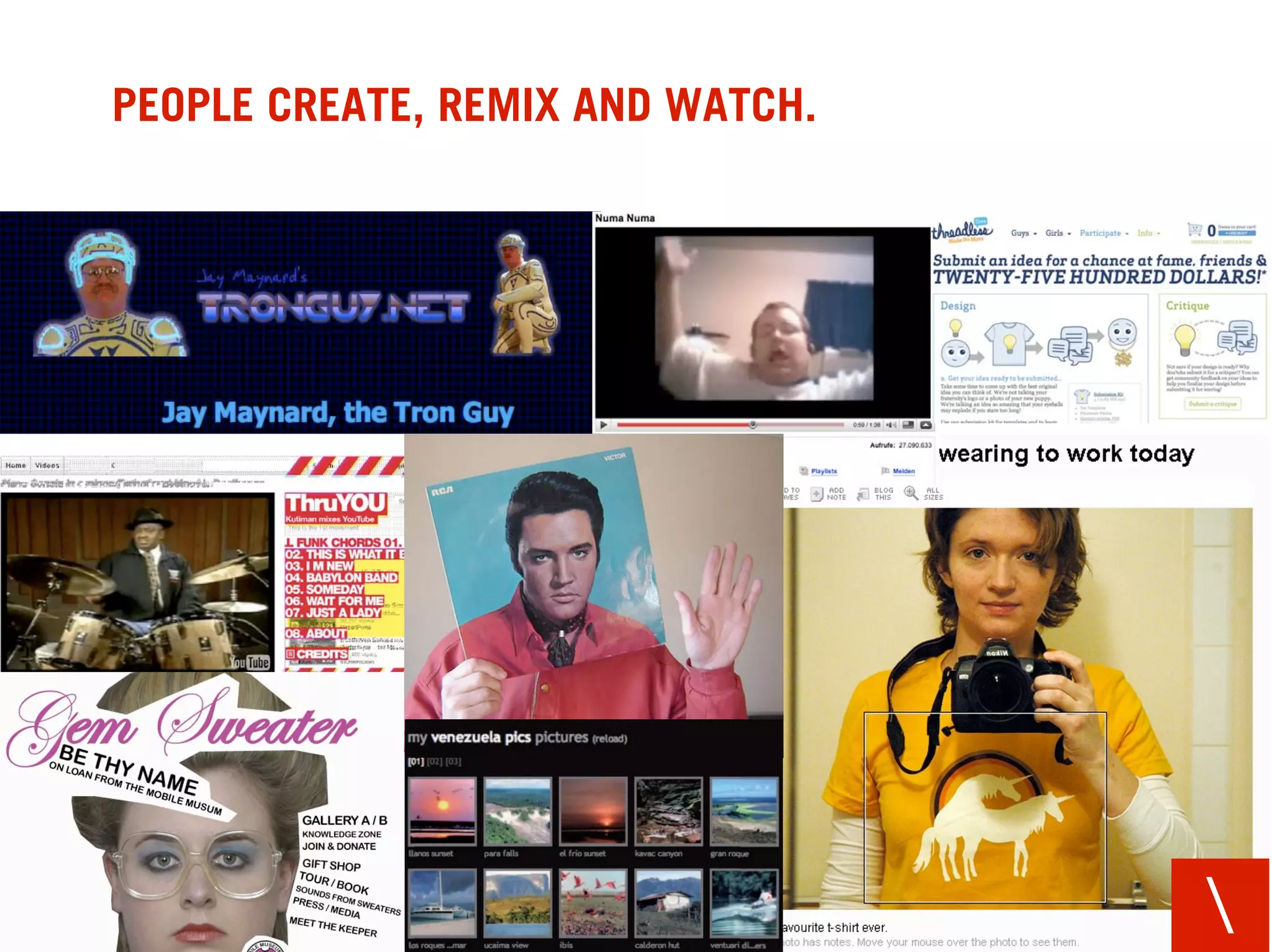
PEOPLE CREATE, REMIX AND WATCH.
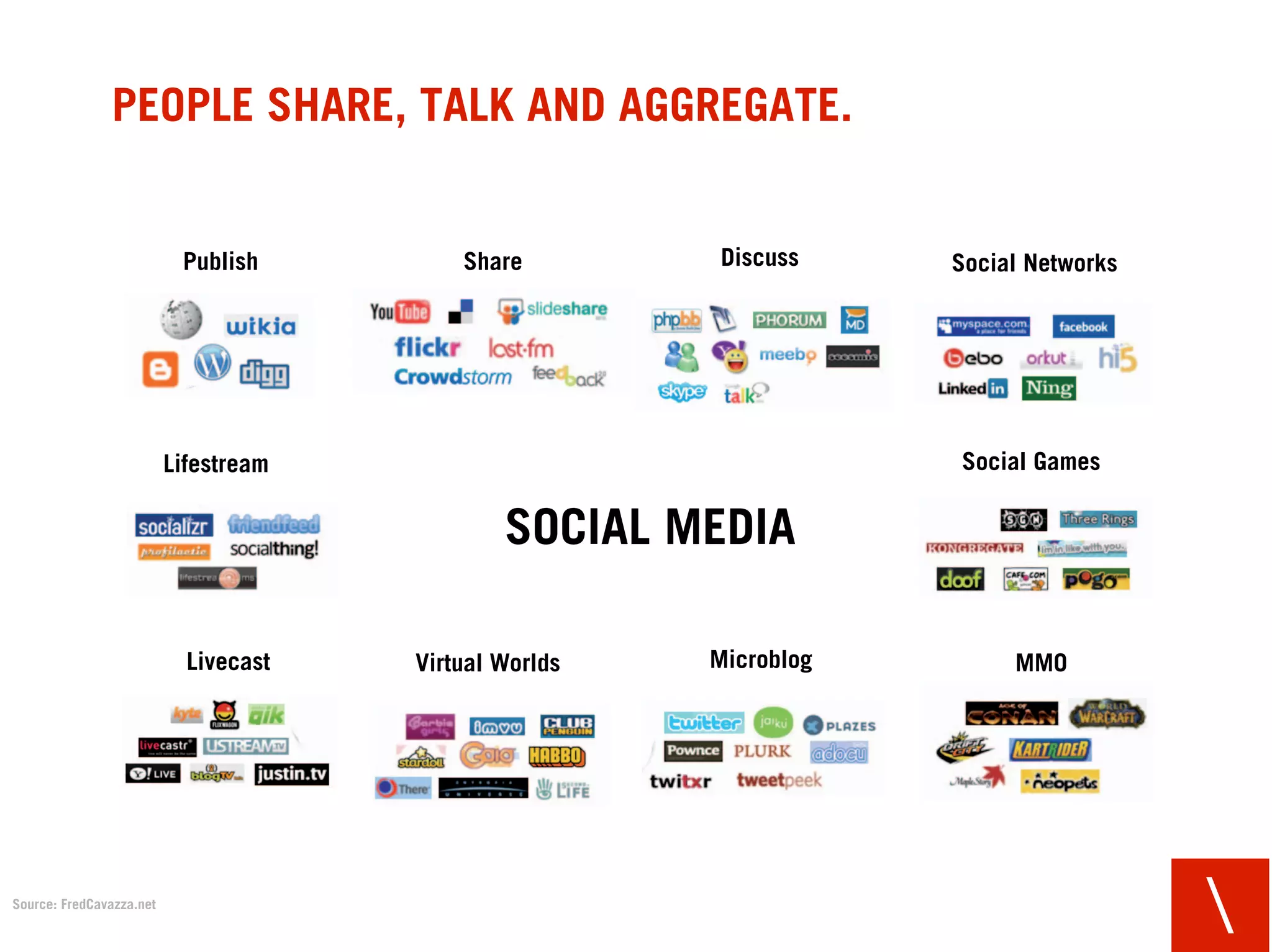
PEOPLE SHARE, TALK AND AGGREGATE.


                           Publish         Share        Discuss     Social Networks


                          Lifestream                                Social Games


                                               SOCIAL MEDIA

                            Livecast   Virtual Worlds   Microblog        MMO


Source: FredCavazza.net
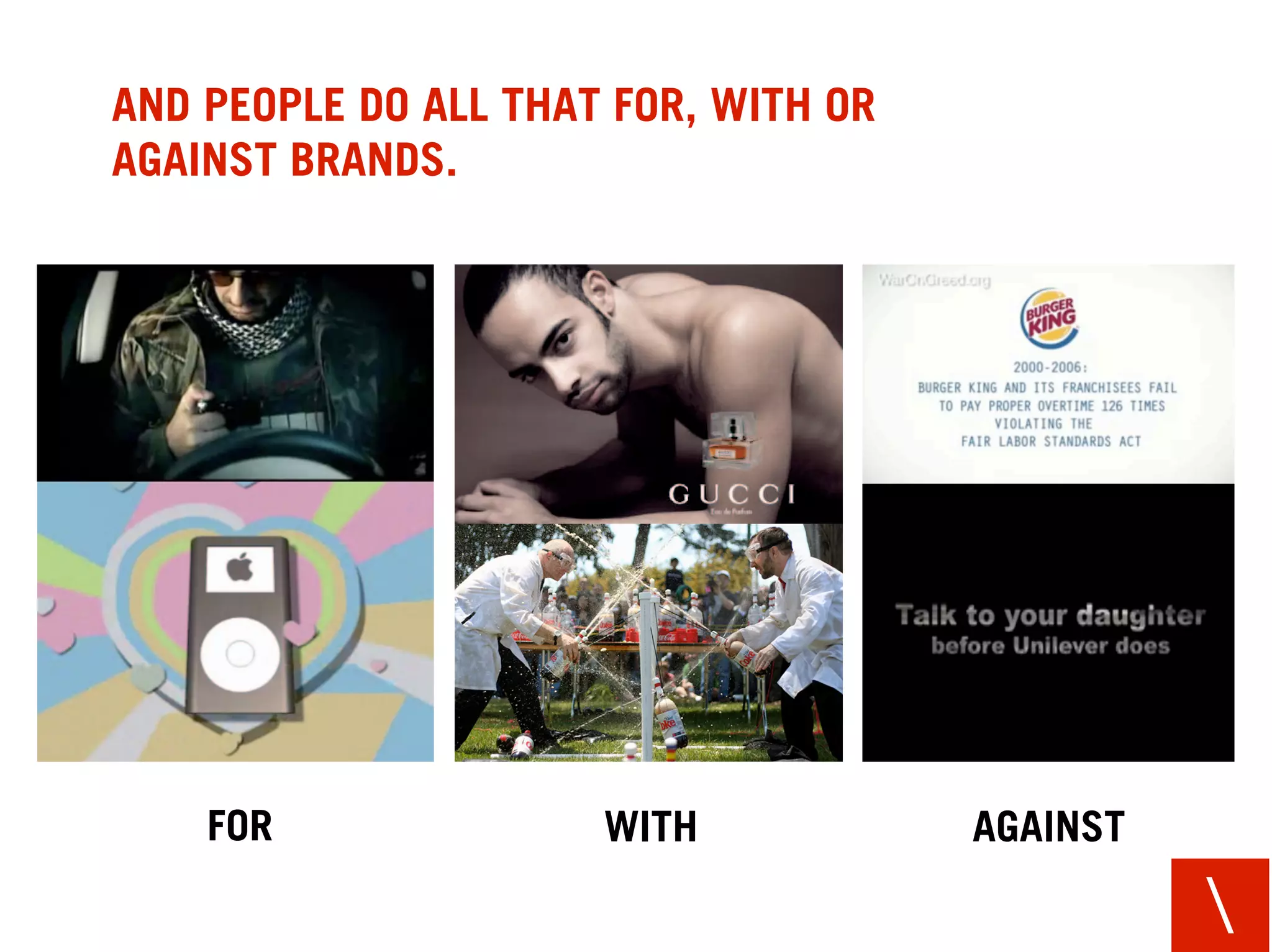
AND PEOPLE DO ALL THAT FOR, WITH OR
AGAINST BRANDS.


    FOR               WITH            AGAINST
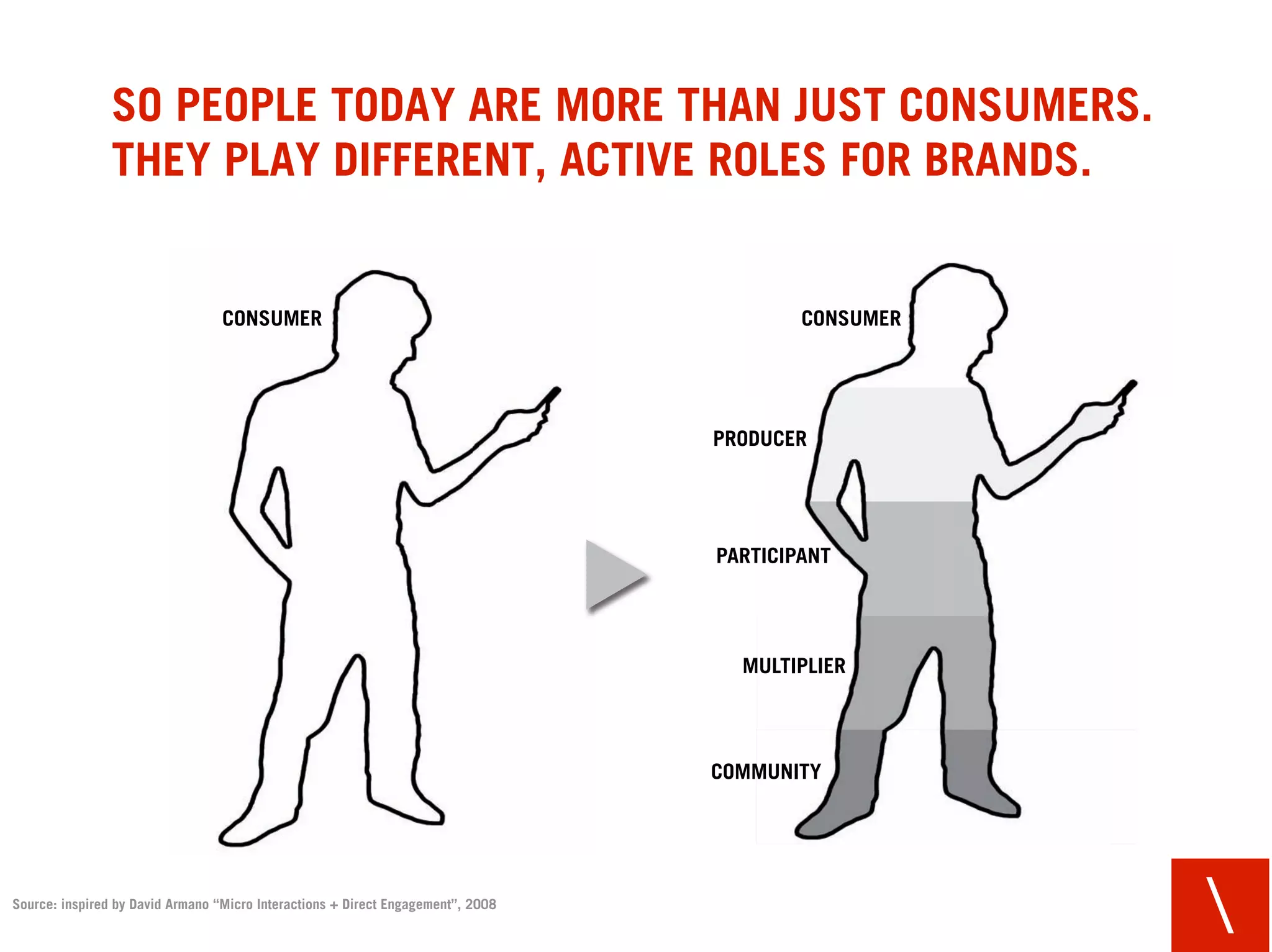
SO PEOPLE TODAY ARE MORE THAN JUST CONSUMERS.
                THEY PLAY DIFFERENT, ACTIVE ROLES FOR BRANDS.


                                  CONSUMER                                                CONSUMER


                                                                                  PRODUCER


                                                                                  PARTICIPANT


                                                                                    MULTIPLIER


                                                                                  COMMUNITY


Source: inspired by David Armano “Micro Interactions + Direct Engagement”, 2008
“Consumers are beginning in a very
   real sense to own our brands
and participate in their creation …
We need to begin to learn to let go.”
        A.G. Lafley, CEO and Chairman, Procter & Gamble
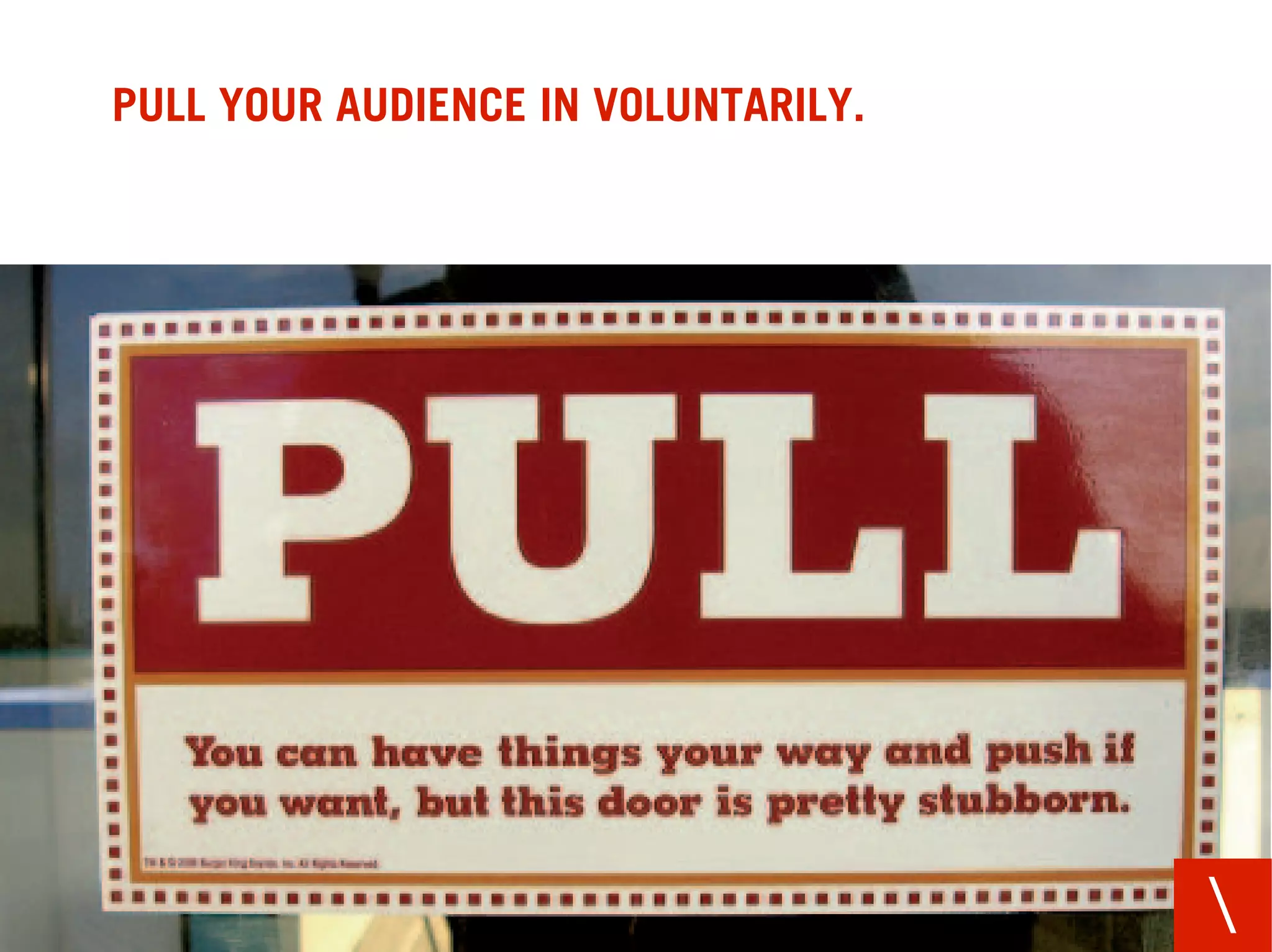
WHAT CHANGES FOR BRANDS
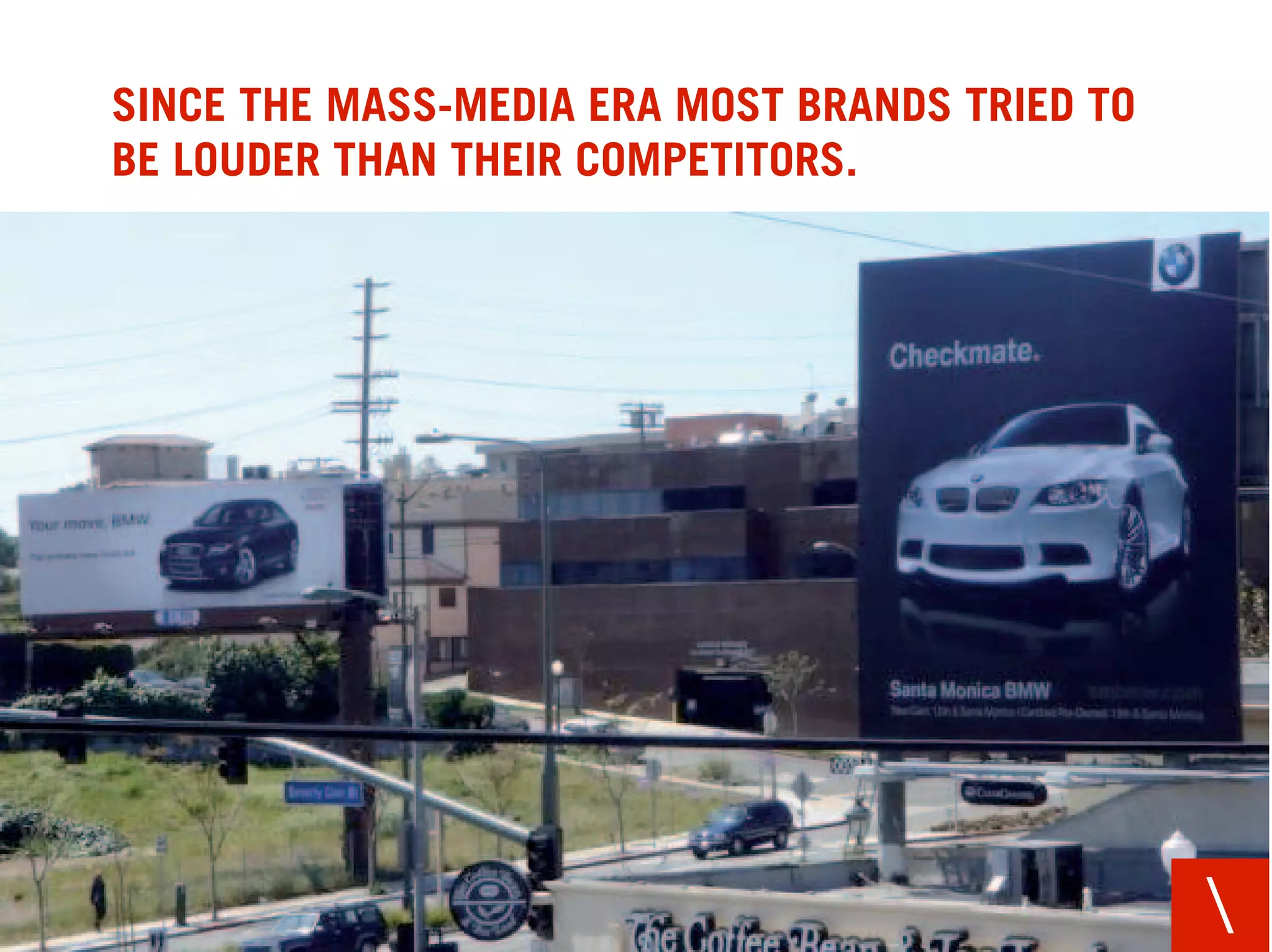
SINCE THE MASS-MEDIA ERA MOST BRANDS TRIED TO
BE LOUDER THAN THEIR COMPETITORS.
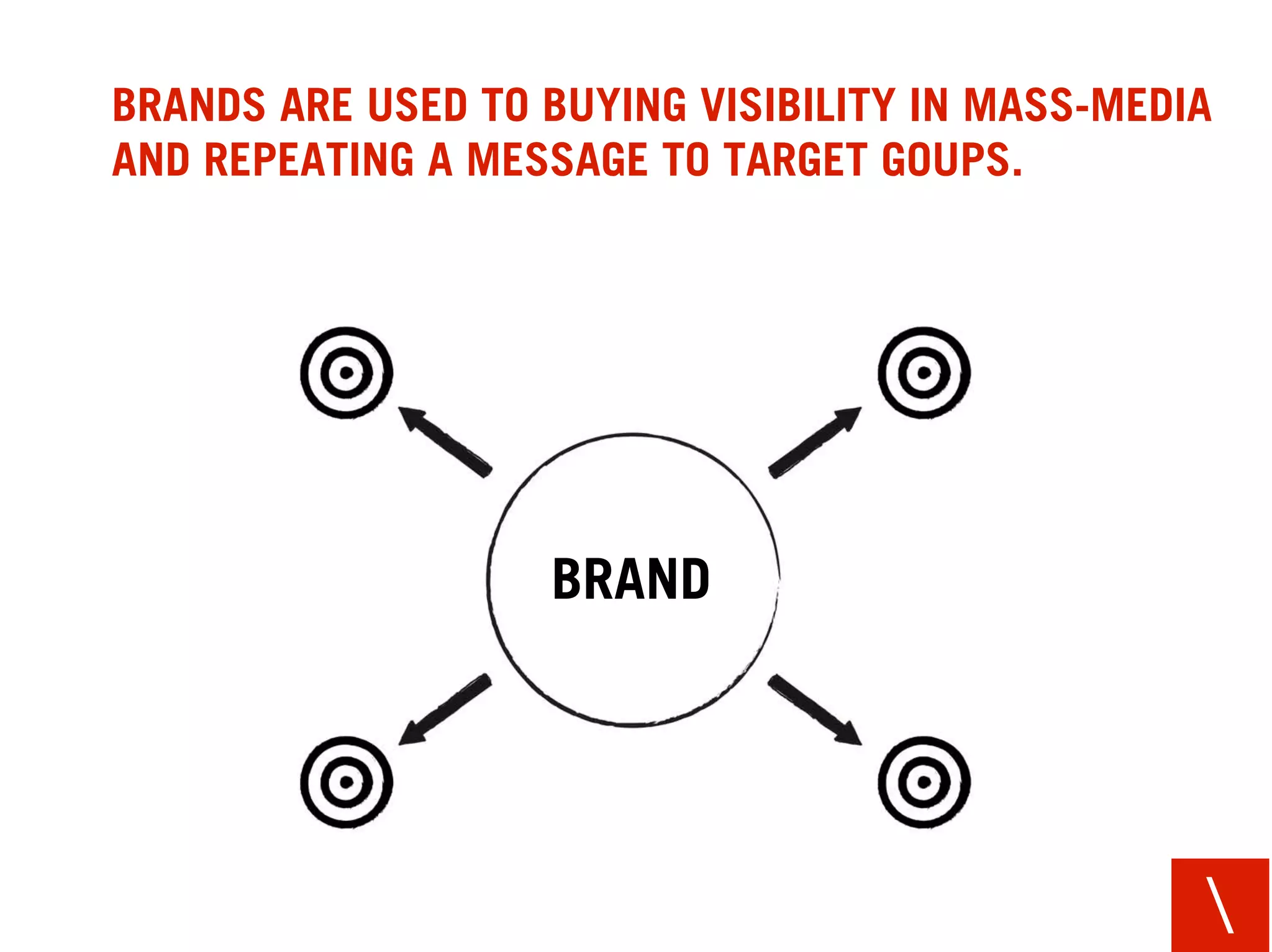
BRANDS ARE USED TO BUYING VISIBILITY IN MASS-MEDIA
AND REPEATING A MESSAGE TO TARGET GOUPS.


                   BRAND
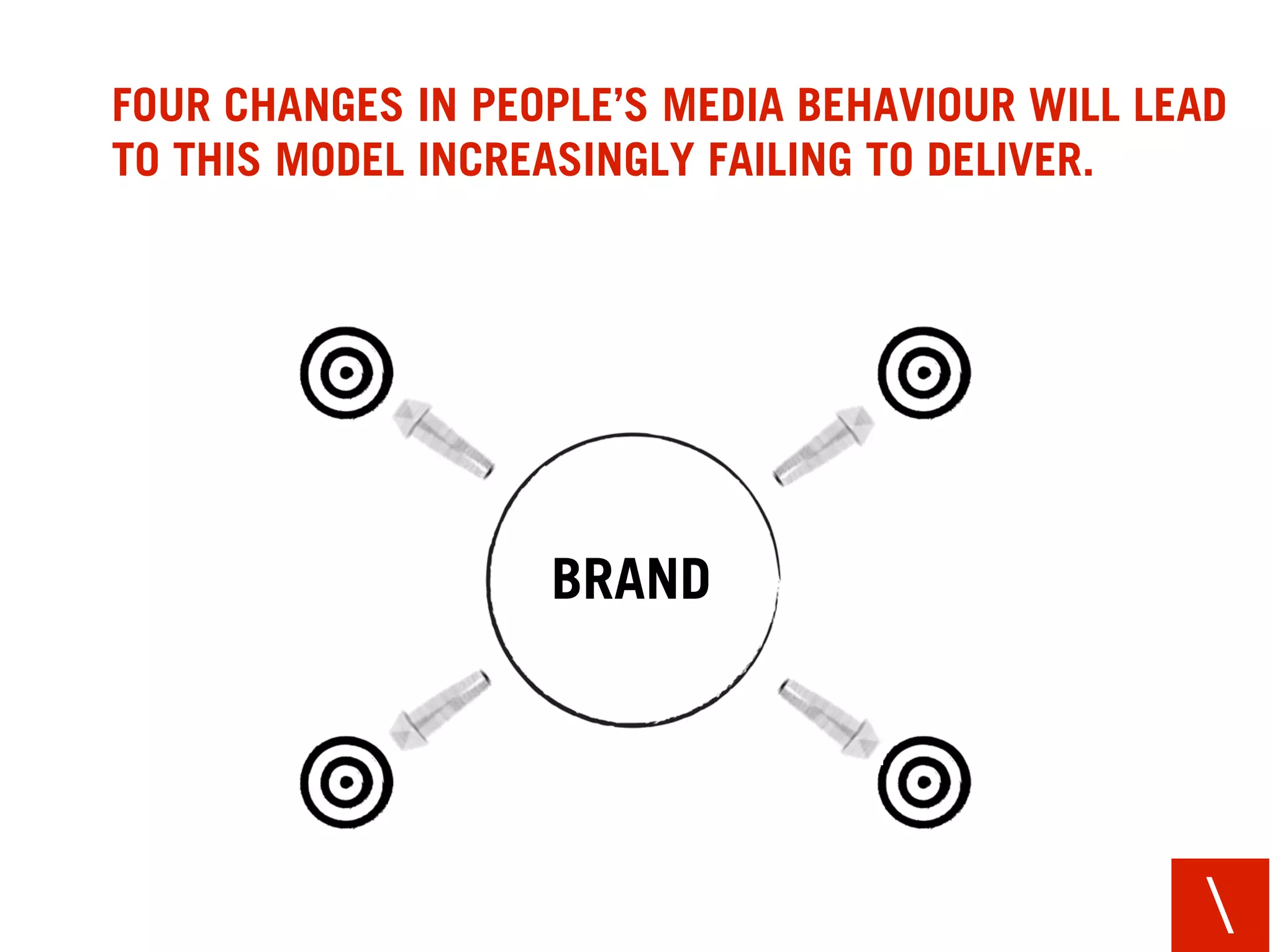
FOUR CHANGES IN PEOPLE’S MEDIA BEHAVIOUR WILL LEAD
TO THIS MODEL INCREASINGLY FAILING TO DELIVER.


                   BRAND
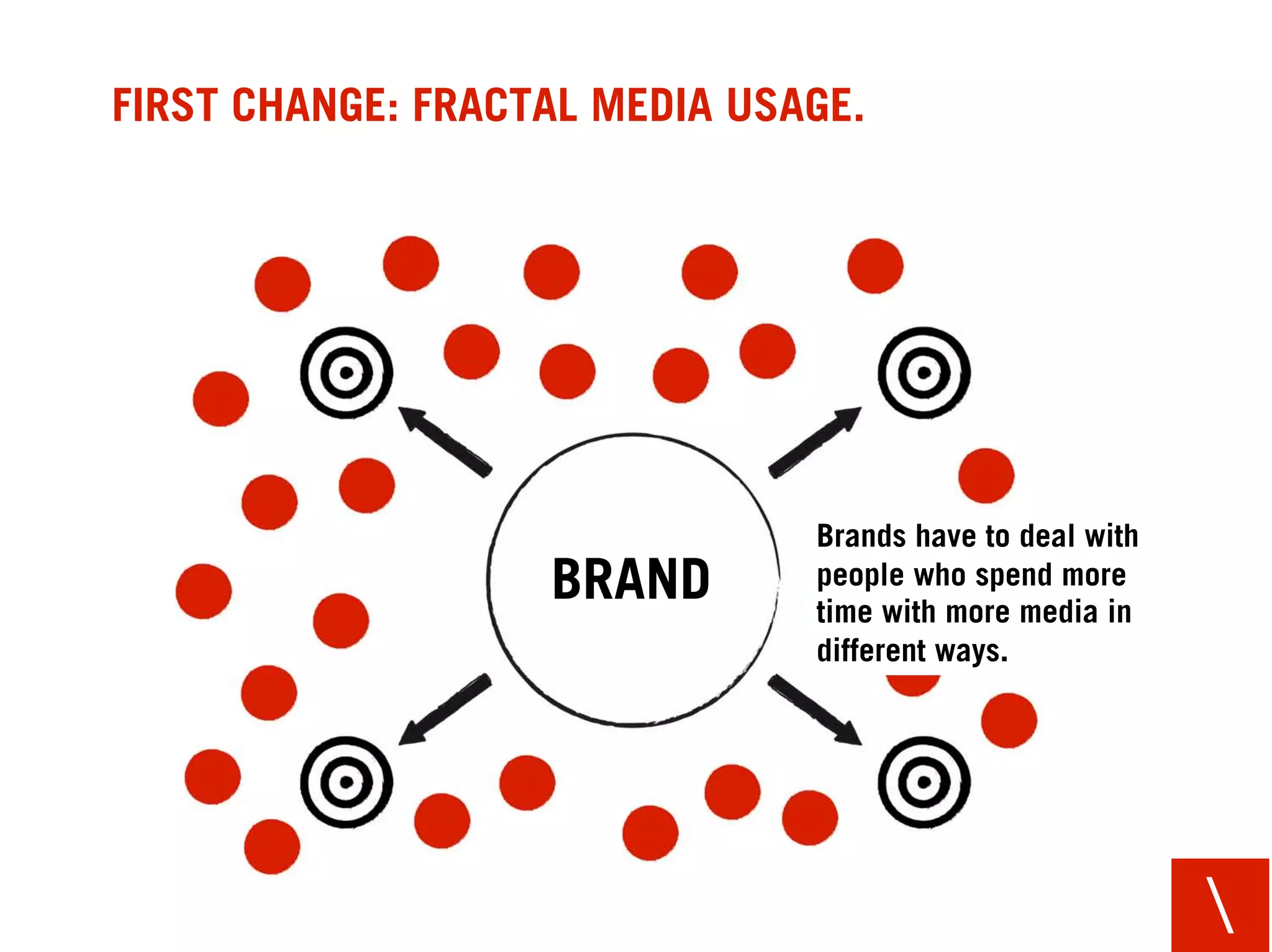
FIRST CHANGE: FRACTAL MEDIA USAGE.


                               Brands have to deal with
                   BRAND       people who spend more
                               time with more media in
                               different ways.
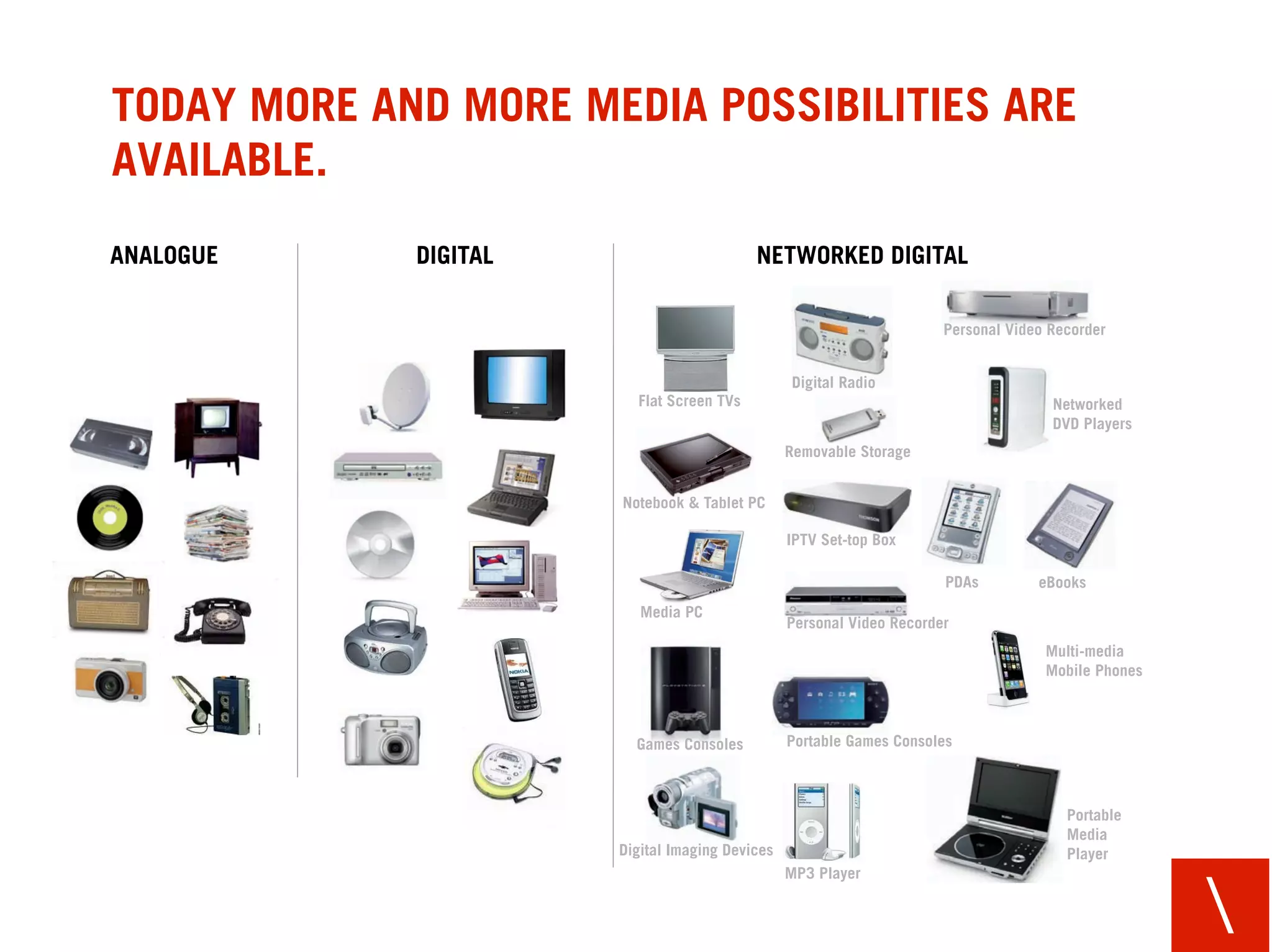
TODAY MORE AND MORE MEDIA POSSIBILITIES ARE
AVAILABLE.
ANALOGUE     DIGITAL                       NETWORKED DIGITAL

                                                                       Personal Video Recorder


                                                 Digital Radio
                         Flat Screen TVs                                              Networked
                                                                                      DVD Players
                                                 Removable Storage


                       Notebook & Tablet PC

                                                 IPTV Set-top Box

                                                                       PDAs         eBooks
                          Media PC
                                                 Personal Video Recorder
                                                                                     Multi-media
                                                                                     Mobile Phones


                         Games Consoles          Portable Games Consoles


                                                                                        Portable
                                                                                        Media
                       Digital Imaging Devices                                          Player
                                                 MP3 Player
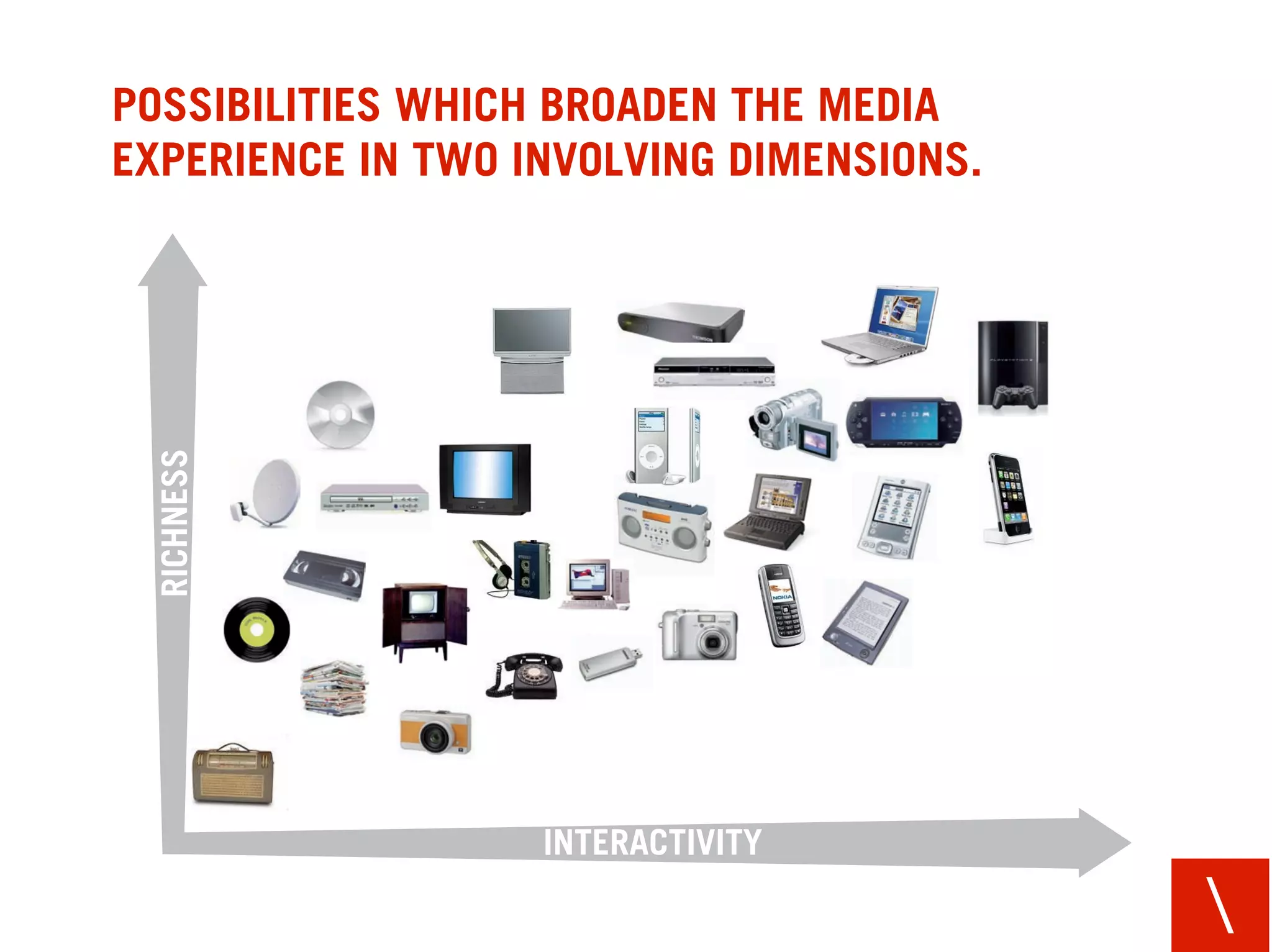
POSSIBILITIES WHICH BROADEN THE MEDIA
EXPERIENCE IN TWO INVOLVING DIMENSIONS.
  RICHNESS


                   INTERACTIVITY
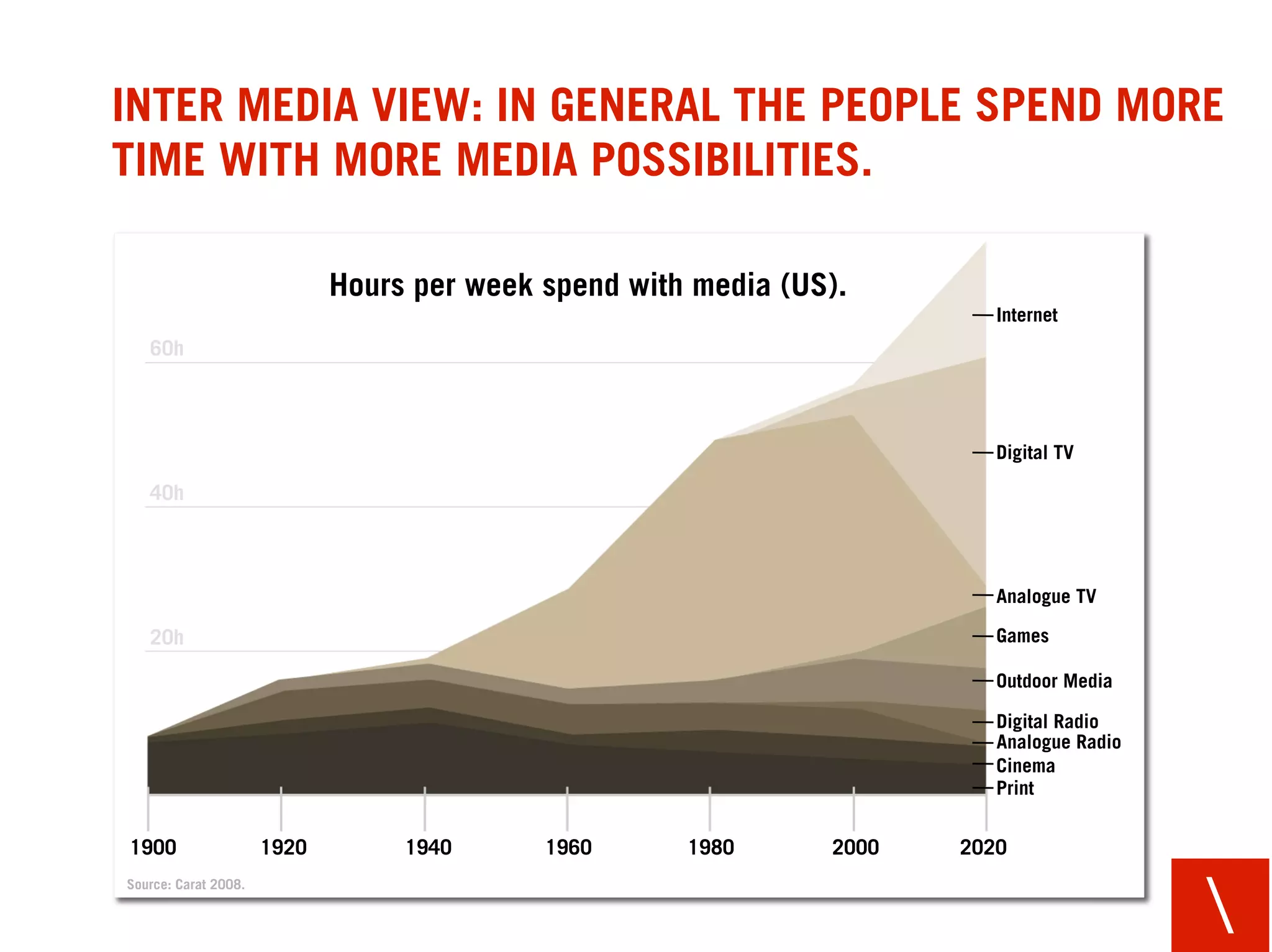
INTER MEDIA VIEW: IN GENERAL THE PEOPLE SPEND MORE
TIME WITH MORE MEDIA POSSIBILITIES.

                             Hours per week spend with media (US).
                                                                          Internet
   60h


                                                                          Digital TV

   40h


                                                                          Analogue TV

   20h                                                                    Games

                                                                          Outdoor Media

                                                                          Digital Radio
                                                                          Analogue Radio
                                                                          Cinema
                                                                          Print


1900                  1920        1940      1960      1980      2000   2020


Source: Carat 2008.
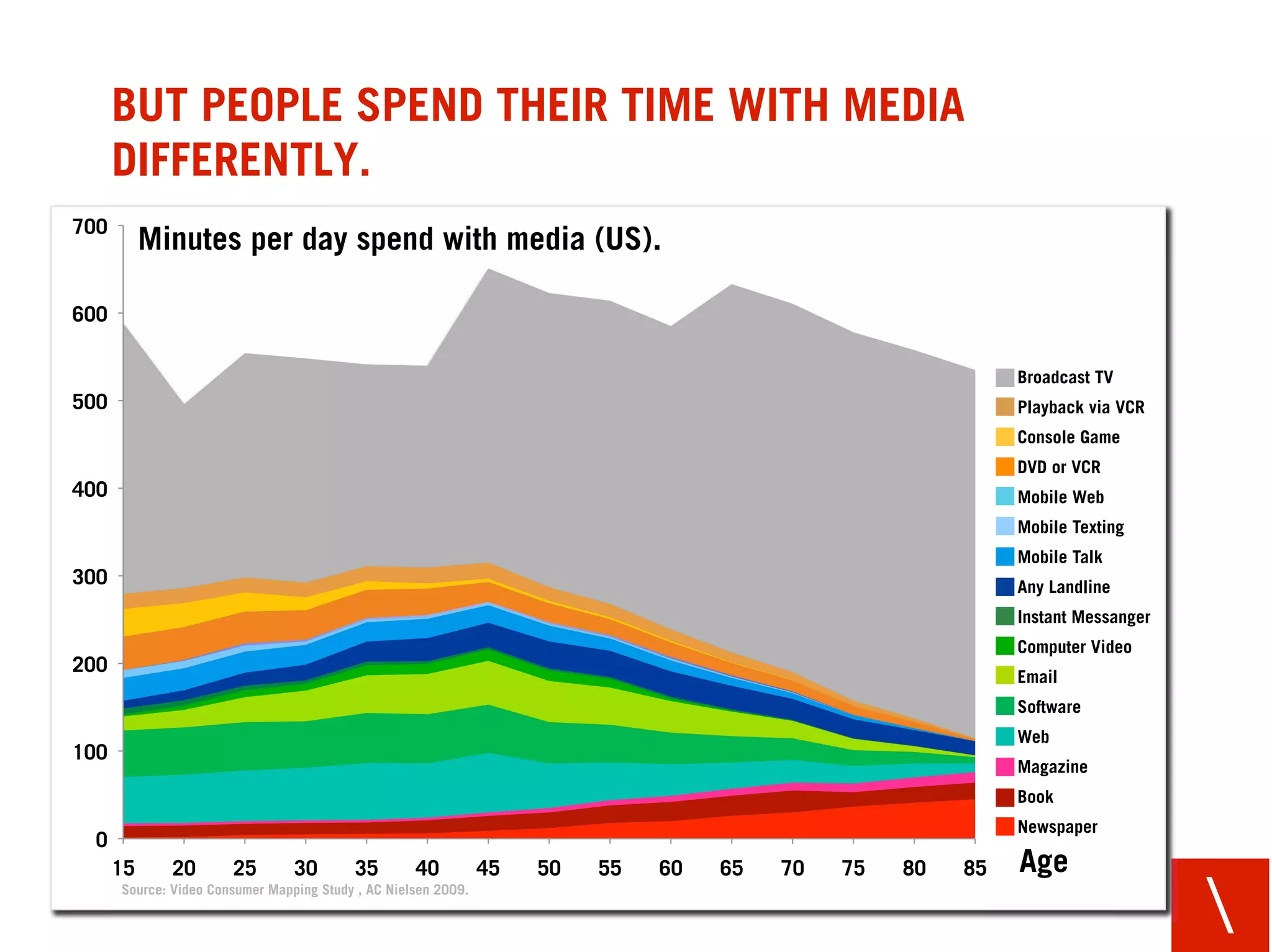
BUT PEOPLE SPEND THEIR TIME WITH MEDIA
      DIFFERENTLY.
700
           Minutes per day spend with media (US).

600

                                                                                                             Broadcast TV
500                                                                                                          Playback via VCR
                                                                                                             Console Game
                                                                                                             DVD or VCR
400                                                                                                          Mobile Web
                                                                                                             Mobile Texting
                                                                                                             Mobile Talk
300                                                                                                          Any Landline
                                                                                                             Instant Messanger
                                                                                                             Computer Video
200
                                                                                                             Email
                                                                                                             Software
                                                                                                             Web
100
                                                                                                             Magazine
                                                                                                             Book
                                                                                                             Newspaper
 0
      15      20       25        30       35        40          45   50   55   60   65   70   75   80   85   Age
                                                                                                                                 
      Source: Video Consumer Mapping Study , AC Nielsen 2009.
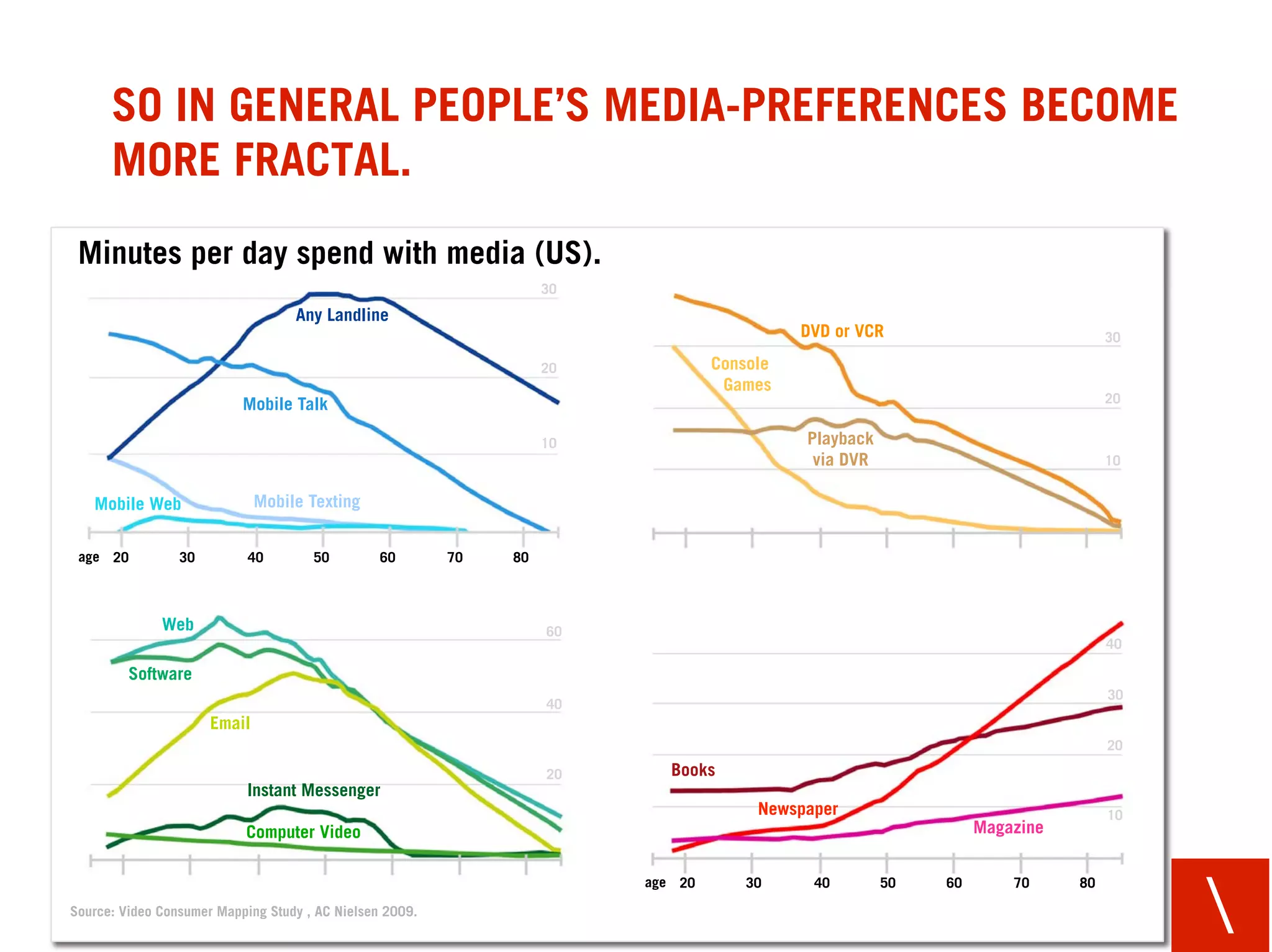
SO IN GENERAL PEOPLE’S MEDIA-PREFERENCES BECOME
      MORE FRACTAL.
 Minutes per day spend with media (US).
                                                                    30
                                   Any Landline
                                                                                            DVD or VCR                           30

                                                                    20            Console
                                                                                   Games
                           Mobile Talk                                                                                           20


                                                                    10                      Playback
                                                                                             via DVR                             10


   Mobile Web                 Mobile Texting


 age 20          30         40        50         60       70   80


              Web                                                   60
                                                                                                                                 40

         Software
                                                                                                                                 30
                                                                    40
                      Email
                                                                                                                                 20

                                                                    20      Books
                            Instant Messenger
                                                                                       Newspaper                                 10
                           Computer Video                                                                        Magazine


                                                                         age 20       30     40        50   60       70     80

Source: Video Consumer Mapping Study , AC Nielsen 2009.
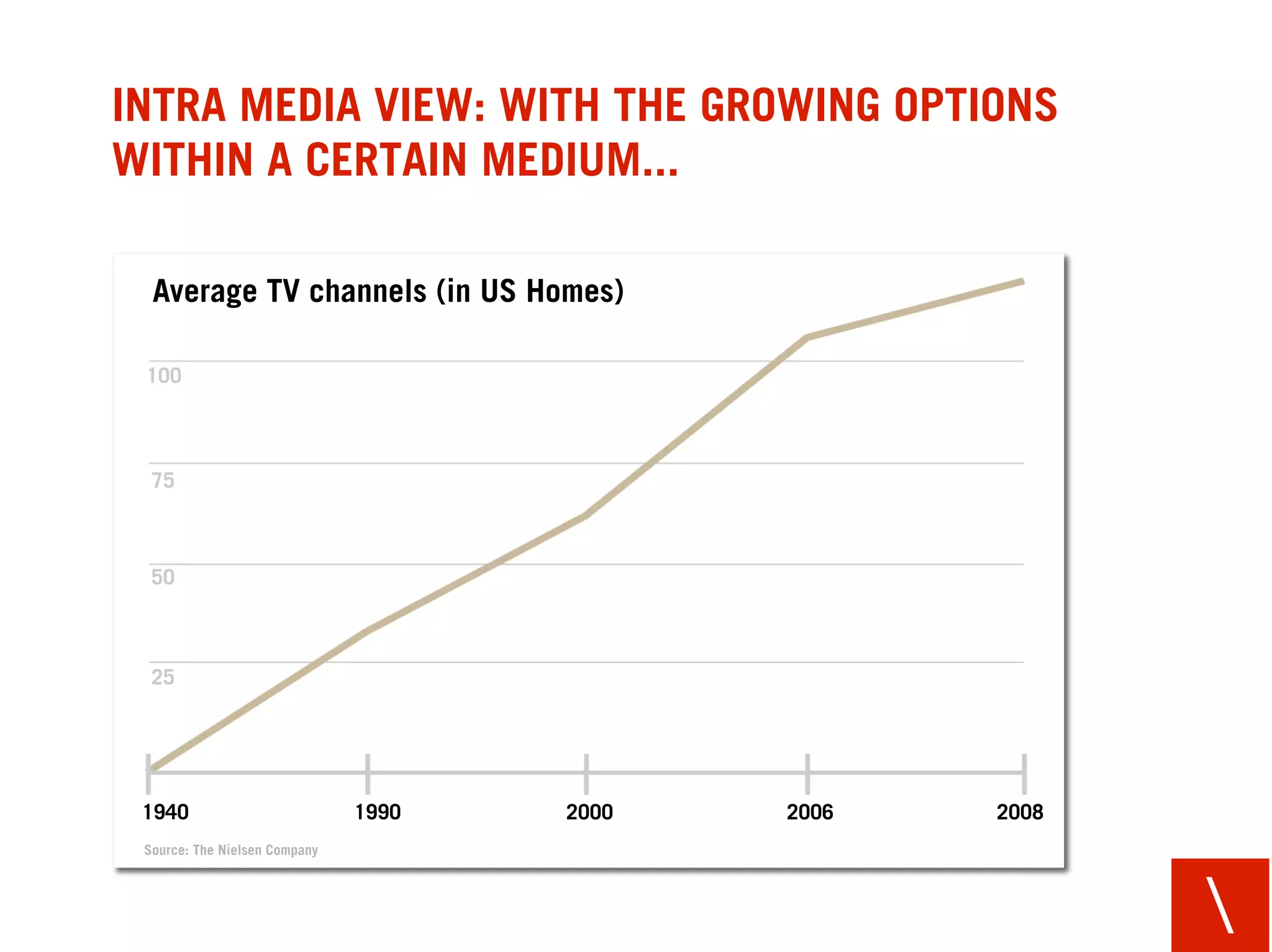
INTRA MEDIA VIEW: WITH THE GROWING OPTIONS
WITHIN A CERTAIN MEDIUM...

  Average TV channels (in US Homes)

 100


  75


  50


  25


 1940                          1990   2000   2006   2008
 Source: The Nielsen Company
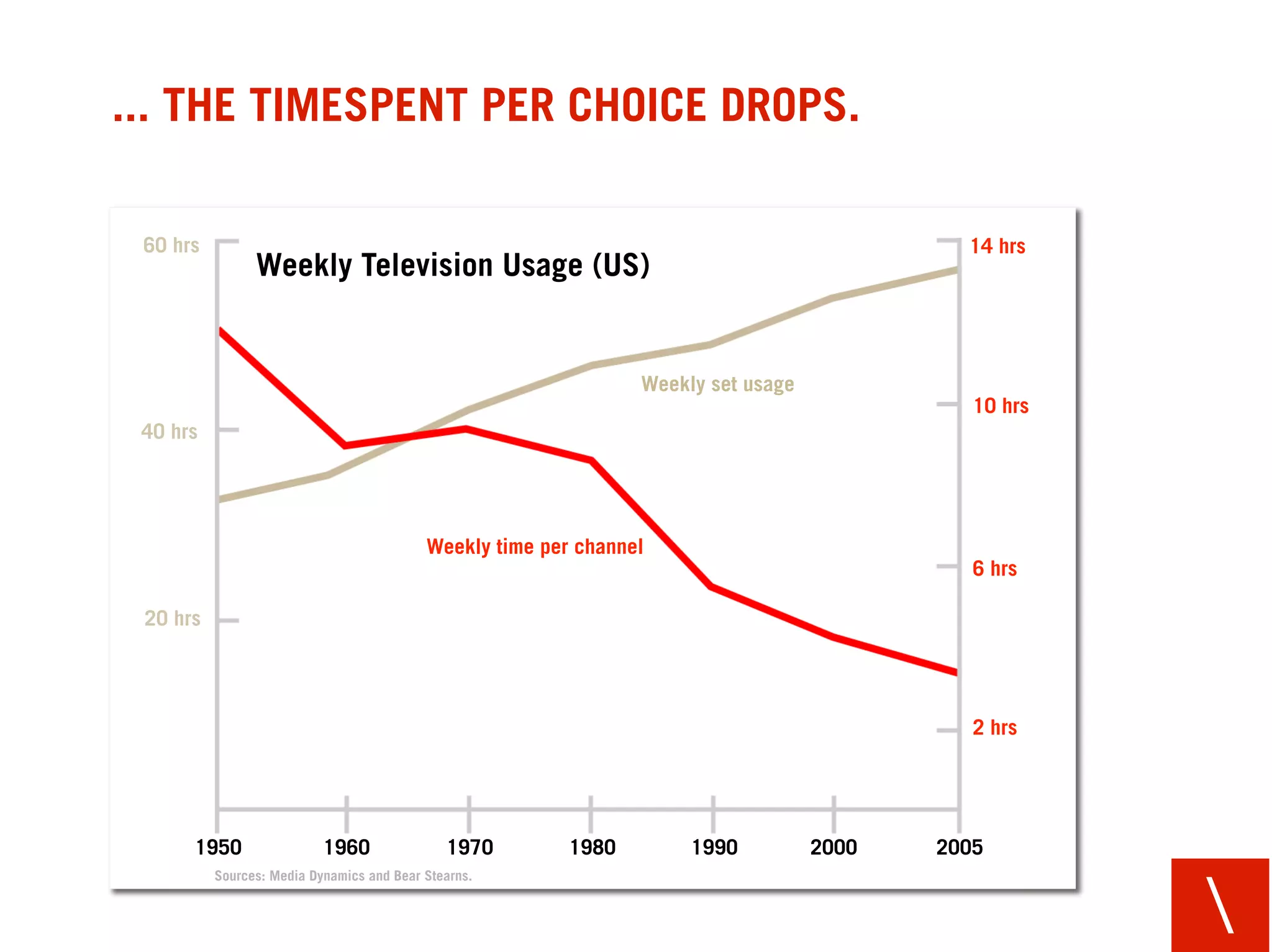
... THE TIMESPENT PER CHOICE DROPS.

 60 hrs                                                                                      14 hrs
                Weekly Television Usage (US)


                                                                 Weekly set usage
                                                                                              10 hrs
 40 hrs


                                           Weekly time per channel
                                                                                              6 hrs

 20 hrs


                                                                                              2 hrs


      1950                 1960               1970        1980        1990          2000   2005
          Sources: Media Dynamics and Bear Stearns.
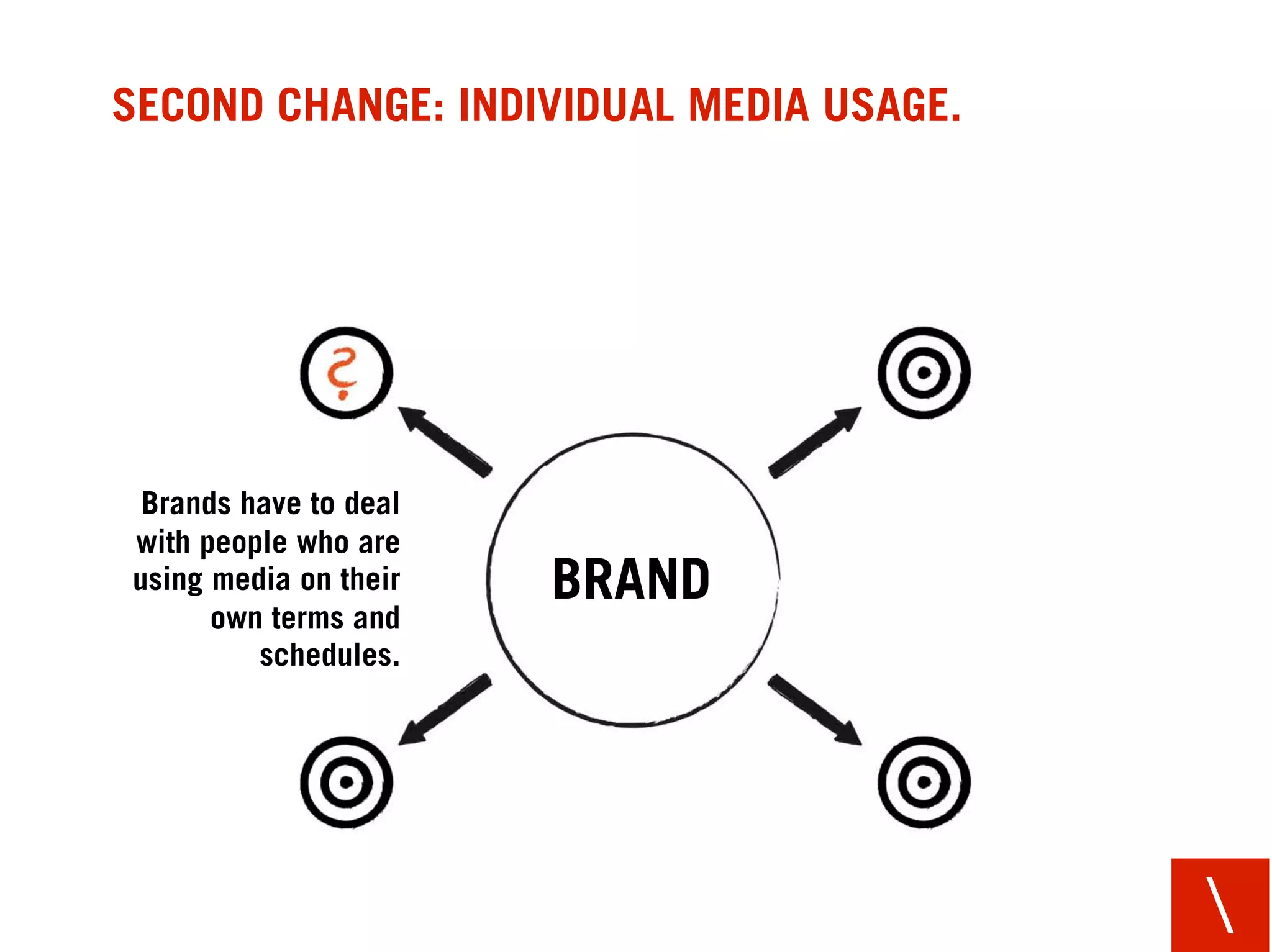
SECOND CHANGE: INDIVIDUAL MEDIA USAGE.


 Brands have to deal
with people who are
using media on their   BRAND
      own terms and
         schedules.
“We don’t want 1000 channels.
We want the one we want to watch.”
          Nicolas Negroponte, MIT Media Lab
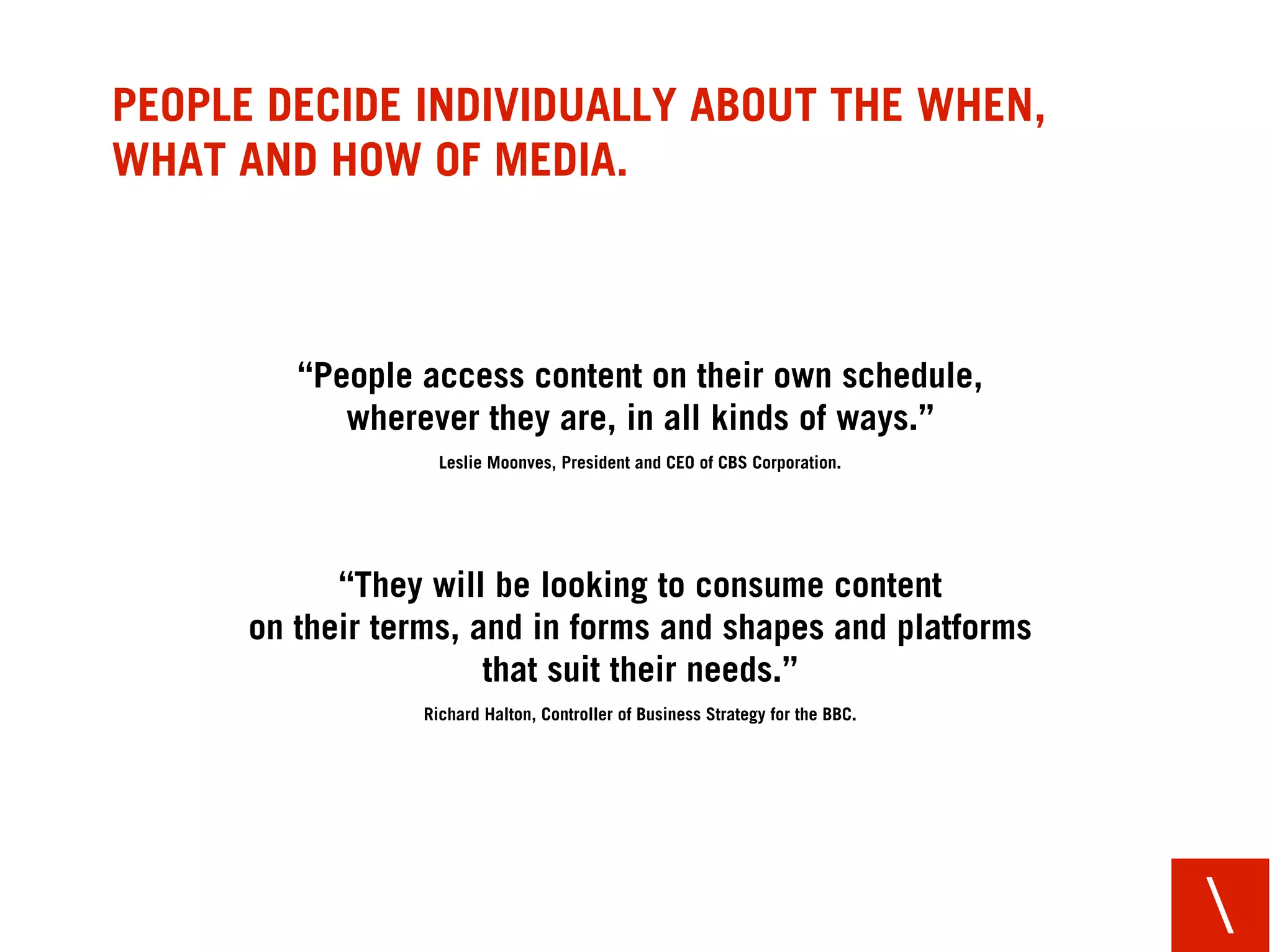
PEOPLE DECIDE INDIVIDUALLY ABOUT THE WHEN,
WHAT AND HOW OF MEDIA.


         “People access content on their own schedule,
            wherever they are, in all kinds of ways.”
                   Leslie Moonves, President and CEO of CBS Corporation.


            “They will be looking to consume content
      on their terms, and in forms and shapes and platforms
                       that suit their needs.”
                 Richard Halton, Controller of Business Strategy for the BBC.
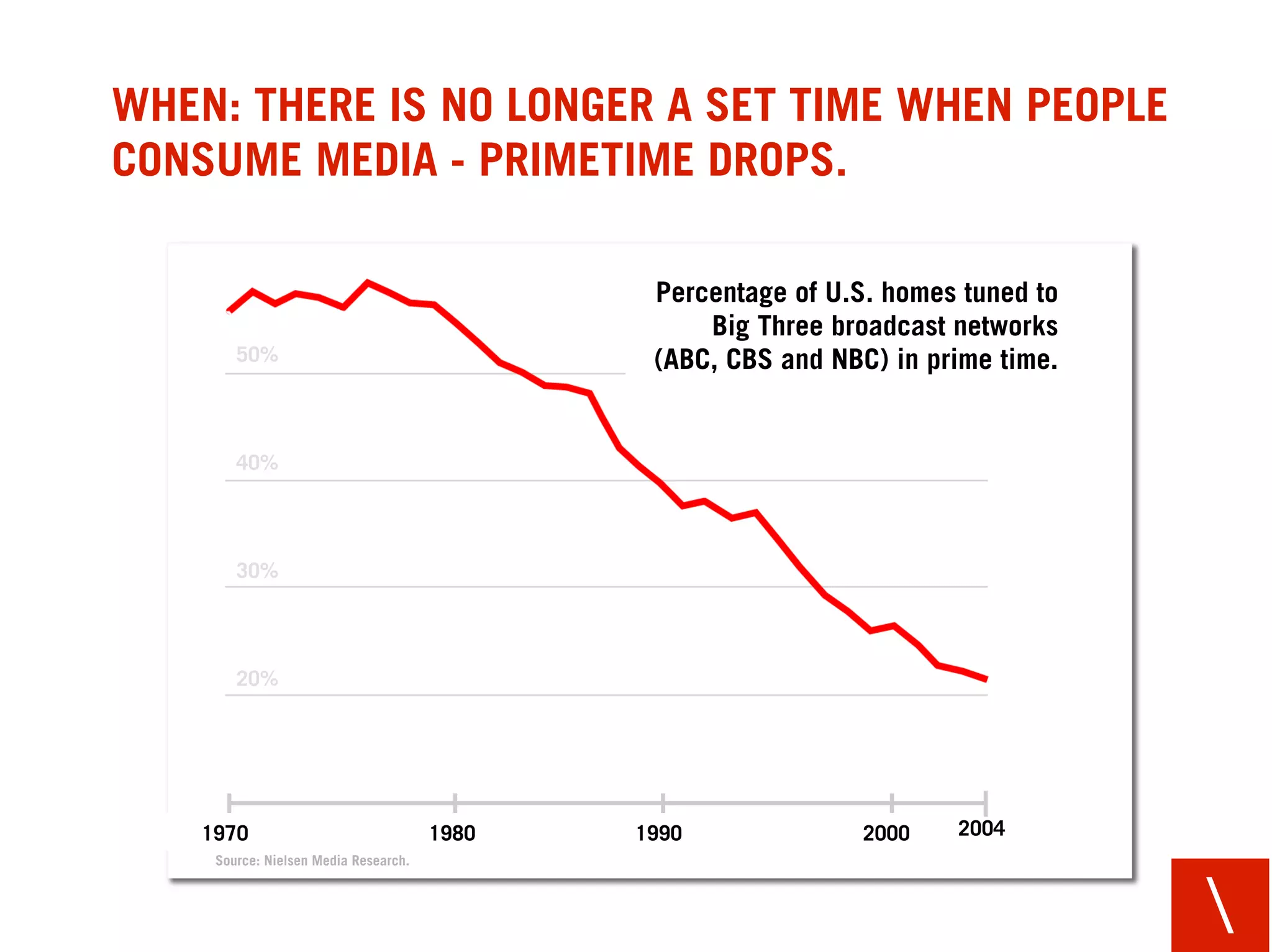
WHEN: THERE IS NO LONGER A SET TIME WHEN PEOPLE
CONSUME MEDIA - PRIMETIME DROPS.

                                              Percentage of U.S. homes tuned to
                                                  Big Three broadcast networks
       50%                                    (ABC, CBS and NBC) in prime time.


       40%


       30%


       20%


   1970                               1980   1990              2000   2004
    Source: Nielsen Media Research.
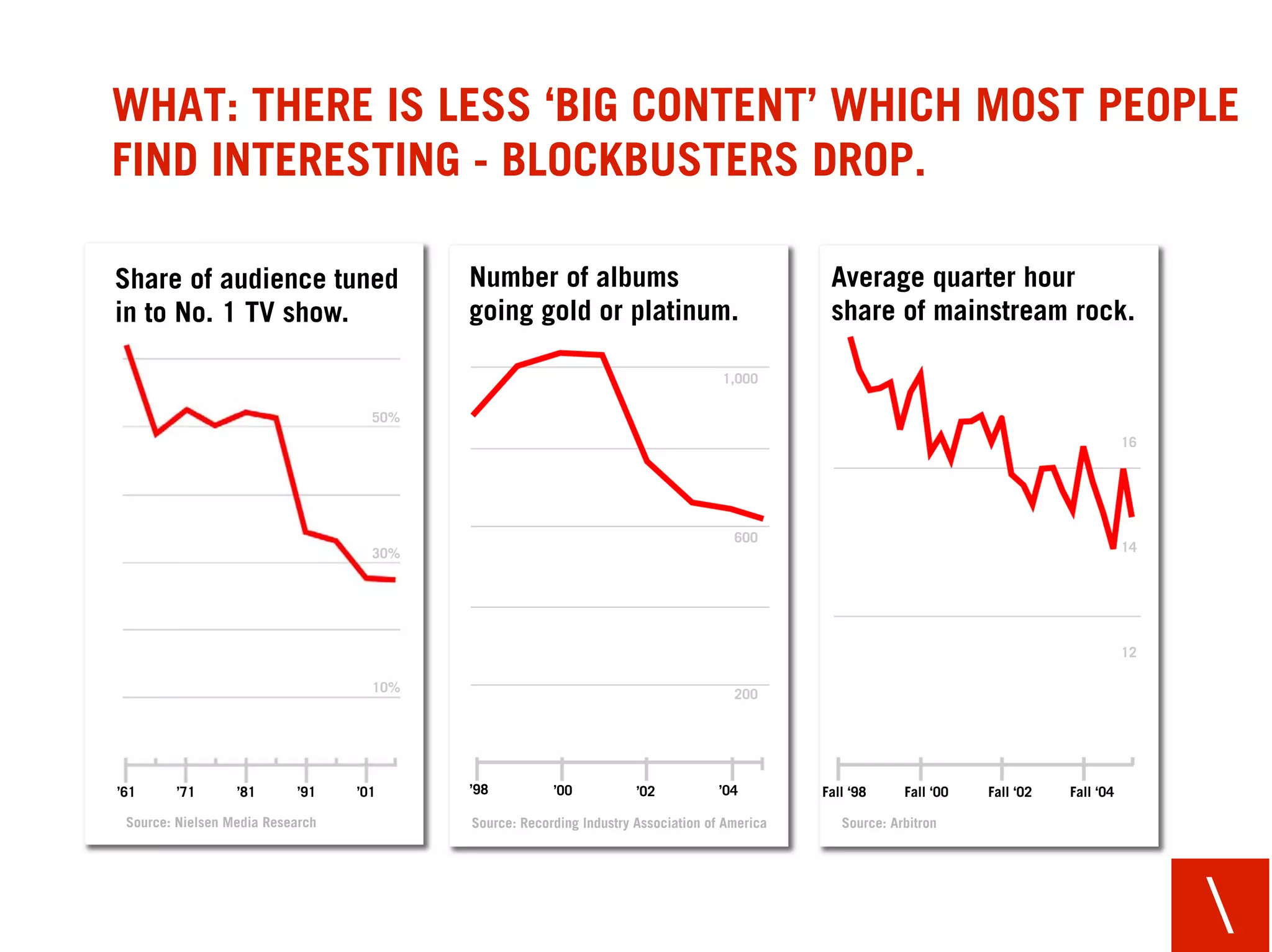
WHAT: THERE IS LESS ‘BIG CONTENT’ WHICH MOST PEOPLE
FIND INTERESTING - BLOCKBUSTERS DROP.

Share of audience tuned                   Number of albums                                     Average quarter hour
in to No. 1 TV show.                      going gold or platinum.                              share of mainstream rock.

                                                                                   1,000

                                    50%
                                                                                                                                            16


                                                                                     600
                                    30%                                                                                                     14


                                                                                                                                            12

                                    10%                                              200


’61     ’71       ’81      ’91    ’01     ’98          ’00           ’02           ’04        Fall ‘98     Fall ‘00   Fall ‘02   Fall ‘04

 Source: Nielsen Media Research           Source: Recording Industry Association of America      Source: Arbitron
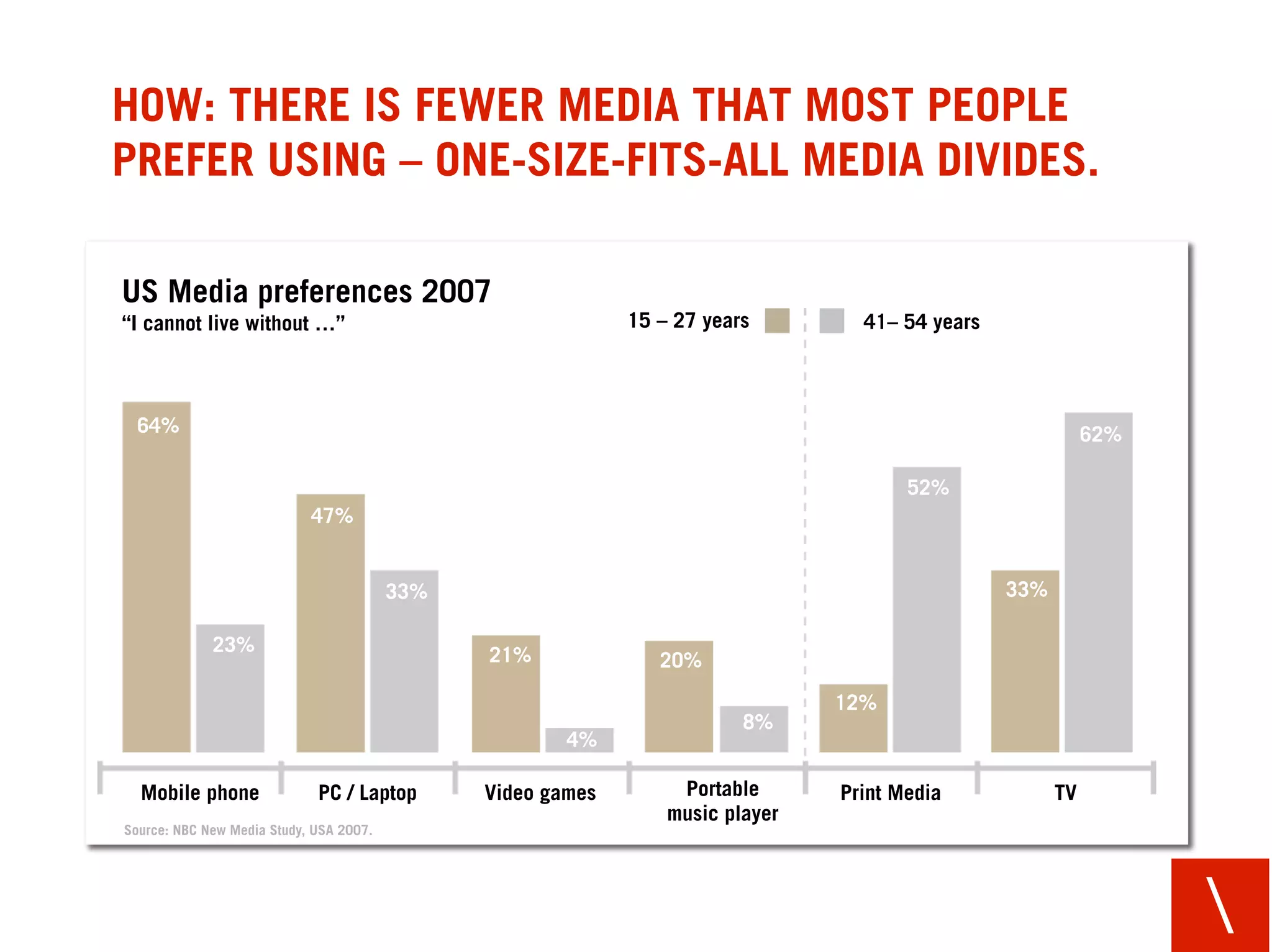
HOW: THERE IS FEWER MEDIA THAT MOST PEOPLE
PREFER USING – ONE-SIZE-FITS-ALL MEDIA DIVIDES.

US Media preferences 2007
“I cannot live without …”                                    15 – 27 years        41– 54 years


  64%                                                                                                       62%

                                                                                       52%
                            47%


                                         33%                                                     33%

             23%                               21%              20%

                                                                                12%
                                                                         8%
                                                       4%

  Mobile phone               PC / Laptop       Video games        Portable      Print Media            TV
                                                                 music player
Source: NBC New Media Study, USA 2007.
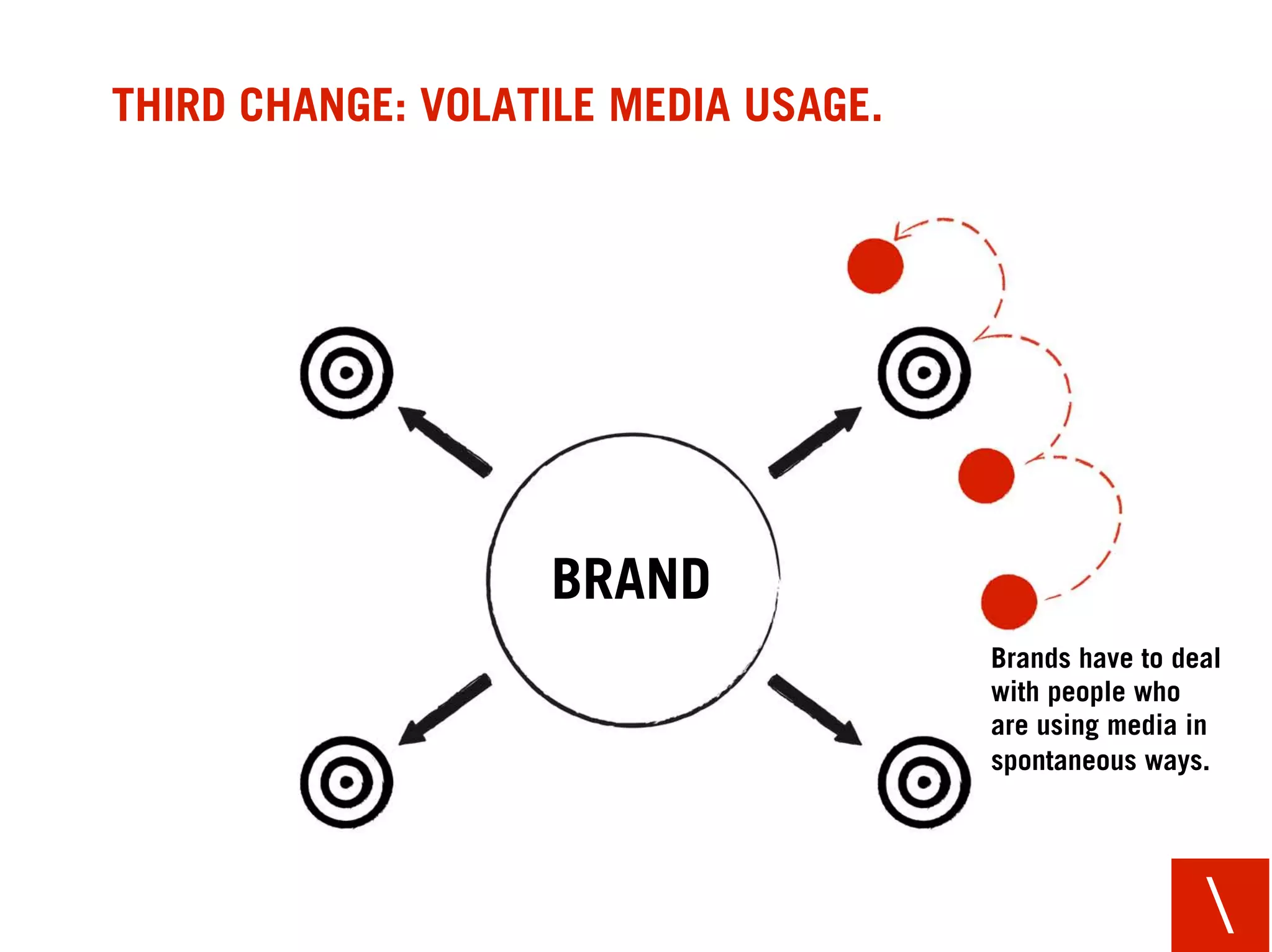
THIRD CHANGE: VOLATILE MEDIA USAGE.


                   BRAND
                                      Brands have to deal
                                      with people who
                                      are using media in
                                      spontaneous ways.
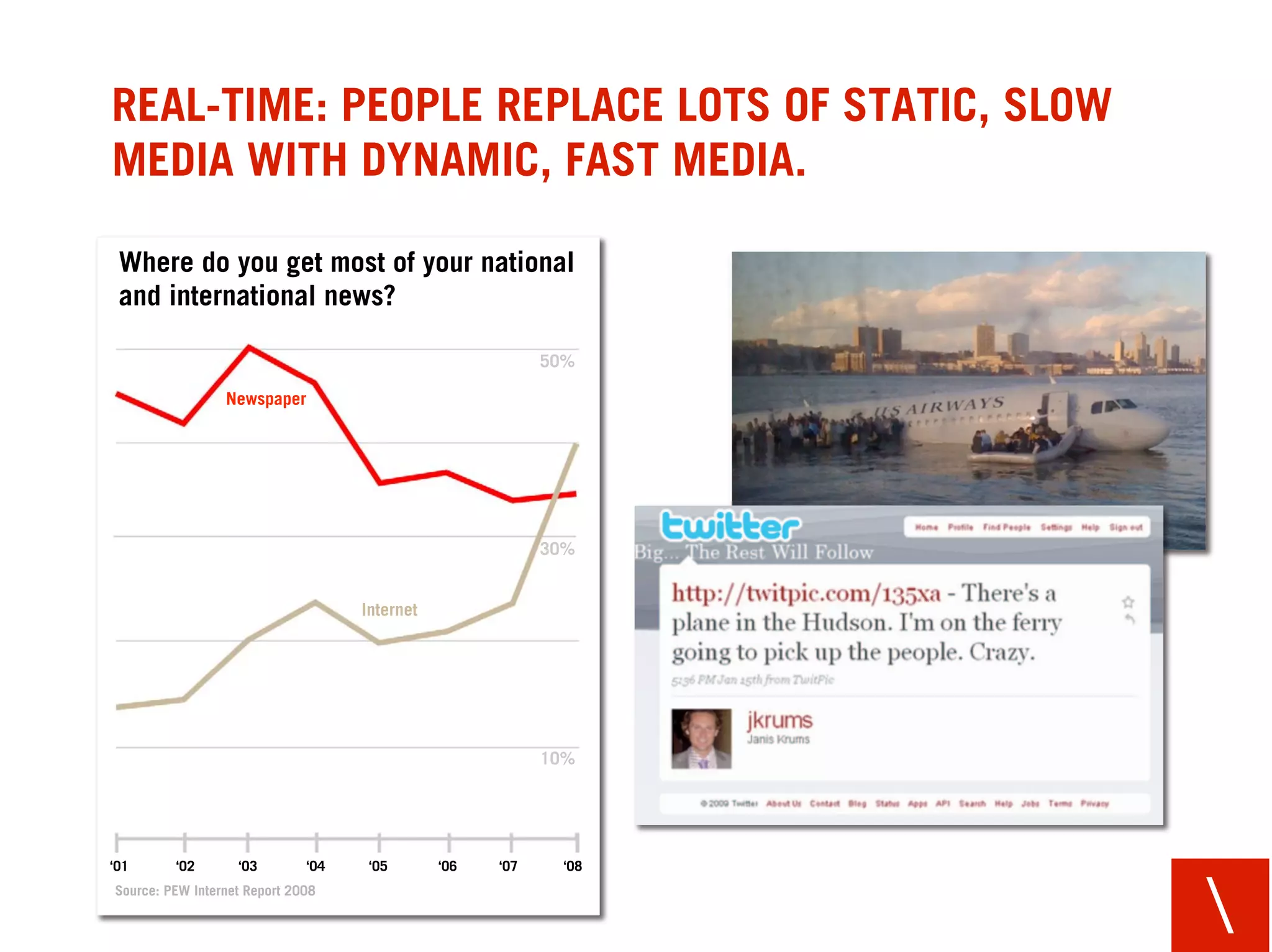
REAL-TIME: PEOPLE REPLACE LOTS OF STATIC, SLOW
MEDIA WITH DYNAMIC, FAST MEDIA.

 Where do you get most of your national
 and international news?

                                                           50%

                 Newspaper


                                                           30%


                                    Internet


                                                           10%


‘01      ‘02       ‘03        ‘04    ‘05       ‘06   ‘07     ‘08


Source: PEW Internet Report 2008
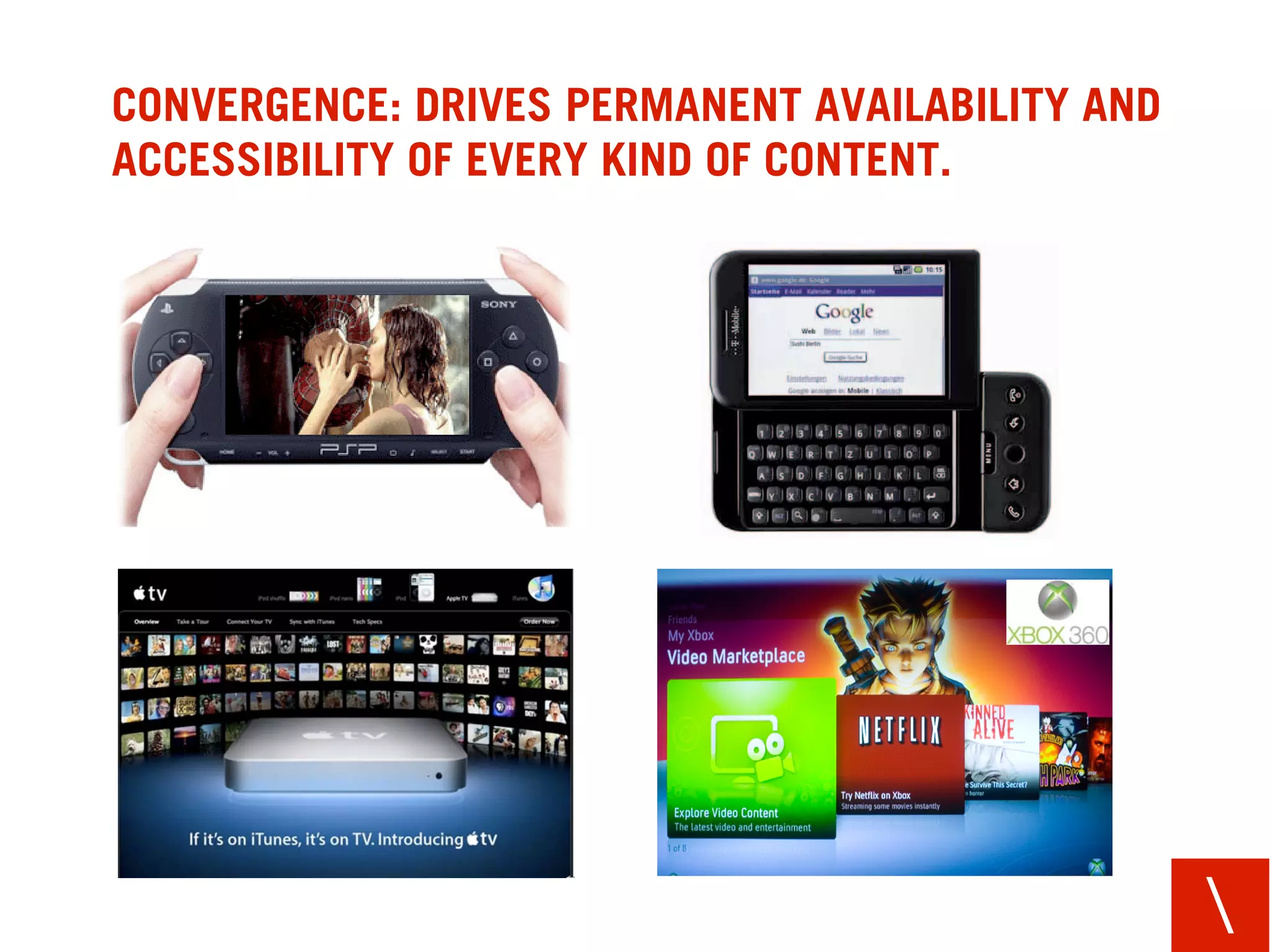
CONVERGENCE: DRIVES PERMANENT AVAILABILITY AND
ACCESSIBILITY OF EVERY KIND OF CONTENT.
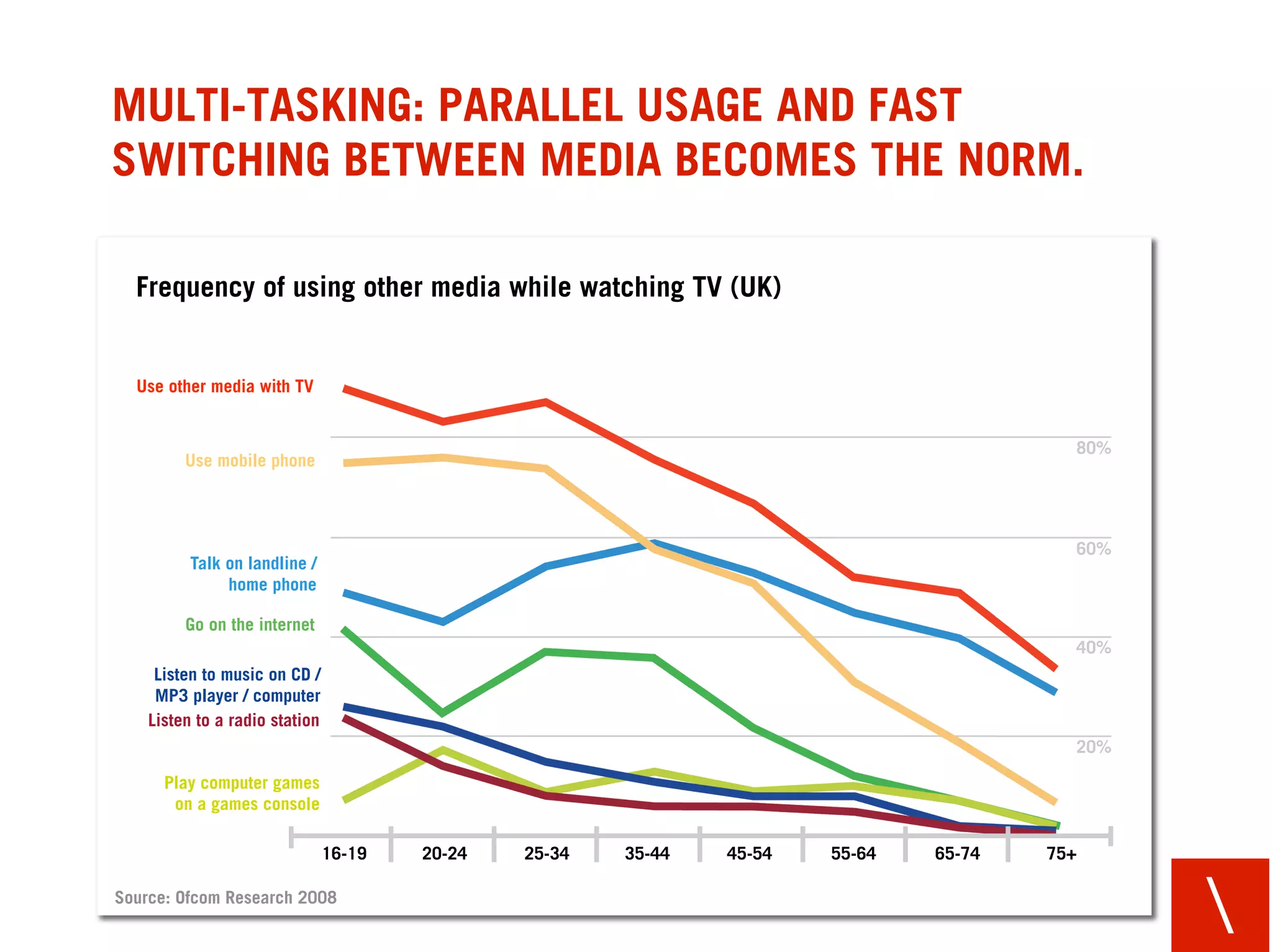
MULTI-TASKING: PARALLEL USAGE AND FAST
SWITCHING BETWEEN MEDIA BECOMES THE NORM.

  Frequency of using other media while watching TV (UK)


  Use other media with TV


                                                                                          80%
         Use mobile phone


                                                                                          60%
          Talk on landline /
               home phone

         Go on the internet
                                                                                          40%
     Listen to music on CD /
     MP3 player / computer
    Listen to a radio station
                                                                                          20%

      Play computer games
       on a games console

                                16-19   20-24   25-34   35-44   45-54   55-64   65-74   75+

Source: Ofcom Research 2008
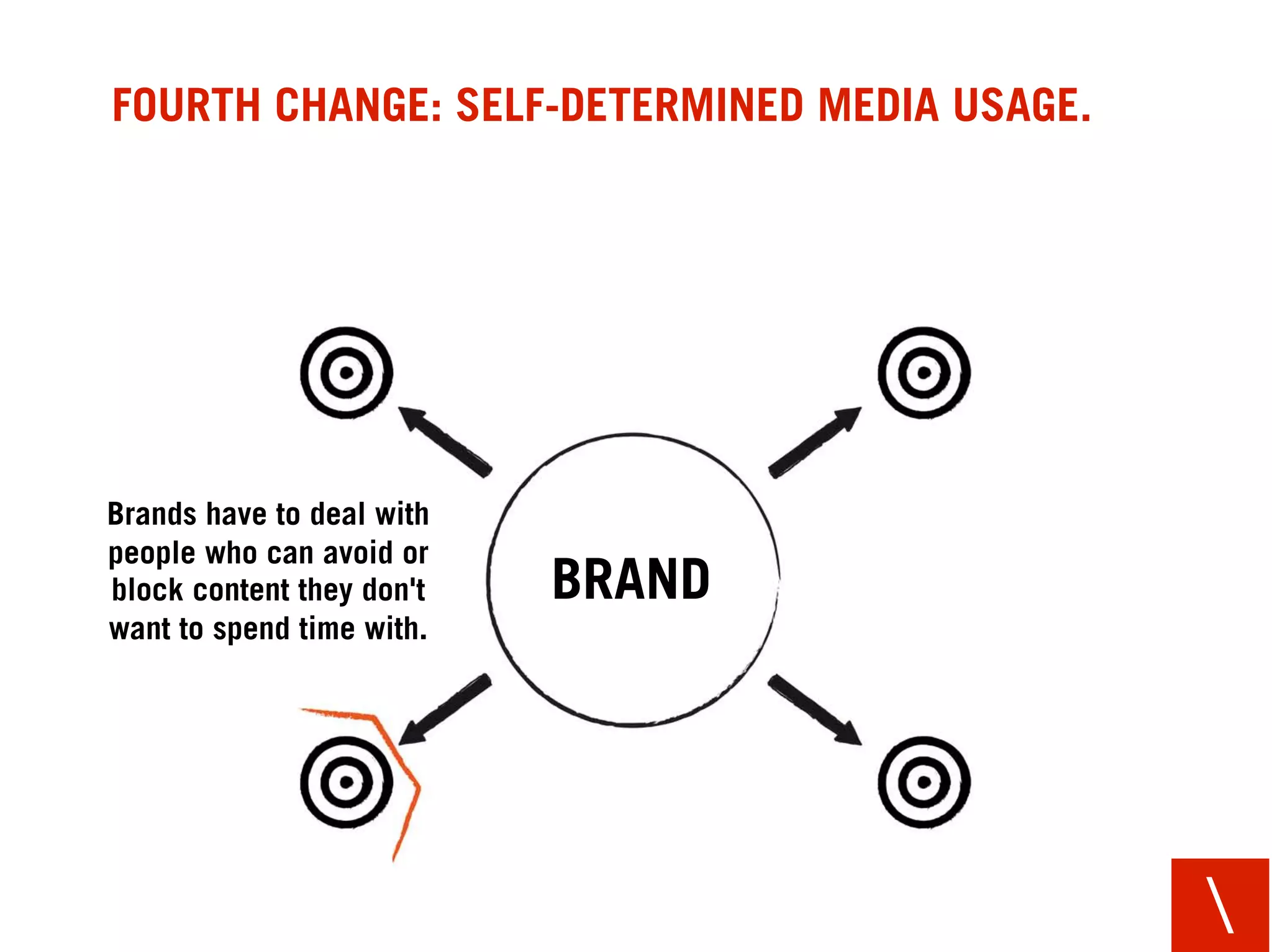
FOURTH CHANGE: SELF-DETERMINED MEDIA USAGE.


Brands have to deal with
people who can avoid or
block content they don't   BRAND
want to spend time with.
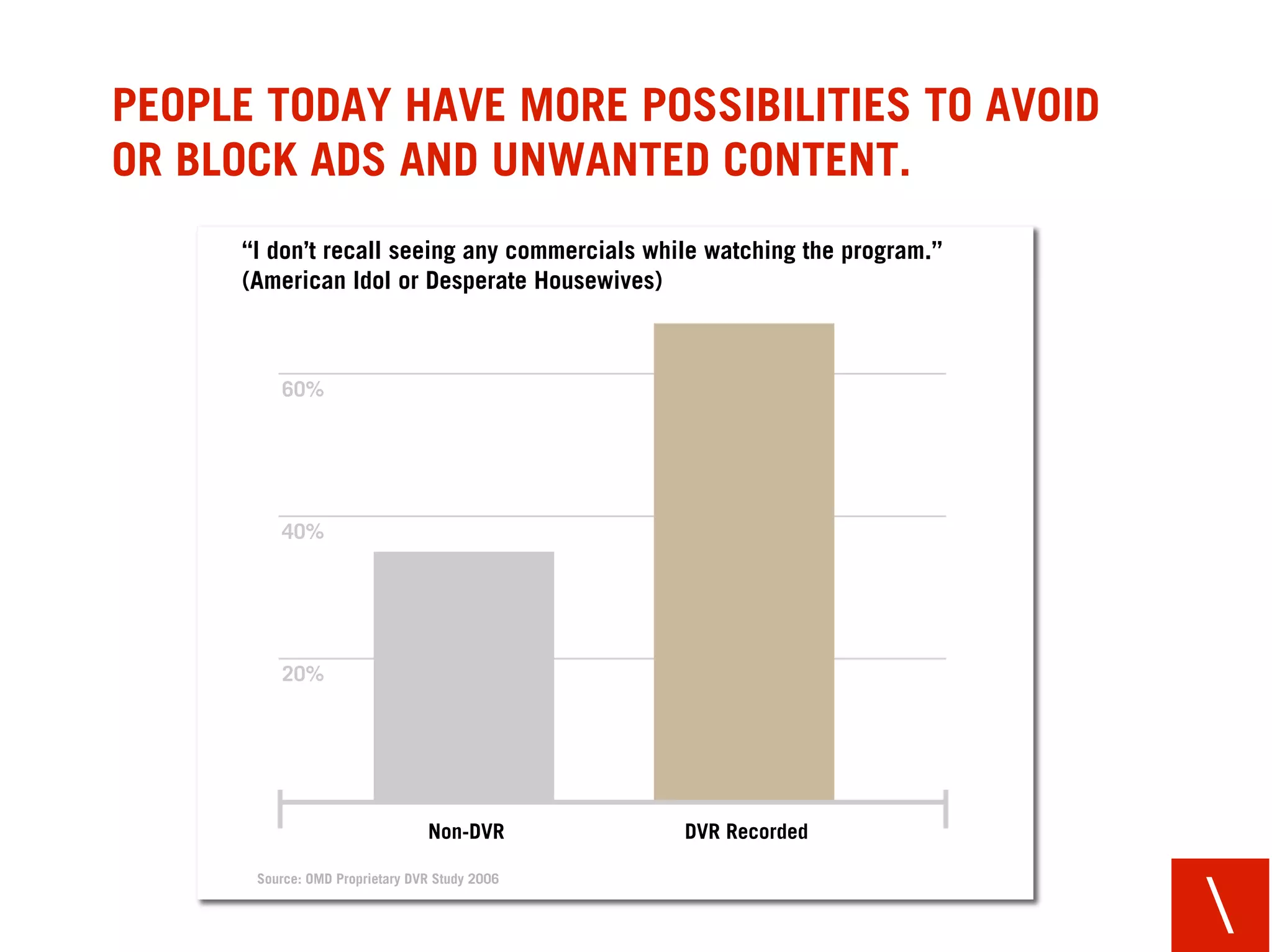
PEOPLE TODAY HAVE MORE POSSIBILITIES TO AVOID
OR BLOCK ADS AND UNWANTED CONTENT.
     “I don’t recall seeing any commercials while watching the program.”
     (American Idol or Desperate Housewives)


         60%


         40%


         20%


                                Non-DVR        DVR Recorded

      Source: OMD Proprietary DVR Study 2006
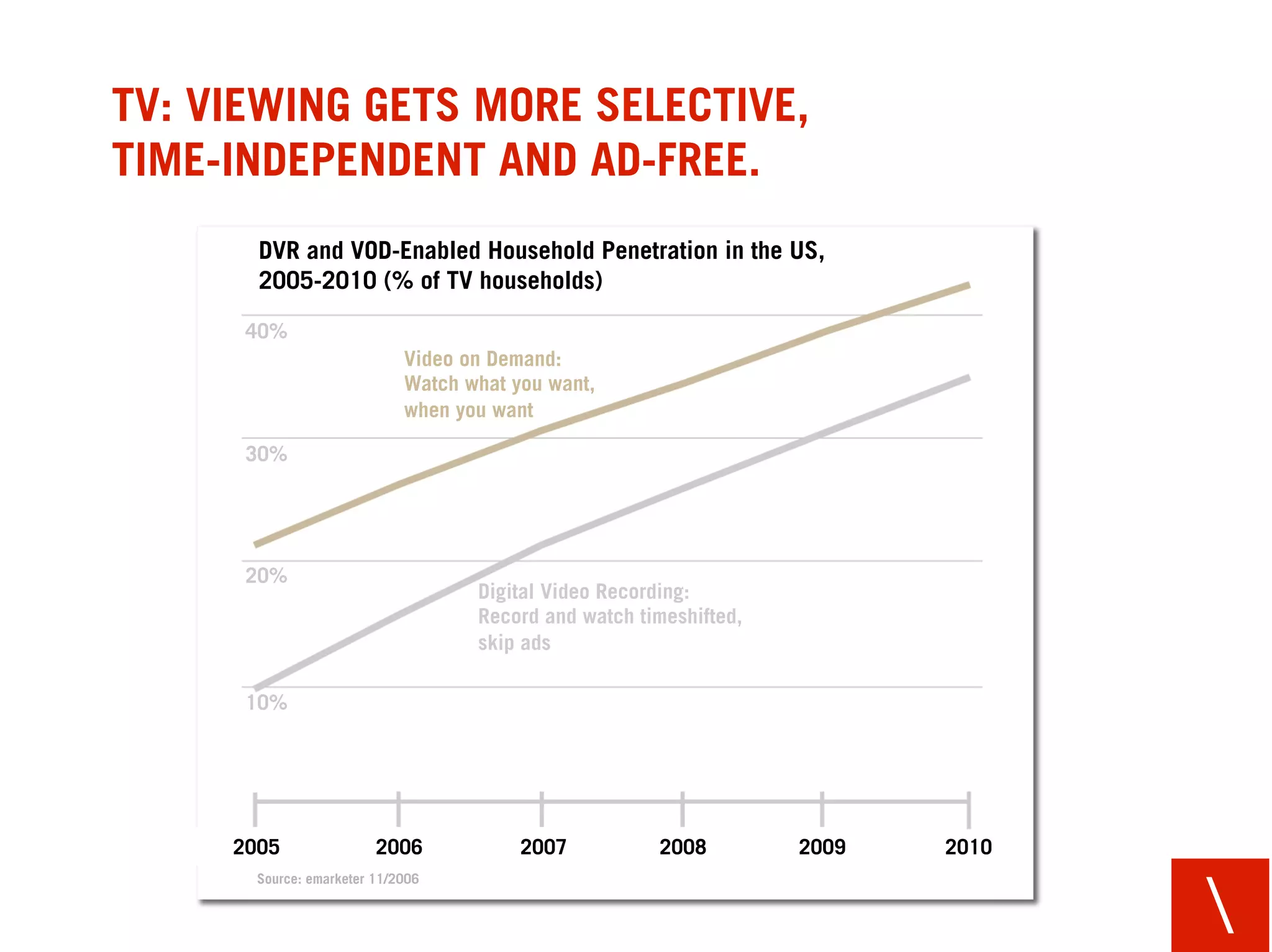
TV: VIEWING GETS MORE SELECTIVE,
TIME-INDEPENDENT AND AD-FREE.
       DVR and VOD-Enabled Household Penetration in the US,
       2005-2010 (% of TV households)

      40%
                             Video on Demand:
                             Watch what you want,
                             when you want

      30%


      20%
                                    Digital Video Recording:
                                    Record and watch timeshifted,
                                    skip ads

      10%


     2005                2006            2007          2008         2009   2010
       Source: emarketer 11/2006
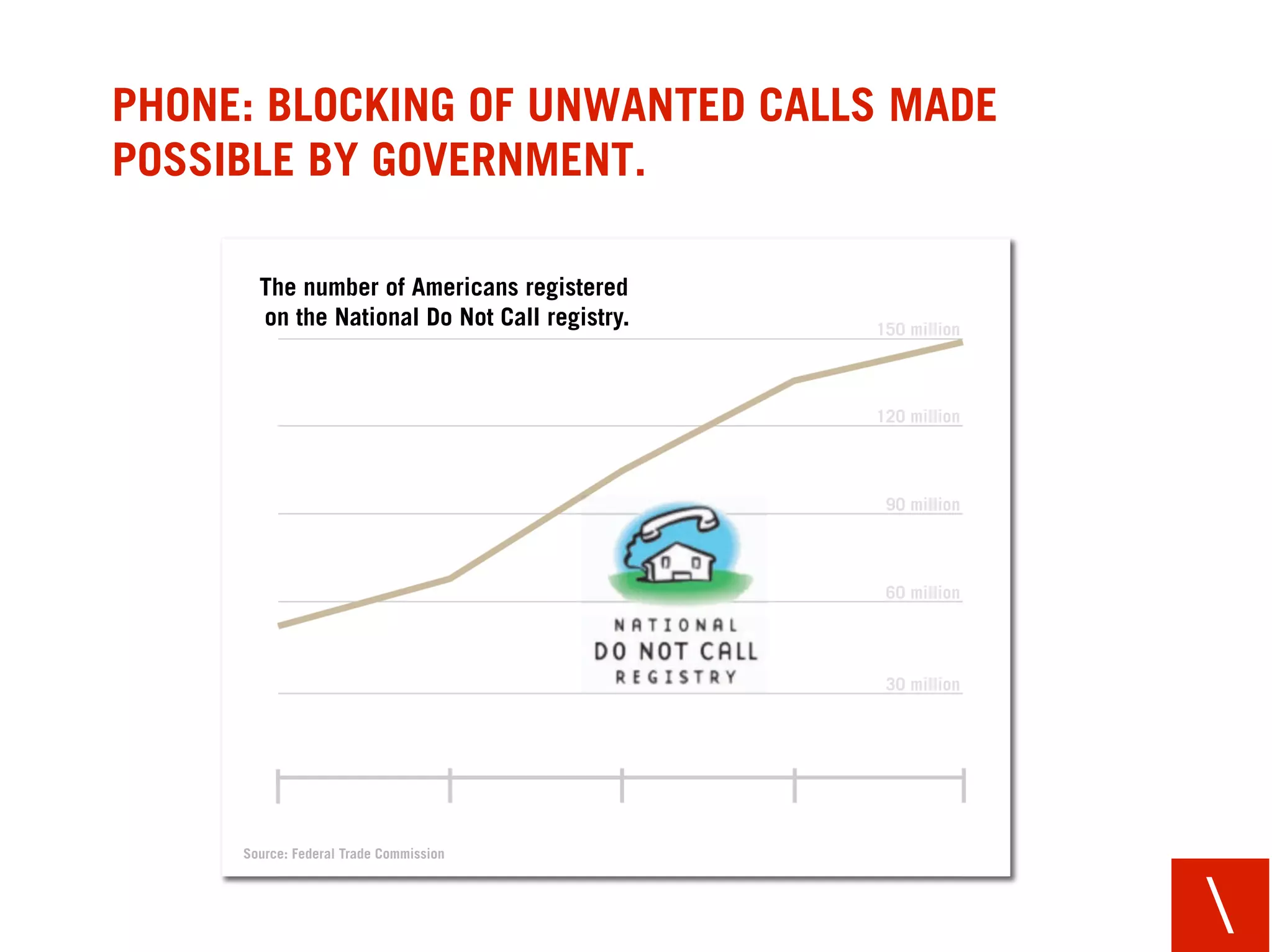
PHONE: BLOCKING OF UNWANTED CALLS MADE
POSSIBLE BY GOVERNMENT.

       The number of Americans registered
       on the National Do Not Call registry.   150 million


                                               120 million


                                                90 million


                                                60 million


                                                30 million


     Source: Federal Trade Commission
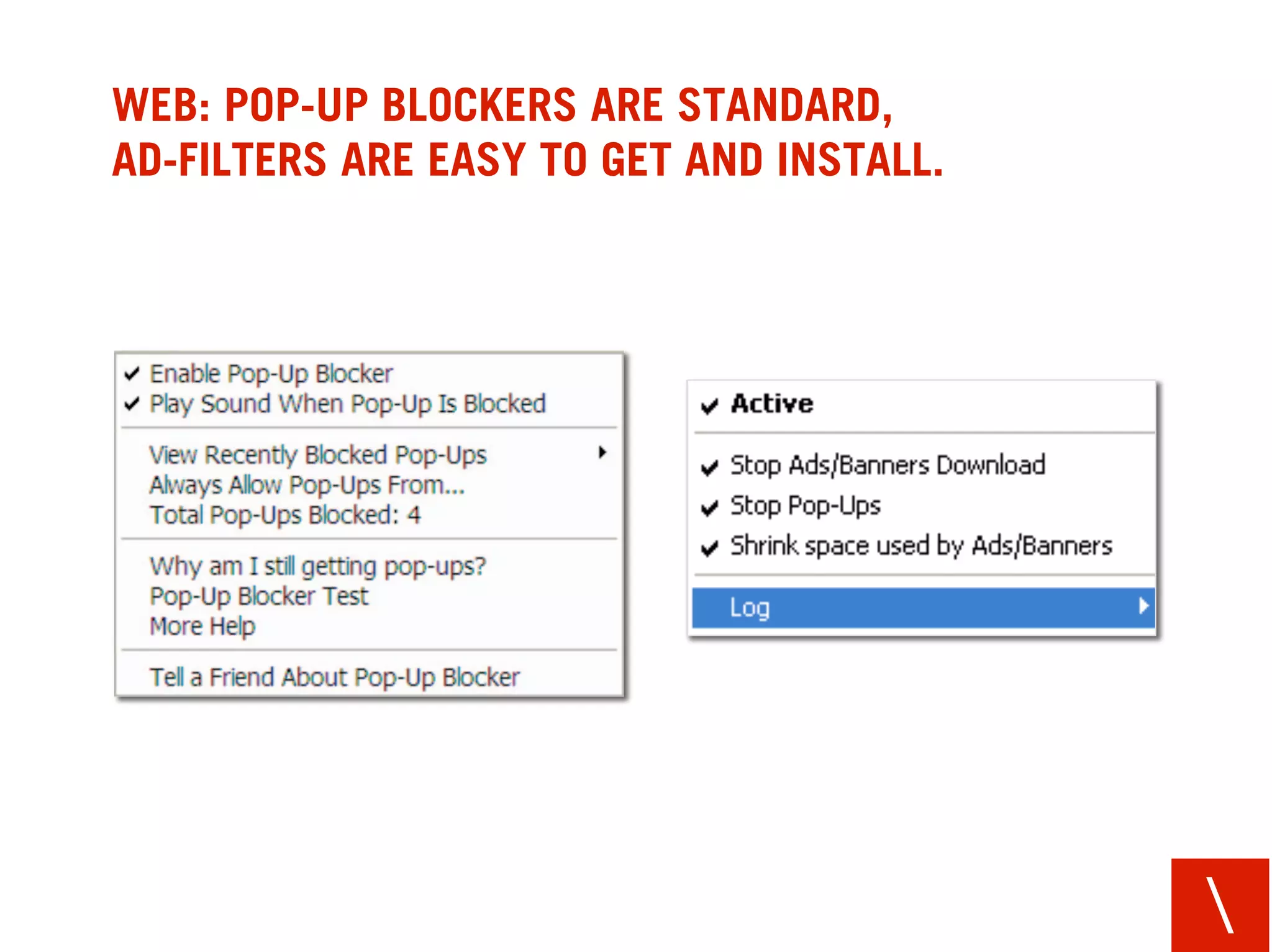
WEB: POP-UP BLOCKERS ARE STANDARD,
AD-FILTERS ARE EASY TO GET AND INSTALL.
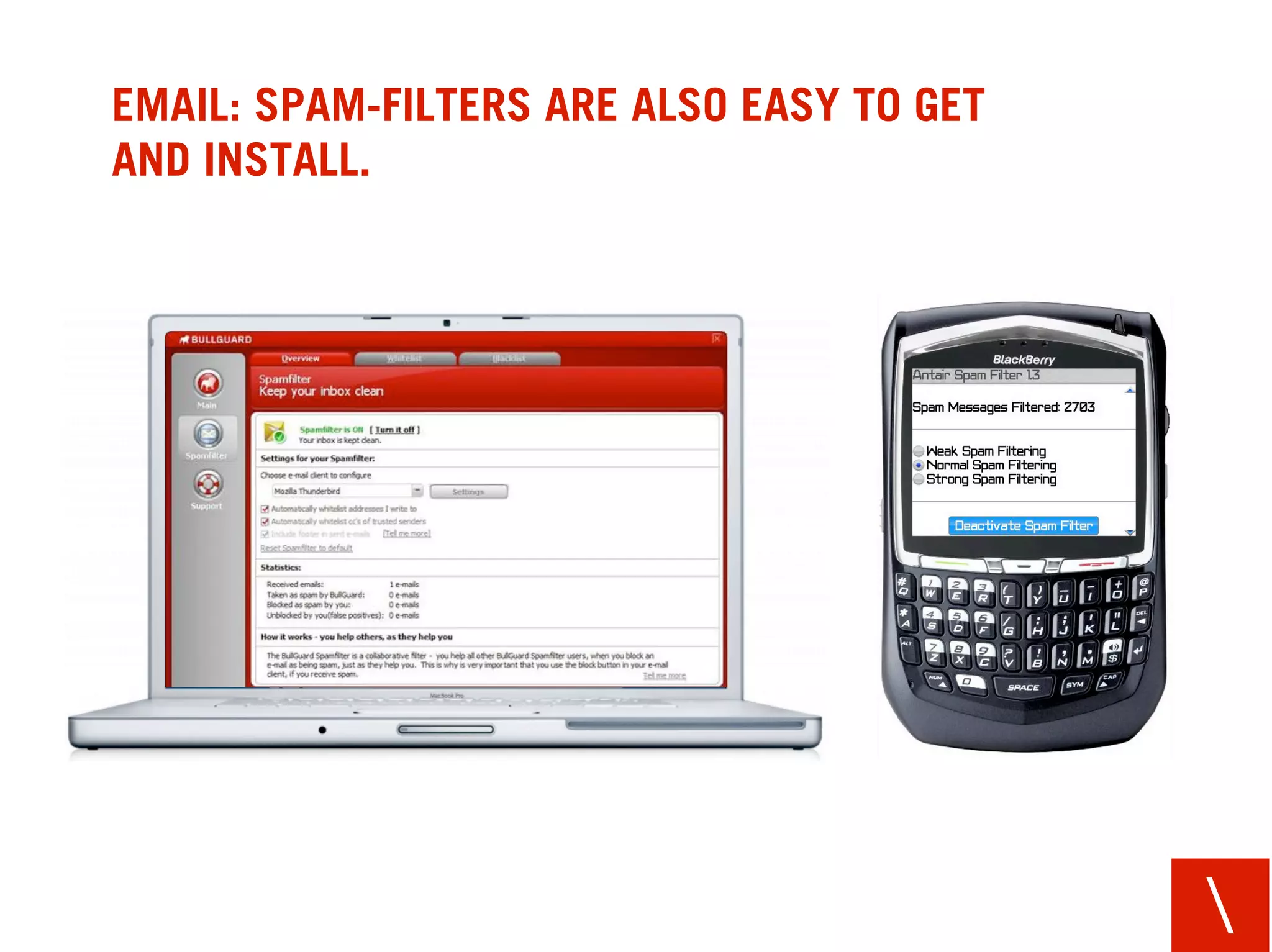
EMAIL: SPAM-FILTERS ARE ALSO EASY TO GET
AND INSTALL.
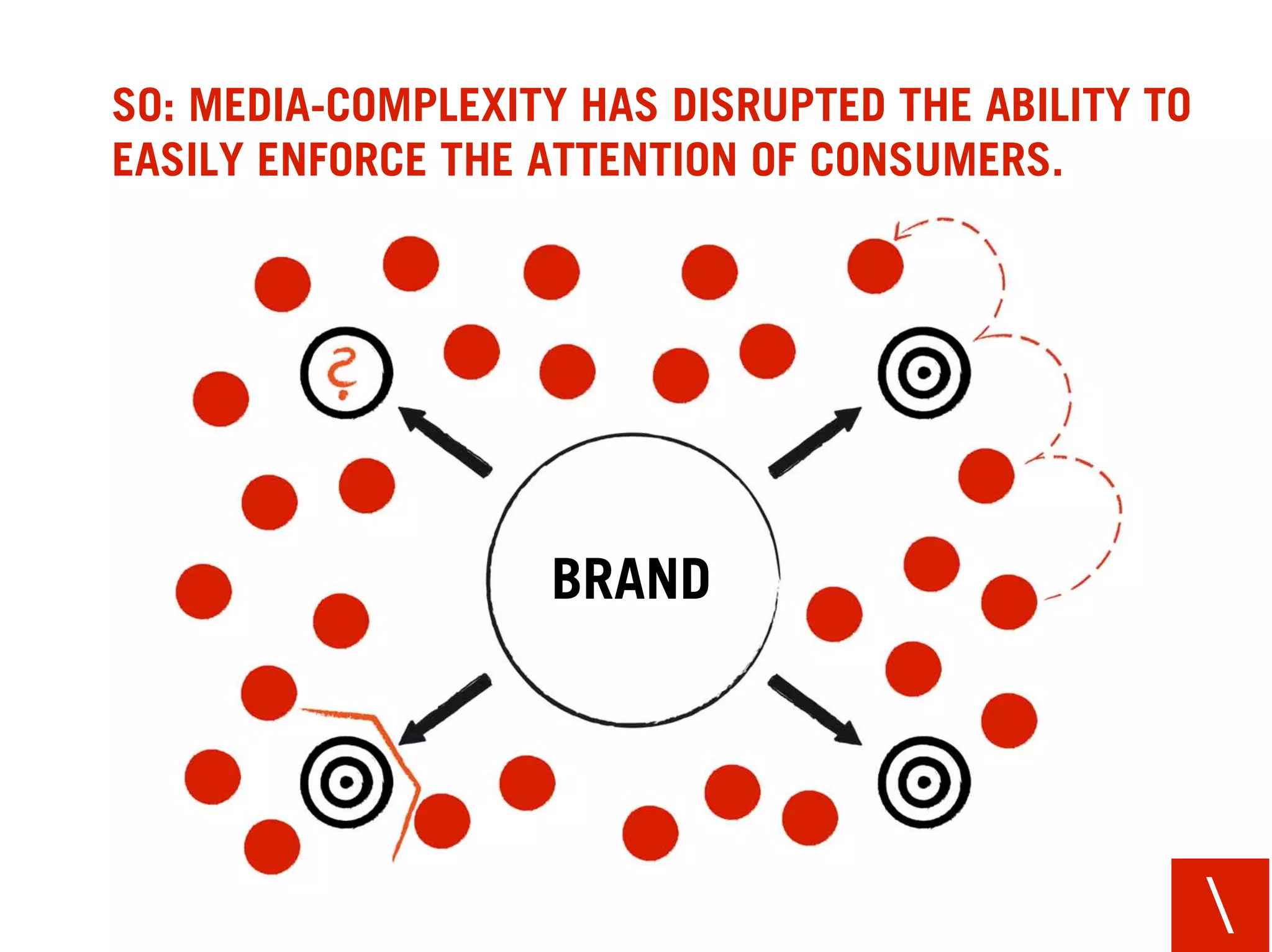
SO: MEDIA-COMPLEXITY HAS DISRUPTED THE ABILITY TO
EASILY ENFORCE THE ATTENTION OF CONSUMERS.


                   BRAND
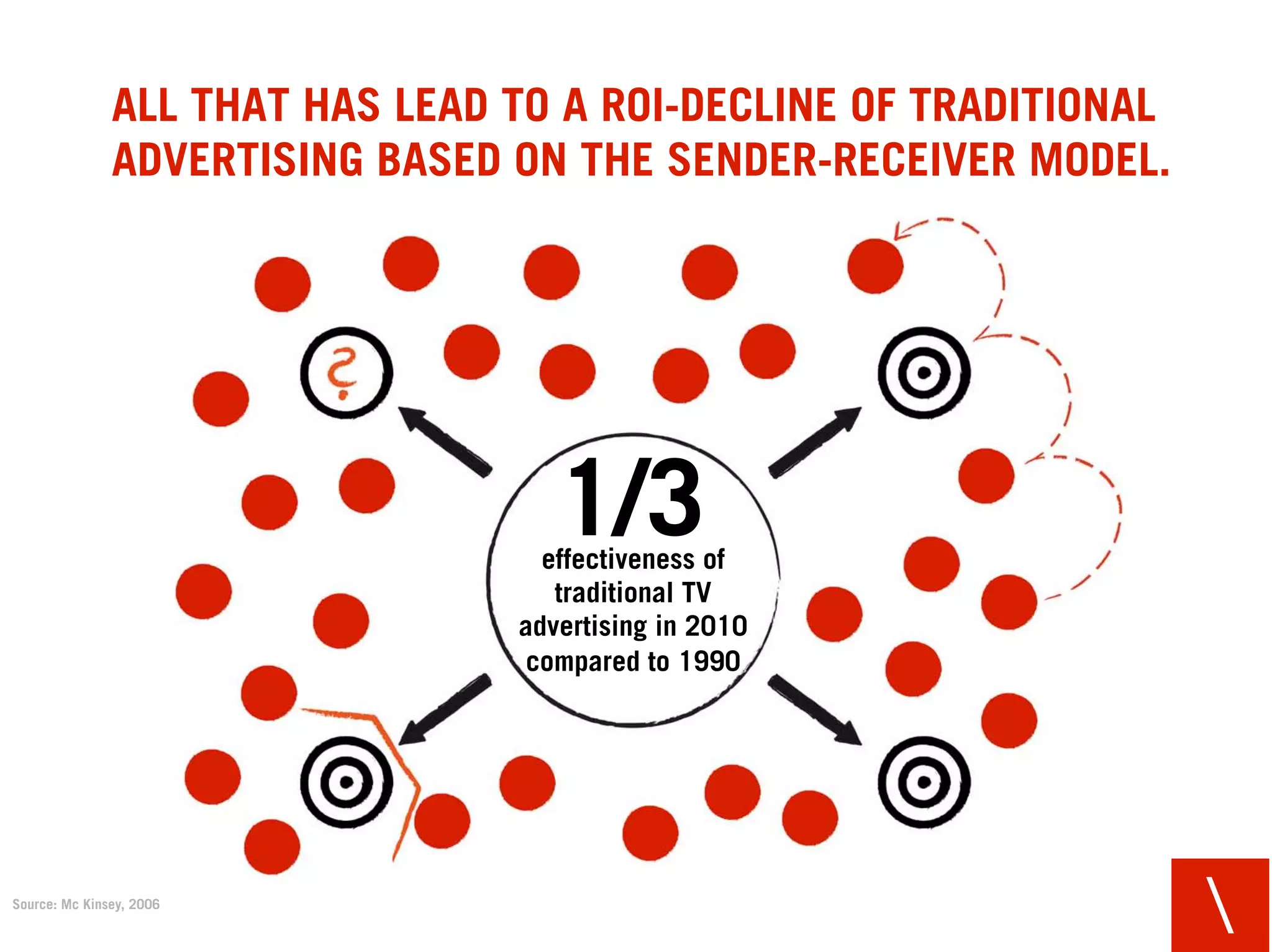
ALL THAT HAS LEAD TO A ROI-DECLINE OF TRADITIONAL
               ADVERTISING BASED ON THE SENDER-RECEIVER MODEL.


                                    1/3
                                   effectiveness of
                                    traditional TV
                                 advertising in 2010
                                  compared to 1990


Source: Mc Kinsey, 2006
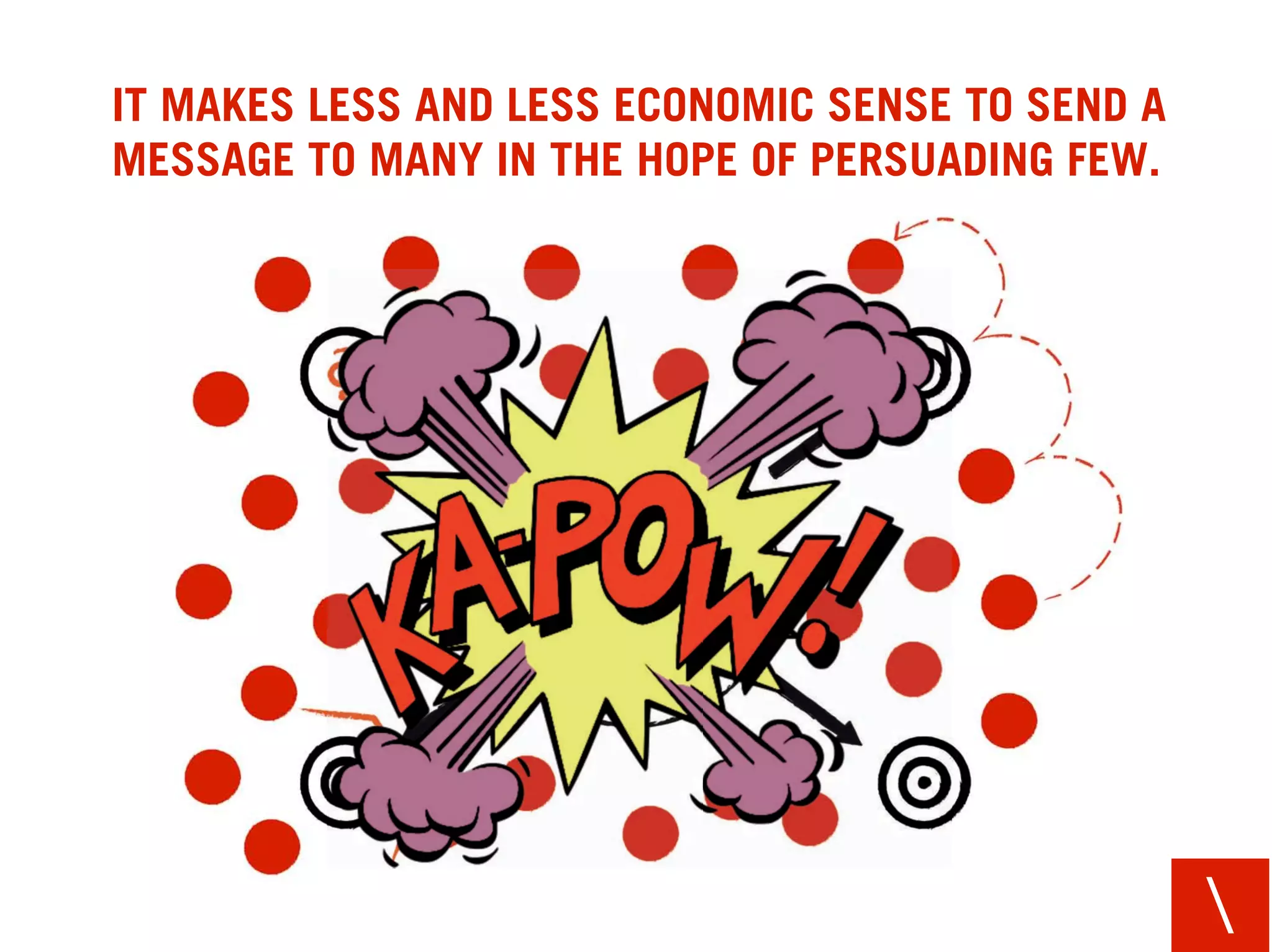
IT MAKES LESS AND LESS ECONOMIC SENSE TO SEND A
MESSAGE TO MANY IN THE HOPE OF PERSUADING FEW.
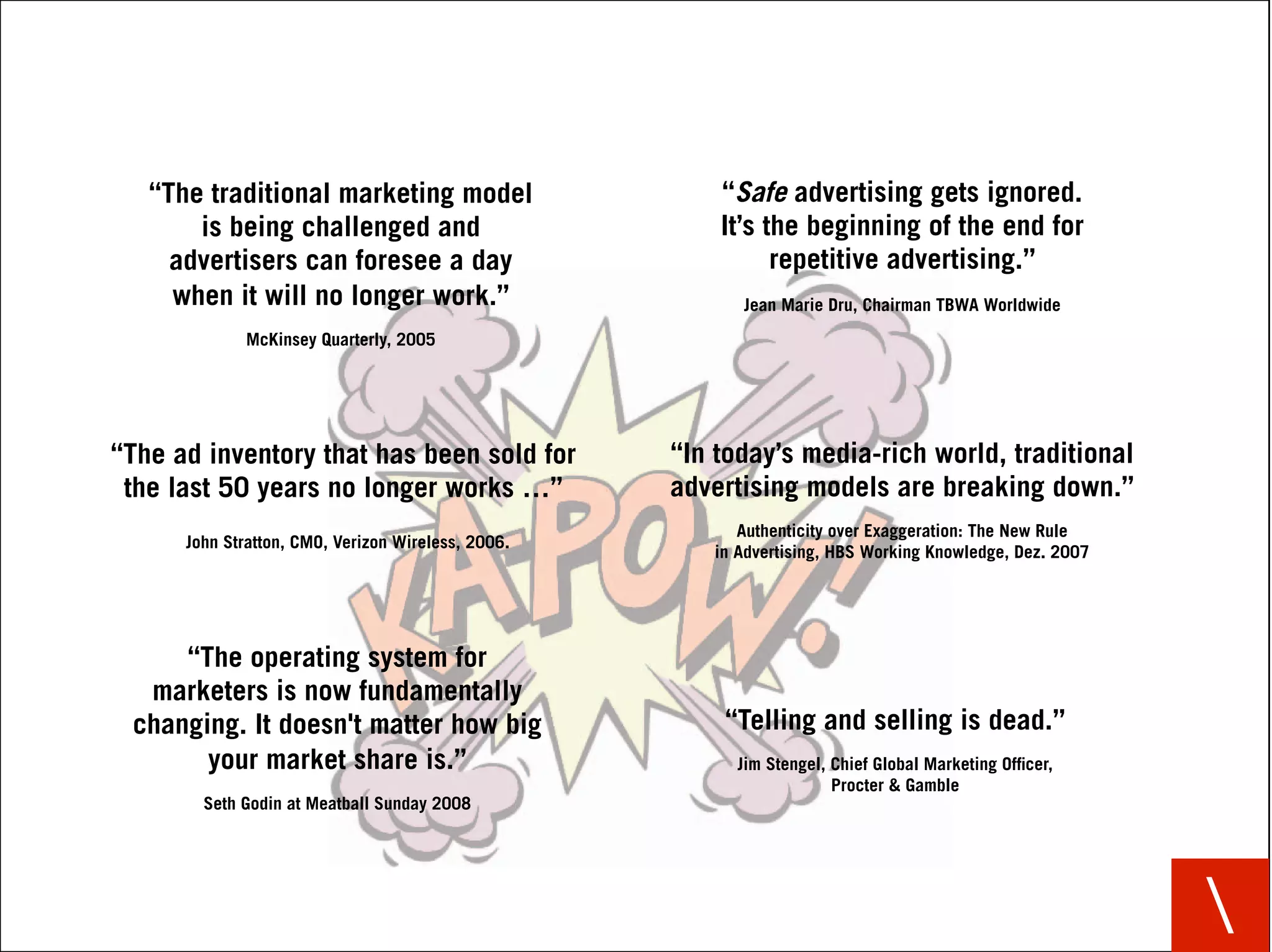
“The traditional marketing model                     “Safe advertising gets ignored.
       is being challenged and                          It’s the beginning of the end for
     advertisers can foresee a day                            repetitive advertising.”
     when it will no longer work.”                        Jean Marie Dru, Chairman TBWA Worldwide
             McKinsey Quarterly, 2005


“The ad inventory that has been sold for            “In today’s media-rich world, traditional
 the last 50 years no longer works …”               advertising models are breaking down.”
                                                          Authenticity over Exaggeration: The New Rule
      John Stratton, CMO, Verizon Wireless, 2006.
                                                       in Advertising, HBS Working Knowledge, Dez. 2007


     “The operating system for
  marketers is now fundamentally
 changing. It doesn't matter how big                    “Telling and selling is dead.”
       your market share is.”                            Jim Stengel, Chief Global Marketing Officer,
                                                                      Procter & Gamble
        Seth Godin at Meatball Sunday 2008
WHAT BRANDS SHOULD DO
13 PATHFINDING QUOTES
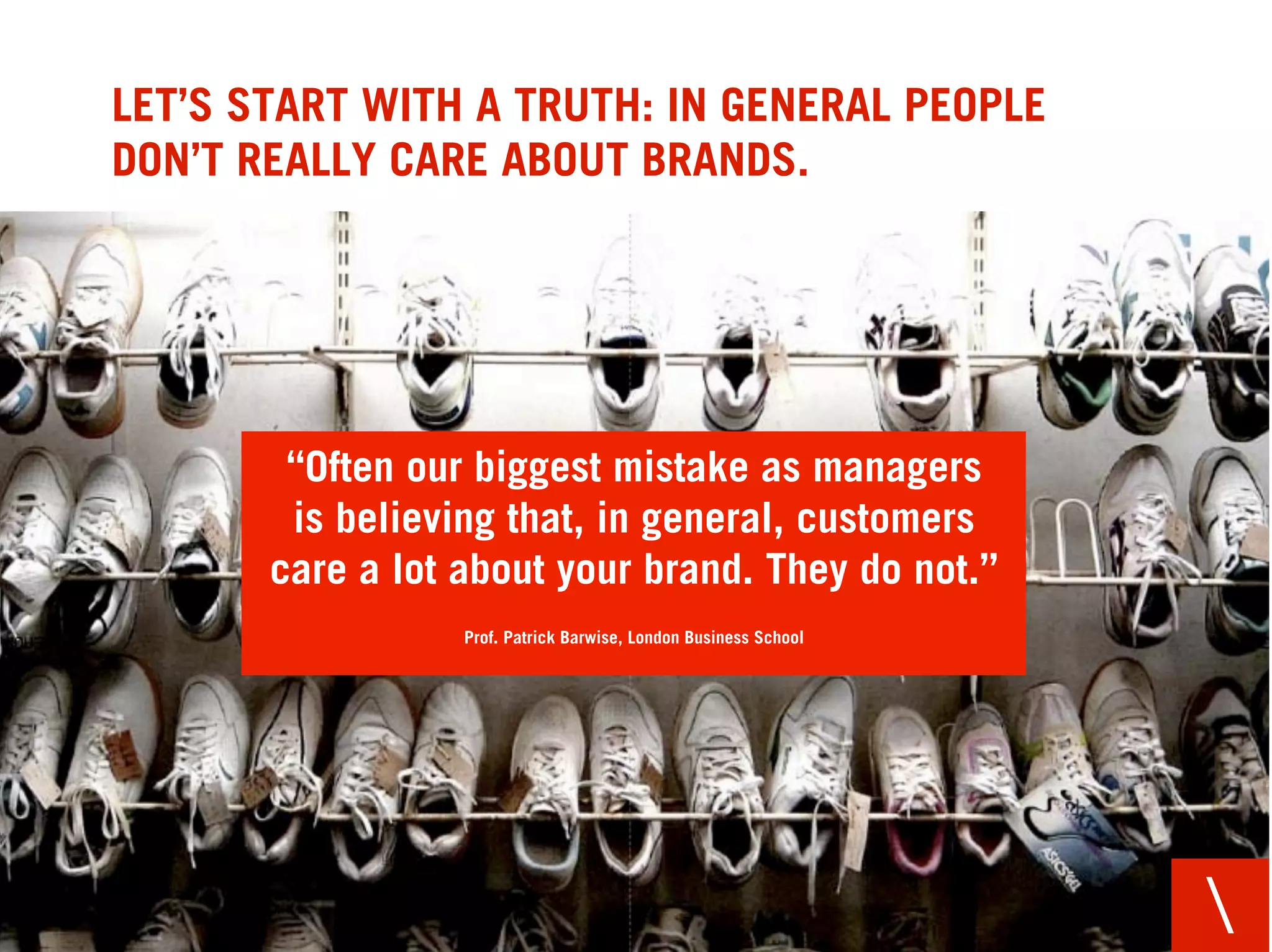
LET’S START WITH A TRUTH: IN GENERAL PEOPLE
DON’T REALLY CARE ABOUT BRANDS.


        “Often our biggest mistake as managers
        is believing that, in general, customers
       care a lot about your brand. They do not.”
                  Prof. Patrick Barwise, London Business School
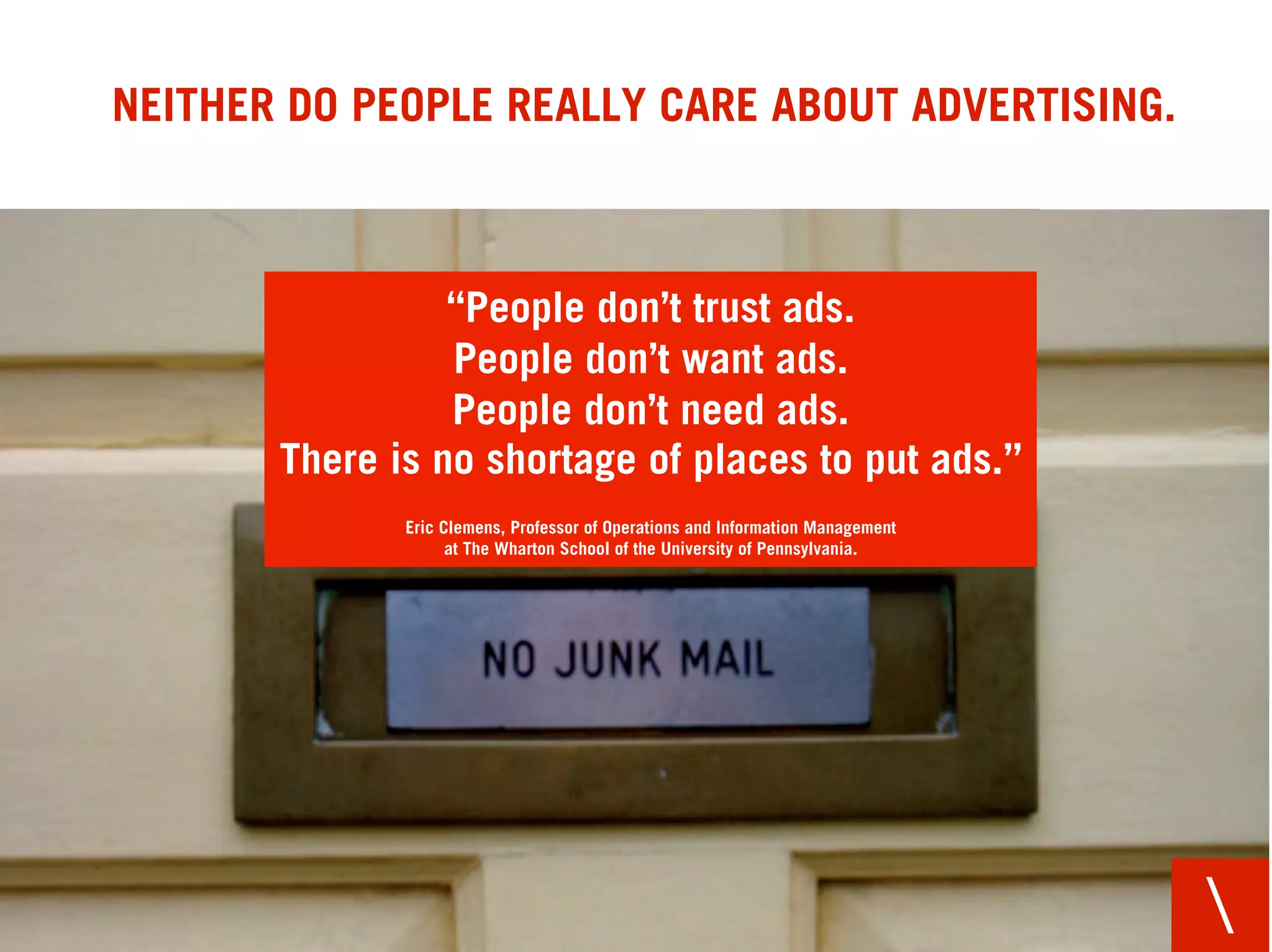
NEITHER DO PEOPLE REALLY CARE ABOUT ADVERTISING.


                 “People don’t trust ads.
                 People don’t want ads.
                 People don’t need ads.
       There is no shortage of places to put ads.”
              Eric Clemens, Professor of Operations and Information Management
                    at The Wharton School of the University of Pennsylvania.
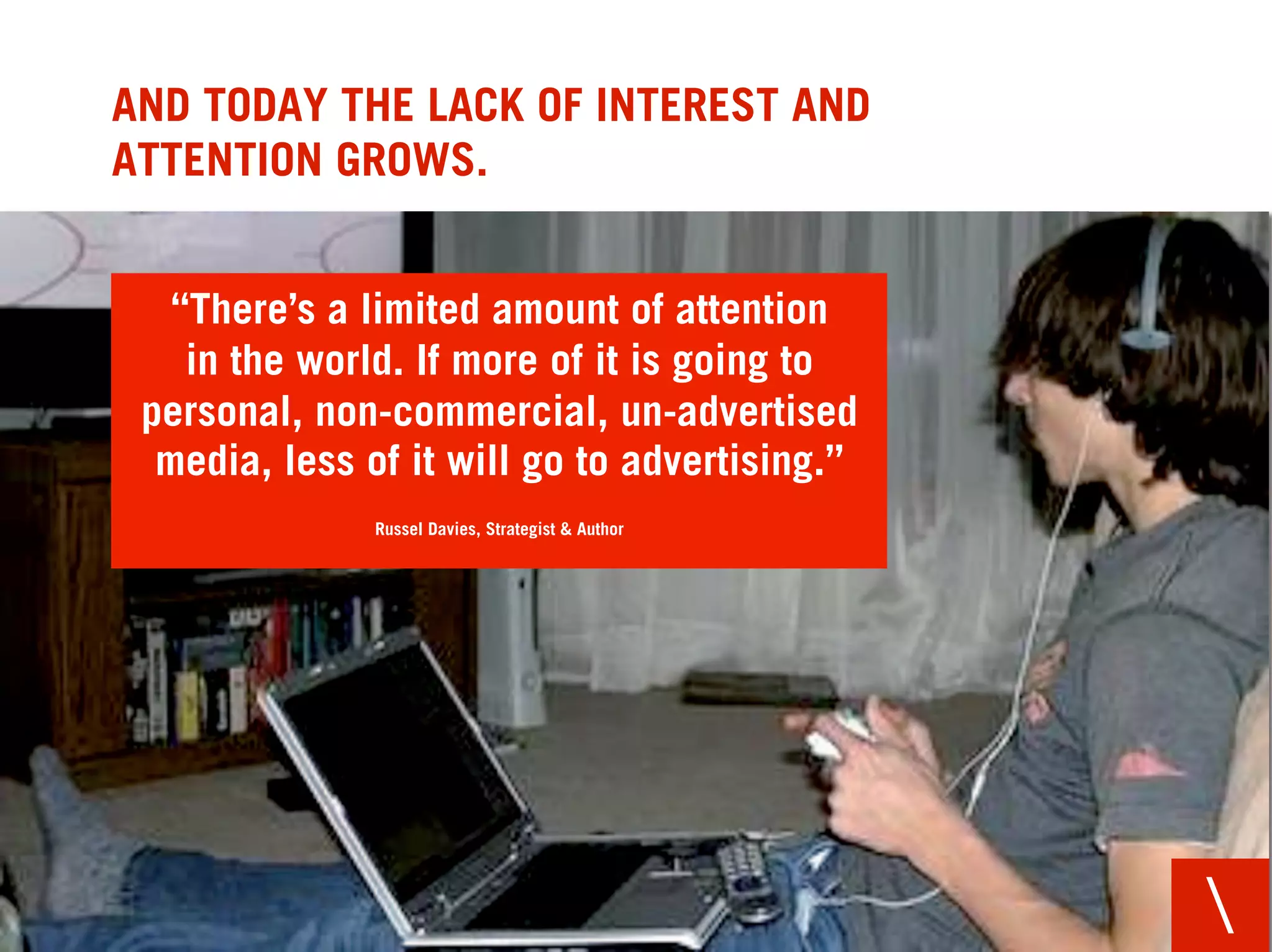
AND TODAY THE LACK OF INTEREST AND
ATTENTION GROWS.


   “There’s a limited amount of attention
    in the world. If more of it is going to
 personal, non-commercial, un-advertised
  media, less of it will go to advertising.”
               Russel Davies, Strategist & Author
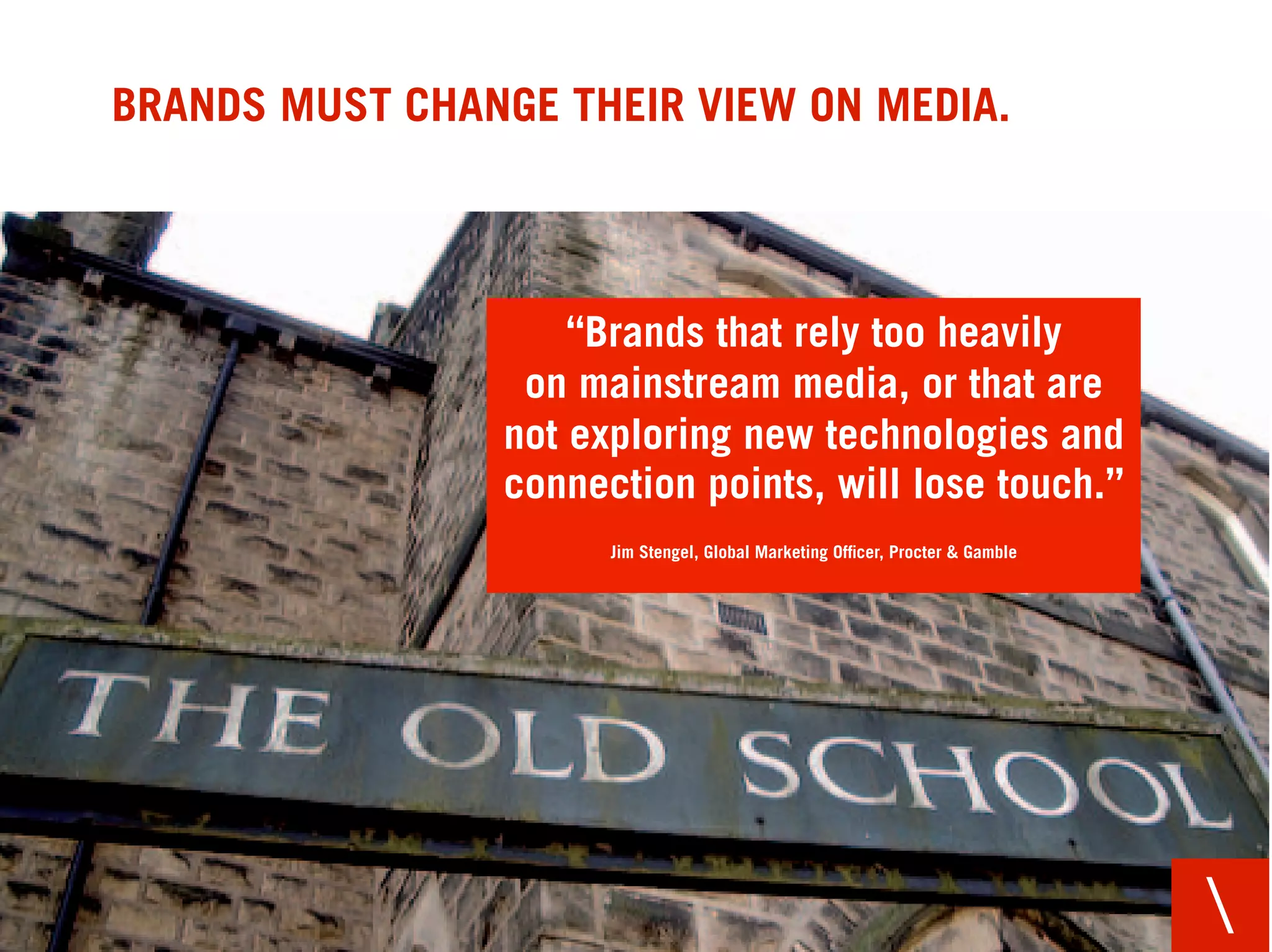
BRANDS MUST CHANGE THEIR VIEW ON MEDIA.


                    “Brands that rely too heavily
                 on mainstream media, or that are
                not exploring new technologies and
                connection points, will lose touch.”
                      Jim Stengel, Global Marketing Officer, Procter & Gamble
BRANDS SHOULD REMIND THEMSELVES WHAT THE
ACTUAL JOB IS.


            “We’re not in the business of
         keeping the media companies alive.
              We‘re in the business of
            connecting with consumers.”
            Trevor Edwards, Vice President of Global Brand Management, Nike
TODAY’S POSSIBILITIES TO CONNECT ARE ENDLESS.


               “Everything a brand does
       that connects to the consumer is media.”
                Lee Clow, Director of Media Arts, TBWA Worldwide
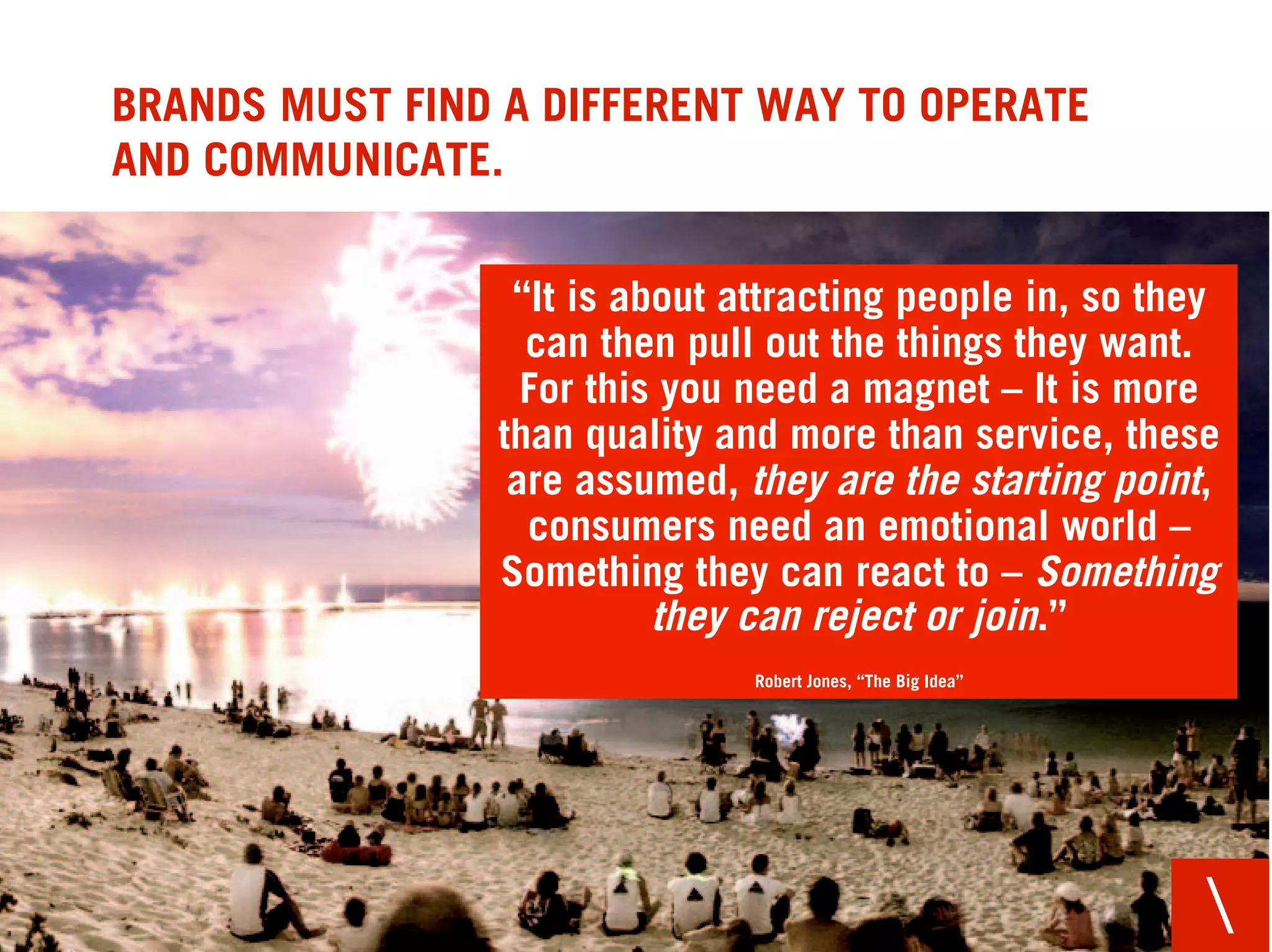
BRANDS MUST FIND A DIFFERENT WAY TO OPERATE
AND COMMUNICATE.

                  “It is about attracting people in, so they
                   can then pull out the things they want.
                   For this you need a magnet – It is more
                 than quality and more than service, these
                  are assumed, they are the starting point,
                   consumers need an emotional world –
                 Something they can react to – Something
                           they can reject or join.”
                                Robert Jones, “The Big Idea”
STOP INTERRUPTING WHAT PEOPLE
ARE INTERESTED IN.


                 “Every brand today has to think and
                   act like a media company, rather
                    than pushing stuff out there, to
                 instead aim to pull an audience in.”
                            Spencer Baim, Head of Virtue
STOP BORING PEOPLE BY SENDING SIMPLE MESSAGES.


     “The whole industry is obsessed with the idea
     of a simple message, endlessly repeated (...)
      What people actually want is stuff with some
      complexity, some meat, some richness (...)
       No-one ever came out of a movie and said
         I really liked that. It was really clear.”
                    Russel Davies, Strategist & Author
WHAT BRANDS AND AGENCIES SHOULD DELIVER
  INSTEAD IS CONTENT.


“The agency’s job is to create content so valuable
 and useful that consumers wouldn’t want to live
   without it (…) content that’s interesting and
  entertaining enough to invite the consumer.”
                Jeff Hicks, CEO, Crispin Porter Bogusky
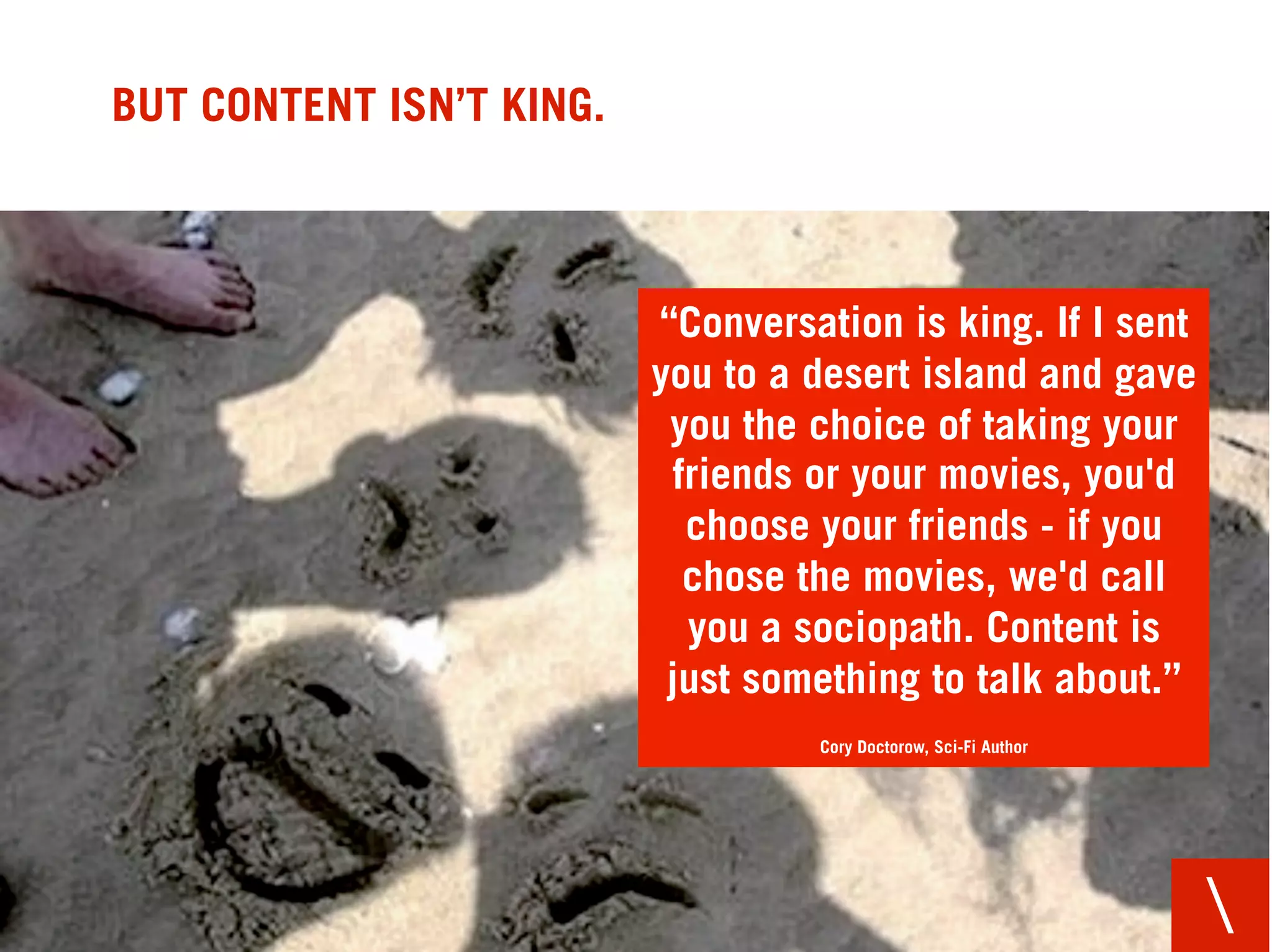
BUT CONTENT ISN’T KING.


                          “Conversation is king. If I sent
                          you to a desert island and gave
                           you the choice of taking your
                            friends or your movies, you'd
                             choose your friends - if you
                             chose the movies, we'd call
                             you a sociopath. Content is
                           just something to talk about.”
                                   Cory Doctorow, Sci-Fi Author
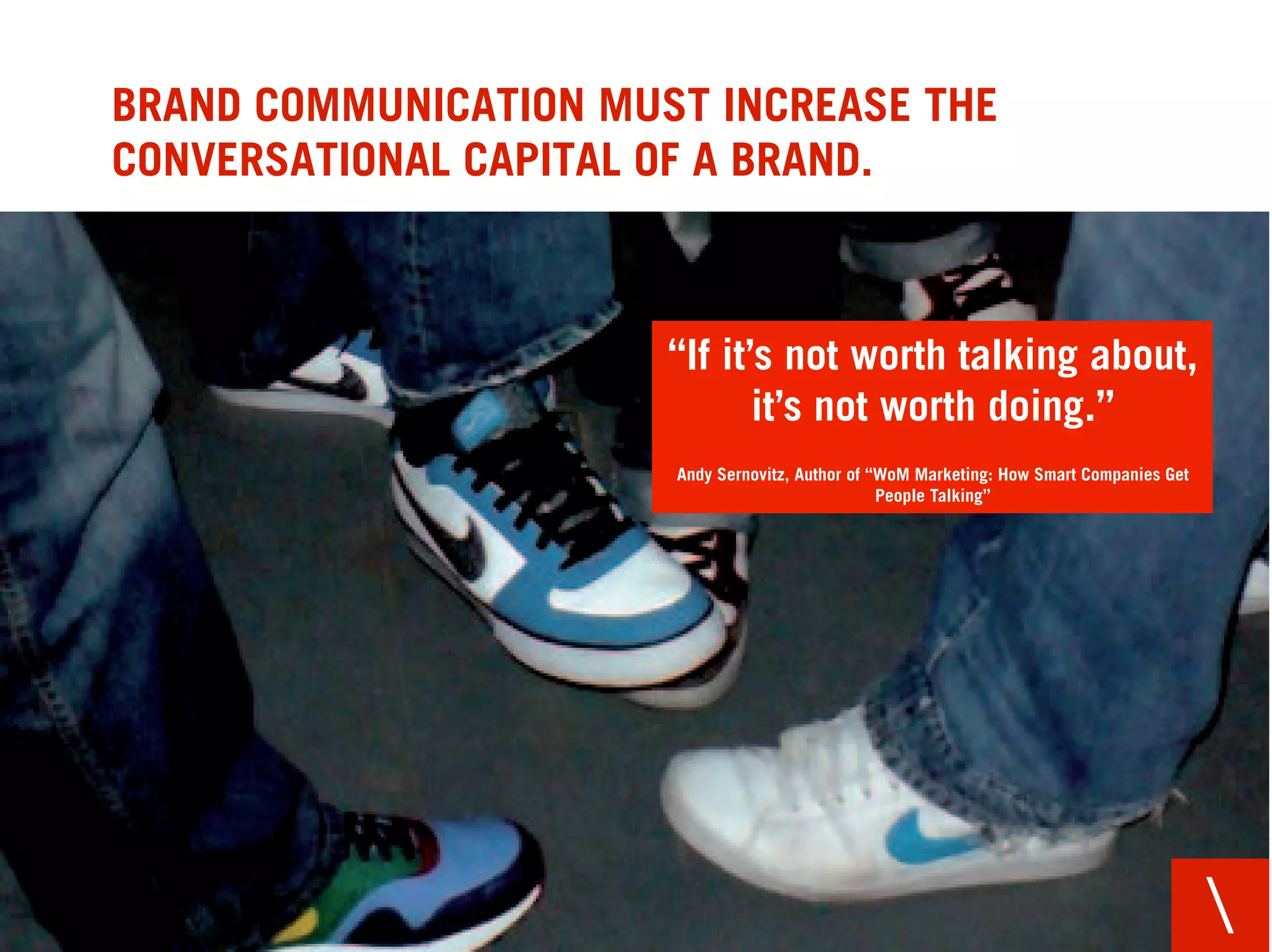
BRAND COMMUNICATION MUST INCREASE THE
CONVERSATIONAL CAPITAL OF A BRAND.


                       “If it’s not worth talking about,
                              it’s not worth doing.”
                       Andy Sernovitz, Author of “WoM Marketing: How Smart Companies Get
                                                  People Talking”
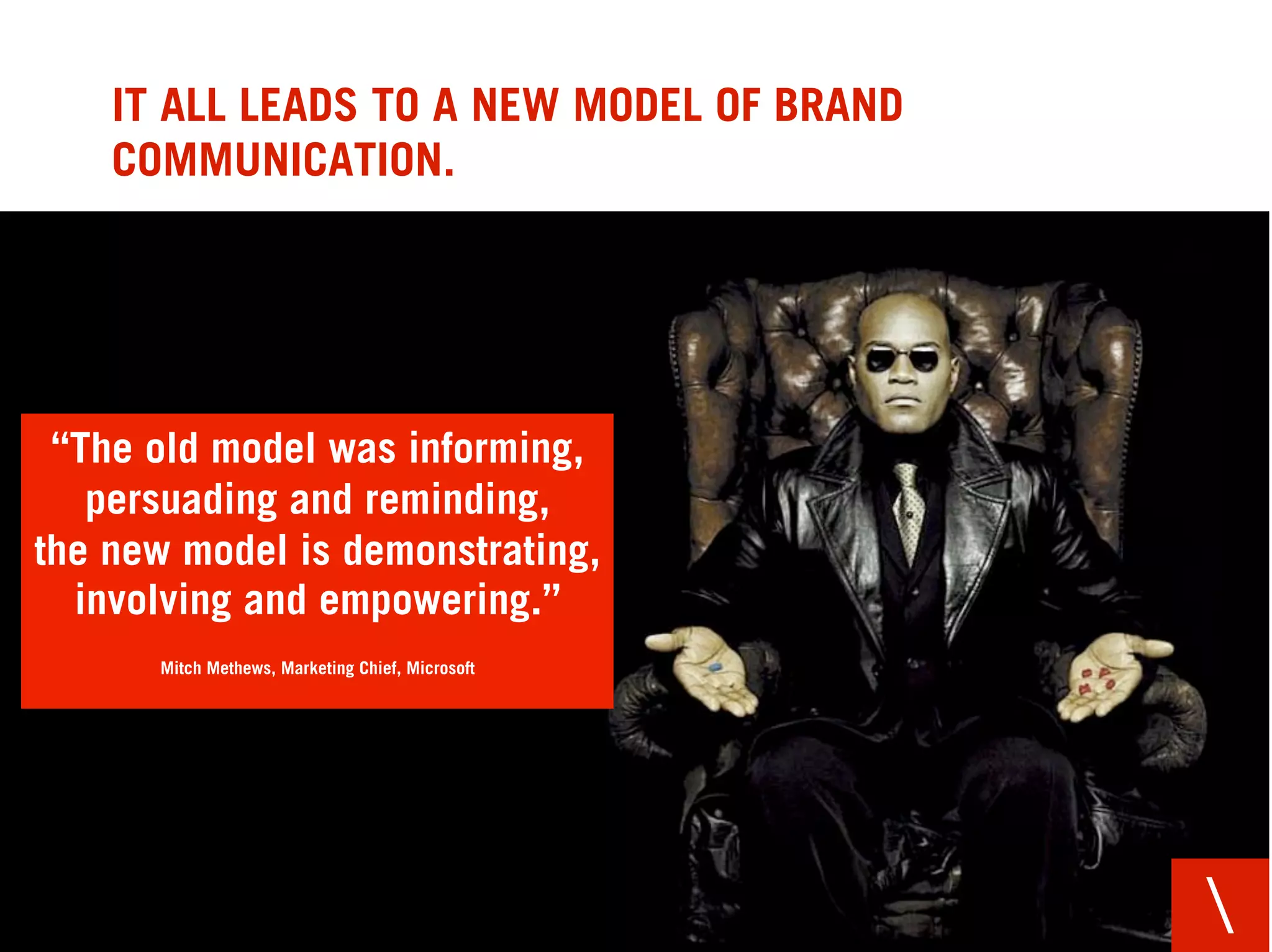
IT ALL LEADS TO A NEW MODEL OF BRAND
    COMMUNICATION.


 “The old model was informing,
   persuading and reminding,
the new model is demonstrating,
  involving and empowering.”
      Mitch Methews, Marketing Chief, Microsoft
IN SHORT:


            Understand everything as media
            Attract an audience
            Produce content
            Create stuff with some richness
            Make stuff worth talking about
HENCE BRAND COMMUNICATION WILL BE MORE CHARACT-
ERIZED BY ENTERTAINMENT THAN BY ADVERTISING.


          Understand everything as media
          Attract an audience
          Produce content
          Create stuff with some richness
          Make stuff worth talking about
“We don’t do advertising any more. (...) Advertising is
   all about achieving awareness, and we no longer
need awareness. We need to become part of people's
lives (...) Now it’s all about deciding what you want to
say and how you're going to say it. There are going to
     be times when a TV ad is the right way to go,
     but that’s the exception rather than the rule.”
                  Simon Pestridge, Nike’s UK marketing director


“Brands today cannot be sustained by what in the past
has been called advertising (…) perhaps the creativity
  of what we’ll do in the future needs a new name.”
                Lee Clow, Director of Media Arts, TBWA Worldwide
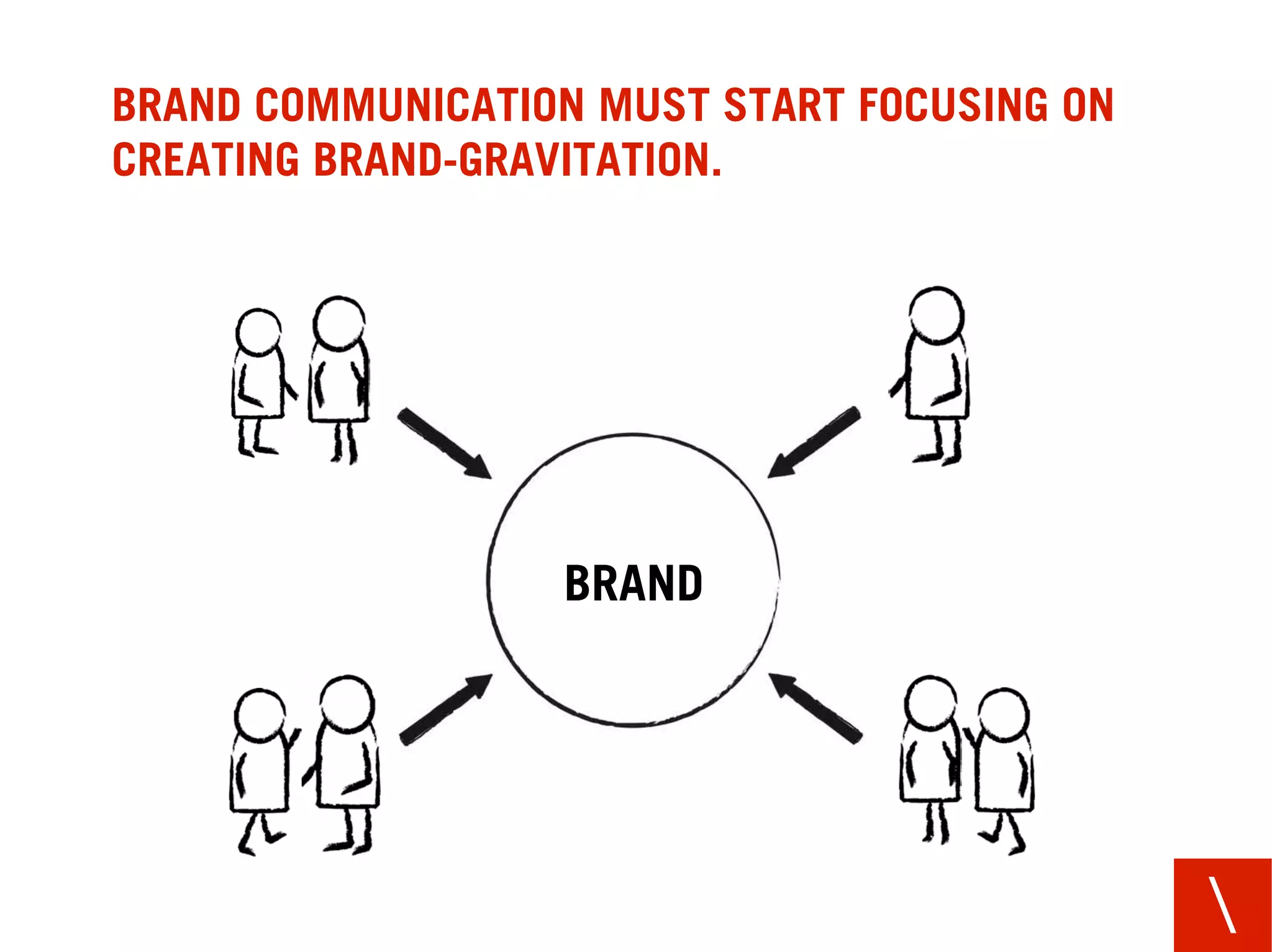
BRAND COMMUNICATION MUST START FOCUSING ON
CREATING BRAND-GRAVITATION.


                  BRAND
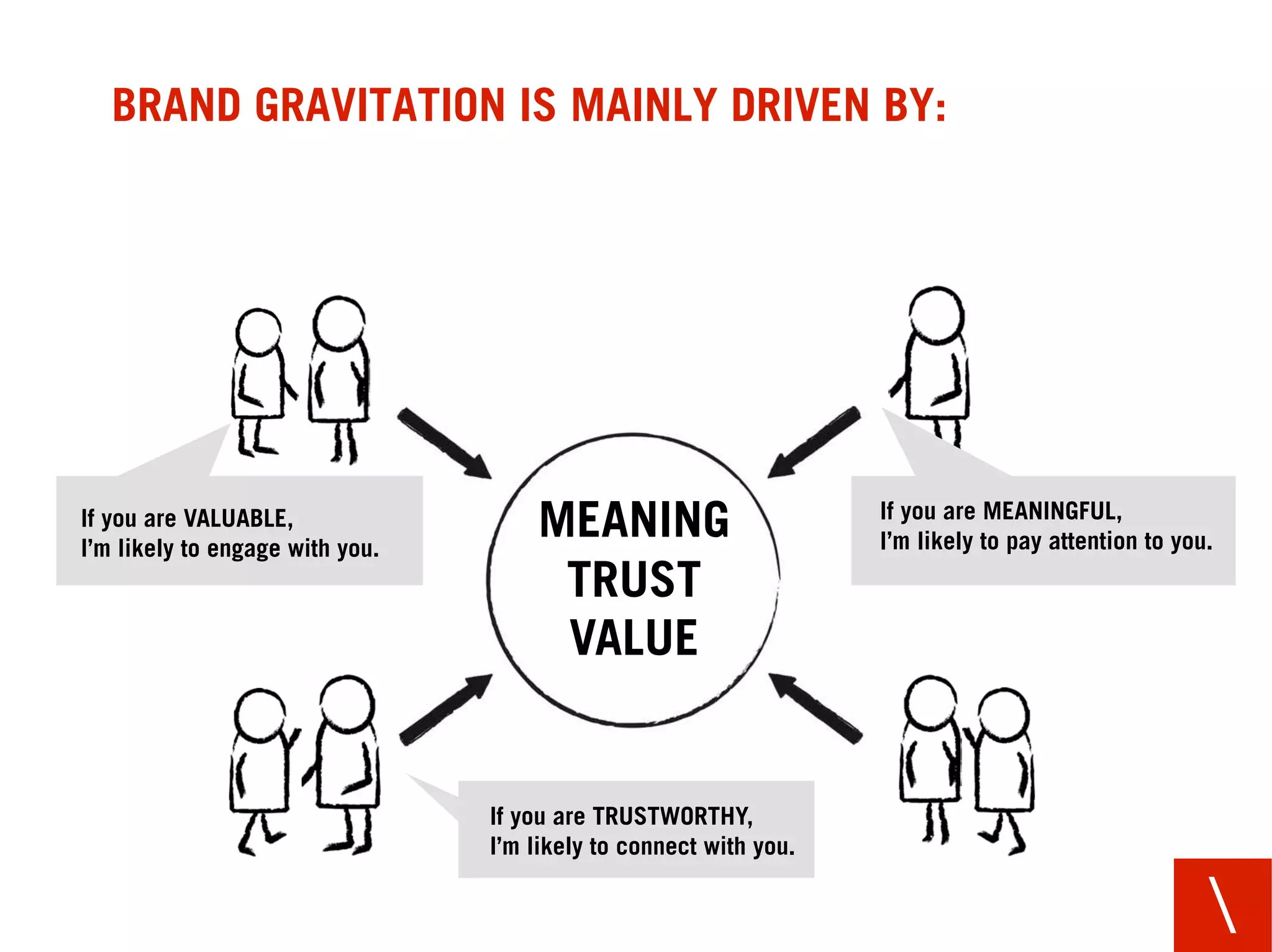
BRAND GRAVITATION IS MAINLY DRIVEN BY:


If you are VALUABLE,
I’m likely to engage with you.
                                     MEANING                       If you are MEANINGFUL,
                                                                   I’m likely to pay attention to you.
                                      TRUST
                                      VALUE


                                 If you are TRUSTWORTHY,
                                 I’m likely to connect with you.
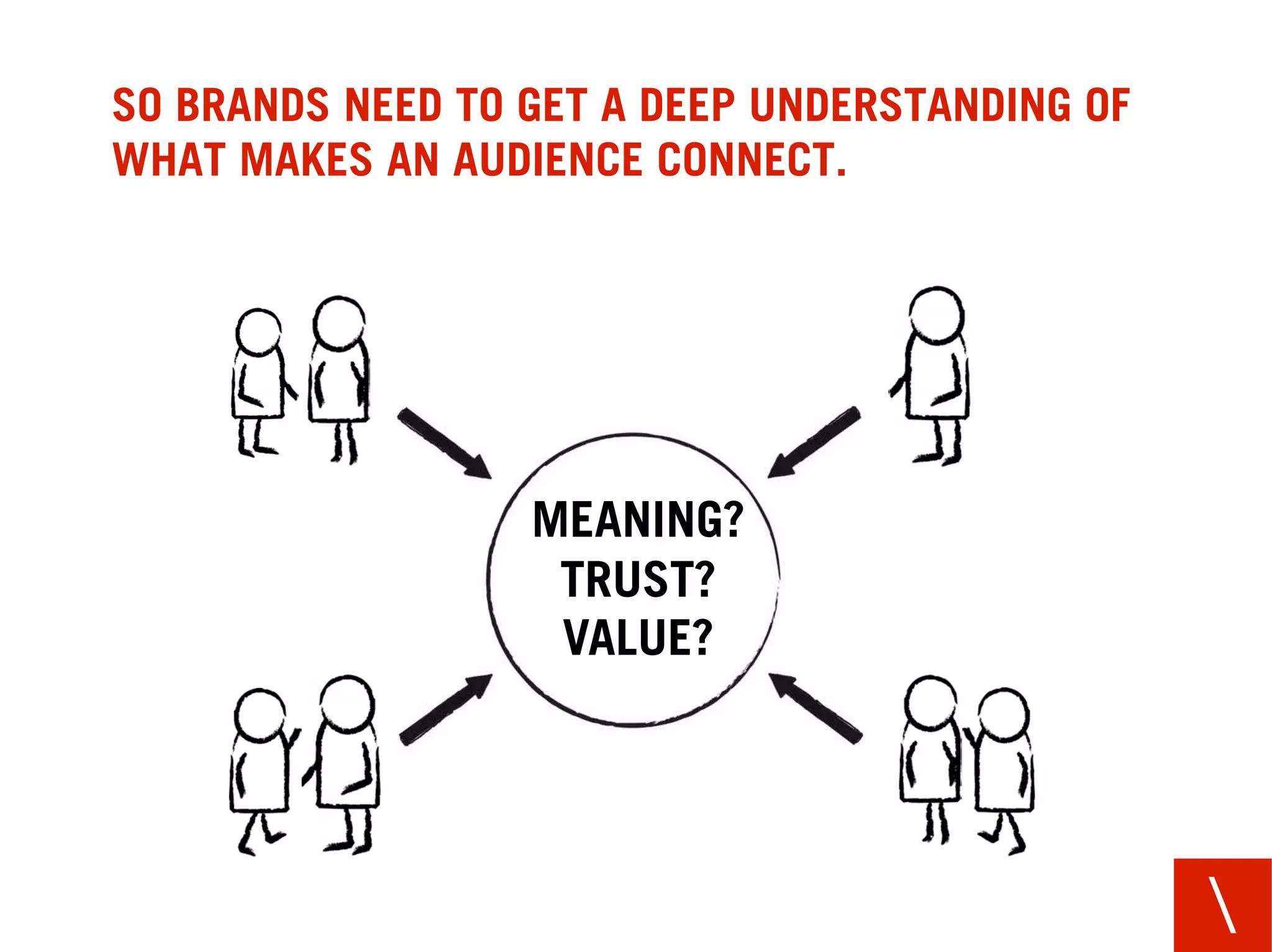
SO BRANDS NEED TO GET A DEEP UNDERSTANDING OF
WHAT MAKES AN AUDIENCE CONNECT.


                  MEANING?
                   TRUST?
                   VALUE?
PULL YOUR AUDIENCE IN VOLUNTARILY.
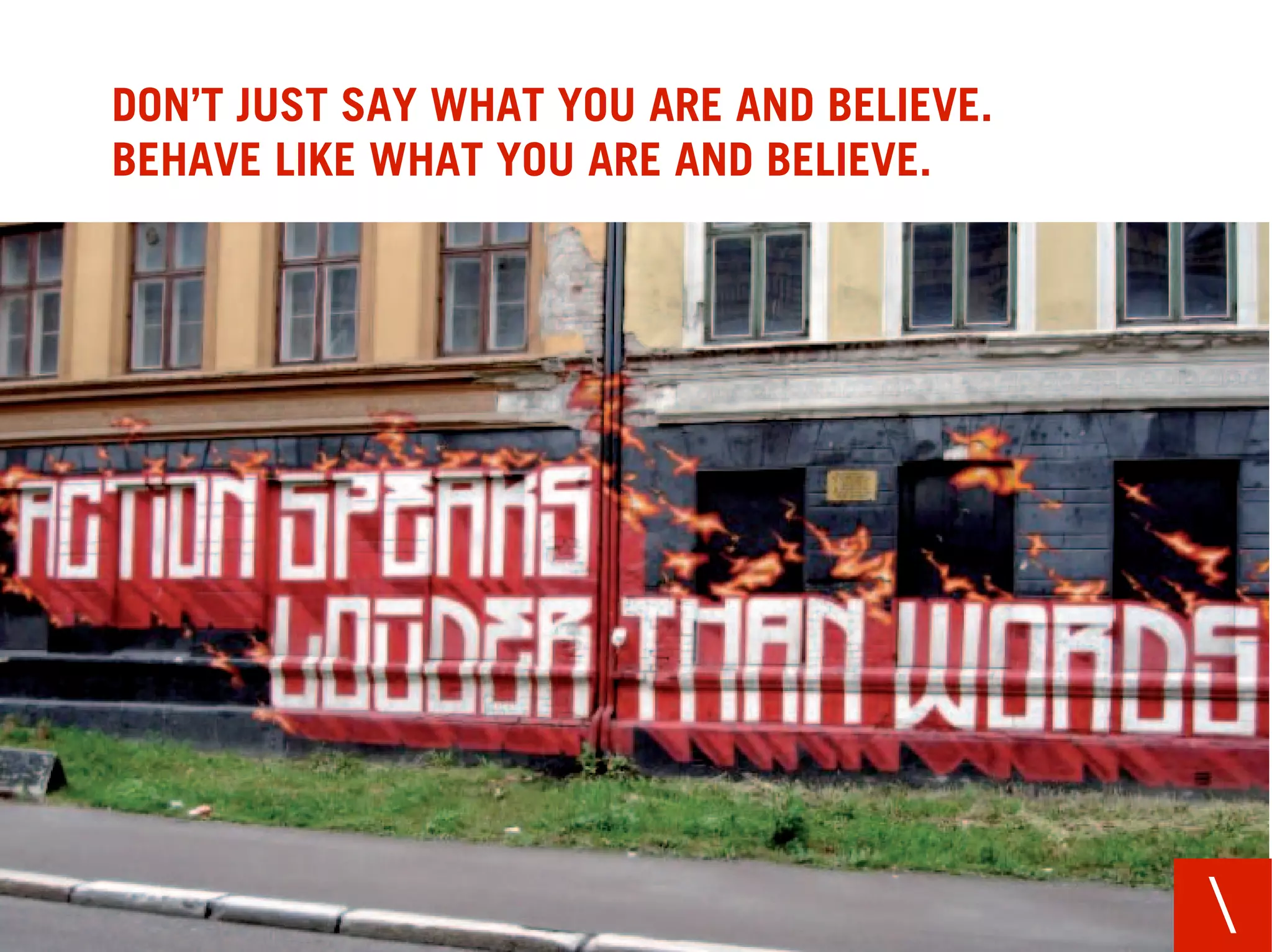
DON’T JUST SAY WHAT YOU ARE AND BELIEVE.
BEHAVE LIKE WHAT YOU ARE AND BELIEVE.
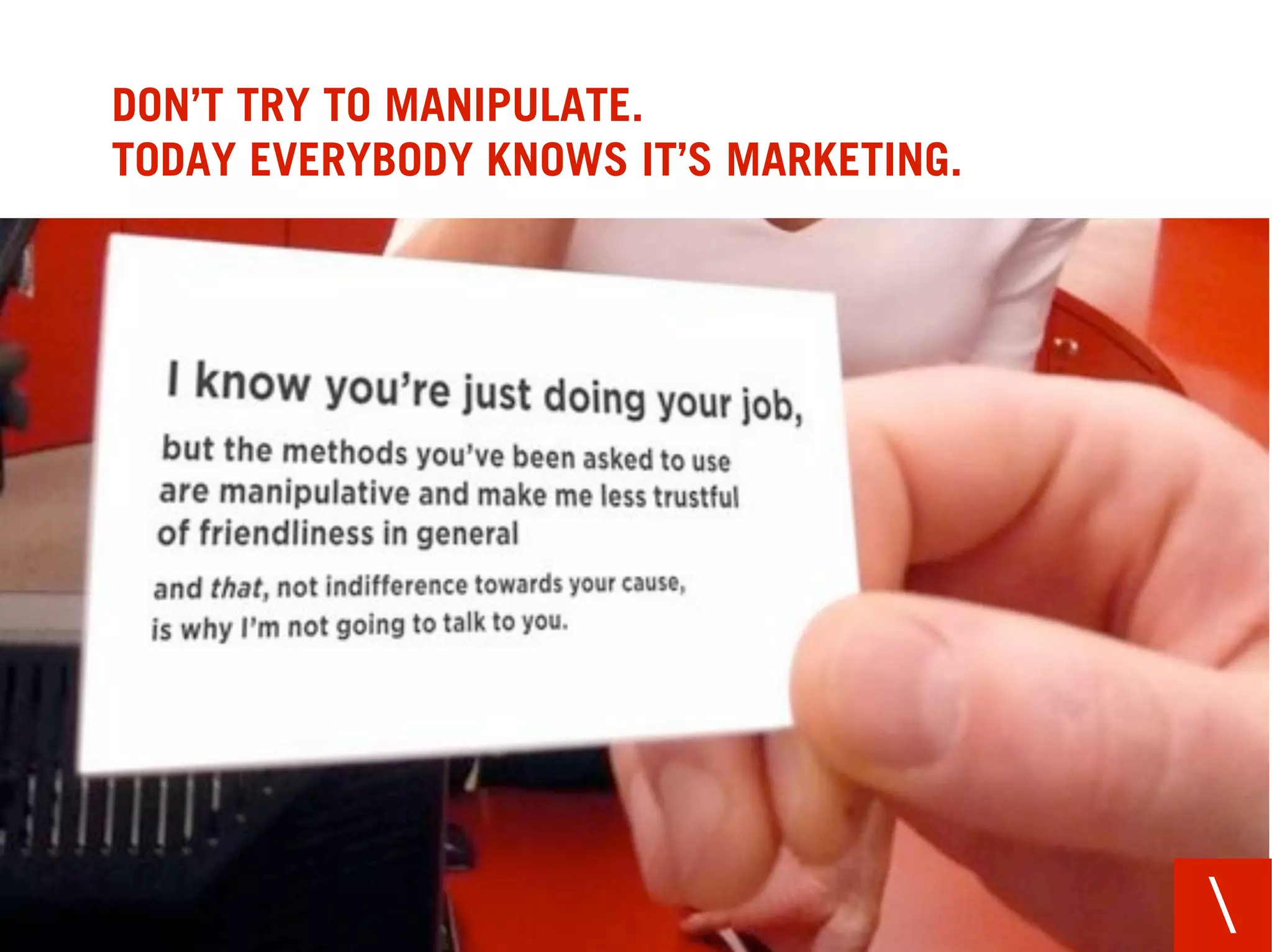
DON’T TRY TO MANIPULATE.
TODAY EVERYBODY KNOWS IT’S MARKETING.
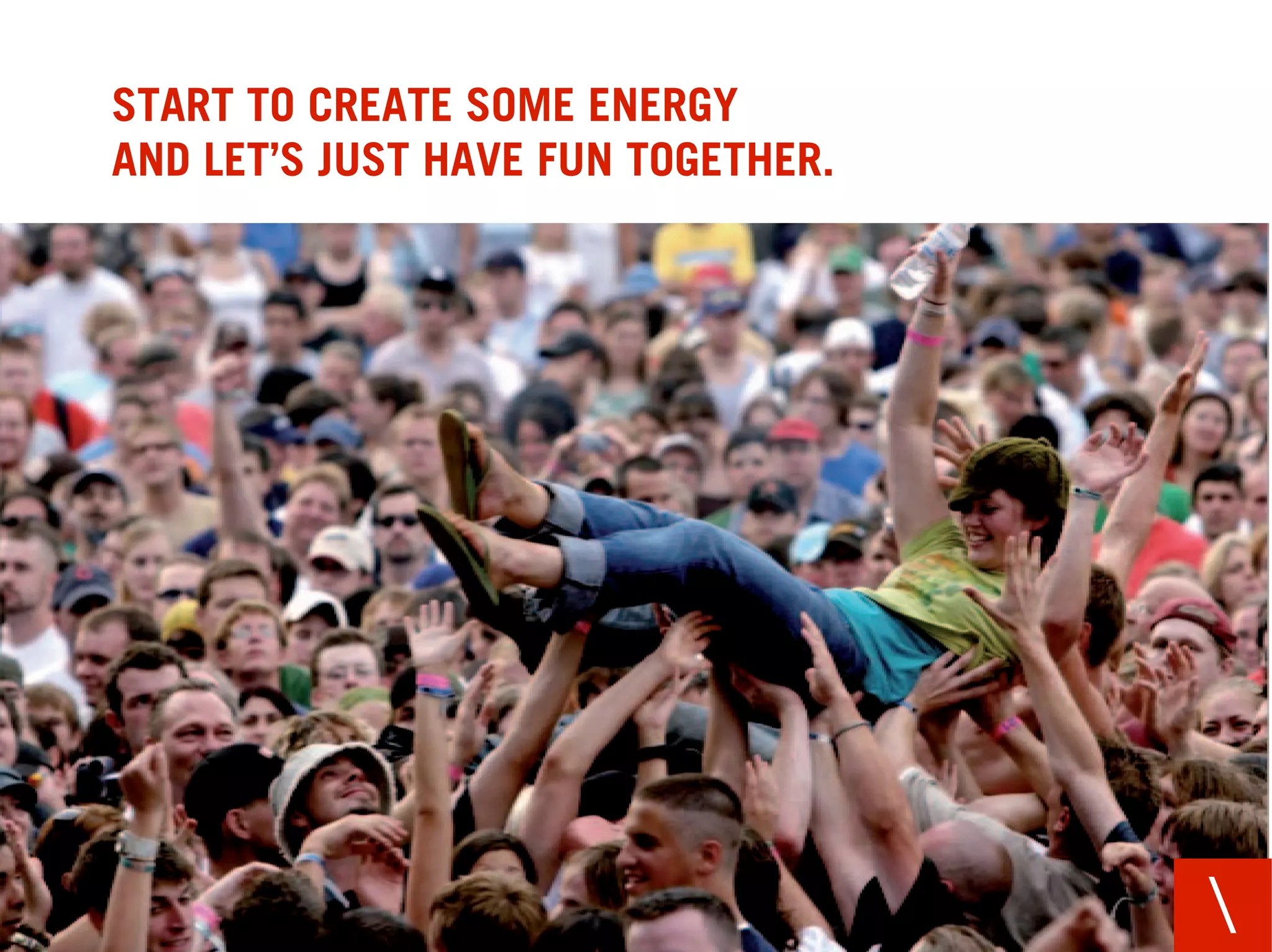
START TO CREATE SOME ENERGY
AND LET’S JUST HAVE FUN TOGETHER.
A NEW APPROACH
The following thoughts are guidelines
 to ensure different creative output –
            not rigid rules.

   You cannot follow a masterplan
   to create something innovative.
START WITH A SIMPLE TRUTH.


   We can’t treat people just as consumers anymore.
   People are audiences first and audiences expect to
    be entertained. As people today mash, tune in or
    ignore what they want, a brand needs to earn the
              engagement of its audience.
AND LET’S START WITH A SIMPLE QUESTION.


               Why should the audience
     spend their time voluntarily with a brand and
       not with all of the other interesting things
      they can choose from - anytime, anywhere?
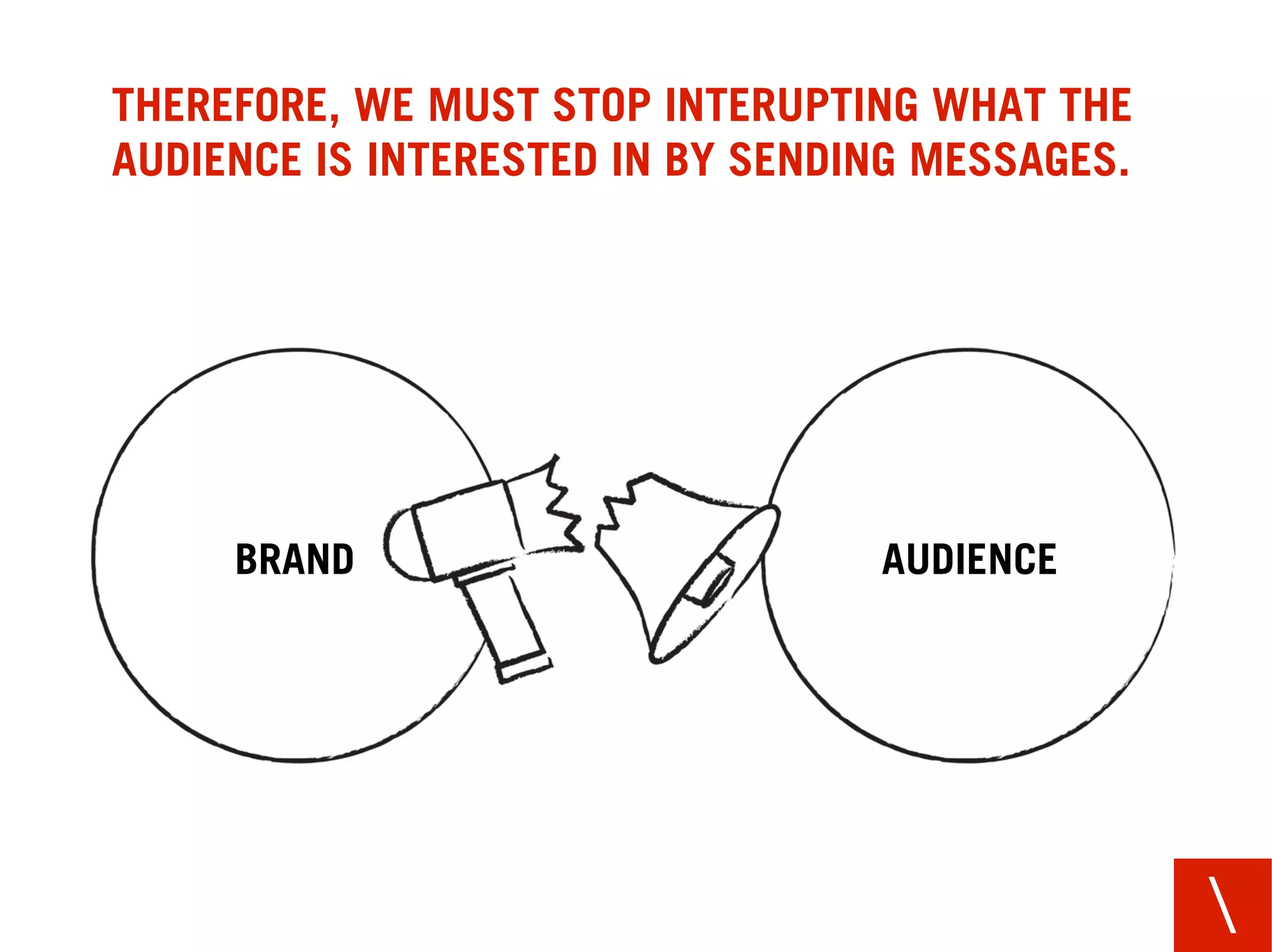
THEREFORE, WE MUST STOP INTERUPTING WHAT THE
AUDIENCE IS INTERESTED IN BY SENDING MESSAGES.


     BRAND                        AUDIENCE
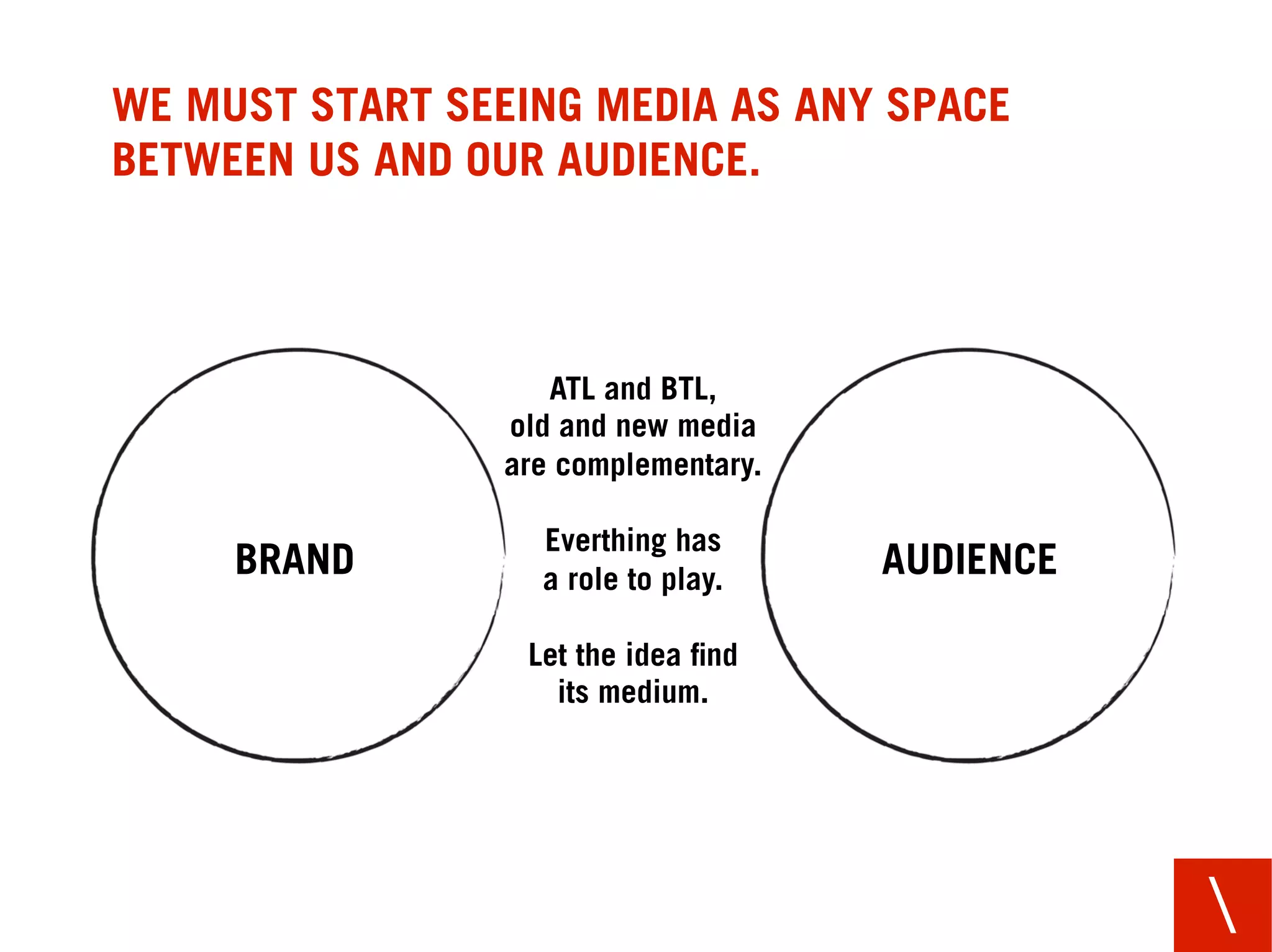
WE MUST START SEEING MEDIA AS ANY SPACE
BETWEEN US AND OUR AUDIENCE.


                    ATL and BTL,
                 old and new media
                 are complementary.

                   Everthing has
     BRAND         a role to play.    AUDIENCE

                  Let the idea find
                    its medium.
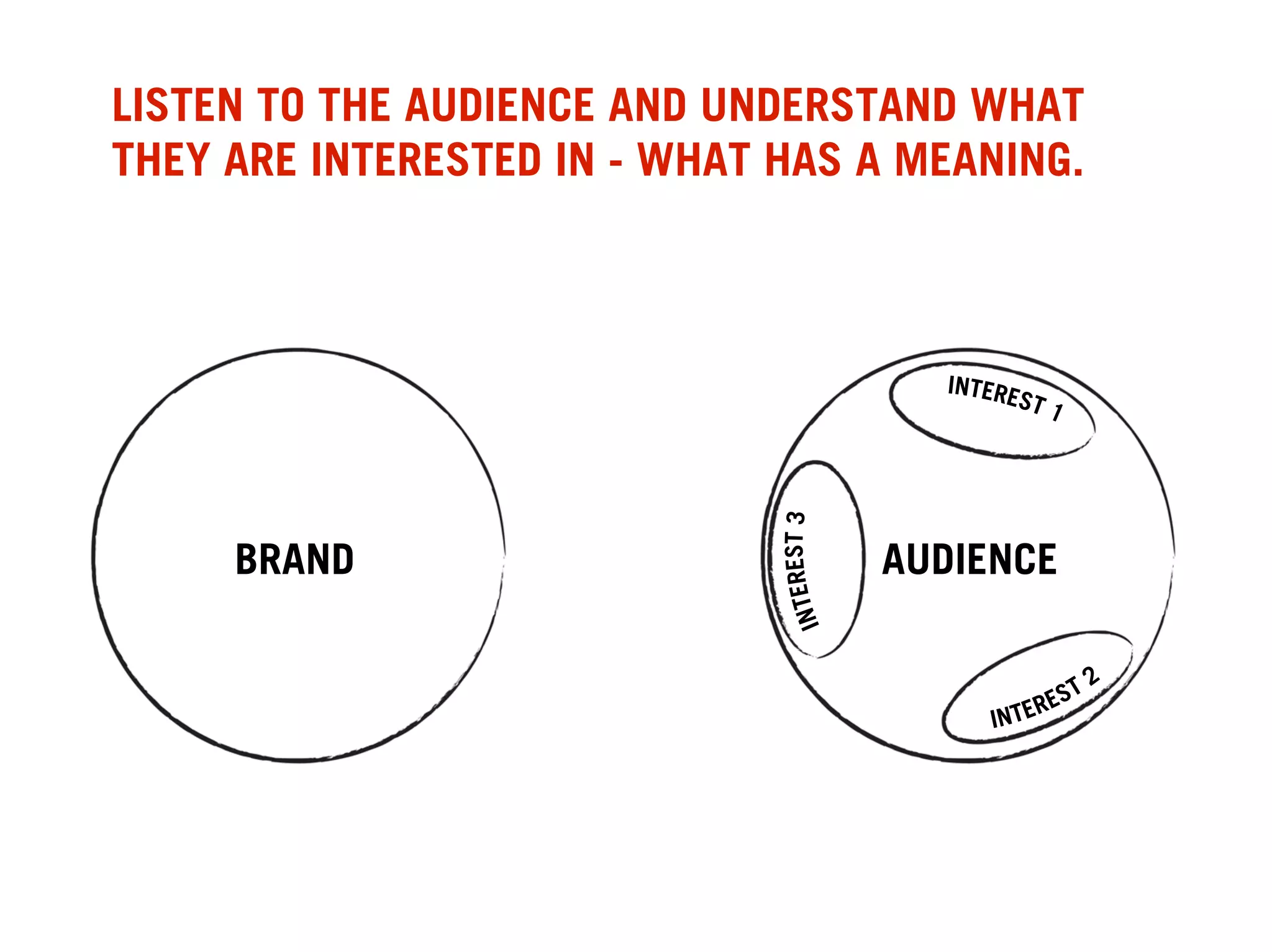
LISTEN TO THE AUDIENCE AND UNDERSTAND WHAT
THEY ARE INTERESTED IN - WHAT HAS A MEANING.


     BRAND                        AUDIENCE
“If communication is to change
behaviour it must be grounded in the
desire and interests of the receivers.”
                 Aristotle
“We’ve been voted the best marketer
         of the 20th century.
   But that’s because we were the
biggest shouters. In the 21st century,
  we want to be the best listeners.”
   Greg Icenhower, Procter&Gamble, director of corporate communications
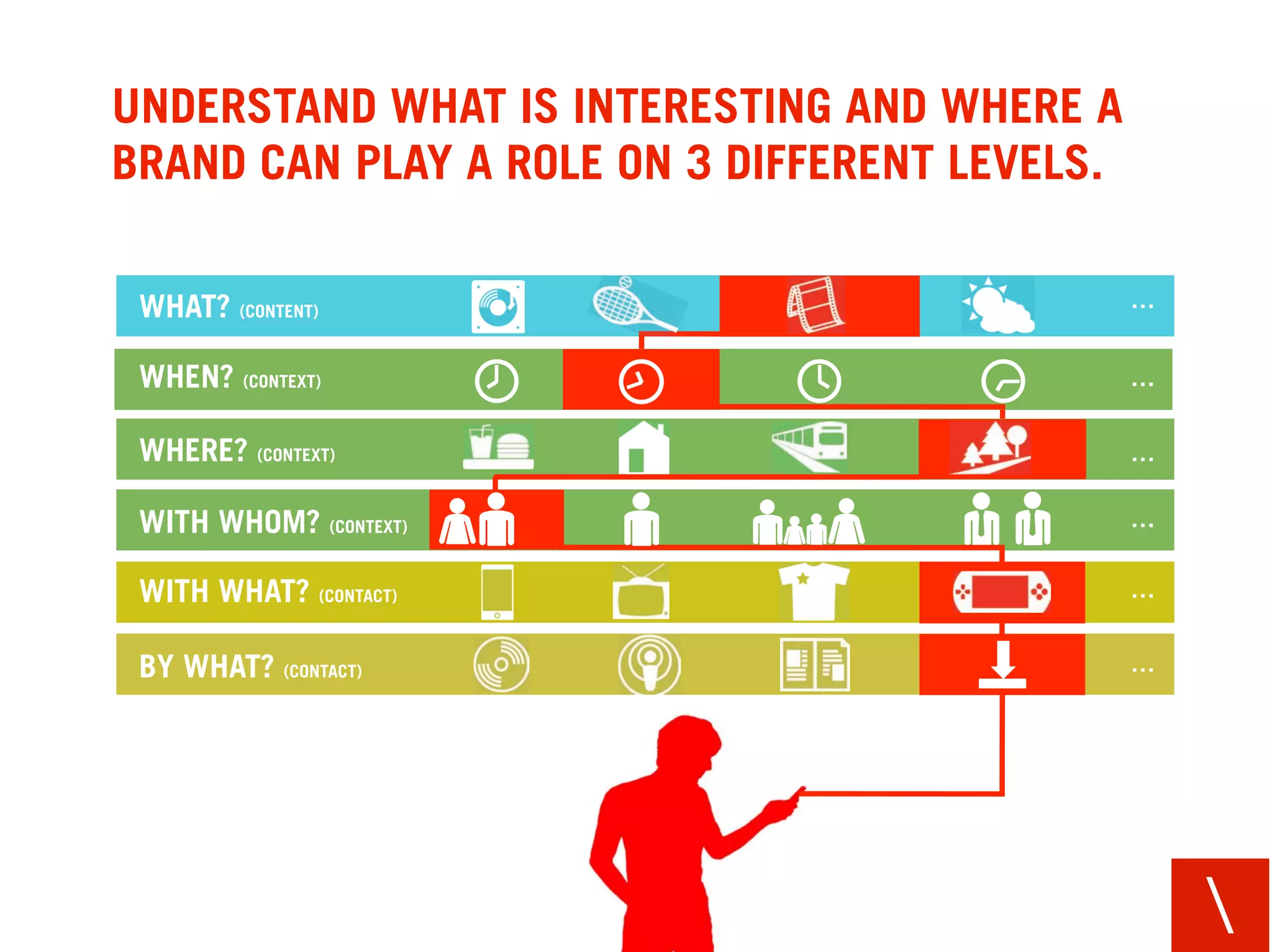
UNDERSTAND WHAT IS INTERESTING AND WHERE A
BRAND CAN PLAY A ROLE ON 3 DIFFERENT LEVELS.

 WHAT? (CONTENT)                               …


 WHEN? (CONTEXT)                               …


 WHERE? (CONTEXT)                              …

 WITH WHOM? (CONTEXT)                          …


 WITH WHAT? (CONTACT)                          …


 BY WHAT? (CONTACT)                            …
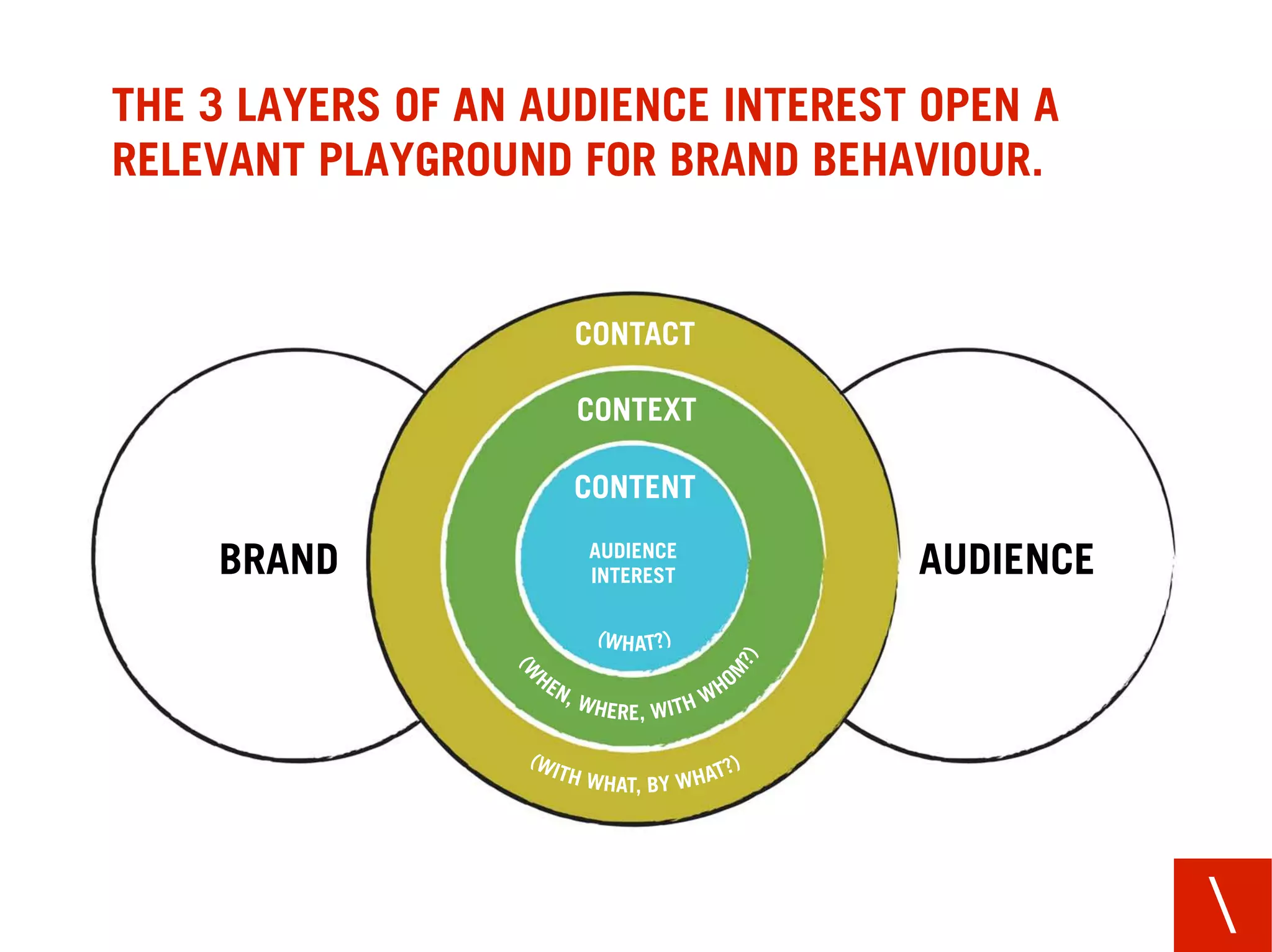
THE 3 LAYERS OF AN AUDIENCE INTEREST OPEN A
RELEVANT PLAYGROUND FOR BRAND BEHAVIOUR.


                     CONTACT

                     CONTEXT

                    CONTENT
                     AUDIENCE
    BRAND            INTEREST       AUDIENCE
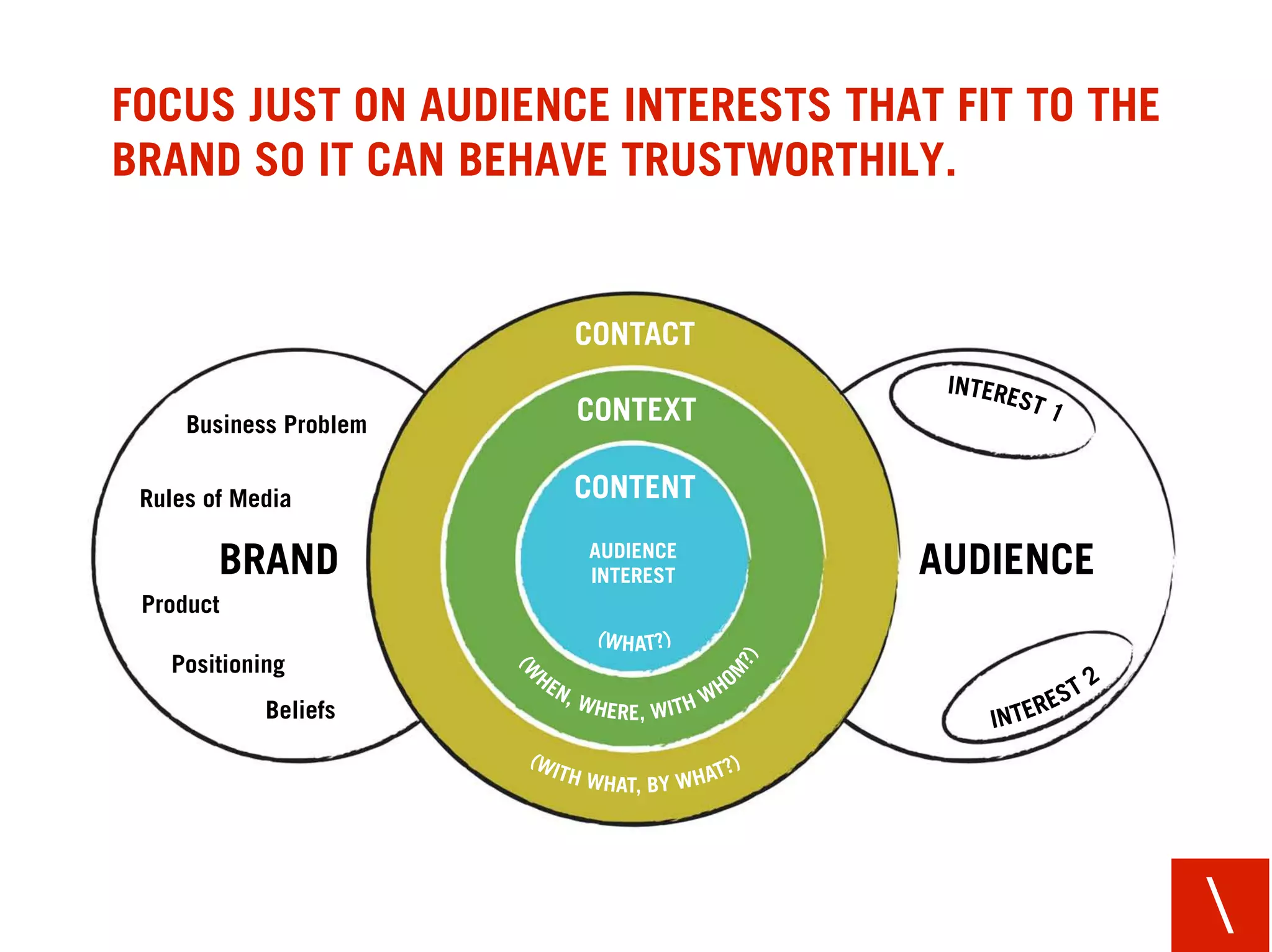
FOCUS JUST ON AUDIENCE INTERESTS THAT FIT TO THE
BRAND SO IT CAN BEHAVE TRUSTWORTHILY.


                        CONTACT

     Business Problem
                        CONTEXT

 Rules of Media         CONTENT
                        AUDIENCE
        BRAND           INTEREST    AUDIENCE
 Product

   Positioning
            Beliefs
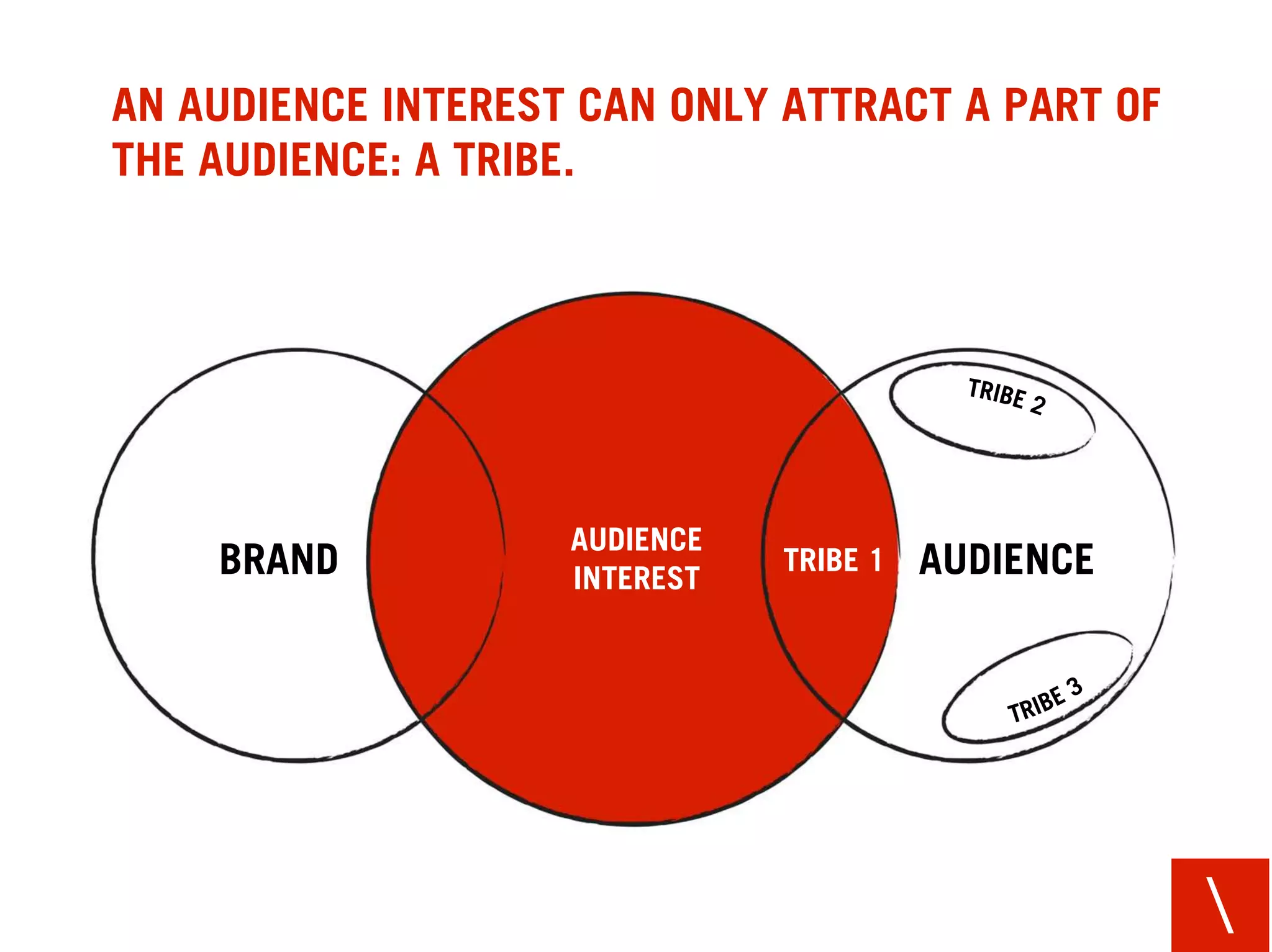
AN AUDIENCE INTEREST CAN ONLY ATTRACT A PART OF
THE AUDIENCE: A TRIBE.


                    AUDIENCE
    BRAND           INTEREST
                               TRIBE 1   AUDIENCE
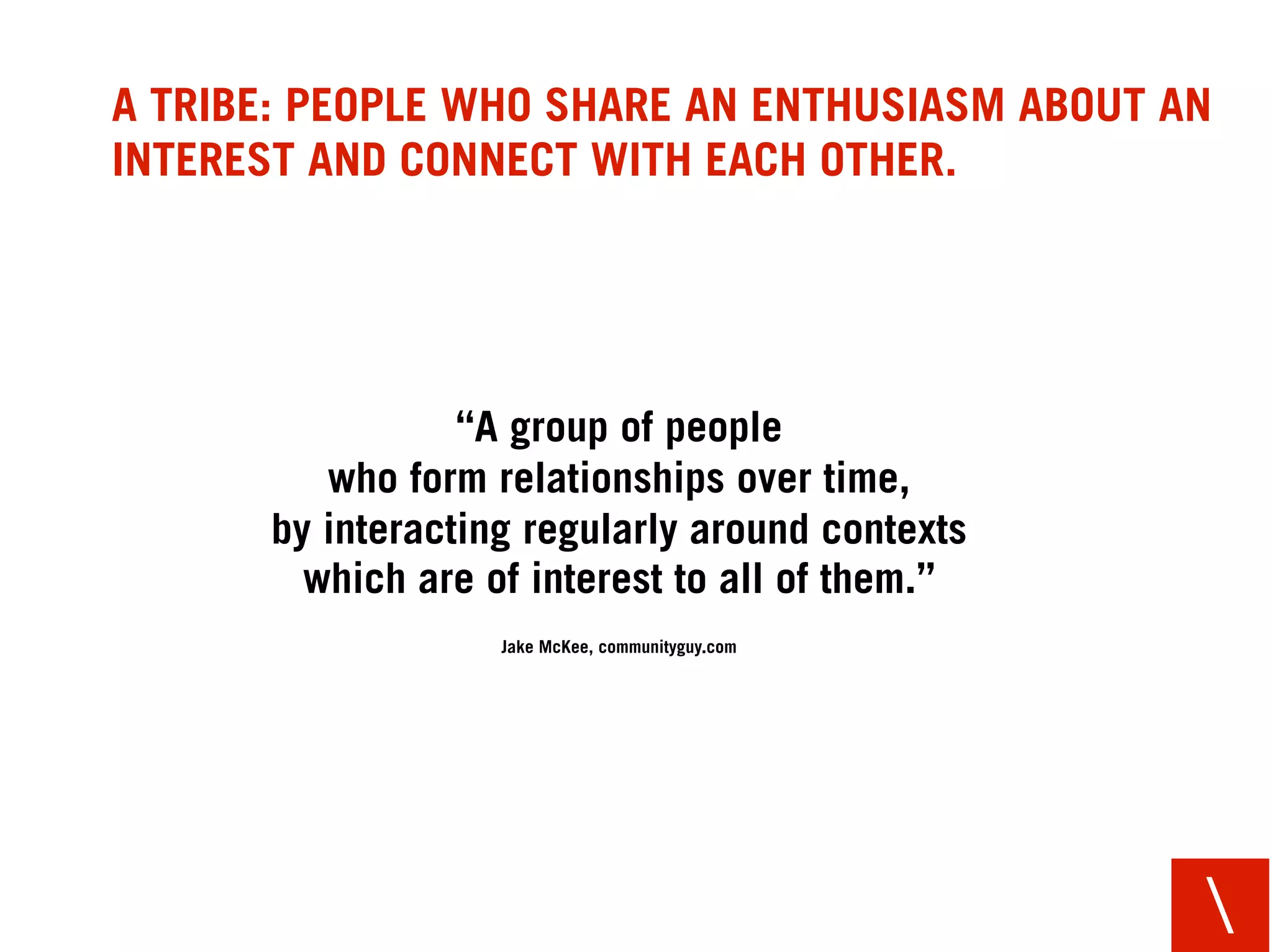
A TRIBE: PEOPLE WHO SHARE AN ENTHUSIASM ABOUT AN
INTEREST AND CONNECT WITH EACH OTHER.


                 “A group of people
         who form relationships over time,
      by interacting regularly around contexts
        which are of interest to all of them.”
                   Jake McKee, communityguy.com
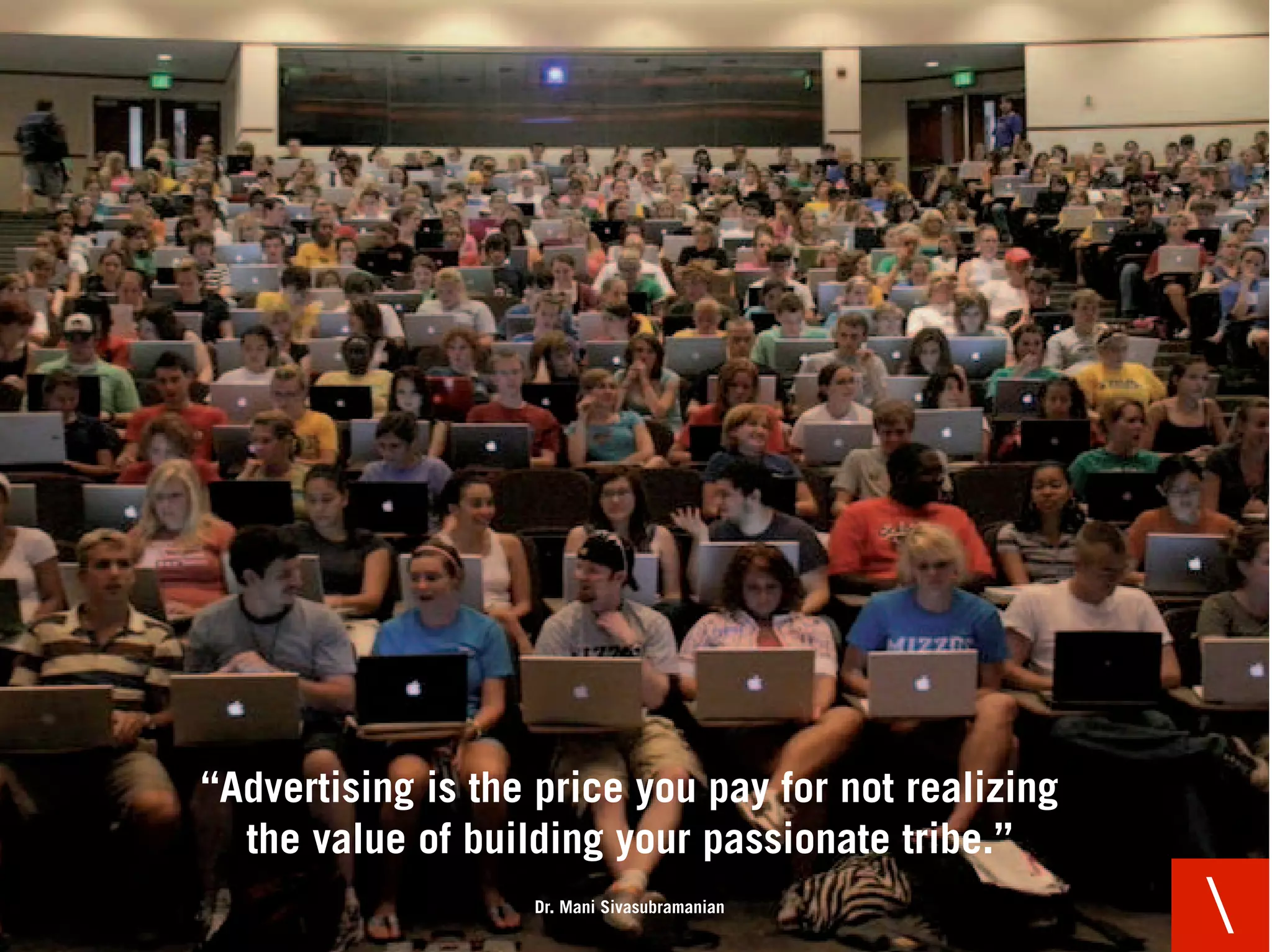
“Advertising is the price you pay for not realizing
  the value of building your passionate tribe.”
                   Dr. Mani Sivasubramanian
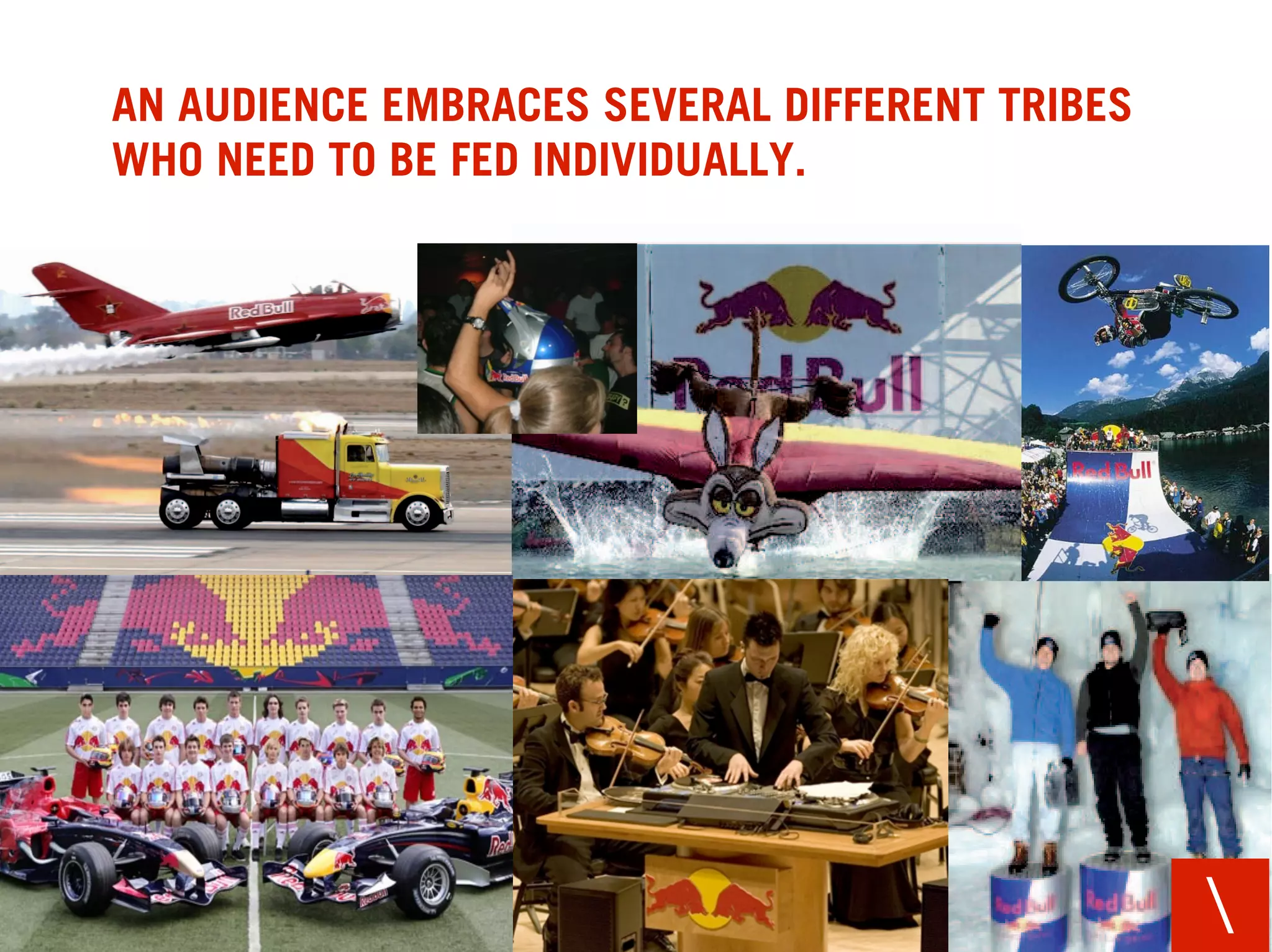
AN AUDIENCE EMBRACES SEVERAL DIFFERENT TRIBES
WHO NEED TO BE FED INDIVIDUALLY.
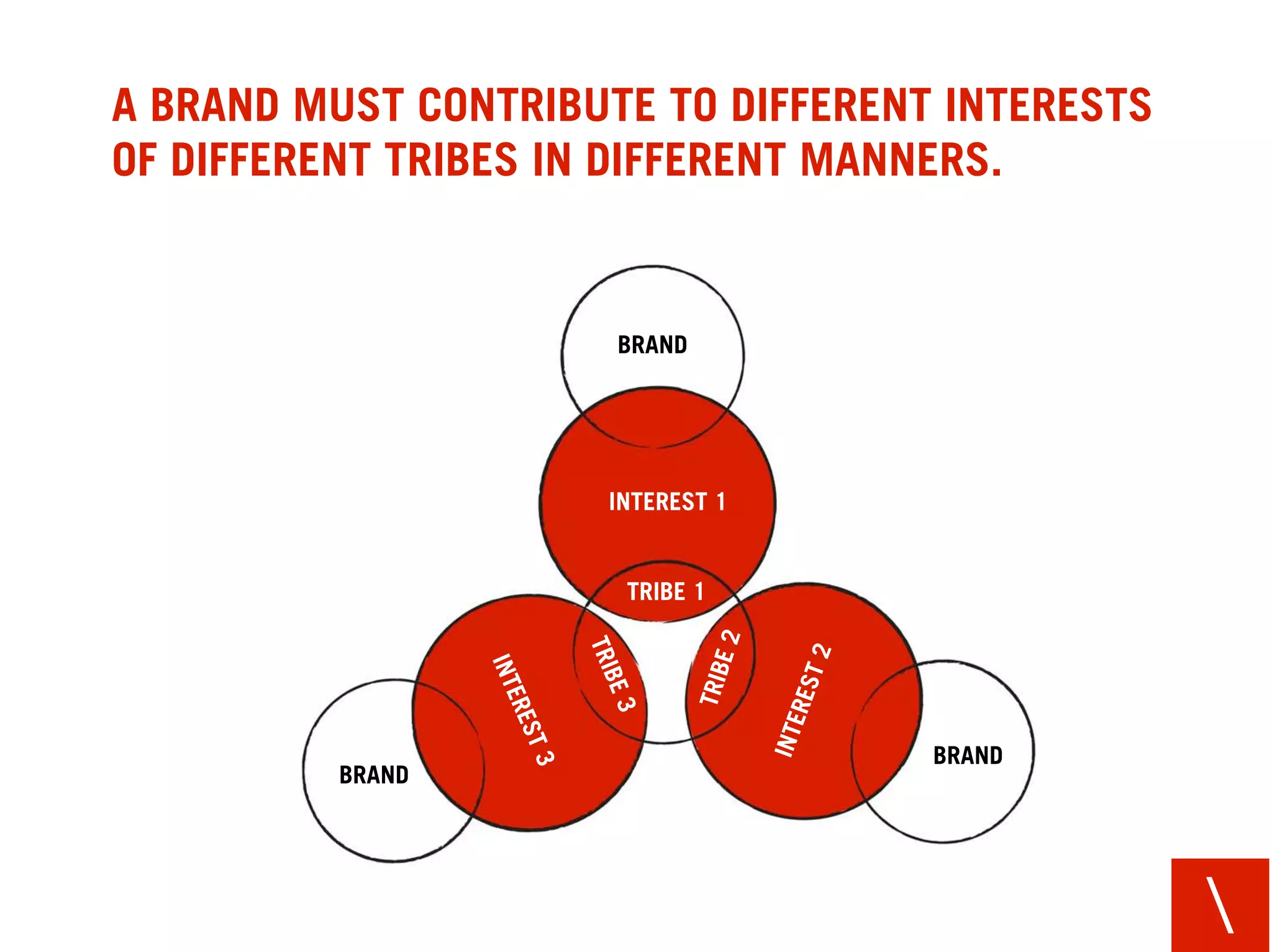
A BRAND MUST CONTRIBUTE TO DIFFERENT INTERESTS
OF DIFFERENT TRIBES IN DIFFERENT MANNERS.


                      BRAND


                     INTEREST 1


                      TRIBE 1


                                 2 E
                              TRIB
                                       BRAND
          BRAND
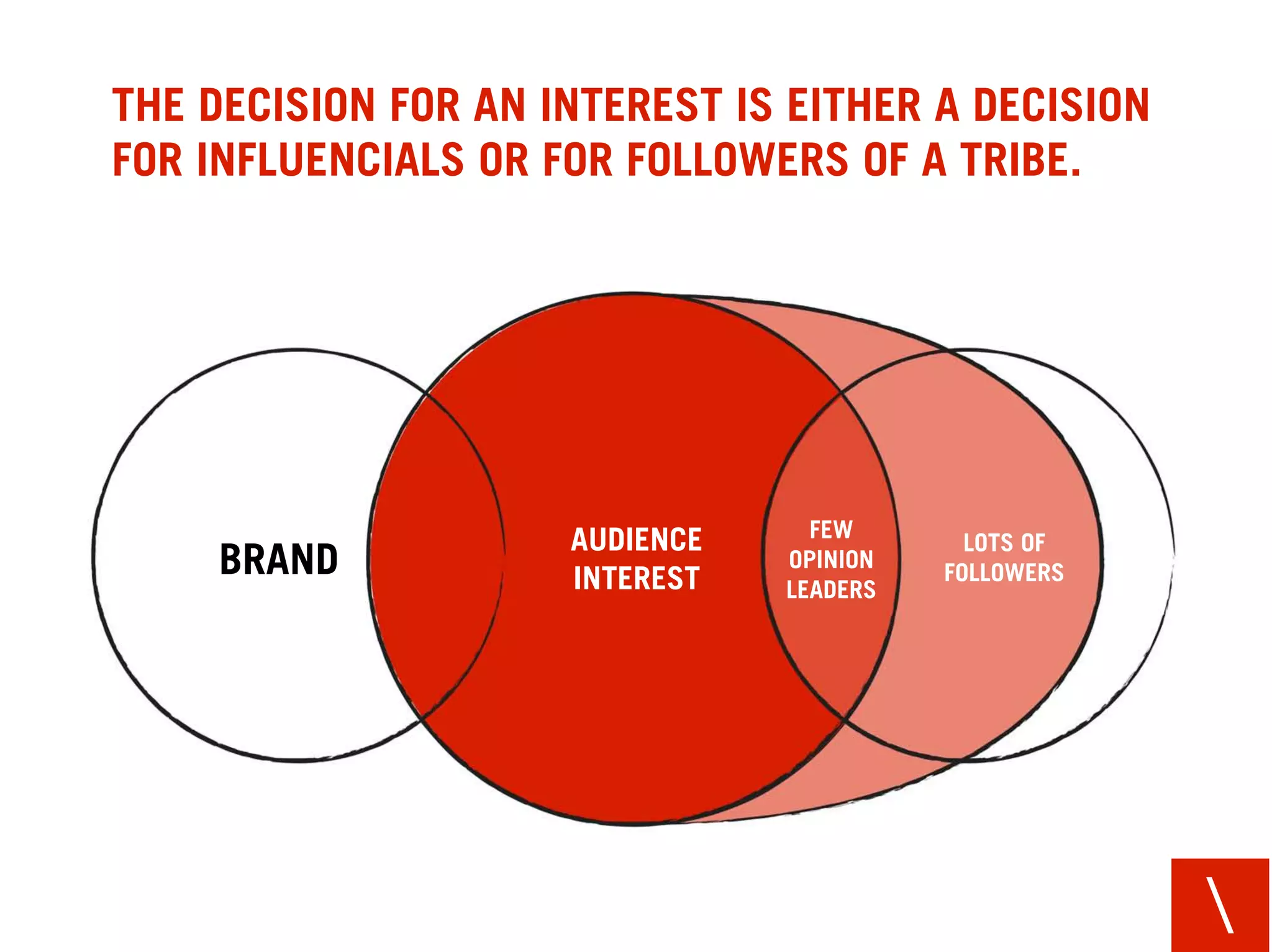
THE DECISION FOR AN INTEREST IS EITHER A DECISION
FOR INFLUENCIALS OR FOR FOLLOWERS OF A TRIBE.


                     AUDIENCE     FEW
                                            LOTS OF
     BRAND           INTEREST
                                OPINION
                                          FOLLOWERS
                                LEADERS
NOW DEVELOP A BRAND BEHAVIORAL IDEA AS A FUSION
OF AUDIENCE INTEREST AND BRAND.


     Business Problem


 Rules of Media
                               AUDIENCE
        BRAND           IDEA
                               INTEREST
                                          TRIBE   AUDIENCE
 Product

   Positioning
            Beliefs
THE IDEA MUST FOLLOW A BASIC PRINCIPLE.


        “The key is to produce something that
           both pulls people together and
            gives them something to do.”
             Henry Jenkins, Director Comparative Media Studies Program, MIT
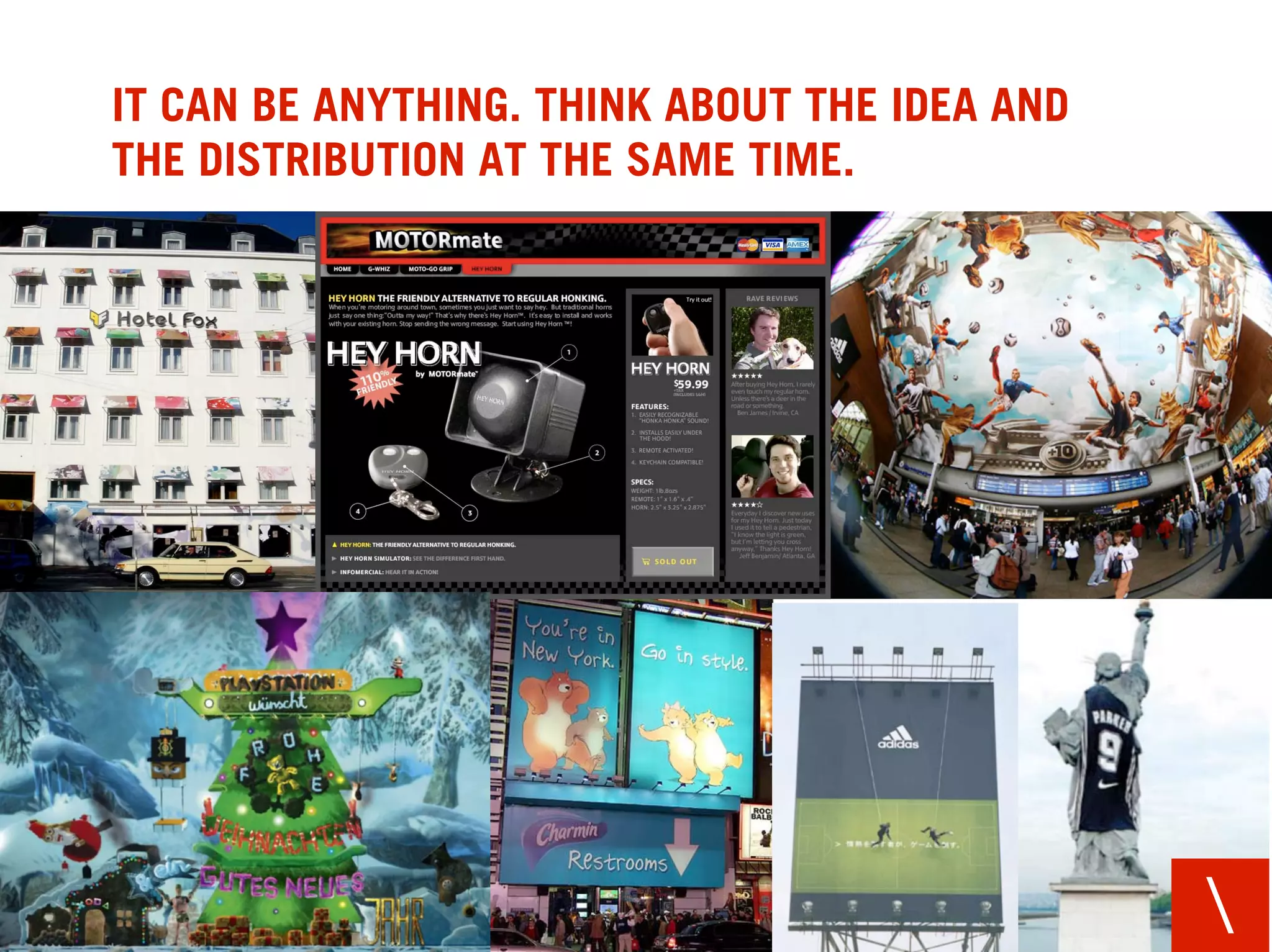
IT CAN BE ANYTHING. THINK ABOUT THE IDEA AND
THE DISTRIBUTION AT THE SAME TIME.
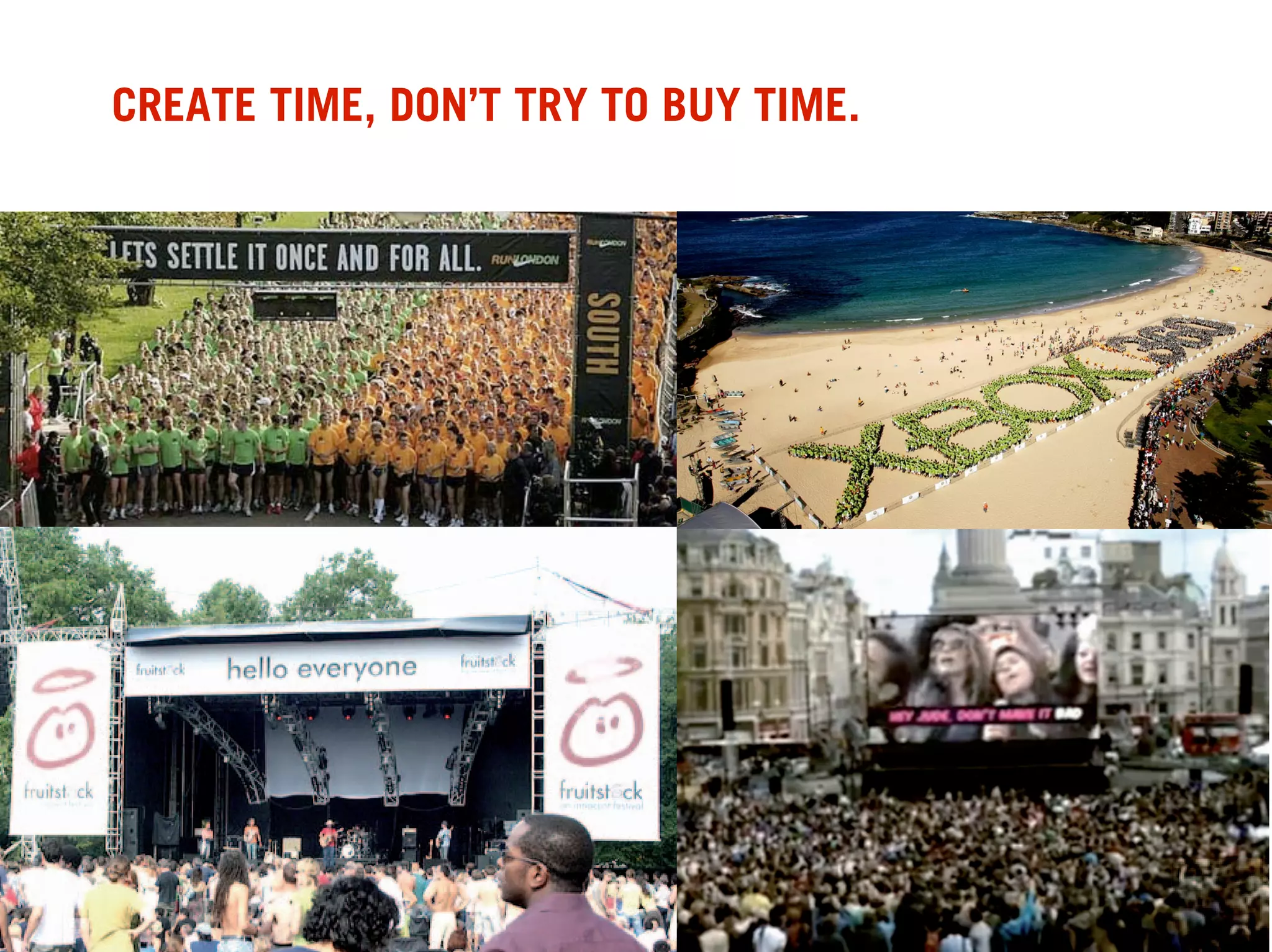
CREATE TIME, DON’T TRY TO BUY TIME.
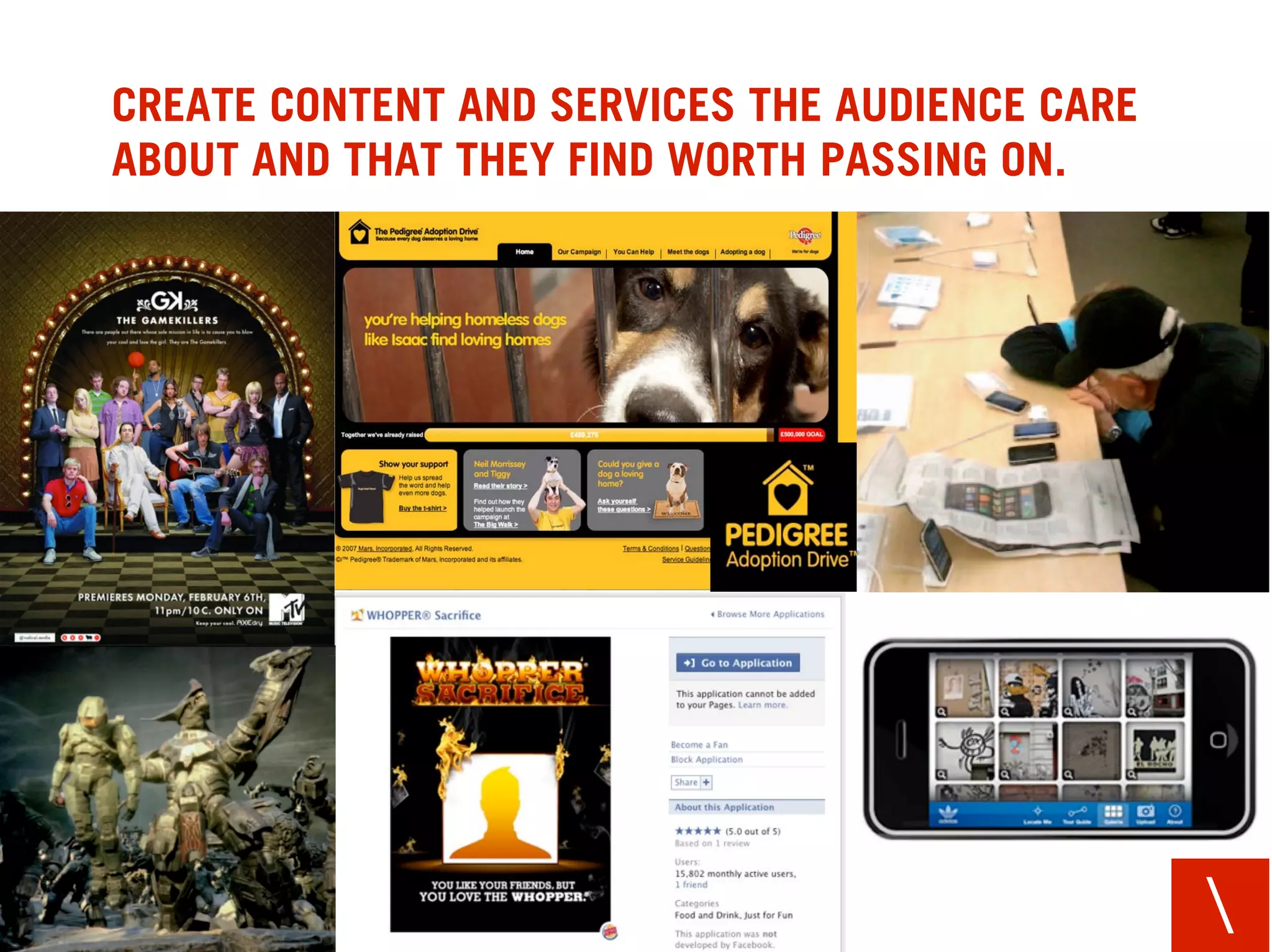
CREATE CONTENT AND SERVICES THE AUDIENCE CARE
ABOUT AND THAT THEY FIND WORTH PASSING ON.
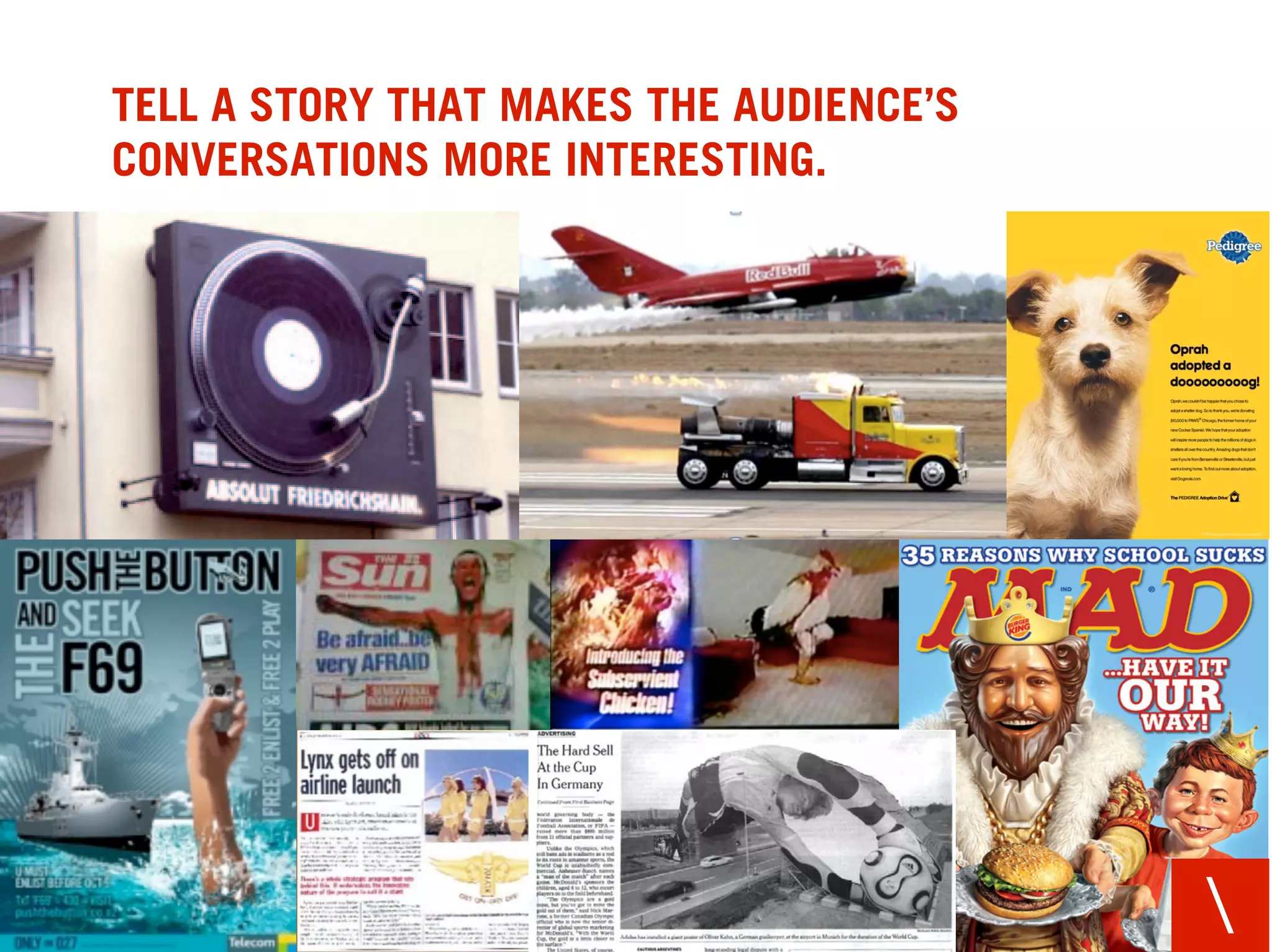
TELL A STORY THAT MAKES THE AUDIENCE’S
CONVERSATIONS MORE INTERESTING.
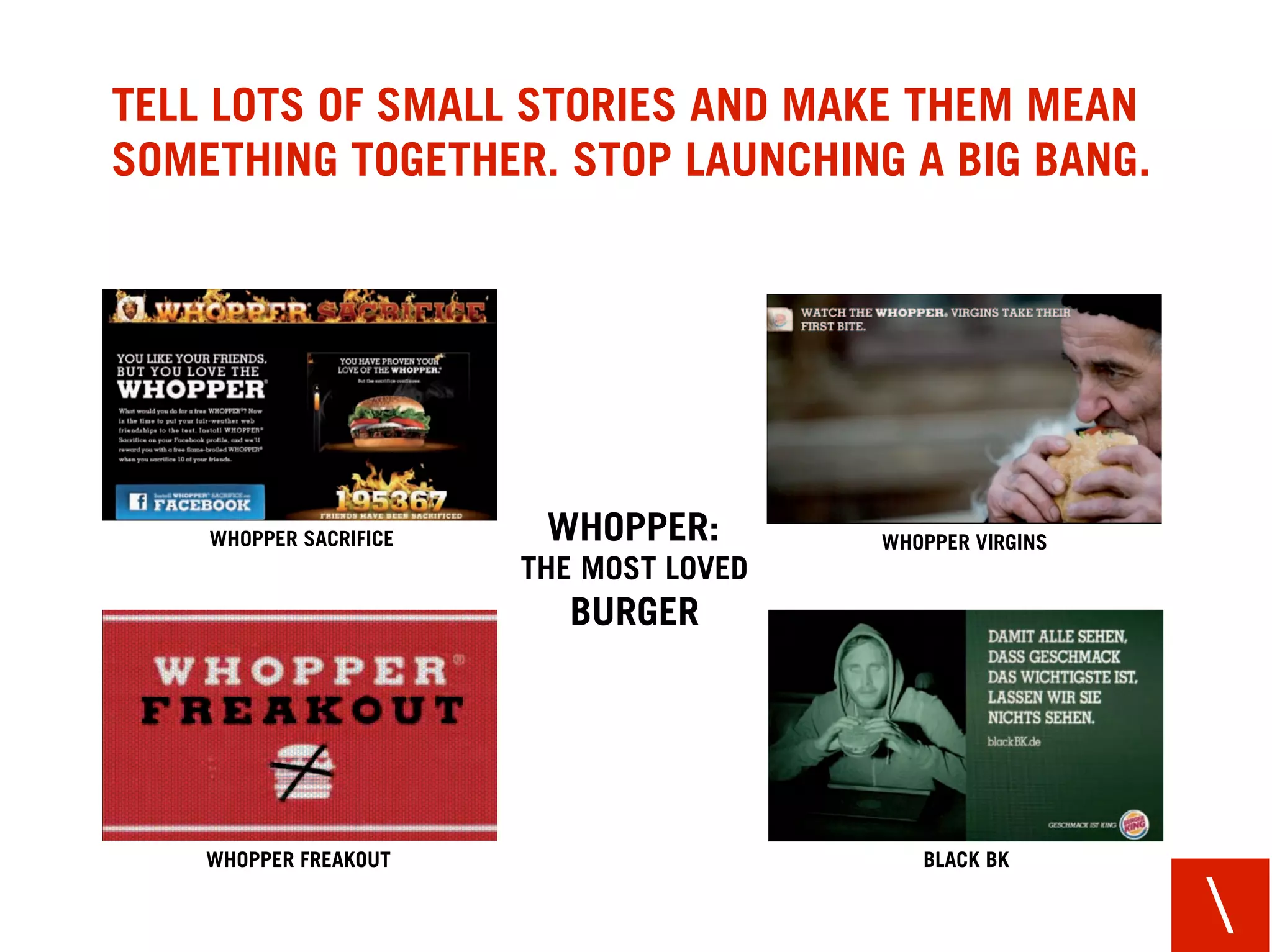
TELL LOTS OF SMALL STORIES AND MAKE THEM MEAN
SOMETHING TOGETHER. STOP LAUNCHING A BIG BANG.


    WHOPPER SACRIFICE    WHOPPER:        WHOPPER VIRGINS
                        THE MOST LOVED
                           BURGER


    WHOPPER FREAKOUT                        BLACK BK
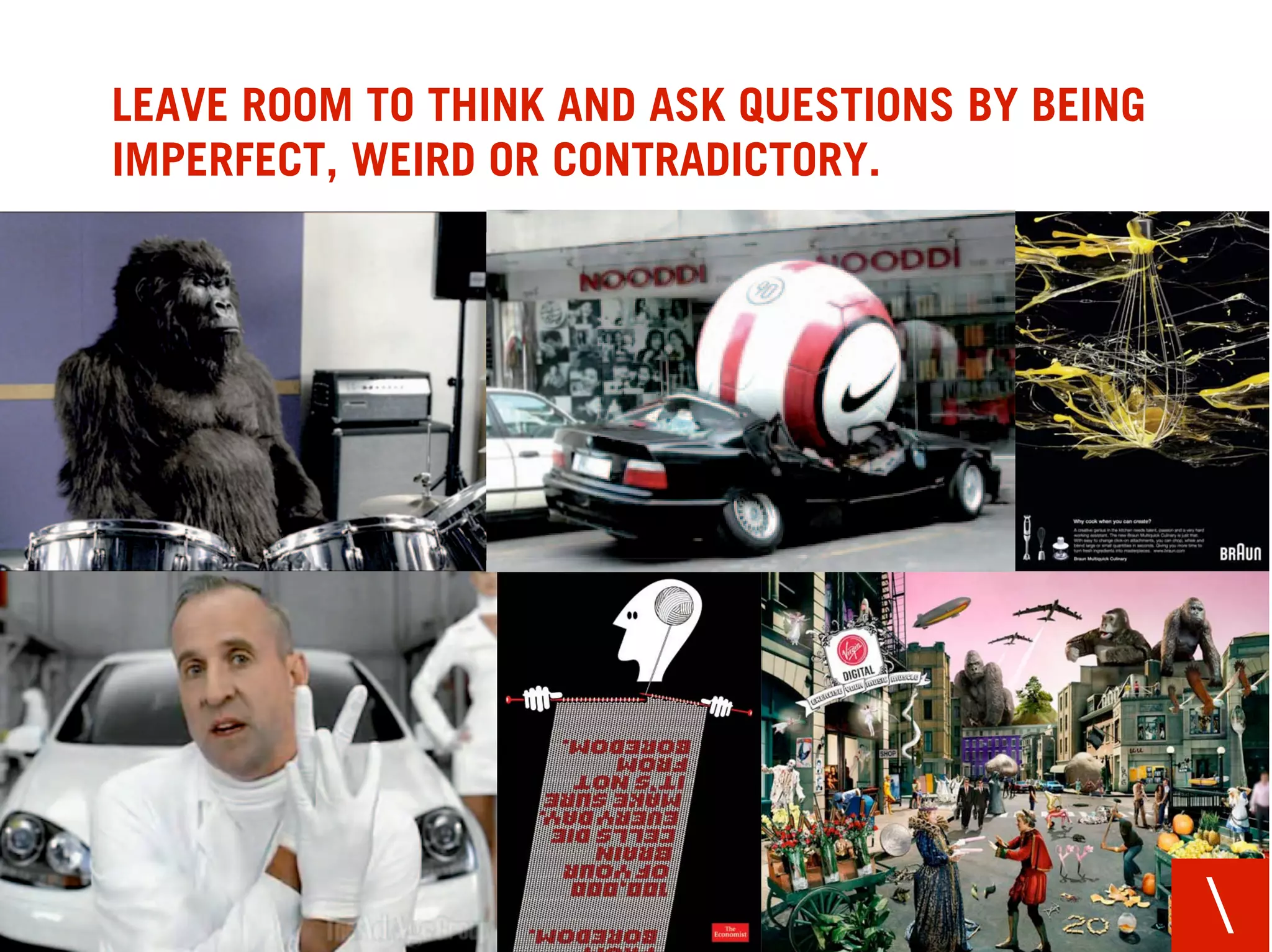
LEAVE ROOM TO THINK AND ASK QUESTIONS BY BEING
IMPERFECT, WEIRD OR CONTRADICTORY.
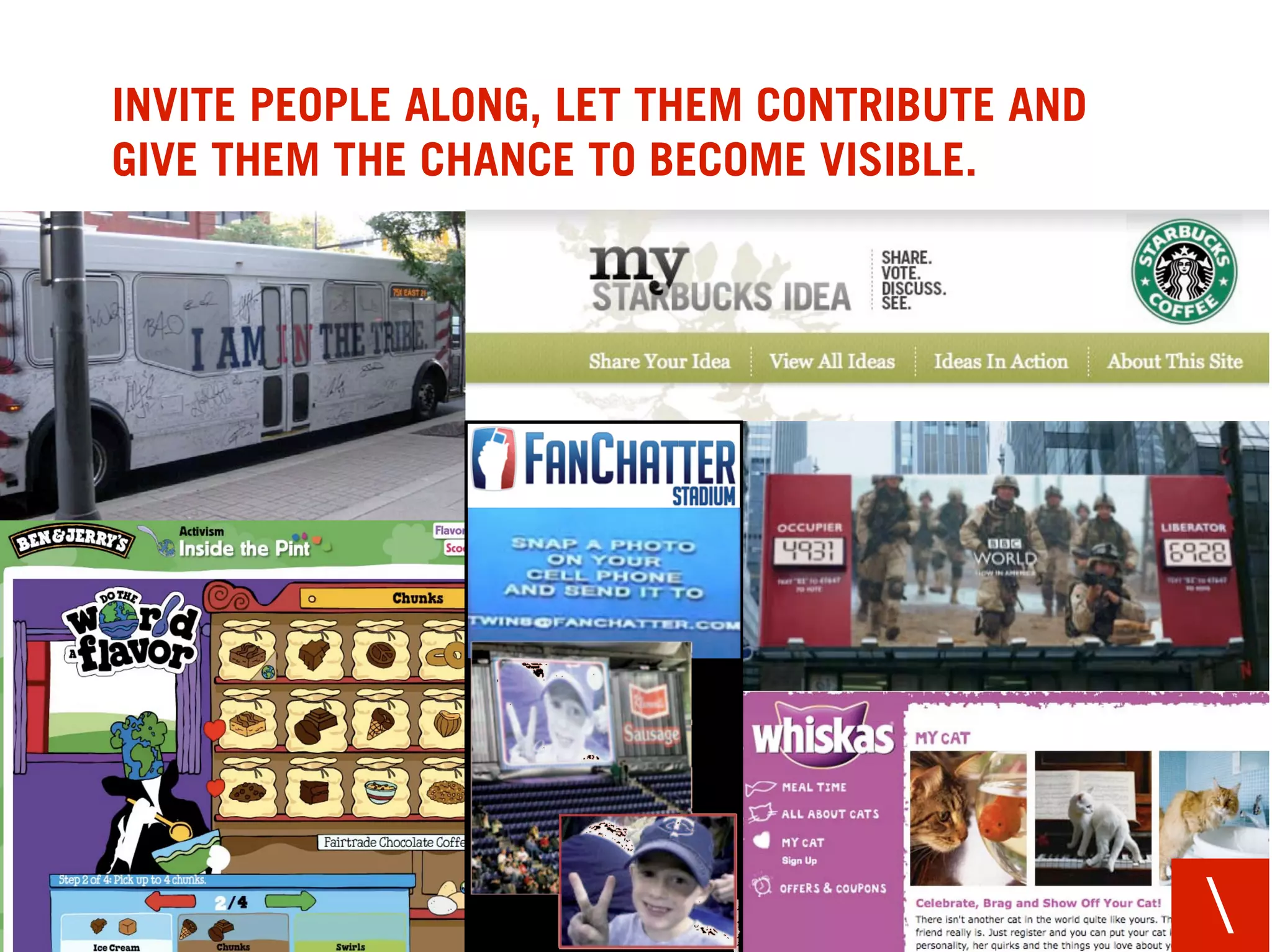
INVITE PEOPLE ALONG, LET THEM CONTRIBUTE AND
GIVE THEM THE CHANCE TO BECOME VISIBLE.
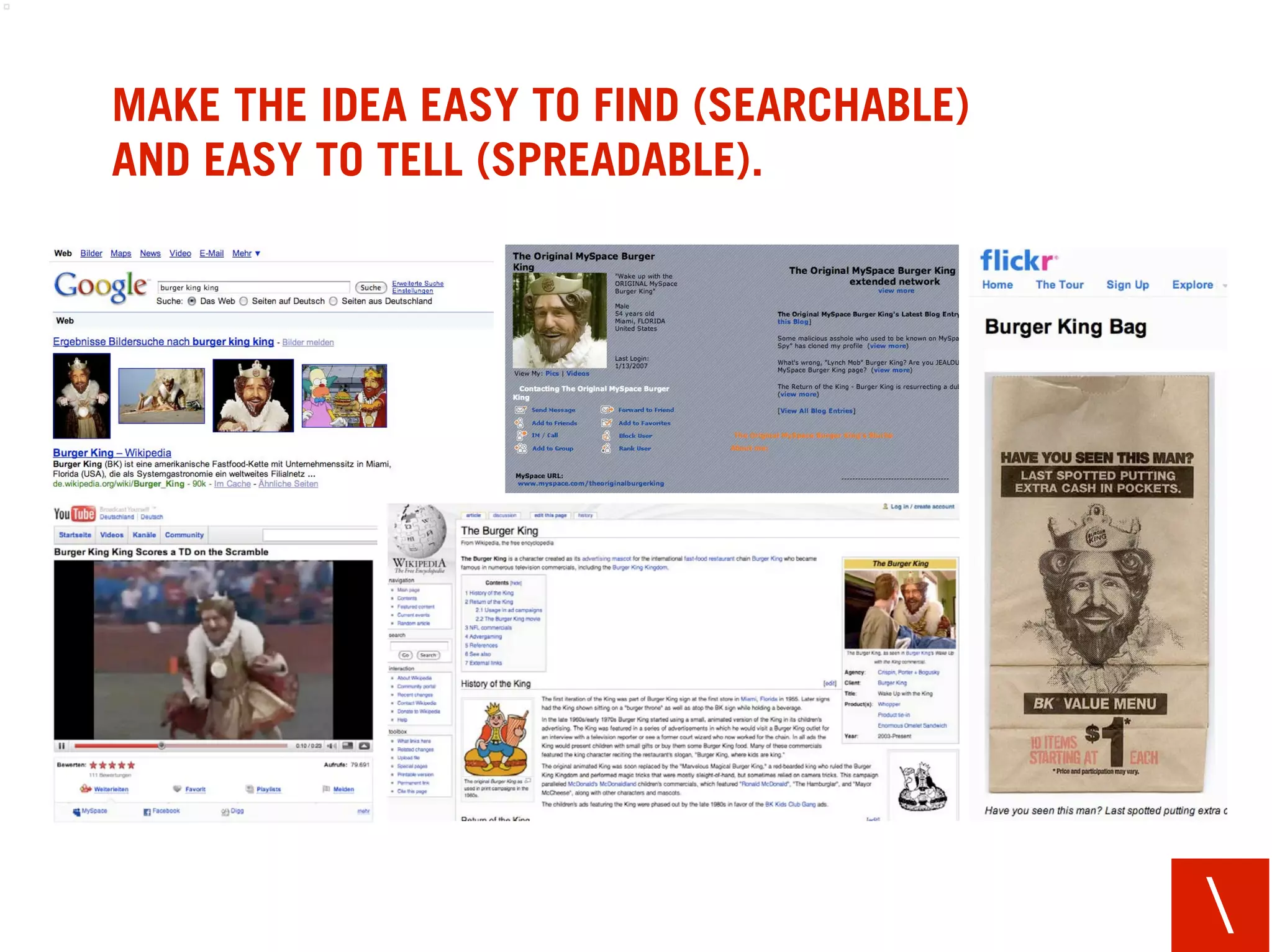
MAKE THE IDEA EASY TO FIND (SEARCHABLE)
AND EASY TO TELL (SPREADABLE).
THE IDEA MUST ALWAYS OFFER A VALUE SO THAT THE
AUDIENCE WANT’S TO ENGAGE WITH IT.


                    AUDIENCE
    BRAND    IDEA   INTEREST
                               TRIBE   AUDIENCE
NOW GIVING BECOMES CRUCIAL FOR A BRAND.


                “People become loyal
          to that what the brand is giving.”
            David Armano, Vice President of Experience Design, Critical Mass.
TODAY NOT ONLY THE PRODUCT MUST BE BENEFICIAL,
BUT ALSO THE COMMUNICATION IDEA AROUND IT.


             Be additive and supportive.

          Deliver something useful and fun.

        Help people enjoy and use the product.
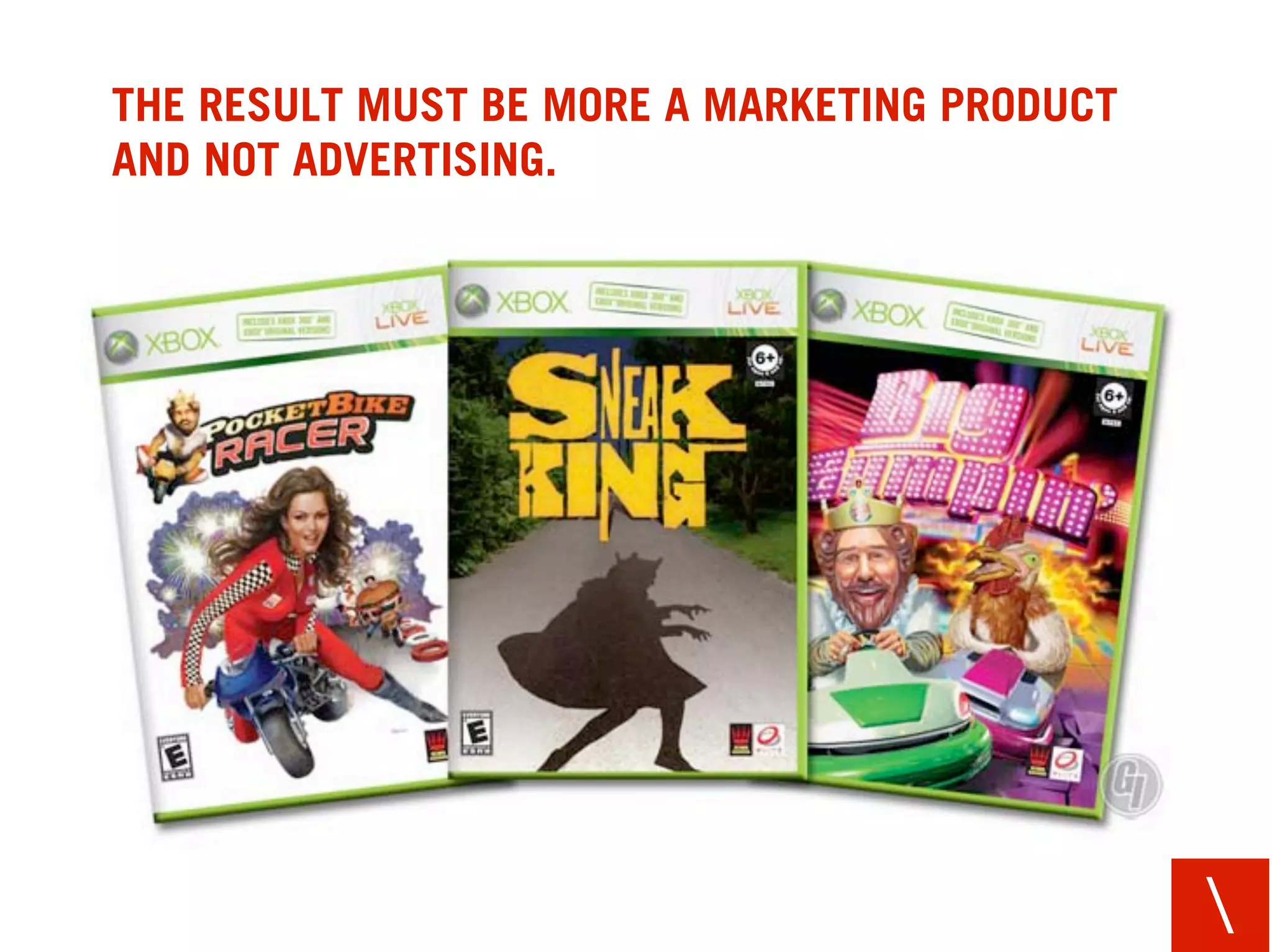
THE RESULT MUST BE MORE A MARKETING PRODUCT
AND NOT ADVERTISING.
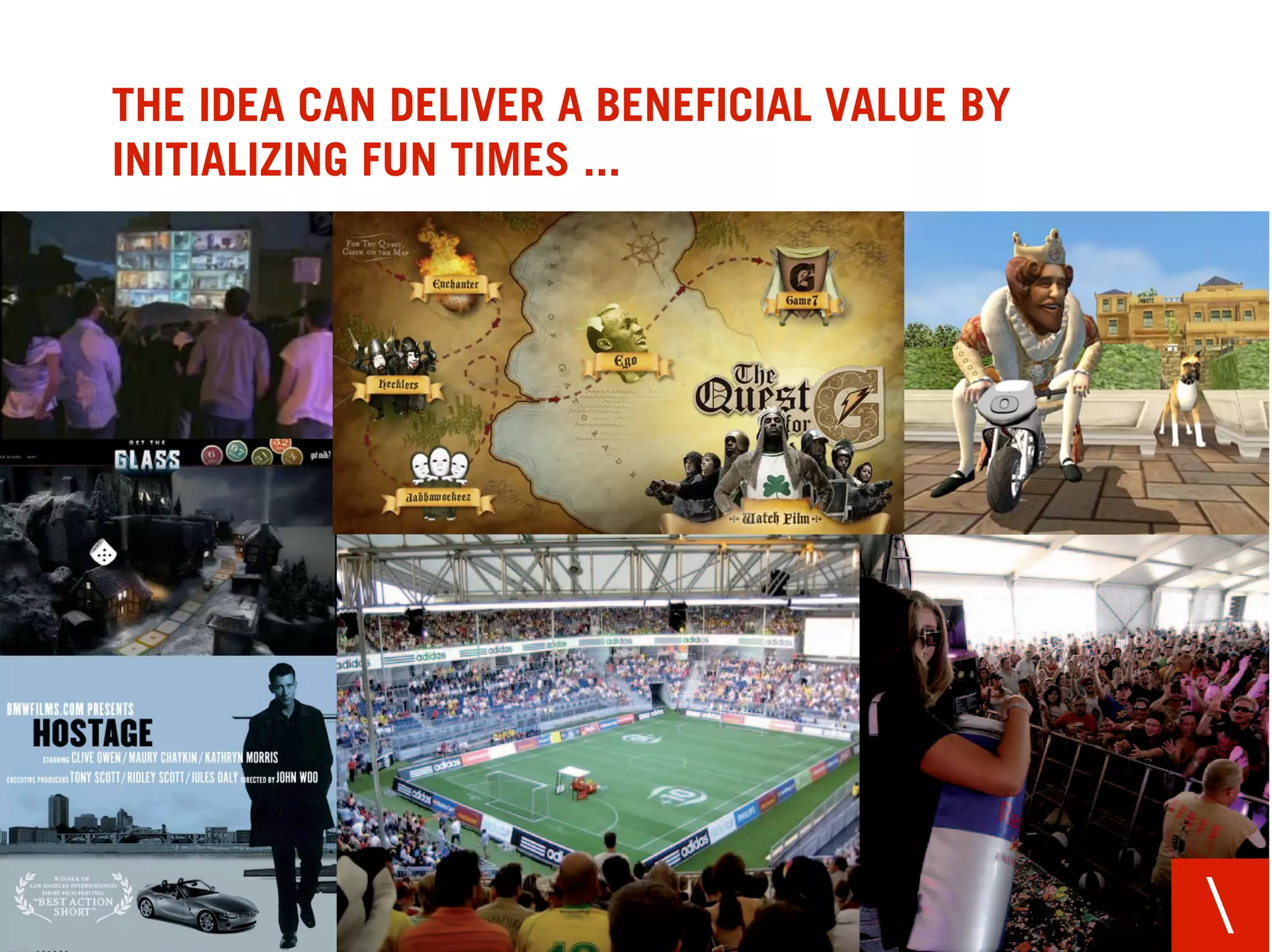
THE IDEA CAN DELIVER A BENEFICIAL VALUE BY
INITIALIZING FUN TIMES ...
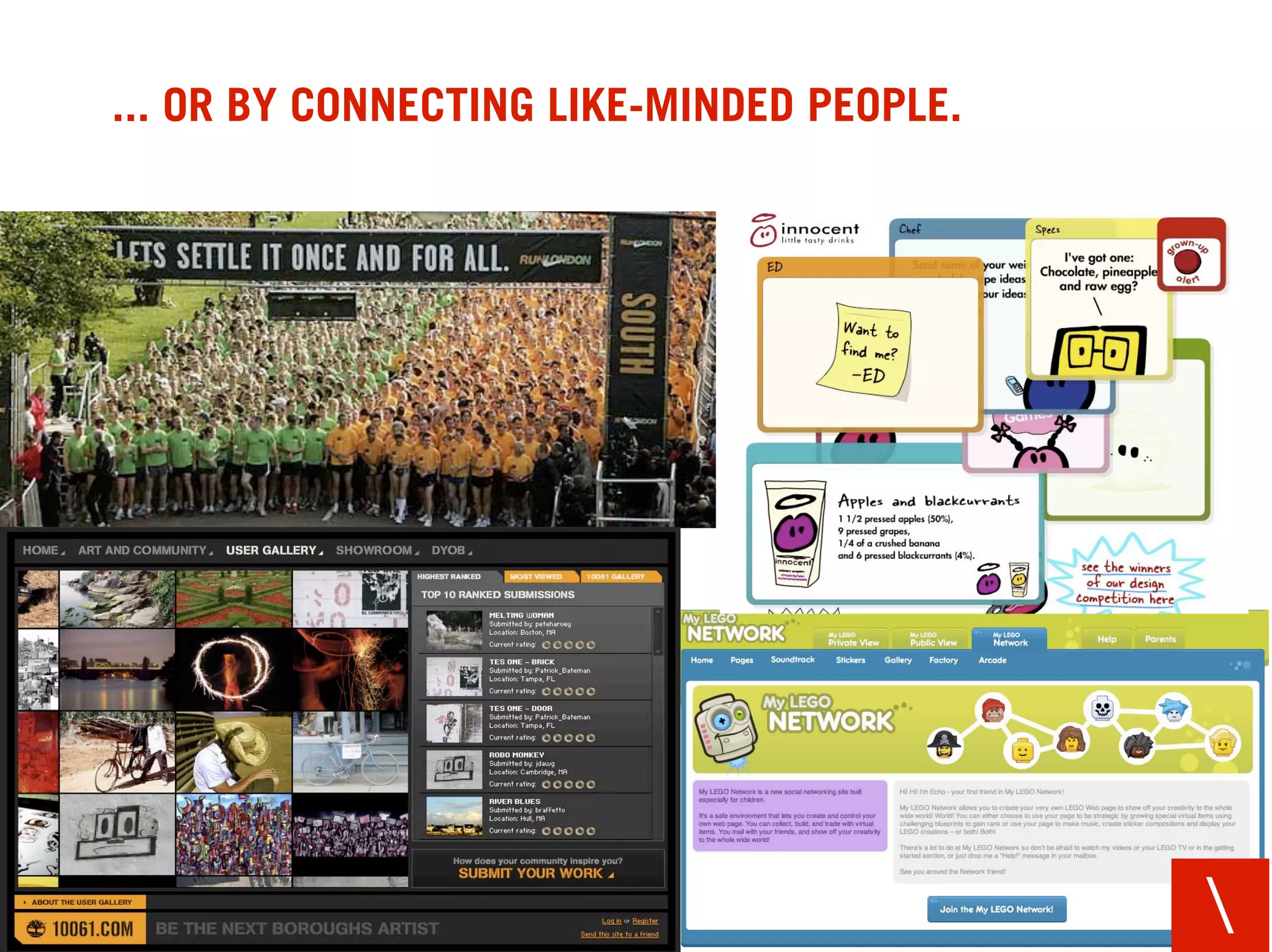
... OR BY CONNECTING LIKE-MINDED PEOPLE.
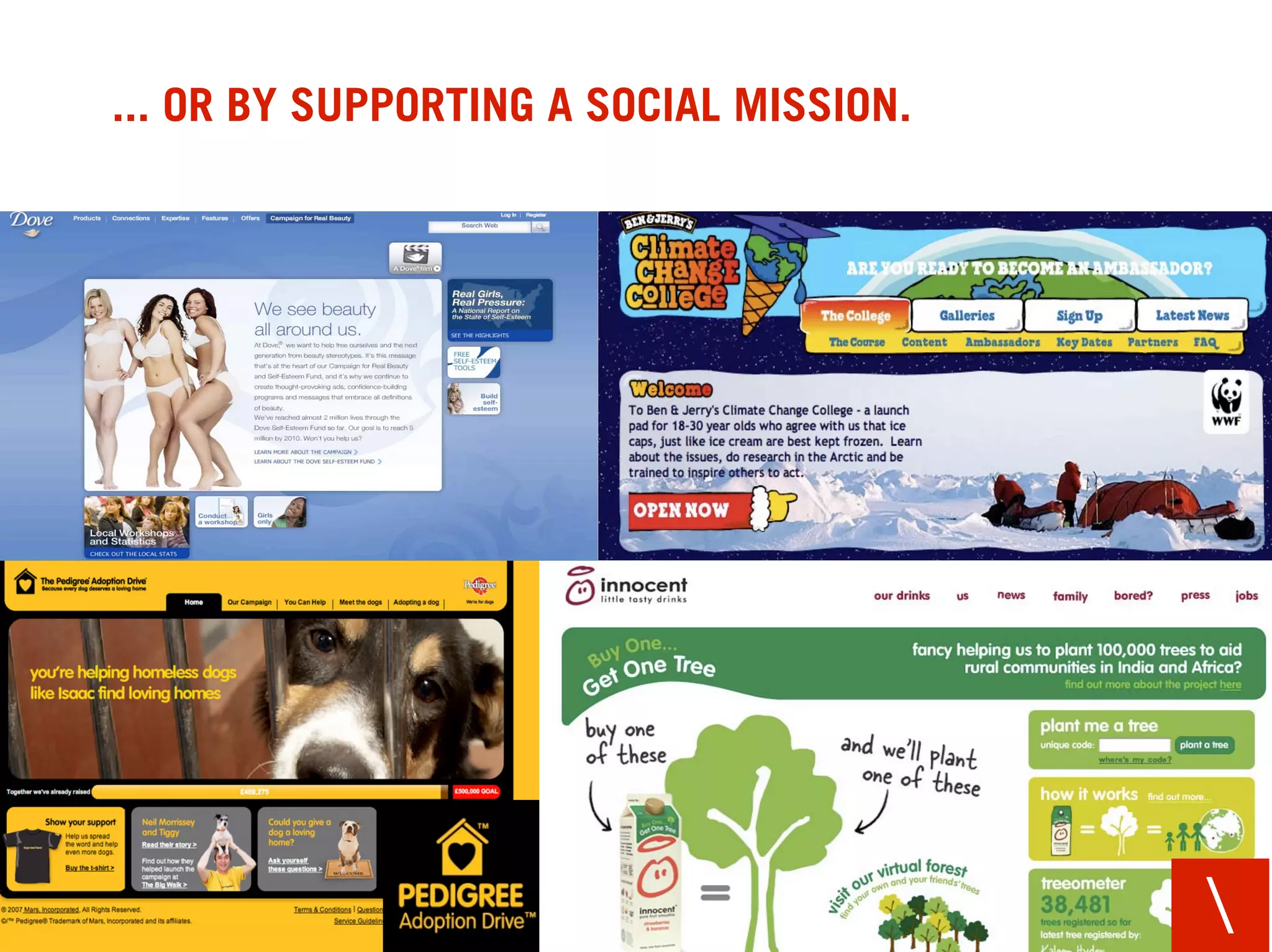
... OR BY SUPPORTING A SOCIAL MISSION.
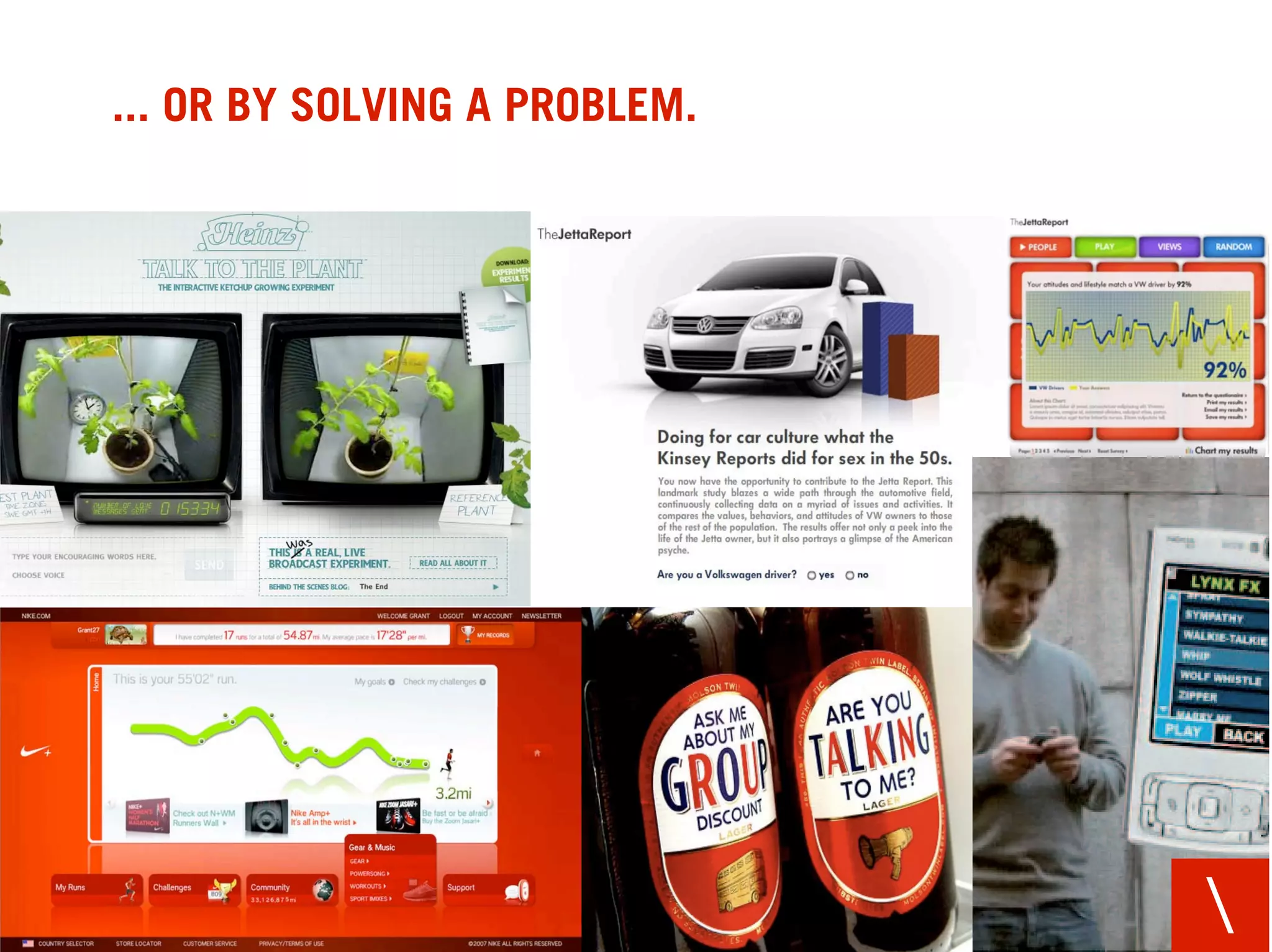
... OR BY SOLVING A PROBLEM.
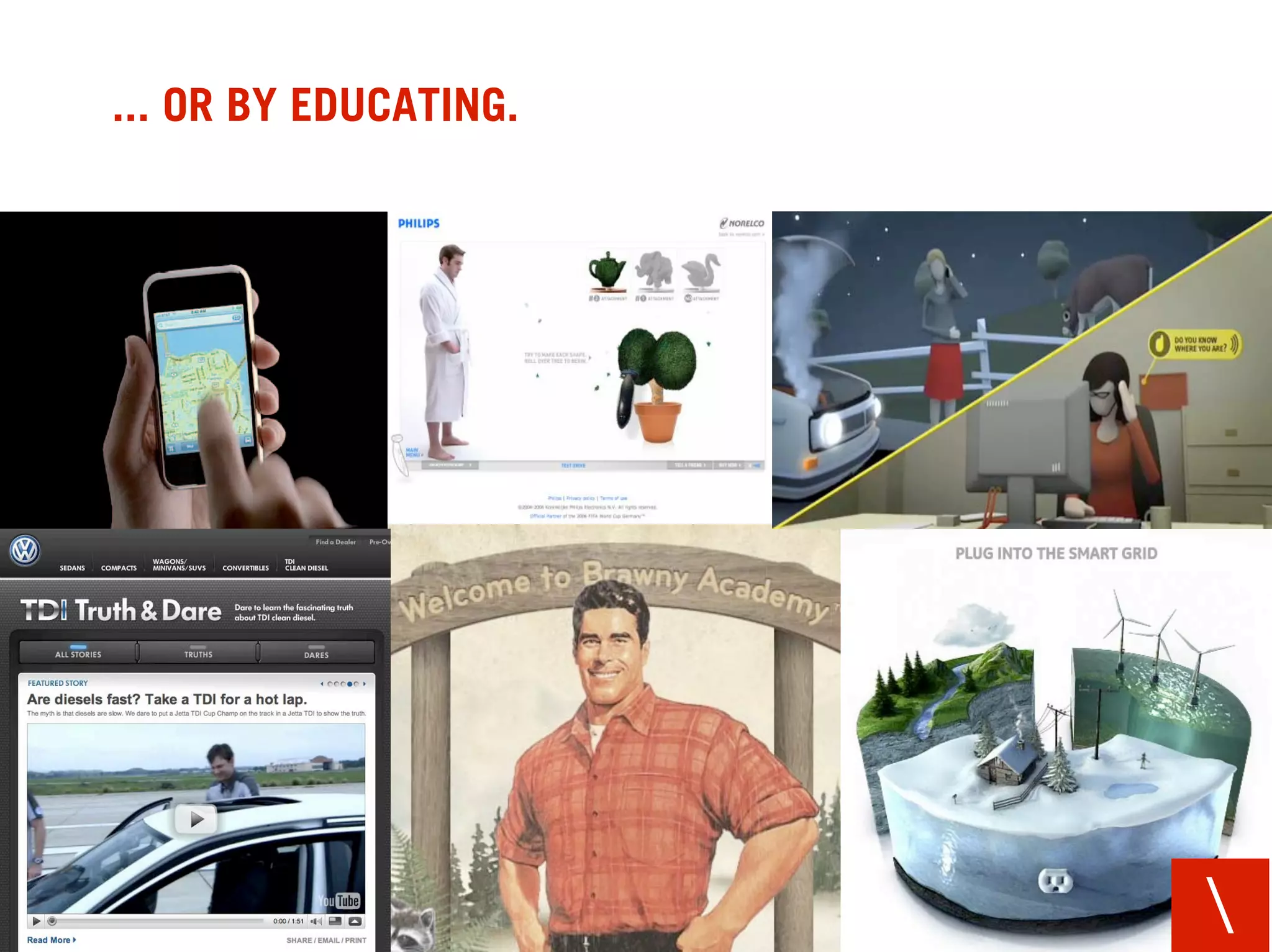
... OR BY EDUCATING.
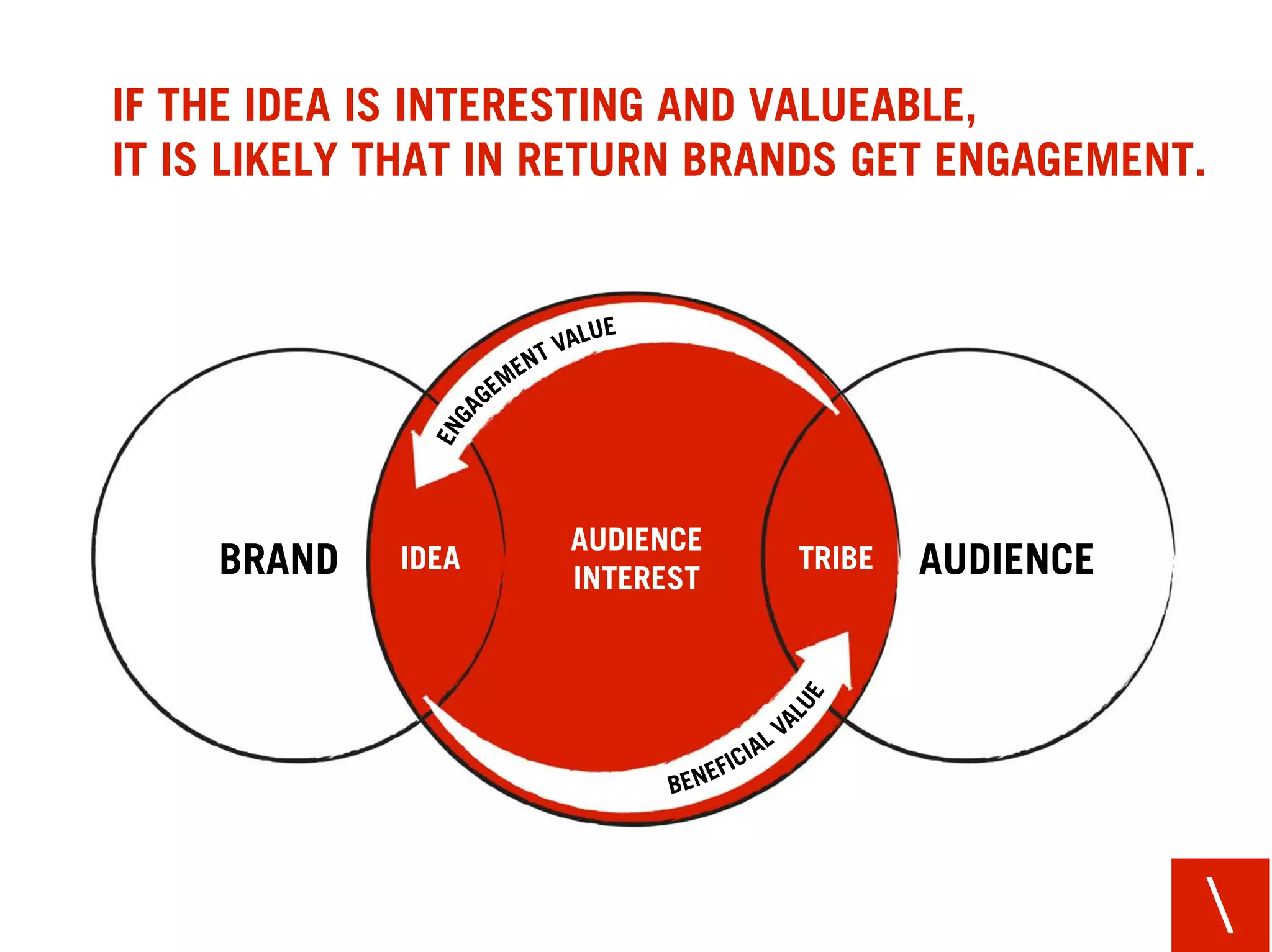
IF THE IDEA IS INTERESTING AND VALUEABLE,
IT IS LIKELY THAT IN RETURN BRANDS GET ENGAGEMENT.


                    AUDIENCE
    BRAND    IDEA
                    INTEREST
                               TRIBE   AUDIENCE
ENGAGEMENT HAS MORE WORTH THAN ATTENTION.


         “Awareness doesn‘t really matter
            in a world of overchoice.”
                    Prof. Andrew Ehrenberg, South Bank University


        “Engagement has a psychological
          component, but it will manifest
      behaviorally – it will lead to an action.”
             Robert DeSena, Director of Relationship Marketing, MARS USA
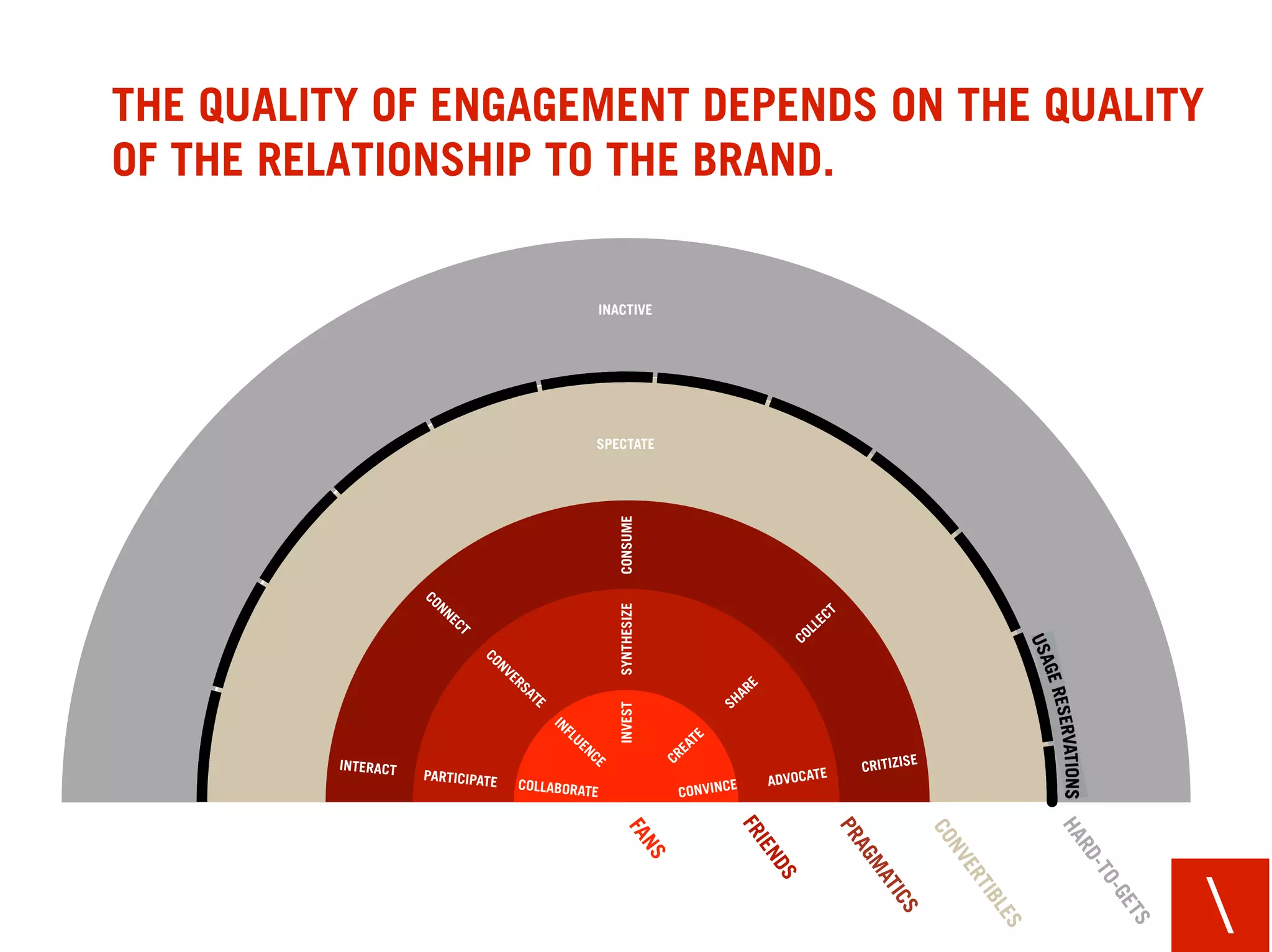
THE QUALITY OF ENGAGEMENT DEPENDS ON THE QUALITY
OF THE RELATIONSHIP TO THE BRAND.


                                                INACTIVE


                                               SPECTATE


                                                   CONSUME
                                                   SYNTHESIZE
                                                   INVEST


                                                                                               E
         INTERACT
                                                                                  E   CRITIZIS
                    PARTICIPATE
                                  COLLABORAT                           E   ADVOCAT
                                            E                   CONVINC
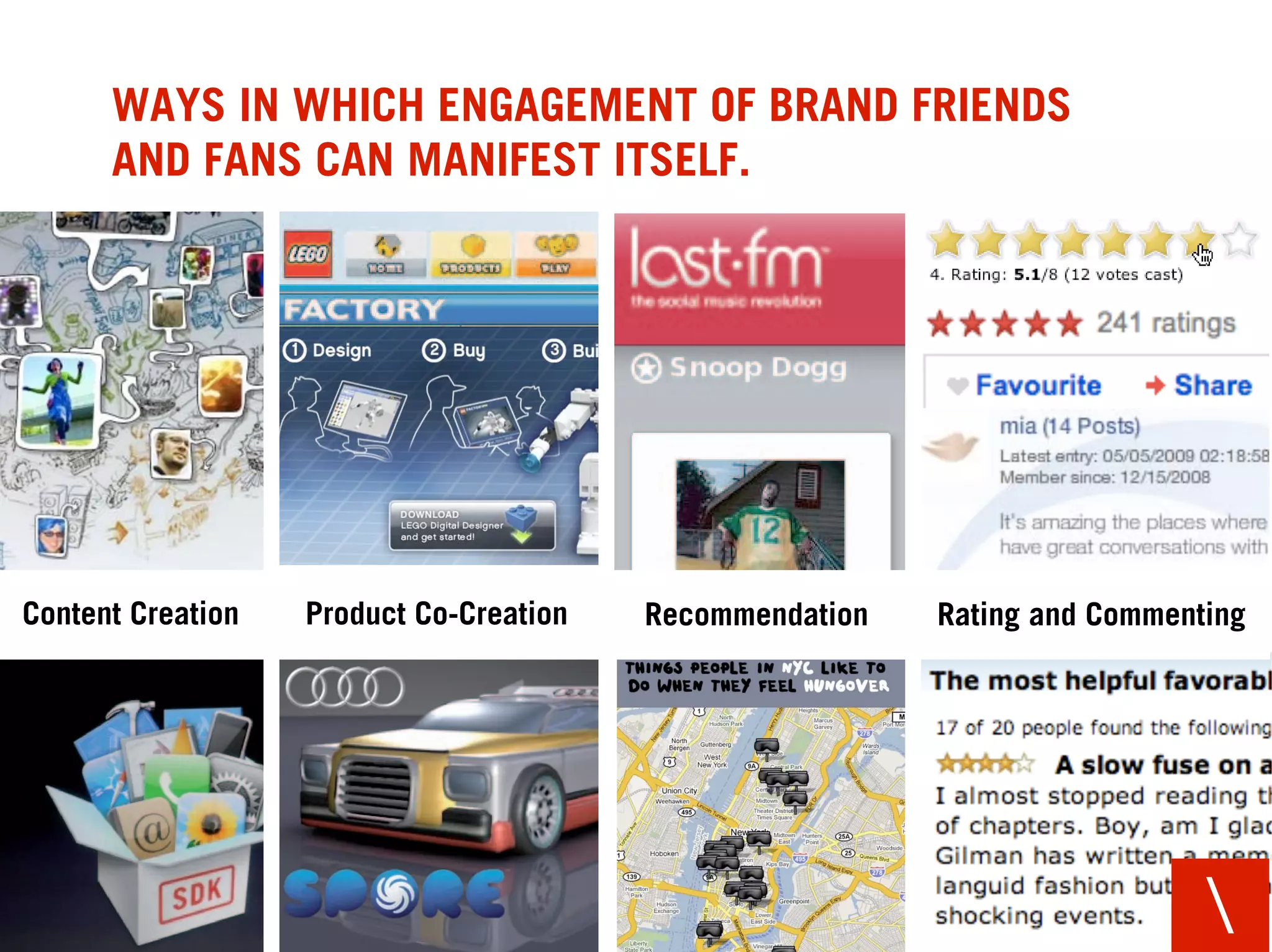
WAYS IN WHICH ENGAGEMENT OF BRAND FRIENDS
      AND FANS CAN MANIFEST ITSELF.


Content Creation   Product Co-Creation   Recommendation   Rating and Commenting
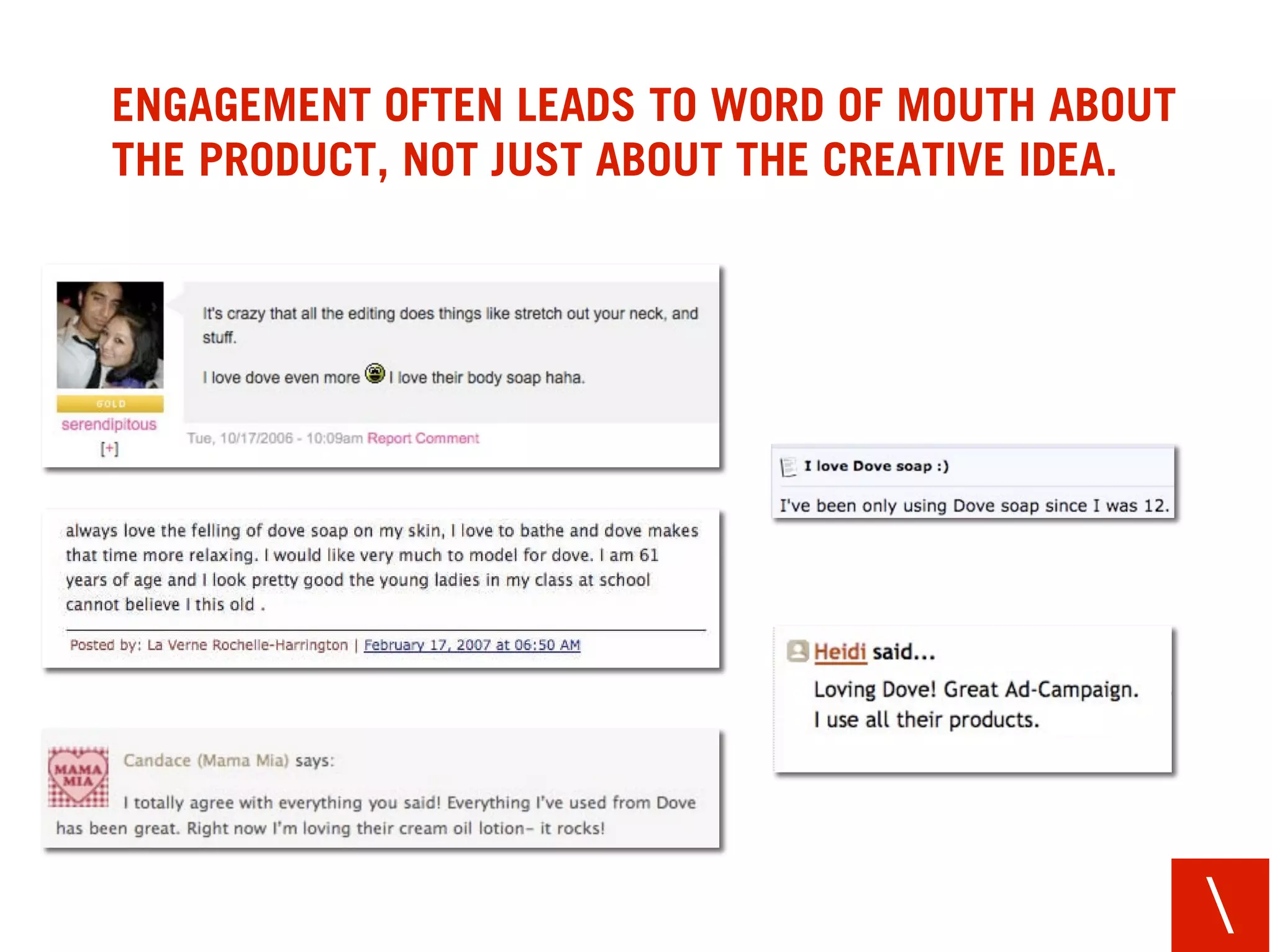
ENGAGEMENT OFTEN LEADS TO WORD OF MOUTH ABOUT
THE PRODUCT, NOT JUST ABOUT THE CREATIVE IDEA.
THIS MAKES ENGAGEMENT A VALUABLE ASSET
TO A BRAND.


    “With our audience, word is spread like wildfire
    and it's much more cost effective for the client.”
                      Spencer Baim, Head of Virtue
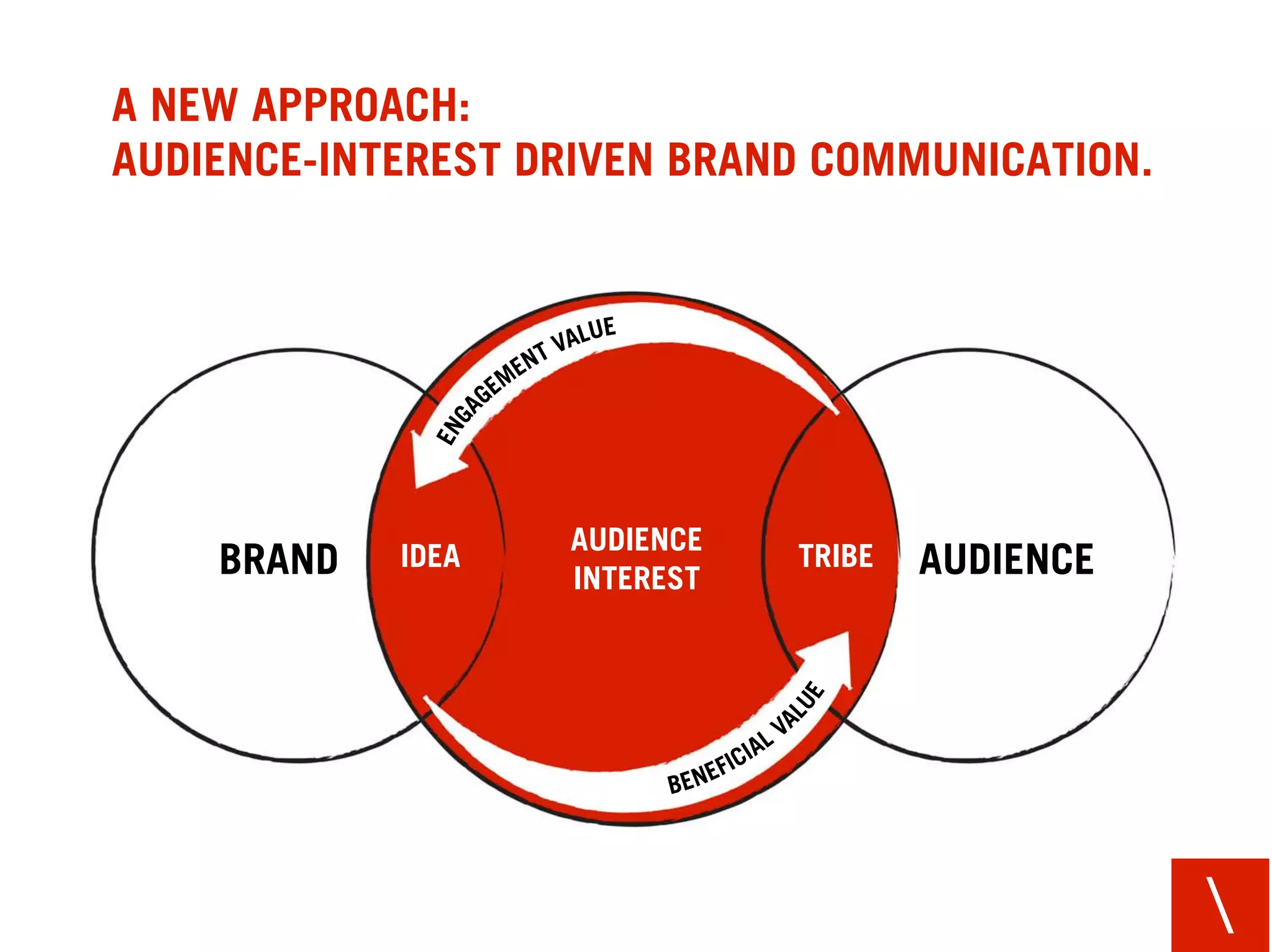
A NEW APPROACH:
AUDIENCE-INTEREST DRIVEN BRAND COMMUNICATION.


                   AUDIENCE
    BRAND   IDEA
                   INTEREST
                              TRIBE   AUDIENCE
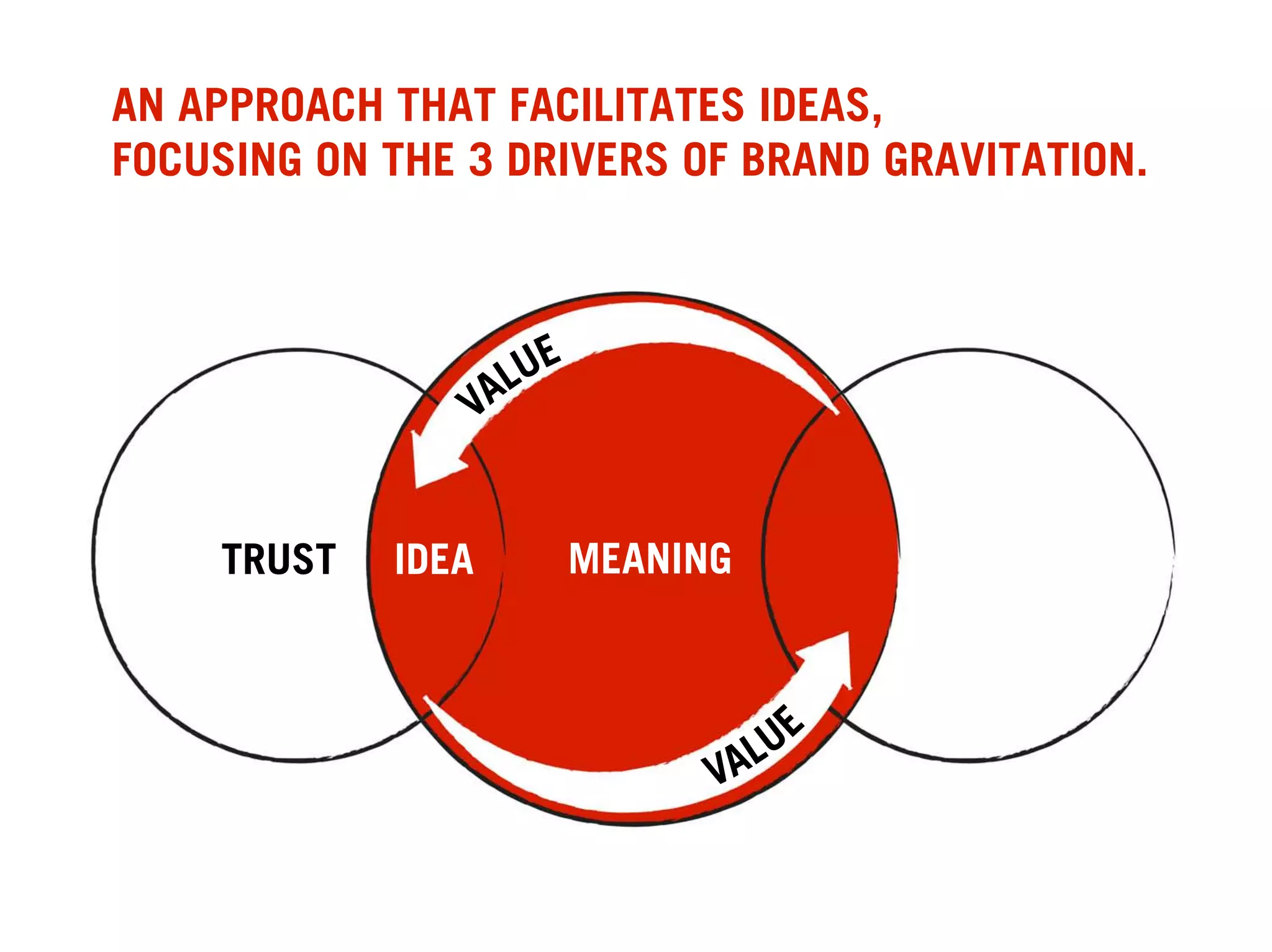
AN APPROACH THAT FACILITATES IDEAS,
FOCUSING ON THE 3 DRIVERS OF BRAND GRAVITATION.


    TRUST   IDEA    MEANING
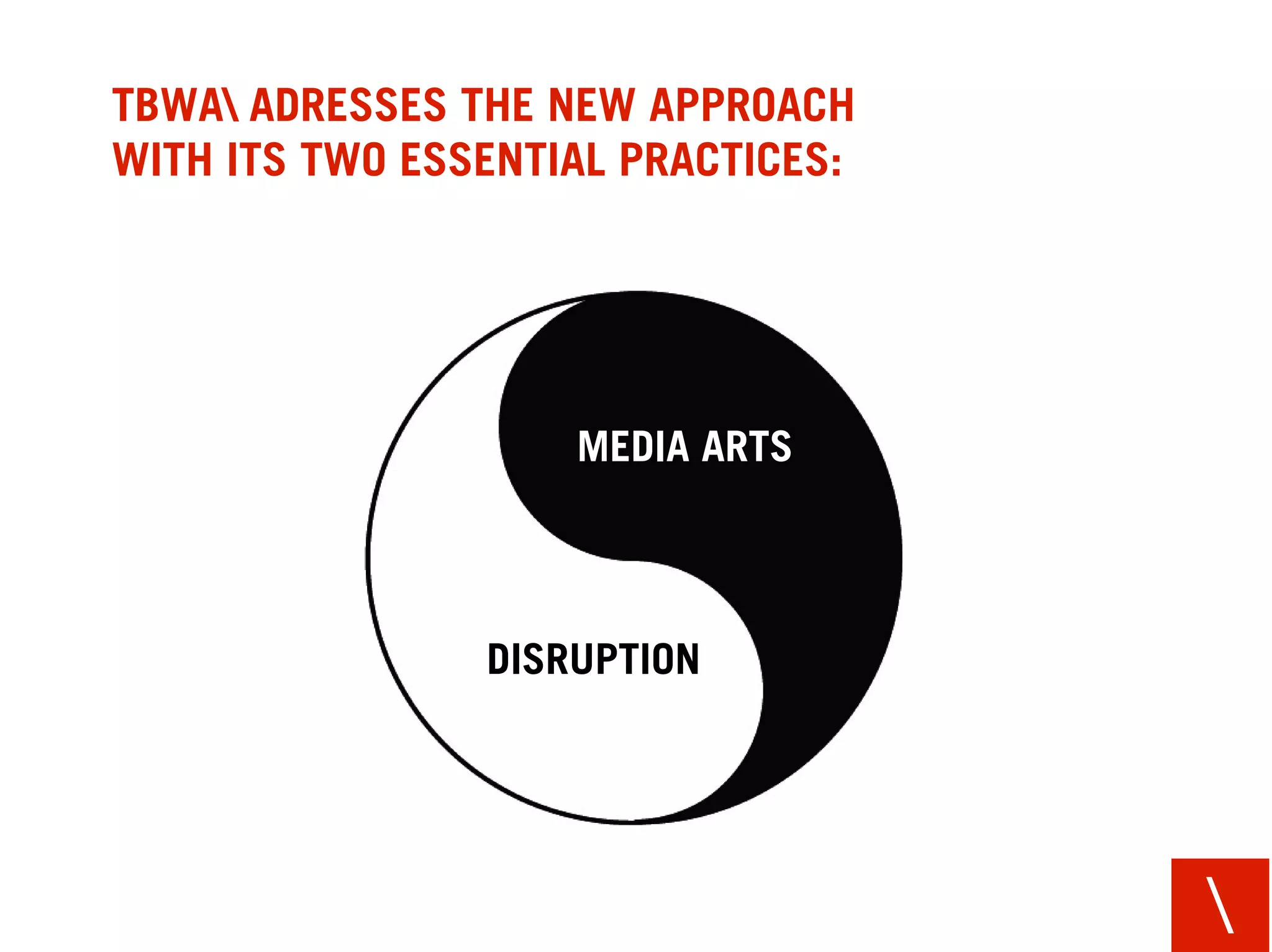
TBWA ADRESSES THE NEW APPROACH
WITH ITS TWO ESSENTIAL PRACTICES:


                    MEDIA ARTS


                DISRUPTION
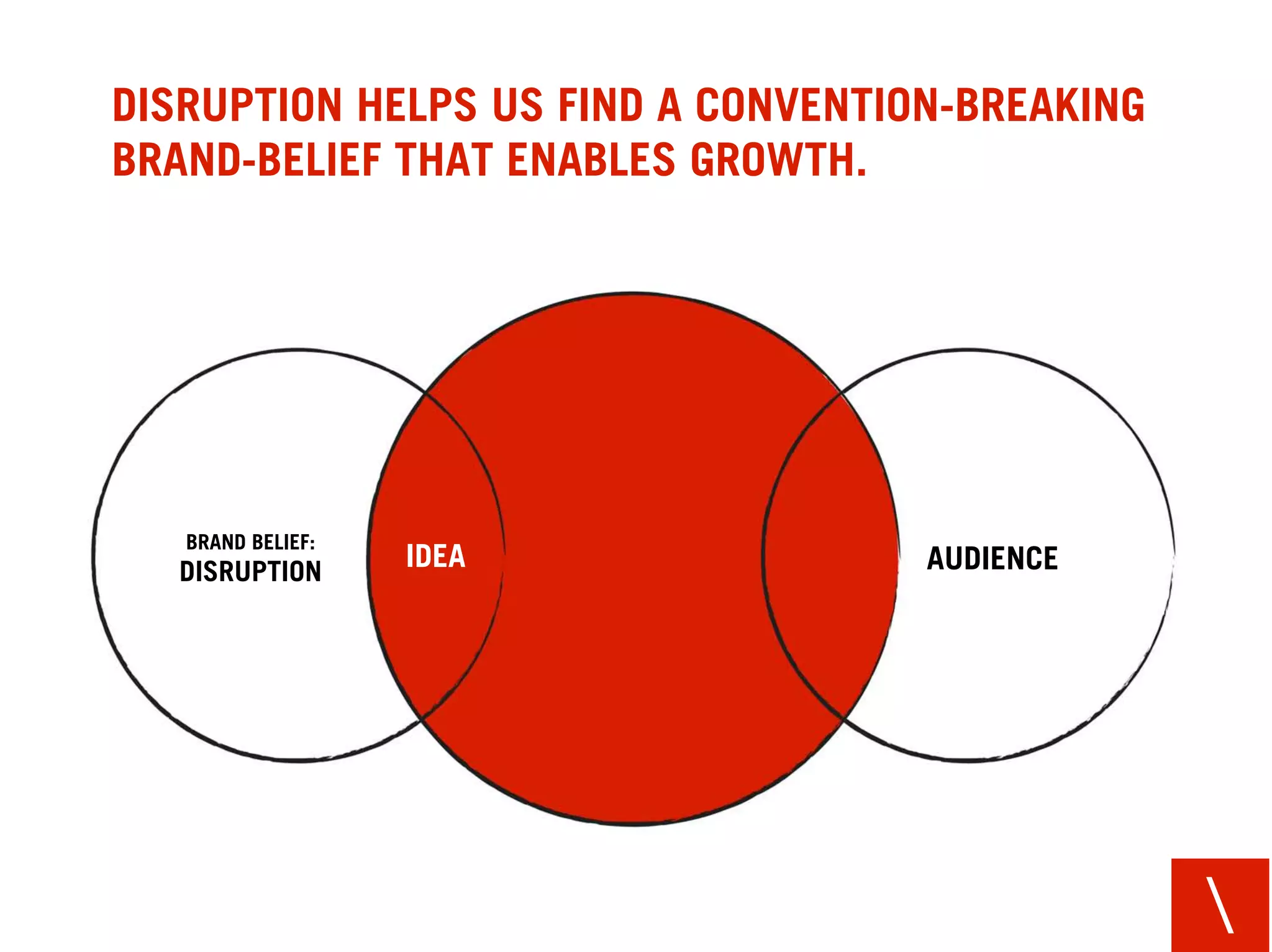
DISRUPTION HELPS US FIND A CONVENTION-BREAKING
BRAND-BELIEF THAT ENABLES GROWTH.


   BRAND BELIEF:
   DISRUPTION
                   IDEA             AUDIENCE
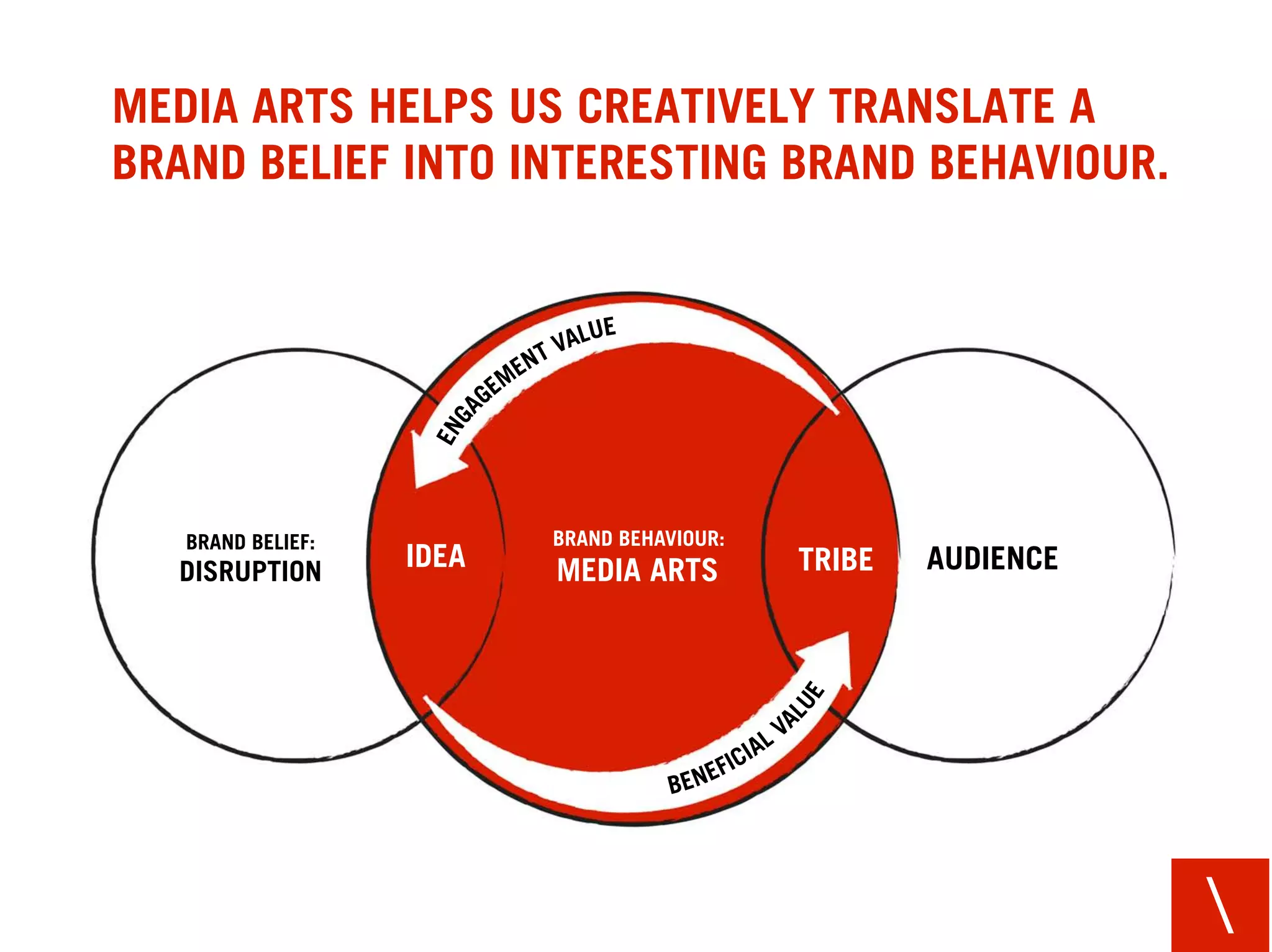
MEDIA ARTS HELPS US CREATIVELY TRANSLATE A
BRAND BELIEF INTO INTERESTING BRAND BEHAVIOUR.


   BRAND BELIEF:          BRAND BEHAVIOUR:
  DISRUPTION
                   IDEA   MEDIA ARTS         TRIBE   AUDIENCE
CHANGE TO MEDIA ARTS
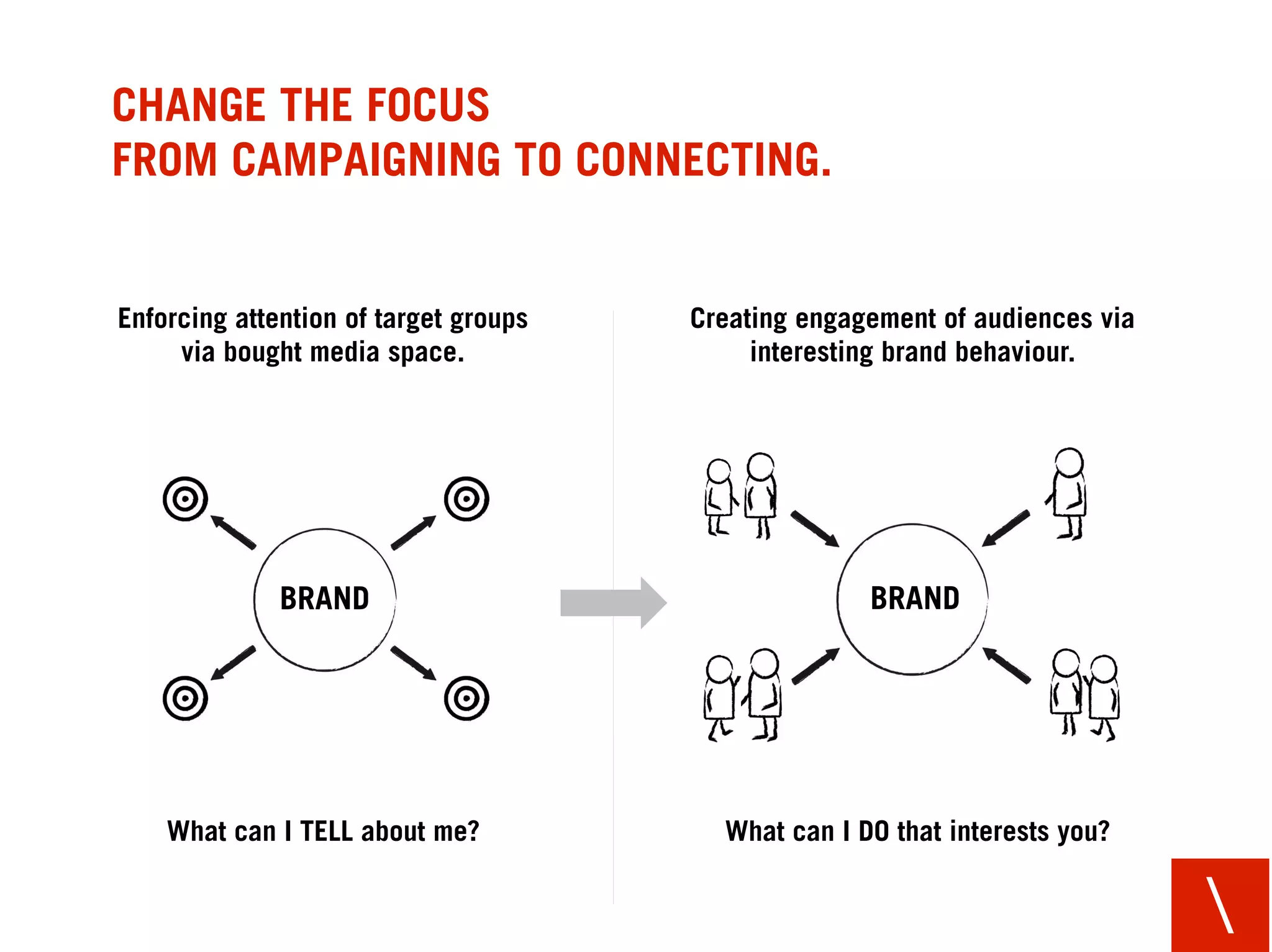
CHANGE THE FOCUS
FROM CAMPAIGNING TO CONNECTING.


Enforcing attention of target groups   Creating engagement of audiences via
     via bought media space.                interesting brand behaviour.


              BRAND                                  BRAND


    What can I TELL about me?            What can I DO that interests you?
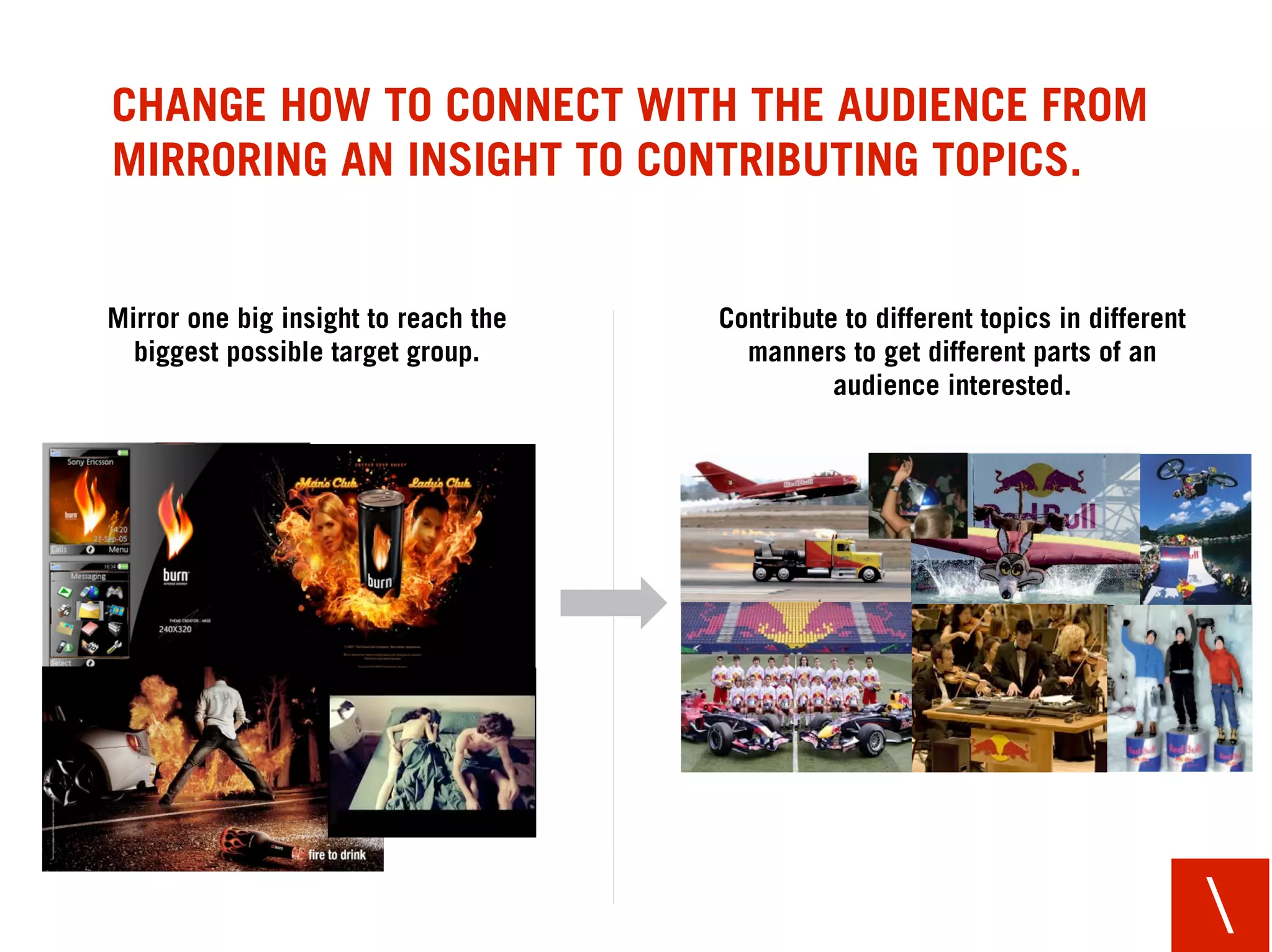
CHANGE HOW TO CONNECT WITH THE AUDIENCE FROM
MIRRORING AN INSIGHT TO CONTRIBUTING TOPICS.


Mirror one big insight to reach the       Contribute to different topics in different
  biggest possible target group.            manners to get different parts of an
                                                    audience interested.


                                      T
                                      V
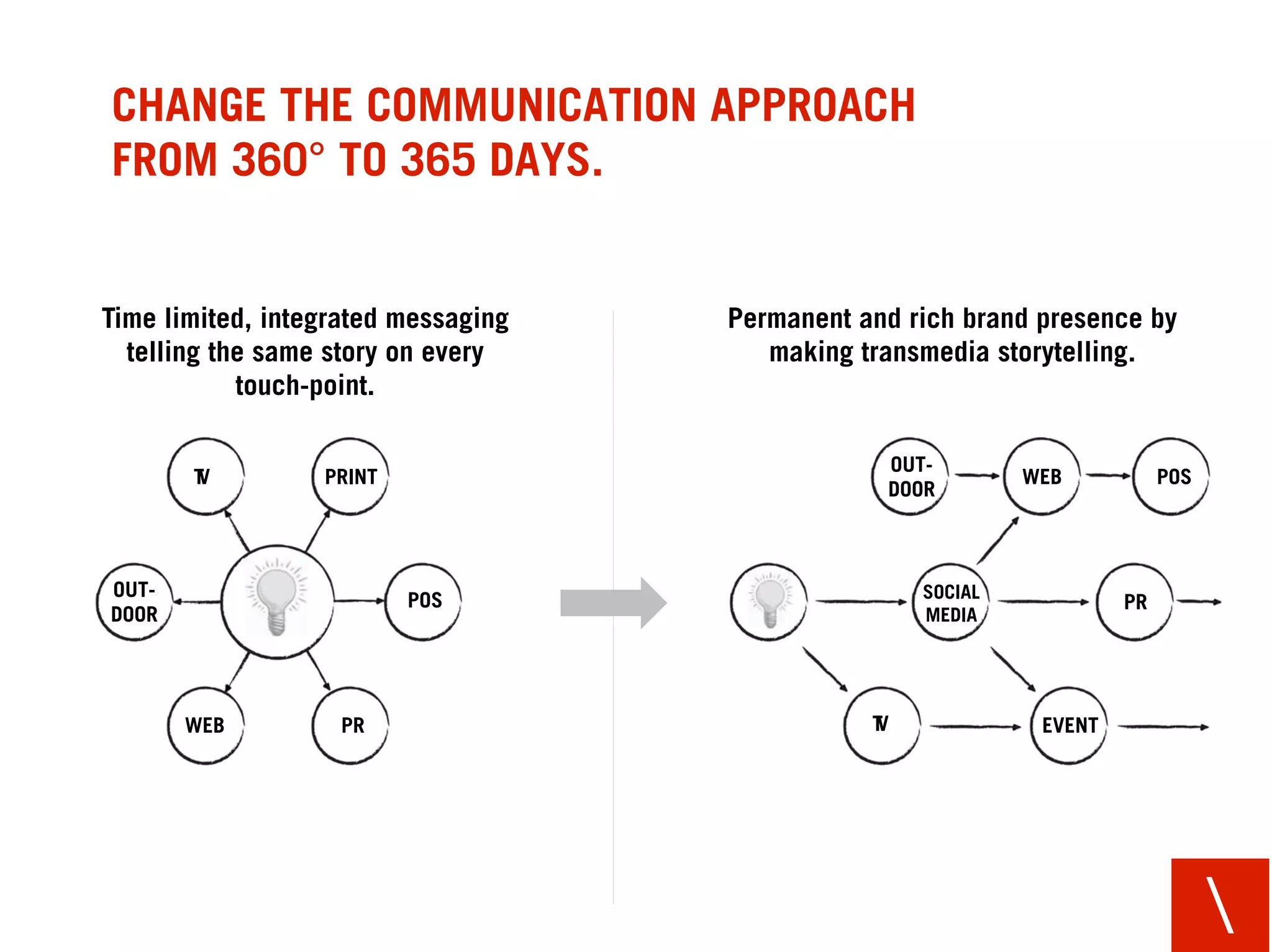
CHANGE THE COMMUNICATION APPROACH
FROM 360° TO 365 DAYS.


Time limited, integrated messaging       Permanent and rich brand presence by
  telling the same story on every           making transmedia storytelling.
            touch-point.

                                                     OUT-
       T
       V          PRINT                                          WEB           POS
                                                     DOOR


OUT-                                                    SOCIAL
                          POS                                             PR
DOOR                                                    MEDIA
                                     T
                                     V


       WEB         PR                               T
                                                    V             EVENT
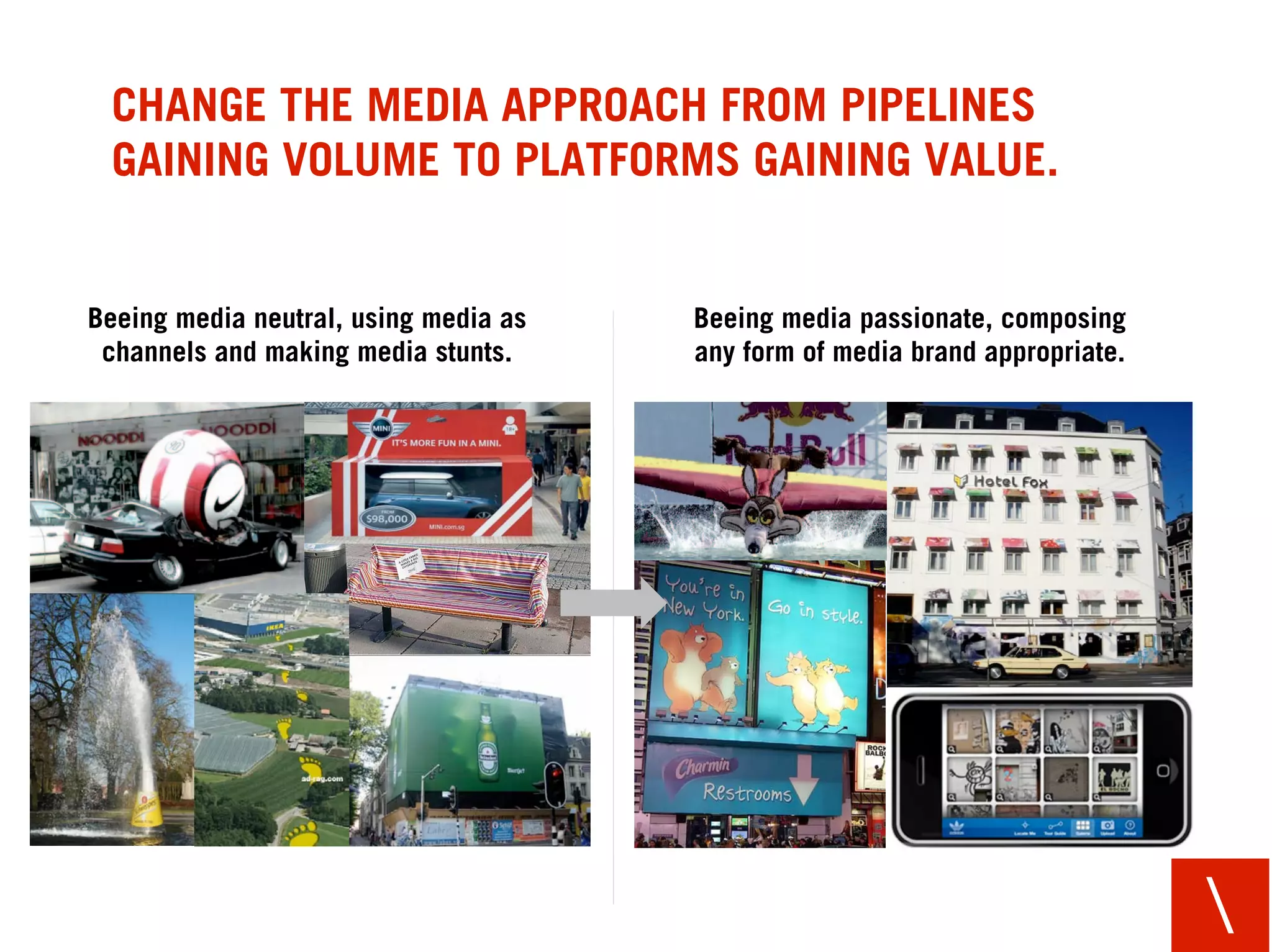
CHANGE THE MEDIA APPROACH FROM PIPELINES
 GAINING VOLUME TO PLATFORMS GAINING VALUE.


Beeing media neutral, using media as   Beeing media passionate, composing
 channels and making media stunts.     any form of media brand appropriate.
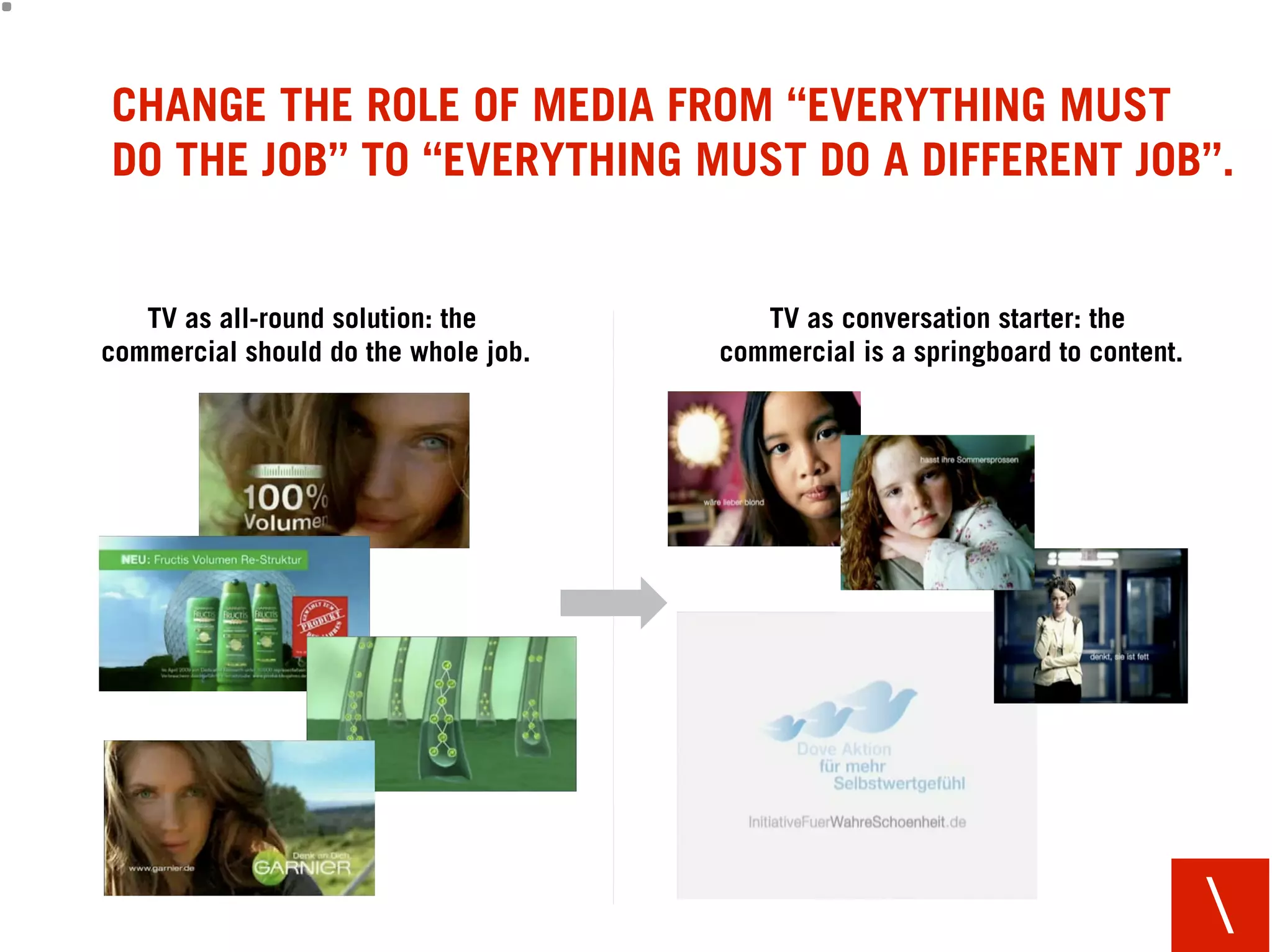
CHANGE THE ROLE OF MEDIA FROM “EVERYTHING MUST
DO THE JOB” TO “EVERYTHING MUST DO A DIFFERENT JOB”.


   TV as all-round solution: the         TV as conversation starter: the
commercial should do the whole job.   commercial is a springboard to content.
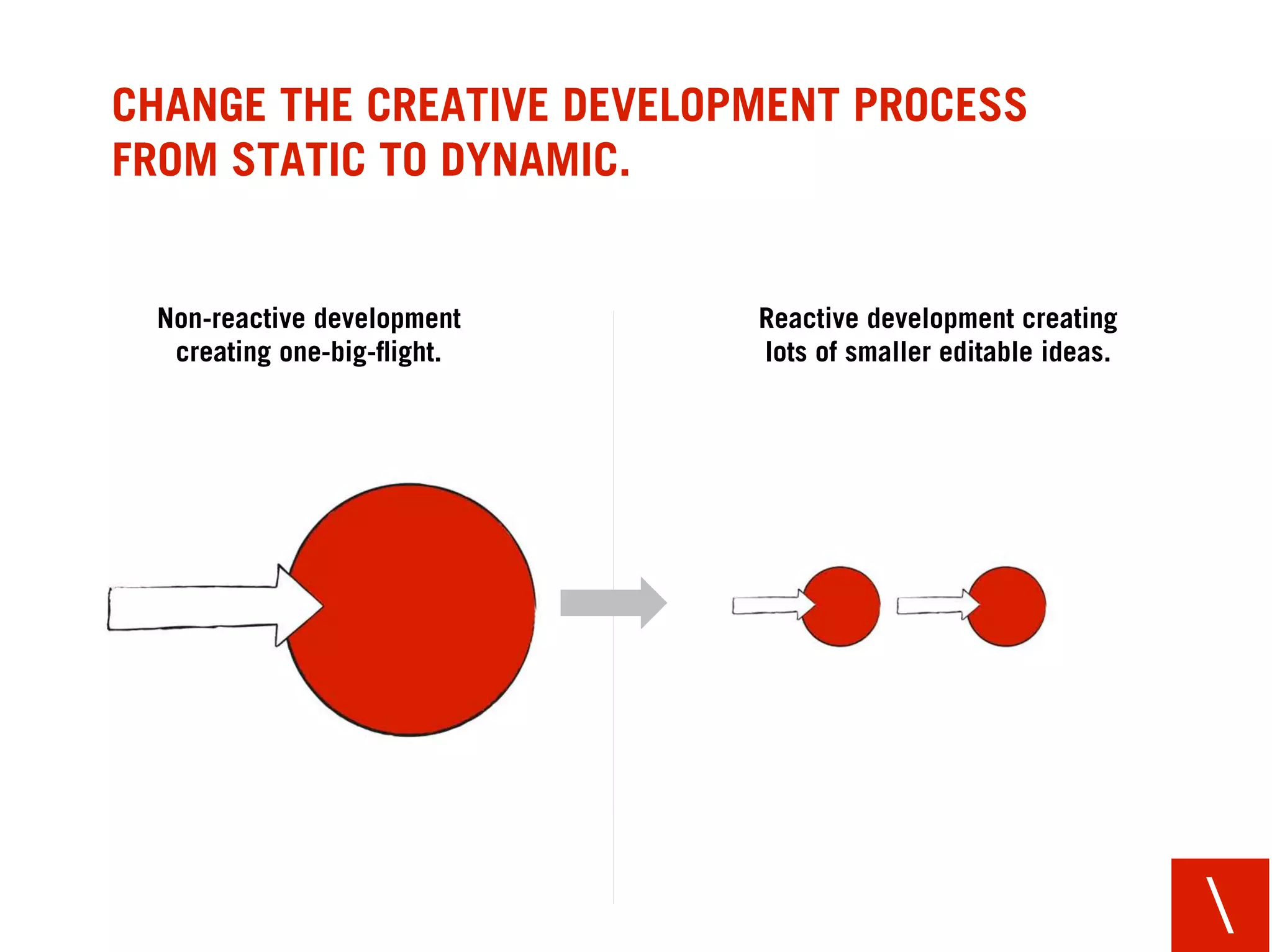
CHANGE THE CREATIVE DEVELOPMENT PROCESS
FROM STATIC TO DYNAMIC.


 Non-reactive development        Reactive development creating
  creating one-big-flight.        lots of smaller editable ideas.


                            TV
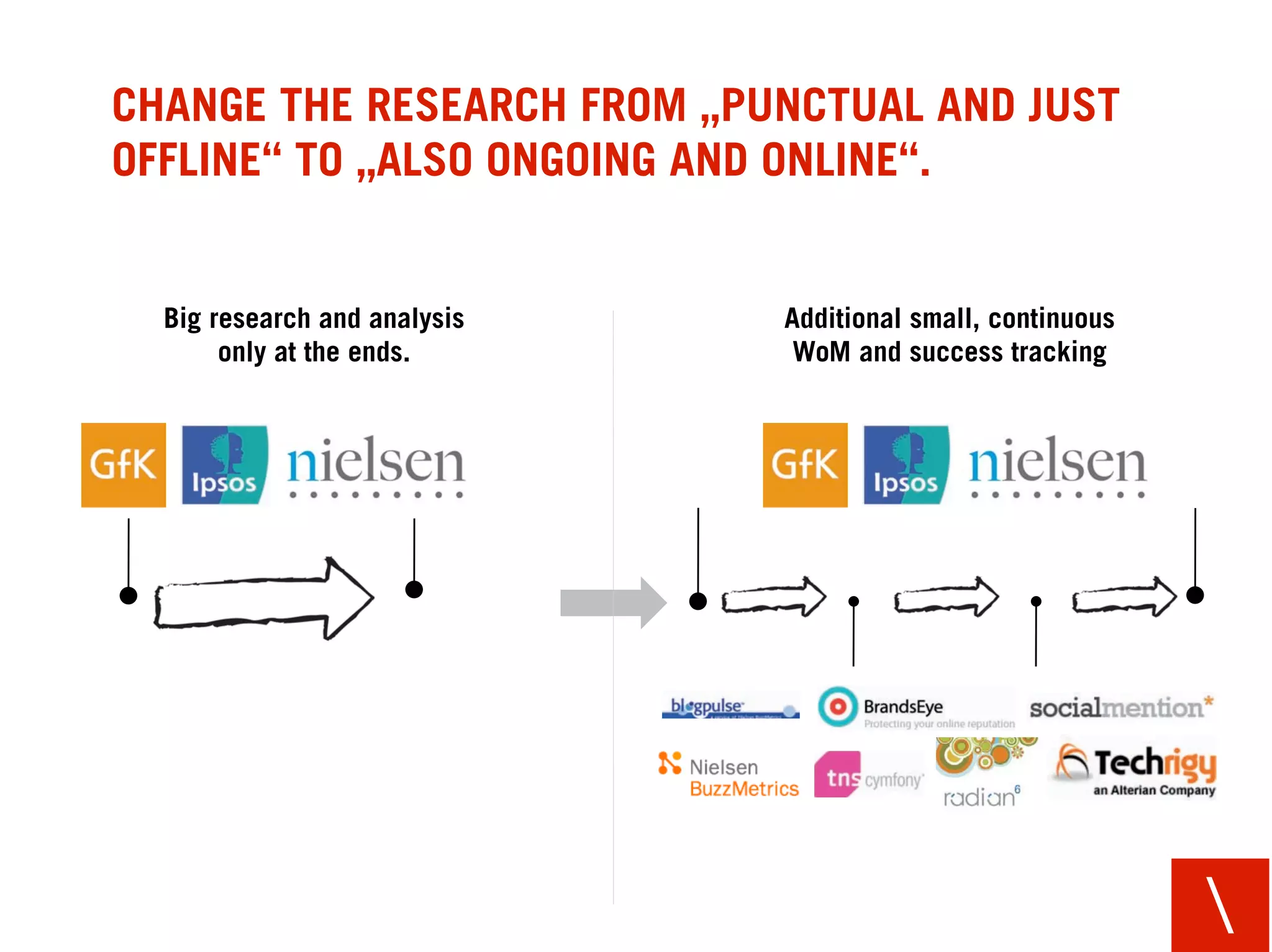
CHANGE THE RESEARCH FROM „PUNCTUAL AND JUST
OFFLINE“ TO „ALSO ONGOING AND ONLINE“.


  Big research and analysis   Additional small, continuous
       only at the ends.       WoM and success tracking
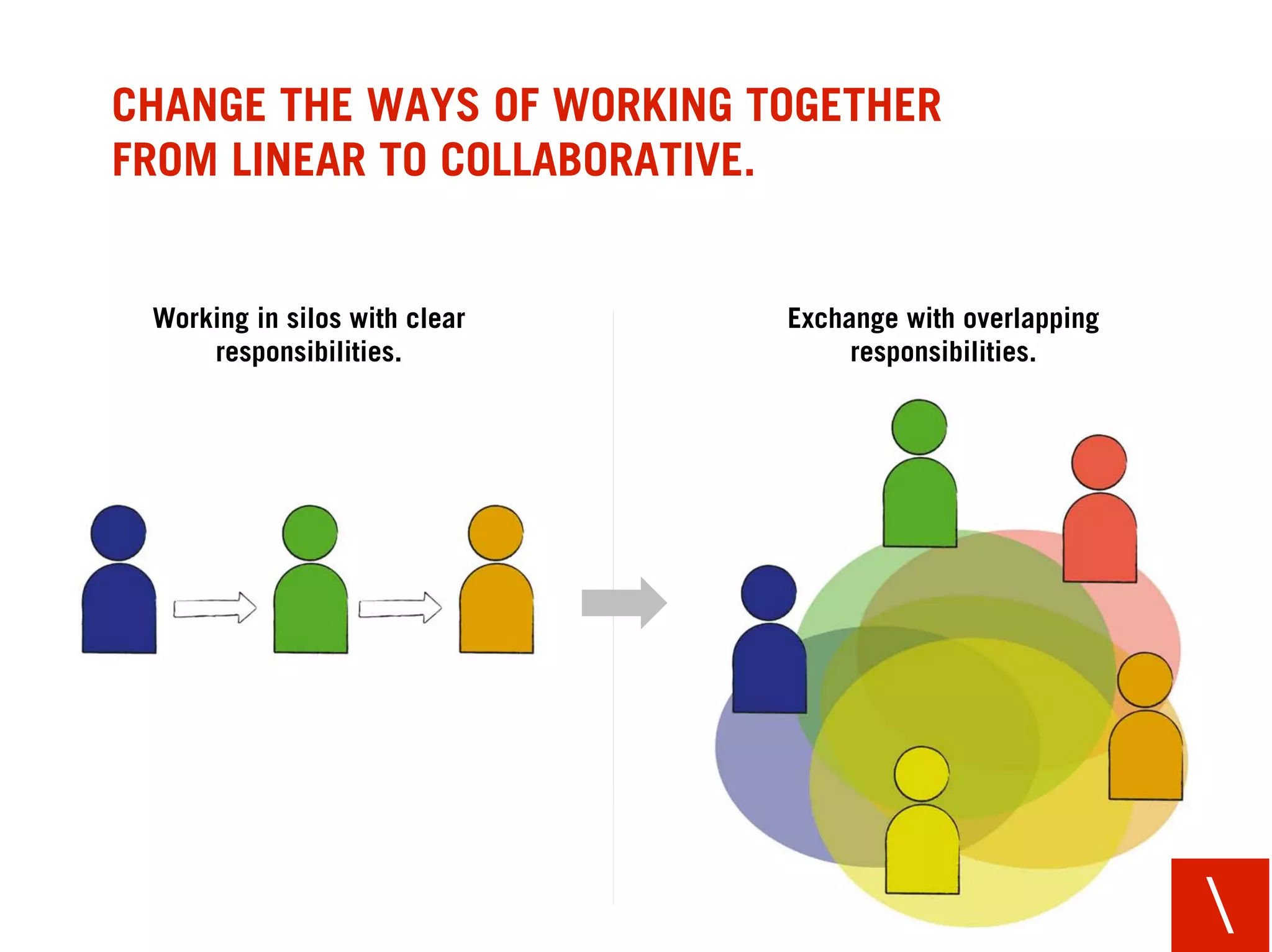
CHANGE THE WAYS OF WORKING TOGETHER
FROM LINEAR TO COLLABORATIVE.


 Working in silos with clear        Exchange with overlapping
     responsibilities.                   responsibilities.


                               TV
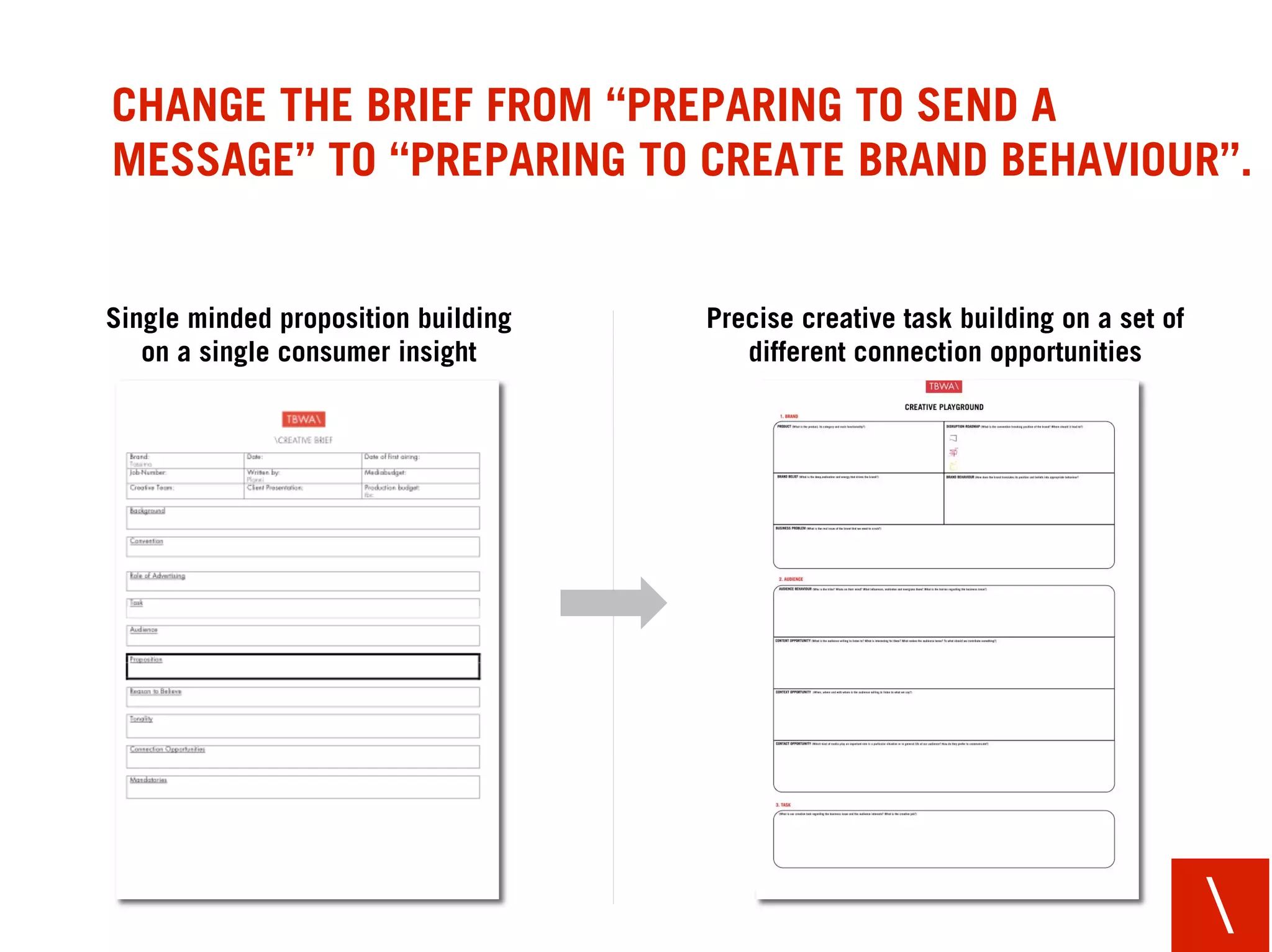
CHANGE THE BRIEF FROM “PREPARING TO SEND A
MESSAGE” TO “PREPARING TO CREATE BRAND BEHAVIOUR”.


Single minded proposition building   Precise creative task building on a set of
   on a single consumer insight         different connection opportunities
This was written by
Michael Zorn, TBWA Berlin
  michael.zorn@tbwa.de
twitter.com/BoyRobot3000
The Audience Is Always Right

The Audience Is Always Right

  • 1.
    THE AUDIENCE ISALWAYS RIGHT HOW PEOPLE'S BEHAVIOUR CHANGE THE WAY BRANDS WILL DO MARKETING T BWA
  • 2.
    THE CHANGE INPEOPLE’S BEHAVIOUR WHAT CANGES FOR BRANDS WHAT BRANDS SHOULD DO A NEW APPROACH CHANGE TO MEDIA ART
  • 3.
    “We are atthe beginning of the most exciting time the advertising business has ever seen. While lots of people are talking about the challenge of the multi-media future, I believe it is the biggest opportunity for creative minds since the ‘60’s.” Lee Clow, Director of Media Arts, TBWA Worldwide
  • 4.
    THE CHANGE INPEOPLE’S BEHAVIOUR
  • 5.
    IT STARTED WITHDIGITALIZATION AND NETWORKING OF DEVICES, CHANNELS, PRODUCTION AND CONTENT.
  • 6.
    THIS CHANGE INTECHNOLOGY LED TO A CHANGE IN HOW PEOPLE USE MEDIA. whatever USE whenever wherever
  • 7.
    MORE IMPORTANTLY THISCHANGE ENABLED THE PEOPLE TO MAKE MEDIA. whatever MAKE whenever wherever
  • 8.
    A NEW MOBILE-GAME-SOCIAL-MEDIA-UNIVERSEIS ON THE RISE WHILE OLD-BIG-MEDIA-WORLD STRUGGLES.
  • 9.
    BUT THE OLDMEDIA WORLD WILL NOT DIE. IT WILL JUST SHRINK AND NEW MEDIA WILL BECOME EQUAL. “As long as there are sofas there’ll be TV.” Rupert Murdoch, Global Media Entrepreneur
  • 10.
    “We will seeneutral evaluation of all media formats. There is no primary role for linear TV any more.” “The end of advertising as we know it”, IBM Corp., 2007
  • 11.
    “Technology is shiftingthe power away from the editors, the publishers, the establishment, the media elite. Now it‘s the people who are in control.” Rupert Murdoch, Global Media Entrepreneur
  • 12.
    NOW THE PEOPLECAN (AND MUST) CHOOSE THE WHAT, WHEN AND WHERE.
  • 13.
    NOW PEOPLE HAVETHE POWER TO PRODUCE, DUPLICATE AND DISTRIBUTE THEIR OWN IDEAS.
  • 14.
    NOW PEOPLE NOLONGER WAIT AT THE END OF THE LINE FOR SOMETHING TO HAPPEN.
  • 15.
  • 16.
    PEOPLE SHARE, TALKAND AGGREGATE. Publish Share Discuss Social Networks Lifestream Social Games SOCIAL MEDIA Livecast Virtual Worlds Microblog MMO Source: FredCavazza.net
  • 17.
    AND PEOPLE DOALL THAT FOR, WITH OR AGAINST BRANDS. FOR WITH AGAINST
  • 18.
    SO PEOPLE TODAYARE MORE THAN JUST CONSUMERS. THEY PLAY DIFFERENT, ACTIVE ROLES FOR BRANDS. CONSUMER CONSUMER PRODUCER PARTICIPANT MULTIPLIER COMMUNITY Source: inspired by David Armano “Micro Interactions + Direct Engagement”, 2008
  • 19.
    “Consumers are beginningin a very real sense to own our brands and participate in their creation … We need to begin to learn to let go.” A.G. Lafley, CEO and Chairman, Procter & Gamble
  • 20.
  • 21.
    SINCE THE MASS-MEDIAERA MOST BRANDS TRIED TO BE LOUDER THAN THEIR COMPETITORS.
  • 22.
    BRANDS ARE USEDTO BUYING VISIBILITY IN MASS-MEDIA AND REPEATING A MESSAGE TO TARGET GOUPS. BRAND
  • 23.
    FOUR CHANGES INPEOPLE’S MEDIA BEHAVIOUR WILL LEAD TO THIS MODEL INCREASINGLY FAILING TO DELIVER. BRAND
  • 24.
    FIRST CHANGE: FRACTALMEDIA USAGE. Brands have to deal with BRAND people who spend more time with more media in different ways.
  • 25.
    TODAY MORE ANDMORE MEDIA POSSIBILITIES ARE AVAILABLE. ANALOGUE DIGITAL NETWORKED DIGITAL Personal Video Recorder Digital Radio Flat Screen TVs Networked DVD Players Removable Storage Notebook & Tablet PC IPTV Set-top Box PDAs eBooks Media PC Personal Video Recorder Multi-media Mobile Phones Games Consoles Portable Games Consoles Portable Media Digital Imaging Devices Player MP3 Player
  • 26.
    POSSIBILITIES WHICH BROADENTHE MEDIA EXPERIENCE IN TWO INVOLVING DIMENSIONS. RICHNESS INTERACTIVITY
  • 27.
    INTER MEDIA VIEW:IN GENERAL THE PEOPLE SPEND MORE TIME WITH MORE MEDIA POSSIBILITIES. Hours per week spend with media (US). Internet 60h Digital TV 40h Analogue TV 20h Games Outdoor Media Digital Radio Analogue Radio Cinema Print 1900 1920 1940 1960 1980 2000 2020 Source: Carat 2008.
  • 28.
    BUT PEOPLE SPENDTHEIR TIME WITH MEDIA DIFFERENTLY. 700 Minutes per day spend with media (US). 600 Broadcast TV 500 Playback via VCR Console Game DVD or VCR 400 Mobile Web Mobile Texting Mobile Talk 300 Any Landline Instant Messanger Computer Video 200 Email Software Web 100 Magazine Book Newspaper 0 15 20 25 30 35 40 45 50 55 60 65 70 75 80 85 Age Source: Video Consumer Mapping Study , AC Nielsen 2009.
  • 29.
    SO IN GENERALPEOPLE’S MEDIA-PREFERENCES BECOME MORE FRACTAL. Minutes per day spend with media (US). 30 Any Landline DVD or VCR 30 20 Console Games Mobile Talk 20 10 Playback via DVR 10 Mobile Web Mobile Texting age 20 30 40 50 60 70 80 Web 60 40 Software 30 40 Email 20 20 Books Instant Messenger Newspaper 10 Computer Video Magazine age 20 30 40 50 60 70 80 Source: Video Consumer Mapping Study , AC Nielsen 2009.
  • 30.
    INTRA MEDIA VIEW:WITH THE GROWING OPTIONS WITHIN A CERTAIN MEDIUM... Average TV channels (in US Homes) 100 75 50 25 1940 1990 2000 2006 2008 Source: The Nielsen Company
  • 31.
    ... THE TIMESPENTPER CHOICE DROPS. 60 hrs 14 hrs Weekly Television Usage (US) Weekly set usage 10 hrs 40 hrs Weekly time per channel 6 hrs 20 hrs 2 hrs 1950 1960 1970 1980 1990 2000 2005 Sources: Media Dynamics and Bear Stearns.
  • 32.
    SECOND CHANGE: INDIVIDUALMEDIA USAGE. Brands have to deal with people who are using media on their BRAND own terms and schedules.
  • 33.
    “We don’t want1000 channels. We want the one we want to watch.” Nicolas Negroponte, MIT Media Lab
  • 34.
    PEOPLE DECIDE INDIVIDUALLYABOUT THE WHEN, WHAT AND HOW OF MEDIA. “People access content on their own schedule, wherever they are, in all kinds of ways.” Leslie Moonves, President and CEO of CBS Corporation. “They will be looking to consume content on their terms, and in forms and shapes and platforms that suit their needs.” Richard Halton, Controller of Business Strategy for the BBC.
  • 35.
    WHEN: THERE ISNO LONGER A SET TIME WHEN PEOPLE CONSUME MEDIA - PRIMETIME DROPS. Percentage of U.S. homes tuned to Big Three broadcast networks 50% (ABC, CBS and NBC) in prime time. 40% 30% 20% 1970 1980 1990 2000 2004 Source: Nielsen Media Research.
  • 36.
    WHAT: THERE ISLESS ‘BIG CONTENT’ WHICH MOST PEOPLE FIND INTERESTING - BLOCKBUSTERS DROP. Share of audience tuned Number of albums Average quarter hour in to No. 1 TV show. going gold or platinum. share of mainstream rock. 1,000 50% 16 600 30% 14 12 10% 200 ’61 ’71 ’81 ’91 ’01 ’98 ’00 ’02 ’04 Fall ‘98 Fall ‘00 Fall ‘02 Fall ‘04 Source: Nielsen Media Research Source: Recording Industry Association of America Source: Arbitron
  • 37.
    HOW: THERE ISFEWER MEDIA THAT MOST PEOPLE PREFER USING – ONE-SIZE-FITS-ALL MEDIA DIVIDES. US Media preferences 2007 “I cannot live without …” 15 – 27 years 41– 54 years 64% 62% 52% 47% 33% 33% 23% 21% 20% 12% 8% 4% Mobile phone PC / Laptop Video games Portable Print Media TV music player Source: NBC New Media Study, USA 2007.
  • 38.
    THIRD CHANGE: VOLATILEMEDIA USAGE. BRAND Brands have to deal with people who are using media in spontaneous ways.
  • 39.
    REAL-TIME: PEOPLE REPLACELOTS OF STATIC, SLOW MEDIA WITH DYNAMIC, FAST MEDIA. Where do you get most of your national and international news? 50% Newspaper 30% Internet 10% ‘01 ‘02 ‘03 ‘04 ‘05 ‘06 ‘07 ‘08 Source: PEW Internet Report 2008
  • 40.
    CONVERGENCE: DRIVES PERMANENTAVAILABILITY AND ACCESSIBILITY OF EVERY KIND OF CONTENT.
  • 41.
    MULTI-TASKING: PARALLEL USAGEAND FAST SWITCHING BETWEEN MEDIA BECOMES THE NORM. Frequency of using other media while watching TV (UK) Use other media with TV 80% Use mobile phone 60% Talk on landline / home phone Go on the internet 40% Listen to music on CD / MP3 player / computer Listen to a radio station 20% Play computer games on a games console 16-19 20-24 25-34 35-44 45-54 55-64 65-74 75+ Source: Ofcom Research 2008
  • 42.
    FOURTH CHANGE: SELF-DETERMINEDMEDIA USAGE. Brands have to deal with people who can avoid or block content they don't BRAND want to spend time with.
  • 43.
    PEOPLE TODAY HAVEMORE POSSIBILITIES TO AVOID OR BLOCK ADS AND UNWANTED CONTENT. “I don’t recall seeing any commercials while watching the program.” (American Idol or Desperate Housewives) 60% 40% 20% Non-DVR DVR Recorded Source: OMD Proprietary DVR Study 2006
  • 44.
    TV: VIEWING GETSMORE SELECTIVE, TIME-INDEPENDENT AND AD-FREE. DVR and VOD-Enabled Household Penetration in the US, 2005-2010 (% of TV households) 40% Video on Demand: Watch what you want, when you want 30% 20% Digital Video Recording: Record and watch timeshifted, skip ads 10% 2005 2006 2007 2008 2009 2010 Source: emarketer 11/2006
  • 45.
    PHONE: BLOCKING OFUNWANTED CALLS MADE POSSIBLE BY GOVERNMENT. The number of Americans registered on the National Do Not Call registry. 150 million 120 million 90 million 60 million 30 million Source: Federal Trade Commission
  • 46.
    WEB: POP-UP BLOCKERSARE STANDARD, AD-FILTERS ARE EASY TO GET AND INSTALL.
  • 47.
    EMAIL: SPAM-FILTERS AREALSO EASY TO GET AND INSTALL.
  • 48.
    SO: MEDIA-COMPLEXITY HASDISRUPTED THE ABILITY TO EASILY ENFORCE THE ATTENTION OF CONSUMERS. BRAND
  • 49.
    ALL THAT HASLEAD TO A ROI-DECLINE OF TRADITIONAL ADVERTISING BASED ON THE SENDER-RECEIVER MODEL. 1/3 effectiveness of traditional TV advertising in 2010 compared to 1990 Source: Mc Kinsey, 2006
  • 50.
    IT MAKES LESSAND LESS ECONOMIC SENSE TO SEND A MESSAGE TO MANY IN THE HOPE OF PERSUADING FEW.
  • 51.
    “The traditional marketingmodel “Safe advertising gets ignored. is being challenged and It’s the beginning of the end for advertisers can foresee a day repetitive advertising.” when it will no longer work.” Jean Marie Dru, Chairman TBWA Worldwide McKinsey Quarterly, 2005 “The ad inventory that has been sold for “In today’s media-rich world, traditional the last 50 years no longer works …” advertising models are breaking down.” Authenticity over Exaggeration: The New Rule John Stratton, CMO, Verizon Wireless, 2006. in Advertising, HBS Working Knowledge, Dez. 2007 “The operating system for marketers is now fundamentally changing. It doesn't matter how big “Telling and selling is dead.” your market share is.” Jim Stengel, Chief Global Marketing Officer, Procter & Gamble Seth Godin at Meatball Sunday 2008
  • 52.
  • 53.
  • 54.
    LET’S START WITHA TRUTH: IN GENERAL PEOPLE DON’T REALLY CARE ABOUT BRANDS. “Often our biggest mistake as managers is believing that, in general, customers care a lot about your brand. They do not.” Prof. Patrick Barwise, London Business School
  • 55.
    NEITHER DO PEOPLEREALLY CARE ABOUT ADVERTISING. “People don’t trust ads. People don’t want ads. People don’t need ads. There is no shortage of places to put ads.” Eric Clemens, Professor of Operations and Information Management at The Wharton School of the University of Pennsylvania.
  • 56.
    AND TODAY THELACK OF INTEREST AND ATTENTION GROWS. “There’s a limited amount of attention in the world. If more of it is going to personal, non-commercial, un-advertised media, less of it will go to advertising.” Russel Davies, Strategist & Author
  • 57.
    BRANDS MUST CHANGETHEIR VIEW ON MEDIA. “Brands that rely too heavily on mainstream media, or that are not exploring new technologies and connection points, will lose touch.” Jim Stengel, Global Marketing Officer, Procter & Gamble
  • 58.
    BRANDS SHOULD REMINDTHEMSELVES WHAT THE ACTUAL JOB IS. “We’re not in the business of keeping the media companies alive. We‘re in the business of connecting with consumers.” Trevor Edwards, Vice President of Global Brand Management, Nike
  • 59.
    TODAY’S POSSIBILITIES TOCONNECT ARE ENDLESS. “Everything a brand does that connects to the consumer is media.” Lee Clow, Director of Media Arts, TBWA Worldwide
  • 60.
    BRANDS MUST FINDA DIFFERENT WAY TO OPERATE AND COMMUNICATE. “It is about attracting people in, so they can then pull out the things they want. For this you need a magnet – It is more than quality and more than service, these are assumed, they are the starting point, consumers need an emotional world – Something they can react to – Something they can reject or join.” Robert Jones, “The Big Idea”
  • 61.
    STOP INTERRUPTING WHATPEOPLE ARE INTERESTED IN. “Every brand today has to think and act like a media company, rather than pushing stuff out there, to instead aim to pull an audience in.” Spencer Baim, Head of Virtue
  • 62.
    STOP BORING PEOPLEBY SENDING SIMPLE MESSAGES. “The whole industry is obsessed with the idea of a simple message, endlessly repeated (...) What people actually want is stuff with some complexity, some meat, some richness (...) No-one ever came out of a movie and said I really liked that. It was really clear.” Russel Davies, Strategist & Author
  • 63.
    WHAT BRANDS ANDAGENCIES SHOULD DELIVER INSTEAD IS CONTENT. “The agency’s job is to create content so valuable and useful that consumers wouldn’t want to live without it (…) content that’s interesting and entertaining enough to invite the consumer.” Jeff Hicks, CEO, Crispin Porter Bogusky
  • 64.
    BUT CONTENT ISN’TKING. “Conversation is king. If I sent you to a desert island and gave you the choice of taking your friends or your movies, you'd choose your friends - if you chose the movies, we'd call you a sociopath. Content is just something to talk about.” Cory Doctorow, Sci-Fi Author
  • 65.
    BRAND COMMUNICATION MUSTINCREASE THE CONVERSATIONAL CAPITAL OF A BRAND. “If it’s not worth talking about, it’s not worth doing.” Andy Sernovitz, Author of “WoM Marketing: How Smart Companies Get People Talking”
  • 66.
    IT ALL LEADSTO A NEW MODEL OF BRAND COMMUNICATION. “The old model was informing, persuading and reminding, the new model is demonstrating, involving and empowering.” Mitch Methews, Marketing Chief, Microsoft
  • 67.
    IN SHORT: Understand everything as media Attract an audience Produce content Create stuff with some richness Make stuff worth talking about
  • 68.
    HENCE BRAND COMMUNICATIONWILL BE MORE CHARACT- ERIZED BY ENTERTAINMENT THAN BY ADVERTISING. Understand everything as media Attract an audience Produce content Create stuff with some richness Make stuff worth talking about
  • 69.
    “We don’t doadvertising any more. (...) Advertising is all about achieving awareness, and we no longer need awareness. We need to become part of people's lives (...) Now it’s all about deciding what you want to say and how you're going to say it. There are going to be times when a TV ad is the right way to go, but that’s the exception rather than the rule.” Simon Pestridge, Nike’s UK marketing director “Brands today cannot be sustained by what in the past has been called advertising (…) perhaps the creativity of what we’ll do in the future needs a new name.” Lee Clow, Director of Media Arts, TBWA Worldwide
  • 70.
    BRAND COMMUNICATION MUSTSTART FOCUSING ON CREATING BRAND-GRAVITATION. BRAND
  • 71.
    BRAND GRAVITATION ISMAINLY DRIVEN BY: If you are VALUABLE, I’m likely to engage with you. MEANING If you are MEANINGFUL, I’m likely to pay attention to you. TRUST VALUE If you are TRUSTWORTHY, I’m likely to connect with you.
  • 72.
    SO BRANDS NEEDTO GET A DEEP UNDERSTANDING OF WHAT MAKES AN AUDIENCE CONNECT. MEANING? TRUST? VALUE?
  • 73.
    PULL YOUR AUDIENCEIN VOLUNTARILY.
  • 74.
    DON’T JUST SAYWHAT YOU ARE AND BELIEVE. BEHAVE LIKE WHAT YOU ARE AND BELIEVE.
  • 75.
    DON’T TRY TOMANIPULATE. TODAY EVERYBODY KNOWS IT’S MARKETING.
  • 76.
    START TO CREATESOME ENERGY AND LET’S JUST HAVE FUN TOGETHER.
  • 77.
  • 78.
    The following thoughtsare guidelines to ensure different creative output – not rigid rules. You cannot follow a masterplan to create something innovative.
  • 79.
    START WITH ASIMPLE TRUTH. We can’t treat people just as consumers anymore. People are audiences first and audiences expect to be entertained. As people today mash, tune in or ignore what they want, a brand needs to earn the engagement of its audience.
  • 80.
    AND LET’S STARTWITH A SIMPLE QUESTION. Why should the audience spend their time voluntarily with a brand and not with all of the other interesting things they can choose from - anytime, anywhere?
  • 81.
    THEREFORE, WE MUSTSTOP INTERUPTING WHAT THE AUDIENCE IS INTERESTED IN BY SENDING MESSAGES. BRAND AUDIENCE
  • 82.
    WE MUST STARTSEEING MEDIA AS ANY SPACE BETWEEN US AND OUR AUDIENCE. ATL and BTL, old and new media are complementary. Everthing has BRAND a role to play. AUDIENCE Let the idea find its medium.
  • 83.
    LISTEN TO THEAUDIENCE AND UNDERSTAND WHAT THEY ARE INTERESTED IN - WHAT HAS A MEANING. BRAND AUDIENCE
  • 84.
    “If communication isto change behaviour it must be grounded in the desire and interests of the receivers.” Aristotle
  • 85.
    “We’ve been votedthe best marketer of the 20th century. But that’s because we were the biggest shouters. In the 21st century, we want to be the best listeners.” Greg Icenhower, Procter&Gamble, director of corporate communications
  • 86.
    UNDERSTAND WHAT ISINTERESTING AND WHERE A BRAND CAN PLAY A ROLE ON 3 DIFFERENT LEVELS. WHAT? (CONTENT) … WHEN? (CONTEXT) … WHERE? (CONTEXT) … WITH WHOM? (CONTEXT) … WITH WHAT? (CONTACT) … BY WHAT? (CONTACT) …
  • 87.
    THE 3 LAYERSOF AN AUDIENCE INTEREST OPEN A RELEVANT PLAYGROUND FOR BRAND BEHAVIOUR. CONTACT CONTEXT CONTENT AUDIENCE BRAND INTEREST AUDIENCE
  • 88.
    FOCUS JUST ONAUDIENCE INTERESTS THAT FIT TO THE BRAND SO IT CAN BEHAVE TRUSTWORTHILY. CONTACT Business Problem CONTEXT Rules of Media CONTENT AUDIENCE BRAND INTEREST AUDIENCE Product Positioning Beliefs
  • 89.
    AN AUDIENCE INTERESTCAN ONLY ATTRACT A PART OF THE AUDIENCE: A TRIBE. AUDIENCE BRAND INTEREST TRIBE 1 AUDIENCE
  • 90.
    A TRIBE: PEOPLEWHO SHARE AN ENTHUSIASM ABOUT AN INTEREST AND CONNECT WITH EACH OTHER. “A group of people who form relationships over time, by interacting regularly around contexts which are of interest to all of them.” Jake McKee, communityguy.com
  • 91.
    “Advertising is theprice you pay for not realizing the value of building your passionate tribe.” Dr. Mani Sivasubramanian
  • 92.
    AN AUDIENCE EMBRACESSEVERAL DIFFERENT TRIBES WHO NEED TO BE FED INDIVIDUALLY.
  • 93.
    A BRAND MUSTCONTRIBUTE TO DIFFERENT INTERESTS OF DIFFERENT TRIBES IN DIFFERENT MANNERS. BRAND INTEREST 1 TRIBE 1 2 E TRIB BRAND BRAND
  • 94.
    THE DECISION FORAN INTEREST IS EITHER A DECISION FOR INFLUENCIALS OR FOR FOLLOWERS OF A TRIBE. AUDIENCE FEW LOTS OF BRAND INTEREST OPINION FOLLOWERS LEADERS
  • 95.
    NOW DEVELOP ABRAND BEHAVIORAL IDEA AS A FUSION OF AUDIENCE INTEREST AND BRAND. Business Problem Rules of Media AUDIENCE BRAND IDEA INTEREST TRIBE AUDIENCE Product Positioning Beliefs
  • 96.
    THE IDEA MUSTFOLLOW A BASIC PRINCIPLE. “The key is to produce something that both pulls people together and gives them something to do.” Henry Jenkins, Director Comparative Media Studies Program, MIT
  • 97.
    IT CAN BEANYTHING. THINK ABOUT THE IDEA AND THE DISTRIBUTION AT THE SAME TIME.
  • 98.
    CREATE TIME, DON’TTRY TO BUY TIME.
  • 99.
    CREATE CONTENT ANDSERVICES THE AUDIENCE CARE ABOUT AND THAT THEY FIND WORTH PASSING ON.
  • 100.
    TELL A STORYTHAT MAKES THE AUDIENCE’S CONVERSATIONS MORE INTERESTING.
  • 101.
    TELL LOTS OFSMALL STORIES AND MAKE THEM MEAN SOMETHING TOGETHER. STOP LAUNCHING A BIG BANG. WHOPPER SACRIFICE WHOPPER: WHOPPER VIRGINS THE MOST LOVED BURGER WHOPPER FREAKOUT BLACK BK
  • 102.
    LEAVE ROOM TOTHINK AND ASK QUESTIONS BY BEING IMPERFECT, WEIRD OR CONTRADICTORY.
  • 103.
    INVITE PEOPLE ALONG,LET THEM CONTRIBUTE AND GIVE THEM THE CHANCE TO BECOME VISIBLE.
  • 104.
    MAKE THE IDEAEASY TO FIND (SEARCHABLE) AND EASY TO TELL (SPREADABLE).
  • 105.
    THE IDEA MUSTALWAYS OFFER A VALUE SO THAT THE AUDIENCE WANT’S TO ENGAGE WITH IT. AUDIENCE BRAND IDEA INTEREST TRIBE AUDIENCE
  • 106.
    NOW GIVING BECOMESCRUCIAL FOR A BRAND. “People become loyal to that what the brand is giving.” David Armano, Vice President of Experience Design, Critical Mass.
  • 107.
    TODAY NOT ONLYTHE PRODUCT MUST BE BENEFICIAL, BUT ALSO THE COMMUNICATION IDEA AROUND IT. Be additive and supportive. Deliver something useful and fun. Help people enjoy and use the product.
  • 108.
    THE RESULT MUSTBE MORE A MARKETING PRODUCT AND NOT ADVERTISING.
  • 109.
    THE IDEA CANDELIVER A BENEFICIAL VALUE BY INITIALIZING FUN TIMES ...
  • 110.
    ... OR BYCONNECTING LIKE-MINDED PEOPLE.
  • 111.
    ... OR BYSUPPORTING A SOCIAL MISSION.
  • 112.
    ... OR BYSOLVING A PROBLEM.
  • 113.
    ... OR BYEDUCATING.
  • 114.
    IF THE IDEAIS INTERESTING AND VALUEABLE, IT IS LIKELY THAT IN RETURN BRANDS GET ENGAGEMENT. AUDIENCE BRAND IDEA INTEREST TRIBE AUDIENCE
  • 115.
    ENGAGEMENT HAS MOREWORTH THAN ATTENTION. “Awareness doesn‘t really matter in a world of overchoice.” Prof. Andrew Ehrenberg, South Bank University “Engagement has a psychological component, but it will manifest behaviorally – it will lead to an action.” Robert DeSena, Director of Relationship Marketing, MARS USA
  • 116.
    THE QUALITY OFENGAGEMENT DEPENDS ON THE QUALITY OF THE RELATIONSHIP TO THE BRAND. INACTIVE SPECTATE CONSUME SYNTHESIZE INVEST E INTERACT E CRITIZIS PARTICIPATE COLLABORAT E ADVOCAT E CONVINC
  • 117.
    WAYS IN WHICHENGAGEMENT OF BRAND FRIENDS AND FANS CAN MANIFEST ITSELF. Content Creation Product Co-Creation Recommendation Rating and Commenting
  • 118.
    ENGAGEMENT OFTEN LEADSTO WORD OF MOUTH ABOUT THE PRODUCT, NOT JUST ABOUT THE CREATIVE IDEA.
  • 119.
    THIS MAKES ENGAGEMENTA VALUABLE ASSET TO A BRAND. “With our audience, word is spread like wildfire and it's much more cost effective for the client.” Spencer Baim, Head of Virtue
  • 120.
    A NEW APPROACH: AUDIENCE-INTERESTDRIVEN BRAND COMMUNICATION. AUDIENCE BRAND IDEA INTEREST TRIBE AUDIENCE
  • 121.
    AN APPROACH THATFACILITATES IDEAS, FOCUSING ON THE 3 DRIVERS OF BRAND GRAVITATION. TRUST IDEA MEANING
  • 122.
    TBWA ADRESSES THENEW APPROACH WITH ITS TWO ESSENTIAL PRACTICES: MEDIA ARTS DISRUPTION
  • 123.
    DISRUPTION HELPS USFIND A CONVENTION-BREAKING BRAND-BELIEF THAT ENABLES GROWTH. BRAND BELIEF: DISRUPTION IDEA AUDIENCE
  • 124.
    MEDIA ARTS HELPSUS CREATIVELY TRANSLATE A BRAND BELIEF INTO INTERESTING BRAND BEHAVIOUR. BRAND BELIEF: BRAND BEHAVIOUR: DISRUPTION IDEA MEDIA ARTS TRIBE AUDIENCE
  • 125.
  • 126.
    CHANGE THE FOCUS FROMCAMPAIGNING TO CONNECTING. Enforcing attention of target groups Creating engagement of audiences via via bought media space. interesting brand behaviour. BRAND BRAND What can I TELL about me? What can I DO that interests you?
  • 127.
    CHANGE HOW TOCONNECT WITH THE AUDIENCE FROM MIRRORING AN INSIGHT TO CONTRIBUTING TOPICS. Mirror one big insight to reach the Contribute to different topics in different biggest possible target group. manners to get different parts of an audience interested. T V
  • 128.
    CHANGE THE COMMUNICATIONAPPROACH FROM 360° TO 365 DAYS. Time limited, integrated messaging Permanent and rich brand presence by telling the same story on every making transmedia storytelling. touch-point. OUT- T V PRINT WEB POS DOOR OUT- SOCIAL POS PR DOOR MEDIA T V WEB PR T V EVENT
  • 129.
    CHANGE THE MEDIAAPPROACH FROM PIPELINES GAINING VOLUME TO PLATFORMS GAINING VALUE. Beeing media neutral, using media as Beeing media passionate, composing channels and making media stunts. any form of media brand appropriate.
  • 130.
    CHANGE THE ROLEOF MEDIA FROM “EVERYTHING MUST DO THE JOB” TO “EVERYTHING MUST DO A DIFFERENT JOB”. TV as all-round solution: the TV as conversation starter: the commercial should do the whole job. commercial is a springboard to content.
  • 131.
    CHANGE THE CREATIVEDEVELOPMENT PROCESS FROM STATIC TO DYNAMIC. Non-reactive development Reactive development creating creating one-big-flight. lots of smaller editable ideas. TV
  • 132.
    CHANGE THE RESEARCHFROM „PUNCTUAL AND JUST OFFLINE“ TO „ALSO ONGOING AND ONLINE“. Big research and analysis Additional small, continuous only at the ends. WoM and success tracking
  • 133.
    CHANGE THE WAYSOF WORKING TOGETHER FROM LINEAR TO COLLABORATIVE. Working in silos with clear Exchange with overlapping responsibilities. responsibilities. TV
  • 134.
    CHANGE THE BRIEFFROM “PREPARING TO SEND A MESSAGE” TO “PREPARING TO CREATE BRAND BEHAVIOUR”. Single minded proposition building Precise creative task building on a set of on a single consumer insight different connection opportunities
  • 135.
    This was writtenby Michael Zorn, TBWA Berlin michael.zorn@tbwa.de twitter.com/BoyRobot3000