Placenta Accreta-Lessons Learnt
Dr Leena Wadhwa
Associate Professor
ESI-PGIMSR,Basaidarapur,Delhi
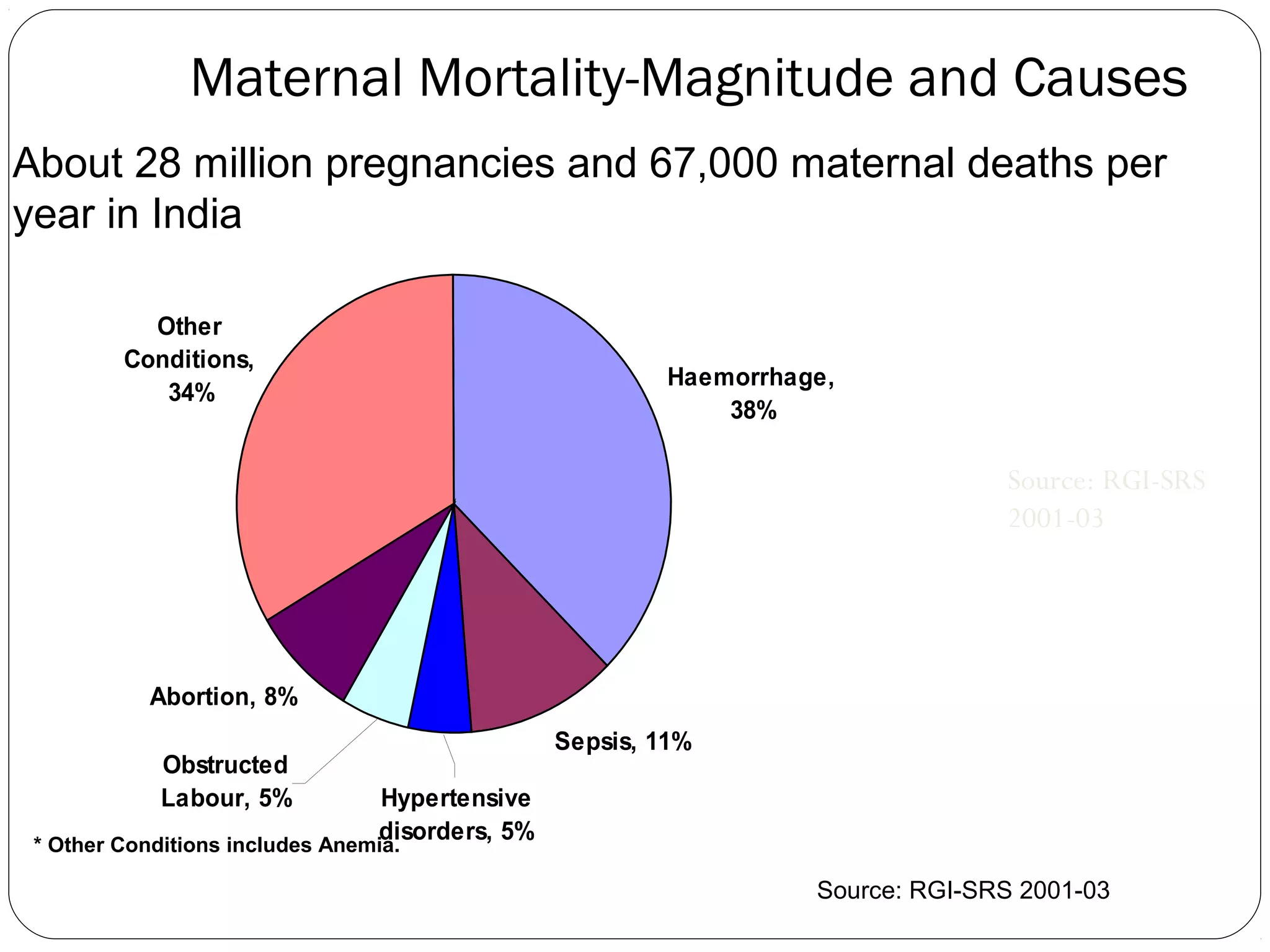
Maternal Mortality-Magnitude and Causes
About 28 million pregnancies and 67,000 maternal deaths per
year in India
Other
Conditions,
34%

Haemorrhage,
38%

Source: RGI-SRS
2001-03

Abortion, 8%
Obstructed
Labour, 5%

Sepsis, 11%

Hypertensive
disorders, 5%
* Other Conditions includes Anemia.
Source: RGI-SRS 2001-03
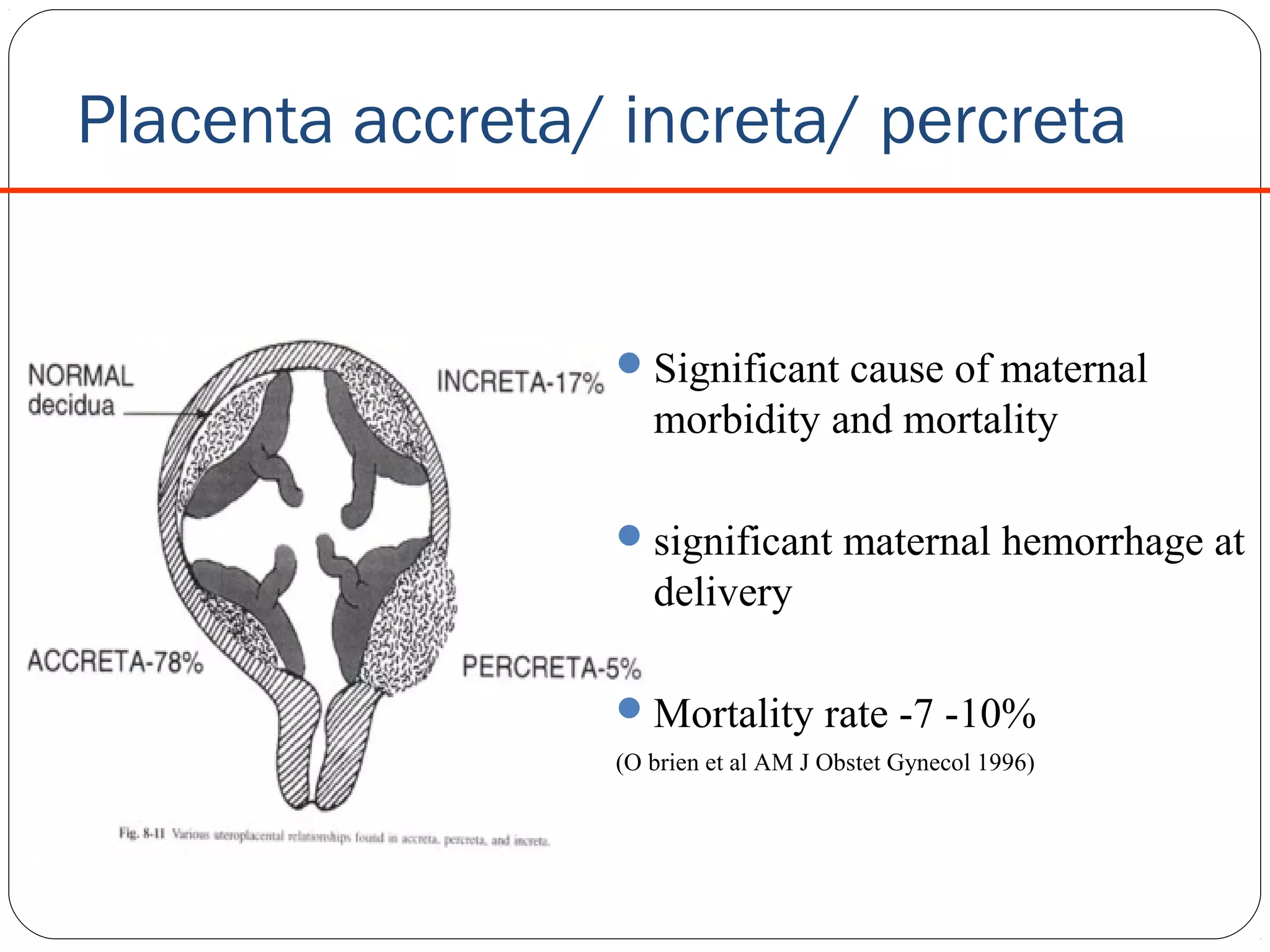
Placenta accreta/ increta/ percreta

 Significant cause of maternal

morbidity and mortality
 significant maternal hemorrhage at

delivery
 Mortality rate -7 -10%
(O brien et al AM J Obstet Gynecol 1996)
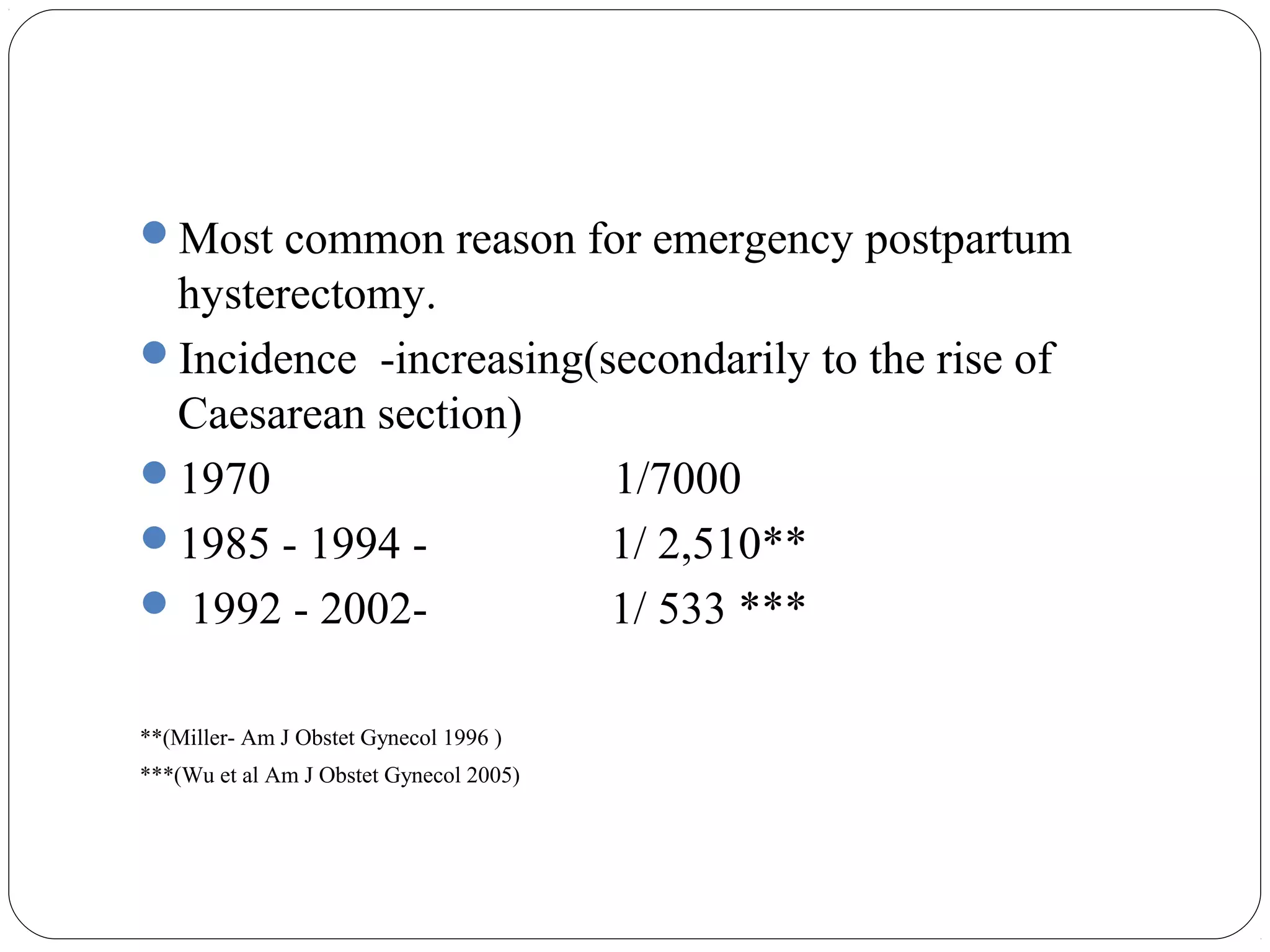
Most common reason for emergency postpartum

hysterectomy.
Incidence -increasing(secondarily to the rise of
Caesarean section)
1970
1/7000
1985 - 1994 1/ 2,510**
 1992 - 20021/ 533 ***
**(Miller- Am J Obstet Gynecol 1996 )
***(Wu et al Am J Obstet Gynecol 2005)
Case 1
Unbooked, G4P2L2A1, 26 weeks, previous LSCS,

fever dysuria
USG:Placenta antr,covering os
Em laprotomy (GA) : hematuria ? Rupture uterus
Per-operative details
Hemoperitoneum (1 litre+)
Posterior wall of bladder found adhered to LUS
Bladder lying open (3cm)
Clots presents inside the bladder removed. large

bleeders present on the posterior bladder wall , clamped
& sutured
Case 1
hysterotomy done and fetus delivered
 fails to recognize percreta going into bladder &

anticipate complications
tries partial MRP hysterectomy with difficulty by 2
consultantsuncontrollable hgg from bladdercystectomy & B/L Int iliac art ligation
6 units Blood
Patient died in ICU
Case 1
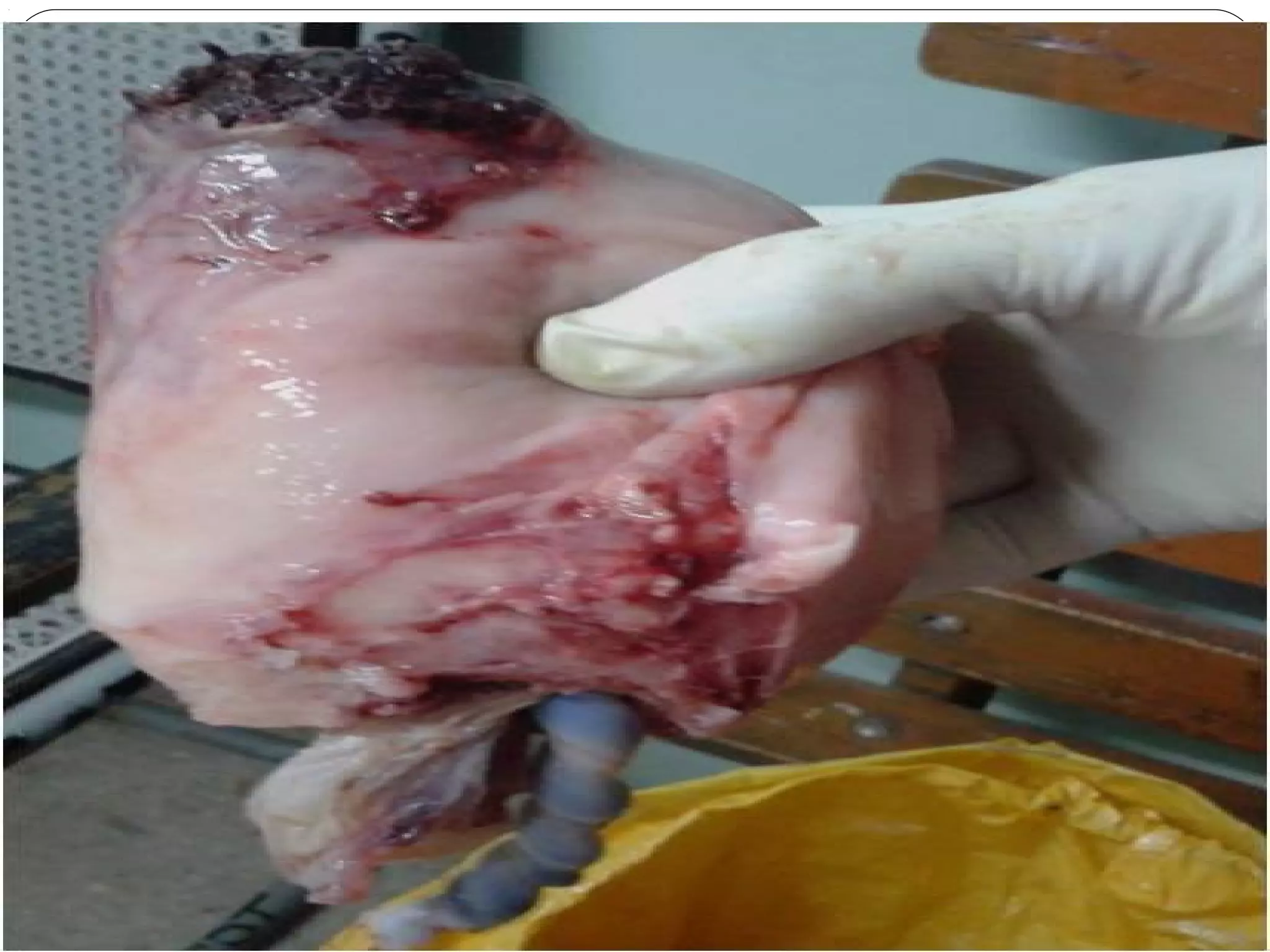
HPE- Placental tissue invading the full thickness

myometrium and the overlying serosa.(placenta
percreta)
‘Placenta accreta mindedness’
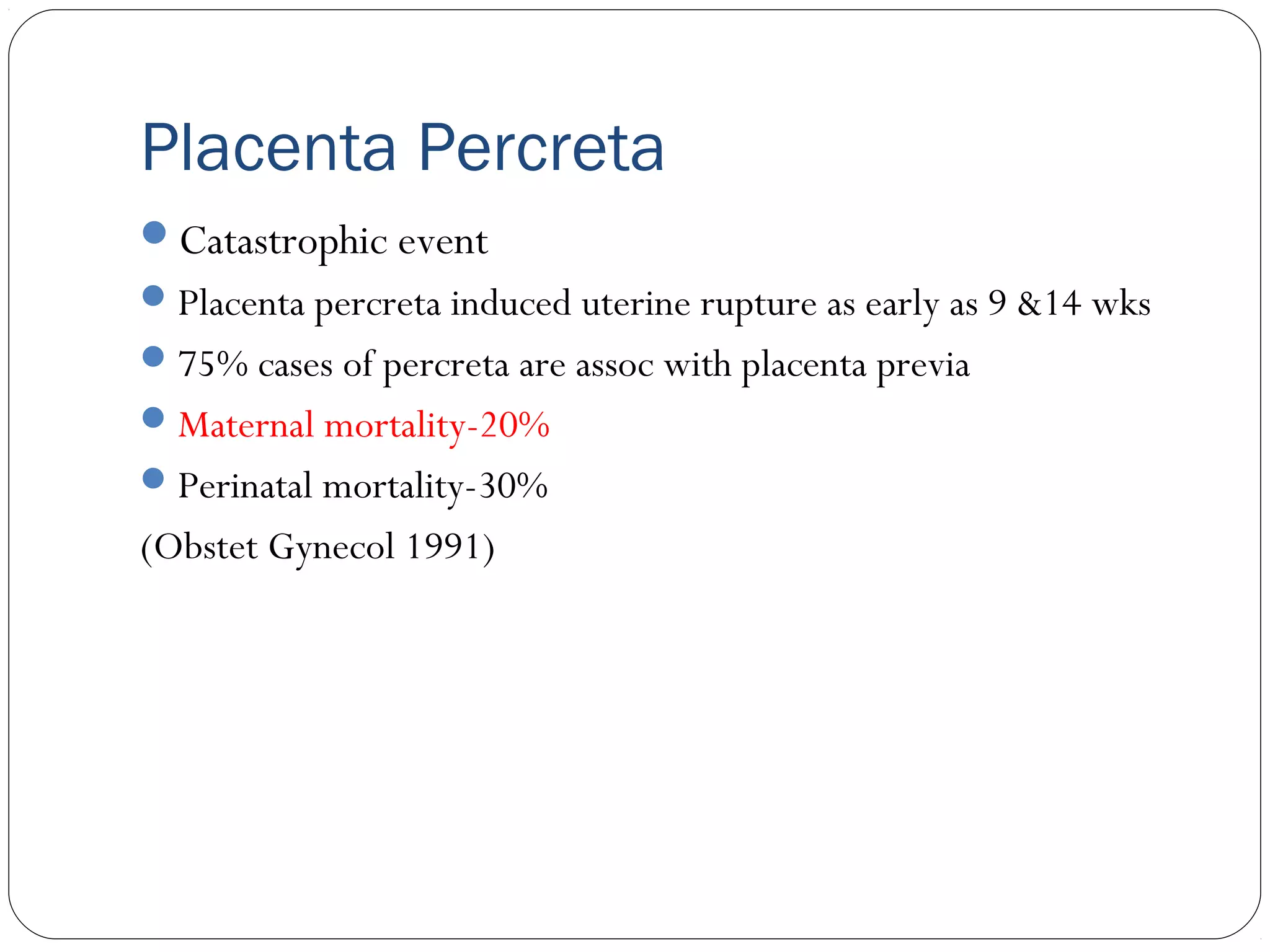
Placenta Percreta
Catastrophic event
 Placenta percreta induced uterine rupture as early as 9 &14 wks
 75% cases of percreta are assoc with placenta previa
 Maternal mortality-20%
 Perinatal mortality-30%

(Obstet Gynecol 1991)
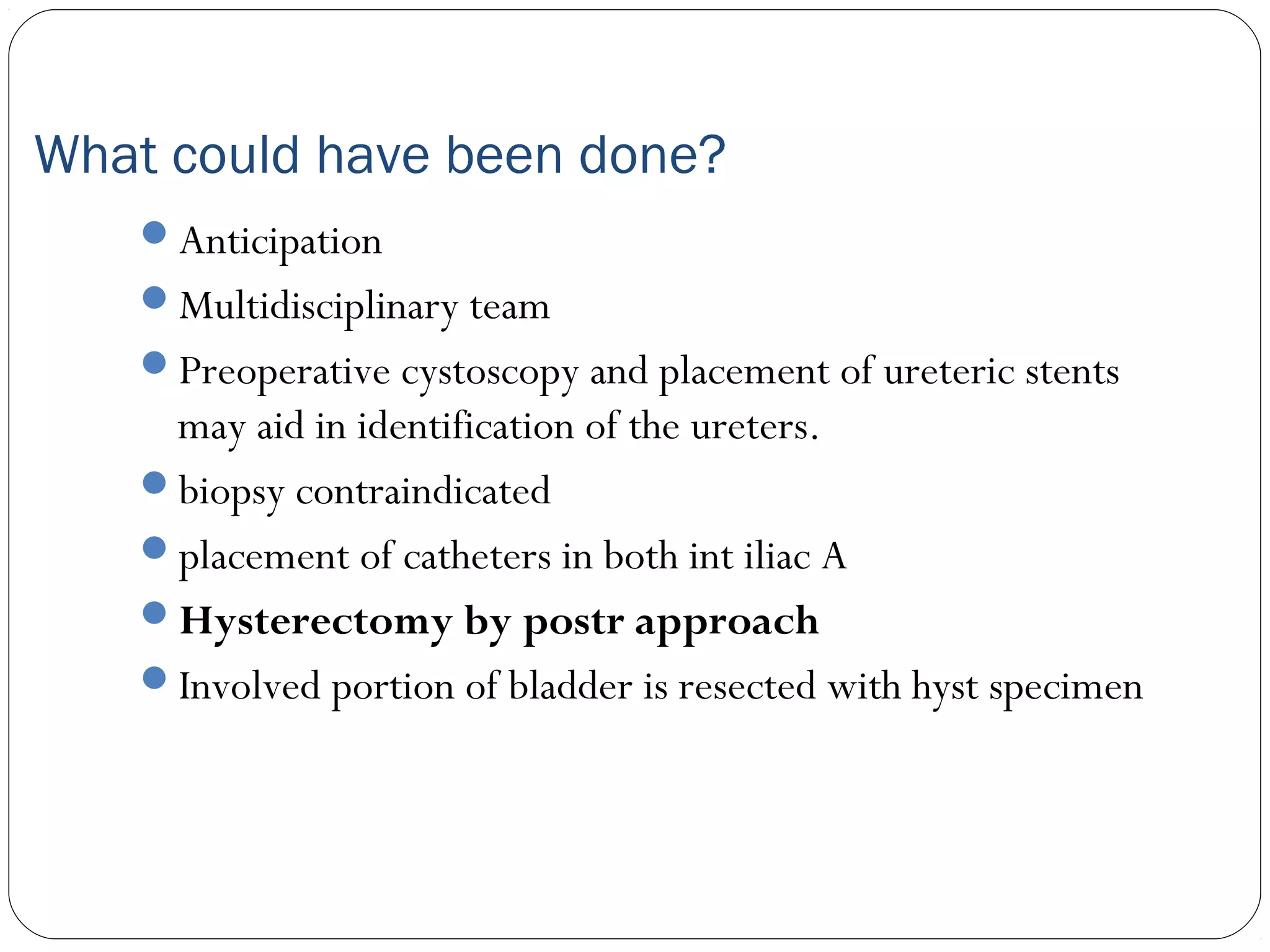
What could have been done?
Anticipation
Multidisciplinary team
Preoperative cystoscopy and placement of ureteric stents

may aid in identification of the ureters.
biopsy contraindicated
placement of catheters in both int iliac A
Hysterectomy by postr approach
Involved portion of bladder is resected with hyst specimen
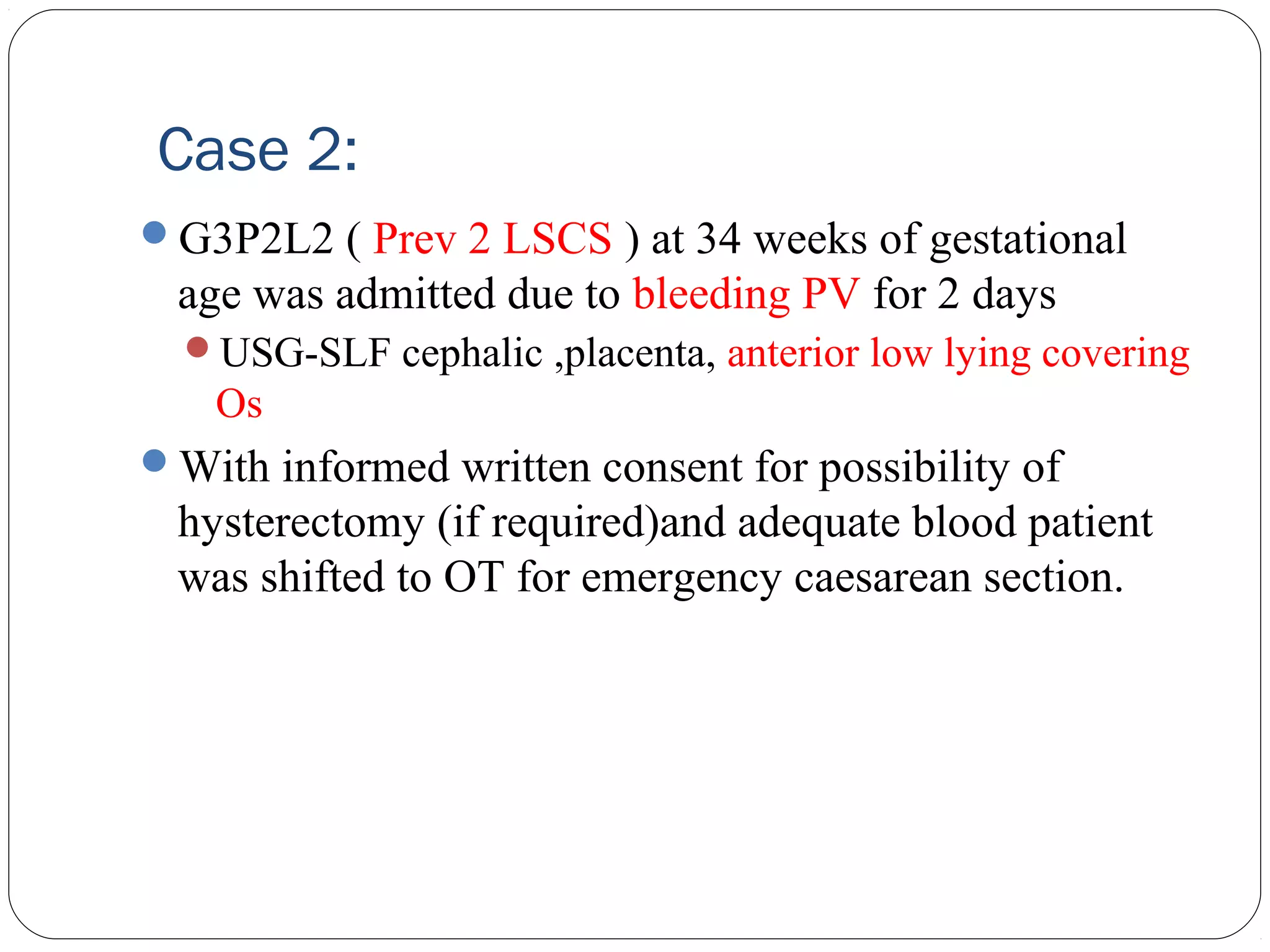
Case 2:
G3P2L2 ( Prev 2 LSCS ) at 34 weeks of gestational

age was admitted due to bleeding PV for 2 days
USG-SLF cephalic ,placenta, anterior low lying covering

Os
With informed written consent for possibility of

hysterectomy (if required)and adequate blood patient
was shifted to OT for emergency caesarean section.
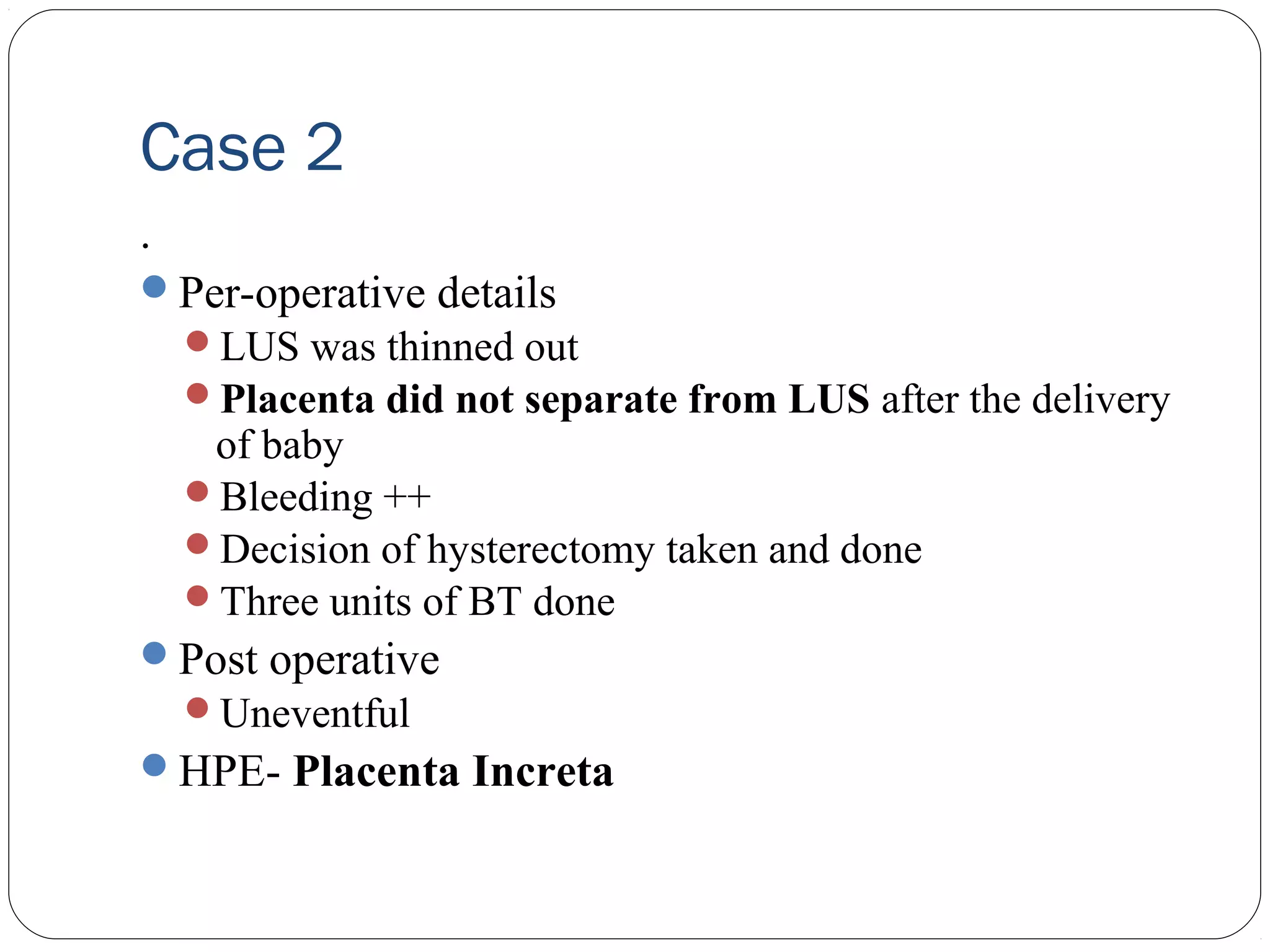
Case 2
.
Per-operative details
LUS was thinned out
Placenta did not separate from LUS after the delivery

of baby
Bleeding ++
Decision of hysterectomy taken and done
Three units of BT done
Post operative
Uneventful

HPE- Placenta Increta
Have we become wiser?
Management of a case where pre-operative diagnosis
was made
Case 3
G2P1L1 with 35 weeks and 5 days was admitted in

antenatal ward in view of placenta previa with
moderate anemia (no H/O bleeding PV)
Obstetric history1st FT LSCS for CPD 2 years back at govt. hospital
USG(8/8/2011)-SLF 29 weeks 4 days ,placenta anterior

low lying covering Os
 Hb-7.1
Case 3
After admission
USG-Placenta anterior extending to LUS, with

extensive placental lakes within. Overlying myometrium
intact with no evidence of placental invasion.
MRI-Myometrium grossly thinned out and placental
interface with myometrium not properly visualized.
Possibility of placenta accreta could not be ruled out
Case 3
Elective LSCS -at 37 weeks
LUS distended with increase vascularity with purple hue

with boggy feeling(?placenta increta)
classical CS
Placenta did not separate
Subtotal hysterectomy done.
Bleeding from stump present.
B/L Internal Iliac Artery Ligation done.
3 units of PRBC given
Case 3
Post operative details
Uneventful

HPE-Placenta Increta.
Others risk factors
Major risk factor -Placenta previa with

history of Caesarean section

previous uterine surgery,
Previous Dilatation and Curettage,
Previous Myomectomy
Asherman Syndrome (Endometrial defects)
Submucous leiomyomata
Advanced maternal age
Multiparity
Tobacco use
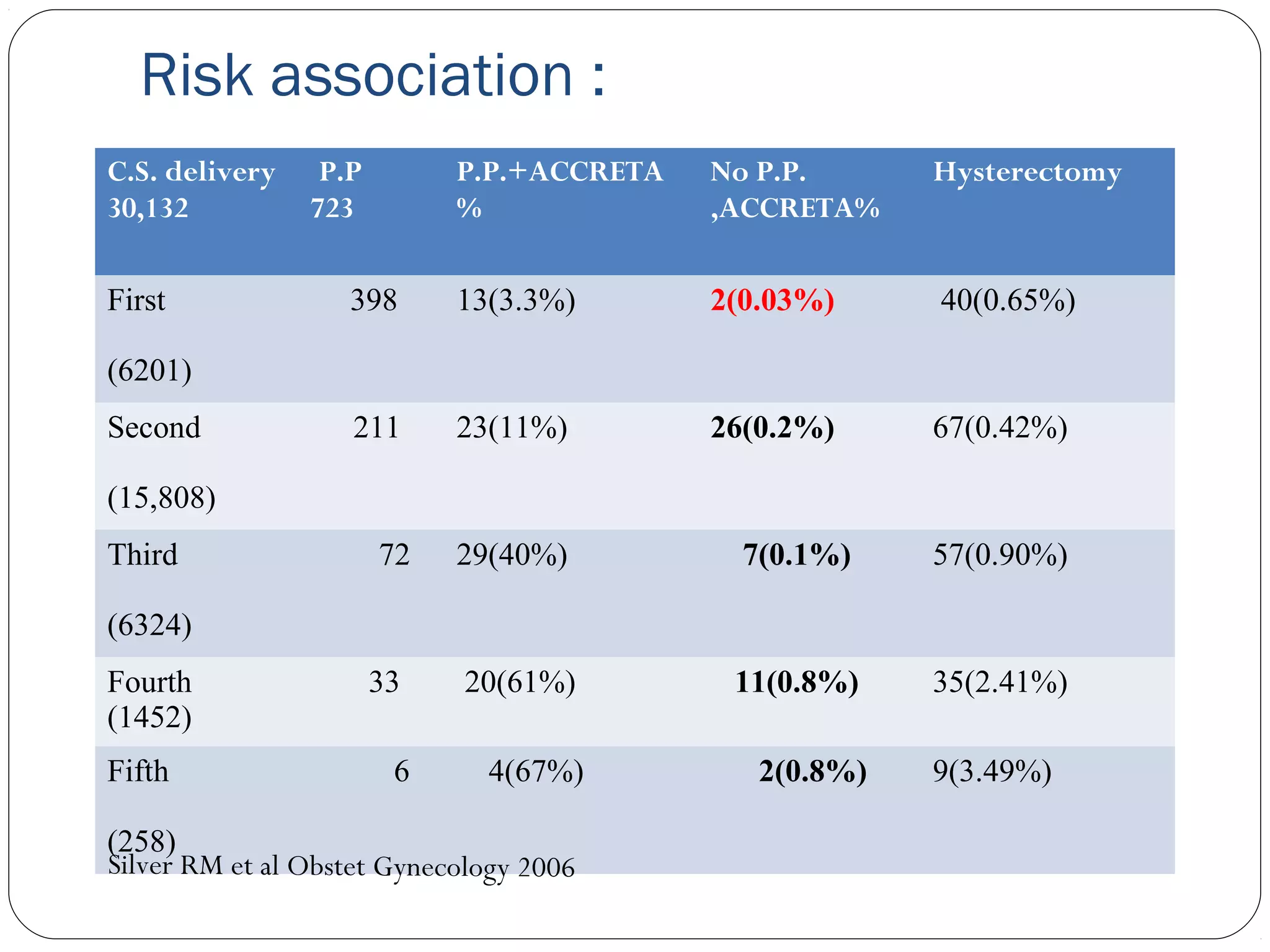
Risk association :
C.S. delivery
30,132
First

P.P
723

P.P.+ACCRETA
%

No P.P.
,ACCRETA%

Hysterectomy

398

13(3.3%)

2(0.03%)

40(0.65%)

211

23(11%)

26(0.2%)

67(0.42%)

72

29(40%)

7(0.1%)

57(0.90%)

33

20(61%)

11(0.8%)

35(2.41%)

6

4(67%)

2(0.8%)

(6201)
Second
(15,808)
Third
(6324)
Fourth
(1452)
Fifth

(258)
Silver RM et al Obstet Gynecology 2006

9(3.49%)
Diagnosis
Clinical suspicion
Ultrasound
Color Doppler
MRI
Biochemical Marker
Histopathology
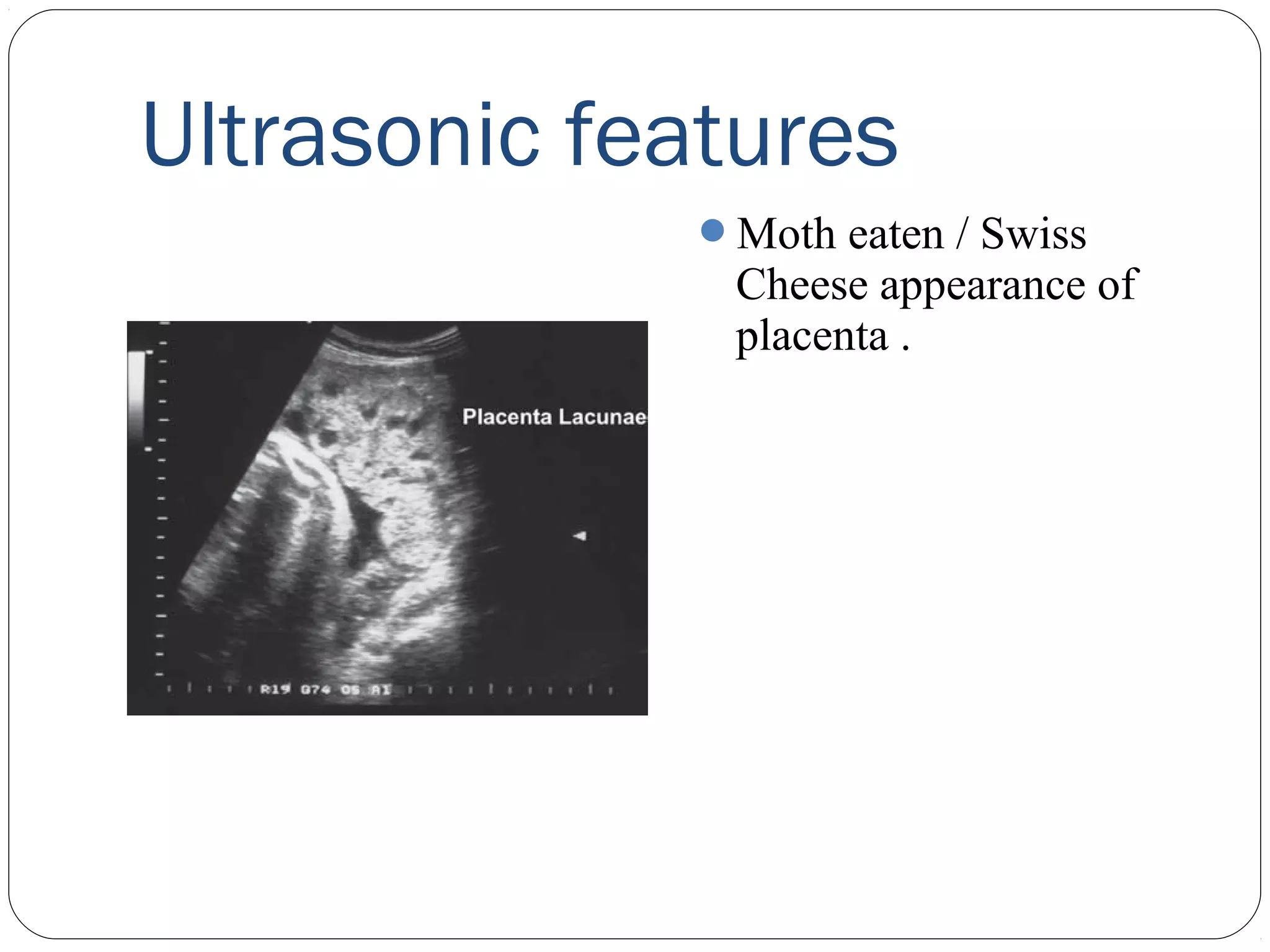
Ultrasonic features
Moth eaten / Swiss

Cheese appearance of
placenta .
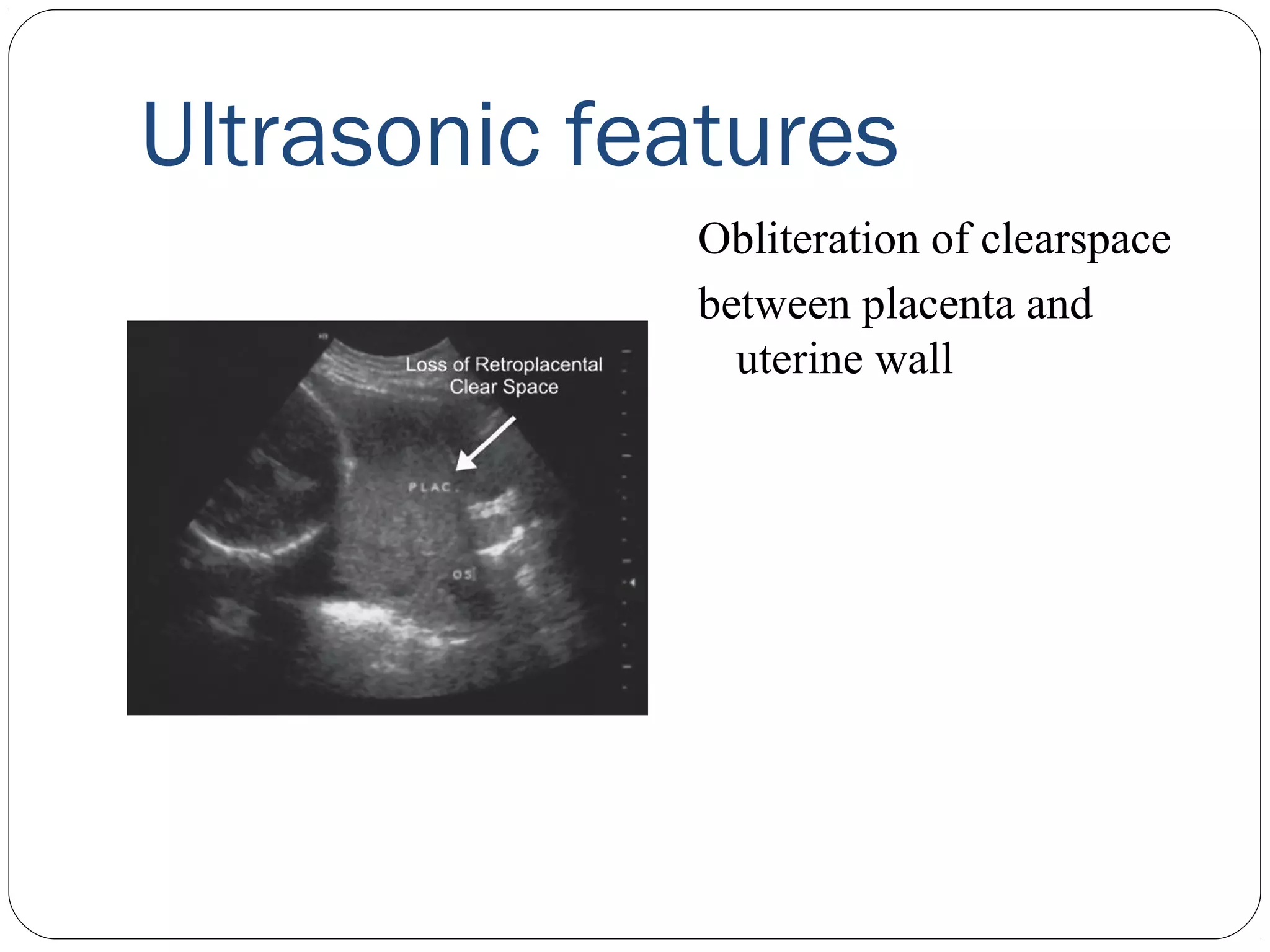
Ultrasonic features
Obliteration of clearspace
between placenta and
uterine wall
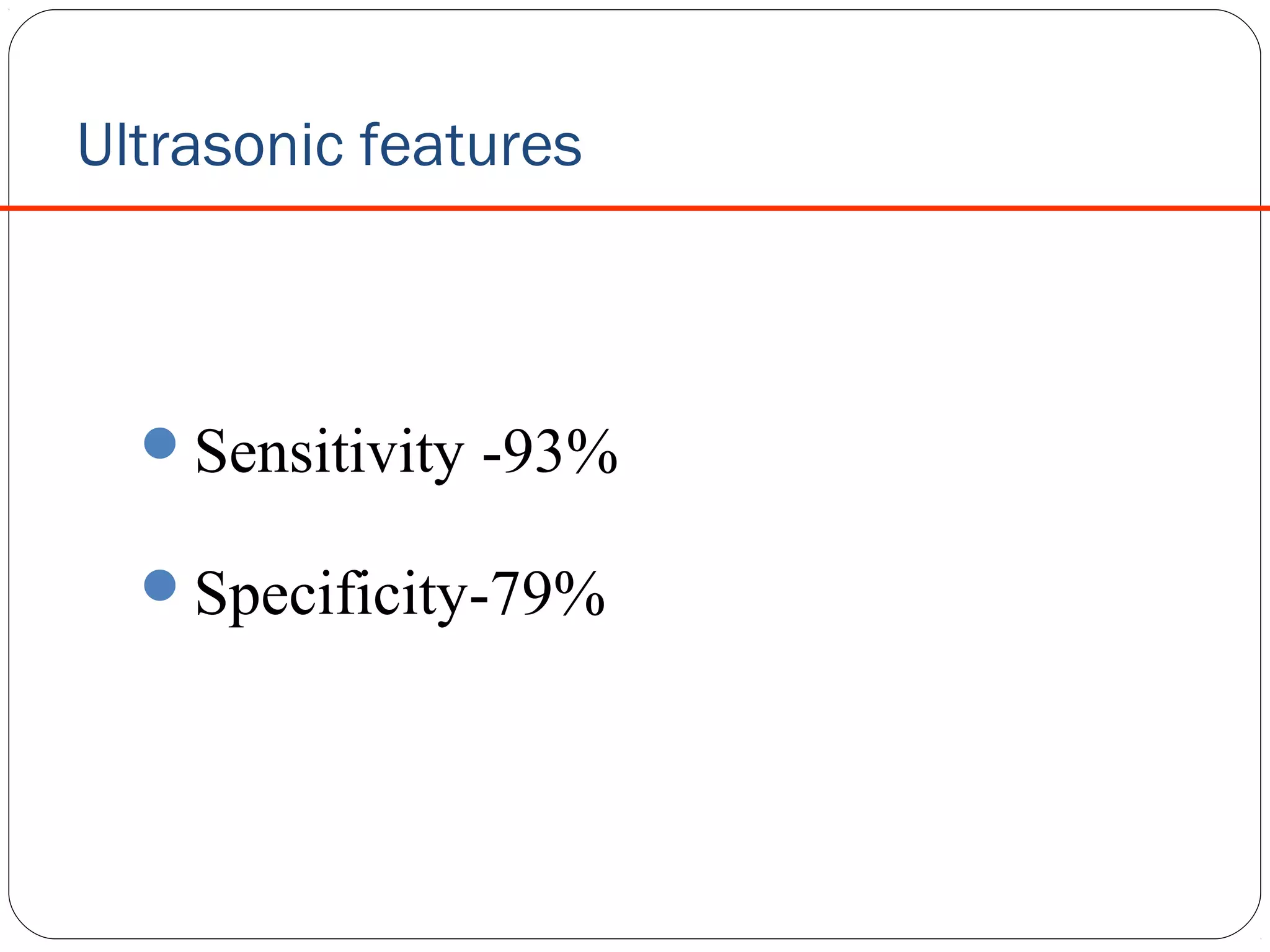
Ultrasonic features

Sensitivity -93%
Specificity-79%
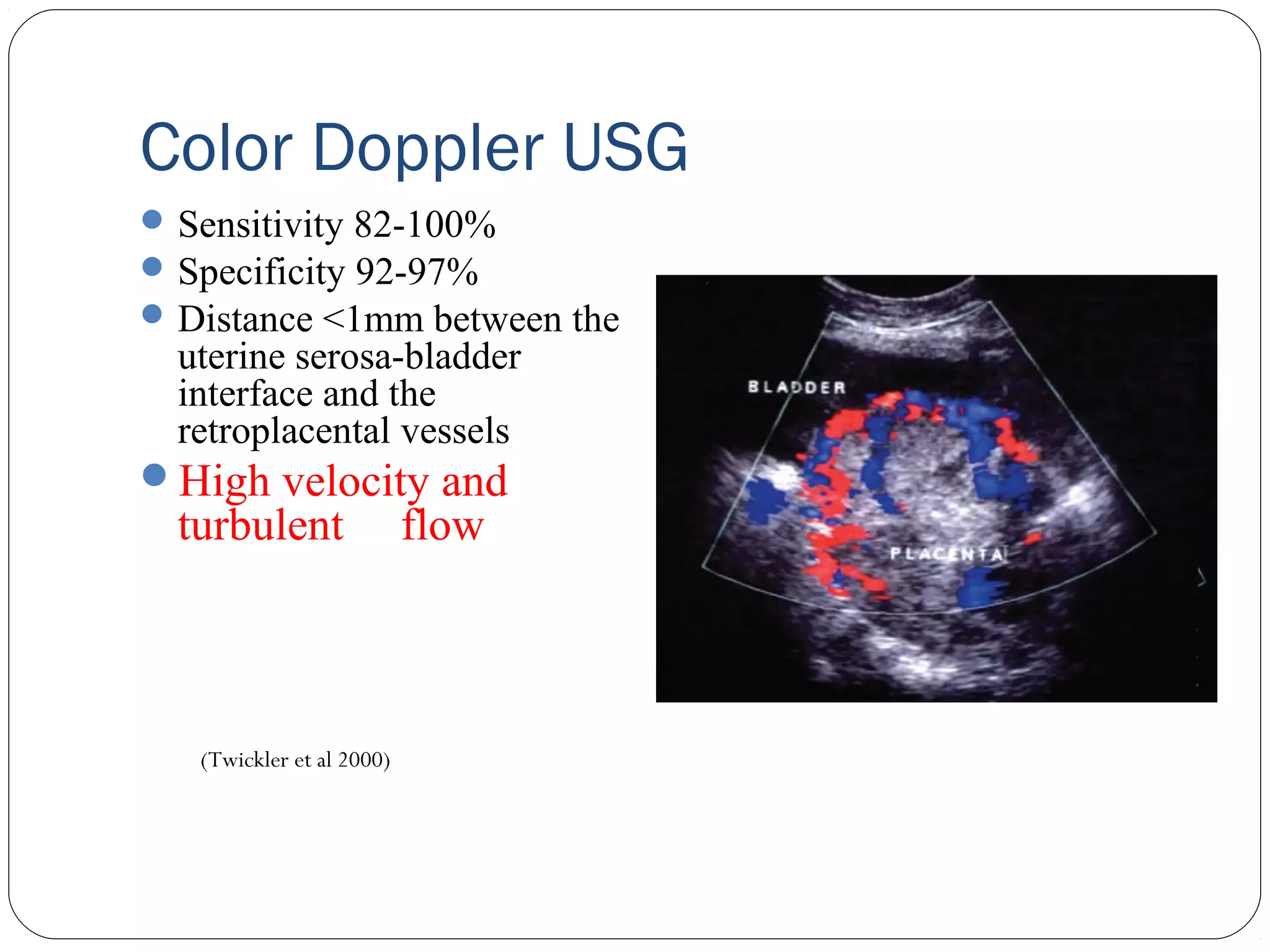
Color Doppler USG
 Sensitivity 82-100%
 Specificity 92-97%
 Distance <1mm between the

uterine serosa-bladder
interface and the
retroplacental vessels
High velocity and

turbulent

(Twickler et al 2000)

flow
MR Imaging
MRI is no more sensitive than USG for diagnosing

placenta accreta*
MRI is used as an adjunct to USG when there is a
strong clinical suspicion of accreta**

(Yinka et al 2006)*(Lax et al 2007)**
Women who have had a previous CS who also have

either placenta praevia or an anterior placenta
underlying the old CS scar at 32 weeks of gestation are
at increased risk of placenta accreta and should be
managed as if they have placenta accreta, with
appropriate preparations for surgery made.
(RCOG 2011)
Management
Elective delivery by caesarean section at 34–35

weeks of gestation for suspected placenta accreta
(AICOG 2012)
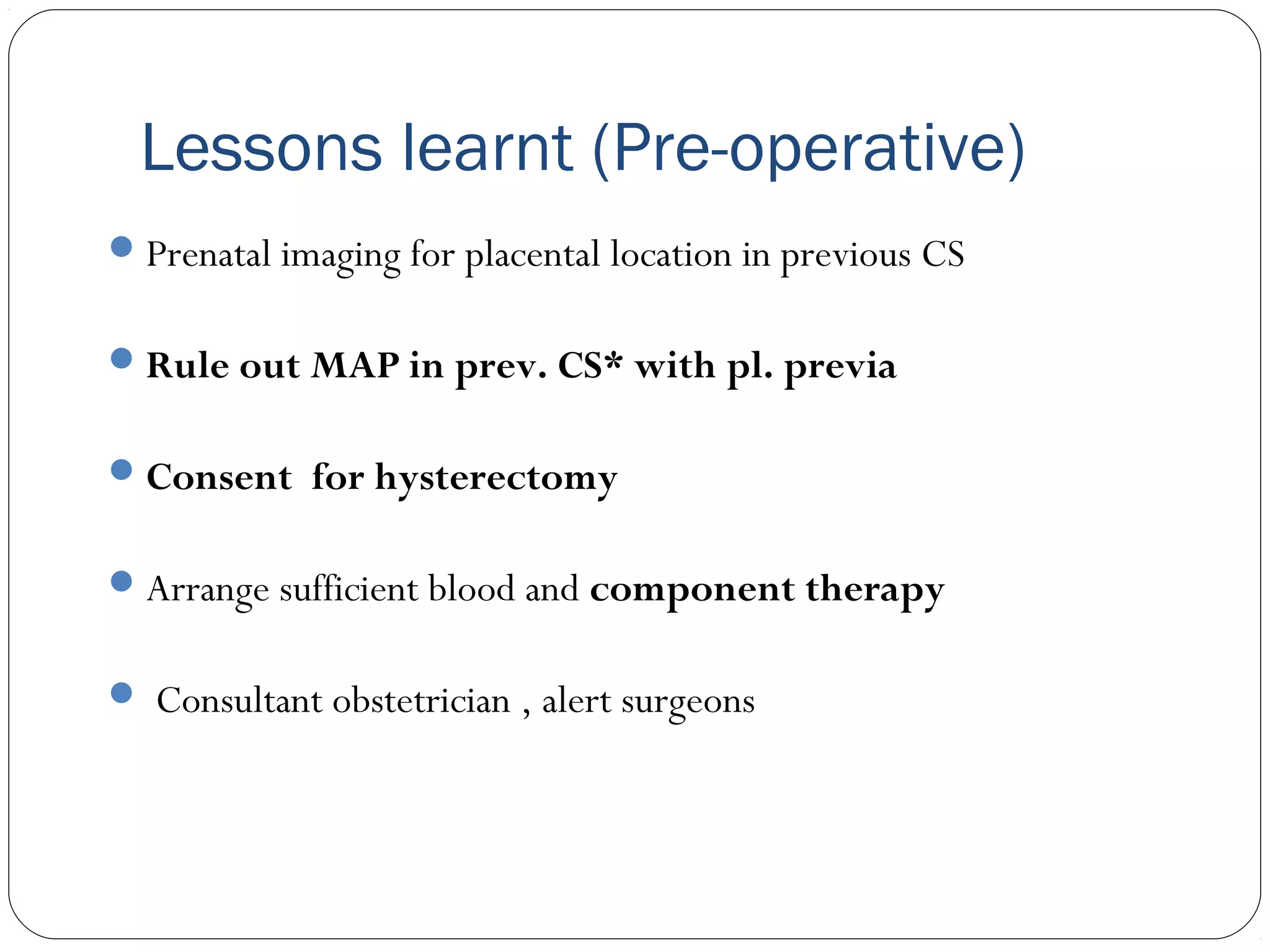
Lessons learnt (Pre-operative)
 Prenatal imaging for placental location in previous CS
 Rule out MAP in prev. CS* with pl. previa
 Consent for hysterectomy
 Arrange sufficient blood and component therapy
 Consultant obstetrician , alert surgeons
 

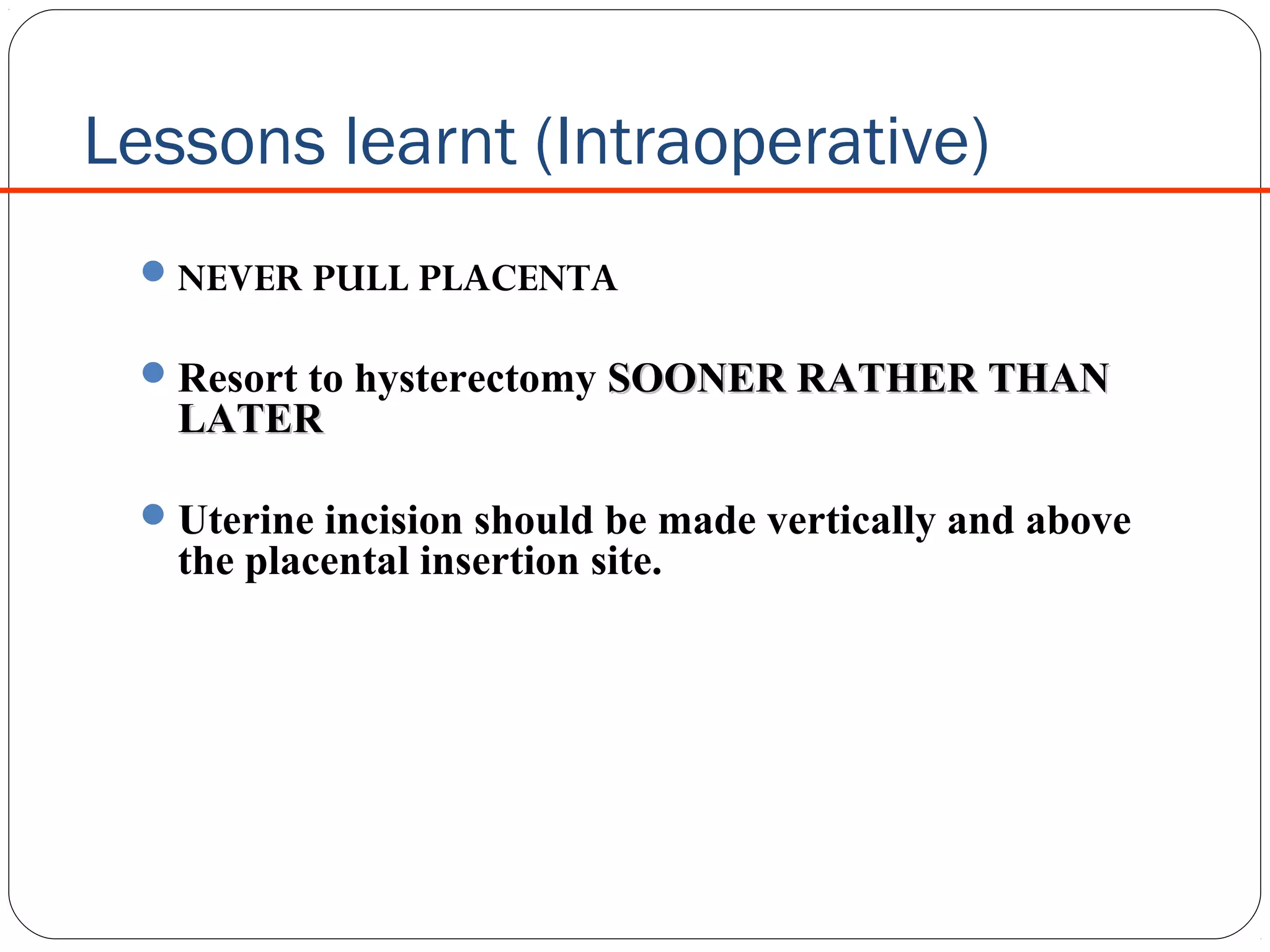
Lessons learnt (Intraoperative)
 NEVER PULL PLACENTA
 Resort to hysterectomy SOONER RATHER THAN

LATER

 Uterine incision should be made vertically and above

the placental insertion site.
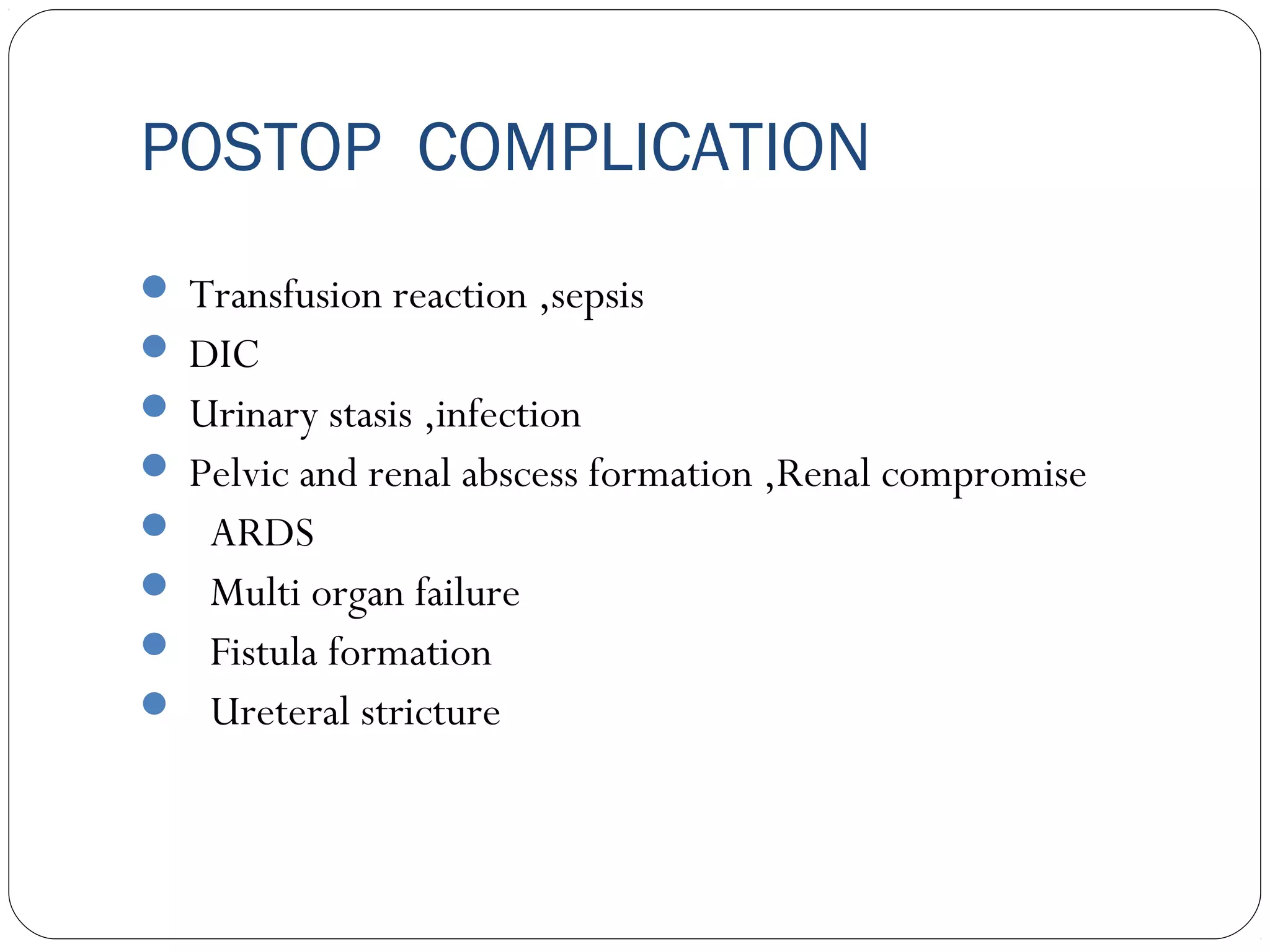
POSTOP COMPLICATION
 Transfusion reaction ,sepsis
 DIC
 Urinary stasis ,infection
 Pelvic and renal abscess formation ,Renal compromise
 ARDS
 Multi organ failure
 Fistula formation
 Ureteral stricture
Uterus preserving modalities
Expectant management
Balloon catheterisation and embolisation of pelvic

vessels
Methotrexate therapy
Uterus preserving surgeries
(Charlotte et al, Arch Gynecol Obstet.2011)*
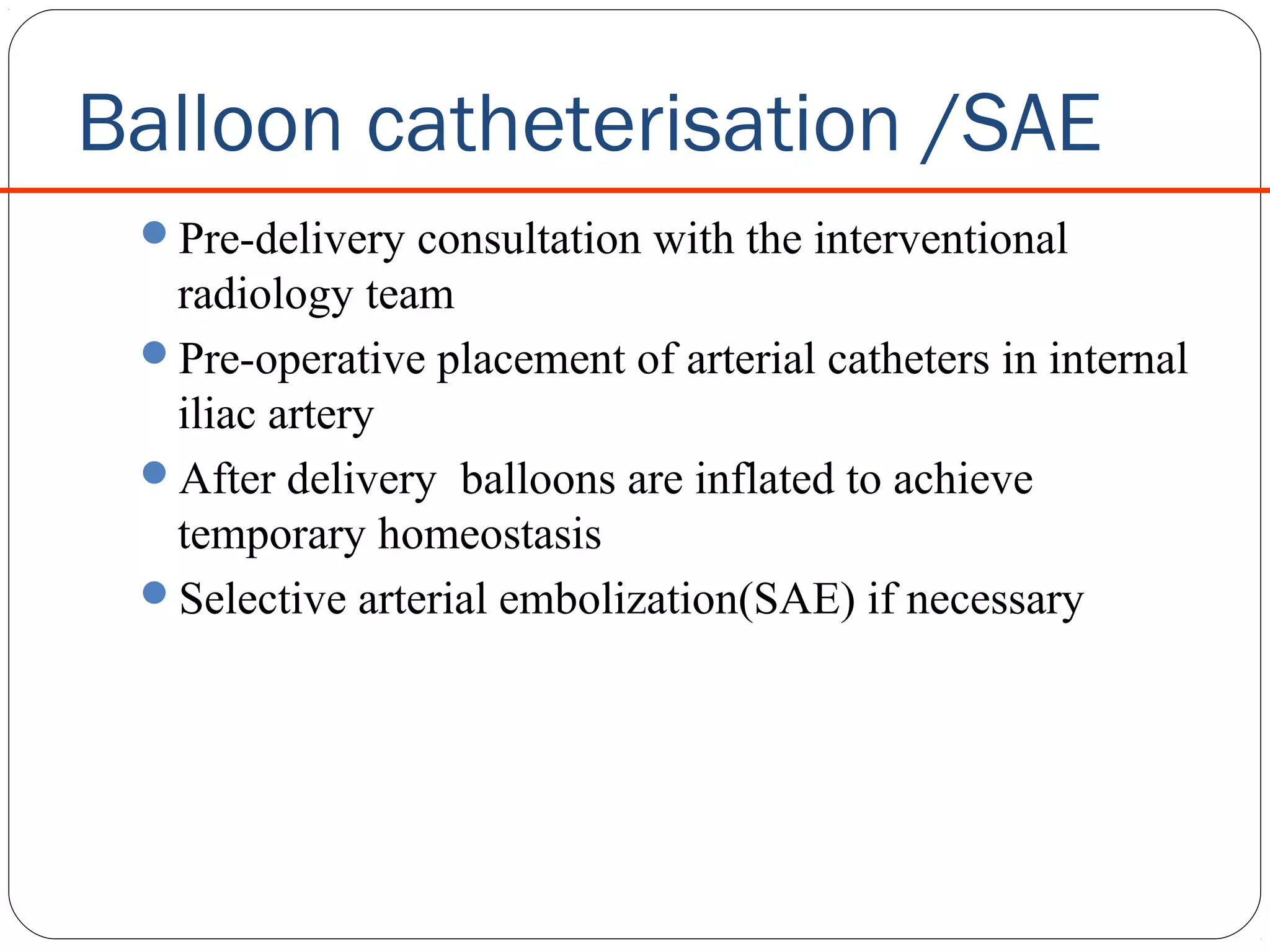
Balloon catheterisation /SAE
Pre-delivery consultation with the interventional

radiology team
Pre-operative placement of arterial catheters in internal
iliac artery
After delivery balloons are inflated to achieve
temporary homeostasis
Selective arterial embolization(SAE) if necessary
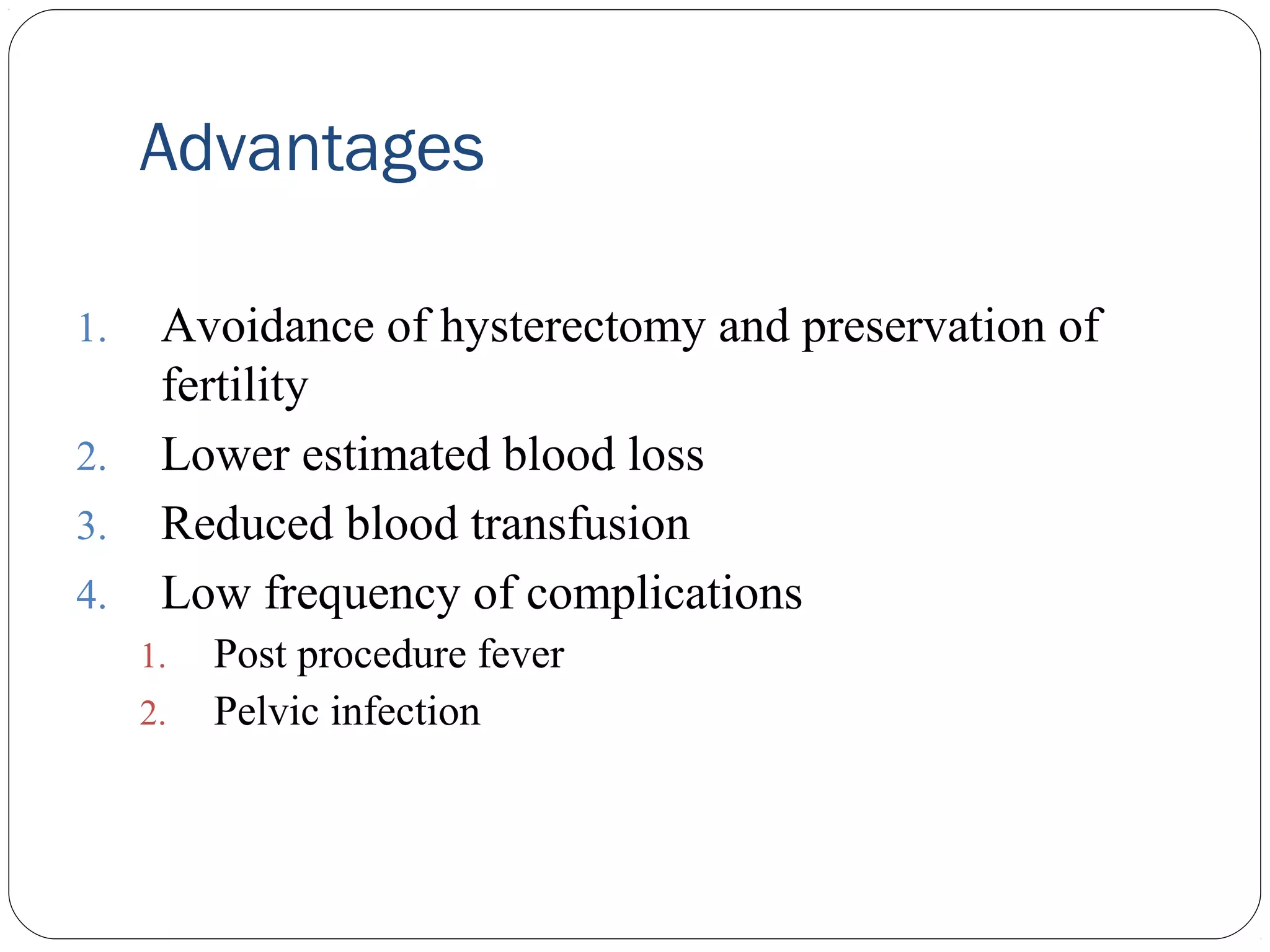
Advantages
1.
2.
3.
4.

Avoidance of hysterectomy and preservation of
fertility
Lower estimated blood loss
Reduced blood transfusion
Low frequency of complications
1.
2.

Post procedure fever
Pelvic infection
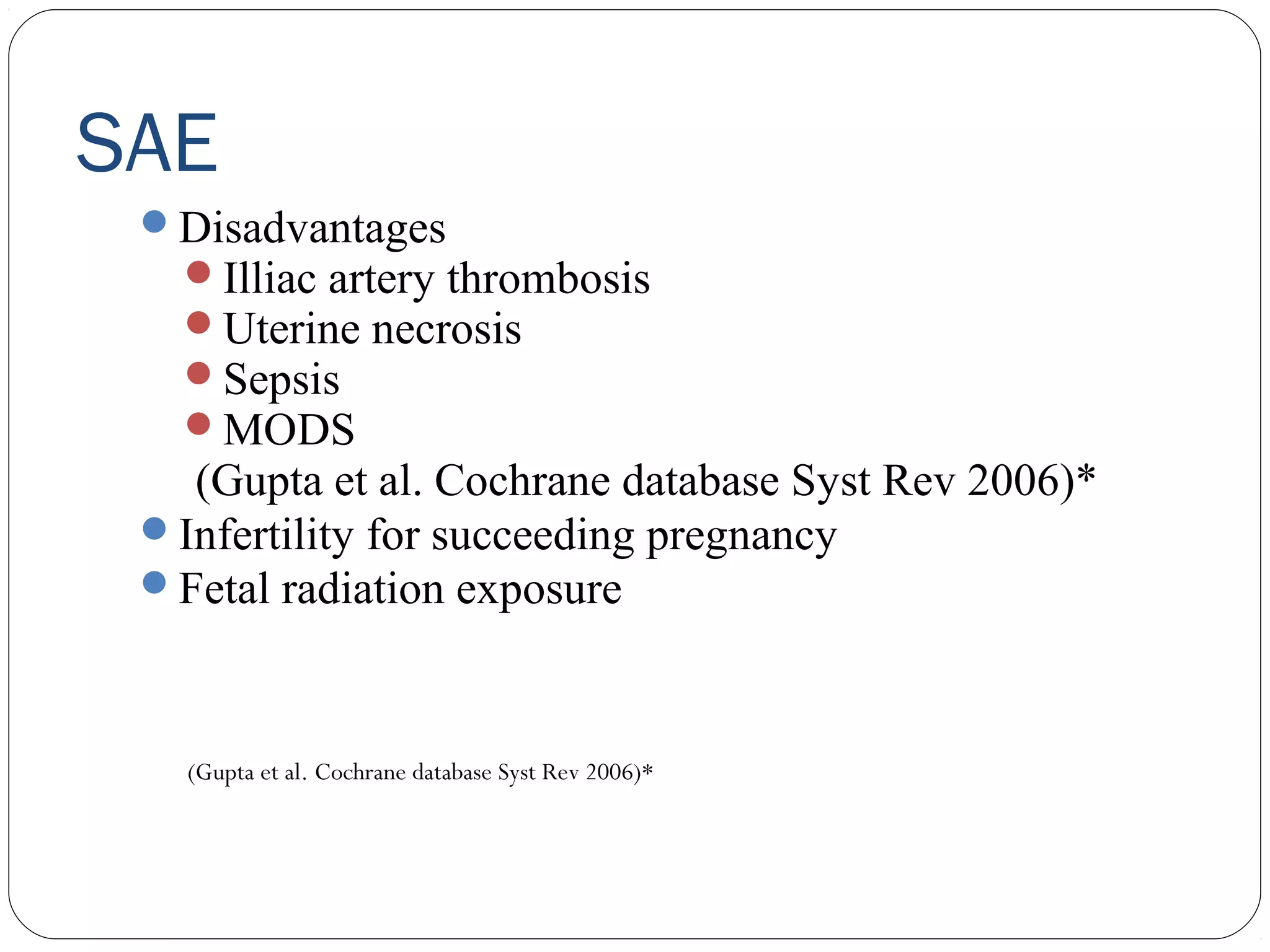
SAE
Disadvantages
Illiac artery thrombosis
Uterine necrosis
Sepsis
MODS

(Gupta et al. Cochrane database Syst Rev 2006)*
Infertility for succeeding pregnancy
Fetal radiation exposure

(Gupta et al. Cochrane database Syst Rev 2006)*
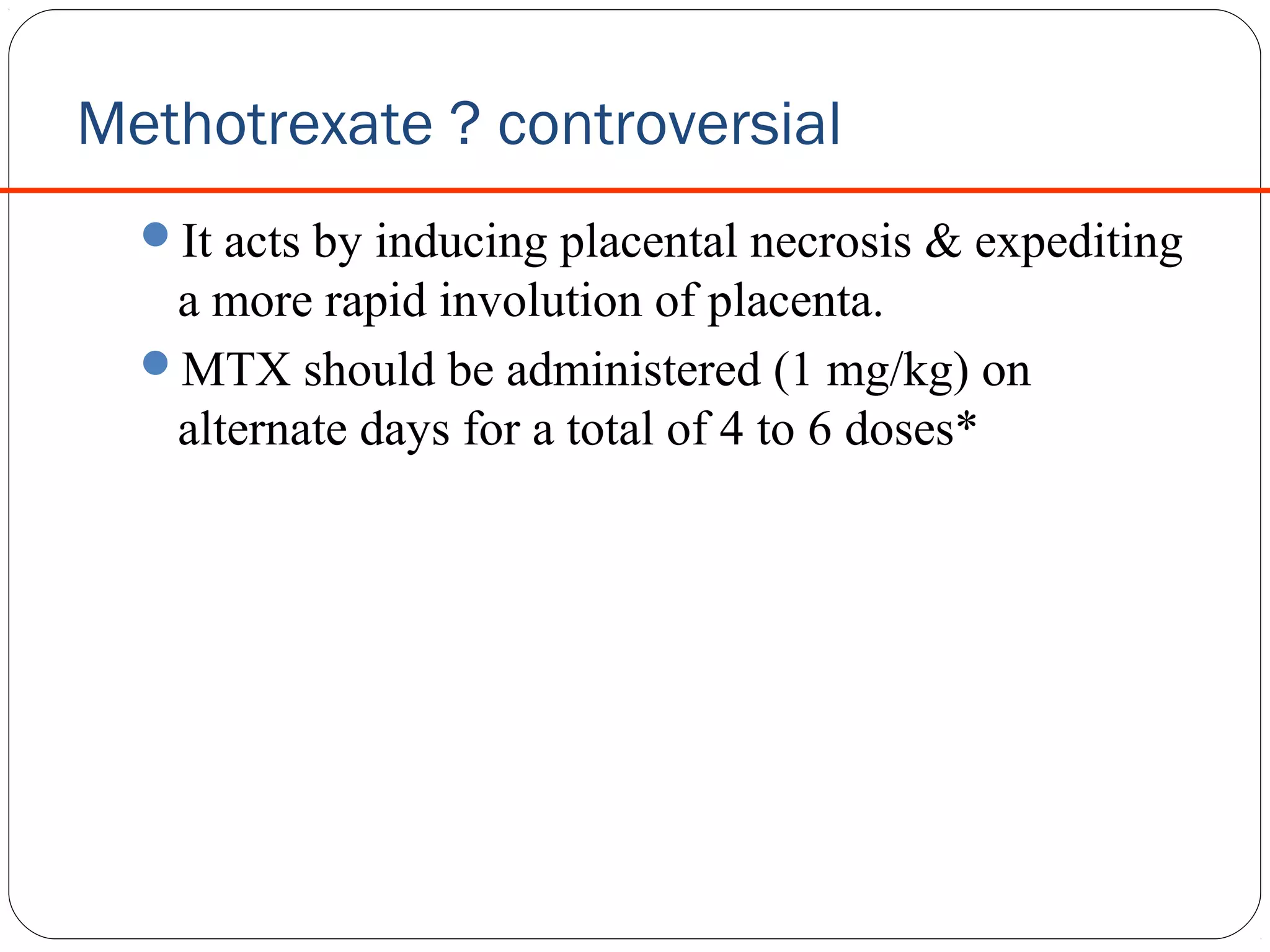
Methotrexate ? controversial
It acts by inducing placental necrosis & expediting

a more rapid involution of placenta.
MTX should be administered (1 mg/kg) on
alternate days for a total of 4 to 6 doses*
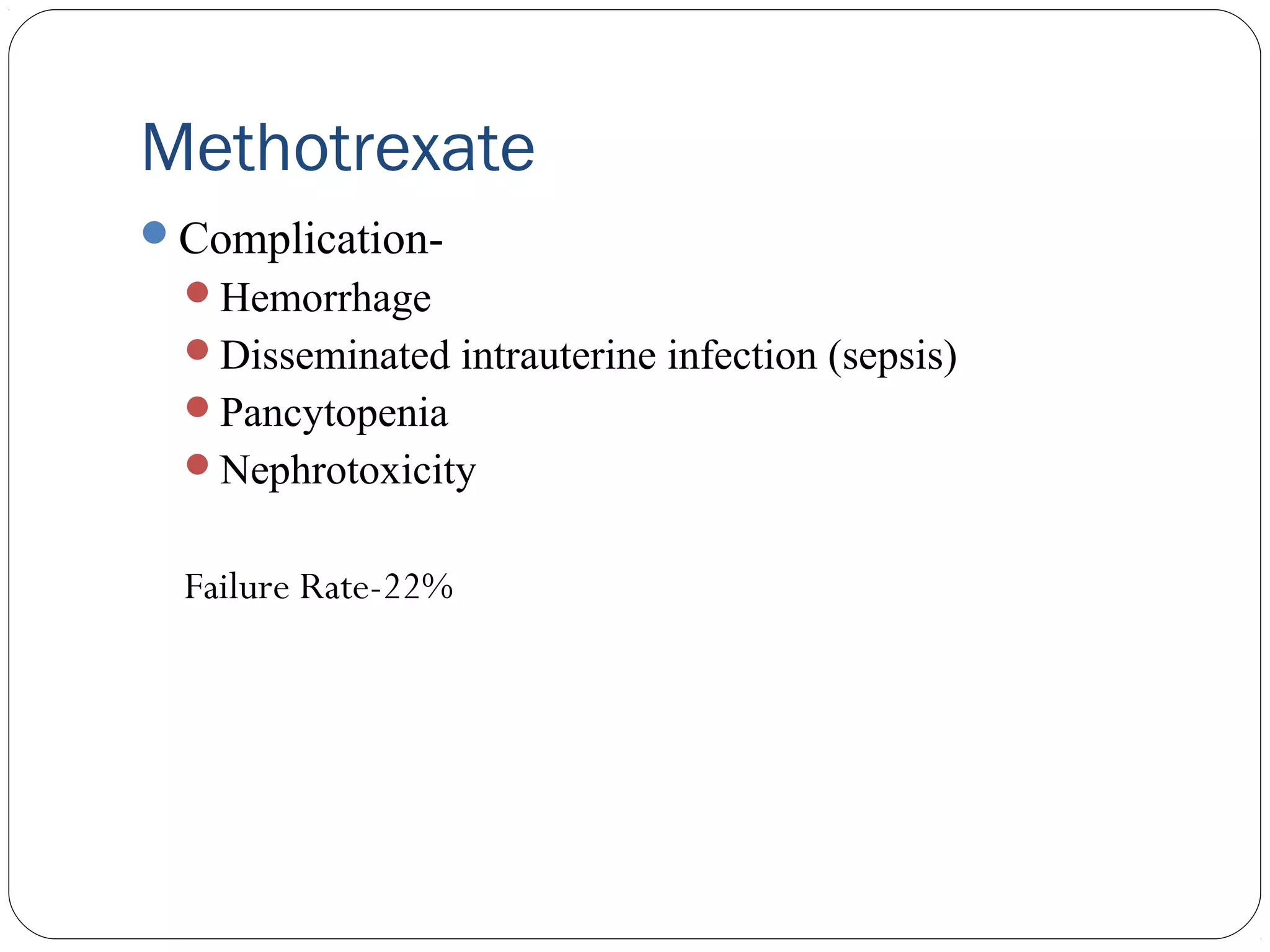
Methotrexate
ComplicationHemorrhage
Disseminated intrauterine infection (sepsis)
Pancytopenia
Nephrotoxicity

Failure Rate-22%
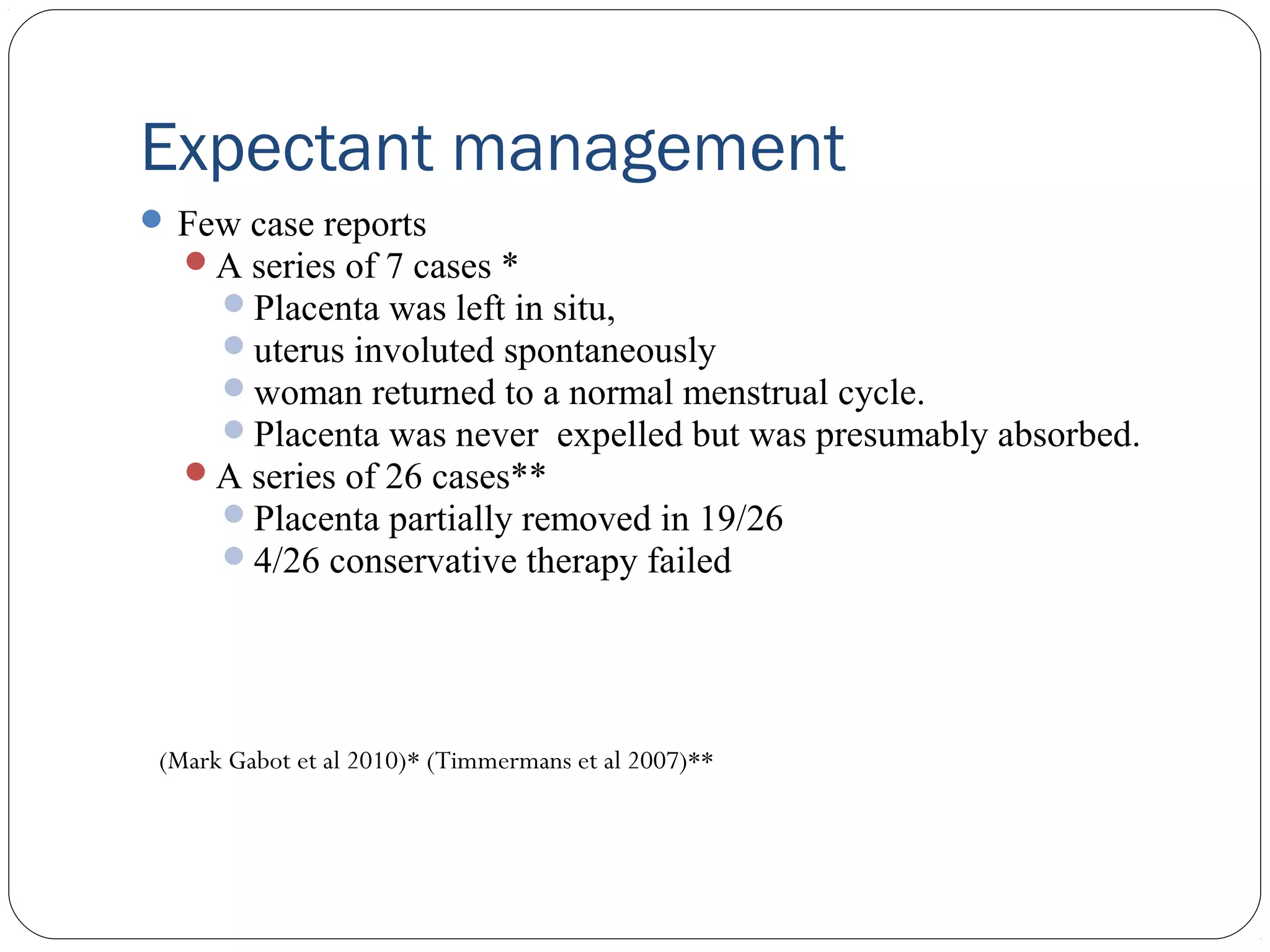
Expectant management
 Few case reports
A series of 7 cases *
Placenta was left in situ,
uterus involuted spontaneously
woman returned to a normal menstrual cycle.
Placenta was never expelled but was presumably absorbed.
A series of 26 cases**
Placenta partially removed in 19/26
4/26 conservative therapy failed

(Mark Gabot et al 2010)* (Timmermans et al 2007)**
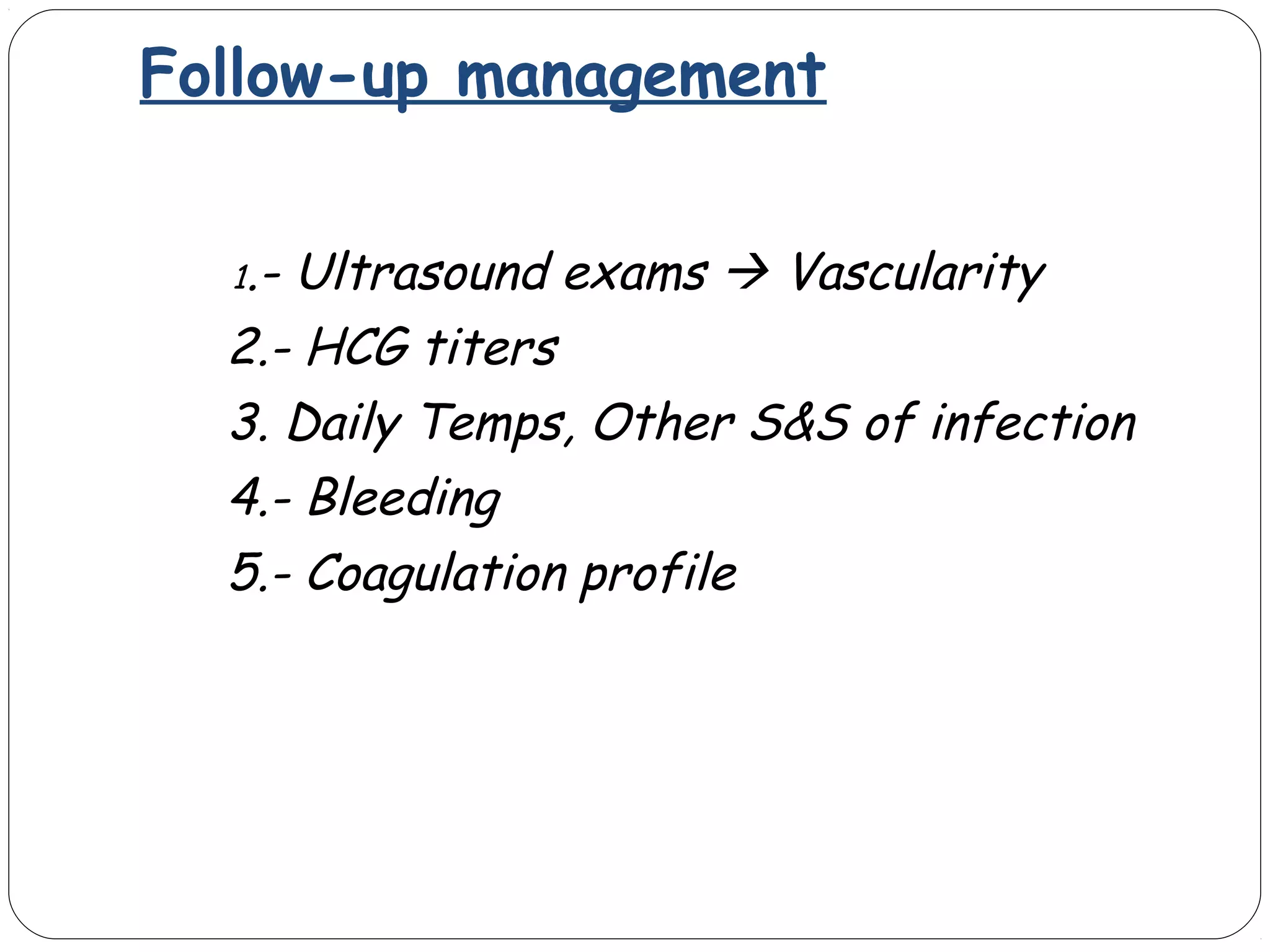
Follow-up management
1.-

Ultrasound exams  Vascularity
2.- HCG titers
3. Daily Temps, Other S&S of infection
4.- Bleeding
5.- Coagulation profile
&
ADDRESS
35 , Defence Enclave, Opp. Preet Vihar Petrol Pump,
Metro pillar no. 88, Vikas Marg , Delhi – 110092
CONTACT US
011-22414049, 42401339
WEBSITE :
www.lifecarecentre.in
www.drshardajain.com
www.lifecareivf.com
E-MAIL ID
Sharda.lifecare@gmail.com
Lifecarecentre21@gmail.com
info@lifecareivf.com

Placenta accreta lessons learnt

  • 1.
    Placenta Accreta-Lessons Learnt DrLeena Wadhwa Associate Professor ESI-PGIMSR,Basaidarapur,Delhi
  • 2.
    Maternal Mortality-Magnitude andCauses About 28 million pregnancies and 67,000 maternal deaths per year in India Other Conditions, 34% Haemorrhage, 38% Source: RGI-SRS 2001-03 Abortion, 8% Obstructed Labour, 5% Sepsis, 11% Hypertensive disorders, 5% * Other Conditions includes Anemia. Source: RGI-SRS 2001-03
  • 3.
    Placenta accreta/ increta/percreta  Significant cause of maternal morbidity and mortality  significant maternal hemorrhage at delivery  Mortality rate -7 -10% (O brien et al AM J Obstet Gynecol 1996)
  • 4.
    Most common reasonfor emergency postpartum hysterectomy. Incidence -increasing(secondarily to the rise of Caesarean section) 1970 1/7000 1985 - 1994 1/ 2,510**  1992 - 20021/ 533 *** **(Miller- Am J Obstet Gynecol 1996 ) ***(Wu et al Am J Obstet Gynecol 2005)
  • 5.
    Case 1 Unbooked, G4P2L2A1,26 weeks, previous LSCS, fever dysuria USG:Placenta antr,covering os Em laprotomy (GA) : hematuria ? Rupture uterus Per-operative details Hemoperitoneum (1 litre+) Posterior wall of bladder found adhered to LUS Bladder lying open (3cm) Clots presents inside the bladder removed. large bleeders present on the posterior bladder wall , clamped & sutured
  • 6.
    Case 1 hysterotomy doneand fetus delivered  fails to recognize percreta going into bladder & anticipate complications tries partial MRP hysterectomy with difficulty by 2 consultantsuncontrollable hgg from bladdercystectomy & B/L Int iliac art ligation 6 units Blood Patient died in ICU
  • 7.
    Case 1 HPE- Placentaltissue invading the full thickness myometrium and the overlying serosa.(placenta percreta)
  • 8.
  • 9.
    Placenta Percreta Catastrophic event Placenta percreta induced uterine rupture as early as 9 &14 wks  75% cases of percreta are assoc with placenta previa  Maternal mortality-20%  Perinatal mortality-30% (Obstet Gynecol 1991)
  • 10.
    What could havebeen done? Anticipation Multidisciplinary team Preoperative cystoscopy and placement of ureteric stents may aid in identification of the ureters. biopsy contraindicated placement of catheters in both int iliac A Hysterectomy by postr approach Involved portion of bladder is resected with hyst specimen
  • 11.
    Case 2: G3P2L2 (Prev 2 LSCS ) at 34 weeks of gestational age was admitted due to bleeding PV for 2 days USG-SLF cephalic ,placenta, anterior low lying covering Os With informed written consent for possibility of hysterectomy (if required)and adequate blood patient was shifted to OT for emergency caesarean section.
  • 12.
    Case 2 . Per-operative details LUSwas thinned out Placenta did not separate from LUS after the delivery of baby Bleeding ++ Decision of hysterectomy taken and done Three units of BT done Post operative Uneventful HPE- Placenta Increta
  • 13.
    Have we becomewiser? Management of a case where pre-operative diagnosis was made
  • 14.
    Case 3 G2P1L1 with35 weeks and 5 days was admitted in antenatal ward in view of placenta previa with moderate anemia (no H/O bleeding PV) Obstetric history1st FT LSCS for CPD 2 years back at govt. hospital USG(8/8/2011)-SLF 29 weeks 4 days ,placenta anterior low lying covering Os  Hb-7.1
  • 15.
    Case 3 After admission USG-Placentaanterior extending to LUS, with extensive placental lakes within. Overlying myometrium intact with no evidence of placental invasion. MRI-Myometrium grossly thinned out and placental interface with myometrium not properly visualized. Possibility of placenta accreta could not be ruled out
  • 16.
    Case 3 Elective LSCS-at 37 weeks LUS distended with increase vascularity with purple hue with boggy feeling(?placenta increta) classical CS Placenta did not separate Subtotal hysterectomy done. Bleeding from stump present. B/L Internal Iliac Artery Ligation done. 3 units of PRBC given
  • 17.
    Case 3 Post operativedetails Uneventful HPE-Placenta Increta.
  • 18.
    Others risk factors Majorrisk factor -Placenta previa with history of Caesarean section previous uterine surgery, Previous Dilatation and Curettage, Previous Myomectomy Asherman Syndrome (Endometrial defects) Submucous leiomyomata Advanced maternal age Multiparity Tobacco use
  • 19.
    Risk association : C.S.delivery 30,132 First P.P 723 P.P.+ACCRETA % No P.P. ,ACCRETA% Hysterectomy 398 13(3.3%) 2(0.03%) 40(0.65%) 211 23(11%) 26(0.2%) 67(0.42%) 72 29(40%) 7(0.1%) 57(0.90%) 33 20(61%) 11(0.8%) 35(2.41%) 6 4(67%) 2(0.8%) (6201) Second (15,808) Third (6324) Fourth (1452) Fifth (258) Silver RM et al Obstet Gynecology 2006 9(3.49%)
  • 21.
  • 22.
    Ultrasonic features Moth eaten/ Swiss Cheese appearance of placenta .
  • 23.
    Ultrasonic features Obliteration ofclearspace between placenta and uterine wall
  • 24.
  • 25.
    Color Doppler USG Sensitivity 82-100%  Specificity 92-97%  Distance <1mm between the uterine serosa-bladder interface and the retroplacental vessels High velocity and turbulent (Twickler et al 2000) flow
  • 26.
    MR Imaging MRI isno more sensitive than USG for diagnosing placenta accreta* MRI is used as an adjunct to USG when there is a strong clinical suspicion of accreta** (Yinka et al 2006)*(Lax et al 2007)**
  • 27.
    Women who havehad a previous CS who also have either placenta praevia or an anterior placenta underlying the old CS scar at 32 weeks of gestation are at increased risk of placenta accreta and should be managed as if they have placenta accreta, with appropriate preparations for surgery made. (RCOG 2011)
  • 28.
    Management Elective delivery bycaesarean section at 34–35 weeks of gestation for suspected placenta accreta (AICOG 2012)
  • 29.
    Lessons learnt (Pre-operative) Prenatal imaging for placental location in previous CS  Rule out MAP in prev. CS* with pl. previa  Consent for hysterectomy  Arrange sufficient blood and component therapy  Consultant obstetrician , alert surgeons
  • 30.
      Lessons learnt (Intraoperative) NEVER PULL PLACENTA  Resort to hysterectomy SOONER RATHER THAN LATER  Uterine incision should be made vertically and above the placental insertion site.
  • 31.
    POSTOP COMPLICATION  Transfusionreaction ,sepsis  DIC  Urinary stasis ,infection  Pelvic and renal abscess formation ,Renal compromise  ARDS  Multi organ failure  Fistula formation  Ureteral stricture
  • 32.
  • 33.
    Expectant management Balloon catheterisationand embolisation of pelvic vessels Methotrexate therapy Uterus preserving surgeries (Charlotte et al, Arch Gynecol Obstet.2011)*
  • 34.
    Balloon catheterisation /SAE Pre-deliveryconsultation with the interventional radiology team Pre-operative placement of arterial catheters in internal iliac artery After delivery balloons are inflated to achieve temporary homeostasis Selective arterial embolization(SAE) if necessary
  • 35.
    Advantages 1. 2. 3. 4. Avoidance of hysterectomyand preservation of fertility Lower estimated blood loss Reduced blood transfusion Low frequency of complications 1. 2. Post procedure fever Pelvic infection
  • 36.
    SAE Disadvantages Illiac artery thrombosis Uterinenecrosis Sepsis MODS (Gupta et al. Cochrane database Syst Rev 2006)* Infertility for succeeding pregnancy Fetal radiation exposure (Gupta et al. Cochrane database Syst Rev 2006)*
  • 37.
    Methotrexate ? controversial Itacts by inducing placental necrosis & expediting a more rapid involution of placenta. MTX should be administered (1 mg/kg) on alternate days for a total of 4 to 6 doses*
  • 38.
    Methotrexate ComplicationHemorrhage Disseminated intrauterine infection(sepsis) Pancytopenia Nephrotoxicity Failure Rate-22%
  • 39.
    Expectant management  Fewcase reports A series of 7 cases * Placenta was left in situ, uterus involuted spontaneously woman returned to a normal menstrual cycle. Placenta was never expelled but was presumably absorbed. A series of 26 cases** Placenta partially removed in 19/26 4/26 conservative therapy failed (Mark Gabot et al 2010)* (Timmermans et al 2007)**
  • 40.
    Follow-up management 1.- Ultrasound exams Vascularity 2.- HCG titers 3. Daily Temps, Other S&S of infection 4.- Bleeding 5.- Coagulation profile
  • 41.
    & ADDRESS 35 , DefenceEnclave, Opp. Preet Vihar Petrol Pump, Metro pillar no. 88, Vikas Marg , Delhi – 110092 CONTACT US 011-22414049, 42401339 WEBSITE : www.lifecarecentre.in www.drshardajain.com www.lifecareivf.com E-MAIL ID Sharda.lifecare@gmail.com Lifecarecentre21@gmail.com info@lifecareivf.com

Editor's Notes

  • #2 {"3":"Normally the placenta adhere to decidua basalis layer, allowing for a smooth separation of the placenta from the uterus after delivery\nIn patients with abnormal placentation, placenta is firmly bound to the defective decidua basalis layer or even to the myometrium, the condition is called as placenta accreta.\nVarying degrees of placenta accreta are*\nPlacenta accreta vera (placenta adheres to myometrium)\nPlacenta increta ( placenta invades the myometrium)\nPlacenta percreta (placenta invades through the myometrium to the uterine serosa and may include invasion into other pelvic organs)\n","20":"23 yr,G3P2 ,previous cesearean,shock with acute pain abdomen.no USG, em laprotomy,blood loss-2 lts,HPE-placenta percreta\n"}