Acting on PhD student feedback
to create new learning resources


Angela Newton
Dan Pullinger
In today’s workshop

• First steps in PhD teaching • New 2011/12 PhD workshops
  – Student feedback           – What we created
• Over to you                  – Student feedback
  – Group work                 – Future activities
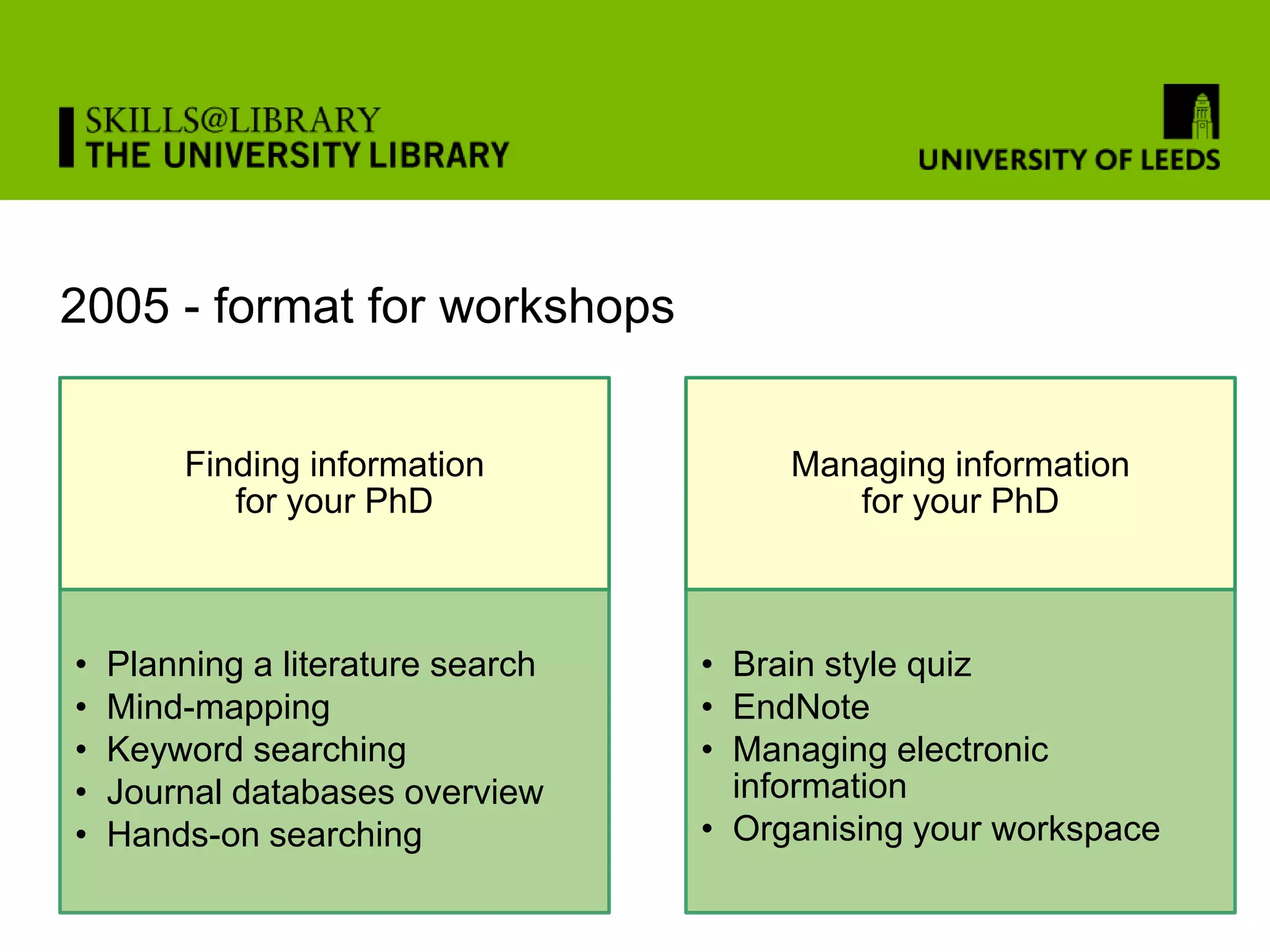
2005 - format for workshops


        Finding information             Managing information
           for your PhD                    for your PhD


•   Planning a literature search   • Brain style quiz
•   Mind-mapping                   • EndNote
•   Keyword searching              • Managing electronic
•   Journal databases overview       information
•   Hands-on searching             • Organising your workspace
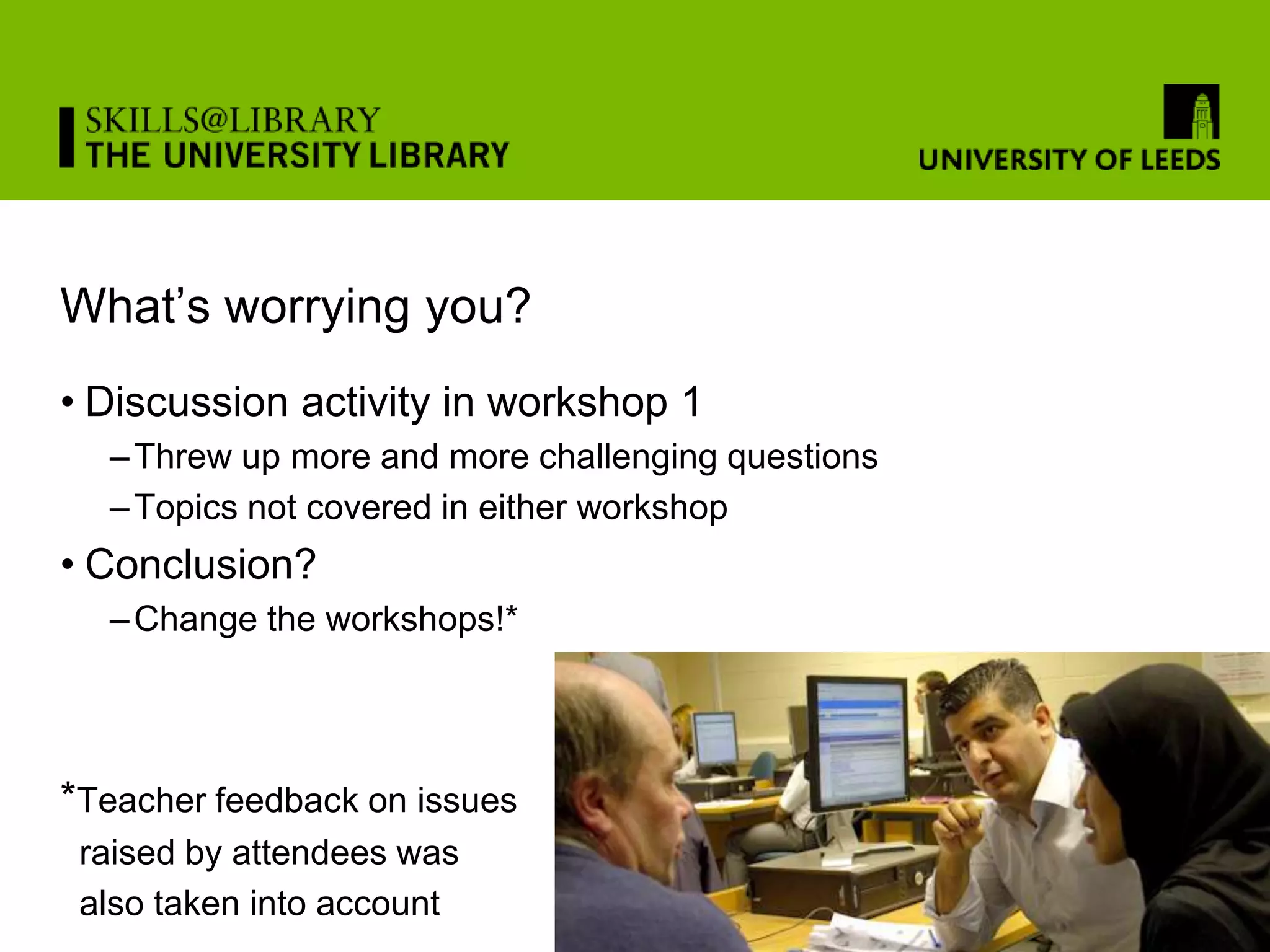
What’s worrying you?
• Discussion activity in workshop 1
  – Threw up more and more challenging questions
  – Topics not covered in either workshop
• Conclusion?
  – Change the workshops!*


*Teacher feedback on issues
 raised by attendees was
 also taken into account
Over to you
• How would you respond to these student ‘worries’?
• In your group, devise a learning activity that addresses the
  problems
• Use the resources on your table to show & describe how it
  would work

                                       • You have 15 minutes!
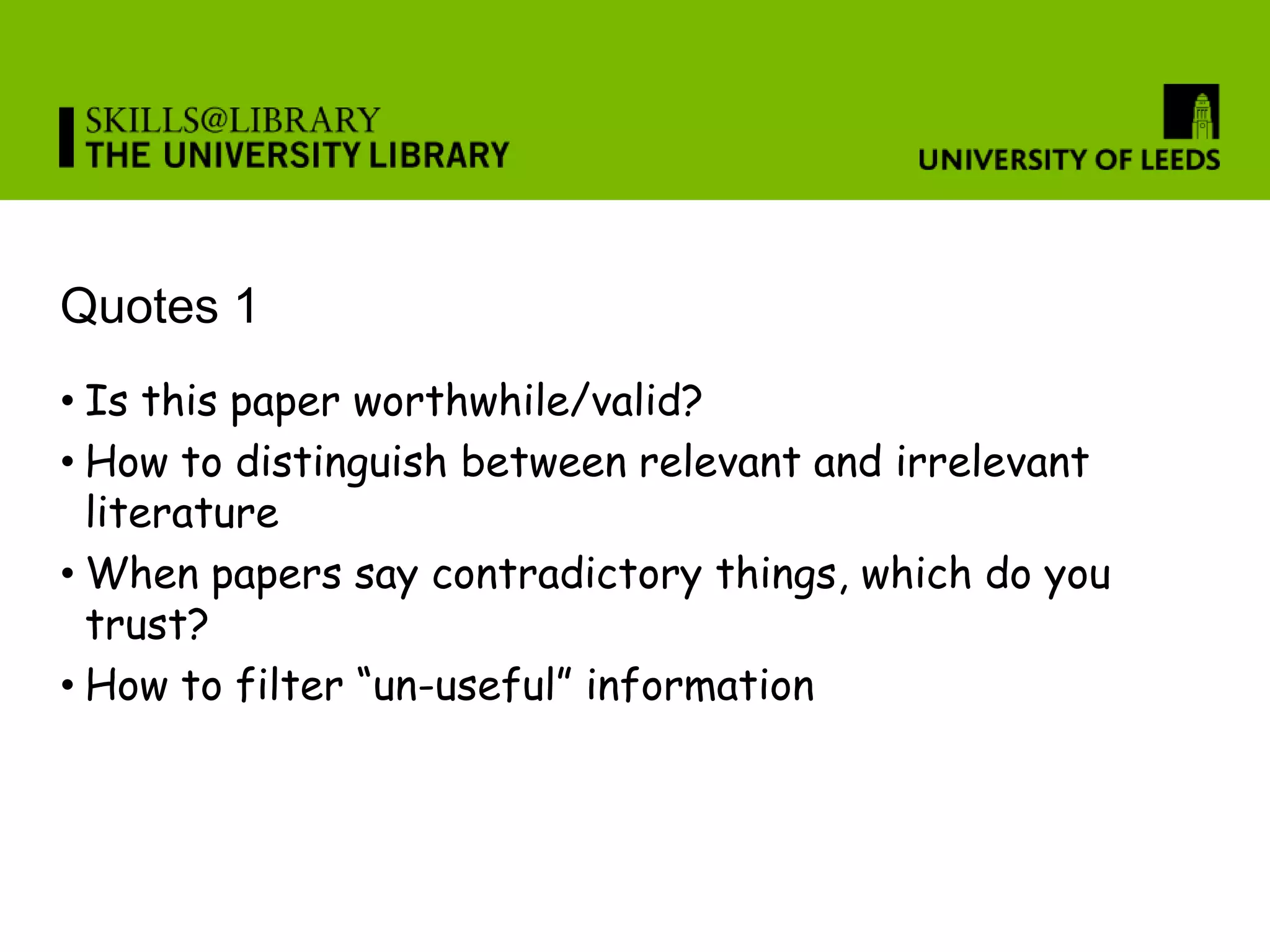
Quotes 1
• Is this paper worthwhile/valid?
• How to distinguish between relevant and irrelevant
  literature
• When papers say contradictory things, which do you
  trust?
• How to filter “un-useful” information
Quotes 2
• How do I get full-text scientific papers online?
• I often worry there's crucial papers out there I don't
  know are there...
• How do I know when to stop looking for information?
• Uni doesn’t have subscriptions to useful papers/journals
  – I don’t want to pay too much
• [How do I find] unpublished and ongoing work?
• Some papers can’t be accessed online
Quotes 3
• How to make selections of what is important in a vast
  number of research sources?
• Which of the articles is most important?
• How can I know this work is significant?
• How do you find/know papers that are the most
  cited/respected, i.e. people who really know their stuff
• How to check the “top rating” research in certain areas?
• Credibility of authors?
• What order should I read the literature in?
Quotes 4
• How do I extract the important information [from a
  paper]?
• Organised reading – by theme / topic?
• I get distracted & find “irrelevant information” interesting
  too
• How to distinguish what is essential to read from what is
  not
• Choosing the most relevant papers to read
• Reading methods – don’t want to read all papers from
  beginning to end
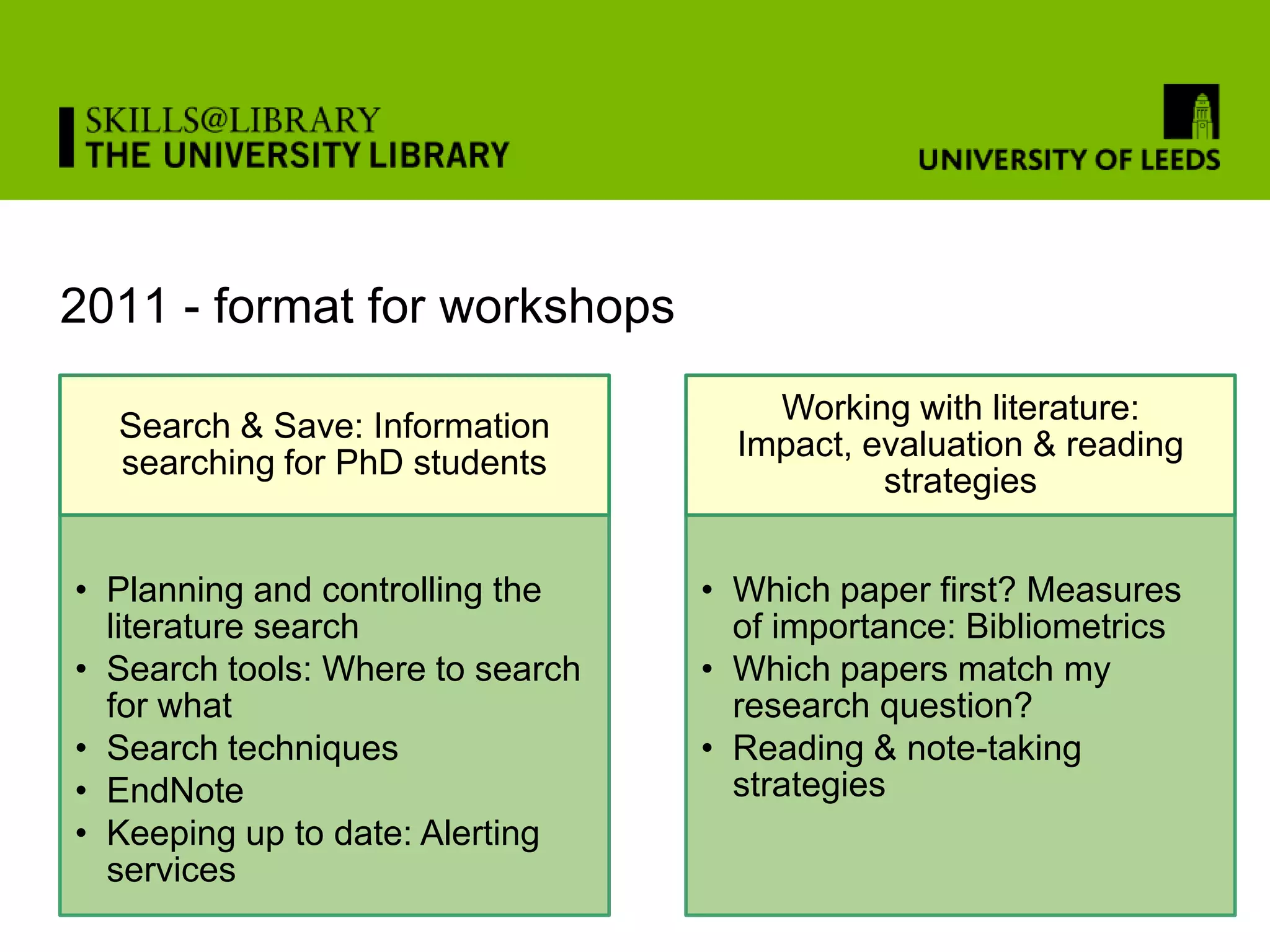
2011 - format for workshops
                                      Working with literature:
  Search & Save: Information
                                    Impact, evaluation & reading
  searching for PhD students
                                             strategies


• Planning and controlling the    • Which paper first? Measures
  literature search                 of importance: Bibliometrics
• Search tools: Where to search   • Which papers match my
  for what                          research question?
• Search techniques               • Reading & note-taking
• EndNote                           strategies
• Keeping up to date: Alerting
  services
How we responded to the feedback
• New activities integrating academic skills
  – Critical analysis
  – Research information landscape
  – Bibliometrics
  – Reading and note-taking strategies
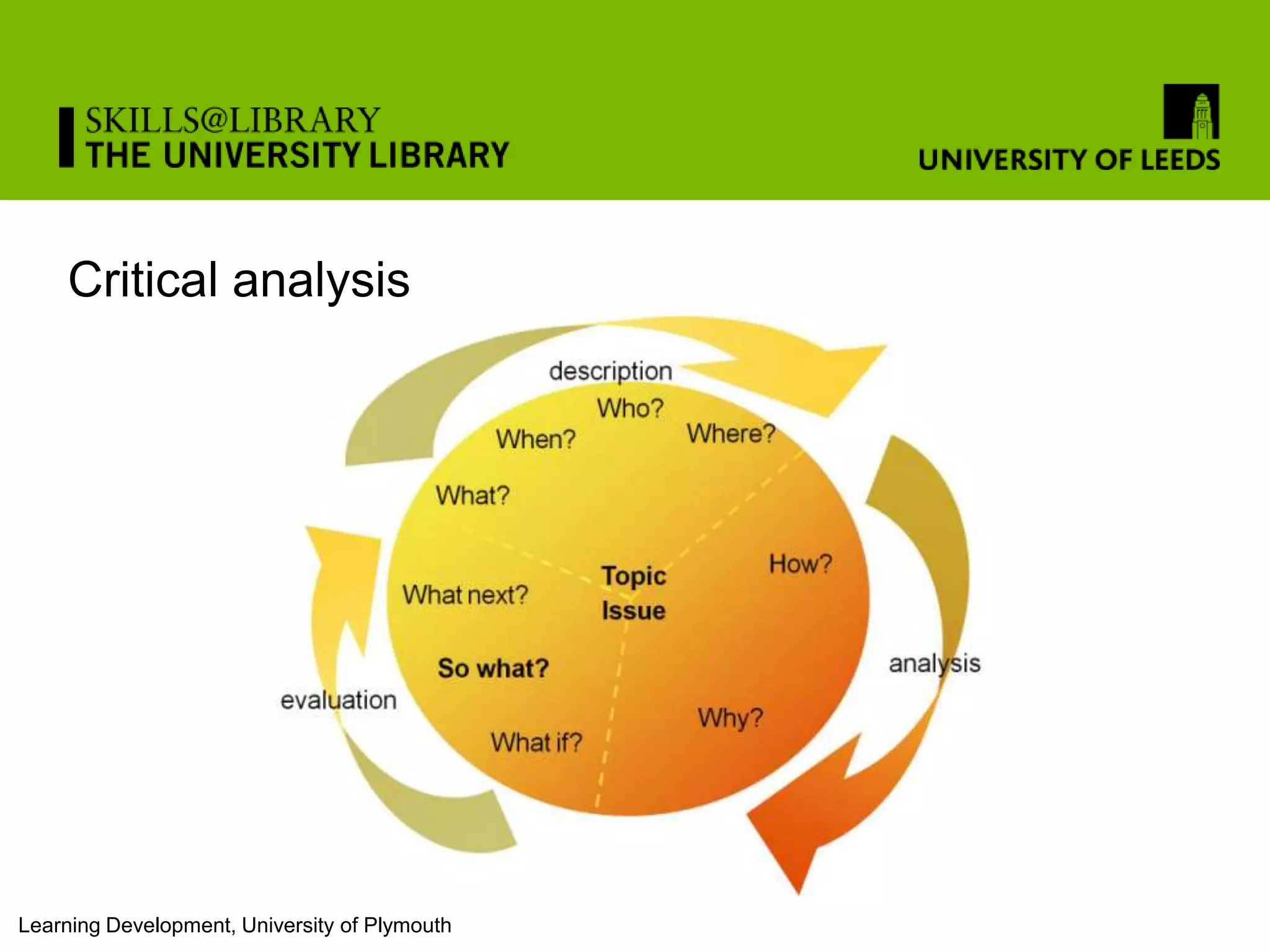
Critical analysis


Learning Development, University of Plymouth
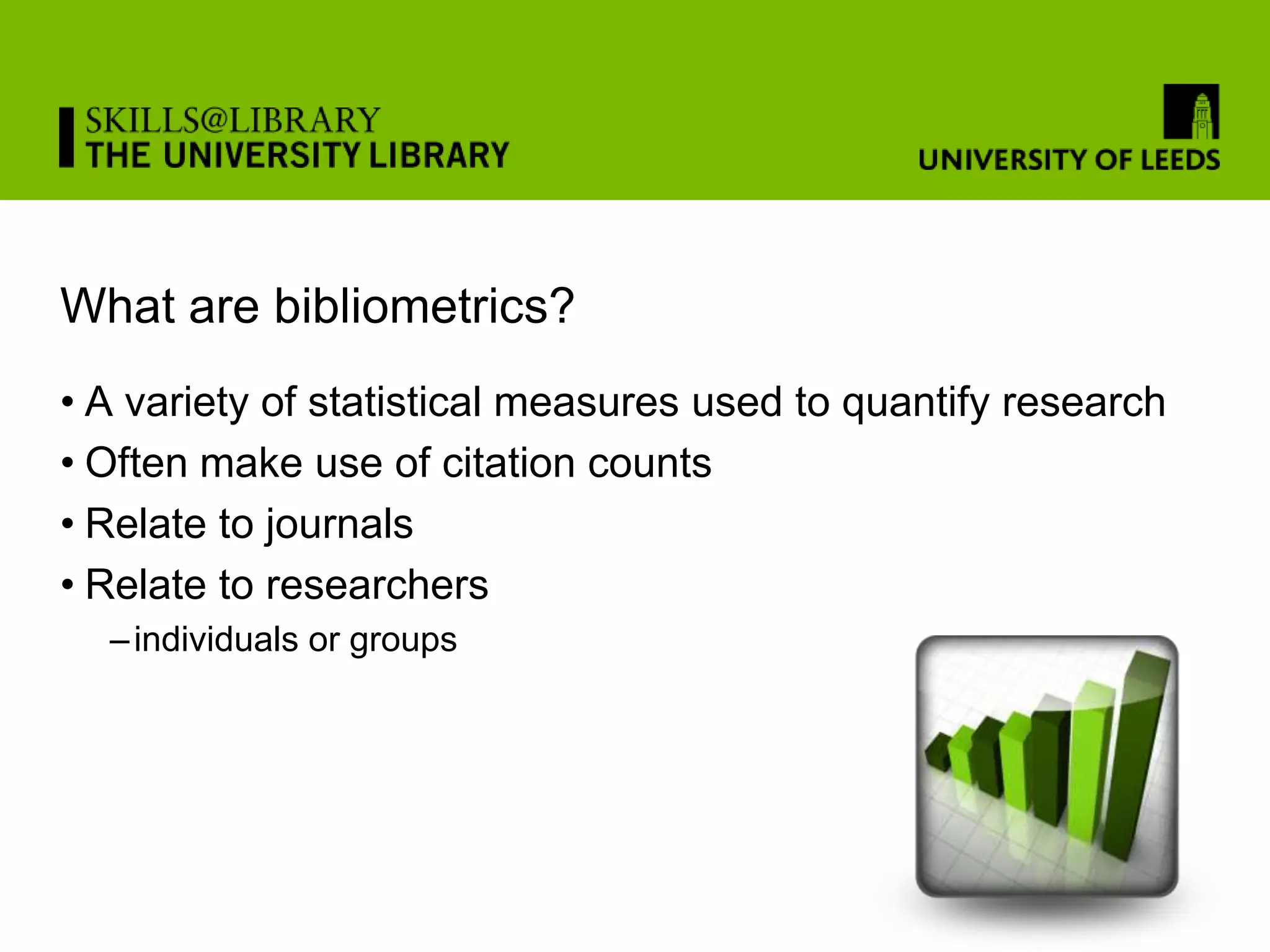
What are bibliometrics?
• A variety of statistical measures used to quantify research
• Often make use of citation counts
• Relate to journals
• Relate to researchers
  – individuals or groups
Which authors are the most important/influential?
  • How it works: h-index, or Hirsch index
     – A scholar with an index of h has published h papers, each of
       which has been cited by others at least h times.
  • You have a go:
     – Search for the h-index for the lead authors of the articles you
       have found
     – What do you think is a ‘good’ h-index score?
     – Will the h-index be a useful tool for your research?
     – What are the pros and cons of the h-index?
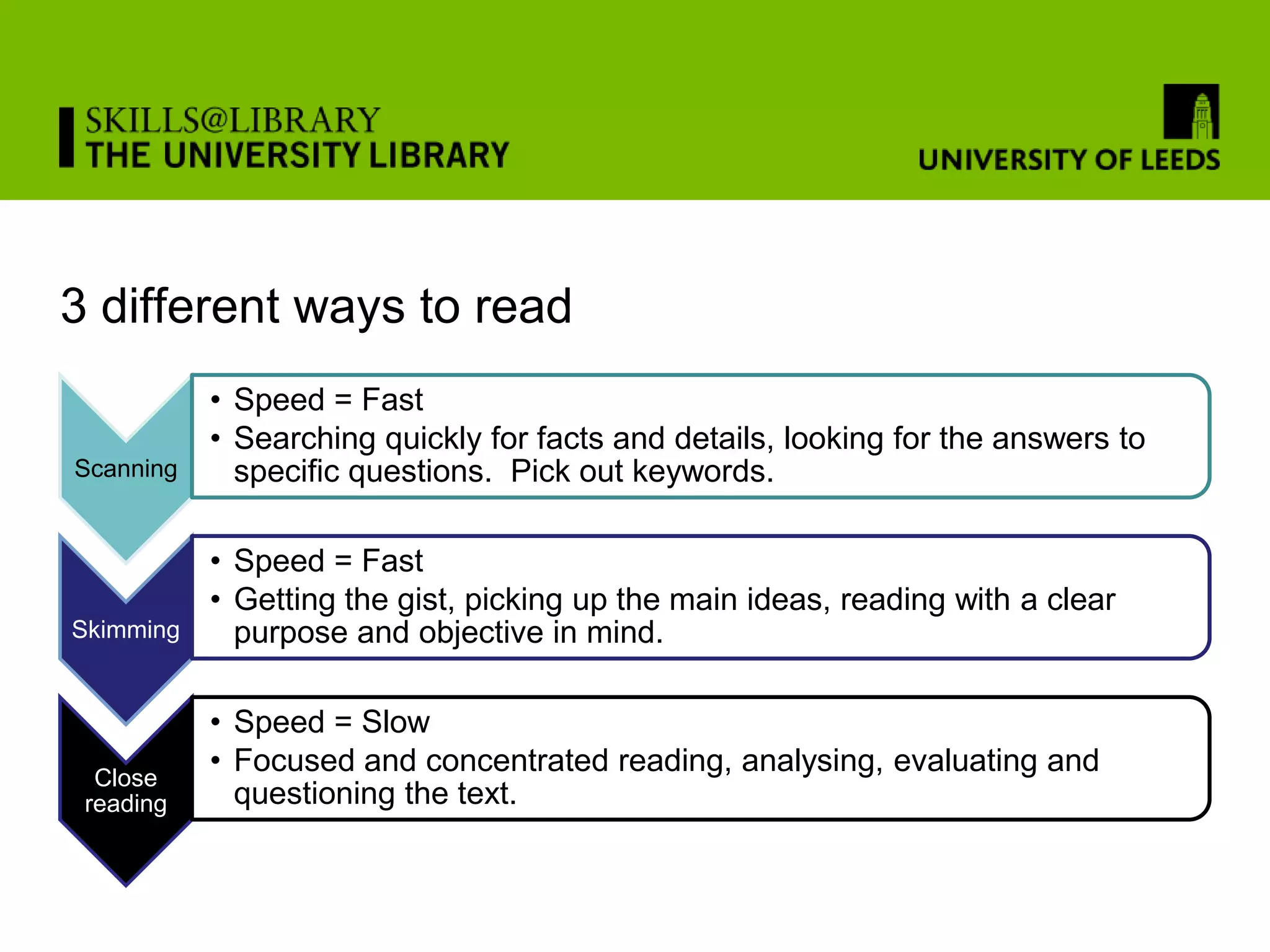
3 different ways to read
           • Speed = Fast
           • Searching quickly for facts and details, looking for the answers to
Scanning     specific questions. Pick out keywords.

           • Speed = Fast
           • Getting the gist, picking up the main ideas, reading with a clear
Skimming     purpose and objective in mind.

           • Speed = Slow
  Close
           • Focused and concentrated reading, analysing, evaluating and
 reading     questioning the text.
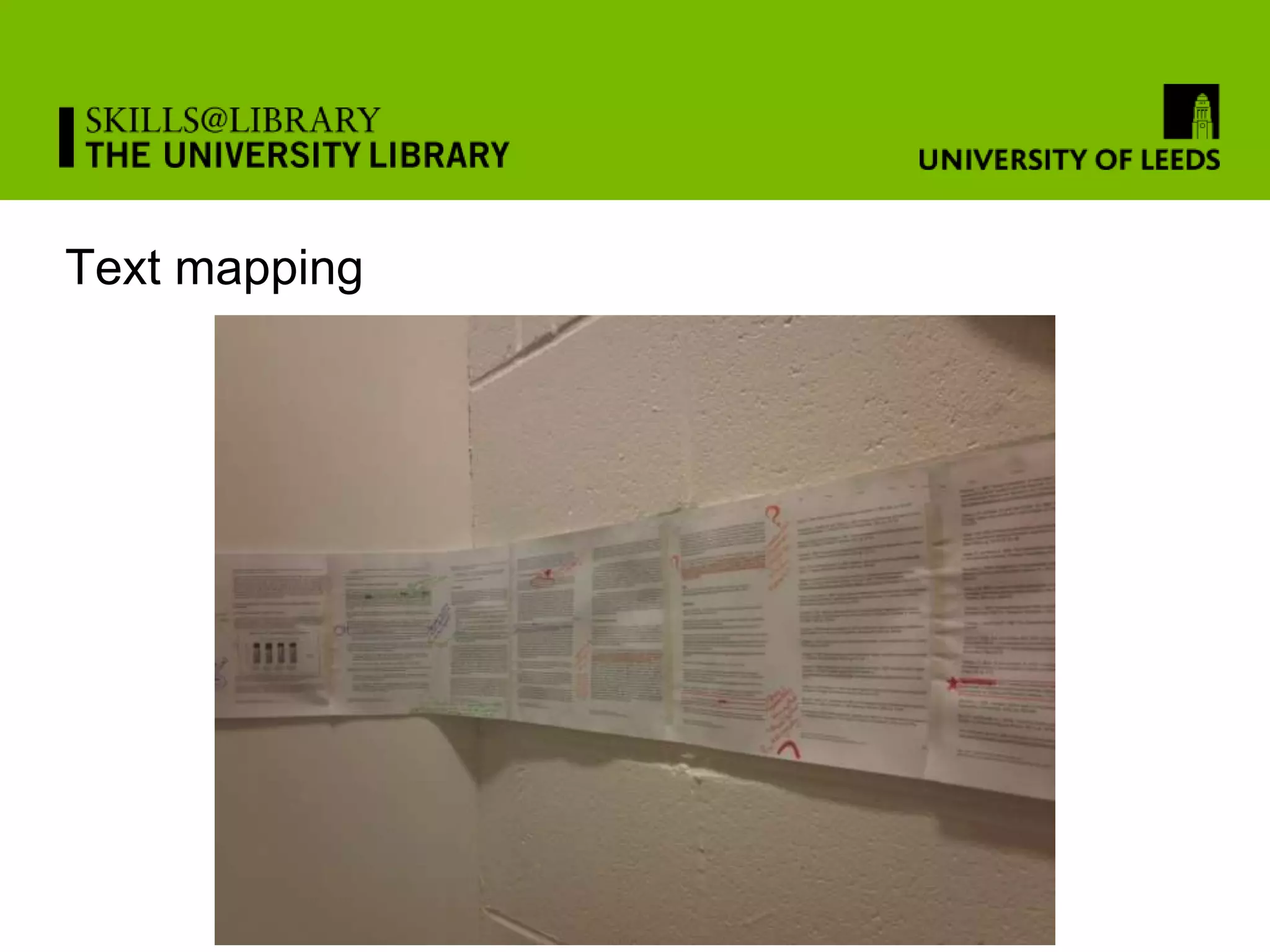
Text mapping
2011/12 students liked
• H-index, how to create groups in EndNote, critical analysis of
  papers
• How to determine influence and impact of authors, journals
  and articles
• Ideas about best ways to take notes
• Factors which determine the importance of a piece of work


                                                      C
• Idea of text-mapping - good way to think about and
  internalise ideas
2011/12 students disliked

• Reading - skim, scan, close - too basic
• Did not really see how bibliometrics help to prioritise
  literature for my subject
• Not enough explanation of reading strategies
• It didn't give the magic answer to solve all my reading
  problems! (high expectation maybe!)


                                                  D
• roll of paper scroll - impractical
What will you do next?

• Change the way I choose references. Use mind-
  mapping
• Put some effort into learning EndNote. Text mapping
• Start using an explicit framework for my
  notes, including a section on how this article
  specifically can enhance my argument (to help draw
  strands together).
What will you do next?
• Rearrange my work
• Be more structured about which articles I select, using
  citation and impact factors
• Now understand I'm a more visual person & will use text
  mapping
• Change my note-taking techniques
• Buy coloured pens, mindmap and use RSS feeds
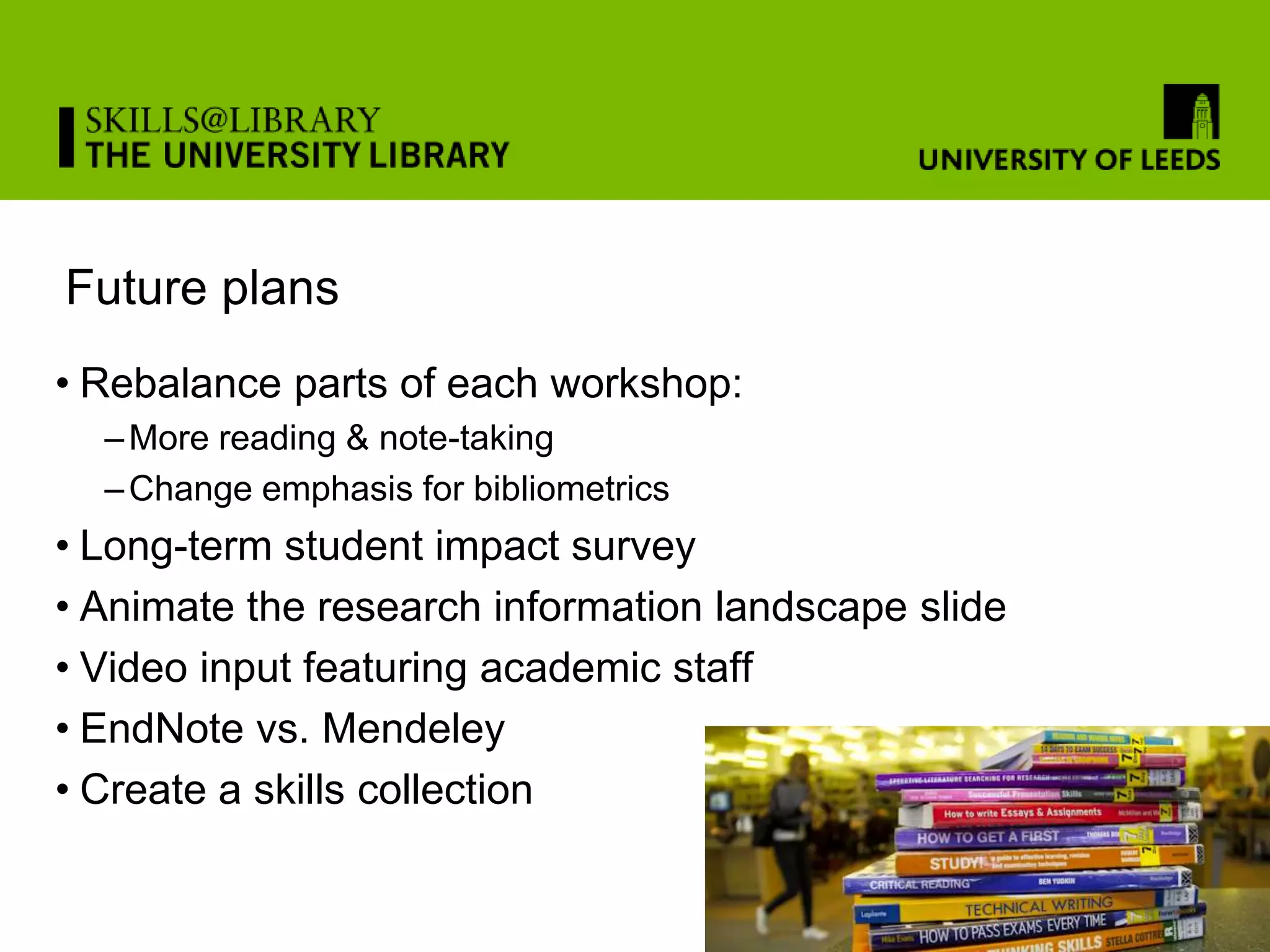
Future plans
• Rebalance parts of each workshop:
  – More reading & note-taking
  – Change emphasis for bibliometrics
• Long-term student impact survey
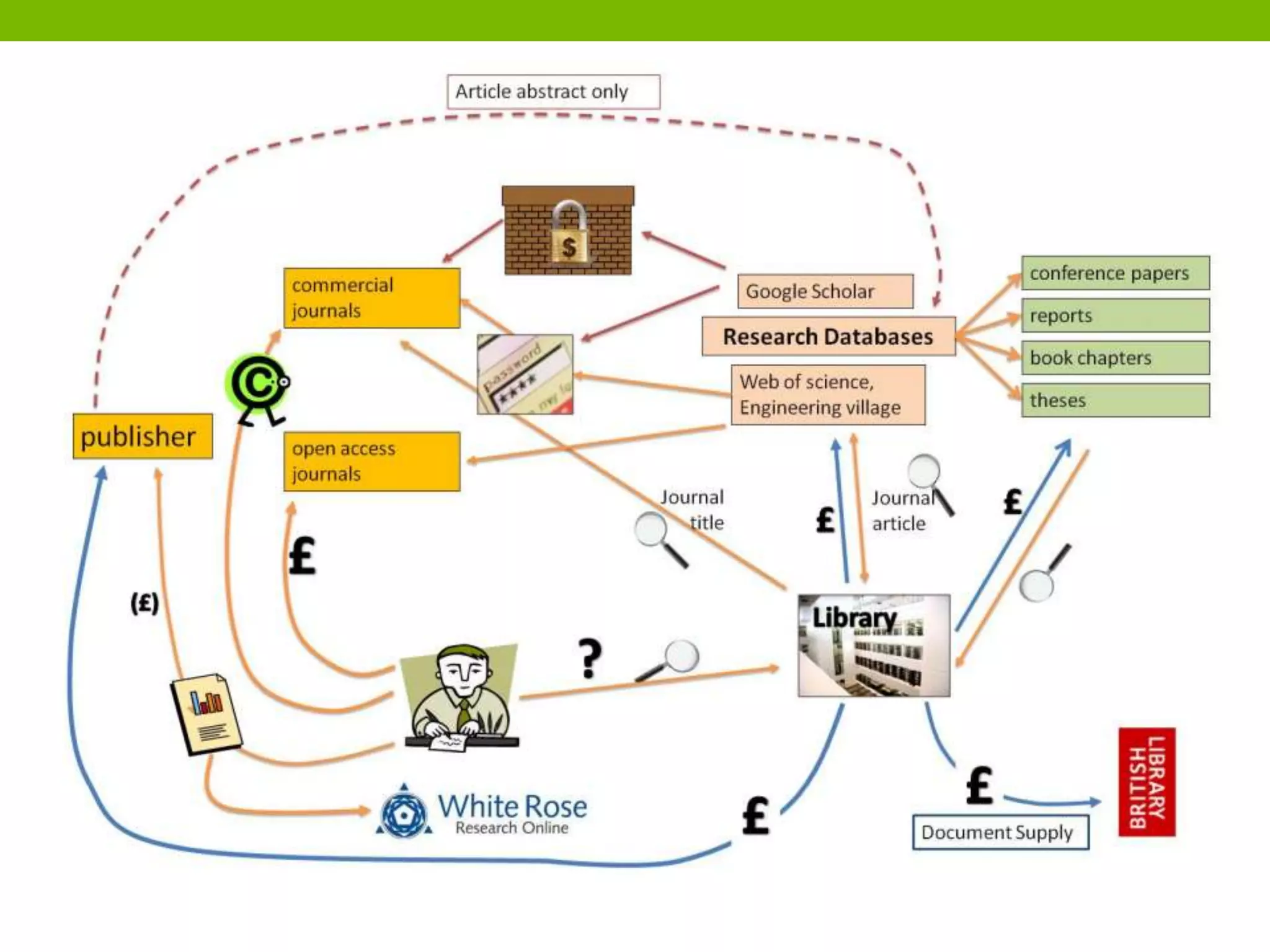
• Animate the research information landscape slide
• Video input featuring academic staff
• EndNote vs. Mendeley
• Create a skills collection

Acting on PhD student feedback to create new learning resources

  • 1.
    Acting on PhDstudent feedback to create new learning resources Angela Newton Dan Pullinger
  • 2.
    In today’s workshop •First steps in PhD teaching • New 2011/12 PhD workshops – Student feedback – What we created • Over to you – Student feedback – Group work – Future activities
  • 3.
    2005 - formatfor workshops Finding information Managing information for your PhD for your PhD • Planning a literature search • Brain style quiz • Mind-mapping • EndNote • Keyword searching • Managing electronic • Journal databases overview information • Hands-on searching • Organising your workspace
  • 4.
    What’s worrying you? •Discussion activity in workshop 1 – Threw up more and more challenging questions – Topics not covered in either workshop • Conclusion? – Change the workshops!* *Teacher feedback on issues raised by attendees was also taken into account
  • 5.
    Over to you •How would you respond to these student ‘worries’? • In your group, devise a learning activity that addresses the problems • Use the resources on your table to show & describe how it would work • You have 15 minutes!
  • 6.
    Quotes 1 • Isthis paper worthwhile/valid? • How to distinguish between relevant and irrelevant literature • When papers say contradictory things, which do you trust? • How to filter “un-useful” information
  • 7.
    Quotes 2 • Howdo I get full-text scientific papers online? • I often worry there's crucial papers out there I don't know are there... • How do I know when to stop looking for information? • Uni doesn’t have subscriptions to useful papers/journals – I don’t want to pay too much • [How do I find] unpublished and ongoing work? • Some papers can’t be accessed online
  • 8.
    Quotes 3 • Howto make selections of what is important in a vast number of research sources? • Which of the articles is most important? • How can I know this work is significant? • How do you find/know papers that are the most cited/respected, i.e. people who really know their stuff • How to check the “top rating” research in certain areas? • Credibility of authors? • What order should I read the literature in?
  • 9.
    Quotes 4 • Howdo I extract the important information [from a paper]? • Organised reading – by theme / topic? • I get distracted & find “irrelevant information” interesting too • How to distinguish what is essential to read from what is not • Choosing the most relevant papers to read • Reading methods – don’t want to read all papers from beginning to end
  • 10.
    2011 - formatfor workshops Working with literature: Search & Save: Information Impact, evaluation & reading searching for PhD students strategies • Planning and controlling the • Which paper first? Measures literature search of importance: Bibliometrics • Search tools: Where to search • Which papers match my for what research question? • Search techniques • Reading & note-taking • EndNote strategies • Keeping up to date: Alerting services
  • 11.
    How we respondedto the feedback • New activities integrating academic skills – Critical analysis – Research information landscape – Bibliometrics – Reading and note-taking strategies
  • 12.
  • 14.
    What are bibliometrics? •A variety of statistical measures used to quantify research • Often make use of citation counts • Relate to journals • Relate to researchers – individuals or groups
  • 15.
    Which authors arethe most important/influential? • How it works: h-index, or Hirsch index – A scholar with an index of h has published h papers, each of which has been cited by others at least h times. • You have a go: – Search for the h-index for the lead authors of the articles you have found – What do you think is a ‘good’ h-index score? – Will the h-index be a useful tool for your research? – What are the pros and cons of the h-index?
  • 16.
    3 different waysto read • Speed = Fast • Searching quickly for facts and details, looking for the answers to Scanning specific questions. Pick out keywords. • Speed = Fast • Getting the gist, picking up the main ideas, reading with a clear Skimming purpose and objective in mind. • Speed = Slow Close • Focused and concentrated reading, analysing, evaluating and reading questioning the text.
  • 17.
  • 18.
    2011/12 students liked •H-index, how to create groups in EndNote, critical analysis of papers • How to determine influence and impact of authors, journals and articles • Ideas about best ways to take notes • Factors which determine the importance of a piece of work C • Idea of text-mapping - good way to think about and internalise ideas
  • 19.
    2011/12 students disliked •Reading - skim, scan, close - too basic • Did not really see how bibliometrics help to prioritise literature for my subject • Not enough explanation of reading strategies • It didn't give the magic answer to solve all my reading problems! (high expectation maybe!) D • roll of paper scroll - impractical
  • 20.
    What will youdo next? • Change the way I choose references. Use mind- mapping • Put some effort into learning EndNote. Text mapping • Start using an explicit framework for my notes, including a section on how this article specifically can enhance my argument (to help draw strands together).
  • 21.
    What will youdo next? • Rearrange my work • Be more structured about which articles I select, using citation and impact factors • Now understand I'm a more visual person & will use text mapping • Change my note-taking techniques • Buy coloured pens, mindmap and use RSS feeds
  • 22.
    Future plans • Rebalanceparts of each workshop: – More reading & note-taking – Change emphasis for bibliometrics • Long-term student impact survey • Animate the research information landscape slide • Video input featuring academic staff • EndNote vs. Mendeley • Create a skills collection