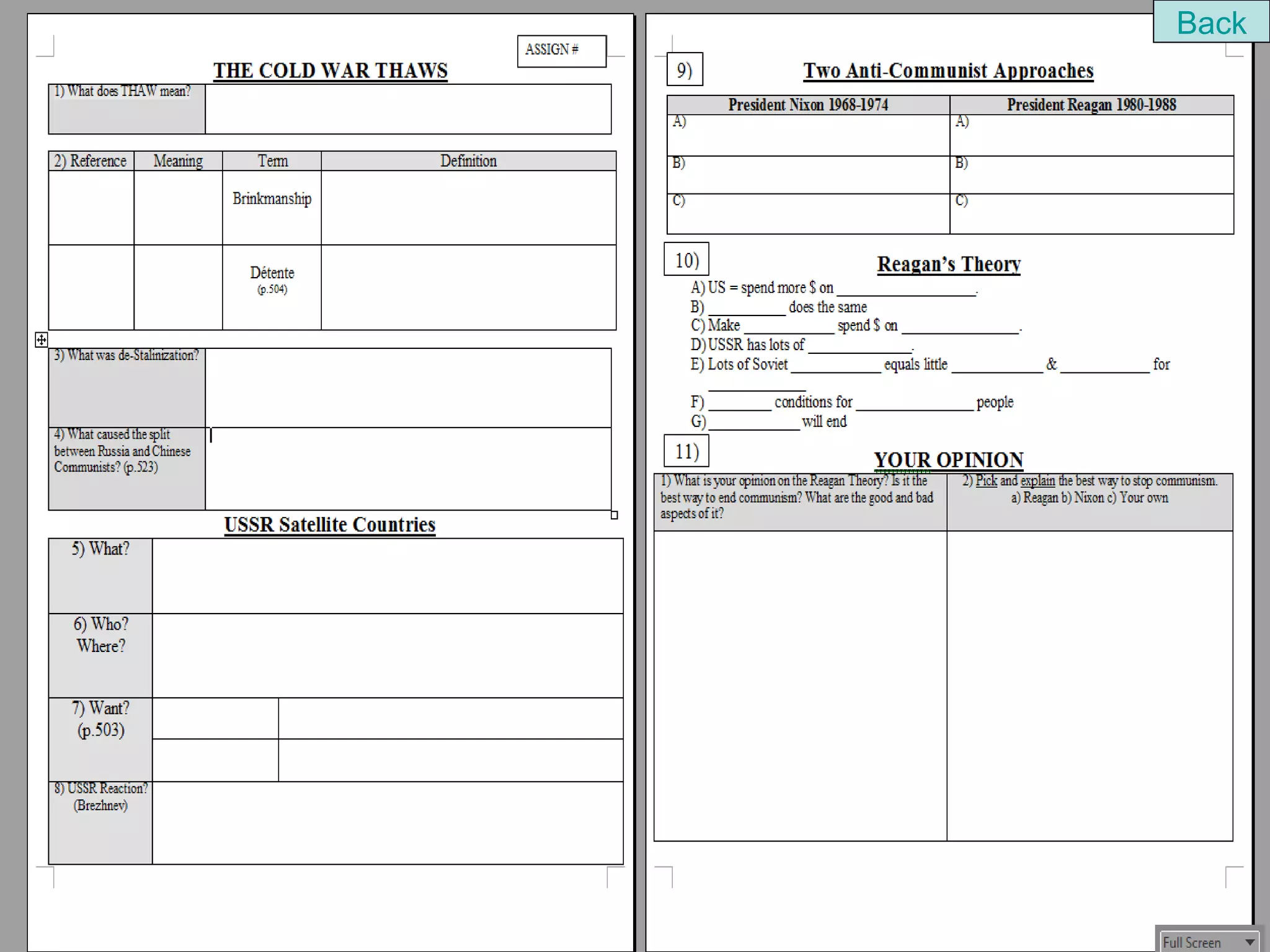
11
Back
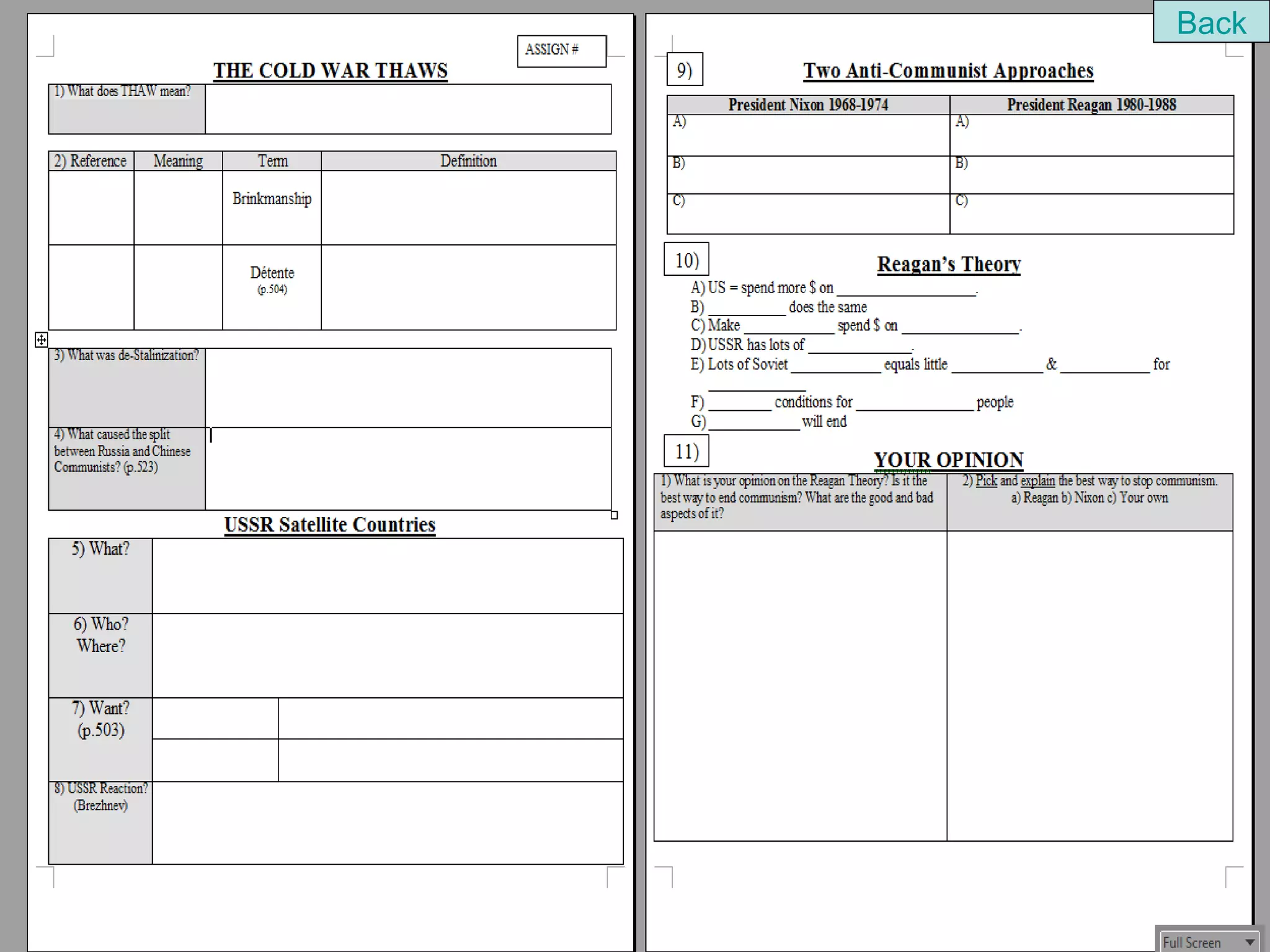
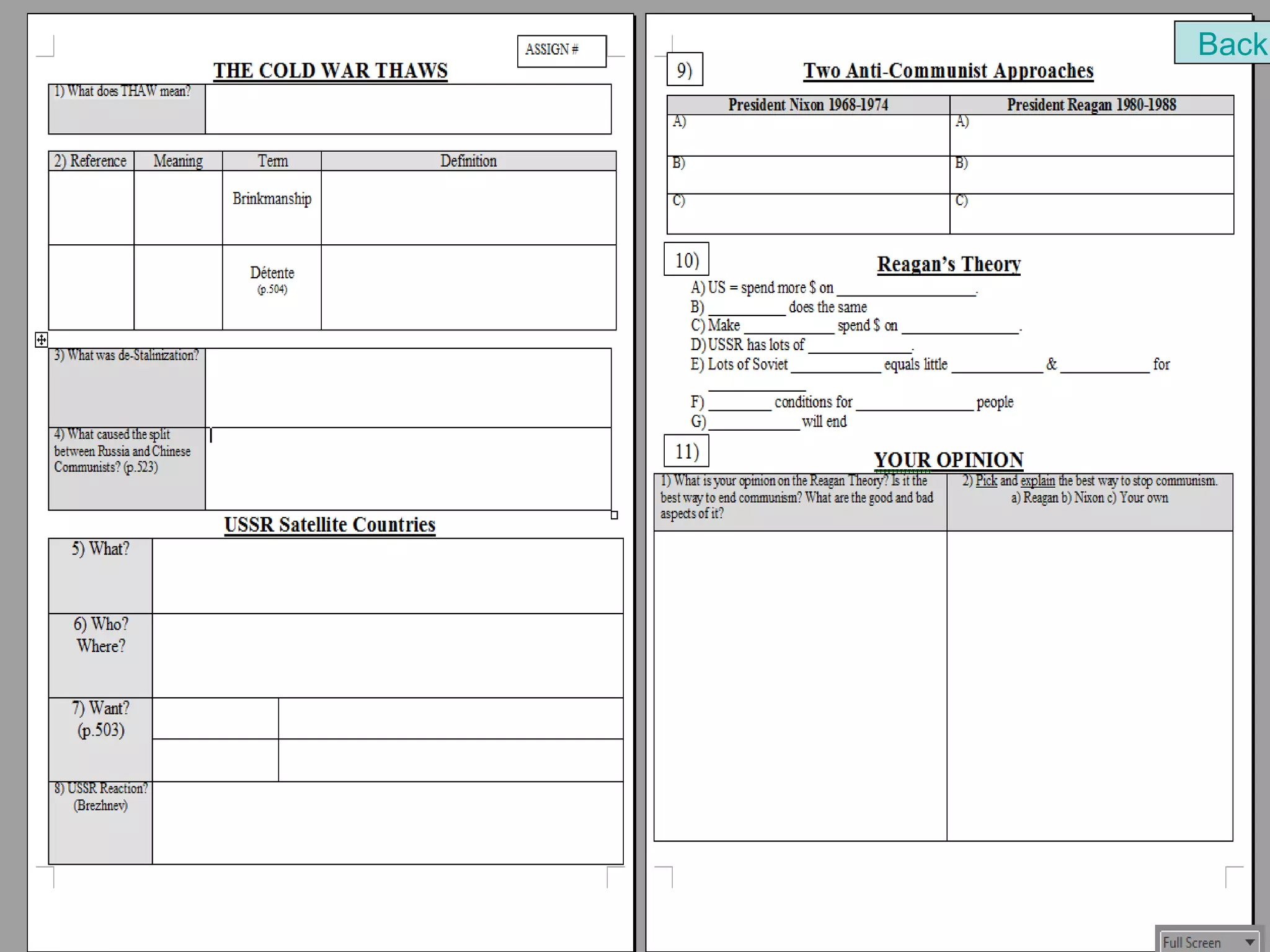
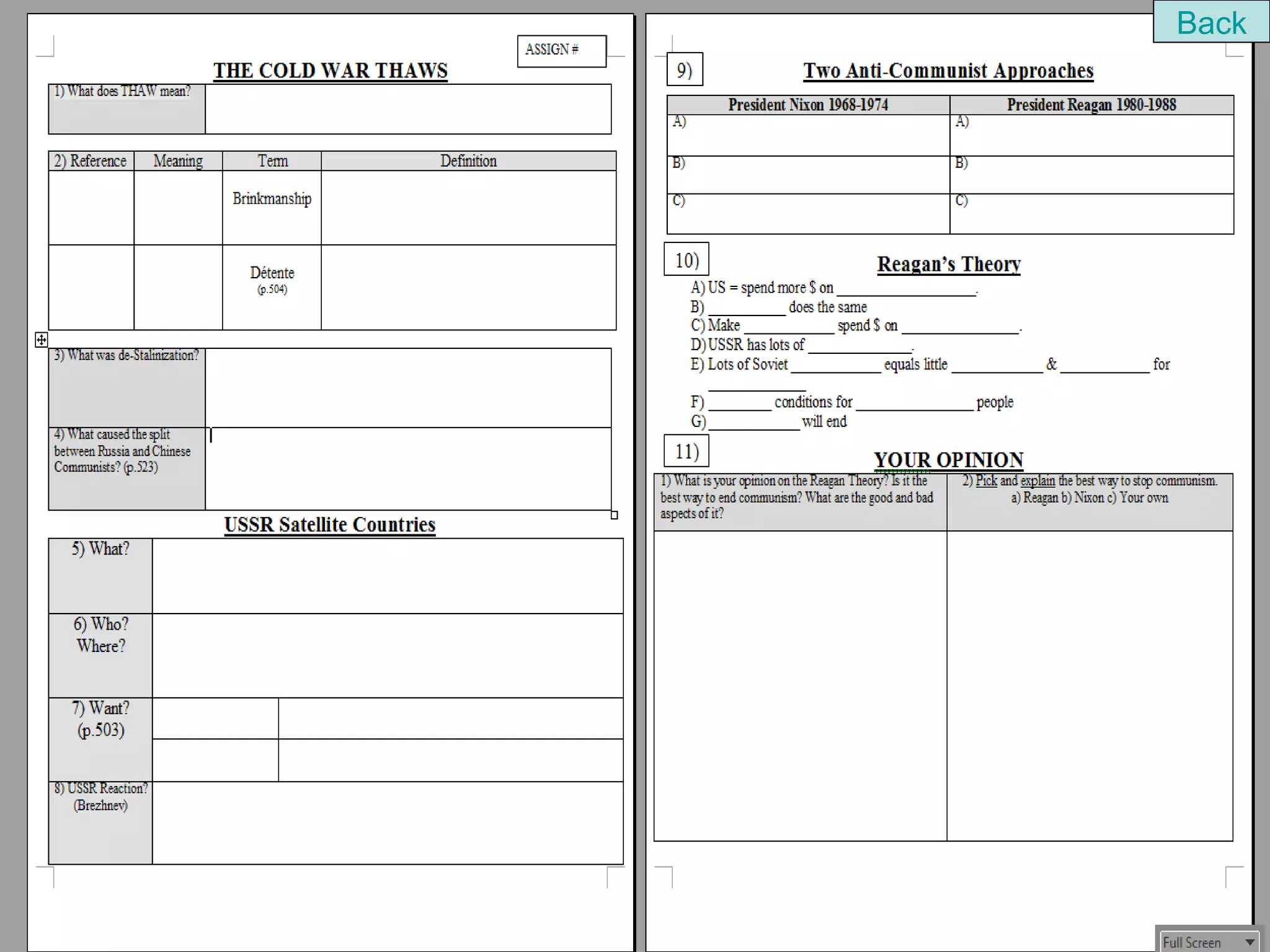
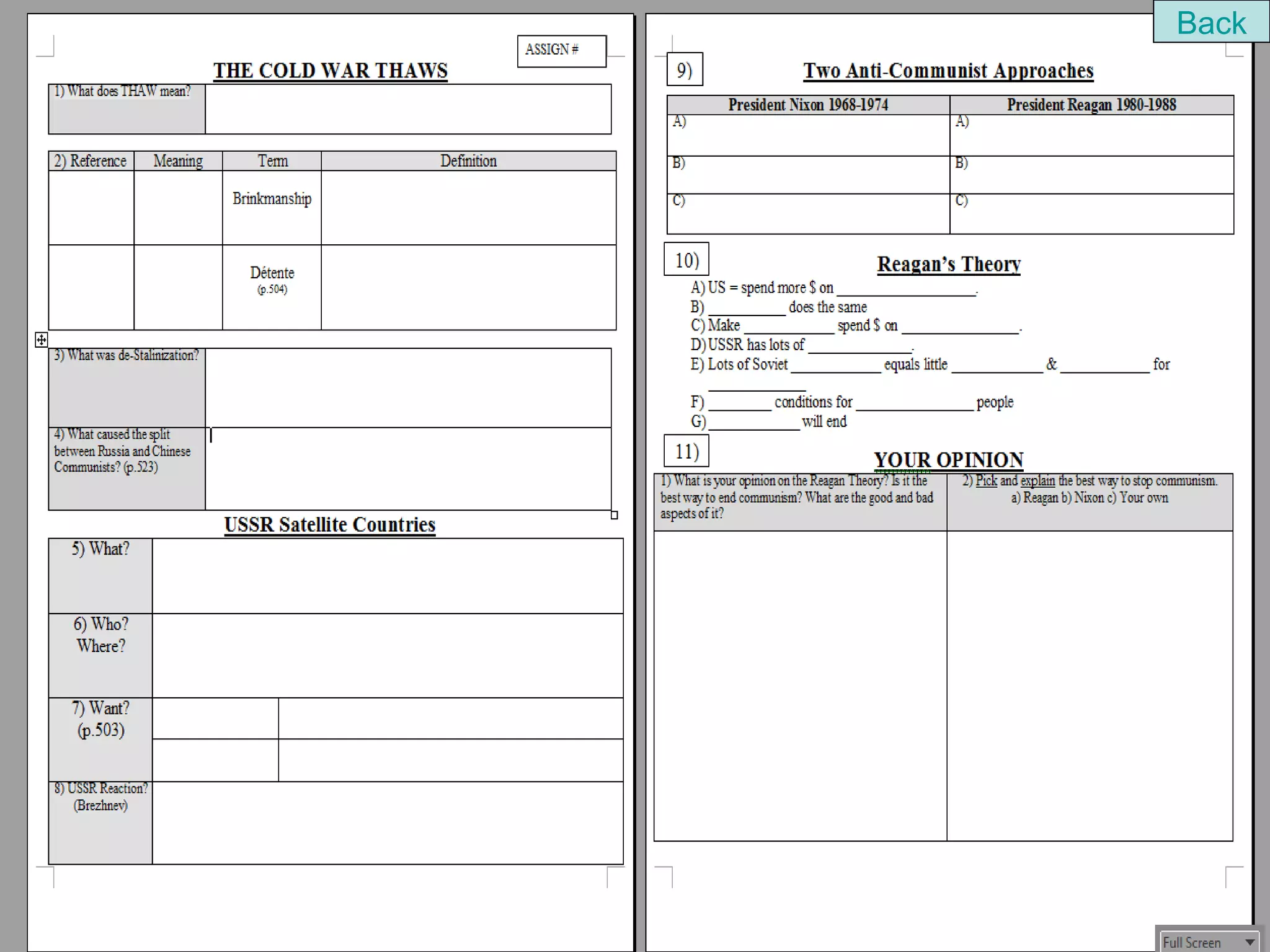
            1) WHAT DOES THAW MEAN?
  WHAT DOES THAW HAVE TO DO WITH THE COLD WAR?
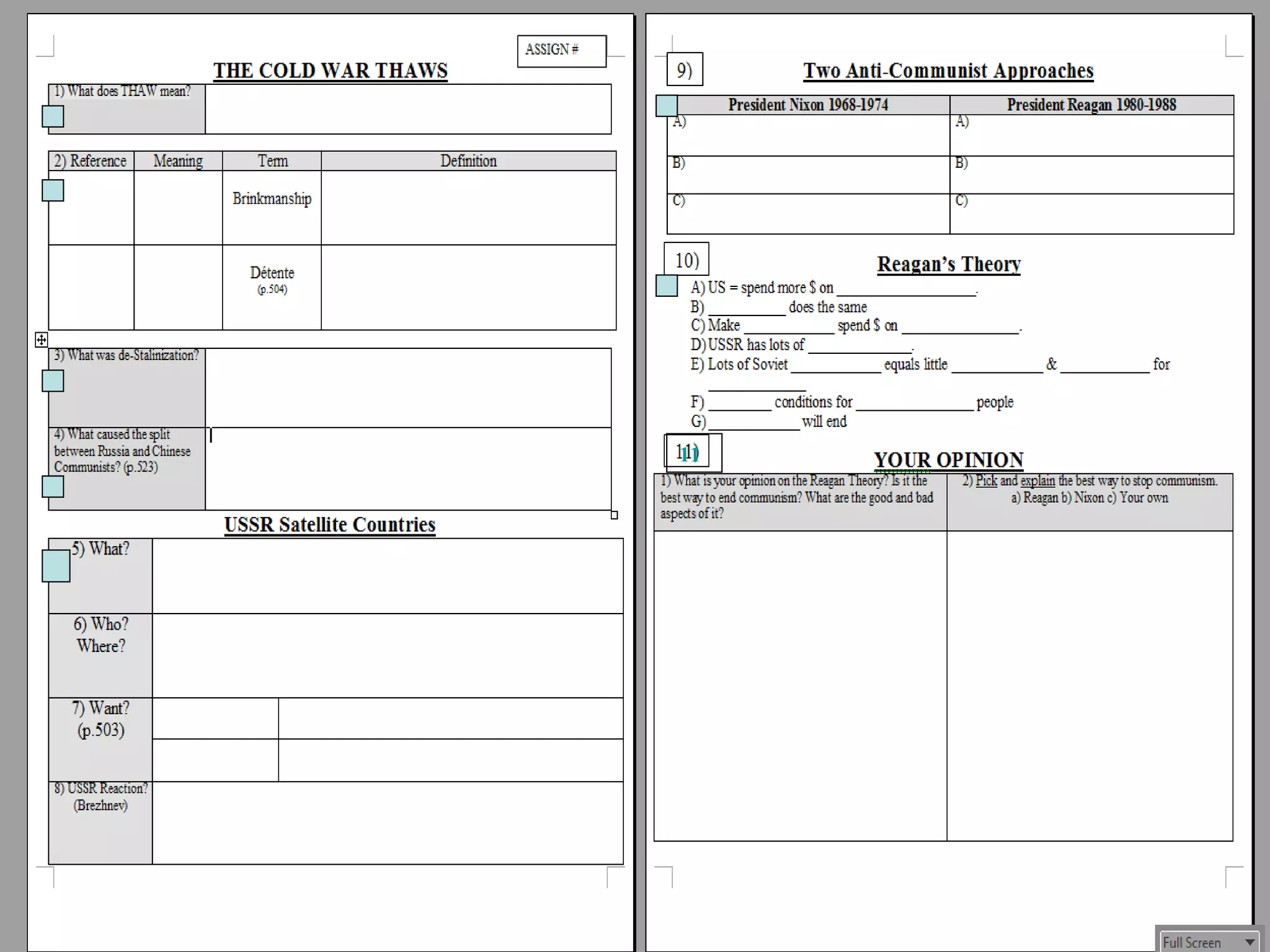
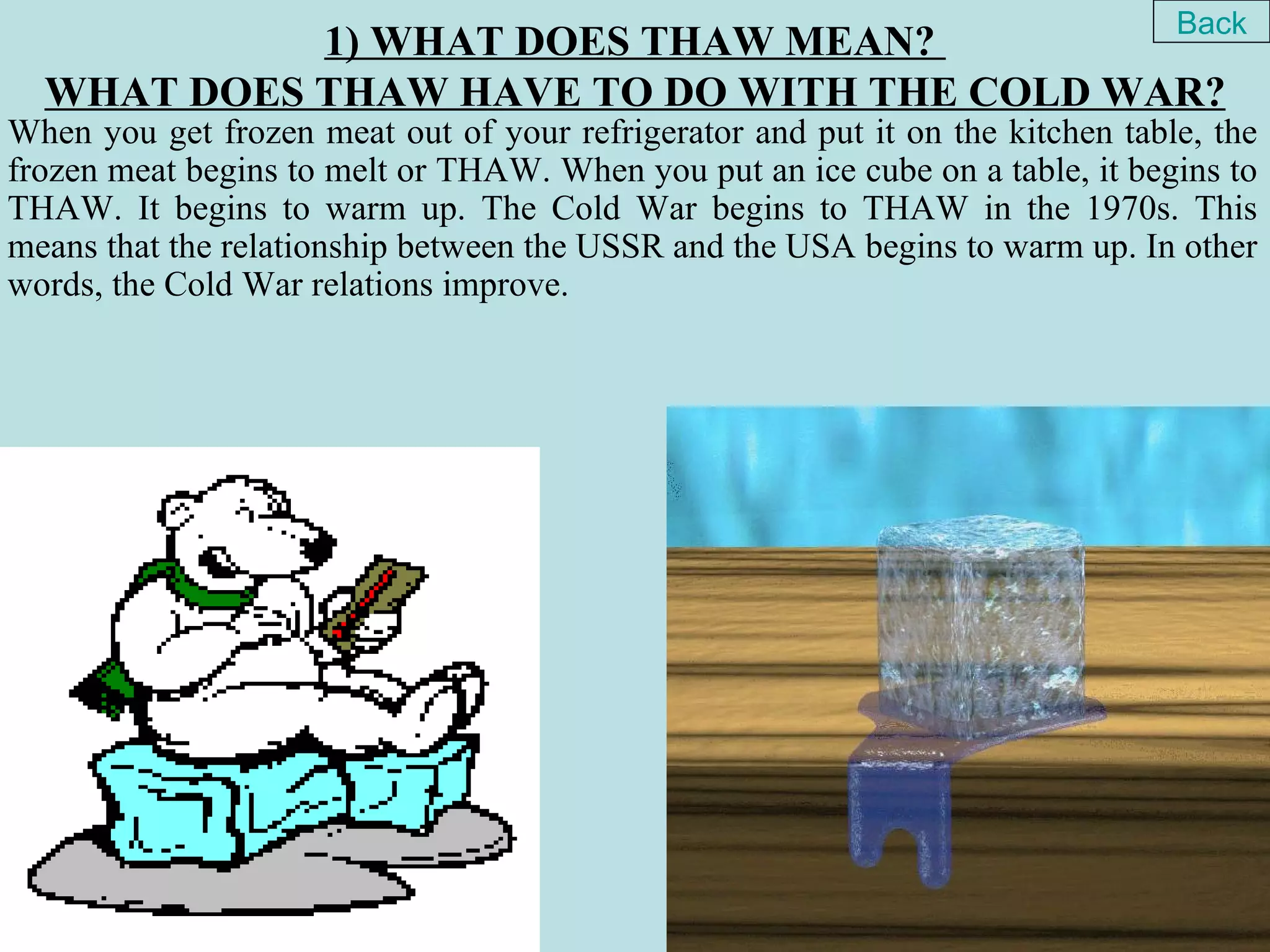
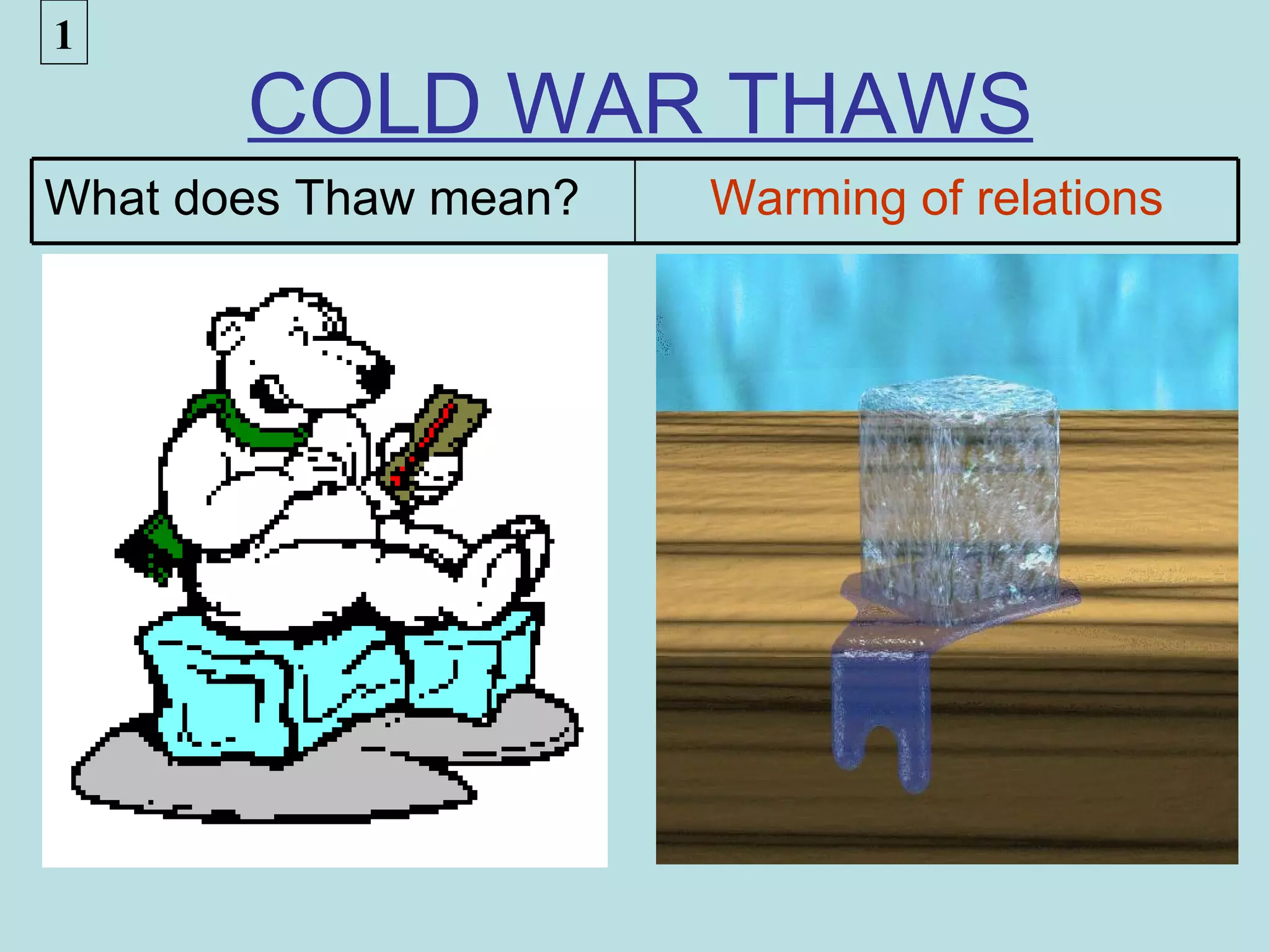
When you get frozen meat out of your refrigerator and put it on the kitchen table, the
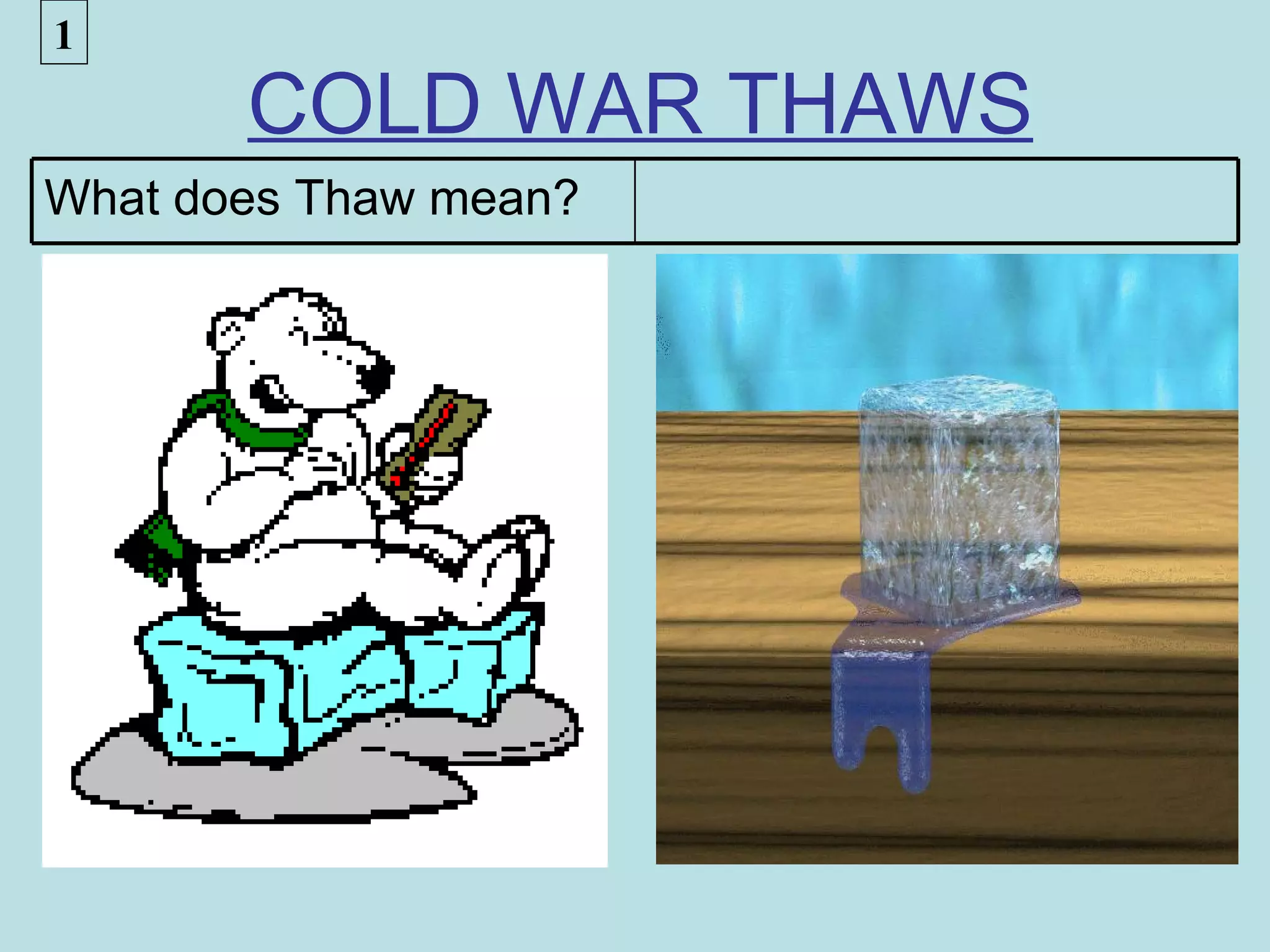
frozen meat begins to melt or THAW. When you put an ice cube on a table, it begins to
THAW. It begins to warm up. The Cold War begins to THAW in the 1970s. This
means that the relationship between the USSR and the USA begins to warm up. In other
words, the Cold War relations improve.
1
       COLD WAR THAWS
What does Thaw mean?
1
       COLD WAR THAWS
What does Thaw mean?
1
       COLD WAR THAWS
What does Thaw mean?   Warming of relations
Back
Back
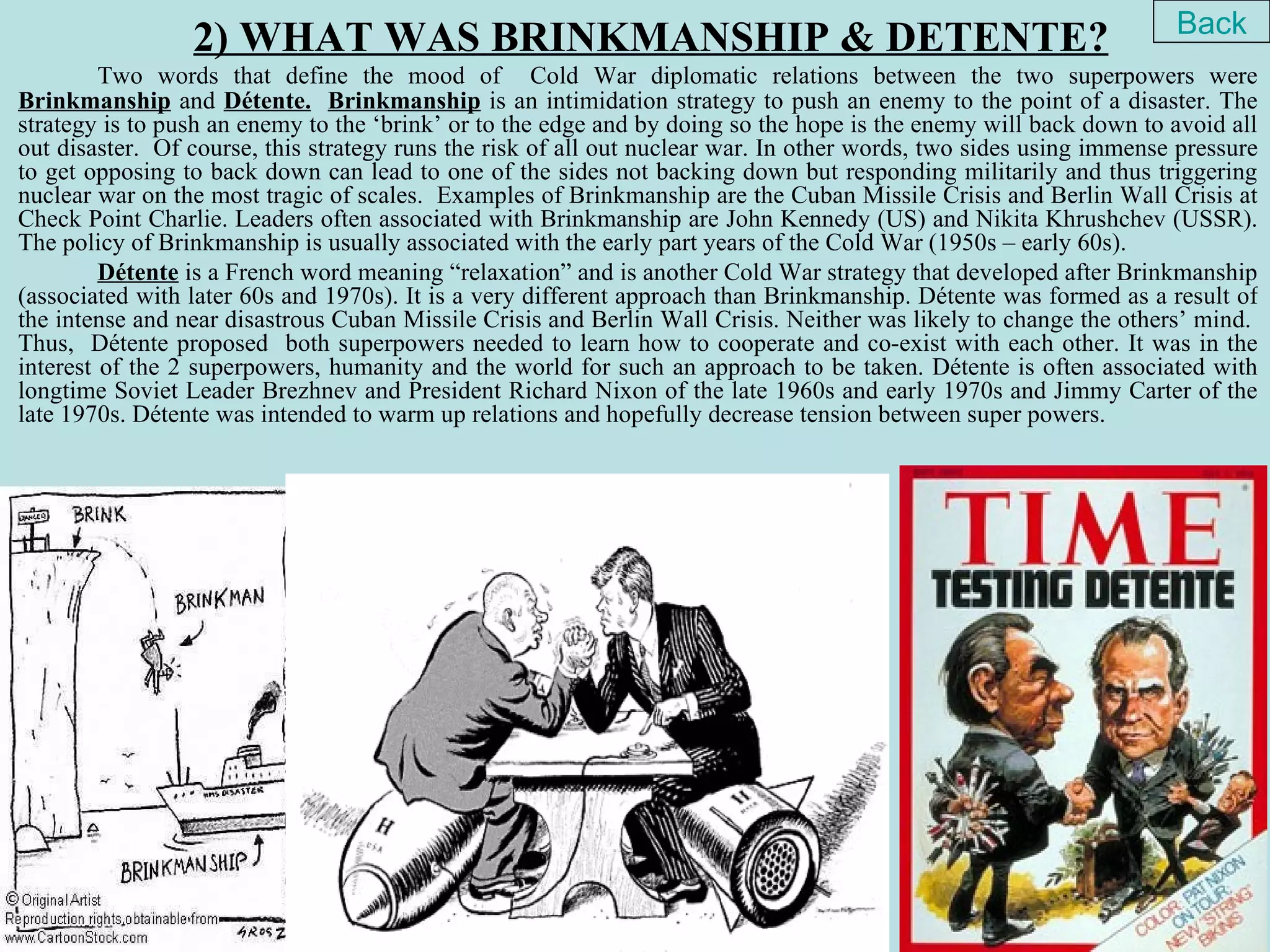
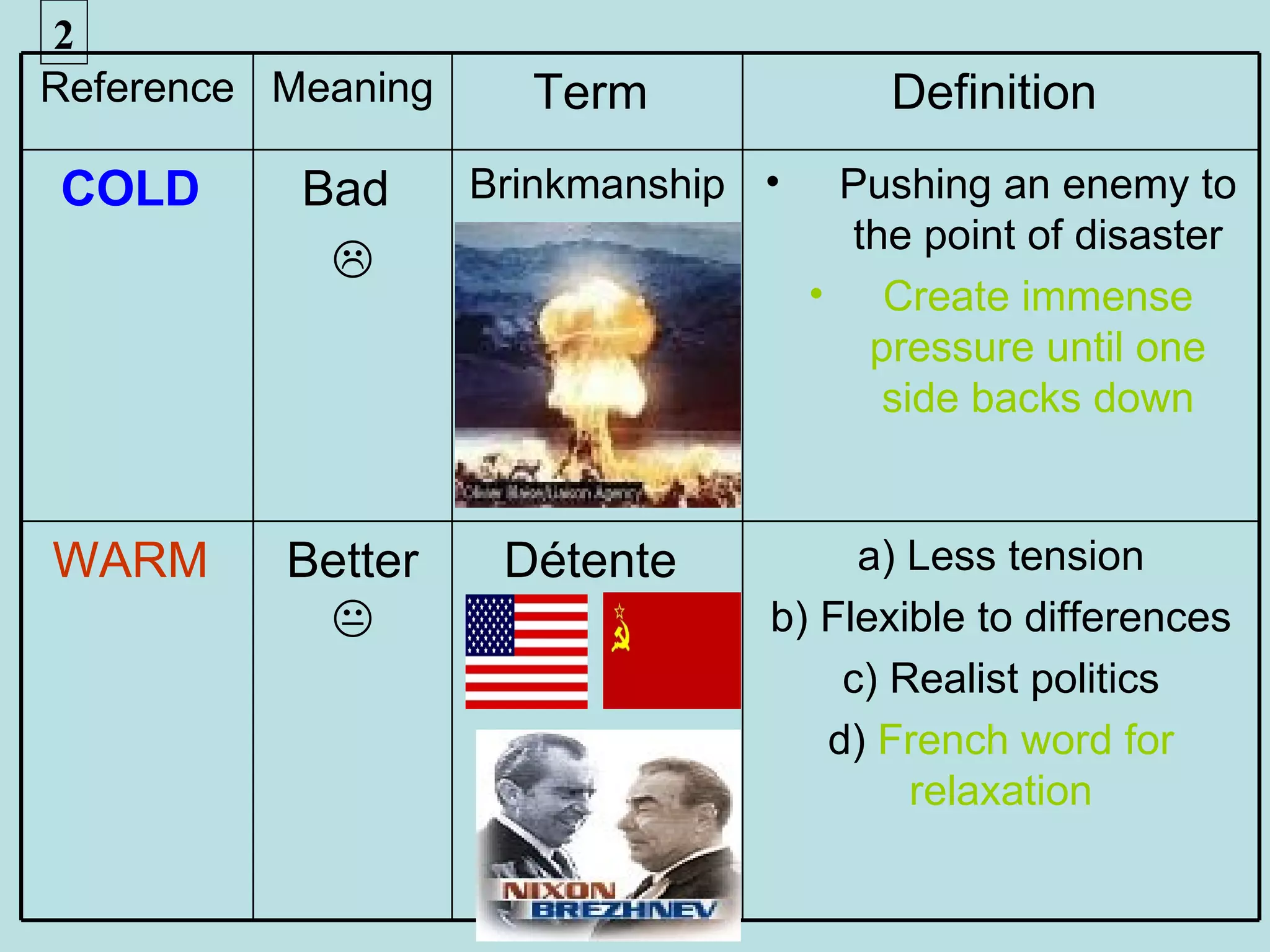
                 2) WHAT WAS BRINKMANSHIP & DETENTE?
         Two words that define the mood of Cold War diplomatic relations between the two superpowers were
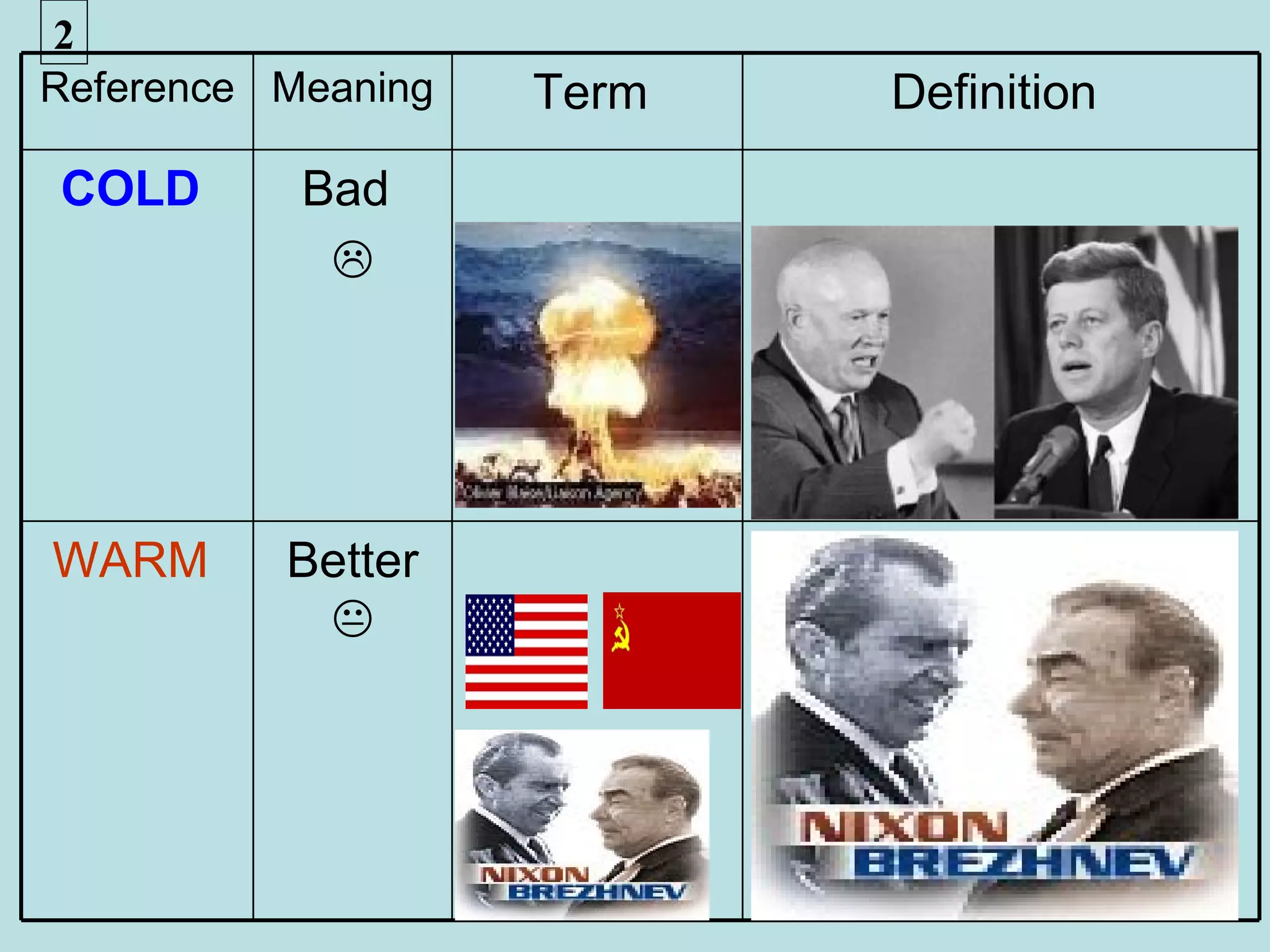
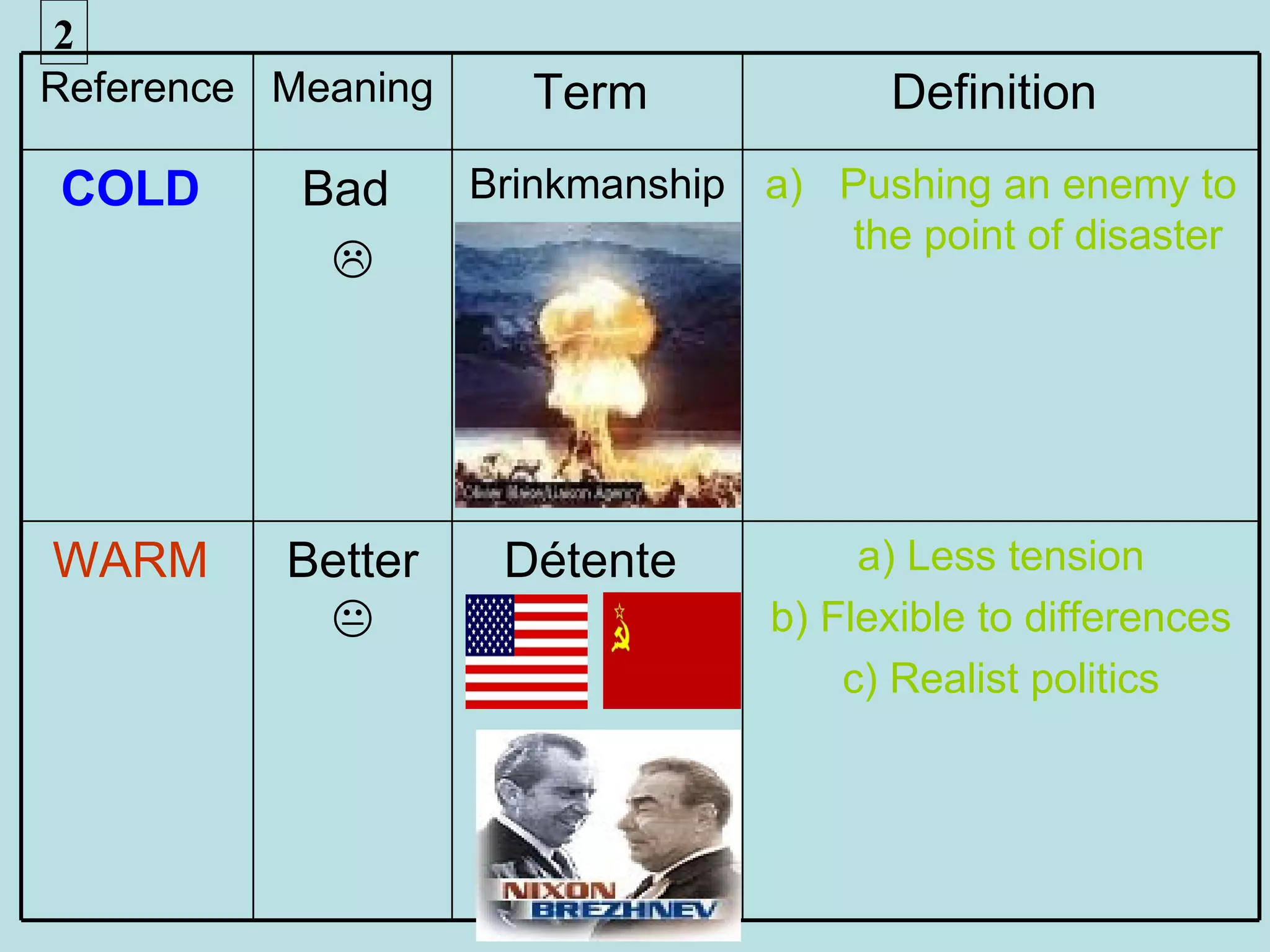
Brinkmanship and Détente. Brinkmanship is an intimidation strategy to push an enemy to the point of a disaster. The
strategy is to push an enemy to the ‘brink’ or to the edge and by doing so the hope is the enemy will back down to avoid all
out disaster. Of course, this strategy runs the risk of all out nuclear war. In other words, two sides using immense pressure
to get opposing to back down can lead to one of the sides not backing down but responding militarily and thus triggering
nuclear war on the most tragic of scales. Examples of Brinkmanship are the Cuban Missile Crisis and Berlin Wall Crisis at
Check Point Charlie. Leaders often associated with Brinkmanship are John Kennedy (US) and Nikita Khrushchev (USSR).
The policy of Brinkmanship is usually associated with the early part years of the Cold War (1950s – early 60s).
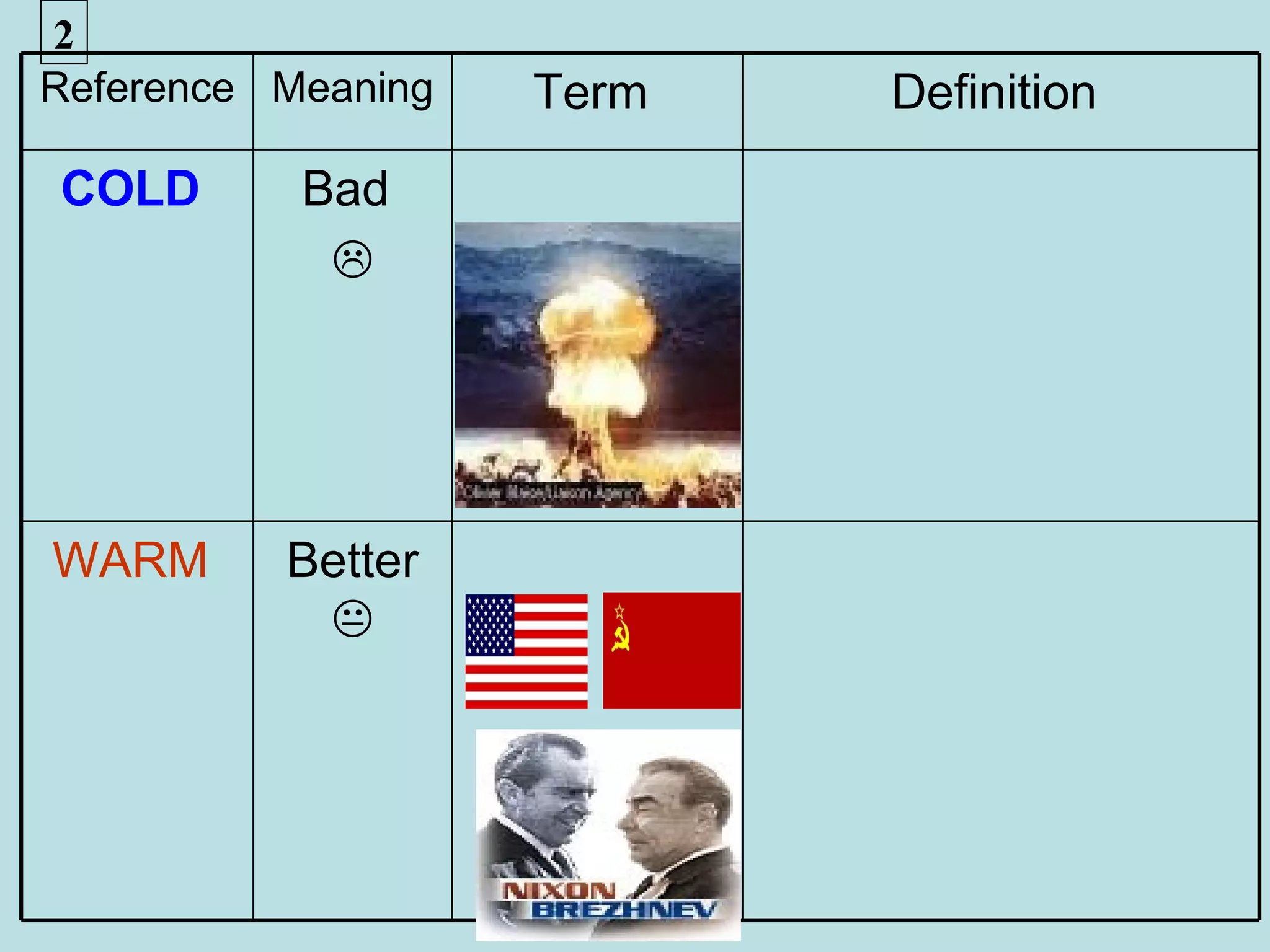
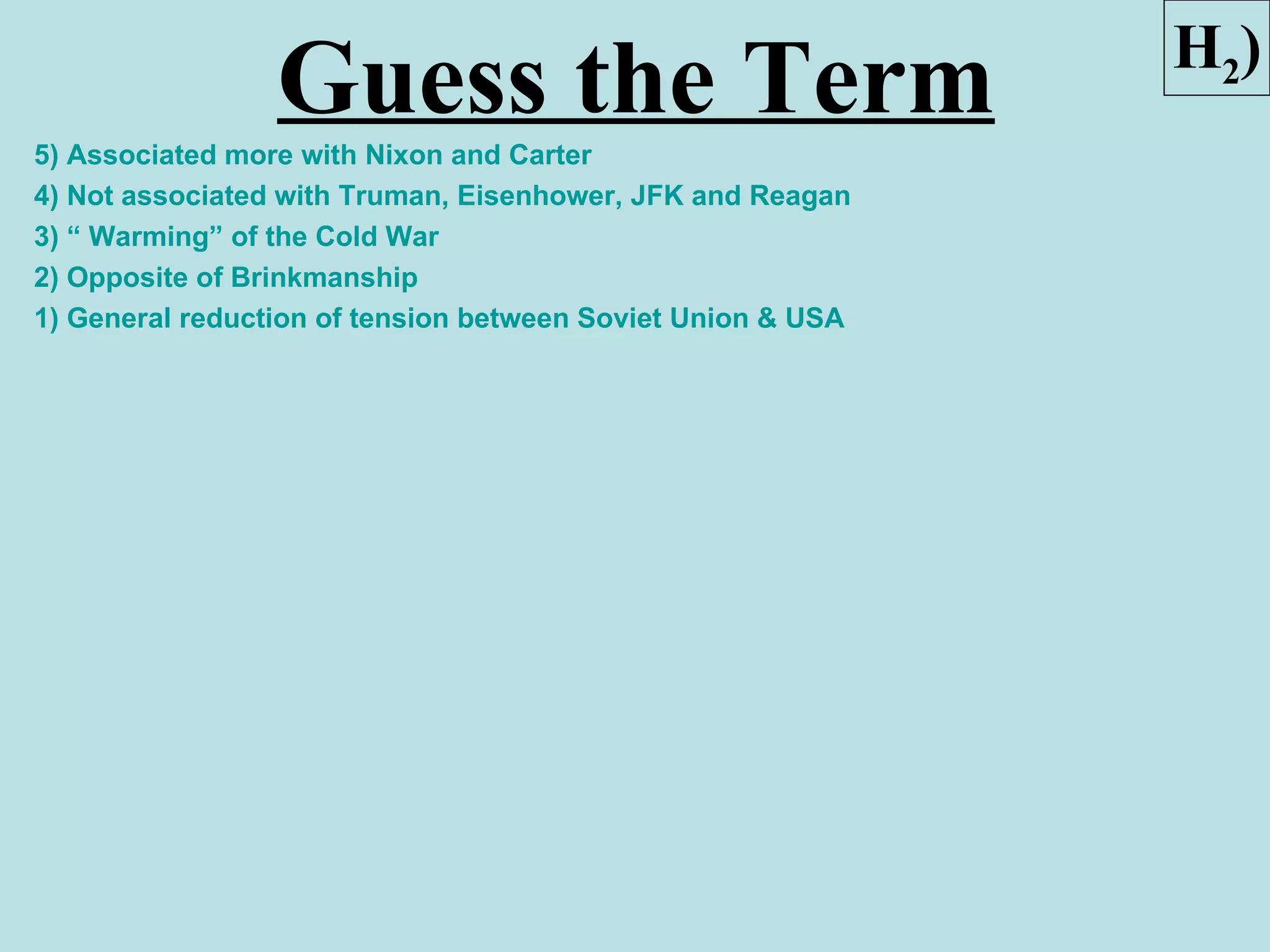
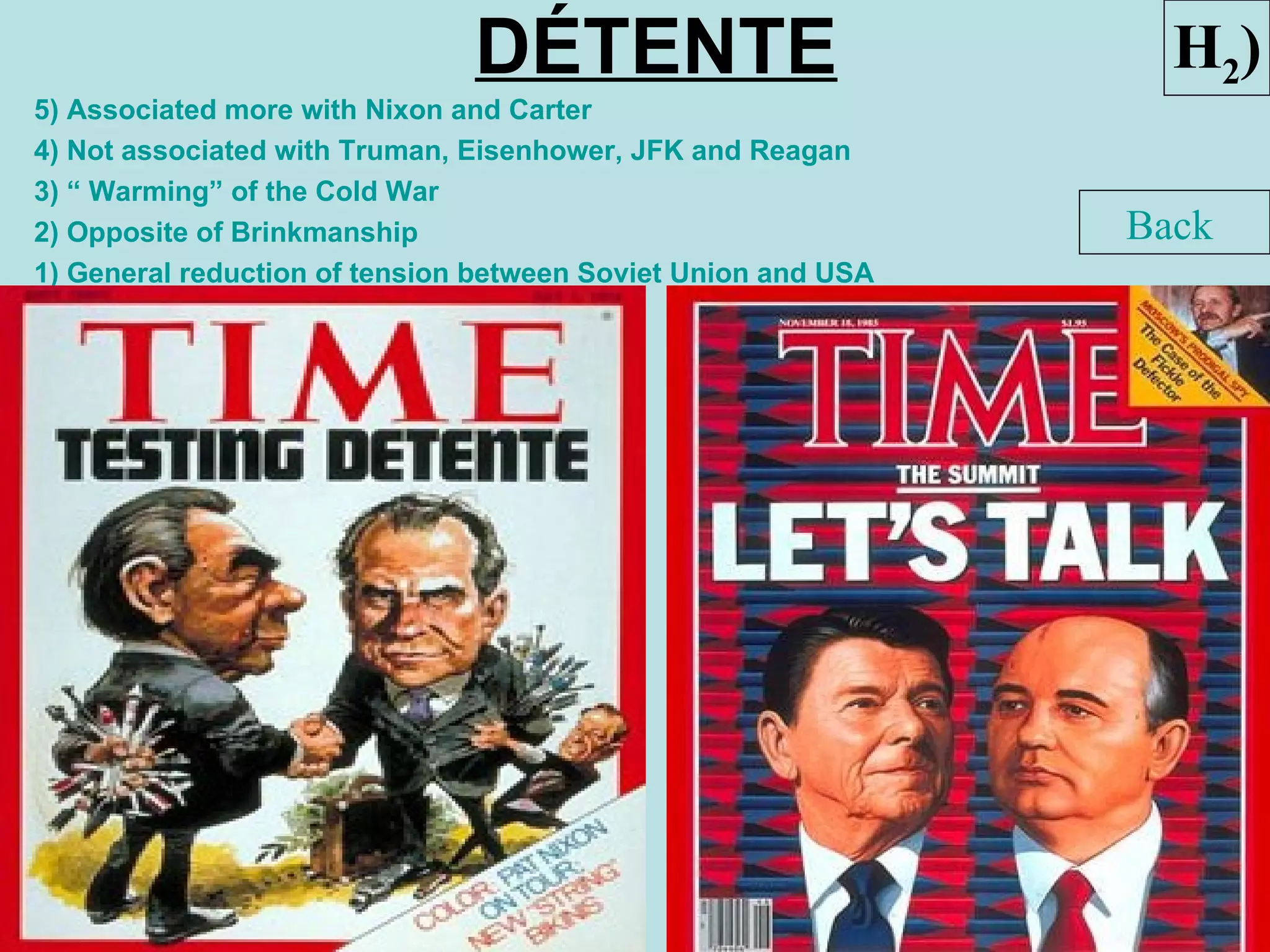
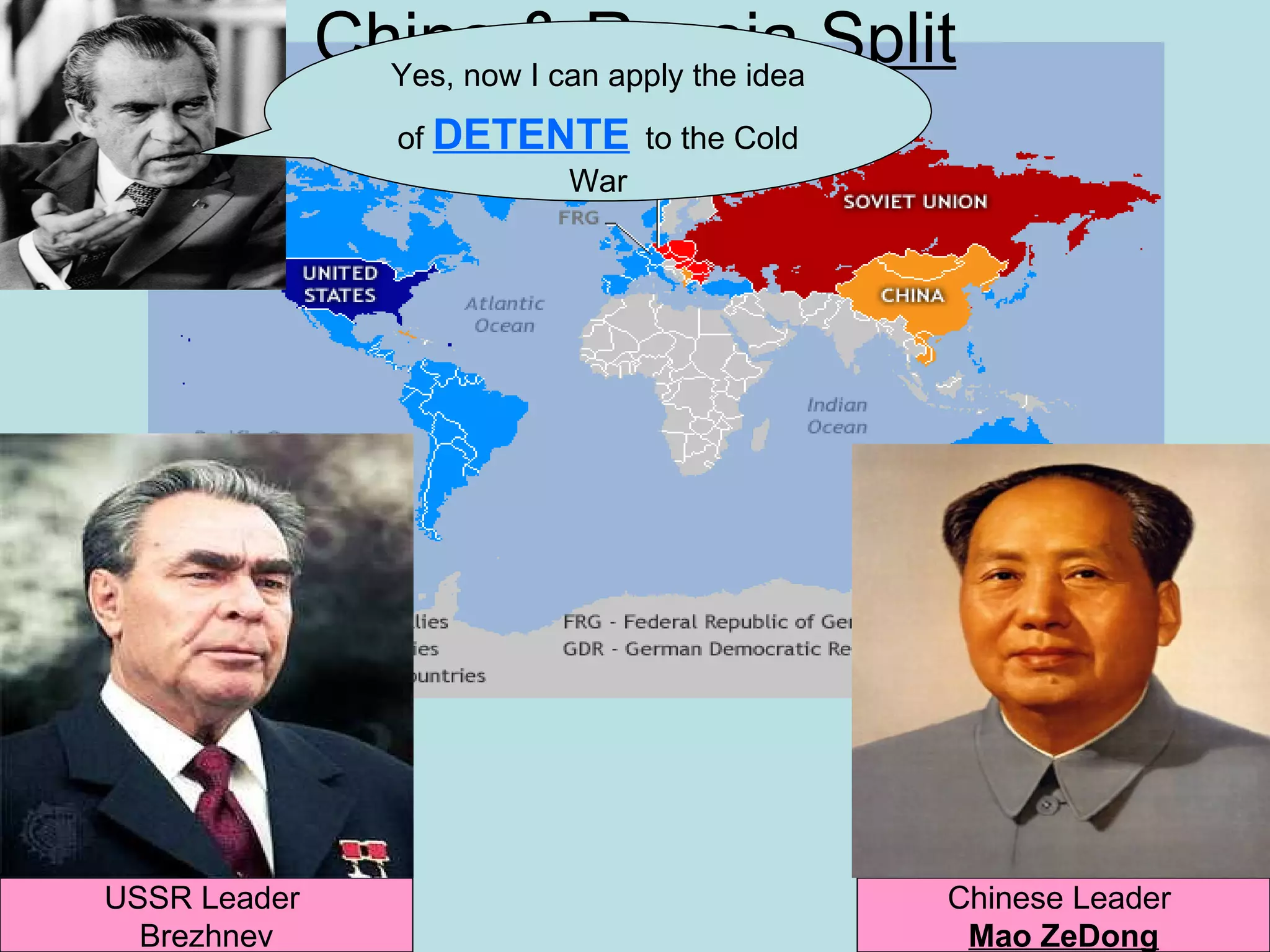
         Détente is a French word meaning “relaxation” and is another Cold War strategy that developed after Brinkmanship
(associated with later 60s and 1970s). It is a very different approach than Brinkmanship. Détente was formed as a result of
the intense and near disastrous Cuban Missile Crisis and Berlin Wall Crisis. Neither was likely to change the others’ mind.
Thus, Détente proposed both superpowers needed to learn how to cooperate and co-exist with each other. It was in the
interest of the 2 superpowers, humanity and the world for such an approach to be taken. Détente is often associated with
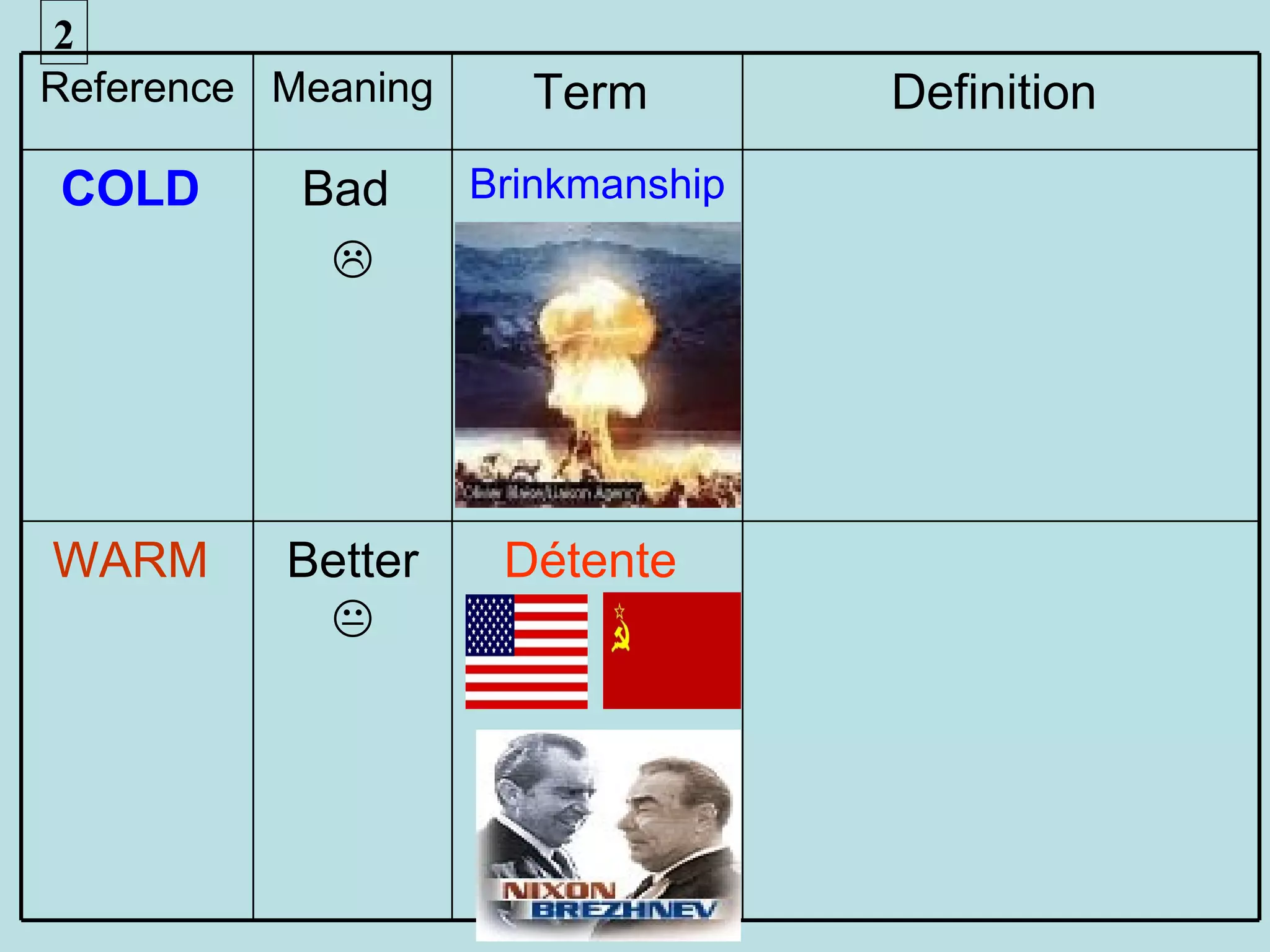
longtime Soviet Leader Brezhnev and President Richard Nixon of the late 1960s and early 1970s and Jimmy Carter of the
late 1970s. Détente was intended to warm up relations and hopefully decrease tension between super powers.
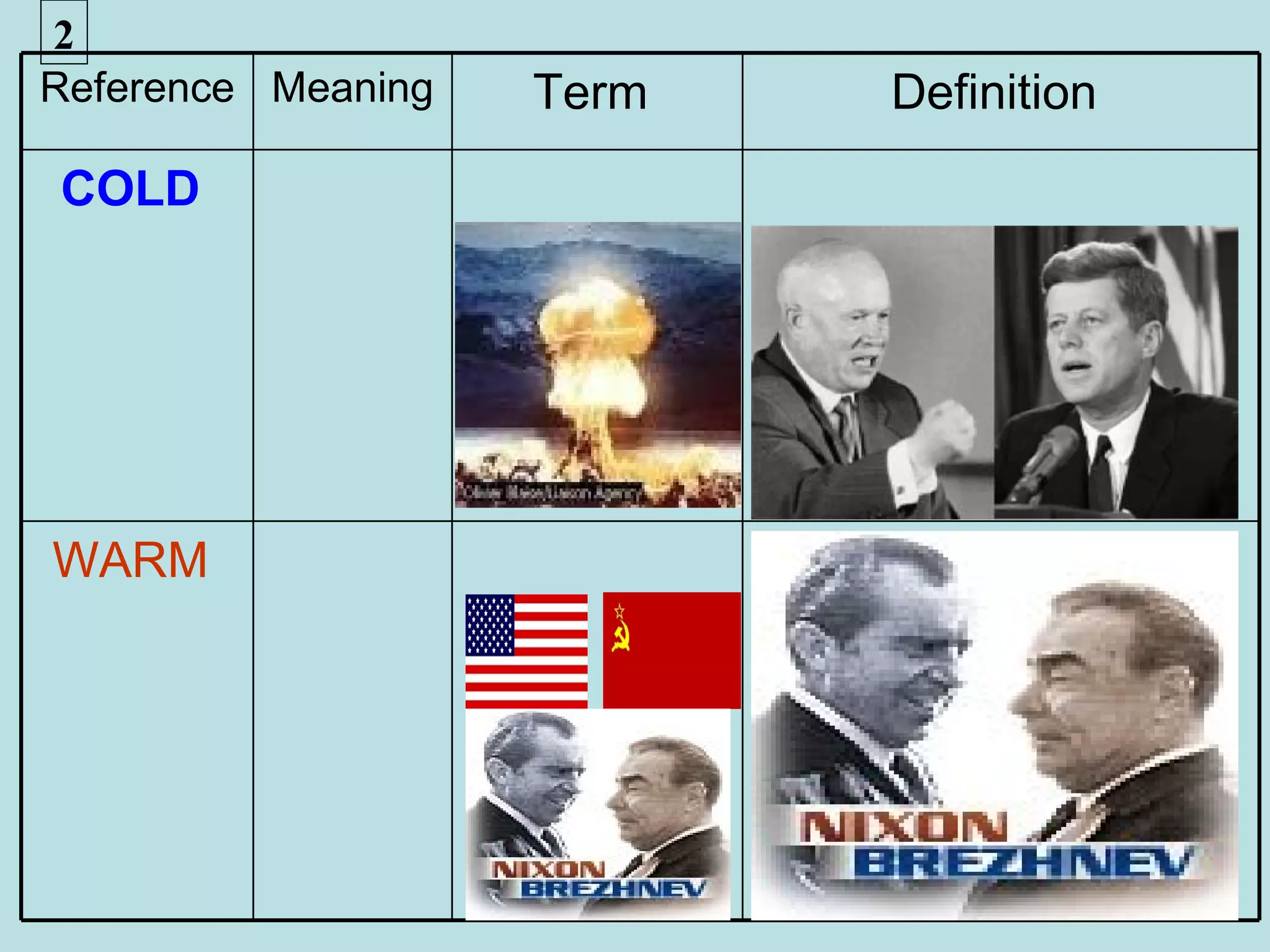
2
Reference Meaning   Term   Definition
COLD


WARM
2
Reference Meaning   Term   Definition
COLD       Bad
            


WARM      Better
           
2
Reference Meaning   Term   Definition
COLD       Bad
            


WARM      Better
           
2
Reference Meaning     Term         Definition
COLD       Bad      Brinkmanship
            


WARM      Better     Détente
           
2
Reference Meaning      Term             Definition
COLD       Bad      Brinkmanship a) Pushing an enemy to
                                    the point of disaster
            


WARM      Better     Détente           a) Less tension
                                 b) Flexible to differences
                                      c) Realist politics
2
Reference Meaning     Term               Definition
COLD       Bad      Brinkmanship •    Pushing an enemy to
                                       the point of disaster
            
                                     • Create immense
                                        pressure until one
                                         side backs down


WARM      Better     Détente          a) Less tension
                                b) Flexible to differences
                                     c) Realist politics
                                    d) French word for
                                         relaxation
Back
3                               De-Stalinization                                                  Back
                                                                                                       Back
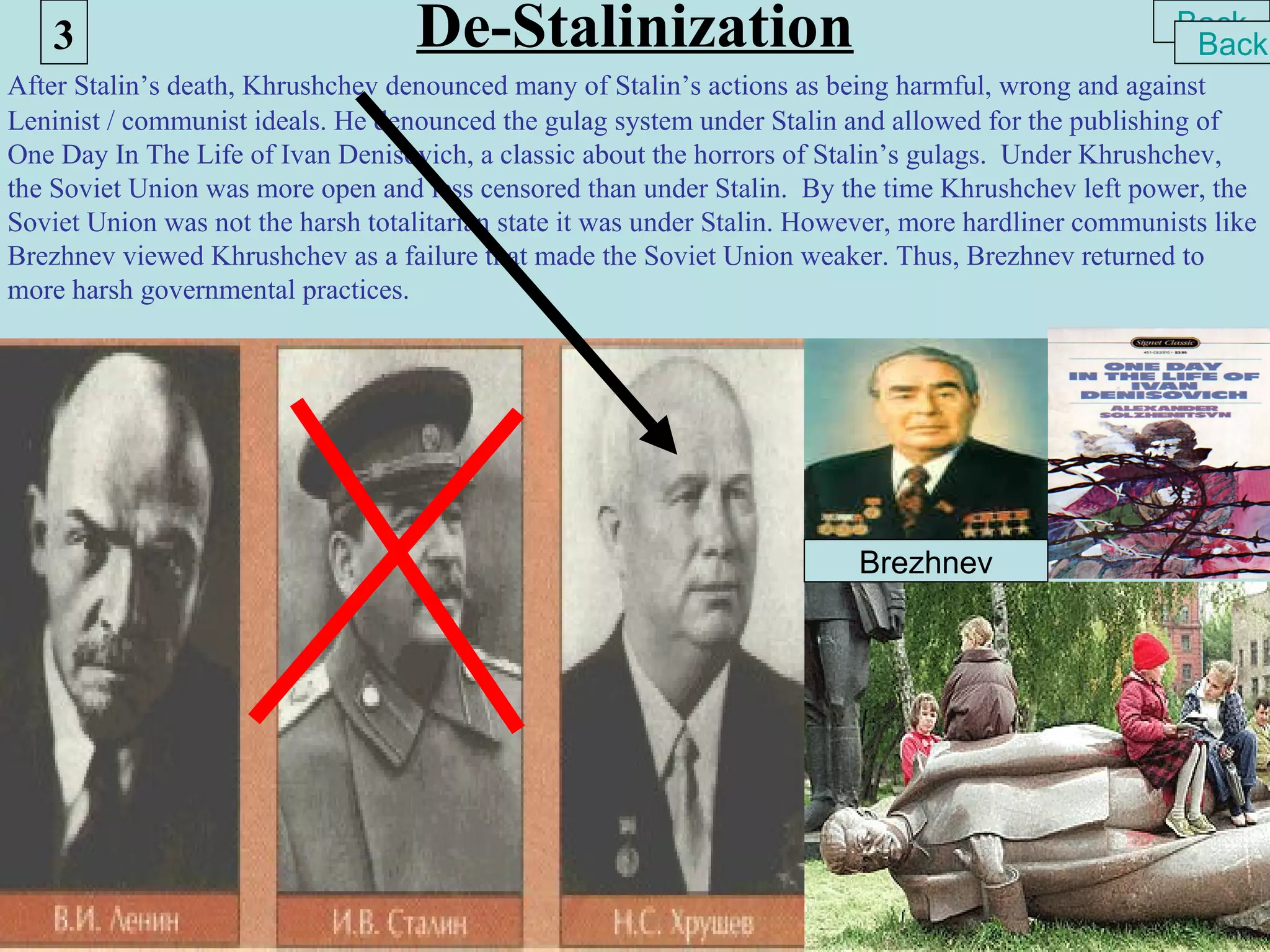
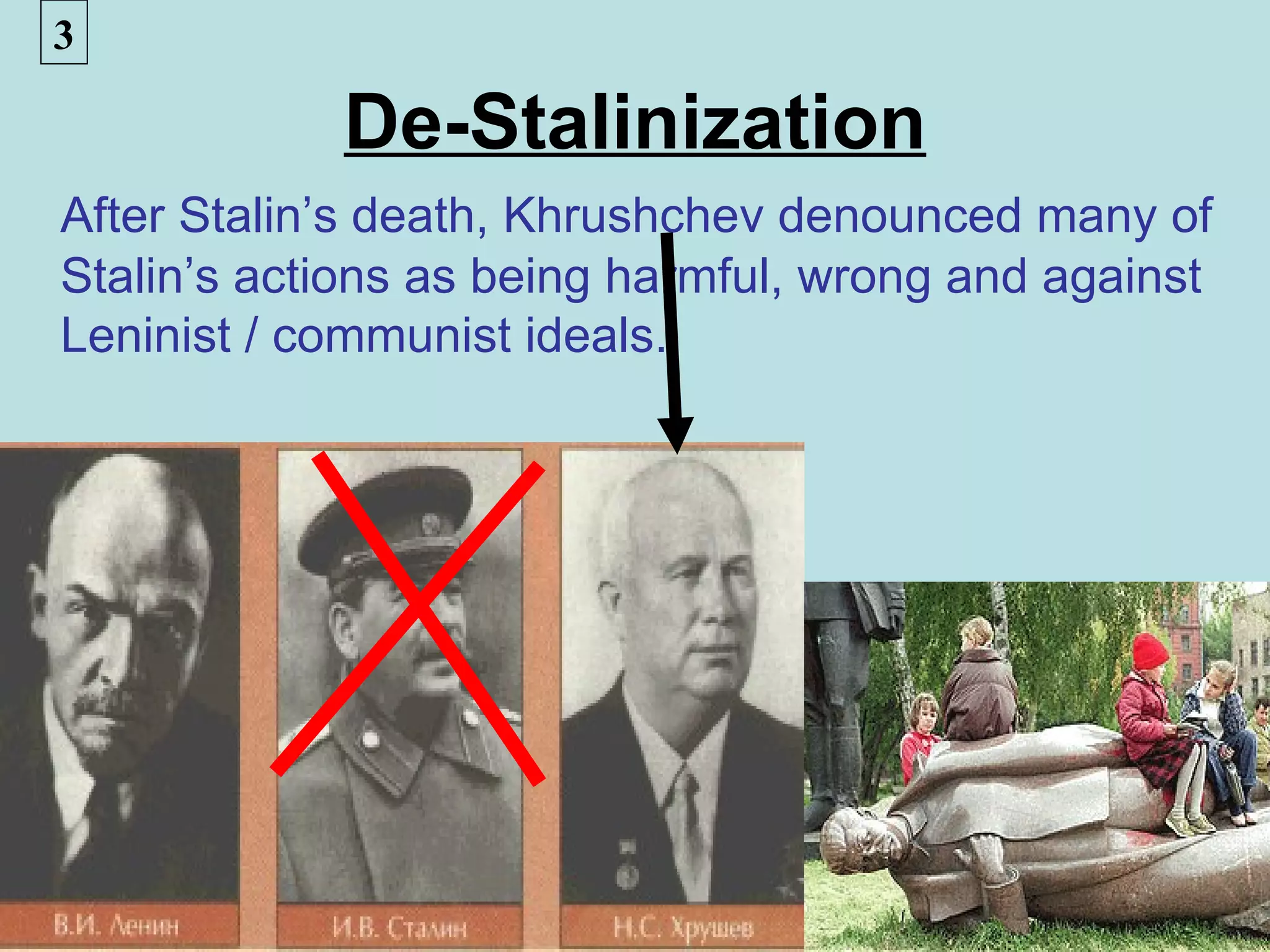
After Stalin’s death, Khrushchev denounced many of Stalin’s actions as being harmful, wrong and against
Leninist / communist ideals. He denounced the gulag system under Stalin and allowed for the publishing of
One Day In The Life of Ivan Denisovich, a classic about the horrors of Stalin’s gulags. Under Khrushchev,
the Soviet Union was more open and less censored than under Stalin. By the time Khrushchev left power, the
Soviet Union was not the harsh totalitarian state it was under Stalin. However, more hardliner communists like
Brezhnev viewed Khrushchev as a failure that made the Soviet Union weaker. Thus, Brezhnev returned to
more harsh governmental practices.


                                                                          Brezhnev
3

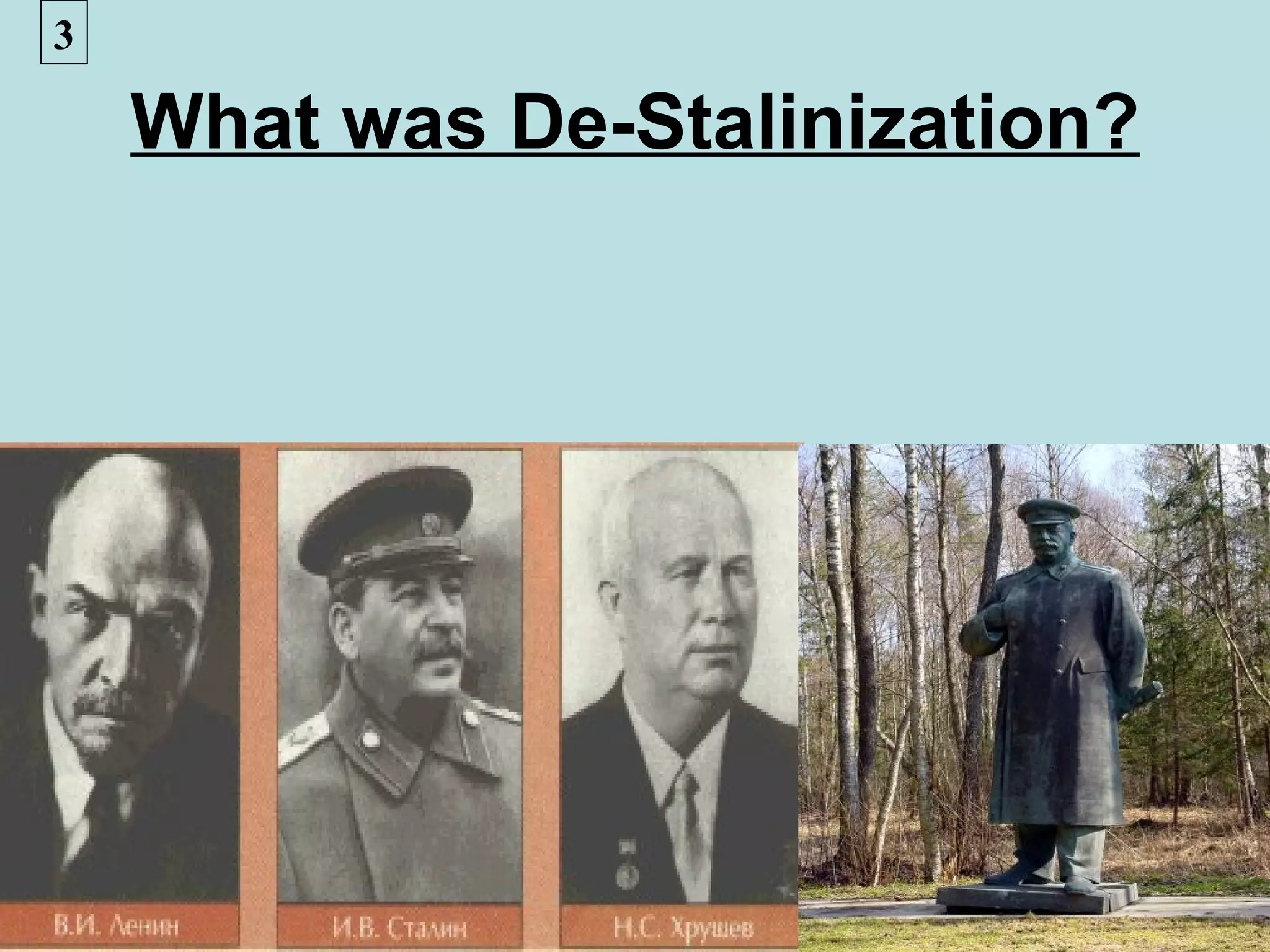
    What was De-Stalinization?
3

            De-Stalinization
After Stalin’s death, Khrushchev denounced many of
Stalin’s actions as being harmful, wrong and against
Leninist / communist ideals.
Back
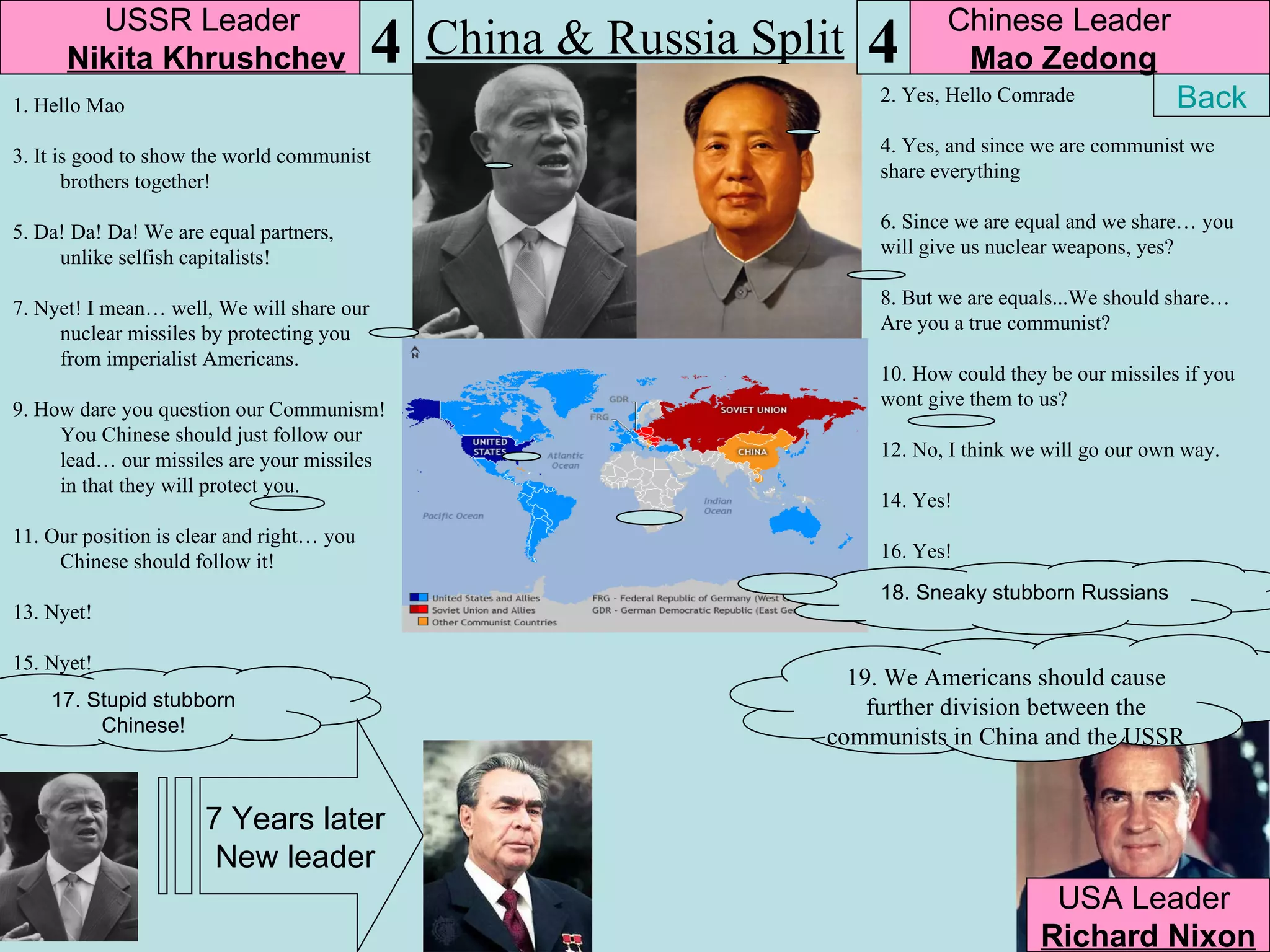
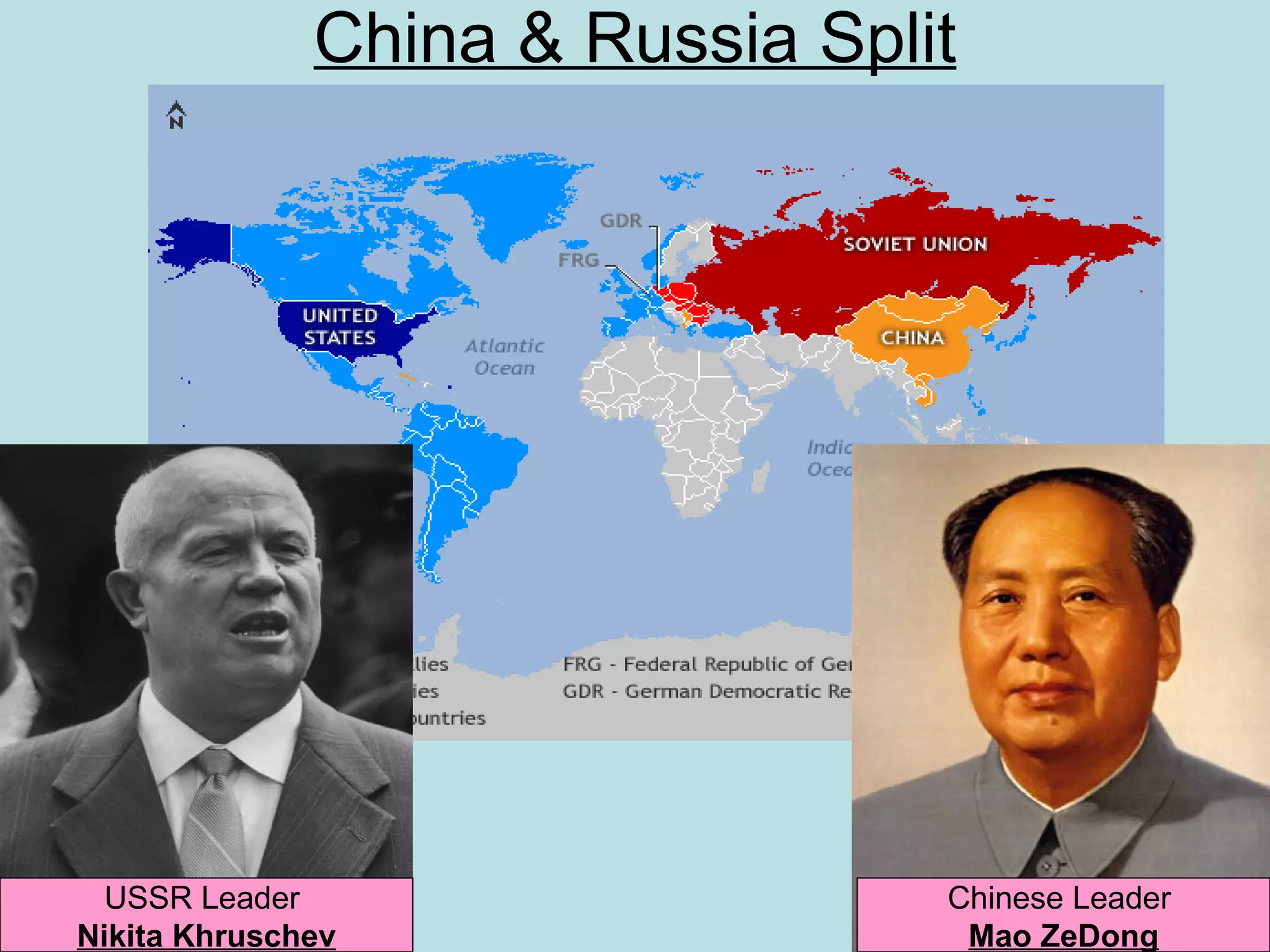
USSR Leader                                                          Chinese Leader
      Nikita Khrushchev                    4   China & Russia Split   4       Mao Zedong
                                                                      2. Yes, Hello Comrade             Back
                                               China & Russia Split
1. Hello Mao

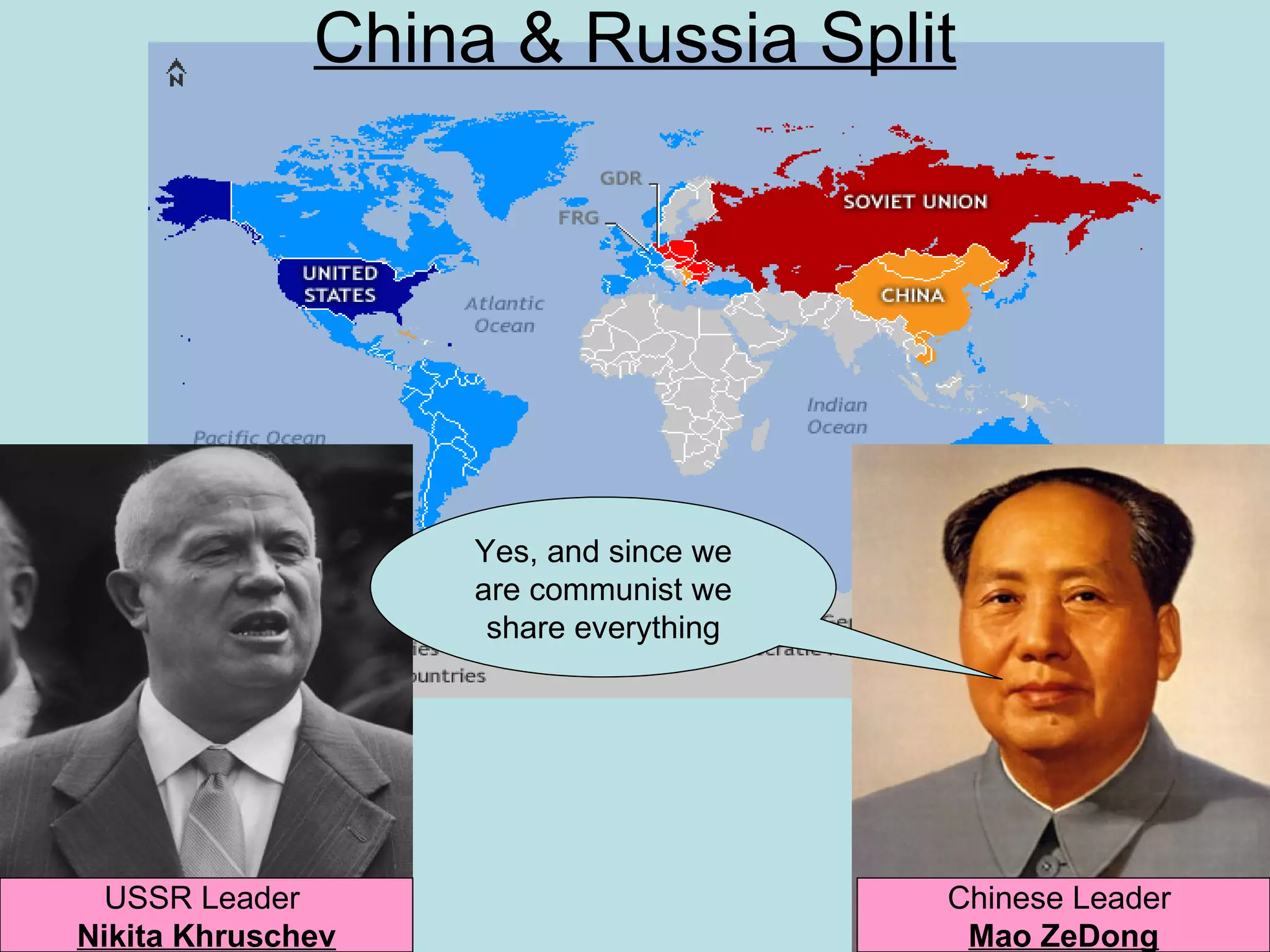
3. It is good to show the world communist                             4. Yes, and since we are communist we
       brothers together!                                             share everything

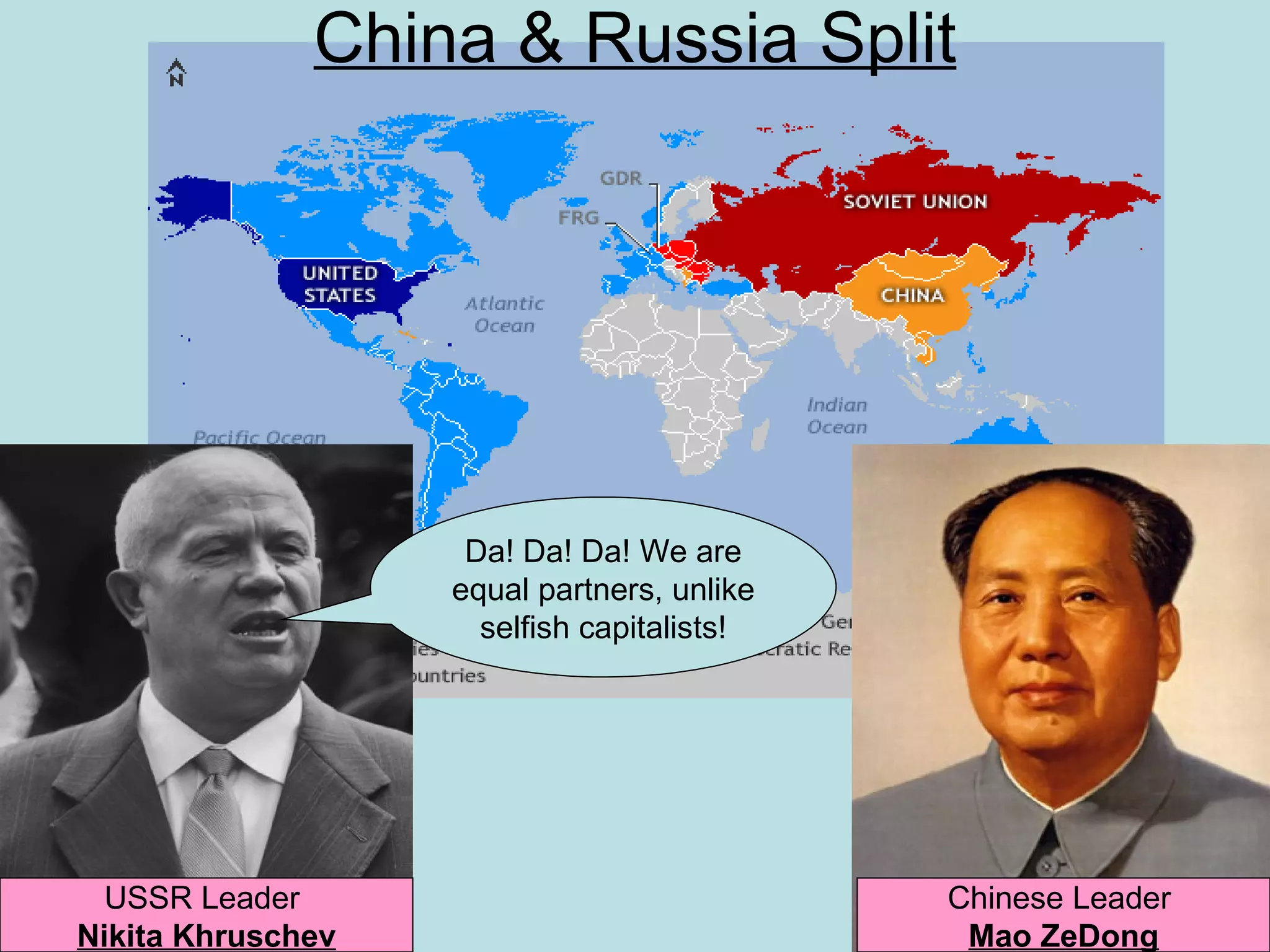
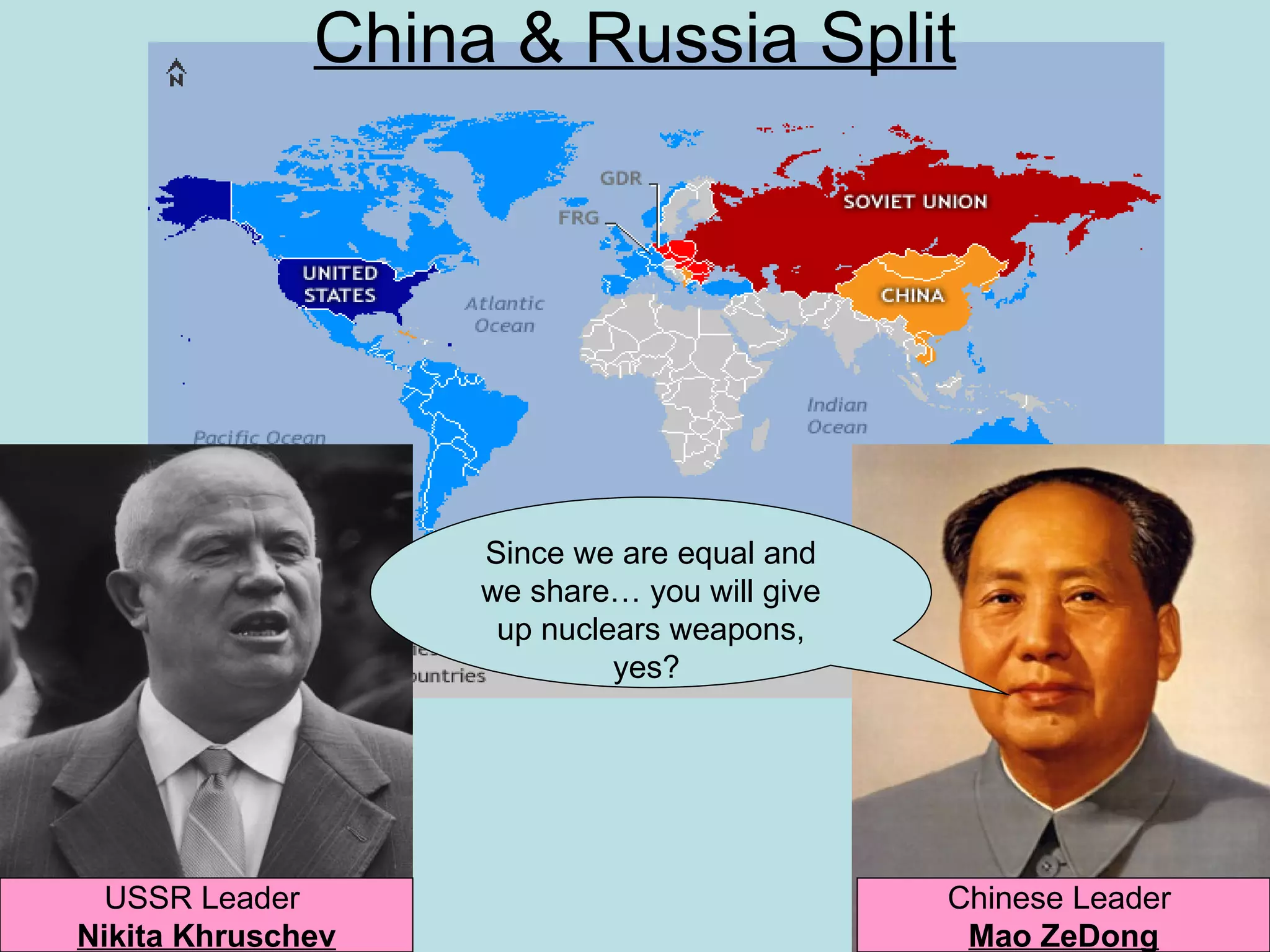
5. Da! Da! Da! We are equal partners,                                 6. Since we are equal and we share… you
     unlike selfish capitalists!                                      will give us nuclear weapons, yes?

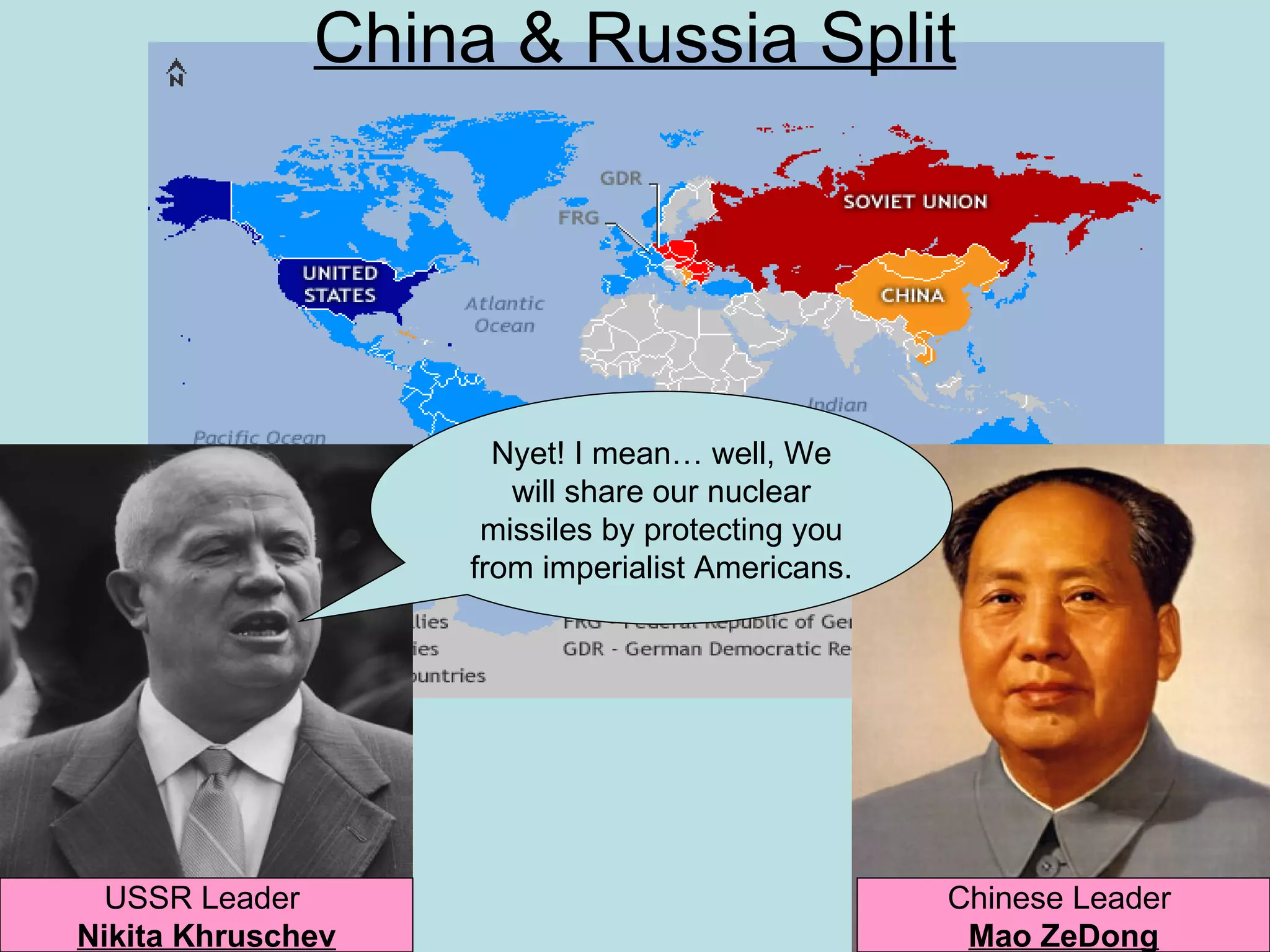
7. Nyet! I mean… well, We will share our                              8. But we are equals...We should share…
     nuclear missiles by protecting you                               Are you a true communist?
     from imperialist Americans.
                                                                      10. How could they be our missiles if you
9. How dare you question our Communism!                               wont give them to us?
     You Chinese should just follow our
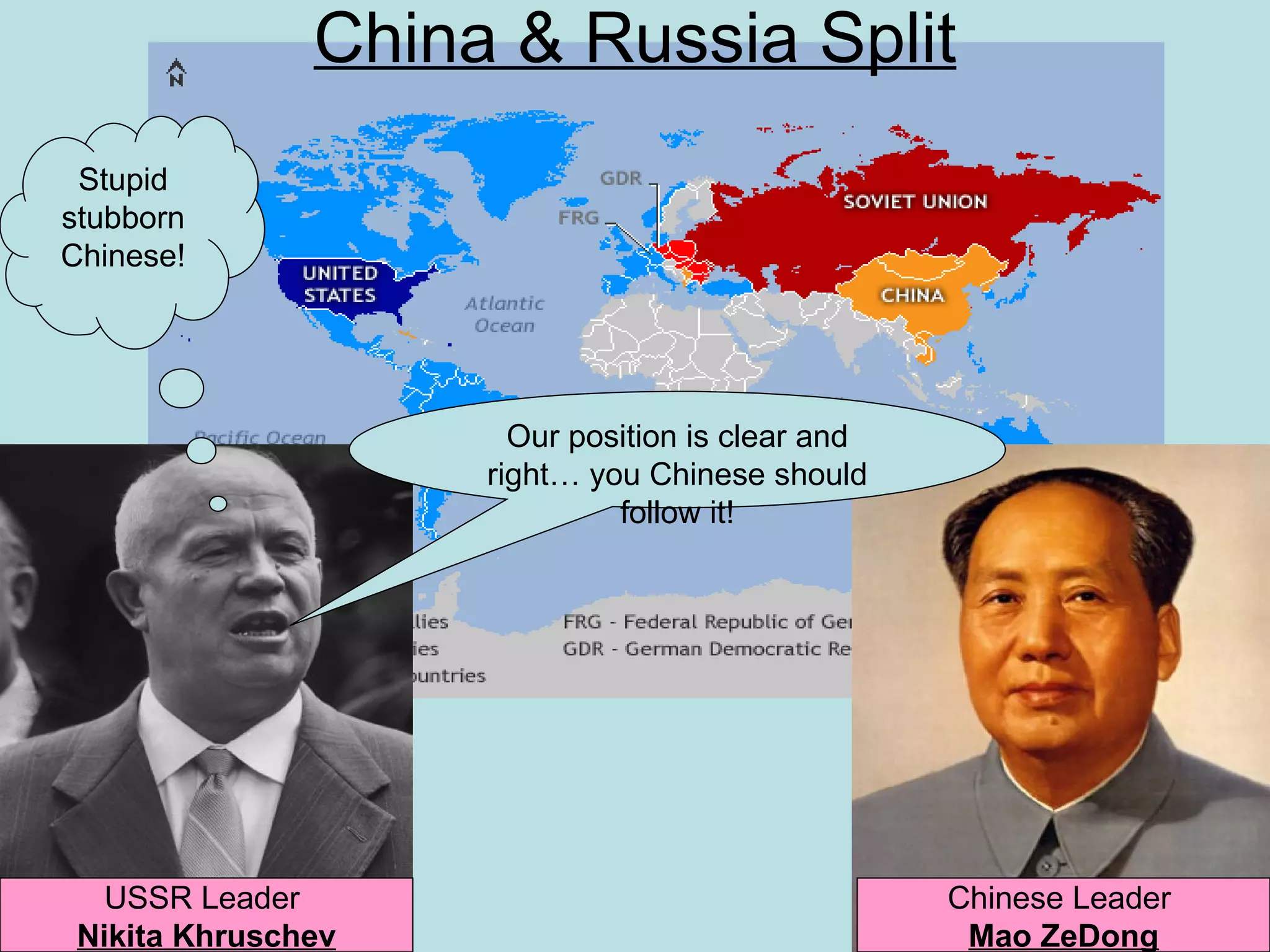
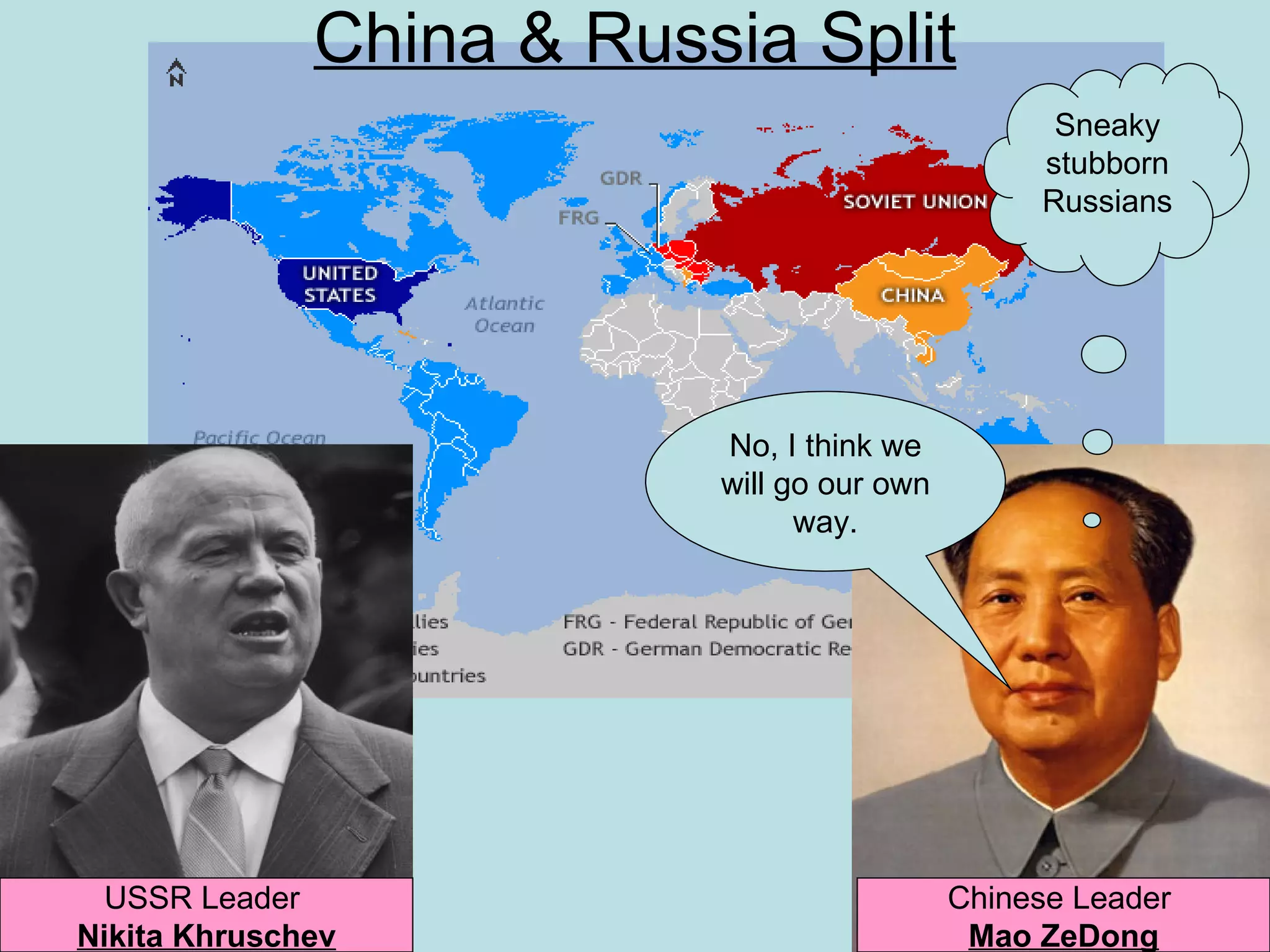
     lead… our missiles are your missiles                             12. No, I think we will go our own way.
     in that they will protect you.
                                                                      14. Yes!
11. Our position is clear and right… you
     Chinese should follow it!                                        16. Yes!
                                                                      18. Sneaky stubborn Russians
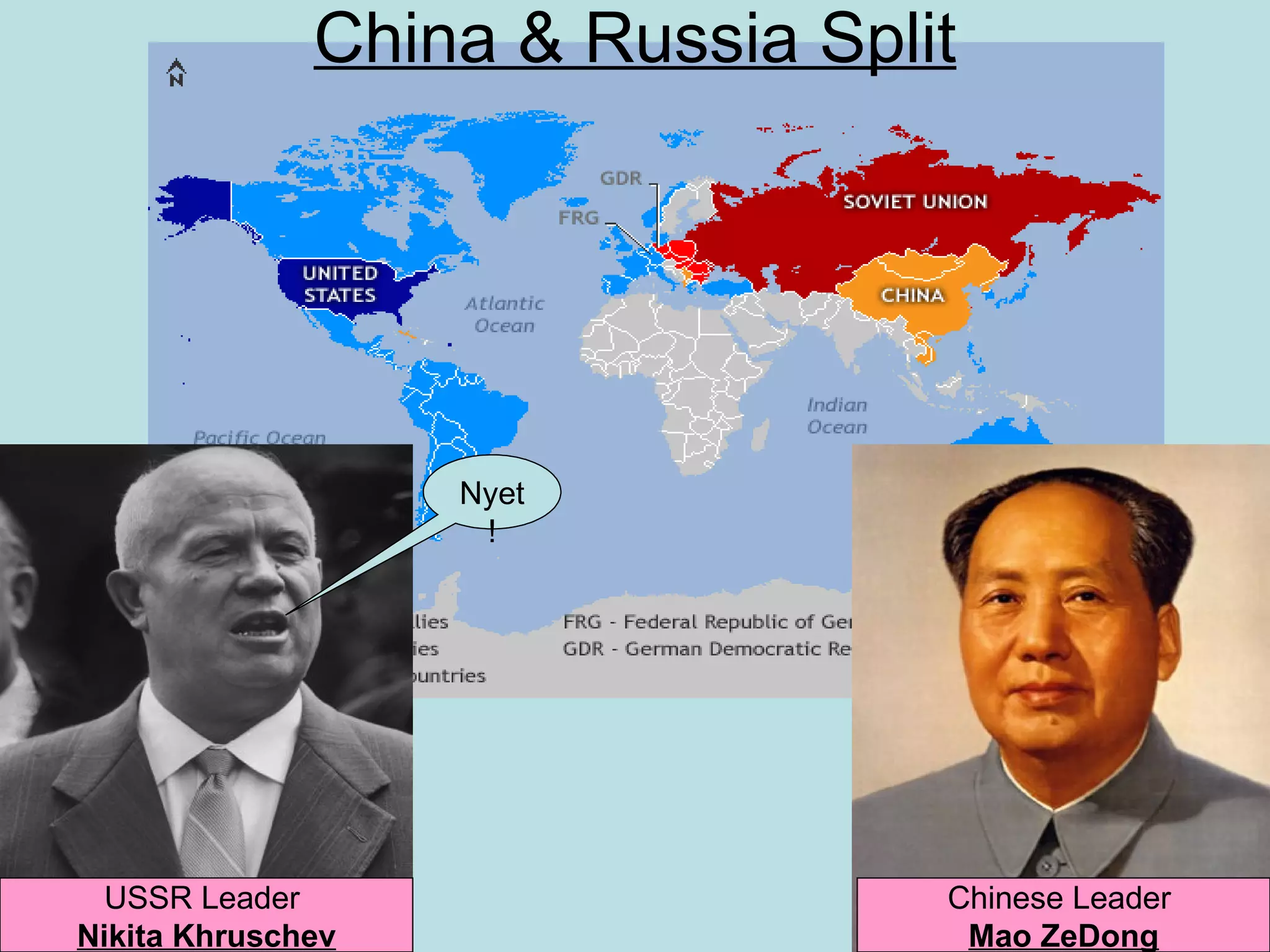
13. Nyet!

15. Nyet!
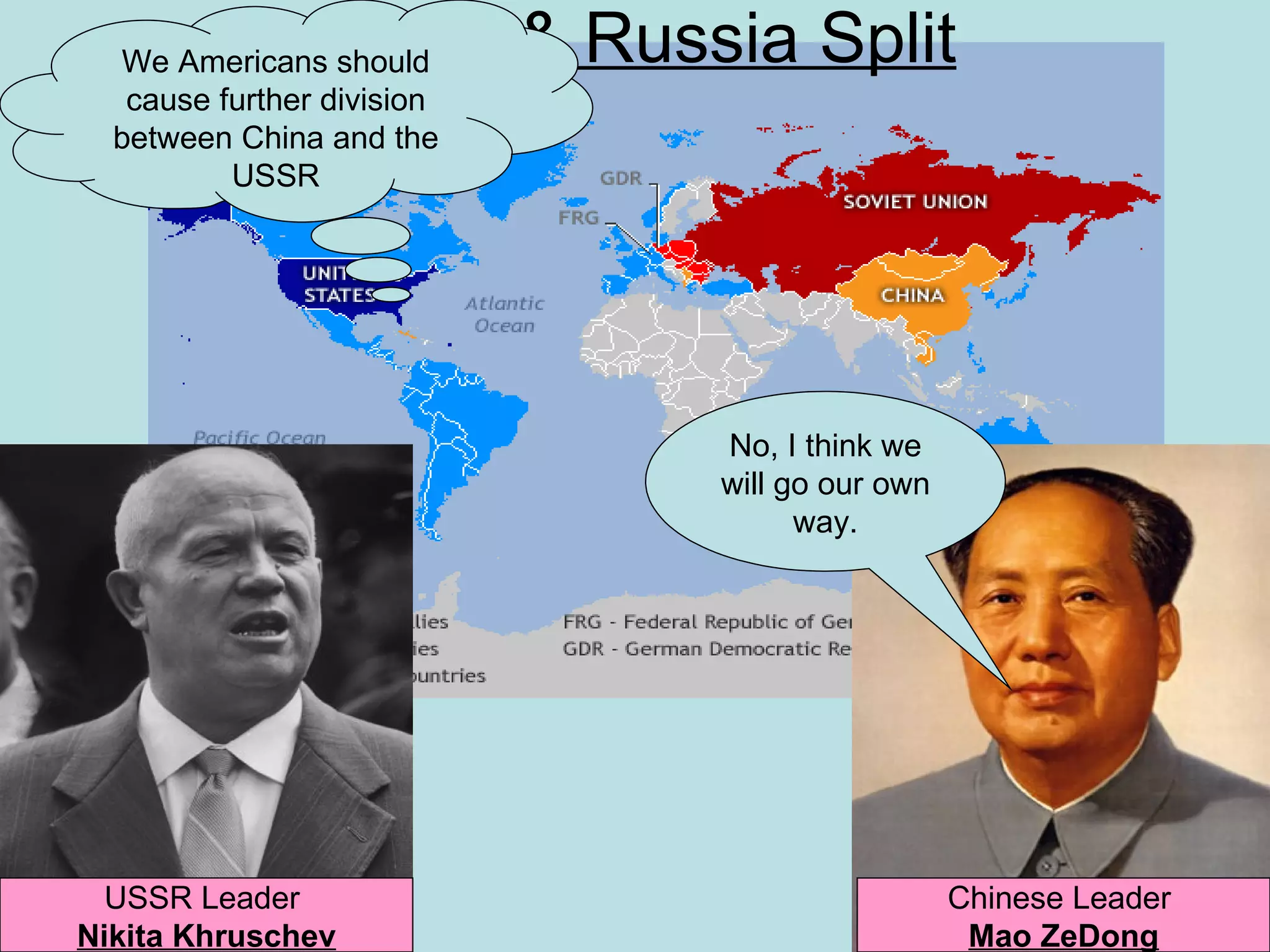
                                                                    19. We Americans should cause
    17. Stupid stubborn                                               further division between the
         Chinese!
                                                                  communists in China and the USSR


                      7 Years later
                       New leader
                                                                                         USA Leader
                                                                                        Richard Nixon
Chinese Leader
                          7 Years later                                            Mao ZeDong
                           New leader                                     21. Hi, Nixon and America!
                                                                          Yes, let’s hang out.
          USSR Leader
            Brezhnev                                                                                    Back
22. I no like! Maybe I talk Nixon too, yes!


 23. Yes, now I can apply                                                         20. Hi Mao, want to hang out?
the idea of DETENTE                                                               Them Russians are treating
     to the Cold War                          China & Russia Split                you wrong. The US won’t!


                                               24. What is DÉTENTE:
                                     1. Associated more with Nixon and Carter
                           2. Not associated with Truman, Eisenhower, JFK and Reagan
                                           3. “ Warming” of the Cold War
                                            4. Opposite of Brinkmanship
                           5. General reduction of tension between Soviet Union & USA
4
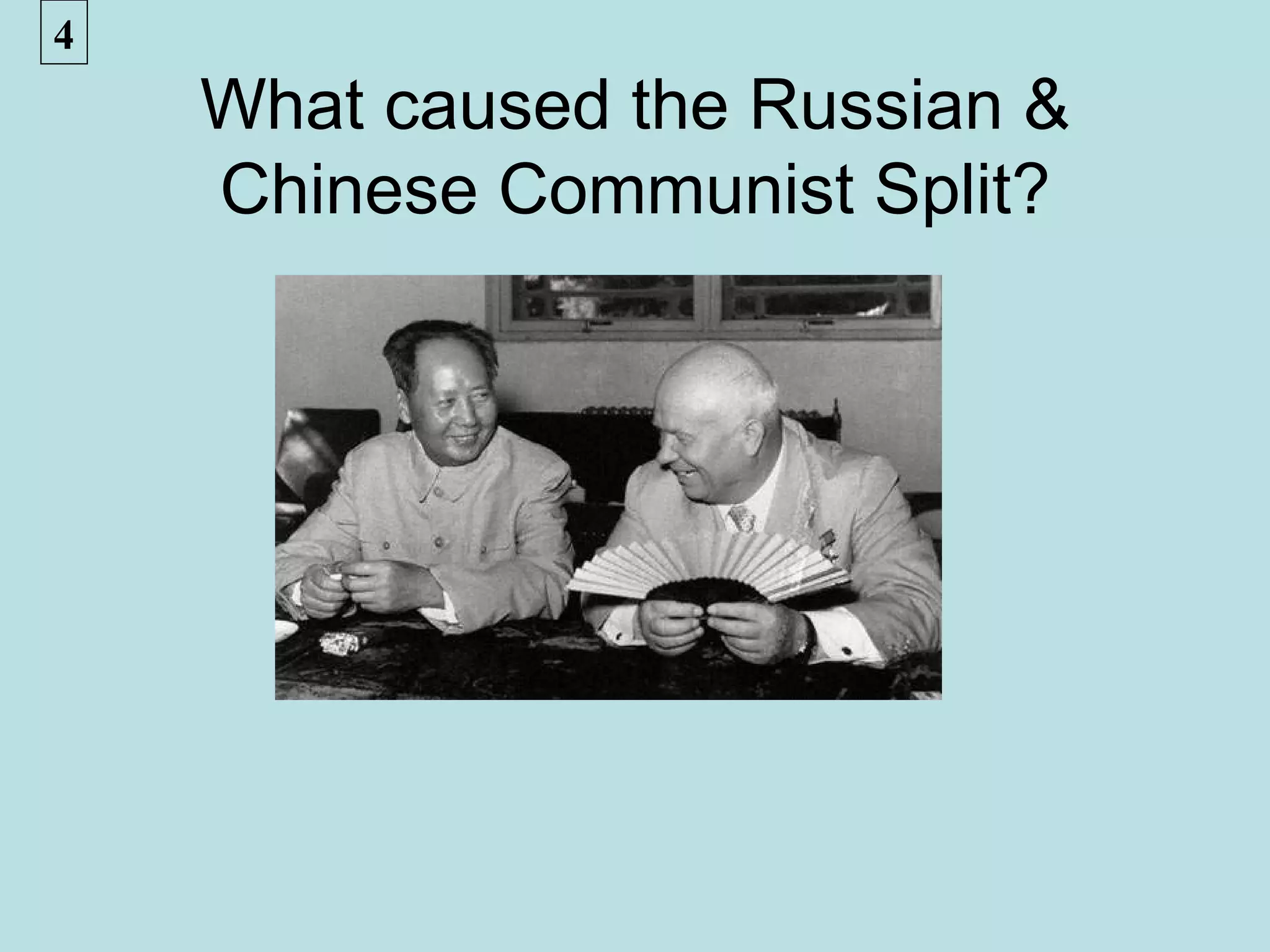
    What caused the Russian &
    Chinese Communist Split?
China & Russia Split


  USSR Leader                    Chinese Leader
Nikita Khruschev                  Mao ZeDong
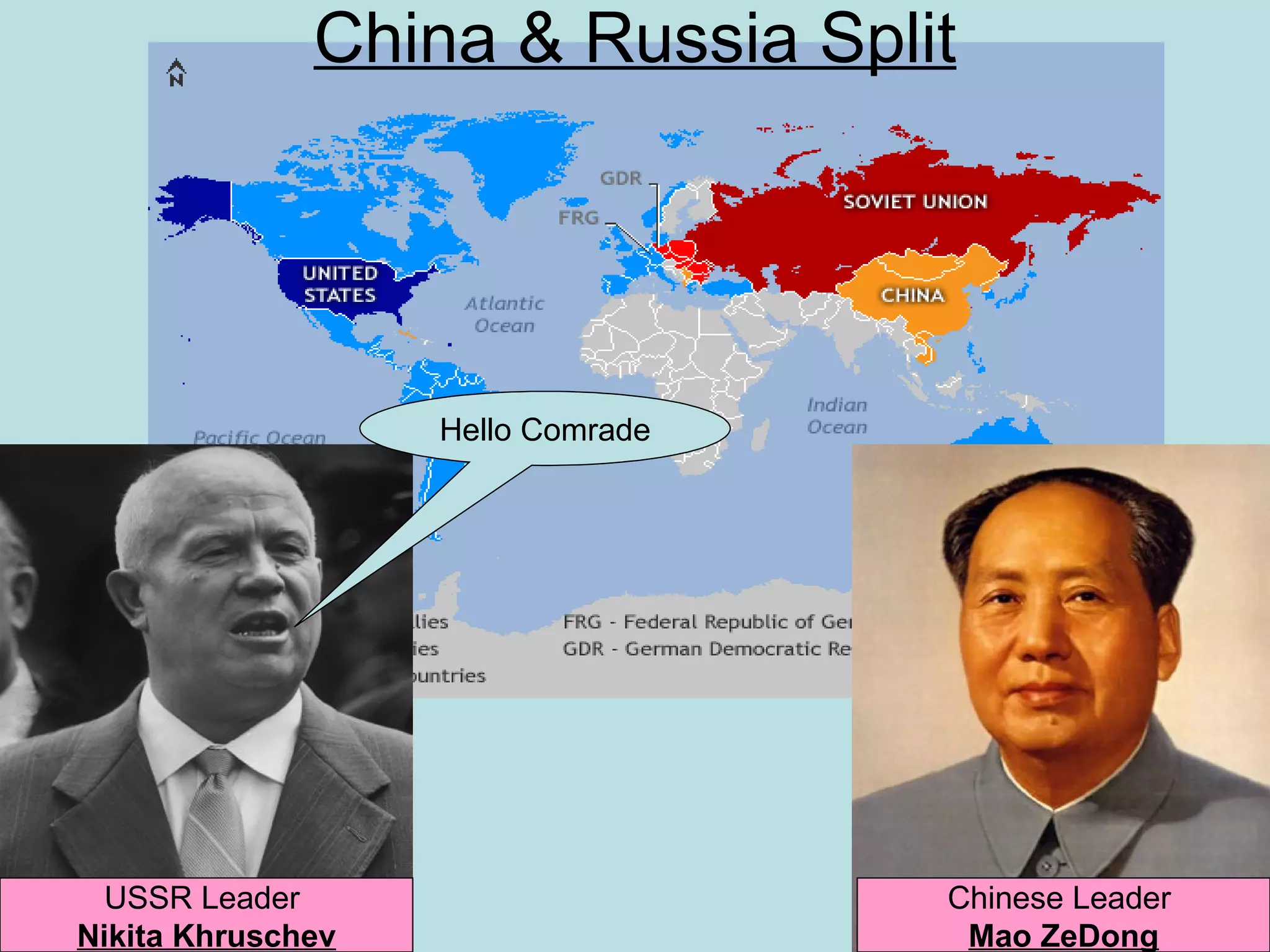
China & Russia Split


                   Hello Comrade


  USSR Leader                      Chinese Leader
Nikita Khruschev                    Mao ZeDong
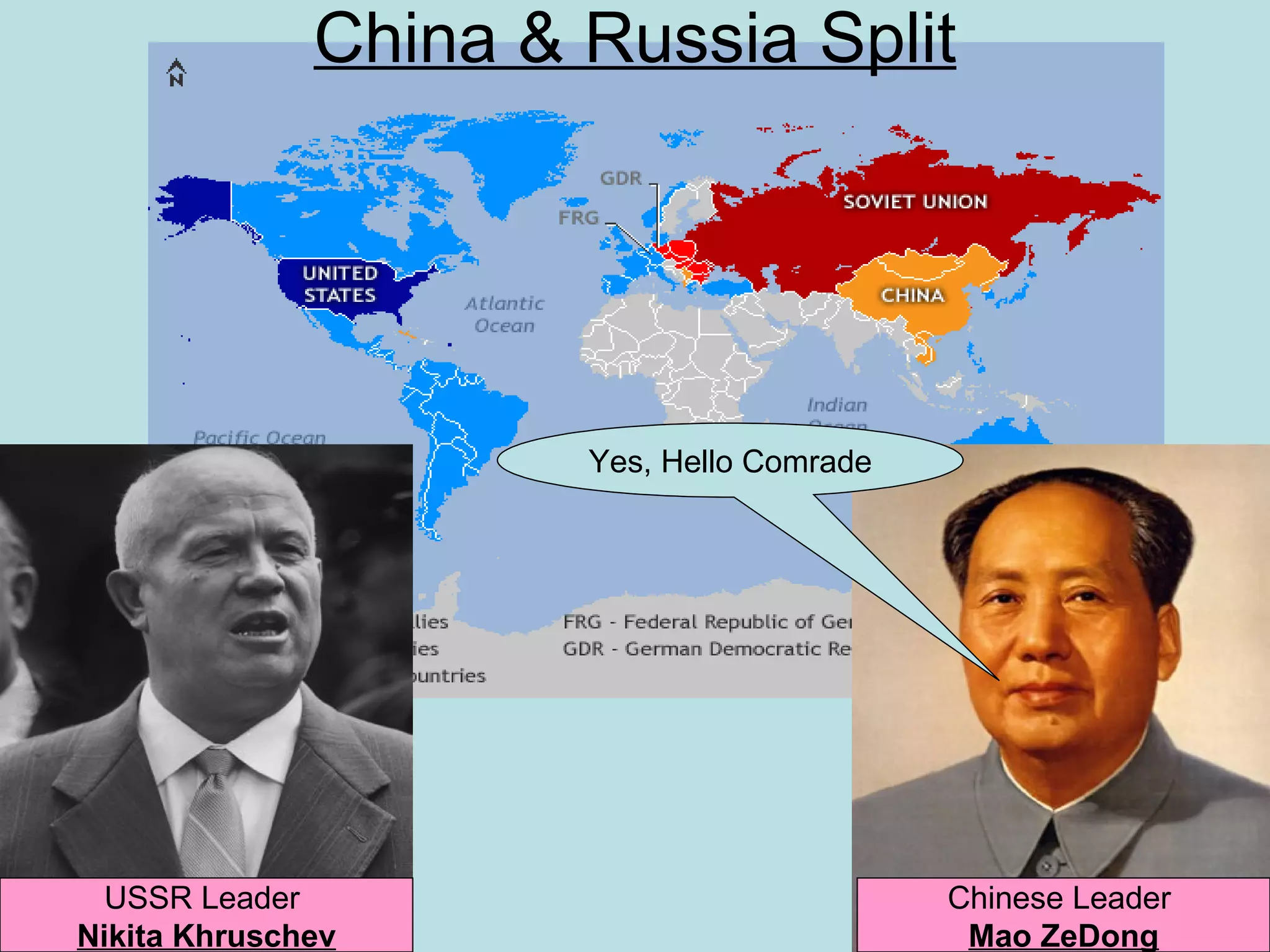
China & Russia Split


                      Yes, Hello Comrade


  USSR Leader                              Chinese Leader
Nikita Khruschev                            Mao ZeDong
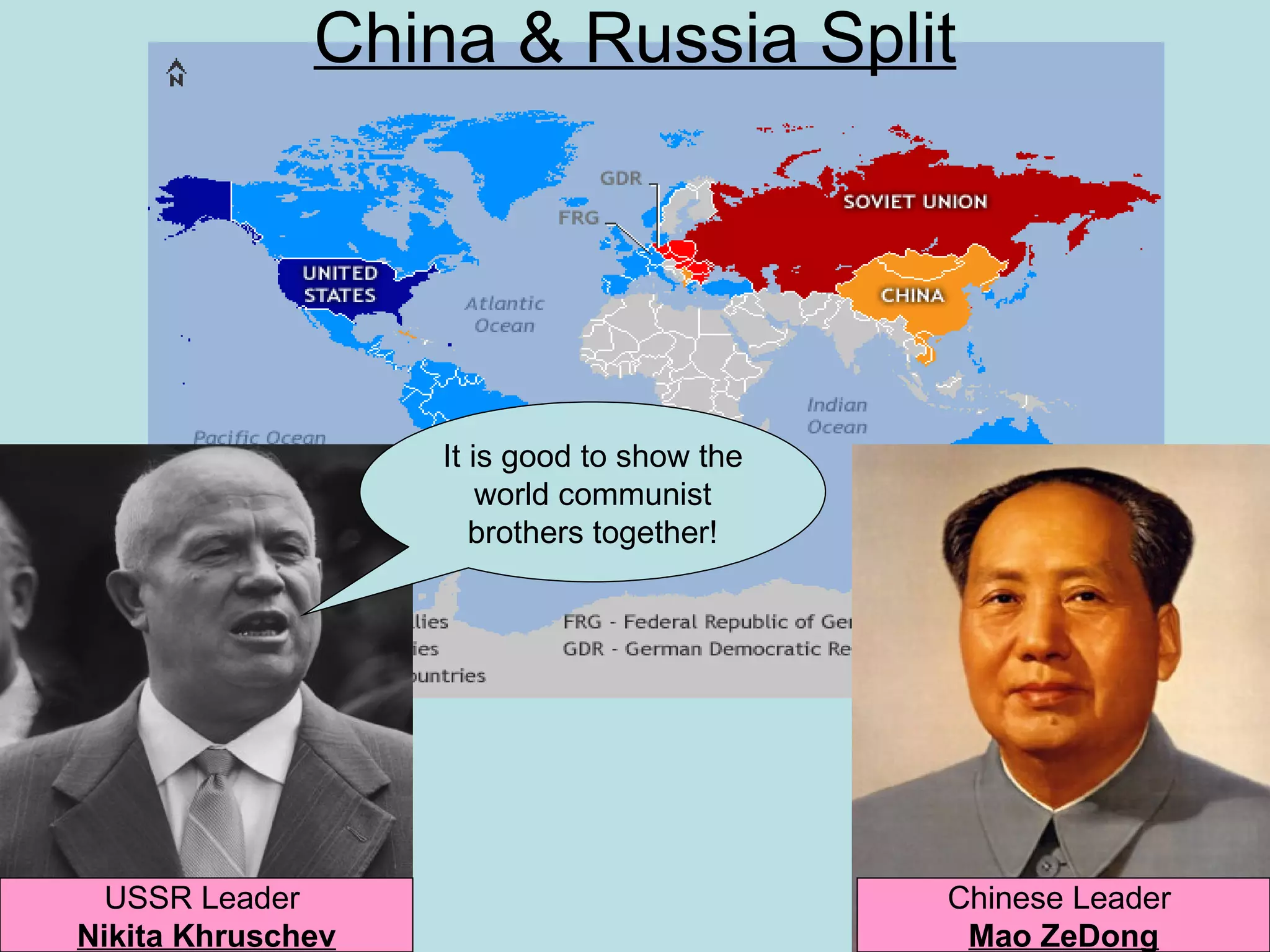
China & Russia Split


                   It is good to show the
                       world communist
                      brothers together!


  USSR Leader                               Chinese Leader
Nikita Khruschev                             Mao ZeDong
China & Russia Split


                   Yes, and since we
                   are communist we
                    share everything


  USSR Leader                          Chinese Leader
Nikita Khruschev                        Mao ZeDong
China & Russia Split


                    Da! Da! Da! We are
                   equal partners, unlike
                     selfish capitalists!


  USSR Leader                               Chinese Leader
Nikita Khruschev                             Mao ZeDong
China & Russia Split


                   Since we are equal and
                   we share… you will give
                    up nuclears weapons,
                            yes?


  USSR Leader                                Chinese Leader
Nikita Khruschev                              Mao ZeDong
China & Russia Split


                     Nyet! I mean… well, We
                      will share our nuclear
                    missiles by protecting you
                   from imperialist Americans.


  USSR Leader                                    Chinese Leader
Nikita Khruschev                                  Mao ZeDong
China & Russia Split


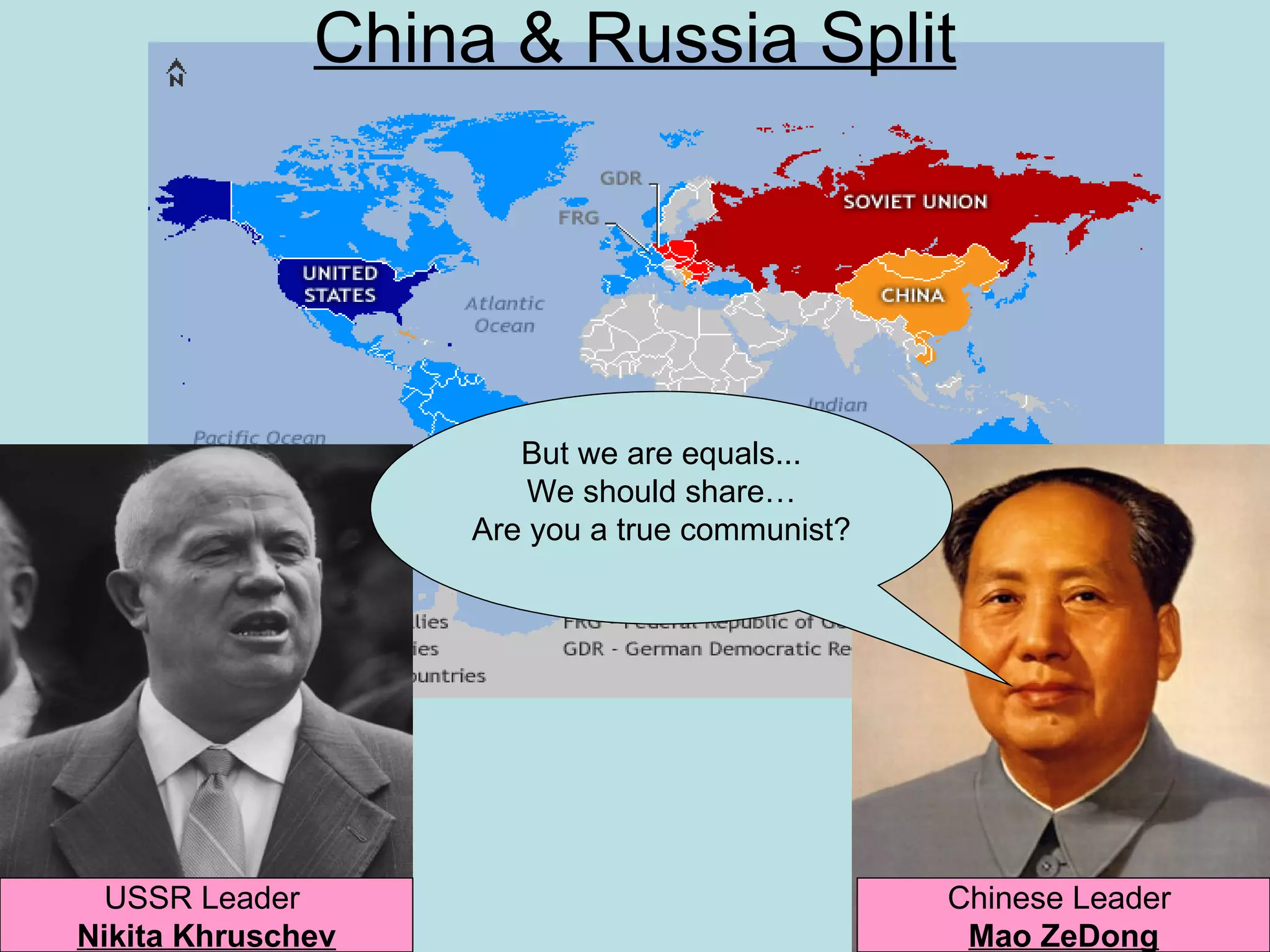
                      But we are equals...
                       We should share…
                   Are you a true communist?


  USSR Leader                                  Chinese Leader
Nikita Khruschev                                Mao ZeDong
China & Russia Split


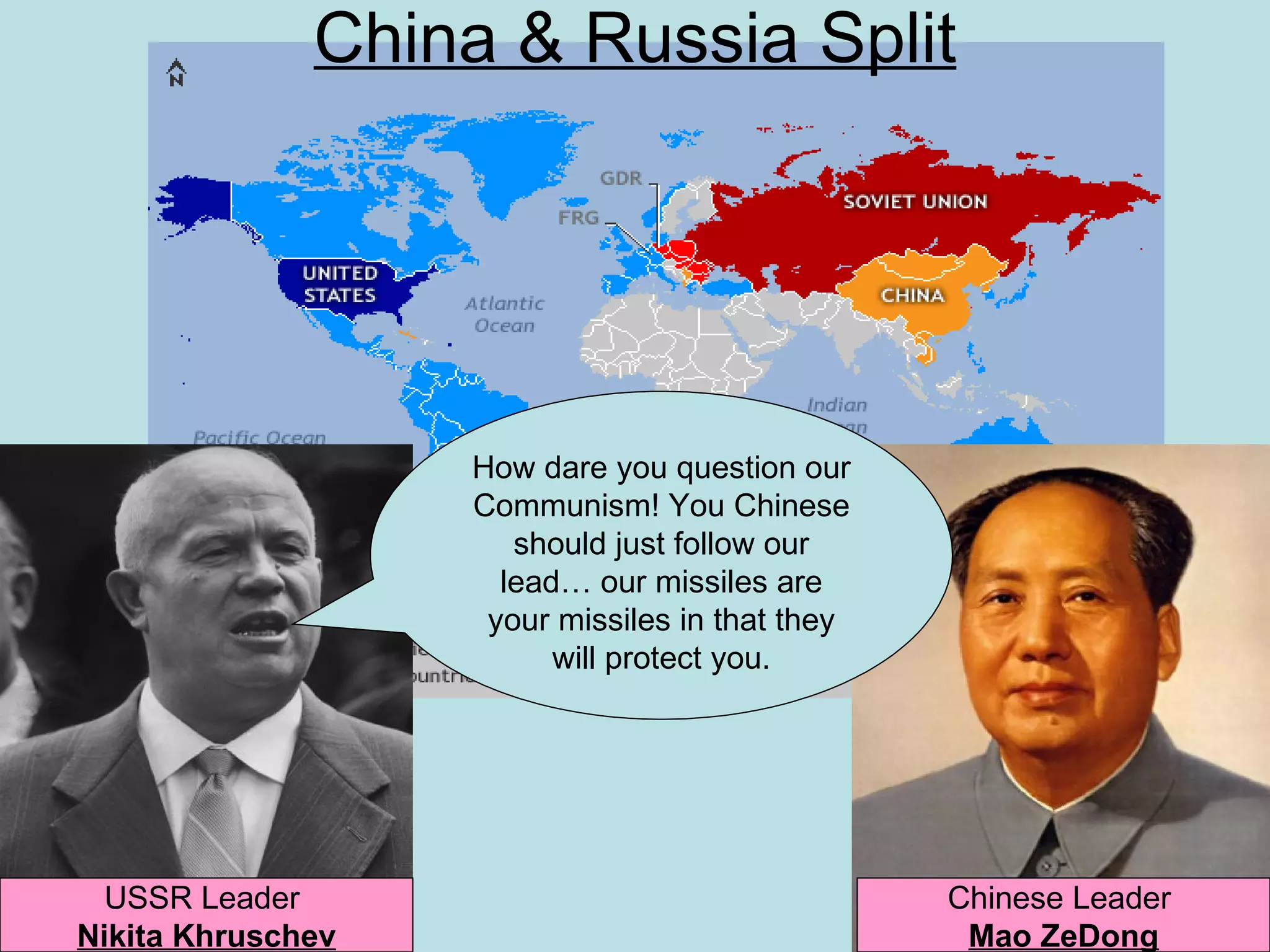
                   How dare you question our
                   Communism! You Chinese
                      should just follow our
                     lead… our missiles are
                    your missiles in that they
                         will protect you.


  USSR Leader                                    Chinese Leader
Nikita Khruschev                                  Mao ZeDong
China & Russia Split


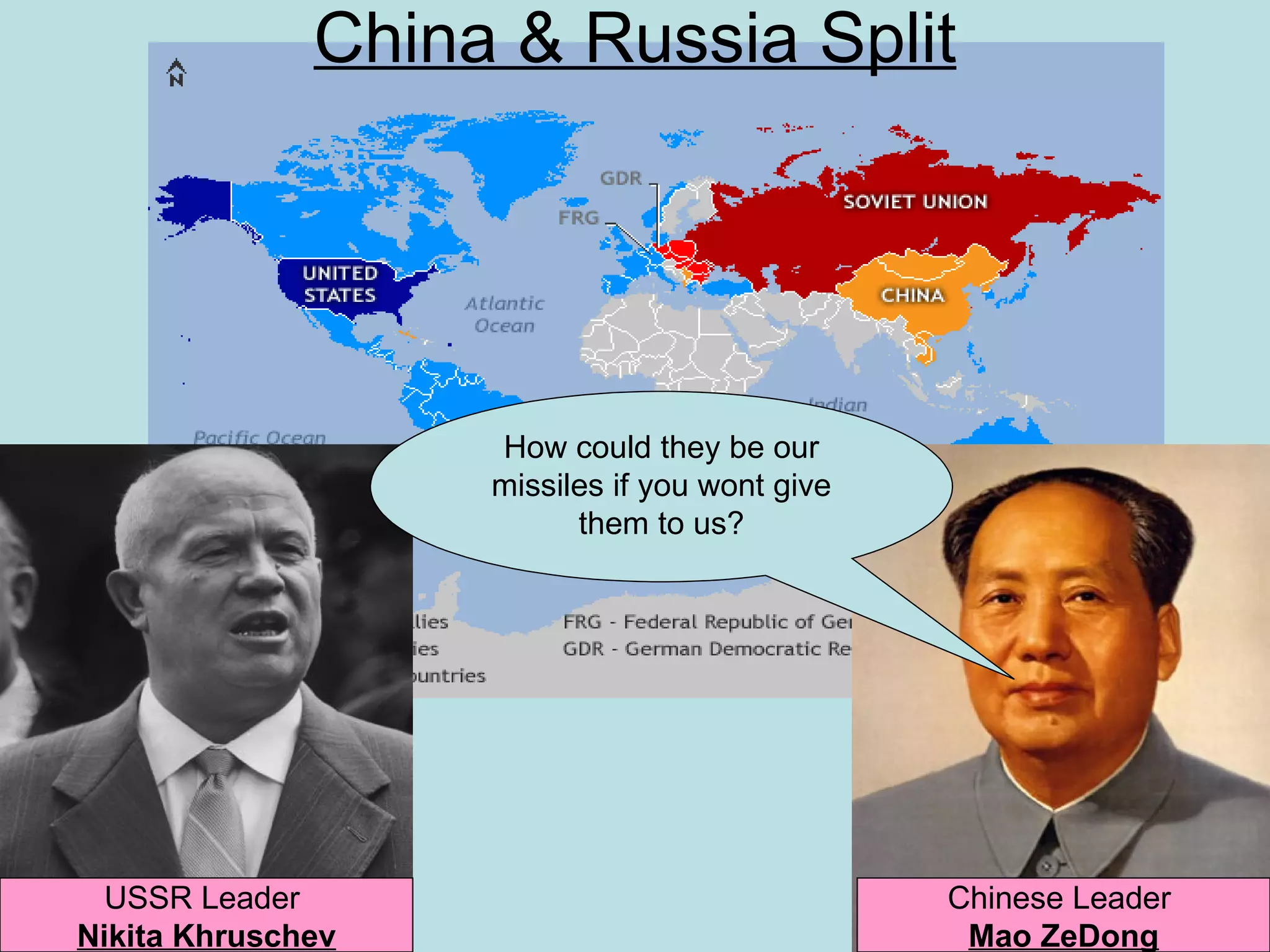
                   How could they be our
                   missiles if you wont give
                         them to us?


  USSR Leader                                  Chinese Leader
Nikita Khruschev                                Mao ZeDong
China & Russia Split
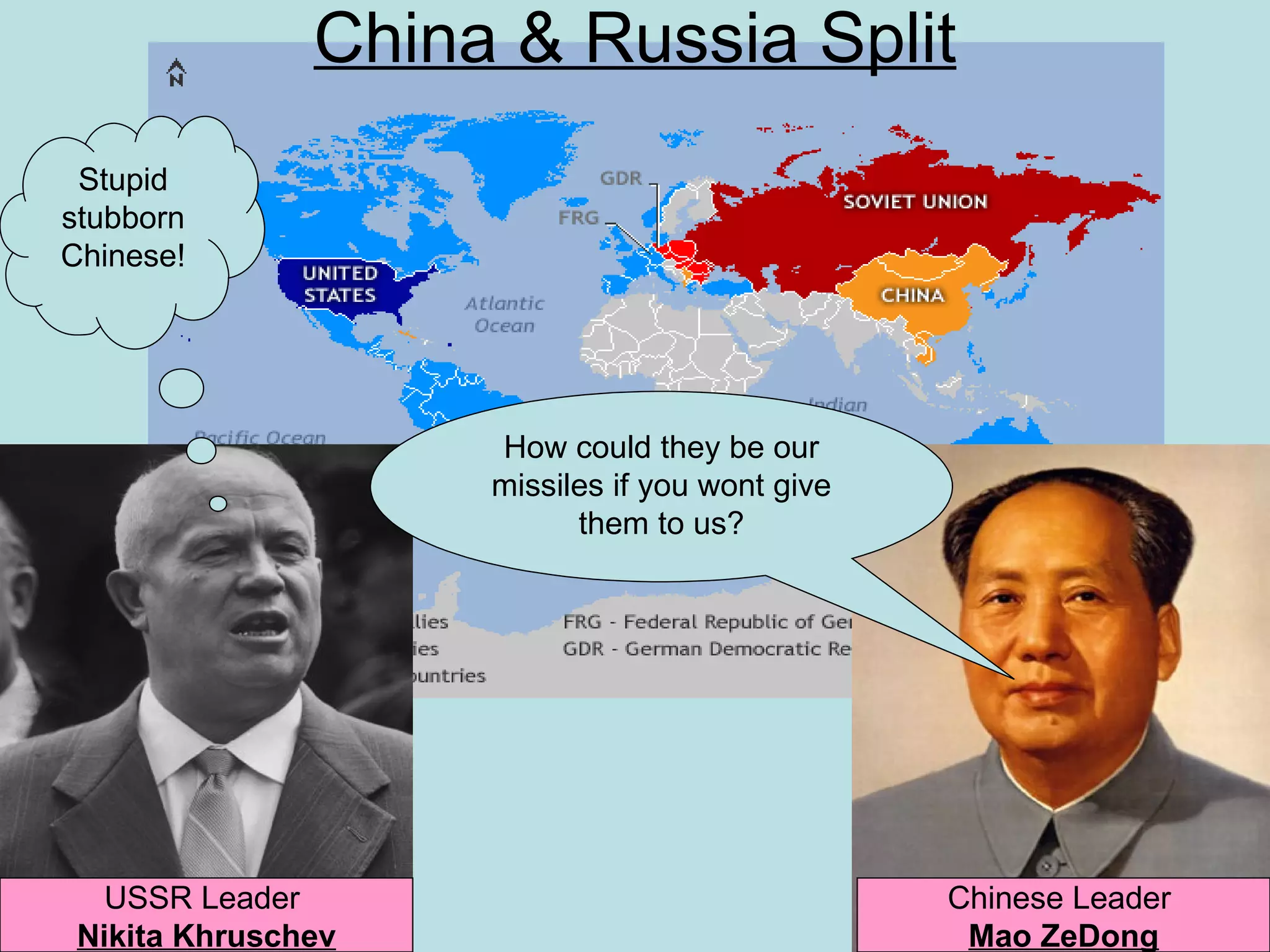
 Stupid
stubborn
Chinese!


                    How could they be our
                    missiles if you wont give
                          them to us?


   USSR Leader                                  Chinese Leader
 Nikita Khruschev                                Mao ZeDong
China & Russia Split
 Stupid
stubborn
Chinese!


                      Our position is clear and
                    right… you Chinese should
                             follow it!


   USSR Leader                                    Chinese Leader
 Nikita Khruschev                                  Mao ZeDong
China & Russia Split
                                                  Sneaky
                                                 stubborn
                                                 Russians


                          No, I think we
                          will go our own
                                way.


  USSR Leader                               Chinese Leader
Nikita Khruschev                             Mao ZeDong
China & Russia Split
  We Americans should
   cause further division
  between China and the
          USSR


                            No, I think we
                            will go our own
                                  way.


  USSR Leader                                 Chinese Leader
Nikita Khruschev                               Mao ZeDong
China & Russia Split


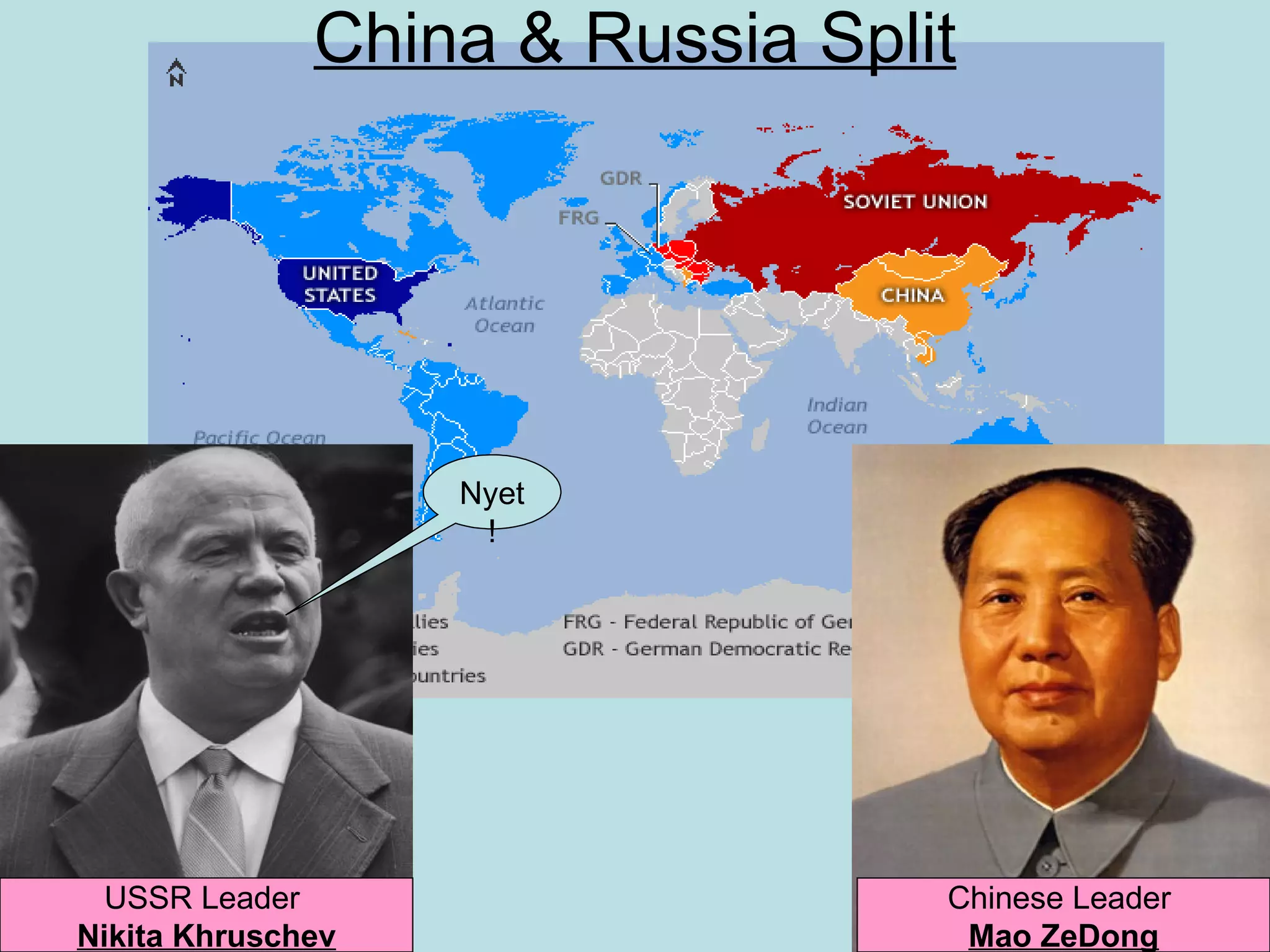
                   Nyet
                    !


  USSR Leader                    Chinese Leader
Nikita Khruschev                  Mao ZeDong
China & Russia Split


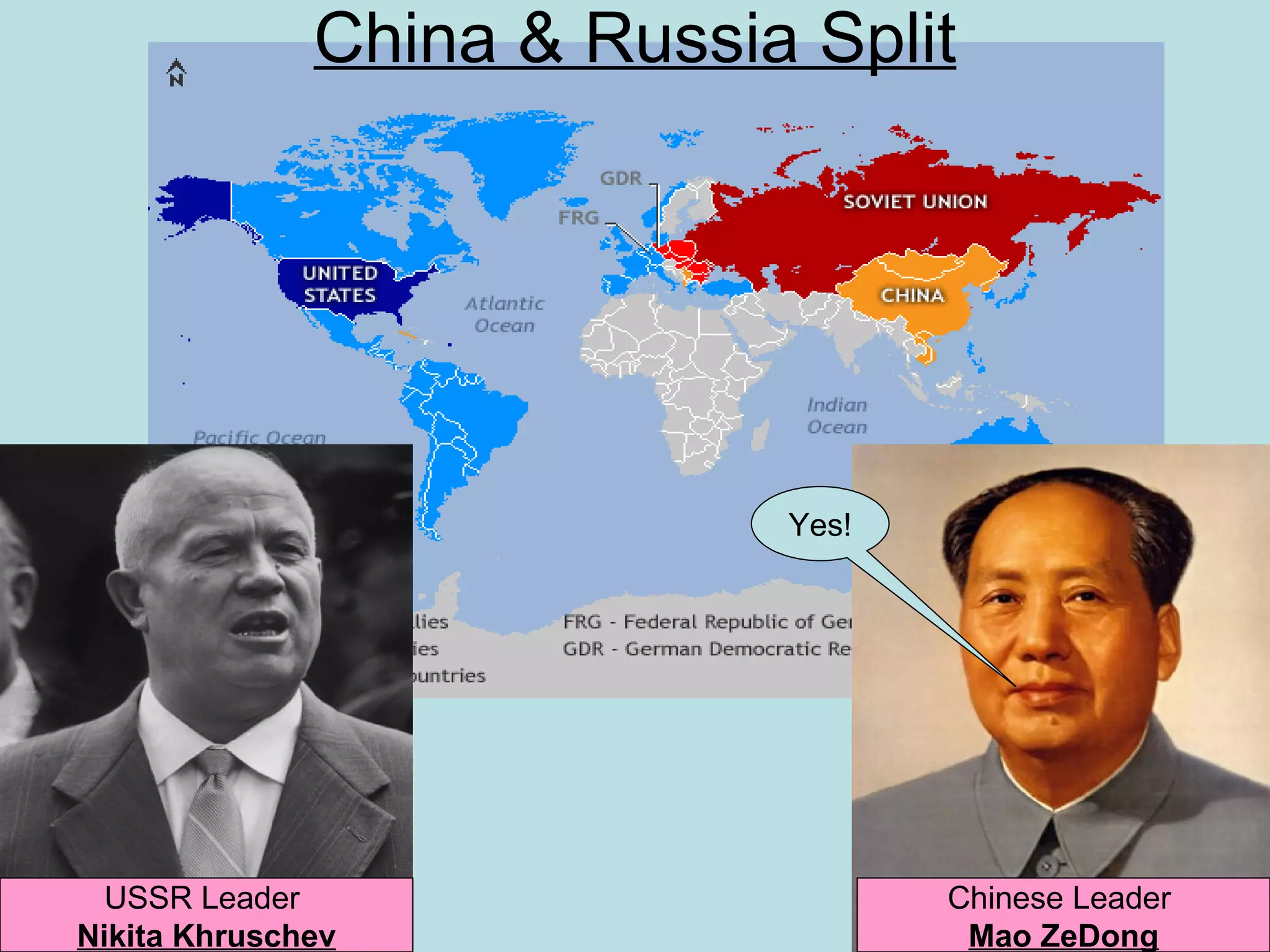
                            Yes!


  USSR Leader                      Chinese Leader
Nikita Khruschev                    Mao ZeDong
China & Russia Split


                   Nyet
                    !


  USSR Leader                    Chinese Leader
Nikita Khruschev                  Mao ZeDong
China & Russia Split
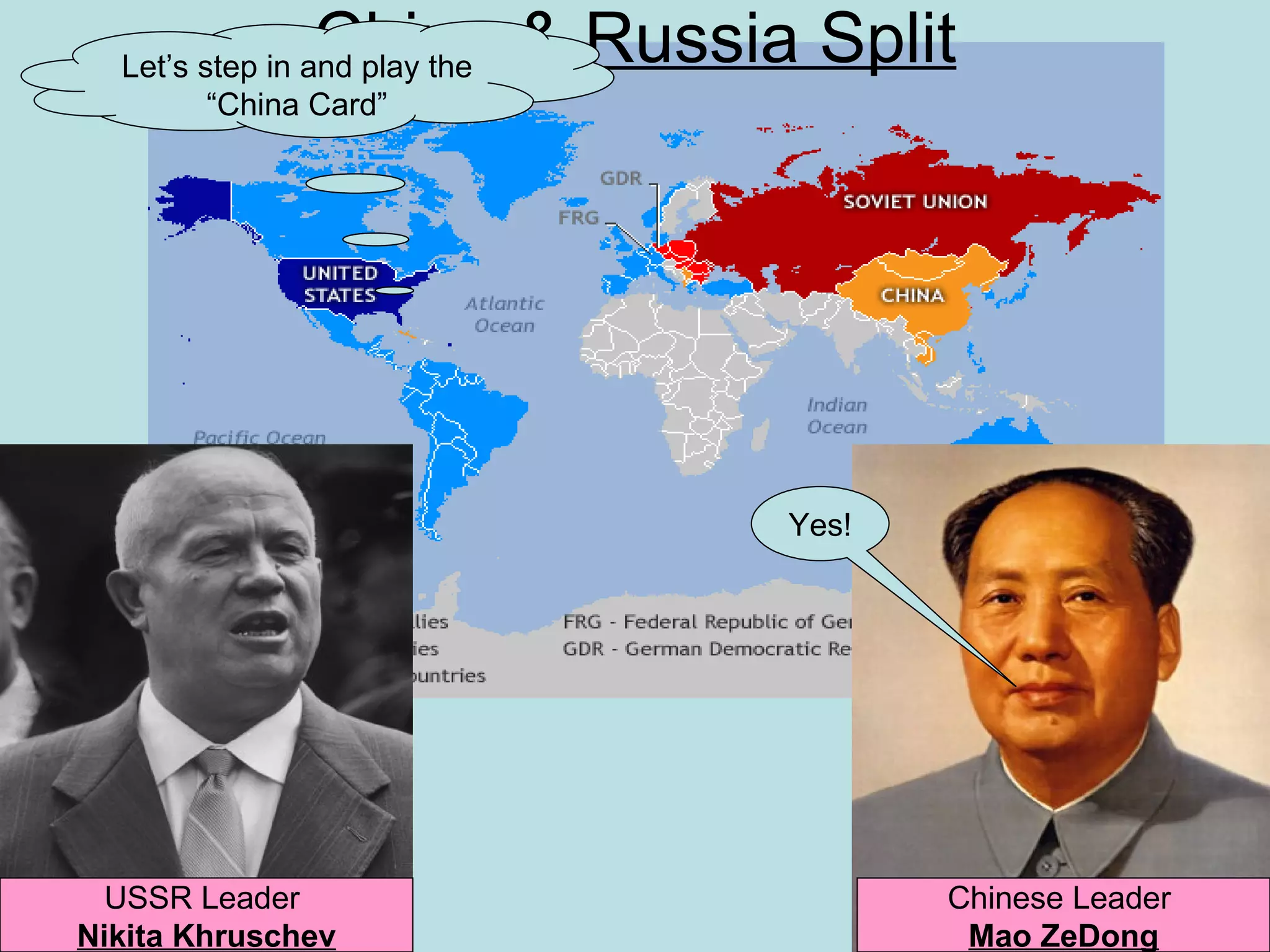
  Let’s step in and play the
         “China Card”


                               Yes!


  USSR Leader                         Chinese Leader
Nikita Khruschev                       Mao ZeDong
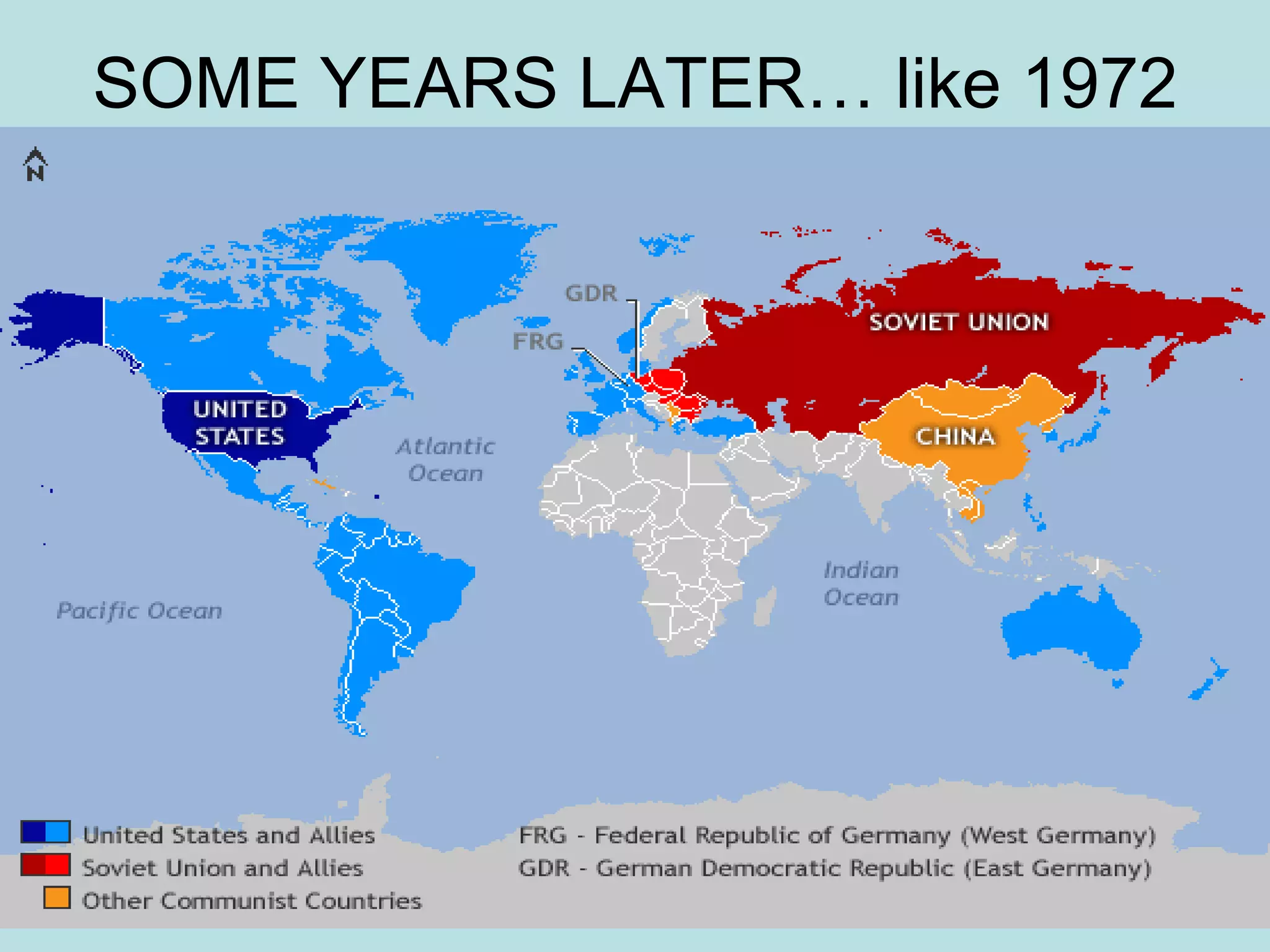
SOME YEARS LATER… like 1972
China & Russia Split
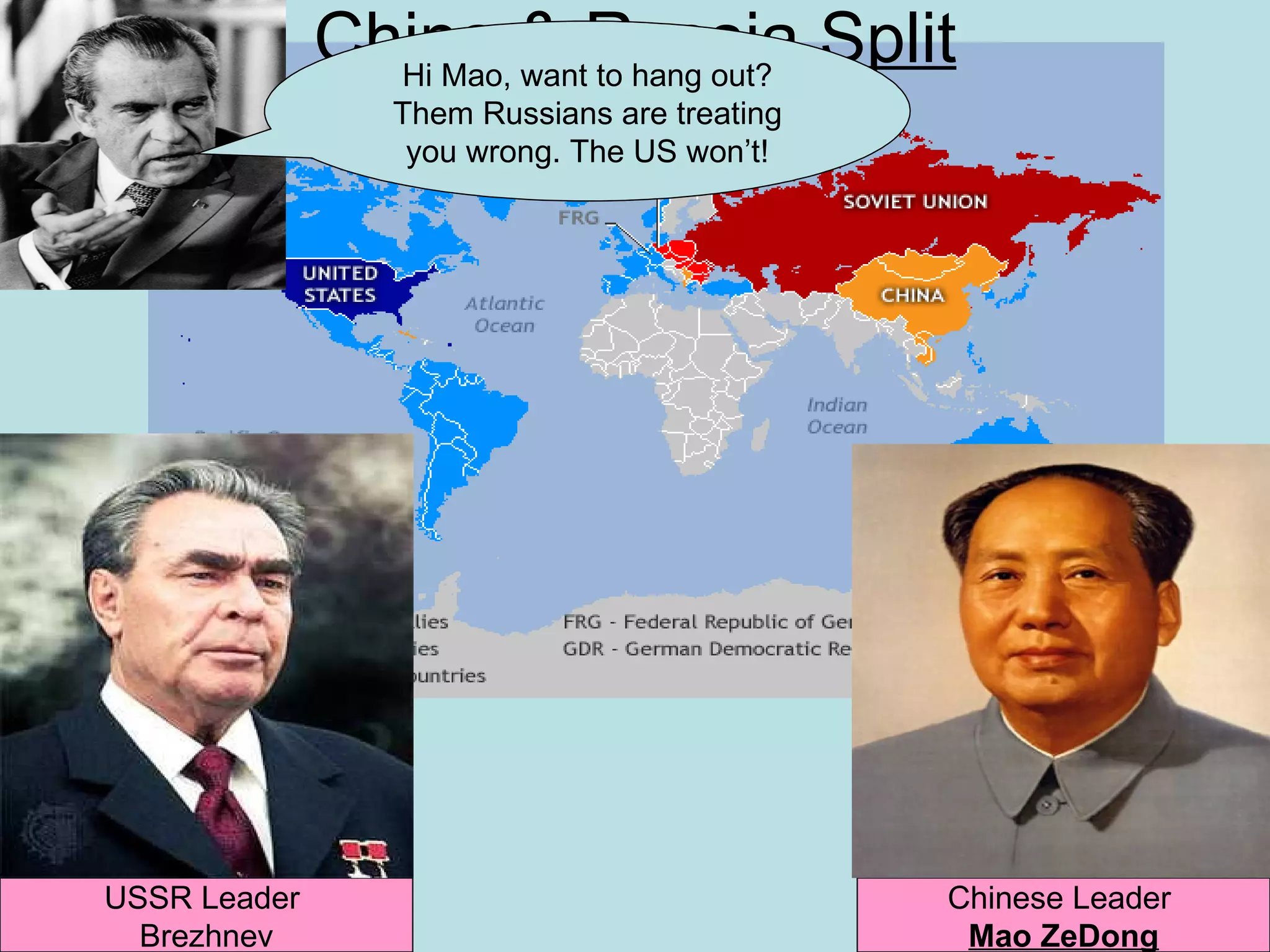
                Hi Mao, want to hang out?
                 Them Russians are treating
                  you wrong. The US won’t!


USSR Leader                                   Chinese Leader
  Brezhnev                                     Mao ZeDong
China & Russia Split
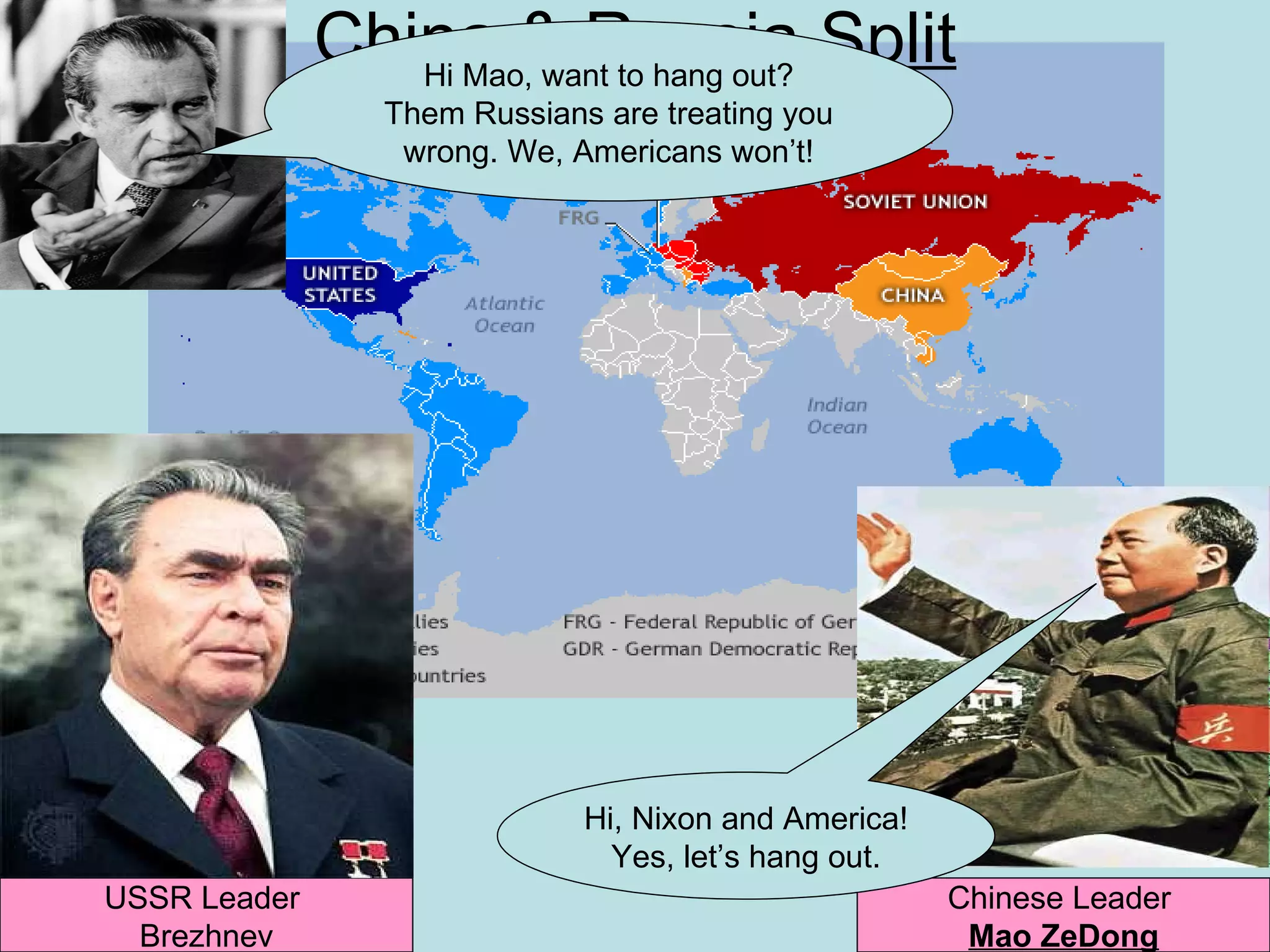
                 Hi Mao, want to hang out?
                 Them Russians are treating you
                  wrong. We, Americans won’t!


                              Hi, Nixon and America!
                                Yes, let’s hang out.
USSR Leader                                            Chinese Leader
  Brezhnev                                              Mao ZeDong
China & Russia Split
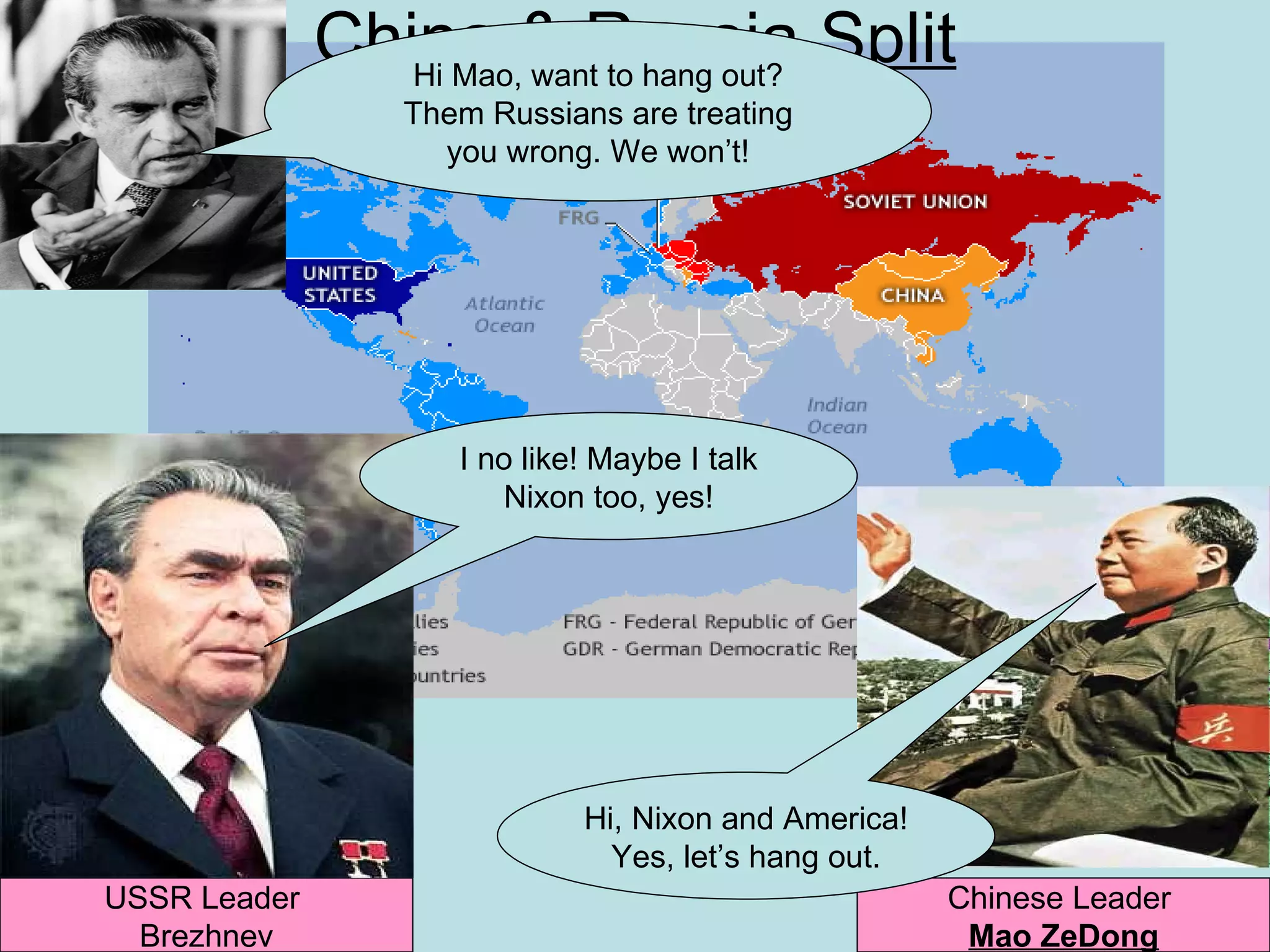
                 Hi Mao, want to hang out?
                 Them Russians are treating
                   you wrong. We won’t!


                    I no like! Maybe I talk
                       Nixon too, yes!


                             Hi, Nixon and America!
                               Yes, let’s hang out.
USSR Leader                                           Chinese Leader
  Brezhnev                                             Mao ZeDong
China & Russia Split
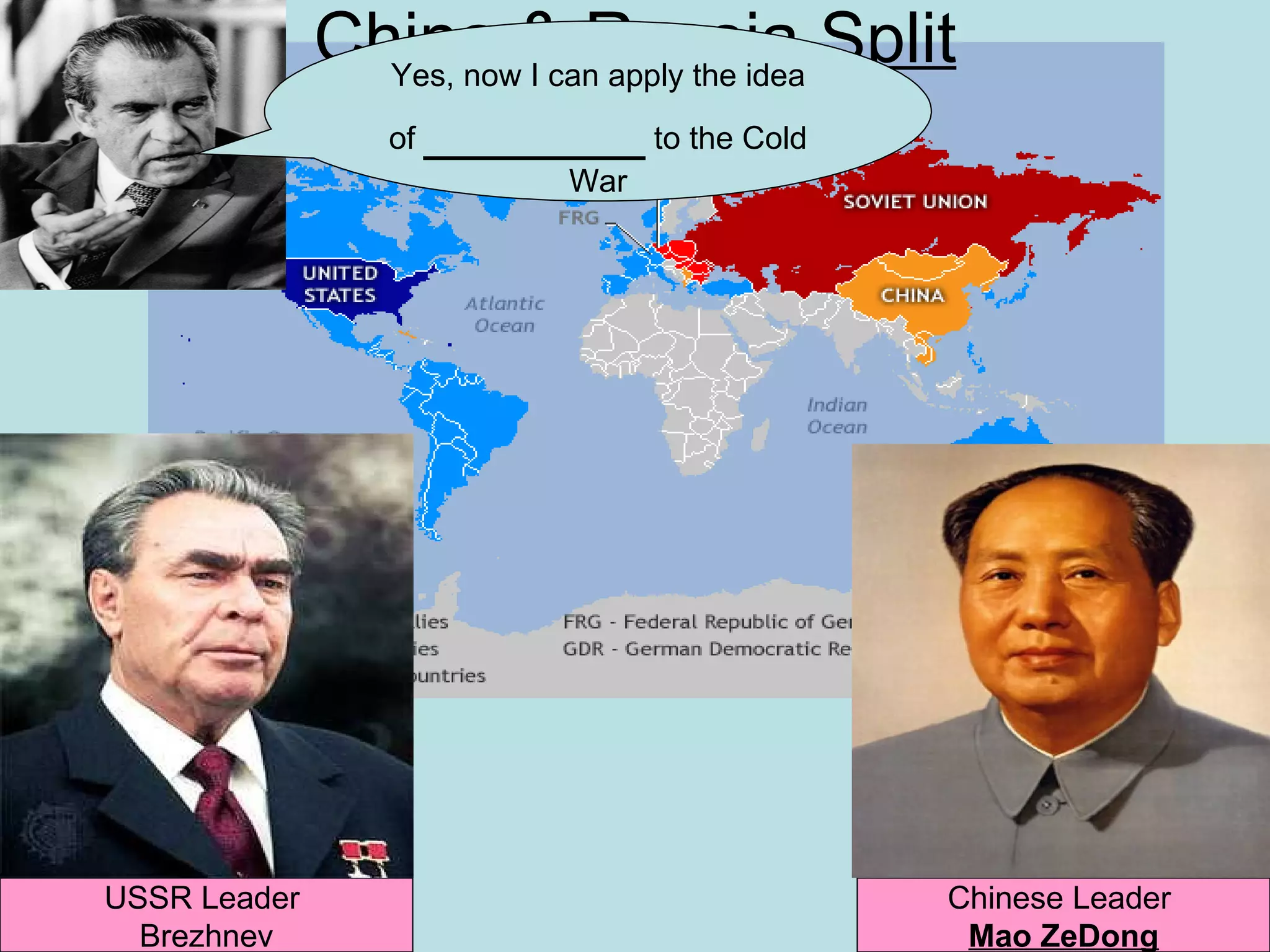
                Yes, now I can apply the idea
                 of   _______ to the Cold
                             War


USSR Leader                                 Chinese Leader
  Brezhnev                                   Mao ZeDong
H2)
     Guess the Term
5)
4)
3)
2)
1)
H2)
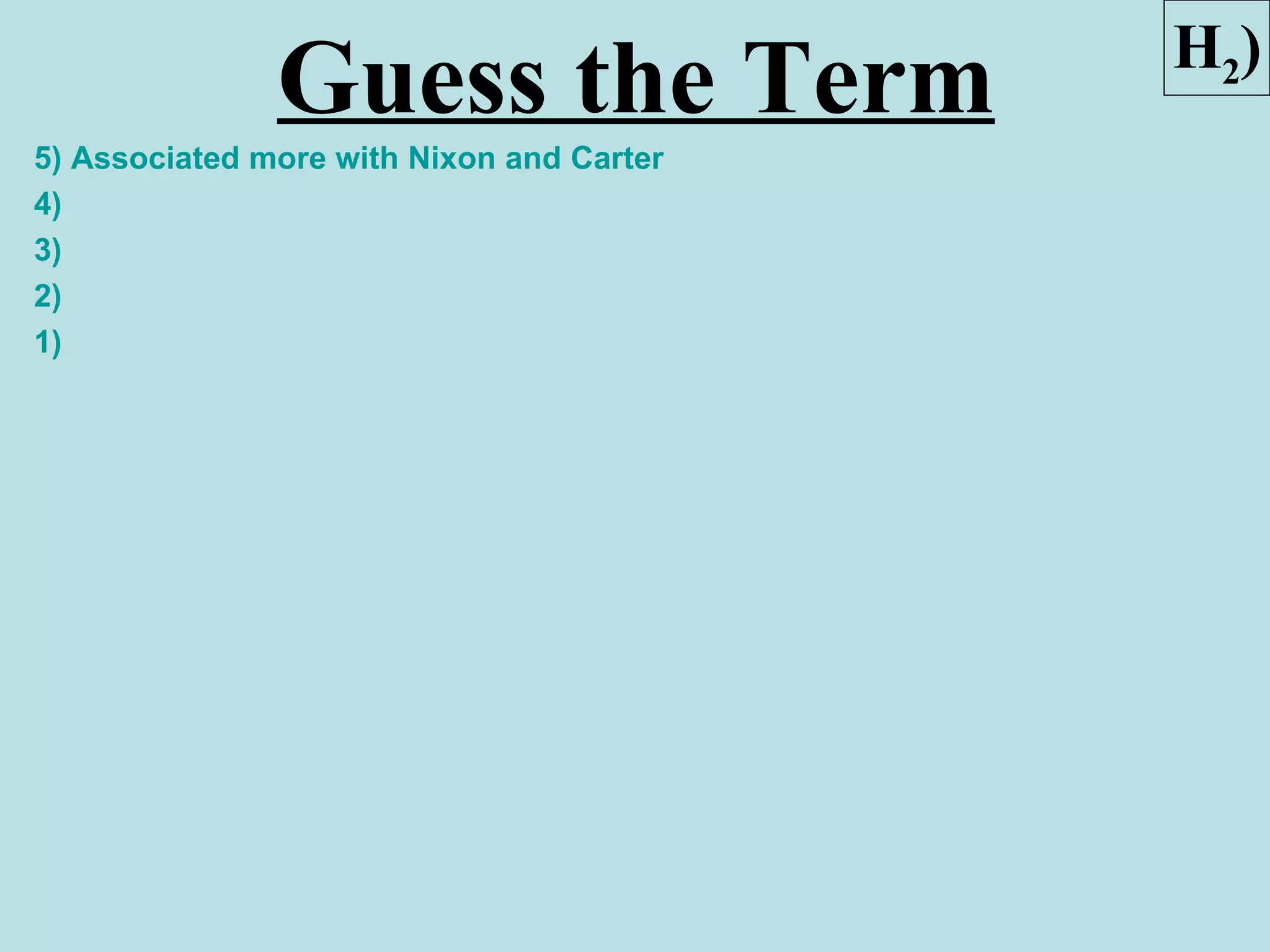
               Guess the Term
5) Associated more with Nixon and Carter
4)
3)
2)
1)
H2)
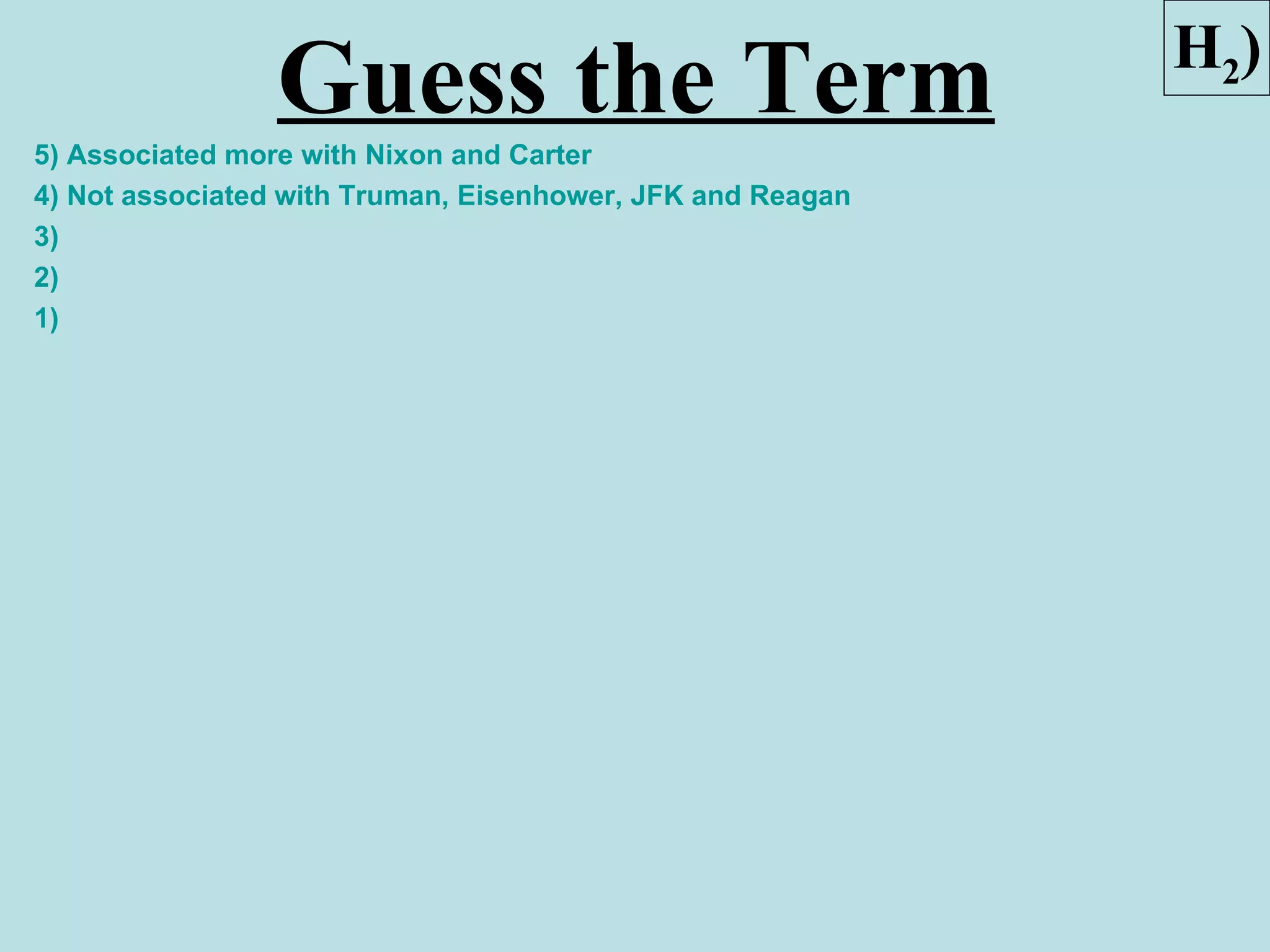
                Guess the Term
5) Associated more with Nixon and Carter
4) Not associated with Truman, Eisenhower, JFK and Reagan
3)
2)
1)
H2)
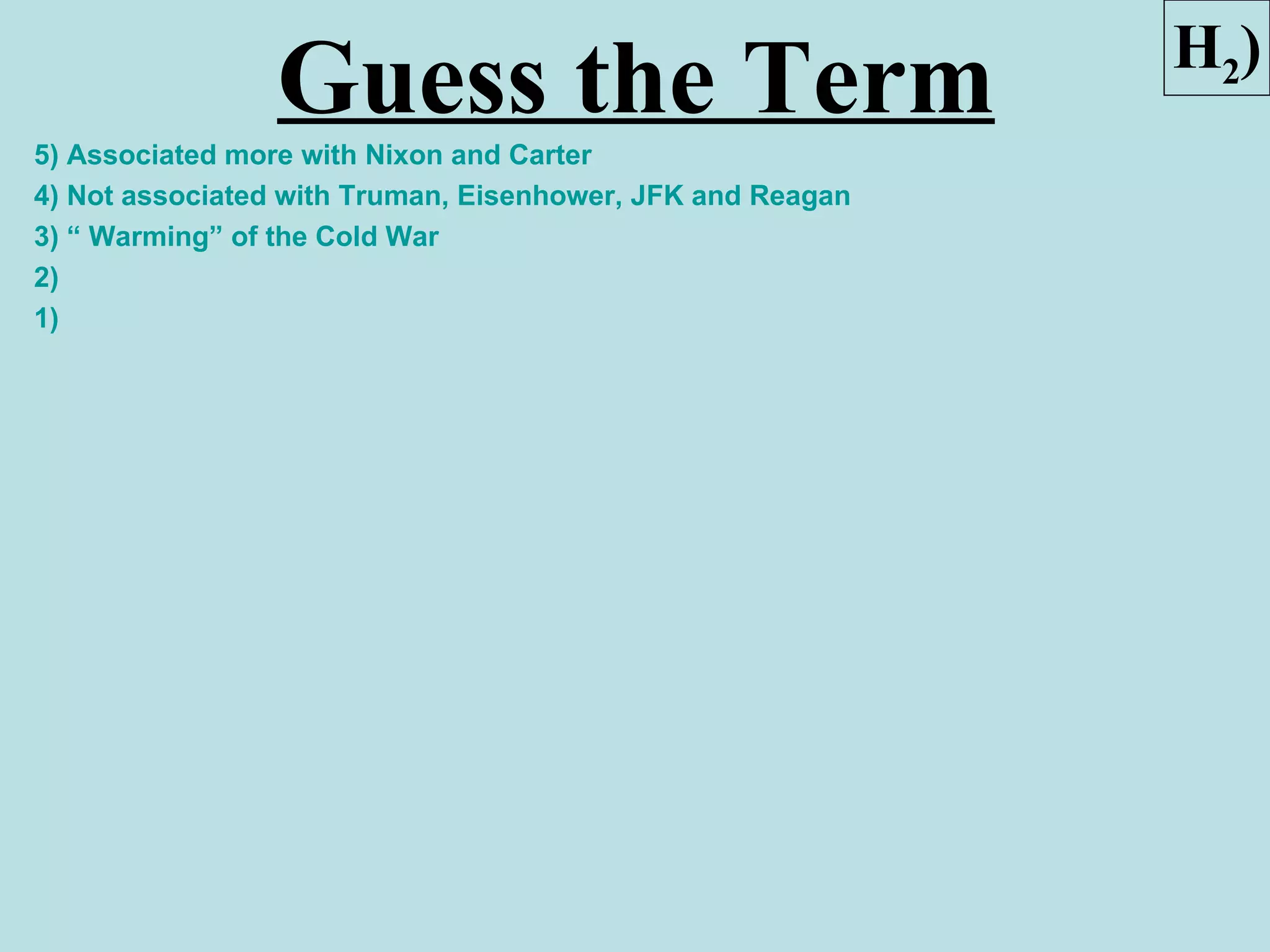
                Guess the Term
5) Associated more with Nixon and Carter
4) Not associated with Truman, Eisenhower, JFK and Reagan
3) “ Warming” of the Cold War
2)
1)
H2)
                Guess the Term
5) Associated more with Nixon and Carter
4) Not associated with Truman, Eisenhower, JFK and Reagan
3) “ Warming” of the Cold War
2) Opposite of Brinkmanship
1)
H2)
                 Guess the Term
5) Associated more with Nixon and Carter
4) Not associated with Truman, Eisenhower, JFK and Reagan
3) “ Warming” of the Cold War
2) Opposite of Brinkmanship
1) General reduction of tension between Soviet Union & USA
DÉTENTE                           H2)
5) Associated more with Nixon and Carter
4) Not associated with Truman, Eisenhower, JFK and Reagan
3) “ Warming” of the Cold War
2) Opposite of Brinkmanship                                    Back
1) General reduction of tension between Soviet Union and USA
China & Russia Split
                Yes, now I can apply the idea
                  of DETENTE to the Cold
                          War


USSR Leader                                 Chinese Leader
  Brezhnev                                   Mao ZeDong
4
         What caused the Russian &
         Chinese Communist Split?
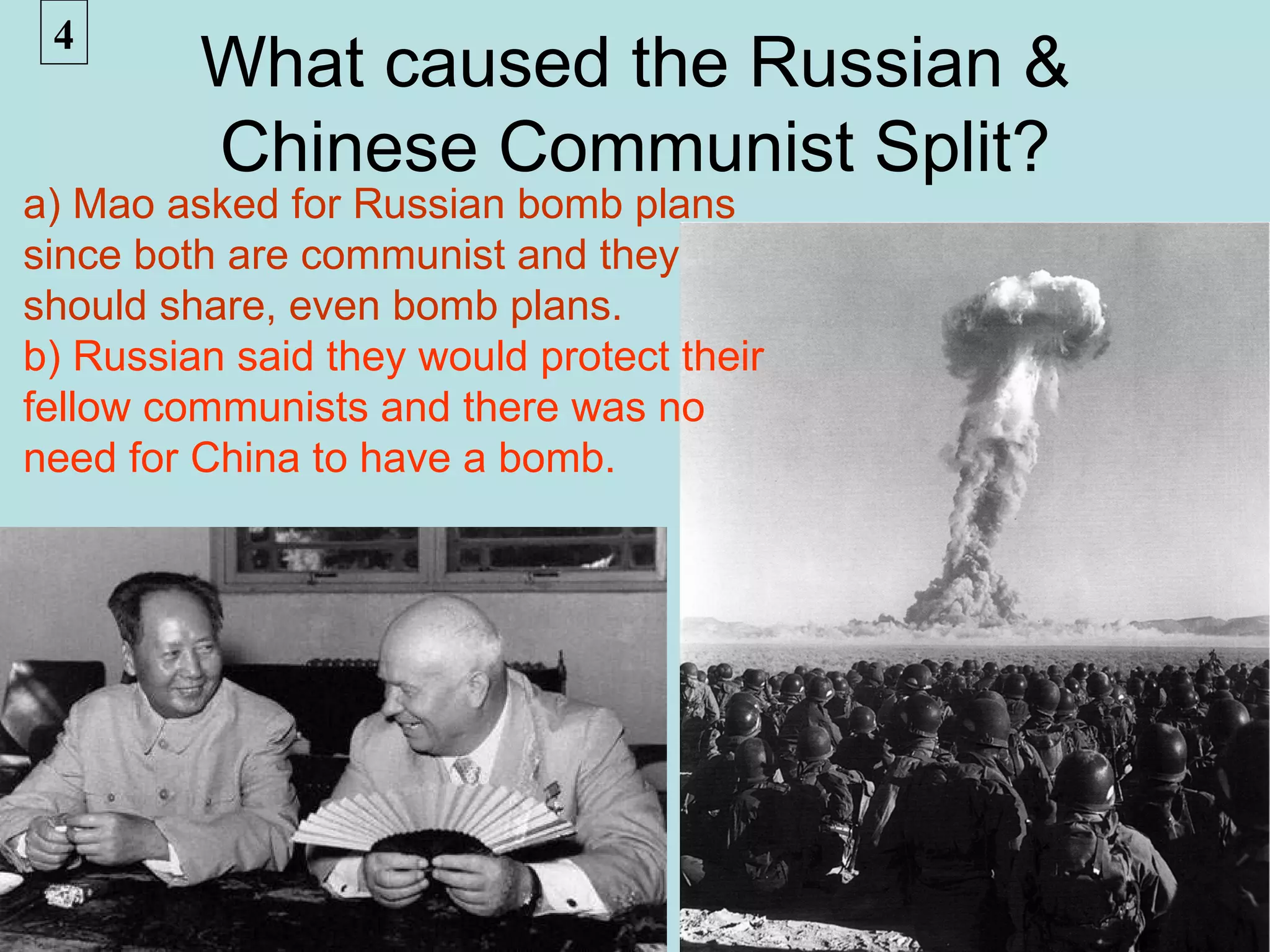
a) Mao asked for Russian bomb plans
since both are communist and they
should share, even bomb plans.
b) Russian said they would protect their
fellow communists and there was no
need for China to have a bomb.
Back
5-8) What are the USSR Satellites Nations? Back
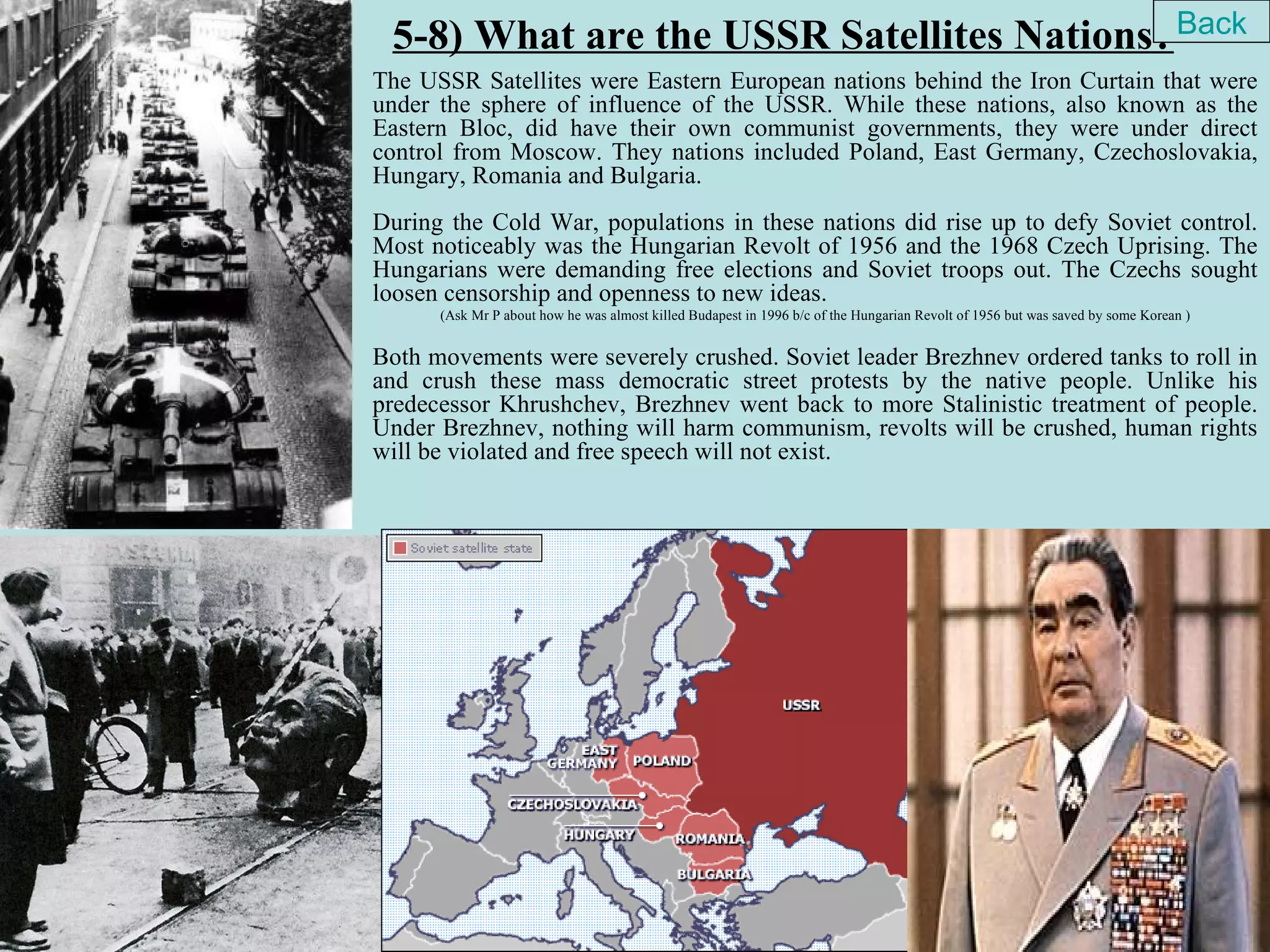
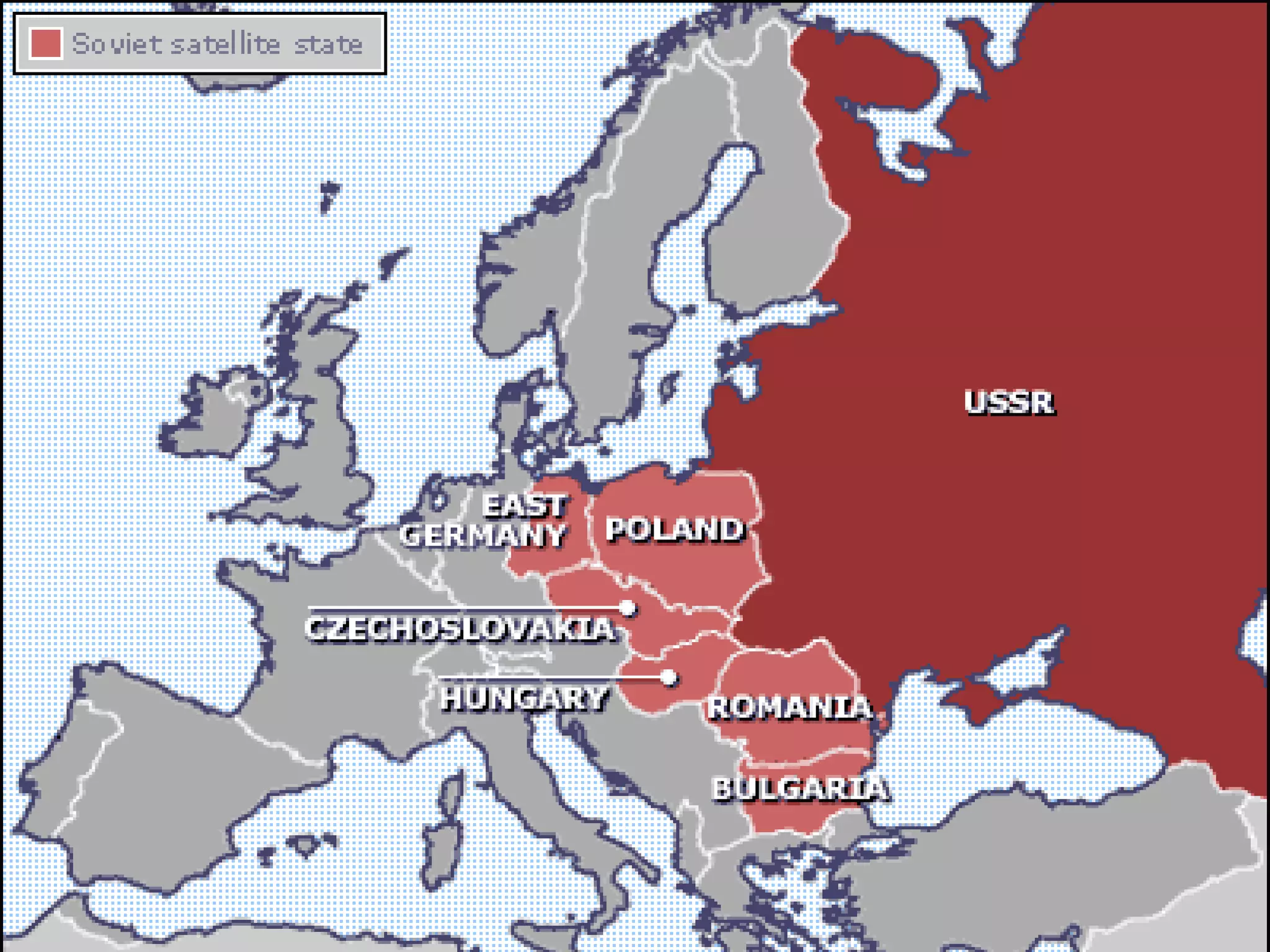
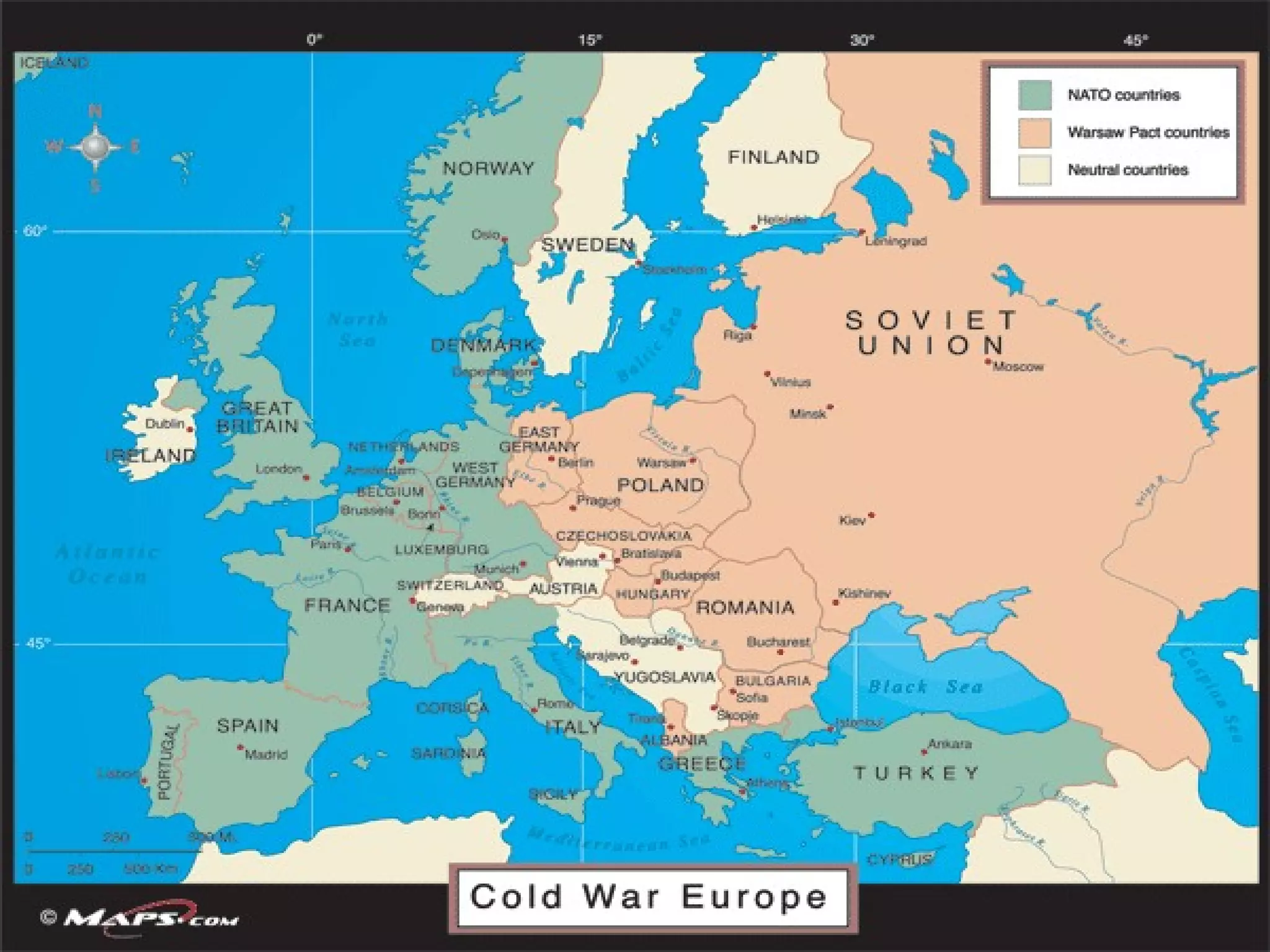
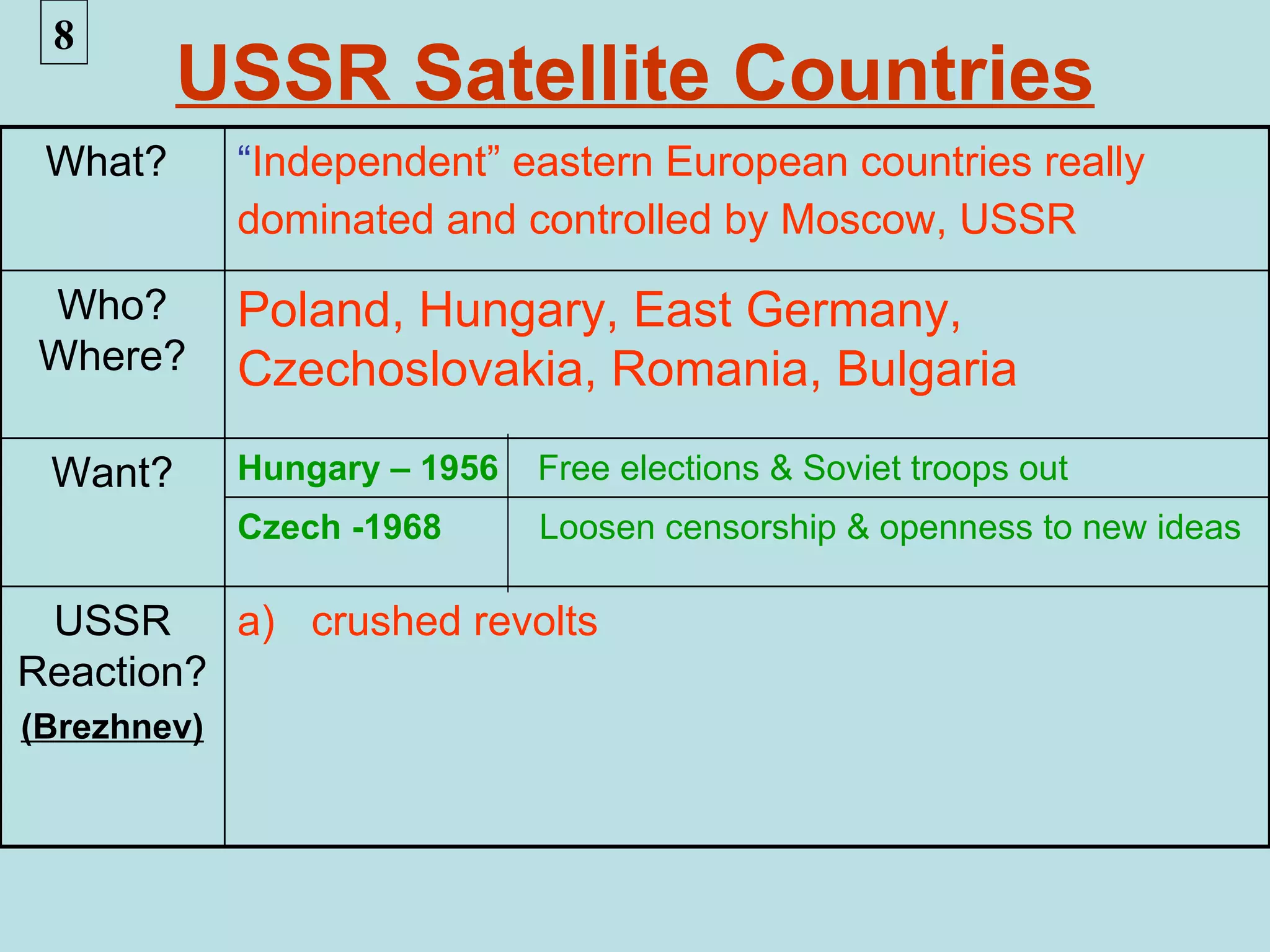
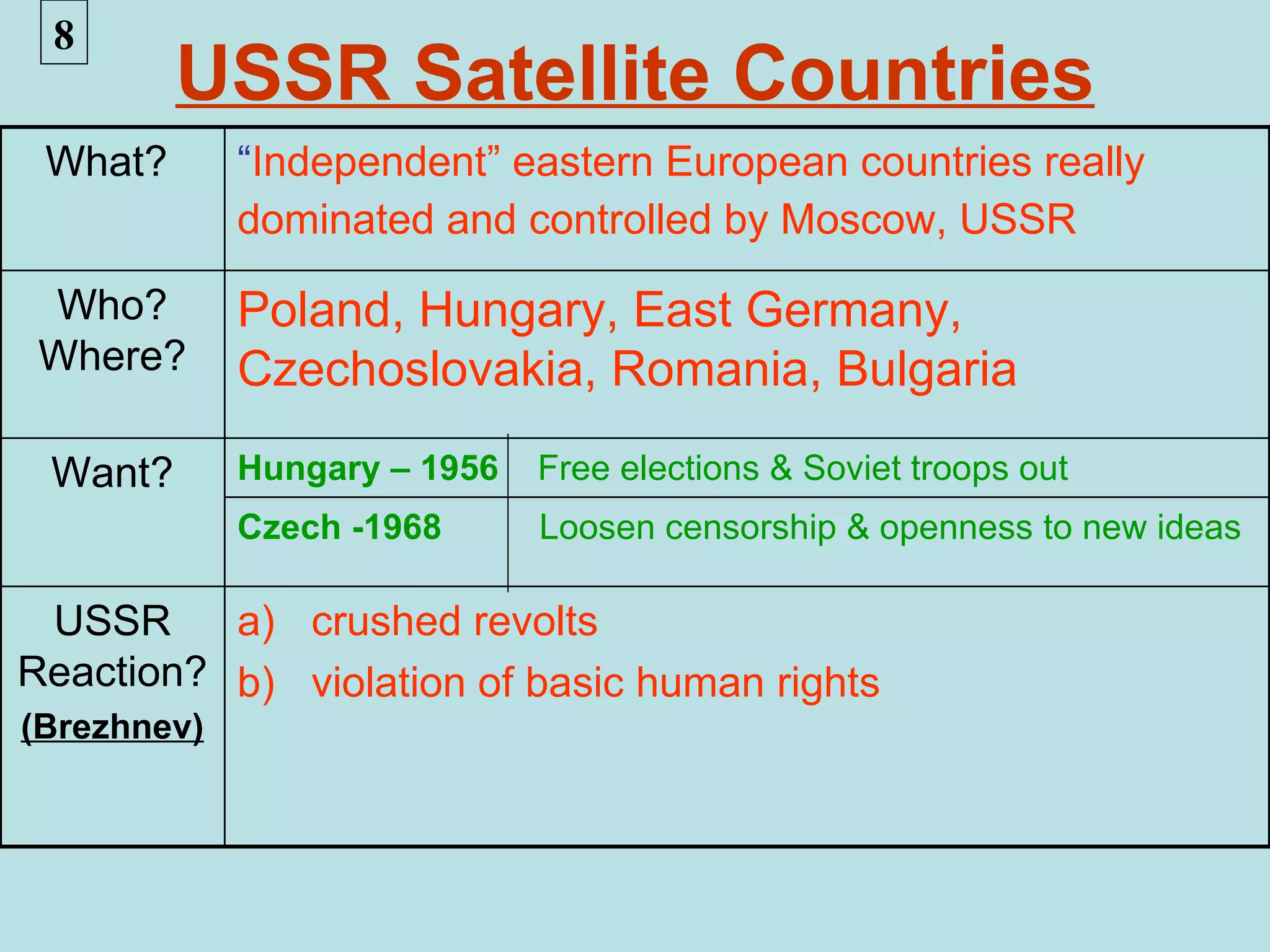
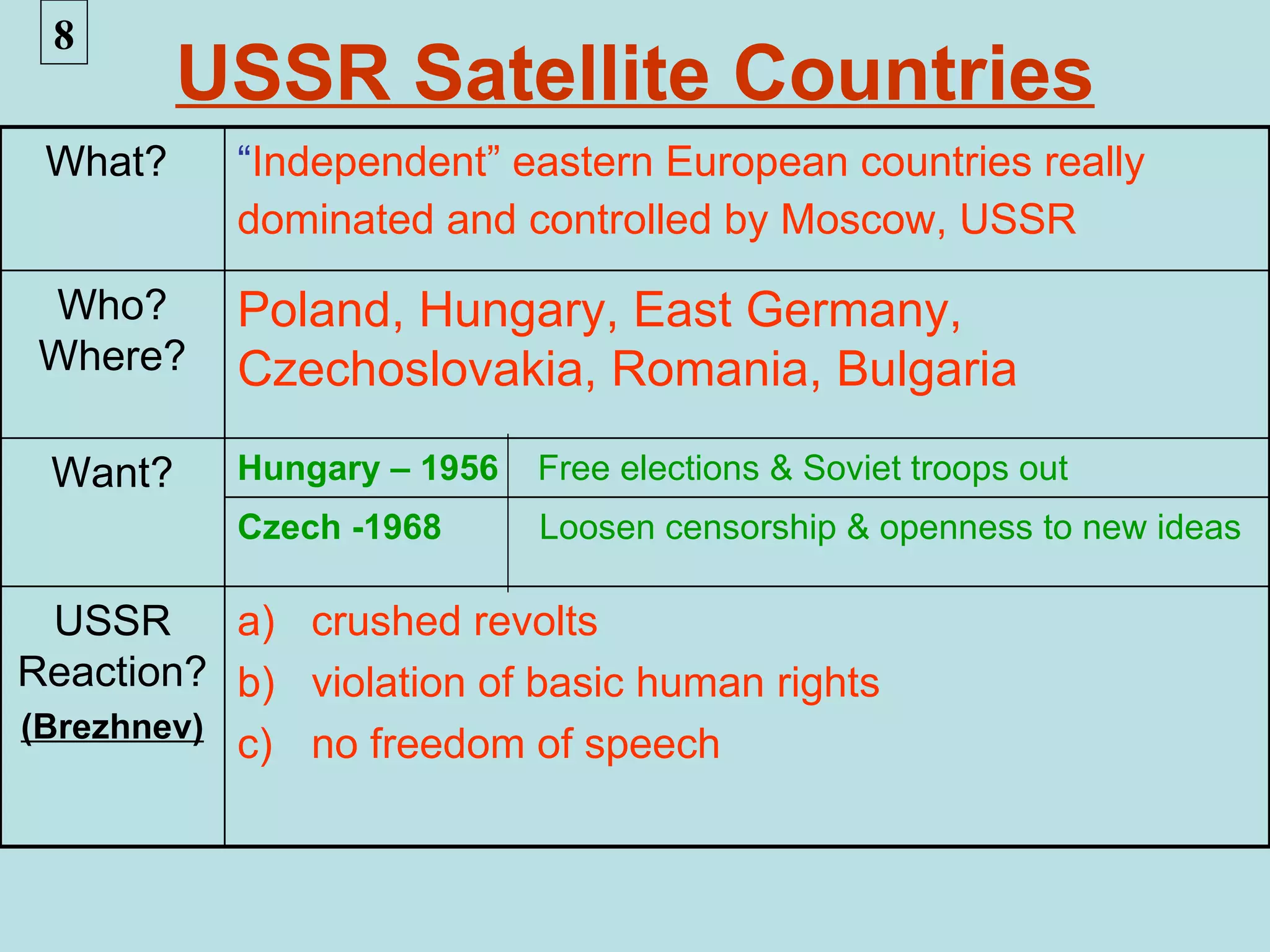
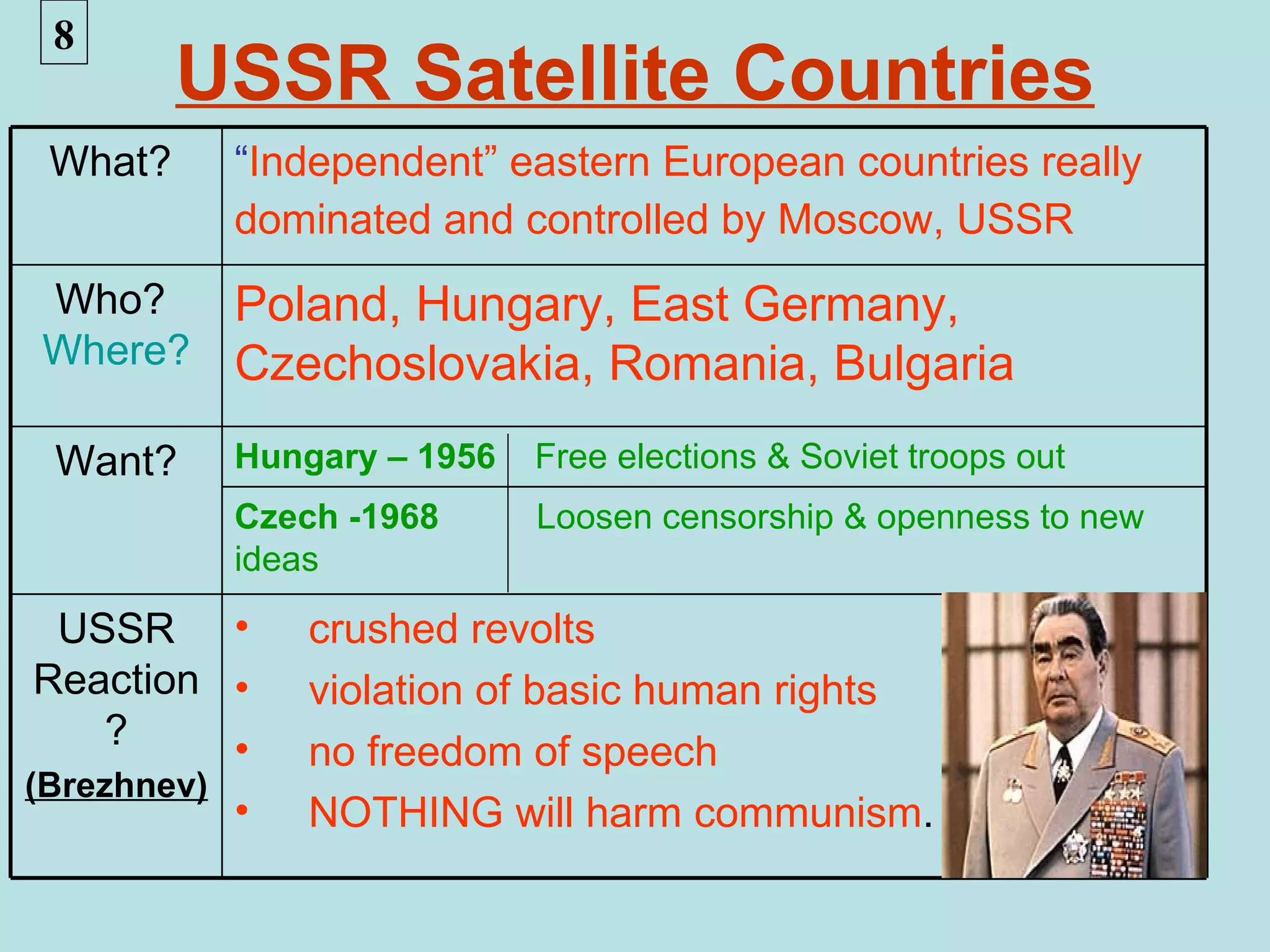
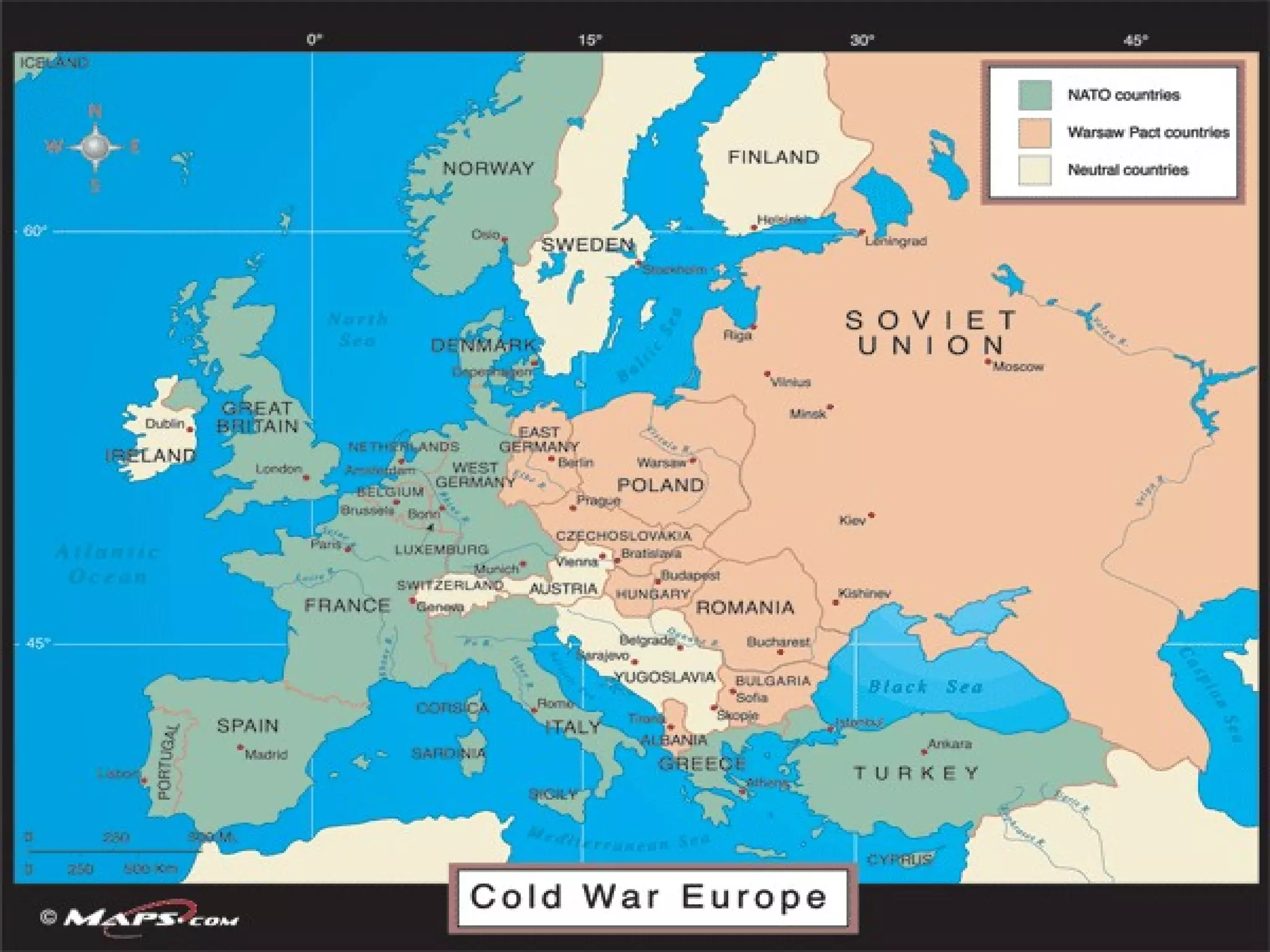
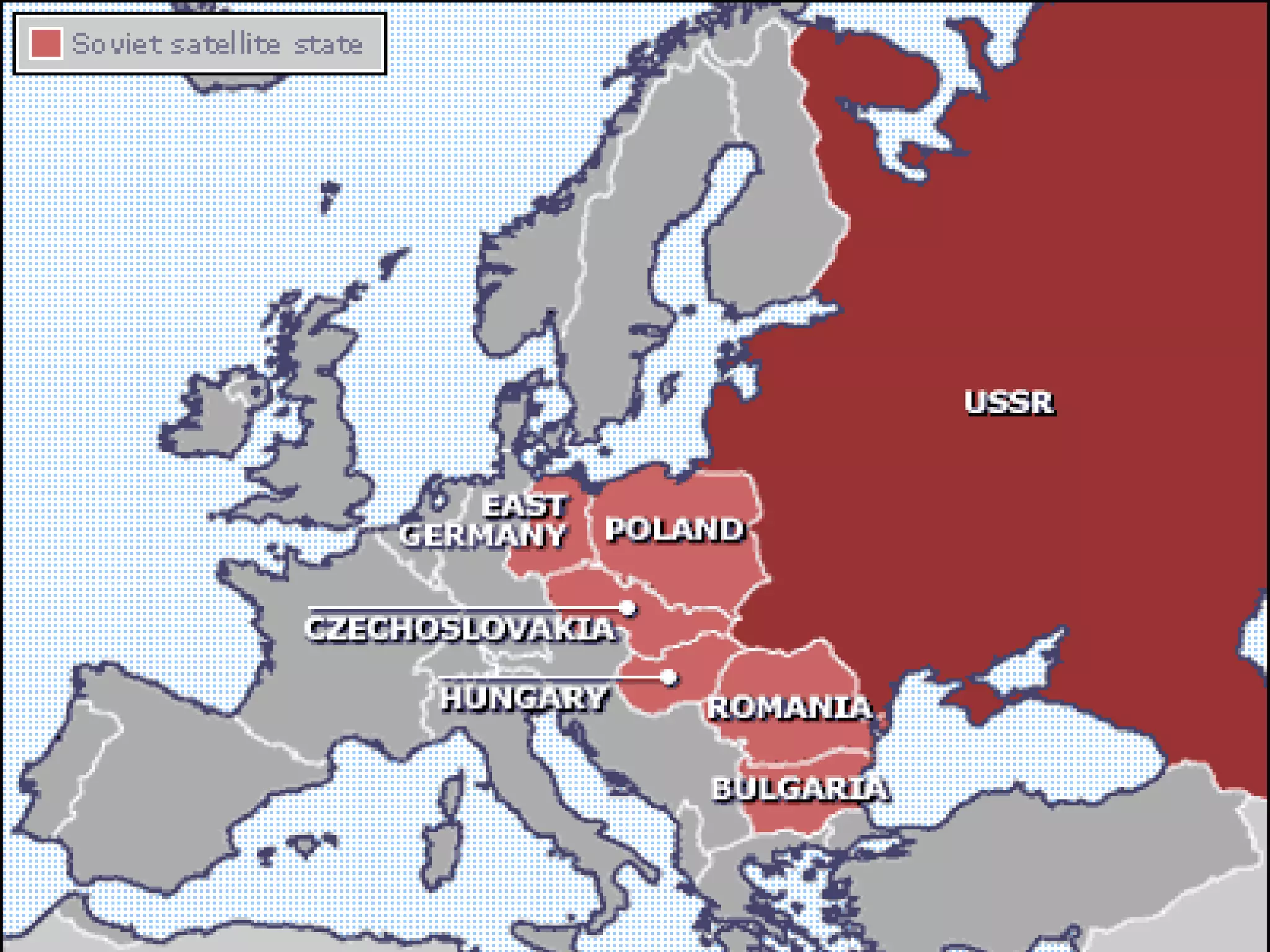
The USSR Satellites were Eastern European nations behind the Iron Curtain that were
under the sphere of influence of the USSR. While these nations, also known as the
Eastern Bloc, did have their own communist governments, they were under direct
control from Moscow. They nations included Poland, East Germany, Czechoslovakia,
Hungary, Romania and Bulgaria.
During the Cold War, populations in these nations did rise up to defy Soviet control.
Most noticeably was the Hungarian Revolt of 1956 and the 1968 Czech Uprising. The
Hungarians were demanding free elections and Soviet troops out. The Czechs sought
loosen censorship and openness to new ideas.
      (Ask Mr P about how he was almost killed Budapest in 1996 b/c of the Hungarian Revolt of 1956 but was saved by some Korean )


Both movements were severely crushed. Soviet leader Brezhnev ordered tanks to roll in
and crush these mass democratic street protests by the native people. Unlike his
predecessor Khrushchev, Brezhnev went back to more Stalinistic treatment of people.
Under Brezhnev, nothing will harm communism, revolts will be crushed, human rights
will be violated and free speech will not exist.
5
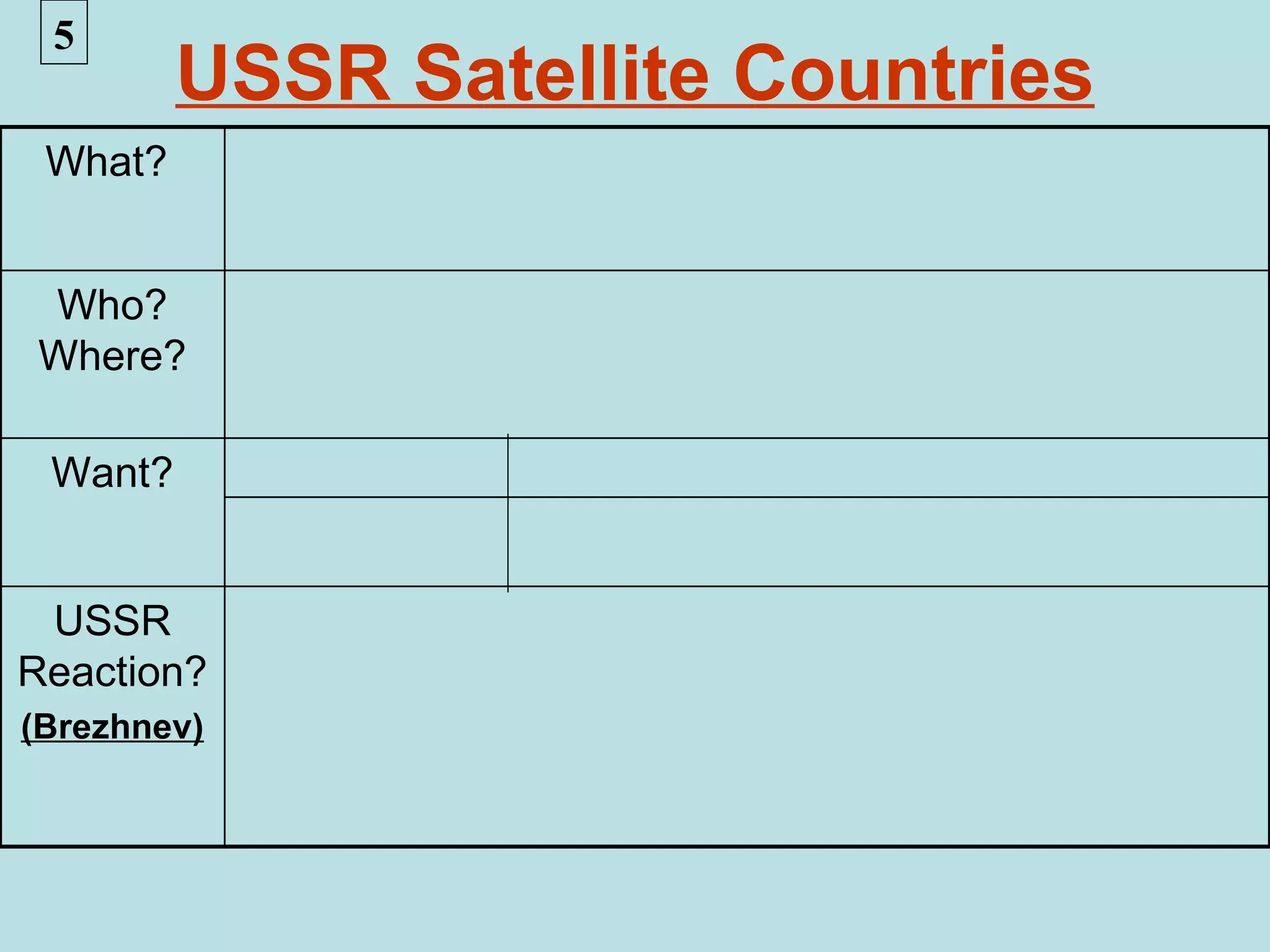
         USSR Satellite Countries
 What?


Who?
Where?

 Want?


 USSR
Reaction?
(Brezhnev)
5
         USSR Satellite Countries
 What?       “Independent” eastern European countries really
             dominated and controlled by Moscow, USSR

Who?
Where?

 Want?


 USSR
Reaction?
(Brezhnev)
6
         USSR Satellite Countries
 What?       “Independent” eastern European countries really
             dominated and controlled by Moscow, USSR

Who?              GROUP 6 tell CLASS THE ANSWER TO THIS.
Where?               USE MAPS ON NEXT FEW SLIDES

 Want?


 USSR
Reaction?
(Brezhnev)
6
         USSR Satellite Countries
 What?       “Independent” eastern European countries really
             dominated and controlled by Moscow, USSR

Who?         Poland, Hungary, East Germany,
Where?       Czechoslovakia, Romania, Bulgaria

 Want?
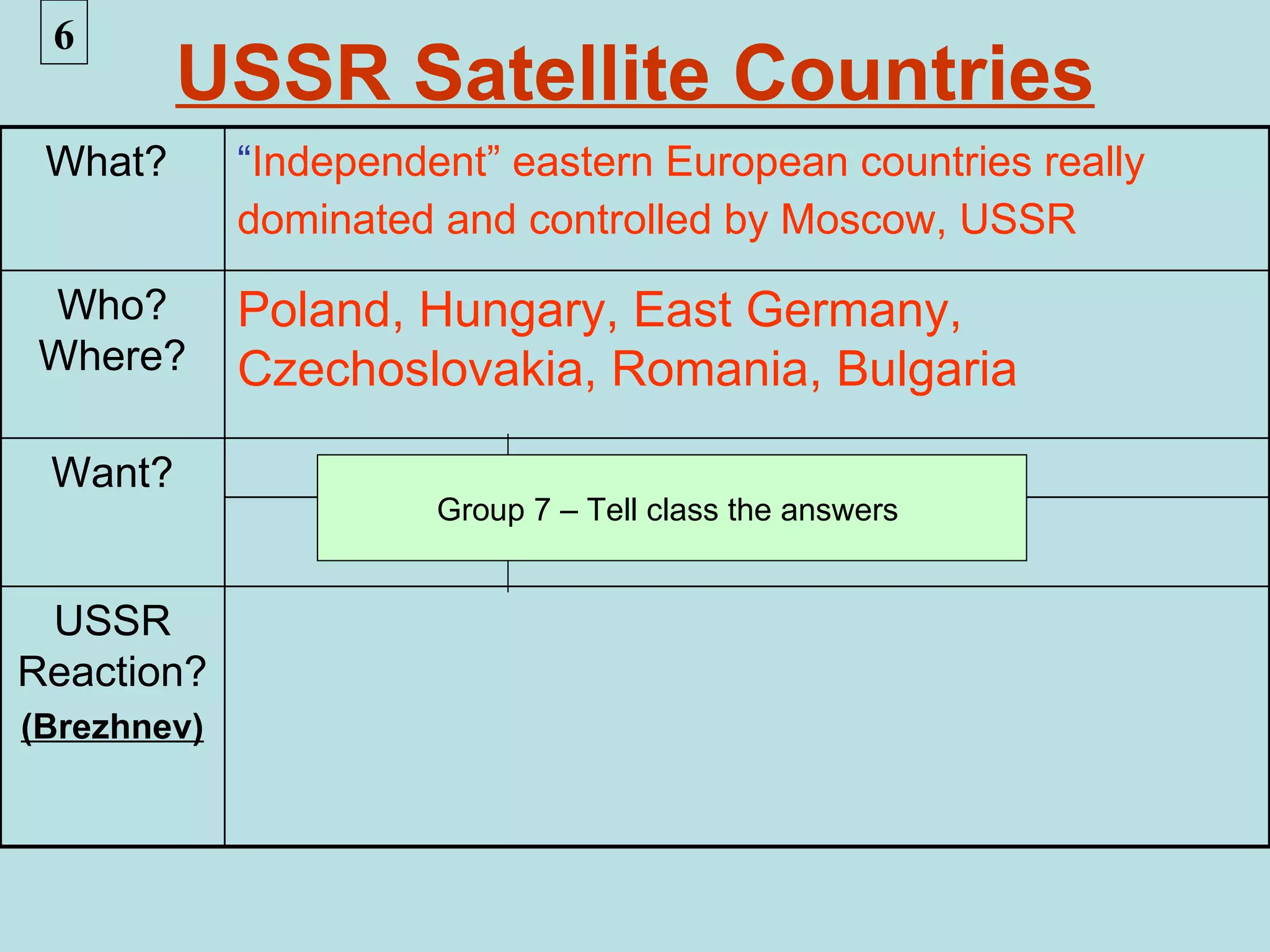
                       Group 7 – Tell class the answers


 USSR
Reaction?
(Brezhnev)
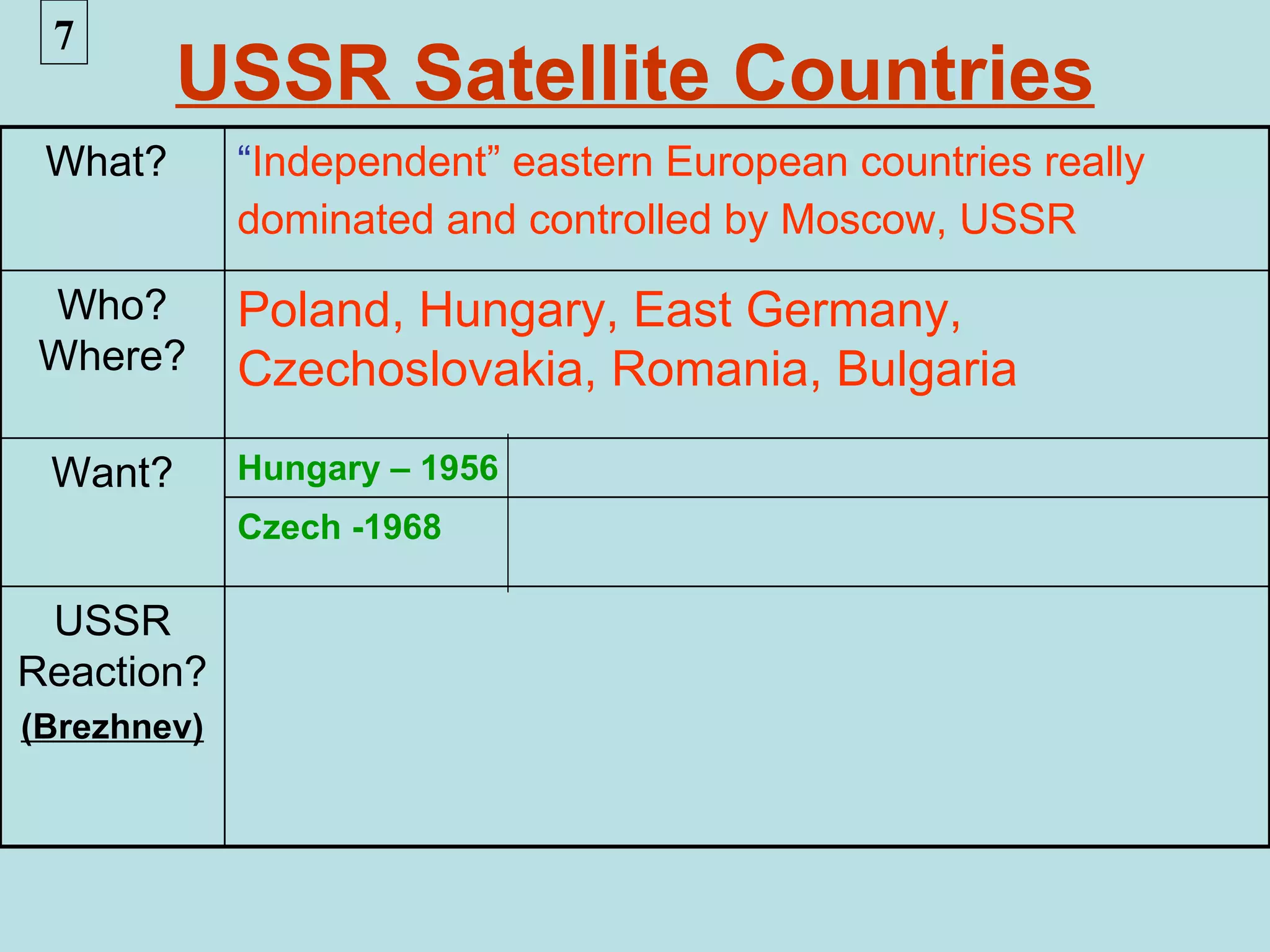
7
         USSR Satellite Countries
 What?       “Independent” eastern European countries really
             dominated and controlled by Moscow, USSR

Who?         Poland, Hungary, East Germany,
Where?       Czechoslovakia, Romania, Bulgaria

 Want?       Hungary – 1956
             Czech -1968

 USSR
Reaction?
(Brezhnev)
7
         USSR Satellite Countries
 What?       “Independent” eastern European countries really
             dominated and controlled by Moscow, USSR

Who?         Poland, Hungary, East Germany,
Where?       Czechoslovakia, Romania, Bulgaria

 Want?       Hungary – 1956
             Czech -1968

 USSR
Reaction?
(Brezhnev)
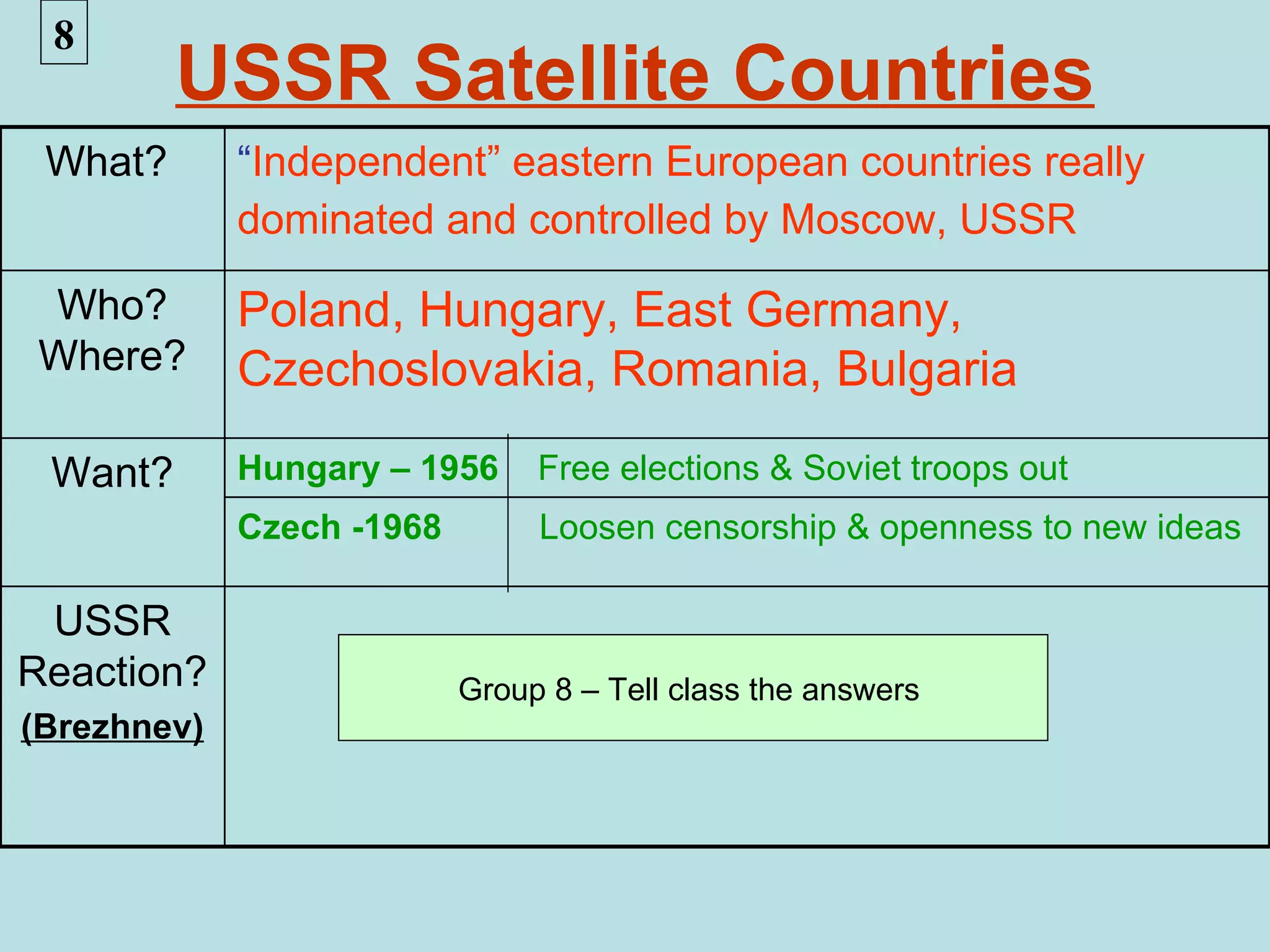
8
         USSR Satellite Countries
 What?       “Independent” eastern European countries really
             dominated and controlled by Moscow, USSR

Who?         Poland, Hungary, East Germany,
Where?       Czechoslovakia, Romania, Bulgaria

 Want?       Hungary – 1956     Free elections & Soviet troops out
             Czech -1968        Loosen censorship & openness to new ideas

 USSR
Reaction?                  Group 8 – Tell class the answers
(Brezhnev)
8
         USSR Satellite Countries
 What?       “Independent” eastern European countries really
             dominated and controlled by Moscow, USSR

 Who?        Poland, Hungary, East Germany,
 Where?      Czechoslovakia, Romania, Bulgaria

 Want?       Hungary – 1956   Free elections & Soviet troops out
             Czech -1968      Loosen censorship & openness to new ideas

 USSR     a) crushed revolts
Reaction?
(Brezhnev)
8
         USSR Satellite Countries
 What?       “Independent” eastern European countries really
             dominated and controlled by Moscow, USSR

 Who?        Poland, Hungary, East Germany,
 Where?      Czechoslovakia, Romania, Bulgaria

 Want?       Hungary – 1956   Free elections & Soviet troops out
             Czech -1968      Loosen censorship & openness to new ideas

 USSR     a) crushed revolts
Reaction? b) violation of basic human rights
(Brezhnev)
8
         USSR Satellite Countries
 What?     “Independent” eastern European countries really
           dominated and controlled by Moscow, USSR

 Who?      Poland, Hungary, East Germany,
 Where?    Czechoslovakia, Romania, Bulgaria

 Want?     Hungary – 1956   Free elections & Soviet troops out
           Czech -1968      Loosen censorship & openness to new ideas

  USSR     a) crushed revolts
Reaction? b) violation of basic human rights
(Brezhnev)
           c) no freedom of speech
8
         USSR Satellite Countries
 What?     “Independent” eastern European countries really
           dominated and controlled by Moscow, USSR
Who?       Poland, Hungary, East Germany,
Where?     Czechoslovakia, Romania, Bulgaria
 Want?     Hungary – 1956   Free elections & Soviet troops out
           Czech -1968      Loosen censorship & openness to new
           ideas

  USSR •       crushed revolts
 Reaction •    violation of basic human rights
     ?     •   no freedom of speech
(Brezhnev)
           •   NOTHING will harm communism.
Back
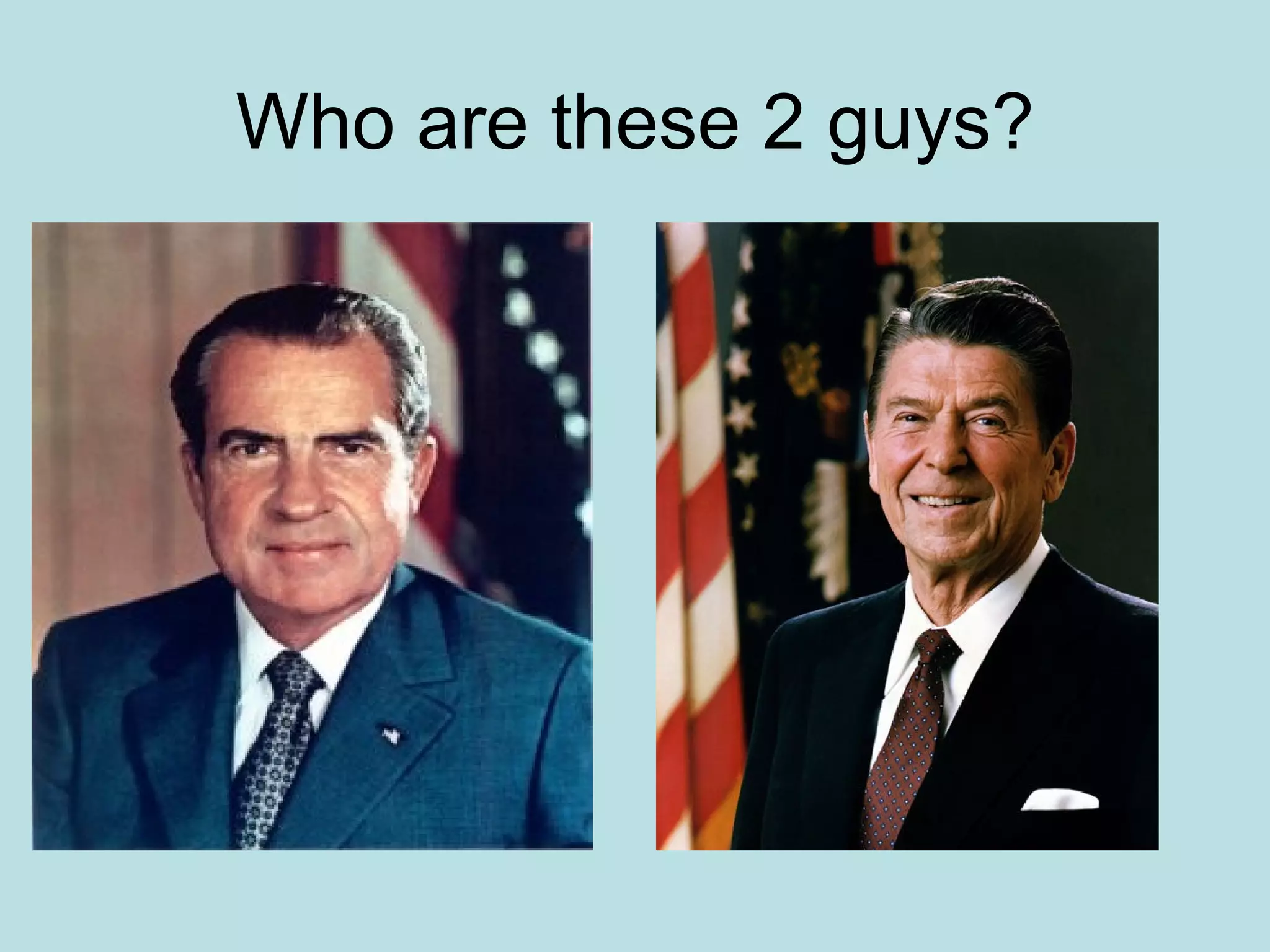
Who are these 2 guys?
9-10) TWO ANTI-COMMUNIST APPROACHES                                                                    Back
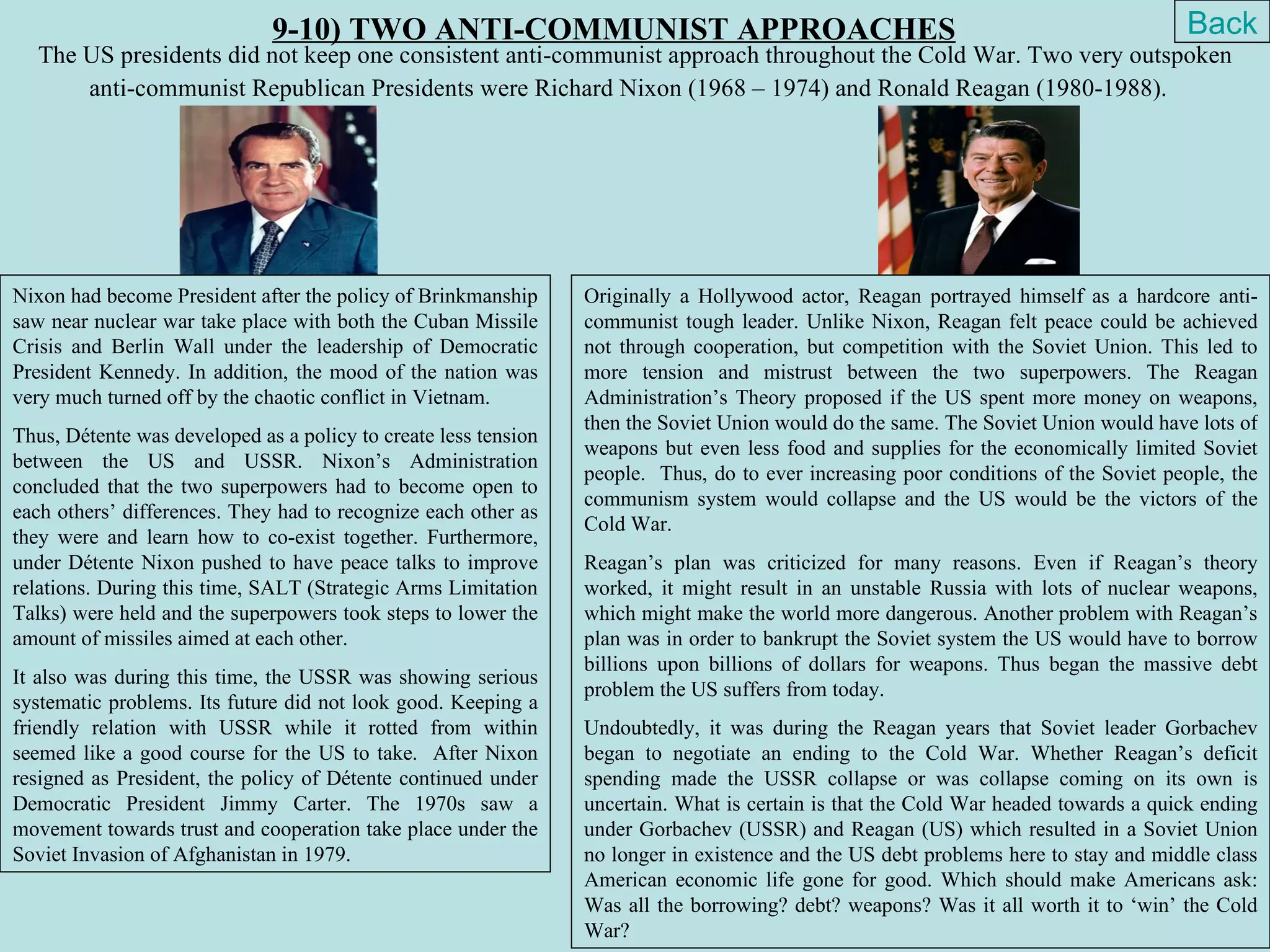
   The US presidents did not keep one consistent anti-communist approach throughout the Cold War. Two very outspoken
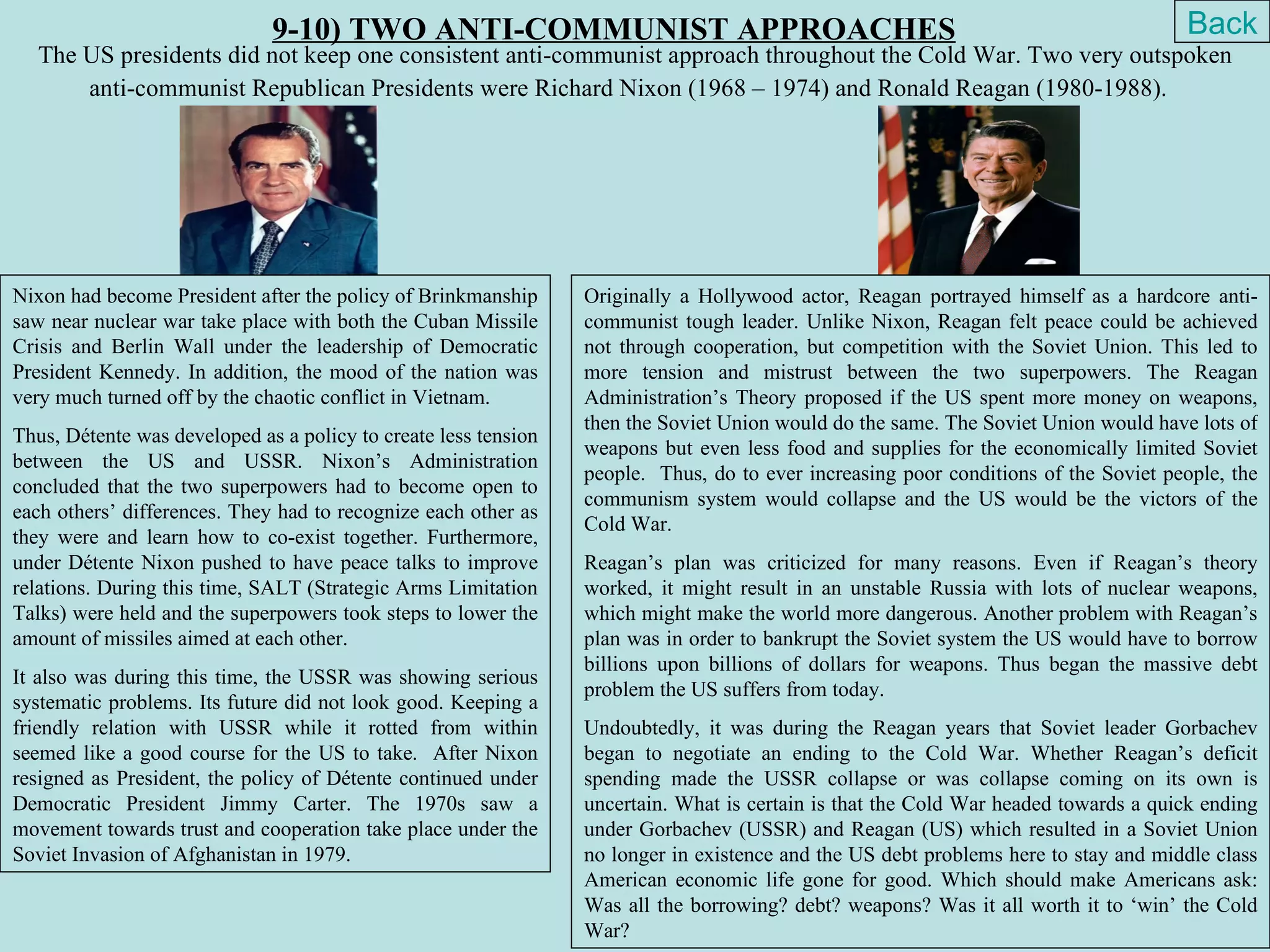
       anti-communist Republican Presidents were Richard Nixon (1968 – 1974) and Ronald Reagan (1980-1988).


Nixon had become President after the policy of Brinkmanship      Originally a Hollywood actor, Reagan portrayed himself as a hardcore anti-
saw near nuclear war take place with both the Cuban Missile      communist tough leader. Unlike Nixon, Reagan felt peace could be achieved
Crisis and Berlin Wall under the leadership of Democratic        not through cooperation, but competition with the Soviet Union. This led to
President Kennedy. In addition, the mood of the nation was       more tension and mistrust between the two superpowers. The Reagan
very much turned off by the chaotic conflict in Vietnam.         Administration’s Theory proposed if the US spent more money on weapons,
                                                                 then the Soviet Union would do the same. The Soviet Union would have lots of
Thus, Détente was developed as a policy to create less tension
                                                                 weapons but even less food and supplies for the economically limited Soviet
between the US and USSR. Nixon’s Administration
                                                                 people. Thus, do to ever increasing poor conditions of the Soviet people, the
concluded that the two superpowers had to become open to
                                                                 communism system would collapse and the US would be the victors of the
each others’ differences. They had to recognize each other as
                                                                 Cold War.
they were and learn how to co-exist together. Furthermore,
under Détente Nixon pushed to have peace talks to improve        Reagan’s plan was criticized for many reasons. Even if Reagan’s theory
relations. During this time, SALT (Strategic Arms Limitation     worked, it might result in an unstable Russia with lots of nuclear weapons,
Talks) were held and the superpowers took steps to lower the     which might make the world more dangerous. Another problem with Reagan’s
amount of missiles aimed at each other.                          plan was in order to bankrupt the Soviet system the US would have to borrow
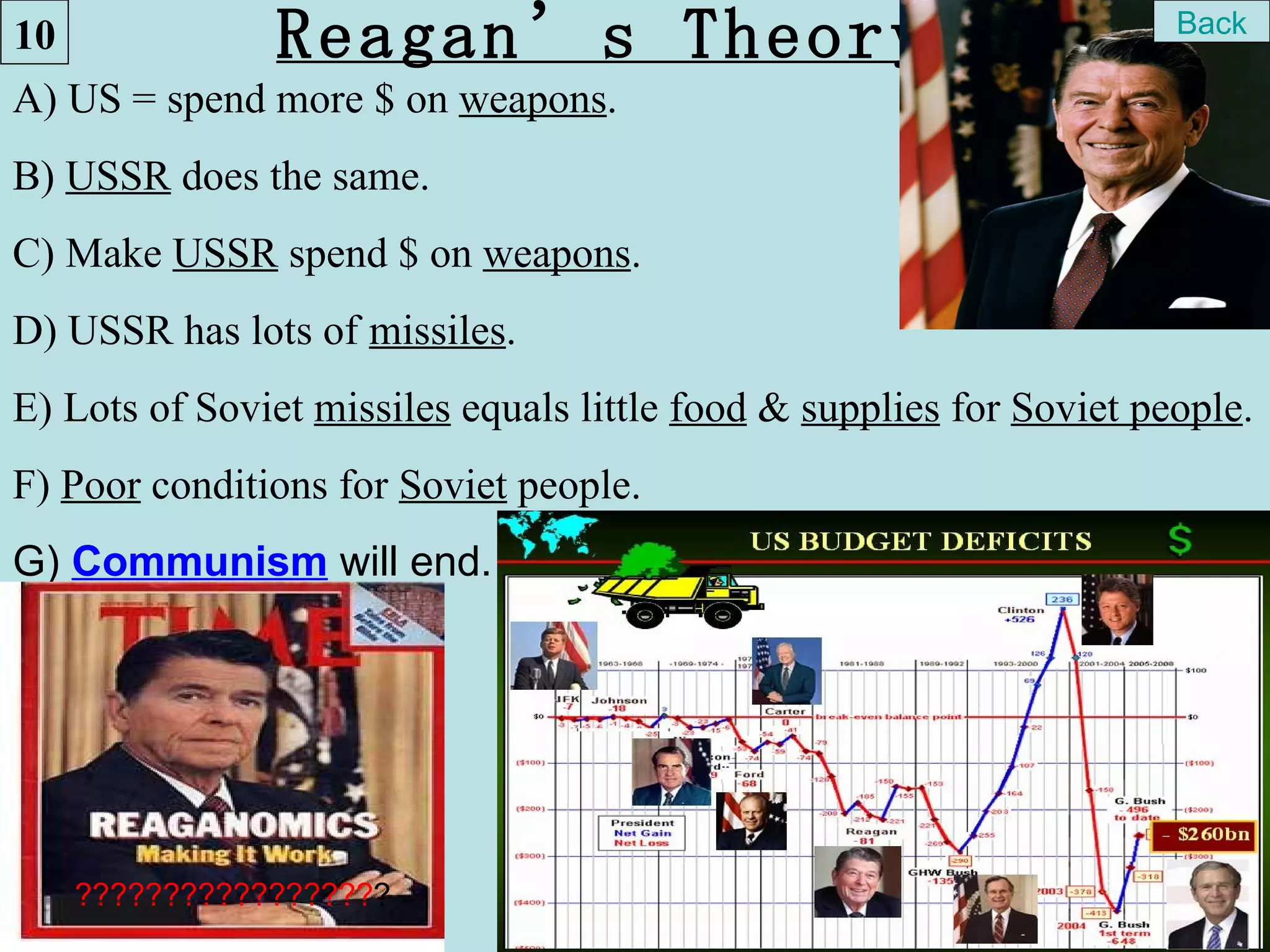
                                                                 billions upon billions of dollars for weapons. Thus began the massive debt
It also was during this time, the USSR was showing serious
                                                                 problem the US suffers from today.
systematic problems. Its future did not look good. Keeping a
friendly relation with USSR while it rotted from within          Undoubtedly, it was during the Reagan years that Soviet leader Gorbachev
seemed like a good course for the US to take. After Nixon        began to negotiate an ending to the Cold War. Whether Reagan’s deficit
resigned as President, the policy of Détente continued under     spending made the USSR collapse or was collapse coming on its own is
Democratic President Jimmy Carter. The 1970s saw a               uncertain. What is certain is that the Cold War headed towards a quick ending
movement towards trust and cooperation take place under the      under Gorbachev (USSR) and Reagan (US) which resulted in a Soviet Union
Soviet Invasion of Afghanistan in 1979.                          no longer in existence and the US debt problems here to stay and middle class
                                                                 American economic life gone for good. Which should make Americans ask:
                                                                 Was all the borrowing? debt? weapons? Was it all worth it to ‘win’ the Cold
                                                                 War?
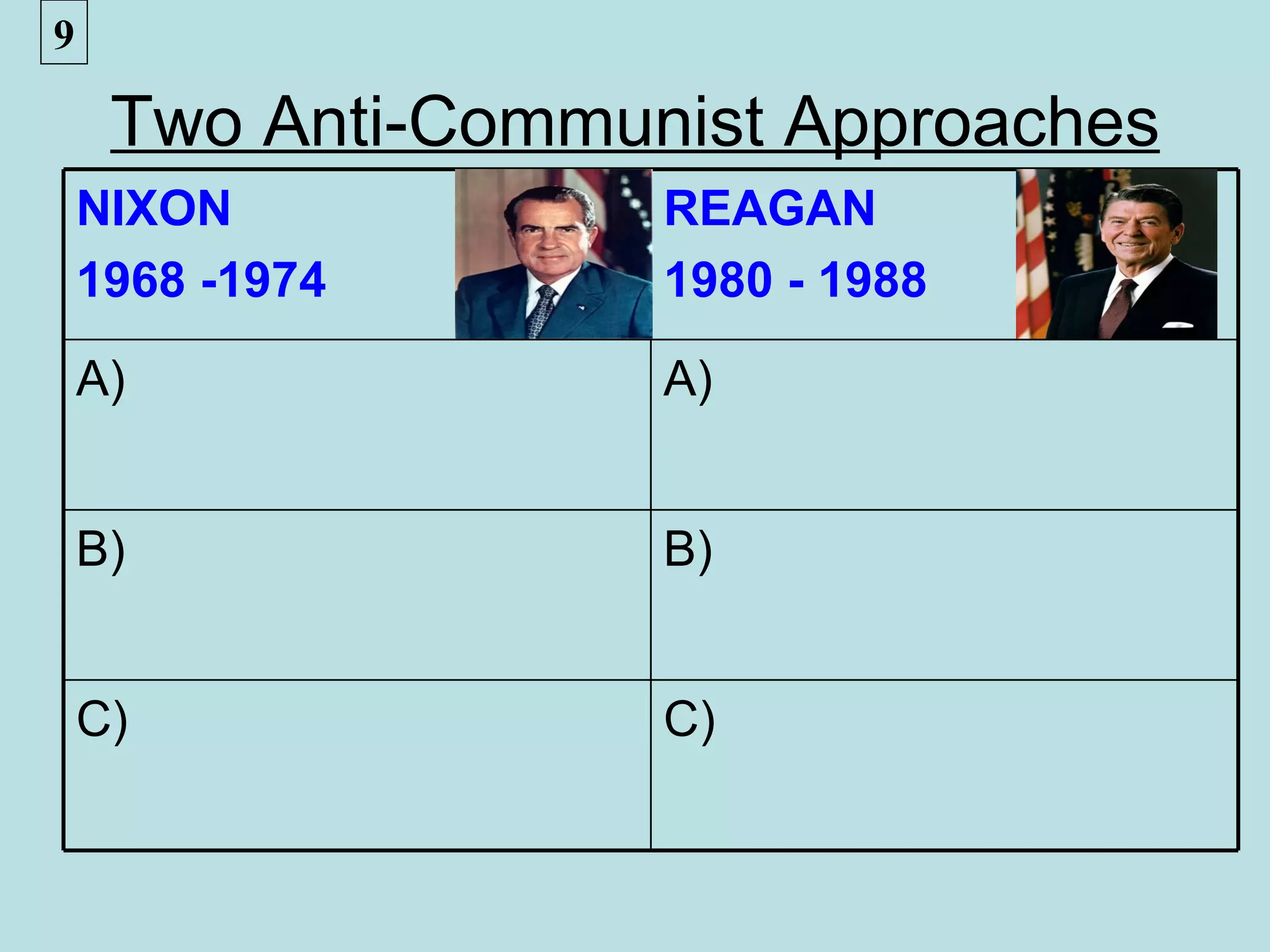
9

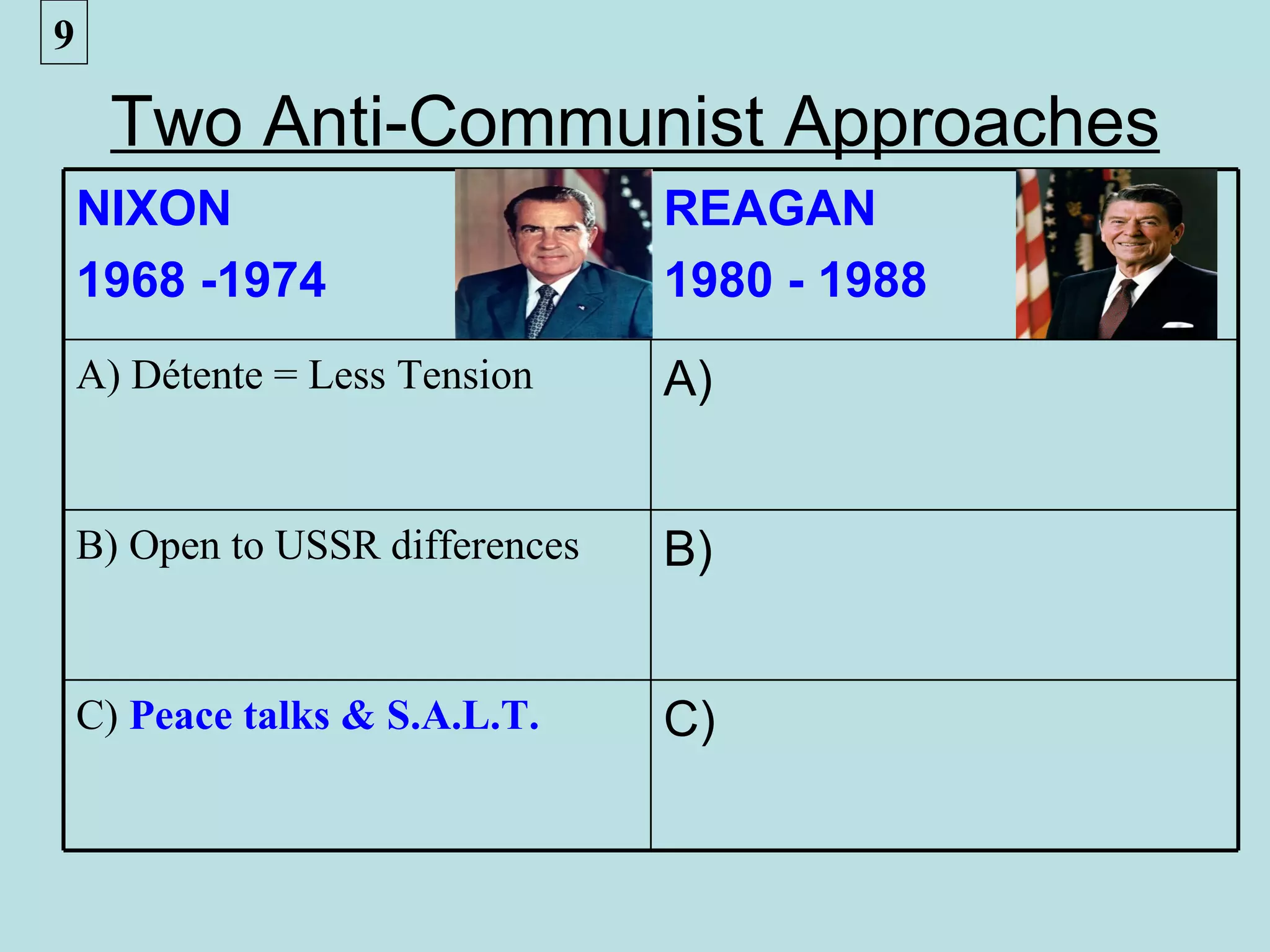
     Two Anti-Communist Approaches
    NIXON           REAGAN
    1968 -1974      1980 - 1988

    A)              A)


    B)              B)


    C)              C)
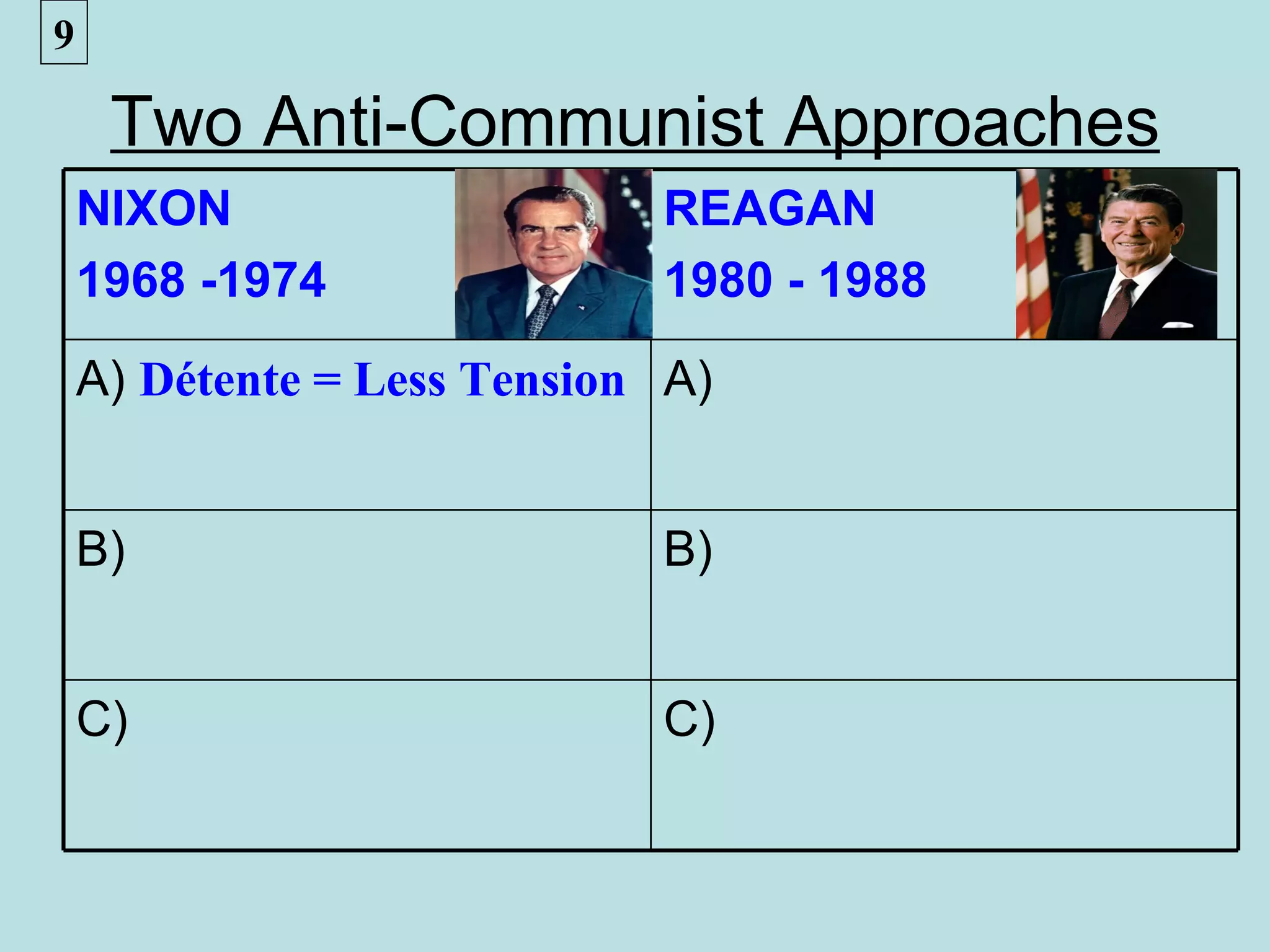
9

     Two Anti-Communist Approaches
    NIXON                    REAGAN
    1968 -1974               1980 - 1988

    A) Détente = Less Tension A)


    B)                       B)


    C)                       C)
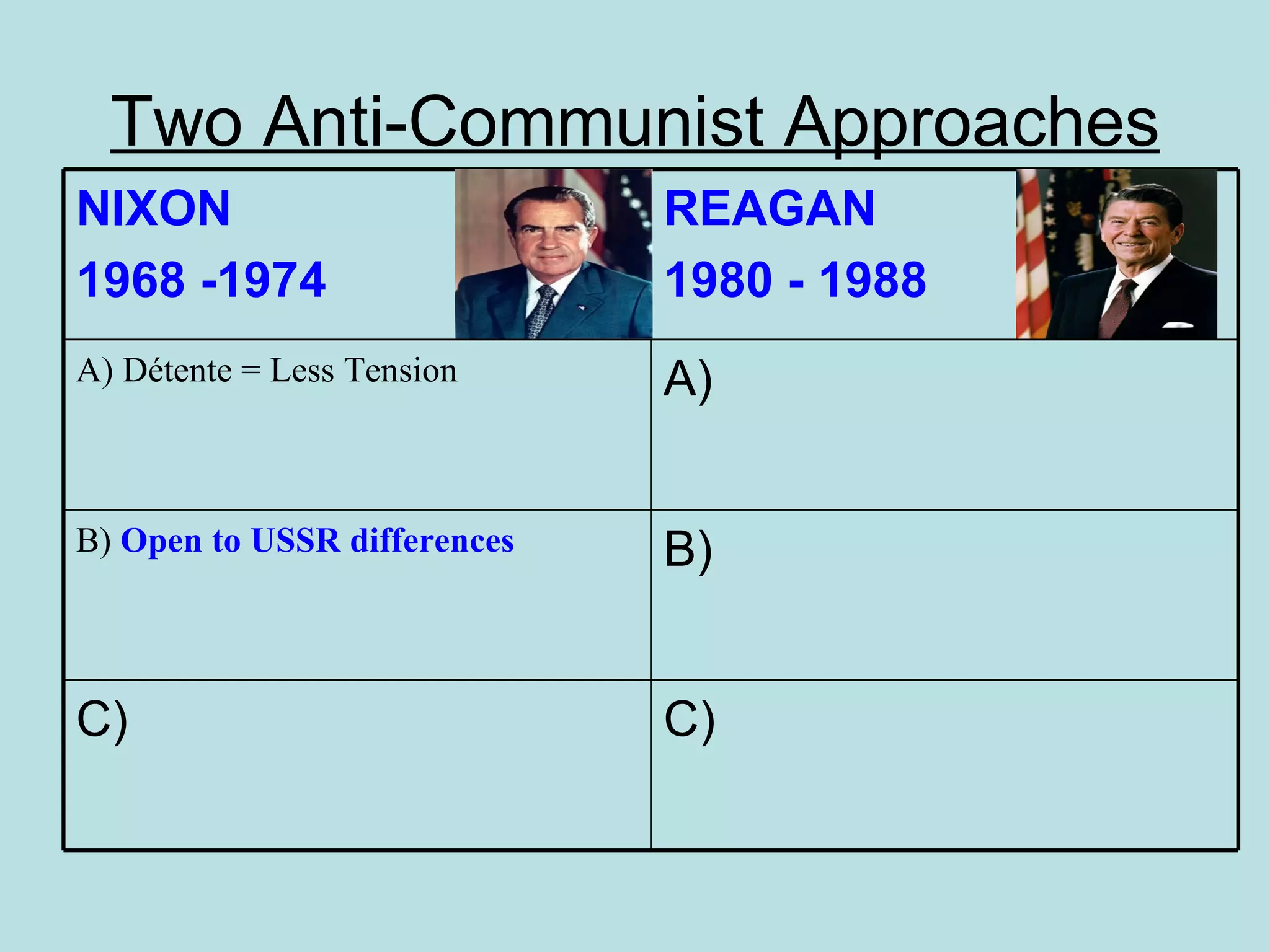
Two Anti-Communist Approaches
NIXON                         REAGAN
1968 -1974                    1980 - 1988
A) Détente = Less Tension     A)


B) Open to USSR differences   B)


C)                            C)
9

     Two Anti-Communist Approaches
    NIXON                         REAGAN
    1968 -1974                    1980 - 1988
    A) Détente = Less Tension     A)


    B) Open to USSR differences   B)


    C) Peace talks & S.A.L.T.     C)
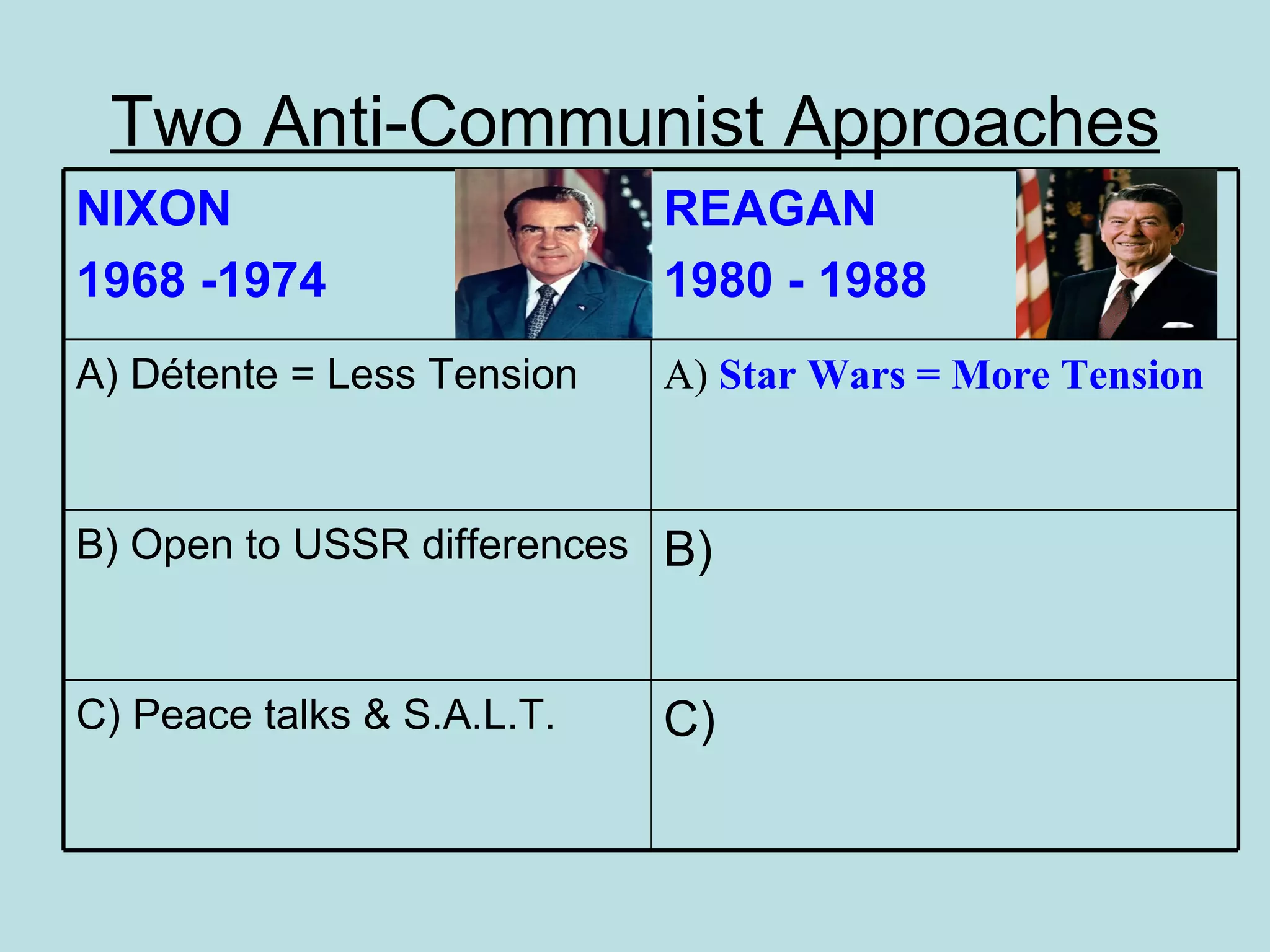
Two Anti-Communist Approaches
NIXON                       REAGAN
1968 -1974                  1980 - 1988
A) Détente = Less Tension   A) Star Wars = More Tension


B) Open to USSR differences B)


C) Peace talks & S.A.L.T.   C)
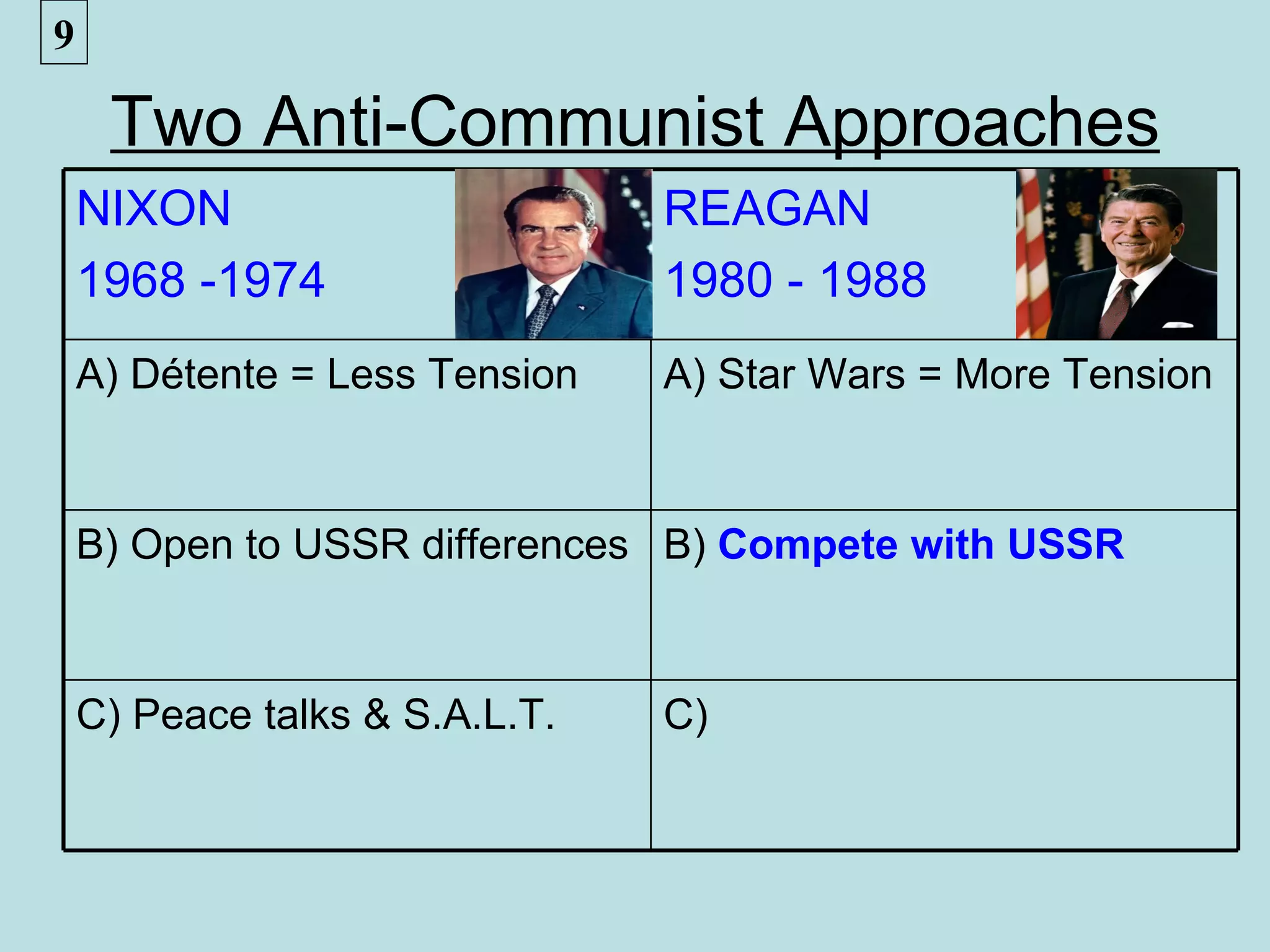
9

     Two Anti-Communist Approaches
    NIXON                       REAGAN
    1968 -1974                  1980 - 1988
    A) Détente = Less Tension   A) Star Wars = More Tension


    B) Open to USSR differences B) Compete with USSR


    C) Peace talks & S.A.L.T.   C)
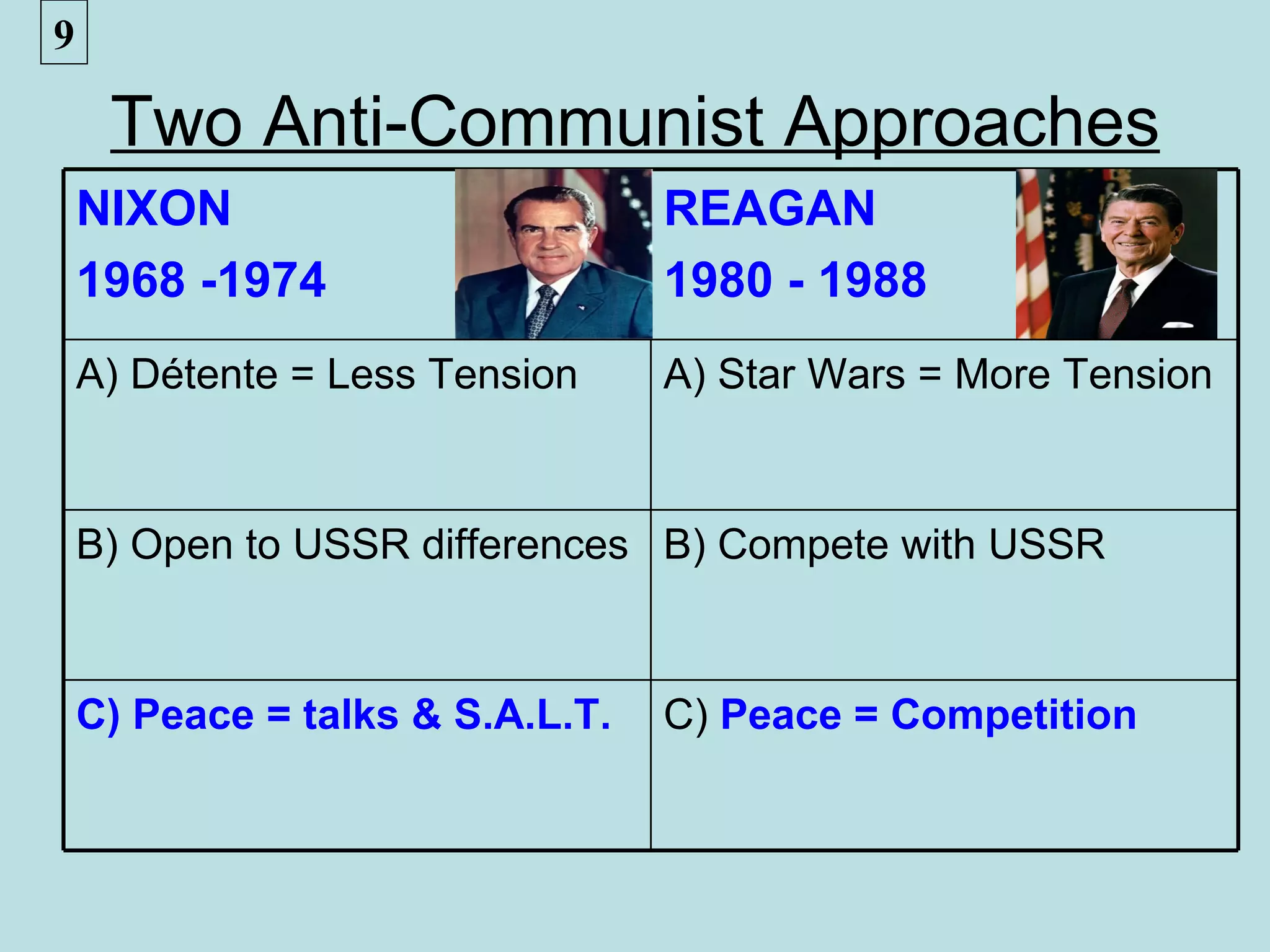
9

     Two Anti-Communist Approaches
    NIXON                         REAGAN
    1968 -1974                    1980 - 1988
    A) Détente = Less Tension     A) Star Wars = More Tension


    B) Open to USSR differences B) Compete with USSR


    C) Peace = talks & S.A.L.T.   C) Peace = Competition
Back
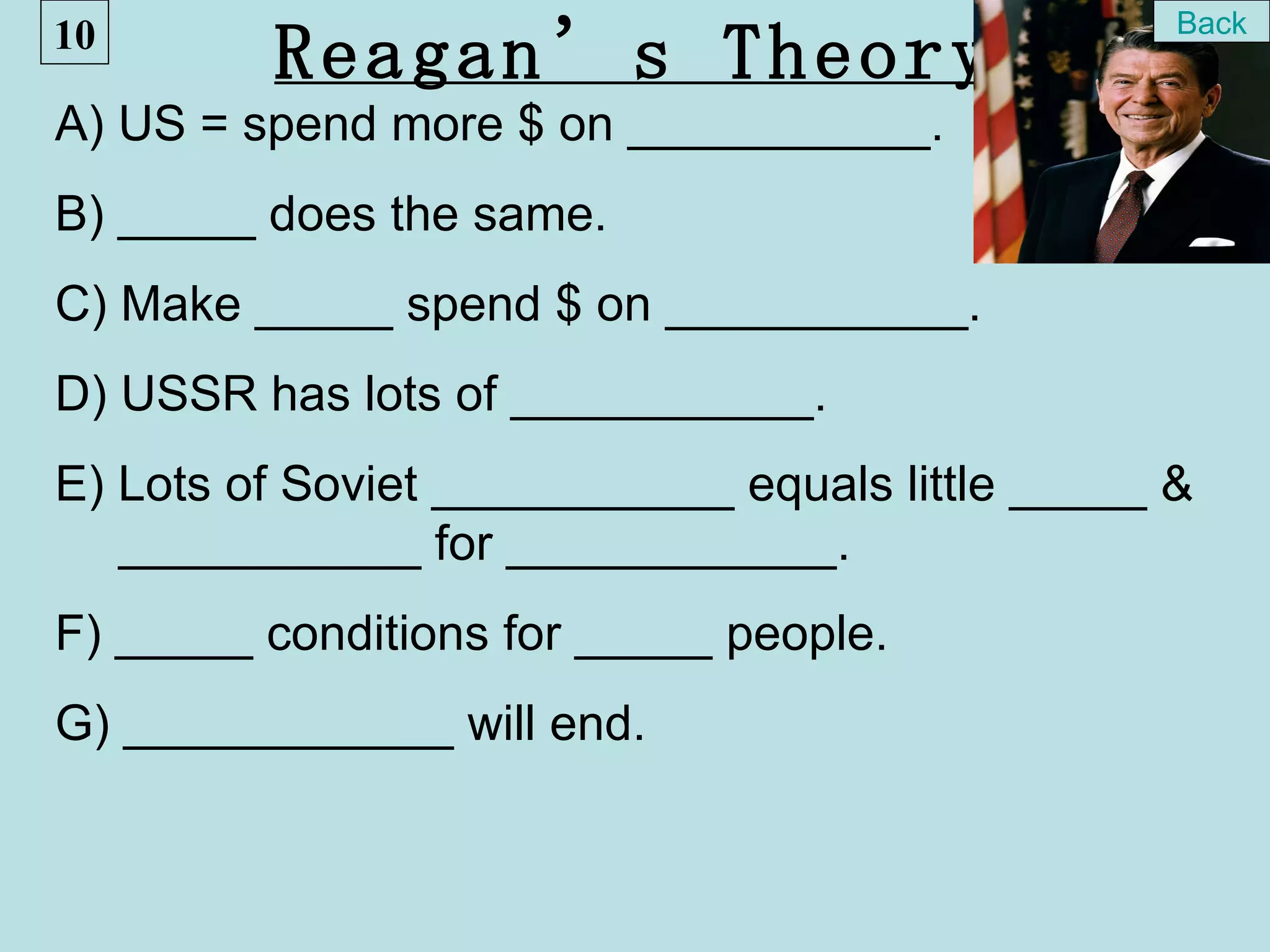
10                                                Back
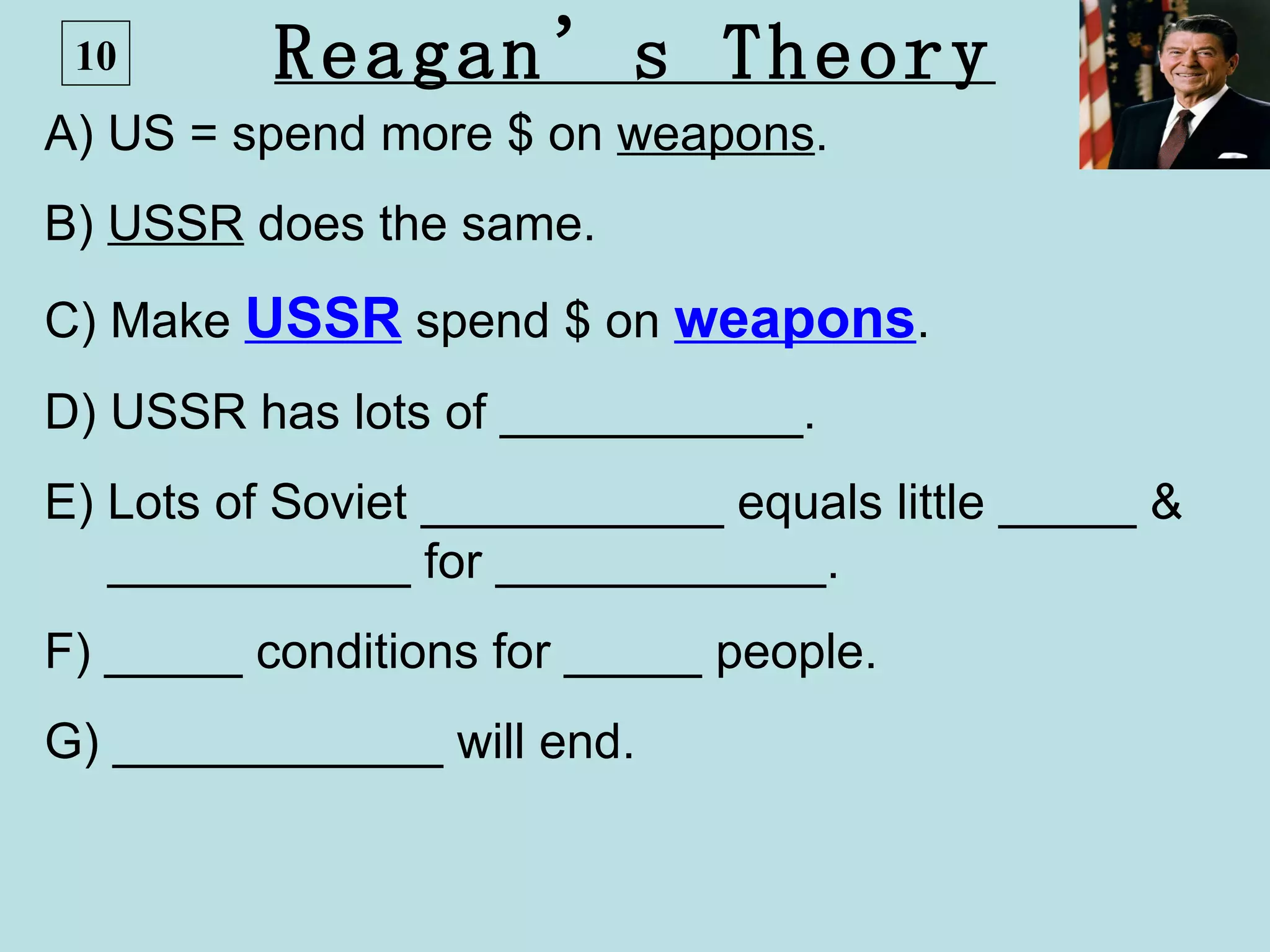
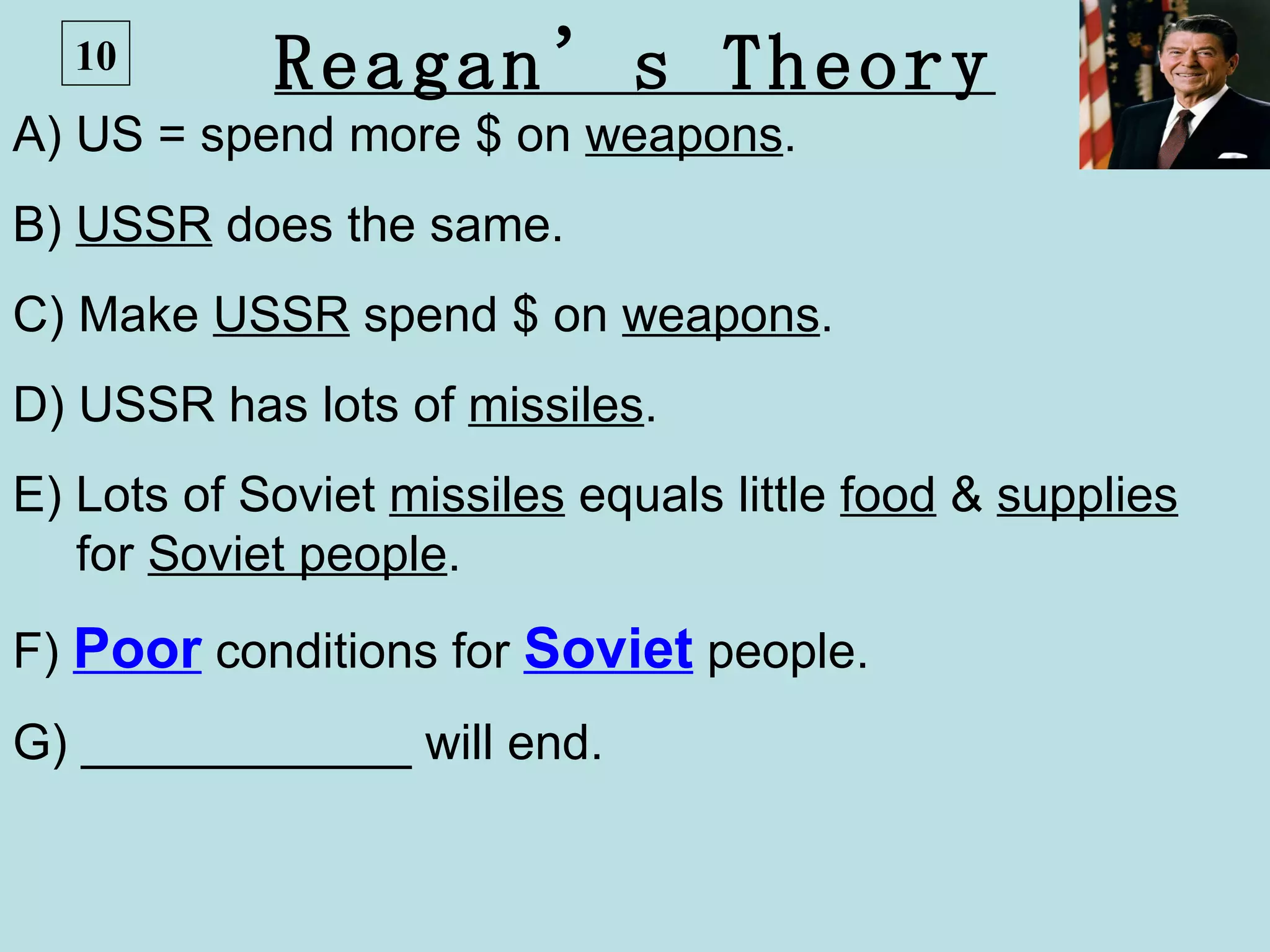
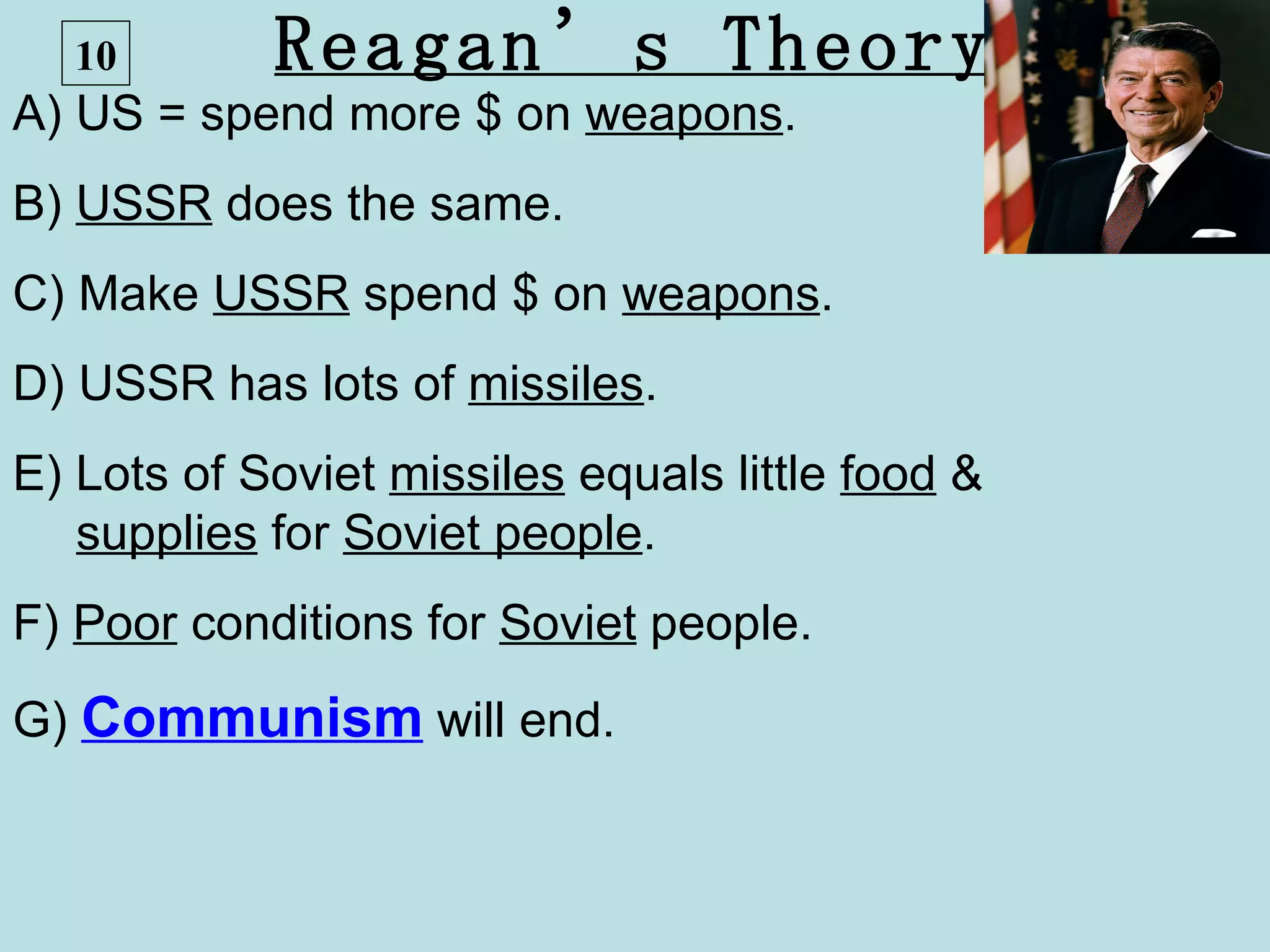
         Reagan’s Theory
A) US = spend more $ on ___________.
B) _____ does the same.
C) Make _____ spend $ on ___________.
D) USSR has lots of ___________.
E) Lots of Soviet ___________ equals little _____ &
   ___________ for ____________.
F) _____ conditions for _____ people.
G) ____________ will end.
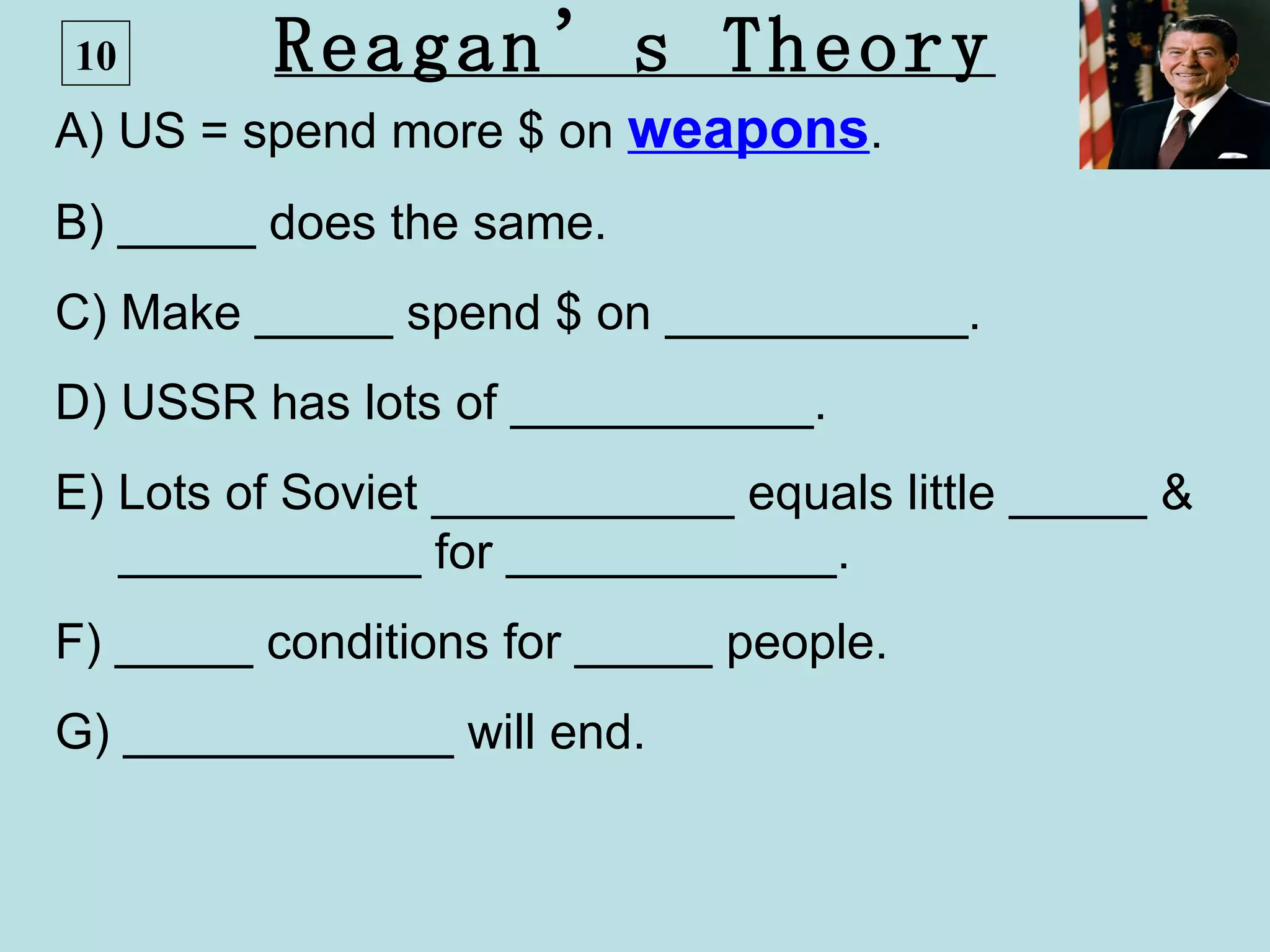
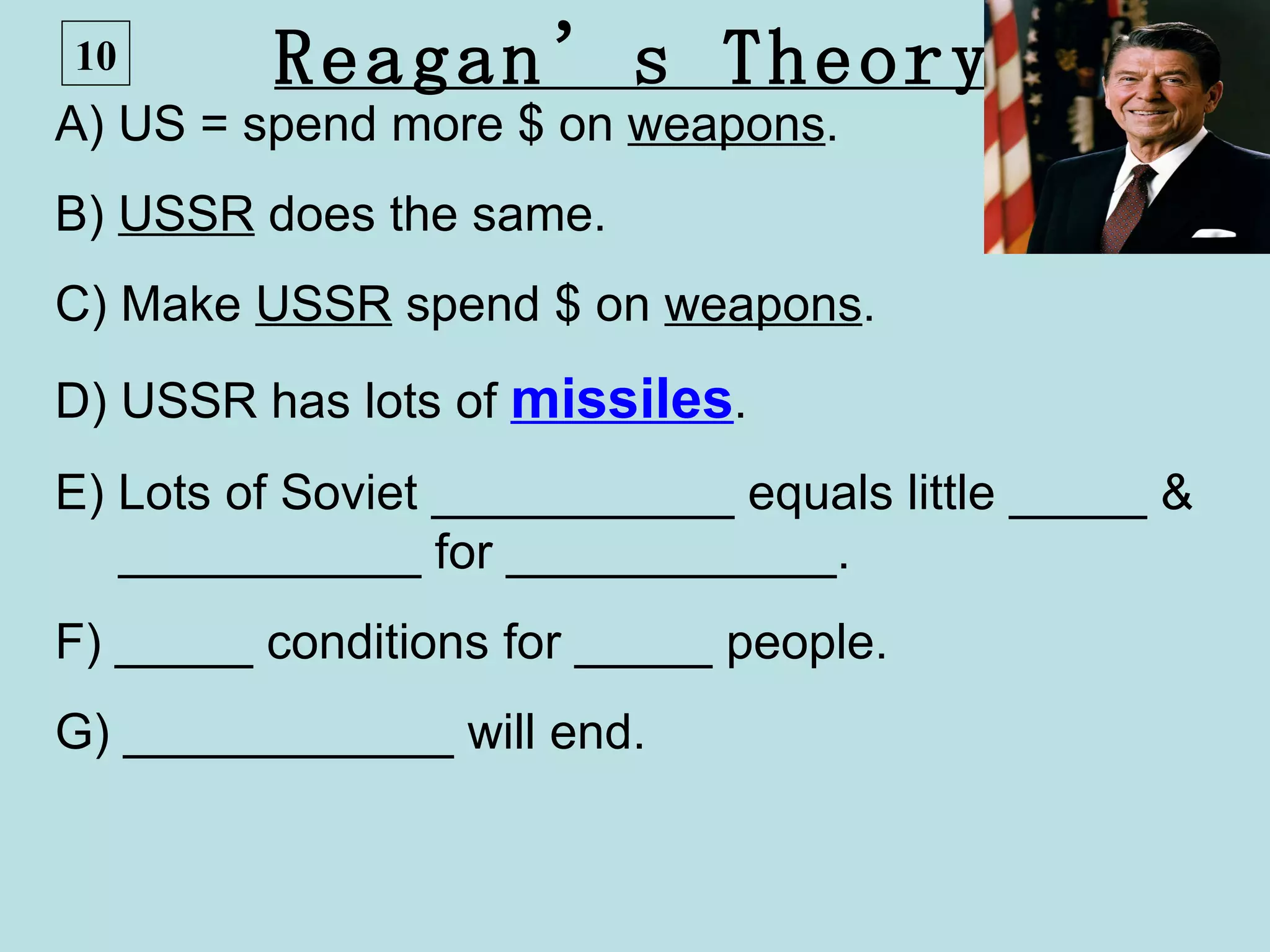
10       Reagan’s Theory
A) US = spend more $ on weapons.
B) _____ does the same.
C) Make _____ spend $ on ___________.
D) USSR has lots of ___________.
E) Lots of Soviet ___________ equals little _____ &
   ___________ for ____________.
F) _____ conditions for _____ people.
G) ____________ will end.
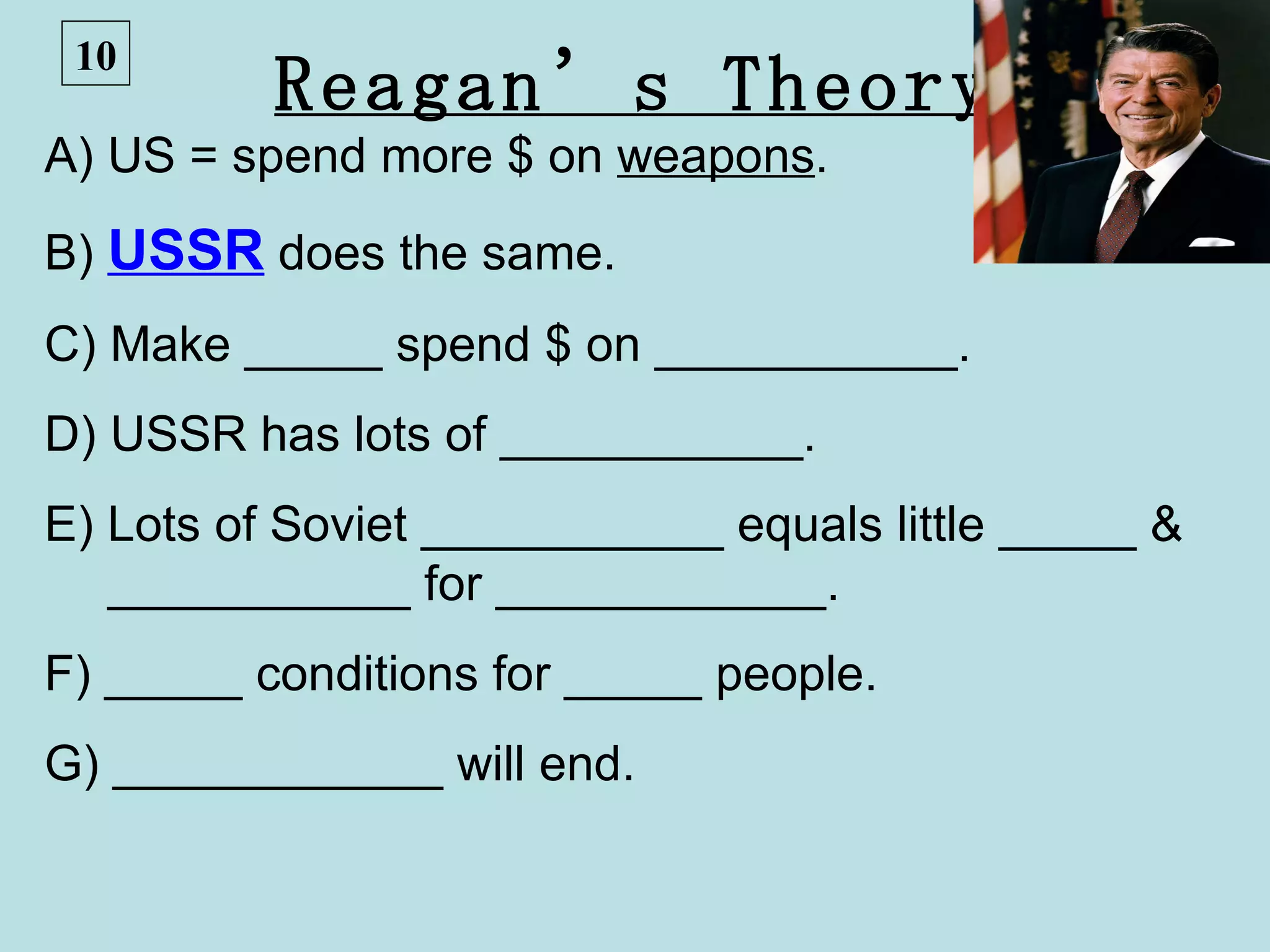
10
          Reagan’s Theory
A) US = spend more $ on weapons.
B) USSR does the same.
C) Make _____ spend $ on ___________.
D) USSR has lots of ___________.
E) Lots of Soviet ___________ equals little _____ &
   ___________ for ____________.
F) _____ conditions for _____ people.
G) ____________ will end.
10       Reagan’s Theory
A) US = spend more $ on weapons.
B) USSR does the same.
C) Make USSR spend $ on weapons.
D) USSR has lots of ___________.
E) Lots of Soviet ___________ equals little _____ &
   ___________ for ____________.
F) _____ conditions for _____ people.
G) ____________ will end.
10       Reagan’s Theory
A) US = spend more $ on weapons.
B) USSR does the same.
C) Make USSR spend $ on weapons.
D) USSR has lots of missiles.
E) Lots of Soviet ___________ equals little _____ &
   ___________ for ____________.
F) _____ conditions for _____ people.
G) ____________ will end.
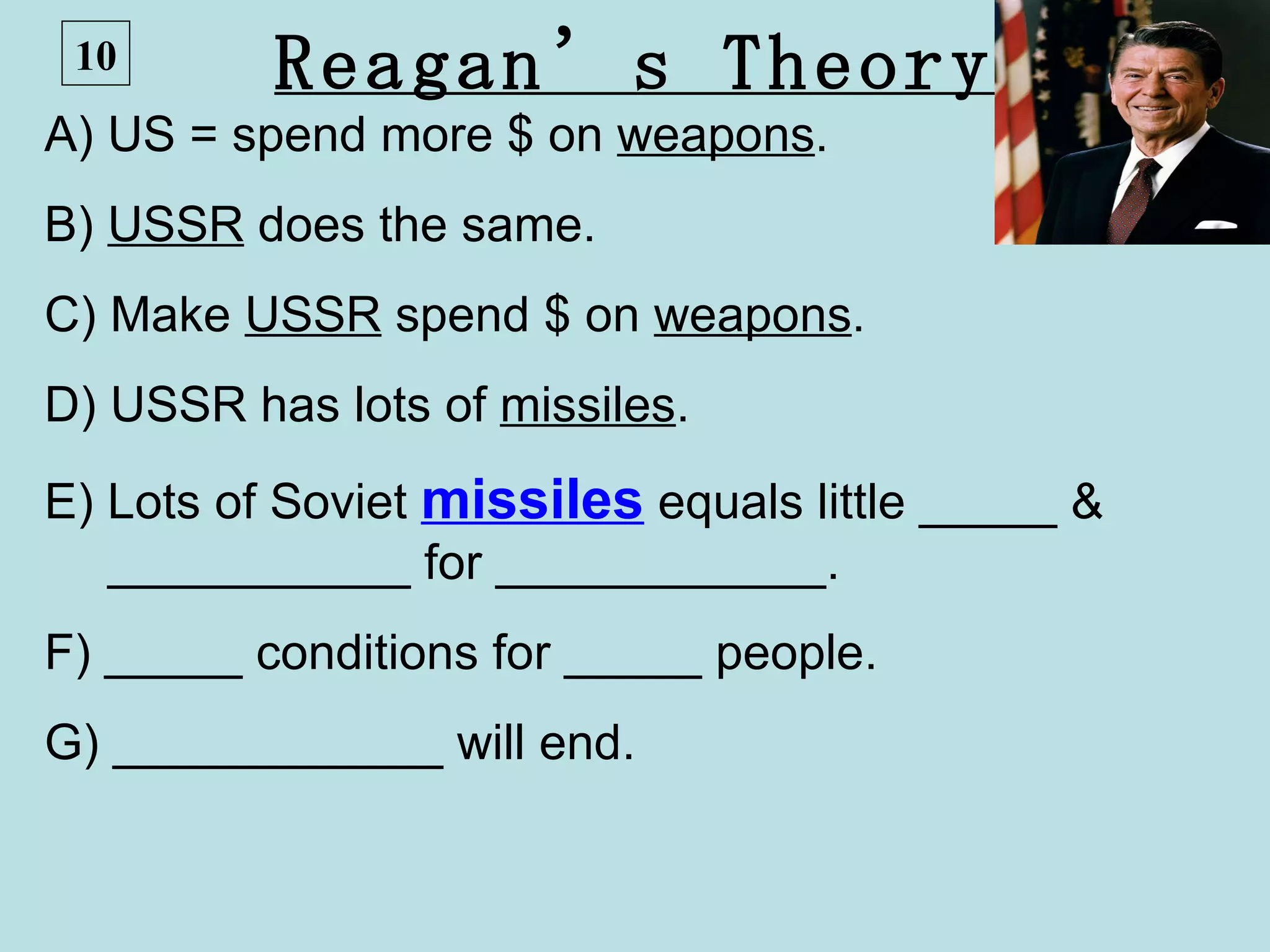
10       Reagan’s Theory
A) US = spend more $ on weapons.
B) USSR does the same.
C) Make USSR spend $ on weapons.
D) USSR has lots of missiles.
E) Lots of Soviet missiles equals little _____ &
   ___________ for ____________.
F) _____ conditions for _____ people.
G) ____________ will end.
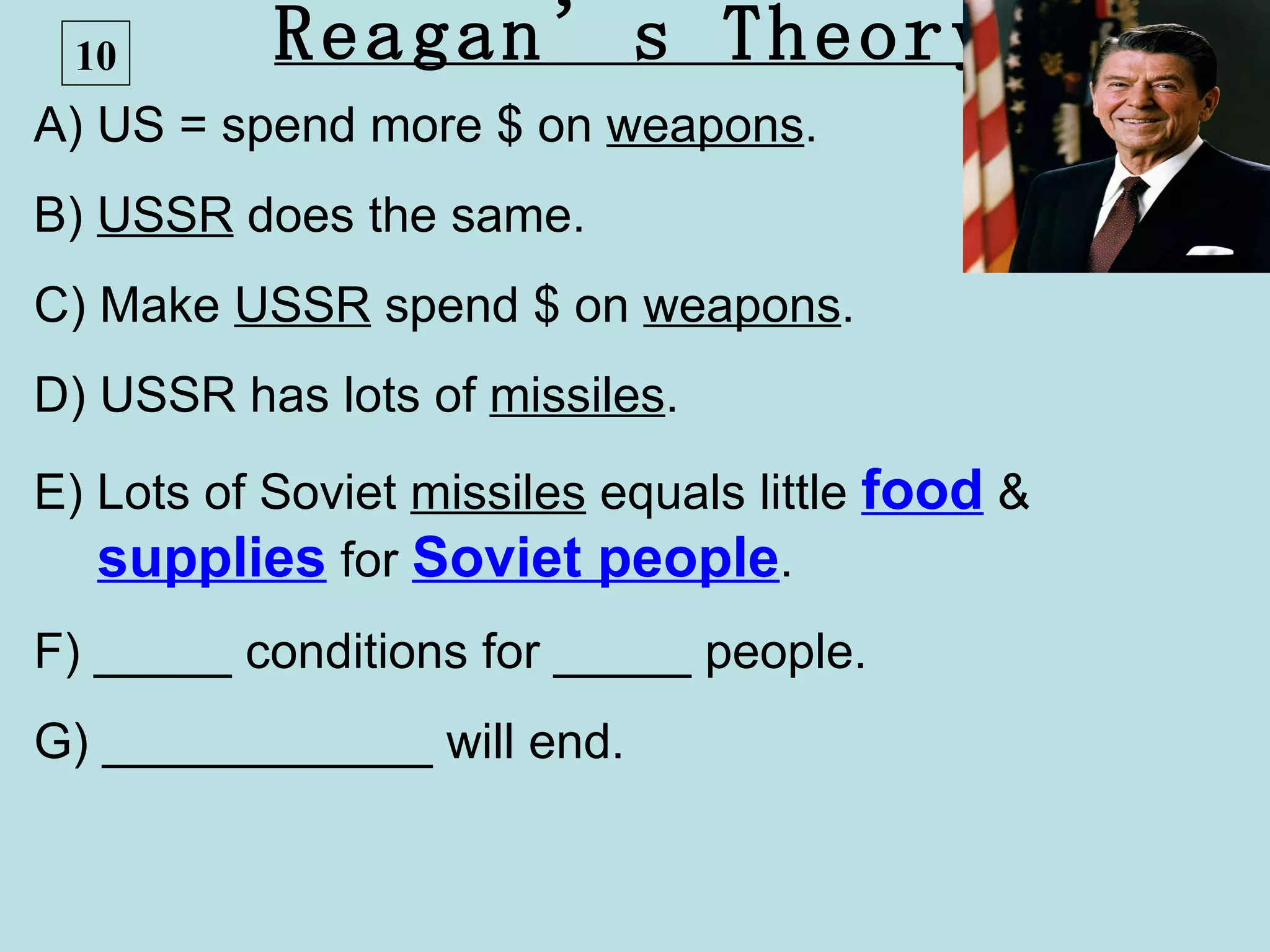
10        Reagan’s Theory
A) US = spend more $ on weapons.
B) USSR does the same.
C) Make USSR spend $ on weapons.
D) USSR has lots of missiles.
E) Lots of Soviet missiles equals little food &
   supplies for Soviet people.
F) _____ conditions for _____ people.
G) ____________ will end.
10        Reagan’s Theory
A) US = spend more $ on weapons.
B) USSR does the same.
C) Make USSR spend $ on weapons.
D) USSR has lots of missiles.
E) Lots of Soviet missiles equals little food & supplies
   for Soviet people.
F) Poor conditions for Soviet people.
G) ____________ will end.
10       Reagan’s Theory
A) US = spend more $ on weapons.
B) USSR does the same.
C) Make USSR spend $ on weapons.
D) USSR has lots of missiles.
E) Lots of Soviet missiles equals little food &
   supplies for Soviet people.
F) Poor conditions for Soviet people.
G) Communism will end.
10             Reagan’s Theory                                        Back
                                                                      Back

A) US = spend more $ on weapons.
B) USSR does the same.
C) Make USSR spend $ on weapons.
D) USSR has lots of missiles.
E) Lots of Soviet missiles equals little food & supplies for Soviet people.
F) Poor conditions for Soviet people.
G) Communism will end.


   ??????????????????
9-10) TWO ANTI-COMMUNIST APPROACHES                                                                    Back
   The US presidents did not keep one consistent anti-communist approach throughout the Cold War. Two very outspoken
       anti-communist Republican Presidents were Richard Nixon (1968 – 1974) and Ronald Reagan (1980-1988).


Nixon had become President after the policy of Brinkmanship      Originally a Hollywood actor, Reagan portrayed himself as a hardcore anti-
saw near nuclear war take place with both the Cuban Missile      communist tough leader. Unlike Nixon, Reagan felt peace could be achieved
Crisis and Berlin Wall under the leadership of Democratic        not through cooperation, but competition with the Soviet Union. This led to
President Kennedy. In addition, the mood of the nation was       more tension and mistrust between the two superpowers. The Reagan
very much turned off by the chaotic conflict in Vietnam.         Administration’s Theory proposed if the US spent more money on weapons,
                                                                 then the Soviet Union would do the same. The Soviet Union would have lots of
Thus, Détente was developed as a policy to create less tension
                                                                 weapons but even less food and supplies for the economically limited Soviet
between the US and USSR. Nixon’s Administration
                                                                 people. Thus, do to ever increasing poor conditions of the Soviet people, the
concluded that the two superpowers had to become open to
                                                                 communism system would collapse and the US would be the victors of the
each others’ differences. They had to recognize each other as
                                                                 Cold War.
they were and learn how to co-exist together. Furthermore,
under Détente Nixon pushed to have peace talks to improve        Reagan’s plan was criticized for many reasons. Even if Reagan’s theory
relations. During this time, SALT (Strategic Arms Limitation     worked, it might result in an unstable Russia with lots of nuclear weapons,
Talks) were held and the superpowers took steps to lower the     which might make the world more dangerous. Another problem with Reagan’s
amount of missiles aimed at each other.                          plan was in order to bankrupt the Soviet system the US would have to borrow
                                                                 billions upon billions of dollars for weapons. Thus began the massive debt
It also was during this time, the USSR was showing serious
                                                                 problem the US suffers from today.
systematic problems. Its future did not look good. Keeping a
friendly relation with USSR while it rotted from within          Undoubtedly, it was during the Reagan years that Soviet leader Gorbachev
seemed like a good course for the US to take. After Nixon        began to negotiate an ending to the Cold War. Whether Reagan’s deficit
resigned as President, the policy of Détente continued under     spending made the USSR collapse or was collapse coming on its own is
Democratic President Jimmy Carter. The 1970s saw a               uncertain. What is certain is that the Cold War headed towards a quick ending
movement towards trust and cooperation take place under the      under Gorbachev (USSR) and Reagan (US) which resulted in a Soviet Union
Soviet Invasion of Afghanistan in 1979.                          no longer in existence and the US debt problems here to stay and middle class
                                                                 American economic life gone for good. Which should make Americans ask:
                                                                 Was all the borrowing? debt? weapons? Was it all worth it to ‘win’ the Cold
                                                                 War?
Back
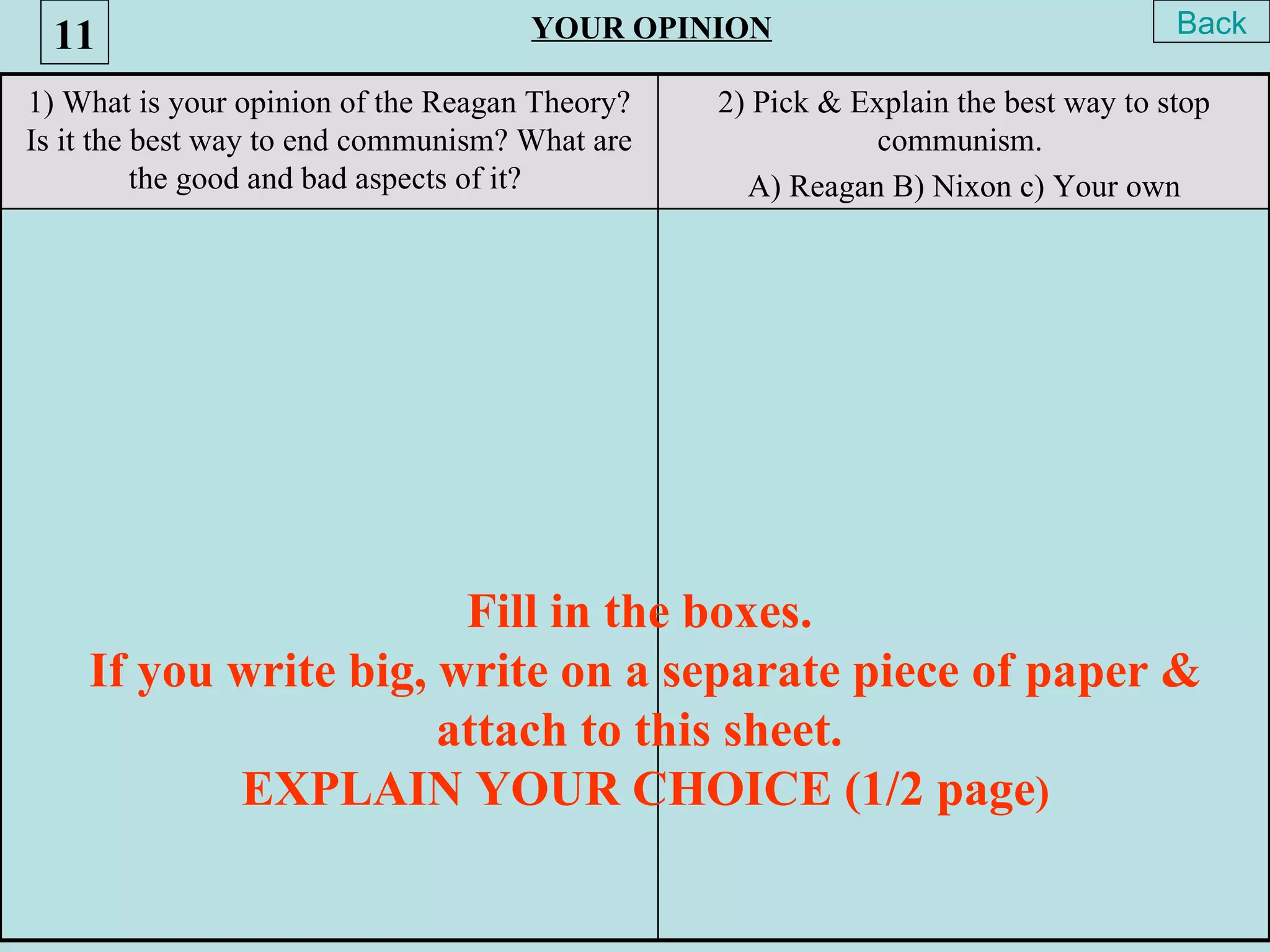
11                                 YOUR OPINION                                  Back

1) What is your opinion of the Reagan Theory?   2) Pick & Explain the best way to stop
Is it the best way to end communism? What are              communism.
          the good and bad aspects of it?         A) Reagan B) Nixon c) Your own


                       Fill in the boxes.
    If you write big, write on a separate piece of paper &
                      attach to this sheet.
           EXPLAIN YOUR CHOICE (1/2 page)

Cold War Thaws

  • 1.
  • 2.
    Back 1) WHAT DOES THAW MEAN? WHAT DOES THAW HAVE TO DO WITH THE COLD WAR? When you get frozen meat out of your refrigerator and put it on the kitchen table, the frozen meat begins to melt or THAW. When you put an ice cube on a table, it begins to THAW. It begins to warm up. The Cold War begins to THAW in the 1970s. This means that the relationship between the USSR and the USA begins to warm up. In other words, the Cold War relations improve.
  • 3.
    1 COLD WAR THAWS What does Thaw mean?
  • 4.
    1 COLD WAR THAWS What does Thaw mean?
  • 5.
    1 COLD WAR THAWS What does Thaw mean? Warming of relations
  • 6.
  • 7.
    Back 2) WHAT WAS BRINKMANSHIP & DETENTE? Two words that define the mood of Cold War diplomatic relations between the two superpowers were Brinkmanship and Détente. Brinkmanship is an intimidation strategy to push an enemy to the point of a disaster. The strategy is to push an enemy to the ‘brink’ or to the edge and by doing so the hope is the enemy will back down to avoid all out disaster. Of course, this strategy runs the risk of all out nuclear war. In other words, two sides using immense pressure to get opposing to back down can lead to one of the sides not backing down but responding militarily and thus triggering nuclear war on the most tragic of scales. Examples of Brinkmanship are the Cuban Missile Crisis and Berlin Wall Crisis at Check Point Charlie. Leaders often associated with Brinkmanship are John Kennedy (US) and Nikita Khrushchev (USSR). The policy of Brinkmanship is usually associated with the early part years of the Cold War (1950s – early 60s). Détente is a French word meaning “relaxation” and is another Cold War strategy that developed after Brinkmanship (associated with later 60s and 1970s). It is a very different approach than Brinkmanship. Détente was formed as a result of the intense and near disastrous Cuban Missile Crisis and Berlin Wall Crisis. Neither was likely to change the others’ mind. Thus, Détente proposed both superpowers needed to learn how to cooperate and co-exist with each other. It was in the interest of the 2 superpowers, humanity and the world for such an approach to be taken. Détente is often associated with longtime Soviet Leader Brezhnev and President Richard Nixon of the late 1960s and early 1970s and Jimmy Carter of the late 1970s. Détente was intended to warm up relations and hopefully decrease tension between super powers.
  • 8.
    2 Reference Meaning Term Definition COLD WARM
  • 9.
    2 Reference Meaning Term Definition COLD Bad  WARM Better 
  • 10.
    2 Reference Meaning Term Definition COLD Bad  WARM Better 
  • 11.
    2 Reference Meaning Term Definition COLD Bad Brinkmanship  WARM Better Détente 
  • 12.
    2 Reference Meaning Term Definition COLD Bad Brinkmanship a) Pushing an enemy to the point of disaster  WARM Better Détente a) Less tension  b) Flexible to differences c) Realist politics
  • 13.
    2 Reference Meaning Term Definition COLD Bad Brinkmanship • Pushing an enemy to the point of disaster  • Create immense pressure until one side backs down WARM Better Détente a) Less tension  b) Flexible to differences c) Realist politics d) French word for relaxation
  • 14.
  • 15.
    3 De-Stalinization Back Back After Stalin’s death, Khrushchev denounced many of Stalin’s actions as being harmful, wrong and against Leninist / communist ideals. He denounced the gulag system under Stalin and allowed for the publishing of One Day In The Life of Ivan Denisovich, a classic about the horrors of Stalin’s gulags. Under Khrushchev, the Soviet Union was more open and less censored than under Stalin. By the time Khrushchev left power, the Soviet Union was not the harsh totalitarian state it was under Stalin. However, more hardliner communists like Brezhnev viewed Khrushchev as a failure that made the Soviet Union weaker. Thus, Brezhnev returned to more harsh governmental practices. Brezhnev
  • 16.
    3 What was De-Stalinization?
  • 17.
    3 De-Stalinization After Stalin’s death, Khrushchev denounced many of Stalin’s actions as being harmful, wrong and against Leninist / communist ideals.
  • 18.
  • 19.
    USSR Leader Chinese Leader Nikita Khrushchev 4 China & Russia Split 4 Mao Zedong 2. Yes, Hello Comrade Back China & Russia Split 1. Hello Mao 3. It is good to show the world communist 4. Yes, and since we are communist we brothers together! share everything 5. Da! Da! Da! We are equal partners, 6. Since we are equal and we share… you unlike selfish capitalists! will give us nuclear weapons, yes? 7. Nyet! I mean… well, We will share our 8. But we are equals...We should share… nuclear missiles by protecting you Are you a true communist? from imperialist Americans. 10. How could they be our missiles if you 9. How dare you question our Communism! wont give them to us? You Chinese should just follow our lead… our missiles are your missiles 12. No, I think we will go our own way. in that they will protect you. 14. Yes! 11. Our position is clear and right… you Chinese should follow it! 16. Yes! 18. Sneaky stubborn Russians 13. Nyet! 15. Nyet! 19. We Americans should cause 17. Stupid stubborn further division between the Chinese! communists in China and the USSR 7 Years later New leader USA Leader Richard Nixon
  • 20.
    Chinese Leader 7 Years later Mao ZeDong New leader 21. Hi, Nixon and America! Yes, let’s hang out. USSR Leader Brezhnev Back 22. I no like! Maybe I talk Nixon too, yes! 23. Yes, now I can apply 20. Hi Mao, want to hang out? the idea of DETENTE Them Russians are treating to the Cold War China & Russia Split you wrong. The US won’t! 24. What is DÉTENTE: 1. Associated more with Nixon and Carter 2. Not associated with Truman, Eisenhower, JFK and Reagan 3. “ Warming” of the Cold War 4. Opposite of Brinkmanship 5. General reduction of tension between Soviet Union & USA
  • 21.
    4 What caused the Russian & Chinese Communist Split?
  • 22.
    China & RussiaSplit USSR Leader Chinese Leader Nikita Khruschev Mao ZeDong
  • 23.
    China & RussiaSplit Hello Comrade USSR Leader Chinese Leader Nikita Khruschev Mao ZeDong
  • 24.
    China & RussiaSplit Yes, Hello Comrade USSR Leader Chinese Leader Nikita Khruschev Mao ZeDong
  • 25.
    China & RussiaSplit It is good to show the world communist brothers together! USSR Leader Chinese Leader Nikita Khruschev Mao ZeDong
  • 26.
    China & RussiaSplit Yes, and since we are communist we share everything USSR Leader Chinese Leader Nikita Khruschev Mao ZeDong
  • 27.
    China & RussiaSplit Da! Da! Da! We are equal partners, unlike selfish capitalists! USSR Leader Chinese Leader Nikita Khruschev Mao ZeDong
  • 28.
    China & RussiaSplit Since we are equal and we share… you will give up nuclears weapons, yes? USSR Leader Chinese Leader Nikita Khruschev Mao ZeDong
  • 29.
    China & RussiaSplit Nyet! I mean… well, We will share our nuclear missiles by protecting you from imperialist Americans. USSR Leader Chinese Leader Nikita Khruschev Mao ZeDong
  • 30.
    China & RussiaSplit But we are equals... We should share… Are you a true communist? USSR Leader Chinese Leader Nikita Khruschev Mao ZeDong
  • 31.
    China & RussiaSplit How dare you question our Communism! You Chinese should just follow our lead… our missiles are your missiles in that they will protect you. USSR Leader Chinese Leader Nikita Khruschev Mao ZeDong
  • 32.
    China & RussiaSplit How could they be our missiles if you wont give them to us? USSR Leader Chinese Leader Nikita Khruschev Mao ZeDong
  • 33.
    China & RussiaSplit Stupid stubborn Chinese! How could they be our missiles if you wont give them to us? USSR Leader Chinese Leader Nikita Khruschev Mao ZeDong
  • 34.
    China & RussiaSplit Stupid stubborn Chinese! Our position is clear and right… you Chinese should follow it! USSR Leader Chinese Leader Nikita Khruschev Mao ZeDong
  • 35.
    China & RussiaSplit Sneaky stubborn Russians No, I think we will go our own way. USSR Leader Chinese Leader Nikita Khruschev Mao ZeDong
  • 36.
    China & RussiaSplit We Americans should cause further division between China and the USSR No, I think we will go our own way. USSR Leader Chinese Leader Nikita Khruschev Mao ZeDong
  • 37.
    China & RussiaSplit Nyet ! USSR Leader Chinese Leader Nikita Khruschev Mao ZeDong
  • 38.
    China & RussiaSplit Yes! USSR Leader Chinese Leader Nikita Khruschev Mao ZeDong
  • 39.
    China & RussiaSplit Nyet ! USSR Leader Chinese Leader Nikita Khruschev Mao ZeDong
  • 40.
    China & RussiaSplit Let’s step in and play the “China Card” Yes! USSR Leader Chinese Leader Nikita Khruschev Mao ZeDong
  • 41.
  • 42.
    China & RussiaSplit Hi Mao, want to hang out? Them Russians are treating you wrong. The US won’t! USSR Leader Chinese Leader Brezhnev Mao ZeDong
  • 43.
    China & RussiaSplit Hi Mao, want to hang out? Them Russians are treating you wrong. We, Americans won’t! Hi, Nixon and America! Yes, let’s hang out. USSR Leader Chinese Leader Brezhnev Mao ZeDong
  • 44.
    China & RussiaSplit Hi Mao, want to hang out? Them Russians are treating you wrong. We won’t! I no like! Maybe I talk Nixon too, yes! Hi, Nixon and America! Yes, let’s hang out. USSR Leader Chinese Leader Brezhnev Mao ZeDong
  • 45.
    China & RussiaSplit Yes, now I can apply the idea of _______ to the Cold War USSR Leader Chinese Leader Brezhnev Mao ZeDong
  • 46.
    H2) Guess the Term 5) 4) 3) 2) 1)
  • 47.
    H2) Guess the Term 5) Associated more with Nixon and Carter 4) 3) 2) 1)
  • 48.
    H2) Guess the Term 5) Associated more with Nixon and Carter 4) Not associated with Truman, Eisenhower, JFK and Reagan 3) 2) 1)
  • 49.
    H2) Guess the Term 5) Associated more with Nixon and Carter 4) Not associated with Truman, Eisenhower, JFK and Reagan 3) “ Warming” of the Cold War 2) 1)
  • 50.
    H2) Guess the Term 5) Associated more with Nixon and Carter 4) Not associated with Truman, Eisenhower, JFK and Reagan 3) “ Warming” of the Cold War 2) Opposite of Brinkmanship 1)
  • 51.
    H2) Guess the Term 5) Associated more with Nixon and Carter 4) Not associated with Truman, Eisenhower, JFK and Reagan 3) “ Warming” of the Cold War 2) Opposite of Brinkmanship 1) General reduction of tension between Soviet Union & USA
  • 52.
    DÉTENTE H2) 5) Associated more with Nixon and Carter 4) Not associated with Truman, Eisenhower, JFK and Reagan 3) “ Warming” of the Cold War 2) Opposite of Brinkmanship Back 1) General reduction of tension between Soviet Union and USA
  • 53.
    China & RussiaSplit Yes, now I can apply the idea of DETENTE to the Cold War USSR Leader Chinese Leader Brezhnev Mao ZeDong
  • 54.
    4 What caused the Russian & Chinese Communist Split? a) Mao asked for Russian bomb plans since both are communist and they should share, even bomb plans. b) Russian said they would protect their fellow communists and there was no need for China to have a bomb.
  • 55.
  • 56.
    5-8) What arethe USSR Satellites Nations? Back The USSR Satellites were Eastern European nations behind the Iron Curtain that were under the sphere of influence of the USSR. While these nations, also known as the Eastern Bloc, did have their own communist governments, they were under direct control from Moscow. They nations included Poland, East Germany, Czechoslovakia, Hungary, Romania and Bulgaria. During the Cold War, populations in these nations did rise up to defy Soviet control. Most noticeably was the Hungarian Revolt of 1956 and the 1968 Czech Uprising. The Hungarians were demanding free elections and Soviet troops out. The Czechs sought loosen censorship and openness to new ideas. (Ask Mr P about how he was almost killed Budapest in 1996 b/c of the Hungarian Revolt of 1956 but was saved by some Korean ) Both movements were severely crushed. Soviet leader Brezhnev ordered tanks to roll in and crush these mass democratic street protests by the native people. Unlike his predecessor Khrushchev, Brezhnev went back to more Stalinistic treatment of people. Under Brezhnev, nothing will harm communism, revolts will be crushed, human rights will be violated and free speech will not exist.
  • 57.
    5 USSR Satellite Countries What? Who? Where? Want? USSR Reaction? (Brezhnev)
  • 58.
    5 USSR Satellite Countries What? “Independent” eastern European countries really dominated and controlled by Moscow, USSR Who? Where? Want? USSR Reaction? (Brezhnev)
  • 59.
    6 USSR Satellite Countries What? “Independent” eastern European countries really dominated and controlled by Moscow, USSR Who? GROUP 6 tell CLASS THE ANSWER TO THIS. Where? USE MAPS ON NEXT FEW SLIDES Want? USSR Reaction? (Brezhnev)
  • 62.
    6 USSR Satellite Countries What? “Independent” eastern European countries really dominated and controlled by Moscow, USSR Who? Poland, Hungary, East Germany, Where? Czechoslovakia, Romania, Bulgaria Want? Group 7 – Tell class the answers USSR Reaction? (Brezhnev)
  • 63.
    7 USSR Satellite Countries What? “Independent” eastern European countries really dominated and controlled by Moscow, USSR Who? Poland, Hungary, East Germany, Where? Czechoslovakia, Romania, Bulgaria Want? Hungary – 1956 Czech -1968 USSR Reaction? (Brezhnev)
  • 64.
    7 USSR Satellite Countries What? “Independent” eastern European countries really dominated and controlled by Moscow, USSR Who? Poland, Hungary, East Germany, Where? Czechoslovakia, Romania, Bulgaria Want? Hungary – 1956 Czech -1968 USSR Reaction? (Brezhnev)
  • 65.
    8 USSR Satellite Countries What? “Independent” eastern European countries really dominated and controlled by Moscow, USSR Who? Poland, Hungary, East Germany, Where? Czechoslovakia, Romania, Bulgaria Want? Hungary – 1956 Free elections & Soviet troops out Czech -1968 Loosen censorship & openness to new ideas USSR Reaction? Group 8 – Tell class the answers (Brezhnev)
  • 66.
    8 USSR Satellite Countries What? “Independent” eastern European countries really dominated and controlled by Moscow, USSR Who? Poland, Hungary, East Germany, Where? Czechoslovakia, Romania, Bulgaria Want? Hungary – 1956 Free elections & Soviet troops out Czech -1968 Loosen censorship & openness to new ideas USSR a) crushed revolts Reaction? (Brezhnev)
  • 67.
    8 USSR Satellite Countries What? “Independent” eastern European countries really dominated and controlled by Moscow, USSR Who? Poland, Hungary, East Germany, Where? Czechoslovakia, Romania, Bulgaria Want? Hungary – 1956 Free elections & Soviet troops out Czech -1968 Loosen censorship & openness to new ideas USSR a) crushed revolts Reaction? b) violation of basic human rights (Brezhnev)
  • 68.
    8 USSR Satellite Countries What? “Independent” eastern European countries really dominated and controlled by Moscow, USSR Who? Poland, Hungary, East Germany, Where? Czechoslovakia, Romania, Bulgaria Want? Hungary – 1956 Free elections & Soviet troops out Czech -1968 Loosen censorship & openness to new ideas USSR a) crushed revolts Reaction? b) violation of basic human rights (Brezhnev) c) no freedom of speech
  • 69.
    8 USSR Satellite Countries What? “Independent” eastern European countries really dominated and controlled by Moscow, USSR Who? Poland, Hungary, East Germany, Where? Czechoslovakia, Romania, Bulgaria Want? Hungary – 1956 Free elections & Soviet troops out Czech -1968 Loosen censorship & openness to new ideas USSR • crushed revolts Reaction • violation of basic human rights ? • no freedom of speech (Brezhnev) • NOTHING will harm communism.
  • 72.
  • 73.
  • 74.
    9-10) TWO ANTI-COMMUNISTAPPROACHES Back The US presidents did not keep one consistent anti-communist approach throughout the Cold War. Two very outspoken anti-communist Republican Presidents were Richard Nixon (1968 – 1974) and Ronald Reagan (1980-1988). Nixon had become President after the policy of Brinkmanship Originally a Hollywood actor, Reagan portrayed himself as a hardcore anti- saw near nuclear war take place with both the Cuban Missile communist tough leader. Unlike Nixon, Reagan felt peace could be achieved Crisis and Berlin Wall under the leadership of Democratic not through cooperation, but competition with the Soviet Union. This led to President Kennedy. In addition, the mood of the nation was more tension and mistrust between the two superpowers. The Reagan very much turned off by the chaotic conflict in Vietnam. Administration’s Theory proposed if the US spent more money on weapons, then the Soviet Union would do the same. The Soviet Union would have lots of Thus, Détente was developed as a policy to create less tension weapons but even less food and supplies for the economically limited Soviet between the US and USSR. Nixon’s Administration people. Thus, do to ever increasing poor conditions of the Soviet people, the concluded that the two superpowers had to become open to communism system would collapse and the US would be the victors of the each others’ differences. They had to recognize each other as Cold War. they were and learn how to co-exist together. Furthermore, under Détente Nixon pushed to have peace talks to improve Reagan’s plan was criticized for many reasons. Even if Reagan’s theory relations. During this time, SALT (Strategic Arms Limitation worked, it might result in an unstable Russia with lots of nuclear weapons, Talks) were held and the superpowers took steps to lower the which might make the world more dangerous. Another problem with Reagan’s amount of missiles aimed at each other. plan was in order to bankrupt the Soviet system the US would have to borrow billions upon billions of dollars for weapons. Thus began the massive debt It also was during this time, the USSR was showing serious problem the US suffers from today. systematic problems. Its future did not look good. Keeping a friendly relation with USSR while it rotted from within Undoubtedly, it was during the Reagan years that Soviet leader Gorbachev seemed like a good course for the US to take. After Nixon began to negotiate an ending to the Cold War. Whether Reagan’s deficit resigned as President, the policy of Détente continued under spending made the USSR collapse or was collapse coming on its own is Democratic President Jimmy Carter. The 1970s saw a uncertain. What is certain is that the Cold War headed towards a quick ending movement towards trust and cooperation take place under the under Gorbachev (USSR) and Reagan (US) which resulted in a Soviet Union Soviet Invasion of Afghanistan in 1979. no longer in existence and the US debt problems here to stay and middle class American economic life gone for good. Which should make Americans ask: Was all the borrowing? debt? weapons? Was it all worth it to ‘win’ the Cold War?
  • 75.
    9 Two Anti-Communist Approaches NIXON REAGAN 1968 -1974 1980 - 1988 A) A) B) B) C) C)
  • 76.
    9 Two Anti-Communist Approaches NIXON REAGAN 1968 -1974 1980 - 1988 A) Détente = Less Tension A) B) B) C) C)
  • 77.
    Two Anti-Communist Approaches NIXON REAGAN 1968 -1974 1980 - 1988 A) Détente = Less Tension A) B) Open to USSR differences B) C) C)
  • 78.
    9 Two Anti-Communist Approaches NIXON REAGAN 1968 -1974 1980 - 1988 A) Détente = Less Tension A) B) Open to USSR differences B) C) Peace talks & S.A.L.T. C)
  • 79.
    Two Anti-Communist Approaches NIXON REAGAN 1968 -1974 1980 - 1988 A) Détente = Less Tension A) Star Wars = More Tension B) Open to USSR differences B) C) Peace talks & S.A.L.T. C)
  • 80.
    9 Two Anti-Communist Approaches NIXON REAGAN 1968 -1974 1980 - 1988 A) Détente = Less Tension A) Star Wars = More Tension B) Open to USSR differences B) Compete with USSR C) Peace talks & S.A.L.T. C)
  • 81.
    9 Two Anti-Communist Approaches NIXON REAGAN 1968 -1974 1980 - 1988 A) Détente = Less Tension A) Star Wars = More Tension B) Open to USSR differences B) Compete with USSR C) Peace = talks & S.A.L.T. C) Peace = Competition
  • 82.
  • 83.
    10 Back Reagan’s Theory A) US = spend more $ on ___________. B) _____ does the same. C) Make _____ spend $ on ___________. D) USSR has lots of ___________. E) Lots of Soviet ___________ equals little _____ & ___________ for ____________. F) _____ conditions for _____ people. G) ____________ will end.
  • 84.
    10 Reagan’s Theory A) US = spend more $ on weapons. B) _____ does the same. C) Make _____ spend $ on ___________. D) USSR has lots of ___________. E) Lots of Soviet ___________ equals little _____ & ___________ for ____________. F) _____ conditions for _____ people. G) ____________ will end.
  • 85.
    10 Reagan’s Theory A) US = spend more $ on weapons. B) USSR does the same. C) Make _____ spend $ on ___________. D) USSR has lots of ___________. E) Lots of Soviet ___________ equals little _____ & ___________ for ____________. F) _____ conditions for _____ people. G) ____________ will end.
  • 86.
    10 Reagan’s Theory A) US = spend more $ on weapons. B) USSR does the same. C) Make USSR spend $ on weapons. D) USSR has lots of ___________. E) Lots of Soviet ___________ equals little _____ & ___________ for ____________. F) _____ conditions for _____ people. G) ____________ will end.
  • 87.
    10 Reagan’s Theory A) US = spend more $ on weapons. B) USSR does the same. C) Make USSR spend $ on weapons. D) USSR has lots of missiles. E) Lots of Soviet ___________ equals little _____ & ___________ for ____________. F) _____ conditions for _____ people. G) ____________ will end.
  • 88.
    10 Reagan’s Theory A) US = spend more $ on weapons. B) USSR does the same. C) Make USSR spend $ on weapons. D) USSR has lots of missiles. E) Lots of Soviet missiles equals little _____ & ___________ for ____________. F) _____ conditions for _____ people. G) ____________ will end.
  • 89.
    10 Reagan’s Theory A) US = spend more $ on weapons. B) USSR does the same. C) Make USSR spend $ on weapons. D) USSR has lots of missiles. E) Lots of Soviet missiles equals little food & supplies for Soviet people. F) _____ conditions for _____ people. G) ____________ will end.
  • 90.
    10 Reagan’s Theory A) US = spend more $ on weapons. B) USSR does the same. C) Make USSR spend $ on weapons. D) USSR has lots of missiles. E) Lots of Soviet missiles equals little food & supplies for Soviet people. F) Poor conditions for Soviet people. G) ____________ will end.
  • 91.
    10 Reagan’s Theory A) US = spend more $ on weapons. B) USSR does the same. C) Make USSR spend $ on weapons. D) USSR has lots of missiles. E) Lots of Soviet missiles equals little food & supplies for Soviet people. F) Poor conditions for Soviet people. G) Communism will end.
  • 92.
    10 Reagan’s Theory Back Back A) US = spend more $ on weapons. B) USSR does the same. C) Make USSR spend $ on weapons. D) USSR has lots of missiles. E) Lots of Soviet missiles equals little food & supplies for Soviet people. F) Poor conditions for Soviet people. G) Communism will end. ??????????????????
  • 93.
    9-10) TWO ANTI-COMMUNISTAPPROACHES Back The US presidents did not keep one consistent anti-communist approach throughout the Cold War. Two very outspoken anti-communist Republican Presidents were Richard Nixon (1968 – 1974) and Ronald Reagan (1980-1988). Nixon had become President after the policy of Brinkmanship Originally a Hollywood actor, Reagan portrayed himself as a hardcore anti- saw near nuclear war take place with both the Cuban Missile communist tough leader. Unlike Nixon, Reagan felt peace could be achieved Crisis and Berlin Wall under the leadership of Democratic not through cooperation, but competition with the Soviet Union. This led to President Kennedy. In addition, the mood of the nation was more tension and mistrust between the two superpowers. The Reagan very much turned off by the chaotic conflict in Vietnam. Administration’s Theory proposed if the US spent more money on weapons, then the Soviet Union would do the same. The Soviet Union would have lots of Thus, Détente was developed as a policy to create less tension weapons but even less food and supplies for the economically limited Soviet between the US and USSR. Nixon’s Administration people. Thus, do to ever increasing poor conditions of the Soviet people, the concluded that the two superpowers had to become open to communism system would collapse and the US would be the victors of the each others’ differences. They had to recognize each other as Cold War. they were and learn how to co-exist together. Furthermore, under Détente Nixon pushed to have peace talks to improve Reagan’s plan was criticized for many reasons. Even if Reagan’s theory relations. During this time, SALT (Strategic Arms Limitation worked, it might result in an unstable Russia with lots of nuclear weapons, Talks) were held and the superpowers took steps to lower the which might make the world more dangerous. Another problem with Reagan’s amount of missiles aimed at each other. plan was in order to bankrupt the Soviet system the US would have to borrow billions upon billions of dollars for weapons. Thus began the massive debt It also was during this time, the USSR was showing serious problem the US suffers from today. systematic problems. Its future did not look good. Keeping a friendly relation with USSR while it rotted from within Undoubtedly, it was during the Reagan years that Soviet leader Gorbachev seemed like a good course for the US to take. After Nixon began to negotiate an ending to the Cold War. Whether Reagan’s deficit resigned as President, the policy of Détente continued under spending made the USSR collapse or was collapse coming on its own is Democratic President Jimmy Carter. The 1970s saw a uncertain. What is certain is that the Cold War headed towards a quick ending movement towards trust and cooperation take place under the under Gorbachev (USSR) and Reagan (US) which resulted in a Soviet Union Soviet Invasion of Afghanistan in 1979. no longer in existence and the US debt problems here to stay and middle class American economic life gone for good. Which should make Americans ask: Was all the borrowing? debt? weapons? Was it all worth it to ‘win’ the Cold War?
  • 94.
  • 95.
    11 YOUR OPINION Back 1) What is your opinion of the Reagan Theory? 2) Pick & Explain the best way to stop Is it the best way to end communism? What are communism. the good and bad aspects of it? A) Reagan B) Nixon c) Your own Fill in the boxes. If you write big, write on a separate piece of paper & attach to this sheet. EXPLAIN YOUR CHOICE (1/2 page)