Rafael Richards MD MS 2014-08 
Linked 
Vitals 
Linked Vitals 
SemTech Conference 
San Jose, CA 
August 20, 2014 
Rafael M Richards MD MS 
Physician Informaticist 
Office of Informatics and Analytics 
Veterans Health Administration 
U.S. Department of Veterans Affairs 
A Linked Data Approach to 
Semantic Interoperability
Rafael Richards MD MS 2014-08 
Linked 
Vitals 
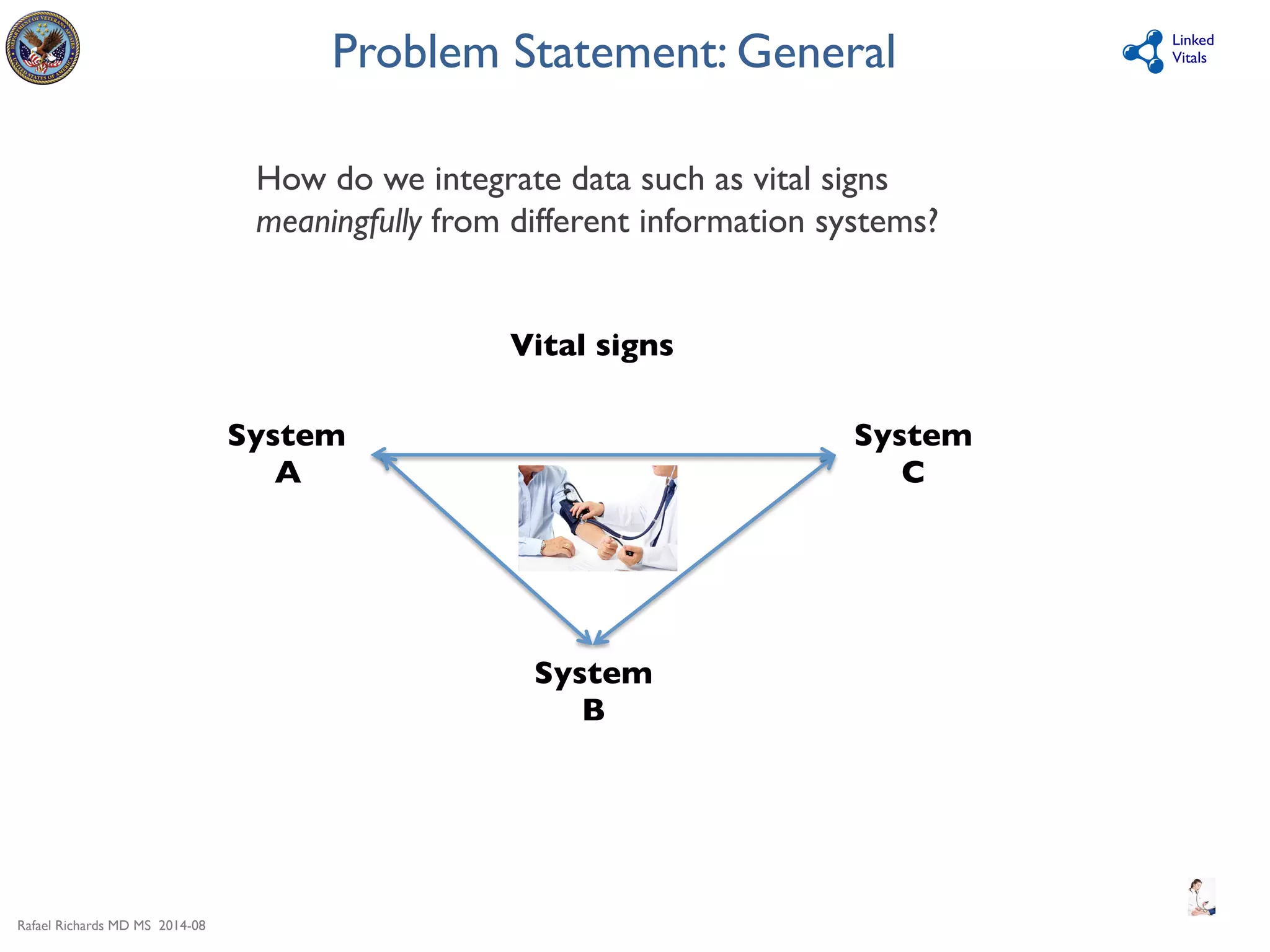
Problem Statement: General 
How do we integrate data such as vital signs 
meaningfully from different information systems? 
Vital signs 
System 
A 
System 
C 
System 
B
Rafael Richards MD MS 2014-08 
Linked 
Vitals 
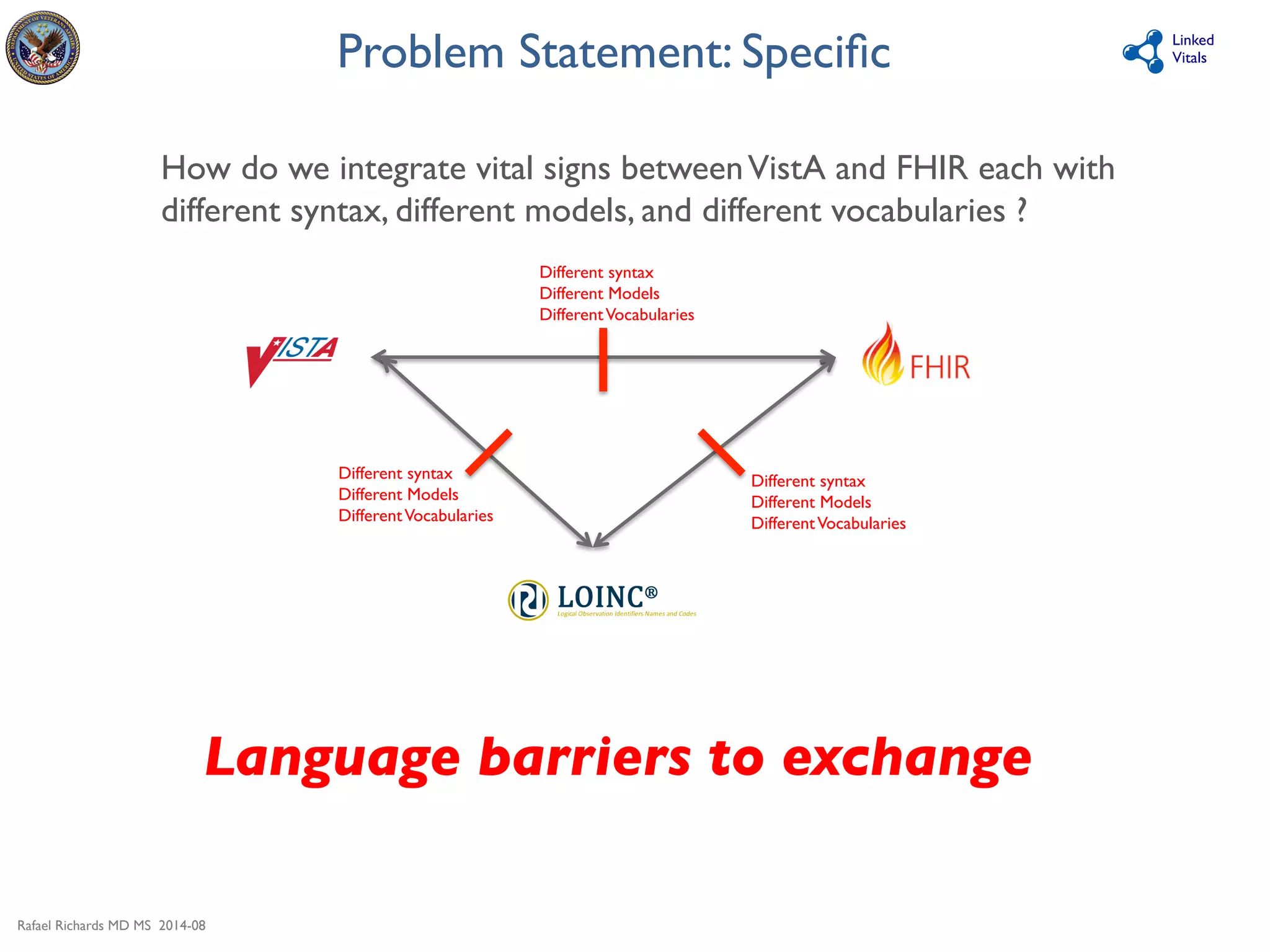
Problem Statement: Specific 
How do we integrate vital signs between VistA and FHIR each with 
different syntax, different models, and different vocabularies ? 
Different syntax 
Different Models 
Different Vocabularies 
Different syntax 
Different Models 
Different Vocabularies 
Different syntax 
Different Models 
Different Vocabularies 
Language barriers to exchange
Rafael Richards MD MS 2014-08 
Linked 
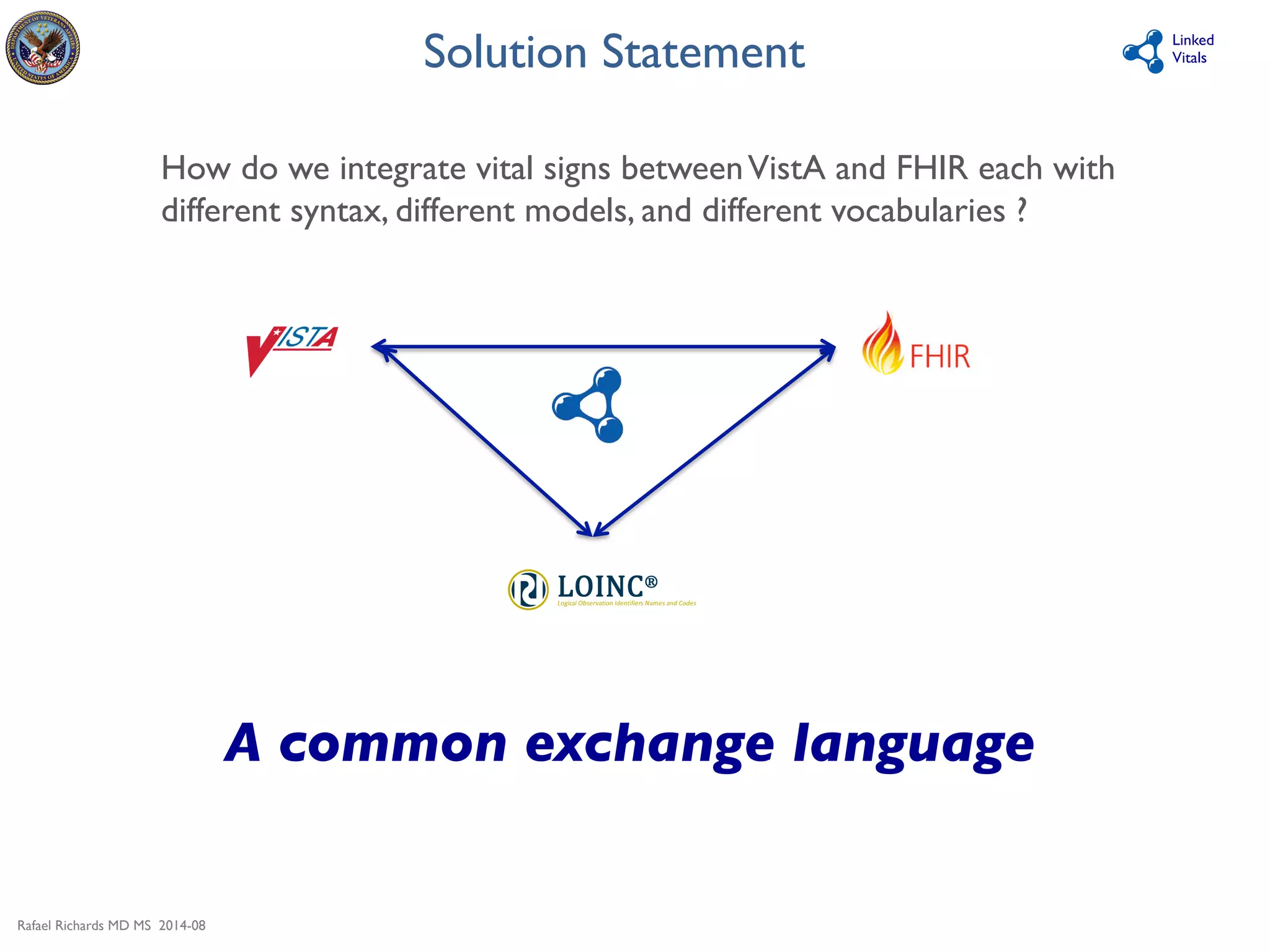
Solution Statement 
Vitals 
How do we integrate vital signs between VistA and FHIR each with 
different syntax, different models, and different vocabularies ? 
A common exchange language
Syntax A 
Model A 
Vocabulary A 
Vocabulary B 
Rafael Richards MD MS 2014-08 
Linked 
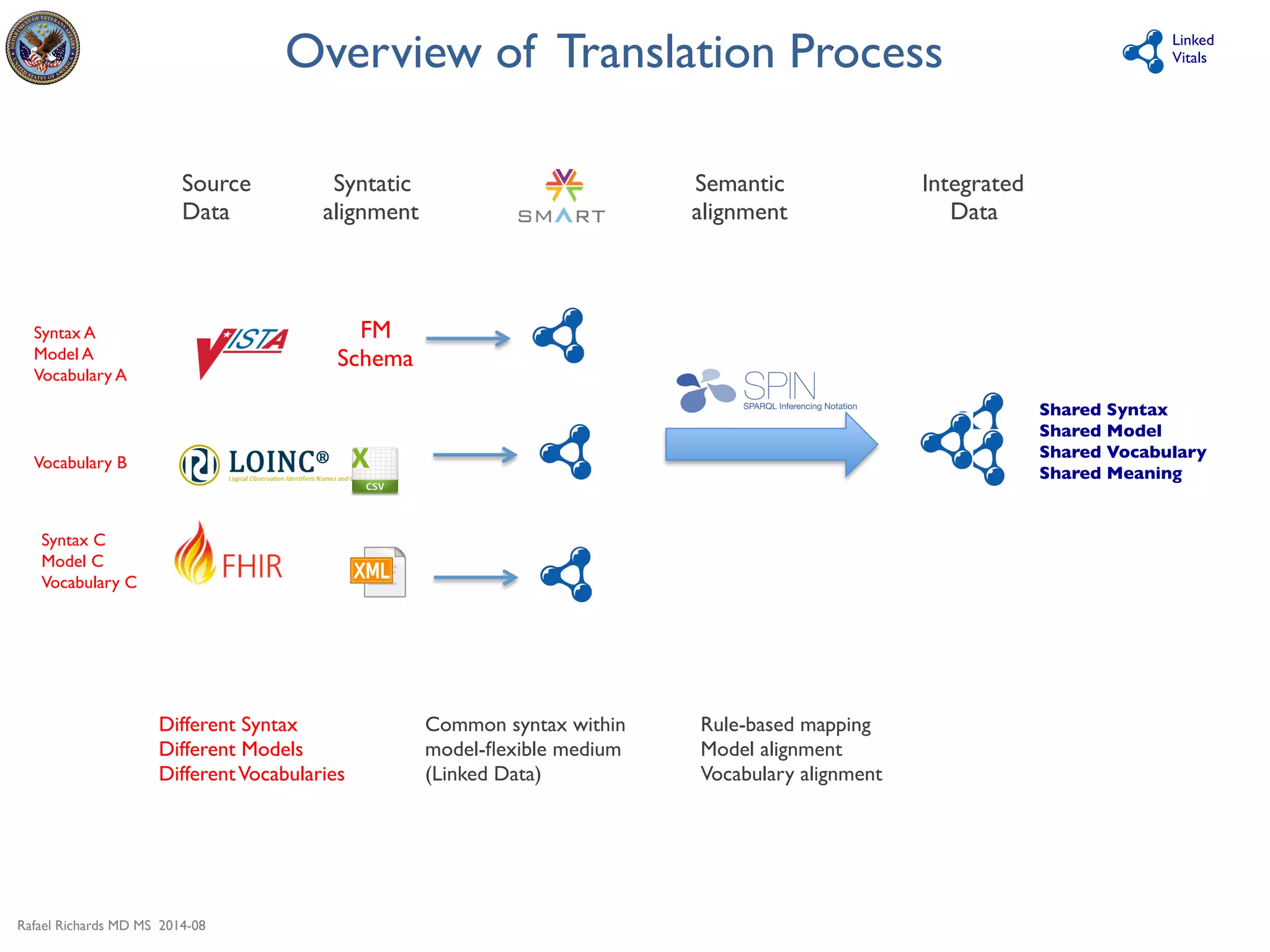
Overview of Translation Process 
Vitals 
Rule-based mapping 
Model alignment 
Vocabulary alignment 
Common syntax within 
model-flexible medium 
(Linked Data) 
Syntatic 
alignment 
FM 
Schema 
Semantic 
alignment 
Source 
Data 
Integrated 
Data 
Different Syntax 
Different Models 
Different Vocabularies 
Shared Syntax 
Shared Model 
Shared Vocabulary 
Shared Meaning 
Syntax C 
Model C 
Vocabulary C
Rafael Richards MD MS 2014-08 
Linked 
Vitals 
Linked Data (RDF): What is it? 
The World Wide Web Consortium (W3C) standard for 
semantic information integration for the Internet of Data. 
HTML (hypertext markup language) 
For humans to exchange information 
RDF (resource description framework) 
For computers to exchange information 
Linked Documents 
(Document Web) 
Linked Data 
(Semantic Web) 
enables 
enables 
“The Semantic Web [Linked Data] provides a common framework that 
allows data to be shared and reused across application, enterprise, and 
community boundaries.” 
Tim Berners-Lee, MIT Professor and Inventor of the World Wide Web 
(HTML and RDF protocols)
Rafael Richards MD MS 2014-08 
Linked 
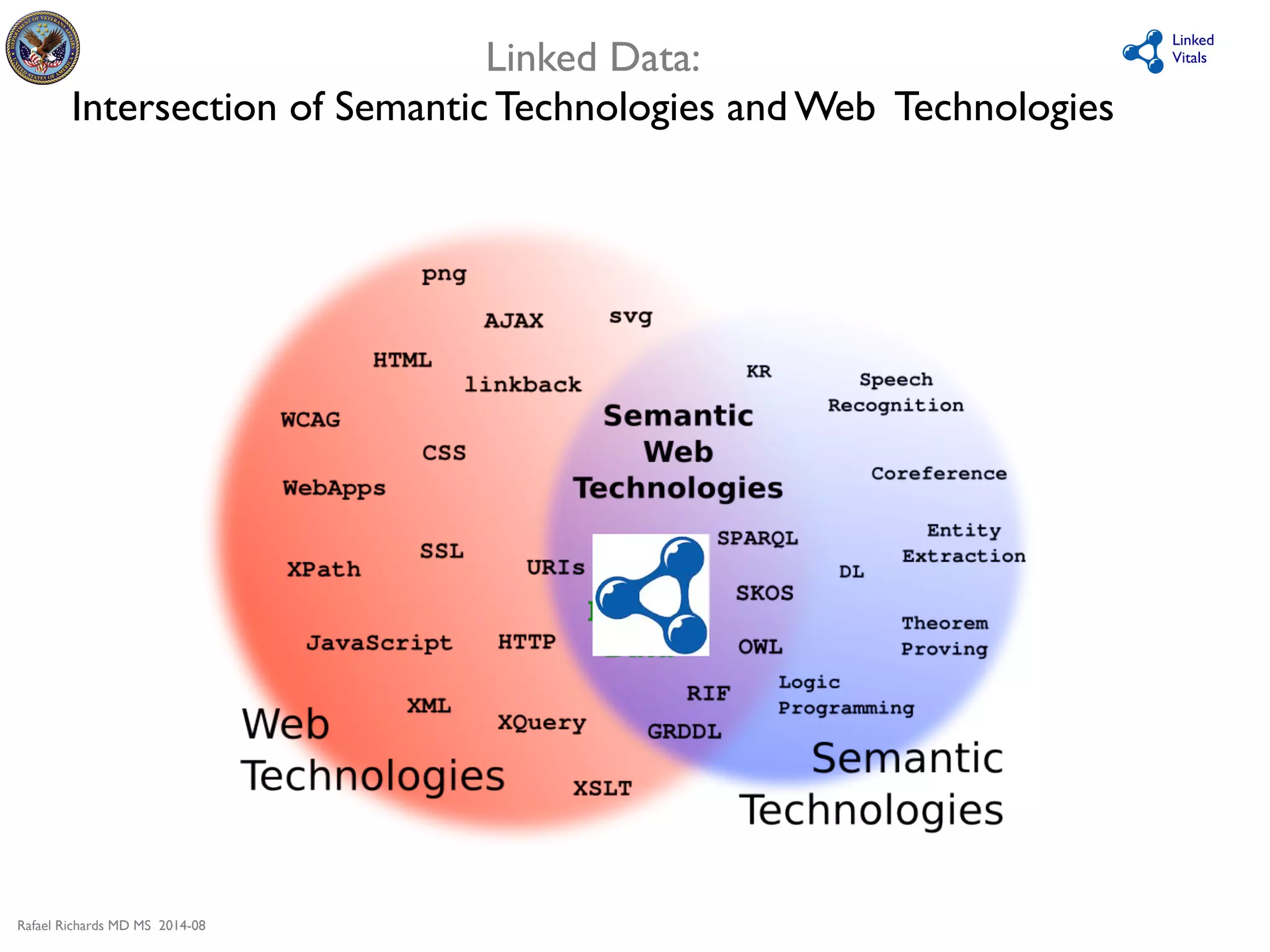
Linked Data: 
Vitals 
Intersection of Semantic Technologies and Web Technologies
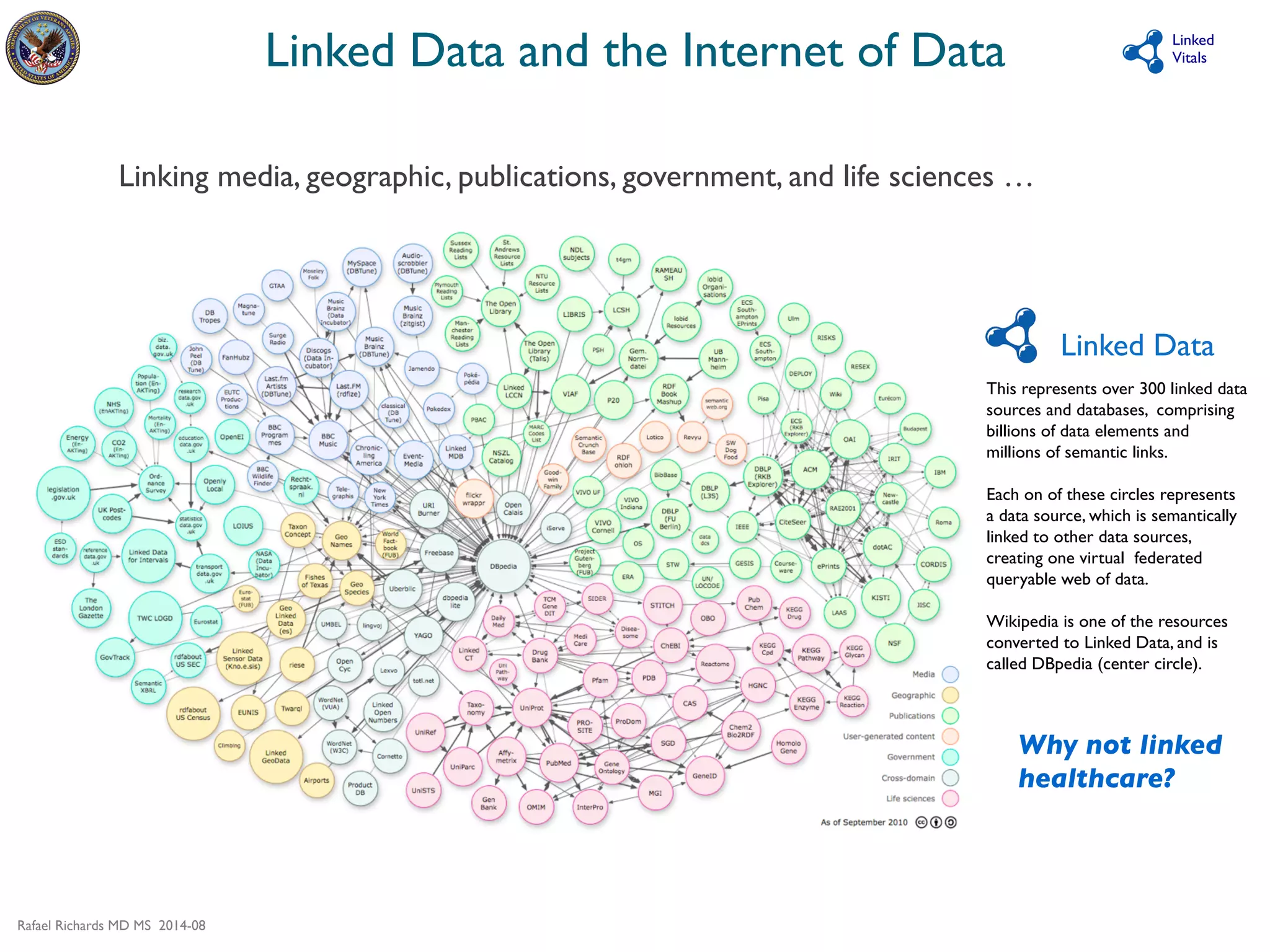
Linking media, geographic, publications, government, and life sciences … 
Rafael Richards MD MS 2014-08 
Linked 
Vitals 
Linked Data 
Linked Data and the Internet of Data 
This represents over 300 linked data 
sources and databases, comprising 
billions of data elements and 
millions of semantic links. 
Each on of these circles represents 
a data source, which is semantically 
linked to other data sources, 
creating one virtual federated 
queryable web of data. 
Wikipedia is one of the resources 
converted to Linked Data, and is 
called DBpedia (center circle). 
Why not linked 
healthcare?
Rafael Richards MD MS 2014-08 
Linked 
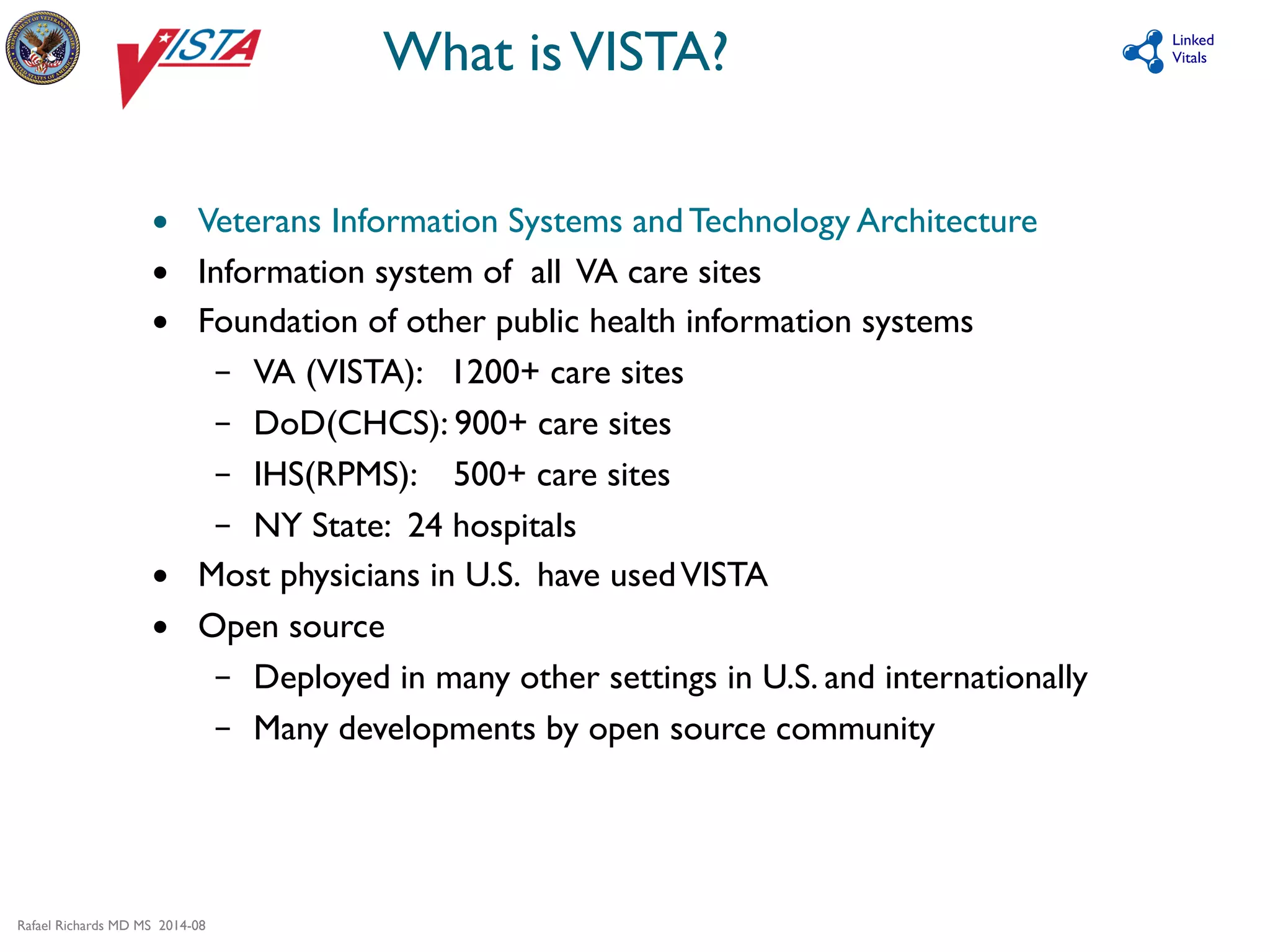
What is VISTA? 
Vitals 
• Veterans Information Systems and Technology Architecture 
• Information system of all VA care sites 
• Foundation of other public health information systems 
– VA (VISTA): 1200+ care sites 
– DoD(CHCS): 900+ care sites 
– IHS(RPMS): 500+ care sites 
– NY State: 24 hospitals 
• Most physicians in U.S. have used VISTA 
• Open source 
– Deployed in many other settings in U.S. and internationally 
– Many developments by open source community
Rafael Richards MD MS 2014-08 
Linked 
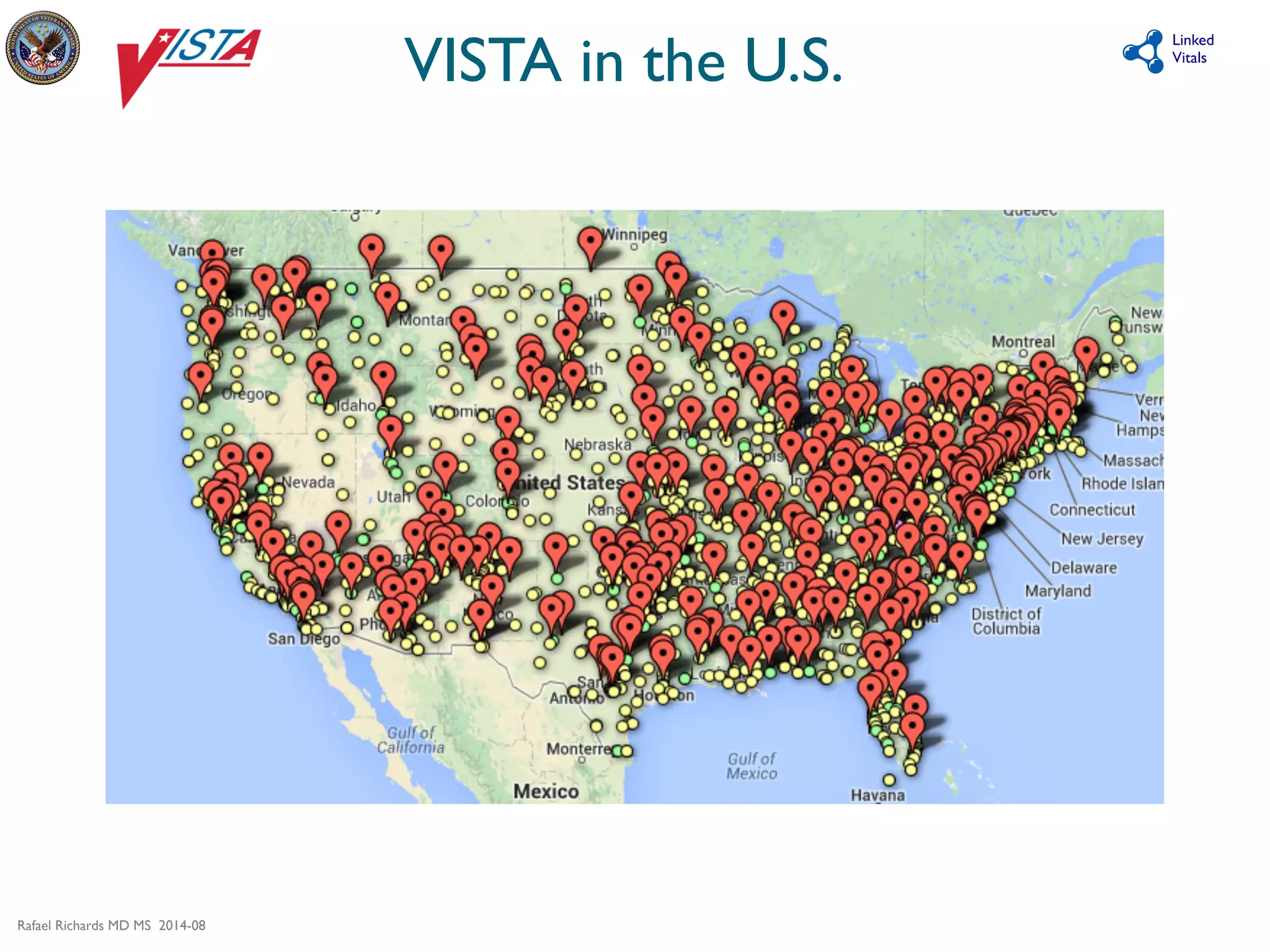
VISTA in the U.S. 
Vitals
Rafael Richards MD MS 2014-08 
Linked 
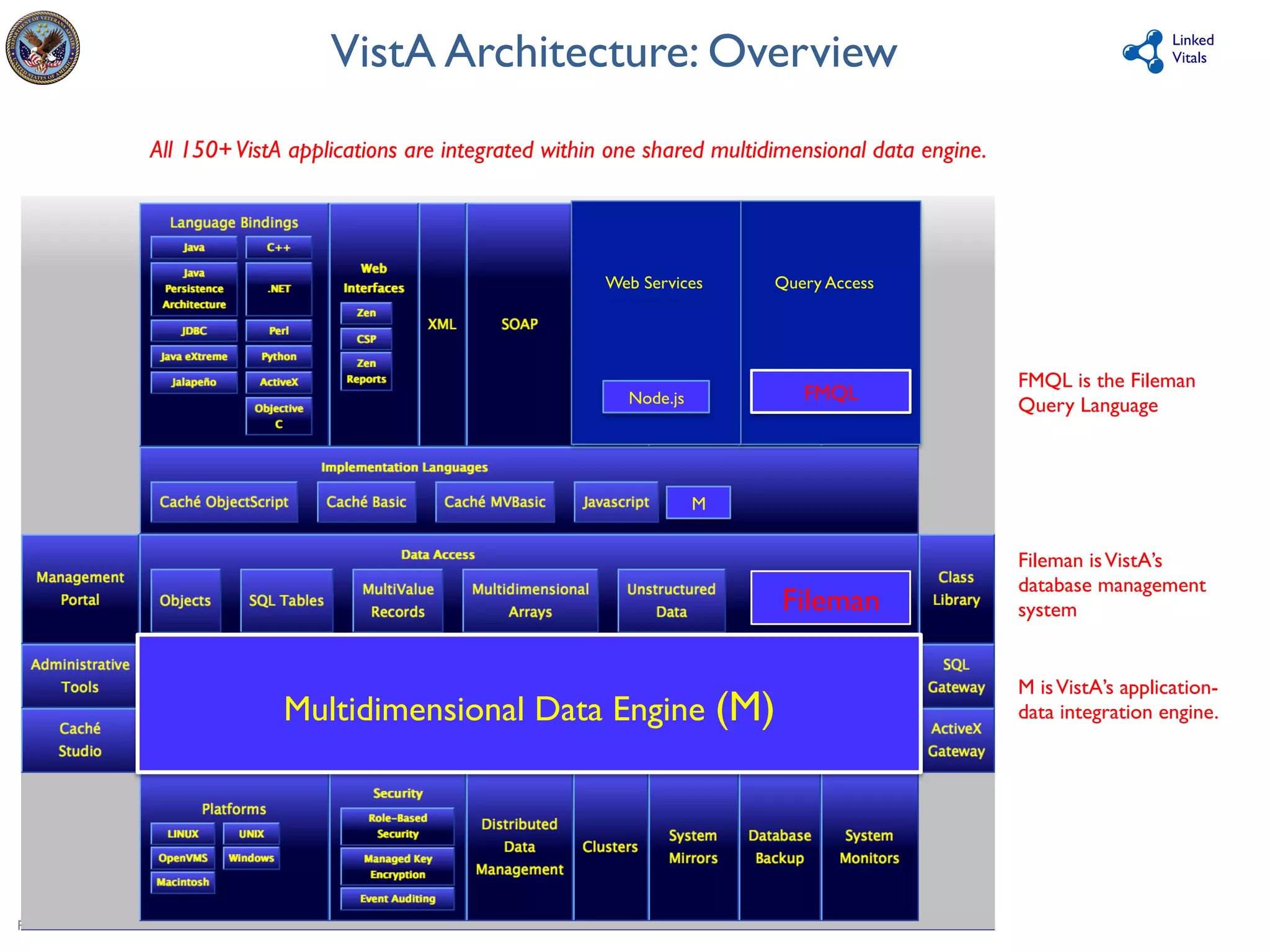
VistA Architecture: Overview 
VistA and Fileman Overview 
Vitals 
Web Services 
Query Access 
Fileman 
Multidimensional Data Engine (M) 
FMQL 
M 
Node.js 
FMQL is the Fileman 
Query Language 
Fileman is VistA’s 
database management 
system 
M is VistA’s application-data 
integration engine. 
All 150+ VistA applications are integrated within one shared multidimensional data engine.
Rafael Richards MD MS 2014-08 
FileMan: VistA’s data conductorVitals 
Linked 
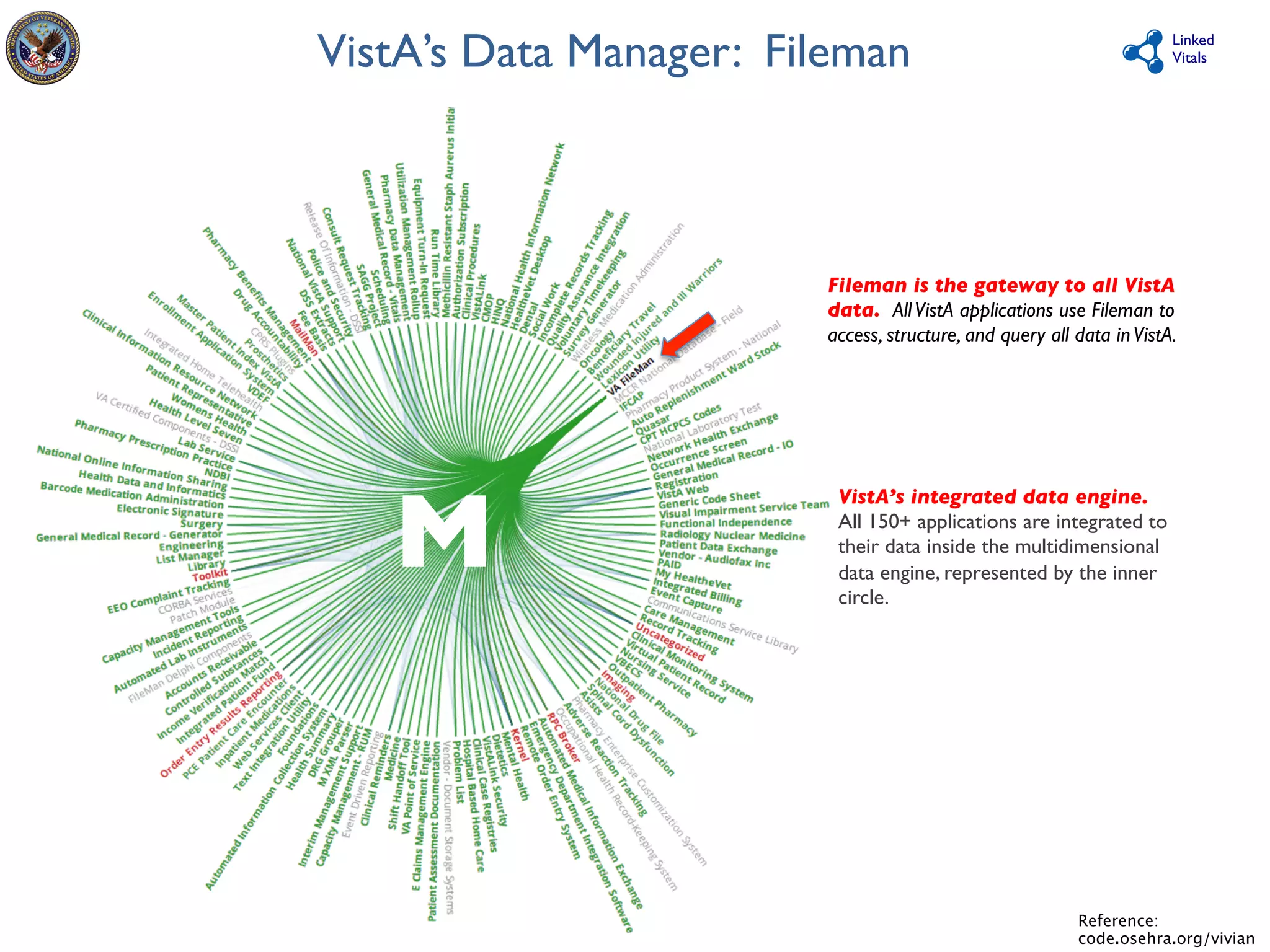
Fileman is the gateway to all VistA 
data. All VistA applications use Fileman to 
access, structure, and query all data in VistA. 
VistA’s integrated data engine. 
All 150+ applications are integrated to 
their data inside the multidimensional 
data engine, represented by the inner 
circle. 
12 
Reference: 
code.osehra.org/vivian 
VistA’s Data Manager: Fileman 
M
Rafael Richards MD MS 2014-08 
Linked 
Vitals 
Exposing VistA’s native data model 
Objective: Make machine-processable schemas, vocabularies, 
and datasets from VISTA 
http://vista.caregraf.info/analytics 
Challenge: Poor RDF/OWL model 
Solution: Refine RDF/OWL model (example here)
Rafael Richards MD MS 2014-08 
Linked 
Vitals 
Exposing VistA’s native data model 
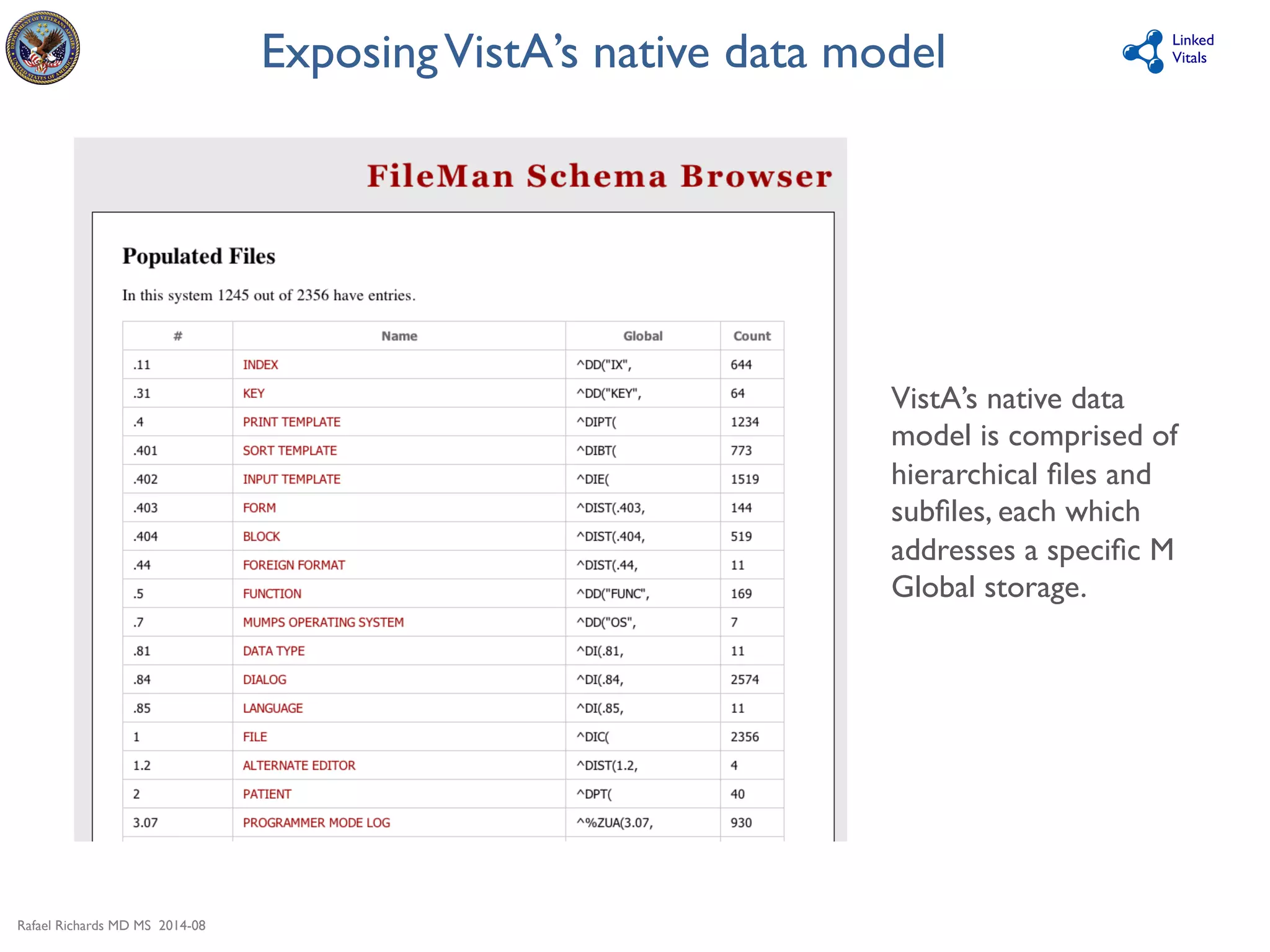
VistA’s native data 
model is comprised of 
hierarchical files and 
subfiles, each which 
addresses a specific M 
Global storage.
Rafael Richards MD MS 2014-08 
Linked 
Vitals 
Fileman Query Language (FMQL) 
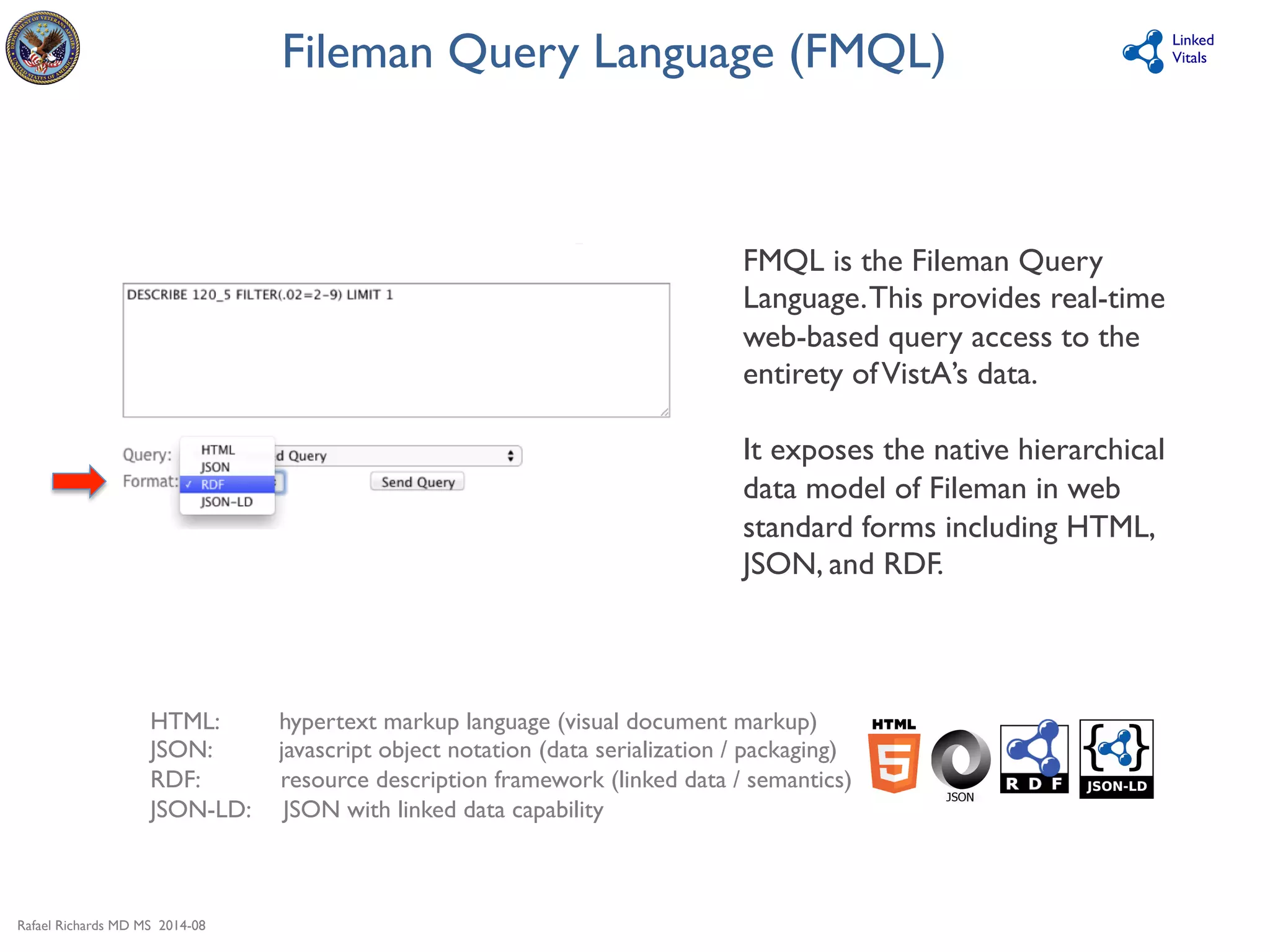
FMQL is the Fileman Query 
Language. This provides real-time 
web-based query access to the 
entirety of VistA’s data. 
It exposes the native hierarchical 
data model of Fileman in web 
standard forms including HTML, 
JSON, and RDF. 
HTML: hypertext markup language (visual document markup) 
JSON: javascript object notation (data serialization / packaging) 
RDF: resource description framework (linked data / semantics) 
JSON-LD: JSON with linked data capability
Rafael Richards MD MS 2014-08 
Linked 
Vitals 
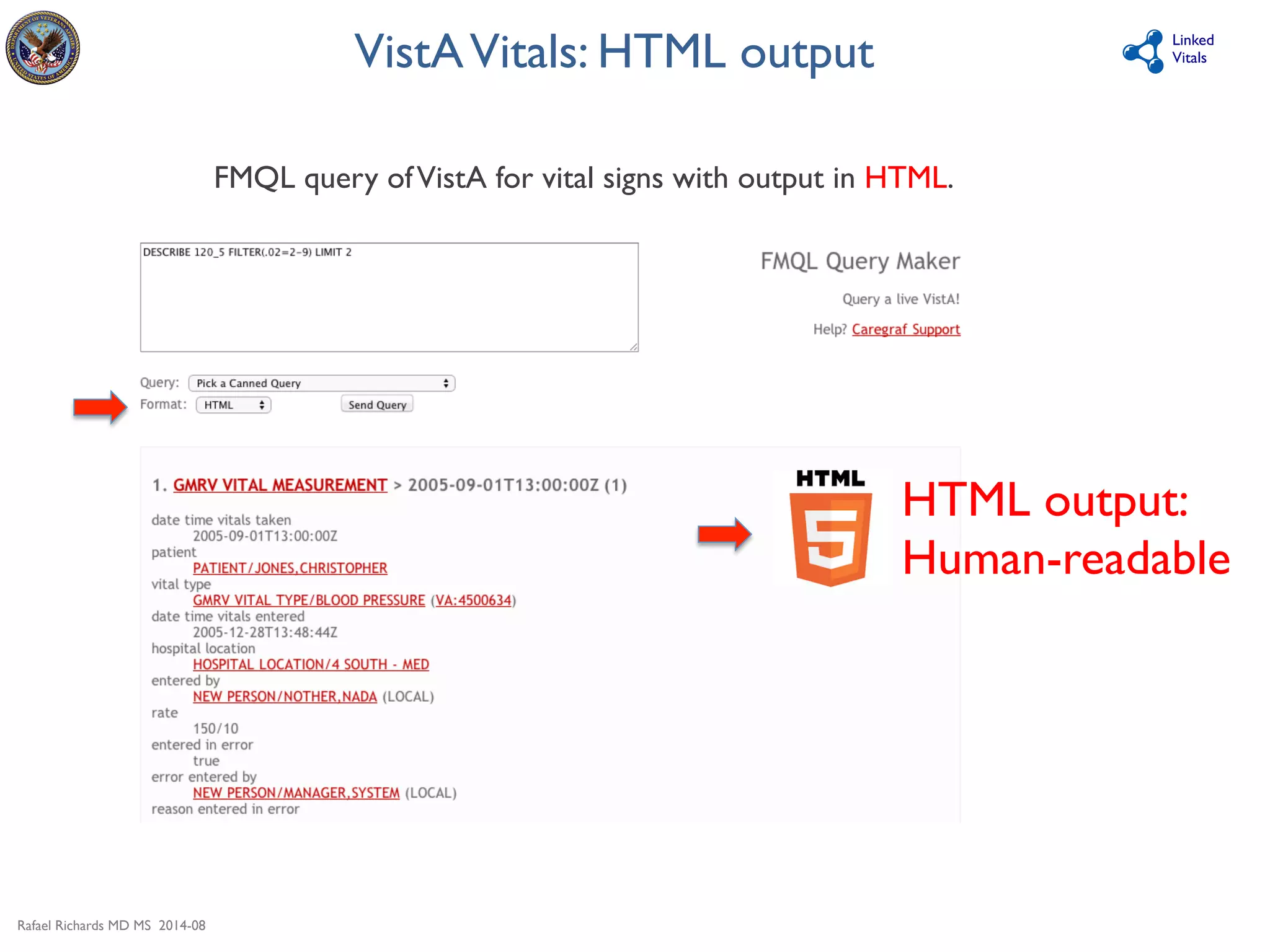
FMQL query of VistA for vital signs with output in HTML. 
HTML output: 
Human-readable 
VistA Vitals: HTML output
Rafael Richards MD MS 2014-08 
Linked 
Vitals 
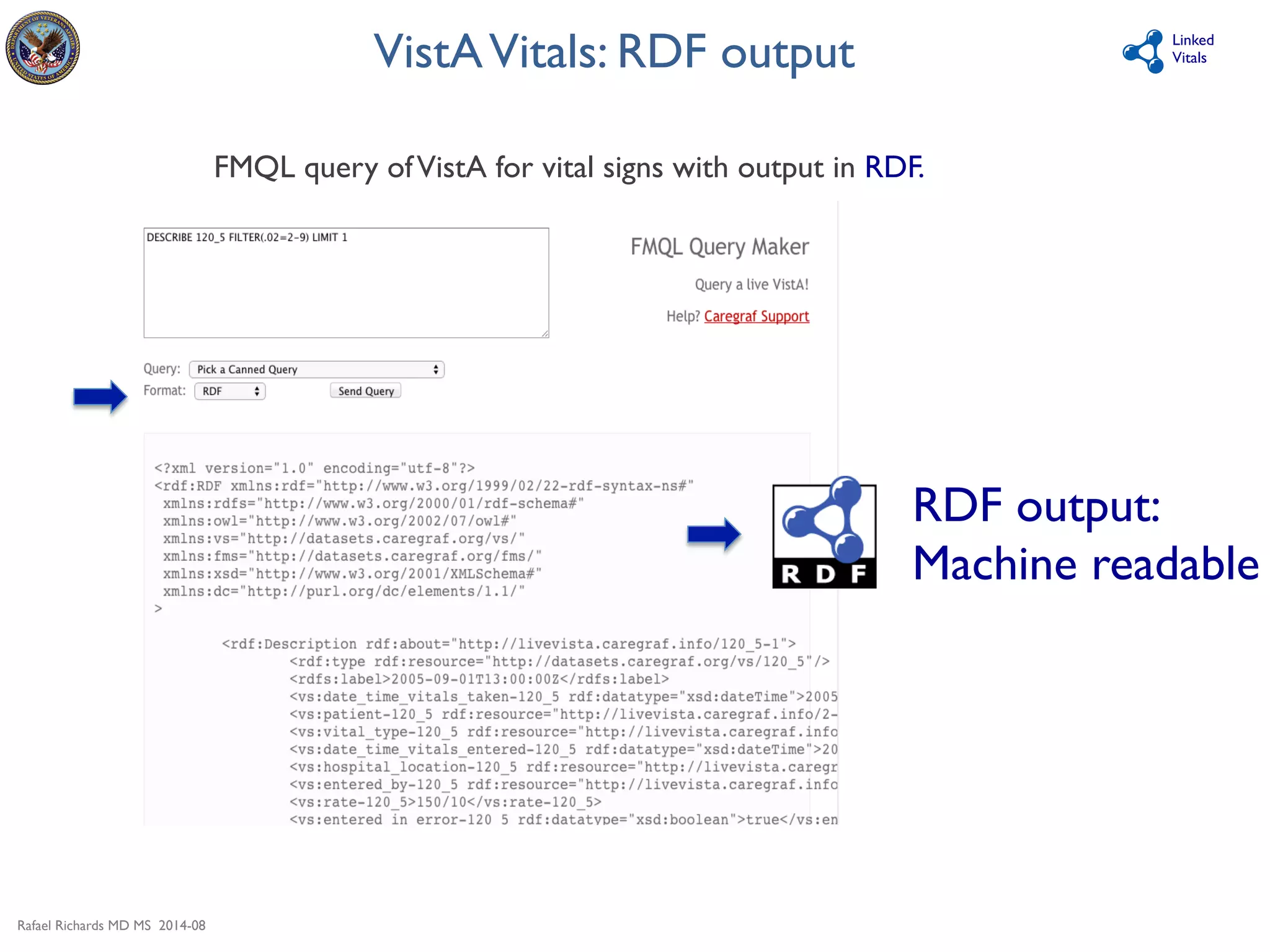
FMQL query of VistA for vital signs with output in RDF. 
RDF output: 
Machine readable 
VistA Vitals: RDF output
Rafael Richards MD MS 2014-08 
Linked 
Vitals 
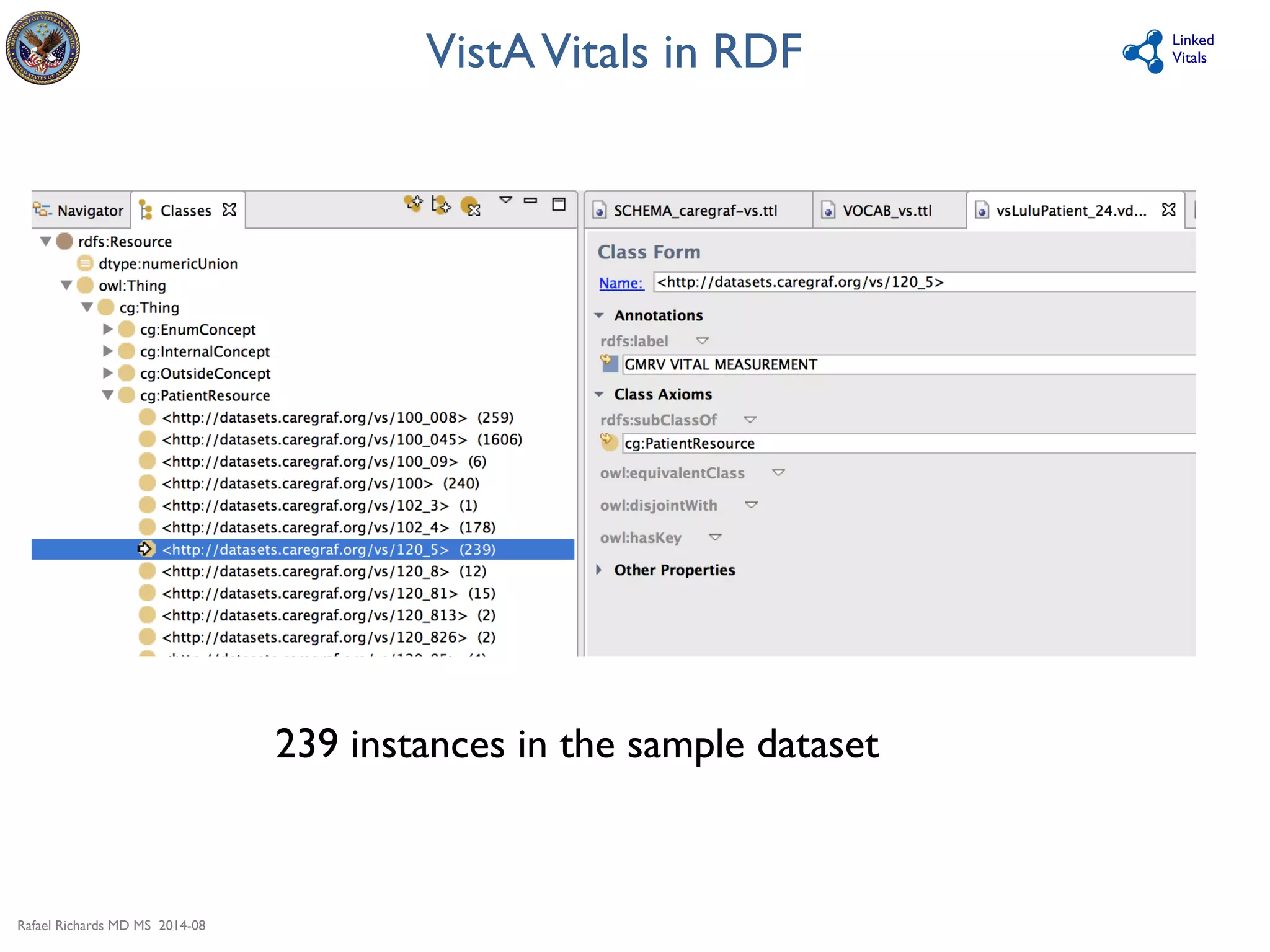
VistA Vitals in RDF 
239 instances in the sample dataset
Rafael Richards MD MS 2014-08 
Linked 
Vitals 
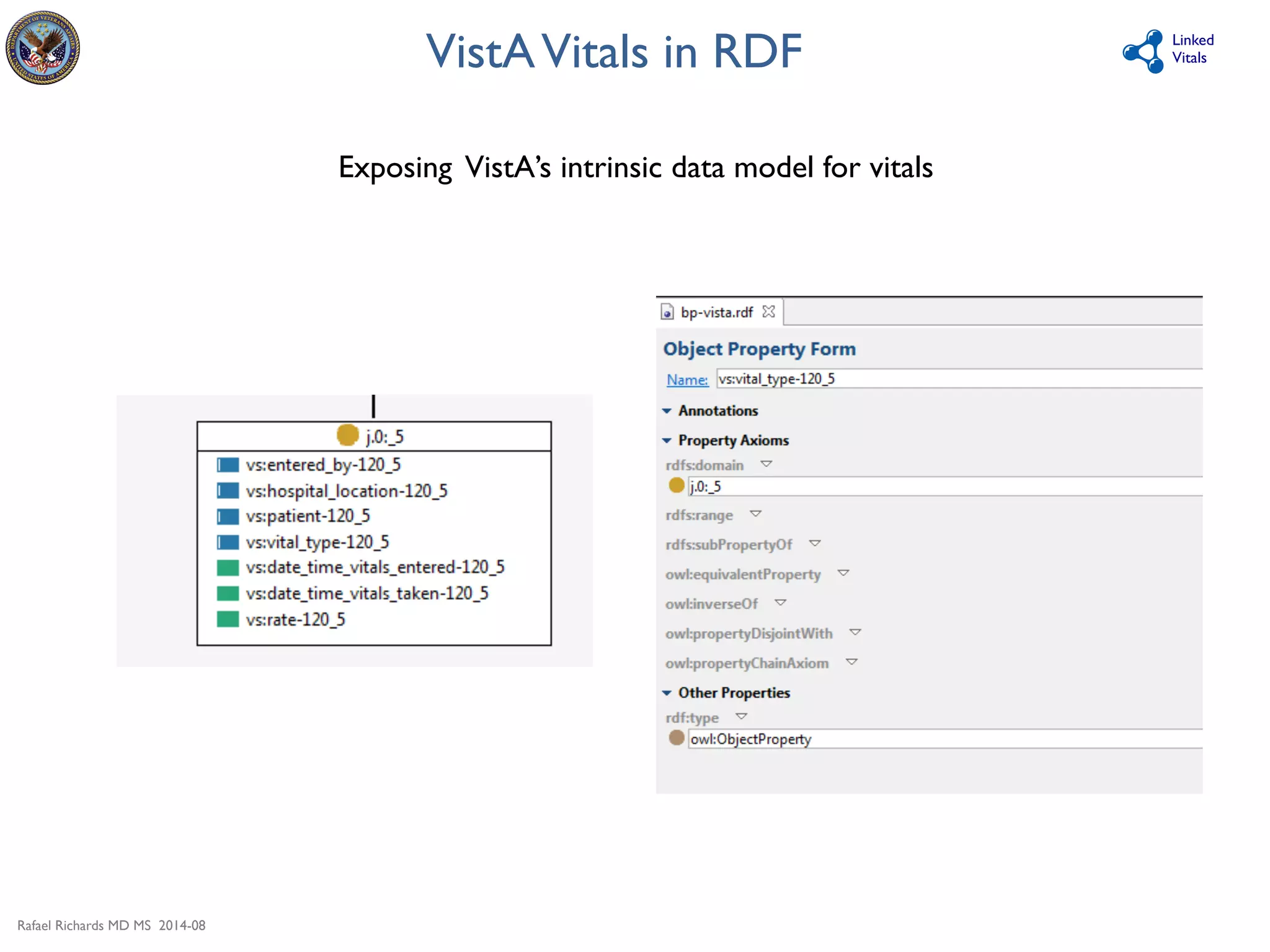
VistA Vitals in RDF 
Exposing VistA’s intrinsic data model for vitals
Rafael Richards MD MS 2014-08 
Linked 
Vitals 
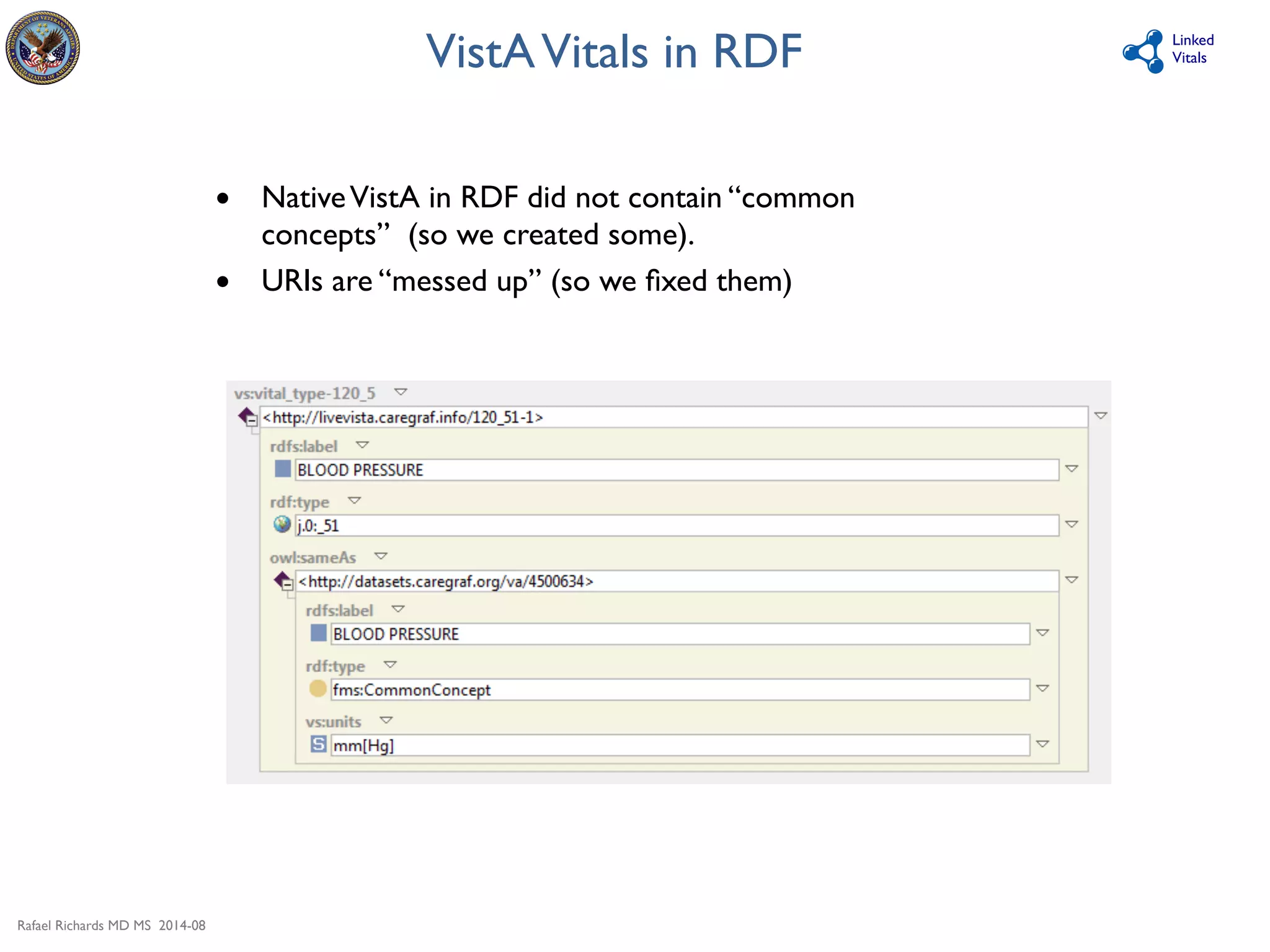
VistA Vitals in RDF 
• Native VistA in RDF did not contain “common 
concepts” (so we created some). 
• URIs are “messed up” (so we fixed them)
Rafael Richards MD MS 2014-08 
Linked 
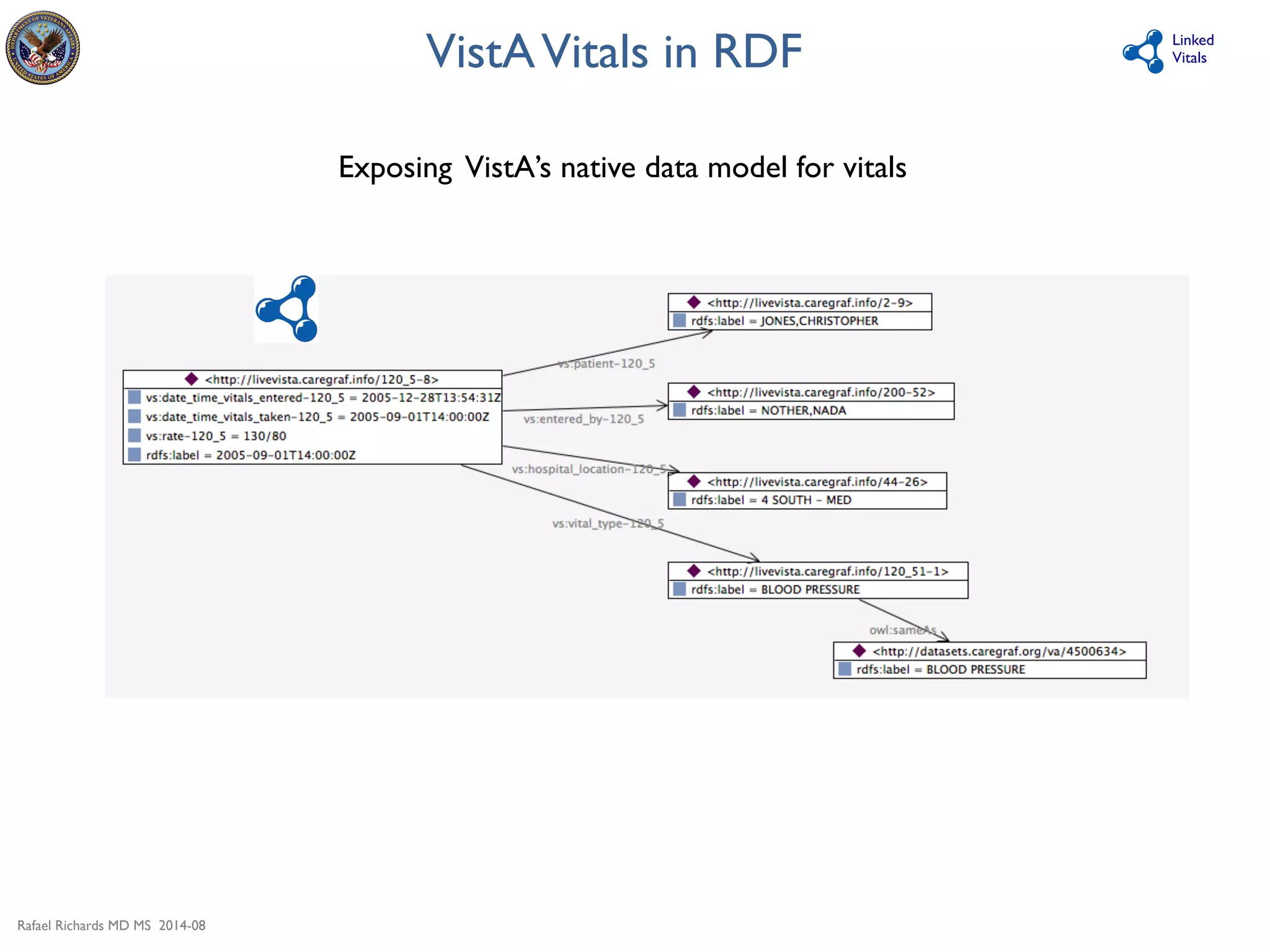
VistA Vitals in RDF 
Vitals 
Exposing VistA’s native data model for vitals
Rafael Richards MD MS 2014-08 
Linked 
Vitals 
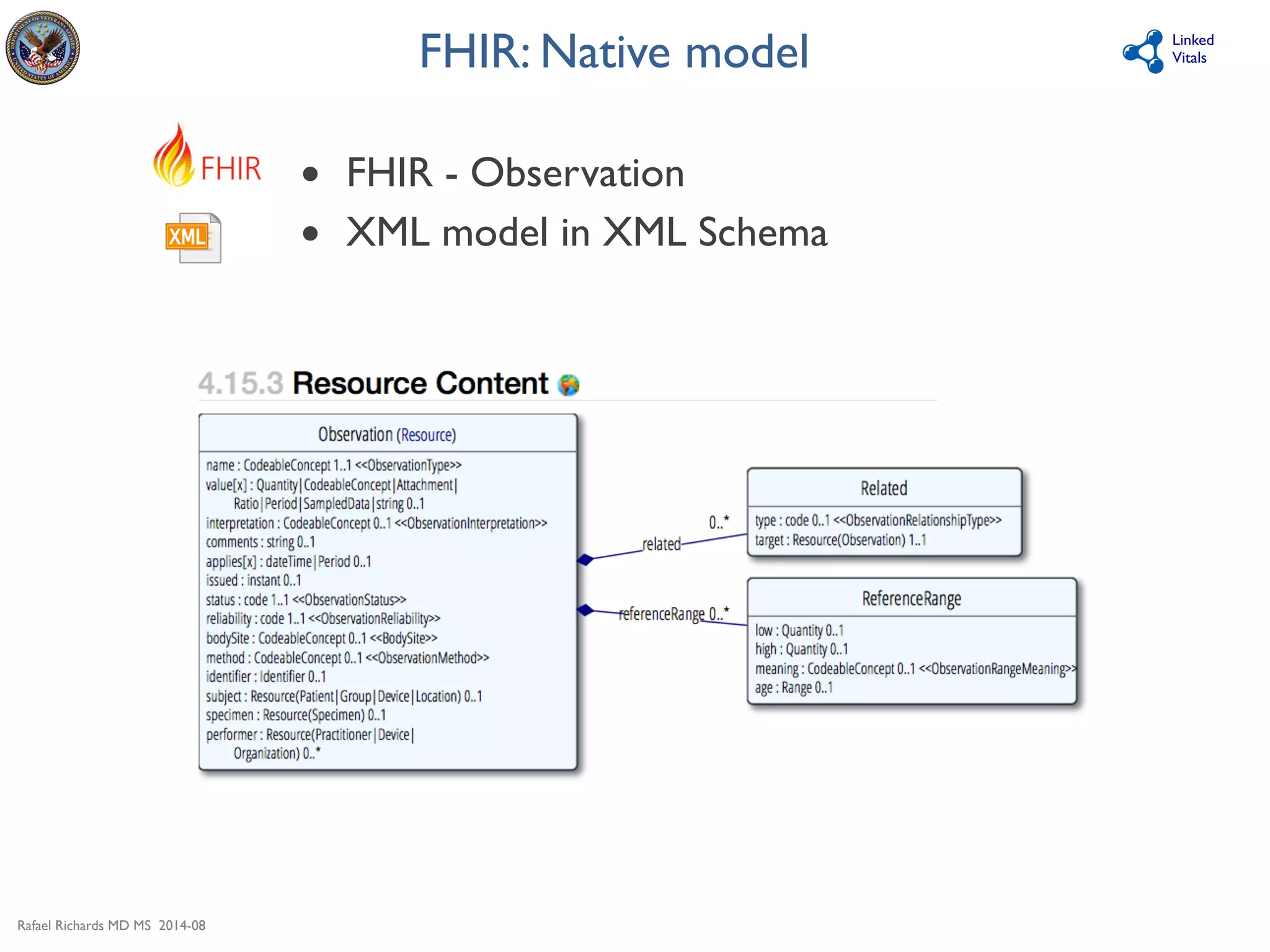
FHIR: Native model 
• FHIR - Observation 
• XML model in XML Schema
Rafael Richards MD MS 2014-08 
Linked 
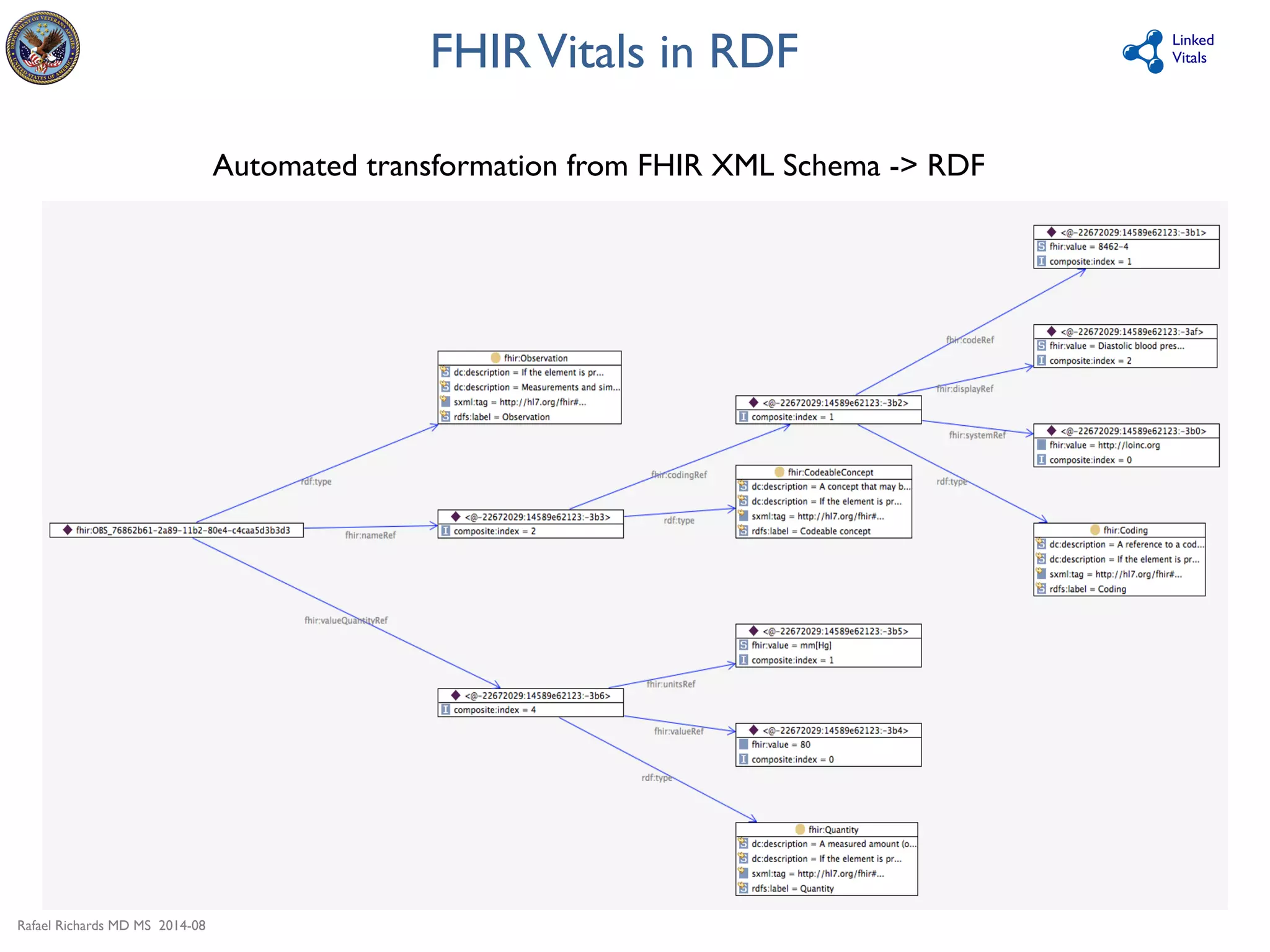
FHIR Vitals in RDF 
Vitals 
Automated transformation from FHIR XML Schema - RDF
Rafael Richards MD MS 2014-08 
Linked 
Vitals 
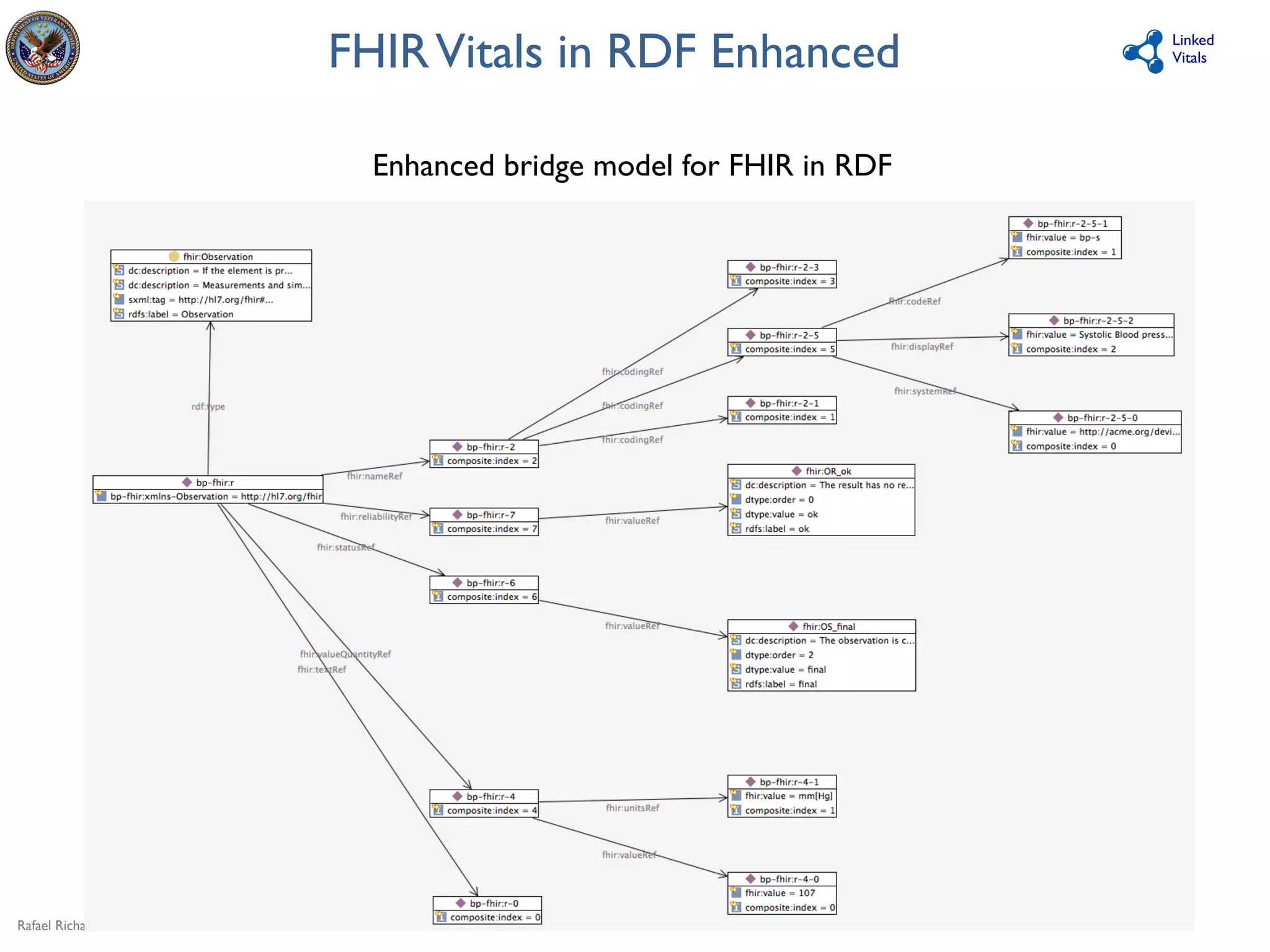
FHIR Vitals in RDF Enhanced 
Enhanced bridge model for FHIR in RDF
Rafael Richards MD MS 2014-08 
Linked 
Vitals 
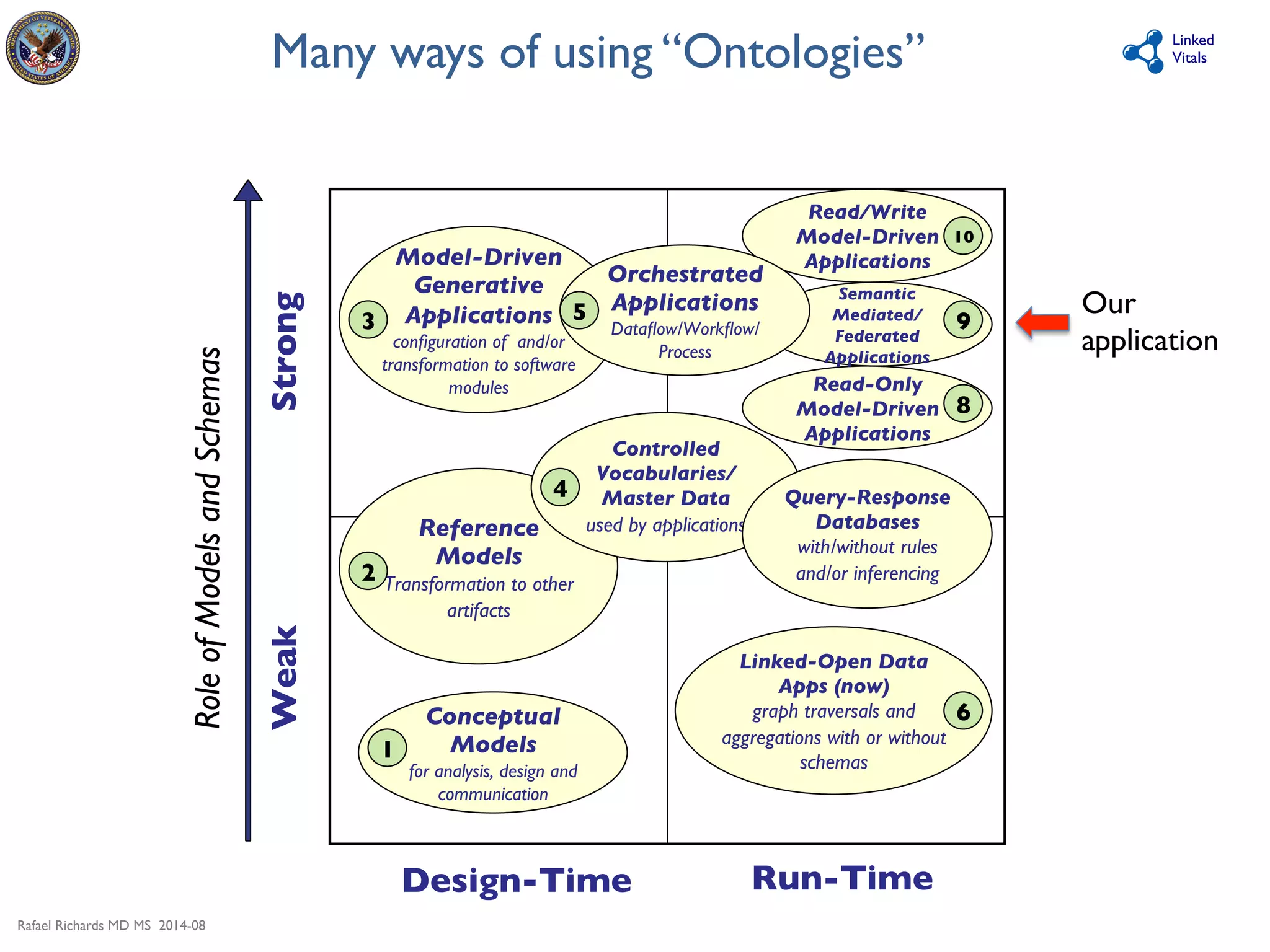
Many ways of using “Ontologies” 
Weak 
Strong 
Read/Write 
Model-Driven 
Applications 
Reference 
Models 
Transformation to other 
artifacts 
Conceptual 
Models 
for analysis, design and 
communication 
Query-Response 
Databases 
with/without rules 
and/or inferencing 
Linked-Open Data 
Apps (now) 
graph traversals and 
aggregations with or without 
schemas 
Model-Driven 
Generative 
Applications 
configuration of and/or 
transformation to software 
modules 
Read-Only 
Model-Driven 
Applications 
Role of Models and Schemas 
Controlled 
Vocabularies/ 
Master Data 
used by applications 
1 
10 
8 
3 
2 
4 
7 
6 
Semantic 
Mediated/ 
Federated 
Applications 
9 
Orchestrated 
Applications 
Dataflow/Workflow/ 
Process 
5 
Design-Time 
Run-Time 
Our 
application
Rafael Richards MD MS 2014-08 
Linked 
Vitals 
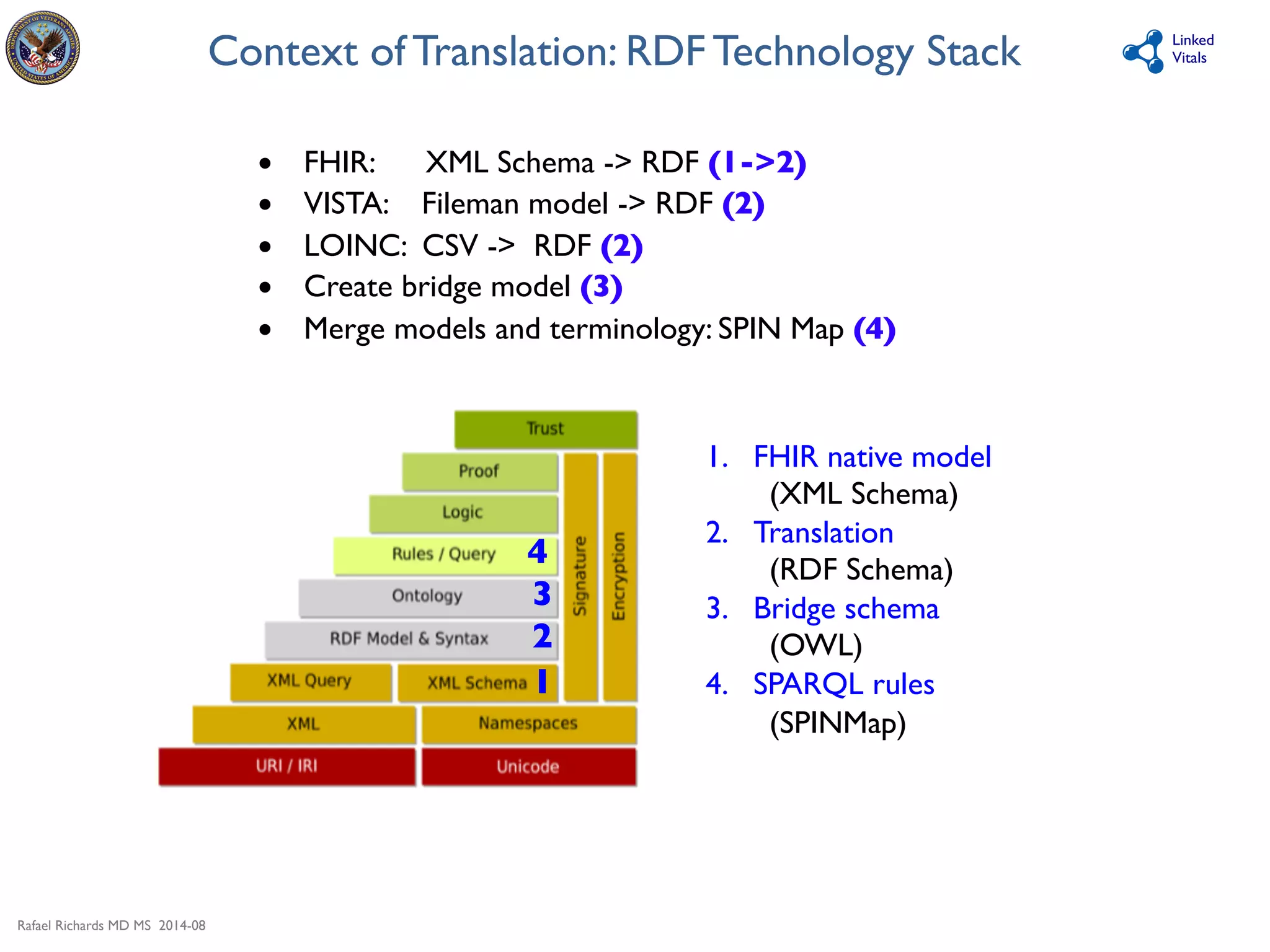
Context of Translation: RDF Technology Stack 
• FHIR: XML Schema - RDF (1-2) 
• VISTA: Fileman model - RDF (2) 
• LOINC: CSV - RDF (2) 
• Create bridge model (3) 
• Merge models and terminology: SPIN Map (4) 
4 
3 
2 
1 
1. FHIR native model 
(XML Schema) 
2. Translation 
(RDF Schema) 
3. Bridge schema 
(OWL) 
4. SPARQL rules 
(SPINMap)
Rafael Richards MD MS 2014-08 
Linked 
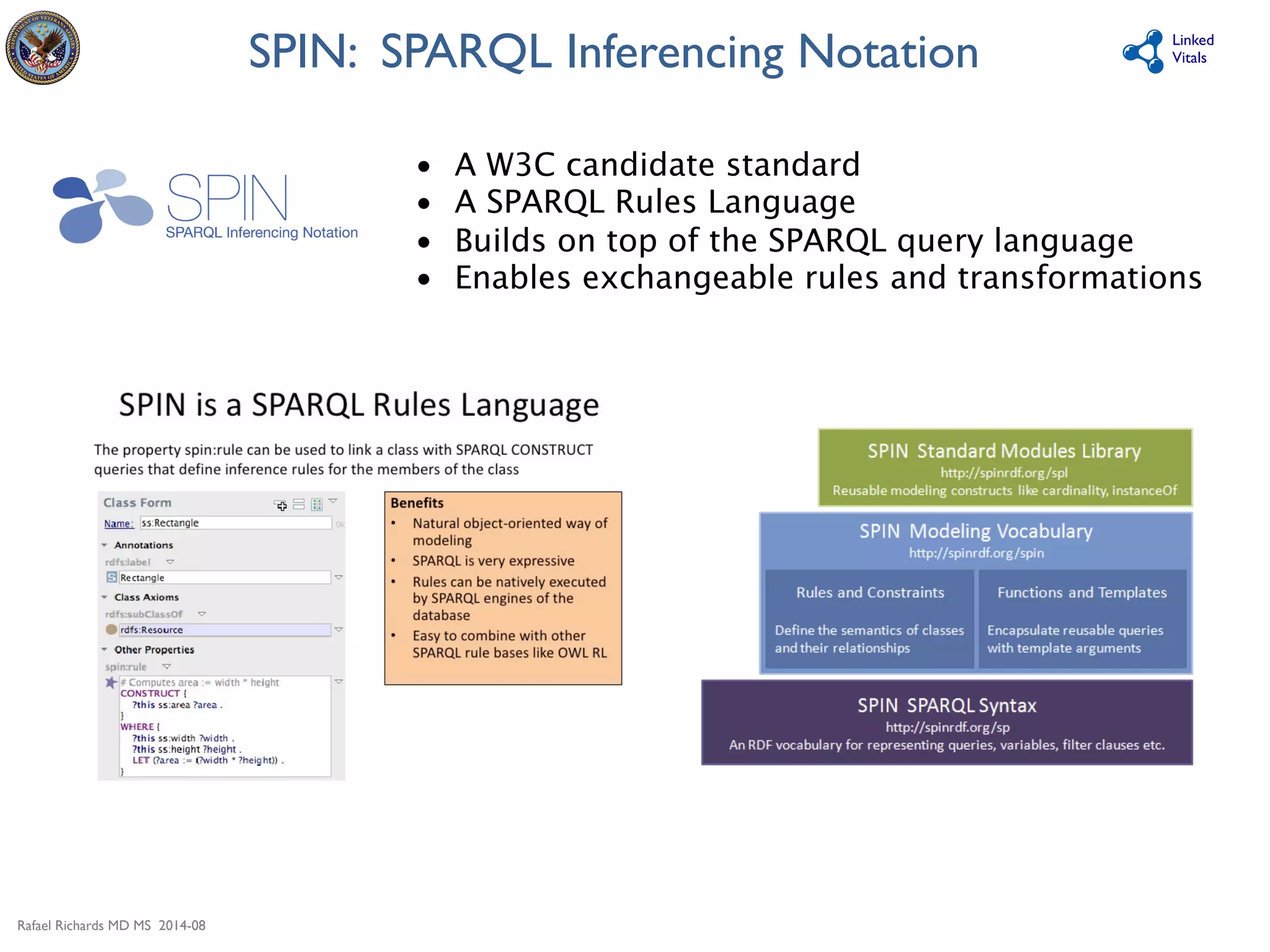
SPIN: SPARQL Inferencing Notation 
Vitals 
• A W3C candidate standard 
• A SPARQL Rules Language 
• Builds on top of the SPARQL query language 
• Enables exchangeable rules and transformations
Rafael Richards MD MS 2014-08 
Linked 
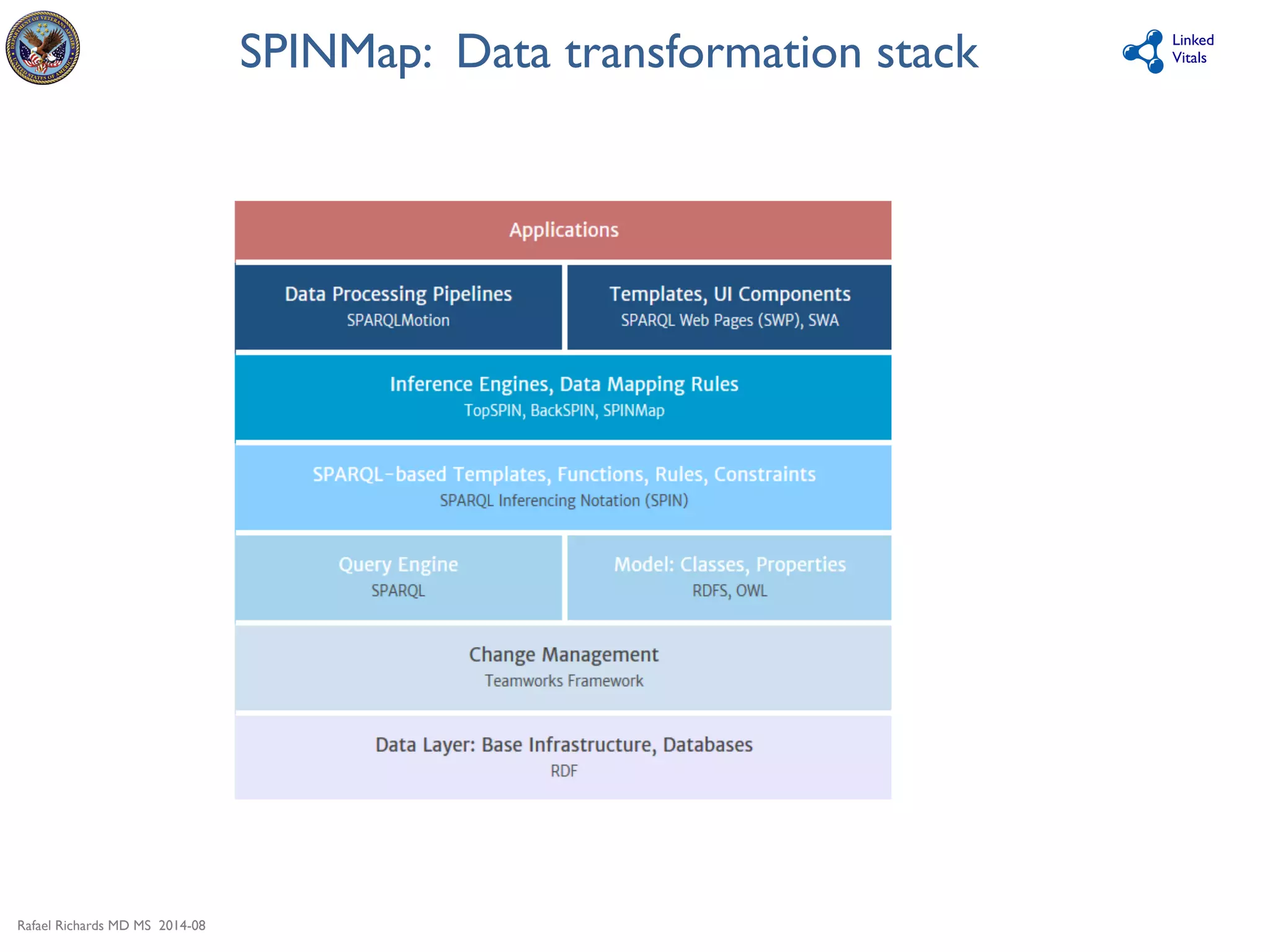
SPINMap: Data transformation stack 
Vitals
Rafael Richards MD MS 2014-08 
Linked 
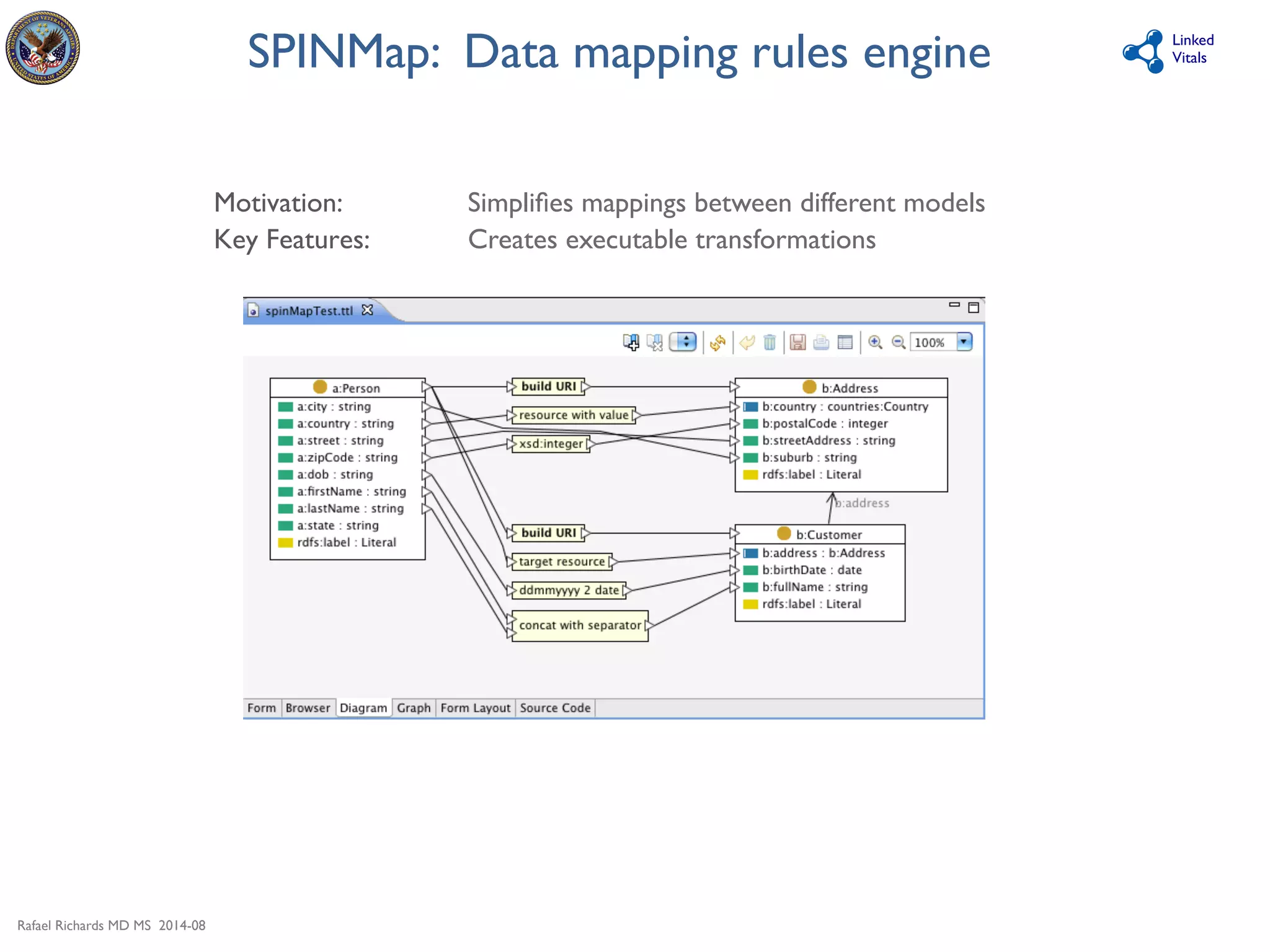
SPINMap: Data mapping rules engine 
Vitals 
Motivation: 
Simplifies mappings between different models 
Key Features: 
Creates executable transformations
Rafael Richards MD MS 2014-08 
Linked 
Vitals 
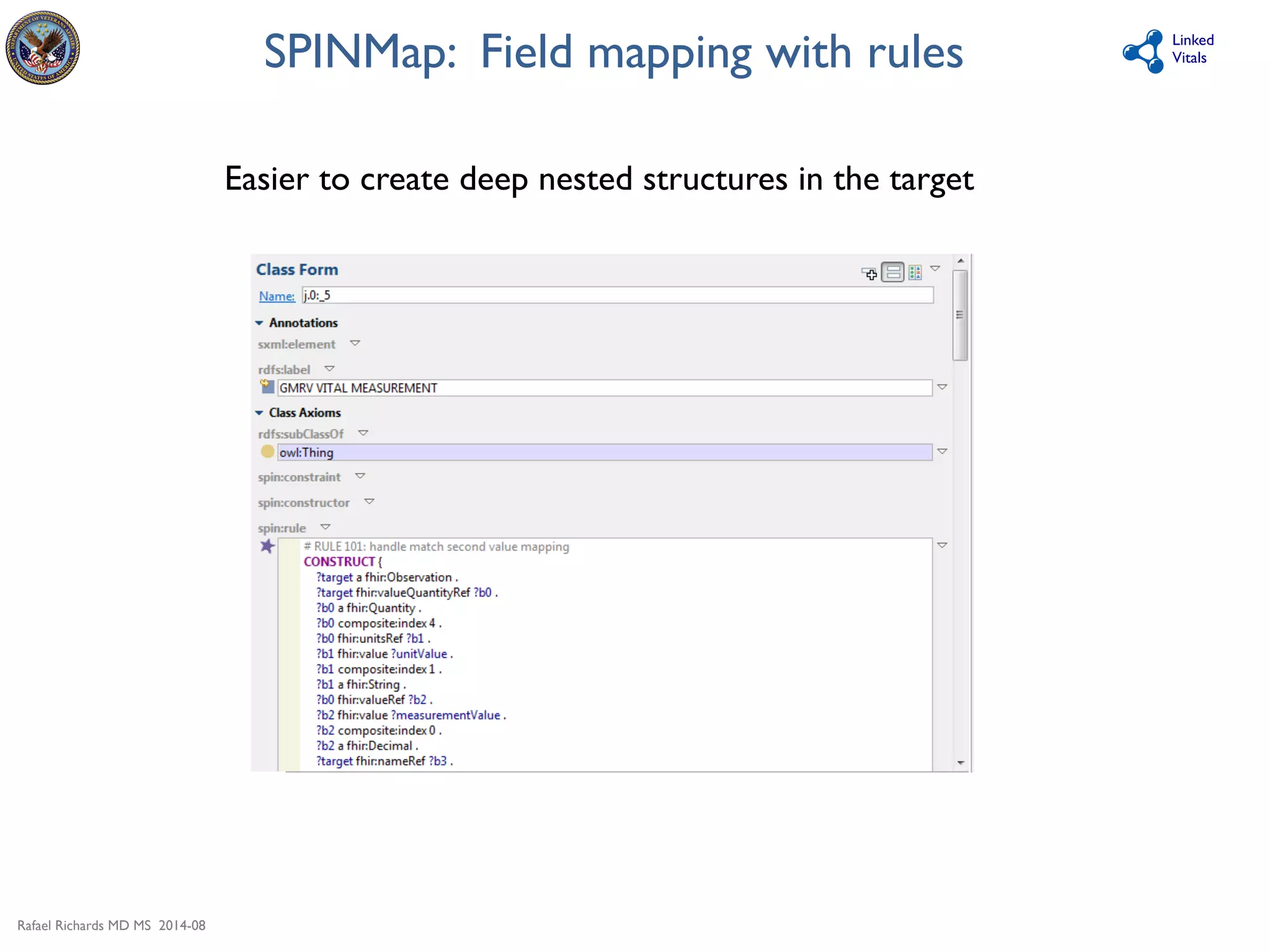
SPINMap: Field mapping with rules 
Easier to create deep nested structures in the target
Rafael Richards MD MS 2014-08 
Linked 
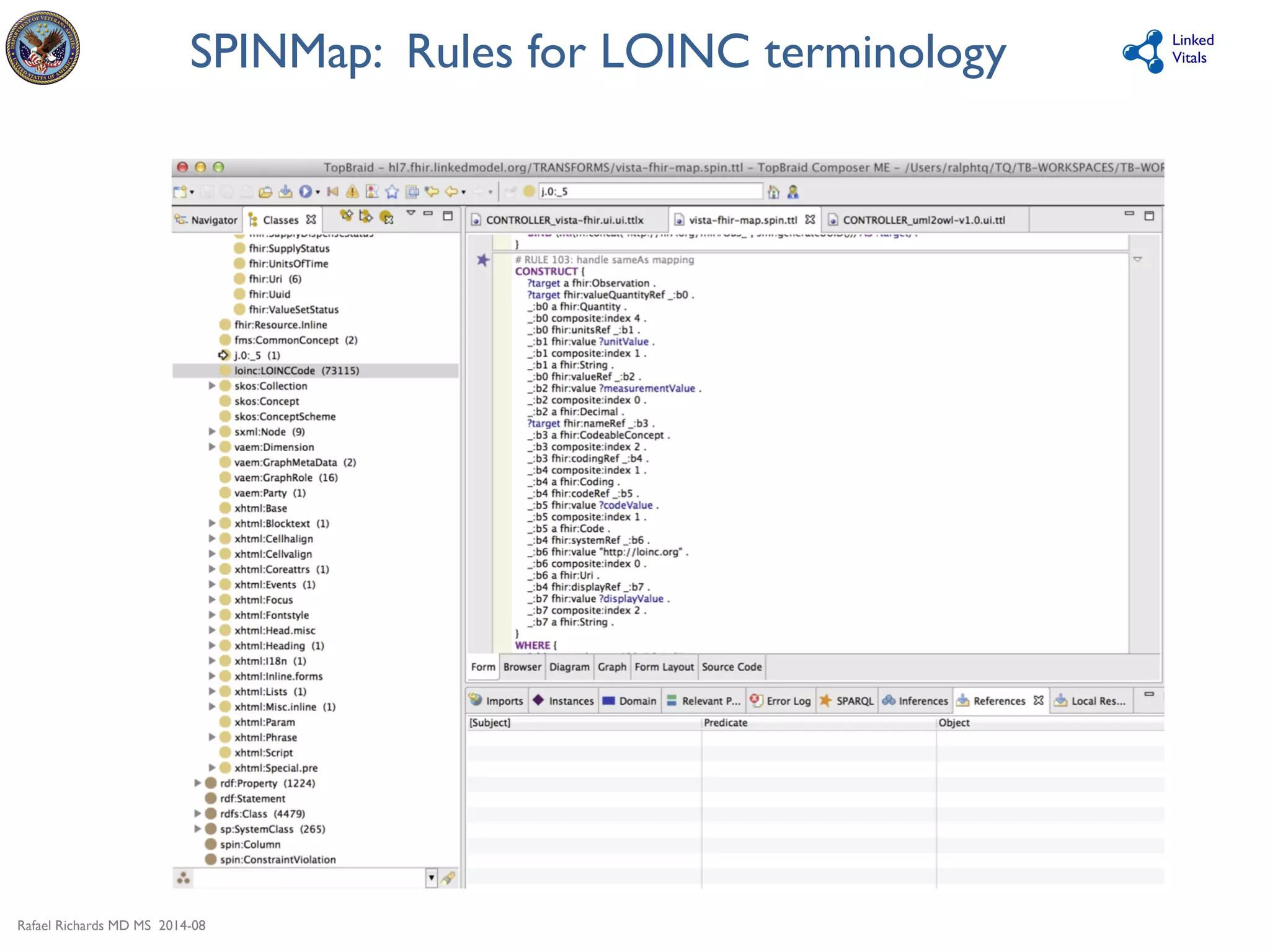
SPINMap: Rules for LOINC terminology 
Vitals
Rafael Richards MD MS 2014-08 
Linked 
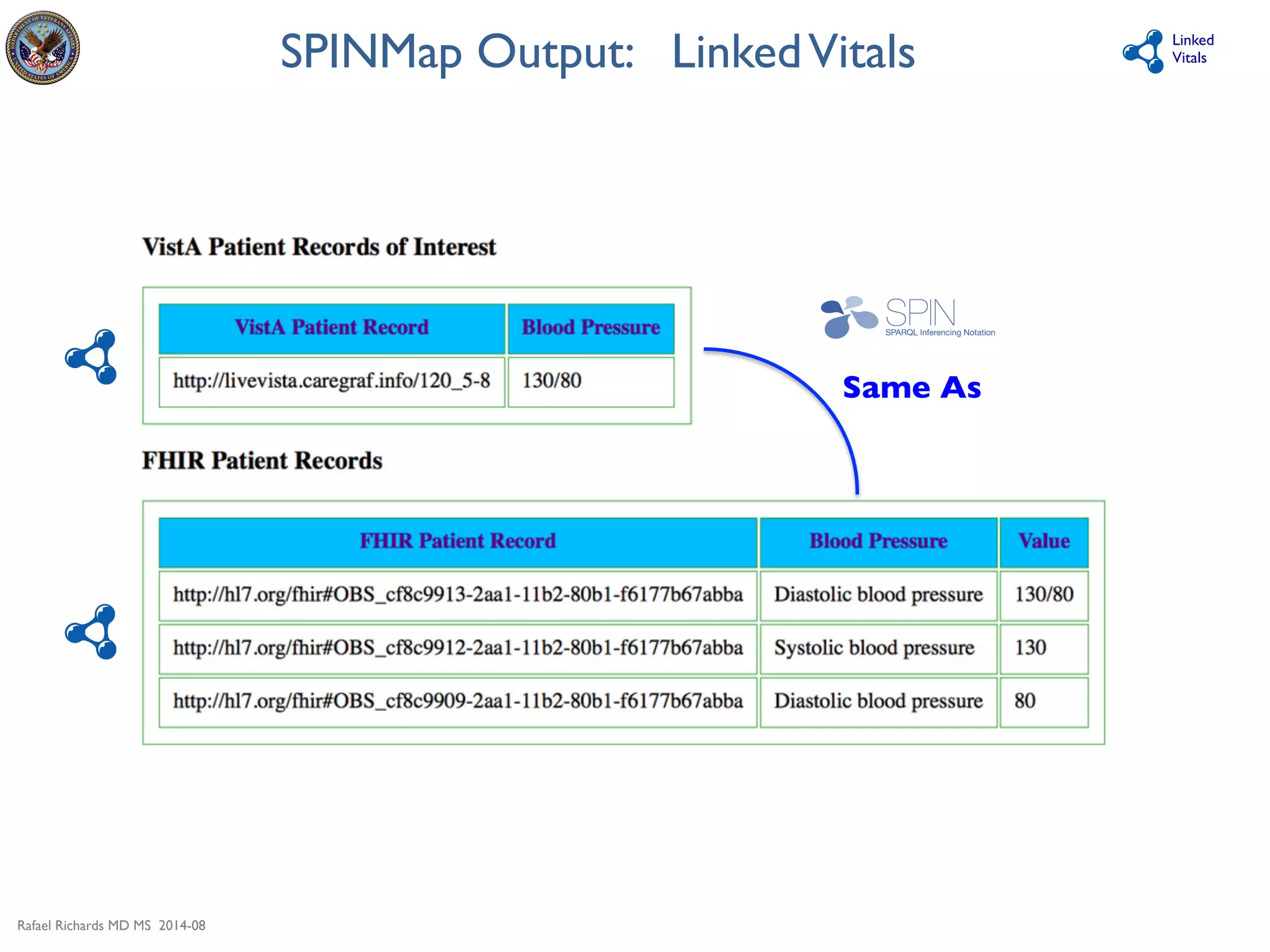
SPINMap Output: Linked Vitals 
Vitals 
Same As
Rafael Richards MD MS 2014-08 
Linked 
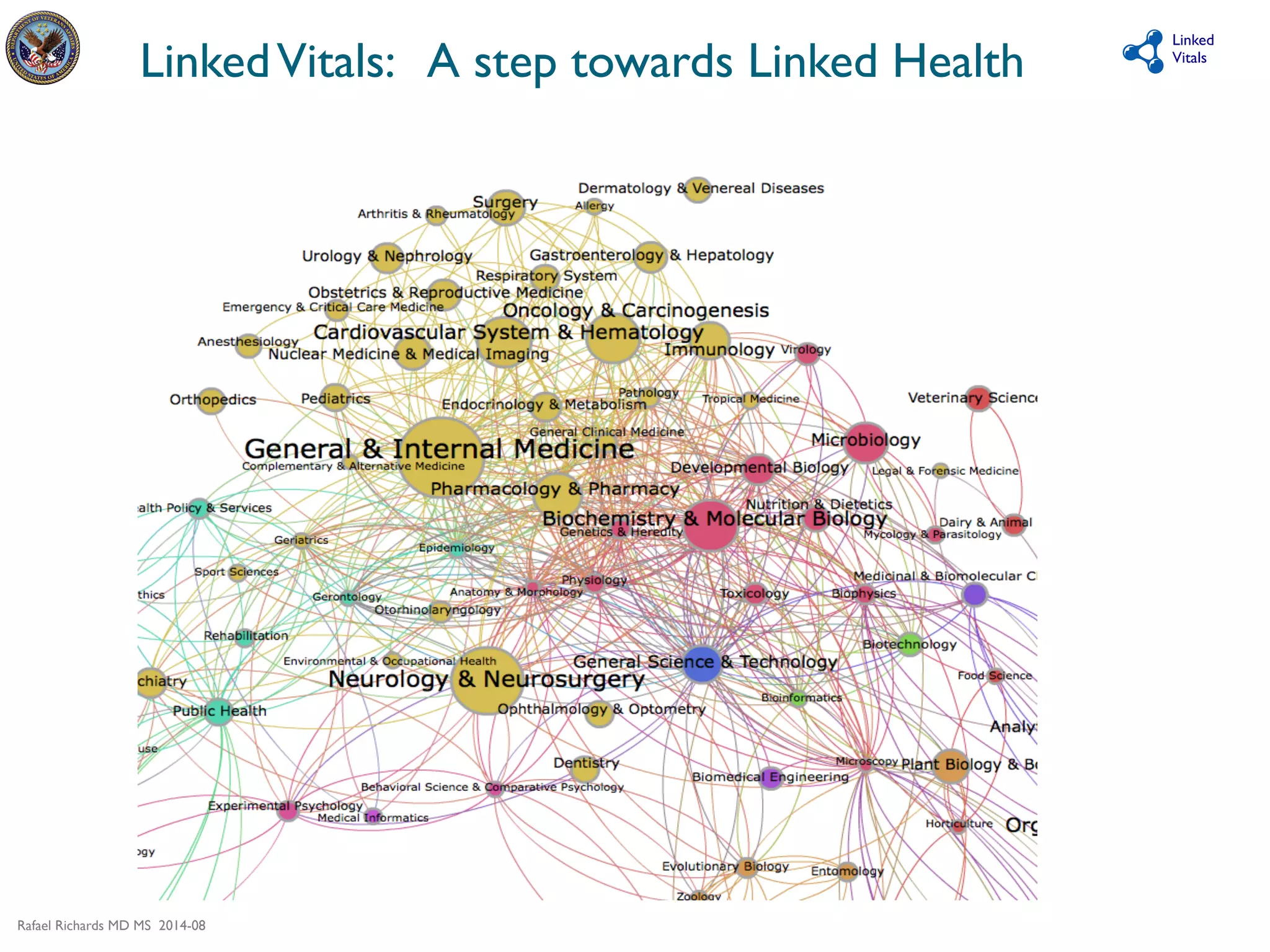
Linked Vitals: A step towards Linked Health 
Vitals
Rafael Richards MD MS 2014-08 
Linked 
Vitals 
Appendix 
Review of Linked Data and its features 
as a sematic interoperability language
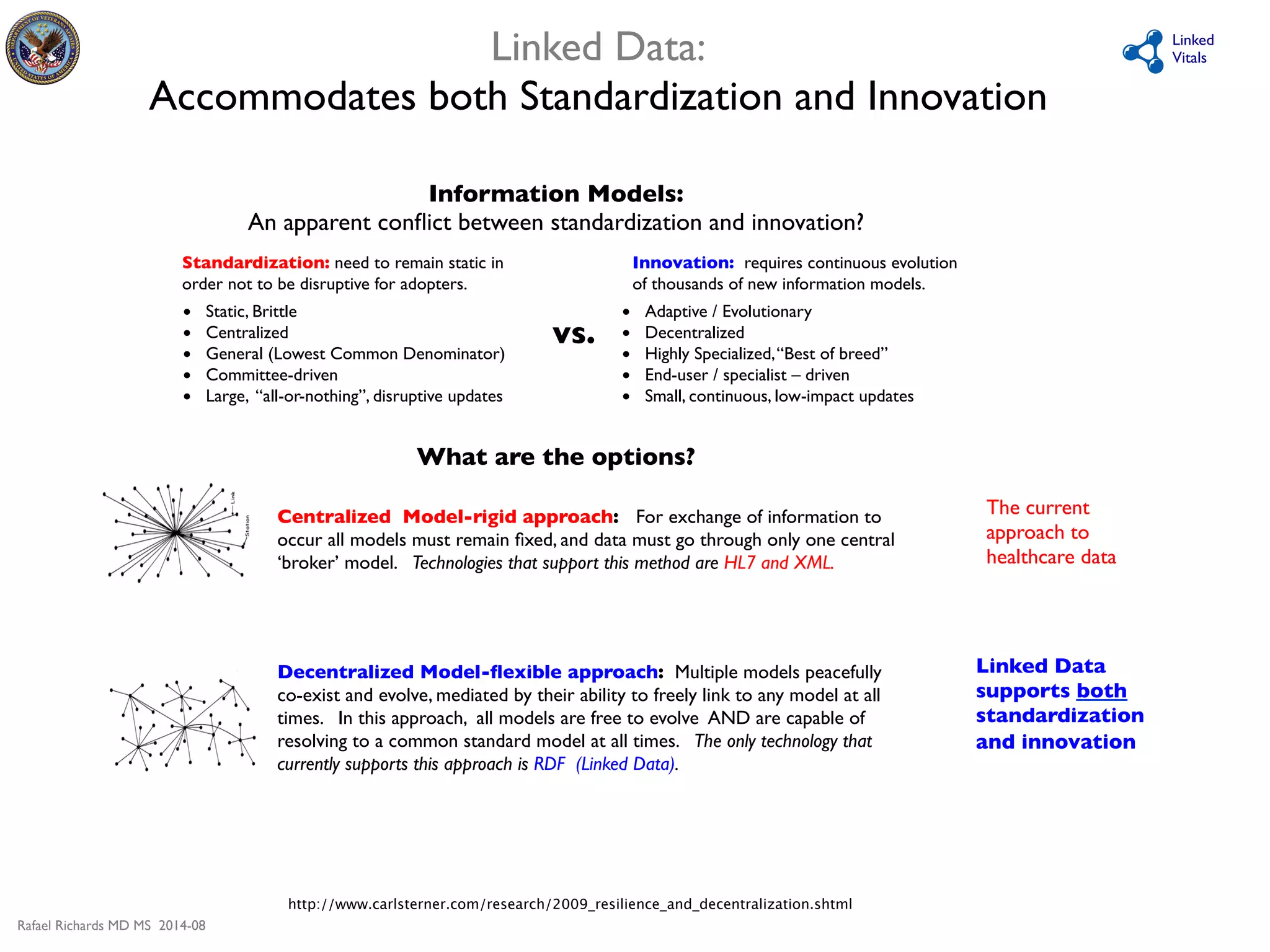
Information Models: 
An apparent conflict between standardization and innovation? 
Standardization: need to remain static in 
order not to be disruptive for adopters. 
• Static, Brittle 
• Centralized 
• General (Lowest Common Denominator) 
• Committee-driven 
• Large, “all-or-nothing”, disruptive updates 
Rafael Richards MD MS 2014-08 
Linked 
Vitals 
Linked Data: 
Accommodates both Standardization and Innovation 
Innovation: requires continuous evolution 
of thousands of new information models. 
• Adaptive / Evolutionary 
• Decentralized 
• Highly Specialized, “Best of breed” 
• End-user / specialist – driven 
• Small, continuous, low-impact updates 
vs. 
What are the options? 
Centralized Model-rigid approach: For exchange of information to 
occur all models must remain fixed, and data must go through only one central 
‘broker’ model. Technologies that support this method are HL7 and XML. 
Decentralized Model-flexible approach: Multiple models peacefully 
co-exist and evolve, mediated by their ability to freely link to any model at all 
times. In this approach, all models are free to evolve AND are capable of 
resolving to a common standard model at all times. The only technology that 
currently supports this approach is RDF (Linked Data). 
http://www.carlsterner.com/research/2009_resilience_and_decentralization.shtml 
The current 
approach to 
healthcare data 
Linked Data 
supports both 
standardization 
and innovation
Rafael Richards MD MS 2014-08 
Linked 
Vitals 
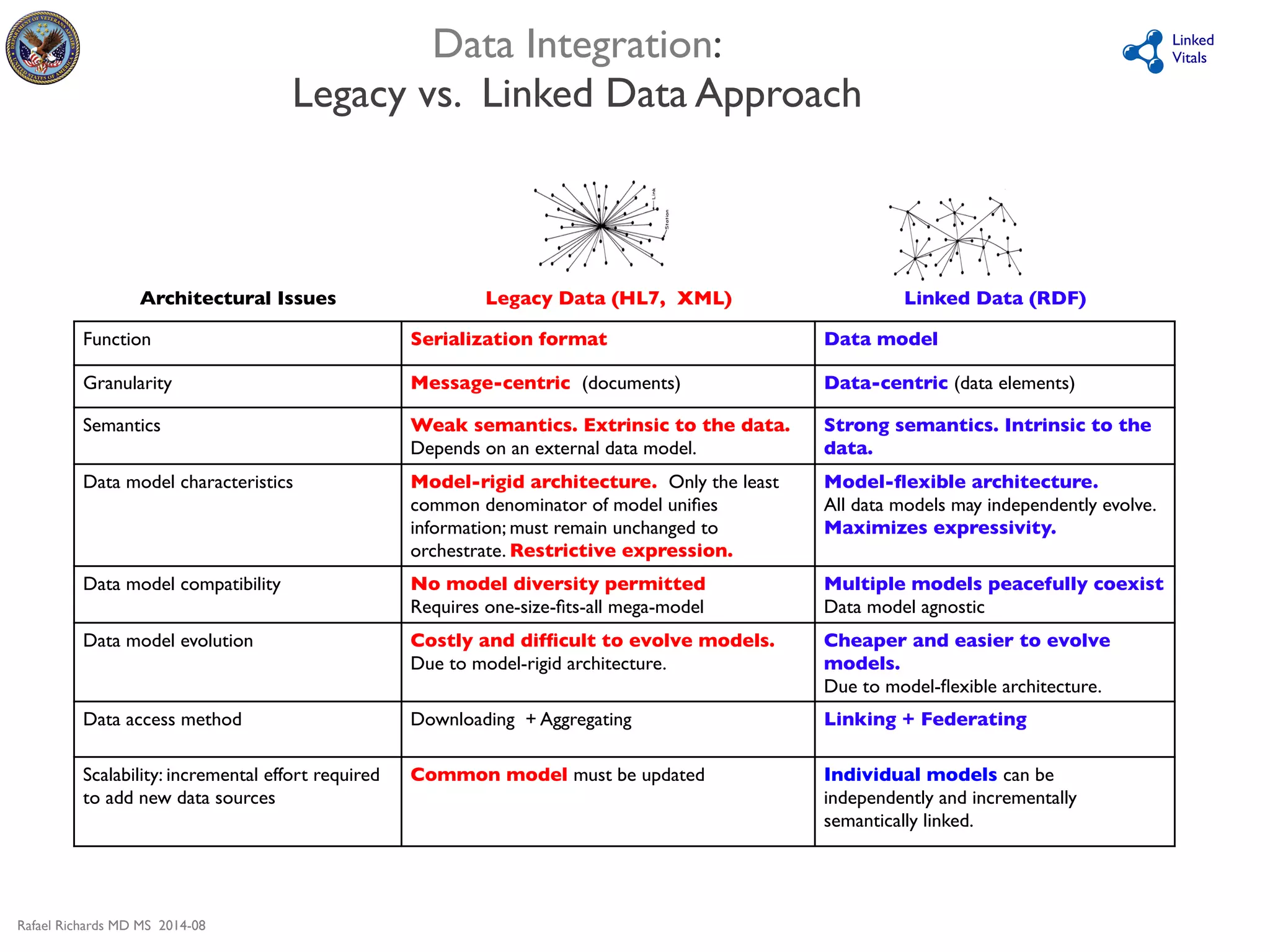
Data Integration:  
Legacy vs. Linked Data Approach 
Architectural Issues 
Legacy Data (HL7, XML) 
Linked Data (RDF) 
Function 
Serialization format 
Data model 
Granularity 
Message-centric (documents) 
Data-centric (data elements) 
Semantics 
Weak semantics. Extrinsic to the data. 
Depends on an external data model. 
Strong semantics. Intrinsic to the 
data. 
Data model characteristics 
Model-rigid architecture. Only the least 
common denominator of model unifies 
information; must remain unchanged to 
orchestrate. Restrictive expression. 
Model-flexible architecture. 
All data models may independently evolve. 
Maximizes expressivity. 
Data model compatibility 
No model diversity permitted 
Requires one-size-fits-all mega-model 
Multiple models peacefully coexist 
Data model agnostic 
Data model evolution 
Costly and difficult to evolve models. 
Due to model-rigid architecture. 
Cheaper and easier to evolve 
models. 
Due to model-flexible architecture. 
Data access method 
Downloading + Aggregating 
Linking + Federating 
Scalability: incremental effort required 
to add new data sources 
Common model must be updated 
Individual models can be 
independently and incrementally 
semantically linked.
Rafael Richards MD MS 2014-08 
Linked 
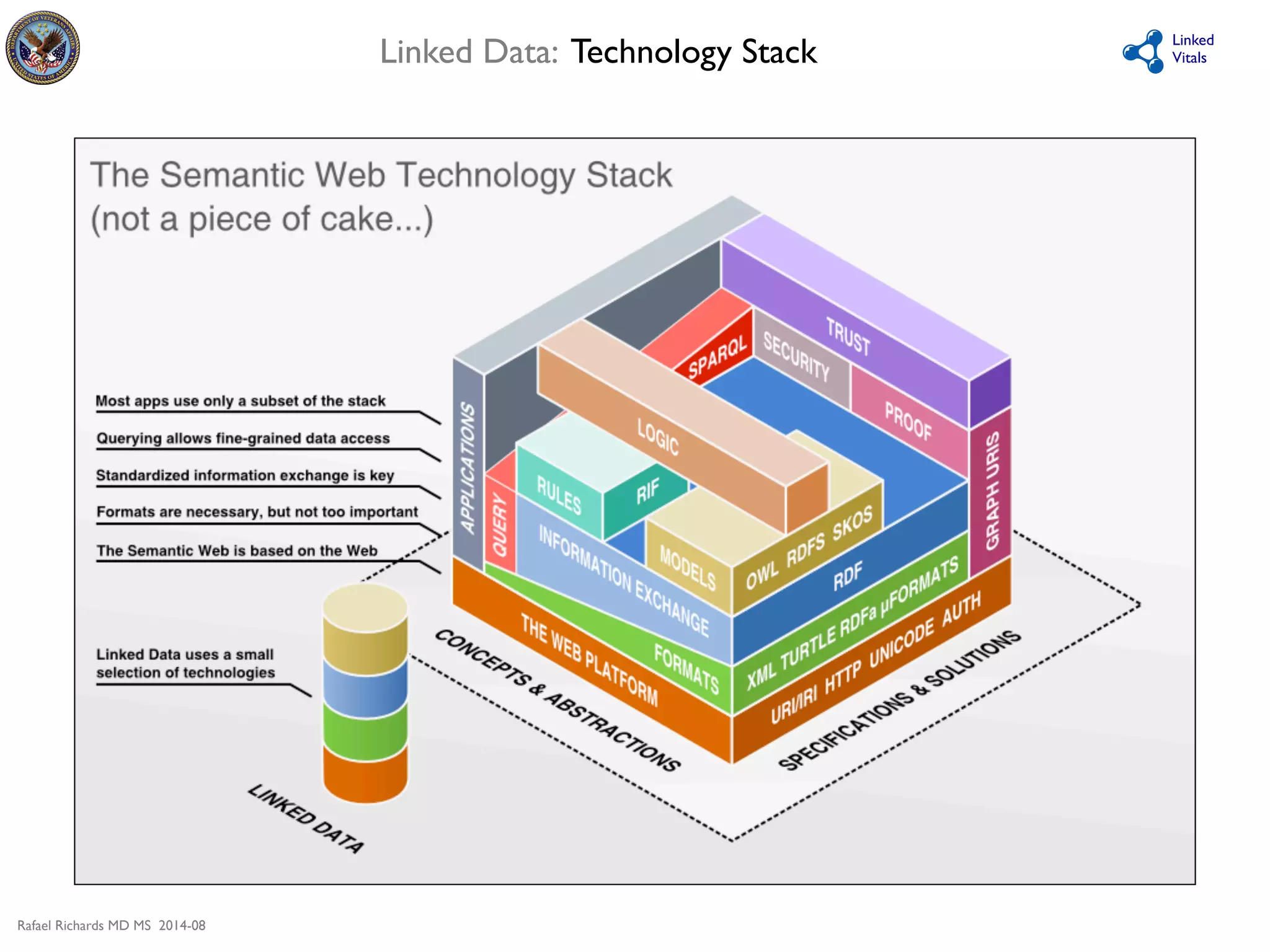
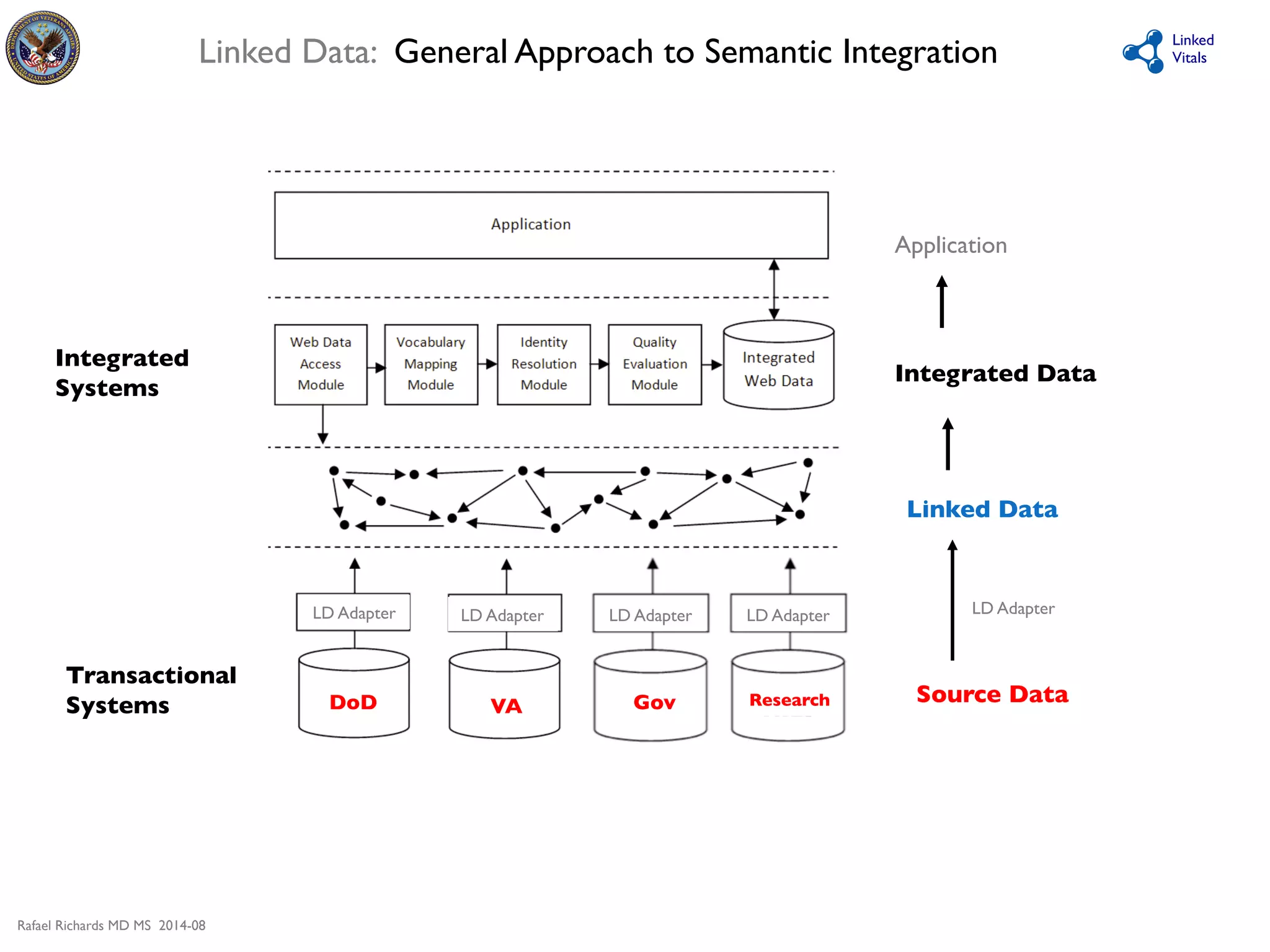
Linked Data: Technology Stack 
Vitals
Integrated 
Systems 
Linked Data: General Approach to Semantic Integration 
Rafael Richards MD MS 2014-08 
Linked 
Vitals 
Application 
Linked Data 
Source Data 
DoD 
VA 
HHS 
Integrated Data 
Gov 
Research 
LD Adapter 
LD Adapter 
LD Adapter 
LD Adapter 
LD Adapter 
Transactional 
Systems
Rafael Richards MD MS 2014-08 
Linked 
Vitals 
End

Linked Vitals: A Linked Data Approach to Semantic Interoperability

  • 1.
    Rafael Richards MDMS 2014-08 Linked Vitals Linked Vitals SemTech Conference San Jose, CA August 20, 2014 Rafael M Richards MD MS Physician Informaticist Office of Informatics and Analytics Veterans Health Administration U.S. Department of Veterans Affairs A Linked Data Approach to Semantic Interoperability
  • 2.
    Rafael Richards MDMS 2014-08 Linked Vitals Problem Statement: General How do we integrate data such as vital signs meaningfully from different information systems? Vital signs System A System C System B
  • 3.
    Rafael Richards MDMS 2014-08 Linked Vitals Problem Statement: Specific How do we integrate vital signs between VistA and FHIR each with different syntax, different models, and different vocabularies ? Different syntax Different Models Different Vocabularies Different syntax Different Models Different Vocabularies Different syntax Different Models Different Vocabularies Language barriers to exchange
  • 4.
    Rafael Richards MDMS 2014-08 Linked Solution Statement Vitals How do we integrate vital signs between VistA and FHIR each with different syntax, different models, and different vocabularies ? A common exchange language
  • 5.
    Syntax A ModelA Vocabulary A Vocabulary B Rafael Richards MD MS 2014-08 Linked Overview of Translation Process Vitals Rule-based mapping Model alignment Vocabulary alignment Common syntax within model-flexible medium (Linked Data) Syntatic alignment FM Schema Semantic alignment Source Data Integrated Data Different Syntax Different Models Different Vocabularies Shared Syntax Shared Model Shared Vocabulary Shared Meaning Syntax C Model C Vocabulary C
  • 6.
    Rafael Richards MDMS 2014-08 Linked Vitals Linked Data (RDF): What is it? The World Wide Web Consortium (W3C) standard for semantic information integration for the Internet of Data. HTML (hypertext markup language) For humans to exchange information RDF (resource description framework) For computers to exchange information Linked Documents (Document Web) Linked Data (Semantic Web) enables enables “The Semantic Web [Linked Data] provides a common framework that allows data to be shared and reused across application, enterprise, and community boundaries.” Tim Berners-Lee, MIT Professor and Inventor of the World Wide Web (HTML and RDF protocols)
  • 7.
    Rafael Richards MDMS 2014-08 Linked Linked Data: Vitals Intersection of Semantic Technologies and Web Technologies
  • 8.
    Linking media, geographic,publications, government, and life sciences … Rafael Richards MD MS 2014-08 Linked Vitals Linked Data Linked Data and the Internet of Data This represents over 300 linked data sources and databases, comprising billions of data elements and millions of semantic links. Each on of these circles represents a data source, which is semantically linked to other data sources, creating one virtual federated queryable web of data. Wikipedia is one of the resources converted to Linked Data, and is called DBpedia (center circle). Why not linked healthcare?
  • 9.
    Rafael Richards MDMS 2014-08 Linked What is VISTA? Vitals • Veterans Information Systems and Technology Architecture • Information system of all VA care sites • Foundation of other public health information systems – VA (VISTA): 1200+ care sites – DoD(CHCS): 900+ care sites – IHS(RPMS): 500+ care sites – NY State: 24 hospitals • Most physicians in U.S. have used VISTA • Open source – Deployed in many other settings in U.S. and internationally – Many developments by open source community
  • 10.
    Rafael Richards MDMS 2014-08 Linked VISTA in the U.S. Vitals
  • 11.
    Rafael Richards MDMS 2014-08 Linked VistA Architecture: Overview VistA and Fileman Overview Vitals Web Services Query Access Fileman Multidimensional Data Engine (M) FMQL M Node.js FMQL is the Fileman Query Language Fileman is VistA’s database management system M is VistA’s application-data integration engine. All 150+ VistA applications are integrated within one shared multidimensional data engine.
  • 12.
    Rafael Richards MDMS 2014-08 FileMan: VistA’s data conductorVitals Linked Fileman is the gateway to all VistA data. All VistA applications use Fileman to access, structure, and query all data in VistA. VistA’s integrated data engine. All 150+ applications are integrated to their data inside the multidimensional data engine, represented by the inner circle. 12 Reference: code.osehra.org/vivian VistA’s Data Manager: Fileman M
  • 13.
    Rafael Richards MDMS 2014-08 Linked Vitals Exposing VistA’s native data model Objective: Make machine-processable schemas, vocabularies, and datasets from VISTA http://vista.caregraf.info/analytics Challenge: Poor RDF/OWL model Solution: Refine RDF/OWL model (example here)
  • 14.
    Rafael Richards MDMS 2014-08 Linked Vitals Exposing VistA’s native data model VistA’s native data model is comprised of hierarchical files and subfiles, each which addresses a specific M Global storage.
  • 15.
    Rafael Richards MDMS 2014-08 Linked Vitals Fileman Query Language (FMQL) FMQL is the Fileman Query Language. This provides real-time web-based query access to the entirety of VistA’s data. It exposes the native hierarchical data model of Fileman in web standard forms including HTML, JSON, and RDF. HTML: hypertext markup language (visual document markup) JSON: javascript object notation (data serialization / packaging) RDF: resource description framework (linked data / semantics) JSON-LD: JSON with linked data capability
  • 16.
    Rafael Richards MDMS 2014-08 Linked Vitals FMQL query of VistA for vital signs with output in HTML. HTML output: Human-readable VistA Vitals: HTML output
  • 17.
    Rafael Richards MDMS 2014-08 Linked Vitals FMQL query of VistA for vital signs with output in RDF. RDF output: Machine readable VistA Vitals: RDF output
  • 18.
    Rafael Richards MDMS 2014-08 Linked Vitals VistA Vitals in RDF 239 instances in the sample dataset
  • 19.
    Rafael Richards MDMS 2014-08 Linked Vitals VistA Vitals in RDF Exposing VistA’s intrinsic data model for vitals
  • 20.
    Rafael Richards MDMS 2014-08 Linked Vitals VistA Vitals in RDF • Native VistA in RDF did not contain “common concepts” (so we created some). • URIs are “messed up” (so we fixed them)
  • 21.
    Rafael Richards MDMS 2014-08 Linked VistA Vitals in RDF Vitals Exposing VistA’s native data model for vitals
  • 22.
    Rafael Richards MDMS 2014-08 Linked Vitals FHIR: Native model • FHIR - Observation • XML model in XML Schema
  • 23.
    Rafael Richards MDMS 2014-08 Linked FHIR Vitals in RDF Vitals Automated transformation from FHIR XML Schema - RDF
  • 24.
    Rafael Richards MDMS 2014-08 Linked Vitals FHIR Vitals in RDF Enhanced Enhanced bridge model for FHIR in RDF
  • 25.
    Rafael Richards MDMS 2014-08 Linked Vitals Many ways of using “Ontologies” Weak Strong Read/Write Model-Driven Applications Reference Models Transformation to other artifacts Conceptual Models for analysis, design and communication Query-Response Databases with/without rules and/or inferencing Linked-Open Data Apps (now) graph traversals and aggregations with or without schemas Model-Driven Generative Applications configuration of and/or transformation to software modules Read-Only Model-Driven Applications Role of Models and Schemas Controlled Vocabularies/ Master Data used by applications 1 10 8 3 2 4 7 6 Semantic Mediated/ Federated Applications 9 Orchestrated Applications Dataflow/Workflow/ Process 5 Design-Time Run-Time Our application
  • 26.
    Rafael Richards MDMS 2014-08 Linked Vitals Context of Translation: RDF Technology Stack • FHIR: XML Schema - RDF (1-2) • VISTA: Fileman model - RDF (2) • LOINC: CSV - RDF (2) • Create bridge model (3) • Merge models and terminology: SPIN Map (4) 4 3 2 1 1. FHIR native model (XML Schema) 2. Translation (RDF Schema) 3. Bridge schema (OWL) 4. SPARQL rules (SPINMap)
  • 27.
    Rafael Richards MDMS 2014-08 Linked SPIN: SPARQL Inferencing Notation Vitals • A W3C candidate standard • A SPARQL Rules Language • Builds on top of the SPARQL query language • Enables exchangeable rules and transformations
  • 28.
    Rafael Richards MDMS 2014-08 Linked SPINMap: Data transformation stack Vitals
  • 29.
    Rafael Richards MDMS 2014-08 Linked SPINMap: Data mapping rules engine Vitals Motivation: Simplifies mappings between different models Key Features: Creates executable transformations
  • 30.
    Rafael Richards MDMS 2014-08 Linked Vitals SPINMap: Field mapping with rules Easier to create deep nested structures in the target
  • 31.
    Rafael Richards MDMS 2014-08 Linked SPINMap: Rules for LOINC terminology Vitals
  • 32.
    Rafael Richards MDMS 2014-08 Linked SPINMap Output: Linked Vitals Vitals Same As
  • 33.
    Rafael Richards MDMS 2014-08 Linked Linked Vitals: A step towards Linked Health Vitals
  • 34.
    Rafael Richards MDMS 2014-08 Linked Vitals Appendix Review of Linked Data and its features as a sematic interoperability language
  • 35.
    Information Models: Anapparent conflict between standardization and innovation? Standardization: need to remain static in order not to be disruptive for adopters. • Static, Brittle • Centralized • General (Lowest Common Denominator) • Committee-driven • Large, “all-or-nothing”, disruptive updates Rafael Richards MD MS 2014-08 Linked Vitals Linked Data: Accommodates both Standardization and Innovation Innovation: requires continuous evolution of thousands of new information models. • Adaptive / Evolutionary • Decentralized • Highly Specialized, “Best of breed” • End-user / specialist – driven • Small, continuous, low-impact updates vs. What are the options? Centralized Model-rigid approach: For exchange of information to occur all models must remain fixed, and data must go through only one central ‘broker’ model. Technologies that support this method are HL7 and XML. Decentralized Model-flexible approach: Multiple models peacefully co-exist and evolve, mediated by their ability to freely link to any model at all times. In this approach, all models are free to evolve AND are capable of resolving to a common standard model at all times. The only technology that currently supports this approach is RDF (Linked Data). http://www.carlsterner.com/research/2009_resilience_and_decentralization.shtml The current approach to healthcare data Linked Data supports both standardization and innovation
  • 36.
    Rafael Richards MDMS 2014-08 Linked Vitals Data Integration: Legacy vs. Linked Data Approach Architectural Issues Legacy Data (HL7, XML) Linked Data (RDF) Function Serialization format Data model Granularity Message-centric (documents) Data-centric (data elements) Semantics Weak semantics. Extrinsic to the data. Depends on an external data model. Strong semantics. Intrinsic to the data. Data model characteristics Model-rigid architecture. Only the least common denominator of model unifies information; must remain unchanged to orchestrate. Restrictive expression. Model-flexible architecture. All data models may independently evolve. Maximizes expressivity. Data model compatibility No model diversity permitted Requires one-size-fits-all mega-model Multiple models peacefully coexist Data model agnostic Data model evolution Costly and difficult to evolve models. Due to model-rigid architecture. Cheaper and easier to evolve models. Due to model-flexible architecture. Data access method Downloading + Aggregating Linking + Federating Scalability: incremental effort required to add new data sources Common model must be updated Individual models can be independently and incrementally semantically linked.
  • 37.
    Rafael Richards MDMS 2014-08 Linked Linked Data: Technology Stack Vitals
  • 38.
    Integrated Systems LinkedData: General Approach to Semantic Integration Rafael Richards MD MS 2014-08 Linked Vitals Application Linked Data Source Data DoD VA HHS Integrated Data Gov Research LD Adapter LD Adapter LD Adapter LD Adapter LD Adapter Transactional Systems
  • 39.
    Rafael Richards MDMS 2014-08 Linked Vitals End