Cutting & Stabbing
Wounds
An Investigators Forensic Overview
Cutting & Stabbing
Wounds
An Investigators Forensic Overview
Course Summary
This course is designed to introduce the
student to the forensic importance of
stabbing and cutting injuries.
This course will describe what these wounds
are and how they are made. It will also
explore each type of wound’s forensic
importance to an investigation.
Objectives
1. List the four categories of cutting wounds
2. Define Abrasion
3. Properly explain how an abrasion is made
4. Define laceration
5. Properly explain the difference between laceration and incised
wound.
6. Properly describe an incised wound appearance
7. Properly explain a stabbing wound appearance and how they
are made
8. Explain what a defense wound is and how they are made
9. Properly define the characteristics of suicidal stabbings
10. Explain how to identify and document a bite mark.
Lets get started
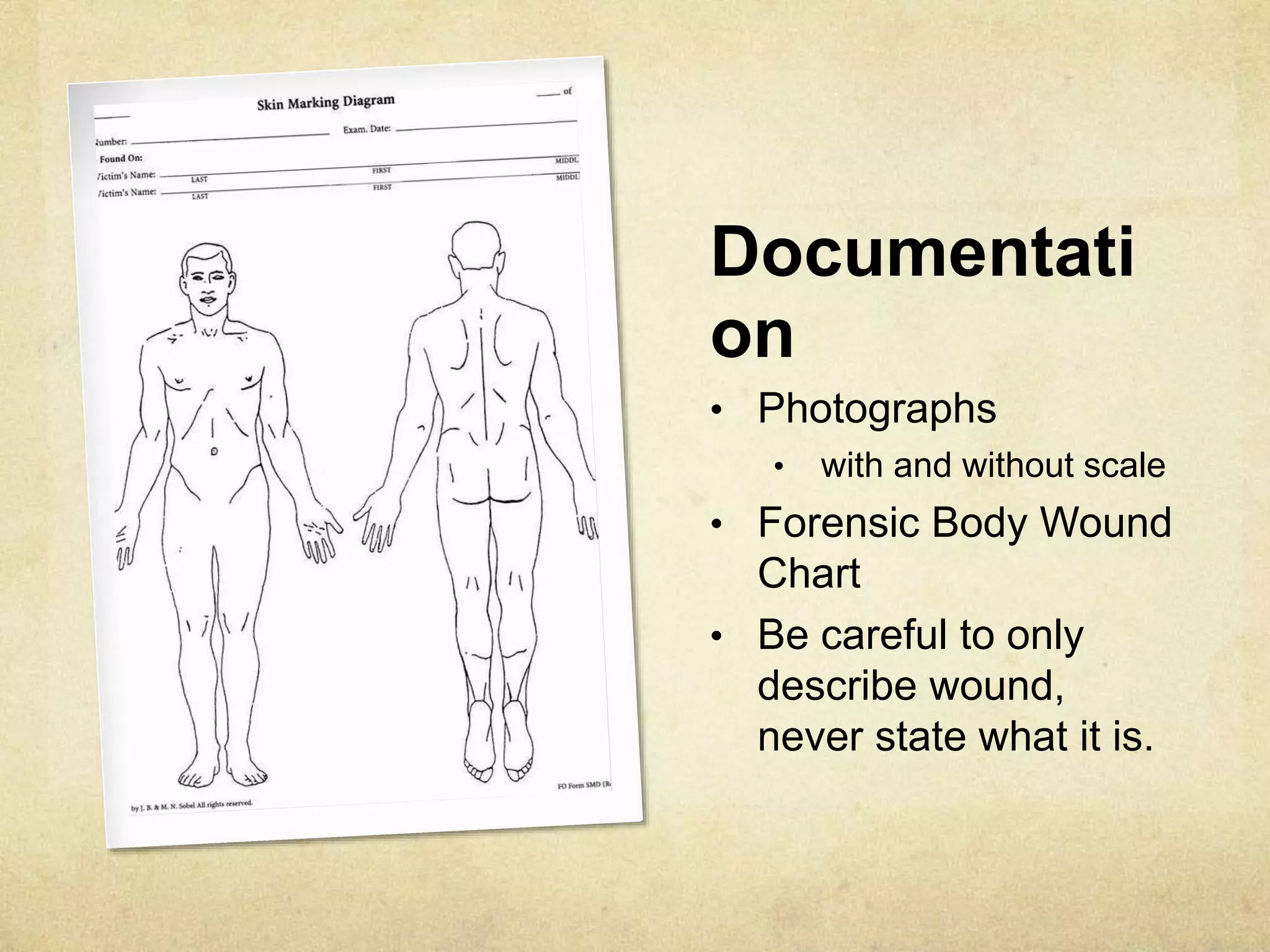
Documentati
on
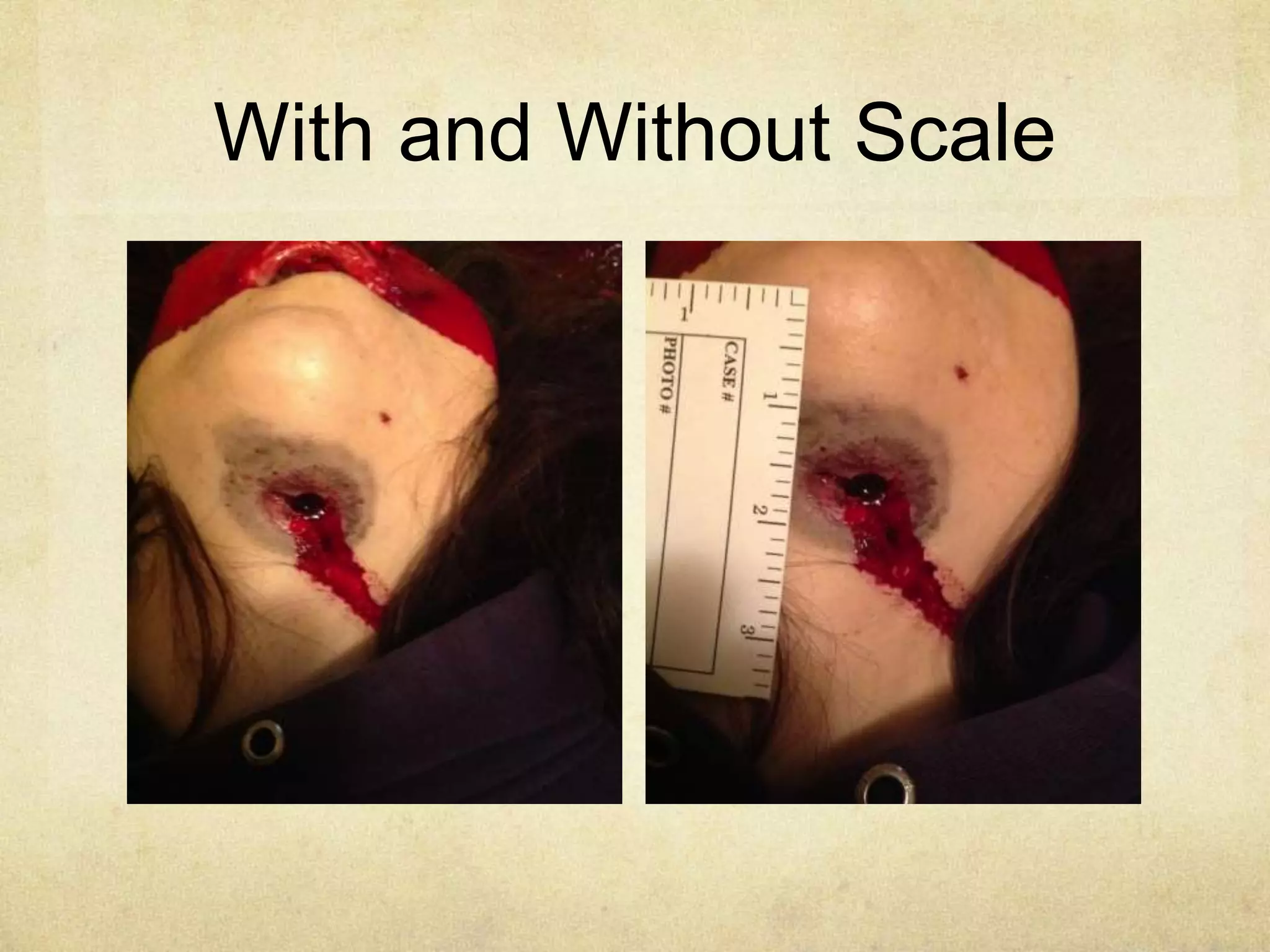
• Photographs
• with and without scale
• Forensic Body Wound
Chart
• Be careful to only
describe wound,
never state what it is.
With and Without Scale
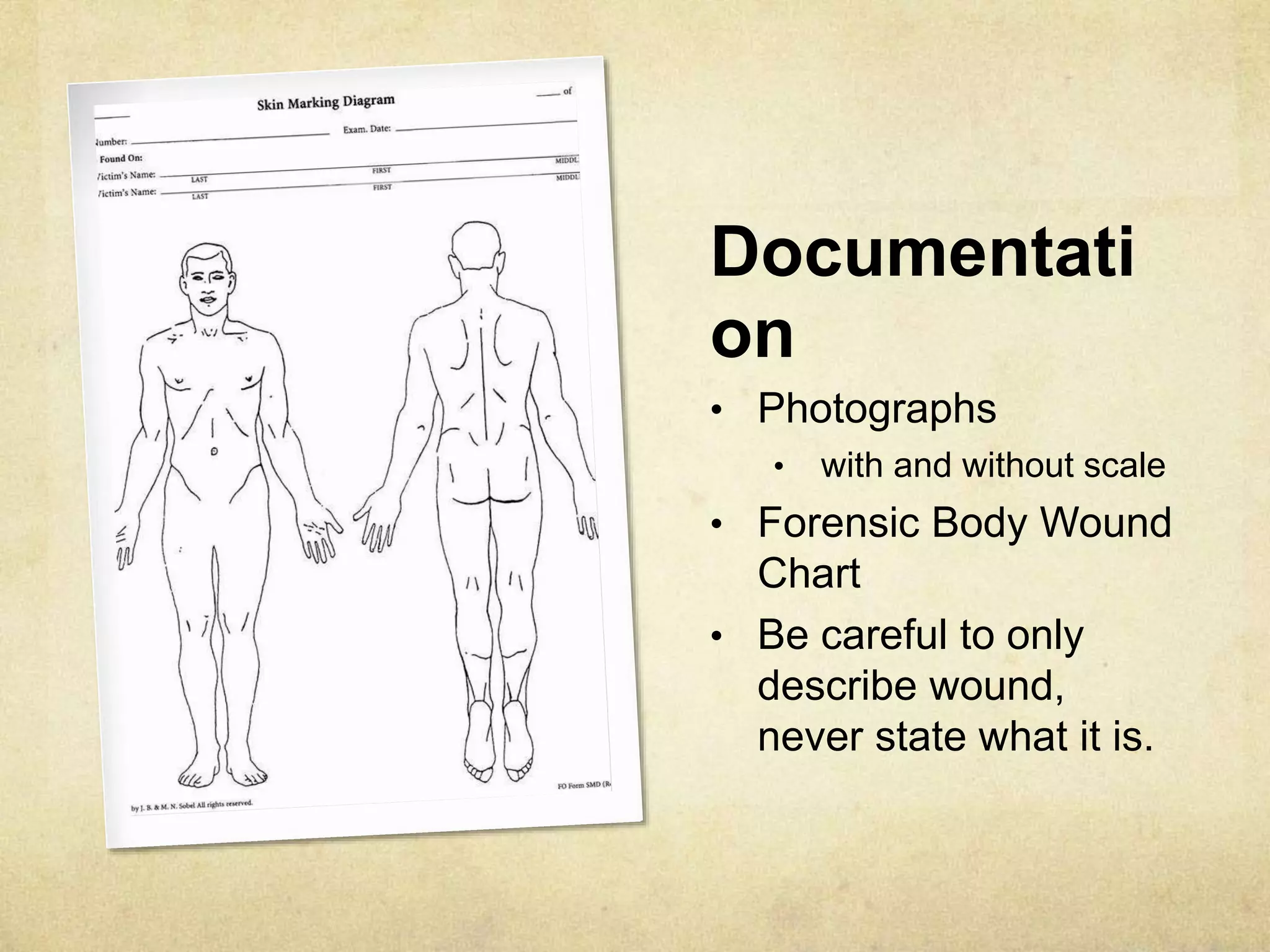
Documentati
on
• Photographs
• with and without scale
• Forensic Body Wound
Chart
• Be careful to only
describe wound,
never state what it is.
Wound Categories
Abrasions (grazes, scrapes, bite marks)
Lacerations
Incised Wounds
Cutting, Slashing and Chopping
Puncture (or stab) wounds
Obj 1
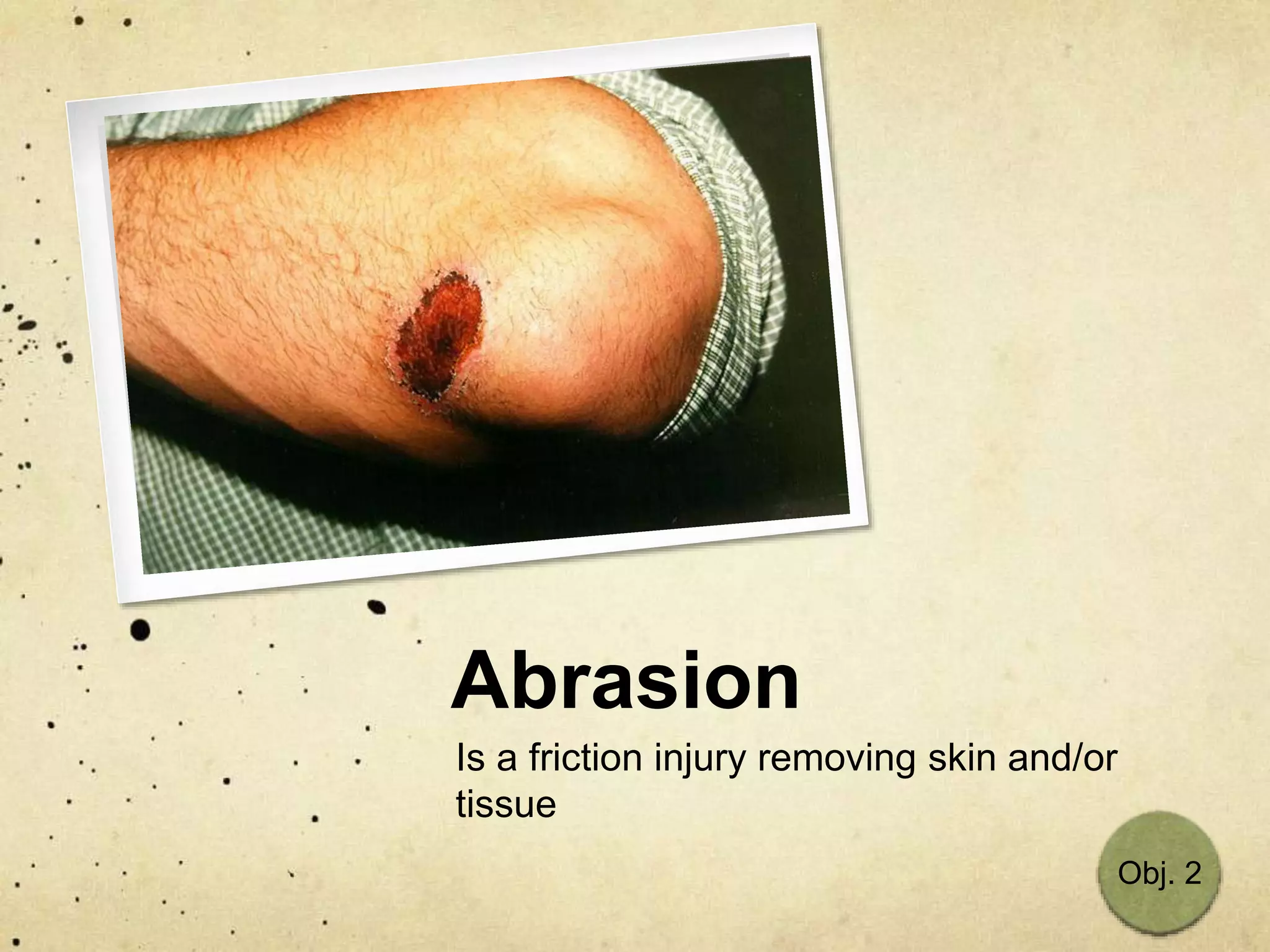
Abrasion
Is a friction injury removing skin and/or
tissue
Obj. 2
Abrasions
Side Impact produces a moving abrasion
Indicates direction
Trace material may be seen (eg. dirt, gravel,
glass)
Direct impact produces and imprint abrasion
Pattern of the object used
All abrasions reflect site of impact in contrast with
bruises
Assessment of age of abrasion is difficult
Post-mortem abrasions are brown and leathery
Obj. 3
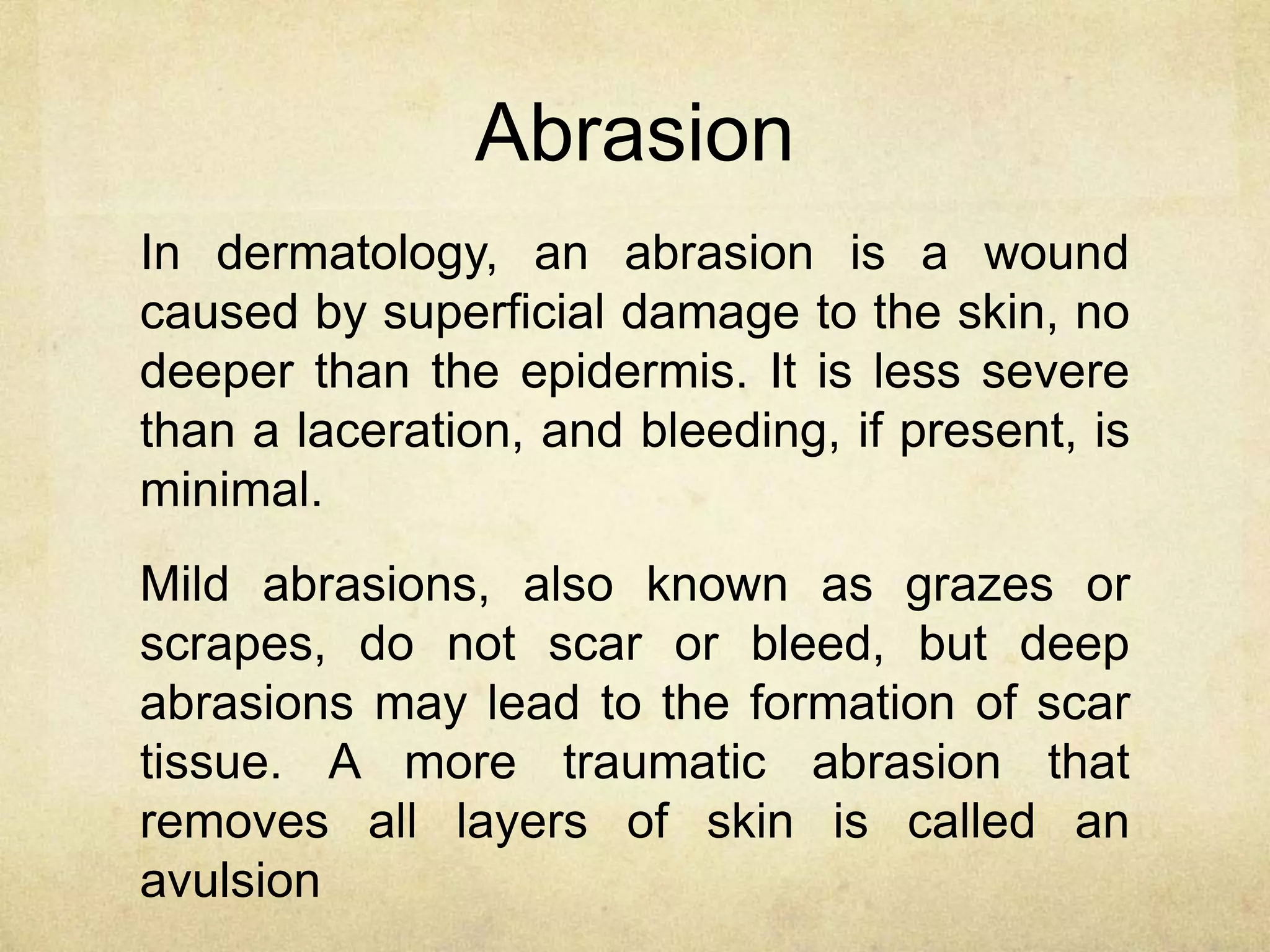
Abrasion
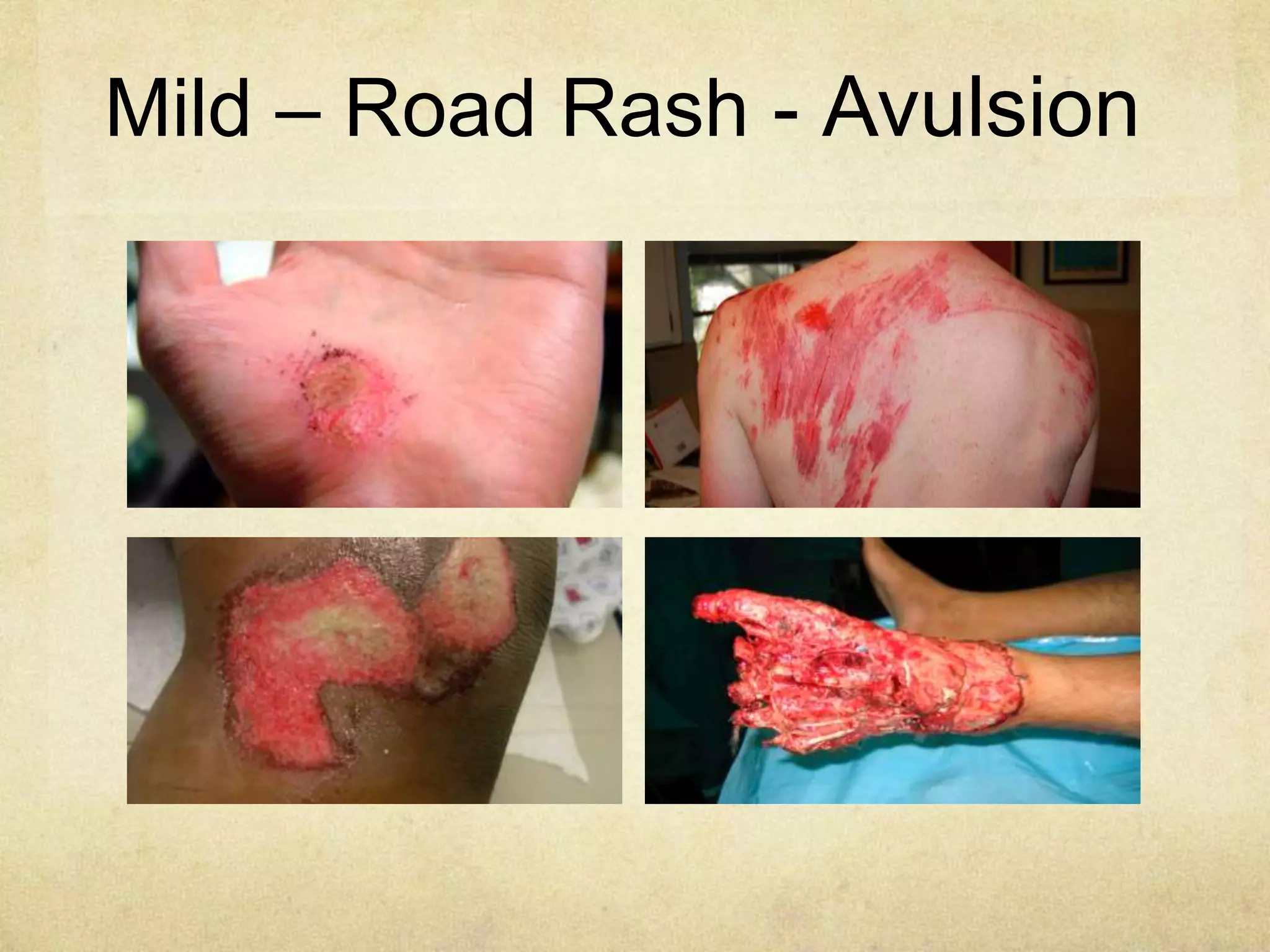
In dermatology, an abrasion is a wound
caused by superficial damage to the skin, no
deeper than the epidermis. It is less severe
than a laceration, and bleeding, if present, is
minimal.
Mild abrasions, also known as grazes or
scrapes, do not scar or bleed, but deep
abrasions may lead to the formation of scar
tissue. A more traumatic abrasion that
removes all layers of skin is called an
avulsion
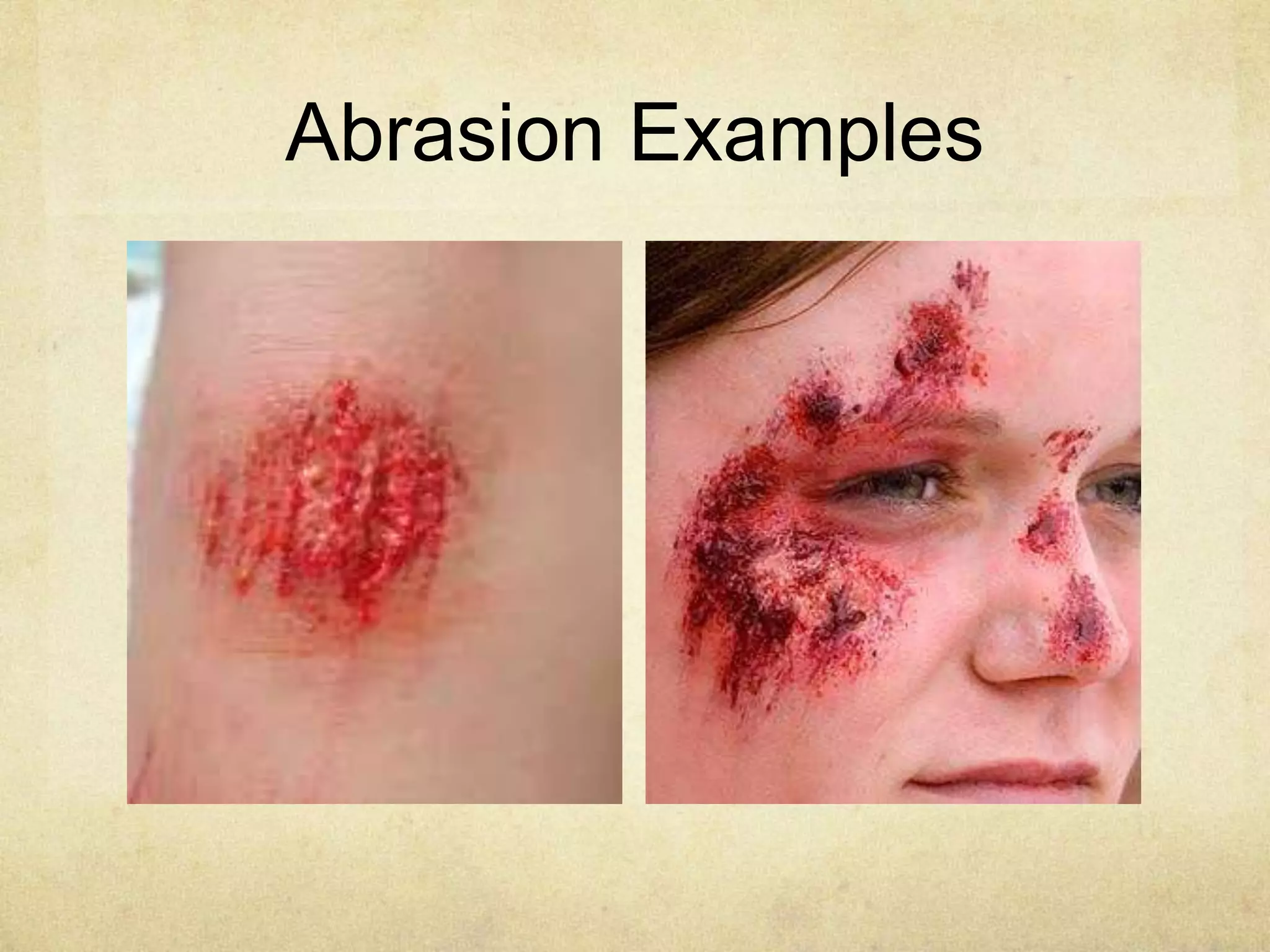
Abrasion Examples
Mild – Road Rash - Avulsion
Lacerations
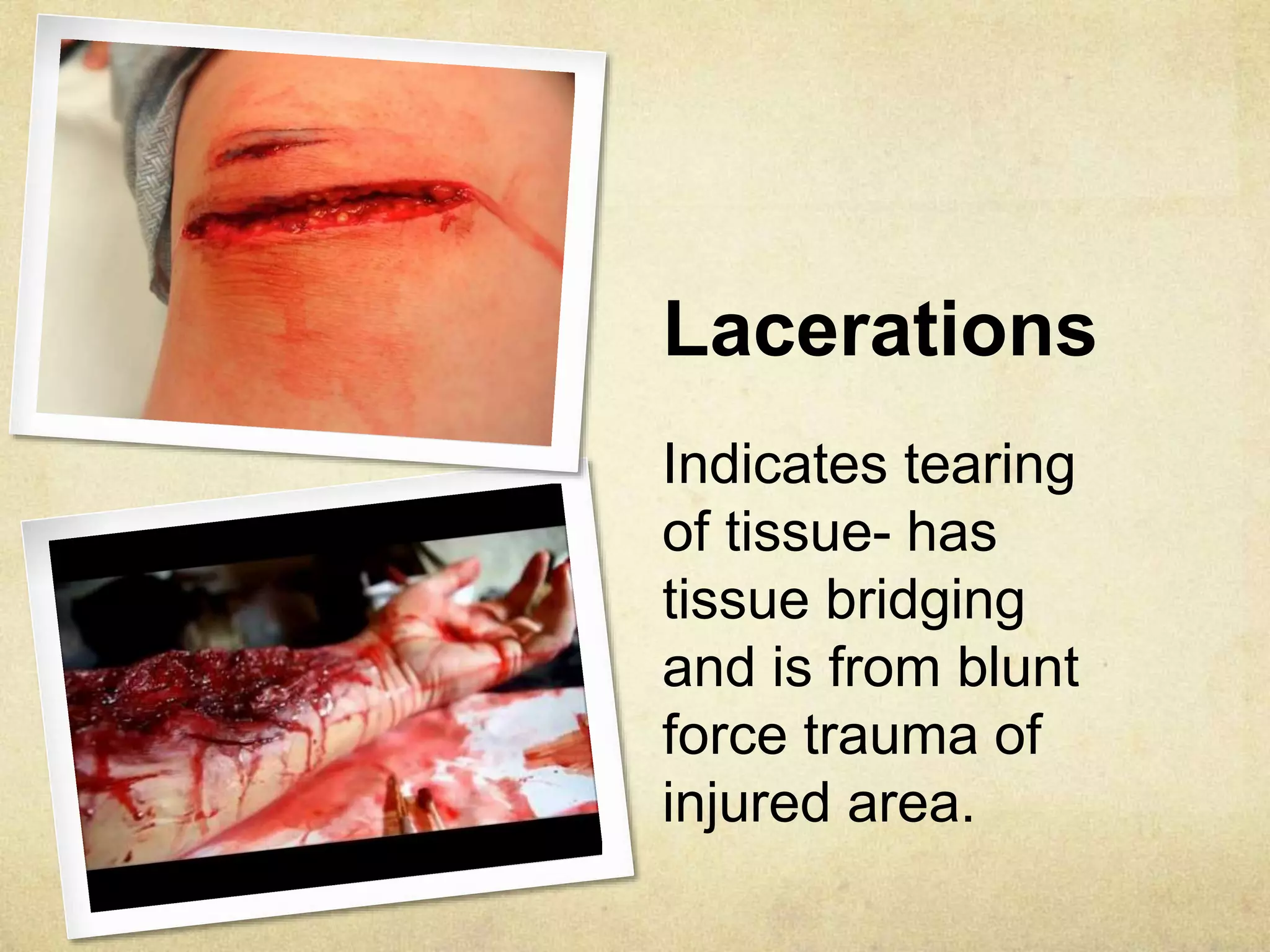
Lacerations
Indicates tearing
of tissue- has
tissue bridging
and is from blunt
force trauma of
injured area.
Lacerations
Is the splitting of the skin by the direct crushing
or ripping blow of the trauma
Typically over bone such as scalp, eyebrow, and
cheekbone – but not always
Different from Incised wounds by:
Adjacent abrasion and/or bruise
Ragged edge
Tissue bridges in depth
Obj. 4
Lacerations
Forensic Importance
Not related to object shape
Trace evidence will be hard to locate if at
all
Typically very little blood loss (except
scalp injuries)
Rarely of suicidal attempts
Unless associated with another injury
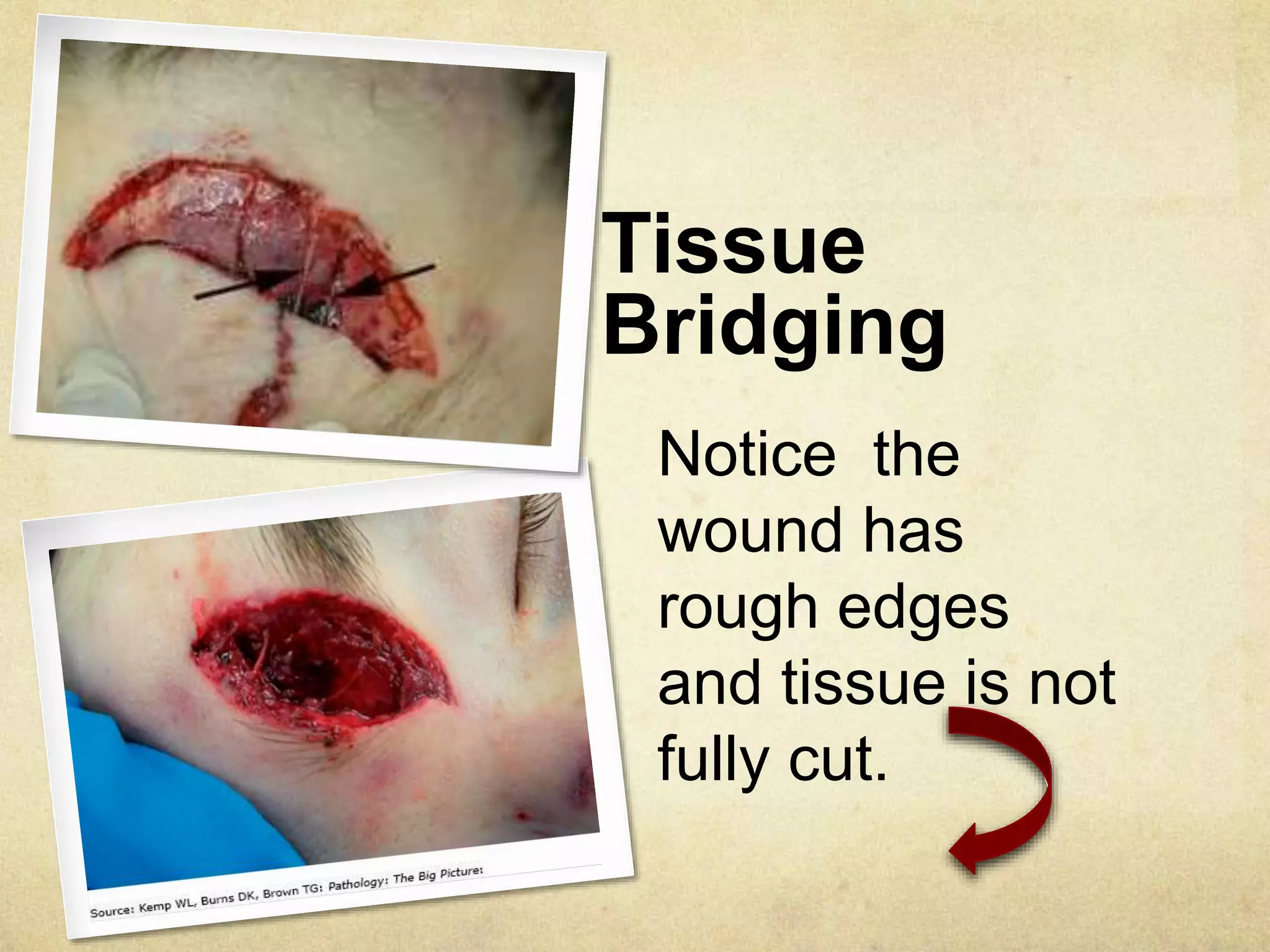
Tissue
Bridging
Notice the
wound has
rough edges
and tissue is not
fully cut.
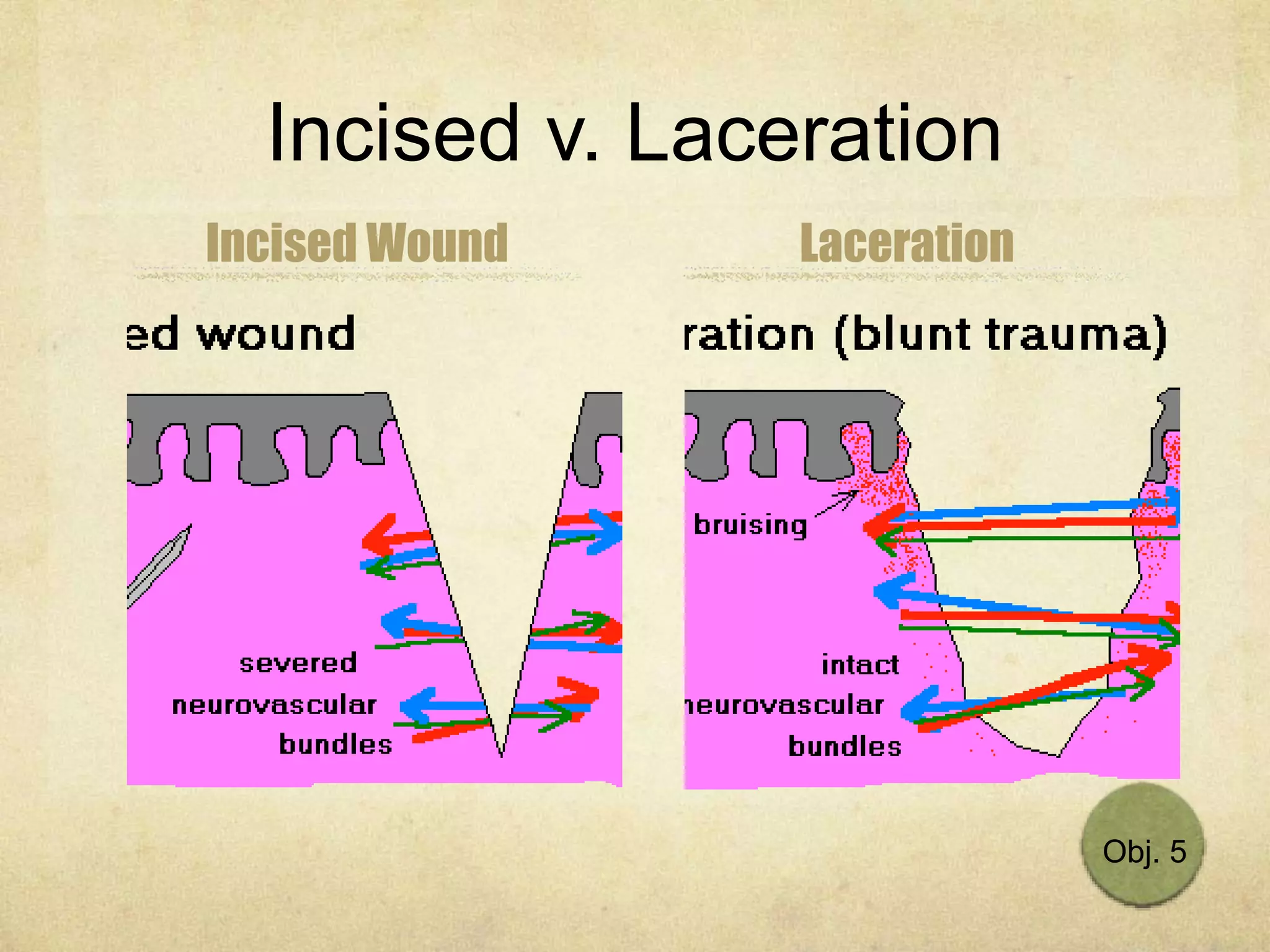
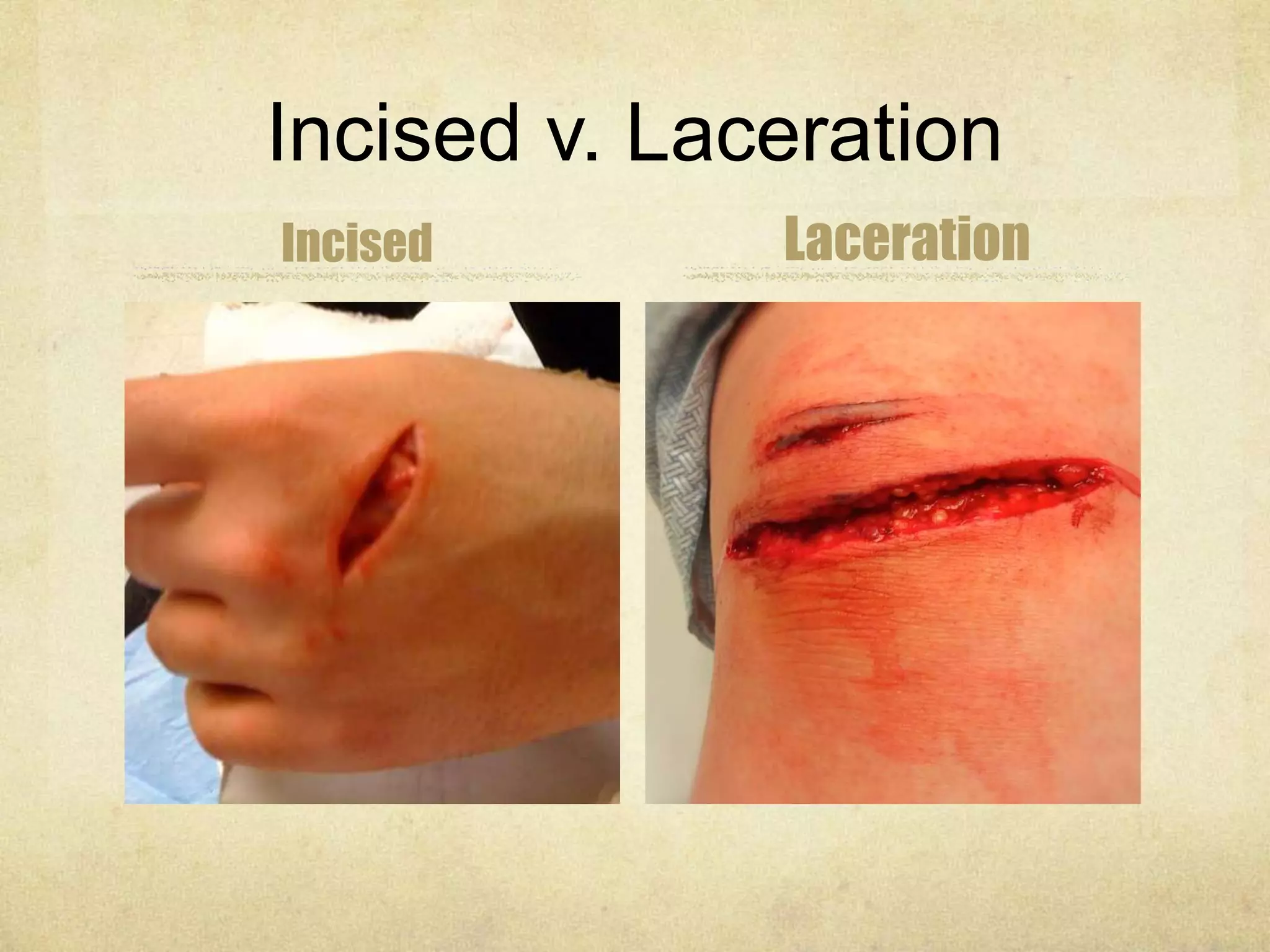
Incised v. Laceration
Incised Wound Laceration
Obj. 5
Incised v. Laceration
Incised Laceration
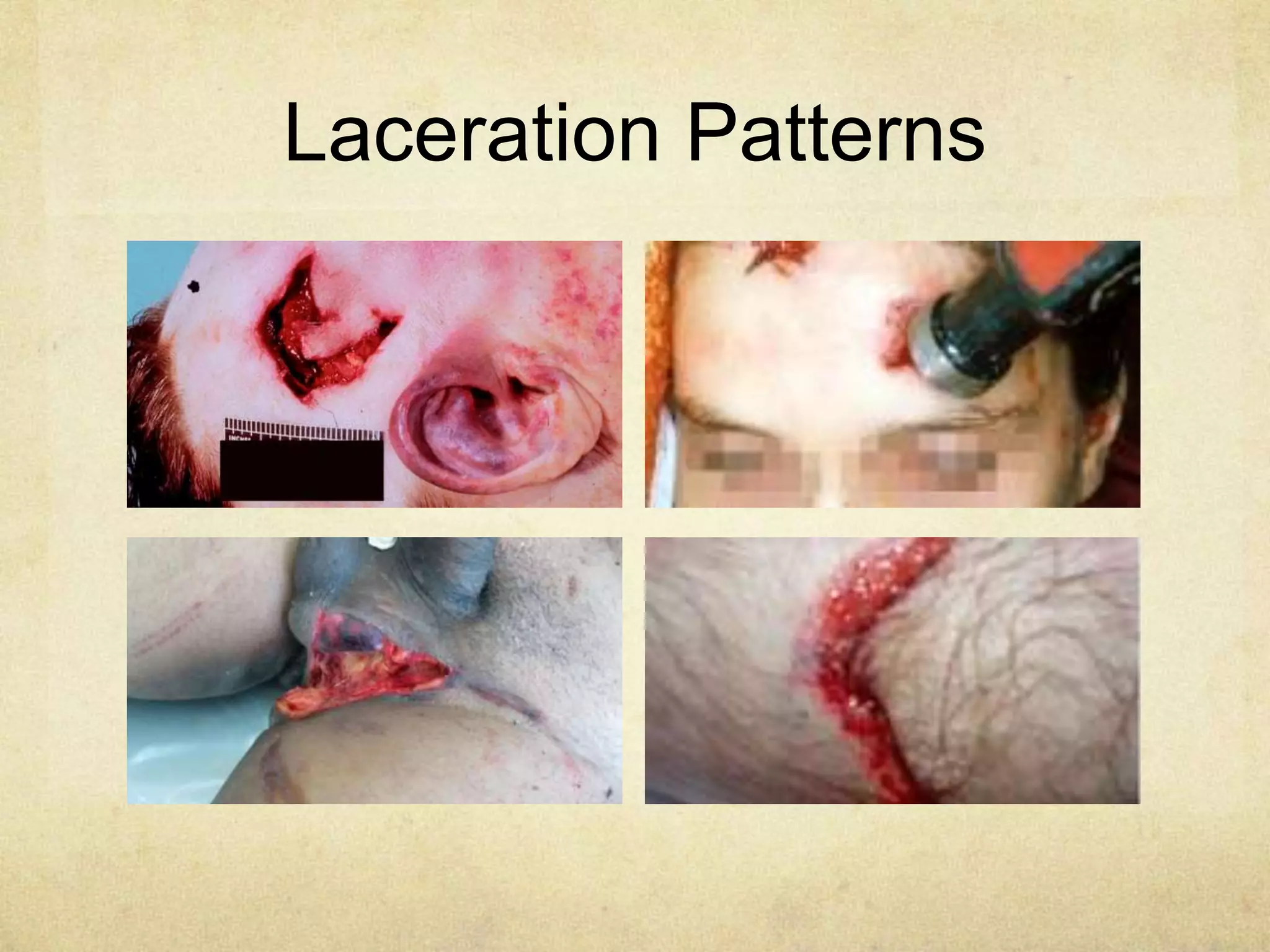
Typical Laceration Patterns
Circles and crescents from hammers
Y-Shape from metal robs
Inside lips from blow to mouth
Ripping on skin from blunt cross
contact
Stretching lacerations in vehicle
accidents
Laceration Patterns
Incised Wounds
Cutting and Chopping
Incised Wounds
Sharp force wound
Well defined severing of tissues
No connecting tissue in wound
Clean edges
Usually no bruises
Usually no abrasions
Obj.6
Incised Wounds
Incised wounds are sharp cut-like injuries,
made by knives or broken glass etc.
The edges of the wound will vary
according to the nature of the cutting
edge of the object, in that a razor will
leave regular margins, whereas an axe
may leave the wound margins crushed
and bruised, resembling a laceration.
Incised Wounds
Incised and Blunt
Force Trauma
From Boat Motor
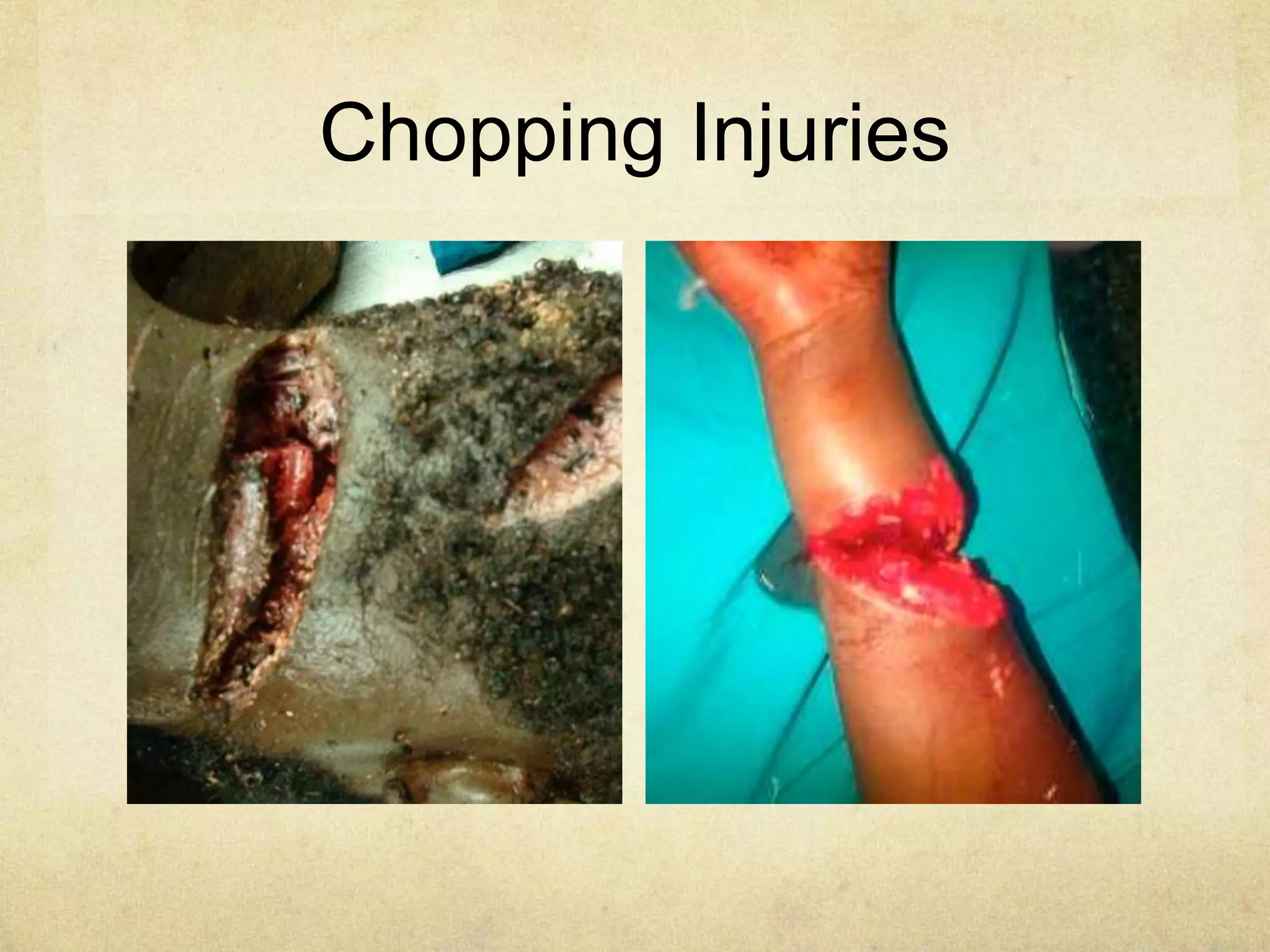
Chopping Injuries
Ain’t that
for sure
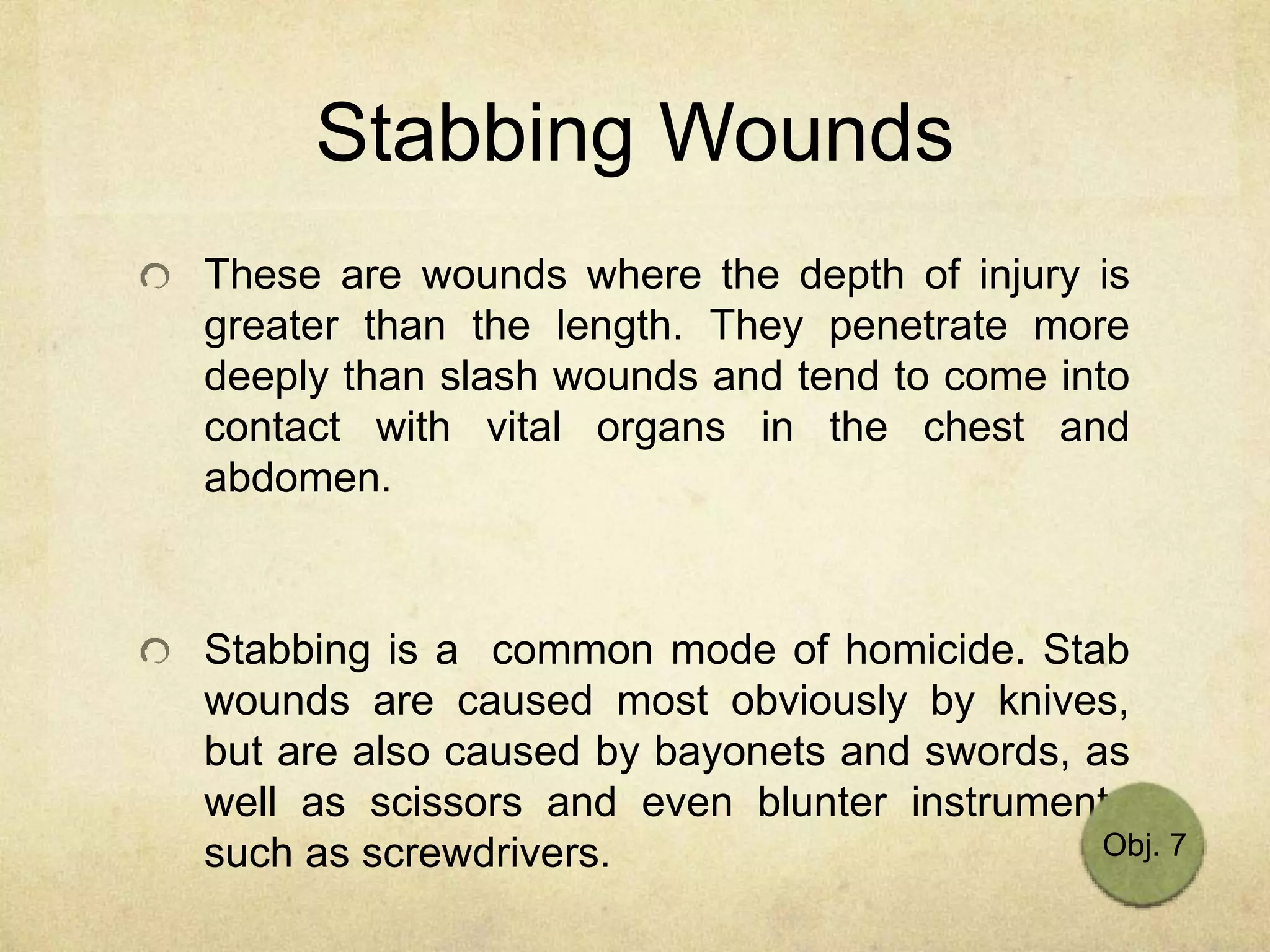
Stabbing Wounds
Stabbing Wounds
These are wounds where the depth of injury is
greater than the length. They penetrate more
deeply than slash wounds and tend to come into
contact with vital organs in the chest and
abdomen.
Stabbing is a common mode of homicide. Stab
wounds are caused most obviously by knives,
but are also caused by bayonets and swords, as
well as scissors and even blunter instruments
such as screwdrivers. Obj. 7
Shape of Weapon
A knife blade with a double edge will normally
produce a symmetrical elliptical wound with both
ends pointed, clean cut edges and without any
associated bruising or marginal abrasion.
A knife with a single-edged blade may show relative
blunting ("fish-tailing") of one end of the entry slit. A
single edged blade can produce a wound with two
pointed ends, mimicking an injury from a double
edged blade.
A bayonet, which has a ridge along the back of the
blade with a groove along each side, may produce a
slit like an elongated letter "T".
Shape of Weapon
Stab wounds produced with relatively blunt
instruments such as pokers, closed scissors and
files, tend to bruise and scrape the wound
margin.
These blunter instruments also tend to lacerate,
as well as cleanly penetrate, the skin; the blunter
the point of the instrument and the thicker its
shaft, the more likely is the entry hole to become
a ragged, often cross shaped split.
Forensic Pathologist sometimes practices wound
type: The Body Farm.
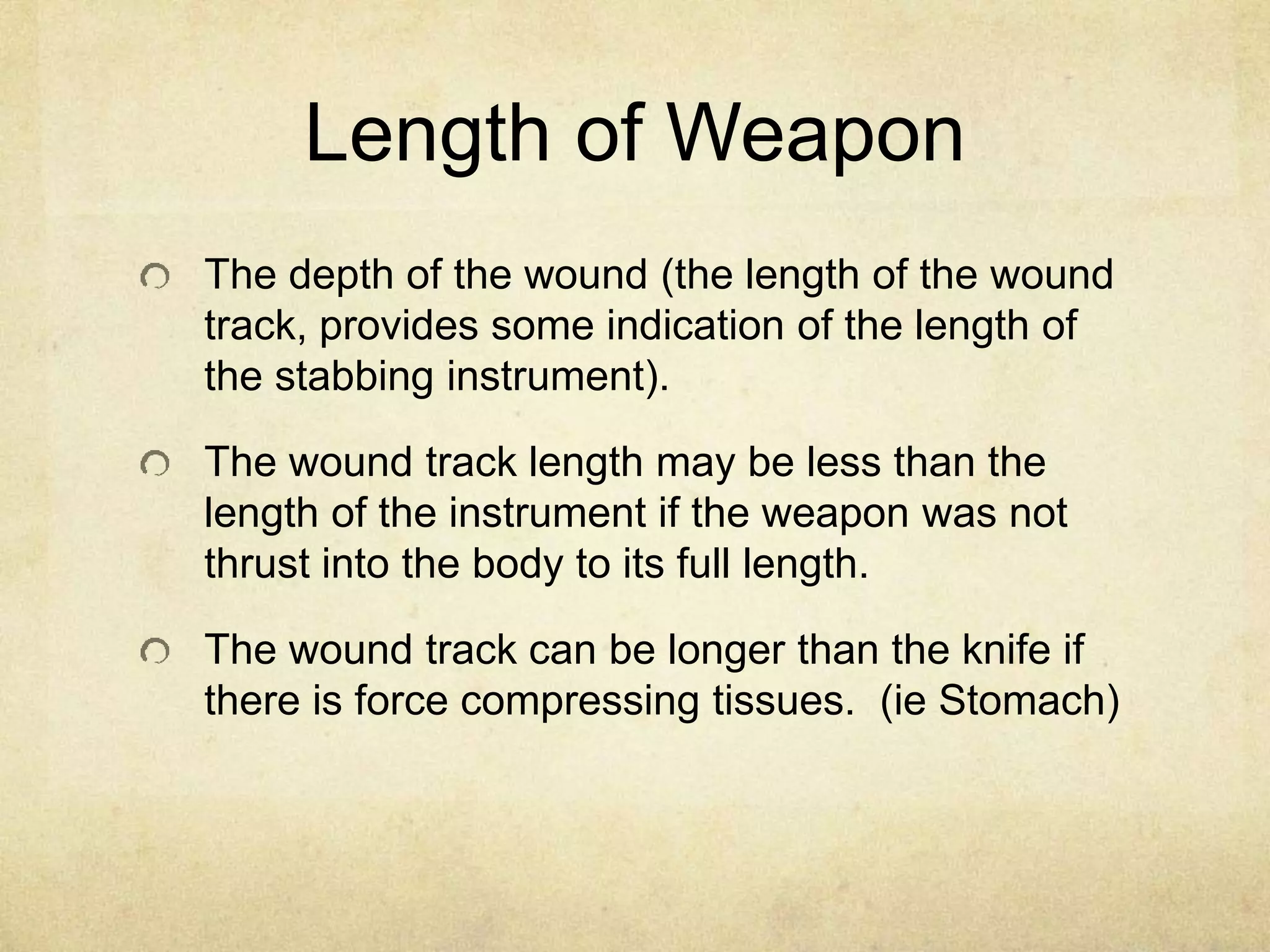
Length of Weapon
The depth of the wound (the length of the wound
track, provides some indication of the length of
the stabbing instrument).
The wound track length may be less than the
length of the instrument if the weapon was not
thrust into the body to its full length.
The wound track can be longer than the knife if
there is force compressing tissues. (ie Stomach)
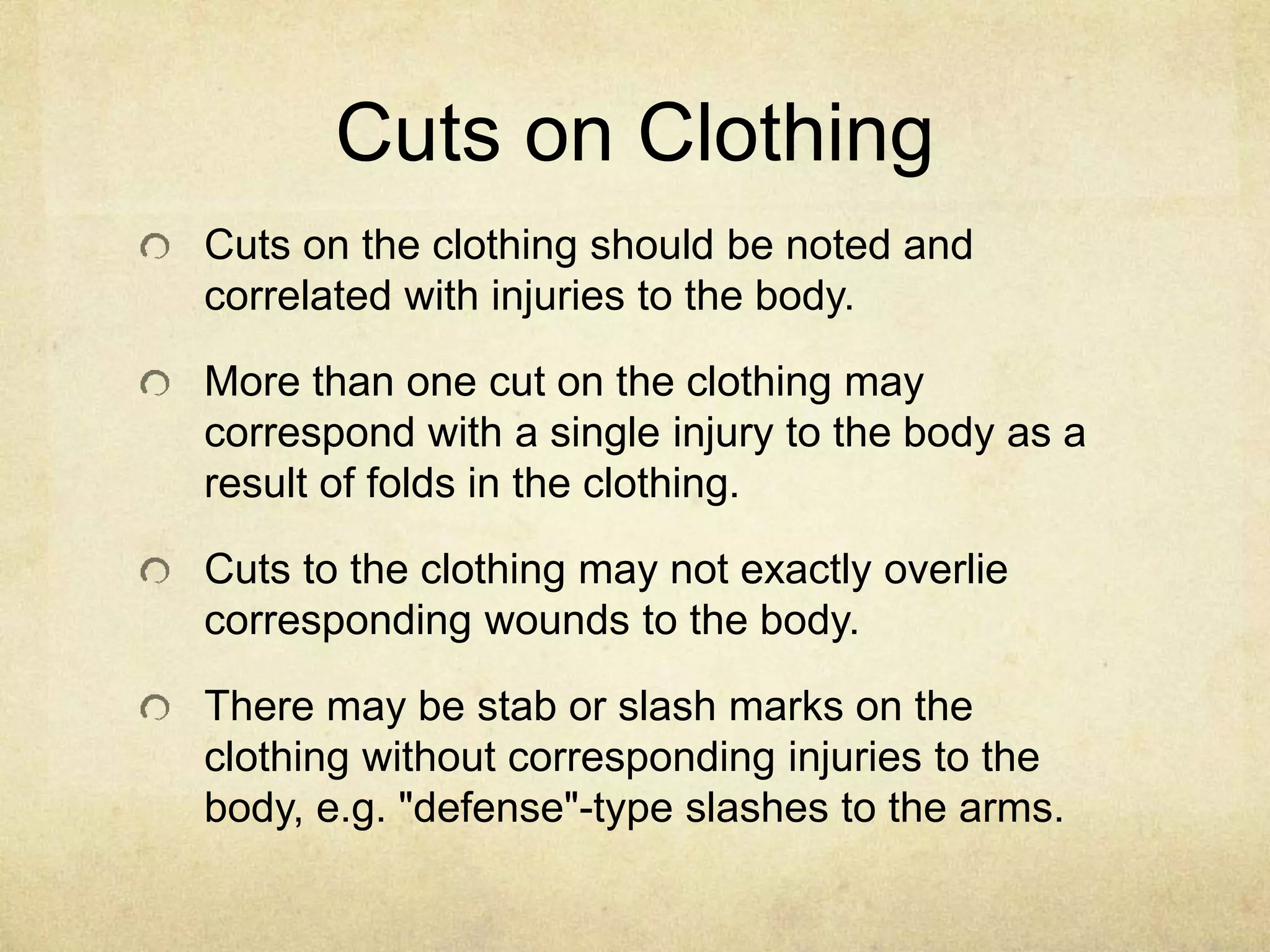
Cuts on Clothing
Cuts on the clothing should be noted and
correlated with injuries to the body.
More than one cut on the clothing may
correspond with a single injury to the body as a
result of folds in the clothing.
Cuts to the clothing may not exactly overlie
corresponding wounds to the body.
There may be stab or slash marks on the
clothing without corresponding injuries to the
body, e.g. "defense"-type slashes to the arms.
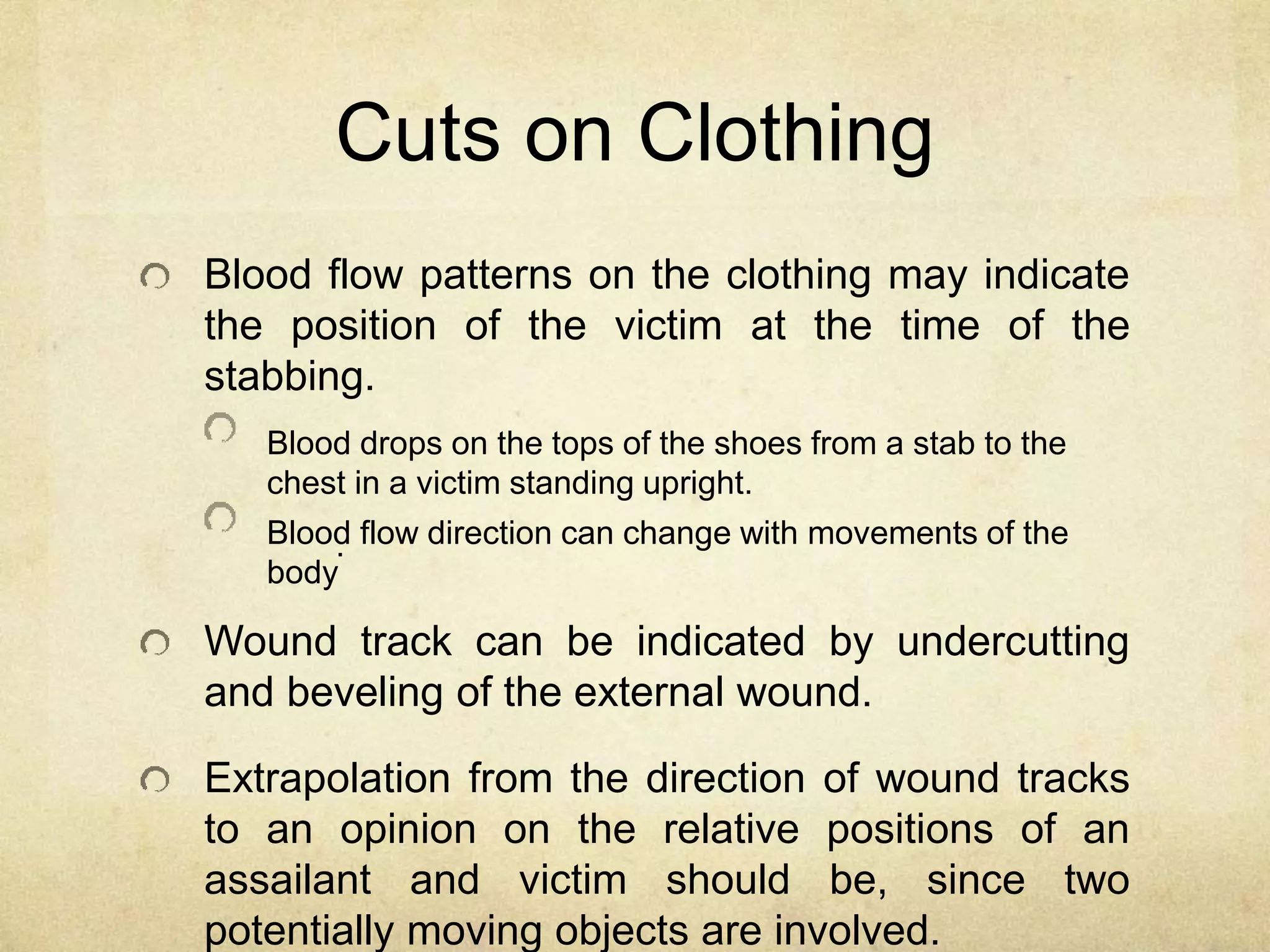
Cuts on Clothing
Blood flow patterns on the clothing may indicate
the position of the victim at the time of the
stabbing.
Blood drops on the tops of the shoes from a stab to the
chest in a victim standing upright.
Blood flow direction can change with movements of the
body
.
Wound track can be indicated by undercutting
and beveling of the external wound.
Extrapolation from the direction of wound tracks
to an opinion on the relative positions of an
assailant and victim should be, since two
potentially moving objects are involved.
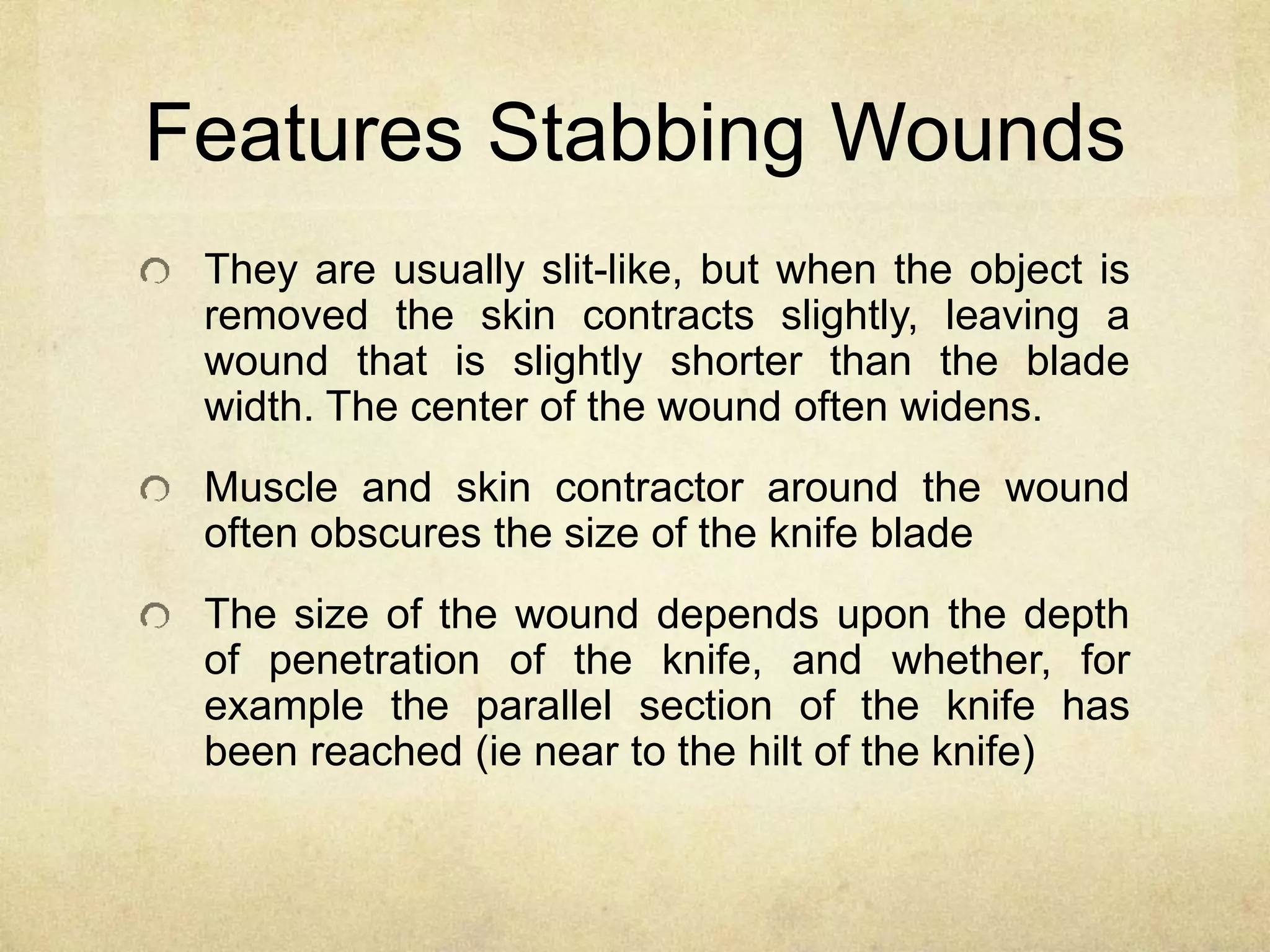
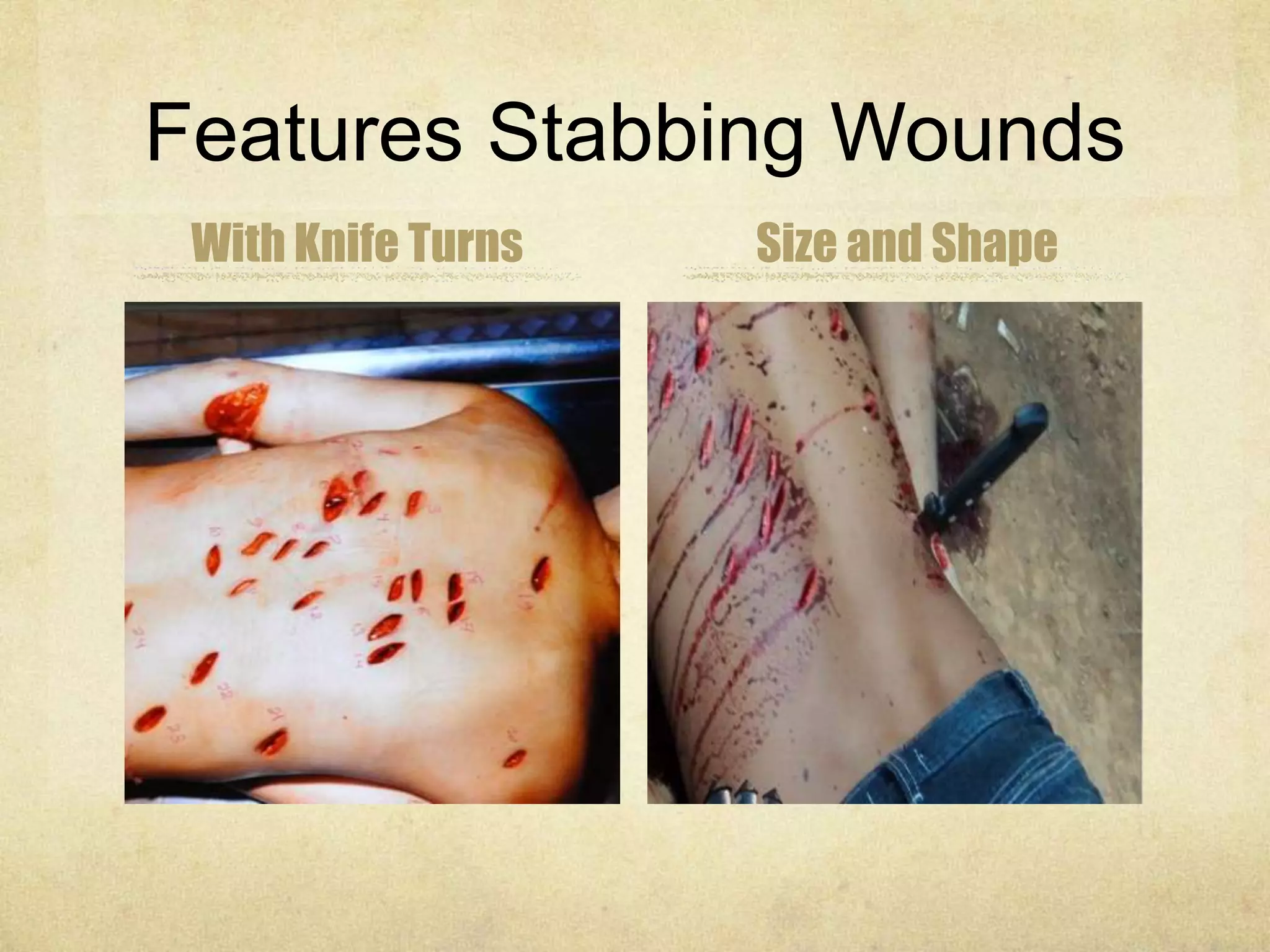
Features Stabbing Wounds
They are usually slit-like, but when the object is
removed the skin contracts slightly, leaving a
wound that is slightly shorter than the blade
width. The center of the wound often widens.
Muscle and skin contractor around the wound
often obscures the size of the knife blade
The size of the wound depends upon the depth
of penetration of the knife, and whether, for
example the parallel section of the knife has
been reached (ie near to the hilt of the knife)
Features Stabbing Wounds
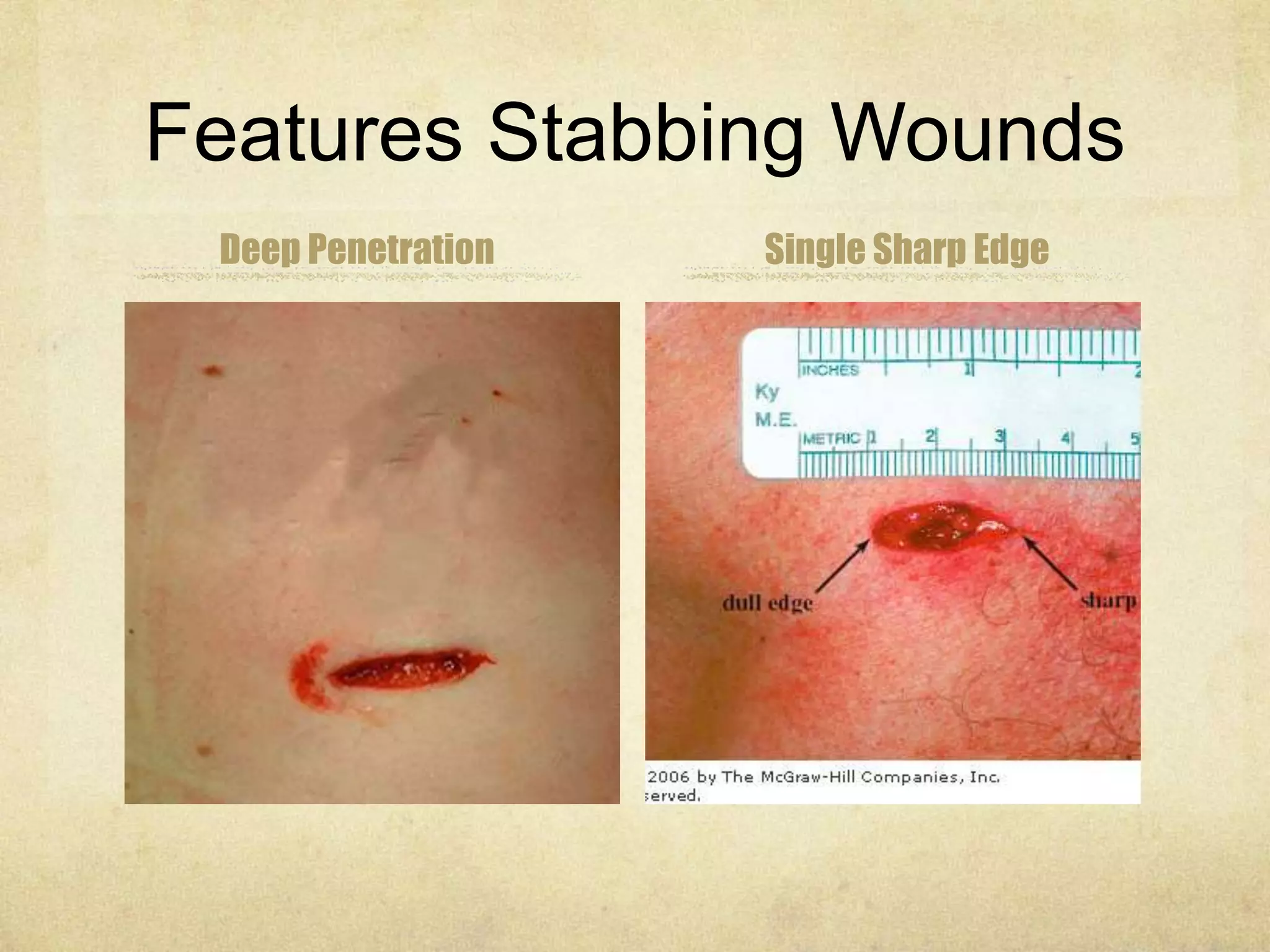
If the blade is 'rocked' in the wound (ie either the
assailant moves the knife around, or the victim moves
in relation to the knife), the wound is longer than if the
knife is inserted in and out rapidly and in the same
direction
Irregular or 'V' shaped wounds arise when the knife is
twisted in the wound
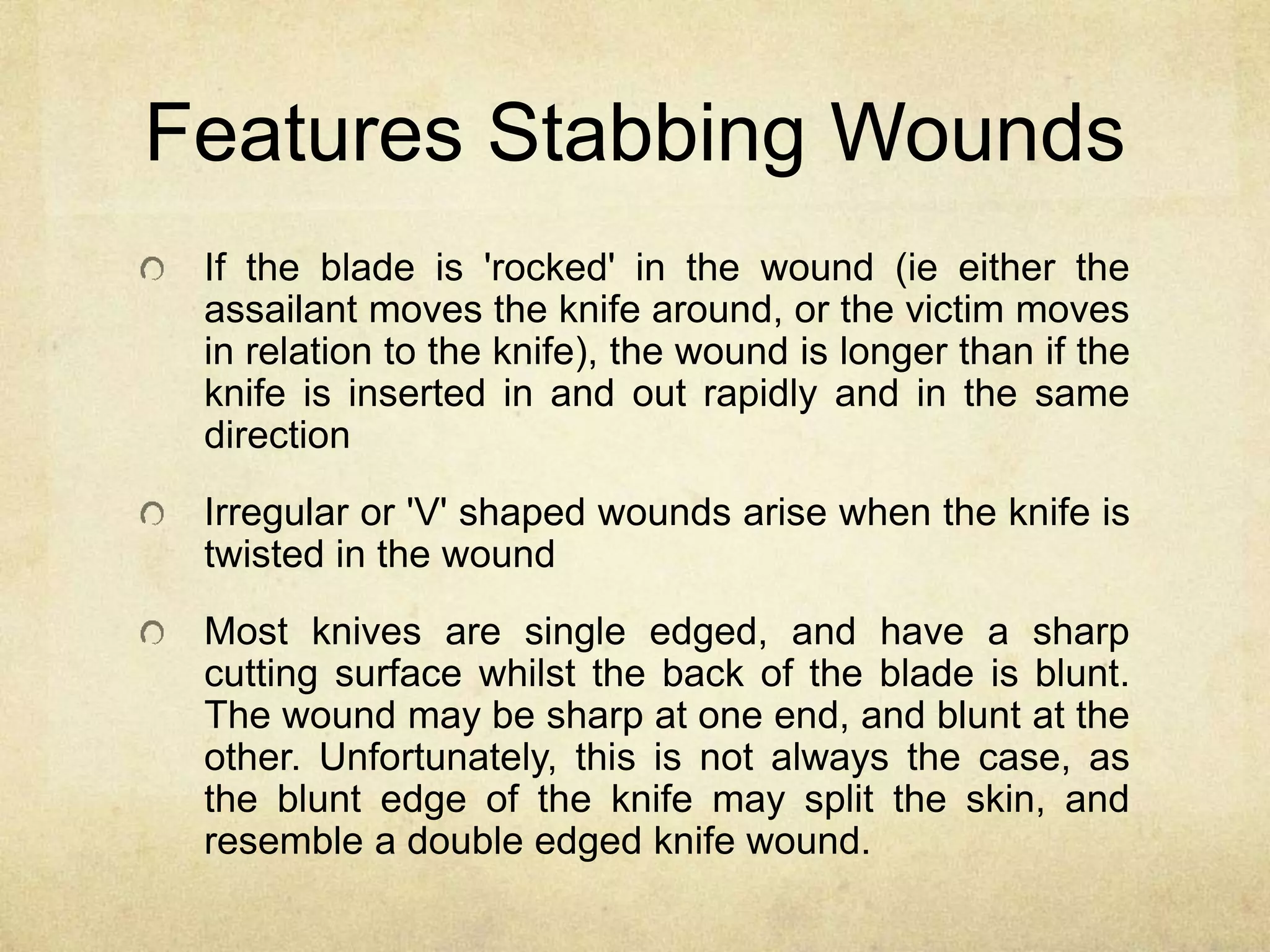
Most knives are single edged, and have a sharp
cutting surface whilst the back of the blade is blunt.
The wound may be sharp at one end, and blunt at the
other. Unfortunately, this is not always the case, as
the blunt edge of the knife may split the skin, and
resemble a double edged knife wound.
Features Stabbing Wounds
Deep Penetration Single Sharp Edge
Features Stabbing Wounds
With Knife Turns Size and Shape
Defense Stab Wounds
"Defense wounds" are the result of the
immediate and instinctive reaction of a
victim to ward off anticipated injuries and
may be seen in both homicidal and
accidental deaths.
Defense wounds result from raising the
arm to ward off the attack or attempts to
grasp the weapon.
The resulting injuries may be stabs or
slashes or both.
Obj.8
Defense Stab Wounds
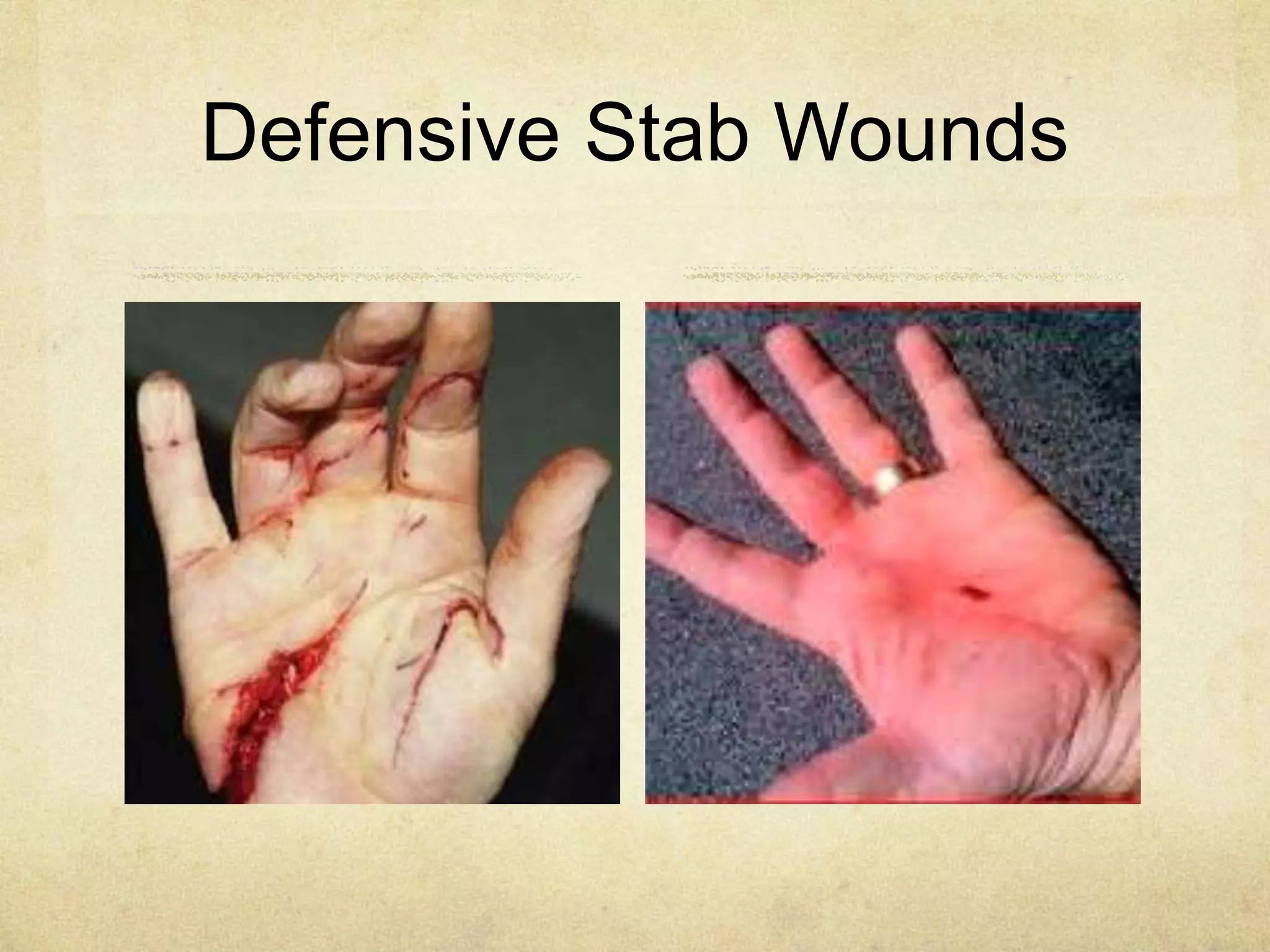
Attempts to grab the knife results in deep cuts to
the palm of the hand and the palm side of
fingers.
With the hand in a gripping position the palm skin
is loose and folded so that resultant cuts appear
irregular and ragged.
They may be duplicated by the thrust and
withdrawal of the weapon.
Penetration of the hand or arm is also a defense
wound.
The absence of defense wounds does not
exclude homicide since the victim may be
incapable of effective defense.
Defensive Stab Wounds
Suicidal Stab Wound
Suicide by stabbing is distinctive. The wounds, if
multiple, have a location and direction accessible
to the victim and are typically grouped in the "pit"
of the stomach.
Use of one hand is indicated by a consistent
direction of penetration.
Multiple wound tracks extending from the same
slit in the skin reflects partial withdrawal of the
weapon and further thrusts (possibly trial
feelers), and suggests possible suicide.
Obj. 9
Suicidal Stab Wound
Typically a suicidal stabbing is to the bare
skin and the clothing may be removed or
pulled aside to effect this.
Defense wounds do not occur in suicide,
although the sharpness of a knife may be
tested by running the blade across the
tips of the fingers.
Multiple scattered wounds weighs against
suicide unless there was serious mental
illness.
Suicidal Stab Wound
Fatalities from a single stab wound can be
difficult and such a wound may be homicidal,
suicidal, or accidental.
Autopsy findings should always be interpreted in
the light of information concerning the
circumstances and scene of death.
If the stab wound was inflicted during a fight then
the usual defense is that it was accidental, the
victim having ran or fallen on to the weapon.
The position and direction of the wound may help
resolve the issue.
Bite Marks
A form of Abrasion
Bite Marks
A form of Abrasion
Bite Marks
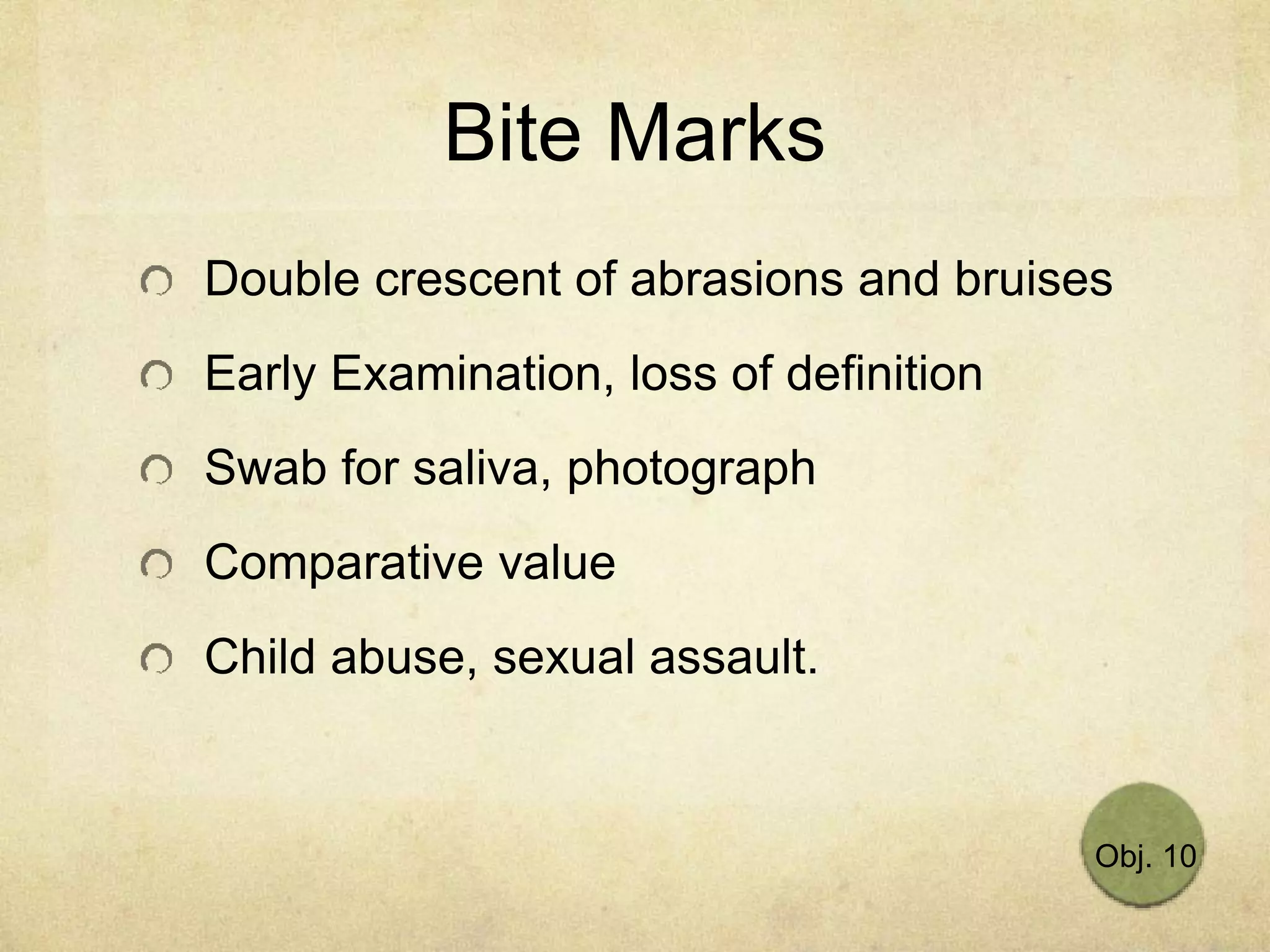
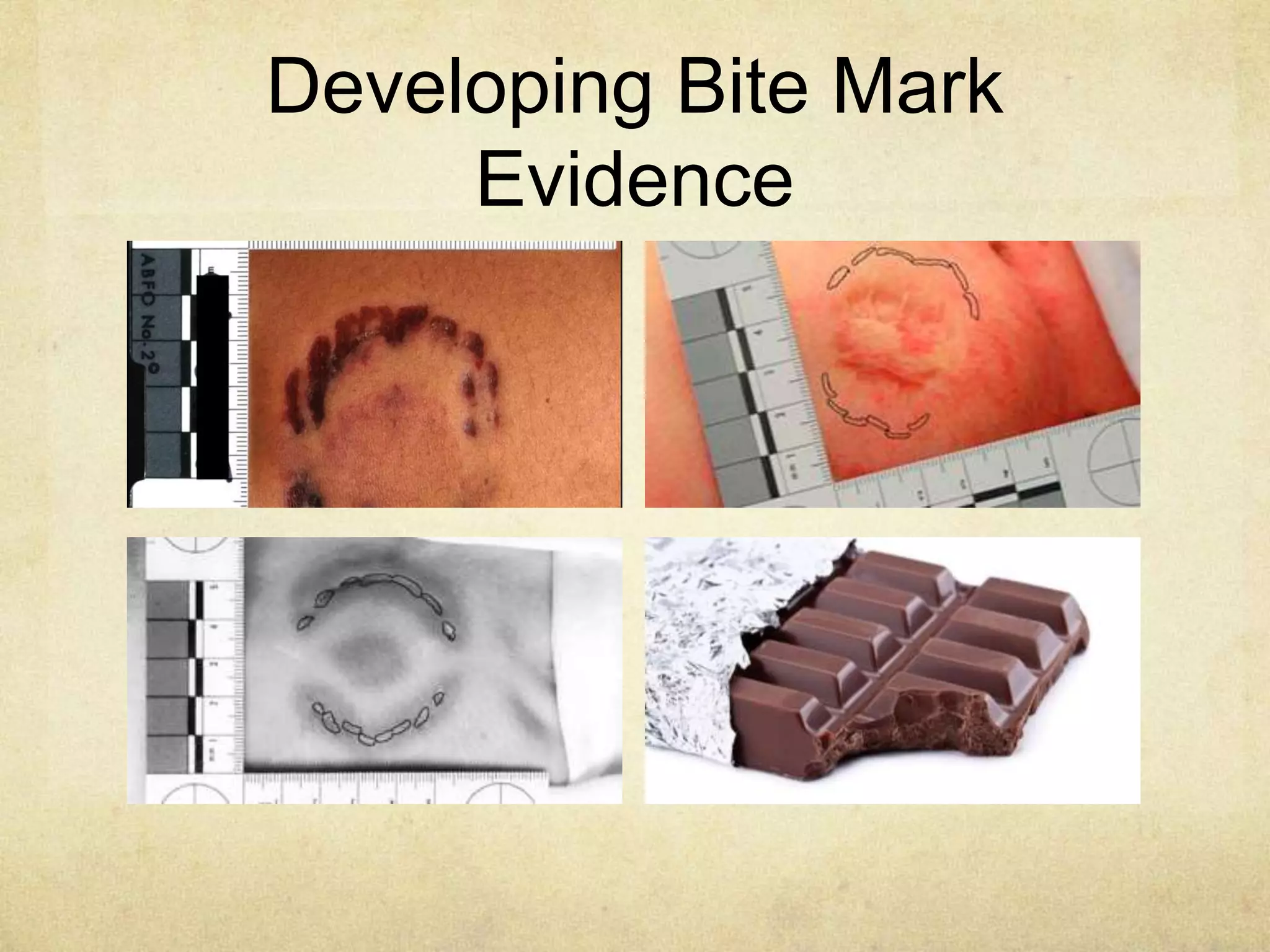
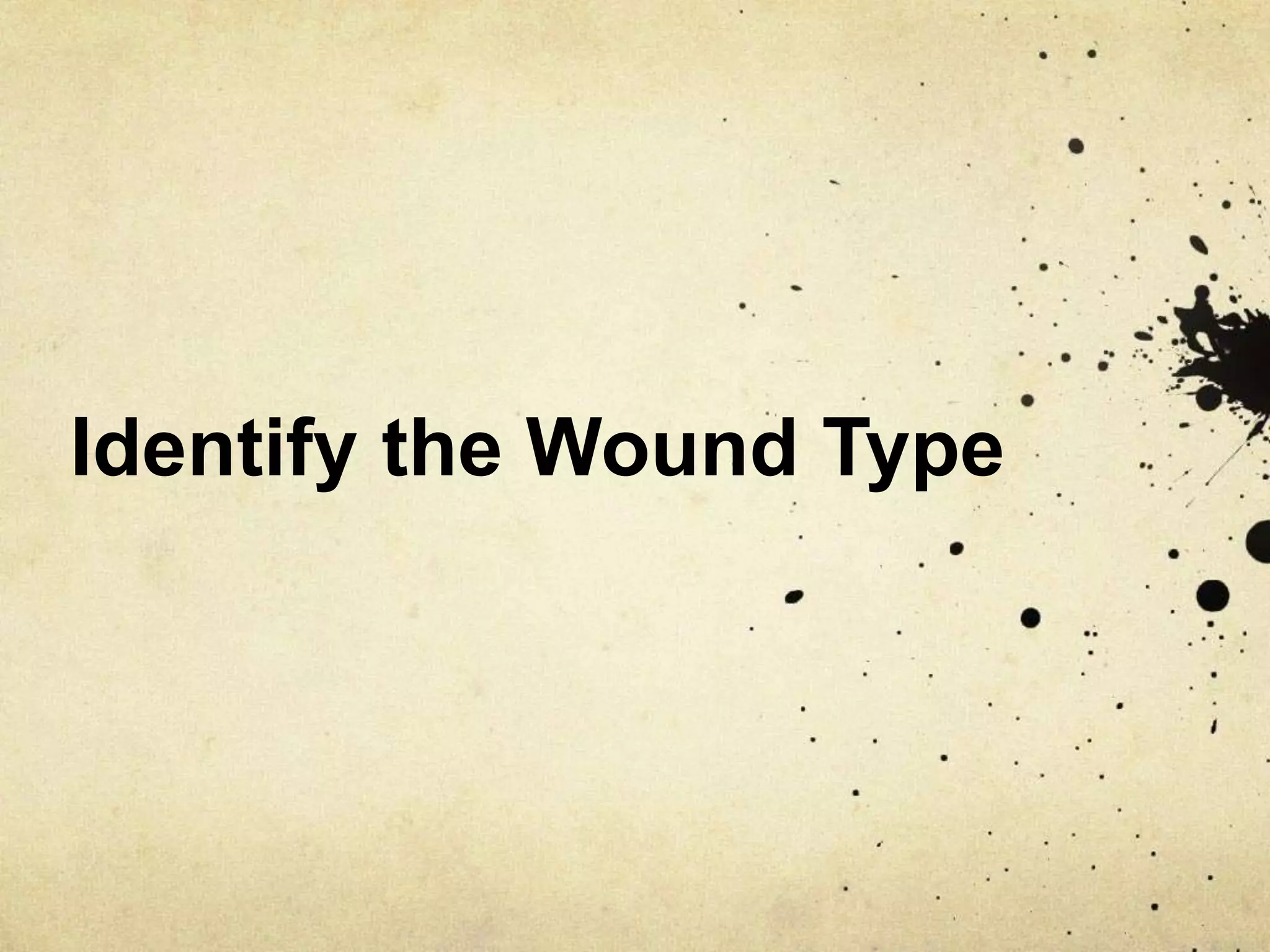
Double crescent of abrasions and bruises
Early Examination, loss of definition
Swab for saliva, photograph
Comparative value
Child abuse, sexual assault.
Obj. 10
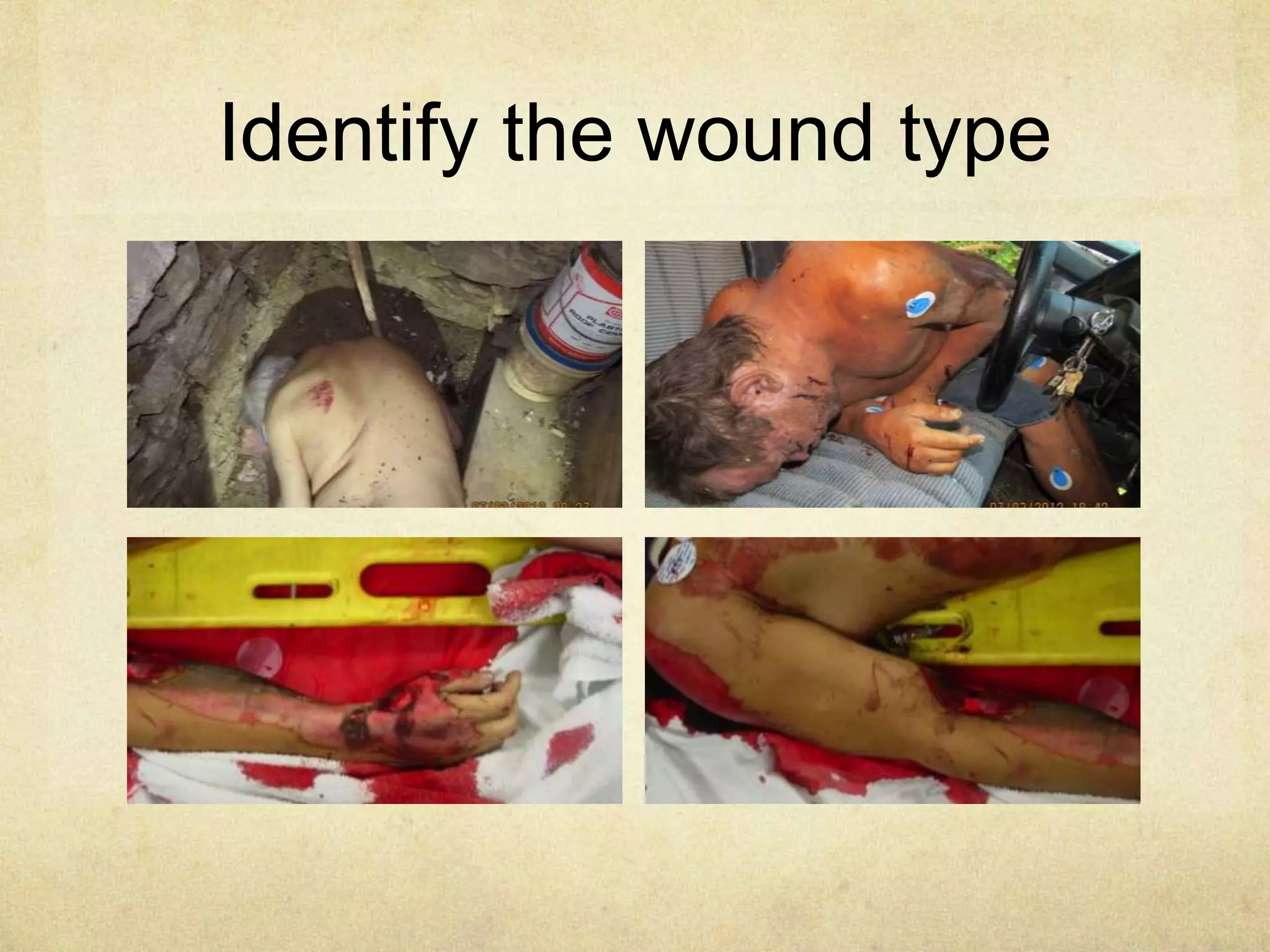
Developing Bite Mark
Evidence
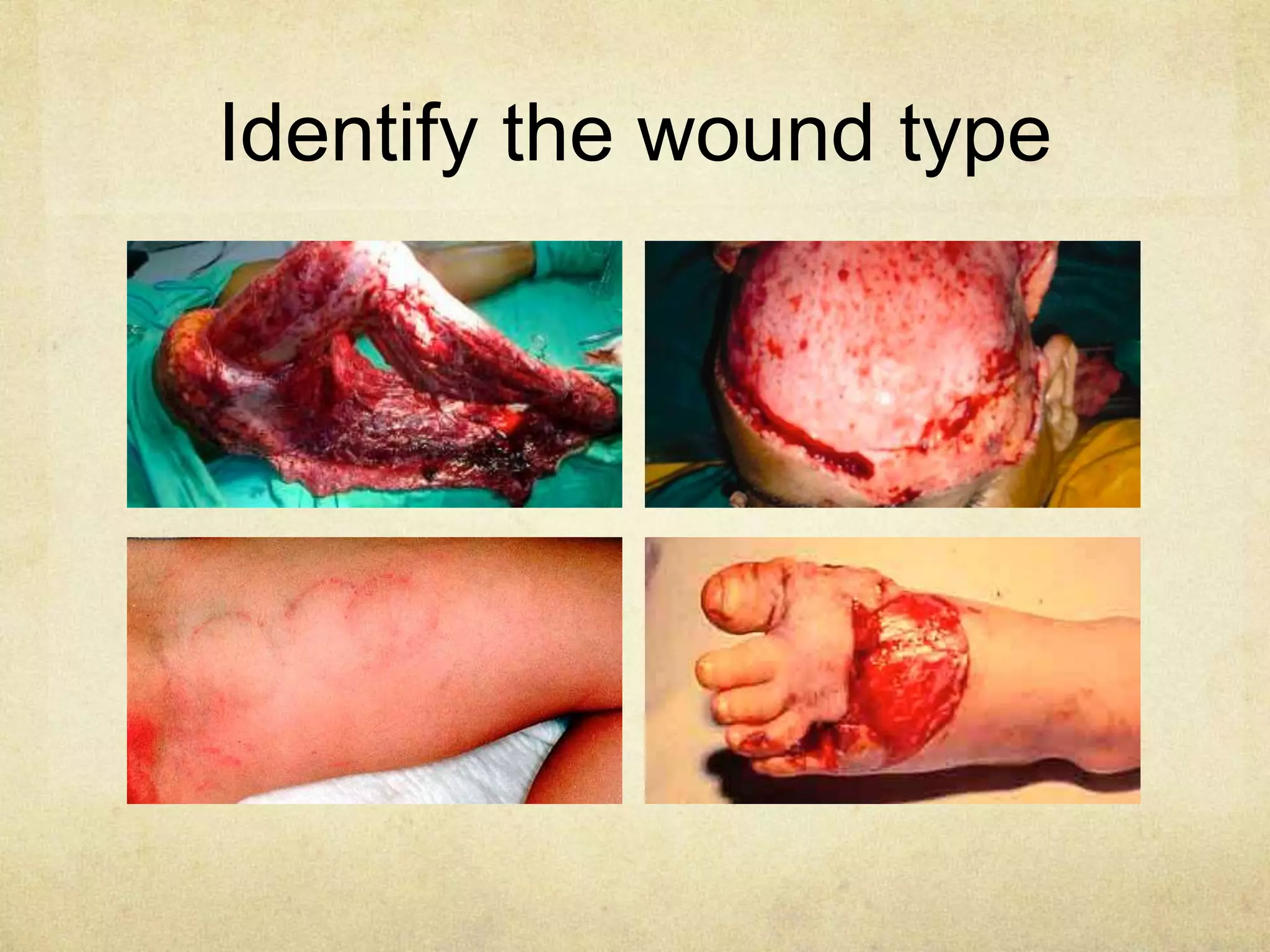
Identify the Wound Type
Identify the wound type
Any Questions
coronertalk.co
m
Darren Dake
darren@coronertalk.co
m

Cutting and Stabbing Wounds - Criminal Documentation

  • 1.
    Cutting & Stabbing Wounds AnInvestigators Forensic Overview
  • 2.
    Cutting & Stabbing Wounds AnInvestigators Forensic Overview
  • 3.
    Course Summary This courseis designed to introduce the student to the forensic importance of stabbing and cutting injuries. This course will describe what these wounds are and how they are made. It will also explore each type of wound’s forensic importance to an investigation.
  • 4.
    Objectives 1. List thefour categories of cutting wounds 2. Define Abrasion 3. Properly explain how an abrasion is made 4. Define laceration 5. Properly explain the difference between laceration and incised wound. 6. Properly describe an incised wound appearance 7. Properly explain a stabbing wound appearance and how they are made 8. Explain what a defense wound is and how they are made 9. Properly define the characteristics of suicidal stabbings 10. Explain how to identify and document a bite mark.
  • 5.
  • 6.
    Documentati on • Photographs • withand without scale • Forensic Body Wound Chart • Be careful to only describe wound, never state what it is.
  • 7.
  • 8.
    Documentati on • Photographs • withand without scale • Forensic Body Wound Chart • Be careful to only describe wound, never state what it is.
  • 9.
    Wound Categories Abrasions (grazes,scrapes, bite marks) Lacerations Incised Wounds Cutting, Slashing and Chopping Puncture (or stab) wounds Obj 1
  • 10.
    Abrasion Is a frictioninjury removing skin and/or tissue Obj. 2
  • 11.
    Abrasions Side Impact producesa moving abrasion Indicates direction Trace material may be seen (eg. dirt, gravel, glass) Direct impact produces and imprint abrasion Pattern of the object used All abrasions reflect site of impact in contrast with bruises Assessment of age of abrasion is difficult Post-mortem abrasions are brown and leathery Obj. 3
  • 12.
    Abrasion In dermatology, anabrasion is a wound caused by superficial damage to the skin, no deeper than the epidermis. It is less severe than a laceration, and bleeding, if present, is minimal. Mild abrasions, also known as grazes or scrapes, do not scar or bleed, but deep abrasions may lead to the formation of scar tissue. A more traumatic abrasion that removes all layers of skin is called an avulsion
  • 13.
  • 14.
    Mild – RoadRash - Avulsion
  • 16.
  • 17.
    Lacerations Indicates tearing of tissue-has tissue bridging and is from blunt force trauma of injured area.
  • 18.
    Lacerations Is the splittingof the skin by the direct crushing or ripping blow of the trauma Typically over bone such as scalp, eyebrow, and cheekbone – but not always Different from Incised wounds by: Adjacent abrasion and/or bruise Ragged edge Tissue bridges in depth Obj. 4
  • 19.
    Lacerations Forensic Importance Not relatedto object shape Trace evidence will be hard to locate if at all Typically very little blood loss (except scalp injuries) Rarely of suicidal attempts Unless associated with another injury
  • 20.
    Tissue Bridging Notice the wound has roughedges and tissue is not fully cut.
  • 21.
    Incised v. Laceration IncisedWound Laceration Obj. 5
  • 22.
  • 23.
    Typical Laceration Patterns Circlesand crescents from hammers Y-Shape from metal robs Inside lips from blow to mouth Ripping on skin from blunt cross contact Stretching lacerations in vehicle accidents
  • 24.
  • 25.
  • 26.
    Incised Wounds Sharp forcewound Well defined severing of tissues No connecting tissue in wound Clean edges Usually no bruises Usually no abrasions Obj.6
  • 27.
    Incised Wounds Incised woundsare sharp cut-like injuries, made by knives or broken glass etc. The edges of the wound will vary according to the nature of the cutting edge of the object, in that a razor will leave regular margins, whereas an axe may leave the wound margins crushed and bruised, resembling a laceration.
  • 28.
  • 29.
    Incised and Blunt ForceTrauma From Boat Motor
  • 30.
  • 31.
  • 32.
  • 33.
    Stabbing Wounds These arewounds where the depth of injury is greater than the length. They penetrate more deeply than slash wounds and tend to come into contact with vital organs in the chest and abdomen. Stabbing is a common mode of homicide. Stab wounds are caused most obviously by knives, but are also caused by bayonets and swords, as well as scissors and even blunter instruments such as screwdrivers. Obj. 7
  • 34.
    Shape of Weapon Aknife blade with a double edge will normally produce a symmetrical elliptical wound with both ends pointed, clean cut edges and without any associated bruising or marginal abrasion. A knife with a single-edged blade may show relative blunting ("fish-tailing") of one end of the entry slit. A single edged blade can produce a wound with two pointed ends, mimicking an injury from a double edged blade. A bayonet, which has a ridge along the back of the blade with a groove along each side, may produce a slit like an elongated letter "T".
  • 35.
    Shape of Weapon Stabwounds produced with relatively blunt instruments such as pokers, closed scissors and files, tend to bruise and scrape the wound margin. These blunter instruments also tend to lacerate, as well as cleanly penetrate, the skin; the blunter the point of the instrument and the thicker its shaft, the more likely is the entry hole to become a ragged, often cross shaped split. Forensic Pathologist sometimes practices wound type: The Body Farm.
  • 36.
    Length of Weapon Thedepth of the wound (the length of the wound track, provides some indication of the length of the stabbing instrument). The wound track length may be less than the length of the instrument if the weapon was not thrust into the body to its full length. The wound track can be longer than the knife if there is force compressing tissues. (ie Stomach)
  • 37.
    Cuts on Clothing Cutson the clothing should be noted and correlated with injuries to the body. More than one cut on the clothing may correspond with a single injury to the body as a result of folds in the clothing. Cuts to the clothing may not exactly overlie corresponding wounds to the body. There may be stab or slash marks on the clothing without corresponding injuries to the body, e.g. "defense"-type slashes to the arms.
  • 38.
    Cuts on Clothing Bloodflow patterns on the clothing may indicate the position of the victim at the time of the stabbing. Blood drops on the tops of the shoes from a stab to the chest in a victim standing upright. Blood flow direction can change with movements of the body . Wound track can be indicated by undercutting and beveling of the external wound. Extrapolation from the direction of wound tracks to an opinion on the relative positions of an assailant and victim should be, since two potentially moving objects are involved.
  • 39.
    Features Stabbing Wounds Theyare usually slit-like, but when the object is removed the skin contracts slightly, leaving a wound that is slightly shorter than the blade width. The center of the wound often widens. Muscle and skin contractor around the wound often obscures the size of the knife blade The size of the wound depends upon the depth of penetration of the knife, and whether, for example the parallel section of the knife has been reached (ie near to the hilt of the knife)
  • 40.
    Features Stabbing Wounds Ifthe blade is 'rocked' in the wound (ie either the assailant moves the knife around, or the victim moves in relation to the knife), the wound is longer than if the knife is inserted in and out rapidly and in the same direction Irregular or 'V' shaped wounds arise when the knife is twisted in the wound Most knives are single edged, and have a sharp cutting surface whilst the back of the blade is blunt. The wound may be sharp at one end, and blunt at the other. Unfortunately, this is not always the case, as the blunt edge of the knife may split the skin, and resemble a double edged knife wound.
  • 41.
    Features Stabbing Wounds DeepPenetration Single Sharp Edge
  • 42.
    Features Stabbing Wounds WithKnife Turns Size and Shape
  • 43.
    Defense Stab Wounds "Defensewounds" are the result of the immediate and instinctive reaction of a victim to ward off anticipated injuries and may be seen in both homicidal and accidental deaths. Defense wounds result from raising the arm to ward off the attack or attempts to grasp the weapon. The resulting injuries may be stabs or slashes or both. Obj.8
  • 44.
    Defense Stab Wounds Attemptsto grab the knife results in deep cuts to the palm of the hand and the palm side of fingers. With the hand in a gripping position the palm skin is loose and folded so that resultant cuts appear irregular and ragged. They may be duplicated by the thrust and withdrawal of the weapon. Penetration of the hand or arm is also a defense wound. The absence of defense wounds does not exclude homicide since the victim may be incapable of effective defense.
  • 45.
  • 46.
    Suicidal Stab Wound Suicideby stabbing is distinctive. The wounds, if multiple, have a location and direction accessible to the victim and are typically grouped in the "pit" of the stomach. Use of one hand is indicated by a consistent direction of penetration. Multiple wound tracks extending from the same slit in the skin reflects partial withdrawal of the weapon and further thrusts (possibly trial feelers), and suggests possible suicide. Obj. 9
  • 47.
    Suicidal Stab Wound Typicallya suicidal stabbing is to the bare skin and the clothing may be removed or pulled aside to effect this. Defense wounds do not occur in suicide, although the sharpness of a knife may be tested by running the blade across the tips of the fingers. Multiple scattered wounds weighs against suicide unless there was serious mental illness.
  • 48.
    Suicidal Stab Wound Fatalitiesfrom a single stab wound can be difficult and such a wound may be homicidal, suicidal, or accidental. Autopsy findings should always be interpreted in the light of information concerning the circumstances and scene of death. If the stab wound was inflicted during a fight then the usual defense is that it was accidental, the victim having ran or fallen on to the weapon. The position and direction of the wound may help resolve the issue.
  • 49.
    Bite Marks A formof Abrasion
  • 50.
    Bite Marks A formof Abrasion
  • 51.
    Bite Marks Double crescentof abrasions and bruises Early Examination, loss of definition Swab for saliva, photograph Comparative value Child abuse, sexual assault. Obj. 10
  • 52.
  • 53.
  • 54.
  • 55.
  • 56.
  • 57.
  • 58.
  • 59.