The value of embracing unknown
unknowns
Dr Danny Kingsley
RLUK Conference
British Library
9 March 2016
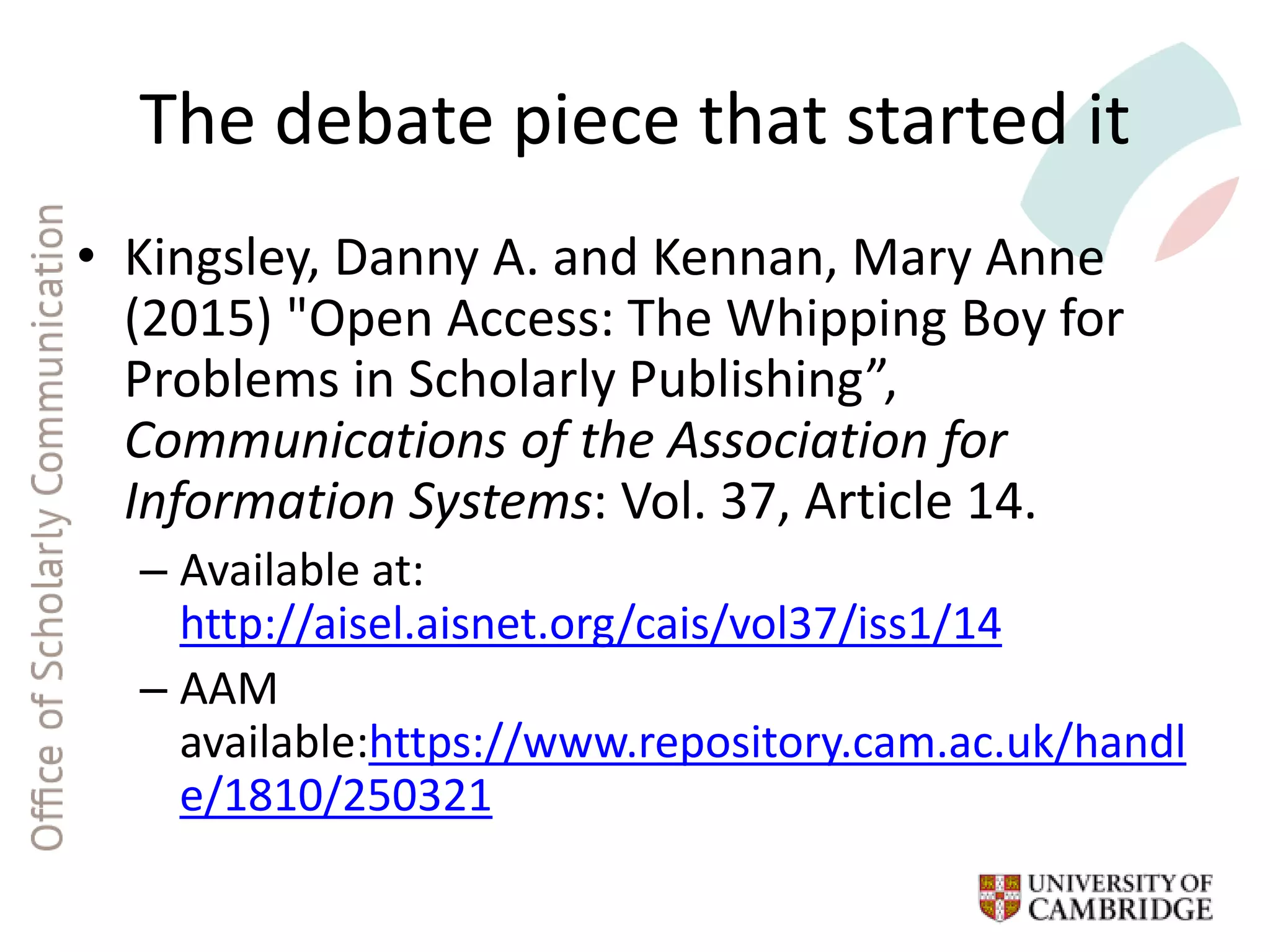
The debate piece that started it
• Kingsley, Danny A. and Kennan, Mary Anne
(2015) "Open Access: The Whipping Boy for
Problems in Scholarly Publishing”,
Communications of the Association for
Information Systems: Vol. 37, Article 14.
– Available at:
http://aisel.aisnet.org/cais/vol37/iss1/14
– AAM
available:https://www.repository.cam.ac.uk/handl
e/1810/250321
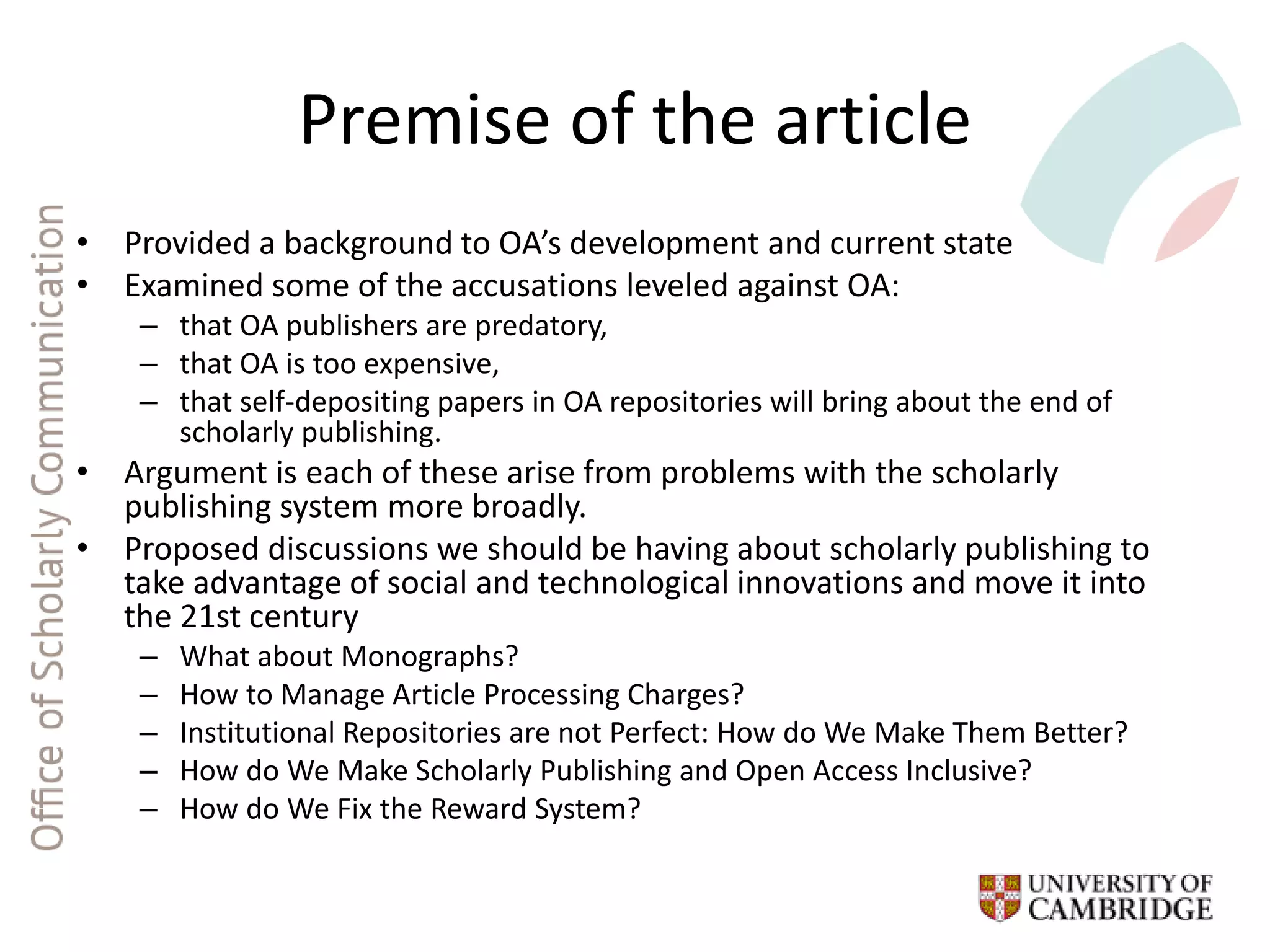
Premise of the article
• Provided a background to OA’s development and current state
• Examined some of the accusations leveled against OA:
– that OA publishers are predatory,
– that OA is too expensive,
– that self-depositing papers in OA repositories will bring about the end of
scholarly publishing.
• Argument is each of these arise from problems with the scholarly
publishing system more broadly.
• Proposed discussions we should be having about scholarly publishing to
take advantage of social and technological innovations and move it into
the 21st century
– What about Monographs?
– How to Manage Article Processing Charges?
– Institutional Repositories are not Perfect: How do We Make Them Better?
– How do We Make Scholarly Publishing and Open Access Inclusive?
– How do We Fix the Reward System?
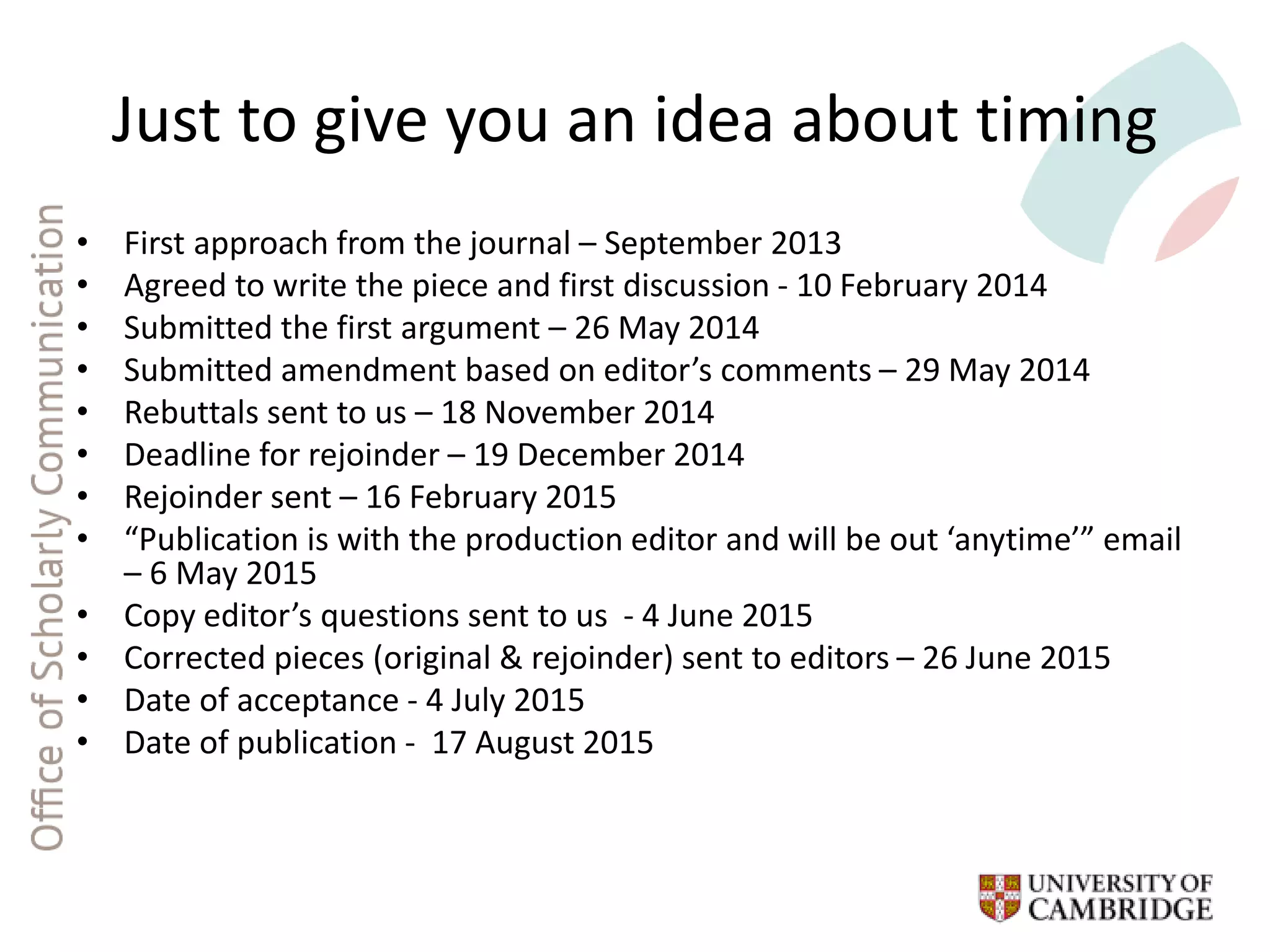
Just to give you an idea about timing
• First approach from the journal – September 2013
• Agreed to write the piece and first discussion - 10 February 2014
• Submitted the first argument – 26 May 2014
• Submitted amendment based on editor’s comments – 29 May 2014
• Rebuttals sent to us – 18 November 2014
• Deadline for rejoinder – 19 December 2014
• Rejoinder sent – 16 February 2015
• “Publication is with the production editor and will be out ‘anytime’” email
– 6 May 2015
• Copy editor’s questions sent to us - 4 June 2015
• Corrected pieces (original & rejoinder) sent to editors – 26 June 2015
• Date of acceptance - 4 July 2015
• Date of publication - 17 August 2015
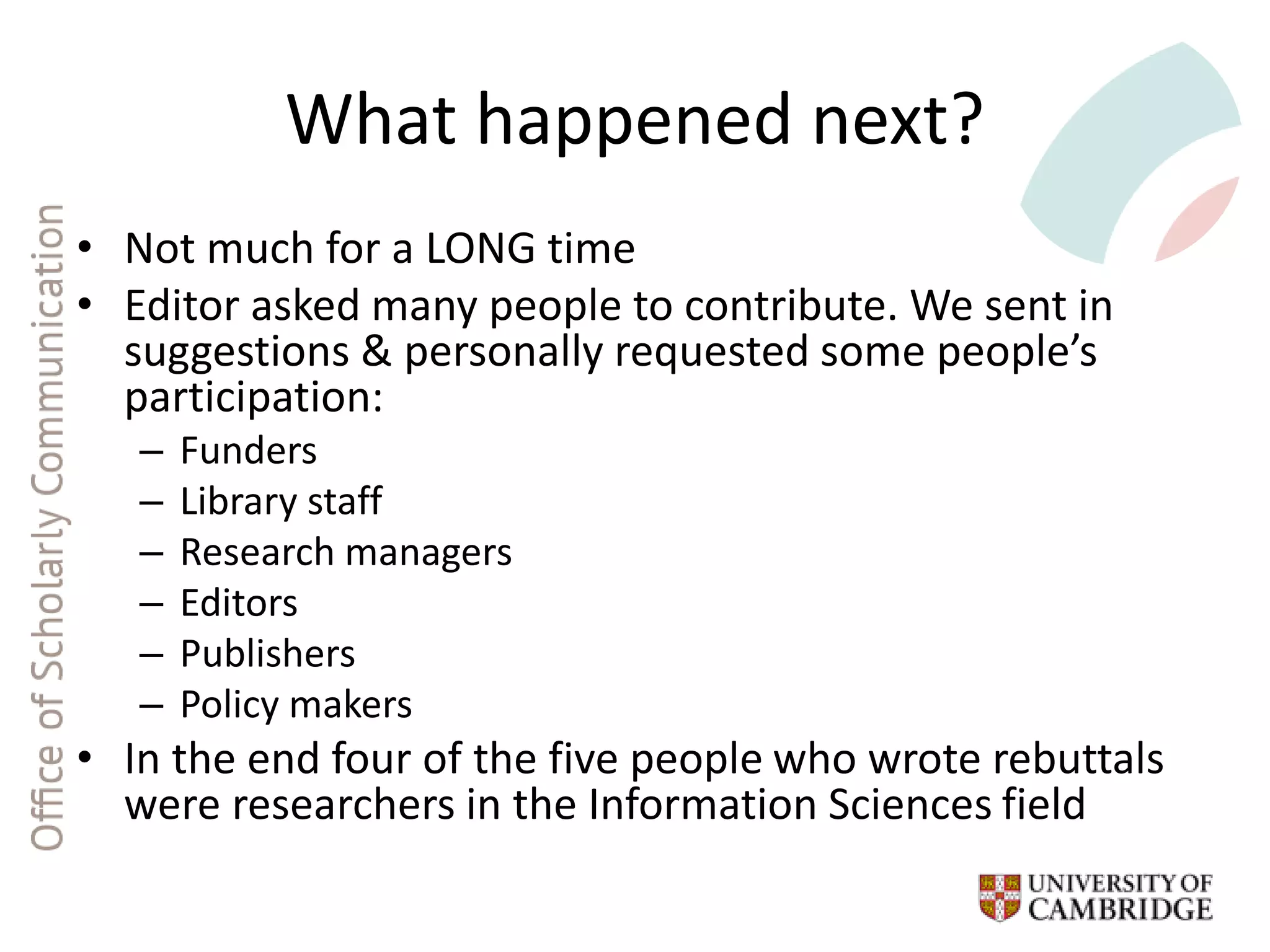
What happened next?
• Not much for a LONG time
• Editor asked many people to contribute. We sent in
suggestions & personally requested some people’s
participation:
– Funders
– Library staff
– Research managers
– Editors
– Publishers
– Policy makers
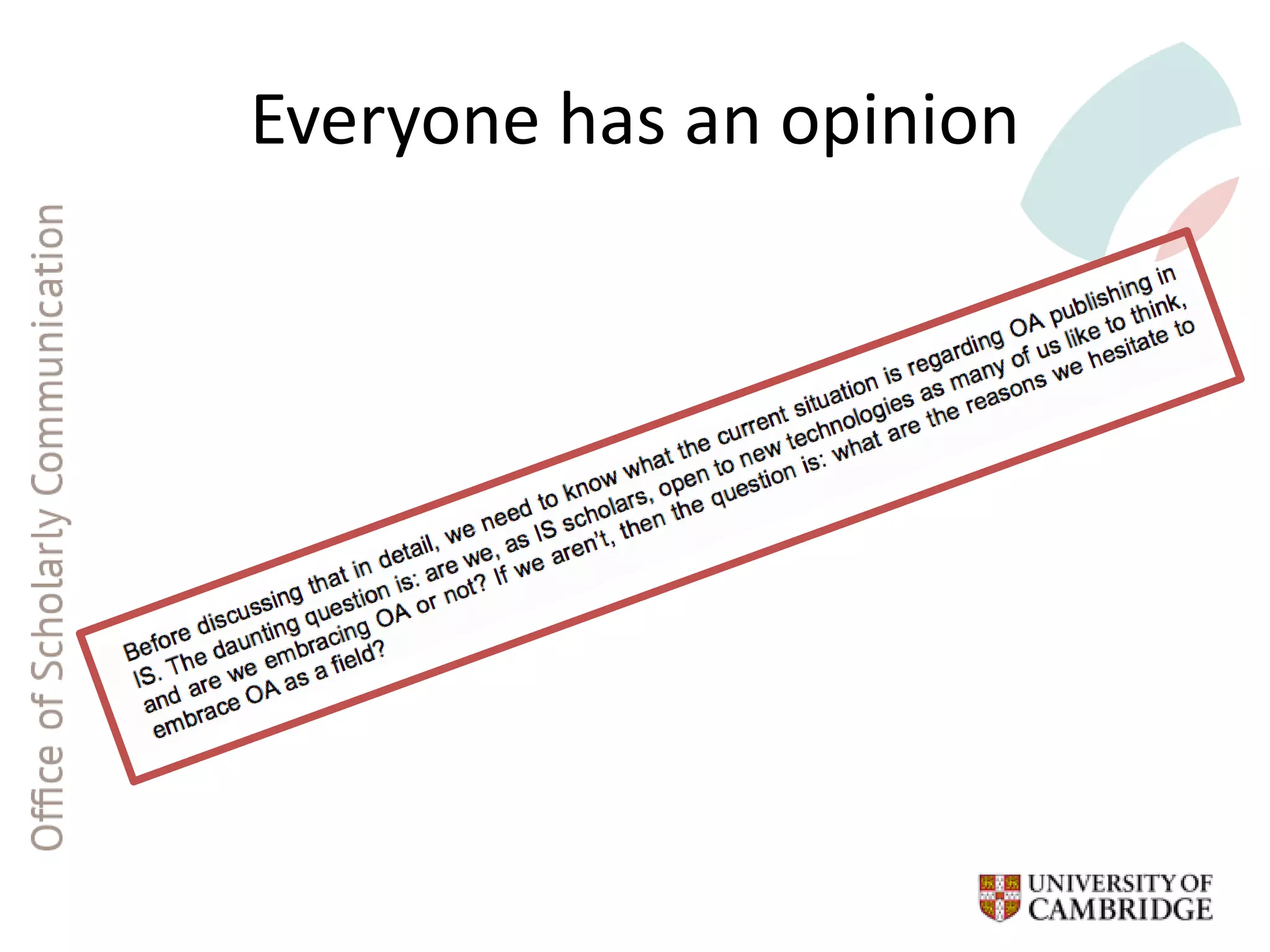
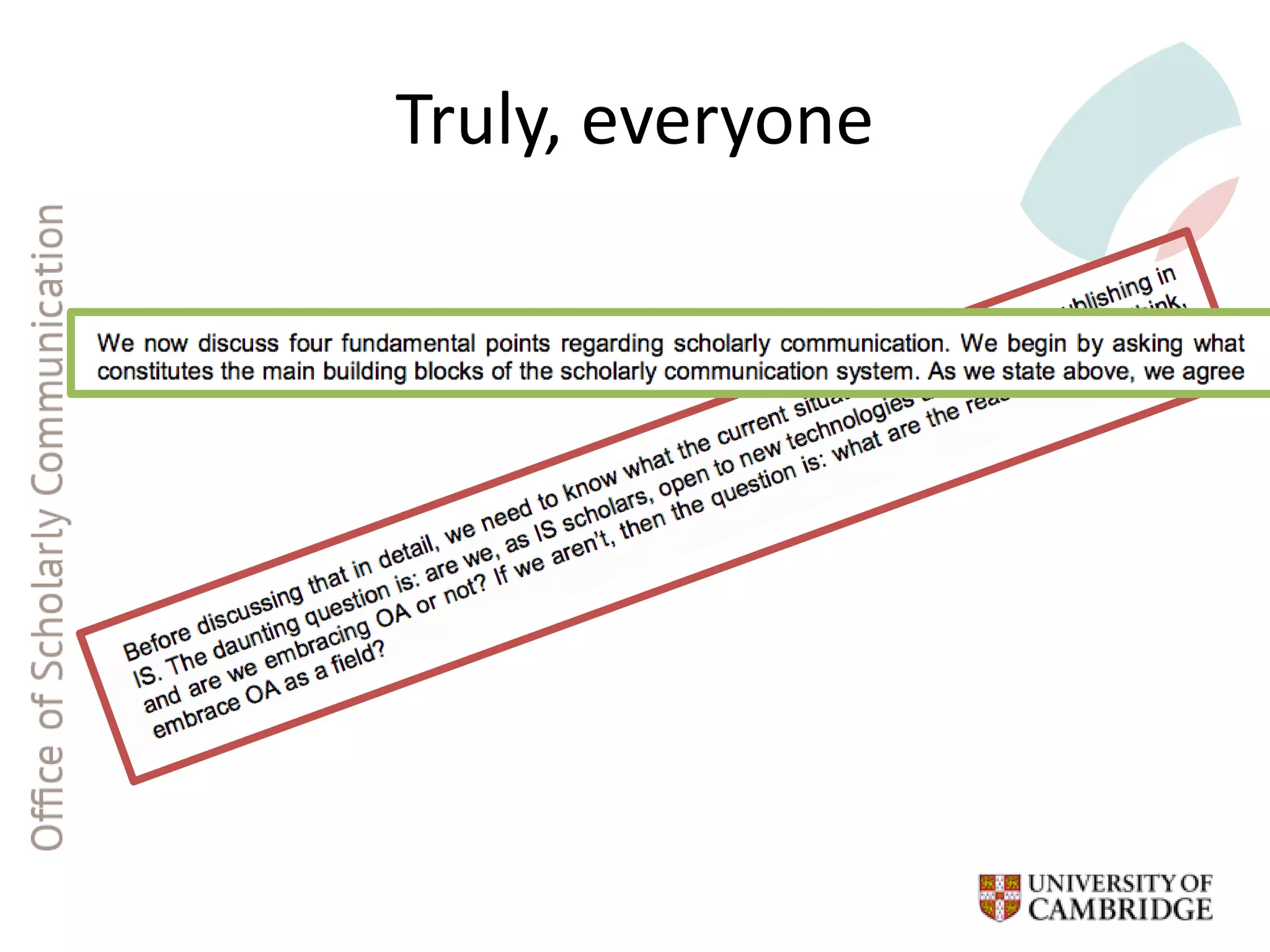
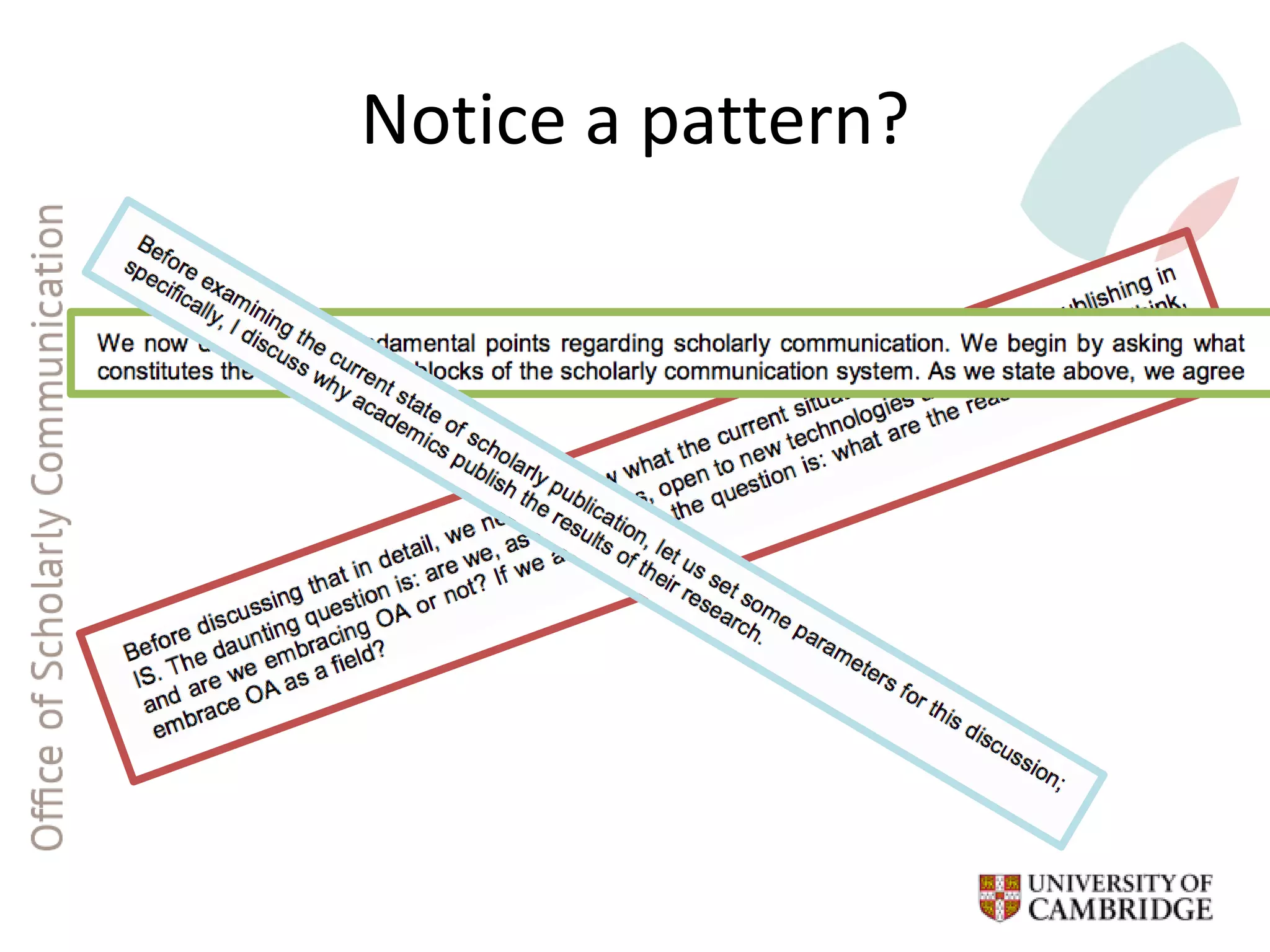
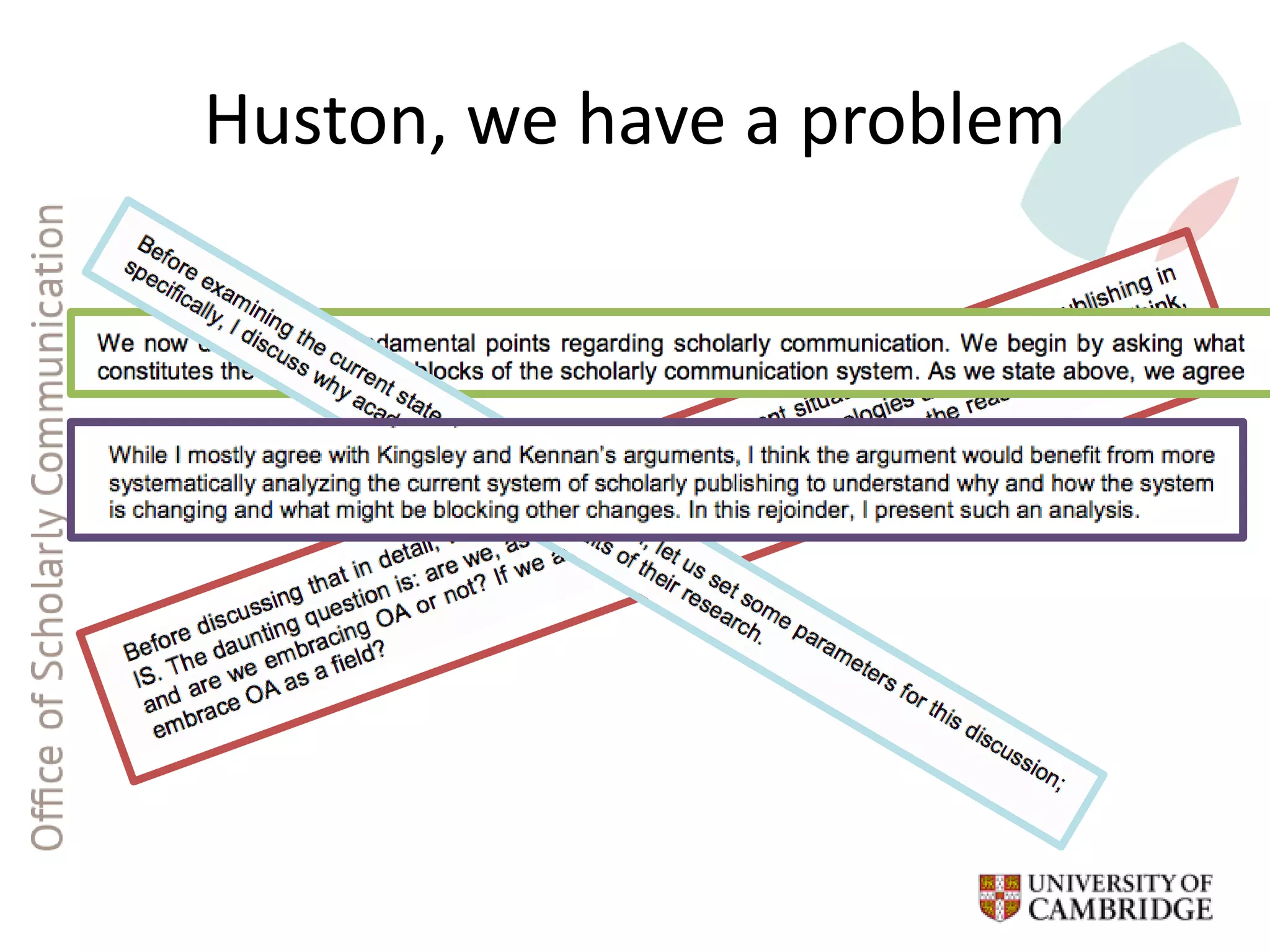
• In the end four of the five people who wrote rebuttals
were researchers in the Information Sciences field
Everyone has an opinion
Truly, everyone
Notice a pattern?
Huston, we have a problem
On a professional note…
• After doing their own analyses each of these
researchers concluded that OA was the way
forward
• But if we wait for every researcher to come to
their own personal epiphany about Open
Access we will NEVER get there
• Engagement has not worked
• We must Enable the academic community to
disseminate their work openly
The research area of scholarly
communication is not well recognised
Two things define a discipline –
scholarly literature and language
Community
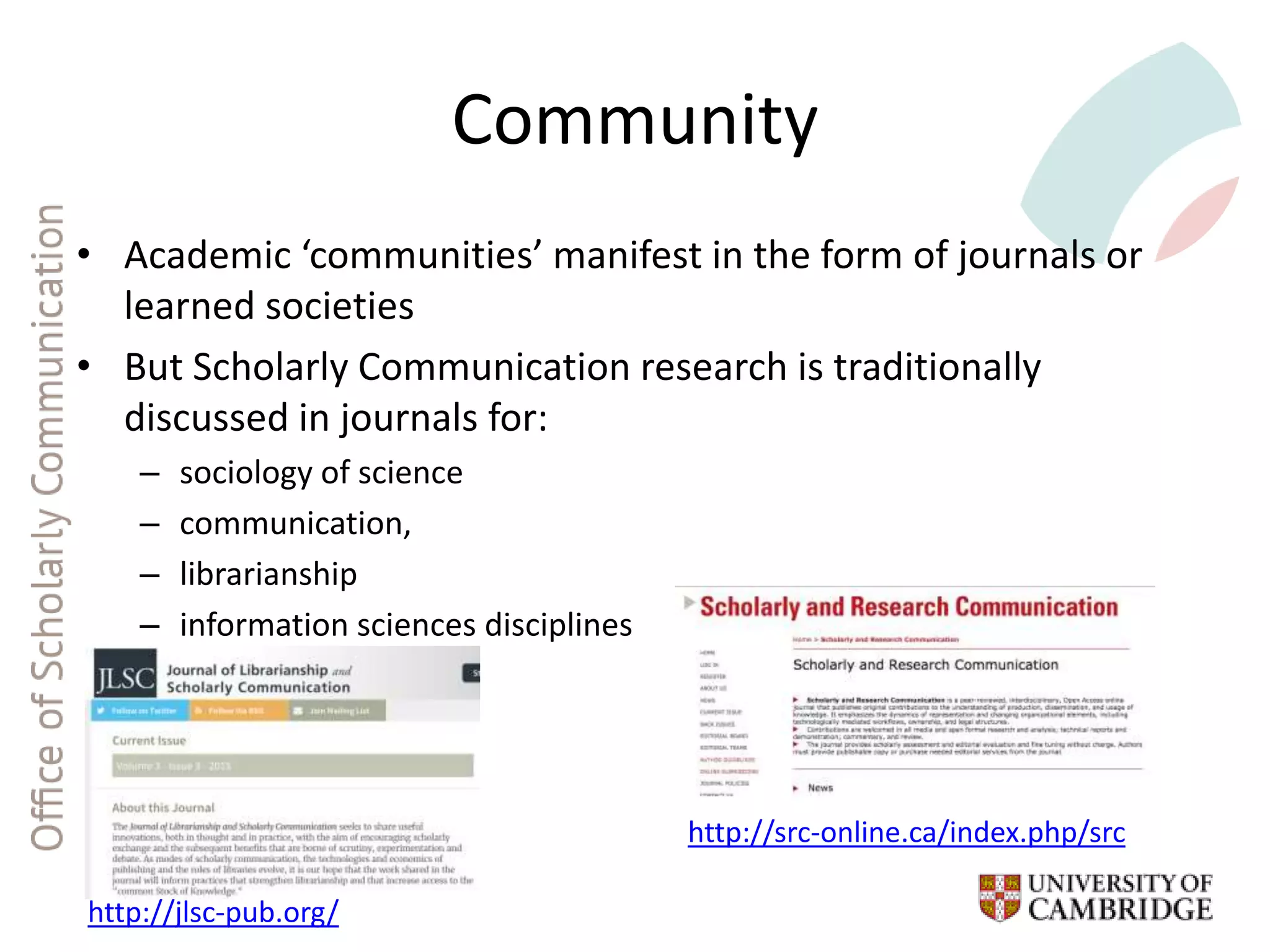
• Academic ‘communities’ manifest in the form of journals or
learned societies
• But Scholarly Communication research is traditionally
discussed in journals for:
– sociology of science
– communication,
– librarianship
– information sciences disciplines
http://jlsc-pub.org/
http://src-online.ca/index.php/src
Slowly getting there…
• There are now Offices of Scholarly
Communication in universities, especially in
the US & increasingly in the UK
• But no Faculties/Departments or Professorial
Chairs of scholarly communication exist [that I
can find]
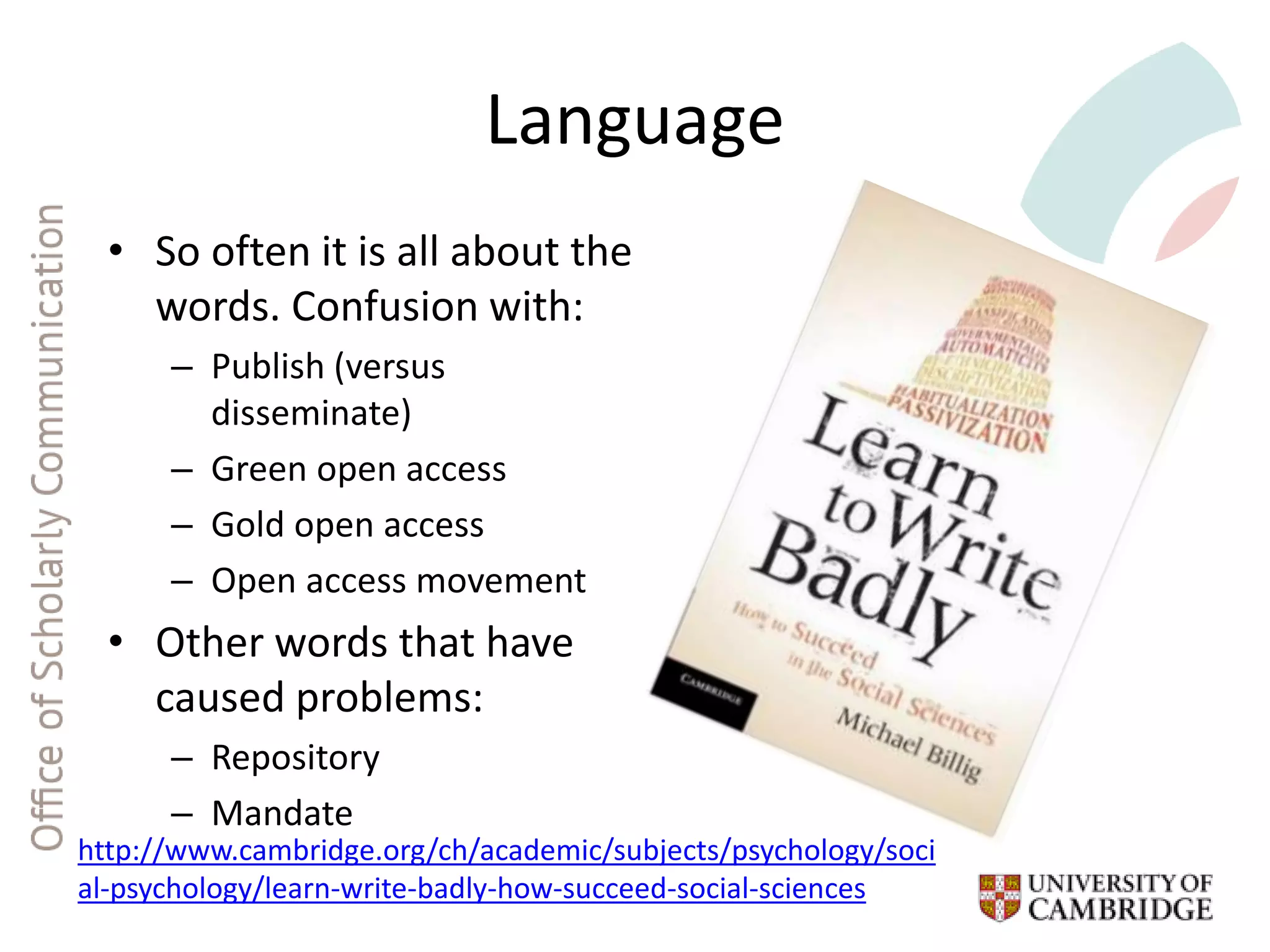
Language
• So often it is all about the
words. Confusion with:
– Publish (versus
disseminate)
– Green open access
– Gold open access
– Open access movement
• Other words that have
caused problems:
– Repository
– Mandate
http://www.cambridge.org/ch/academic/subjects/psychology/soci
al-psychology/learn-write-badly-how-succeed-social-sciences
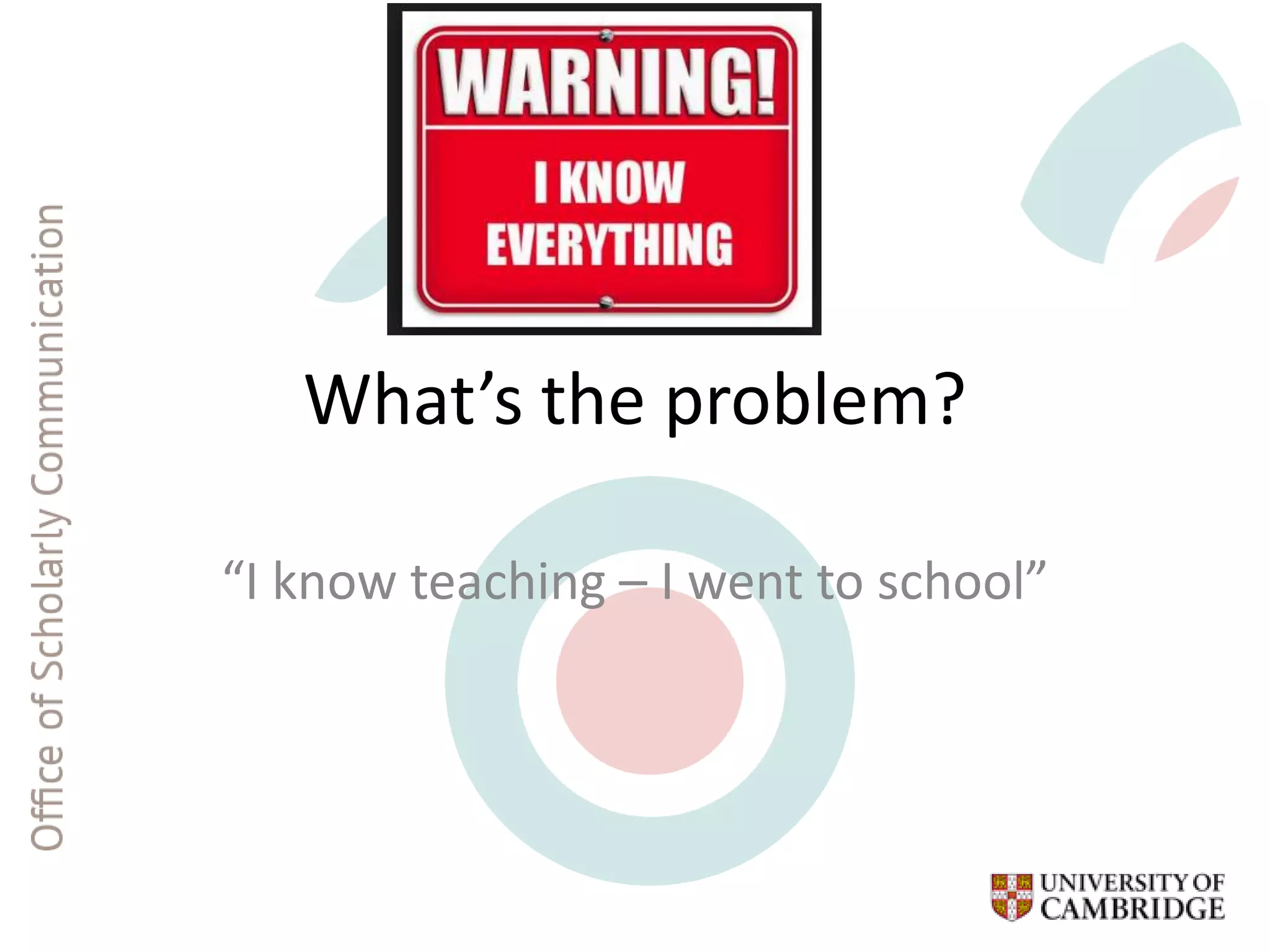
What’s the problem?
“I know teaching – I went to school”
Our conclusion?
• The practice of scholarly communication (as distinct from the study
of it) is shared among all academic fields, librarians, publishers, and
administrators.
• Each of these bring their own levels of understanding, perspectives,
and involvement in the scholarly communication system.
• Regardless of where individuals sit, however, in all instances there
needs to be a base level of competence.
• The methods by which different fields and administrative areas
reach this competence varies.
– Kingsley, Danny A. and Kennan, Mary Anne (2015) "Open Access: The
Whipping Boy for Problems in Scholarly Communication—A Response
to the Rebuttals," Communications of the Association for Information
Systems: Vol. 37, Article 20.
Available at: http://aisel.aisnet.org/cais/vol37/iss1/20
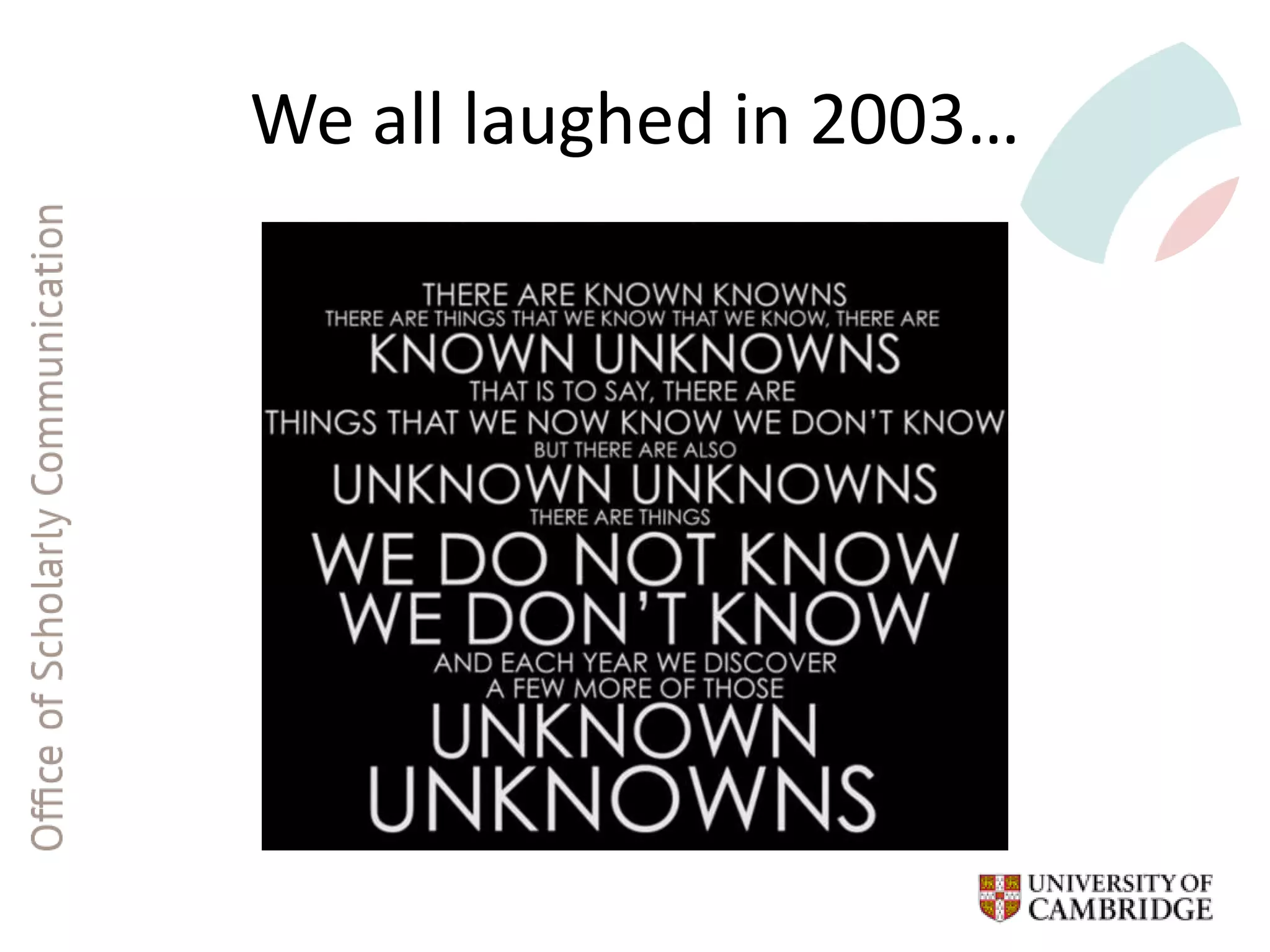
We all laughed in 2003…
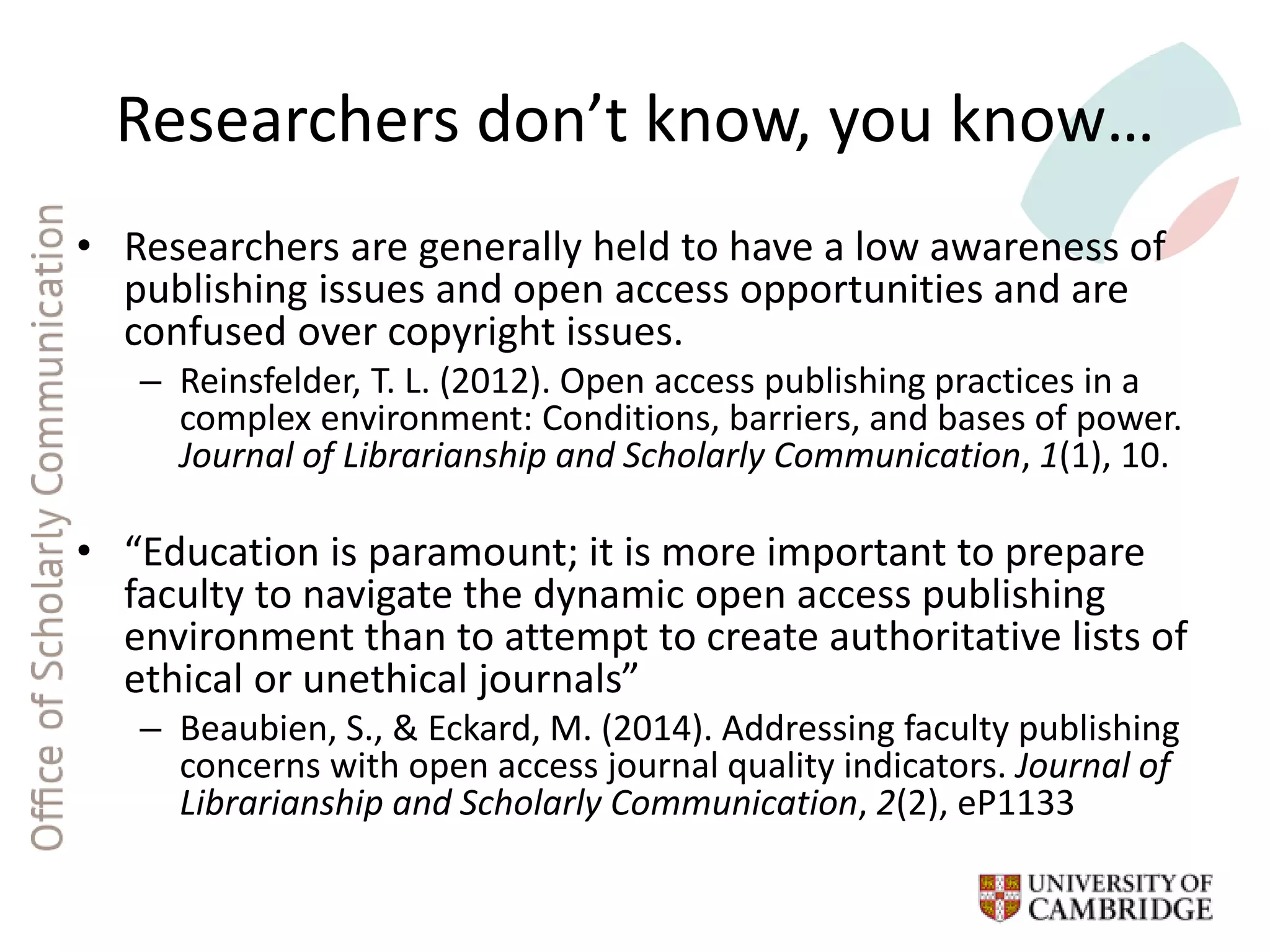
Researchers don’t know, you know…
• Researchers are generally held to have a low awareness of
publishing issues and open access opportunities and are
confused over copyright issues.
– Reinsfelder, T. L. (2012). Open access publishing practices in a
complex environment: Conditions, barriers, and bases of power.
Journal of Librarianship and Scholarly Communication, 1(1), 10.
• “Education is paramount; it is more important to prepare
faculty to navigate the dynamic open access publishing
environment than to attempt to create authoritative lists of
ethical or unethical journals”
– Beaubien, S., & Eckard, M. (2014). Addressing faculty publishing
concerns with open access journal quality indicators. Journal of
Librarianship and Scholarly Communication, 2(2), eP1133
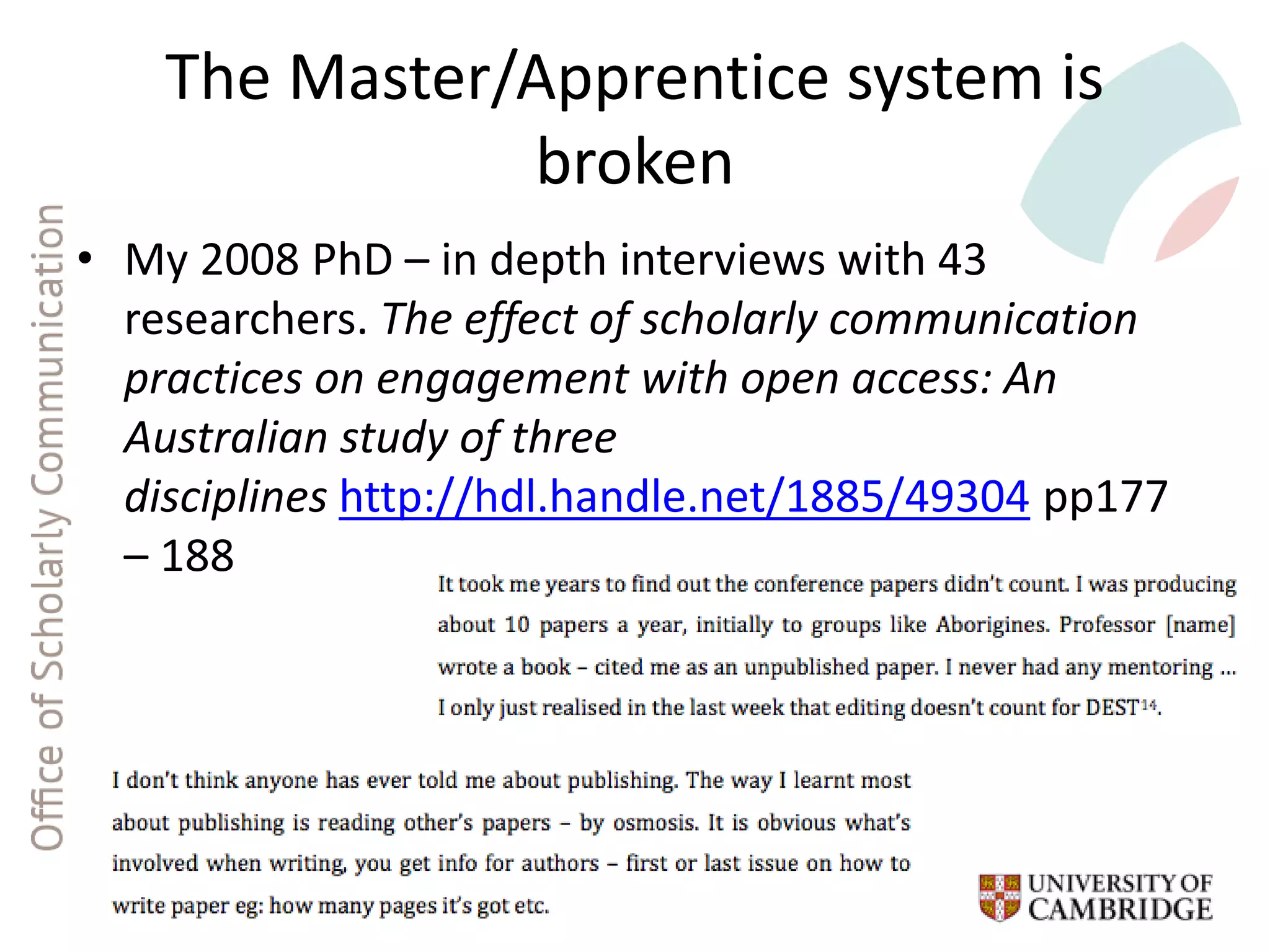
The Master/Apprentice system is
broken
• My 2008 PhD – in depth interviews with 43
researchers. The effect of scholarly communication
practices on engagement with open access: An
Australian study of three
disciplines http://hdl.handle.net/1885/49304 pp177
– 188
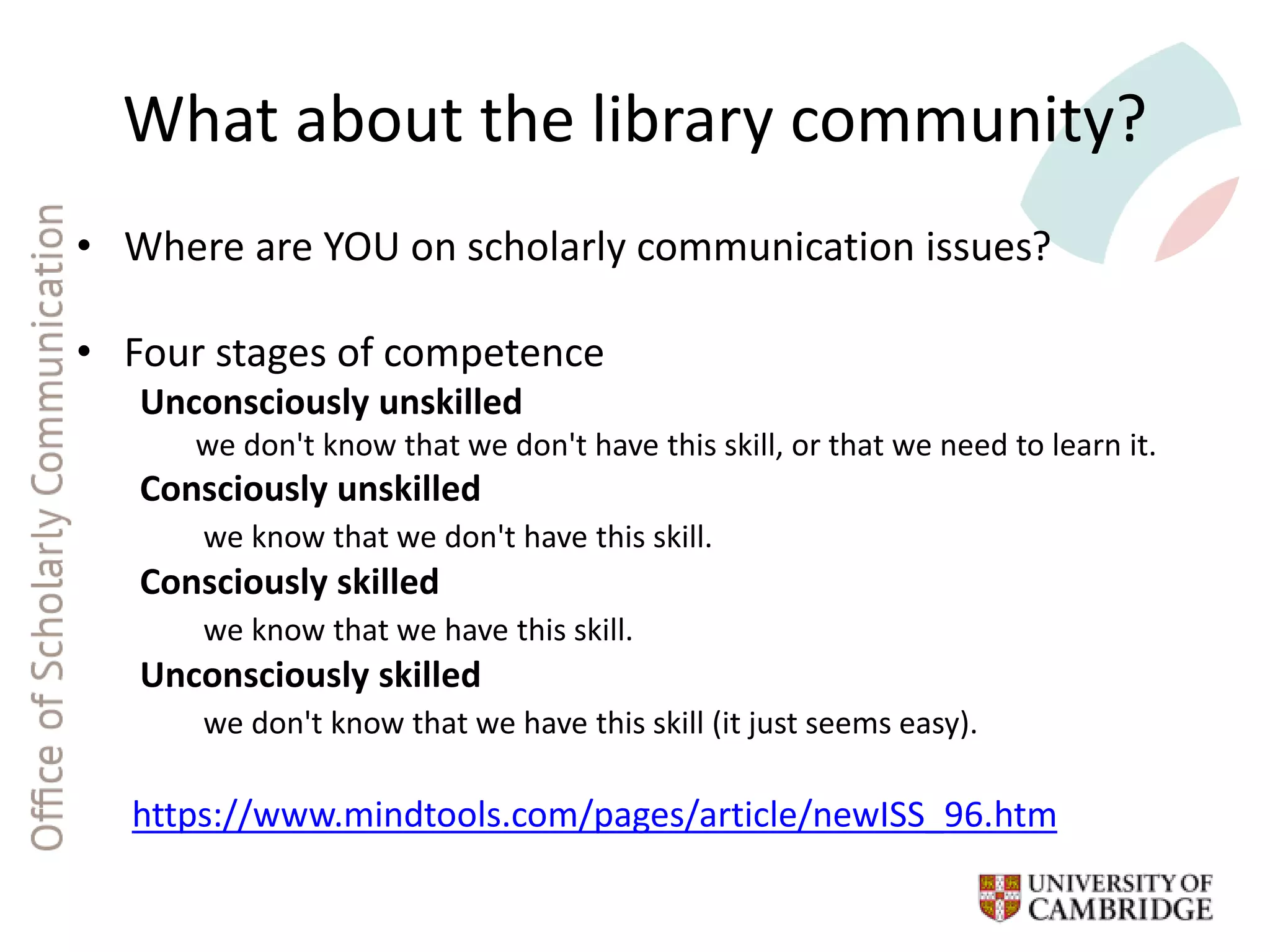
What about the library community?
• Where are YOU on scholarly communication issues?
• Four stages of competence
Unconsciously unskilled
we don't know that we don't have this skill, or that we need to learn it.
Consciously unskilled
we know that we don't have this skill.
Consciously skilled
we know that we have this skill.
Unconsciously skilled
we don't know that we have this skill (it just seems easy).
https://www.mindtools.com/pages/article/newISS_96.htm
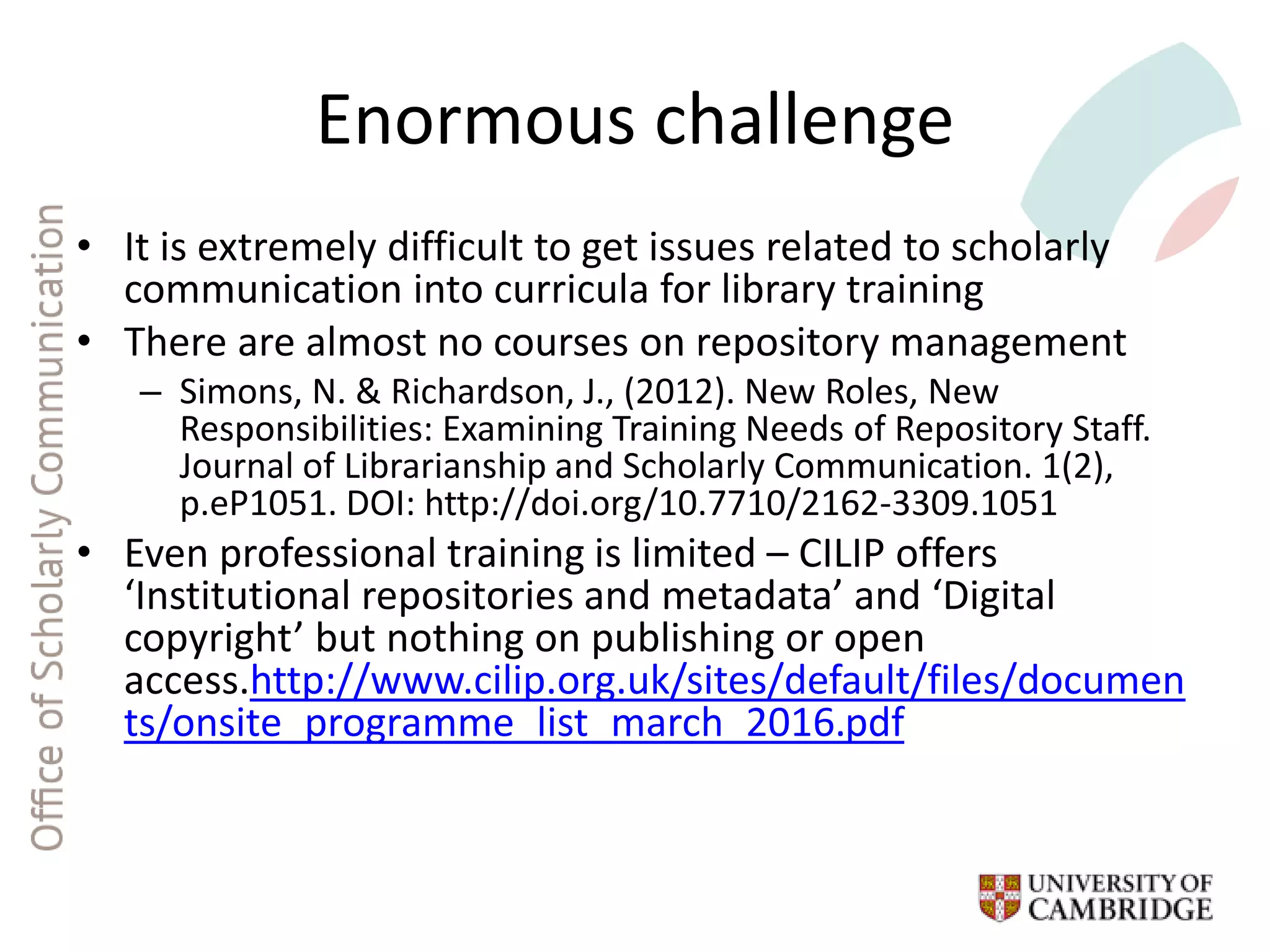
Enormous challenge
• It is extremely difficult to get issues related to scholarly
communication into curricula for library training
• There are almost no courses on repository management
– Simons, N. & Richardson, J., (2012). New Roles, New
Responsibilities: Examining Training Needs of Repository Staff.
Journal of Librarianship and Scholarly Communication. 1(2),
p.eP1051. DOI: http://doi.org/10.7710/2162-3309.1051
• Even professional training is limited – CILIP offers
‘Institutional repositories and metadata’ and ‘Digital
copyright’ but nothing on publishing or open
access.http://www.cilip.org.uk/sites/default/files/documen
ts/onsite_programme_list_march_2016.pdf
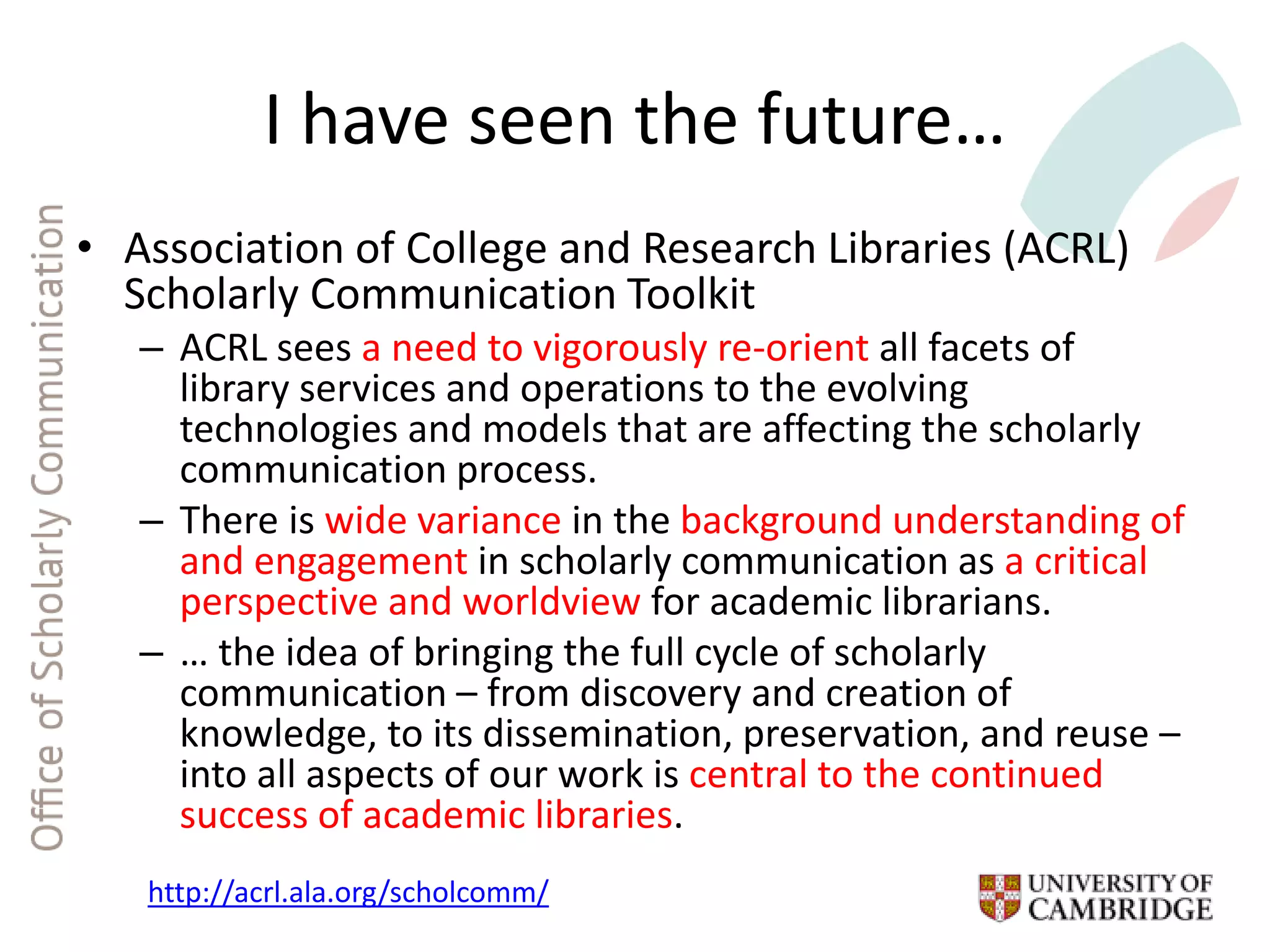
I have seen the future…
• Association of College and Research Libraries (ACRL)
Scholarly Communication Toolkit
– ACRL sees a need to vigorously re-orient all facets of
library services and operations to the evolving
technologies and models that are affecting the scholarly
communication process.
– There is wide variance in the background understanding of
and engagement in scholarly communication as a critical
perspective and worldview for academic librarians.
– … the idea of bringing the full cycle of scholarly
communication – from discovery and creation of
knowledge, to its dissemination, preservation, and reuse –
into all aspects of our work is central to the continued
success of academic libraries.
http://acrl.ala.org/scholcomm/
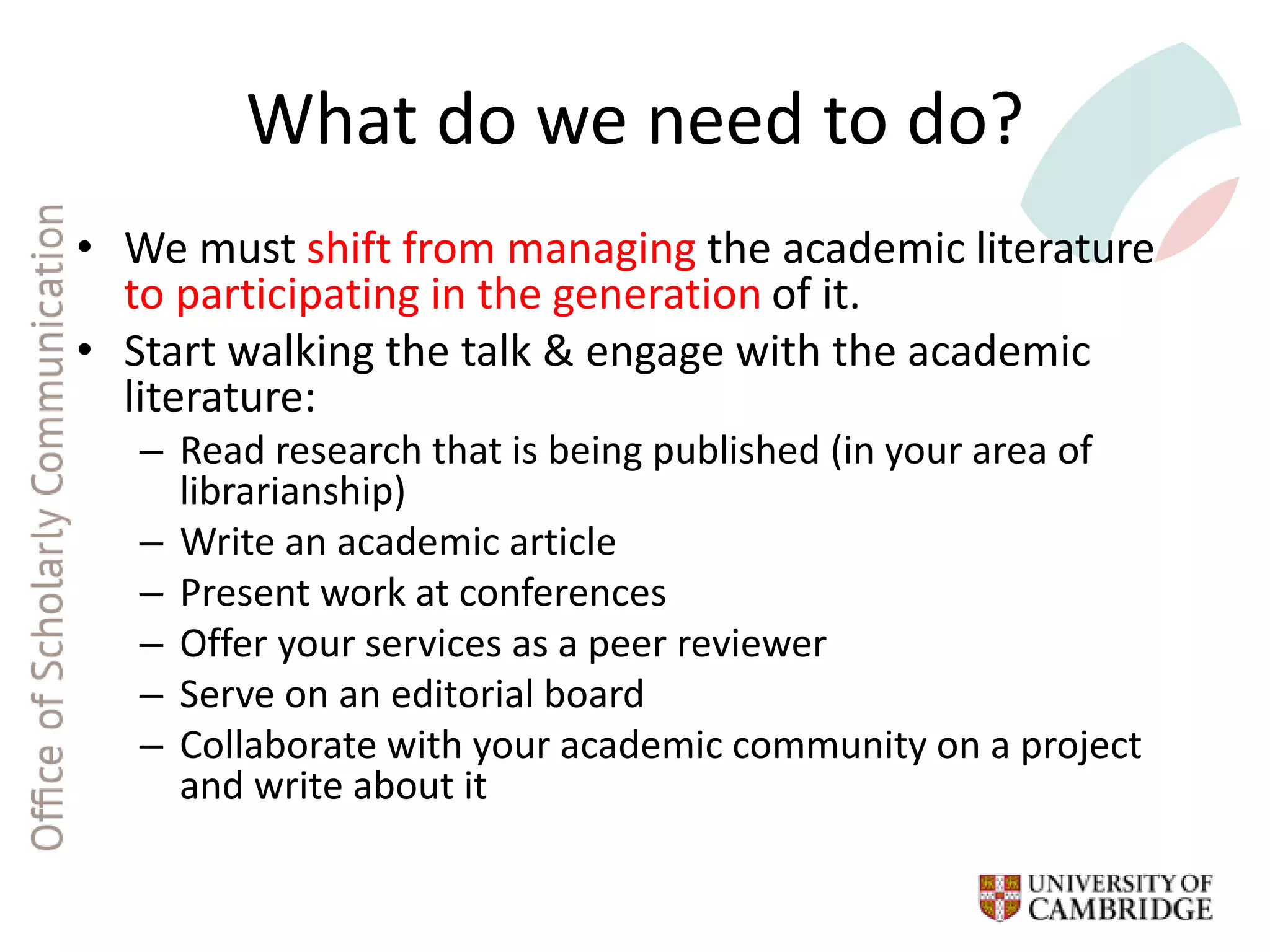
What do we need to do?
• We must shift from managing the academic literature
to participating in the generation of it.
• Start walking the talk & engage with the academic
literature:
– Read research that is being published (in your area of
librarianship)
– Write an academic article
– Present work at conferences
– Offer your services as a peer reviewer
– Serve on an editorial board
– Collaborate with your academic community on a project
and write about it
Thanks and discussion
Dr Danny Kingsley
Head of Scholarly Communication, Cambridge University Libraries
dak45@cam.ac.uk
www.osc.cam.ac.uk
@dannykay68

The value of embracing unknown unknowns

  • 1.
    The value ofembracing unknown unknowns Dr Danny Kingsley RLUK Conference British Library 9 March 2016
  • 2.
    The debate piecethat started it • Kingsley, Danny A. and Kennan, Mary Anne (2015) "Open Access: The Whipping Boy for Problems in Scholarly Publishing”, Communications of the Association for Information Systems: Vol. 37, Article 14. – Available at: http://aisel.aisnet.org/cais/vol37/iss1/14 – AAM available:https://www.repository.cam.ac.uk/handl e/1810/250321
  • 3.
    Premise of thearticle • Provided a background to OA’s development and current state • Examined some of the accusations leveled against OA: – that OA publishers are predatory, – that OA is too expensive, – that self-depositing papers in OA repositories will bring about the end of scholarly publishing. • Argument is each of these arise from problems with the scholarly publishing system more broadly. • Proposed discussions we should be having about scholarly publishing to take advantage of social and technological innovations and move it into the 21st century – What about Monographs? – How to Manage Article Processing Charges? – Institutional Repositories are not Perfect: How do We Make Them Better? – How do We Make Scholarly Publishing and Open Access Inclusive? – How do We Fix the Reward System?
  • 4.
    Just to giveyou an idea about timing • First approach from the journal – September 2013 • Agreed to write the piece and first discussion - 10 February 2014 • Submitted the first argument – 26 May 2014 • Submitted amendment based on editor’s comments – 29 May 2014 • Rebuttals sent to us – 18 November 2014 • Deadline for rejoinder – 19 December 2014 • Rejoinder sent – 16 February 2015 • “Publication is with the production editor and will be out ‘anytime’” email – 6 May 2015 • Copy editor’s questions sent to us - 4 June 2015 • Corrected pieces (original & rejoinder) sent to editors – 26 June 2015 • Date of acceptance - 4 July 2015 • Date of publication - 17 August 2015
  • 5.
    What happened next? •Not much for a LONG time • Editor asked many people to contribute. We sent in suggestions & personally requested some people’s participation: – Funders – Library staff – Research managers – Editors – Publishers – Policy makers • In the end four of the five people who wrote rebuttals were researchers in the Information Sciences field
  • 6.
  • 7.
  • 8.
  • 9.
    Huston, we havea problem
  • 10.
    On a professionalnote… • After doing their own analyses each of these researchers concluded that OA was the way forward • But if we wait for every researcher to come to their own personal epiphany about Open Access we will NEVER get there • Engagement has not worked • We must Enable the academic community to disseminate their work openly
  • 11.
    The research areaof scholarly communication is not well recognised Two things define a discipline – scholarly literature and language
  • 12.
    Community • Academic ‘communities’manifest in the form of journals or learned societies • But Scholarly Communication research is traditionally discussed in journals for: – sociology of science – communication, – librarianship – information sciences disciplines http://jlsc-pub.org/ http://src-online.ca/index.php/src
  • 13.
    Slowly getting there… •There are now Offices of Scholarly Communication in universities, especially in the US & increasingly in the UK • But no Faculties/Departments or Professorial Chairs of scholarly communication exist [that I can find]
  • 14.
    Language • So oftenit is all about the words. Confusion with: – Publish (versus disseminate) – Green open access – Gold open access – Open access movement • Other words that have caused problems: – Repository – Mandate http://www.cambridge.org/ch/academic/subjects/psychology/soci al-psychology/learn-write-badly-how-succeed-social-sciences
  • 15.
    What’s the problem? “Iknow teaching – I went to school”
  • 16.
    Our conclusion? • Thepractice of scholarly communication (as distinct from the study of it) is shared among all academic fields, librarians, publishers, and administrators. • Each of these bring their own levels of understanding, perspectives, and involvement in the scholarly communication system. • Regardless of where individuals sit, however, in all instances there needs to be a base level of competence. • The methods by which different fields and administrative areas reach this competence varies. – Kingsley, Danny A. and Kennan, Mary Anne (2015) "Open Access: The Whipping Boy for Problems in Scholarly Communication—A Response to the Rebuttals," Communications of the Association for Information Systems: Vol. 37, Article 20. Available at: http://aisel.aisnet.org/cais/vol37/iss1/20
  • 17.
    We all laughedin 2003…
  • 18.
    Researchers don’t know,you know… • Researchers are generally held to have a low awareness of publishing issues and open access opportunities and are confused over copyright issues. – Reinsfelder, T. L. (2012). Open access publishing practices in a complex environment: Conditions, barriers, and bases of power. Journal of Librarianship and Scholarly Communication, 1(1), 10. • “Education is paramount; it is more important to prepare faculty to navigate the dynamic open access publishing environment than to attempt to create authoritative lists of ethical or unethical journals” – Beaubien, S., & Eckard, M. (2014). Addressing faculty publishing concerns with open access journal quality indicators. Journal of Librarianship and Scholarly Communication, 2(2), eP1133
  • 19.
    The Master/Apprentice systemis broken • My 2008 PhD – in depth interviews with 43 researchers. The effect of scholarly communication practices on engagement with open access: An Australian study of three disciplines http://hdl.handle.net/1885/49304 pp177 – 188
  • 20.
    What about thelibrary community? • Where are YOU on scholarly communication issues? • Four stages of competence Unconsciously unskilled we don't know that we don't have this skill, or that we need to learn it. Consciously unskilled we know that we don't have this skill. Consciously skilled we know that we have this skill. Unconsciously skilled we don't know that we have this skill (it just seems easy). https://www.mindtools.com/pages/article/newISS_96.htm
  • 21.
    Enormous challenge • Itis extremely difficult to get issues related to scholarly communication into curricula for library training • There are almost no courses on repository management – Simons, N. & Richardson, J., (2012). New Roles, New Responsibilities: Examining Training Needs of Repository Staff. Journal of Librarianship and Scholarly Communication. 1(2), p.eP1051. DOI: http://doi.org/10.7710/2162-3309.1051 • Even professional training is limited – CILIP offers ‘Institutional repositories and metadata’ and ‘Digital copyright’ but nothing on publishing or open access.http://www.cilip.org.uk/sites/default/files/documen ts/onsite_programme_list_march_2016.pdf
  • 22.
    I have seenthe future… • Association of College and Research Libraries (ACRL) Scholarly Communication Toolkit – ACRL sees a need to vigorously re-orient all facets of library services and operations to the evolving technologies and models that are affecting the scholarly communication process. – There is wide variance in the background understanding of and engagement in scholarly communication as a critical perspective and worldview for academic librarians. – … the idea of bringing the full cycle of scholarly communication – from discovery and creation of knowledge, to its dissemination, preservation, and reuse – into all aspects of our work is central to the continued success of academic libraries. http://acrl.ala.org/scholcomm/
  • 23.
    What do weneed to do? • We must shift from managing the academic literature to participating in the generation of it. • Start walking the talk & engage with the academic literature: – Read research that is being published (in your area of librarianship) – Write an academic article – Present work at conferences – Offer your services as a peer reviewer – Serve on an editorial board – Collaborate with your academic community on a project and write about it
  • 24.
    Thanks and discussion DrDanny Kingsley Head of Scholarly Communication, Cambridge University Libraries dak45@cam.ac.uk www.osc.cam.ac.uk @dannykay68