Insights into Dark Matter
         Hints and Signals from Astrophysics


         Katherine J. Mack
         University of Melbourne


                                      www.ph.unimelb.edu.au/~kmack
                                                       : @AstroKatie


Tuesday, 5 March 13                                                    1
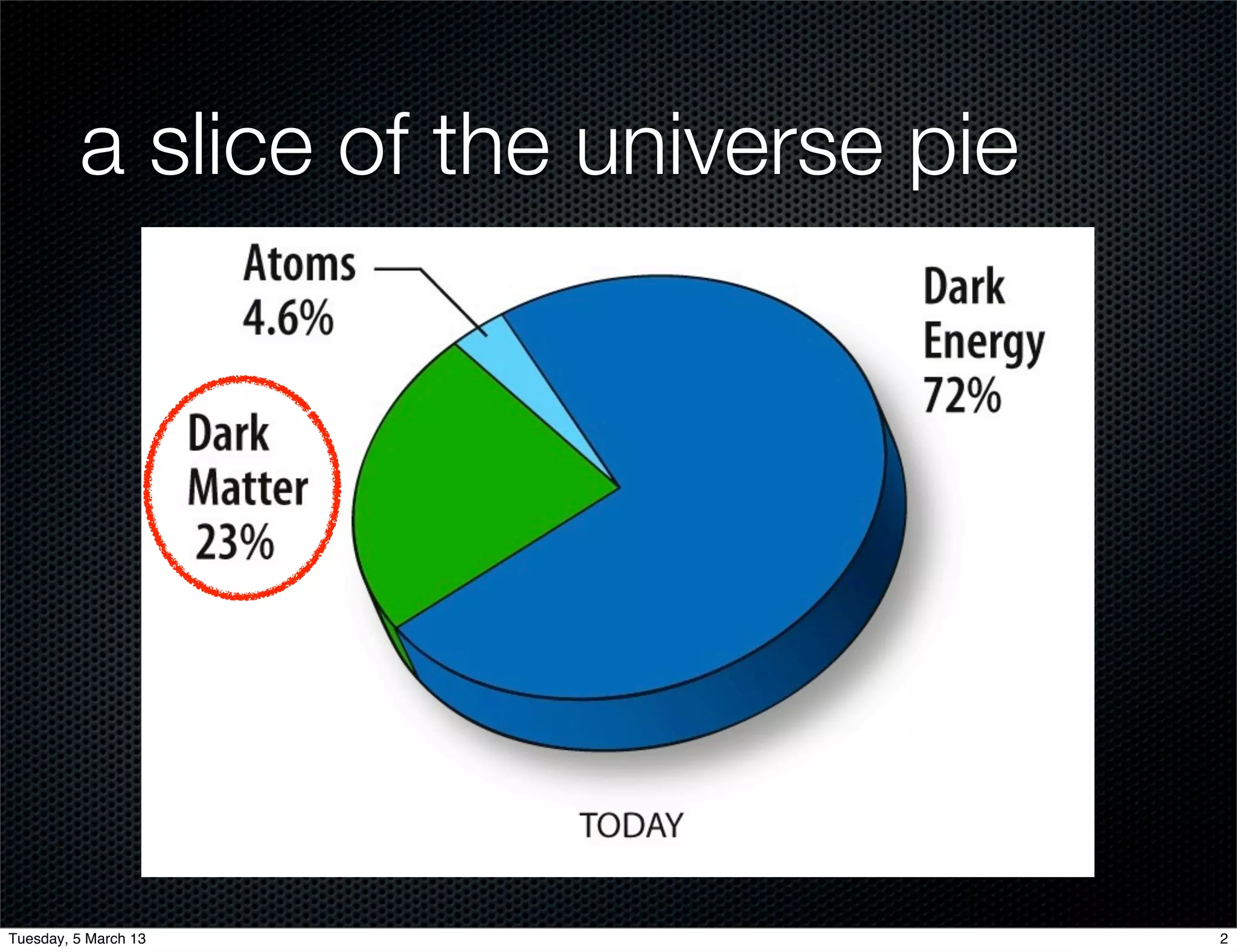
a slice of the universe pie


Tuesday, 5 March 13                    2
what we know
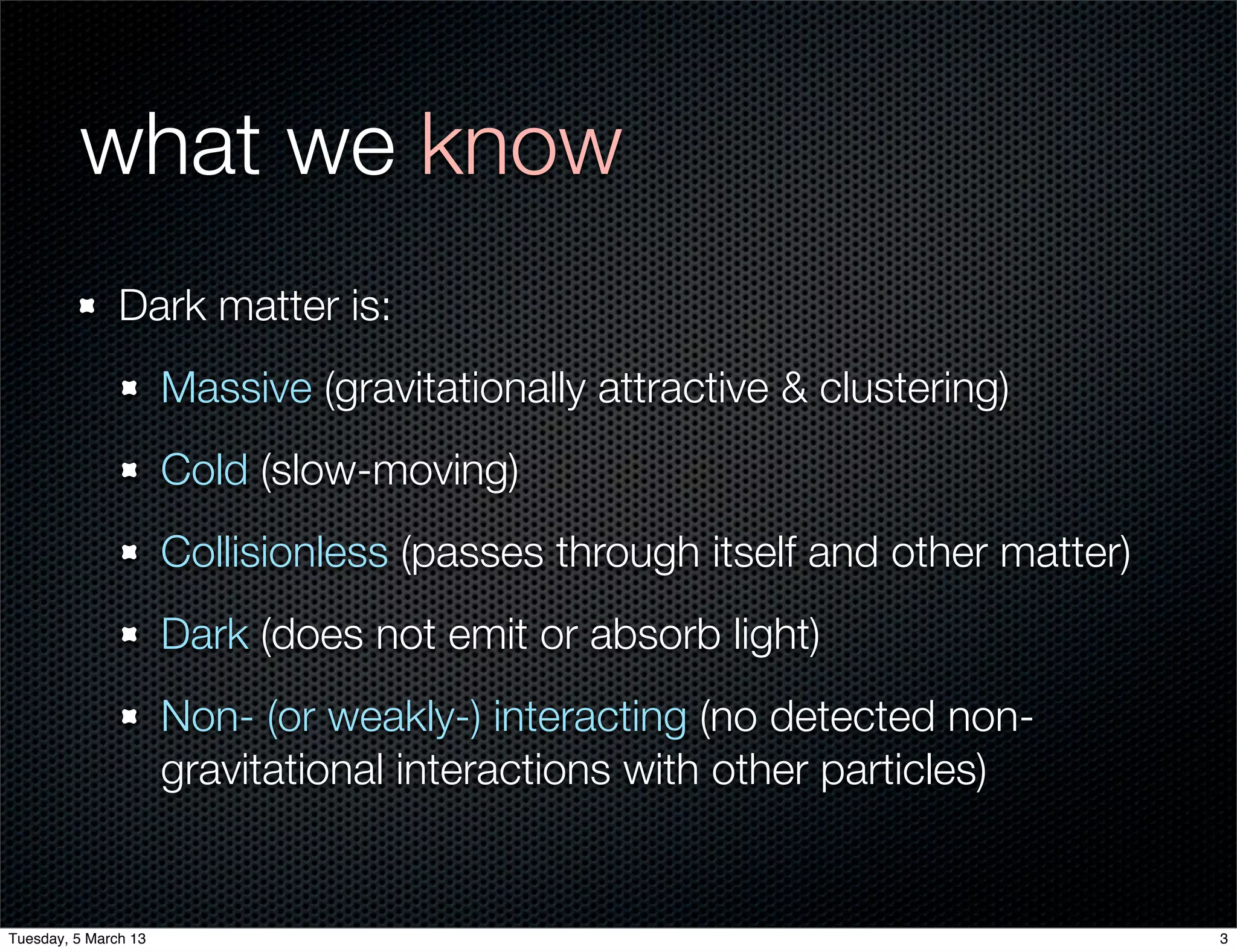
               Dark matter is:
                      Massive (gravitationally attractive & clustering)
                      Cold (slow-moving)
                      Collisionless (passes through itself and other matter)
                      Dark (does not emit or absorb light)
                      Non- (or weakly-) interacting (no detected non-
                      gravitational interactions with other particles)


Tuesday, 5 March 13                                                            3
what we don’t know

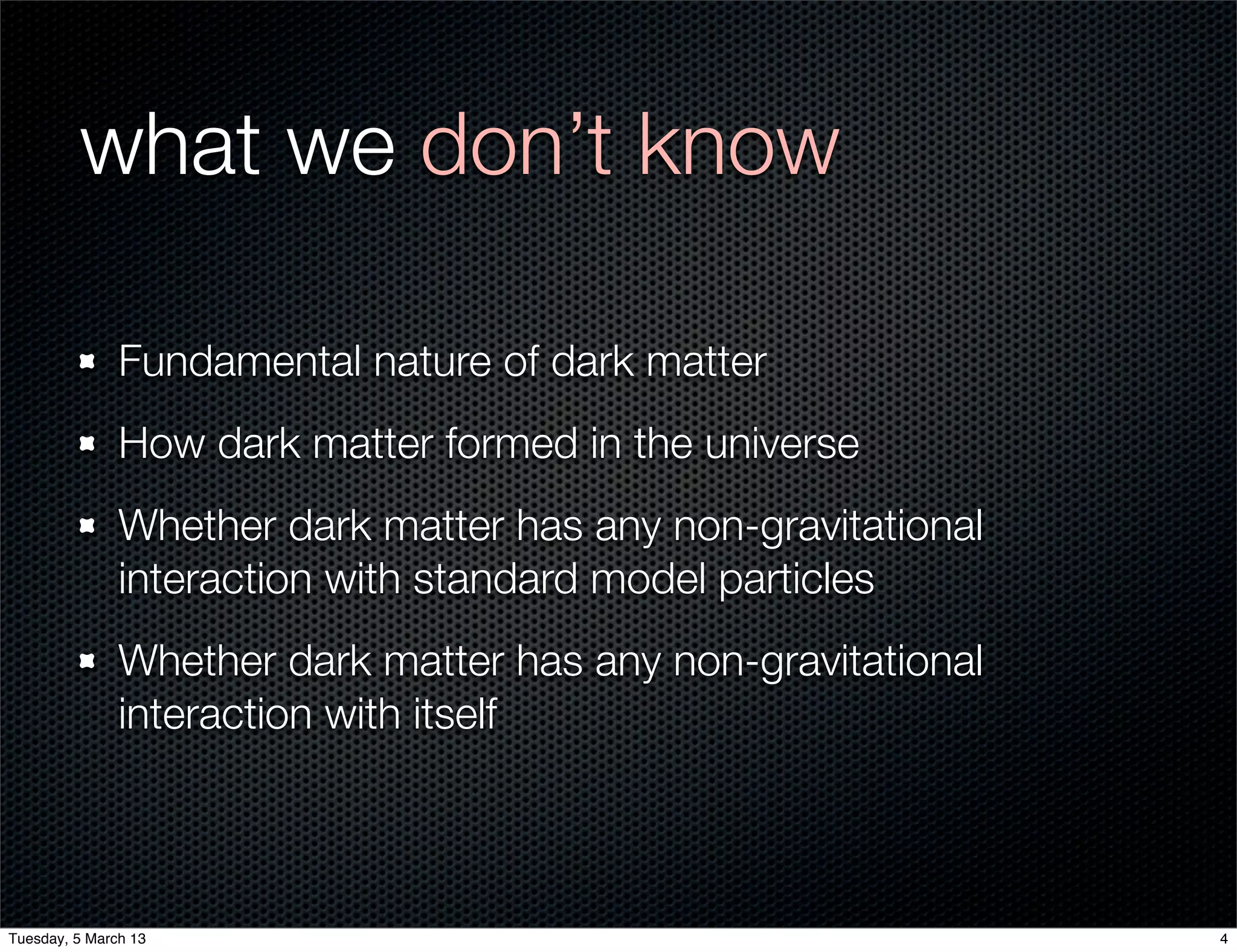
               Fundamental nature of dark matter
               How dark matter formed in the universe
               Whether dark matter has any non-gravitational
               interaction with standard model particles
               Whether dark matter has any non-gravitational
               interaction with itself


Tuesday, 5 March 13                                            4
the evidence amasses
               Rotation curves & galactic dynamics (missing mass)
               Cluster dynamics (missing mass)
               Strong & weak gravitational lensing (missing mass / halo
               shapes / substructure)
               Gravitational microlensing (smooth distribution of mass)
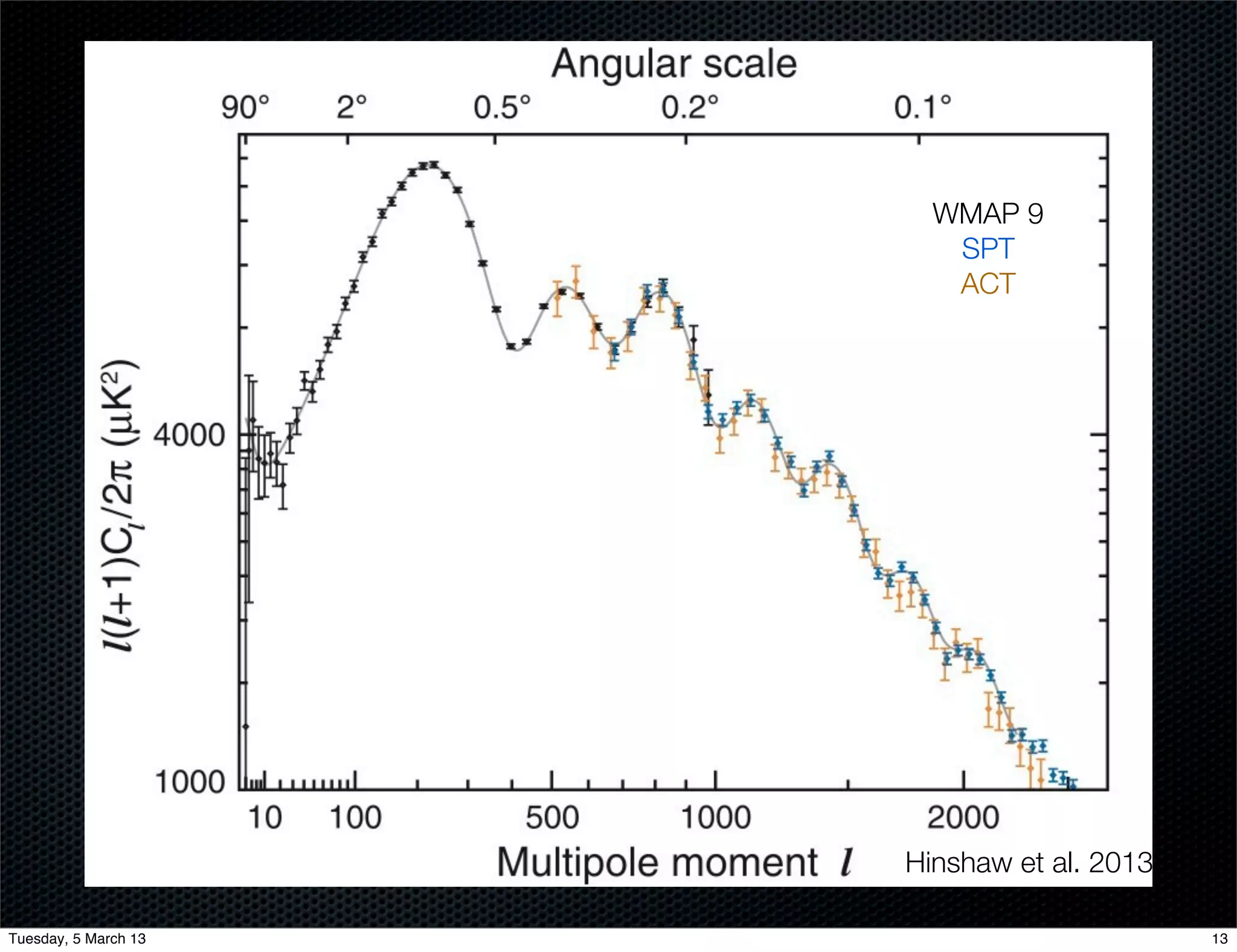
               CMB acoustic peaks (DM/baryon ratio)
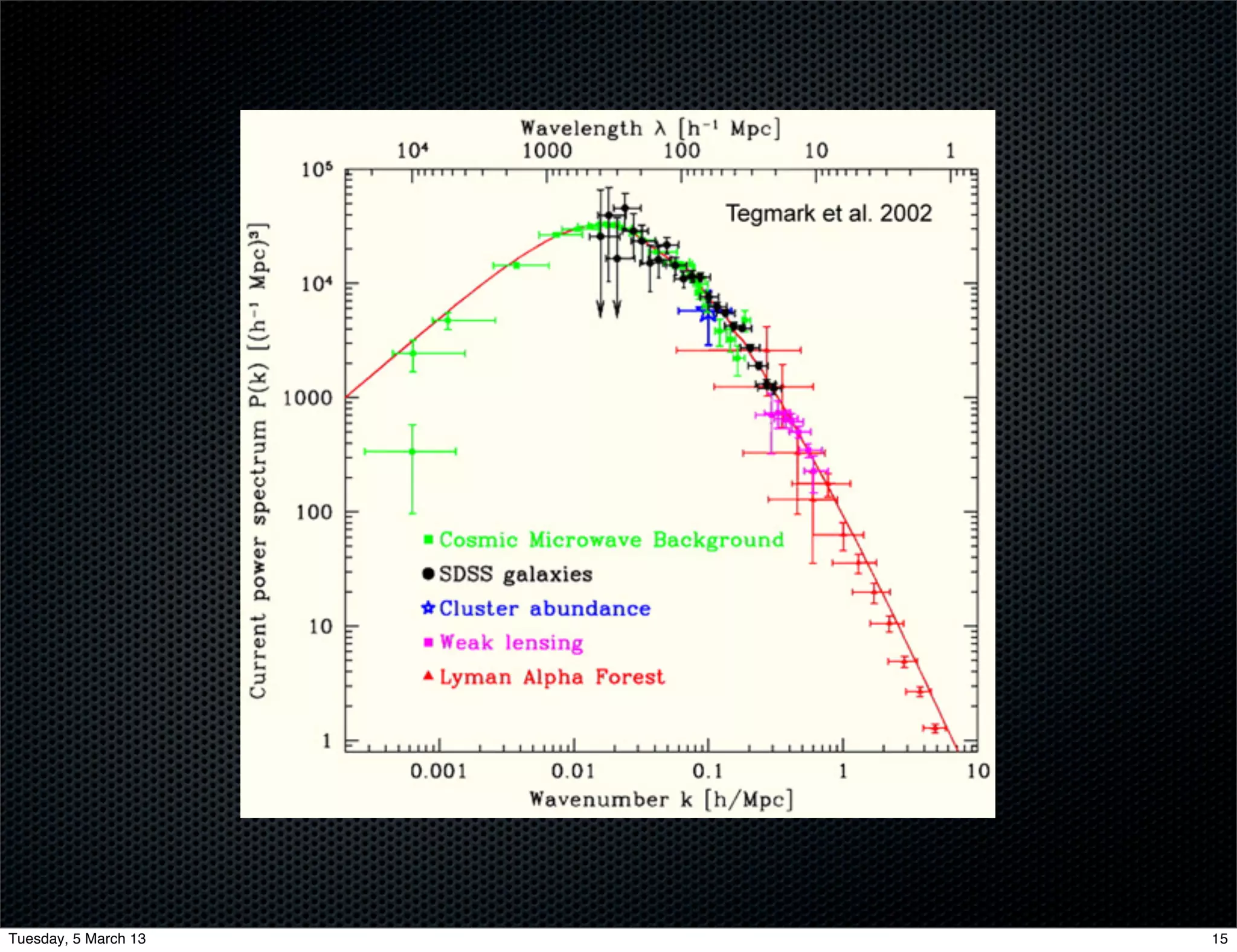
               Matter power spectrum & structure formation (DM/baryon ratio)
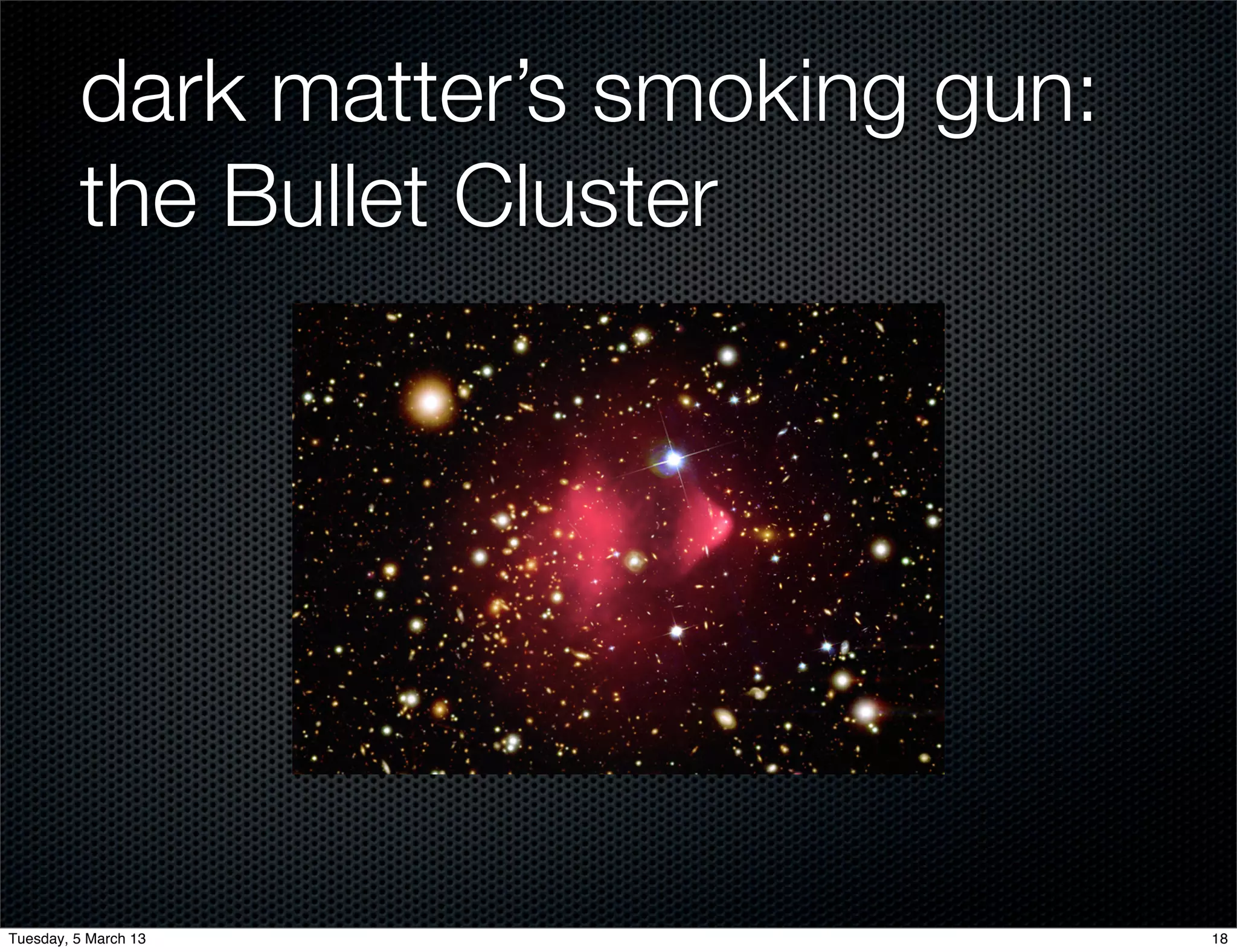
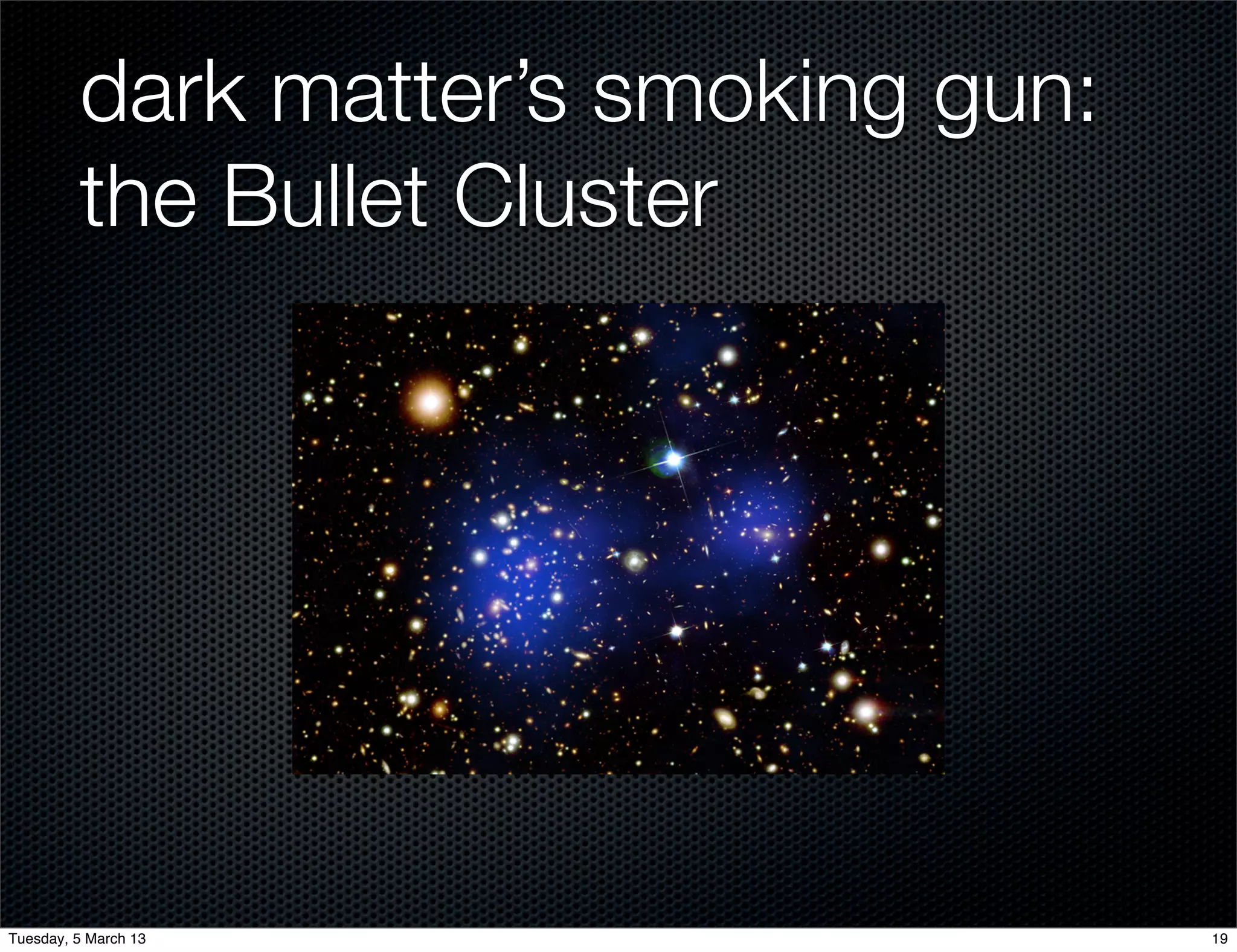
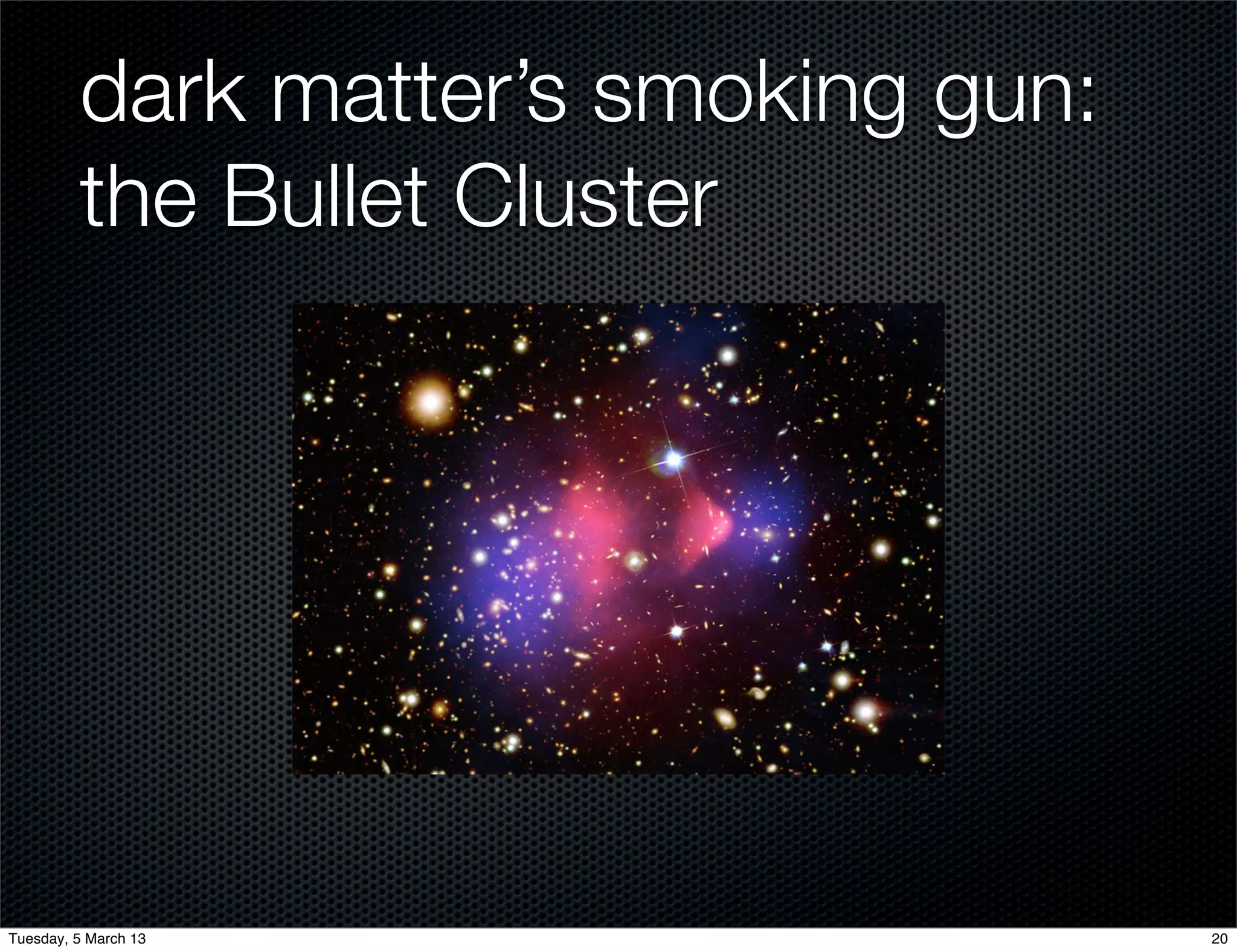
               Cluster collisions (missing mass / collisionless matter)


Tuesday, 5 March 13                                                            5
the evidence amasses
               Rotation curves & galactic dynamics (missing mass)
               Cluster dynamics (missing mass)
               Strong & weak gravitational lensing (missing mass / halo
               shapes / substructure)
               Gravitational microlensing (smooth distribution of mass)
               CMB acoustic peaks (DM/baryon ratio)
               Matter power spectrum & structure formation (DM/baryon ratio)
               Cluster collisions (missing mass / collisionless matter)


Tuesday, 5 March 13                                                            6
the evidence amasses
               Rotation curves & galactic dynamics (missing mass)
               Cluster dynamics (missing mass)
               Strong & weak gravitational lensing (missing mass / halo
               shapes / substructure)
               Gravitational microlensing (smooth distribution of mass)
               CMB acoustic peaks (DM/baryon ratio)
               Matter power spectrum & structure formation (DM/baryon ratio)
               Cluster collisions (missing mass / collisionless matter)


Tuesday, 5 March 13                                                            7
the evidence amasses
               Rotation curves & galactic dynamics (missing mass)
               Cluster dynamics (missing mass)
               Strong & weak gravitational lensing (missing mass / halo
               shapes / substructure)
               Gravitational microlensing (smooth distribution of mass)
               CMB acoustic peaks (DM/baryon ratio)
               Matter power spectrum & structure formation (DM/baryon ratio)
               Cluster collisions (missing mass / collisionless matter)


Tuesday, 5 March 13                                                            8
the evidence amasses
               Rotation curves & galactic dynamics (missing mass)
               Cluster dynamics (missing mass)
               Strong & weak gravitational lensing (missing mass / halo
               shapes / substructure)
               Gravitational microlensing (smooth distribution of mass)
               CMB acoustic peaks (DM/baryon ratio)
               Matter power spectrum & structure formation (DM/baryon ratio)
               Cluster collisions (missing mass / collisionless matter)


Tuesday, 5 March 13                                                            9
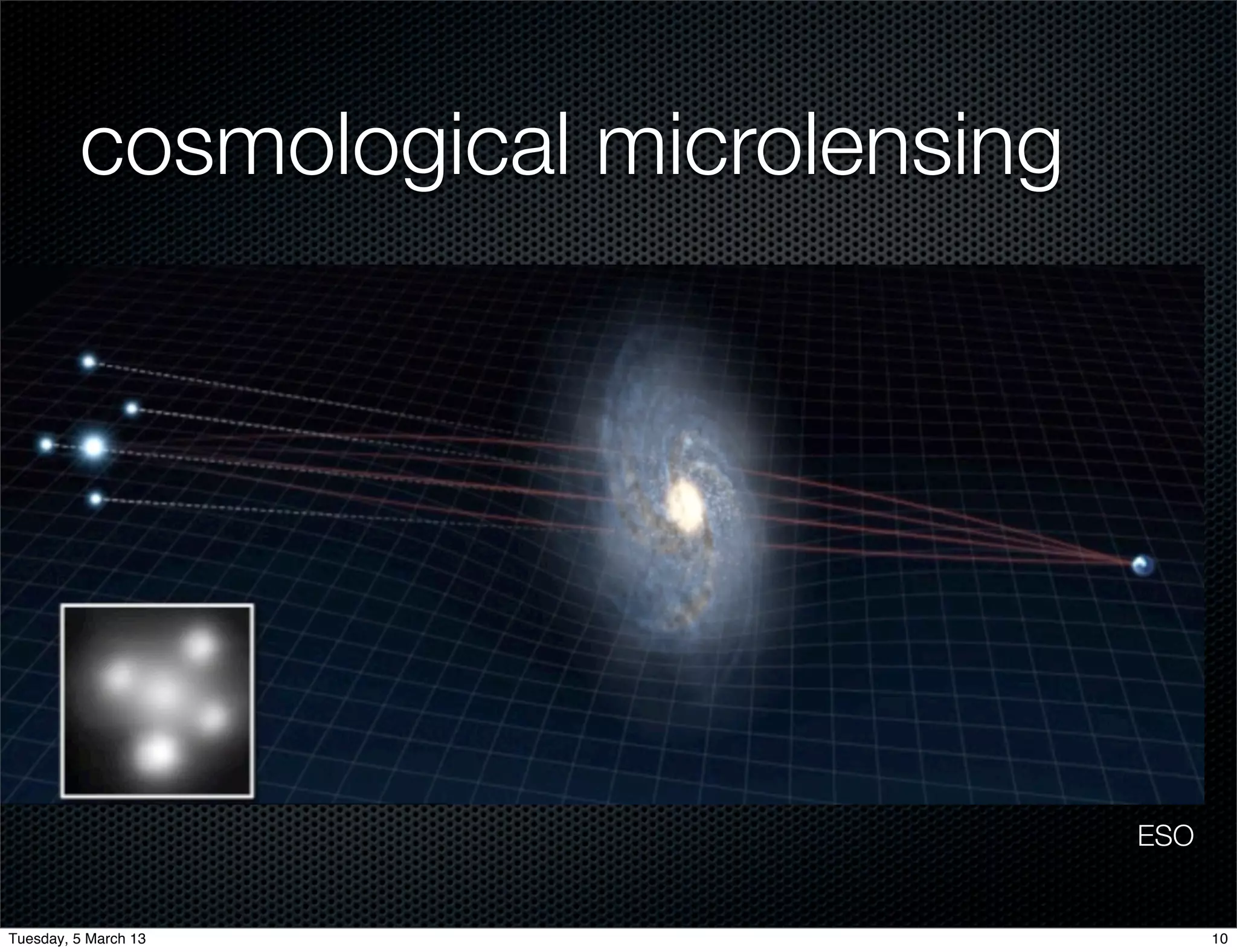
cosmological microlensing


                                     ESO


Tuesday, 5 March 13                        10
cosmological microlensing
                                      1454                                                              MEDIAVILLA ET AL.                                                                   Vol. 706


                                             α=0.01                                                α=0.05                                                α=0.1
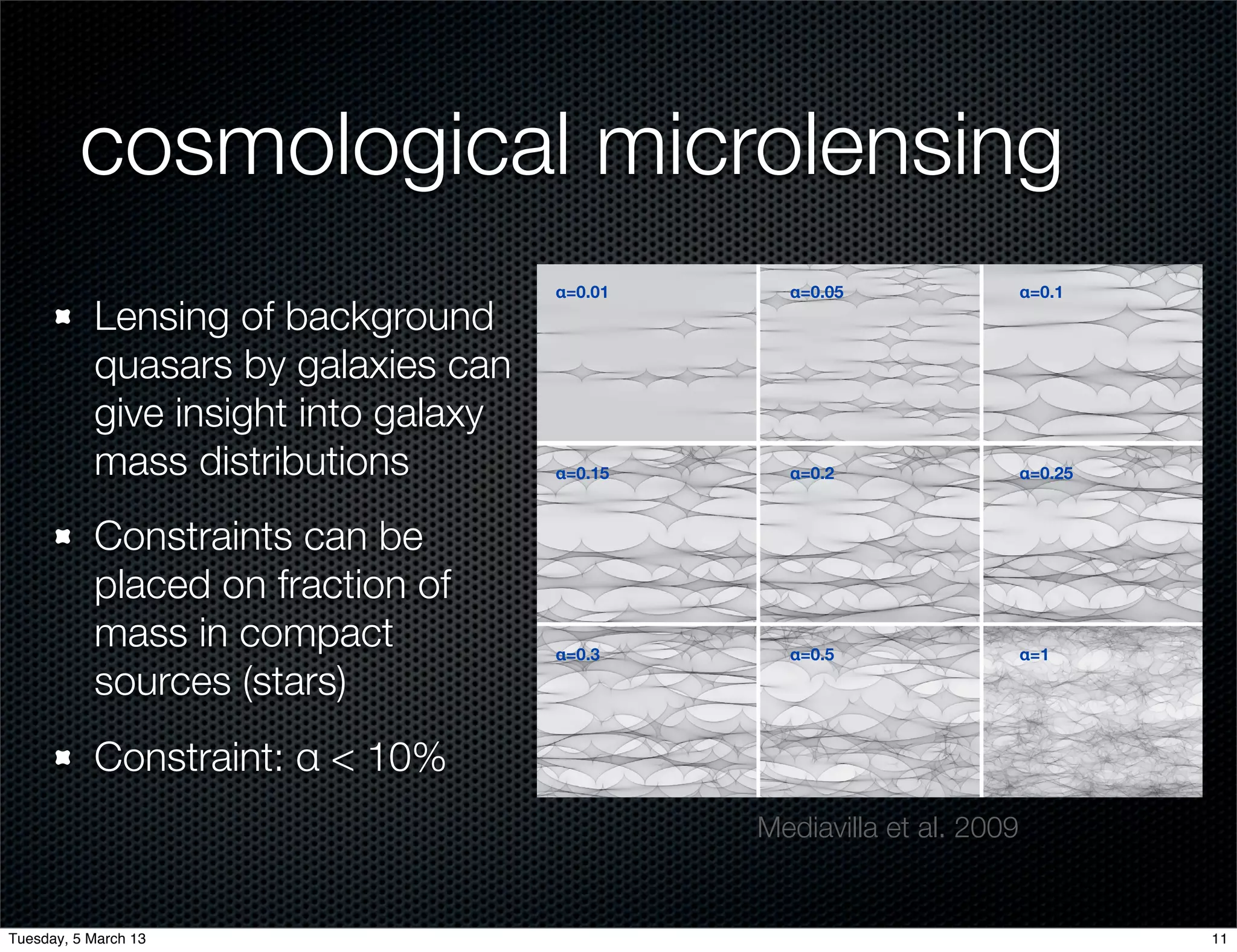
           Lensing of background
           quasars by galaxies can
           give insight into galaxy
           mass distributions                α=0.15                                                α=0.2                                                 α=0.25


           Constraints can be
           placed on fraction of
           mass in compact                   α=0.3                                                 α=0.5                                                 α=1

           sources (stars)
           Constraint: α < 10%
                                      Figure 2. Example of magnification maps for the case κ = γ = 0.45. From top to bottom and from left to right, maps correspond to α = 0.01, 0.05, 0.10, 0.15, 0.20,
                                      0.25, 0.30, 0.50, 1.00.
                                                                                            Mediavilla et al. 2009
                                      2. OBSERVED MICROLENSING MAGNIFICATIONS AND                                            For some of the image pairs (∼30% of the sample) there
                                                   MACRO-LENS MODELS                                                      are mid-IR flux ratios available. Except for one system, SDSS
                                                                                                                          J1004+4112 (where image C is probably affected by extinction,
                                         We collected the data, ∆m (see Equation (4)), examining all                               ´
                                                                                                                          G´ mez-Alvarez et al. 2006), they are in very good agreement
                                                                                                                            o
                                      the optical spectroscopy5 found in the literature (see Table 1). In                 with the emission-line flux ratios (see Table 2). The average
                                      most cases, the microlensing magnification or the scaling of the                     difference between mid-IR and emission line flux ratios is only
Tuesday, 5 March 13                   emission line ratio with respect to the continuum ratio are di-                                                                                  11
the evidence amasses
               Rotation curves & galactic dynamics (missing mass)
               Cluster dynamics (missing mass)
               Strong & weak gravitational lensing (missing mass / halo
               shapes / substructure)
               Gravitational microlensing (smooth distribution of mass)
               CMB acoustic peaks (DM/baryon ratio)
               Matter power spectrum & structure formation (DM/baryon ratio)
               Cluster collisions (missing mass / collisionless matter)


Tuesday, 5 March 13                                                            12
WMAP 9
                         SPT
                         ACT


                      Hinshaw et al. 2013

Tuesday, 5 March 13                         13
the evidence amasses
               Rotation curves & galactic dynamics (missing mass)
               Cluster dynamics (missing mass)
               Strong & weak gravitational lensing (missing mass / halo shapes /
               substructure)
               Gravitational microlensing (smooth distribution of mass)
               CMB acoustic peaks (DM/baryon ratio)
               Matter power spectrum & structure formation (DM/baryon
               ratio)
               Cluster collisions (missing mass / collisionless matter)


Tuesday, 5 March 13                                                                14
Tuesday, 5 March 13   15
the evidence amasses
               Rotation curves & galactic dynamics (missing mass)
               Cluster dynamics (missing mass)
               Strong & weak gravitational lensing (missing mass / halo
               shapes / substructure)
               Gravitational microlensing (smooth distribution of mass)
               CMB acoustic peaks (DM/baryon ratio)
               Matter power spectrum & structure formation (DM/baryon ratio)
               Cluster collisions (missing mass / collisionless matter)


Tuesday, 5 March 13                                                            16
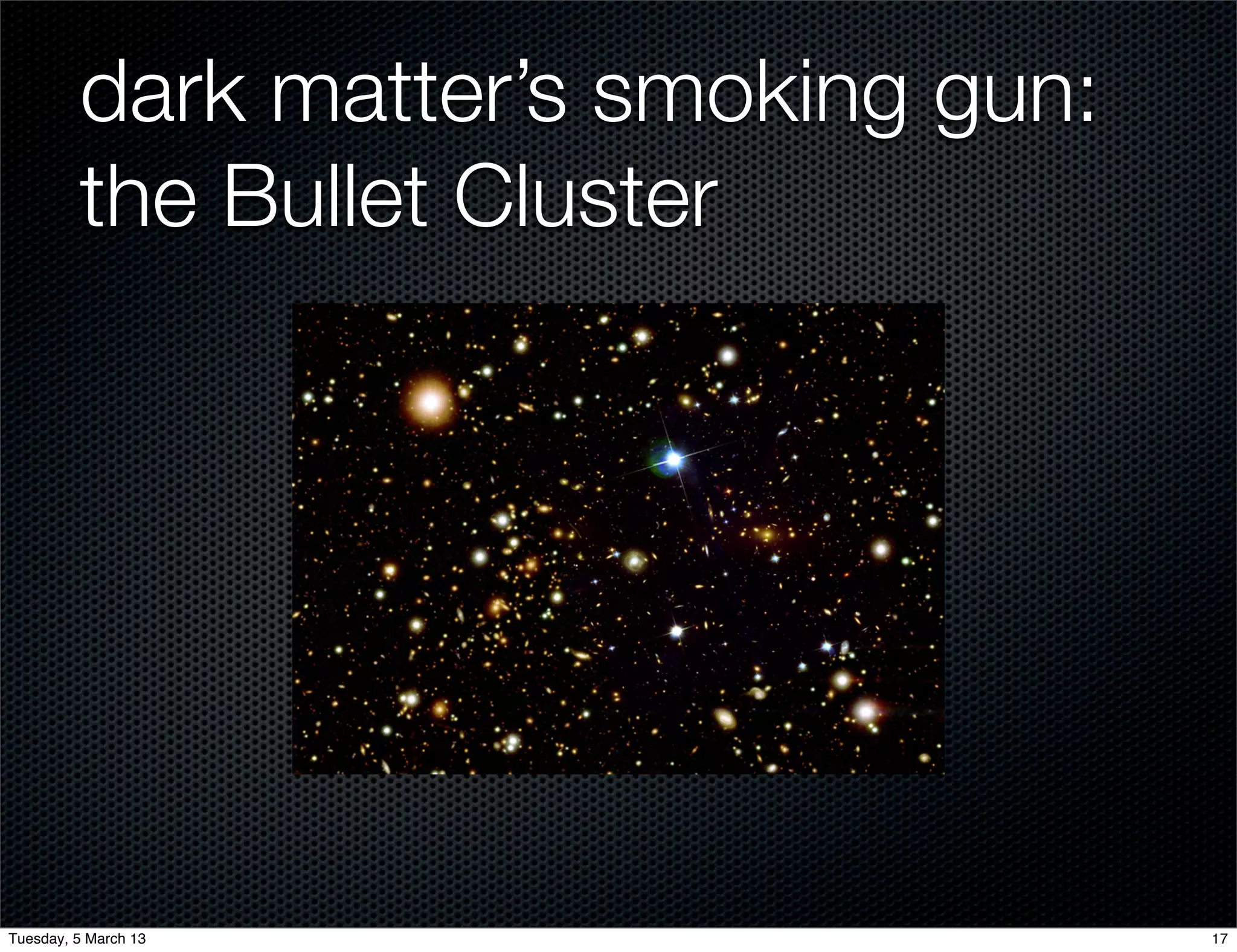
dark matter’s smoking gun:
         the Bullet Cluster


Tuesday, 5 March 13                   17
dark matter’s smoking gun:
         the Bullet Cluster


Tuesday, 5 March 13                   18
dark matter’s smoking gun:
         the Bullet Cluster


Tuesday, 5 March 13                   19
dark matter’s smoking gun:
         the Bullet Cluster


Tuesday, 5 March 13                   20
classes of dark matter
               Annihilating DM (e.g., SUSY neutralino WIMP)
               Decaying DM (e.g., axino)
               Warm DM (WDM) (e.g., sterile neutrino)
               Self-interacting DM (SIDM) (particle + dark sector force)
               Axion DM (e.g., QCD axion / string axion)
               MACHO DM (e.g., primordial black holes)


Tuesday, 5 March 13                                                        21
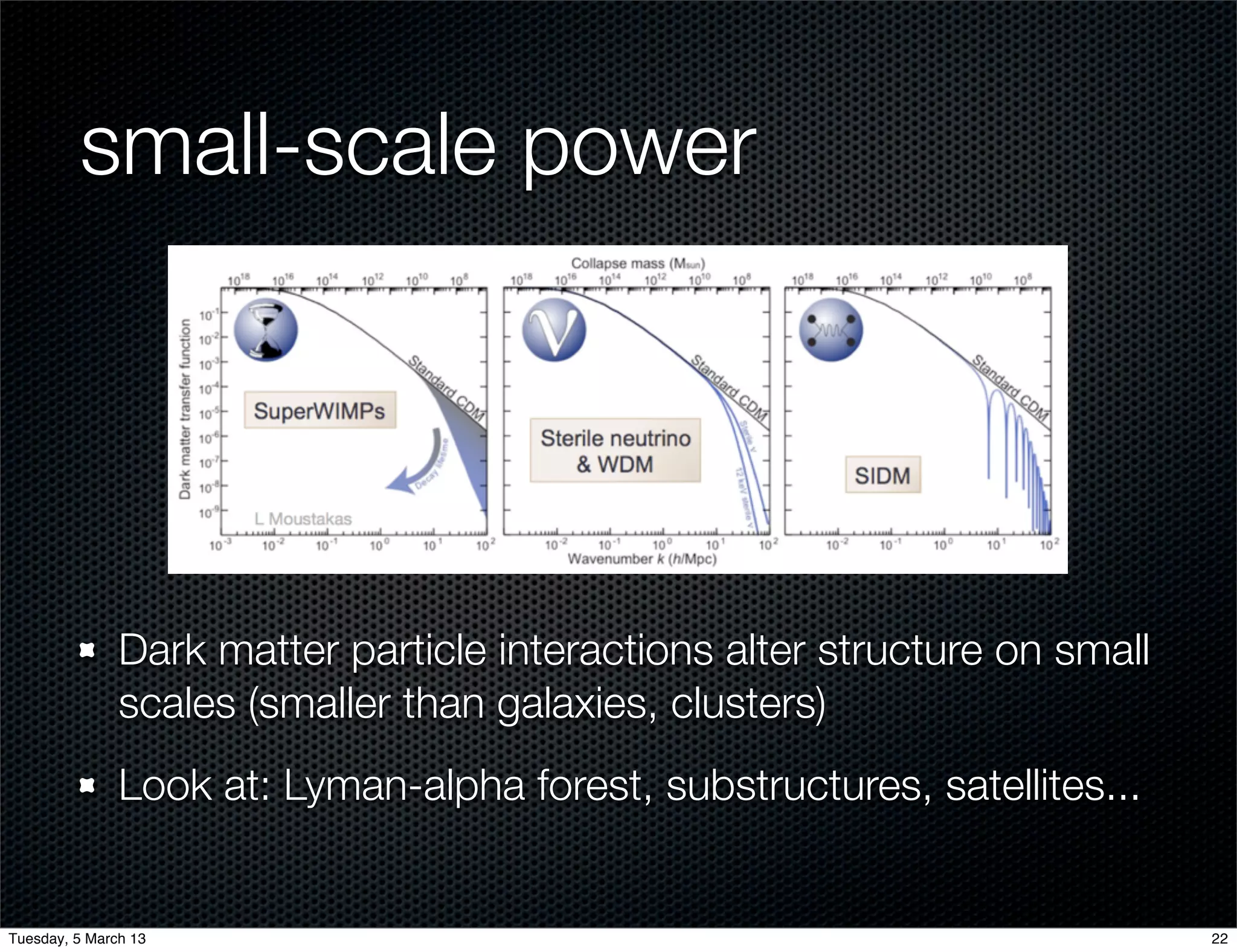
small-scale power


               Dark matter particle interactions alter structure on small
               scales (smaller than galaxies, clusters)
               Look at: Lyman-alpha forest, substructures, satellites...


Tuesday, 5 March 13                                                         22
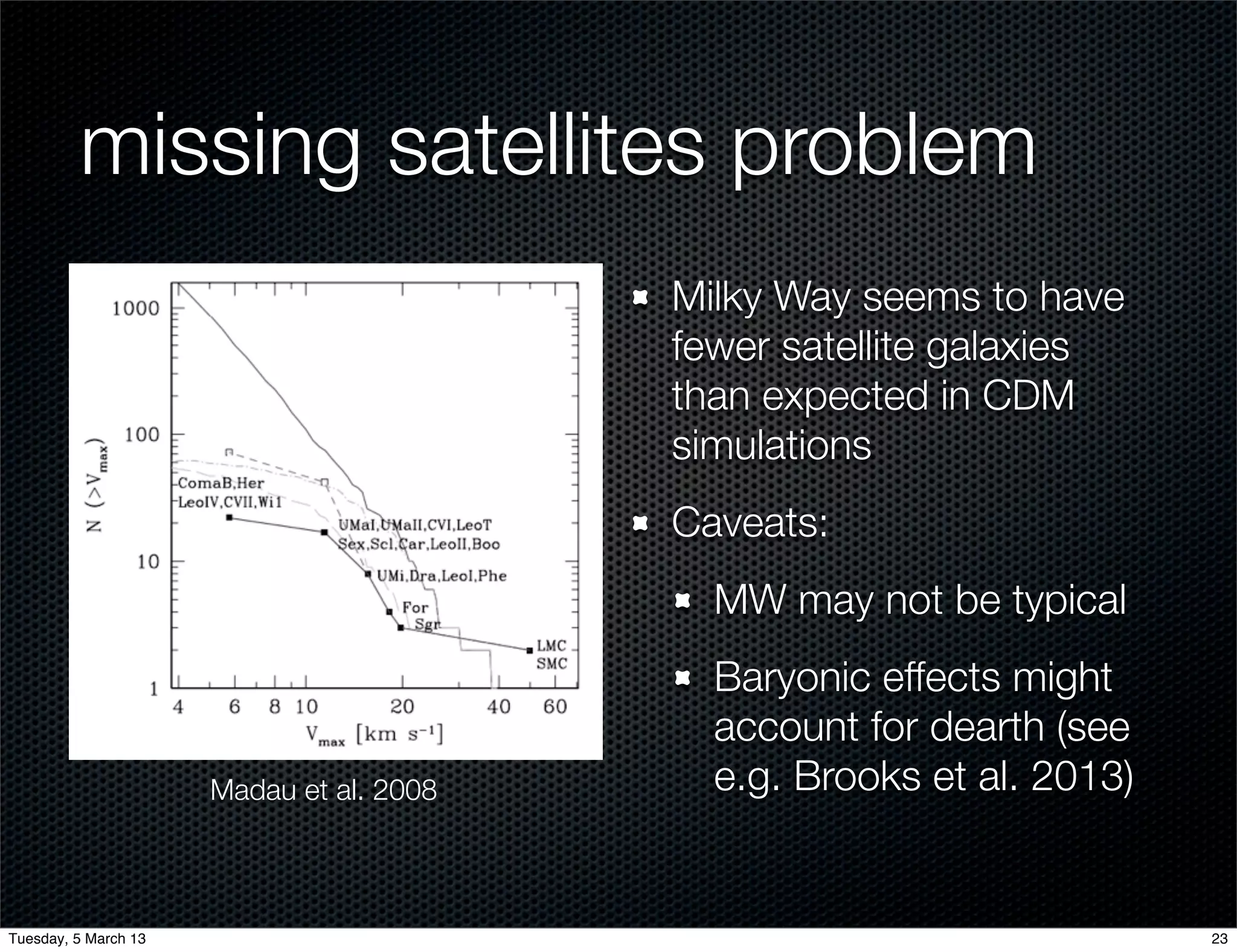
missing satellites problem
                                          Milky Way seems to have
                                          fewer satellite galaxies
                                          than expected in CDM
                                          simulations
                                          Caveats:
                                            MW may not be typical
                                            Baryonic effects might
                                            account for dearth (see
                      Madau et al. 2008     e.g. Brooks et al. 2013)


Tuesday, 5 March 13                                                    23
Navarro, Frenk & White 1997
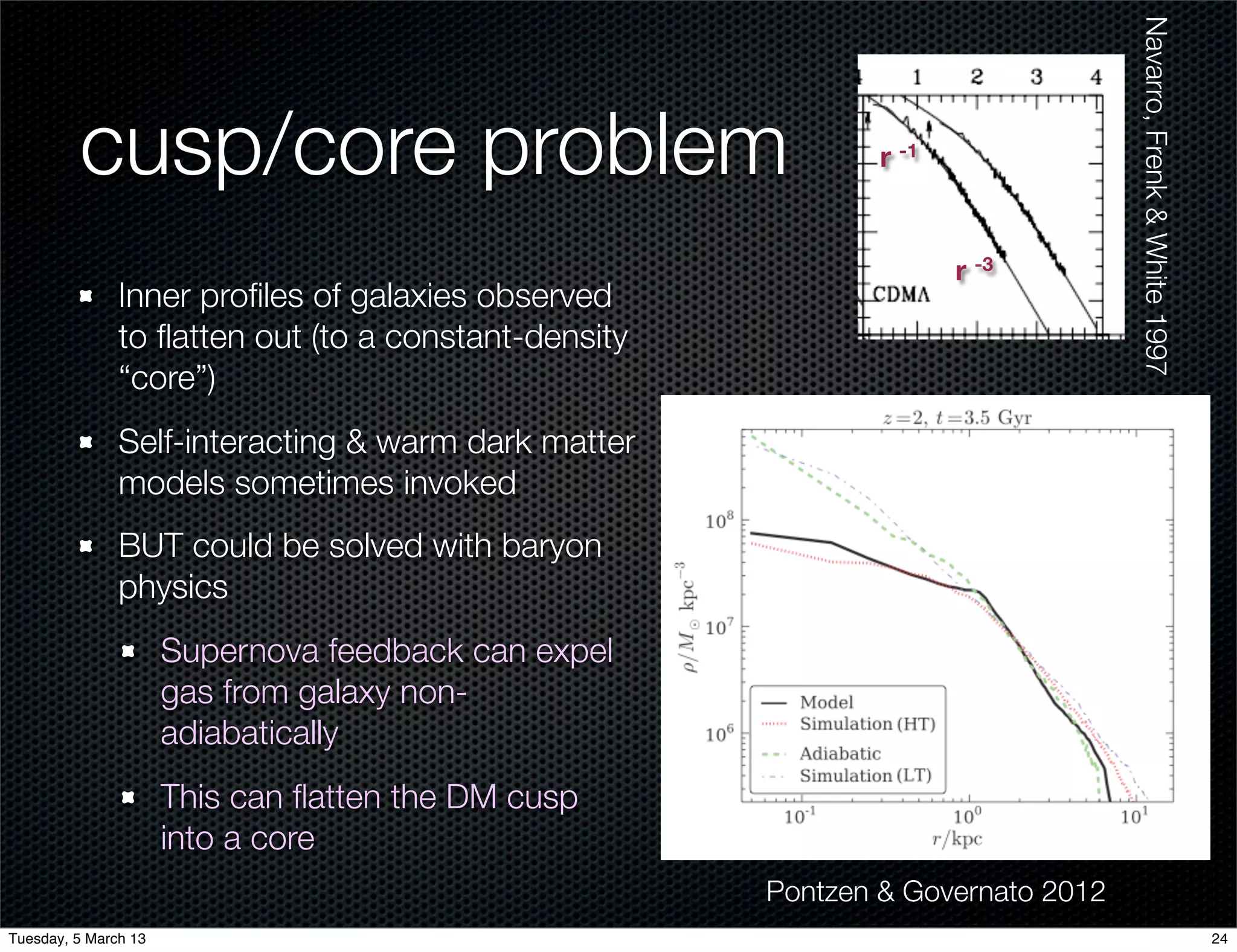
         cusp/core problem                                    r -1


                                                                     r -3
               Inner profiles of galaxies observed
               to flatten out (to a constant-density
               “core”)
               Self-interacting & warm dark matter
               models sometimes invoked
               BUT could be solved with baryon
               physics
                      Supernova feedback can expel
                      gas from galaxy non-
                      adiabatically
                      This can flatten the DM cusp
                      into a core
                                                      Pontzen & Governato 2012
Tuesday, 5 March 13                                                                                            24
warm dark matter
               WDM has a free-streaming scale
               within which structures are smooth
               “Erases” small-scale structure in
               the matter power spectrum
               Invoked for substructures,
               satellites
               Constrained by Lyman-alpha forest
               measurements
               BUT: core size - mass relation       Bode, Ostriker & Turok
                                                           2001
               doesn’t hold up
Tuesday, 5 March 13                                                          25
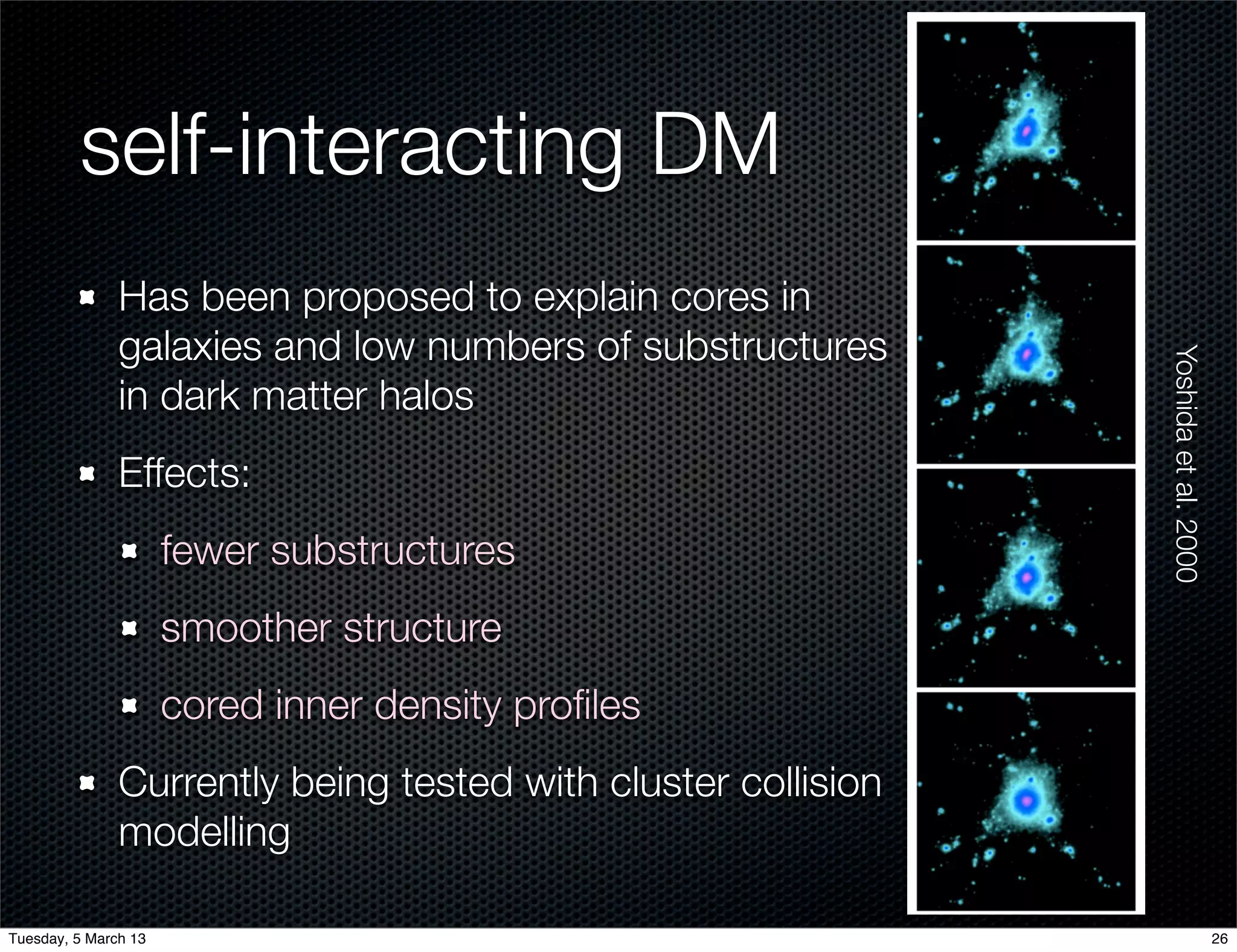
self-interacting DM
               Has been proposed to explain cores in
               galaxies and low numbers of substructures


                                                               Yoshida et al. 2000
               in dark matter halos
               Effects:
                      fewer substructures
                      smoother structure
                      cored inner density profiles
               Currently being tested with cluster collision
               modelling

Tuesday, 5 March 13                                                                  26
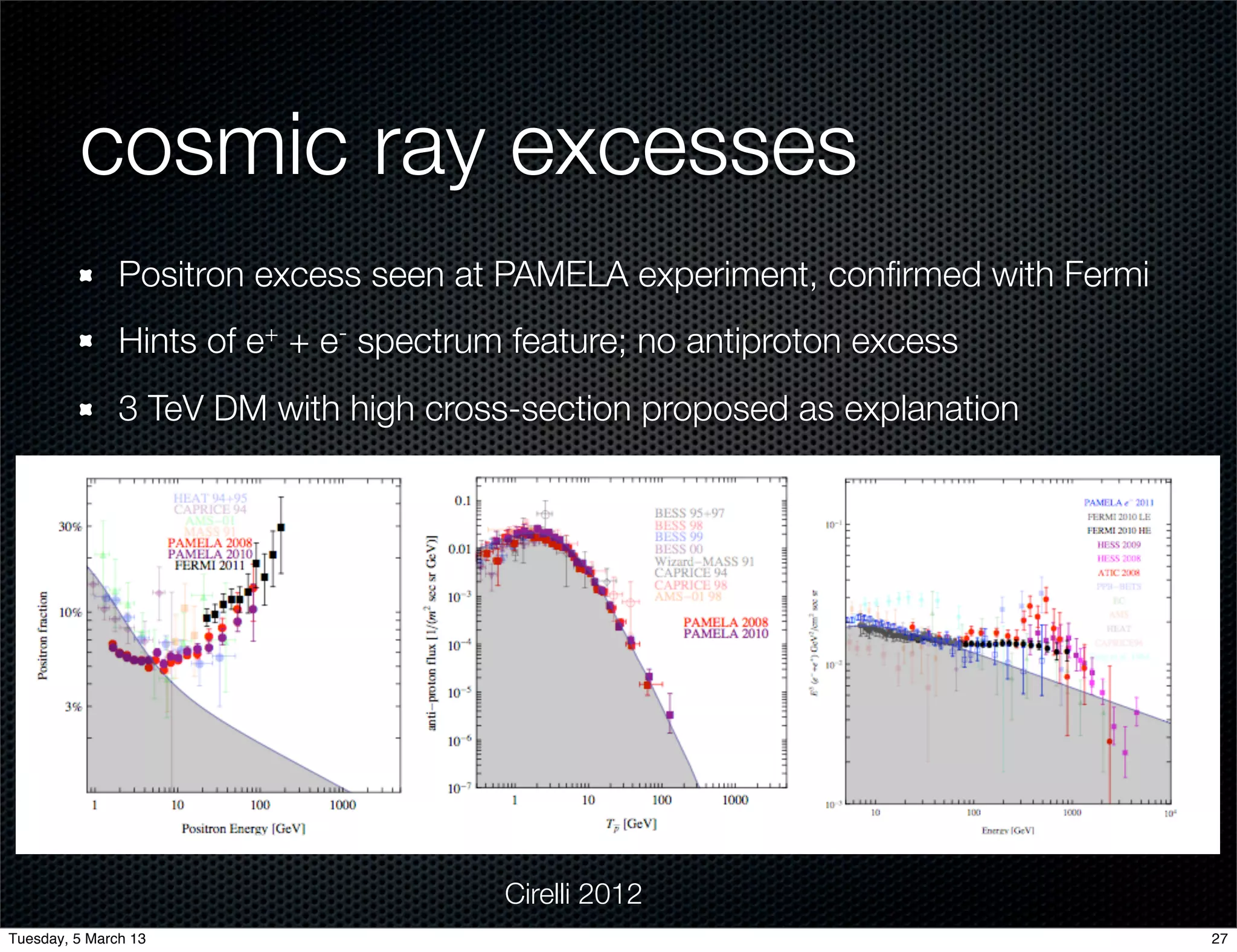
cosmic ray excesses
               Positron excess seen at PAMELA experiment, confirmed with Fermi
               Hints of e+ + e- spectrum feature; no antiproton excess
               3 TeV DM with high cross-section proposed as explanation


                                        Cirelli 2012
Tuesday, 5 March 13                                                             27
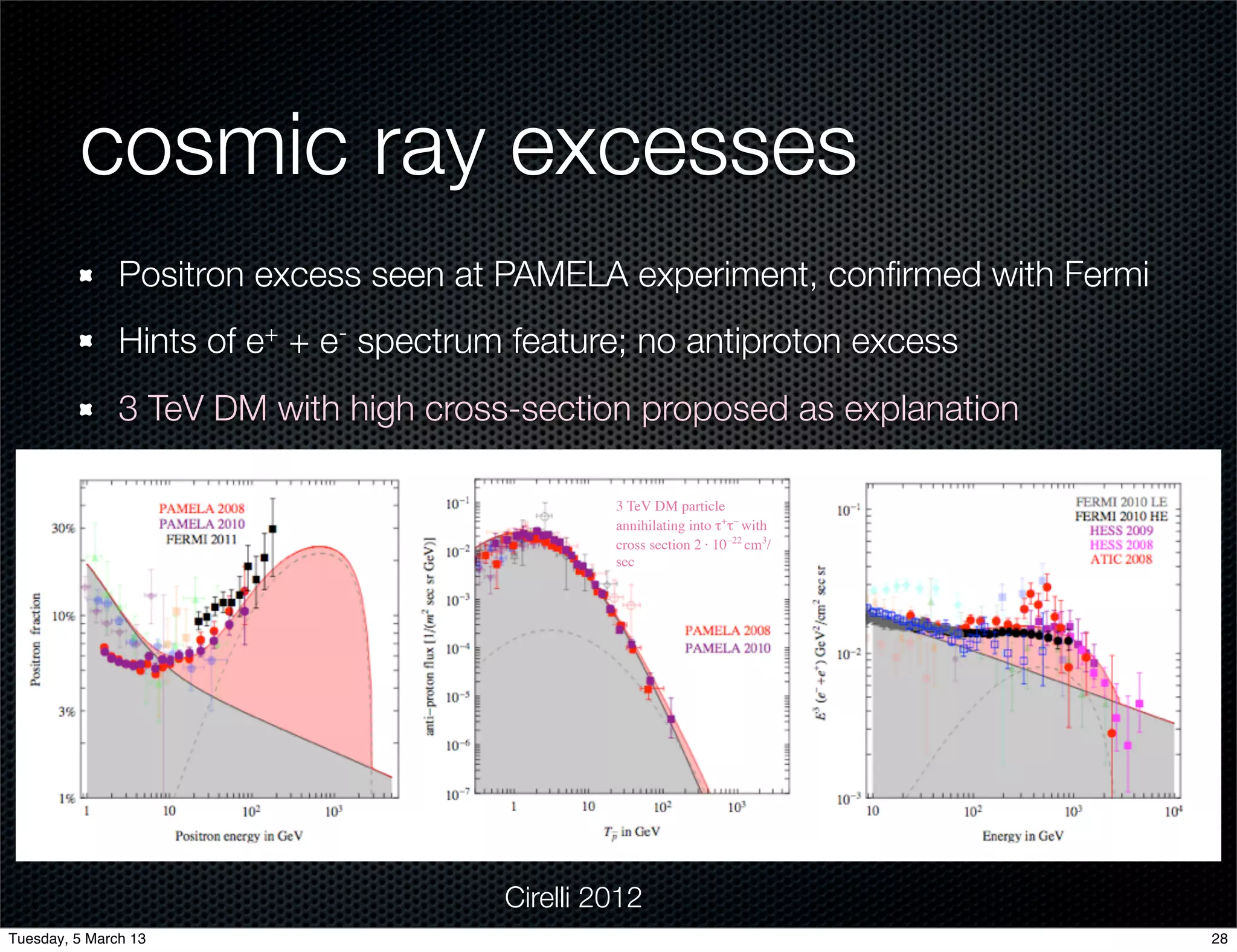
cosmic ray excesses
               Positron excess seen at PAMELA experiment, confirmed with Fermi
               Hints of e+ + e- spectrum feature; no antiproton excess
               3 TeV DM with high cross-section proposed as explanation

                                                 3 TeV DM particle
                                                 annihilating into τ+τ− with
                                                 cross section 2 · 10−22 cm3/
                                                 sec


                                        Cirelli 2012
Tuesday, 5 March 13                                                             28
cosmic ray excesses
               BUT it could be
               pulsars
               No directional
               information
               available
               Pulsars are known
               to produce
               electron/positron
               pairs               Grasso et al. 2009


Tuesday, 5 March 13                                     29
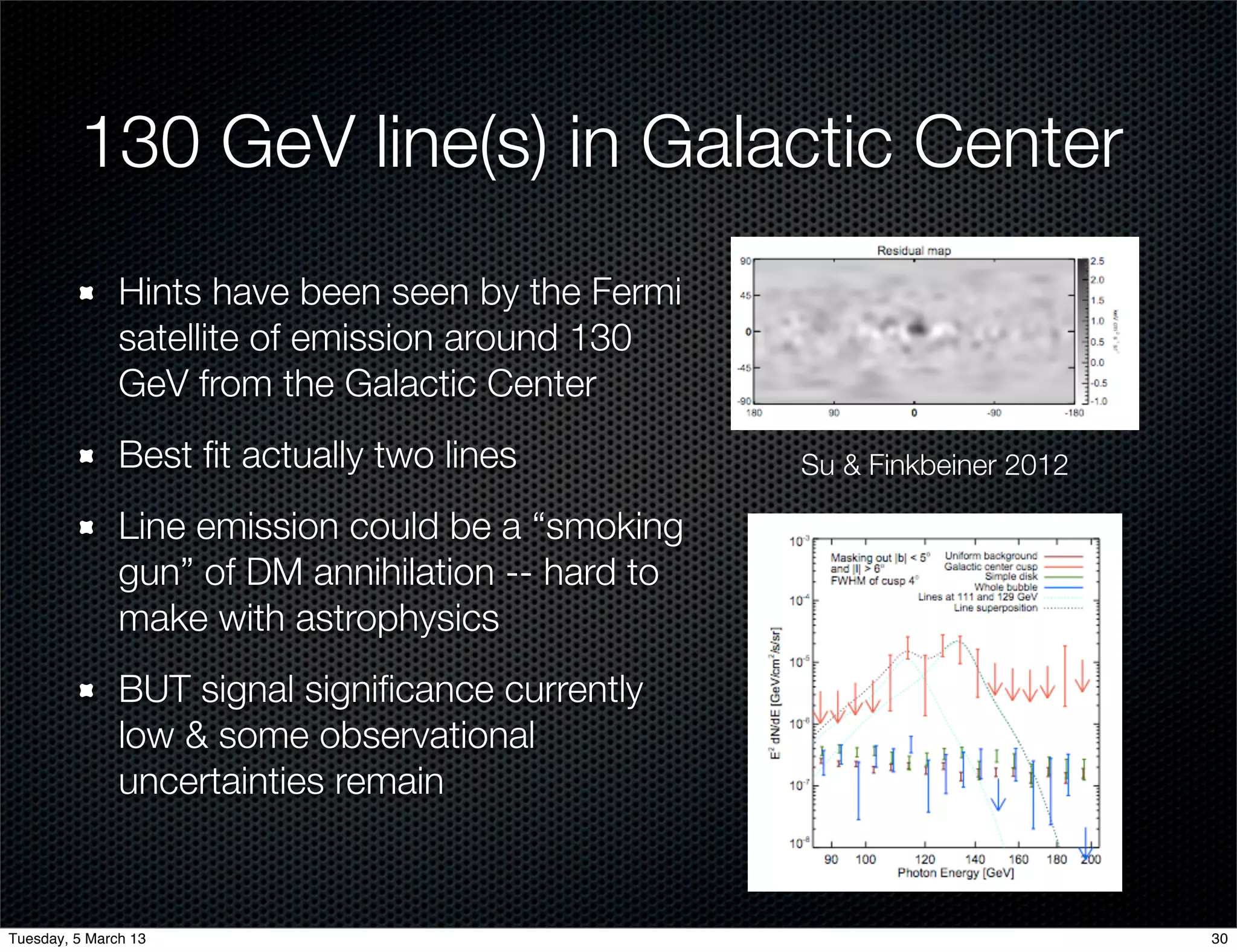
130 GeV line(s) in Galactic Center
               Hints have been seen by the Fermi
               satellite of emission around 130
               GeV from the Galactic Center
               Best fit actually two lines           Su & Finkbeiner 2012

               Line emission could be a “smoking
               gun” of DM annihilation -- hard to
               make with astrophysics
               BUT signal significance currently
               low & some observational
               uncertainties remain


Tuesday, 5 March 13                                                        30
future: signatures at early times
               Dark matter annihilation or
               decay can alter the         M.E.DE.A. code
                                                                                                                      M.Valdés, CE, A.Ferrara, MNRAS, 2011


               evolution of the
               intergalactic medium
                                                                                                                             heating


               Energy injection heats &               injected particle


               ionizes gas
                                                                            Lyman photons          ionization
               Signals may be seen in                             Image from talk by Carmello Evoli
                                                  • MEDEA follows every particle from TeV down to eV energies in a continuous way.

               redshifted 21cm line of            • Previous works have considered electrons up to keV only
                                                  (e.g. J.M.Shull & M.E. van Steenberg, APJ, 1985; S.Furlanetto & S.J.Stoever,!MNRAS, 2010).

               neutral hydrogen            giovedì 26 aprile 12


Tuesday, 5 March 13                                                                                                                                    31
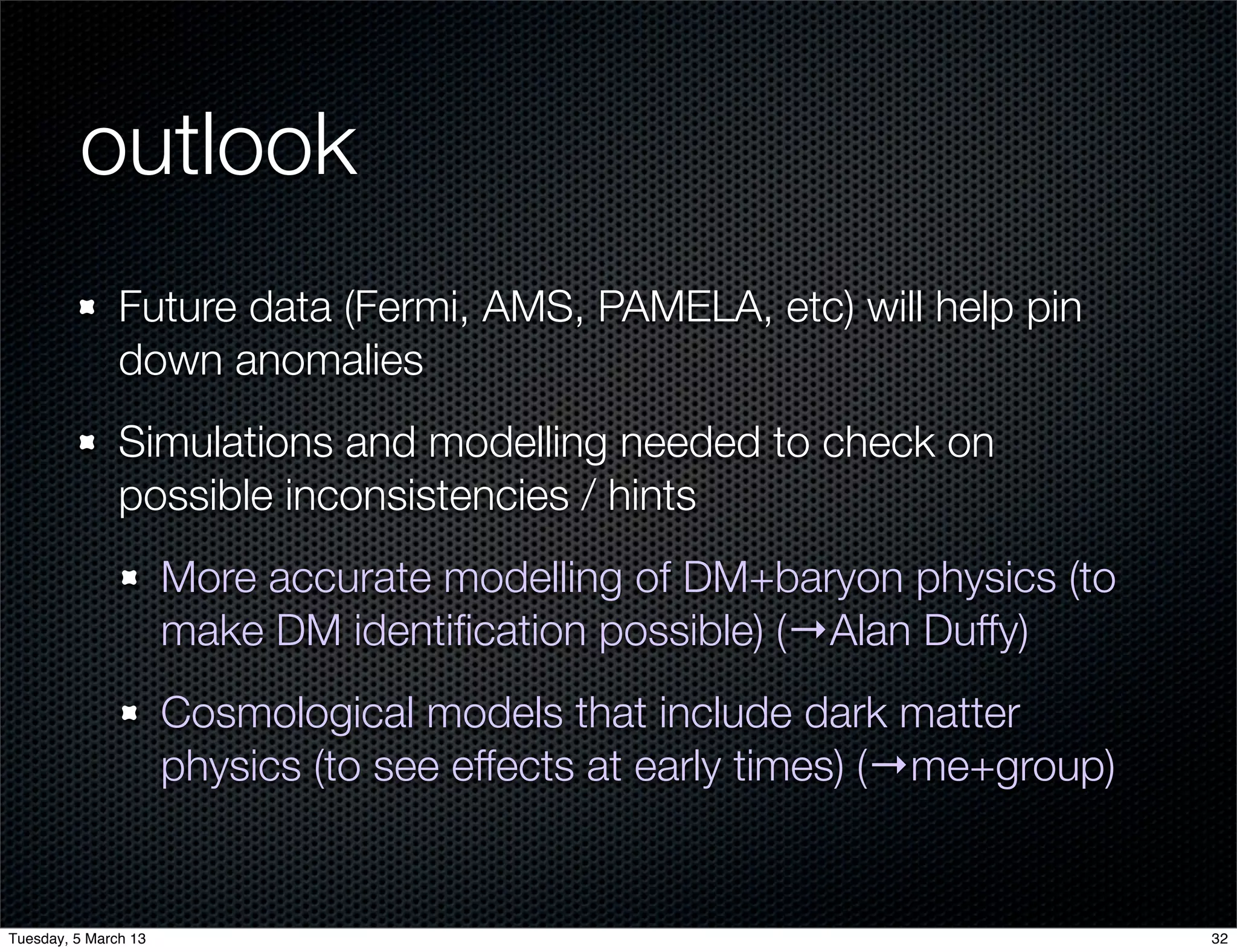
outlook
               Future data (Fermi, AMS, PAMELA, etc) will help pin
               down anomalies
               Simulations and modelling needed to check on
               possible inconsistencies / hints
                      More accurate modelling of DM+baryon physics (to
                      make DM identification possible) (→Alan Duffy)
                      Cosmological models that include dark matter
                      physics (to see effects at early times) (→me+group)


Tuesday, 5 March 13                                                         32
dark matter annihilates


                      altered radiation field                                                                     dark matter halos heat
                          at early times                                                                              themselves


                                                   altered small-scale
                                                          power


                                                                                        altered Pop III /
                                       change in IGM                                       dark stars
                                     evolution (heating/
                                         ionization)


                                                                                                                 change in SMBH production
                                                                                                                    from direct collapse /
             altered H2 abundance                                                                                        quasistars
                                                                          DRAGONS
                                                                    (Dark-ages Reionization And
                                                                    Galaxy Formation Simulation)


                                                   21cm global                                      21cm power
                                                      signal                                         spectrum


Tuesday, 5 March 13                                                                                                                          33
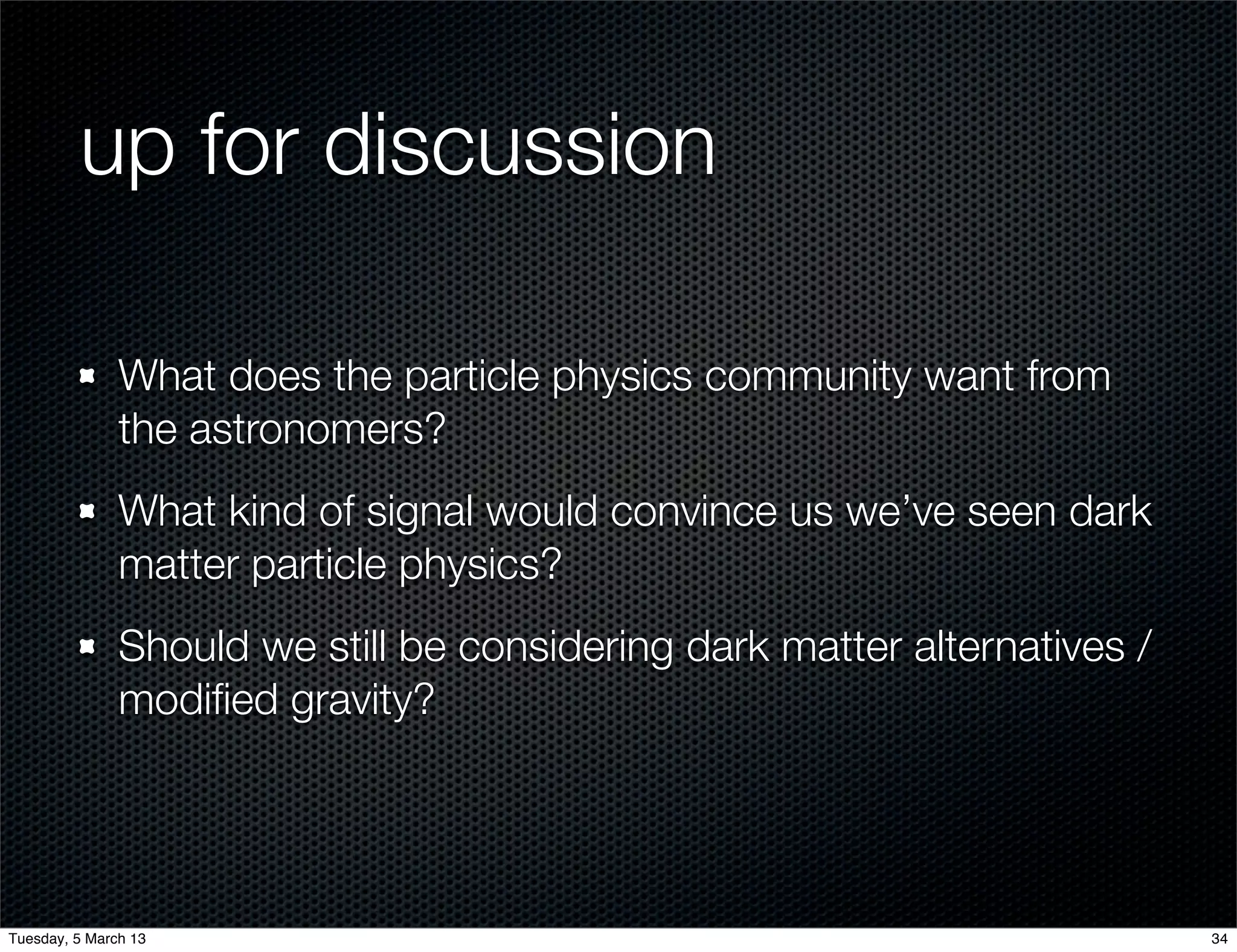
up for discussion

               What does the particle physics community want from
               the astronomers?
               What kind of signal would convince us we’ve seen dark
               matter particle physics?
               Should we still be considering dark matter alternatives /
               modified gravity?


Tuesday, 5 March 13                                                        34

Insights into Dark Matter

  • 1.
    Insights into DarkMatter Hints and Signals from Astrophysics Katherine J. Mack University of Melbourne www.ph.unimelb.edu.au/~kmack : @AstroKatie Tuesday, 5 March 13 1
  • 2.
    a slice ofthe universe pie Tuesday, 5 March 13 2
  • 3.
    what we know Dark matter is: Massive (gravitationally attractive & clustering) Cold (slow-moving) Collisionless (passes through itself and other matter) Dark (does not emit or absorb light) Non- (or weakly-) interacting (no detected non- gravitational interactions with other particles) Tuesday, 5 March 13 3
  • 4.
    what we don’tknow Fundamental nature of dark matter How dark matter formed in the universe Whether dark matter has any non-gravitational interaction with standard model particles Whether dark matter has any non-gravitational interaction with itself Tuesday, 5 March 13 4
  • 5.
    the evidence amasses Rotation curves & galactic dynamics (missing mass) Cluster dynamics (missing mass) Strong & weak gravitational lensing (missing mass / halo shapes / substructure) Gravitational microlensing (smooth distribution of mass) CMB acoustic peaks (DM/baryon ratio) Matter power spectrum & structure formation (DM/baryon ratio) Cluster collisions (missing mass / collisionless matter) Tuesday, 5 March 13 5
  • 6.
    the evidence amasses Rotation curves & galactic dynamics (missing mass) Cluster dynamics (missing mass) Strong & weak gravitational lensing (missing mass / halo shapes / substructure) Gravitational microlensing (smooth distribution of mass) CMB acoustic peaks (DM/baryon ratio) Matter power spectrum & structure formation (DM/baryon ratio) Cluster collisions (missing mass / collisionless matter) Tuesday, 5 March 13 6
  • 7.
    the evidence amasses Rotation curves & galactic dynamics (missing mass) Cluster dynamics (missing mass) Strong & weak gravitational lensing (missing mass / halo shapes / substructure) Gravitational microlensing (smooth distribution of mass) CMB acoustic peaks (DM/baryon ratio) Matter power spectrum & structure formation (DM/baryon ratio) Cluster collisions (missing mass / collisionless matter) Tuesday, 5 March 13 7
  • 8.
    the evidence amasses Rotation curves & galactic dynamics (missing mass) Cluster dynamics (missing mass) Strong & weak gravitational lensing (missing mass / halo shapes / substructure) Gravitational microlensing (smooth distribution of mass) CMB acoustic peaks (DM/baryon ratio) Matter power spectrum & structure formation (DM/baryon ratio) Cluster collisions (missing mass / collisionless matter) Tuesday, 5 March 13 8
  • 9.
    the evidence amasses Rotation curves & galactic dynamics (missing mass) Cluster dynamics (missing mass) Strong & weak gravitational lensing (missing mass / halo shapes / substructure) Gravitational microlensing (smooth distribution of mass) CMB acoustic peaks (DM/baryon ratio) Matter power spectrum & structure formation (DM/baryon ratio) Cluster collisions (missing mass / collisionless matter) Tuesday, 5 March 13 9
  • 10.
    cosmological microlensing ESO Tuesday, 5 March 13 10
  • 11.
    cosmological microlensing 1454 MEDIAVILLA ET AL. Vol. 706 α=0.01 α=0.05 α=0.1 Lensing of background quasars by galaxies can give insight into galaxy mass distributions α=0.15 α=0.2 α=0.25 Constraints can be placed on fraction of mass in compact α=0.3 α=0.5 α=1 sources (stars) Constraint: α < 10% Figure 2. Example of magnification maps for the case κ = γ = 0.45. From top to bottom and from left to right, maps correspond to α = 0.01, 0.05, 0.10, 0.15, 0.20, 0.25, 0.30, 0.50, 1.00. Mediavilla et al. 2009 2. OBSERVED MICROLENSING MAGNIFICATIONS AND For some of the image pairs (∼30% of the sample) there MACRO-LENS MODELS are mid-IR flux ratios available. Except for one system, SDSS J1004+4112 (where image C is probably affected by extinction, We collected the data, ∆m (see Equation (4)), examining all ´ G´ mez-Alvarez et al. 2006), they are in very good agreement o the optical spectroscopy5 found in the literature (see Table 1). In with the emission-line flux ratios (see Table 2). The average most cases, the microlensing magnification or the scaling of the difference between mid-IR and emission line flux ratios is only Tuesday, 5 March 13 emission line ratio with respect to the continuum ratio are di- 11
  • 12.
    the evidence amasses Rotation curves & galactic dynamics (missing mass) Cluster dynamics (missing mass) Strong & weak gravitational lensing (missing mass / halo shapes / substructure) Gravitational microlensing (smooth distribution of mass) CMB acoustic peaks (DM/baryon ratio) Matter power spectrum & structure formation (DM/baryon ratio) Cluster collisions (missing mass / collisionless matter) Tuesday, 5 March 13 12
  • 13.
    WMAP 9 SPT ACT Hinshaw et al. 2013 Tuesday, 5 March 13 13
  • 14.
    the evidence amasses Rotation curves & galactic dynamics (missing mass) Cluster dynamics (missing mass) Strong & weak gravitational lensing (missing mass / halo shapes / substructure) Gravitational microlensing (smooth distribution of mass) CMB acoustic peaks (DM/baryon ratio) Matter power spectrum & structure formation (DM/baryon ratio) Cluster collisions (missing mass / collisionless matter) Tuesday, 5 March 13 14
  • 15.
  • 16.
    the evidence amasses Rotation curves & galactic dynamics (missing mass) Cluster dynamics (missing mass) Strong & weak gravitational lensing (missing mass / halo shapes / substructure) Gravitational microlensing (smooth distribution of mass) CMB acoustic peaks (DM/baryon ratio) Matter power spectrum & structure formation (DM/baryon ratio) Cluster collisions (missing mass / collisionless matter) Tuesday, 5 March 13 16
  • 17.
    dark matter’s smokinggun: the Bullet Cluster Tuesday, 5 March 13 17
  • 18.
    dark matter’s smokinggun: the Bullet Cluster Tuesday, 5 March 13 18
  • 19.
    dark matter’s smokinggun: the Bullet Cluster Tuesday, 5 March 13 19
  • 20.
    dark matter’s smokinggun: the Bullet Cluster Tuesday, 5 March 13 20
  • 21.
    classes of darkmatter Annihilating DM (e.g., SUSY neutralino WIMP) Decaying DM (e.g., axino) Warm DM (WDM) (e.g., sterile neutrino) Self-interacting DM (SIDM) (particle + dark sector force) Axion DM (e.g., QCD axion / string axion) MACHO DM (e.g., primordial black holes) Tuesday, 5 March 13 21
  • 22.
    small-scale power Dark matter particle interactions alter structure on small scales (smaller than galaxies, clusters) Look at: Lyman-alpha forest, substructures, satellites... Tuesday, 5 March 13 22
  • 23.
    missing satellites problem Milky Way seems to have fewer satellite galaxies than expected in CDM simulations Caveats: MW may not be typical Baryonic effects might account for dearth (see Madau et al. 2008 e.g. Brooks et al. 2013) Tuesday, 5 March 13 23
  • 24.
    Navarro, Frenk &White 1997 cusp/core problem r -1 r -3 Inner profiles of galaxies observed to flatten out (to a constant-density “core”) Self-interacting & warm dark matter models sometimes invoked BUT could be solved with baryon physics Supernova feedback can expel gas from galaxy non- adiabatically This can flatten the DM cusp into a core Pontzen & Governato 2012 Tuesday, 5 March 13 24
  • 25.
    warm dark matter WDM has a free-streaming scale within which structures are smooth “Erases” small-scale structure in the matter power spectrum Invoked for substructures, satellites Constrained by Lyman-alpha forest measurements BUT: core size - mass relation Bode, Ostriker & Turok 2001 doesn’t hold up Tuesday, 5 March 13 25
  • 26.
    self-interacting DM Has been proposed to explain cores in galaxies and low numbers of substructures Yoshida et al. 2000 in dark matter halos Effects: fewer substructures smoother structure cored inner density profiles Currently being tested with cluster collision modelling Tuesday, 5 March 13 26
  • 27.
    cosmic ray excesses Positron excess seen at PAMELA experiment, confirmed with Fermi Hints of e+ + e- spectrum feature; no antiproton excess 3 TeV DM with high cross-section proposed as explanation Cirelli 2012 Tuesday, 5 March 13 27
  • 28.
    cosmic ray excesses Positron excess seen at PAMELA experiment, confirmed with Fermi Hints of e+ + e- spectrum feature; no antiproton excess 3 TeV DM with high cross-section proposed as explanation 3 TeV DM particle annihilating into τ+τ− with cross section 2 · 10−22 cm3/ sec Cirelli 2012 Tuesday, 5 March 13 28
  • 29.
    cosmic ray excesses BUT it could be pulsars No directional information available Pulsars are known to produce electron/positron pairs Grasso et al. 2009 Tuesday, 5 March 13 29
  • 30.
    130 GeV line(s)in Galactic Center Hints have been seen by the Fermi satellite of emission around 130 GeV from the Galactic Center Best fit actually two lines Su & Finkbeiner 2012 Line emission could be a “smoking gun” of DM annihilation -- hard to make with astrophysics BUT signal significance currently low & some observational uncertainties remain Tuesday, 5 March 13 30
  • 31.
    future: signatures atearly times Dark matter annihilation or decay can alter the M.E.DE.A. code M.Valdés, CE, A.Ferrara, MNRAS, 2011 evolution of the intergalactic medium heating Energy injection heats & injected particle ionizes gas Lyman photons ionization Signals may be seen in Image from talk by Carmello Evoli • MEDEA follows every particle from TeV down to eV energies in a continuous way. redshifted 21cm line of • Previous works have considered electrons up to keV only (e.g. J.M.Shull & M.E. van Steenberg, APJ, 1985; S.Furlanetto & S.J.Stoever,!MNRAS, 2010). neutral hydrogen giovedì 26 aprile 12 Tuesday, 5 March 13 31
  • 32.
    outlook Future data (Fermi, AMS, PAMELA, etc) will help pin down anomalies Simulations and modelling needed to check on possible inconsistencies / hints More accurate modelling of DM+baryon physics (to make DM identification possible) (→Alan Duffy) Cosmological models that include dark matter physics (to see effects at early times) (→me+group) Tuesday, 5 March 13 32
  • 33.
    dark matter annihilates altered radiation field dark matter halos heat at early times themselves altered small-scale power altered Pop III / change in IGM dark stars evolution (heating/ ionization) change in SMBH production from direct collapse / altered H2 abundance quasistars DRAGONS (Dark-ages Reionization And Galaxy Formation Simulation) 21cm global 21cm power signal spectrum Tuesday, 5 March 13 33
  • 34.
    up for discussion What does the particle physics community want from the astronomers? What kind of signal would convince us we’ve seen dark matter particle physics? Should we still be considering dark matter alternatives / modified gravity? Tuesday, 5 March 13 34