CLOUD COMPUTING
Adhish PendharkarFeb - 2014
2
What is cloud computing?
3
1Cloud computing is an information-processing model in which centrally administered
computing capabilities are delivered as services, on an as-needed basis, across the
network to a variety of user-facing devices.
1. Cloud Computing By Brain J.S. Chee & Curtis Fran
Abstraction is a critical foundation concept for cloud computing because it allows us
to think of a particular service:
 an application
 a particular communication protocol
 processing cycles within a CPU
 storage capacity on a hard disk
Without thinking about a particular piece of hardware that will provide that service.
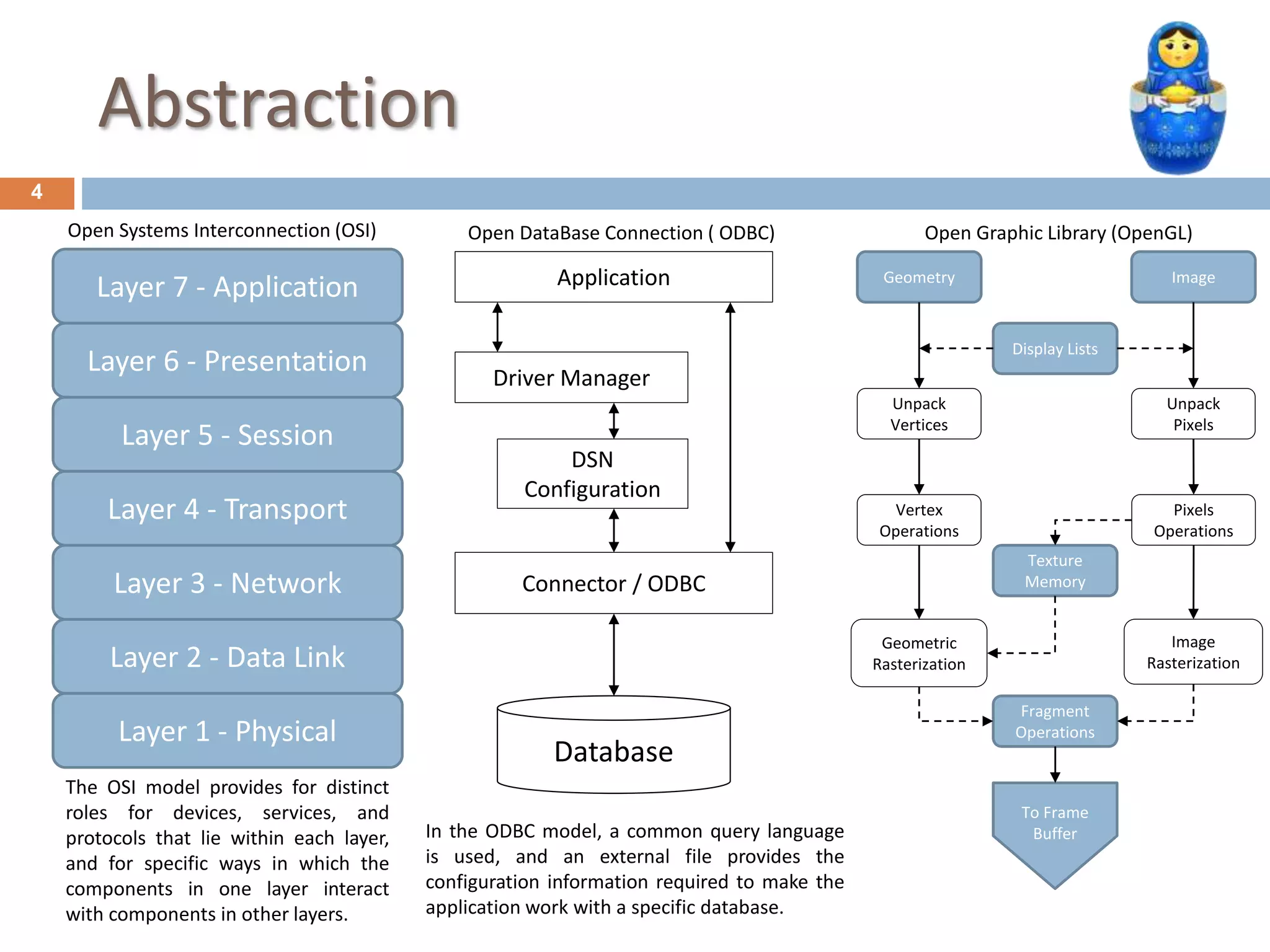
Abstraction
4
Layer 1 - Physical
Layer 2 - Data Link
Layer 3 - Network
Layer 4 - Transport
Layer 5 - Session
Layer 6 - Presentation
Layer 7 - Application
Open Systems Interconnection (OSI)
The OSI model provides for distinct
roles for devices, services, and
protocols that lie within each layer,
and for specific ways in which the
components in one layer interact
with components in other layers.
Open DataBase Connection ( ODBC)
Application
Driver Manager
DSN
Configuration
Connector / ODBC
Database
In the ODBC model, a common query language
is used, and an external file provides the
configuration information required to make the
application work with a specific database.
Open Graphic Library (OpenGL)
Geometry Image
Unpack
Vertices
Vertex
Operations
Geometric
Rasterization
Unpack
Pixels
Pixels
Operations
Image
Rasterization
Display Lists
Texture
Memory
Fragment
Operations
To Frame
Buffer
Grid Computing
5
According to Wikipedia:
Grid computing is a form of distributed computing whereby a “super and virtual computer” is
composed of a cluster of networked, loosely-coupled computers, acting in concert to perform very
large tasks.
This technology has been applied to computationally-intensive scientific, mathematical, and
academic problems through volunteer computing, and it is used in commercial enterprises for
such diverse applications as drug discovery, economic forecasting, seismic analysis, and back-office
data processing in support of e-commerce and web services.
What distinguishes grid computing from typical cluster computing systems is that grids tend to be
more loosely coupled, heterogeneous, and geographically dispersed. Also, while a computing grid
may be dedicated to a specialized application, it is often constructed with the aid of general
purpose grid software libraries and middleware.
Cloud Computing - In a nut case
6
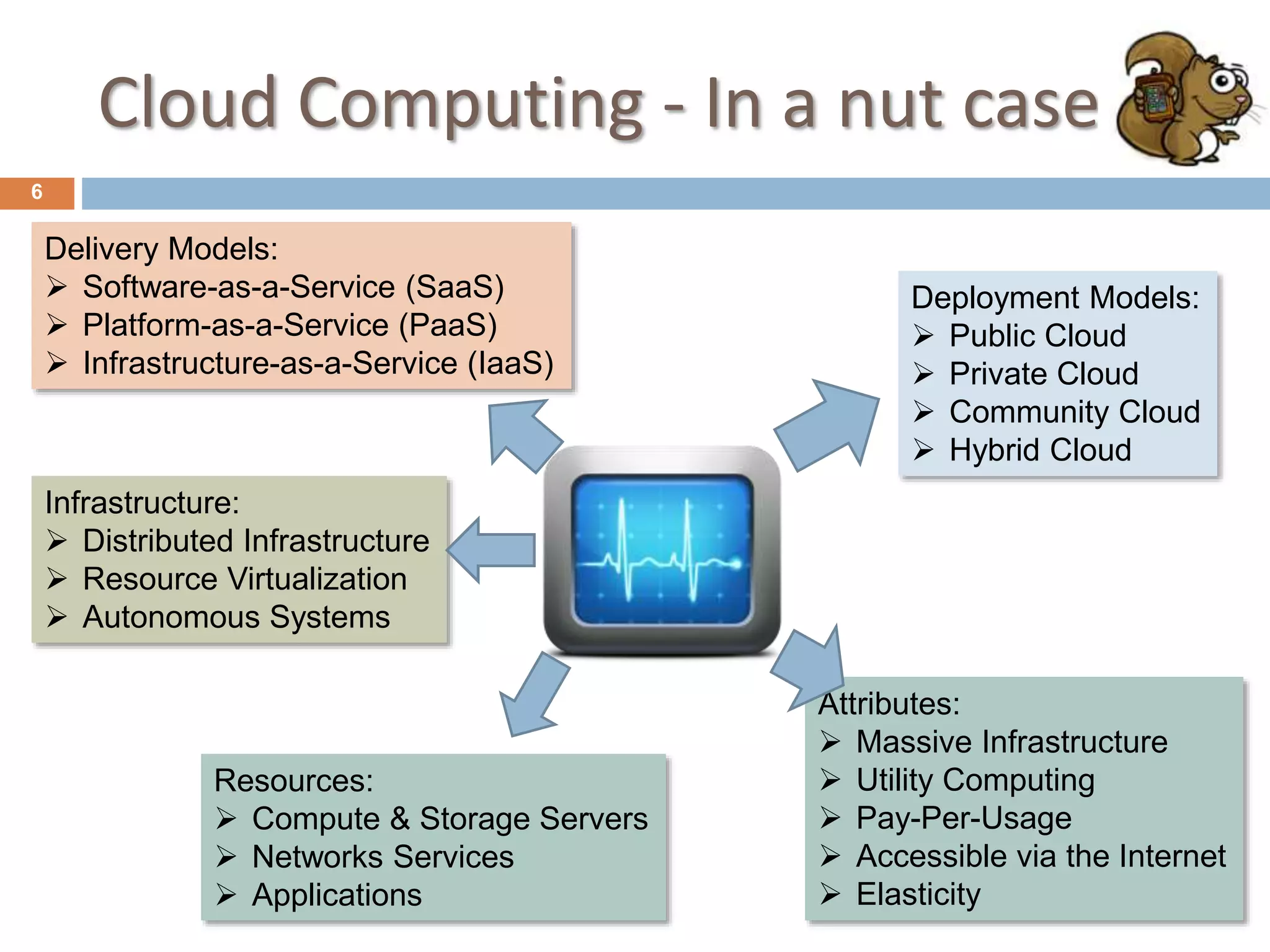
Deployment Models:
 Public Cloud
 Private Cloud
 Community Cloud
 Hybrid Cloud
Delivery Models:
 Software-as-a-Service (SaaS)
 Platform-as-a-Service (PaaS)
 Infrastructure-as-a-Service (IaaS)
Infrastructure:
 Distributed Infrastructure
 Resource Virtualization
 Autonomous Systems
Resources:
 Compute & Storage Servers
 Networks Services
 Applications
Attributes:
 Massive Infrastructure
 Utility Computing
 Pay-Per-Usage
 Accessible via the Internet
 Elasticity
Cloud Computing - Delivery Models
7
Cloud computing is a general term for anything that involves delivering hosted services
over the network (typically Internet).
Cloud computing services are broadly classified under three main categories:
Software-As-A-Service
Infrastructure-As-A-Service
Platform-As-A-Service
This is a software distribution model in which applications are hosted by a vendor/service
provider and available to customers over a network.
This is a way to rent hardware / Operating Systems / Storage and Network Capacity over the
network, typically over internet. The service delivery model allows us to rent different
capacities but build a virtual environment that suits our needs.
* PaaS is NOT Virtualization.
This is a provision model in which the equipments used i.e. storage, hardware, servers and
networking are outsourced. The service provider owns the equipment and is responsible
for hosting, running and maintaining these equipments.
Software-as-a-Service [SaaS]
8
 Gives users the capability to use
applications supplied by service
provider.
 Not suitable for applications that
require real-time response, or
hosting of local data.
 Suitable for products like emails,
billing and payroll.
 Suitable for need to access over
web or mobile.
API
Abstraction
Core
Connectivity
Hardware
Facilities
Platform-as-a-Service [PaaS]
9
 Gives the capability to deploy consumer-
created or acquired applications using
programming languages & tools.
 User has full control over the deployed
application
 Session Management
 Device Integration
 Sandboxes
 Instrumentation and Testing
 PaaS is not useful when application must
be portable or proprietary programming
languages are used.
API
Abstraction
Core
Connectivity
Hardware
Facilities
Integration &
Middleware
Infrastructure-as-a-Service [IaaS]
10
 Gives the capability to provision
processing, storage, network and
computing resources.
 Services offered
 Server hosting
 Web Servers
 Storage
 Computing Hardware
 Operating Systems
 Virtual Instances
 Load Balancing
API
Abstraction
Core
Connectivity
Hardware
Facilities
Integration &
Middleware
Data Metadata
Applications
API
Presentation
Cloud Computing - Making it success
11
 Service Management
& Provisioning
 Virtualization
 Service Provisioning
 Call Center
 Operations
Management
 QoS Management
 Billing & Accounting
 Asset Management
 SLA Management
 Technical Support
 Backups
 Security Management
 ID & Authentication
 Certification &
Accreditation
 Intrusion Prevention &
Detection
 Virus Protection
 Cryptography
 Physical Security
 Incident Response
 Access Control
 Audit & Trails
 FireWall
Cloud Computing - Making it success
12
 Customer Service
 Customer Assistance
 Online Help
 Subscriptions
 Business Intelligence
 Reporting
 Customer Preferences
 Personalization
 Integration Services
 Data Management
 Development
Cloud Computing - Ethical Issues
13
 The control is relinquished to third-party services
 Risk: Unauthorized access, data corruption, service
unavailability.
 The data is stored on multiple sites administered by
several organizations
 Difficult to identify the source and entity causing the
problems.
 Multiple services interoperate across the network
 Identity fraud and theft are impossible to identify due to
lack of traceability.
 Vendor lock-in
Offerings in the market
 Compute
 Compute Engine [IaaS]
 App Engine [PaaS]
 Storage
 Cloud SQL
 Cloud Storage
 Cloud Datastore
 Big Data
 BigQuery
 Services
 Cloud Endpoints
 Translate API
 Prediction API
14 Google Cloud [https://cloud.google.com/products/]
 Solutions
 Mobile
 Gaming
 Hadoop [SaaS]
 Developer Tools
 Google Cloud SDK
 Push-to-Deploy
 Cloud Playground
 Android Studio
 Google Plugin for
Eclipse
Offerings in the market
 Compute
 Elastic Compute Cloud
 Elastic Load Balancing
 Auto Scaling
 WorkSpaces
 Storage
 Simple Storage Service (S3)
 Glacier
 Storage Gateway
 Elastic Block Store
 Import / Export
 Database / BigData
 Relational Database Service
 DynamoDB
 Redshift (petabyte)
 SimpleDB (non-relational data
store)
 ElasticCache
15 Amazon Cloud [http://aws.amazon.com/products/]
 Solutions
 AppStream
 Simple Workflow
Service
 Simple Notification
Service
 CloudSearch
 CloudFront
 Developer Tools
 AWS Cloud SDK
 Eclipse
 Visual Studio
Q.A?
16
Appendix - Recommended Reading
17
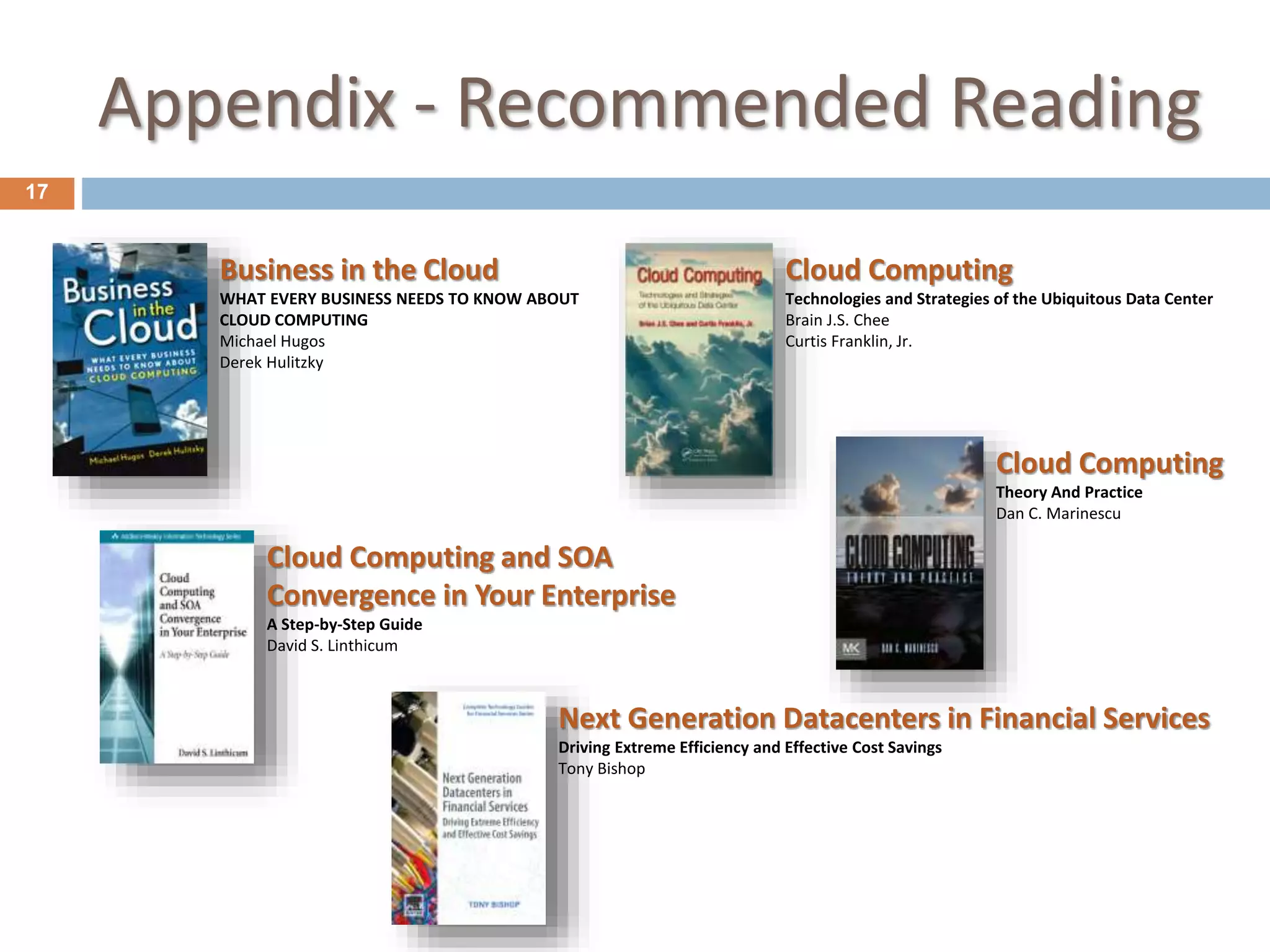
Business in the Cloud
WHAT EVERY BUSINESS NEEDS TO KNOW ABOUT
CLOUD COMPUTING
Michael Hugos
Derek Hulitzky
Cloud Computing
Technologies and Strategies of the Ubiquitous Data Center
Brain J.S. Chee
Curtis Franklin, Jr.
Next Generation Datacenters in Financial Services
Driving Extreme Efficiency and Effective Cost Savings
Tony Bishop
Cloud Computing
Theory And Practice
Dan C. Marinescu
Cloud Computing and SOA
Convergence in Your Enterprise
A Step-by-Step Guide
David S. Linthicum
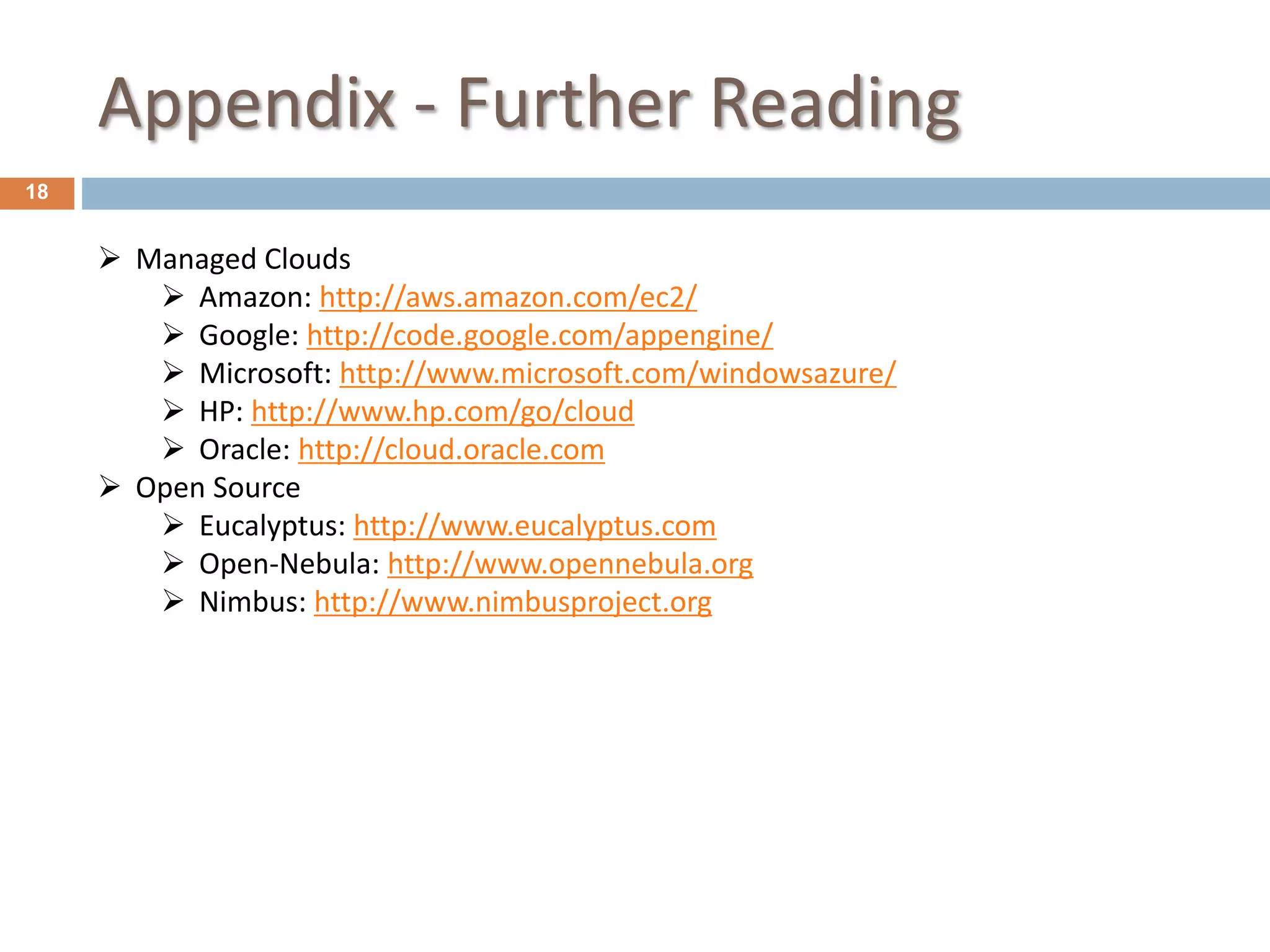
Appendix - Further Reading
18
 Managed Clouds
 Amazon: http://aws.amazon.com/ec2/
 Google: http://code.google.com/appengine/
 Microsoft: http://www.microsoft.com/windowsazure/
 HP: http://www.hp.com/go/cloud
 Oracle: http://cloud.oracle.com
 Open Source
 Eucalyptus: http://www.eucalyptus.com
 Open-Nebula: http://www.opennebula.org
 Nimbus: http://www.nimbusproject.org

Cloud Computing

  • 1.
  • 2.
  • 3.
    What is cloudcomputing? 3 1Cloud computing is an information-processing model in which centrally administered computing capabilities are delivered as services, on an as-needed basis, across the network to a variety of user-facing devices. 1. Cloud Computing By Brain J.S. Chee & Curtis Fran Abstraction is a critical foundation concept for cloud computing because it allows us to think of a particular service:  an application  a particular communication protocol  processing cycles within a CPU  storage capacity on a hard disk Without thinking about a particular piece of hardware that will provide that service.
  • 4.
    Abstraction 4 Layer 1 -Physical Layer 2 - Data Link Layer 3 - Network Layer 4 - Transport Layer 5 - Session Layer 6 - Presentation Layer 7 - Application Open Systems Interconnection (OSI) The OSI model provides for distinct roles for devices, services, and protocols that lie within each layer, and for specific ways in which the components in one layer interact with components in other layers. Open DataBase Connection ( ODBC) Application Driver Manager DSN Configuration Connector / ODBC Database In the ODBC model, a common query language is used, and an external file provides the configuration information required to make the application work with a specific database. Open Graphic Library (OpenGL) Geometry Image Unpack Vertices Vertex Operations Geometric Rasterization Unpack Pixels Pixels Operations Image Rasterization Display Lists Texture Memory Fragment Operations To Frame Buffer
  • 5.
    Grid Computing 5 According toWikipedia: Grid computing is a form of distributed computing whereby a “super and virtual computer” is composed of a cluster of networked, loosely-coupled computers, acting in concert to perform very large tasks. This technology has been applied to computationally-intensive scientific, mathematical, and academic problems through volunteer computing, and it is used in commercial enterprises for such diverse applications as drug discovery, economic forecasting, seismic analysis, and back-office data processing in support of e-commerce and web services. What distinguishes grid computing from typical cluster computing systems is that grids tend to be more loosely coupled, heterogeneous, and geographically dispersed. Also, while a computing grid may be dedicated to a specialized application, it is often constructed with the aid of general purpose grid software libraries and middleware.
  • 6.
    Cloud Computing -In a nut case 6 Deployment Models:  Public Cloud  Private Cloud  Community Cloud  Hybrid Cloud Delivery Models:  Software-as-a-Service (SaaS)  Platform-as-a-Service (PaaS)  Infrastructure-as-a-Service (IaaS) Infrastructure:  Distributed Infrastructure  Resource Virtualization  Autonomous Systems Resources:  Compute & Storage Servers  Networks Services  Applications Attributes:  Massive Infrastructure  Utility Computing  Pay-Per-Usage  Accessible via the Internet  Elasticity
  • 7.
    Cloud Computing -Delivery Models 7 Cloud computing is a general term for anything that involves delivering hosted services over the network (typically Internet). Cloud computing services are broadly classified under three main categories: Software-As-A-Service Infrastructure-As-A-Service Platform-As-A-Service This is a software distribution model in which applications are hosted by a vendor/service provider and available to customers over a network. This is a way to rent hardware / Operating Systems / Storage and Network Capacity over the network, typically over internet. The service delivery model allows us to rent different capacities but build a virtual environment that suits our needs. * PaaS is NOT Virtualization. This is a provision model in which the equipments used i.e. storage, hardware, servers and networking are outsourced. The service provider owns the equipment and is responsible for hosting, running and maintaining these equipments.
  • 8.
    Software-as-a-Service [SaaS] 8  Givesusers the capability to use applications supplied by service provider.  Not suitable for applications that require real-time response, or hosting of local data.  Suitable for products like emails, billing and payroll.  Suitable for need to access over web or mobile. API Abstraction Core Connectivity Hardware Facilities
  • 9.
    Platform-as-a-Service [PaaS] 9  Givesthe capability to deploy consumer- created or acquired applications using programming languages & tools.  User has full control over the deployed application  Session Management  Device Integration  Sandboxes  Instrumentation and Testing  PaaS is not useful when application must be portable or proprietary programming languages are used. API Abstraction Core Connectivity Hardware Facilities Integration & Middleware
  • 10.
    Infrastructure-as-a-Service [IaaS] 10  Givesthe capability to provision processing, storage, network and computing resources.  Services offered  Server hosting  Web Servers  Storage  Computing Hardware  Operating Systems  Virtual Instances  Load Balancing API Abstraction Core Connectivity Hardware Facilities Integration & Middleware Data Metadata Applications API Presentation
  • 11.
    Cloud Computing -Making it success 11  Service Management & Provisioning  Virtualization  Service Provisioning  Call Center  Operations Management  QoS Management  Billing & Accounting  Asset Management  SLA Management  Technical Support  Backups  Security Management  ID & Authentication  Certification & Accreditation  Intrusion Prevention & Detection  Virus Protection  Cryptography  Physical Security  Incident Response  Access Control  Audit & Trails  FireWall
  • 12.
    Cloud Computing -Making it success 12  Customer Service  Customer Assistance  Online Help  Subscriptions  Business Intelligence  Reporting  Customer Preferences  Personalization  Integration Services  Data Management  Development
  • 13.
    Cloud Computing -Ethical Issues 13  The control is relinquished to third-party services  Risk: Unauthorized access, data corruption, service unavailability.  The data is stored on multiple sites administered by several organizations  Difficult to identify the source and entity causing the problems.  Multiple services interoperate across the network  Identity fraud and theft are impossible to identify due to lack of traceability.  Vendor lock-in
  • 14.
    Offerings in themarket  Compute  Compute Engine [IaaS]  App Engine [PaaS]  Storage  Cloud SQL  Cloud Storage  Cloud Datastore  Big Data  BigQuery  Services  Cloud Endpoints  Translate API  Prediction API 14 Google Cloud [https://cloud.google.com/products/]  Solutions  Mobile  Gaming  Hadoop [SaaS]  Developer Tools  Google Cloud SDK  Push-to-Deploy  Cloud Playground  Android Studio  Google Plugin for Eclipse
  • 15.
    Offerings in themarket  Compute  Elastic Compute Cloud  Elastic Load Balancing  Auto Scaling  WorkSpaces  Storage  Simple Storage Service (S3)  Glacier  Storage Gateway  Elastic Block Store  Import / Export  Database / BigData  Relational Database Service  DynamoDB  Redshift (petabyte)  SimpleDB (non-relational data store)  ElasticCache 15 Amazon Cloud [http://aws.amazon.com/products/]  Solutions  AppStream  Simple Workflow Service  Simple Notification Service  CloudSearch  CloudFront  Developer Tools  AWS Cloud SDK  Eclipse  Visual Studio
  • 16.
  • 17.
    Appendix - RecommendedReading 17 Business in the Cloud WHAT EVERY BUSINESS NEEDS TO KNOW ABOUT CLOUD COMPUTING Michael Hugos Derek Hulitzky Cloud Computing Technologies and Strategies of the Ubiquitous Data Center Brain J.S. Chee Curtis Franklin, Jr. Next Generation Datacenters in Financial Services Driving Extreme Efficiency and Effective Cost Savings Tony Bishop Cloud Computing Theory And Practice Dan C. Marinescu Cloud Computing and SOA Convergence in Your Enterprise A Step-by-Step Guide David S. Linthicum
  • 18.
    Appendix - FurtherReading 18  Managed Clouds  Amazon: http://aws.amazon.com/ec2/  Google: http://code.google.com/appengine/  Microsoft: http://www.microsoft.com/windowsazure/  HP: http://www.hp.com/go/cloud  Oracle: http://cloud.oracle.com  Open Source  Eucalyptus: http://www.eucalyptus.com  Open-Nebula: http://www.opennebula.org  Nimbus: http://www.nimbusproject.org