Multidisciplinary Lessons
What is the multidisciplinary approach?

    The multidisciplinary approach is also
    called the “interdisciplinary” approach

    It allows for the combination of different
    subjects during one lesson or project.

    It can be also be an opportunity to team
    teach with another teacher if so desired
    (although it is by no means necessary).
Multidisciplinary Lessons
Why use it?

    Real-world situations are complex and
    require knowledge of several different
    subjects.

    Encourages the students to apply their
    existing and newly-acquired knowledge in
    a more practical and hands-on way.
Multidisciplinary Lessons
Here's an example:


                The Israeli-Palestinian
                       Conflict


             Obviously, this is a very
                 complex issue.
Multidisciplinary Lessons
Here's an example:
                                                      Political origins of
      Retaliation                                            Israel
       mentality


                            The Israeli-Palestinian
                                   Conflict


           Religious
                                                   Water resources
          differences


   These are all factors in the conflict. Each factor represents a different
                          discipline or area of study.
Multidisciplinary Lessons
Here's an example:
                                                 Political origins of
     Retaliation                                        Israel
      mentality
                                                       History
     Sociology
                       The Israeli-Palestinian
                              Conflict


          Religious
         differences                        Water resources

         Philosophy
         Philosophy                          Earth sciences
Multidisciplinary Lessons
Here's an example:

    It's impossible to analyze the Israeli-
    Palestinian conflict without touching on
    several different subjects.

    This example is intentionally broad, but
    there are plenty of opportunities to
    incorporate other disciplines into your
    lessons.
Multidisciplinary Lessons
6 steps for a multidisciplinary lesson:

    Pre-instructional planning – If teaching alone, make sure
    that you are acquainted with the material from the other
    disciplines.

    Introduce the methodology to your students – Explain
    why the subject at hand has such a wide variety of
    approaches to understanding it.

    Deliver the lesson – Make sure to deliver the content in a
    clear, coherent way so that the students understand the
    connections between each point and how they relate to
    each other.
Multidisciplinary Lessons
6 steps for a multidisciplinary lesson:

    Practice interdisciplinary thinking – Give your students
    regular assignments that allow them to think about
    issues from other sides, other than just the subject you
    teach.

     Provide feedback – Note especially if the students are
    able to successfully integrate and synthesize their
    knowledge.

     Self-assessment – Ask the students to evaluate their
    ability to view a topic from multiple angles.
Multidisciplinary Lessons
Here's an example:


                     Climate change


           Start by identifying some of the
            important parts of the climate
                   change debate.
Multidisciplinary Lessons
Here's an example:
                                                   Developing nations
   Economic incentive to                                desiring
         pollute                                    improved living
                                                      conditions


                                Climate change


        Political reactions                           Climatology


  Step 1: Make sure you understand all the relevant information from each
  discipline. (i.e., climatology, political science, economics, and sociology)
Multidisciplinary Lessons
Here's an example:
                                                 Developing nations
   Economic incentive to                              desiring
         pollute                                  improved living
                                                    conditions


                               Climate change


        Political reactions                        Climatology


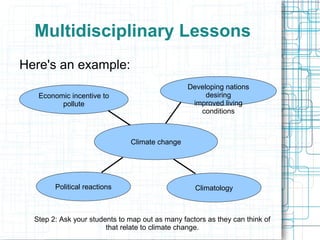
  Step 2: Ask your students to map out as many factors as they can think of
                        that relate to climate change.
Multidisciplinary Lessons
Here's an example:
                                                 Developing nations
   Economic incentive to                              desiring
         pollute                                  improved living
                                                    conditions


                               Climate change


       Political reactions                         Climatology


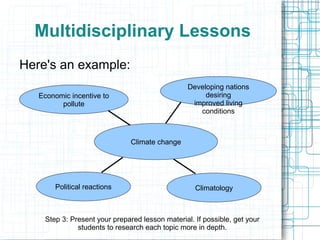
    Step 3: Present your prepared lesson material. If possible, get your
              students to research each topic more in depth.
Multidisciplinary Lessons
Here's an example:
                                                 Developing nations
   Economic incentive to                              desiring
         pollute                                  improved living
                                                    conditions


                                Climate change


        Political reactions                         Climatology


   Step 4: Have the students take sides in a mock UN panel about how to
  address climate change. Have each student represent a different “interest”
Multidisciplinary Lessons
Here's an example:
                                                  Developing nations
   Economic incentive to                               desiring
         pollute                                   improved living
                                                     conditions


                                Climate change


       Political reactions                          Climatology


     Step 5: Give feedback to the students (using a rubric if applicable)
Multidisciplinary Lessons
Here's an example:
                                                   Developing nations
   Economic incentive to                                desiring
         pollute                                    improved living
                                                      conditions


                                Climate change


       Political reactions                           Climatology


        Step 6: Debrief students on their participation in the activity
Multidisciplinary Lessons
Now it's your turn:

    Design an multidisciplinary lesson based
    on a topic of your choice. Map out the
    various issues involved (as above) and
    give specific activities that you could do to
    integrate and synthesize the information.
Multidisciplinary Lessons
Now it's your turn:

    If you cannot think of a topic, here are a
    few examples you may use:
        −   The gender pay gap
        −   Gun control
        −   Music in the 70s
        −   The Cold War
        −   The Industrial Revolution in Europe/US
        −   The element helium

Multidisciplinary approach

  • 1.
    Multidisciplinary Lessons What isthe multidisciplinary approach?  The multidisciplinary approach is also called the “interdisciplinary” approach  It allows for the combination of different subjects during one lesson or project.  It can be also be an opportunity to team teach with another teacher if so desired (although it is by no means necessary).
  • 2.
    Multidisciplinary Lessons Why useit?  Real-world situations are complex and require knowledge of several different subjects.  Encourages the students to apply their existing and newly-acquired knowledge in a more practical and hands-on way.
  • 3.
    Multidisciplinary Lessons Here's anexample: The Israeli-Palestinian Conflict Obviously, this is a very complex issue.
  • 4.
    Multidisciplinary Lessons Here's anexample: Political origins of Retaliation Israel mentality The Israeli-Palestinian Conflict Religious Water resources differences These are all factors in the conflict. Each factor represents a different discipline or area of study.
  • 5.
    Multidisciplinary Lessons Here's anexample: Political origins of Retaliation Israel mentality History Sociology The Israeli-Palestinian Conflict Religious differences Water resources Philosophy Philosophy Earth sciences
  • 6.
    Multidisciplinary Lessons Here's anexample:  It's impossible to analyze the Israeli- Palestinian conflict without touching on several different subjects.  This example is intentionally broad, but there are plenty of opportunities to incorporate other disciplines into your lessons.
  • 7.
    Multidisciplinary Lessons 6 stepsfor a multidisciplinary lesson:  Pre-instructional planning – If teaching alone, make sure that you are acquainted with the material from the other disciplines.  Introduce the methodology to your students – Explain why the subject at hand has such a wide variety of approaches to understanding it.  Deliver the lesson – Make sure to deliver the content in a clear, coherent way so that the students understand the connections between each point and how they relate to each other.
  • 8.
    Multidisciplinary Lessons 6 stepsfor a multidisciplinary lesson:  Practice interdisciplinary thinking – Give your students regular assignments that allow them to think about issues from other sides, other than just the subject you teach.  Provide feedback – Note especially if the students are able to successfully integrate and synthesize their knowledge.  Self-assessment – Ask the students to evaluate their ability to view a topic from multiple angles.
  • 9.
    Multidisciplinary Lessons Here's anexample: Climate change Start by identifying some of the important parts of the climate change debate.
  • 10.
    Multidisciplinary Lessons Here's anexample: Developing nations Economic incentive to desiring pollute improved living conditions Climate change Political reactions Climatology Step 1: Make sure you understand all the relevant information from each discipline. (i.e., climatology, political science, economics, and sociology)
  • 11.
    Multidisciplinary Lessons Here's anexample: Developing nations Economic incentive to desiring pollute improved living conditions Climate change Political reactions Climatology Step 2: Ask your students to map out as many factors as they can think of that relate to climate change.
  • 12.
    Multidisciplinary Lessons Here's anexample: Developing nations Economic incentive to desiring pollute improved living conditions Climate change Political reactions Climatology Step 3: Present your prepared lesson material. If possible, get your students to research each topic more in depth.
  • 13.
    Multidisciplinary Lessons Here's anexample: Developing nations Economic incentive to desiring pollute improved living conditions Climate change Political reactions Climatology Step 4: Have the students take sides in a mock UN panel about how to address climate change. Have each student represent a different “interest”
  • 14.
    Multidisciplinary Lessons Here's anexample: Developing nations Economic incentive to desiring pollute improved living conditions Climate change Political reactions Climatology Step 5: Give feedback to the students (using a rubric if applicable)
  • 15.
    Multidisciplinary Lessons Here's anexample: Developing nations Economic incentive to desiring pollute improved living conditions Climate change Political reactions Climatology Step 6: Debrief students on their participation in the activity
  • 16.
    Multidisciplinary Lessons Now it'syour turn:  Design an multidisciplinary lesson based on a topic of your choice. Map out the various issues involved (as above) and give specific activities that you could do to integrate and synthesize the information.
  • 17.
    Multidisciplinary Lessons Now it'syour turn:  If you cannot think of a topic, here are a few examples you may use: − The gender pay gap − Gun control − Music in the 70s − The Cold War − The Industrial Revolution in Europe/US − The element helium