Detection-aided medical image segmentation
using deep learning
8. September 2017 | Master Thesis
Míriam Bellver Bueno, Kevis-Kokitsi Maninis, Jordi Pont-Tuset, Xavier Giró-i-Nieto,
Jordi Torres, Luc Van Gool
Outline
§  Introduction
§  Related Work
§  Method
§  Experimental Validation
§  Conclusions
8. September 2017 2
Introduction
Detection-aided medical image segmentation using deep learning
8. September 2017 3
Introduction
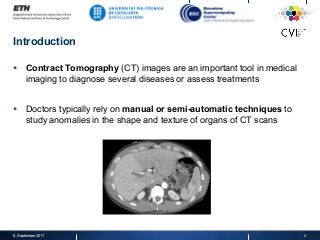
§  Contract Tomography (CT) images are an important tool in medical
imaging to diagnose several diseases or assess treatments
§  Doctors typically rely on manual or semi-automatic techniques to
study anomalies in the shape and texture of organs of CT scans
8. September 2017 4
Introduction
§  Contract Tomography (CT) images are an important tool in medical
imaging to diagnose several diseases or assess treatments
§  Doctors typically rely on manual or semi-automatic techniques to
study anomalies in the shape and texture of organs of CT scans
§  Time-consuming
§  Subjective
8. September 2017 5
Introduction
§  Contract Tomography (CT) images are an important tool in medical
imaging to diagnose several diseases or assess treatments
§  Doctors typically rely on manual or semi-automatic techniques to
study anomalies in the shape and texture of organs of CT scans
§  Time-consuming
§  Subjective
8. September 2017 6
Fully Automatic Tool ✔
Introduction
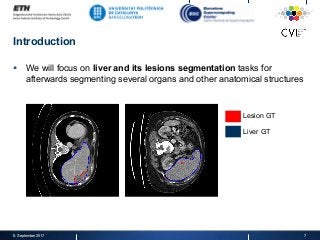
§  We will focus on liver and its lesions segmentation tasks for
afterwards segmenting several organs and other anatomical structures
8. September 2017 7
Lesion GT
Liver GT
Introduction
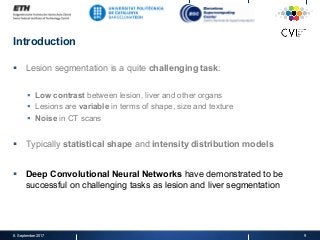
§  Lesion segmentation is a quite challenging task:
§  Low contrast between lesion, liver and other organs
§  Lesions are variable in terms of shape, size and texture
§  Noise in CT scans
§  Typically statistical shape and intensity distribution models
8. September 2017 8
Introduction
§  Lesion segmentation is a quite challenging task:
§  Low contrast between lesion, liver and other organs
§  Lesions are variable in terms of shape, size and texture
§  Noise in CT scans
§  Typically statistical shape and intensity distribution models
§  Deep Convolutional Neural Networks have demonstrated to be
successful on challenging tasks as lesion and liver segmentation
8. September 2017 9
Introduction
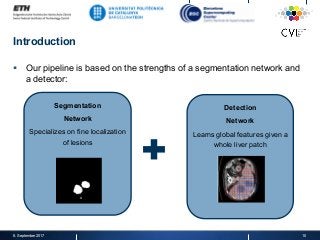
§  Our pipeline is based on the strengths of a segmentation network and
a detector:
8. September 2017 10
Segmentation
Network
Specializes on fine localization
of lesions
Detection
Network
Learns global features given a
whole liver patch
Introduction
§  Tasks:
§  Develop a method to segment the lesion and the liver from CT scans using
in the framework of the LiTS Challenge.
§  Prove generality of segmentation network with Visceral dataset.
8. September 2017 11
Related Work
Detection-aided medical image segmentation using deep learning
8. September 2017 12
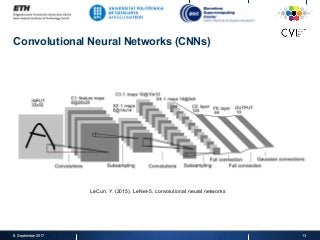
Convolutional Neural Networks (CNNs)
8. September 2017 13
LeCun, Y. (2015). LeNet-5, convolutional neural networks
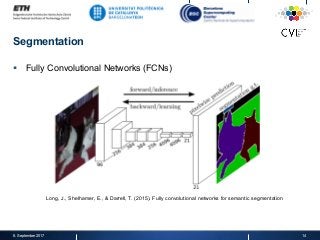
Segmentation
§  Fully Convolutional Networks (FCNs)
8. September 2017 14
Long, J., Shelhamer, E., & Darrell, T. (2015). Fully convolutional networks for semantic segmentation
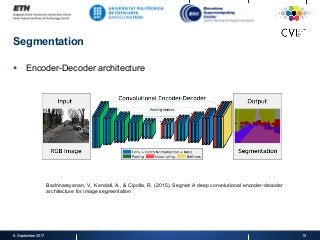
Segmentation
§  Encoder-Decoder architecture
8. September 2017 15
Badrinarayanan, V., Kendall, A., & Cipolla, R. (2015). Segnet: A deep convolutional encoder-decoder
architecture for image segmentation
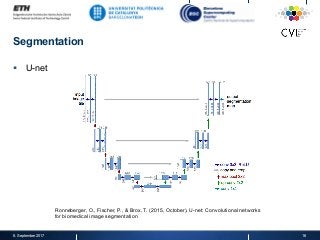
Segmentation
§  U-net
8. September 2017 16
Ronneberger, O., Fischer, P., & Brox, T. (2015, October). U-net: Convolutional networks
for biomedical image segmentation
Segmentation
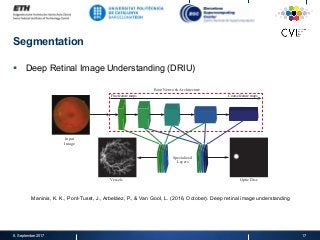
§  Deep Retinal Image Understanding (DRIU)
8. September 2017 17
Maninis, K. K., Pont-Tuset, J., Arbeláez, P., & Van Gool, L. (2016, October). Deep retinal image understanding
Input
Fine feature maps Coarse feature maps
Vessels Optic Disc
Specialized
Layers
Image
Base Network Architecture
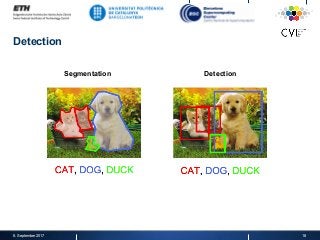
Detection
8. September 2017 18
Segmentation Detection
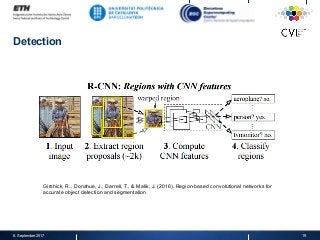
Detection
8. September 2017 19
Girshick, R., Donahue, J., Darrell, T., & Malik, J. (2016). Region-based convolutional networks for
accurate object detection and segmentation
Method
Detection-aided medical image segmentation using deep learning
8. September 2017 20
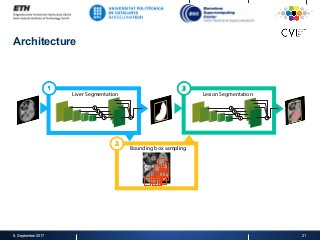
Architecture
Liver Segmentation
1
Lesion Segmentation
3
Bounding box sampling
2
8. September 2017 21
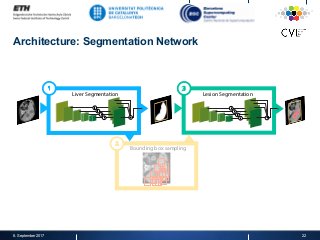
Architecture: Segmentation Network
Liver Segmentation
1
Lesion Segmentation
3
Bounding box sampling
2
8. September 2017 22
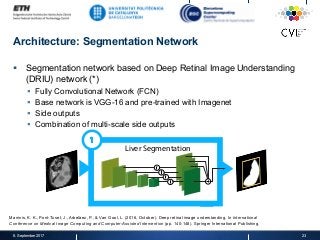
Architecture: Segmentation Network
§  Segmentation network based on Deep Retinal Image Understanding
(DRIU) network (*)
§  Fully Convolutional Network (FCN)
§  Base network is VGG-16 and pre-trained with Imagenet
§  Side outputs
§  Combination of multi-scale side outputs
8. September 2017 23
Liver Segmentation
1
Les
3
Bounding box sampling
2Maninis, K. K., Pont-Tuset, J., Arbeláez, P., & Van Gool, L. (2016, October). Deep retinal image understanding. In International
Conference on Medical Image Computing and Computer-Assisted Intervention (pp. 140-148). Springer International Publishing.
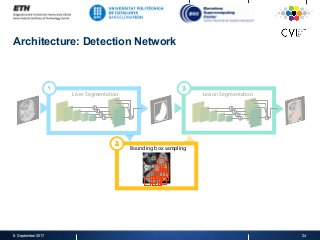
Architecture: Detection Network
Liver Segmentation
1
Lesion Segmentation
3
Bounding box sampling
2
8. September 2017 24
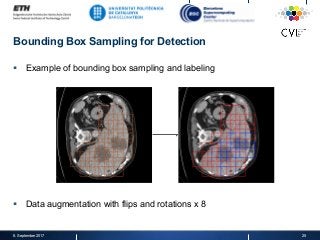
Bounding Box Sampling for Detection
§  Example of bounding box sampling and labeling
§  Data augmentation with flips and rotations x 8
8. September 2017 25
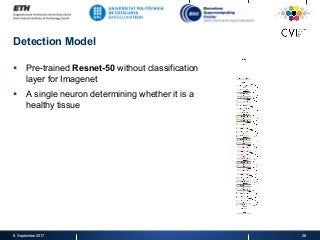
Detection Model
§  Pre-trained Resnet-50 without classification
layer for Imagenet
§  A single neuron determining whether it is a
healthy tissue
8. September 2017 26
Experimental Validation
Detection-aided medical image segmentation using deep learning
8. September 2017 27
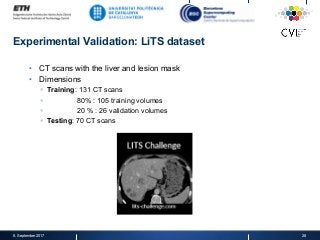
Experimental Validation: LiTS dataset
•  CT scans with the liver and lesion mask
•  Dimensions
§  Training: 131 CT scans
§  80% : 105 training volumes
§  20 % : 26 validation volumes
§  Testing: 70 CT scans
8. September 2017 28
Experimental Validation: Metrics
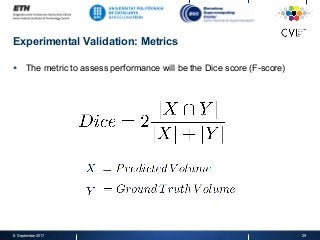
§  The metric to assess performance will be the Dice score (F-score)
8. September 2017 29
Experimental Validation: Ablation study for segmentation
network
Key features of our segmentation network
§  1. Pre-processing
§  2. Weighting of Binary Cross Entropy (BCE) loss
§  3. Stacking 3 consecutive slices at the input of the network
§  4. Using liver segmentation to segment lesion
8. September 2017 30
Experimental Validation: Ablation study for segmentation
network
Key features of our segmentation network
§  1. Pre-processing
§  2. Weighting of Binary Cross Entropy (BCE) loss
§  3. Stacking 3 consecutive slices at the input of the network
§  4. Using liver segmentation to segment lesion
8. September 2017 31
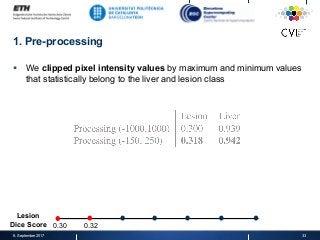
1. Pre-processing
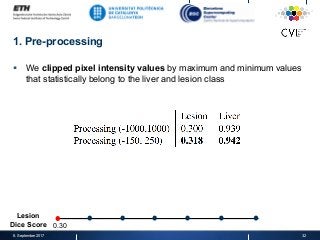
§  We clipped pixel intensity values by maximum and minimum values
that statistically belong to the liver and lesion class
8. September 2017 32
0.30
Lesion
Dice Score
1. Pre-processing
§  We clipped pixel intensity values by maximum and minimum values
that statistically belong to the liver and lesion class
8. September 2017 33
0.30 0.32
Lesion
Dice Score
Experimental Validation: Ablation study for segmentation
network
Key features of our segmentation network
§  1. Pre-processing
§  2. Weighting of Binary Cross Entropy (BCE) loss
§  3. Stacking 3 consecutive slices at the input of the network
§  4. Using liver segmentation to segment lesion
8. September 2017 34
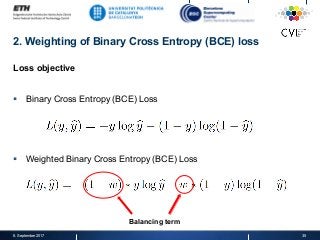
2. Weighting of Binary Cross Entropy (BCE) loss
Loss objective
§  Binary Cross Entropy (BCE) Loss
§  Weighted Binary Cross Entropy (BCE) Loss
8. September 2017 35
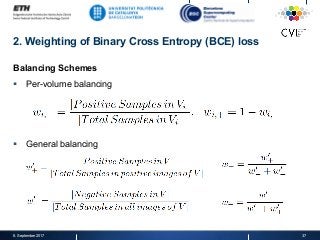
Balancing term
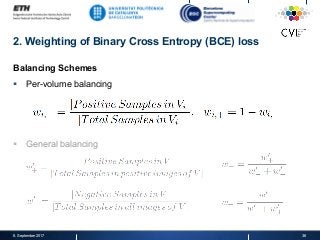
2. Weighting of Binary Cross Entropy (BCE) loss
Balancing Schemes
§  Per-volume balancing
§  General balancing
8. September 2017 36
2. Weighting of Binary Cross Entropy (BCE) loss
Balancing Schemes
§  Per-volume balancing
§  General balancing
8. September 2017 37
2. Weighting of Binary Cross Entropy (BCE) loss
8. September 2017 38
0.2 0.4 0.6 0.8 1
Recall
0.1
0.2
0.3
0.4
0.5
0.6
0.7
0.8
0.9
1
Precision
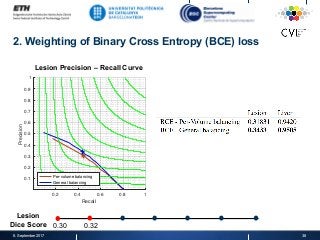
Per-volume balancing
General balancing
Lesion Precision – Recall Curve
0.30 0.32
Lesion
Dice Score
2. Weighting of Binary Cross Entropy (BCE) loss
8. September 2017 39
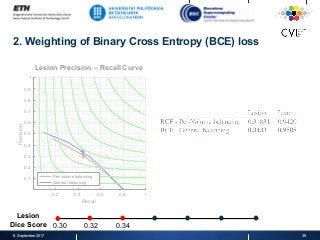
Lesion Precision – Recall Curve
0.2 0.4 0.6 0.8 1
Recall
0.1
0.2
0.3
0.4
0.5
0.6
0.7
0.8
0.9
1
Precision
Per-volume balancing
General balancing
0.30 0.32 0.34
Lesion
Dice Score
Experimental Validation: Ablation study for segmentation
network
Key features of our segmentation network
§  1. Pre-processing
§  2. Weighting of Binary Cross Entropy (BCE) loss
§  3. Stacking 3 consecutive slices at the input of the network
§  4. Using liver segmentation to segment lesion
8. September 2017 40
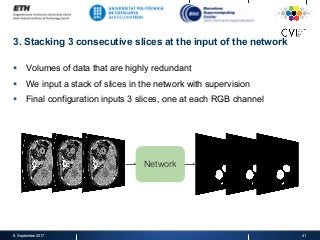
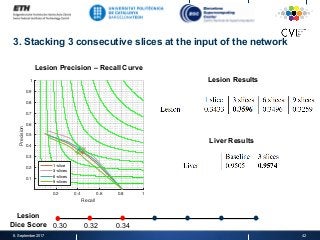
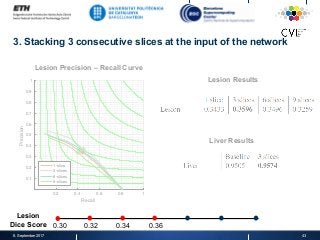
3. Stacking 3 consecutive slices at the input of the network
§  Volumes of data that are highly redundant
§  We input a stack of slices in the network with supervision
§  Final configuration inputs 3 slices, one at each RGB channel
8. September 2017 41
Network
3. Stacking 3 consecutive slices at the input of the network
8. September 2017 42
0.2 0.4 0.6 0.8 1
Recall
0.1
0.2
0.3
0.4
0.5
0.6
0.7
0.8
0.9
1
Precision
1-slice
3-slices
6-slices
9-slices
Lesion Precision – Recall Curve
Lesion Results
Liver Results
0.30 0.32 0.34
Lesion
Dice Score
3. Stacking 3 consecutive slices at the input of the network
8. September 2017 43
0.2 0.4 0.6 0.8 1
Recall
0.1
0.2
0.3
0.4
0.5
0.6
0.7
0.8
0.9
1
Precision
1-slice
3-slices
6-slices
9-slices
Lesion Results
Liver Results
Lesion Precision – Recall Curve
Lesion
Dice Score 0.30 0.32 0.34 0.36
Experimental Validation: Ablation study for segmentation
network
Key features of our segmentation network
§  1. Pre-processing
§  2. Weighting of Binary Cross Entropy (BCE) loss
§  3. Stacking 3 consecutive slices at the input of the network
§  4. Using liver segmentation to segment lesion
8. September 2017 44
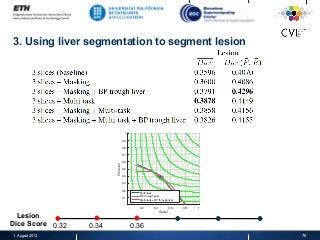
4. Using liver segmentation to segment lesion
§  We worked with 2 different strategies:
1.  Back-propagation (BP) through liver: Only back-propagation through liver
2.  Multitask: Segmenting the liver and the lesion simultaneously
8. September 2017 45
4. Using liver segmentation to segment lesion
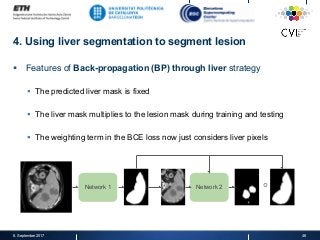
§  Features of Back-propagation (BP) through liver strategy
§  The predicted liver mask is fixed
§  The liver mask multiplies to the lesion mask during training and testing
§  The weighting term in the BCE loss now just considers liver pixels
8. September 2017 46
Network 1 ∘Network 2
4. Using liver segmentation to segment lesion
§  Pros of BP through liver ✔
§  Network learns from relevant pixels
§  Positive/Negative pixels are more balanced
§  Cons of BP through liver ✖
§  If there is a mistake in the liver mask, this mistake will affect the lesion
segmentation
8. September 2017 47
4. Using liver segmentation to segment lesion
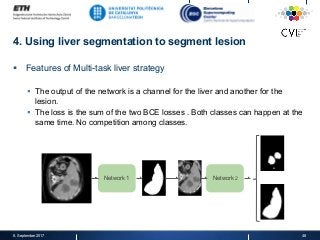
§  Features of Multi-task liver strategy
§  The output of the network is a channel for the liver and another for the
lesion.
§  The loss is the sum of the two BCE losses . Both classes can happen at the
same time. No competition among classes.
8. September 2017 48
Network 1 ∘Network 2
Network 1 Network 2
4. Using liver segmentation to segment lesion
§  Pros of Multi-task ✔
§  The gradients of the network have information of both the liver and lesion
§  Efficient and Scalable
§  Cons of Multi-task ✖
§  Difficult to weight each task properly
8. September 2017 49
4. Using liver segmentation to segment lesion
8. September 2017 50
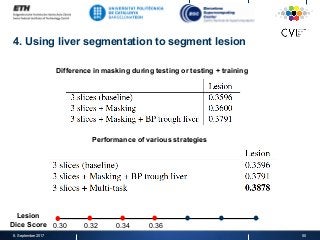
Difference in masking during testing or testing + training
Performance of various strategies
Lesion
Dice Score 0.30 0.32 0.34 0.36
4. Using liver segmentation to segment lesion
8. September 2017 51
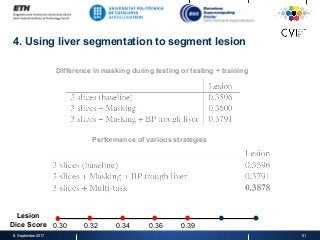
Difference in masking during testing or testing + training
Performance of various strategies
Lesion
Dice Score 0.30 0.32 0.34 0.36 0.39
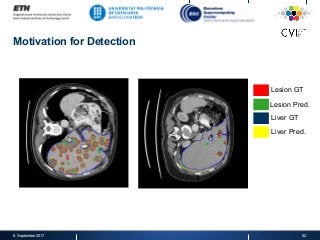
Motivation for Detection
8. September 2017 52
Lesion GT
Lesion Pred.
Liver GT
Liver Pred.
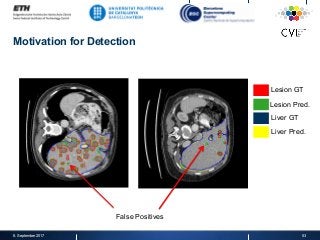
Motivation for Detection
8. September 2017 53
Lesion GT
Lesion Pred.
Liver GT
Liver Pred.
False Positives
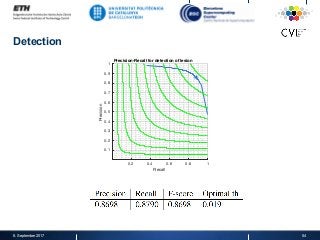
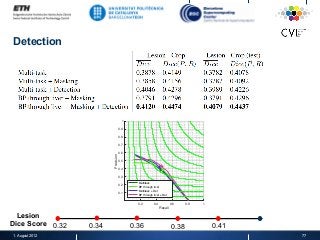
Detection
8. September 2017 54
0.2 0.4 0.6 0.8 1
Recall
0.1
0.2
0.3
0.4
0.5
0.6
0.7
0.8
0.9
1
Precision
Precision-Recall for detection of lesion
Detection
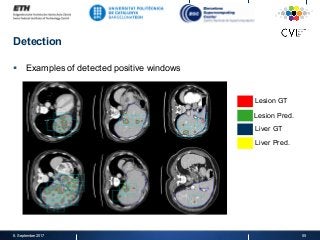
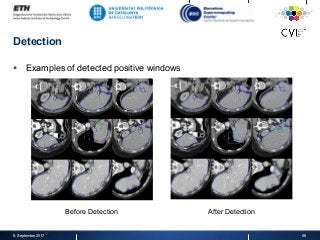
§  Examples of detected positive windows
8. September 2017 55
Lesion GT
Lesion Pred.
Liver GT
Liver Pred.
Detection
§  Examples of detected positive windows
8. September 2017 56
Before Detection After Detection
Detection
8. September 2017 57
0.2 0.4 0.6 0.8 1
Recall
0.1
0.2
0.3
0.4
0.5
0.6
0.7
0.8
0.9
1
Precision
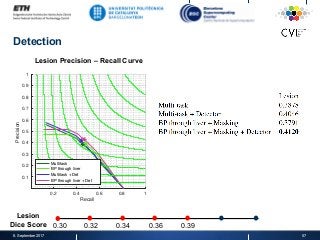
Multitask
BP through liver
Multitask + Det
BP through liver + Det
Lesion Precision – Recall Curve
Lesion
Dice Score 0.30 0.32 0.34 0.36 0.39
Detection
8. September 2017 58
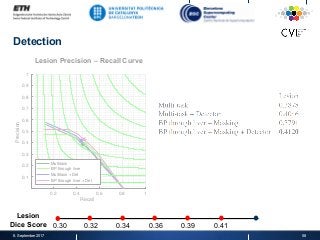
Lesion Precision – Recall Curve
0.2 0.4 0.6 0.8 1
Recall
0.1
0.2
0.3
0.4
0.5
0.6
0.7
0.8
0.9
1
Precision
Multitask
BP through liver
Multitask + Det
BP through liver + Det
Lesion
Dice Score 0.30 0.32 0.34 0.36 0.39 0.41
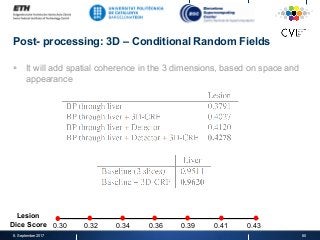
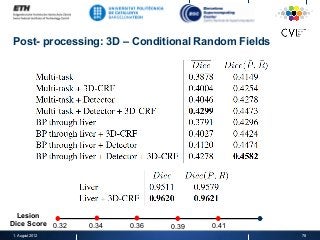
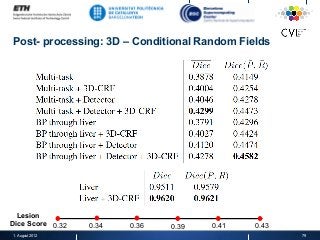
Post- processing: 3D – Conditional Random Fields
§  It will add spatial coherence in the 3 dimensions, based on space and
appearance
8. September 2017 59
Lesion
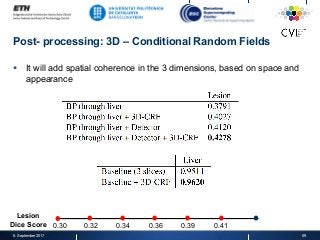
Dice Score 0.30 0.32 0.34 0.36 0.39 0.41
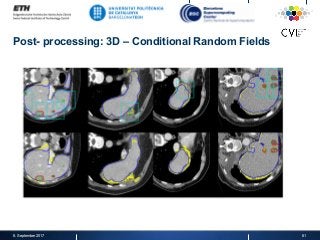
Post- processing: 3D – Conditional Random Fields
§  It will add spatial coherence in the 3 dimensions, based on space and
appearance
8. September 2017 60
Lesion
Dice Score 0.30 0.32 0.34 0.36 0.39 0.41 0.43
Post- processing: 3D – Conditional Random Fields
8. September 2017 61
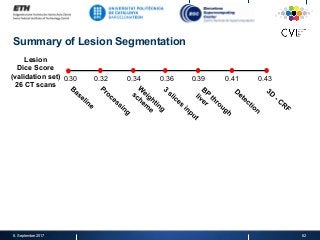
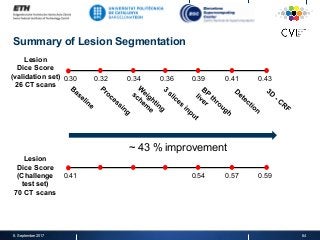
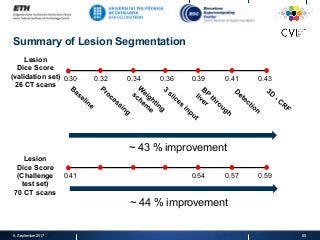
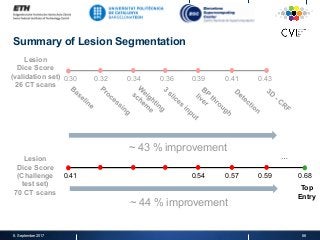
Summary of Lesion Segmentation
8. September 2017 62
Lesion
Dice Score
(validation set)
26 CT scans 62
0.30 0.32 0.34 0.36 0.39 0.41 0.43
62
Summary of Lesion Segmentation
8. September 2017 63
Lesion
Dice Score
(validation set)
26 CT scans 63
0.30 0.32 0.34 0.36 0.39 0.41 0.43
63
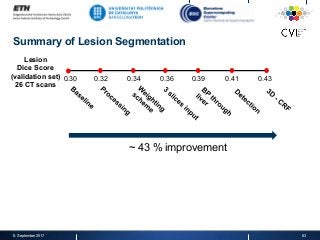
~ 43 % improvement
Summary of Lesion Segmentation
8. September 2017 64
Lesion
Dice Score
(validation set)
26 CT scans 64
0.30 0.32 0.34 0.36 0.39 0.41 0.43
64
0.41 0.54 0.57 0.59
~ 43 % improvement
Lesion
Dice Score
(Challenge
test set)
70 CT scans
Summary of Lesion Segmentation
8. September 2017 65
Lesion
Dice Score
(validation set)
26 CT scans 65
0.30 0.32 0.34 0.36 0.39 0.41 0.43
65
0.41 0.54 0.57 0.59
~ 43 % improvement
~ 44 % improvement
Lesion
Dice Score
(Challenge
test set)
70 CT scans
Summary of Lesion Segmentation
8. September 2017 66
Lesion
Dice Score
(validation set)
26 CT scans 66
0.30 0.32 0.34 0.36 0.39 0.41 0.43
66
0.41 0.54 0.57 0.59
~ 43 % improvement
~ 44 % improvement
0.68
Top
Entry
Lesion
Dice Score
(Challenge
test set)
70 CT scans
…
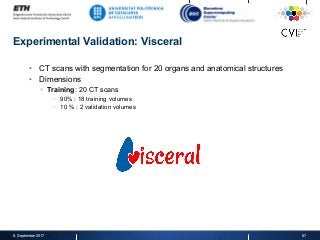
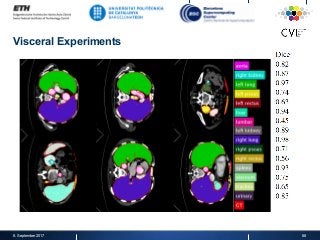
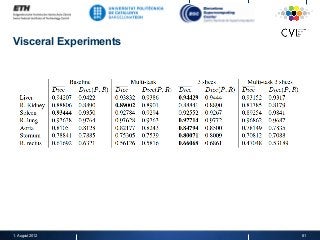
Experimental Validation: Visceral
•  CT scans with segmentation for 20 organs and anatomical structures
•  Dimensions
§  Training: 20 CT scans
§  90% : 18 training volumes
§  10 % : 2 validation volumes
8. September 2017 67
Visceral Experiments
8. September 2017 68
Conclusions
Detection-aided medical image segmentation using deep learning
8. September 2017 69
Conclusions
§  We improved the baseline we worked on developing a set of strategies
applicable to other pipelines.
§  Detection + Segmentation improved over only Segmentation.
§  Using the liver for the lesion segmentation boosted the performance.
Learning from relevant samples seems a good practice.
§  Segmentation network has a lot of potential to segment different kinds of
structures in a single forward pass.
8. September 2017 70
Publication
8. September 2017 71
Acknowledgements
8. September 2017 72
Thank you for your attention!
8. September 2017 73
31. July 2017 74
Publication
8. July 2017 75
0.2 0.4 0.6 0.8 1
Recall
0.1
0.2
0.3
0.4
0.5
0.6
0.7
0.8
0.9
1
Precision
Multi-task
BP through liver
Multi-task + BP through liver
3. Using liver segmentation to segment lesion
1. August 2012 76
0.32 0.34 0.36
Lesion
Dice Score
Detection
1. August 2012 77
0.2 0.4 0.6 0.8 1
Recall
0.1
0.2
0.3
0.4
0.5
0.6
0.7
0.8
0.9
1
Precision
Multitask
BP through liver
Multitask + Det
BP through liver + Det
0.32 0.34 0.36 0.38 0.41
Lesion
Dice Score
Post- processing: 3D – Conditional Random Fields
1. August 2012 78
0.32 0.34 0.36 0.39 0.41
Lesion
Dice Score
Post- processing: 3D – Conditional Random Fields
1. August 2012 79
0.32 0.34 0.36 0.39 0.41 0.43
Lesion
Dice Score
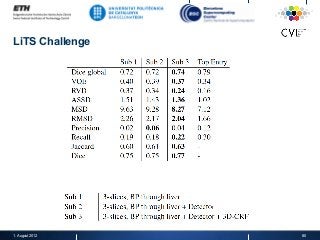
LiTS Challenge
1. August 2012 80
Visceral Experiments
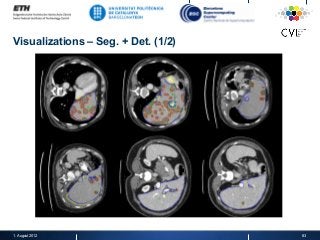
1. August 2012 81
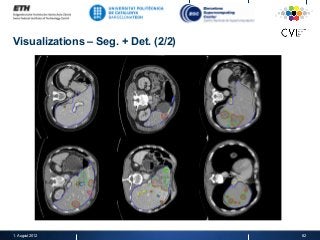
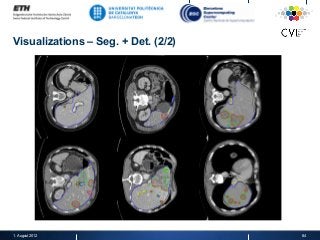
Visualizations – Seg. + Det. (2/2)
1. August 2012 82
Visualizations – Seg. + Det. (1/2)
1. August 2012 83
Visualizations – Seg. + Det. (2/2)
1. August 2012 84
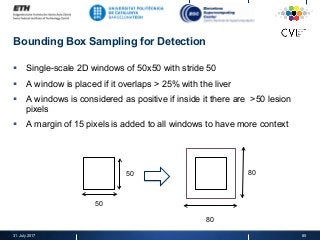
Bounding Box Sampling for Detection
§  Single-scale 2D windows of 50x50 with stride 50
§  A window is placed if it overlaps > 25% with the liver
§  A windows is considered as positive if inside it there are >50 lesion
pixels
§  A margin of 15 pixels is added to all windows to have more context
31. July 2017 85
50
50 80
80
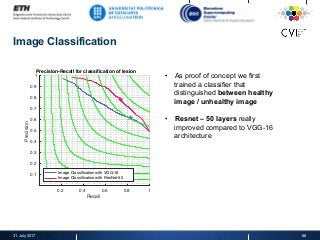
Image Classification
0.2 0.4 0.6 0.8 1
Recall
0.1
0.2
0.3
0.4
0.5
0.6
0.7
0.8
0.9
1
Precision
Precision-Recall for classification of lesion
Image Classification with VGG-16
Image Classification with ResNet-50
31. July 2017 86
•  As proof of concept we first
trained a classifier that
distinguished between healthy
image / unhealthy image
•  Resnet – 50 layers really
improved compared to VGG-16
architecture

Detection-aided liver lesion segmentation using deep learning

  • 1.
    Detection-aided medical imagesegmentation using deep learning 8. September 2017 | Master Thesis Míriam Bellver Bueno, Kevis-Kokitsi Maninis, Jordi Pont-Tuset, Xavier Giró-i-Nieto, Jordi Torres, Luc Van Gool
  • 2.
    Outline §  Introduction §  RelatedWork §  Method §  Experimental Validation §  Conclusions 8. September 2017 2
  • 3.
    Introduction Detection-aided medical imagesegmentation using deep learning 8. September 2017 3
  • 4.
    Introduction §  Contract Tomography(CT) images are an important tool in medical imaging to diagnose several diseases or assess treatments §  Doctors typically rely on manual or semi-automatic techniques to study anomalies in the shape and texture of organs of CT scans 8. September 2017 4
  • 5.
    Introduction §  Contract Tomography(CT) images are an important tool in medical imaging to diagnose several diseases or assess treatments §  Doctors typically rely on manual or semi-automatic techniques to study anomalies in the shape and texture of organs of CT scans §  Time-consuming §  Subjective 8. September 2017 5
  • 6.
    Introduction §  Contract Tomography(CT) images are an important tool in medical imaging to diagnose several diseases or assess treatments §  Doctors typically rely on manual or semi-automatic techniques to study anomalies in the shape and texture of organs of CT scans §  Time-consuming §  Subjective 8. September 2017 6 Fully Automatic Tool ✔
  • 7.
    Introduction §  We willfocus on liver and its lesions segmentation tasks for afterwards segmenting several organs and other anatomical structures 8. September 2017 7 Lesion GT Liver GT
  • 8.
    Introduction §  Lesion segmentationis a quite challenging task: §  Low contrast between lesion, liver and other organs §  Lesions are variable in terms of shape, size and texture §  Noise in CT scans §  Typically statistical shape and intensity distribution models 8. September 2017 8
  • 9.
    Introduction §  Lesion segmentationis a quite challenging task: §  Low contrast between lesion, liver and other organs §  Lesions are variable in terms of shape, size and texture §  Noise in CT scans §  Typically statistical shape and intensity distribution models §  Deep Convolutional Neural Networks have demonstrated to be successful on challenging tasks as lesion and liver segmentation 8. September 2017 9
  • 10.
    Introduction §  Our pipelineis based on the strengths of a segmentation network and a detector: 8. September 2017 10 Segmentation Network Specializes on fine localization of lesions Detection Network Learns global features given a whole liver patch
  • 11.
    Introduction §  Tasks: §  Developa method to segment the lesion and the liver from CT scans using in the framework of the LiTS Challenge. §  Prove generality of segmentation network with Visceral dataset. 8. September 2017 11
  • 12.
    Related Work Detection-aided medicalimage segmentation using deep learning 8. September 2017 12
  • 13.
    Convolutional Neural Networks(CNNs) 8. September 2017 13 LeCun, Y. (2015). LeNet-5, convolutional neural networks
  • 14.
    Segmentation §  Fully ConvolutionalNetworks (FCNs) 8. September 2017 14 Long, J., Shelhamer, E., & Darrell, T. (2015). Fully convolutional networks for semantic segmentation
  • 15.
    Segmentation §  Encoder-Decoder architecture 8.September 2017 15 Badrinarayanan, V., Kendall, A., & Cipolla, R. (2015). Segnet: A deep convolutional encoder-decoder architecture for image segmentation
  • 16.
    Segmentation §  U-net 8. September2017 16 Ronneberger, O., Fischer, P., & Brox, T. (2015, October). U-net: Convolutional networks for biomedical image segmentation
  • 17.
    Segmentation §  Deep RetinalImage Understanding (DRIU) 8. September 2017 17 Maninis, K. K., Pont-Tuset, J., Arbeláez, P., & Van Gool, L. (2016, October). Deep retinal image understanding Input Fine feature maps Coarse feature maps Vessels Optic Disc Specialized Layers Image Base Network Architecture
  • 18.
    Detection 8. September 201718 Segmentation Detection
  • 19.
    Detection 8. September 201719 Girshick, R., Donahue, J., Darrell, T., & Malik, J. (2016). Region-based convolutional networks for accurate object detection and segmentation
  • 20.
    Method Detection-aided medical imagesegmentation using deep learning 8. September 2017 20
  • 21.
  • 22.
    Architecture: Segmentation Network LiverSegmentation 1 Lesion Segmentation 3 Bounding box sampling 2 8. September 2017 22
  • 23.
    Architecture: Segmentation Network § Segmentation network based on Deep Retinal Image Understanding (DRIU) network (*) §  Fully Convolutional Network (FCN) §  Base network is VGG-16 and pre-trained with Imagenet §  Side outputs §  Combination of multi-scale side outputs 8. September 2017 23 Liver Segmentation 1 Les 3 Bounding box sampling 2Maninis, K. K., Pont-Tuset, J., Arbeláez, P., & Van Gool, L. (2016, October). Deep retinal image understanding. In International Conference on Medical Image Computing and Computer-Assisted Intervention (pp. 140-148). Springer International Publishing.
  • 24.
    Architecture: Detection Network LiverSegmentation 1 Lesion Segmentation 3 Bounding box sampling 2 8. September 2017 24
  • 25.
    Bounding Box Samplingfor Detection §  Example of bounding box sampling and labeling §  Data augmentation with flips and rotations x 8 8. September 2017 25
  • 26.
    Detection Model §  Pre-trainedResnet-50 without classification layer for Imagenet §  A single neuron determining whether it is a healthy tissue 8. September 2017 26
  • 27.
    Experimental Validation Detection-aided medicalimage segmentation using deep learning 8. September 2017 27
  • 28.
    Experimental Validation: LiTSdataset •  CT scans with the liver and lesion mask •  Dimensions §  Training: 131 CT scans §  80% : 105 training volumes §  20 % : 26 validation volumes §  Testing: 70 CT scans 8. September 2017 28
  • 29.
    Experimental Validation: Metrics § The metric to assess performance will be the Dice score (F-score) 8. September 2017 29
  • 30.
    Experimental Validation: Ablationstudy for segmentation network Key features of our segmentation network §  1. Pre-processing §  2. Weighting of Binary Cross Entropy (BCE) loss §  3. Stacking 3 consecutive slices at the input of the network §  4. Using liver segmentation to segment lesion 8. September 2017 30
  • 31.
    Experimental Validation: Ablationstudy for segmentation network Key features of our segmentation network §  1. Pre-processing §  2. Weighting of Binary Cross Entropy (BCE) loss §  3. Stacking 3 consecutive slices at the input of the network §  4. Using liver segmentation to segment lesion 8. September 2017 31
  • 32.
    1. Pre-processing §  Weclipped pixel intensity values by maximum and minimum values that statistically belong to the liver and lesion class 8. September 2017 32 0.30 Lesion Dice Score
  • 33.
    1. Pre-processing §  Weclipped pixel intensity values by maximum and minimum values that statistically belong to the liver and lesion class 8. September 2017 33 0.30 0.32 Lesion Dice Score
  • 34.
    Experimental Validation: Ablationstudy for segmentation network Key features of our segmentation network §  1. Pre-processing §  2. Weighting of Binary Cross Entropy (BCE) loss §  3. Stacking 3 consecutive slices at the input of the network §  4. Using liver segmentation to segment lesion 8. September 2017 34
  • 35.
    2. Weighting ofBinary Cross Entropy (BCE) loss Loss objective §  Binary Cross Entropy (BCE) Loss §  Weighted Binary Cross Entropy (BCE) Loss 8. September 2017 35 Balancing term
  • 36.
    2. Weighting ofBinary Cross Entropy (BCE) loss Balancing Schemes §  Per-volume balancing §  General balancing 8. September 2017 36
  • 37.
    2. Weighting ofBinary Cross Entropy (BCE) loss Balancing Schemes §  Per-volume balancing §  General balancing 8. September 2017 37
  • 38.
    2. Weighting ofBinary Cross Entropy (BCE) loss 8. September 2017 38 0.2 0.4 0.6 0.8 1 Recall 0.1 0.2 0.3 0.4 0.5 0.6 0.7 0.8 0.9 1 Precision Per-volume balancing General balancing Lesion Precision – Recall Curve 0.30 0.32 Lesion Dice Score
  • 39.
    2. Weighting ofBinary Cross Entropy (BCE) loss 8. September 2017 39 Lesion Precision – Recall Curve 0.2 0.4 0.6 0.8 1 Recall 0.1 0.2 0.3 0.4 0.5 0.6 0.7 0.8 0.9 1 Precision Per-volume balancing General balancing 0.30 0.32 0.34 Lesion Dice Score
  • 40.
    Experimental Validation: Ablationstudy for segmentation network Key features of our segmentation network §  1. Pre-processing §  2. Weighting of Binary Cross Entropy (BCE) loss §  3. Stacking 3 consecutive slices at the input of the network §  4. Using liver segmentation to segment lesion 8. September 2017 40
  • 41.
    3. Stacking 3consecutive slices at the input of the network §  Volumes of data that are highly redundant §  We input a stack of slices in the network with supervision §  Final configuration inputs 3 slices, one at each RGB channel 8. September 2017 41 Network
  • 42.
    3. Stacking 3consecutive slices at the input of the network 8. September 2017 42 0.2 0.4 0.6 0.8 1 Recall 0.1 0.2 0.3 0.4 0.5 0.6 0.7 0.8 0.9 1 Precision 1-slice 3-slices 6-slices 9-slices Lesion Precision – Recall Curve Lesion Results Liver Results 0.30 0.32 0.34 Lesion Dice Score
  • 43.
    3. Stacking 3consecutive slices at the input of the network 8. September 2017 43 0.2 0.4 0.6 0.8 1 Recall 0.1 0.2 0.3 0.4 0.5 0.6 0.7 0.8 0.9 1 Precision 1-slice 3-slices 6-slices 9-slices Lesion Results Liver Results Lesion Precision – Recall Curve Lesion Dice Score 0.30 0.32 0.34 0.36
  • 44.
    Experimental Validation: Ablationstudy for segmentation network Key features of our segmentation network §  1. Pre-processing §  2. Weighting of Binary Cross Entropy (BCE) loss §  3. Stacking 3 consecutive slices at the input of the network §  4. Using liver segmentation to segment lesion 8. September 2017 44
  • 45.
    4. Using liversegmentation to segment lesion §  We worked with 2 different strategies: 1.  Back-propagation (BP) through liver: Only back-propagation through liver 2.  Multitask: Segmenting the liver and the lesion simultaneously 8. September 2017 45
  • 46.
    4. Using liversegmentation to segment lesion §  Features of Back-propagation (BP) through liver strategy §  The predicted liver mask is fixed §  The liver mask multiplies to the lesion mask during training and testing §  The weighting term in the BCE loss now just considers liver pixels 8. September 2017 46 Network 1 ∘Network 2
  • 47.
    4. Using liversegmentation to segment lesion §  Pros of BP through liver ✔ §  Network learns from relevant pixels §  Positive/Negative pixels are more balanced §  Cons of BP through liver ✖ §  If there is a mistake in the liver mask, this mistake will affect the lesion segmentation 8. September 2017 47
  • 48.
    4. Using liversegmentation to segment lesion §  Features of Multi-task liver strategy §  The output of the network is a channel for the liver and another for the lesion. §  The loss is the sum of the two BCE losses . Both classes can happen at the same time. No competition among classes. 8. September 2017 48 Network 1 ∘Network 2 Network 1 Network 2
  • 49.
    4. Using liversegmentation to segment lesion §  Pros of Multi-task ✔ §  The gradients of the network have information of both the liver and lesion §  Efficient and Scalable §  Cons of Multi-task ✖ §  Difficult to weight each task properly 8. September 2017 49
  • 50.
    4. Using liversegmentation to segment lesion 8. September 2017 50 Difference in masking during testing or testing + training Performance of various strategies Lesion Dice Score 0.30 0.32 0.34 0.36
  • 51.
    4. Using liversegmentation to segment lesion 8. September 2017 51 Difference in masking during testing or testing + training Performance of various strategies Lesion Dice Score 0.30 0.32 0.34 0.36 0.39
  • 52.
    Motivation for Detection 8.September 2017 52 Lesion GT Lesion Pred. Liver GT Liver Pred.
  • 53.
    Motivation for Detection 8.September 2017 53 Lesion GT Lesion Pred. Liver GT Liver Pred. False Positives
  • 54.
    Detection 8. September 201754 0.2 0.4 0.6 0.8 1 Recall 0.1 0.2 0.3 0.4 0.5 0.6 0.7 0.8 0.9 1 Precision Precision-Recall for detection of lesion
  • 55.
    Detection §  Examples ofdetected positive windows 8. September 2017 55 Lesion GT Lesion Pred. Liver GT Liver Pred.
  • 56.
    Detection §  Examples ofdetected positive windows 8. September 2017 56 Before Detection After Detection
  • 57.
    Detection 8. September 201757 0.2 0.4 0.6 0.8 1 Recall 0.1 0.2 0.3 0.4 0.5 0.6 0.7 0.8 0.9 1 Precision Multitask BP through liver Multitask + Det BP through liver + Det Lesion Precision – Recall Curve Lesion Dice Score 0.30 0.32 0.34 0.36 0.39
  • 58.
    Detection 8. September 201758 Lesion Precision – Recall Curve 0.2 0.4 0.6 0.8 1 Recall 0.1 0.2 0.3 0.4 0.5 0.6 0.7 0.8 0.9 1 Precision Multitask BP through liver Multitask + Det BP through liver + Det Lesion Dice Score 0.30 0.32 0.34 0.36 0.39 0.41
  • 59.
    Post- processing: 3D– Conditional Random Fields §  It will add spatial coherence in the 3 dimensions, based on space and appearance 8. September 2017 59 Lesion Dice Score 0.30 0.32 0.34 0.36 0.39 0.41
  • 60.
    Post- processing: 3D– Conditional Random Fields §  It will add spatial coherence in the 3 dimensions, based on space and appearance 8. September 2017 60 Lesion Dice Score 0.30 0.32 0.34 0.36 0.39 0.41 0.43
  • 61.
    Post- processing: 3D– Conditional Random Fields 8. September 2017 61
  • 62.
    Summary of LesionSegmentation 8. September 2017 62 Lesion Dice Score (validation set) 26 CT scans 62 0.30 0.32 0.34 0.36 0.39 0.41 0.43 62
  • 63.
    Summary of LesionSegmentation 8. September 2017 63 Lesion Dice Score (validation set) 26 CT scans 63 0.30 0.32 0.34 0.36 0.39 0.41 0.43 63 ~ 43 % improvement
  • 64.
    Summary of LesionSegmentation 8. September 2017 64 Lesion Dice Score (validation set) 26 CT scans 64 0.30 0.32 0.34 0.36 0.39 0.41 0.43 64 0.41 0.54 0.57 0.59 ~ 43 % improvement Lesion Dice Score (Challenge test set) 70 CT scans
  • 65.
    Summary of LesionSegmentation 8. September 2017 65 Lesion Dice Score (validation set) 26 CT scans 65 0.30 0.32 0.34 0.36 0.39 0.41 0.43 65 0.41 0.54 0.57 0.59 ~ 43 % improvement ~ 44 % improvement Lesion Dice Score (Challenge test set) 70 CT scans
  • 66.
    Summary of LesionSegmentation 8. September 2017 66 Lesion Dice Score (validation set) 26 CT scans 66 0.30 0.32 0.34 0.36 0.39 0.41 0.43 66 0.41 0.54 0.57 0.59 ~ 43 % improvement ~ 44 % improvement 0.68 Top Entry Lesion Dice Score (Challenge test set) 70 CT scans …
  • 67.
    Experimental Validation: Visceral • CT scans with segmentation for 20 organs and anatomical structures •  Dimensions §  Training: 20 CT scans §  90% : 18 training volumes §  10 % : 2 validation volumes 8. September 2017 67
  • 68.
  • 69.
    Conclusions Detection-aided medical imagesegmentation using deep learning 8. September 2017 69
  • 70.
    Conclusions §  We improvedthe baseline we worked on developing a set of strategies applicable to other pipelines. §  Detection + Segmentation improved over only Segmentation. §  Using the liver for the lesion segmentation boosted the performance. Learning from relevant samples seems a good practice. §  Segmentation network has a lot of potential to segment different kinds of structures in a single forward pass. 8. September 2017 70
  • 71.
  • 72.
  • 73.
    Thank you foryour attention! 8. September 2017 73
  • 74.
  • 75.
  • 76.
    0.2 0.4 0.60.8 1 Recall 0.1 0.2 0.3 0.4 0.5 0.6 0.7 0.8 0.9 1 Precision Multi-task BP through liver Multi-task + BP through liver 3. Using liver segmentation to segment lesion 1. August 2012 76 0.32 0.34 0.36 Lesion Dice Score
  • 77.
    Detection 1. August 201277 0.2 0.4 0.6 0.8 1 Recall 0.1 0.2 0.3 0.4 0.5 0.6 0.7 0.8 0.9 1 Precision Multitask BP through liver Multitask + Det BP through liver + Det 0.32 0.34 0.36 0.38 0.41 Lesion Dice Score
  • 78.
    Post- processing: 3D– Conditional Random Fields 1. August 2012 78 0.32 0.34 0.36 0.39 0.41 Lesion Dice Score
  • 79.
    Post- processing: 3D– Conditional Random Fields 1. August 2012 79 0.32 0.34 0.36 0.39 0.41 0.43 Lesion Dice Score
  • 80.
  • 81.
  • 82.
    Visualizations – Seg.+ Det. (2/2) 1. August 2012 82
  • 83.
    Visualizations – Seg.+ Det. (1/2) 1. August 2012 83
  • 84.
    Visualizations – Seg.+ Det. (2/2) 1. August 2012 84
  • 85.
    Bounding Box Samplingfor Detection §  Single-scale 2D windows of 50x50 with stride 50 §  A window is placed if it overlaps > 25% with the liver §  A windows is considered as positive if inside it there are >50 lesion pixels §  A margin of 15 pixels is added to all windows to have more context 31. July 2017 85 50 50 80 80
  • 86.
    Image Classification 0.2 0.40.6 0.8 1 Recall 0.1 0.2 0.3 0.4 0.5 0.6 0.7 0.8 0.9 1 Precision Precision-Recall for classification of lesion Image Classification with VGG-16 Image Classification with ResNet-50 31. July 2017 86 •  As proof of concept we first trained a classifier that distinguished between healthy image / unhealthy image •  Resnet – 50 layers really improved compared to VGG-16 architecture