Jesse	Emmanuel	Rosario	
@jemrosario	
WordPress,
UX Design,
and You
every		
project	kickoff	
EVER
How	do	we	
do	this?!?
TODAY’S	AGENDA:	
	
What	is		
User	Experience	
Design?	
	
How	do	we	use	it		
to	build	digital	
products	that		
people	love?
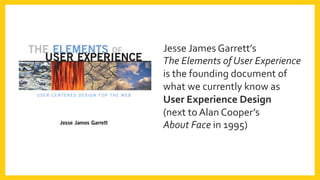
Jesse	James	Garrett’s		
The	Elements	of	User	Experience		
is	the	founding	document	of	
what	we	currently	know	as		
User	Experience	Design		
(next	to	Alan	Cooper’s		
About	Face	in	1995)
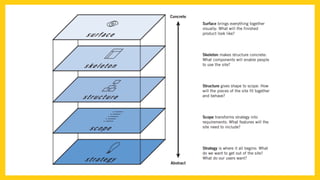
1
Strategy
	
What	do	we	want		
to	get	out	of	the	site?		
What	do	our	users	want?	
	
GOAL:	
Establish	business	+		
user	needs	and	goals	
CONTENT	
STRATEGY	
USER	EXPERIENCE	
RESEARCH	
content	analysis	
core	strategy	
message	architecture	
content	audit	
content	plan	
governance	model	
stakeholder	interviews	
personas	
competitive	analysis	
mental	models	
journey	maps	
usability	testing
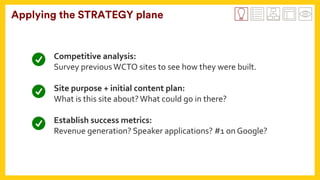
Applying the STRATEGY plane
Competitive	analysis:		
Survey	previous	WCTO	sites	to	see	how	they	were	built.	
	
Site	purpose	+	initial	content	plan:	
What	is	this	site	about?	What	could	go	in	there?	
	
Establish	success	metrics:	
Revenue	generation?	Speaker	applications?	#1	on	Google?
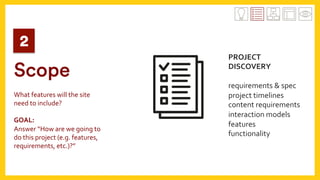
2
Scope
	
What	features	will	the	site	
need	to	include?	
	
GOAL:	
Answer	“How	are	we	going	to	
do	this	project	(e.g.	features,	
requirements,	etc.)?”	
PROJECT		
DISCOVERY	
	
requirements	&	spec	
project	timelines	
content	requirements	
interaction	models	
features	
functionality
Applying the SCOPE plane
Firm	up	project’s	business	framework:		
Objectives,	KPIs,	OKRs,	timelines,	project	team,	etc.	
	
Tech	specs:	
e.g.	Domain	and	hosting,	WP	security,	third-party	services,	etc.	
	
Content	and	functionality:	
What	pages,	content,	and	features	must	this	site	have	that	truly	
matter	to	users?
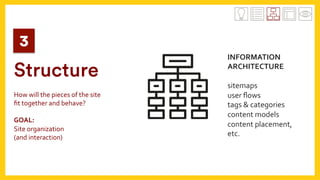
3
Structure
	
How	will	the	pieces	of	the	site	
fit	together	and	behave?	
	
GOAL:	
Site	organization		
(and	interaction)	
INFORMATION		
ARCHITECTURE	
	
sitemaps	
user	flows	
tags	&	categories	
content	models	
content	placement,		
etc.
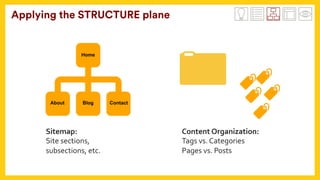
Applying the STRUCTURE plane
Sitemap:	
Site	sections,	
subsections,	etc.	
Content	Organization:	
Tags	vs.	Categories	
Pages	vs.	Posts	
Home
About Blog Contact
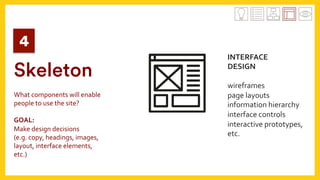
4
Skeleton
	
What	components	will	enable	
people	to	use	the	site?	
	
GOAL:	
Make	design	decisions		
(e.g.	copy,	headings,	images,	
layout,	interface	elements,	
etc.)	
INTERFACE		
DESIGN	
	
wireframes	
page	layouts	
information	hierarchy	
interface	controls	
interactive	prototypes,	
etc.
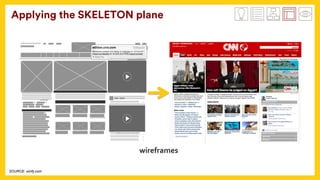
Applying the SKELETON plane
SOURCE: wirify.com
wireframes
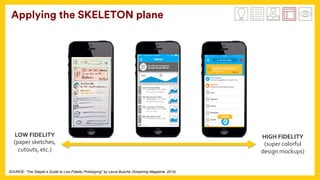
Applying the SKELETON plane
SOURCE: “The Skeptic’s Guide to Low-Fidelity Prototyping” by Laura Busche (Smashing Magazine, 2014)
LOW	FIDELITY	
(paper	sketches,	
cutouts,	etc.)	
HIGH	FIDELITY	
(super	colorful	
design	mockups)
Applying the SKELETON plane
5
Surface
	
What	will	the		
finished	product		
look	like?	
	
GOAL:	
Packaging	and	presentation	
VISUAL		
DESIGN	
	
color	
layout	
typography	
imagery	
high-fidelity	comps	
design	systems,	etc.	
Hello	world!
A very important distinction!
creative	problem-solving	 “make	it	pretty”	
Design
 design
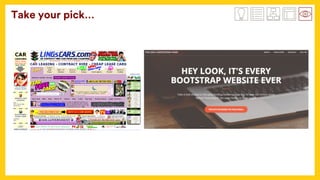
Take your pick…
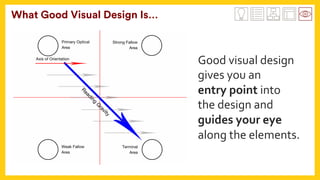
What Good Visual Design Is…
Good	visual	design	
gives	you	an		
entry	point	into		
the	design	and	
guides	your	eye	
along	the	elements.
Applying the SURFACE plane
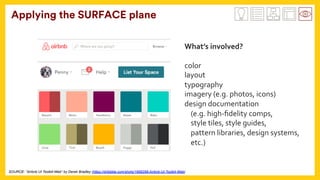
What’s	involved?	
	
color	
layout	
typography	
imagery	(e.g.	photos,	icons)	
design	documentation	
(e.g.	high-fidelity	comps,		
style	tiles,	style	guides,		
pattern	libraries,	design	systems,	
etc.)	
SOURCE: “Airbnb UI Toolkit-Web” by Derek Bradley (https://dribbble.com/shots/1669299-Airbnb-UI-Toolkit-Web)
Applying the SURFACE plane
Decide	on	the	colors,	fonts,	images,	page	layouts,	etc.:		
Document	these	decisions	somewhere	(e.g.	style	tile)	
	
Select	the	WP	theme:	
Which	theme	suits	my	needs?	Free?	Premium?	
	
Consider	theme	customization:	
How	far	can	I	‘personalize’	this	theme?	Child	themes?	
functions.php?	Page	builders?
User-centered beats being
(solely) business-centered.1
y	tho
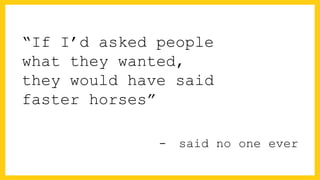
“If I’d asked people
what they wanted,
they would have said
faster horses”
-  said no one ever
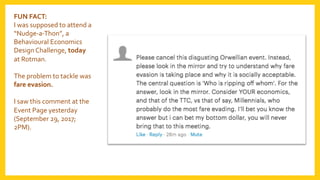
FUN	FACT:	
I	was	supposed	to	attend	a	
“Nudge-a-Thon”,	a	
Behavioural	Economics	
Design	Challenge,	today	
at	Rotman.	
	
The	problem	to	tackle	was	
fare	evasion.	
	
I	saw	this	comment	at	the		
Event	Page	yesterday	
(September	29,	2017;	
2PM).
As designers, we strike a balance
between what users want and what
matters to the business.
2
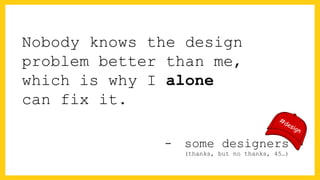
Nobody knows the design
problem better than me,
which is why I alone
can fix it.
-  some designers
(thanks, but no thanks, 45…)
A solid process gives you signposts
to look out for.3
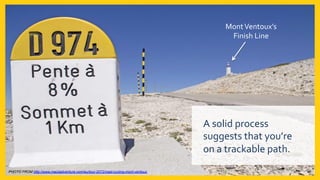
THINK	OF	IT	THIS	WAY:	
What	if	a	marathon	
didn’t	have	any	
progress	indicators?
Mont	Ventoux’s		
Finish	Line	
A	solid	process		
suggests	that	you’re		
on	a	trackable	path.	
PHOTO FROM http://www.macsadventure.com/eu/tour-2072/road-cycling-mont-ventoux
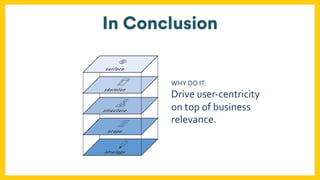
In Conclusion
WHY	DO	IT:	
Drive	user-centricity	
on	top	of	business	
relevance.
If	you	only	have	to	
remember	one	thing…
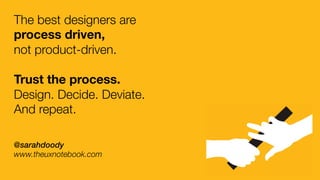
The best designers are !
process driven, !
not product-driven. 

Trust the process. 

Design. Decide. Deviate. !
And repeat.
@sarahdoody
www.theuxnotebook.com
Thank You!
SLIDES:	 		
http://bit.ly/ux4wordpress	
	
CONNECT:	 		
@jemrosario

Wp, uxd, and you