Network: RU-Secure
Username: trsguest2017
Password: RUguest253$
Drew Wilde - Product Manager
Website Optimization Through
Quality Experimentation
1. Why we optimize
1. Overcoming fear of optimization
1. Optimization best practices
1. Experiment ideas and examples
1. Google Optimize BETA closer look
Q1 PerformanceWeb Optimization and Experimentation
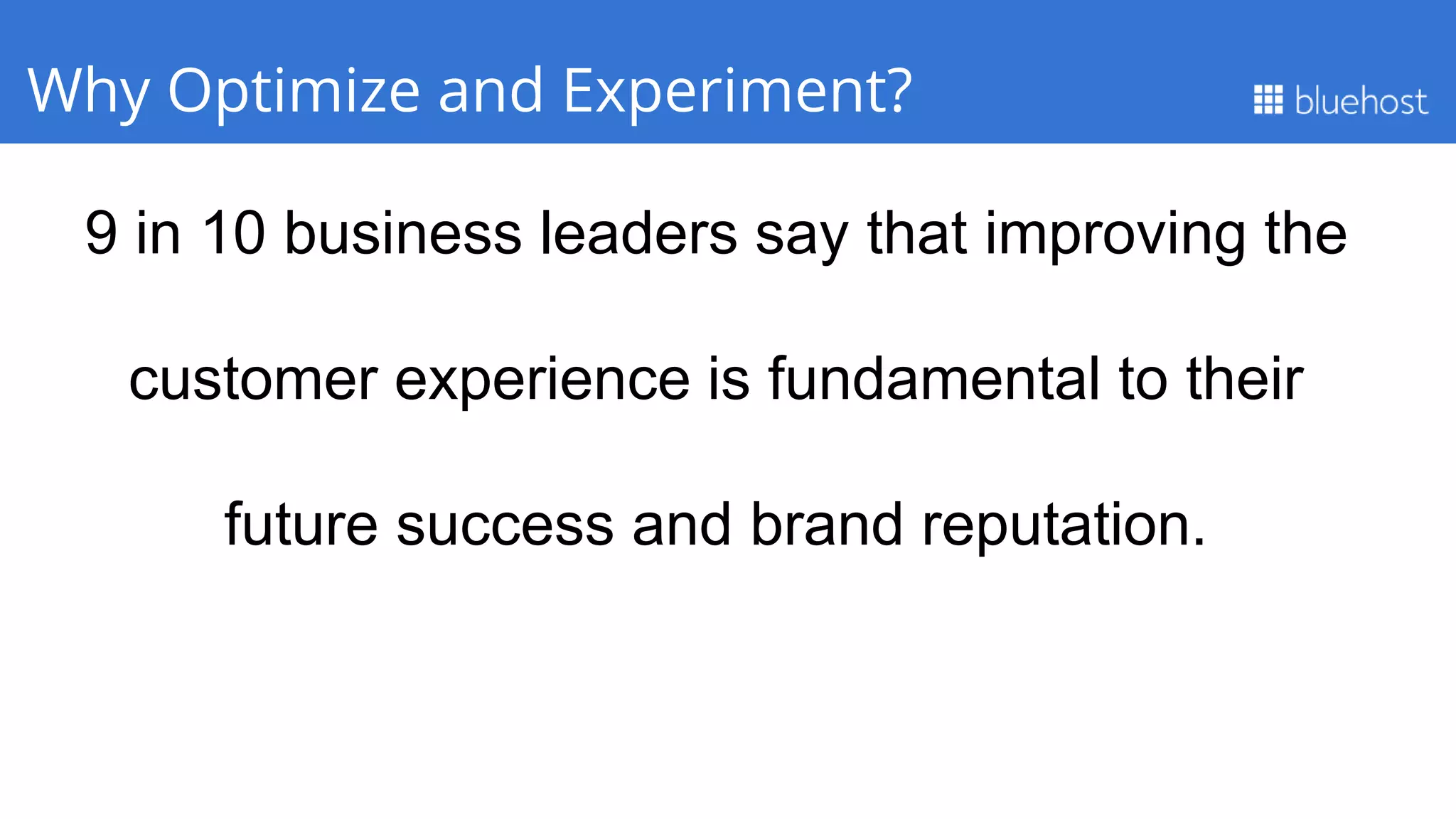
9 in 10 business leaders say that improving the
customer experience is fundamental to their
future success and brand reputation.
Q1 PerformanceWhy Optimize and Experiment?
Q1 PerformanceAgile Project Management
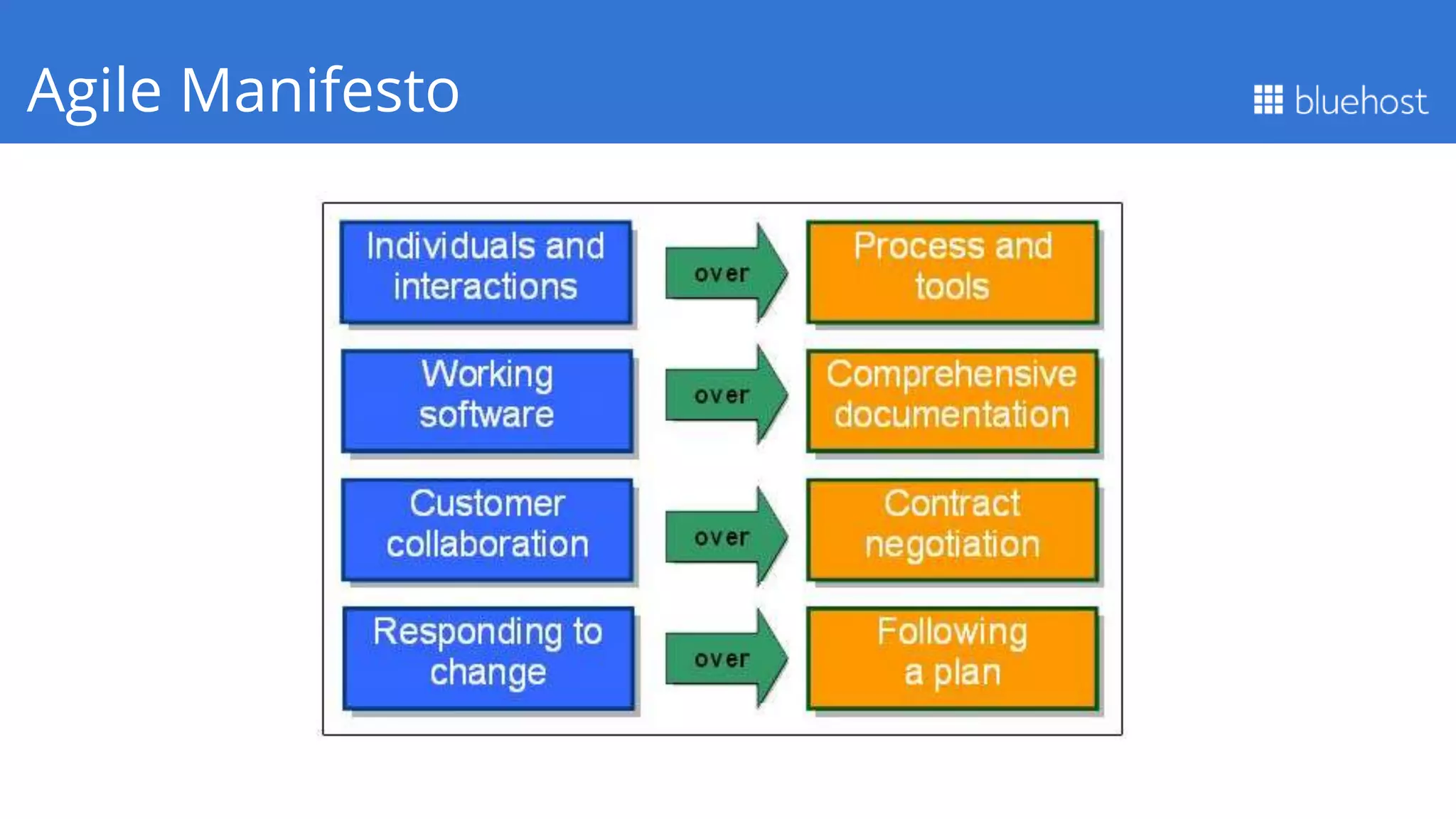
Q1 PerformanceAgile Manifesto
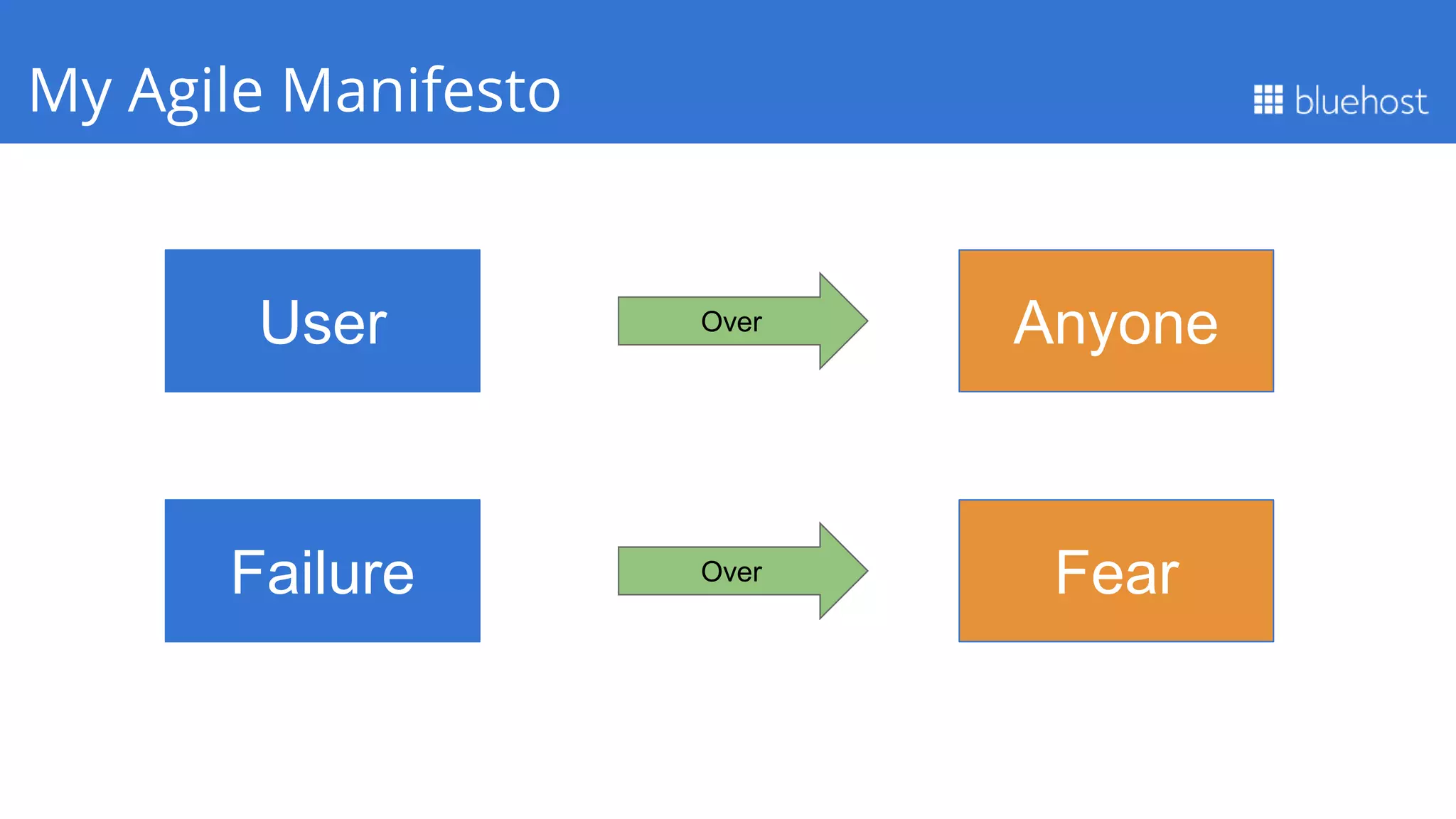
Q1 PerformanceMy Agile Manifesto
User Over Anyone
Failure Over Fear
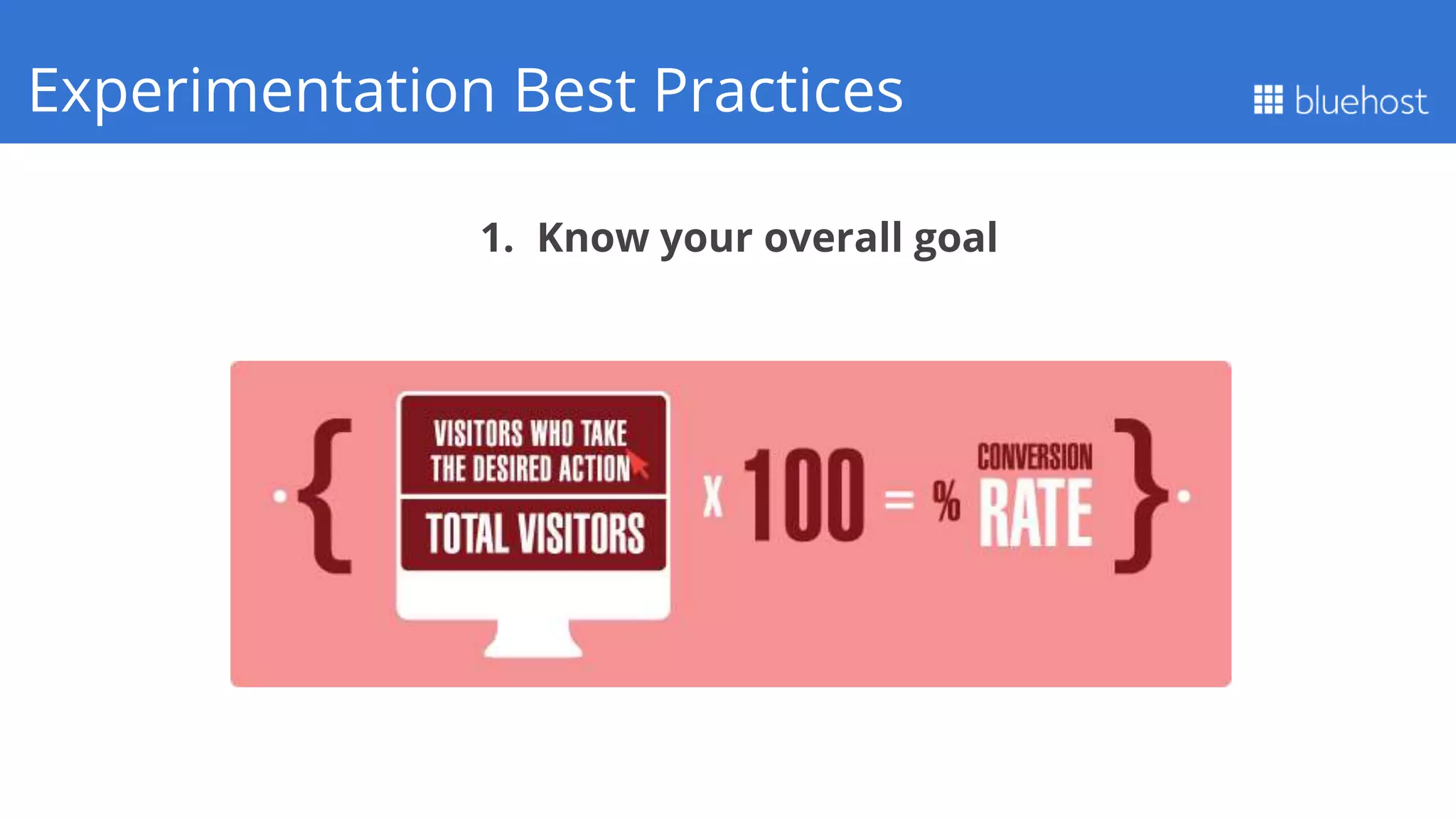
1. Know your overall goal
Q1 PerformanceExperimentation Best Practices
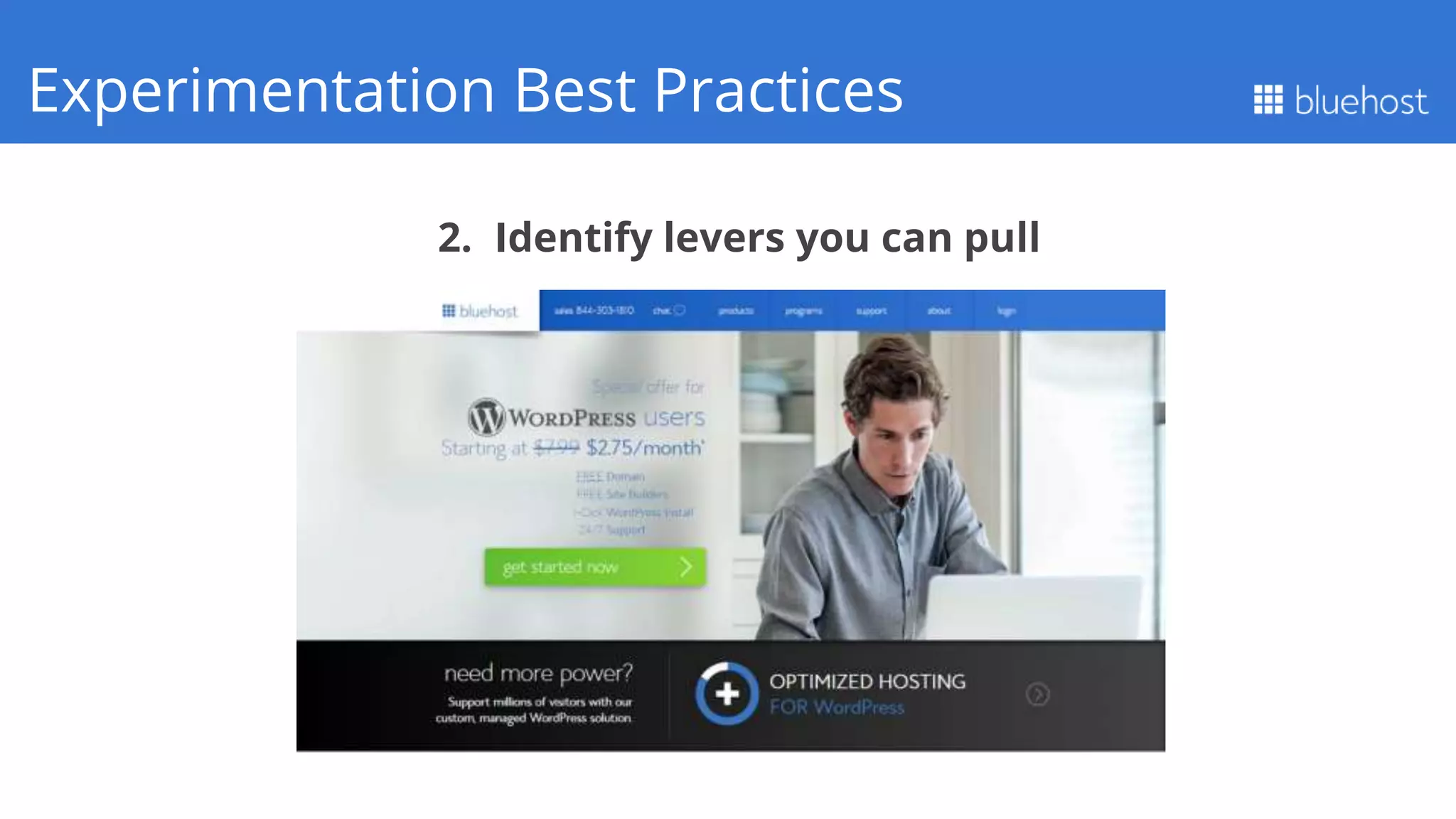
2. Identify levers you can pull
Q1 PerformanceExperimentation Best Practices
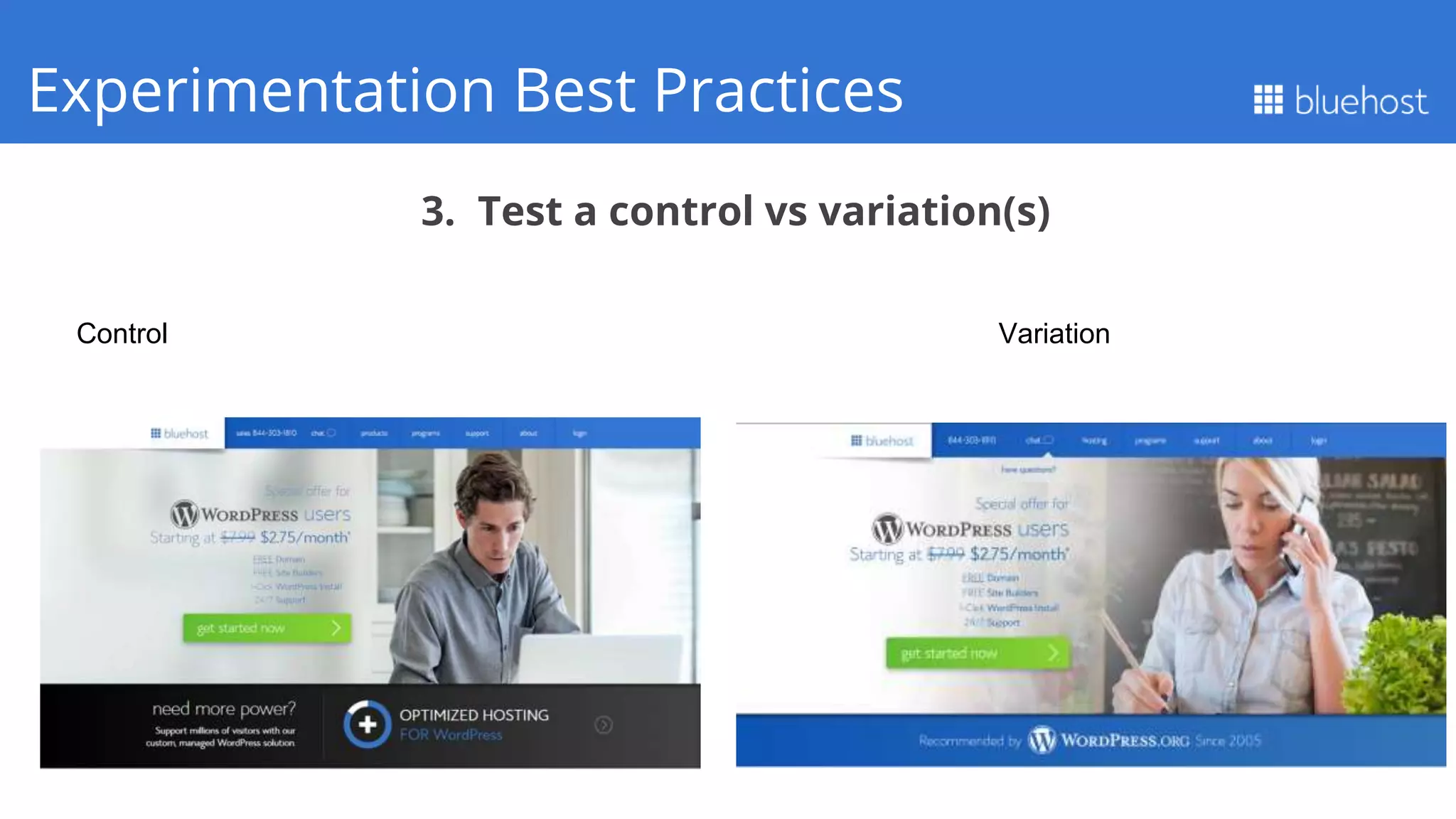
3. Test a control vs variation(s)
Q1 PerformanceExperimentation Best Practices
Control Variation
4. Look at combined impact
Q1 PerformanceExperimentation Best Practices
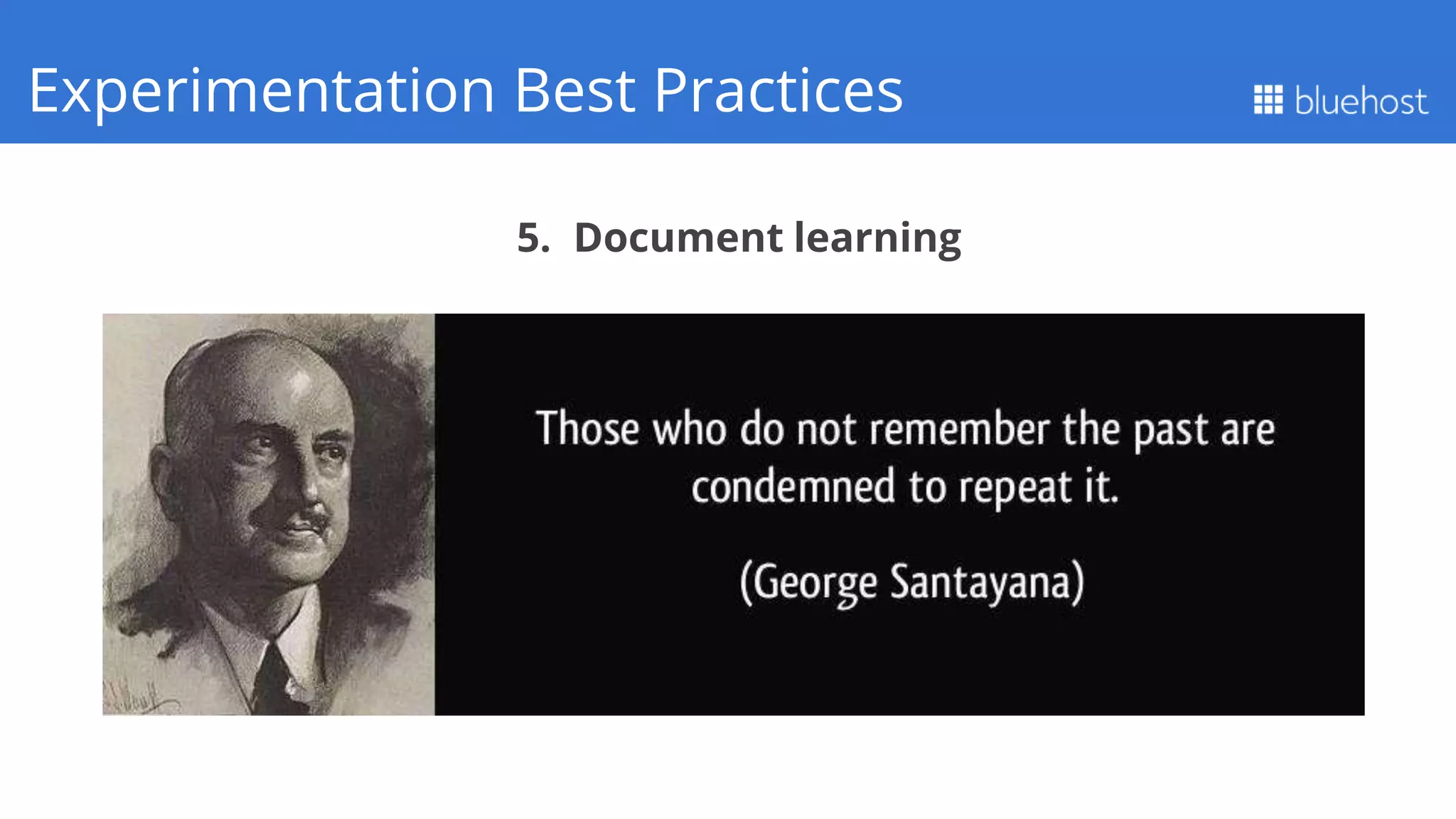
5. Document learning
Q1 PerformanceExperimentation Best Practices
The 7 Deadly Sins of Landing Page Design
Q1 PerformanceExperimentation Ideas
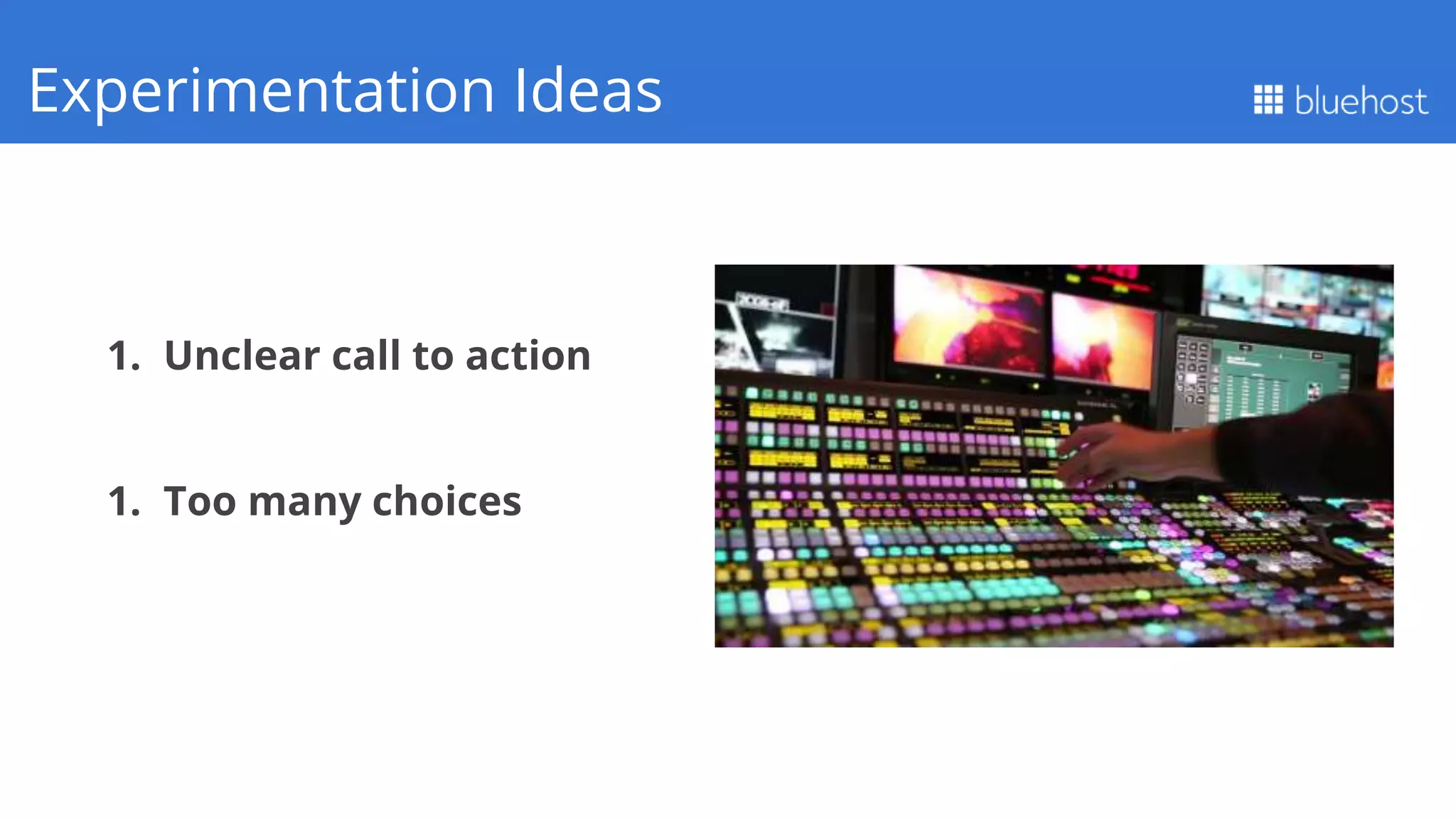
1. Unclear call to action
1. Too many choices
Q1 PerformanceExperimentation Ideas
3. Visual distractions
3. Not keeping promises
Q1 PerformanceExperimentation Ideas
5. Too much text
Q1 PerformanceExperimentation Ideas
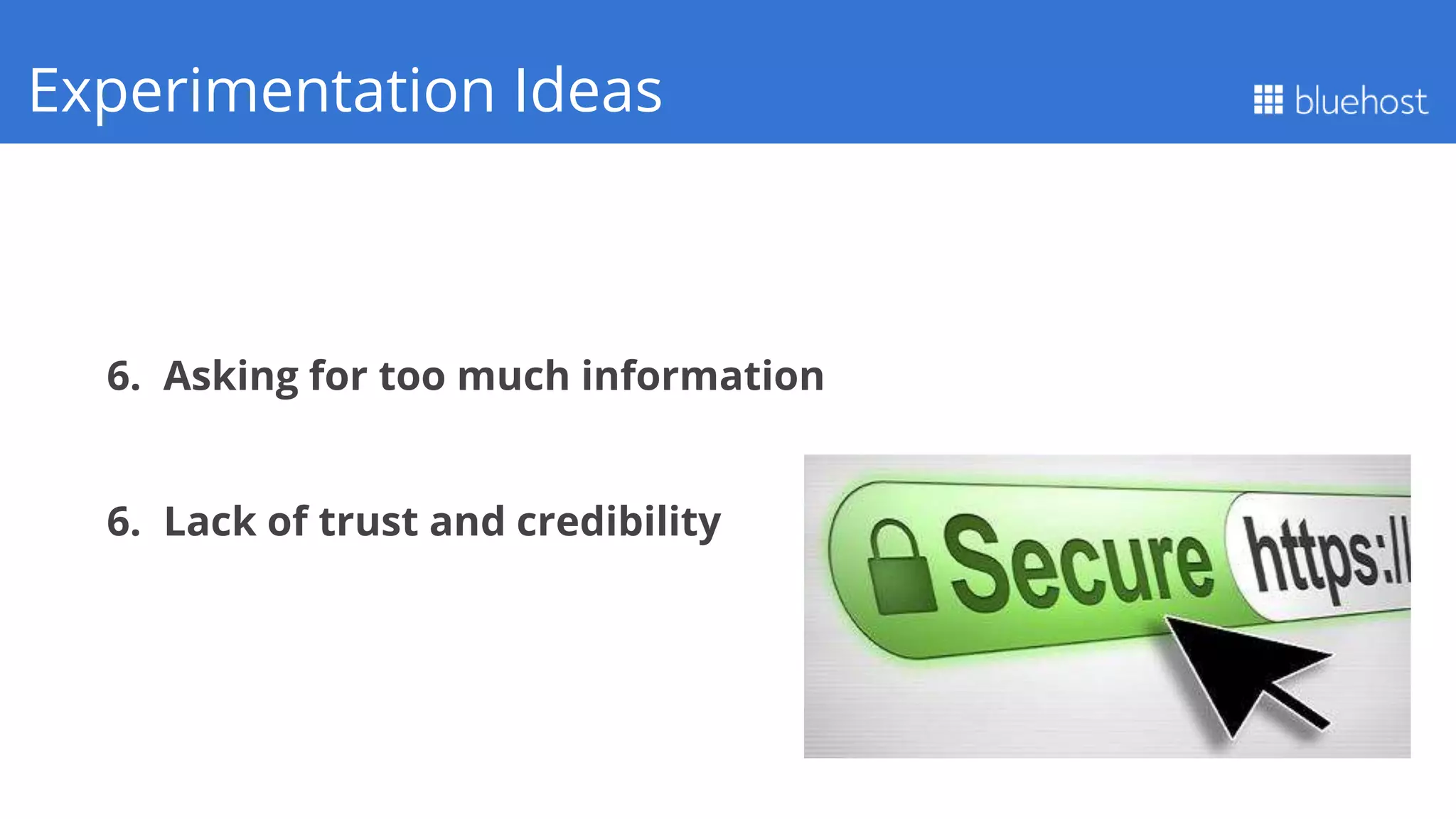
6. Asking for too much information
6. Lack of trust and credibility
Q1 PerformanceExperimentation Ideas
And a personal one!
8. Feature over Benefits
Q1 PerformanceExperimentation Ideas
Q1 PerformanceTesting Examples
Email A: Email B:
Q1 PerformanceTesting Examples
Email A: Email B:
Q1 PerformanceTesting Examples
Test A Test B
Q1 PerformanceTesting Tools
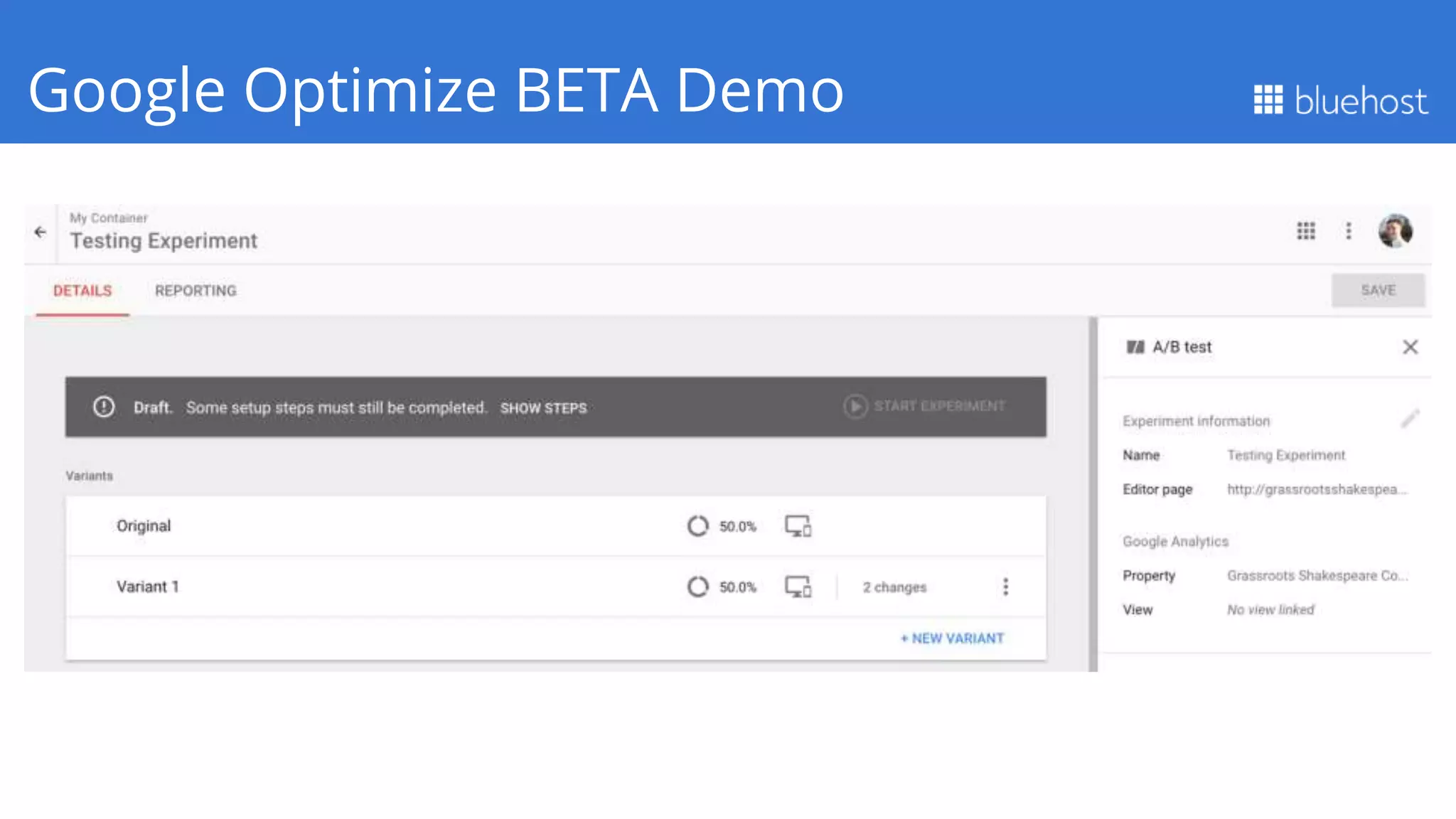
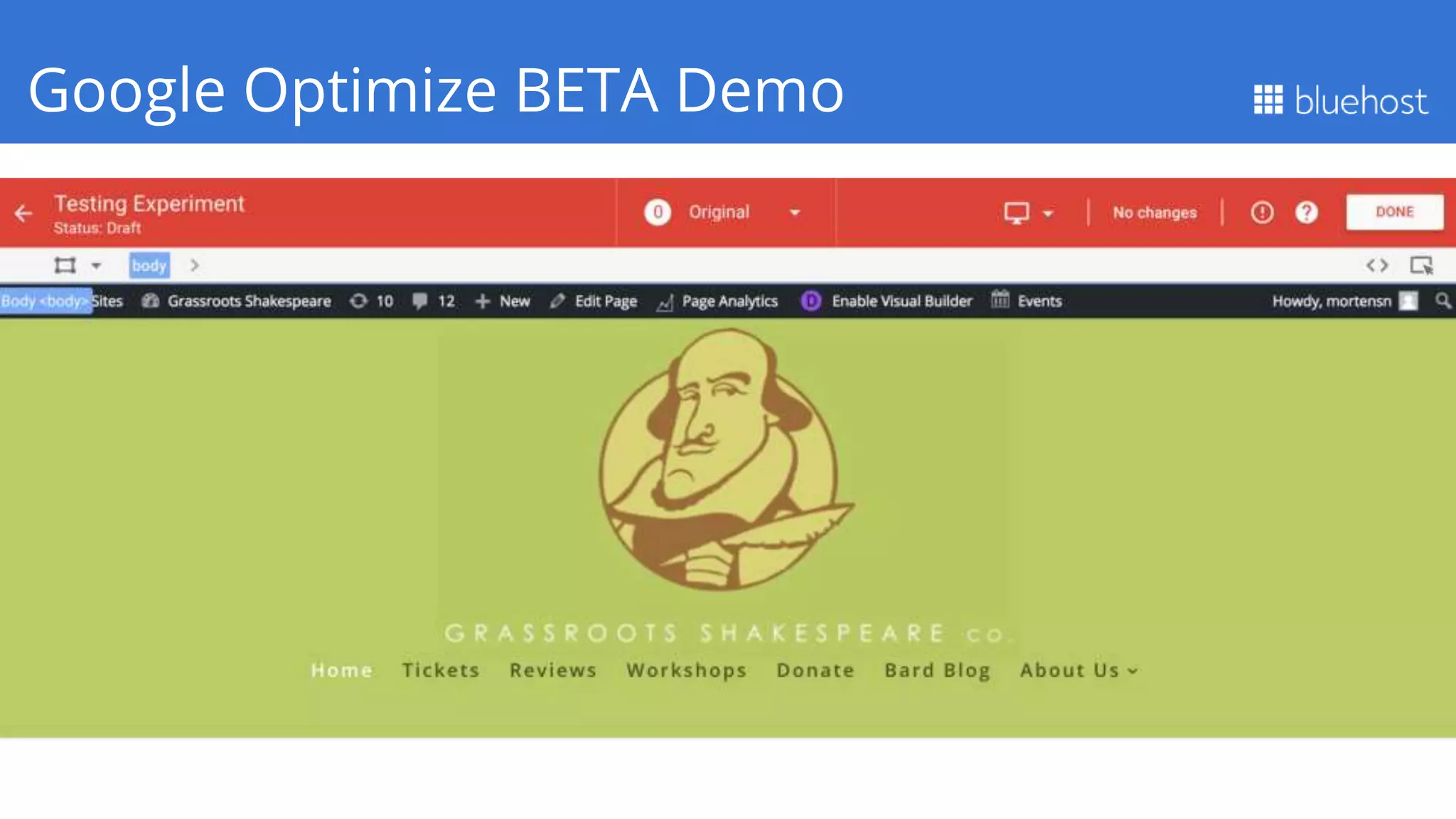
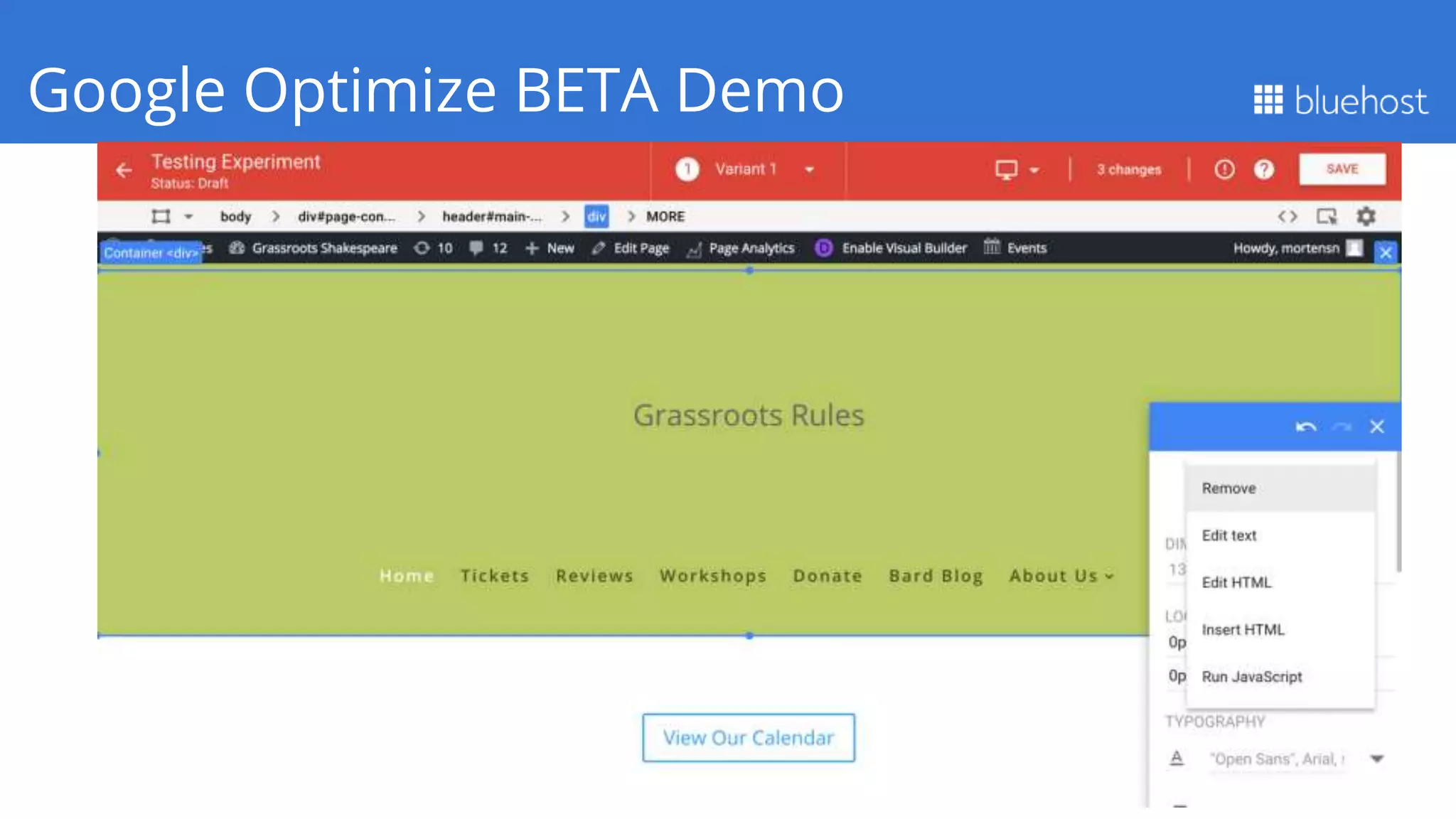
Q1 PerformanceGoogle Optimize BETA Demo
1. Why we optimize
1. Overcoming fear of optimization
1. Optimization best practices
1. Experiment ideas and examples
Q1 PerformanceWeb Optimization Wrap-up
9 in 10 business leaders say that improving the
customer experience is fundamental to their
future success and brand reputation.
Q1 PerformanceWhy Optimize and Experiment?
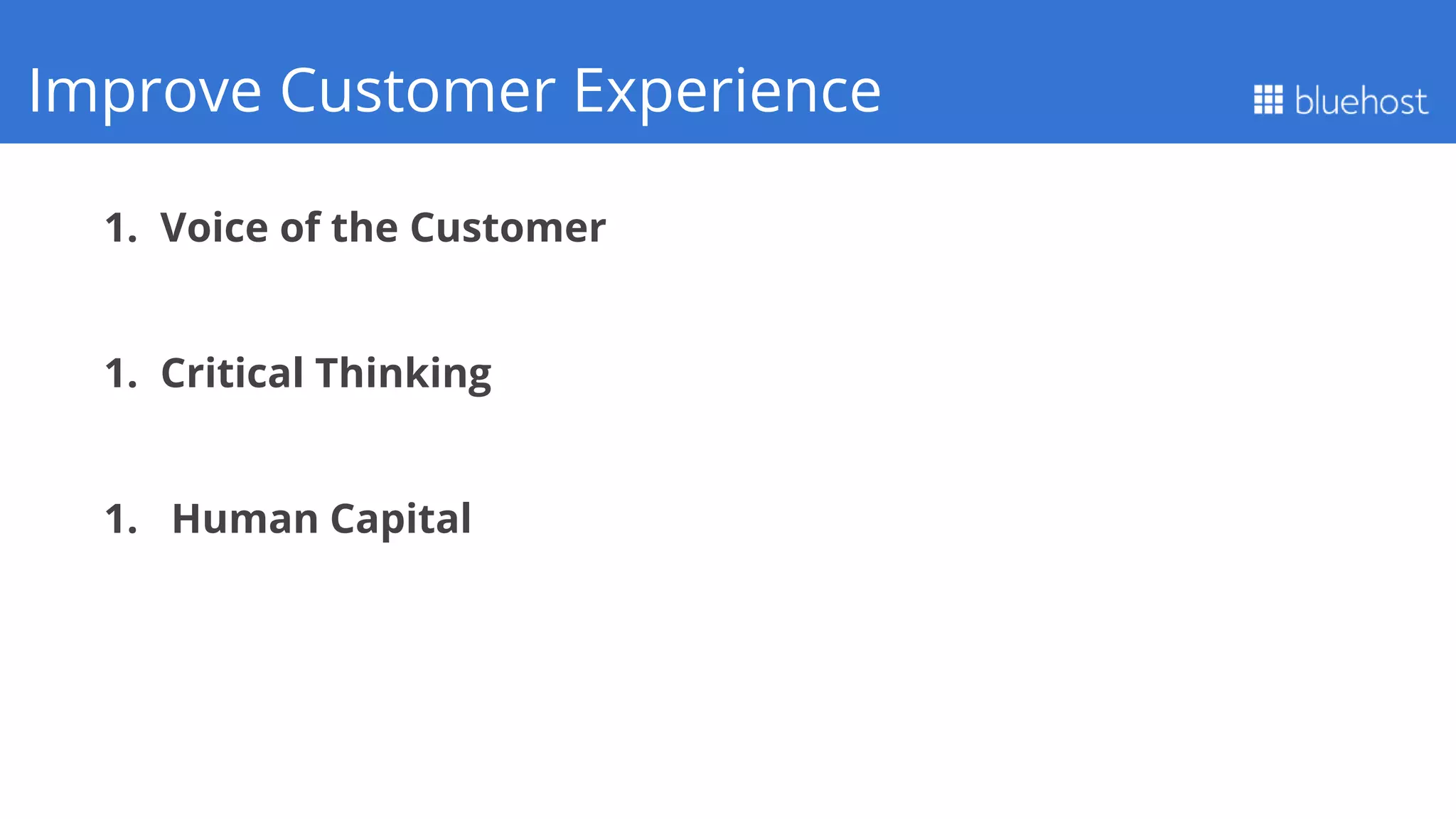
1. Voice of the Customer
1. Critical Thinking
1. Human Capital
Q1 PerformanceImprove Customer Experience
Q&A

Website optimization through quality experimentation (2)

Editor's Notes

  • #3 Introduction Bluehost for over 6 years, in sales management, project management and product management for 4 of those years. Project Management Roots. Degree in English and an recently completed MBA Run a WordPress website for a theatre company and run all their marketing Past few 12 months or so we’ve done a good job of establishing a healthier Web Optimization culture at Bluehost and the learning is really great for websites at any level Working to improve the product ALWAYS
  • #4 Tell them what you’re going to tell them tell them what you’re going to tell them Overview of what we’re going to be looking at today! And feel free to ask questions at any time :) i want this to be effective and helpful for everyone who has come today. Set expectations covering a lot of basics and healthy thought processes around testing and but not into the nitty-gritty of specific tools and experiment nuances.
  • #5 Why Optimize and experiment? Yet less than half of business leaders say they have actually taken action around their customer experience activities. Testing is vital for improving the customer experience and in my experience professionally, it’s the single biggest action item I have on my list to hit goals. experiences engage and delight your customers. “There’s a difference between having an experience that doesn’t suck and creating one that people will love” -Dana Chisnell
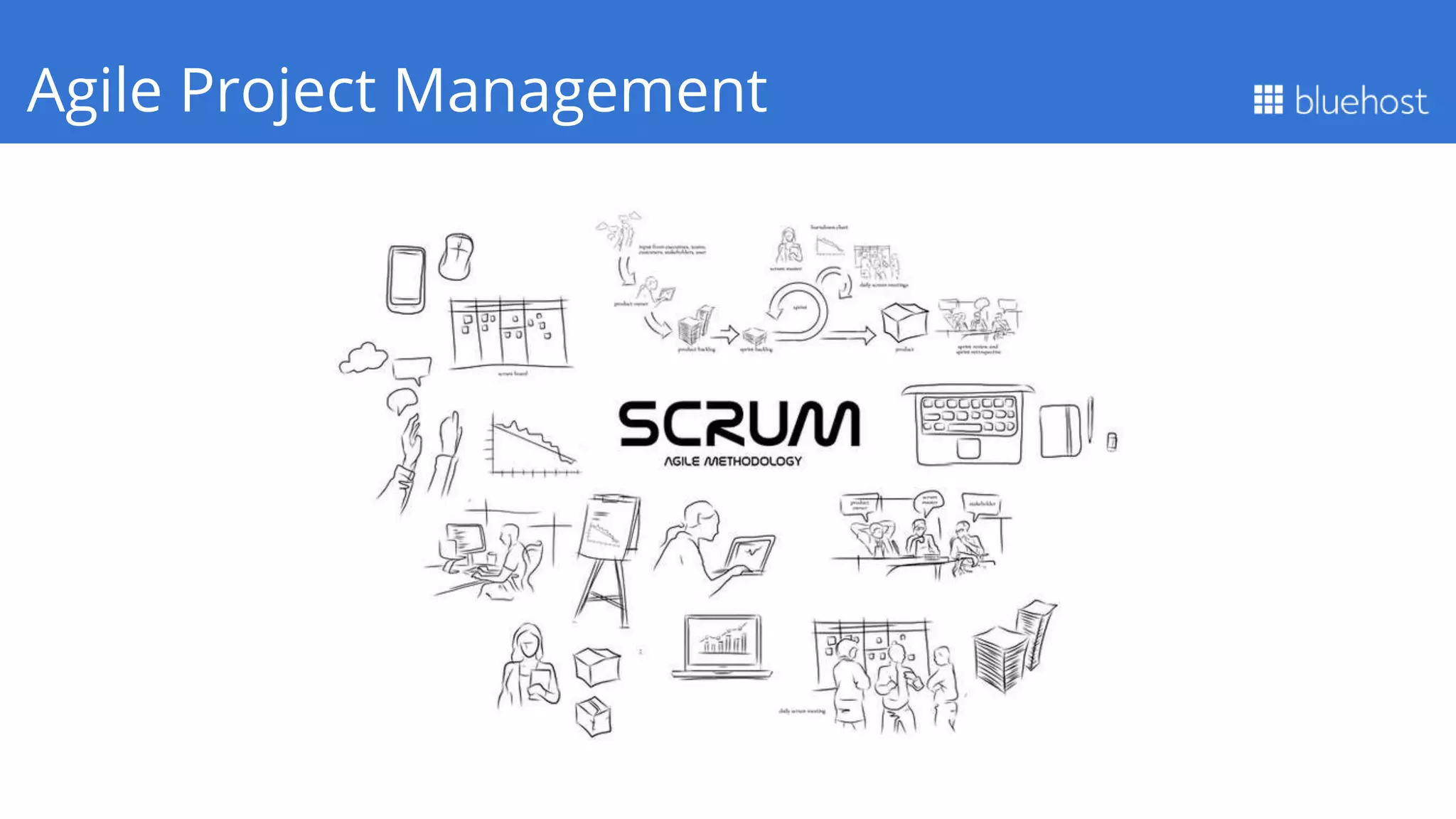
  • #6 Agile Project Management Who has heard of or has any experience in Agile Project Management? Anyone wanna give a short synopsis of Agile PM? highly flexible and interactive process and project management meant to incrementally design and build.
  • #7 The Agile Manifesto Briefly touch on all the points Moral of the story here is agile PM is great.
  • #8 I have a couple of other pieces to add to the manifesto users over anyone else failure over fear These are the two pieces of Agile PM that I want to focus on as we delve into web optimization Getting experiments in front of users will be more effective than other methods to determine optimization such as primary or secondary market research In my PM responsibilities this isn’t necessarily a test that goes to the end use on LIVE. talking with your users could be as simple as asking your WordCamp fried to take a look at what you’re working on and providing feedback. and Failure is an important part of experimentation and it should be cherished rather than feared. You have to fail to succeed. Fail fast and succeed early To recap: Experimentation is important for optimizing UX and other KPIs Don’t be afraid of it. Users will let you know when to shift or explore. And Failure is part of the process of learning and you can learn just as much if not more from failure
  • #9 So let’s jump into some optimization best practices. 5 simple things to remember as you start to experiment on your site. #1 Know your overall goal. Define your KPIs!! Go over questions BH example -> Total Signup Revenue What do you want to learn? What question will this test answer? How will you use the answer in the future? Is the tactic you are testing repeatable? Tests should not be so specific that you can’t apply learning to other campaigns (i.e. mom’s vs. mother’s day) Is it meaningful? If you cannot answer the above questions - STOP! - and rethink your test! BH example: New Signup Revenue
  • #10 Identify levels you can pull or in other words elements on your site that you can experiment with. Focus on high impact areas Go over the BH WordPress Landing page we identified two spaces that we thought would have a high impact on the conversion signups - traffic and conversion rate and AOV Different aspects of your site that could help increase GOAL This is the majority of the creative portion of the test. Go through BH example of our Wordpress landing page
  • #11  eliminate variances to test one thing at a time one important thing is running control and variation at the same time. The scientific method at work here. 5th grade coming back with vengeance. Trial in Patience .
  • #12  18.9% increase in Conversion Rate But we saw a decrease in the AOV. However our conversion made the overall goal of REVENUE impacted positively
  • #13 Spanish American philosopher, essayist, poet, and novelist Agile principle of retrospective In an optimization culture there’s so much learning that if there’s no documentation you risk repeating history.
  • #14 Tim Ash is the author of the bestselling book Landing Page Optimization, and CEO of SiteTuners. A computer scientist and cognitive scientist by education (his PhD studies were in Neural Networks and Artificial Intelligence)
  • #15 What am I supposed to do on this page? b. The Fix i. The call-to-action should be clear and should draw the eye. ii. The placement of the call to action should be above the fold. iii. Competing visuals should be deemphasized What am I supposed to do first? b. The Fix i. Don’t present detail too early in the process. ii. Group related choices into a smaller number of categories. iii. Use visual shortcuts to reduce reading
  • #16 What am I supposed to look at? i. The key to effective landing pages is clarity. ii. “Boring” works. And it makes you a lot more money--that should make it much more exciting. b. The Fix i. Remove all graphical elements that do not directly support the conversion action. ii. Remove colorful page elements and animation or motion (unless they test better). iii. Replace generic stock photos with specific relevant images. Not Keeping Your Promises a. Does your landing page deliver what I expected? i. Your visitor came from somewhere(email, link in blog post, search result, etc.) where an expectation was set. ii. It is critical to match the visitor’s expectation and intent to maximize conversion rate. b. The Fix i. Understand your important upstream traffic sources and their context. ii. Match landing page content to the traffic source messaging and intent. iii. Provide clear access to promised information or functionality.
  • #17 Do you really expect me to read all this? b. The Fix i. Use a clear page title and headings ii. Use an “inverted pyramid” writing style, putting the important stuff first. iii. Do not write in complete sentences--use short bullet lists whenever possible. iv. Ruthlessly edit and shorten your text. v. Move long text to supporting pages or informational popovers.
  • #18 Why should I give you all this information? b. The Fix i. Ask only for information that is absolutely required. ii. Collect additional information at a later date as trust is established. iii. Shorten labels and unclutter form layout. Why should I trust you? i. First impressions matter. We do judge a book by its cover. ii. Don’t get disqualified based solely on how you look. b. The Fix i. Appearance: ● Professional design ● Sparseness and neatness ● Organization and clarity ii. Transactional Assurances (these make the visitor feel “less worse”) ● Guarantees ● Policies ● Trials ● Privacy symbols iii. Outside Expertsand Media(3rdpartyvalidationmakesthevisitorfeel “more better”) ● Reviews and awards ● Media mentions ● Endorsements from trade organizations and associations ● Paid endorsements and spokespeople ● Partnerships with other respected companies* ● Client lists and logos* * Borrow trust from better-known brands. i. Consensus of Peers ● The many (objective large numbers) -- lots of people have used it ● The comparable (likeness) -- someone similar to the visitor has Free SSL on all Bluehost WP installs
  • #19 Each is a feature-a factual statement about the product or service being promoted. But features aren't what entice customers to buy. That's where benefits come in. A benefit answers the question "What's in it for me?," meaning the feature provides the customer with something of value to them.
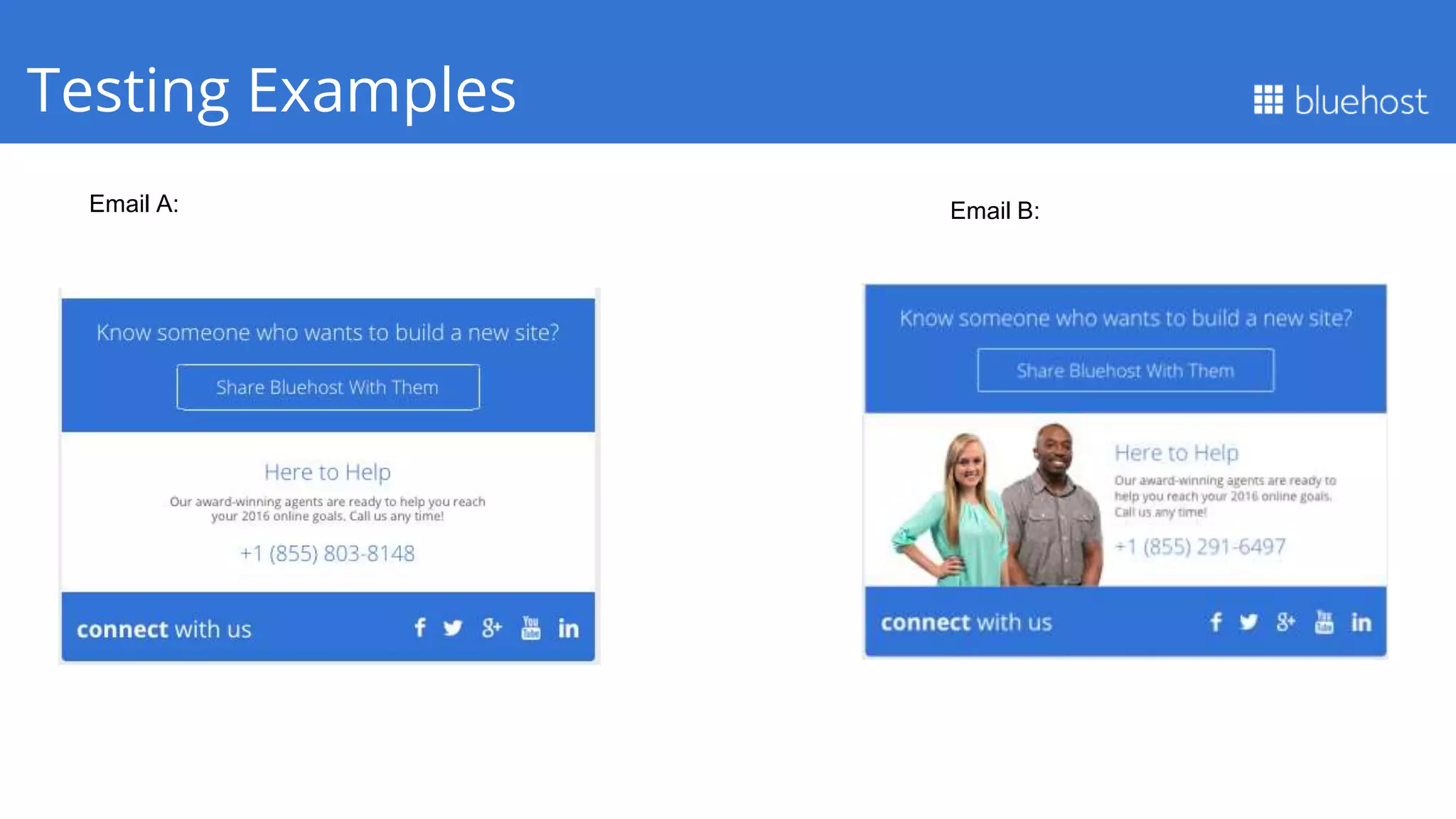
  • #20 Does having humans in the creative encourage more clicks? Key Take-Away: Having humans in the creative garners more clicks. Lift = 3.57%
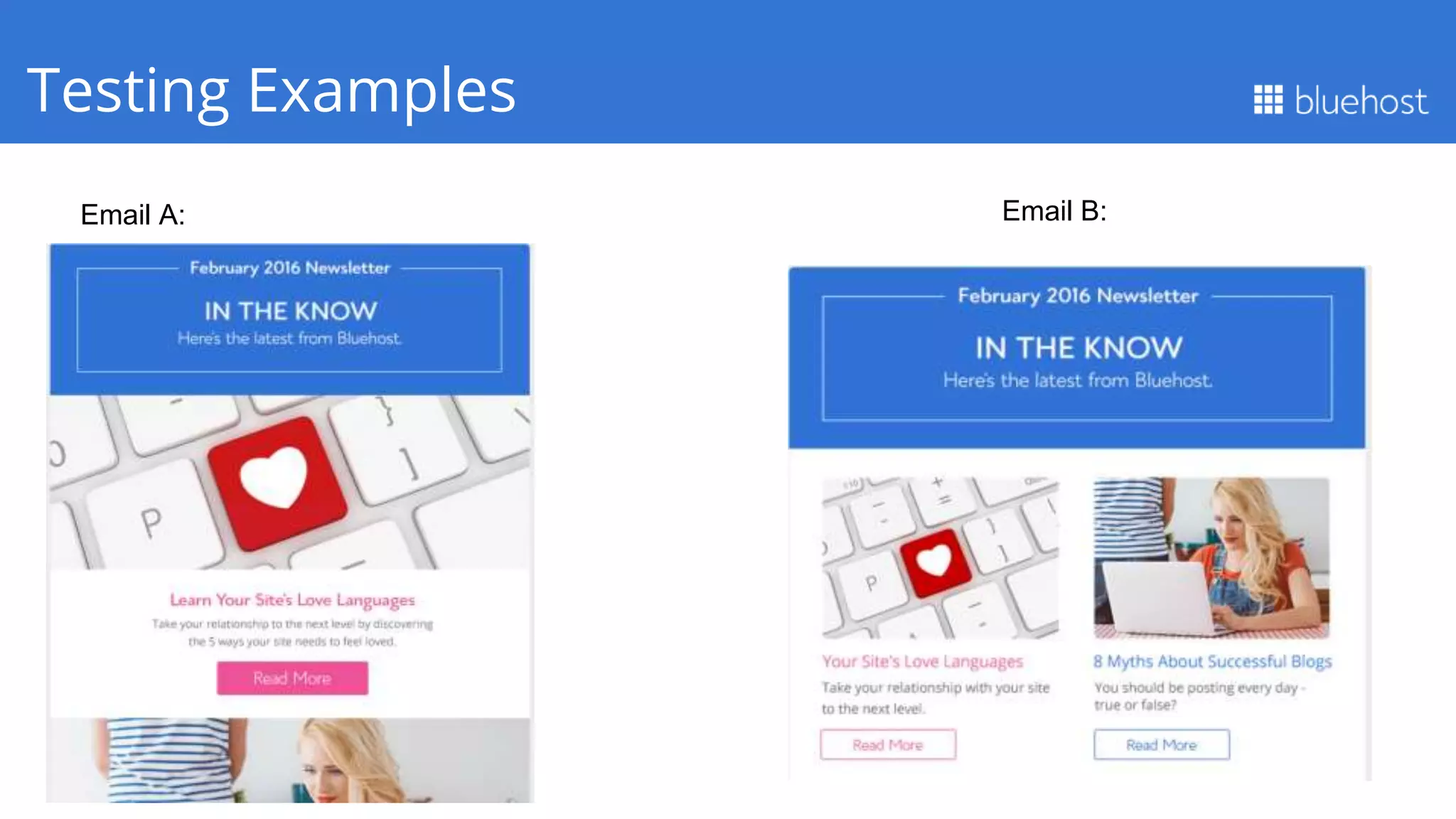
  • #21 Key Take-Away: Shorter text and more pictures drew more clicks. Not statistically significant, need further testing. Lift = 3.77%
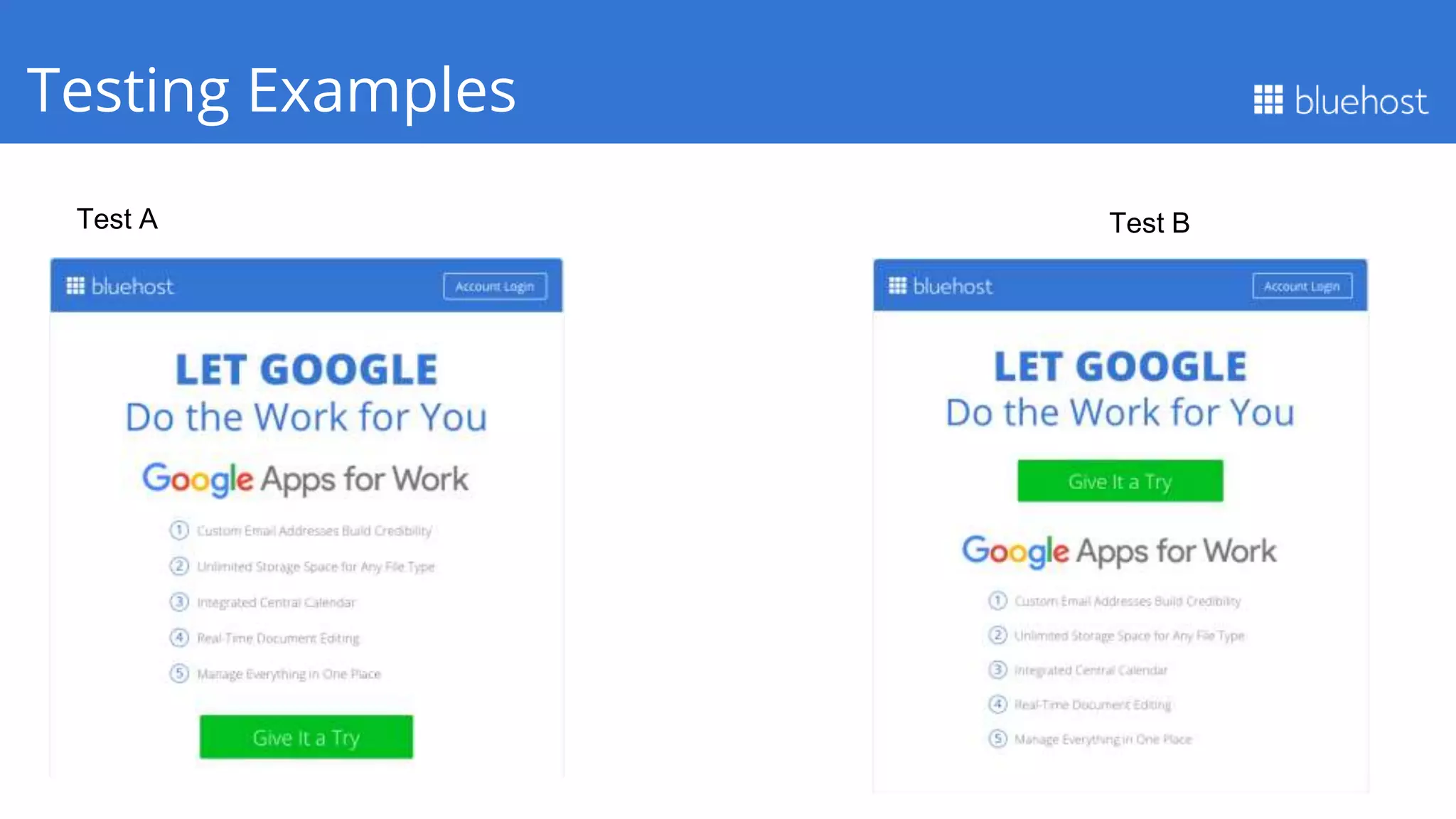
  • #22 Key Take-Away: The location of the button trumps the flow of content. The button or actionable item needs to be offensively high. Lift = 8.77%
  • #23 Optimization tools out there that make it easy! I use monetate in a corporate environment but am excited to use Google Optimize with my personal sites. Is great for the front end experiences that we’ve been running and they have a dev team that we leverage for custom features. Not as familiar with Optimizely but their reputation is solid and they’re built for WordPress. -30 day free trial. Targeting (insert js or whatever) WYSIWYG. Intergration with salesforce or the atlassian suite Better Google Analytics Plugin - has an a/b testing option Google Optimize - WYSIWYG tied already to GA on your site. All your data in one place.
  • #27 Tell them what you told them
  • #28 Why Optimize and experiment? Yet less than half of business leaders say they have actually taken action around their customer experience activities. Testing is vital for improving the customer experience and in my experience professionally, it’s the single biggest action item I have on my list to hit goals. experiences engage and delight your customers. “There’s a difference between having an experience that doesn’t suck and creating one that people will love” -Dana Chisnell
  • #29 VoC Surveys NPS Visits Feedback Loop Critical Thinking “How can I frame this problem that the users have in context of what’s currently available to them and make it compelling?” Steal like an artist! Human Capital Product success is hinged on the people involved in researching, developing and designing the product at hand. If you’re wearing some or all of the hats, take time to try and all the necessary questions of: What How Which Way Why