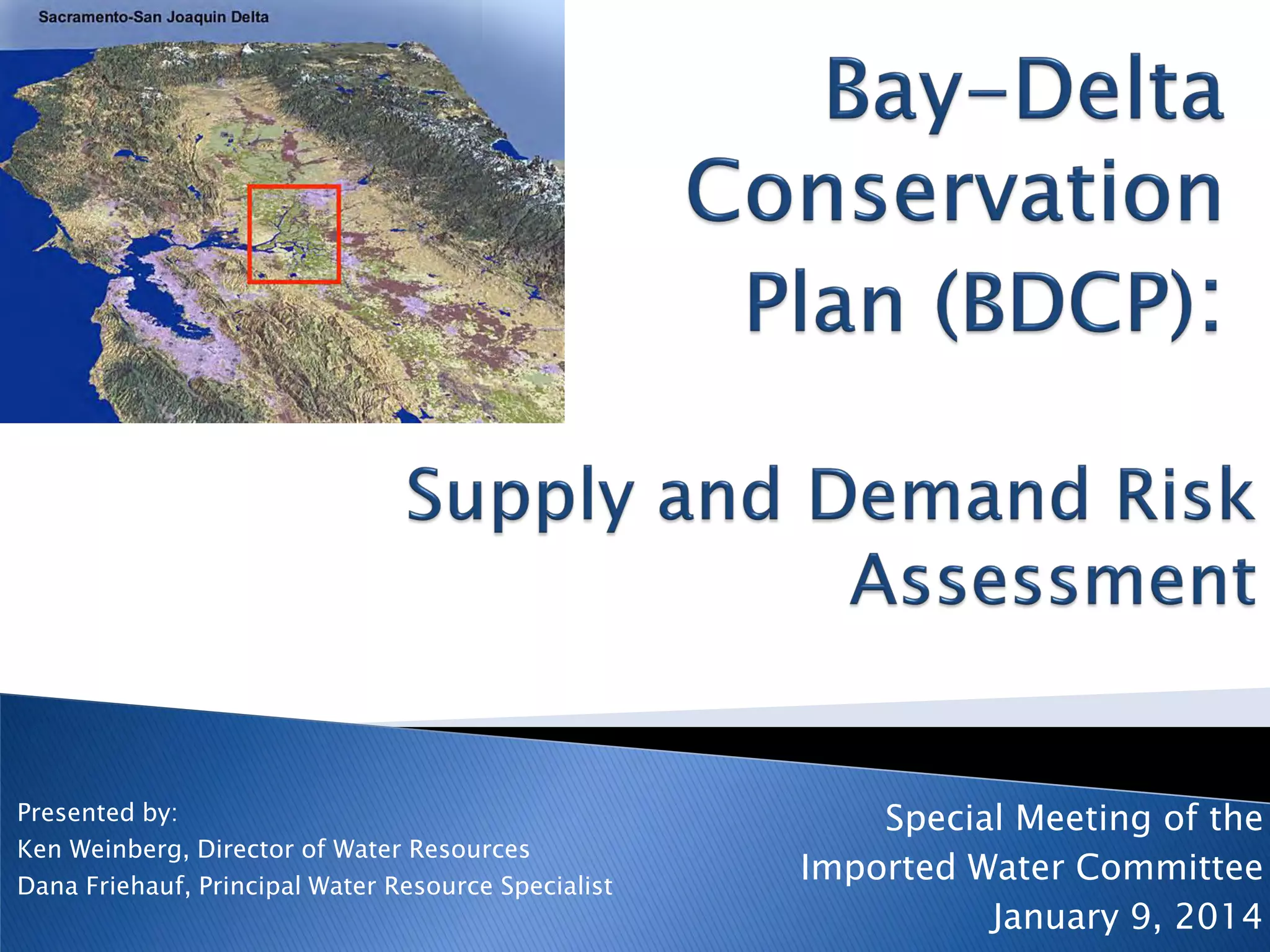
Presented by:
Ken Weinberg, Director of Water Resources
Dana Friehauf, Principal Water Resource Specialist

Special Meeting of the
Imported Water Committee
January 9, 2014





BDCP update
Summary of previous SWP supply reliability
analyses
Risk assessment
◦
◦
◦
◦
◦



Permitting
Schedule
Implementation
Supply
Demand

Summary/Observations

2


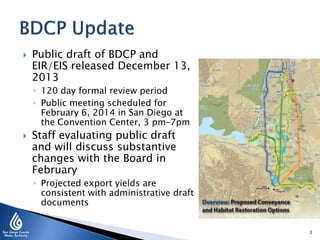
Public draft of BDCP and
EIR/EIS released December 13,
2013
◦ 120 day formal review period
◦ Public meeting scheduled for
February 6, 2014 in San Diego at
the Convention Center, 3 pm–7pm



Staff evaluating public draft
and will discuss substantive
changes with the Board in
February
◦ Projected export yields are
consistent with administrative draft
documents
3


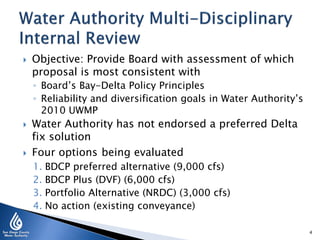
Objective: Provide Board with assessment of which
proposal is most consistent with
◦ Board’s Bay-Delta Policy Principles
◦ Reliability and diversification goals in Water Authority’s
2010 UWMP





Water Authority has not endorsed a preferred Delta
fix solution
Four options being evaluated
1. BDCP preferred alternative (9,000 cfs)
2. BDCP Plus (DVF) (6,000 cfs)
3. Portfolio Alternative (NRDC) (3,000 cfs)
4. No action (existing conveyance)
4



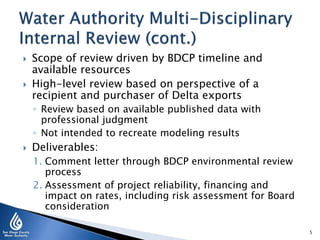
Scope of review driven by BDCP timeline and
available resources
High-level review based on perspective of a
recipient and purchaser of Delta exports
◦ Review based on available published data with
professional judgment
◦ Not intended to recreate modeling results



Deliverables:
1. Comment letter through BDCP environmental review
process
2. Assessment of project reliability, financing and
impact on rates, including risk assessment for Board
consideration
5




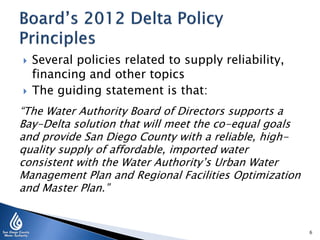
Several policies related to supply reliability,
financing and other topics
The guiding statement is that:

“The Water Authority Board of Directors supports a
Bay-Delta solution that will meet the co-equal goals
and provide San Diego County with a reliable, highquality supply of affordable, imported water
consistent with the Water Authority’s Urban Water
Management Plan and Regional Facilities Optimization
and Master Plan.”

6
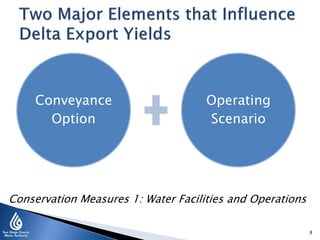
Conveyance
Option

Operating
Scenario

Conservation Measures 1: Water Facilities and Operations
8
5.0

4.7

4.5

4.4

South Delta
4.2

North Delta

4.0

Average Annual Exports (MAF)

3.5

2.3

1.8

3.0

49%

41%

1.2

28%

2.5
2.0
1.5
1.0

2.4
51%

2.6
59%

3.0

3.4

72%

0.5
0.0
Proposed Action 9,000
cfs

Source: BDCP Chapter 9, Table 9-3

6,000 cfs Alt

3,000 cfs Alt

Existing Conveyance

Average Annual Exports
Early Long-Term (2025)
9

9




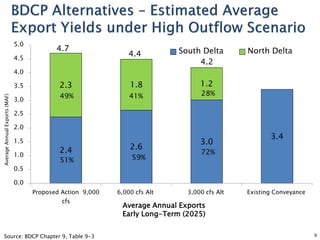
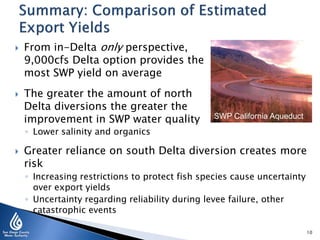
From in-Delta only perspective,
9,000cfs Delta option provides the
most SWP yield on average
The greater the amount of north
Delta diversions the greater the
improvement in SWP water quality

SWP California Aqueduct

◦ Lower salinity and organics


Greater reliance on south Delta diversion creates more
risk
◦ Increasing restrictions to protect fish species cause uncertainty
over export yields
◦ Uncertainty regarding reliability during levee failure, other
catastrophic events
10


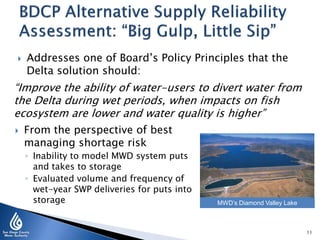
Addresses one of Board’s Policy Principles that the
Delta solution should:

“Improve the ability of water-users to divert water from
the Delta during wet periods, when impacts on fish
ecosystem are lower and water quality is higher”


From the perspective of best
managing shortage risk
◦ Inability to model MWD system puts
and takes to storage
◦ Evaluated volume and frequency of
wet-year SWP deliveries for puts into
storage

MWD’s Diamond Valley Lake

11
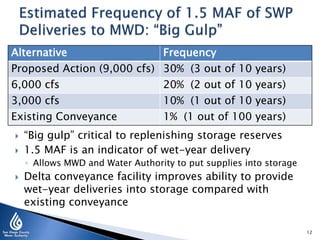
Alternative
Frequency
Proposed Action (9,000 cfs) 30% (3 out of 10 years)
6,000 cfs
3,000 cfs
Existing Conveyance



20% (2 out of 10 years)
10% (1 out of 10 years)
1% (1 out of 100 years)

“Big gulp” critical to replenishing storage reserves
1.5 MAF is an indicator of wet-year delivery
◦ Allows MWD and Water Authority to put supplies into storage



Delta conveyance facility improves ability to provide
wet-year deliveries into storage compared with
existing conveyance
12


Adequate MWD and Water Authority dry-year
supplies are key to SWP supply reliability
◦ Dry year reliability of SWP supplies needs to be seen
as both yield and stored water





Frequency and volume of wet-year SWP
deliveries is critical to replenishing storage
A north Delta conveyance facility provides
best opportunity to ensure “big gulp”
◦ Addresses Water Authority’s policy principle
◦ Larger conveyance size provides more
opportunities to put SWP supplies into storage
13




Previous evaluations focused on imported water
supply reliability from SWP
This assessment evaluates potential for additional
local projects and south of Delta storage to
improve overall reliability with smaller conveyance
◦ Consistent with NRDC and DVF proposals
◦ What are the risks associated with these options compared
with BDCP Proposed Action?



Reliability assessment does not take into account
costs or financial impacts
◦ Evaluated at future meetings

15
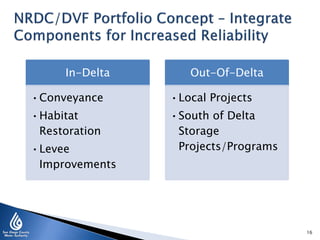
In-Delta

Out-Of-Delta

•Conveyance

•Local Projects

•Habitat
Restoration

•South of Delta
Storage
Projects/Programs

•Levee
Improvements

16




NRDC and DVF proposed integrated components as
comprehensive Delta solution
In October 2013 Governor released draft Water Action
Plan, recognizing importance of an integrated approach to
address state water issues
◦ Components developed individually by state, federal, regional
and local agencies



Other statewide planning efforts place
additional focus on integration
◦ 2009 State Water Plan
◦ Delta Reform Act (2013 Delta Plan)
◦ 2010 CALFED Surface Storage Investigations,
Progress Report
17


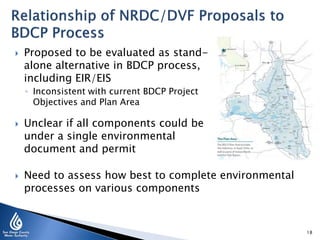
Proposed to be evaluated as standalone alternative in BDCP process,
including EIR/EIS
◦ Inconsistent with current BDCP Project
Objectives and Plan Area





Unclear if all components could be
under a single environmental
document and permit
Need to assess how best to complete environmental
processes on various components

18


NRDC/DVF proposals did not identify specific local
projects
◦ More risk relying on other water agencies state-wide to develop
additional local projects
◦ Supply projects are identified in UWMPs



Assess potential of additional local project development
in San Diego Region, rather than statewide, to offset
risk in SWP deliveries from MWD
◦ Water Authority/member agencies develop additional projects
◦ Less risky approach, provides for local control
◦ Projects offset decrease in dry-year supplies from MWD due to
less storage reserves, which resulted from smaller conveyance

19
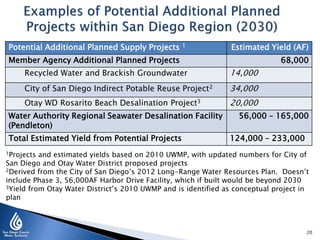
Potential Additional Planned Supply Projects

1

Estimated Yield (AF)

Member Agency Additional Planned Projects

68,000

Recycled Water and Brackish Groundwater

14,000

City of San Diego Indirect Potable Reuse Project2

34,000

Otay WD Rosarito Beach Desalination Project3

20,000

Water Authority Regional Seawater Desalination Facility
(Pendleton)
Total Estimated Yield from Potential Projects

56,000 – 165,000
124,000 – 233,000

1Projects

and estimated yields based on 2010 UWMP, with updated numbers for City of
San Diego and Otay Water District proposed projects
2Derived from the City of San Diego’s 2012 Long-Range Water Resources Plan. Doesn’t
include Phase 3, 56,000AF Harbor Drive Facility, which if built would be beyond 2030
3Yield from Otay Water District’s 2010 UWMP and is identified as conceptual project in
plan

20
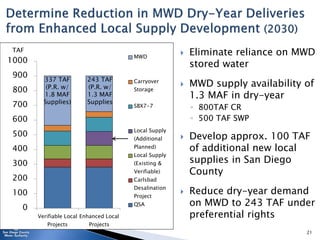
TAF

MWD

1000
900
800
700

337 TAF
(P.R. w/
1.8 MAF
Supplies)

243 TAF
(P.R. w/
1.3 MAF
Supplies

Carryover
Storage





600
Local Supply

400

Planned)

300

(Existing &

(Additional



Local Supply
Verifiable)

200

Carlsbad
Desalination

100

Project
QSA

0
Verifiable Local Enhanced Local
Projects

MWD supply availability of
1.3 MAF in dry-year
◦ 800TAF CR
◦ 500 TAF SWP

SBX7-7

500

Eliminate reliance on MWD
stored water



Develop approx. 100 TAF
of additional new local
supplies in San Diego
County
Reduce dry-year demand
on MWD to 243 TAF under
preferential rights

Projects
21


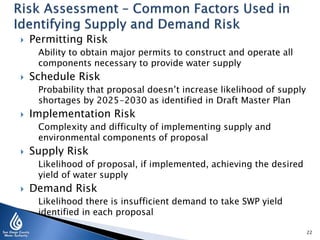
Permitting Risk
Ability to obtain major permits to construct and operate all
components necessary to provide water supply



Schedule Risk
Probability that proposal doesn’t increase likelihood of supply
shortages by 2025-2030 as identified in Draft Master Plan



Implementation Risk
Complexity and difficulty of implementing supply and
environmental components of proposal



Supply Risk
Likelihood of proposal, if implemented, achieving the desired
yield of water supply



Demand Risk
Likelihood there is insufficient demand to take SWP yield
identified in each proposal
22


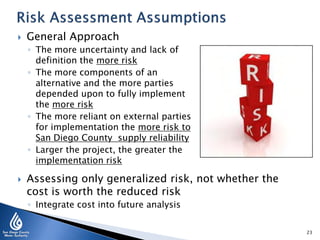
General Approach
◦ The more uncertainty and lack of
definition the more risk
◦ The more components of an
alternative and the more parties
depended upon to fully implement
the more risk
◦ The more reliant on external parties
for implementation the more risk to
San Diego County supply reliability
◦ Larger the project, the greater the
implementation risk



Assessing only generalized risk, not whether the
cost is worth the reduced risk
◦ Integrate cost into future analysis
23


NRDC/DVF modified portfolio approach contains two
components
◦ In-Delta (conveyance and habitat protection)
◦ Out-of-Delta (south of Delta storage and San Diego region local
projects)
 Modified option assumes focus on San Diego projects instead of statewide



No specific storage projects identified in NRDC or DVF
proposals
◦ Difficult to analyze permitting, schedule and implementation risks
◦ Included in supply risk assessment



Existing conveyance option not evaluated in this supply
reliability risk assessment
◦ As demonstrated in previous analysis, doesn’t meet Board’s supply
reliability policy principles

24
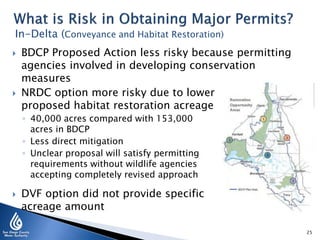
In-Delta (Conveyance and Habitat Restoration)




BDCP Proposed Action less risky because permitting
agencies involved in developing conservation
measures
NRDC option more risky due to lower
proposed habitat restoration acreage
◦ 40,000 acres compared with 153,000
acres in BDCP
◦ Less direct mitigation
◦ Unclear proposal will satisfy permitting
requirements without wildlife agencies
accepting completely revised approach



DVF option did not provide specific
acreage amount
25


Opposition and potential litigation poses greatest
schedule risk






Opposition from in-Delta users and other stakeholders
for 9,000 cfs alternative
Likely opposition from exporters to 3,000 cfs option

Uncertainty regarding financing and payment
commitments is greatest implementation risk
◦ Risk exists for all options
◦ Cannot obtain permits without demonstrating financing



Reduced scheduling risk with smaller single
tunnel 3,000 cfs facility due to less
construction time than two-tunnel options

26
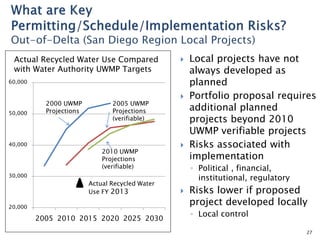
Actual Recycled Water Use Compared
with Water Authority UWMP Targets



60,000

50,000

40,000

2000 UWMP
Projections

2005 UWMP
Projections
(verifiable)

2010 UWMP
Projections
(verifiable)





◦ Political , financial,
institutional, regulatory

30,000

Actual Recycled Water
Use FY 2013
20,000

2005 2010 2015 2020 2025 2030

Local projects have not
always developed as
planned
Portfolio proposal requires
additional planned
projects beyond 2010
UWMP verifiable projects
Risks associated with
implementation



Risks lower if proposed
project developed locally
◦ Local control
27
In-Delta (SWP Reliability)


In-Delta facilities perspective,
9,000 cfs Delta option provides:
◦
◦
◦
◦
◦



Most SWP average yield
Better export water quality
Better operational redundancy
SWP Banks Pumping Plant
Greatest reliability if Delta levees fail
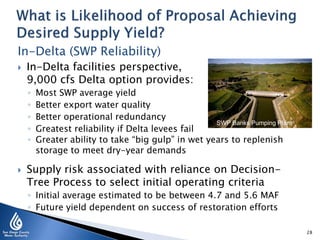
Greater ability to take “big gulp” in wet years to replenish
storage to meet dry-year demands

Supply risk associated with reliance on DecisionTree Process to select initial operating criteria
◦ Initial average estimated to be between 4.7 and 5.6 MAF
◦ Future yield dependent on success of restoration efforts
28
Out-of-Delta (San Diego Region Local Projects)


Increase San Diego Region supply reliability
◦ Further reduce dependence on MWD dry-year deliveries beyond 2010
UWMP
◦ Build upon current successes in local supply implementation



Achieved through development of additional planned
projects identified in 2010 UWMP
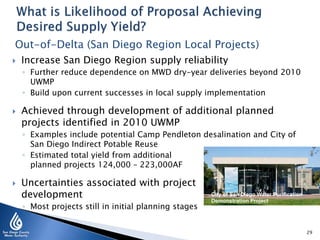
◦ Examples include potential Camp Pendleton desalination and City of
San Diego Indirect Potable Reuse
◦ Estimated total yield from additional
planned projects 124,000 – 223,000AF



Uncertainties associated with project
development
◦ Most projects still in initial planning stages

City of San Diego Water Purification
Demonstration Project

29
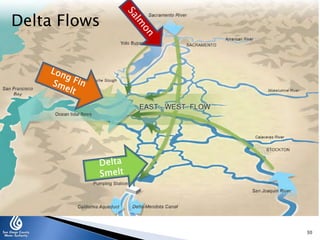
Delta Flows

30
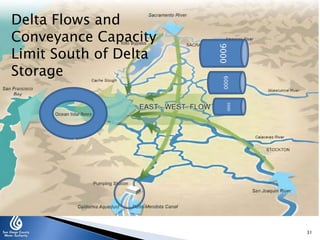
9000
6000

Delta Flows and
Conveyance Capacity
Limit South of Delta
Storage

3000

31
Out-of-Delta (South of Delta Storage)


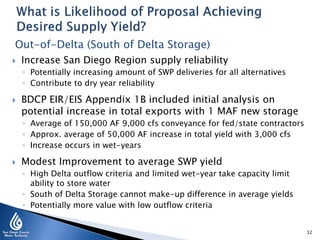
Increase San Diego Region supply reliability
◦ Potentially increasing amount of SWP deliveries for all alternatives
◦ Contribute to dry year reliability



BDCP EIR/EIS Appendix 1B included initial analysis on
potential increase in total exports with 1 MAF new storage
◦ Average of 150,000 AF 9,000 cfs conveyance for fed/state contractors
◦ Approx. average of 50,000 AF increase in total yield with 3,000 cfs
◦ Increase occurs in wet-years



Modest Improvement to average SWP yield
◦ High Delta outflow criteria and limited wet-year take capacity limit
ability to store water
◦ South of Delta Storage cannot make-up difference in average yields
◦ Potentially more value with low outflow criteria
32
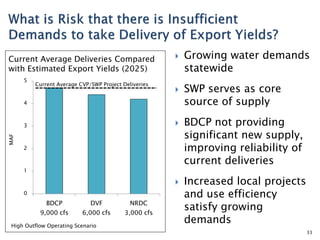
Current Average Deliveries Compared
with Estimated Export Yields (2025)
5

Current Average CVP/SWP Project Deliveries





4



MAF

3

2

1


0

BDCP

DVF

NRDC

9,000 cfs

6,000 cfs

3,000 cfs

High Outflow Operating Scenario

Growing water demands
statewide
SWP serves as core
source of supply
BDCP not providing
significant new supply,
improving reliability of
current deliveries

Increased local projects
and use efficiency
satisfy growing
demands
33
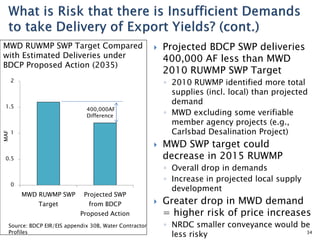
MWD RUWMP SWP Target Compared
with Estimated Deliveries under
BDCP Proposed Action (2035)



◦ 2010 RUWMP identified more total
supplies (incl. local) than projected
demand
◦ MWD excluding some verifiable
member agency projects (e.g.,
Carlsbad Desalination Project)

2

MAF

1.5

400,000AF
Difference

1



0.5

Projected SWP

Target

from BDCP
Proposed Action

Source: BDCP EIR/EIS appendix 30B, Water Contractor
Profiles

MWD SWP target could
decrease in 2015 RUWMP
◦ Overall drop in demands
◦ Increase in projected local supply
development

0

MWD RUWMP SWP

Projected BDCP SWP deliveries
400,000 AF less than MWD
2010 RUWMP SWP Target



Greater drop in MWD demand
= higher risk of price increases
◦ NRDC smaller conveyance would be
34
less risky


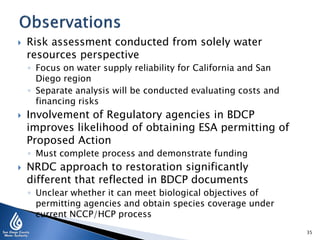
Risk assessment conducted from solely water
resources perspective
◦ Focus on water supply reliability for California and San
Diego region
◦ Separate analysis will be conducted evaluating costs and
financing risks



Involvement of Regulatory agencies in BDCP
improves likelihood of obtaining ESA permitting of
Proposed Action
◦ Must complete process and demonstrate funding



NRDC approach to restoration significantly
different that reflected in BDCP documents
◦ Unclear whether it can meet biological objectives of
permitting agencies and obtain species coverage under
current NCCP/HCP process
35


Risk of reduced yield if species recovery goals not
met during operation
◦ BDCP proposing strategies to minimize risk to SWP yield
◦ Some actions could impose cost on MWD to maintain yields



Under high outflow criteria and limited conveyance
capacity, new south of delta storage provides
limited benefit to increasing SWP yield
◦ Cannot make up for entire reduced yield from smaller
conveyance capacity
◦ Filling MWD storage and Water Authority storage more
important to imported water reliability
◦ New south of delta storage may have more yield benefits
under relaxed regulatory standards
 Successful restoration and species recovery

36


Risk of SWP supply reliability best managed
through local supply development in San Diego
County
◦ Water Authority and member agencies have proven track
record in developing local supplies
◦ Relying on State or other water agencies to develop local
supplies more risky
◦ Local control allows risk to be managed more effectively
◦ Still has significant unknowns and risk
◦ Key question is costs and improvement in reliability

37
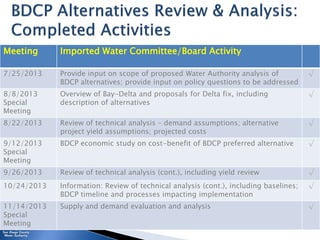
Meeting

Imported Water Committee/Board Activity

7/25/2013

Provide input on scope of proposed Water Authority analysis of
BDCP alternatives; provide input on policy questions to be addressed

√

8/8/2013
Special
Meeting

Overview of Bay-Delta and proposals for Delta fix, including
description of alternatives

√

8/22/2013

Review of technical analysis – demand assumptions; alternative
project yield assumptions; projected costs

√

9/12/2013
Special
Meeting

BDCP economic study on cost-benefit of BDCP preferred alternative

√

9/26/2013

Review of technical analysis (cont.), including yield review

√

10/24/2013

Information: Review of technical analysis (cont.), including baselines;
BDCP timeline and processes impacting implementation

√

11/14/2013
Special
Meeting

Supply and demand evaluation and analysis

√
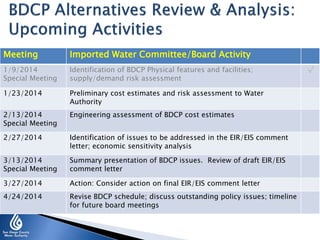
Meeting

Imported Water Committee/Board Activity

1/9/2014
Special Meeting

Identification of BDCP Physical features and facilities;
supply/demand risk assessment

1/23/2014

Preliminary cost estimates and risk assessment to Water
Authority

2/13/2014
Special Meeting

Engineering assessment of BDCP cost estimates

2/27/2014

Identification of issues to be addressed in the EIR/EIS comment
letter; economic sensitivity analysis

3/13/2014
Special Meeting

Summary presentation of BDCP issues. Review of draft EIR/EIS
comment letter

3/27/2014

Action: Consider action on final EIR/EIS comment letter

4/24/2014

Revise BDCP schedule; discuss outstanding policy issues; timeline
for future board meetings

√

Bay-Delta Conservation Plan (BDCP) Supply and Demand Risk Assessment - Jan. 9, 2014

  • 1.
    Presented by: Ken Weinberg,Director of Water Resources Dana Friehauf, Principal Water Resource Specialist Special Meeting of the Imported Water Committee January 9, 2014
  • 2.
       BDCP update Summary ofprevious SWP supply reliability analyses Risk assessment ◦ ◦ ◦ ◦ ◦  Permitting Schedule Implementation Supply Demand Summary/Observations 2
  • 3.
     Public draft ofBDCP and EIR/EIS released December 13, 2013 ◦ 120 day formal review period ◦ Public meeting scheduled for February 6, 2014 in San Diego at the Convention Center, 3 pm–7pm  Staff evaluating public draft and will discuss substantive changes with the Board in February ◦ Projected export yields are consistent with administrative draft documents 3
  • 4.
     Objective: Provide Boardwith assessment of which proposal is most consistent with ◦ Board’s Bay-Delta Policy Principles ◦ Reliability and diversification goals in Water Authority’s 2010 UWMP   Water Authority has not endorsed a preferred Delta fix solution Four options being evaluated 1. BDCP preferred alternative (9,000 cfs) 2. BDCP Plus (DVF) (6,000 cfs) 3. Portfolio Alternative (NRDC) (3,000 cfs) 4. No action (existing conveyance) 4
  • 5.
      Scope of reviewdriven by BDCP timeline and available resources High-level review based on perspective of a recipient and purchaser of Delta exports ◦ Review based on available published data with professional judgment ◦ Not intended to recreate modeling results  Deliverables: 1. Comment letter through BDCP environmental review process 2. Assessment of project reliability, financing and impact on rates, including risk assessment for Board consideration 5
  • 6.
      Several policies relatedto supply reliability, financing and other topics The guiding statement is that: “The Water Authority Board of Directors supports a Bay-Delta solution that will meet the co-equal goals and provide San Diego County with a reliable, highquality supply of affordable, imported water consistent with the Water Authority’s Urban Water Management Plan and Regional Facilities Optimization and Master Plan.” 6
  • 8.
  • 9.
    5.0 4.7 4.5 4.4 South Delta 4.2 North Delta 4.0 AverageAnnual Exports (MAF) 3.5 2.3 1.8 3.0 49% 41% 1.2 28% 2.5 2.0 1.5 1.0 2.4 51% 2.6 59% 3.0 3.4 72% 0.5 0.0 Proposed Action 9,000 cfs Source: BDCP Chapter 9, Table 9-3 6,000 cfs Alt 3,000 cfs Alt Existing Conveyance Average Annual Exports Early Long-Term (2025) 9 9
  • 10.
      From in-Delta onlyperspective, 9,000cfs Delta option provides the most SWP yield on average The greater the amount of north Delta diversions the greater the improvement in SWP water quality SWP California Aqueduct ◦ Lower salinity and organics  Greater reliance on south Delta diversion creates more risk ◦ Increasing restrictions to protect fish species cause uncertainty over export yields ◦ Uncertainty regarding reliability during levee failure, other catastrophic events 10
  • 11.
     Addresses one ofBoard’s Policy Principles that the Delta solution should: “Improve the ability of water-users to divert water from the Delta during wet periods, when impacts on fish ecosystem are lower and water quality is higher”  From the perspective of best managing shortage risk ◦ Inability to model MWD system puts and takes to storage ◦ Evaluated volume and frequency of wet-year SWP deliveries for puts into storage MWD’s Diamond Valley Lake 11
  • 12.
    Alternative Frequency Proposed Action (9,000cfs) 30% (3 out of 10 years) 6,000 cfs 3,000 cfs Existing Conveyance   20% (2 out of 10 years) 10% (1 out of 10 years) 1% (1 out of 100 years) “Big gulp” critical to replenishing storage reserves 1.5 MAF is an indicator of wet-year delivery ◦ Allows MWD and Water Authority to put supplies into storage  Delta conveyance facility improves ability to provide wet-year deliveries into storage compared with existing conveyance 12
  • 13.
     Adequate MWD andWater Authority dry-year supplies are key to SWP supply reliability ◦ Dry year reliability of SWP supplies needs to be seen as both yield and stored water   Frequency and volume of wet-year SWP deliveries is critical to replenishing storage A north Delta conveyance facility provides best opportunity to ensure “big gulp” ◦ Addresses Water Authority’s policy principle ◦ Larger conveyance size provides more opportunities to put SWP supplies into storage 13
  • 15.
      Previous evaluations focusedon imported water supply reliability from SWP This assessment evaluates potential for additional local projects and south of Delta storage to improve overall reliability with smaller conveyance ◦ Consistent with NRDC and DVF proposals ◦ What are the risks associated with these options compared with BDCP Proposed Action?  Reliability assessment does not take into account costs or financial impacts ◦ Evaluated at future meetings 15
  • 16.
  • 17.
      NRDC and DVFproposed integrated components as comprehensive Delta solution In October 2013 Governor released draft Water Action Plan, recognizing importance of an integrated approach to address state water issues ◦ Components developed individually by state, federal, regional and local agencies  Other statewide planning efforts place additional focus on integration ◦ 2009 State Water Plan ◦ Delta Reform Act (2013 Delta Plan) ◦ 2010 CALFED Surface Storage Investigations, Progress Report 17
  • 18.
     Proposed to beevaluated as standalone alternative in BDCP process, including EIR/EIS ◦ Inconsistent with current BDCP Project Objectives and Plan Area   Unclear if all components could be under a single environmental document and permit Need to assess how best to complete environmental processes on various components 18
  • 19.
     NRDC/DVF proposals didnot identify specific local projects ◦ More risk relying on other water agencies state-wide to develop additional local projects ◦ Supply projects are identified in UWMPs  Assess potential of additional local project development in San Diego Region, rather than statewide, to offset risk in SWP deliveries from MWD ◦ Water Authority/member agencies develop additional projects ◦ Less risky approach, provides for local control ◦ Projects offset decrease in dry-year supplies from MWD due to less storage reserves, which resulted from smaller conveyance 19
  • 20.
    Potential Additional PlannedSupply Projects 1 Estimated Yield (AF) Member Agency Additional Planned Projects 68,000 Recycled Water and Brackish Groundwater 14,000 City of San Diego Indirect Potable Reuse Project2 34,000 Otay WD Rosarito Beach Desalination Project3 20,000 Water Authority Regional Seawater Desalination Facility (Pendleton) Total Estimated Yield from Potential Projects 56,000 – 165,000 124,000 – 233,000 1Projects and estimated yields based on 2010 UWMP, with updated numbers for City of San Diego and Otay Water District proposed projects 2Derived from the City of San Diego’s 2012 Long-Range Water Resources Plan. Doesn’t include Phase 3, 56,000AF Harbor Drive Facility, which if built would be beyond 2030 3Yield from Otay Water District’s 2010 UWMP and is identified as conceptual project in plan 20
  • 21.
    TAF MWD 1000 900 800 700 337 TAF (P.R. w/ 1.8MAF Supplies) 243 TAF (P.R. w/ 1.3 MAF Supplies Carryover Storage   600 Local Supply 400 Planned) 300 (Existing & (Additional  Local Supply Verifiable) 200 Carlsbad Desalination 100 Project QSA 0 Verifiable Local Enhanced Local Projects MWD supply availability of 1.3 MAF in dry-year ◦ 800TAF CR ◦ 500 TAF SWP SBX7-7 500 Eliminate reliance on MWD stored water  Develop approx. 100 TAF of additional new local supplies in San Diego County Reduce dry-year demand on MWD to 243 TAF under preferential rights Projects 21
  • 22.
     Permitting Risk Ability toobtain major permits to construct and operate all components necessary to provide water supply  Schedule Risk Probability that proposal doesn’t increase likelihood of supply shortages by 2025-2030 as identified in Draft Master Plan  Implementation Risk Complexity and difficulty of implementing supply and environmental components of proposal  Supply Risk Likelihood of proposal, if implemented, achieving the desired yield of water supply  Demand Risk Likelihood there is insufficient demand to take SWP yield identified in each proposal 22
  • 23.
     General Approach ◦ Themore uncertainty and lack of definition the more risk ◦ The more components of an alternative and the more parties depended upon to fully implement the more risk ◦ The more reliant on external parties for implementation the more risk to San Diego County supply reliability ◦ Larger the project, the greater the implementation risk  Assessing only generalized risk, not whether the cost is worth the reduced risk ◦ Integrate cost into future analysis 23
  • 24.
     NRDC/DVF modified portfolioapproach contains two components ◦ In-Delta (conveyance and habitat protection) ◦ Out-of-Delta (south of Delta storage and San Diego region local projects)  Modified option assumes focus on San Diego projects instead of statewide  No specific storage projects identified in NRDC or DVF proposals ◦ Difficult to analyze permitting, schedule and implementation risks ◦ Included in supply risk assessment  Existing conveyance option not evaluated in this supply reliability risk assessment ◦ As demonstrated in previous analysis, doesn’t meet Board’s supply reliability policy principles 24
  • 25.
    In-Delta (Conveyance andHabitat Restoration)   BDCP Proposed Action less risky because permitting agencies involved in developing conservation measures NRDC option more risky due to lower proposed habitat restoration acreage ◦ 40,000 acres compared with 153,000 acres in BDCP ◦ Less direct mitigation ◦ Unclear proposal will satisfy permitting requirements without wildlife agencies accepting completely revised approach  DVF option did not provide specific acreage amount 25
  • 26.
     Opposition and potentiallitigation poses greatest schedule risk    Opposition from in-Delta users and other stakeholders for 9,000 cfs alternative Likely opposition from exporters to 3,000 cfs option Uncertainty regarding financing and payment commitments is greatest implementation risk ◦ Risk exists for all options ◦ Cannot obtain permits without demonstrating financing  Reduced scheduling risk with smaller single tunnel 3,000 cfs facility due to less construction time than two-tunnel options 26
  • 27.
    Actual Recycled WaterUse Compared with Water Authority UWMP Targets  60,000 50,000 40,000 2000 UWMP Projections 2005 UWMP Projections (verifiable) 2010 UWMP Projections (verifiable)   ◦ Political , financial, institutional, regulatory 30,000 Actual Recycled Water Use FY 2013 20,000 2005 2010 2015 2020 2025 2030 Local projects have not always developed as planned Portfolio proposal requires additional planned projects beyond 2010 UWMP verifiable projects Risks associated with implementation  Risks lower if proposed project developed locally ◦ Local control 27
  • 28.
    In-Delta (SWP Reliability)  In-Deltafacilities perspective, 9,000 cfs Delta option provides: ◦ ◦ ◦ ◦ ◦  Most SWP average yield Better export water quality Better operational redundancy SWP Banks Pumping Plant Greatest reliability if Delta levees fail Greater ability to take “big gulp” in wet years to replenish storage to meet dry-year demands Supply risk associated with reliance on DecisionTree Process to select initial operating criteria ◦ Initial average estimated to be between 4.7 and 5.6 MAF ◦ Future yield dependent on success of restoration efforts 28
  • 29.
    Out-of-Delta (San DiegoRegion Local Projects)  Increase San Diego Region supply reliability ◦ Further reduce dependence on MWD dry-year deliveries beyond 2010 UWMP ◦ Build upon current successes in local supply implementation  Achieved through development of additional planned projects identified in 2010 UWMP ◦ Examples include potential Camp Pendleton desalination and City of San Diego Indirect Potable Reuse ◦ Estimated total yield from additional planned projects 124,000 – 223,000AF  Uncertainties associated with project development ◦ Most projects still in initial planning stages City of San Diego Water Purification Demonstration Project 29
  • 30.
  • 31.
    9000 6000 Delta Flows and ConveyanceCapacity Limit South of Delta Storage 3000 31
  • 32.
    Out-of-Delta (South ofDelta Storage)  Increase San Diego Region supply reliability ◦ Potentially increasing amount of SWP deliveries for all alternatives ◦ Contribute to dry year reliability  BDCP EIR/EIS Appendix 1B included initial analysis on potential increase in total exports with 1 MAF new storage ◦ Average of 150,000 AF 9,000 cfs conveyance for fed/state contractors ◦ Approx. average of 50,000 AF increase in total yield with 3,000 cfs ◦ Increase occurs in wet-years  Modest Improvement to average SWP yield ◦ High Delta outflow criteria and limited wet-year take capacity limit ability to store water ◦ South of Delta Storage cannot make-up difference in average yields ◦ Potentially more value with low outflow criteria 32
  • 33.
    Current Average DeliveriesCompared with Estimated Export Yields (2025) 5 Current Average CVP/SWP Project Deliveries   4  MAF 3 2 1  0 BDCP DVF NRDC 9,000 cfs 6,000 cfs 3,000 cfs High Outflow Operating Scenario Growing water demands statewide SWP serves as core source of supply BDCP not providing significant new supply, improving reliability of current deliveries Increased local projects and use efficiency satisfy growing demands 33
  • 34.
    MWD RUWMP SWPTarget Compared with Estimated Deliveries under BDCP Proposed Action (2035)  ◦ 2010 RUWMP identified more total supplies (incl. local) than projected demand ◦ MWD excluding some verifiable member agency projects (e.g., Carlsbad Desalination Project) 2 MAF 1.5 400,000AF Difference 1  0.5 Projected SWP Target from BDCP Proposed Action Source: BDCP EIR/EIS appendix 30B, Water Contractor Profiles MWD SWP target could decrease in 2015 RUWMP ◦ Overall drop in demands ◦ Increase in projected local supply development 0 MWD RUWMP SWP Projected BDCP SWP deliveries 400,000 AF less than MWD 2010 RUWMP SWP Target  Greater drop in MWD demand = higher risk of price increases ◦ NRDC smaller conveyance would be 34 less risky
  • 35.
     Risk assessment conductedfrom solely water resources perspective ◦ Focus on water supply reliability for California and San Diego region ◦ Separate analysis will be conducted evaluating costs and financing risks  Involvement of Regulatory agencies in BDCP improves likelihood of obtaining ESA permitting of Proposed Action ◦ Must complete process and demonstrate funding  NRDC approach to restoration significantly different that reflected in BDCP documents ◦ Unclear whether it can meet biological objectives of permitting agencies and obtain species coverage under current NCCP/HCP process 35
  • 36.
     Risk of reducedyield if species recovery goals not met during operation ◦ BDCP proposing strategies to minimize risk to SWP yield ◦ Some actions could impose cost on MWD to maintain yields  Under high outflow criteria and limited conveyance capacity, new south of delta storage provides limited benefit to increasing SWP yield ◦ Cannot make up for entire reduced yield from smaller conveyance capacity ◦ Filling MWD storage and Water Authority storage more important to imported water reliability ◦ New south of delta storage may have more yield benefits under relaxed regulatory standards  Successful restoration and species recovery 36
  • 37.
     Risk of SWPsupply reliability best managed through local supply development in San Diego County ◦ Water Authority and member agencies have proven track record in developing local supplies ◦ Relying on State or other water agencies to develop local supplies more risky ◦ Local control allows risk to be managed more effectively ◦ Still has significant unknowns and risk ◦ Key question is costs and improvement in reliability 37
  • 38.
    Meeting Imported Water Committee/BoardActivity 7/25/2013 Provide input on scope of proposed Water Authority analysis of BDCP alternatives; provide input on policy questions to be addressed √ 8/8/2013 Special Meeting Overview of Bay-Delta and proposals for Delta fix, including description of alternatives √ 8/22/2013 Review of technical analysis – demand assumptions; alternative project yield assumptions; projected costs √ 9/12/2013 Special Meeting BDCP economic study on cost-benefit of BDCP preferred alternative √ 9/26/2013 Review of technical analysis (cont.), including yield review √ 10/24/2013 Information: Review of technical analysis (cont.), including baselines; BDCP timeline and processes impacting implementation √ 11/14/2013 Special Meeting Supply and demand evaluation and analysis √
  • 39.
    Meeting Imported Water Committee/BoardActivity 1/9/2014 Special Meeting Identification of BDCP Physical features and facilities; supply/demand risk assessment 1/23/2014 Preliminary cost estimates and risk assessment to Water Authority 2/13/2014 Special Meeting Engineering assessment of BDCP cost estimates 2/27/2014 Identification of issues to be addressed in the EIR/EIS comment letter; economic sensitivity analysis 3/13/2014 Special Meeting Summary presentation of BDCP issues. Review of draft EIR/EIS comment letter 3/27/2014 Action: Consider action on final EIR/EIS comment letter 4/24/2014 Revise BDCP schedule; discuss outstanding policy issues; timeline for future board meetings √