Artificial Intelligence
Tutor:
Engr. Sander
Ali
Intelligent Agents
Definition of an Agent
Anything/entity that can be viewed as
perceiving its environment through
sensors and acting upon the
environment through effectors.
Examples
 A Human Agent
 A Robotic Agent
Sensors/Percepts and Effectors/Actions
 Humans
◦ Sensors: Eyes (vision), ears (hearing), skin (touch), tongue
(gustation), nose (olfaction), neuromuscular system
(proprioception)
◦ Percepts:
 At the lowest level – electrical signals from these sensors
 After preprocessing – objects in the visual field (location,
textures, colors, …), auditory streams (pitch, loudness,
direction), …
◦ Effectors: limbs, digits, eyes, tongue, …
◦ Actions: lift a finger, turn left, walk, run, carry an object, …
 Robot
◦ Sensors: camera, infrared range finders,
◦ Effectors: motors
Percepts and actions need to be carefully defined, possibly at
different levels of abstraction
What is Intelligent Agent?
Software entities that carryout some set
of operations on behalf of a user or
another program with some degree of
independence or autonomy, and so
doing employ some knowledge or
representation of a user’s goals or
desires.
Description of an Agent
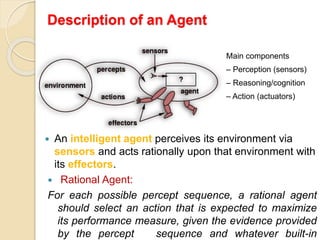
 An intelligent agent perceives its environment via
sensors and acts rationally upon that environment with
its effectors.
 Rational Agent:
For each possible percept sequence, a rational agent
should select an action that is expected to maximize
its performance measure, given the evidence provided
by the percept sequence and whatever built-in
Main components
– Perception (sensors)
– Reasoning/cognition
– Action (actuators)
Vacuum-cleaner world
 Percepts: location and contents, e.g.,
[A,Dirty]
 Actions: Left, Right, Suck, NoOp
Possible Properties
 Agents are autonomous – they act on behalf of the
user
 Agents can adapt to changes in the environment
 Agents not only act reactively, but sometimes also
proactively
 Agents have social ability – they communicate with
the user, the system, and other agents as required
 Agents also cooperate with other agents to carry out
more complex tasks than they themselves can handle
 Agents migrate from one system to another to
access remote resources or even to meet other
agents
PEAS
 PEAS: Performance measure, Environment,
Actuators, Sensors
 Must first specify the setting for intelligent
agent design
 Consider, e.g., the task of designing an
automated taxi driver:
◦ Performance measure
◦ Environment
◦ Actuators
◦ Sensors
PEAS
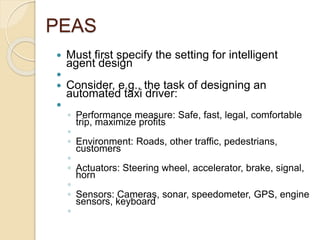
 Must first specify the setting for intelligent
agent design

 Consider, e.g., the task of designing an
automated taxi driver:

◦ Performance measure: Safe, fast, legal, comfortable
trip, maximize profits
◦
◦ Environment: Roads, other traffic, pedestrians,
customers
◦
◦ Actuators: Steering wheel, accelerator, brake, signal,
horn
◦
◦ Sensors: Cameras, sonar, speedometer, GPS, engine
sensors, keyboard
◦
PEAS
 Agent: Medical diagnosis system
 Performance measure: Healthy
patient, minimize costs, lawsuits
 Environment: Patient, hospital, staff
 Actuators: Screen display (questions,
tests, diagnoses, treatments, referrals)

 Sensors: Keyboard (entry of
symptoms, findings, patient's
answers)
PEAS
 Agent: Part-picking robot
 Performance measure: Percentage of
parts in correct bins
 Environment: Conveyor belt with
parts, bins
 Actuators: Jointed arm and hand
 Sensors: Camera, joint angle sensors
PEAS
 Agent: Interactive English tutor
 Performance measure: Maximize
student's score on test
 Environment: Set of students
 Actuators: Screen display (exercises,
suggestions, corrections)
 Sensors: Keyboard
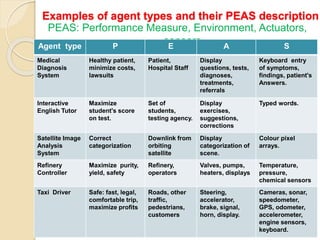
Examples of agent types and their PEAS description
PEAS: Performance Measure, Environment, Actuators,
sensorsAgent type P E A S
Medical
Diagnosis
System
Healthy patient,
minimize costs,
lawsuits
Patient,
Hospital Staff
Display
questions, tests,
diagnoses,
treatments,
referrals
Keyboard entry
of symptoms,
findings, patient's
Answers.
Interactive
English Tutor
Maximize
student's score
on test.
Set of
students,
testing agency.
Display
exercises,
suggestions,
corrections
Typed words.
Satellite Image
Analysis
System
Correct
categorization
Downlink from
orbiting
satellite
Display
categorization of
scene.
Colour pixel
arrays.
Refinery
Controller
Maximize purity,
yield, safety
Refinery,
operators
Valves, pumps,
heaters, displays
Temperature,
pressure,
chemical sensors
Taxi Driver Safe: fast, legal,
comfortable trip,
maximize profits
Roads, other
traffic,
pedestrians,
customers
Steering,
accelerator,
brake, signal,
horn, display.
Cameras, sonar,
speedometer,
GPS, odometer,
accelerometer,
engine sensors,
keyboard.
Home Work
For each of the following agents, develop a
PEAS description of the task environment:
a. Robot soccer player;
b. Internet book-shopping agent;
c. Autonomous Mars rover;
d. Mathematician's theorem-proving
assistant.
Properties of Environments
1. Fully observable/Partially observable.
 If an agent’s sensors give it access to the complete state of the
environment needed to choose an action, the environment is fully
observable.
 Such environments are convenient, since the agent is freed from
the task of keeping track of the changes in the environment.
2. Deterministic/Stochastic.
 An environment is deterministic if the next state of the
environment is completely determined by the current state of the
environment and the action of the agent; in a stochastic
environment, there are multiple, unpredictable outcomes
 In a fully observable, deterministic environment, the agent need
not deal with uncertainty.
Properties of Environments
3. Episodic/Sequential.
 An episodic environment means that subsequent episodes do
not depend on what actions occurred in previous episodes.
 In a sequential environment, the agent engages in a series of
connected episodes.
 Such environments do not require the agent to plan ahead.
4. Static/Dynamic.
 A static environment does not change while the agent is
thinking.
 The passage of time as an agent deliberates is irrelevant.
 The agent doesn’t need to observe the world during deliberation.
 If the environment can change while an agent is deliberating,
then we say the environment is dynamic for the agent.
 If the environment does not change with the passage of time but
the agent’s performance score does, then we say the
environment is semi-dynamic.
Properties of Environments
5. Discrete/Continuous.
◦ If the number of distinct percepts and actions is
limited, the environment is discrete, otherwise it is
continuous.
6. Single-agent/Multi-agent.
◦ If the environment contains other intelligent agents,
the agent needs to be concerned about strategic,
game-theoretic aspects of the environment (for either
cooperative or competitive agents)
◦ Most engineering environments don’t have multi-agent
properties, whereas most social and economic
systems get their complexity from the interactions of
(more or less) rational agents.
Environment Properties - Examples
Fully
observabl
e?
Deterministic? Episodic? Static
?
Discrete? Single
agent?
Solitaire No Yes Yes Yes Yes Yes
Backgammo
n
Yes No No Yes Yes No
Taxi driving No No No No No No
Internet
shopping
No No No No Yes No
Medical
diagnosis
No No No No No Yes
→ Lots of real-world domains fall into the hardest case!
Basic Agents Types
1. Table-driven agents
use a percept sequence/action table in memory to find the next
action. They are implemented by a (large) lookup table.
2. Simple reflex agents
are based on condition-action rules, implemented with an
appropriate production system. They are stateless devices
which do not have memory of past world states.
3. Agents with memory
have internal state, which is used to keep track of past states of
the world.
4. Agents with goals
are agents that, in addition to state information, have goal
information that describes desirable situations. Agents of this
kind take future events into consideration.
5. Utility-based agents
base their decisions on classic axiomatic utility theory in
order to act rationally.
Table Driven Agents
 Table lookup of percept-action pairs mapping
from every possible perceived state to the optimal
action for that state
 Problems
◦ Too big to generate and to store (Chess has about
10120 states)
◦ No knowledge of non-perceptual parts of the current
state
◦ Not adaptive to changes in the environment; requires
entire table to be updated if changes occur
◦ Looping: Can’t make actions conditional on previous
actions/states.
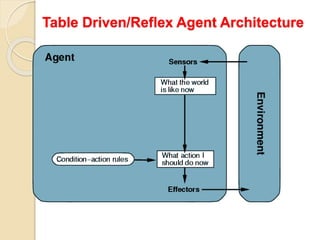
Simple Reflex Agent
 An agent whose action depends only on the current
percepts.
 Rule-based reasoning to map from percepts to
optimal action; each rule handles a collection of
perceived states
 Problems
◦ Still usually too big to generate and to store
◦ Still no knowledge of non-perceptual parts of state
◦ Still not adaptive to changes in the environment; requires
collection of rules to be updated if changes occur
◦ Still can’t make actions conditional on previous state
Table Driven/Reflex Agent Architecture
Agents with Memory
 Encode “internal state” of the world to remember
the past as contained in earlier percepts.
 Needed because sensors do not usually give the
entire state of the world at each input, so
perception of the environment is captured over
time. “State” is used to encode different "world
states" that generate the same immediate percept.
 Requires ability to represent change in the world;
one possibility is to represent just the latest state,
but then can’t reason about hypothetical courses
of action.
Architecture for an Agent with Memory
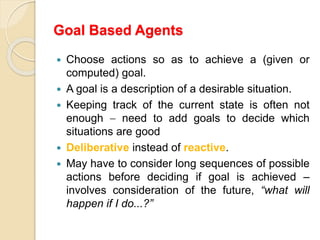
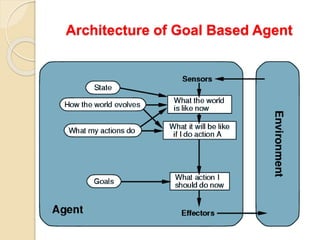
Goal Based Agents
 Choose actions so as to achieve a (given or
computed) goal.
 A goal is a description of a desirable situation.
 Keeping track of the current state is often not
enough  need to add goals to decide which
situations are good
 Deliberative instead of reactive.
 May have to consider long sequences of possible
actions before deciding if goal is achieved –
involves consideration of the future, “what will
happen if I do...?”
Architecture of Goal Based Agent
Utility based Agents
When there are multiple possible alternatives,
how to decide which one is best?
 A goal specifies a crude distinction between a happy and
unhappy state, but often need a more general
performance measure that describes “degree of
happiness.”
 Utility function U: State  Real indicating a measure of
success or happiness when at a given state.
 Allows decisions comparing choice between conflicting
goals, and choice between likelihood of success and
importance of goal (if achievement is uncertain).
Architecture for Utility based Agent
Summary
 An Agent perceives and acts in an environment, has an
architecture, and is implemented by an agent program.
 An Ideal agent always chooses the action which
maximizes its expected performance, given its percept
sequence so far.
 An Autonomous agent uses its own experience rather
than built-in knowledge of the environment by the
designer.
 An Agent program maps from percept to action and
updates its internal state.
 Reflex agents respond immediately to percepts.
 Goal-based agents act in order to achieve their
goal(s).
 Utility-based agents maximize their own utility
function.
 Representing knowledge is important for successful

Artificial Intelligence

  • 1.
  • 2.
  • 3.
    Definition of anAgent Anything/entity that can be viewed as perceiving its environment through sensors and acting upon the environment through effectors. Examples  A Human Agent  A Robotic Agent
  • 4.
    Sensors/Percepts and Effectors/Actions Humans ◦ Sensors: Eyes (vision), ears (hearing), skin (touch), tongue (gustation), nose (olfaction), neuromuscular system (proprioception) ◦ Percepts:  At the lowest level – electrical signals from these sensors  After preprocessing – objects in the visual field (location, textures, colors, …), auditory streams (pitch, loudness, direction), … ◦ Effectors: limbs, digits, eyes, tongue, … ◦ Actions: lift a finger, turn left, walk, run, carry an object, …  Robot ◦ Sensors: camera, infrared range finders, ◦ Effectors: motors Percepts and actions need to be carefully defined, possibly at different levels of abstraction
  • 5.
    What is IntelligentAgent? Software entities that carryout some set of operations on behalf of a user or another program with some degree of independence or autonomy, and so doing employ some knowledge or representation of a user’s goals or desires.
  • 6.
    Description of anAgent  An intelligent agent perceives its environment via sensors and acts rationally upon that environment with its effectors.  Rational Agent: For each possible percept sequence, a rational agent should select an action that is expected to maximize its performance measure, given the evidence provided by the percept sequence and whatever built-in Main components – Perception (sensors) – Reasoning/cognition – Action (actuators)
  • 7.
    Vacuum-cleaner world  Percepts:location and contents, e.g., [A,Dirty]  Actions: Left, Right, Suck, NoOp
  • 8.
    Possible Properties  Agentsare autonomous – they act on behalf of the user  Agents can adapt to changes in the environment  Agents not only act reactively, but sometimes also proactively  Agents have social ability – they communicate with the user, the system, and other agents as required  Agents also cooperate with other agents to carry out more complex tasks than they themselves can handle  Agents migrate from one system to another to access remote resources or even to meet other agents
  • 9.
    PEAS  PEAS: Performancemeasure, Environment, Actuators, Sensors  Must first specify the setting for intelligent agent design  Consider, e.g., the task of designing an automated taxi driver: ◦ Performance measure ◦ Environment ◦ Actuators ◦ Sensors
  • 10.
    PEAS  Must firstspecify the setting for intelligent agent design   Consider, e.g., the task of designing an automated taxi driver:  ◦ Performance measure: Safe, fast, legal, comfortable trip, maximize profits ◦ ◦ Environment: Roads, other traffic, pedestrians, customers ◦ ◦ Actuators: Steering wheel, accelerator, brake, signal, horn ◦ ◦ Sensors: Cameras, sonar, speedometer, GPS, engine sensors, keyboard ◦
  • 11.
    PEAS  Agent: Medicaldiagnosis system  Performance measure: Healthy patient, minimize costs, lawsuits  Environment: Patient, hospital, staff  Actuators: Screen display (questions, tests, diagnoses, treatments, referrals)   Sensors: Keyboard (entry of symptoms, findings, patient's answers)
  • 12.
    PEAS  Agent: Part-pickingrobot  Performance measure: Percentage of parts in correct bins  Environment: Conveyor belt with parts, bins  Actuators: Jointed arm and hand  Sensors: Camera, joint angle sensors
  • 13.
    PEAS  Agent: InteractiveEnglish tutor  Performance measure: Maximize student's score on test  Environment: Set of students  Actuators: Screen display (exercises, suggestions, corrections)  Sensors: Keyboard
  • 14.
    Examples of agenttypes and their PEAS description PEAS: Performance Measure, Environment, Actuators, sensorsAgent type P E A S Medical Diagnosis System Healthy patient, minimize costs, lawsuits Patient, Hospital Staff Display questions, tests, diagnoses, treatments, referrals Keyboard entry of symptoms, findings, patient's Answers. Interactive English Tutor Maximize student's score on test. Set of students, testing agency. Display exercises, suggestions, corrections Typed words. Satellite Image Analysis System Correct categorization Downlink from orbiting satellite Display categorization of scene. Colour pixel arrays. Refinery Controller Maximize purity, yield, safety Refinery, operators Valves, pumps, heaters, displays Temperature, pressure, chemical sensors Taxi Driver Safe: fast, legal, comfortable trip, maximize profits Roads, other traffic, pedestrians, customers Steering, accelerator, brake, signal, horn, display. Cameras, sonar, speedometer, GPS, odometer, accelerometer, engine sensors, keyboard.
  • 15.
    Home Work For eachof the following agents, develop a PEAS description of the task environment: a. Robot soccer player; b. Internet book-shopping agent; c. Autonomous Mars rover; d. Mathematician's theorem-proving assistant.
  • 16.
    Properties of Environments 1.Fully observable/Partially observable.  If an agent’s sensors give it access to the complete state of the environment needed to choose an action, the environment is fully observable.  Such environments are convenient, since the agent is freed from the task of keeping track of the changes in the environment. 2. Deterministic/Stochastic.  An environment is deterministic if the next state of the environment is completely determined by the current state of the environment and the action of the agent; in a stochastic environment, there are multiple, unpredictable outcomes  In a fully observable, deterministic environment, the agent need not deal with uncertainty.
  • 17.
    Properties of Environments 3.Episodic/Sequential.  An episodic environment means that subsequent episodes do not depend on what actions occurred in previous episodes.  In a sequential environment, the agent engages in a series of connected episodes.  Such environments do not require the agent to plan ahead. 4. Static/Dynamic.  A static environment does not change while the agent is thinking.  The passage of time as an agent deliberates is irrelevant.  The agent doesn’t need to observe the world during deliberation.  If the environment can change while an agent is deliberating, then we say the environment is dynamic for the agent.  If the environment does not change with the passage of time but the agent’s performance score does, then we say the environment is semi-dynamic.
  • 18.
    Properties of Environments 5.Discrete/Continuous. ◦ If the number of distinct percepts and actions is limited, the environment is discrete, otherwise it is continuous. 6. Single-agent/Multi-agent. ◦ If the environment contains other intelligent agents, the agent needs to be concerned about strategic, game-theoretic aspects of the environment (for either cooperative or competitive agents) ◦ Most engineering environments don’t have multi-agent properties, whereas most social and economic systems get their complexity from the interactions of (more or less) rational agents.
  • 19.
    Environment Properties -Examples Fully observabl e? Deterministic? Episodic? Static ? Discrete? Single agent? Solitaire No Yes Yes Yes Yes Yes Backgammo n Yes No No Yes Yes No Taxi driving No No No No No No Internet shopping No No No No Yes No Medical diagnosis No No No No No Yes → Lots of real-world domains fall into the hardest case!
  • 20.
    Basic Agents Types 1.Table-driven agents use a percept sequence/action table in memory to find the next action. They are implemented by a (large) lookup table. 2. Simple reflex agents are based on condition-action rules, implemented with an appropriate production system. They are stateless devices which do not have memory of past world states. 3. Agents with memory have internal state, which is used to keep track of past states of the world. 4. Agents with goals are agents that, in addition to state information, have goal information that describes desirable situations. Agents of this kind take future events into consideration. 5. Utility-based agents base their decisions on classic axiomatic utility theory in order to act rationally.
  • 21.
    Table Driven Agents Table lookup of percept-action pairs mapping from every possible perceived state to the optimal action for that state  Problems ◦ Too big to generate and to store (Chess has about 10120 states) ◦ No knowledge of non-perceptual parts of the current state ◦ Not adaptive to changes in the environment; requires entire table to be updated if changes occur ◦ Looping: Can’t make actions conditional on previous actions/states.
  • 22.
    Simple Reflex Agent An agent whose action depends only on the current percepts.  Rule-based reasoning to map from percepts to optimal action; each rule handles a collection of perceived states  Problems ◦ Still usually too big to generate and to store ◦ Still no knowledge of non-perceptual parts of state ◦ Still not adaptive to changes in the environment; requires collection of rules to be updated if changes occur ◦ Still can’t make actions conditional on previous state
  • 23.
  • 24.
    Agents with Memory Encode “internal state” of the world to remember the past as contained in earlier percepts.  Needed because sensors do not usually give the entire state of the world at each input, so perception of the environment is captured over time. “State” is used to encode different "world states" that generate the same immediate percept.  Requires ability to represent change in the world; one possibility is to represent just the latest state, but then can’t reason about hypothetical courses of action.
  • 25.
    Architecture for anAgent with Memory
  • 26.
    Goal Based Agents Choose actions so as to achieve a (given or computed) goal.  A goal is a description of a desirable situation.  Keeping track of the current state is often not enough  need to add goals to decide which situations are good  Deliberative instead of reactive.  May have to consider long sequences of possible actions before deciding if goal is achieved – involves consideration of the future, “what will happen if I do...?”
  • 27.
  • 28.
    Utility based Agents Whenthere are multiple possible alternatives, how to decide which one is best?  A goal specifies a crude distinction between a happy and unhappy state, but often need a more general performance measure that describes “degree of happiness.”  Utility function U: State  Real indicating a measure of success or happiness when at a given state.  Allows decisions comparing choice between conflicting goals, and choice between likelihood of success and importance of goal (if achievement is uncertain).
  • 29.
  • 30.
    Summary  An Agentperceives and acts in an environment, has an architecture, and is implemented by an agent program.  An Ideal agent always chooses the action which maximizes its expected performance, given its percept sequence so far.  An Autonomous agent uses its own experience rather than built-in knowledge of the environment by the designer.  An Agent program maps from percept to action and updates its internal state.  Reflex agents respond immediately to percepts.  Goal-based agents act in order to achieve their goal(s).  Utility-based agents maximize their own utility function.  Representing knowledge is important for successful

Editor's Notes

  • #17 Sense the environment, take decision and perform action. Sensing environment again depends on what the effect was and then iterative process Accessible vs non accessible Outcome is known in deterministic, If the action is same and multiple outcomes are there then it is said to be stochastic
  • #18 If you fail in one sub-experiment and if you succeed in another sub-experiment and they do not interfere one another is called episodic, episodic is easier but you don’t have to worry about episodic If the environment is static it means its predictable.