Project Guide
Dr. MD Hussain
Head Of Dept. (CIVIL)
BATCH-18
• K.Dinesh Reddy(83)
• P.Eswar (A1)
• S.K.Riyaz (A9)
• V.Venkat Ramana Reddy(C0)
• B.Nirmal Kumar(118)
13/3/2015
GOKARAJU RANGARAJU INSTITUTE OF ENGINEERING
AND TECHNOLOGY
DEPARTMENT OF CIVIL ENGINEERING
13/3/2015
Contents:
1) Abstract
2) Introduction
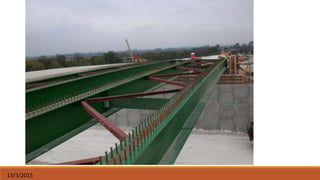
3) Composite Deck Bridge
a)The structural components of composite bridge
b)Advantages of composite deck bridge
4) Design Procedure
5) Literature Survey
6) References
13/3/2015
Abstract:
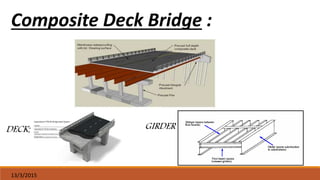
The most common type of composite deck bridge
comprises of RC continuous slab supported by steel plate
girders . In a composite deck bridge ,the individual
materials are used efficiently since concrete is strong in
compression and steel in tension . This type of deck bridge
facilitates speedy erection of prefabricated steel girders
and considerably reduces the cost of form work . The
saving in overall depth of the beams leads to saving in the
lengths of approaches in the case embankments
13/3/2015
Introduction :
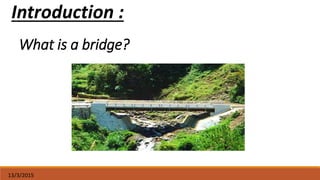
What is a bridge?
13/3/2015
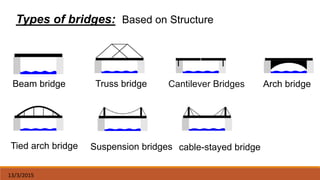
Types of bridges: Based on Structure
Beam bridge Truss bridge Cantilever Bridges Arch bridge
Tied arch bridge Suspension bridges cable-stayed bridge
Composite Deck Bridge :
13/3/2015
13/3/2015
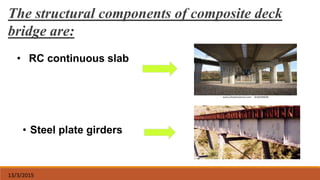
The structural components of composite deck
bridge are:
• RC continuous slab
• Steel plate girders
13/3/2015
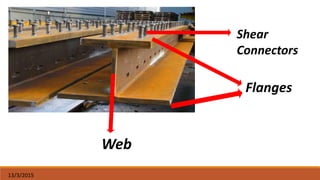
Shear
Connectors
Flanges
Web
13/3/2015
13/3/2015
13/3/2015
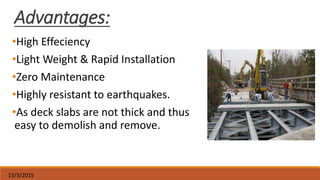
Advantages:
•High Effeciency
•Light Weight & Rapid Installation
•Zero Maintenance
•Highly resistant to earthquakes.
•As deck slabs are not thick and thus
easy to demolish and remove.
13/3/2015
Types Of Loads Acting On Structure:
• Dead load
• Live load
• Impact load
• Wind load
• Earthquake load
13/3/2015
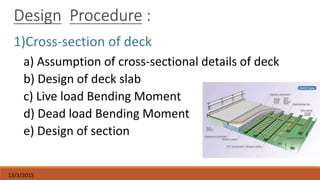
a) Assumption of cross-sectional details of deck
b) Design of deck slab
c) Live load Bending Moment
d) Dead load Bending Moment
e) Design of section
1)Cross-section of deck
13/3/2015
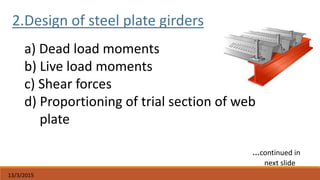
a) Dead load moments
b) Live load moments
c) Shear forces
d) Proportioning of trial section of web
plate
2.Design of steel plate girders
…continued in
next slide
13/3/2015
e) Flange plates (top & bottom)
f) Check for maximum stresses
g)Connection between flange and web
h)Intermediate stiffeners
i)End bearing stiffeners
j) Connection of vertical stiffeners to web
…continued in
next slide
continuation …..
13/3/2015
k)Connection between bearing stiffner & web
l)Design of shear connectors
m)Check for ultimate strength of plate girder
(i)Flexural strength
(ii)Shear strength
Continuation …..
13/3/2015
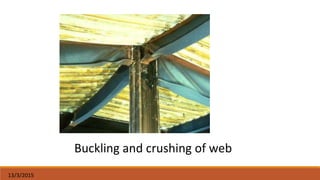
Buckling and crushing of web
13/3/2015
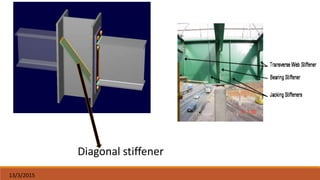
Diagonal stiffener
13/3/2015
1) Journal of Bridge Engineering-2004 (vol-9)
Recommended procedures for Simplified Inelastic Design of Steel
I-Girder Bridges J. Bridge Eng, 9(3), 230–242
By:Barth.k , Hartnagel ,Donalt W White, Michael G Barker
This paper presents summary recommendations pertaining to new
AASHTO procedures for simplified inelastic design of steel I girder
bridges , effective plastic moment predictions based on the outcome
equations are combined with the recent design method
13/3/2015
2) KSCE Journal of Civil Engineering-2001 (vol-5)
Design of Transverse Joints In Composite Bridges with Precast
Decks Issue 1, pp 17-27
By:Chang- Su Shim PhD, Kyu-Yong Choi ,Sung-Pil Chang
This paper investigated about the 2 types of connection for precast deck bridge
systems , shear connection & transverse joints between precast panels . It is
necessary to apply longitudinal prestress to prevent crack and water leakage to
transverse joints, assuming full prestressing is proposed. The long term
behaviour of composite beam with precast deck is investigated through
experiments for 430 days. From investigations loss of compressive stress at
joints is high and it should be a major factor in determining the magnitude of
initial prestress
13/3/2015
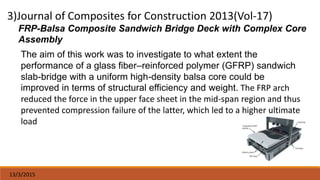
FRP-Balsa Composite Sandwich Bridge Deck with Complex Core
Assembly
The aim of this work was to investigate to what extent the
performance of a glass fiber–reinforced polymer (GFRP) sandwich
slab-bridge with a uniform high-density balsa core could be
improved in terms of structural efficiency and weight. The FRP arch
reduced the force in the upper face sheet in the mid-span region and thus
prevented compression failure of the latter, which led to a higher ultimate
load
13/3/2015
REFERENCES :
Data is collected from the following books
1. Design of steel structures part –I by V.Rama chadra
2. Design of steel structures by V.Krishnam Raju
3. Design of steel structures by S K Duggal
4. Code books
a) IS 800 : 2007
b) IRC 22 : 1986
c) IRC 6 : 2010
5. Journals are collected from http://www.ascelibrary.org and
also from http://www.sciencedirect.com
11/3/2015
Now we will collect the required data from the site
and implement the above procedure for analysing
that structure and also trying to design the new
deck bridge by using the MIDAS Software……..

Composite deck bridge systems

  • 1.
    Project Guide Dr. MDHussain Head Of Dept. (CIVIL) BATCH-18 • K.Dinesh Reddy(83) • P.Eswar (A1) • S.K.Riyaz (A9) • V.Venkat Ramana Reddy(C0) • B.Nirmal Kumar(118) 13/3/2015 GOKARAJU RANGARAJU INSTITUTE OF ENGINEERING AND TECHNOLOGY DEPARTMENT OF CIVIL ENGINEERING
  • 2.
    13/3/2015 Contents: 1) Abstract 2) Introduction 3)Composite Deck Bridge a)The structural components of composite bridge b)Advantages of composite deck bridge 4) Design Procedure 5) Literature Survey 6) References
  • 3.
    13/3/2015 Abstract: The most commontype of composite deck bridge comprises of RC continuous slab supported by steel plate girders . In a composite deck bridge ,the individual materials are used efficiently since concrete is strong in compression and steel in tension . This type of deck bridge facilitates speedy erection of prefabricated steel girders and considerably reduces the cost of form work . The saving in overall depth of the beams leads to saving in the lengths of approaches in the case embankments
  • 4.
  • 5.
    13/3/2015 Types of bridges:Based on Structure Beam bridge Truss bridge Cantilever Bridges Arch bridge Tied arch bridge Suspension bridges cable-stayed bridge
  • 6.
  • 7.
    13/3/2015 The structural componentsof composite deck bridge are: • RC continuous slab • Steel plate girders
  • 8.
  • 9.
  • 10.
  • 11.
    13/3/2015 Advantages: •High Effeciency •Light Weight& Rapid Installation •Zero Maintenance •Highly resistant to earthquakes. •As deck slabs are not thick and thus easy to demolish and remove.
  • 12.
    13/3/2015 Types Of LoadsActing On Structure: • Dead load • Live load • Impact load • Wind load • Earthquake load
  • 13.
    13/3/2015 a) Assumption ofcross-sectional details of deck b) Design of deck slab c) Live load Bending Moment d) Dead load Bending Moment e) Design of section 1)Cross-section of deck
  • 14.
    13/3/2015 a) Dead loadmoments b) Live load moments c) Shear forces d) Proportioning of trial section of web plate 2.Design of steel plate girders …continued in next slide
  • 15.
    13/3/2015 e) Flange plates(top & bottom) f) Check for maximum stresses g)Connection between flange and web h)Intermediate stiffeners i)End bearing stiffeners j) Connection of vertical stiffeners to web …continued in next slide continuation …..
  • 16.
    13/3/2015 k)Connection between bearingstiffner & web l)Design of shear connectors m)Check for ultimate strength of plate girder (i)Flexural strength (ii)Shear strength Continuation …..
  • 17.
  • 18.
  • 19.
    13/3/2015 1) Journal ofBridge Engineering-2004 (vol-9) Recommended procedures for Simplified Inelastic Design of Steel I-Girder Bridges J. Bridge Eng, 9(3), 230–242 By:Barth.k , Hartnagel ,Donalt W White, Michael G Barker This paper presents summary recommendations pertaining to new AASHTO procedures for simplified inelastic design of steel I girder bridges , effective plastic moment predictions based on the outcome equations are combined with the recent design method
  • 20.
    13/3/2015 2) KSCE Journalof Civil Engineering-2001 (vol-5) Design of Transverse Joints In Composite Bridges with Precast Decks Issue 1, pp 17-27 By:Chang- Su Shim PhD, Kyu-Yong Choi ,Sung-Pil Chang This paper investigated about the 2 types of connection for precast deck bridge systems , shear connection & transverse joints between precast panels . It is necessary to apply longitudinal prestress to prevent crack and water leakage to transverse joints, assuming full prestressing is proposed. The long term behaviour of composite beam with precast deck is investigated through experiments for 430 days. From investigations loss of compressive stress at joints is high and it should be a major factor in determining the magnitude of initial prestress
  • 21.
    13/3/2015 FRP-Balsa Composite SandwichBridge Deck with Complex Core Assembly The aim of this work was to investigate to what extent the performance of a glass fiber–reinforced polymer (GFRP) sandwich slab-bridge with a uniform high-density balsa core could be improved in terms of structural efficiency and weight. The FRP arch reduced the force in the upper face sheet in the mid-span region and thus prevented compression failure of the latter, which led to a higher ultimate load
  • 22.
    13/3/2015 REFERENCES : Data iscollected from the following books 1. Design of steel structures part –I by V.Rama chadra 2. Design of steel structures by V.Krishnam Raju 3. Design of steel structures by S K Duggal 4. Code books a) IS 800 : 2007 b) IRC 22 : 1986 c) IRC 6 : 2010 5. Journals are collected from http://www.ascelibrary.org and also from http://www.sciencedirect.com
  • 23.
    11/3/2015 Now we willcollect the required data from the site and implement the above procedure for analysing that structure and also trying to design the new deck bridge by using the MIDAS Software……..