ASPHYXIANTS
Dr. Vikas Vaibhav
Junior Resident
Forensic Medicine & Toxicology
AIIMS- Rishikesh
• Irrespirable gases.
• Respiratory embarrassment.
• Henderson & Haggard classified it into 5
classes.
A. IRRITANT TO RESPIRATORY TRACT
Irritate.
Inflammatory changes.
Divided into 5 sub classes :
a) Halogens- Cl, Br, I, Fl.
b) Halogen compounds- Phosgene, Chloropicrin.
c) Sulphurous gases- So2, H2S.
d) Nitrogenous gases- N2, N2O, NO2.
e) Phosphorous gases- Ph3, Phosphides.
B. CHEMICAL ASPHYXIANTS
• CO: Reduces o2 carrying capacity of blood.
• HCN: Interferes with Respiratory enzymes
(Cyt O)
C. SIMPLE ASPHYXIANTS
• Act mechanically by excluding O2 from tissue.
 Co2, No2, Methane.
D. VOLATILE AGENTS
• Act as either anaesthetic or toxic to different
organs.
 Aliphatic hydrocarbon, Aromatic hydrocarbon,
Halogenated hydrocarbon.
CARBON MONOXIDE [CO]
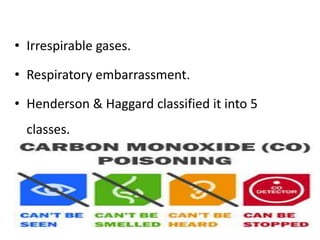
• Colourless, tasteless, non irritating, odourless.
• Lighter than air.
• Burns with bluish-white flame.
• Combine with metals like nickel, iron to form
colourless liquid ‘Carbonyls’.
• Combination with chlorine ‘Carbonyl chloride
or Phosgene gas’.
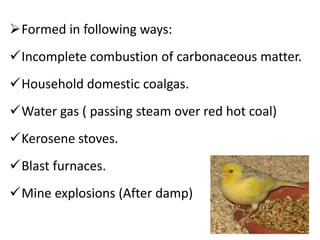
Formed in following ways:
Incomplete combustion of carbonaceous matter.
Household domestic coalgas.
Water gas ( passing steam over red hot coal)
Kerosene stoves.
Blast furnaces.
Mine explosions (After damp)
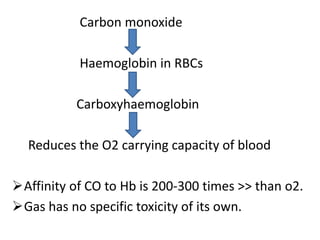
Carbon monoxide
Haemoglobin in RBCs
Carboxyhaemoglobin
Reduces the O2 carrying capacity of blood
Affinity of CO to Hb is 200-300 times >> than o2.
Gas has no specific toxicity of its own.
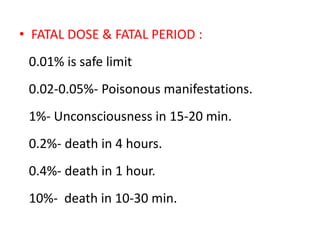
• FATAL DOSE & FATAL PERIOD :
0.01% is safe limit
0.02-0.05%- Poisonous manifestations.
1%- Unconsciousness in 15-20 min.
0.2%- death in 4 hours.
0.4%- death in 1 hour.
10%- death in 10-30 min.
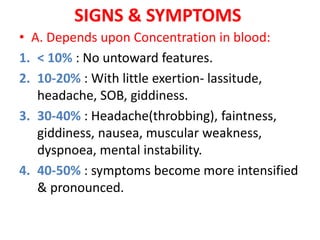
SIGNS & SYMPTOMS
• A. Depends upon Concentration in blood:
1. < 10% : No untoward features.
2. 10-20% : With little exertion- lassitude,
headache, SOB, giddiness.
3. 30-40% : Headache(throbbing), faintness,
giddiness, nausea, muscular weakness,
dyspnoea, mental instability.
4. 40-50% : symptoms become more intensified
& pronounced.
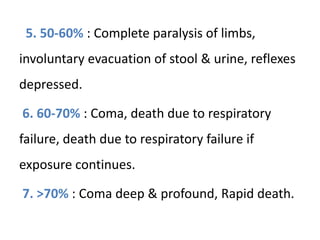
5. 50-60% : Complete paralysis of limbs,
involuntary evacuation of stool & urine, reflexes
depressed.
6. 60-70% : Coma, death due to respiratory
failure, death due to respiratory failure if
exposure continues.
7. >70% : Coma deep & profound, Rapid death.
• B. When gas is inhaled in dilute form :
 State of helplessness.
 symptoms are less pronouced & delayed.
• C. Sequalae of prolonged post hypoxic effects:
 cerebral h’rrhge, optic neuritis, spastic paraplegia,
retrograde amnesia, dementia, gastric irritability,
breathlessness, tachycardia may persist for days or
weeks.
• CHRONIC CO POISONING :
 who are at risk ????
 Workers of gas houses
 Automobile worshop
 Inhabitants of ill-ventilated rooms
 Workers of mines.
 Person who smoke.
Remain symptomless until saturation reaches
above 20% (Approx).
TREATMENT
• Remove from offending atmosphere.
• Attend source of gas.
• Artificial respiration.
• 100% oxygen.
• Hyperbaric oxygen (2-2 ½ ATM).
• Patency of airway.
• Exchange blood transfusion.
 Special gas mask should be worn by rescue
workers.
POST MORTEM APPEARANCES
• EXTERNALLY:
Cherry red lividity.
Petechial haemorrhagic spots- face, conjuctiva, .
Blood- Bright red in color.
• INTERNALLY:
Organs – Congested, hyperaemic, bright red.
Varying degree of brain damage.
Lungs – congested, oedematous, intrapulmonary
haemorrhages, pulmonary oedema.
Heart – right side filled with bright red blood,
myocardial degeneration, patchy necrotic areas with
haemorrhages.
TESTS
 Spectroscopic test:
2 well defined bands between D & E lines of
solar spectrum.
 Kunkel test/ Tannic acid test:
When 3% aq. Tannic acid solution added to
blood after dilution with water, pinkish white
precipitate is formed.
Medico-legal Points
• Accidental CO poisoning – ill-ventillated,
overcrowding.
• From house hold use of – geyser, radiator, oil
lamps, cooking with butane lamps.
• Explosion in confined spaces, mines,
industries.
• Suicidal deaths are common with coal gas in
western countries.
• Homicidal use of CO is not uncommon unless
victim is incapacitated.
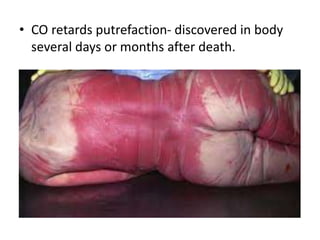
• CO retards putrefaction- discovered in body
several days or months after death.
CARBON DIOXIDE (CO2)
• Colourless, odourless, heavy gas, 0.4% of atm
gas.
• Formed in following ways:
 Respiration, combustion, fermentation,
decomposition.
After damp.
Ill ventilated rooms, overcrowding.
MODE OF ACTION
• Gas is not toxic.
• Prevent tissue from obtaining required amount of
O2.
• Potent vasodilator.
• Stimulant of respiratory centre, but when
respiratory centre is depressed by anoxaemia or
narcotics CO2 fails to stimulate it.
SIGNS & SYMPTOMS
• 1. Pure CO2 gas: Sudden death, Vagal inhibition,
spasm of glottis.
• 2. Co2 < 2% No symptoms occurs.
• 3. 2%-5% : Breathing deeper, tidal volume
increases.
• 4. 5%-10% : Headache ( throbbing), dizziness,
giddiness, dyspnoea, tightness in chest, impaired
vision.
• 5. >20%-40% : symptoms will intensify.
• 6. 40%-60% : dyspnoea, discomfort, muscle
weakness.
• 7. > 60% : Unconsciousness, convulsion, death.
• Seqalae:
Residual aches, paralysis, amnesia, anoxia,
anorexia, malnutrition, tendency to sleep,
weakness, weight loss.
TREATMENT
• Remove from offending atmosphere.
• Attend source of gas.
• Artificial respiration.
• 100% oxygen.
• Cardiac stimulants: amphetamine sulphate,
coramine.
• Treat symptoms of irreversible brain damage
respectively.
POST MORTEM APPEARANCE
• Externally:
 Cyanosis, eyes-congested, pupils-dilated.
 Face- pale, flaccid with petechial haemorrhages.
 Neck veins- engorged.
• Internally:
 Organs- congested.
 Lungs- oedematous, on cut section-frothy fluid
blood.
MEDICO LEGAL ASPECTS
• Nearly always accidental:
 Ill ventilated rooms, overcrowded rooms.
 After damp
 Well cleaning, pits.
 Intoxication during anaesthesia.
SULPHARATED HYDROGEN(H2S)
• Colourless, transparent.
• Slightly heavier than air.
• Sweetish disagreeable taste.
• Smell of rotten eggs.
• Blue flame with production of SO2 & water.
• Produced during :
 decomposition of organic & vegetable mater.
 sewers (stink dump)
 rubber industry, sulphur dye work, tanneries.
• FATAL DOSE & FATAL PERIOD:
0.02%: local irritation.
0.05%: alarming symptoms.
0.15%: death within ½ hr.
0.18%: Immediate death.
SIGNS & SYMPTOMS
• If > 0.18% then unconsciousness, respiratory
depression, convulsion, death.
• Dilute form : lacrimation, photophobia,
conjunctivitis, headache, giddiness, nausea,
vomiting, muscular weakness, convulsion,
delirium.
• Chronic poisoning: above symptoms plus
features of bronchopneumonia, GI
disturbances, peripheral neuritis.
TREATMENT
• Remove from offending atmosphere.
• Attend source of gas.
• Artificial respiration.
• 100% oxygen.
• Cardiac stimulants: amphetamine sulphate,
coramine.
• Treat symptoms of lung complications
respectively.
POST MORTEM APPEARANCE
• Organs-dark brown (due to sulphmethaemoglobin)
• Lungs : congested & oedematous, evidence of
bronchopneumonia & pulmonary oedema.
• Rapid putrefaction, greenish discoloration due to
formation of sulphmethaemoglobin.
• Blood: dark brown in colour.
WAR GASES
• Chemical compounds used at times of war for
mass destruction.
• ESSENTIALS:
 Cheap
 Surely toxic
Getting volatalised
 Heavier than air.
Stable, non corroding to its container.
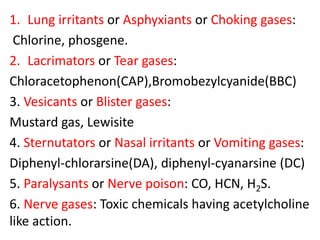
1. Lung irritants or Asphyxiants or Choking gases:
Chlorine, phosgene.
2. Lacrimators or Tear gases:
Chloracetophenon(CAP),Bromobezylcyanide(BBC)
3. Vesicants or Blister gases:
Mustard gas, Lewisite
4. Sternutators or Nasal irritants or Vomiting gases:
Diphenyl-chlorarsine(DA), diphenyl-cyanarsine (DC)
5. Paralysants or Nerve poison: CO, HCN, H2S.
6. Nerve gases: Toxic chemicals having acetylcholine
like action.
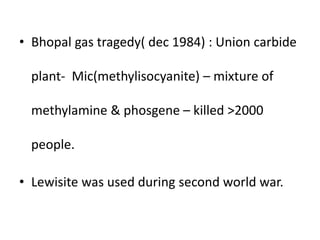
• Bhopal gas tragedy( dec 1984) : Union carbide
plant- Mic(methylisocyanite) – mixture of
methylamine & phosgene – killed >2000
people.
• Lewisite was used during second world war.

Asphyxiants new

  • 1.
    ASPHYXIANTS Dr. Vikas Vaibhav JuniorResident Forensic Medicine & Toxicology AIIMS- Rishikesh
  • 3.
    • Irrespirable gases. •Respiratory embarrassment. • Henderson & Haggard classified it into 5 classes.
  • 4.
    A. IRRITANT TORESPIRATORY TRACT Irritate. Inflammatory changes. Divided into 5 sub classes : a) Halogens- Cl, Br, I, Fl. b) Halogen compounds- Phosgene, Chloropicrin. c) Sulphurous gases- So2, H2S. d) Nitrogenous gases- N2, N2O, NO2. e) Phosphorous gases- Ph3, Phosphides.
  • 5.
    B. CHEMICAL ASPHYXIANTS •CO: Reduces o2 carrying capacity of blood. • HCN: Interferes with Respiratory enzymes (Cyt O)
  • 6.
    C. SIMPLE ASPHYXIANTS •Act mechanically by excluding O2 from tissue.  Co2, No2, Methane. D. VOLATILE AGENTS • Act as either anaesthetic or toxic to different organs.  Aliphatic hydrocarbon, Aromatic hydrocarbon, Halogenated hydrocarbon.
  • 7.
    CARBON MONOXIDE [CO] •Colourless, tasteless, non irritating, odourless. • Lighter than air. • Burns with bluish-white flame. • Combine with metals like nickel, iron to form colourless liquid ‘Carbonyls’. • Combination with chlorine ‘Carbonyl chloride or Phosgene gas’.
  • 8.
    Formed in followingways: Incomplete combustion of carbonaceous matter. Household domestic coalgas. Water gas ( passing steam over red hot coal) Kerosene stoves. Blast furnaces. Mine explosions (After damp)
  • 9.
    Carbon monoxide Haemoglobin inRBCs Carboxyhaemoglobin Reduces the O2 carrying capacity of blood Affinity of CO to Hb is 200-300 times >> than o2. Gas has no specific toxicity of its own.
  • 10.
    • FATAL DOSE& FATAL PERIOD : 0.01% is safe limit 0.02-0.05%- Poisonous manifestations. 1%- Unconsciousness in 15-20 min. 0.2%- death in 4 hours. 0.4%- death in 1 hour. 10%- death in 10-30 min.
  • 11.
    SIGNS & SYMPTOMS •A. Depends upon Concentration in blood: 1. < 10% : No untoward features. 2. 10-20% : With little exertion- lassitude, headache, SOB, giddiness. 3. 30-40% : Headache(throbbing), faintness, giddiness, nausea, muscular weakness, dyspnoea, mental instability. 4. 40-50% : symptoms become more intensified & pronounced.
  • 12.
    5. 50-60% :Complete paralysis of limbs, involuntary evacuation of stool & urine, reflexes depressed. 6. 60-70% : Coma, death due to respiratory failure, death due to respiratory failure if exposure continues. 7. >70% : Coma deep & profound, Rapid death.
  • 13.
    • B. Whengas is inhaled in dilute form :  State of helplessness.  symptoms are less pronouced & delayed. • C. Sequalae of prolonged post hypoxic effects:  cerebral h’rrhge, optic neuritis, spastic paraplegia, retrograde amnesia, dementia, gastric irritability, breathlessness, tachycardia may persist for days or weeks.
  • 14.
    • CHRONIC COPOISONING :  who are at risk ????  Workers of gas houses  Automobile worshop  Inhabitants of ill-ventilated rooms  Workers of mines.  Person who smoke. Remain symptomless until saturation reaches above 20% (Approx).
  • 15.
    TREATMENT • Remove fromoffending atmosphere. • Attend source of gas. • Artificial respiration. • 100% oxygen. • Hyperbaric oxygen (2-2 ½ ATM). • Patency of airway. • Exchange blood transfusion.  Special gas mask should be worn by rescue workers.
  • 16.
    POST MORTEM APPEARANCES •EXTERNALLY: Cherry red lividity. Petechial haemorrhagic spots- face, conjuctiva, . Blood- Bright red in color. • INTERNALLY: Organs – Congested, hyperaemic, bright red. Varying degree of brain damage. Lungs – congested, oedematous, intrapulmonary haemorrhages, pulmonary oedema. Heart – right side filled with bright red blood, myocardial degeneration, patchy necrotic areas with haemorrhages.
  • 17.
    TESTS  Spectroscopic test: 2well defined bands between D & E lines of solar spectrum.  Kunkel test/ Tannic acid test: When 3% aq. Tannic acid solution added to blood after dilution with water, pinkish white precipitate is formed.
  • 18.
    Medico-legal Points • AccidentalCO poisoning – ill-ventillated, overcrowding. • From house hold use of – geyser, radiator, oil lamps, cooking with butane lamps. • Explosion in confined spaces, mines, industries. • Suicidal deaths are common with coal gas in western countries. • Homicidal use of CO is not uncommon unless victim is incapacitated.
  • 19.
    • CO retardsputrefaction- discovered in body several days or months after death.
  • 20.
    CARBON DIOXIDE (CO2) •Colourless, odourless, heavy gas, 0.4% of atm gas. • Formed in following ways:  Respiration, combustion, fermentation, decomposition. After damp. Ill ventilated rooms, overcrowding.
  • 21.
    MODE OF ACTION •Gas is not toxic. • Prevent tissue from obtaining required amount of O2. • Potent vasodilator. • Stimulant of respiratory centre, but when respiratory centre is depressed by anoxaemia or narcotics CO2 fails to stimulate it.
  • 22.
    SIGNS & SYMPTOMS •1. Pure CO2 gas: Sudden death, Vagal inhibition, spasm of glottis. • 2. Co2 < 2% No symptoms occurs. • 3. 2%-5% : Breathing deeper, tidal volume increases. • 4. 5%-10% : Headache ( throbbing), dizziness, giddiness, dyspnoea, tightness in chest, impaired vision. • 5. >20%-40% : symptoms will intensify. • 6. 40%-60% : dyspnoea, discomfort, muscle weakness. • 7. > 60% : Unconsciousness, convulsion, death.
  • 23.
    • Seqalae: Residual aches,paralysis, amnesia, anoxia, anorexia, malnutrition, tendency to sleep, weakness, weight loss.
  • 24.
    TREATMENT • Remove fromoffending atmosphere. • Attend source of gas. • Artificial respiration. • 100% oxygen. • Cardiac stimulants: amphetamine sulphate, coramine. • Treat symptoms of irreversible brain damage respectively.
  • 25.
    POST MORTEM APPEARANCE •Externally:  Cyanosis, eyes-congested, pupils-dilated.  Face- pale, flaccid with petechial haemorrhages.  Neck veins- engorged. • Internally:  Organs- congested.  Lungs- oedematous, on cut section-frothy fluid blood.
  • 26.
    MEDICO LEGAL ASPECTS •Nearly always accidental:  Ill ventilated rooms, overcrowded rooms.  After damp  Well cleaning, pits.  Intoxication during anaesthesia.
  • 27.
    SULPHARATED HYDROGEN(H2S) • Colourless,transparent. • Slightly heavier than air. • Sweetish disagreeable taste. • Smell of rotten eggs. • Blue flame with production of SO2 & water.
  • 28.
    • Produced during:  decomposition of organic & vegetable mater.  sewers (stink dump)  rubber industry, sulphur dye work, tanneries. • FATAL DOSE & FATAL PERIOD: 0.02%: local irritation. 0.05%: alarming symptoms. 0.15%: death within ½ hr. 0.18%: Immediate death.
  • 29.
    SIGNS & SYMPTOMS •If > 0.18% then unconsciousness, respiratory depression, convulsion, death. • Dilute form : lacrimation, photophobia, conjunctivitis, headache, giddiness, nausea, vomiting, muscular weakness, convulsion, delirium. • Chronic poisoning: above symptoms plus features of bronchopneumonia, GI disturbances, peripheral neuritis.
  • 30.
    TREATMENT • Remove fromoffending atmosphere. • Attend source of gas. • Artificial respiration. • 100% oxygen. • Cardiac stimulants: amphetamine sulphate, coramine. • Treat symptoms of lung complications respectively.
  • 31.
    POST MORTEM APPEARANCE •Organs-dark brown (due to sulphmethaemoglobin) • Lungs : congested & oedematous, evidence of bronchopneumonia & pulmonary oedema. • Rapid putrefaction, greenish discoloration due to formation of sulphmethaemoglobin. • Blood: dark brown in colour.
  • 32.
    WAR GASES • Chemicalcompounds used at times of war for mass destruction. • ESSENTIALS:  Cheap  Surely toxic Getting volatalised  Heavier than air. Stable, non corroding to its container.
  • 33.
    1. Lung irritantsor Asphyxiants or Choking gases: Chlorine, phosgene. 2. Lacrimators or Tear gases: Chloracetophenon(CAP),Bromobezylcyanide(BBC) 3. Vesicants or Blister gases: Mustard gas, Lewisite 4. Sternutators or Nasal irritants or Vomiting gases: Diphenyl-chlorarsine(DA), diphenyl-cyanarsine (DC) 5. Paralysants or Nerve poison: CO, HCN, H2S. 6. Nerve gases: Toxic chemicals having acetylcholine like action.
  • 34.
    • Bhopal gastragedy( dec 1984) : Union carbide plant- Mic(methylisocyanite) – mixture of methylamine & phosgene – killed >2000 people. • Lewisite was used during second world war.