Introduction to
negotiation skills
10 March 2021
Marilena Shakalli Maroudia
Senior Manager & Tutor
PwC’s Academy
PwC
Agenda
Let’s get to know each other!
3Ps of negotiations: Prepare, Probe, Propose
The negotiation process
Your attitude to negotiation
1
2
3
4
PwC
Negotiation tactics
5
PwC
The negotiation
process
2
PwC
PwC
Negotiation
is not a contest!
PwC
PwC
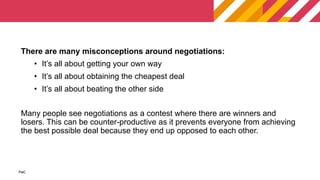
There are many misconceptions around negotiations:
• It’s all about getting your own way
• It’s all about obtaining the cheapest deal
• It’s all about beating the other side
Many people see negotiations as a contest where there are winners and
losers. This can be counter-productive as it prevents everyone from achieving
the best possible deal because they end up opposed to each other.
PwC
Let us never negotiate out of fear.
But let us never fear to negotiate
– John F. Kennedy
You don’t ask,
you don’t get
3Ps of negotiations:
Prepare
Probe
Propose
3
PwC
PwC
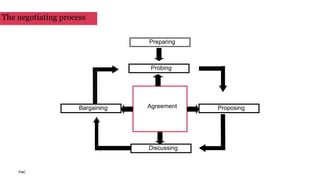
The negotiating process
Probing
Discussing
Bargaining Proposing
Agreement
Preparing
PwC
PwC
Prepare
Conducting negotiations
PwC
PwC
Failing to prepare
is preparing to fail!
PwC
PwC
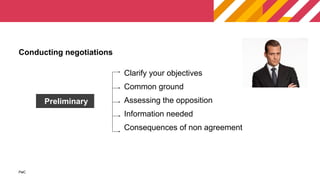
Preliminary
Clarify your objectives
Common ground
Assessing the opposition
Information needed
Consequences of non agreement
Conducting negotiations
PwC
PwC
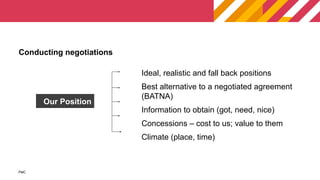
Ideal, realistic and fall back positions
Best alternative to a negotiated agreement
(BATNA)
Information to obtain (got, need, nice)
Concessions – cost to us; value to them
Climate (place, time)
Conducting negotiations
Our Position
PwC
PwC
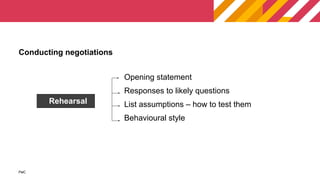
Opening statement
Responses to likely questions
List assumptions – how to test them
Behavioural style
Conducting negotiations
Rehearsal
PwC
PwC
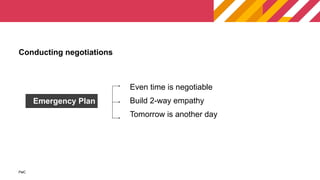
Even time is negotiable
Build 2-way empathy
Tomorrow is another day
Conducting negotiations
Emergency Plan
PwC
PwC
Probe
Conducting negotiations
PwC
PwC
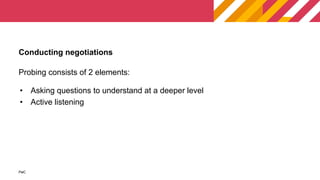
Probing consists of 2 elements:
• Asking questions to understand at a deeper level
• Active listening
Conducting negotiations
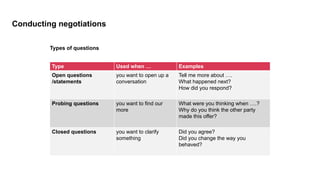
Types of questions
Type Used when … Examples
Open questions
/statements
you want to open up a
conversation
Tell me more about ….
What happened next?
How did you respond?
Probing questions you want to find our
more
What were you thinking when ….?
Why do you think the other party
made this offer?
Closed questions you want to clarify
something
Did you agree?
Did you change the way you
behaved?
Conducting negotiations
PwC
PwC
Conducting negotiations
Propose
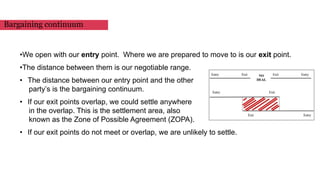
•We open with our entry point. Where we are prepared to move to is our exit point.
•The distance between them is our negotiable range.
• The distance between our entry point and the other
party’s is the bargaining continuum.
• If our exit points overlap, we could settle anywhere
in the overlap. This is the settlement area, also
known as the Zone of Possible Agreement (ZOPA).
• If our exit points do not meet or overlap, we are unlikely to settle.
Bargaining continuum
Negotiation
tactics
4
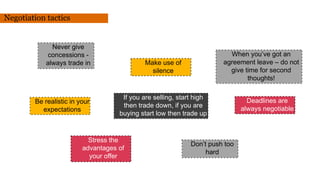
Never give
concessions -
always trade in
Deadlines are
always negotiable
Stress the
advantages of
your offer
Don’t push too
hard
Make use of
silence
If you are selling, start high
then trade down, if you are
buying start low then trade up
Be realistic in your
expectations
When you’ve got an
agreement leave – do not
give time for second
thoughts!
Negotiation tactics
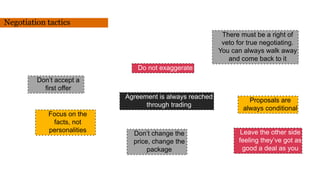
Don’t accept a
first offer
Leave the other side
feeling they’ve got as
good a deal as you
Proposals are
always conditional
Don’t change the
price, change the
package
Agreement is always reached
through trading
Focus on the
facts, not
personalities
There must be a right of
veto for true negotiating.
You can always walk away
and come back to it
Do not exaggerate
Negotiation tactics
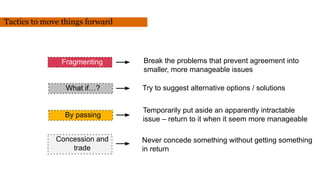
Fragmenting Break the problems that prevent agreement into
smaller, more manageable issues
What if…? Try to suggest alternative options / solutions
By passing
Temporarily put aside an apparently intractable
issue – return to it when it seem more manageable
Concession and
trade
Never concede something without getting something
in return
Tactics to move things forward
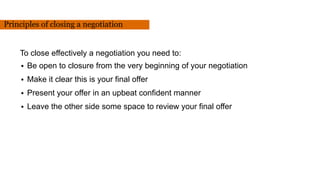
To close effectively a negotiation you need to:
• Be open to closure from the very beginning of your negotiation
• Make it clear this is your final offer
• Present your offer in an upbeat confident manner
• Leave the other side some space to review your final offer
Principles of closing a negotiation
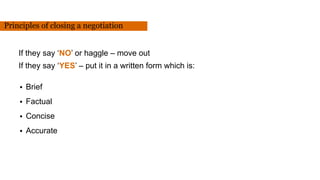
If they say ‘NO’ or haggle – move out
If they say ‘YES’ – put it in a written form which is:
• Brief
• Factual
• Concise
• Accurate
Principles of closing a negotiation
Your attitude
to negotiation
5
Effective negotiation
is 10% technique and
90% attitude!
• Make sure your attitude is positive and your purpose is clear
• Believe that others have entered the negotiating process in good faith and by
behaving with integrity you set the standards for the negotiation that you wish
to maintain
• In order to achieve your aims you need to keep in mind what you want.
Specifically, during a negotiation you should be:
– Convinced of your own case: this gives you confidence in your dealings
– Clear about your goal
– Able to ‘walk away’
Your attitude to negotiation
Thank you!
© 2021 PwC. PricewaterhouseCoopers Professional Training Limited is a private company registered in Cyprus (Reg. No. 253615). Its registered office is at 3 Themistocles Dervis Street,
CY-1066, Nicosia. A list of the company’s directors, including for individuals the present and former (if any) name and surname and nationality, if not Cypriot and for legal entities the corporate
name, is kept by the Secretary of the company at its registered office. PwC refers to PricewaterhouseCoopers Professional Training Limited, member firm in Cyprus and may sometimes refer
to the PwC network. Each member firm is a separate legal entity. Please see www.pwc.com/structure for further details.

PwC Lecture: ‘Introduction to Negotiation Skills’

  • 1.
    Introduction to negotiation skills 10March 2021 Marilena Shakalli Maroudia Senior Manager & Tutor PwC’s Academy
  • 2.
    PwC Agenda Let’s get toknow each other! 3Ps of negotiations: Prepare, Probe, Propose The negotiation process Your attitude to negotiation 1 2 3 4 PwC Negotiation tactics 5
  • 3.
  • 4.
  • 5.
    PwC PwC There are manymisconceptions around negotiations: • It’s all about getting your own way • It’s all about obtaining the cheapest deal • It’s all about beating the other side Many people see negotiations as a contest where there are winners and losers. This can be counter-productive as it prevents everyone from achieving the best possible deal because they end up opposed to each other.
  • 6.
    PwC Let us nevernegotiate out of fear. But let us never fear to negotiate – John F. Kennedy
  • 7.
  • 8.
  • 9.
  • 10.
  • 11.
  • 12.
    PwC PwC Preliminary Clarify your objectives Commonground Assessing the opposition Information needed Consequences of non agreement Conducting negotiations
  • 13.
    PwC PwC Ideal, realistic andfall back positions Best alternative to a negotiated agreement (BATNA) Information to obtain (got, need, nice) Concessions – cost to us; value to them Climate (place, time) Conducting negotiations Our Position
  • 14.
    PwC PwC Opening statement Responses tolikely questions List assumptions – how to test them Behavioural style Conducting negotiations Rehearsal
  • 15.
    PwC PwC Even time isnegotiable Build 2-way empathy Tomorrow is another day Conducting negotiations Emergency Plan
  • 16.
  • 17.
    PwC PwC Probing consists of2 elements: • Asking questions to understand at a deeper level • Active listening Conducting negotiations
  • 18.
    Types of questions TypeUsed when … Examples Open questions /statements you want to open up a conversation Tell me more about …. What happened next? How did you respond? Probing questions you want to find our more What were you thinking when ….? Why do you think the other party made this offer? Closed questions you want to clarify something Did you agree? Did you change the way you behaved? Conducting negotiations
  • 19.
  • 20.
    •We open withour entry point. Where we are prepared to move to is our exit point. •The distance between them is our negotiable range. • The distance between our entry point and the other party’s is the bargaining continuum. • If our exit points overlap, we could settle anywhere in the overlap. This is the settlement area, also known as the Zone of Possible Agreement (ZOPA). • If our exit points do not meet or overlap, we are unlikely to settle. Bargaining continuum
  • 21.
  • 22.
    Never give concessions - alwaystrade in Deadlines are always negotiable Stress the advantages of your offer Don’t push too hard Make use of silence If you are selling, start high then trade down, if you are buying start low then trade up Be realistic in your expectations When you’ve got an agreement leave – do not give time for second thoughts! Negotiation tactics
  • 23.
    Don’t accept a firstoffer Leave the other side feeling they’ve got as good a deal as you Proposals are always conditional Don’t change the price, change the package Agreement is always reached through trading Focus on the facts, not personalities There must be a right of veto for true negotiating. You can always walk away and come back to it Do not exaggerate Negotiation tactics
  • 24.
    Fragmenting Break theproblems that prevent agreement into smaller, more manageable issues What if…? Try to suggest alternative options / solutions By passing Temporarily put aside an apparently intractable issue – return to it when it seem more manageable Concession and trade Never concede something without getting something in return Tactics to move things forward
  • 25.
    To close effectivelya negotiation you need to: • Be open to closure from the very beginning of your negotiation • Make it clear this is your final offer • Present your offer in an upbeat confident manner • Leave the other side some space to review your final offer Principles of closing a negotiation
  • 26.
    If they say‘NO’ or haggle – move out If they say ‘YES’ – put it in a written form which is: • Brief • Factual • Concise • Accurate Principles of closing a negotiation
  • 27.
  • 28.
    Effective negotiation is 10%technique and 90% attitude!
  • 29.
    • Make sureyour attitude is positive and your purpose is clear • Believe that others have entered the negotiating process in good faith and by behaving with integrity you set the standards for the negotiation that you wish to maintain • In order to achieve your aims you need to keep in mind what you want. Specifically, during a negotiation you should be: – Convinced of your own case: this gives you confidence in your dealings – Clear about your goal – Able to ‘walk away’ Your attitude to negotiation
  • 31.
    Thank you! © 2021PwC. PricewaterhouseCoopers Professional Training Limited is a private company registered in Cyprus (Reg. No. 253615). Its registered office is at 3 Themistocles Dervis Street, CY-1066, Nicosia. A list of the company’s directors, including for individuals the present and former (if any) name and surname and nationality, if not Cypriot and for legal entities the corporate name, is kept by the Secretary of the company at its registered office. PwC refers to PricewaterhouseCoopers Professional Training Limited, member firm in Cyprus and may sometimes refer to the PwC network. Each member firm is a separate legal entity. Please see www.pwc.com/structure for further details.