

Graded readers with
technology
TOM WALTON
tomwalton@gmail.com
http://blogs.ihes.com/tech-elt/
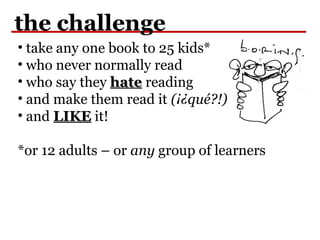
the challenge
• take any one book to 25 kids*
• who never normally read
• who say they hatehate reading
• and make them read it (¡¿qué?!)
• and LIKELIKE it!
*or 12 adults – or any group of learners
what you get from books
• better vocabulary
• better reading comprehension skills
• a subject to talk and write about
• an enjoyable, shared experience
• success with English
When I talk with a friend I can be proud of me
because I have read a book of Stephen King in
English
what to do with a reader
• read it
• teach reading skills
• listen to it
• talk about it
• write about it
BUT most
important
is to…
BUT most
important
is to…
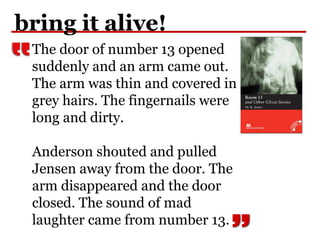
bring it alive!
The door of number 13 opened
suddenly and an arm came out.
The arm was thin and covered in
grey hairs. The fingernails were
long and dirty.
Anderson shouted and pulled
Jensen away from the door. The
arm disappeared and the door
closed. The sound of mad
laughter came from number 13.
assumptions about ICT
• we don't need any more exercises
• the learners, not the teacher using it
• NO kid needs your technical “help”!
• a digital space to share things in
More on how we should use technology
More on task design
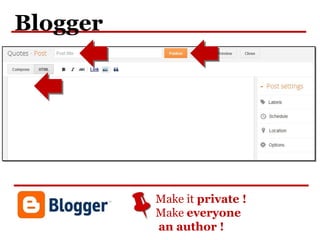
Blogger
Make it private !
Make everyone
an author !
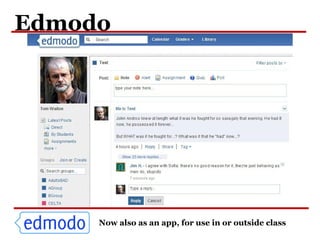
Edmodo
Now also as an app, for use in or outside class
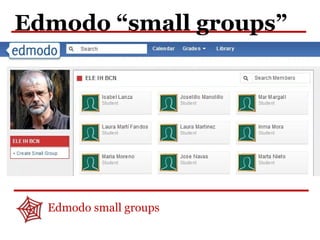
Edmodo “small groups”
Edmodo small groups
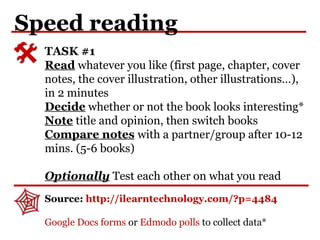
Speed reading
TASK #1
Read whatever you like (first page, chapter, cover
notes, the cover illustration, other illustrations…),
in 2 minutes
Decide whether or not the book looks interesting*
Note title and opinion, then switch books
Compare notes with a partner/group after 10-12
mins. (5-6 books)
Optionally Test each other on what you read
Source: http://ilearntechnology.com/?p=4484
Google Docs forms or Edmodo polls to collect data*
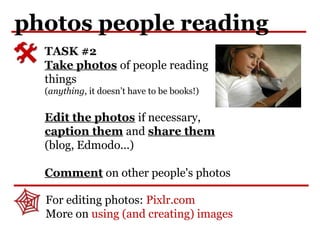
photos people reading
TASK #2
Take photos of people reading
things
(anything, it doesn’t have to be books!)
Edit the photos if necessary,
caption them and share them
(blog, Edmodo...)
Comment on other people's photos
For editing photos: Pixlr.com
More on using (and creating) images
lists people reading
TASK #3
Make a list of the
people you see reading
Share your list on
Edmodo
No repetition!
Examples
Man in a bar reading a text
message on his mobile
Woman reading an
unidentified novel in the
park
Man reading lottery ticket
numbers before buying one
Woman reading something
on Kindle (?)
Man reading Sport (Bayern
Munich 4, Barça 0!!!)
Woman reading a recipe in
a magazine
Student reading notes on
the Metro
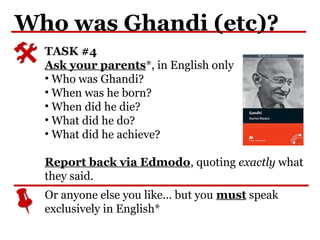
Who was Ghandi (etc)?
Or anyone else you like… but you must speak
exclusively in English*
TASK #4
Ask your parents*, in English only
• Who was Ghandi?
• When was he born?
• When did he die?
• What did he do?
• What did he achieve?
Report back via Edmodo, quoting exactly what
they said.
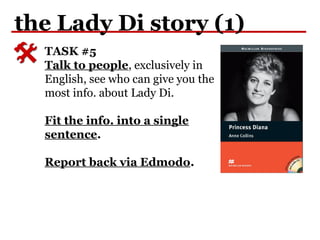
the Lady Di story (1)
TASK #5
Talk to people, exclusively in
English, see who can give you the
most info. about Lady Di.
Fit the info. into a single
sentence.
Report back via Edmodo.
Wordle
TASK #6 With a partner, pick out the 15-20
most important words, phrases, dates, names etc.
from the story
Put them into Wordle, making the most
important words largest
Share it with us and describe it to us
www.wordle.net
!
creative writing (1)
TASK #7
Pick out the elements (and vocab) from the
text that make the story a good ghost [love etc.]
story
Pool and discuss these
Write your own stories (in pairs) using the
above
Illustrate your story in some way
Share it with us on our blog (or Edmodo)
Comment on other people's stories
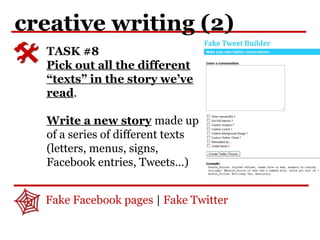
creative writing (2)
TASK #8
Pick out all the different
“texts” in the story we’ve
read.
Write a new story made up
of a series of different texts
(letters, menus, signs,
Facebook entries, Tweets…)
Fake Facebook pages | Fake Twitter
creative writing (3)
TASK #9 Write an alternative ending for the story
More on creative writing
TASK #10 Write a "modern" version of the story
TASK #11 Write the sequel / prequel
audio
TASK #12
In a group, take a section from the story and
produce it as a radio play, including sound
effects.
For recording, soundcloud.com, vocaroo.com
Share it via Edmodo or our blog* and
comment on other people's plays.
Soundcloud also available as a brilliant app, to turn smartphones into
recording devices
!
video
TASK #13
Video a suitable scene from the story
Works great with mobile phones (though the
sound tends to be terrible)!
IMPORTANT The opportunities for language
practice in choosing, planning, scripting and
rehearsing
TIP Insist that audio or video is (a) well-rehearsed
and (b) short (i.e. under 2 mins)
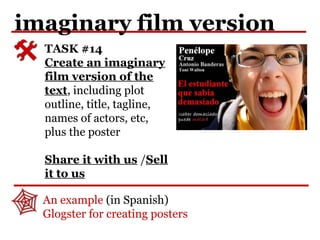
imaginary film version
TASK #14
Create an imaginary
film version of the
text, including plot
outline, title, tagline,
names of actors, etc,
plus the poster
Share it with us /Sell
it to us
An example (in Spanish)
Glogster for creating posters
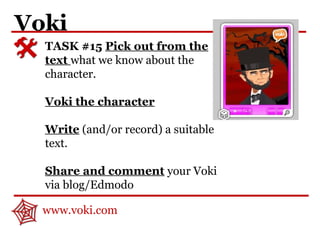
Voki
TASK #15 Pick out from the
text what we know about the
character.
Voki the character
Write (and/or record) a suitable
text.
Share and comment your Voki
via blog/Edmodo
www.voki.com
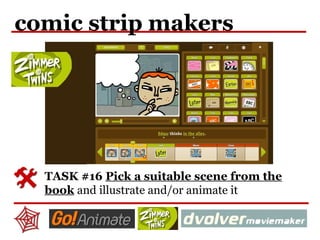
comic strip makers
TASK #16 Pick a suitable scene from the
book and illustrate and/or animate it
fantasy maps (etc)
If I ruled the world, or at least a publishing
company, all books would contain as much
supplementary information as possible (…).
Every work would have an appendix filled with
diagrams, background information,
digressions and anecdata. And of course,
maps | Victoria Johnson
TASK #17 How much of the story can you get
into a single drawing/collage/map/diagram…?
Source
timelines
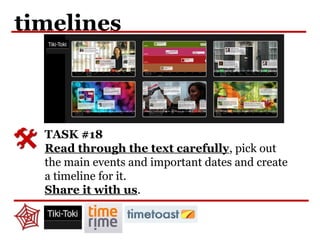
TASK #18
Read through the text carefully, pick out
the main events and important dates and create
a timeline for it.
Share it with us.
oral presentations
TASK #19 Present the book you’ve read to
the class orally
• short! (90 seconds, max. 3 slides or zooms)
• stop mercilessly (but don't fail)
• NO stolen images !!!
• pairs, 3s or small groups
• reason for listening (peer assessment?)
• Q+A session (another 90 seconds)
• help with performance (nerves, good .ppts)
• short! (90 seconds, max. 3 slides or zooms)
• stop mercilessly (but don't fail)
• NO stolen images !!!
• pairs, 3s or small groups
• reason for listening (peer assessment?)
• Q+A session (another 90 seconds)
• help with performance (nerves, good .ppts)
!
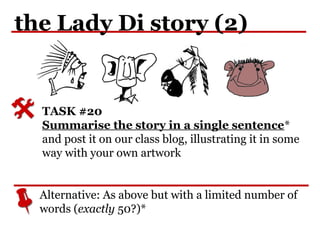
the Lady Di story (2)
TASK #20
Summarise the story in a single sentence*
and post it on our class blog, illustrating it in some
way with your own artwork
Alternative: As above but with a limited number of
words (exactly 50?)*
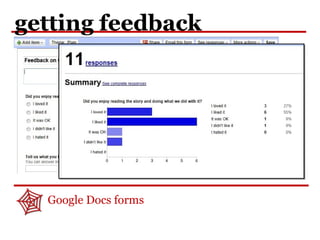
getting feedback
Google Docs forms
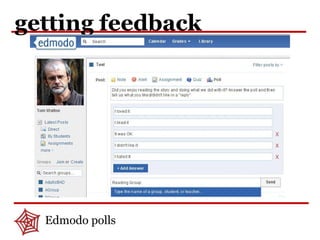
getting feedback
Edmodo polls
getting feedback
“I think that coment the book in class, make me clear
more things.”
“I like read a books in class, is better than do grammar,
and in the same time you can learn vocabulary”
“(....) is easy to understand and it isn't worry.”
“Cati [the teacher] enjoy very much doing the class.”
“No I didn't recomend because I didn't liked, I prefered
the books with action, or with afraid, but the love is
always the same and it hasn't got any emotion”
This page: feedback from teenagers reading different graded readers
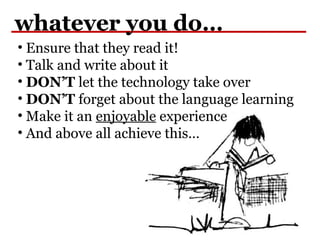
whatever you do…
• Ensure that they read it!
• Talk and write about it
• DON’T let the technology take over
• DON’T forget about the language learning
• Make it an enjoyable experience
• And above all achieve this…
TOM WALTONTOM WALTON
tomwalton@gmail.com
http://blogs.ihes.com/tech-elt/
Macmillan readers
Macmillan guide to using readers
Macmillan readers on Twitter
Macmillan readers on Facebook

Using graded readers with technology

  • 1.
    Graded readers with technology TOMWALTON tomwalton@gmail.com http://blogs.ihes.com/tech-elt/
  • 2.
    the challenge • takeany one book to 25 kids* • who never normally read • who say they hatehate reading • and make them read it (¡¿qué?!) • and LIKELIKE it! *or 12 adults – or any group of learners
  • 3.
    what you getfrom books • better vocabulary • better reading comprehension skills • a subject to talk and write about • an enjoyable, shared experience • success with English When I talk with a friend I can be proud of me because I have read a book of Stephen King in English
  • 4.
    what to dowith a reader • read it • teach reading skills • listen to it • talk about it • write about it BUT most important is to… BUT most important is to…
  • 5.
    bring it alive! Thedoor of number 13 opened suddenly and an arm came out. The arm was thin and covered in grey hairs. The fingernails were long and dirty. Anderson shouted and pulled Jensen away from the door. The arm disappeared and the door closed. The sound of mad laughter came from number 13.
  • 6.
    assumptions about ICT •we don't need any more exercises • the learners, not the teacher using it • NO kid needs your technical “help”! • a digital space to share things in More on how we should use technology More on task design
  • 7.
    Blogger Make it private! Make everyone an author !
  • 8.
    Edmodo Now also asan app, for use in or outside class
  • 9.
  • 10.
    Speed reading TASK #1 Readwhatever you like (first page, chapter, cover notes, the cover illustration, other illustrations…), in 2 minutes Decide whether or not the book looks interesting* Note title and opinion, then switch books Compare notes with a partner/group after 10-12 mins. (5-6 books) Optionally Test each other on what you read Source: http://ilearntechnology.com/?p=4484 Google Docs forms or Edmodo polls to collect data*
  • 11.
    photos people reading TASK#2 Take photos of people reading things (anything, it doesn’t have to be books!) Edit the photos if necessary, caption them and share them (blog, Edmodo...) Comment on other people's photos For editing photos: Pixlr.com More on using (and creating) images
  • 12.
    lists people reading TASK#3 Make a list of the people you see reading Share your list on Edmodo No repetition! Examples Man in a bar reading a text message on his mobile Woman reading an unidentified novel in the park Man reading lottery ticket numbers before buying one Woman reading something on Kindle (?) Man reading Sport (Bayern Munich 4, Barça 0!!!) Woman reading a recipe in a magazine Student reading notes on the Metro
  • 13.
    Who was Ghandi(etc)? Or anyone else you like… but you must speak exclusively in English* TASK #4 Ask your parents*, in English only • Who was Ghandi? • When was he born? • When did he die? • What did he do? • What did he achieve? Report back via Edmodo, quoting exactly what they said.
  • 14.
    the Lady Distory (1) TASK #5 Talk to people, exclusively in English, see who can give you the most info. about Lady Di. Fit the info. into a single sentence. Report back via Edmodo.
  • 15.
    Wordle TASK #6 Witha partner, pick out the 15-20 most important words, phrases, dates, names etc. from the story Put them into Wordle, making the most important words largest Share it with us and describe it to us www.wordle.net
  • 16.
    ! creative writing (1) TASK#7 Pick out the elements (and vocab) from the text that make the story a good ghost [love etc.] story Pool and discuss these Write your own stories (in pairs) using the above Illustrate your story in some way Share it with us on our blog (or Edmodo) Comment on other people's stories
  • 17.
    creative writing (2) TASK#8 Pick out all the different “texts” in the story we’ve read. Write a new story made up of a series of different texts (letters, menus, signs, Facebook entries, Tweets…) Fake Facebook pages | Fake Twitter
  • 18.
    creative writing (3) TASK#9 Write an alternative ending for the story More on creative writing TASK #10 Write a "modern" version of the story TASK #11 Write the sequel / prequel
  • 19.
    audio TASK #12 In agroup, take a section from the story and produce it as a radio play, including sound effects. For recording, soundcloud.com, vocaroo.com Share it via Edmodo or our blog* and comment on other people's plays. Soundcloud also available as a brilliant app, to turn smartphones into recording devices
  • 20.
    ! video TASK #13 Video asuitable scene from the story Works great with mobile phones (though the sound tends to be terrible)! IMPORTANT The opportunities for language practice in choosing, planning, scripting and rehearsing TIP Insist that audio or video is (a) well-rehearsed and (b) short (i.e. under 2 mins)
  • 21.
    imaginary film version TASK#14 Create an imaginary film version of the text, including plot outline, title, tagline, names of actors, etc, plus the poster Share it with us /Sell it to us An example (in Spanish) Glogster for creating posters
  • 22.
    Voki TASK #15 Pickout from the text what we know about the character. Voki the character Write (and/or record) a suitable text. Share and comment your Voki via blog/Edmodo www.voki.com
  • 23.
    comic strip makers TASK#16 Pick a suitable scene from the book and illustrate and/or animate it
  • 24.
    fantasy maps (etc) IfI ruled the world, or at least a publishing company, all books would contain as much supplementary information as possible (…). Every work would have an appendix filled with diagrams, background information, digressions and anecdata. And of course, maps | Victoria Johnson TASK #17 How much of the story can you get into a single drawing/collage/map/diagram…? Source
  • 25.
    timelines TASK #18 Read throughthe text carefully, pick out the main events and important dates and create a timeline for it. Share it with us.
  • 26.
    oral presentations TASK #19Present the book you’ve read to the class orally • short! (90 seconds, max. 3 slides or zooms) • stop mercilessly (but don't fail) • NO stolen images !!! • pairs, 3s or small groups • reason for listening (peer assessment?) • Q+A session (another 90 seconds) • help with performance (nerves, good .ppts) • short! (90 seconds, max. 3 slides or zooms) • stop mercilessly (but don't fail) • NO stolen images !!! • pairs, 3s or small groups • reason for listening (peer assessment?) • Q+A session (another 90 seconds) • help with performance (nerves, good .ppts) !
  • 27.
    the Lady Distory (2) TASK #20 Summarise the story in a single sentence* and post it on our class blog, illustrating it in some way with your own artwork Alternative: As above but with a limited number of words (exactly 50?)*
  • 28.
  • 29.
  • 30.
    getting feedback “I thinkthat coment the book in class, make me clear more things.” “I like read a books in class, is better than do grammar, and in the same time you can learn vocabulary” “(....) is easy to understand and it isn't worry.” “Cati [the teacher] enjoy very much doing the class.” “No I didn't recomend because I didn't liked, I prefered the books with action, or with afraid, but the love is always the same and it hasn't got any emotion” This page: feedback from teenagers reading different graded readers
  • 31.
    whatever you do… •Ensure that they read it! • Talk and write about it • DON’T let the technology take over • DON’T forget about the language learning • Make it an enjoyable experience • And above all achieve this…
  • 32.
    TOM WALTONTOM WALTON tomwalton@gmail.com http://blogs.ihes.com/tech-elt/ Macmillanreaders Macmillan guide to using readers Macmillan readers on Twitter Macmillan readers on Facebook