Simple and Complex Machines
Agenda
   Simple Machine
        Lever
       Screw
       Wheel- and- Axle
       Inclined plane
       Pulley
       Wedge


   Application of simple machines in a complex
    machine
What are Simple Machines?

    machines with few or no moving parts.


    make work easier.


    use energy to work.


    change the direction of a force such a push or pull.
Types of Simple Machines
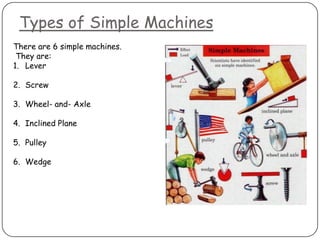
There are 6 simple machines.
 They are:
1. Lever

2. Screw

3. Wheel- and- Axle

4. Inclined Plane

5. Pulley

6. Wedge
Lever
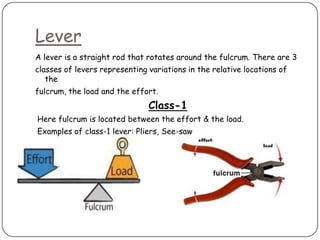
A lever is a straight rod that rotates around the fulcrum. There are 3
classes of levers representing variations in the relative locations of
   the
fulcrum, the load and the effort.
                               Class-1
Here fulcrum is located between the effort & the load.
Examples of class-1 lever: Pliers, See-saw
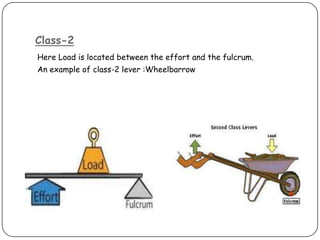
Class-2
Here Load is located between the effort and the fulcrum.
An example of class-2 lever :Wheelbarrow
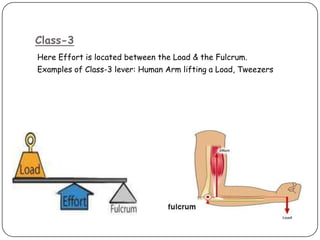
Class-3
Here Effort is located between the Load & the Fulcrum.
Examples of Class-3 lever: Human Arm lifting a Load, Tweezers
Screw
    A screw is a thin rod with edges ,or threads that curve around it.
    Turning a screw produces a force that can push the screw into wood or
    tighten it against a nut. They are also used on jars and other
    containers so that lids close tightly.


                          Types of screw
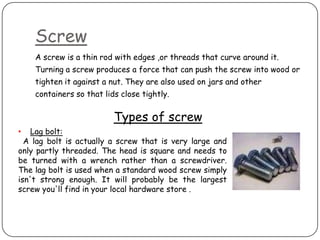
•   Lag bolt:
  A lag bolt is actually a screw that is very large and
only partly threaded. The head is square and needs to
be turned with a wrench rather than a screwdriver.
The lag bolt is used when a standard wood screw simply
isn't strong enough. It will probably be the largest
screw you'll find in your local hardware store .
     Wood Screws:
     The standard wood screw is used to secure one piece of wood to
     another. Screws with a rounded head are generally preferred for
     thinner pieces of wood. Screws with a flat or oval-shaped head are a
     better choice when you will be counter sinking the screw for a more
     decorative appearance.


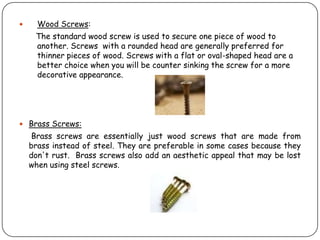
 Brass Screws:
     Brass screws are essentially just wood screws that are made from
    brass instead of steel. They are preferable in some cases because they
    don't rust. Brass screws also add an aesthetic appeal that may be lost
    when using steel screws.
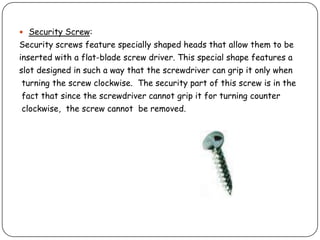
 Security Screw:
Security screws feature specially shaped heads that allow them to be
inserted with a flat-blade screw driver. This special shape features a
slot designed in such a way that the screwdriver can grip it only when
turning the screw clockwise. The security part of this screw is in the
fact that since the screwdriver cannot grip it for turning counter
clockwise, the screw cannot be removed.
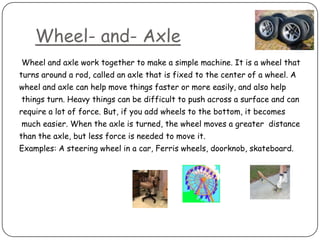
Wheel- and- Axle
Wheel and axle work together to make a simple machine. It is a wheel that
turns around a rod, called an axle that is fixed to the center of a wheel. A
wheel and axle can help move things faster or more easily, and also help
things turn. Heavy things can be difficult to push across a surface and can
require a lot of force. But, if you add wheels to the bottom, it becomes
much easier. When the axle is turned, the wheel moves a greater distance
than the axle, but less force is needed to move it.
Examples: A steering wheel in a car, Ferris wheels, doorknob, skateboard.
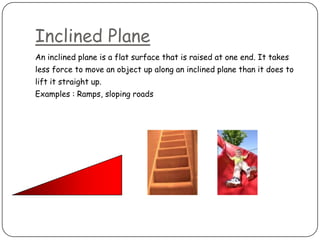
Inclined Plane
An inclined plane is a flat surface that is raised at one end. It takes
less force to move an object up along an inclined plane than it does to
lift it straight up.
Examples : Ramps, sloping roads
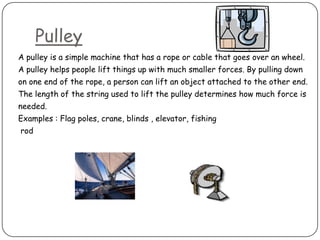
Pulley
A pulley is a simple machine that has a rope or cable that goes over an wheel.
A pulley helps people lift things up with much smaller forces. By pulling down
on one end of the rope, a person can lift an object attached to the other end.
The length of the string used to lift the pulley determines how much force is
needed.
Examples : Flag poles, crane, blinds , elevator, fishing
rod
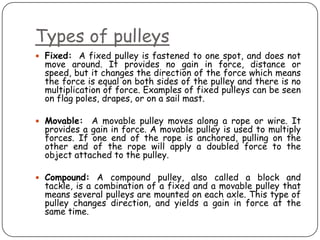
Types of pulleys
 Fixed: A fixed pulley is fastened to one spot, and does not
  move around. It provides no gain in force, distance or
  speed, but it changes the direction of the force which means
  the force is equal on both sides of the pulley and there is no
  multiplication of force. Examples of fixed pulleys can be seen
  on flag poles, drapes, or on a sail mast.

 Movable:   A movable pulley moves     along a rope or wire. It
  provides a gain in force. A movable   pulley is used to multiply
  forces. If one end of the rope is     anchored, pulling on the
  other end of the rope will apply      a doubled force to the
  object attached to the pulley.

 Compound: A compound pulley, also called a block and
  tackle, is a combination of a fixed and a movable pulley that
  means several pulleys are mounted on each axle. This type of
  pulley changes direction, and yields a gain in force at the
  same time.
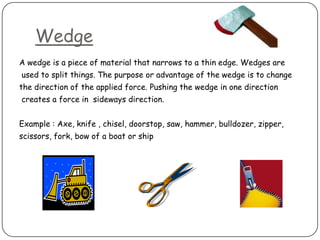
Wedge
A wedge is a piece of material that narrows to a thin edge. Wedges are
used to split things. The purpose or advantage of the wedge is to change
the direction of the applied force. Pushing the wedge in one direction
creates a force in sideways direction.


Example : Axe, knife , chisel, doorstop, saw, hammer, bulldozer, zipper,
scissors, fork, bow of a boat or ship
Complex machines
Simple machines can be combined to create complex machines.
Complex machines can be as small as a mechanical watch or as large
as a construction crane. Complex machines are also called compound
machines. Two or more simple machines work together to form a
complex machine. Compound machines can do more difficult jobs
than simple machines alone.
Examples of complex machines are:
Bicycle, wheel barrow, garden hoe , stapler, car jack ,crane , tow
truck, bicycle, can opener, lawn mower
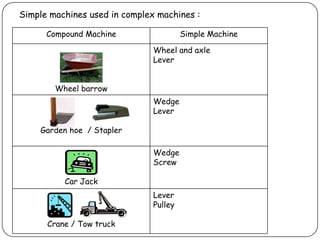
Simple machines used in complex machines :

      Compound Machine                  Simple Machine

                               Wheel and axle
                               Lever


        Wheel barrow
                               Wedge
                               Lever

    Garden hoe / Stapler

                               Wedge
                               Screw

          Car Jack
                               Lever
                               Pulley

      Crane / Tow truck
Compound Machine          Simple Machine

                   Wheel and axle
                   Pulley
                   Lever
                   Screw
    Bicycle

                   Wheel and axle
                   Wedge
                   Lever

   Can opener

                   Wheel and axle
                   Screw
                   Lever
                   Wedge
  Lawn Mower
A wheelbarrow’s long handles act as levers, and it rolls on a wheel
which acts as wheel and axle.
A Garden hoe is made up of a lever and a wedge. The handle of the
hoe is a lever, while the blade that cuts into the ground is a wedge.
A Stapler is made up of two Simple Machines, Wedge and Lever. The
staples in a stapler are wedges because they pierce through papers.
The top arm of the stapler is a Lever, it has a fulcrum or a pivot point,
which allows the top of the stapler to move up and down. When you put
energy on this lever, it transfers energy into a staple, which staples
the paper.
A Bicycle is a compound machine. Screws are used to hold the pieces
together and the seat adjustment is a screw. The wheels and pedals
each form a separate wheel and axle system. The pedals are attached
to a lever that turns a pulley. The brakes and brake handles are levers.
Can Opener is made up of 3 simple machines. First is the wheel and
axle which is the handle, when you turn the handle energy transfers to
the wedge which opens the can. Second is the wedge, the thing that
slices open the can is the wedge. Lastly is the lever, the arms of the
can opener are the levers. These two levers open and close on one
fulcrum to grip and help open the can.
References & Acknowledgements
 www.goggle.com
 www.wikipedia.com
 www.school.enboline.com
Prepared By:
           Thomas
Simple and complex machines

Simple and complex machines

  • 1.
  • 2.
    Agenda  Simple Machine  Lever  Screw  Wheel- and- Axle  Inclined plane  Pulley  Wedge  Application of simple machines in a complex machine
  • 3.
    What are SimpleMachines?  machines with few or no moving parts.  make work easier.  use energy to work.  change the direction of a force such a push or pull.
  • 4.
    Types of SimpleMachines There are 6 simple machines. They are: 1. Lever 2. Screw 3. Wheel- and- Axle 4. Inclined Plane 5. Pulley 6. Wedge
  • 5.
    Lever A lever isa straight rod that rotates around the fulcrum. There are 3 classes of levers representing variations in the relative locations of the fulcrum, the load and the effort. Class-1 Here fulcrum is located between the effort & the load. Examples of class-1 lever: Pliers, See-saw
  • 6.
    Class-2 Here Load islocated between the effort and the fulcrum. An example of class-2 lever :Wheelbarrow
  • 7.
    Class-3 Here Effort islocated between the Load & the Fulcrum. Examples of Class-3 lever: Human Arm lifting a Load, Tweezers
  • 8.
    Screw A screw is a thin rod with edges ,or threads that curve around it. Turning a screw produces a force that can push the screw into wood or tighten it against a nut. They are also used on jars and other containers so that lids close tightly. Types of screw • Lag bolt: A lag bolt is actually a screw that is very large and only partly threaded. The head is square and needs to be turned with a wrench rather than a screwdriver. The lag bolt is used when a standard wood screw simply isn't strong enough. It will probably be the largest screw you'll find in your local hardware store .
  • 9.
    Wood Screws: The standard wood screw is used to secure one piece of wood to another. Screws with a rounded head are generally preferred for thinner pieces of wood. Screws with a flat or oval-shaped head are a better choice when you will be counter sinking the screw for a more decorative appearance.  Brass Screws: Brass screws are essentially just wood screws that are made from brass instead of steel. They are preferable in some cases because they don't rust. Brass screws also add an aesthetic appeal that may be lost when using steel screws.
  • 10.
     Security Screw: Securityscrews feature specially shaped heads that allow them to be inserted with a flat-blade screw driver. This special shape features a slot designed in such a way that the screwdriver can grip it only when turning the screw clockwise. The security part of this screw is in the fact that since the screwdriver cannot grip it for turning counter clockwise, the screw cannot be removed.
  • 11.
    Wheel- and- Axle Wheeland axle work together to make a simple machine. It is a wheel that turns around a rod, called an axle that is fixed to the center of a wheel. A wheel and axle can help move things faster or more easily, and also help things turn. Heavy things can be difficult to push across a surface and can require a lot of force. But, if you add wheels to the bottom, it becomes much easier. When the axle is turned, the wheel moves a greater distance than the axle, but less force is needed to move it. Examples: A steering wheel in a car, Ferris wheels, doorknob, skateboard.
  • 12.
    Inclined Plane An inclinedplane is a flat surface that is raised at one end. It takes less force to move an object up along an inclined plane than it does to lift it straight up. Examples : Ramps, sloping roads
  • 13.
    Pulley A pulley isa simple machine that has a rope or cable that goes over an wheel. A pulley helps people lift things up with much smaller forces. By pulling down on one end of the rope, a person can lift an object attached to the other end. The length of the string used to lift the pulley determines how much force is needed. Examples : Flag poles, crane, blinds , elevator, fishing rod
  • 14.
    Types of pulleys Fixed: A fixed pulley is fastened to one spot, and does not move around. It provides no gain in force, distance or speed, but it changes the direction of the force which means the force is equal on both sides of the pulley and there is no multiplication of force. Examples of fixed pulleys can be seen on flag poles, drapes, or on a sail mast.  Movable: A movable pulley moves along a rope or wire. It provides a gain in force. A movable pulley is used to multiply forces. If one end of the rope is anchored, pulling on the other end of the rope will apply a doubled force to the object attached to the pulley.  Compound: A compound pulley, also called a block and tackle, is a combination of a fixed and a movable pulley that means several pulleys are mounted on each axle. This type of pulley changes direction, and yields a gain in force at the same time.
  • 15.
    Wedge A wedge isa piece of material that narrows to a thin edge. Wedges are used to split things. The purpose or advantage of the wedge is to change the direction of the applied force. Pushing the wedge in one direction creates a force in sideways direction. Example : Axe, knife , chisel, doorstop, saw, hammer, bulldozer, zipper, scissors, fork, bow of a boat or ship
  • 16.
    Complex machines Simple machinescan be combined to create complex machines. Complex machines can be as small as a mechanical watch or as large as a construction crane. Complex machines are also called compound machines. Two or more simple machines work together to form a complex machine. Compound machines can do more difficult jobs than simple machines alone. Examples of complex machines are: Bicycle, wheel barrow, garden hoe , stapler, car jack ,crane , tow truck, bicycle, can opener, lawn mower
  • 17.
    Simple machines usedin complex machines : Compound Machine Simple Machine Wheel and axle Lever Wheel barrow Wedge Lever Garden hoe / Stapler Wedge Screw Car Jack Lever Pulley Crane / Tow truck
  • 18.
    Compound Machine Simple Machine Wheel and axle Pulley Lever Screw Bicycle Wheel and axle Wedge Lever Can opener Wheel and axle Screw Lever Wedge Lawn Mower
  • 19.
    A wheelbarrow’s longhandles act as levers, and it rolls on a wheel which acts as wheel and axle. A Garden hoe is made up of a lever and a wedge. The handle of the hoe is a lever, while the blade that cuts into the ground is a wedge. A Stapler is made up of two Simple Machines, Wedge and Lever. The staples in a stapler are wedges because they pierce through papers. The top arm of the stapler is a Lever, it has a fulcrum or a pivot point, which allows the top of the stapler to move up and down. When you put energy on this lever, it transfers energy into a staple, which staples the paper. A Bicycle is a compound machine. Screws are used to hold the pieces together and the seat adjustment is a screw. The wheels and pedals each form a separate wheel and axle system. The pedals are attached to a lever that turns a pulley. The brakes and brake handles are levers. Can Opener is made up of 3 simple machines. First is the wheel and axle which is the handle, when you turn the handle energy transfers to the wedge which opens the can. Second is the wedge, the thing that slices open the can is the wedge. Lastly is the lever, the arms of the can opener are the levers. These two levers open and close on one fulcrum to grip and help open the can.
  • 20.
    References & Acknowledgements www.goggle.com  www.wikipedia.com  www.school.enboline.com
  • 21.