Class 12
Health and Physical Education
Psychology and sports
Unit-9
Rationalized syllabus
Psychology and sports
 Psychology
The scientific study of the human mind and
its functions, especially those affecting
behaviour in a given context.
 Sport Psychology.
 Sport psychology is a proficiency that
uses psychological knowledge and skills to
address optimal performance and well-being
of athletes, developmental and social aspects
of sports participation, and systemic issues
associated with sports settings and
organizations.
 1.Personality, its definition and types
Traits and types.
 2.Sheldon and Jung’s classification and Big
Five theory.
 3.Motivation its types and technique.
 4.Meaning, concept and types of
aggression in sports.
Definition of personality
 “Personality refers to an individual’s
characteristic patterns of
thought,emotion,and behaviour,together
with the psychological mechanisms-
hidden or not – behind those patterns.” -
DC Funder.
 “Personality is that quality which permits a
prediction of what a person will do in a
given situation”. -Cattel
Types of Personality
Type ‘A’ personality
Type ‘B’ personality
Type ‘C’ personality
 .
Type ‘D’ personality
Personality Traits
TYPES OF PERSONALITY
Sheldon and Jung’s Classification and Big FiveTheory
W H Sheldon classified personality of individuals into
the
following categories
1.Endomorph
2. Mesomorph
3. Ectomorph
Jung’s Classification
Jung has classified personality on the basis of sociability
character as introverts, extrovert and ambiverts.
1.Introverts
2. Extroverts
3. Ambiverts
W H Sheldon classified personality of
individuals into the following categories
1.Endomorph 2. Mesomorph 3. Ectomorph
sonality of individuals
into the
following categories
1.Endomorph
2. Mesomorph
3. Ectomorph
1. Endomorph:
 These individuals have short arms and legs. They
have rounded physique. Their limbs seem to be
shorter because of excessive deposits of adipose
tissues. The upper parts of arms and legs are
significantly thicker than the lower parts.
 It is hard for them to lose weight. They have soft
body. They have underdeveloped muscles. They
have a capacity for high fat storage and become fat
easily.
 In fact, they are more inclined to become obese.
They have pear shaped body. Their excessive mass
hinders their ability to compete in sports.
 In fact, sports require high level of agility or speed.
Sports and games, which require strength like
weightlifting and power-lifting are most suitable for
endomorphs
2. Mesomorph:
Mesomorphs are categorized as in-between the other two
body types and are generally described as muscular. They
have athletic physique and balanced body composition. They
are able to increase their muscle size quickly and easily.
They have well-developed rectangular shaped body. They
have thick bones and muscles. Their chest and shoulders
are larger and broader in comparison to their waistline.
 They are physically capable of doing a lot of activities and
tend to be athletically aggressive. Generally, they store fat
evenly all over their bodies but they can become overweight
if they lead sedentary lifestyle and take high calorie diet.
 They can excel in such sports which require great strength,
short bursts of energy and lots of power because they have
enough strength, agility and speed. These characteristics
make them strong contenders to be the top sportspersons in
any sports
3. Ectomorph:
 The individuals who have an ectomorph body are usually
referred to as slim persons because their muscles and limbs
are elongated.They have weak constitution of body and
usually face great difficulties in gaining weight.
 They have flat chests and have less muscle mass.The lack of
muscle mass creates the impression that they are taller than
they really are.They do not have a lot of strength but they
dominate the endurance sports because their body type is
naturally suited to perform wonderfully in endurance
activities.
 They have a quick metabolism to burn fat.They also have a
tendency to stick with what they do best.Their light body
constitution makes them suited for aerobic activities like
gymnastics
Jung’s Classification
1. Introverts:
Introverts:
These are the persons who share characteristics
such as shyness, social
withdrawal and tendency to talk less.
Owing to these characteristics such persons
seem to be self-centered, unable to adjust
easily in society or social situations.
They are very sensible, rigid in ideas and
future oriented
Few Traits of Introverts
2. Extroverts:
 Extroverts have a tendency to be friendly,
outgoing, talkative and social in nature.They
usually prefer social contacts.
 They are generous, supportive and
courageous.They may be called happy, go,
lucky persons.They show interest in present
reality than future.
 They do not have hesitation.They express
their feelings openly.They take decision
quickly and act upon quickly.They are not
affected easily by difficulties and troubles
Few Traits of Extroverts
3. Ambiverts:
 There are only few persons who are pure
introverts or pure extroverts.
 The remaining majority of persons possess
both the qualities or traits of introverts
 and extroverts such persons are called as
ambiverts
Ambiverts
Big Five Personality Theory
 It is a well known fact that persons give
different response to the same situations.
Indeed,
 the big five factors of personality are the five
main domains which define human
personality
 and account for individual differences.These
five domains or dimensions of personality are
 considered to be the fundamental traits that
make up an individual’s overall personality.
1. Openness:
 Persons who like to learn new things, new
concepts and enjoy new
 experiences usually remain on the top in
openness. Openness includes traits like
being
 imaginative, insightful and having a
variety of interests.
2. Conscientiousness:
 Persons who have a high degree of
conscientiousness are reliable
 and prompt. Such persons remain
organized, systematic, laborious and
complete in
 all respects.
3. Extroversion:
 Extroverts get their energy from
interacting with other individuals, whereas
introverts get their energy from within
themselves.
Extroversion includes the traits of being
energetic, talkative and assertive
4. Agreeableness:
 Such individuals are friendly, cooperative,
compatible, kind and gentle. Persons with
too much agreeableness may be more
distant or aloof.
 They are usually kind, generous,
affectionate and sympathetic.
5. Neuroticism:
 Neuroticism is also called emotional
stability.This domain or dimension
relates to one’s emotional stability and the
degree of negative emotions. Persons who
have high neuroticism usually experience
emotional instability and negative
emotions.
Such individuals remain moody and tense.
MEANING, CONCEPT AND TYPES OFAGGRESSION IN
SPORTS
Meaning and Concept of Aggression
In psychology, the term aggression refers to a range of
behaviors that can result in both physical and psychological
harm to oneself, others or objects in the environment.This type
of social interaction centers on harming another individual
either physically or mentally.
As a matter of fact, most of the persons view aggression as a
negative psychological characteristic, however some sports
psychologists agree that aggression can enhance sports
performance.
In fact, aggression in the field of sports and games comes out
of frustration, which arises due to goal blockage. Along with
this, situational and personal factors play a vital role in causing a
person to behave aggressively. It can be seen that aggression
comes from a number of sources
Motivation
 Motivation comes from the word ‘Motive’ which is a thought,
feeling or condition that causes one to act. Every inaction or
action of man is driven by a motive.
 Human behavior is controlled, directed and modified by certain
motives.
 In sports motivation is the main psychological factor that
affects performance. It can be said that motivation is to give
reason, enthusiasm or interest to a specific action or behavior.
 .Acc to Crooks and Stein:-”Any condition that might energize
and direct our action is called motivation”.
 Sage:-”The drive to strive is called motivation”.
 It is the force that incites an individual to perform some
activities. Motivation alone cannot in some cases assure
success, it has to be complimented with skill knowledge, ability
and other forces to successfully achieve.

Types of motivation
1.Intrinsic motivation 2.Extrinsic motivation
 Intrinsic Motivation.
 Intrinsic motivation is a type of
motivation in which an individual is
being motivated by internal desires. ...
 Extrinsic Motivation.
 Extrinsic motivation, on the other hand, is
a type of motivation in which an individual
is being motivated by external desires.
Intrinsic motivation
 Intrinsic motivation is the act of doing something
without any obvious external rewards.You do it
because it's enjoyable and interesting, rather than
because of an outside incentive or pressure to do it,
such as a reward or deadline.
Extrinsic motivation
 Extrinsic motivation is reward-driven behavior. It's a
type of operant conditioning. ... In extrinsic
motivation, rewards or other incentives — like praise,
fame, or money — are used as motivation for specific
activities. external factors drive this form
of motivation.
Techniques of motivation
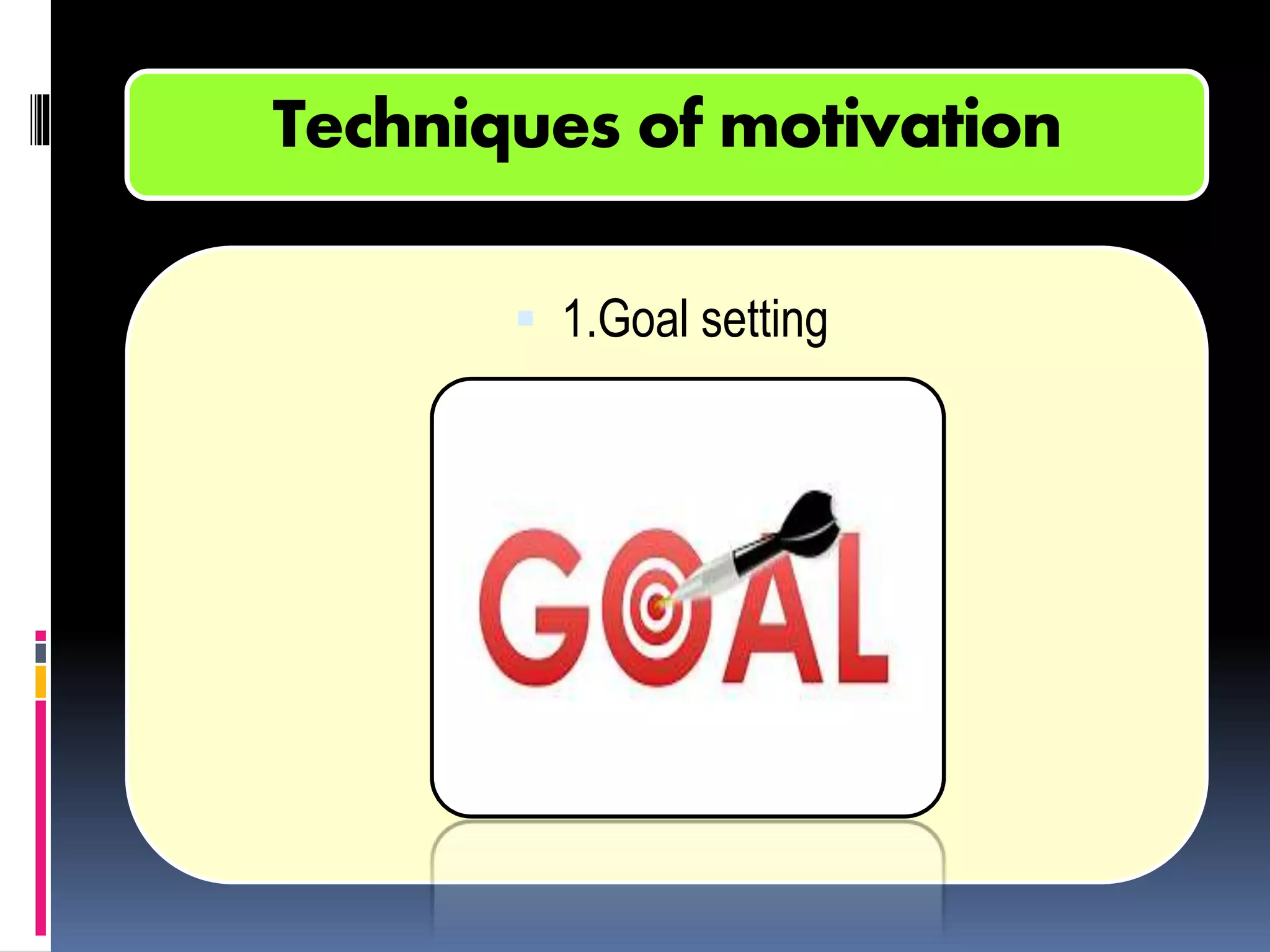
 1.Goal setting
 2.Healthy positive environment
 3.Spectators
 4.Positive attitude
 5.Music
 6.Presence of the opposite sex
 7.Rewards…….
Techniques of motivation
 1.Goal setting
Techniques of motivation
 2.Healthy positive environment
Techniques of motivation
 2.Healthy positive environment
Techniques of motivation
Spectators
Techniques of motivation
 Positive attitude
Aggression in Sports
Aggression-Meaning,concept and
types
 In sports, aggression means the desire to harm another player
which is not within the laws of the game. For example, pushing
another player over a game in football or using abusive language
for other players or teams.
 Aggression. ... Aggression is overt or covert, often harmful, social
interaction with the intention of inflicting damage or other
unpleasantness upon another individual. It may occur either
reactively or without provocation.
 In sport, aggression is a characteristic that can have many negative
as well as positive effects on
performance. Aggression is defined as “any form of behaviour
directed toward the goal of harming of injuring another live being
who is motivated to avoid such treatment” (Baron & Richardson,
1994).
What is Aggression ?
 Aggression is any behaviour intended to
harm another individual or object by
physical or verbal means.:-Bull
 Aggression is a set of behaviours that are
likely to ,or have the potential to, cause
harm to others, or intended to cause harm
and are goal directed.:-Berkowitz
 1.“Aggression is a behaviour with a goal
harming or injuring another being
motivated to avoid such treatment.”
 This definition raises certain points:
 (i) Aggression is behaviour.Thinking
negative thoughts being angry is not
aggression.
 (ii) Aggression is intentional behaviour.
Accidental harm is not aggression.
 (iii) Aggression involves harm or injury.
 (iv) Aggression involves living beings.
2. “ any form of behaviour directed towards the
goal of harming
or injuring another living being who in motivated to
avoid such treatment.” (Baron and Richardson)
3. “Aggression is noun that is generally defined as
an act of aggressive behaviour.”
4. Baron and Richardson who define, “Any
form of behaviour towards the goal of harming or
injuring another living being who is
motivated to avoid such treatment.”
5. Berkowitz summarised that two factors
are required to classify a behaviour as
showing aggression.
(i)The behaviour must be directed at another
human being with the goal of causing
some form of physical harm.
(ii)The behaviour must show a reasonable
expectation that the attempt to inflict
harm
will be successful
Aggression in sports
Types of Aggression in Sports
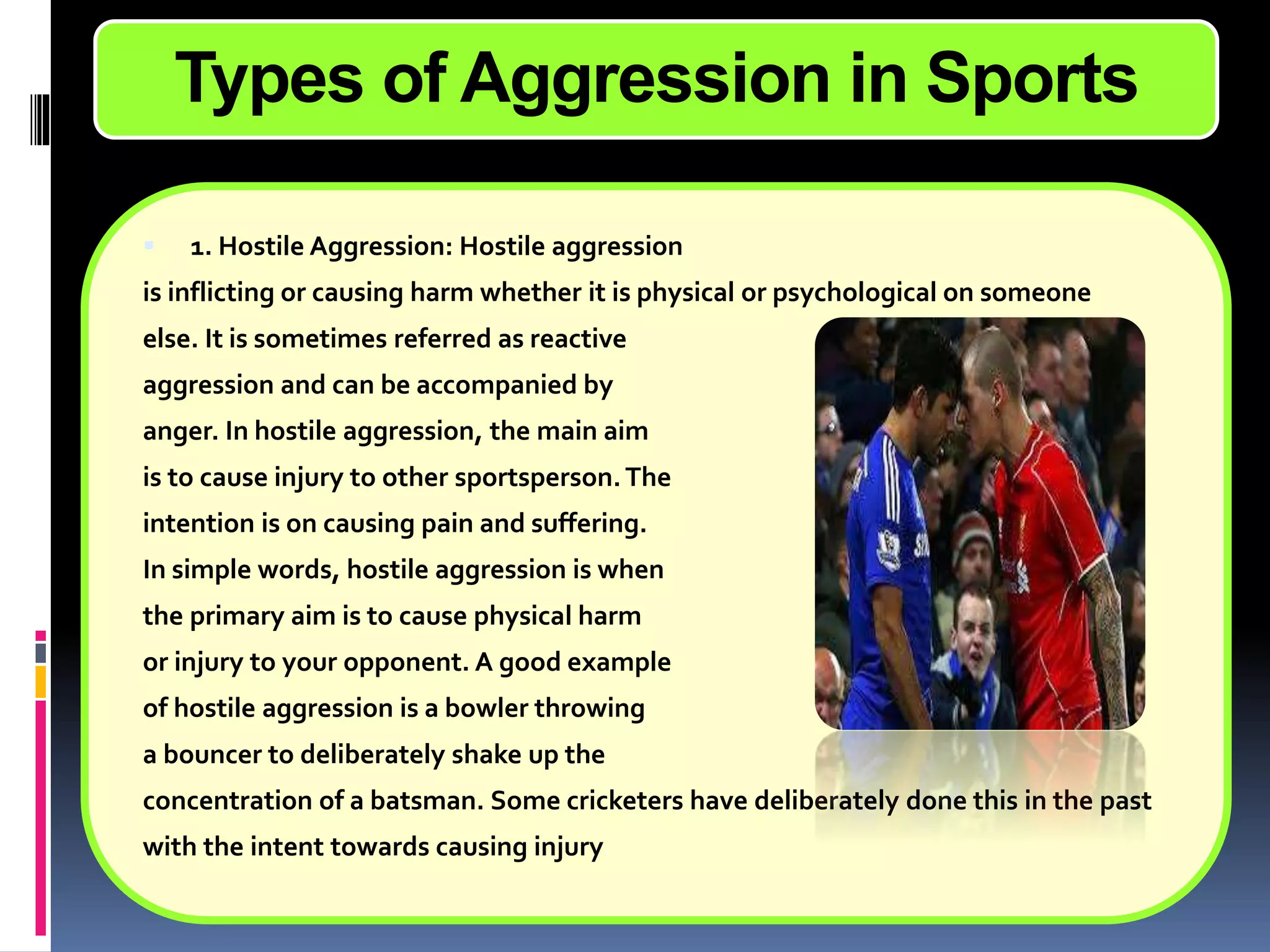
 1. Hostile Aggression: Hostile aggression
is inflicting or causing harm whether it is physical or psychological on someone
else. It is sometimes referred as reactive
aggression and can be accompanied by
anger. In hostile aggression, the main aim
is to cause injury to other sportsperson.The
intention is on causing pain and suffering.
In simple words, hostile aggression is when
the primary aim is to cause physical harm
or injury to your opponent. A good example
of hostile aggression is a bowler throwing
a bouncer to deliberately shake up the
concentration of a batsman. Some cricketers have deliberately done this in the past
with the intent towards causing injury.
2. Instrumental Aggression:
 Instrumental aggression is displaying aggressive
 behaviour in the pursuit of a non-aggressive goal, It is also known as channelled
 aggression and is not accompanied by anger.This type of aggression comes in
contact
 sports. In other words, instrumental aggression is behaviour that has the intent
to
 hurt in order to achieve money, praise or victory. In case of instrumental
aggression an
 athlete may intend to injure the opponent, but the most important goal to be
achieved
 by the aggressive act is to win the competition. For example, a rugby player
using
 aggression to tackle his opponent to win the ball. Actually the player is not using
his
 aggression to hurt the opponent but rather to win the ball back.
Instrumental Aggression
3. Assertive Behaviour
Assertive behaviour is different type of
aggression/aggressive
behaviour.This is defined as behaviour that involves the
use of legitimate physical
or verbal force to achieve one’s purpose. For example,
sledging in cricket to cause
psychological discomfort for the batsman. For an act to
be assertive it must be goal
directed with no specific intention to harm with the use
of legitimate force with
no rules broken. In assertive aggression or assertive
behaviour, the intention is to
3. Assertive Behaviour
 establish dominance rather than to harm the
opponent. Any physical injury that may
 occur through assertive behaviour is accidental
and unintentional. In fact, assertive
 behaviour is related to four main criteria i.e., it
is goal oriented, not intended to
 harm, uses only legitimate force and does not
break any rule of the game or sport.
 Even when coaches say to their players to be
aggressive they mean to say that they
 be assertive.

Psychology and sports- Class 12 .C.B.S.E. Physical Education

  • 1.
    Class 12 Health andPhysical Education Psychology and sports Unit-9 Rationalized syllabus
  • 2.
    Psychology and sports Psychology The scientific study of the human mind and its functions, especially those affecting behaviour in a given context.  Sport Psychology.  Sport psychology is a proficiency that uses psychological knowledge and skills to address optimal performance and well-being of athletes, developmental and social aspects of sports participation, and systemic issues associated with sports settings and organizations.
  • 3.
     1.Personality, itsdefinition and types Traits and types.  2.Sheldon and Jung’s classification and Big Five theory.  3.Motivation its types and technique.  4.Meaning, concept and types of aggression in sports.
  • 4.
    Definition of personality “Personality refers to an individual’s characteristic patterns of thought,emotion,and behaviour,together with the psychological mechanisms- hidden or not – behind those patterns.” - DC Funder.  “Personality is that quality which permits a prediction of what a person will do in a given situation”. -Cattel
  • 5.
  • 6.
  • 7.
  • 8.
  • 9.
  • 10.
  • 11.
    TYPES OF PERSONALITY Sheldonand Jung’s Classification and Big FiveTheory W H Sheldon classified personality of individuals into the following categories 1.Endomorph 2. Mesomorph 3. Ectomorph Jung’s Classification Jung has classified personality on the basis of sociability character as introverts, extrovert and ambiverts. 1.Introverts 2. Extroverts 3. Ambiverts
  • 12.
    W H Sheldonclassified personality of individuals into the following categories 1.Endomorph 2. Mesomorph 3. Ectomorph sonality of individuals into the following categories 1.Endomorph 2. Mesomorph 3. Ectomorph
  • 13.
    1. Endomorph:  Theseindividuals have short arms and legs. They have rounded physique. Their limbs seem to be shorter because of excessive deposits of adipose tissues. The upper parts of arms and legs are significantly thicker than the lower parts.  It is hard for them to lose weight. They have soft body. They have underdeveloped muscles. They have a capacity for high fat storage and become fat easily.  In fact, they are more inclined to become obese. They have pear shaped body. Their excessive mass hinders their ability to compete in sports.  In fact, sports require high level of agility or speed. Sports and games, which require strength like weightlifting and power-lifting are most suitable for endomorphs
  • 14.
    2. Mesomorph: Mesomorphs arecategorized as in-between the other two body types and are generally described as muscular. They have athletic physique and balanced body composition. They are able to increase their muscle size quickly and easily. They have well-developed rectangular shaped body. They have thick bones and muscles. Their chest and shoulders are larger and broader in comparison to their waistline.  They are physically capable of doing a lot of activities and tend to be athletically aggressive. Generally, they store fat evenly all over their bodies but they can become overweight if they lead sedentary lifestyle and take high calorie diet.  They can excel in such sports which require great strength, short bursts of energy and lots of power because they have enough strength, agility and speed. These characteristics make them strong contenders to be the top sportspersons in any sports
  • 15.
    3. Ectomorph:  Theindividuals who have an ectomorph body are usually referred to as slim persons because their muscles and limbs are elongated.They have weak constitution of body and usually face great difficulties in gaining weight.  They have flat chests and have less muscle mass.The lack of muscle mass creates the impression that they are taller than they really are.They do not have a lot of strength but they dominate the endurance sports because their body type is naturally suited to perform wonderfully in endurance activities.  They have a quick metabolism to burn fat.They also have a tendency to stick with what they do best.Their light body constitution makes them suited for aerobic activities like gymnastics
  • 16.
    Jung’s Classification 1. Introverts: Introverts: Theseare the persons who share characteristics such as shyness, social withdrawal and tendency to talk less. Owing to these characteristics such persons seem to be self-centered, unable to adjust easily in society or social situations. They are very sensible, rigid in ideas and future oriented
  • 17.
    Few Traits ofIntroverts
  • 18.
    2. Extroverts:  Extrovertshave a tendency to be friendly, outgoing, talkative and social in nature.They usually prefer social contacts.  They are generous, supportive and courageous.They may be called happy, go, lucky persons.They show interest in present reality than future.  They do not have hesitation.They express their feelings openly.They take decision quickly and act upon quickly.They are not affected easily by difficulties and troubles
  • 19.
    Few Traits ofExtroverts
  • 20.
    3. Ambiverts:  Thereare only few persons who are pure introverts or pure extroverts.  The remaining majority of persons possess both the qualities or traits of introverts  and extroverts such persons are called as ambiverts
  • 21.
  • 22.
  • 23.
    Big Five PersonalityTheory  It is a well known fact that persons give different response to the same situations. Indeed,  the big five factors of personality are the five main domains which define human personality  and account for individual differences.These five domains or dimensions of personality are  considered to be the fundamental traits that make up an individual’s overall personality.
  • 24.
    1. Openness:  Personswho like to learn new things, new concepts and enjoy new  experiences usually remain on the top in openness. Openness includes traits like being  imaginative, insightful and having a variety of interests.
  • 25.
    2. Conscientiousness:  Personswho have a high degree of conscientiousness are reliable  and prompt. Such persons remain organized, systematic, laborious and complete in  all respects.
  • 26.
    3. Extroversion:  Extrovertsget their energy from interacting with other individuals, whereas introverts get their energy from within themselves. Extroversion includes the traits of being energetic, talkative and assertive
  • 27.
    4. Agreeableness:  Suchindividuals are friendly, cooperative, compatible, kind and gentle. Persons with too much agreeableness may be more distant or aloof.  They are usually kind, generous, affectionate and sympathetic.
  • 28.
    5. Neuroticism:  Neuroticismis also called emotional stability.This domain or dimension relates to one’s emotional stability and the degree of negative emotions. Persons who have high neuroticism usually experience emotional instability and negative emotions. Such individuals remain moody and tense.
  • 29.
    MEANING, CONCEPT ANDTYPES OFAGGRESSION IN SPORTS Meaning and Concept of Aggression In psychology, the term aggression refers to a range of behaviors that can result in both physical and psychological harm to oneself, others or objects in the environment.This type of social interaction centers on harming another individual either physically or mentally. As a matter of fact, most of the persons view aggression as a negative psychological characteristic, however some sports psychologists agree that aggression can enhance sports performance. In fact, aggression in the field of sports and games comes out of frustration, which arises due to goal blockage. Along with this, situational and personal factors play a vital role in causing a person to behave aggressively. It can be seen that aggression comes from a number of sources
  • 30.
    Motivation  Motivation comesfrom the word ‘Motive’ which is a thought, feeling or condition that causes one to act. Every inaction or action of man is driven by a motive.  Human behavior is controlled, directed and modified by certain motives.  In sports motivation is the main psychological factor that affects performance. It can be said that motivation is to give reason, enthusiasm or interest to a specific action or behavior.  .Acc to Crooks and Stein:-”Any condition that might energize and direct our action is called motivation”.  Sage:-”The drive to strive is called motivation”.  It is the force that incites an individual to perform some activities. Motivation alone cannot in some cases assure success, it has to be complimented with skill knowledge, ability and other forces to successfully achieve. 
  • 31.
    Types of motivation 1.Intrinsicmotivation 2.Extrinsic motivation  Intrinsic Motivation.  Intrinsic motivation is a type of motivation in which an individual is being motivated by internal desires. ...  Extrinsic Motivation.  Extrinsic motivation, on the other hand, is a type of motivation in which an individual is being motivated by external desires.
  • 32.
    Intrinsic motivation  Intrinsicmotivation is the act of doing something without any obvious external rewards.You do it because it's enjoyable and interesting, rather than because of an outside incentive or pressure to do it, such as a reward or deadline.
  • 33.
    Extrinsic motivation  Extrinsicmotivation is reward-driven behavior. It's a type of operant conditioning. ... In extrinsic motivation, rewards or other incentives — like praise, fame, or money — are used as motivation for specific activities. external factors drive this form of motivation.
  • 34.
    Techniques of motivation 1.Goal setting  2.Healthy positive environment  3.Spectators  4.Positive attitude  5.Music  6.Presence of the opposite sex  7.Rewards…….
  • 35.
  • 36.
    Techniques of motivation 2.Healthy positive environment
  • 37.
    Techniques of motivation 2.Healthy positive environment
  • 38.
  • 39.
  • 40.
  • 41.
    Aggression-Meaning,concept and types  Insports, aggression means the desire to harm another player which is not within the laws of the game. For example, pushing another player over a game in football or using abusive language for other players or teams.  Aggression. ... Aggression is overt or covert, often harmful, social interaction with the intention of inflicting damage or other unpleasantness upon another individual. It may occur either reactively or without provocation.  In sport, aggression is a characteristic that can have many negative as well as positive effects on performance. Aggression is defined as “any form of behaviour directed toward the goal of harming of injuring another live being who is motivated to avoid such treatment” (Baron & Richardson, 1994).
  • 42.
    What is Aggression?  Aggression is any behaviour intended to harm another individual or object by physical or verbal means.:-Bull  Aggression is a set of behaviours that are likely to ,or have the potential to, cause harm to others, or intended to cause harm and are goal directed.:-Berkowitz
  • 43.
     1.“Aggression isa behaviour with a goal harming or injuring another being motivated to avoid such treatment.”  This definition raises certain points:  (i) Aggression is behaviour.Thinking negative thoughts being angry is not aggression.  (ii) Aggression is intentional behaviour. Accidental harm is not aggression.  (iii) Aggression involves harm or injury.  (iv) Aggression involves living beings.
  • 44.
    2. “ anyform of behaviour directed towards the goal of harming or injuring another living being who in motivated to avoid such treatment.” (Baron and Richardson) 3. “Aggression is noun that is generally defined as an act of aggressive behaviour.” 4. Baron and Richardson who define, “Any form of behaviour towards the goal of harming or injuring another living being who is motivated to avoid such treatment.”
  • 45.
    5. Berkowitz summarisedthat two factors are required to classify a behaviour as showing aggression. (i)The behaviour must be directed at another human being with the goal of causing some form of physical harm. (ii)The behaviour must show a reasonable expectation that the attempt to inflict harm will be successful
  • 46.
  • 47.
    Types of Aggressionin Sports  1. Hostile Aggression: Hostile aggression is inflicting or causing harm whether it is physical or psychological on someone else. It is sometimes referred as reactive aggression and can be accompanied by anger. In hostile aggression, the main aim is to cause injury to other sportsperson.The intention is on causing pain and suffering. In simple words, hostile aggression is when the primary aim is to cause physical harm or injury to your opponent. A good example of hostile aggression is a bowler throwing a bouncer to deliberately shake up the concentration of a batsman. Some cricketers have deliberately done this in the past with the intent towards causing injury.
  • 48.
    2. Instrumental Aggression: Instrumental aggression is displaying aggressive  behaviour in the pursuit of a non-aggressive goal, It is also known as channelled  aggression and is not accompanied by anger.This type of aggression comes in contact  sports. In other words, instrumental aggression is behaviour that has the intent to  hurt in order to achieve money, praise or victory. In case of instrumental aggression an  athlete may intend to injure the opponent, but the most important goal to be achieved  by the aggressive act is to win the competition. For example, a rugby player using  aggression to tackle his opponent to win the ball. Actually the player is not using his  aggression to hurt the opponent but rather to win the ball back.
  • 49.
  • 50.
    3. Assertive Behaviour Assertivebehaviour is different type of aggression/aggressive behaviour.This is defined as behaviour that involves the use of legitimate physical or verbal force to achieve one’s purpose. For example, sledging in cricket to cause psychological discomfort for the batsman. For an act to be assertive it must be goal directed with no specific intention to harm with the use of legitimate force with no rules broken. In assertive aggression or assertive behaviour, the intention is to
  • 51.
  • 52.
     establish dominancerather than to harm the opponent. Any physical injury that may  occur through assertive behaviour is accidental and unintentional. In fact, assertive  behaviour is related to four main criteria i.e., it is goal oriented, not intended to  harm, uses only legitimate force and does not break any rule of the game or sport.  Even when coaches say to their players to be aggressive they mean to say that they  be assertive.