2/19/2015
1
MARIA MERCEDES “CHED” ARZADON
COLLEGE OF EDUCATION, UNIVERSITY OF THE PHILIPPINES
RIDING INTO THE FINAL WAVE OF EFA:
INSTITUTIONALIZATION OF MOTHER
TONGUE EDUCATION IN THE
PHILIPPINES
Comparative & International Education Conference 2014
March 10-15, 2014; Sheraton Centre, Toronto, Canada
Mother Tongue Based Multilingual
Education Policy in Philippine Education
• The Philippines is the only country in Asia with very
strong support for policy and action for MTBMLE
(Kosonen 2012)
• Department of Education Order 54 (2009) and
Republic Act 10533 (2013) --the learner’s mother
tongue as medium of instruction in all subject
areas, language of literacy, and subject area from
kindergarten up - grade 3, transitioning up to gr 6
• 16 million pupils
2/19/2015
2
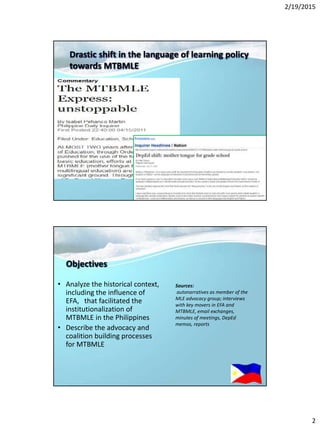
Drastic shift in the language of learning policy
towards MTBMLE
Objectives
• Analyze the historical context,
including the influence of
EFA, that facilitated the
institutionalization of
MTBMLE in the Philippines
• Describe the advocacy and
coalition building processes
for MTBMLE
Sources:
autonarratives as member of the
MLE advocacy group; interviews
with key movers in EFA and
MTBMLE, email exchanges,
minutes of meetings, DepEd
memos, reports
2/19/2015
3
Long and difficult wait
• Since 1925 through 2008, a series of educational
reform proposal had included the use of the local
language
– Resulted to short-lived programs
– Weak policy support
• Privileging of English and Filipino (national language)
• Regional languages only as auxiliary medium of
instruction
Socio-historical context
• Greater demand for English proficiency in labor
(migrant labor and business process
outsourcing/call centers)
• Weakening influence of nationalism (restoration of
independence; period of peace)
• Decentralization in governance
• Commitment to Education for All 2015
• Various education reform initiatives
2/19/2015
4
Education for ALL Plan of Action 1991
• Decentralized school governance
• Alternatives for adult illiterates and school leavers
thru nonformal education and equivalency programs
• Making every child a reader
• School feeding programs
 Resulted to various national policies and education
reform programs
Phil EFA Report 2008 “Not much progress”
In fact, access indicators in both elementary and secondary
education show declining trends. It is almost mid-term for
the Global EFA 2015 and the Philippines may find itself
lagging behind with a discouraging performance.
Lack of political consensus, frequent leadership change,
tight fiscal situation, over-dependence on external
financing, high population growth rate, inability to capitalize
on proven education innovations, and lack of sound social
marketing strategy for education programs are likely to
undermine sector reforms (Rodriguez)
2/19/2015
5
The local language issue in EFA
• High dropout rate
– Due to lack of personal interest (35%
among 6-15yo)
– Prevalent among indigenous people groups
• Poor reading outcomes - reading without
comprehension, reading delays
• Low level thinking skills especially in Math
and Science
Enabling global support
• UNESCO support for the use of the mother tongue in
education (Advocacy Kit for Multilingual Education;
EFA Global Monitoring report 2009)
• MLE international conferences affirming various MLE
initiatives
• Availability of international studies
• Affirmation of the Philippine initiatives
2/19/2015
6
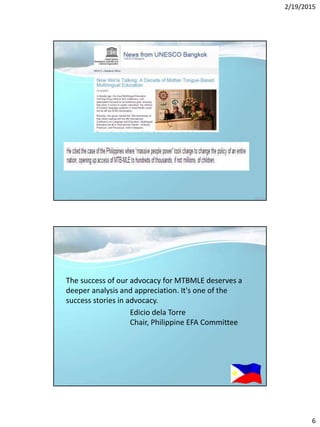
The success of our advocacy for MTBMLE deserves a
deeper analysis and appreciation. It's one of the
success stories in advocacy.
Edicio dela Torre
Chair, Philippine EFA Committee
2/19/2015
7
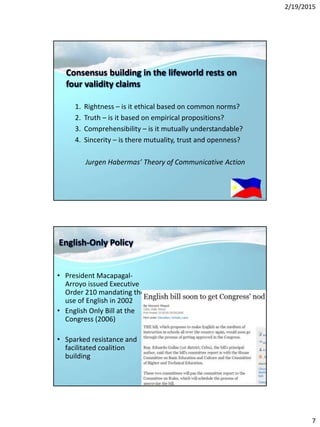
Consensus building in the lifeworld rests on
four validity claims
1. Rightness – is it ethical based on common norms?
2. Truth – is it based on empirical propositions?
3. Comprehensibility – is it mutually understandable?
4. Sincerity – is there mutuality, trust and openness?
Jurgen Habermas’ Theory of Communicative Action
English-Only Policy
• President Macapagal-
Arroyo issued Executive
Order 210 mandating the
use of English in 2002
• English Only Bill at the
Congress (2006)
• Sparked resistance and
facilitated coalition
building
2/19/2015
8
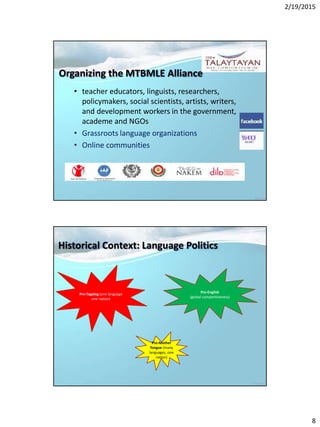
Organizing the MTBMLE Alliance
• teacher educators, linguists, researchers,
policymakers, social scientists, artists, writers,
and development workers in the government,
academe and NGOs
• Grassroots language organizations
• Online communities
Historical Context: Language Politics
Pro-Tagalog (one language
one nation)
Pro-English
(global competitiveness)
Pro-Mother
Tongue (many
languages, one
nation)
2/19/2015
9
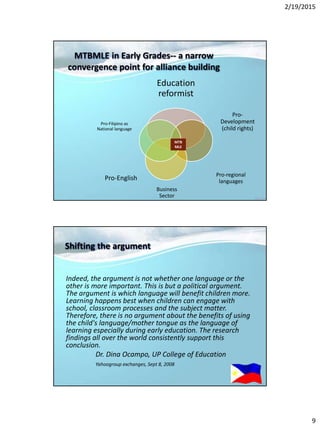
MTBMLE in Early Grades-- a narrow
convergence point for alliance building
Education
reformist
Pro-
Development
(child rights)
Pro-regional
languagesPro-English
Pro-Filipino as
National language
MTB
MLE
Business
Sector
Shifting the argument
Indeed, the argument is not whether one language or the
other is more important. This is but a political argument.
The argument is which language will benefit children more.
Learning happens best when children can engage with
school, classroom processes and the subject matter.
Therefore, there is no argument about the benefits of using
the child's language/mother tongue as the language of
learning especially during early education. The research
findings all over the world consistently support this
conclusion.
Dr. Dina Ocampo, UP College of Education
Yahoogroup exchanges, Sept 8, 2008
2/19/2015
10
Primary Message --a compelling claim
that resonates among all the
stakeholders
• Defending the most affected, the most
vulnerable --Children, especially those whose
mother tongue is not Filipino or English
• Identification of the new enemy
illiteracy, underachievement, exclusion
Politicking instead of improving education
Primary and secondary messages
• MTBMLE improves literacy, higher order thinking
skills, confidence; unburdens the teacher
• Effective bridge in learning the national language
(Filipino) and English
• Child friendly, lowers dropout rate
• Promotes peace and understanding
• Involves parents and the whole community
2/19/2015
11
Building Momentum: Key Events 2008 - 2013
• Signature campaign
• MTMBLE caravan/ lecture forums in all regions
• National teachers training; devt of instructional matls
• Dept of Education Order 74 s.2009
• Conferences
• Strategic Planning
• Radio/TV /newspaper exposure
• Republic Act 10533 of 2013 (K-12 Act)
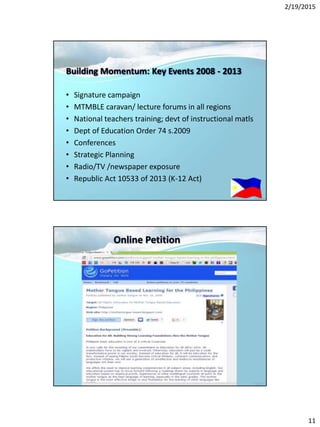
Online Petition
2/19/2015
12
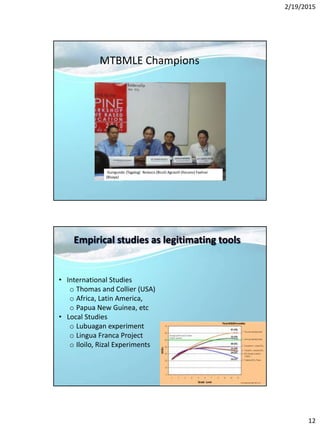
MTBMLE Champions
Gunigundo (Tagalog) Nolasco (Bicol) Agcaoili (Ilocano) Faelnar
(Bisaya)
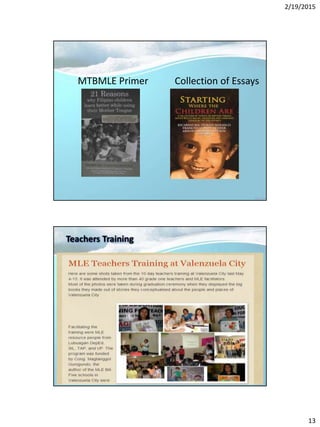
Empirical studies as legitimating tools
• International Studies
o Thomas and Collier (USA)
o Africa, Latin America,
o Papua New Guinea, etc
• Local Studies
o Lubuagan experiment
o Lingua Franca Project
o Iloilo, Rizal Experiments
2/19/2015
13
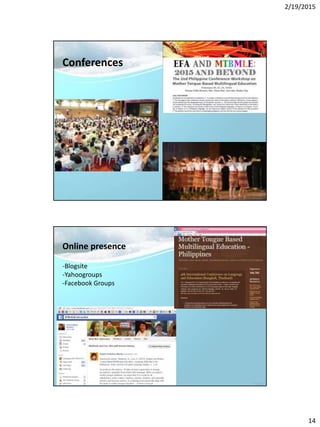
MTBMLE Primer Collection of Essays
Teachers Training
2/19/2015
14
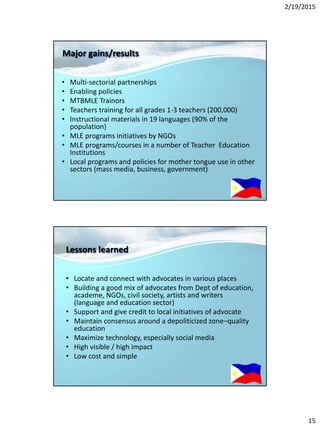
Conferences
Online presence
-Blogsite
-Yahoogroups
-Facebook Groups
2/19/2015
15
Major gains/results
• Multi-sectorial partnerships
• Enabling policies
• MTBMLE Trainors
• Teachers training for all grades 1-3 teachers (200,000)
• Instructional materials in 19 languages (90% of the
population)
• MLE programs initiatives by NGOs
• MLE programs/courses in a number of Teacher Education
Institutions
• Local programs and policies for mother tongue use in other
sectors (mass media, business, government)
Lessons learned
• Locate and connect with advocates in various places
• Building a good mix of advocates from Dept of education,
academe, NGOs, civil society, artists and writers
(language and education sector)
• Support and give credit to local initiatives of advocate
• Maintain consensus around a depoliticized zone–quality
education
• Maximize technology, especially social media
• High visible / high impact
• Low cost and simple
2/19/2015
16
Challenges/Needs
• Quality teachers training / materials (esp reproduction)
• Facilitating dialogical/participatory relationship among MLE
stakeholders (orthography, materials development, etc)
• Empirical studies to address the unique pluralingual contexts
• Consensus building to include parents and the general public
• Communicative teaching strategies in large classes
• Making MTBMLE generative and transformative
• Intellectualizing and professionalizing local languages
• Mother tongue literacy beyond the school gates
• Making pre-service teacher education curriculum MLE-friendly
Agyamannakunay
Diositi agngina
ched.arzadon@gmail.com

Arzadon ched cies 2014

  • 1.
    2/19/2015 1 MARIA MERCEDES “CHED”ARZADON COLLEGE OF EDUCATION, UNIVERSITY OF THE PHILIPPINES RIDING INTO THE FINAL WAVE OF EFA: INSTITUTIONALIZATION OF MOTHER TONGUE EDUCATION IN THE PHILIPPINES Comparative & International Education Conference 2014 March 10-15, 2014; Sheraton Centre, Toronto, Canada Mother Tongue Based Multilingual Education Policy in Philippine Education • The Philippines is the only country in Asia with very strong support for policy and action for MTBMLE (Kosonen 2012) • Department of Education Order 54 (2009) and Republic Act 10533 (2013) --the learner’s mother tongue as medium of instruction in all subject areas, language of literacy, and subject area from kindergarten up - grade 3, transitioning up to gr 6 • 16 million pupils
  • 2.
    2/19/2015 2 Drastic shift inthe language of learning policy towards MTBMLE Objectives • Analyze the historical context, including the influence of EFA, that facilitated the institutionalization of MTBMLE in the Philippines • Describe the advocacy and coalition building processes for MTBMLE Sources: autonarratives as member of the MLE advocacy group; interviews with key movers in EFA and MTBMLE, email exchanges, minutes of meetings, DepEd memos, reports
  • 3.
    2/19/2015 3 Long and difficultwait • Since 1925 through 2008, a series of educational reform proposal had included the use of the local language – Resulted to short-lived programs – Weak policy support • Privileging of English and Filipino (national language) • Regional languages only as auxiliary medium of instruction Socio-historical context • Greater demand for English proficiency in labor (migrant labor and business process outsourcing/call centers) • Weakening influence of nationalism (restoration of independence; period of peace) • Decentralization in governance • Commitment to Education for All 2015 • Various education reform initiatives
  • 4.
    2/19/2015 4 Education for ALLPlan of Action 1991 • Decentralized school governance • Alternatives for adult illiterates and school leavers thru nonformal education and equivalency programs • Making every child a reader • School feeding programs  Resulted to various national policies and education reform programs Phil EFA Report 2008 “Not much progress” In fact, access indicators in both elementary and secondary education show declining trends. It is almost mid-term for the Global EFA 2015 and the Philippines may find itself lagging behind with a discouraging performance. Lack of political consensus, frequent leadership change, tight fiscal situation, over-dependence on external financing, high population growth rate, inability to capitalize on proven education innovations, and lack of sound social marketing strategy for education programs are likely to undermine sector reforms (Rodriguez)
  • 5.
    2/19/2015 5 The local languageissue in EFA • High dropout rate – Due to lack of personal interest (35% among 6-15yo) – Prevalent among indigenous people groups • Poor reading outcomes - reading without comprehension, reading delays • Low level thinking skills especially in Math and Science Enabling global support • UNESCO support for the use of the mother tongue in education (Advocacy Kit for Multilingual Education; EFA Global Monitoring report 2009) • MLE international conferences affirming various MLE initiatives • Availability of international studies • Affirmation of the Philippine initiatives
  • 6.
    2/19/2015 6 The success ofour advocacy for MTBMLE deserves a deeper analysis and appreciation. It's one of the success stories in advocacy. Edicio dela Torre Chair, Philippine EFA Committee
  • 7.
    2/19/2015 7 Consensus building inthe lifeworld rests on four validity claims 1. Rightness – is it ethical based on common norms? 2. Truth – is it based on empirical propositions? 3. Comprehensibility – is it mutually understandable? 4. Sincerity – is there mutuality, trust and openness? Jurgen Habermas’ Theory of Communicative Action English-Only Policy • President Macapagal- Arroyo issued Executive Order 210 mandating the use of English in 2002 • English Only Bill at the Congress (2006) • Sparked resistance and facilitated coalition building
  • 8.
    2/19/2015 8 Organizing the MTBMLEAlliance • teacher educators, linguists, researchers, policymakers, social scientists, artists, writers, and development workers in the government, academe and NGOs • Grassroots language organizations • Online communities Historical Context: Language Politics Pro-Tagalog (one language one nation) Pro-English (global competitiveness) Pro-Mother Tongue (many languages, one nation)
  • 9.
    2/19/2015 9 MTBMLE in EarlyGrades-- a narrow convergence point for alliance building Education reformist Pro- Development (child rights) Pro-regional languagesPro-English Pro-Filipino as National language MTB MLE Business Sector Shifting the argument Indeed, the argument is not whether one language or the other is more important. This is but a political argument. The argument is which language will benefit children more. Learning happens best when children can engage with school, classroom processes and the subject matter. Therefore, there is no argument about the benefits of using the child's language/mother tongue as the language of learning especially during early education. The research findings all over the world consistently support this conclusion. Dr. Dina Ocampo, UP College of Education Yahoogroup exchanges, Sept 8, 2008
  • 10.
    2/19/2015 10 Primary Message --acompelling claim that resonates among all the stakeholders • Defending the most affected, the most vulnerable --Children, especially those whose mother tongue is not Filipino or English • Identification of the new enemy illiteracy, underachievement, exclusion Politicking instead of improving education Primary and secondary messages • MTBMLE improves literacy, higher order thinking skills, confidence; unburdens the teacher • Effective bridge in learning the national language (Filipino) and English • Child friendly, lowers dropout rate • Promotes peace and understanding • Involves parents and the whole community
  • 11.
    2/19/2015 11 Building Momentum: KeyEvents 2008 - 2013 • Signature campaign • MTMBLE caravan/ lecture forums in all regions • National teachers training; devt of instructional matls • Dept of Education Order 74 s.2009 • Conferences • Strategic Planning • Radio/TV /newspaper exposure • Republic Act 10533 of 2013 (K-12 Act) Online Petition
  • 12.
    2/19/2015 12 MTBMLE Champions Gunigundo (Tagalog)Nolasco (Bicol) Agcaoili (Ilocano) Faelnar (Bisaya) Empirical studies as legitimating tools • International Studies o Thomas and Collier (USA) o Africa, Latin America, o Papua New Guinea, etc • Local Studies o Lubuagan experiment o Lingua Franca Project o Iloilo, Rizal Experiments
  • 13.
    2/19/2015 13 MTBMLE Primer Collectionof Essays Teachers Training
  • 14.
  • 15.
    2/19/2015 15 Major gains/results • Multi-sectorialpartnerships • Enabling policies • MTBMLE Trainors • Teachers training for all grades 1-3 teachers (200,000) • Instructional materials in 19 languages (90% of the population) • MLE programs initiatives by NGOs • MLE programs/courses in a number of Teacher Education Institutions • Local programs and policies for mother tongue use in other sectors (mass media, business, government) Lessons learned • Locate and connect with advocates in various places • Building a good mix of advocates from Dept of education, academe, NGOs, civil society, artists and writers (language and education sector) • Support and give credit to local initiatives of advocate • Maintain consensus around a depoliticized zone–quality education • Maximize technology, especially social media • High visible / high impact • Low cost and simple
  • 16.
    2/19/2015 16 Challenges/Needs • Quality teacherstraining / materials (esp reproduction) • Facilitating dialogical/participatory relationship among MLE stakeholders (orthography, materials development, etc) • Empirical studies to address the unique pluralingual contexts • Consensus building to include parents and the general public • Communicative teaching strategies in large classes • Making MTBMLE generative and transformative • Intellectualizing and professionalizing local languages • Mother tongue literacy beyond the school gates • Making pre-service teacher education curriculum MLE-friendly Agyamannakunay Diositi agngina ched.arzadon@gmail.com