「ゆるいまちづくり」のイノベーション

鯖江市役所JK課とパターン・ランゲージ
SFC Open Research Forum 2017 (ORF2017)
小川克彦
慶應義塾大学環境情報学部 教授
ゆるいコミュニケーション・ラボ 代表
井庭崇 慶應義塾大学 総合政策学部 准教授
牧野百男 鯖江市 市長
若新 雄純 慶應義塾大学 政策・メディア研究科 特任准教授
木村 紀彦 慶應義塾大学 政策・メディア研究科 修士課程
「ゆるいまちづくり」のイノベーション

鯖江市役所JK課とパターン・ランゲージ
井庭 崇
慶應義塾大学 総合政策学部 准教授
【理論編】
「おしゃべりの放し飼い」が
ゆるい創造につながるメカニズム
創造システム理論による理解
Takashi Iba, "An Autopoietic Systems
Theory for Creativity”, Procedia -
Social and Behavioral Sciences, Vol.2,
Issue 4, 2010, pp.6610-6625
Collaborative Innovation Networks Conference 2009
Procedia
Social and
Behavioral
Sciences
www.elsevier.com/locate/procedia
COINs2009: Collaborative Innovation Networks Conference
An Autopoietic Systems Theory for Creativity
Takashi Ibaab
aMIT Center for Collective Intelligence, Cambridge MA, USA
bFaculty of Policy Management, Keio University, Japan
AAbbssttrraacctt
In this paper, a new, non-psychological and non-sociological approach to understanding creativity is proposed.
The approach is based on autopoietic system theory, where an autopoietic system is defined as a unity whose
organization is defined by a particular network of production processes of elements. While the theory was
originally proposed in biology and then applied to sociology, I have applied it to understand the nature of
creation, and called it "Creative Systems Theory". A creative system is an autopoietic system whose element
is "discovery", which emerges only when a synthesis of three selections has occurred: "idea", "association",
and "consequence". With using these concepts, we open the way to understand creation itself separated from
psychic and social aspects of creativity. On this basis, the coupling between creative, psychic, and social
systems is discussed. I suggest, in this paper, the future of creativity studies, re-defining a discipline
"Creatology" for inquiring creative systems and propose an interdisciplinary field as "Creative Sciences" for
interdisciplinary connections among creatology, psychology, and so on.
Keywords; creativity; systems theory; autopoiesis; pattern language
11.. IInnttrroodduuccttiioonn
In this paper, a new, non-psychological and non-sociological approach to understanding creativity
is proposed. The approach is based on autopoietic system theory, where an autopoietic system is
defined as a unity whose organization is defined by a particular network of production processes
of elements. While the theory was originally proposed in biology and then applied to sociology, I
have applied it to understand the nature of creation, and called it "Creative Systems Theory". A
creative system is an autopoietic system whose element is "discovery", which emerges only when a
創造システム理論
Creative Systems Theory
Takashi Iba, "An Autopoietic Systems Theory for Creativity”,
Procedia - Social and Behavioral Sciences,Vol.2, Issue 4, 2010, pp.6610-6625
創造システム理論では、「創造」(発見の連鎖)を、「思考」(意識の連鎖)
と「社会」(コミュニケーションの連鎖)を(独自の論理をもつ)別のシス
テムとして切り出して捉える。
Iba, T. (2009) “An Autopoietic Systems Theory for Creativity”, COINs2009.
創造 = “発見”の連鎖
Iba, T. (2009) “An Autopoietic Systems Theory for Creativity”, COINs2009.
創造 = “発見”の連鎖
「おしゃべりの放し飼い」が
ゆるい創造につながるメカニズム
おしゃべり
「小さな発見」の連鎖
「おしゃべり」のなかで、

「小さな発見」の連鎖が起きる。
「おしゃべり」を抑制してしまうと、

発見の連鎖もシュリンクしてしまう。
一見無駄に見える「おしゃべり」も、

発見の連鎖が可能となるための土台

(環境)をつくりだしている。
鯖江市では何が起きているのか
ハーシュマンの社会変革モデル
の拡張版による理解
組織や社会を変える方法
claim
Visualized by Takashi Iba, base on the framework proposed by Albert O. Hirschman
Albert O. Hirschman, Exit, Voice, and Loyalty: Responses to Decline
in Firms, Organizations, and States, Harvard University Press, 1970
A.O. ハーシュマン, 『離脱・発言・忠誠―企業・組織・
国家における衰退への反応』, ミネルヴァ書房, 2005
Exit / Voice
かつて開発経済学者ハーシュマンは、社会を変える方法
には、「離脱」(Exit)と「発言」(Voice)の2つの選択
肢があると捉え、社会現象を分析した。
Exit
Ignore
/ Voice
Complain
20th Century
Depressive Society
組織や社会を変える方法?(現在の日本)
Extended and
claim
Visualized by Takashi Iba, base on the framework proposed by Albert O. Hirschman
しかし、現在の日本では、「離脱」(Exit)と「発言」(Voice)より、
「無視」(Ignore)や「愚痴」(Complain)が蔓延しており、これで
は、組織や社会は変わらない。
Exit / Voice20th Century
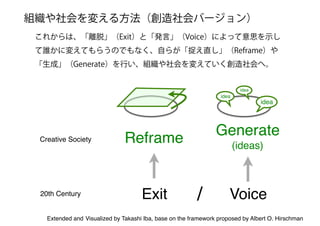
組織や社会を変える方法(創造社会バージョン)
Reframe GenerateCreative Society
(ideas)
idea
idea
idea
Extended and Visualized by Takashi Iba, base on the framework proposed by Albert O. Hirschman
これからは、「離脱」(Exit)と「発言」(Voice)によって意思を示し
て誰かに変えてもらうのでもなく、自らが「捉え直し」(Reframe)や
「生成」(Generate)を行い、組織や社会を変えていく創造社会へ。
鯖江市では何が起きているのか
Reframe
Generate
(ideas)
idea
idea
idea
鯖江市は若い人たちにとっ
ても面白い魅力的な場であ
る、という捉え直しの実現
JK課をはじめ、誰でもどん
なことでも、アイデアを出
せるという生成の場づくり
なぜ若者が鯖江市に残るようになるのか
川喜田二郎の創造論による理解
「創造的行為は、まずその対象となるもの、つまり「客体」
を創造するが、同時に、その創造を行うことによっ
て自らをも脱皮変容させる。つまり「主体」も
創造される のであて、一方的に対象を作る出すだけとい
うのは、本当の創造的行為ではないのである。そして創造的
であればあるほど、その主体である人間の脱皮変容には目
を瞠るものがある。」
川喜田二郎, 『創造性とは何か』, 祥伝社, 2010 (1993)
つくることは探究すること、変わること
「では、創造的行為において「客体」と「主体」の双方が創
造されるだけかというと、その行為を通じて 主体と客体
とは、ひじょうに深い「愛と連帯感」で結ば
れる のである。創造的行為が達成された当座は、きわめて
ホットな愛であり、時がたつと連帯という形で落ち着
く。」
川喜田二郎, 『創造性とは何か』, 祥伝社, 2010 (1993)
創造により生まれる愛と連帯感
「しかも、主体と客体が創造されるだけではなく、その創
造が行われた「場」も、また新たな価値を付
加 されて生み出されるのである。

 したがって、ひとつの創造的行為が達成された場合、そこ
には「主体」と「客体」と「場」の三つが生み出されると
いうことで、その「場」というものが、第二の、そして第三
の「ふるさと」となるということである。」
川喜田二郎, 『創造性とは何か』, 祥伝社, 2010 (1993)
創造により生み出される「ふるさと」
なぜ若者が鯖江市に残るようになるのか
JK課のような場での「創造」の体験は、つくるもの(客体)だけで
なく、自ら(主体)もつくられる(学び、成長する)。
自分たちがつくりだしたもの(地域のなかでの何か、あるいは地域)
には、愛着が生まれ、それらとの連帯感が生じる。
その「創造」を行なった場(その地域)が、創造による「ふるさと」
となる。
こうして、自分(たち)にとって特別な場所となり、これからも暮
らし続けたいと思える魅力的な場所となる。
「ゆるいまちづくり」のイノベーション

鯖江市役所JK課とパターン・ランゲージ
井庭 崇
慶應義塾大学 総合政策学部 准教授
【理論編】

ORF2017-「ゆるいまちづくり」のイノベーション:
鯖江市役所JK課とパターン・ランゲージ