Is This Plagiarism?
   Copying a direct quotation into your paper,
placing quotation marks around it, and crediting
                   the source.

                        NO!
              This is not plagiarism.
How About this?
Taking someone’s ideas or words, putting them
into your own words, and crediting the source.

                       NO!
             This is not plagiarism.

             It’s Paraphrasing!
What is paraphrasing
A paraphrase uses an author's idea, but expresses
    it in your own words, without the use of
                quotation marks.

        Just changing a few words from the
               original is plagiarism.
         Paraphrasing is permitted as long
              as you credit the source.
Examples of Paraphrasing
The original passage:
Students frequently overuse direct quotation [when] taking notes,
and as a result they overuse quotations in the final [research]
paper. Probably only about 10% of your final manuscript
should appear as directly quoted matter. Therefore, you
should strive to limit the amount of exact transcribing of source
materials while taking notes. Lester, James D. Writing Research Papers.
2nd ed. (1976): 46-47

A legitimate paraphrase:
In research papers students often quote excessively, failing to keep
quoted material down to a desirable level. Since the problem usually
originates during note taking, it is essential to minimize the material
recorded verbatim (Lester 46-47).
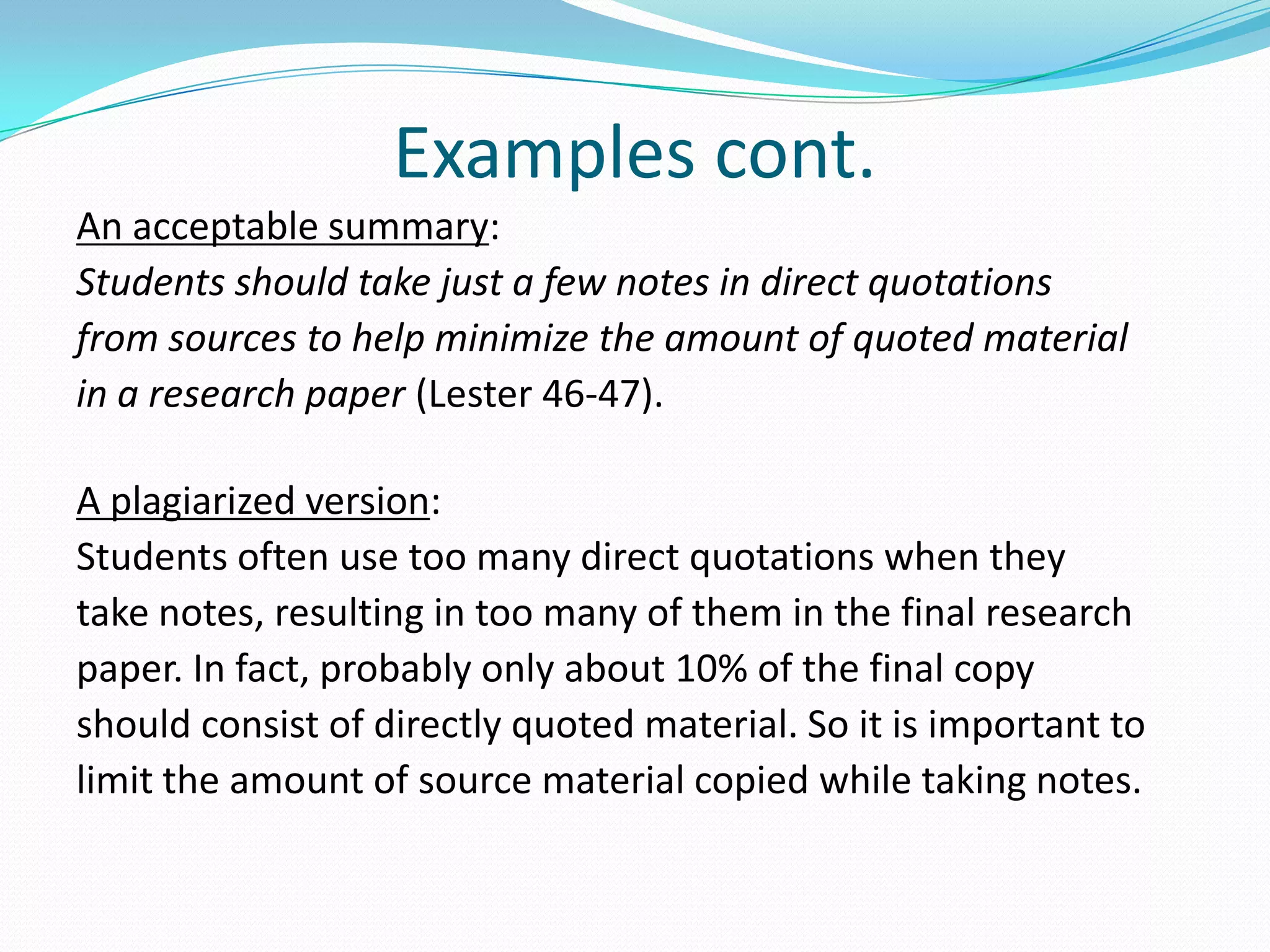
Examples cont.
An acceptable summary:
Students should take just a few notes in direct quotations
from sources to help minimize the amount of quoted material
in a research paper (Lester 46-47).

A plagiarized version:
Students often use too many direct quotations when they
take notes, resulting in too many of them in the final research
paper. In fact, probably only about 10% of the final copy
should consist of directly quoted material. So it is important to
limit the amount of source material copied while taking notes.
The original passage:
Students frequently overuse direct quotation [when] taking notes,
and as a result they overuse quotations in the final [research]
paper. Probably only about 10% of your final manuscript
should appear as directly quoted matter. Therefore, you
should strive to limit the amount of exact transcribing of source
materials while taking notes. Lester, James D. Writing Research Papers.
2nd ed. (1976): 46-47
A plagiarized version:
Students often use too many direct quotations when they
take notes, resulting in too many of them in the final research
paper. In fact, probably only about 10% of the final copy
should consist of directly quoted material. So it is important to
limit the amount of source material copied while taking notes.
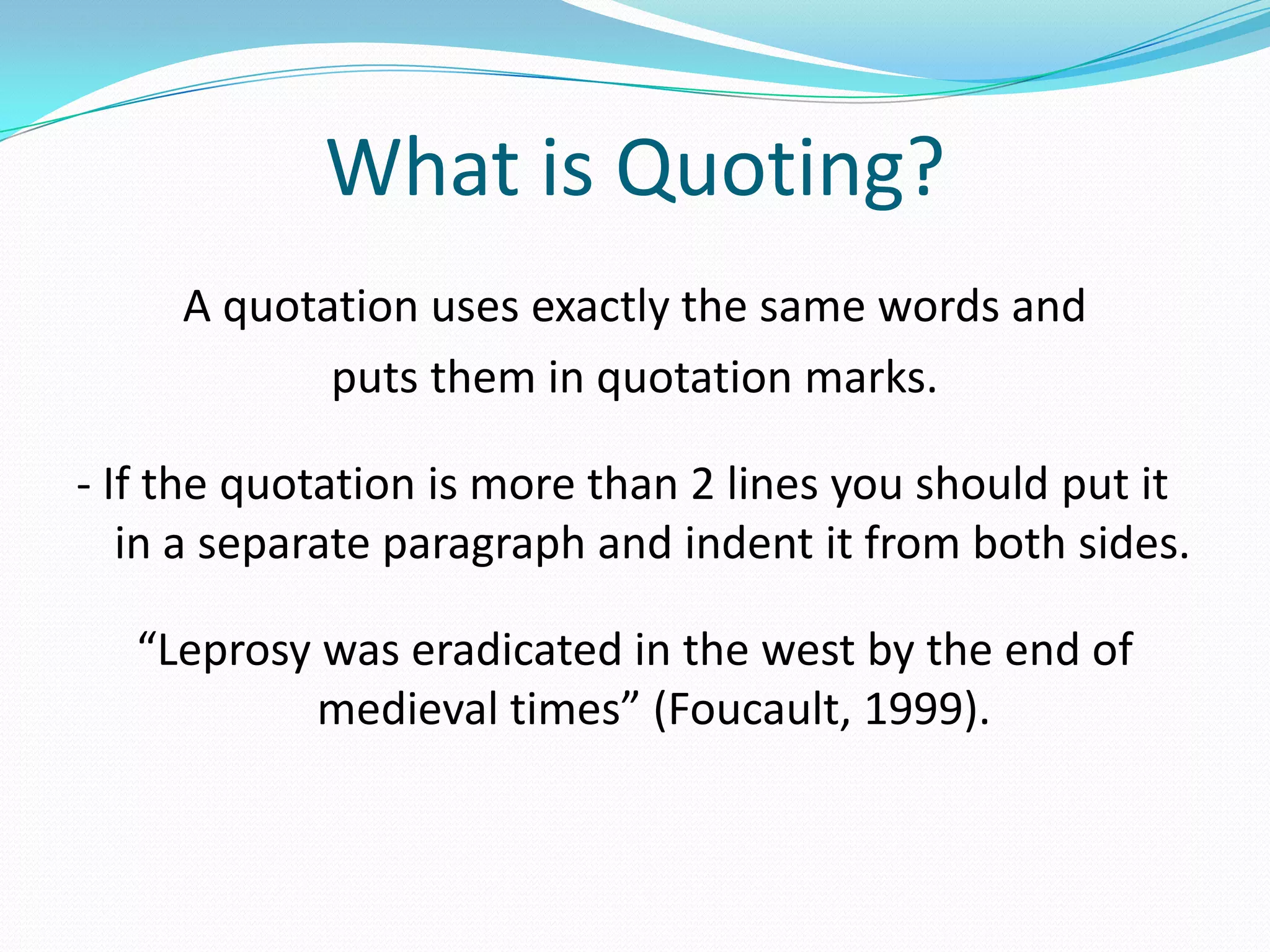
What is Quoting?
     A quotation uses exactly the same words and
            puts them in quotation marks.

- If the quotation is more than 2 lines you should put it
   in a separate paragraph and indent it from both sides.

   “Leprosy was eradicated in the west by the end of
            medieval times” (Foucault, 1999).
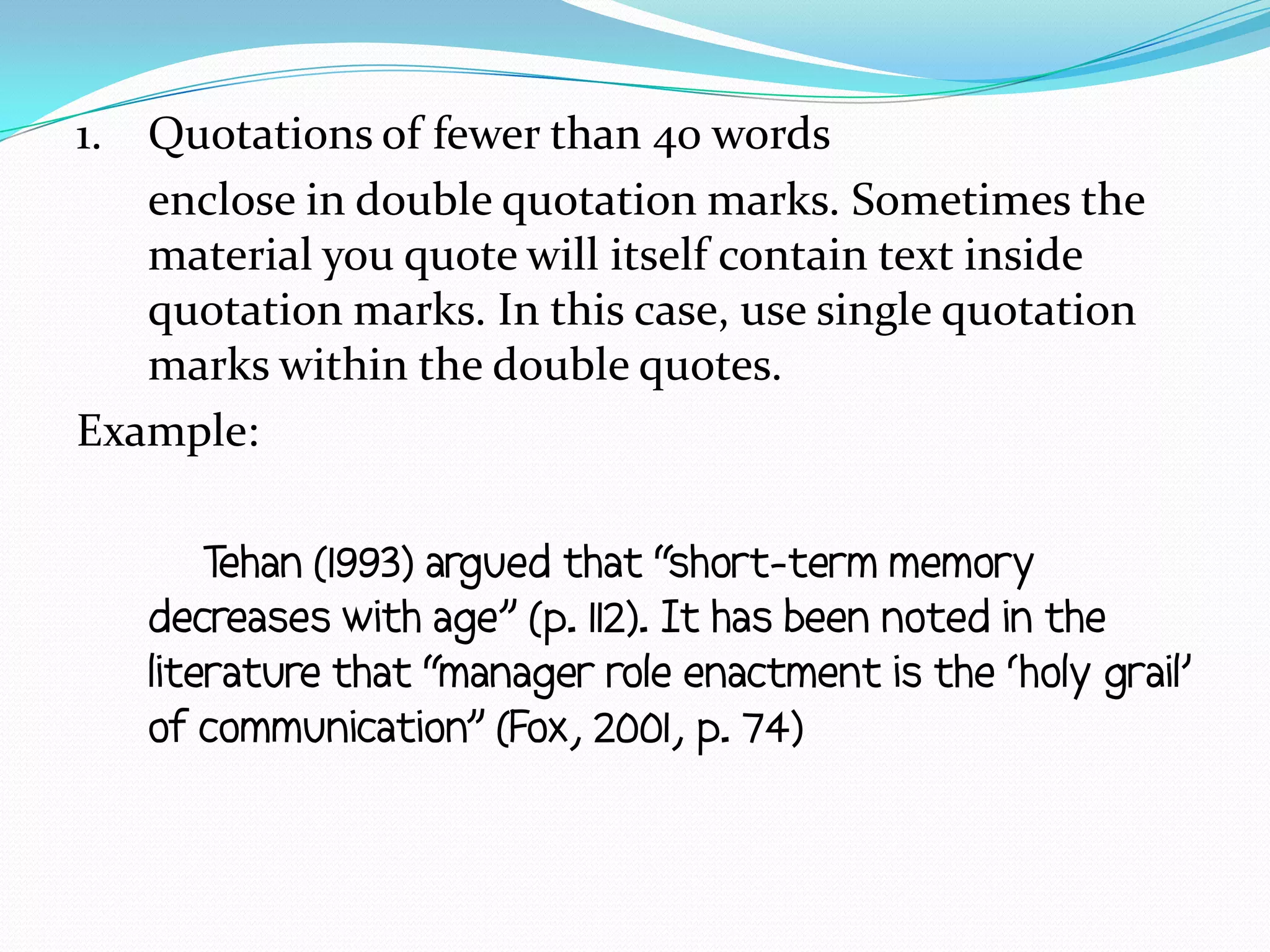
1. Quotations of fewer than 40 words
   enclose in double quotation marks. Sometimes the
   material you quote will itself contain text inside
   quotation marks. In this case, use single quotation
   marks within the double quotes.
Example:

       Tehan (1993) argued that “short-term memory
   decreases with age” (p. 112). It has been noted in the
   literature that “manager role enactment is the ‘holy grail’
   of communication” (Fox, 2001, p. 74)
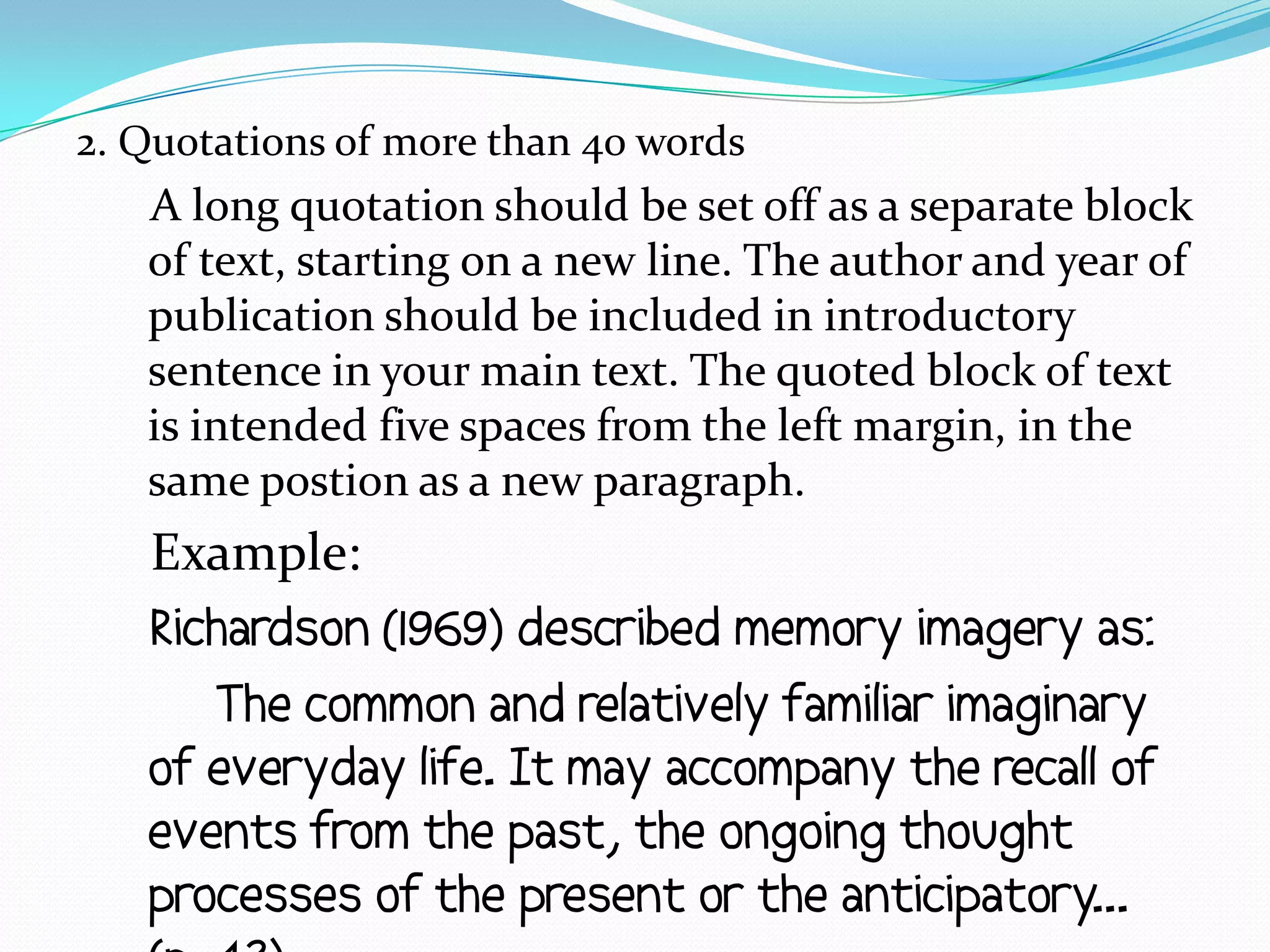
2. Quotations of more than 40 words
   A long quotation should be set off as a separate block
   of text, starting on a new line. The author and year of
   publication should be included in introductory
   sentence in your main text. The quoted block of text
   is intended five spaces from the left margin, in the
   same postion as a new paragraph.
   Example:
   Richardson (1969) described memory imagery as:
      The common and relatively familiar imaginary
   of everyday life. It may accompany the recall of
   events from the past, the ongoing thought
   processes of the present or the anticipatory...
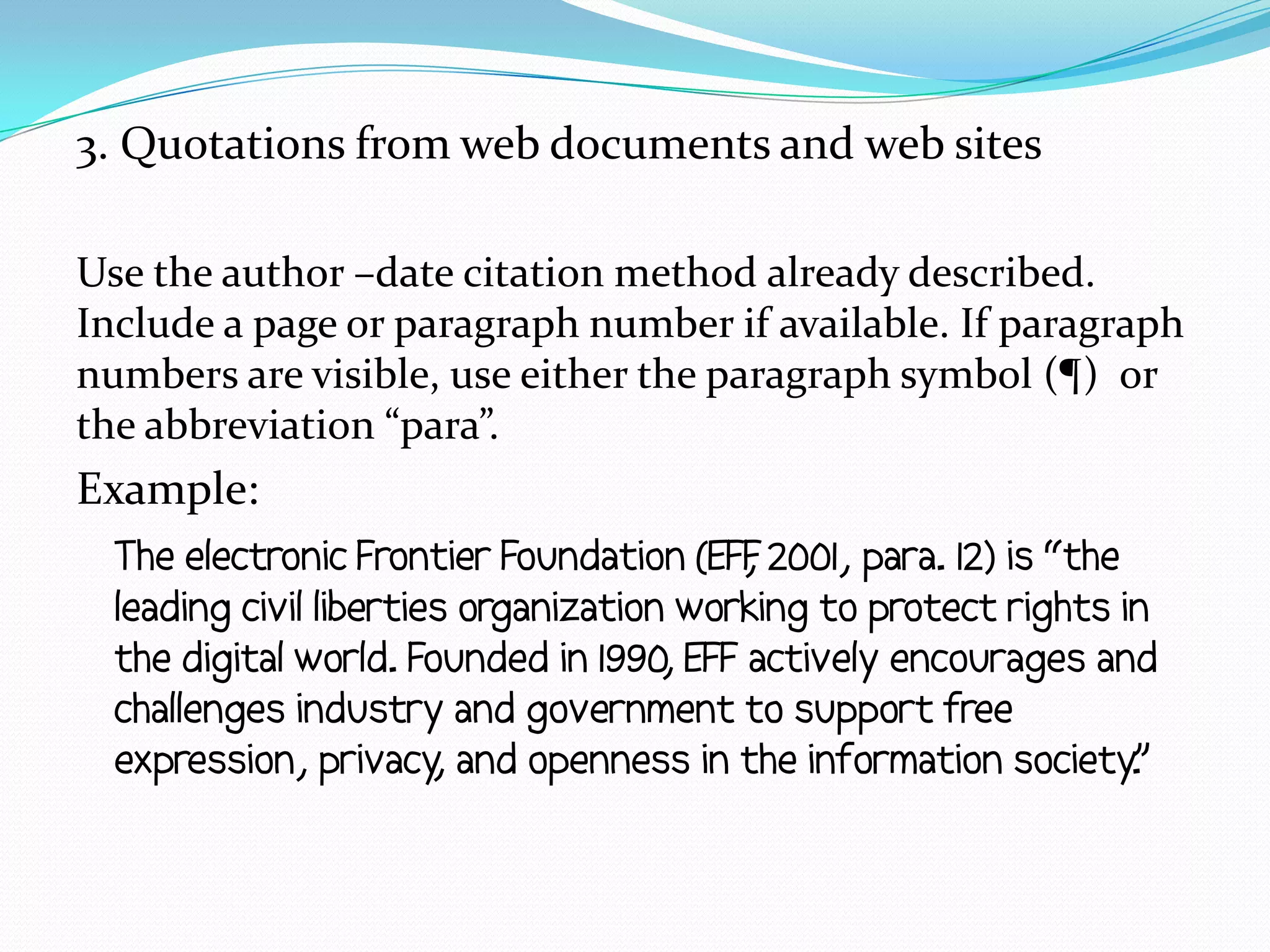
3. Quotations from web documents and web sites

Use the author –date citation method already described.
Include a page or paragraph number if available. If paragraph
numbers are visible, use either the paragraph symbol (¶) or
the abbreviation “para”.
Example:
  The electronic Frontier Foundation (EFF 2001, para. 12) is “the
                                          ,
  leading civil liberties organization working to protect rights in
  the digital world. Founded in 1990, EFF actively encourages and
  challenges industry and government to support free
  expression, privacy and openness in the information society.
                        ,                                         ”
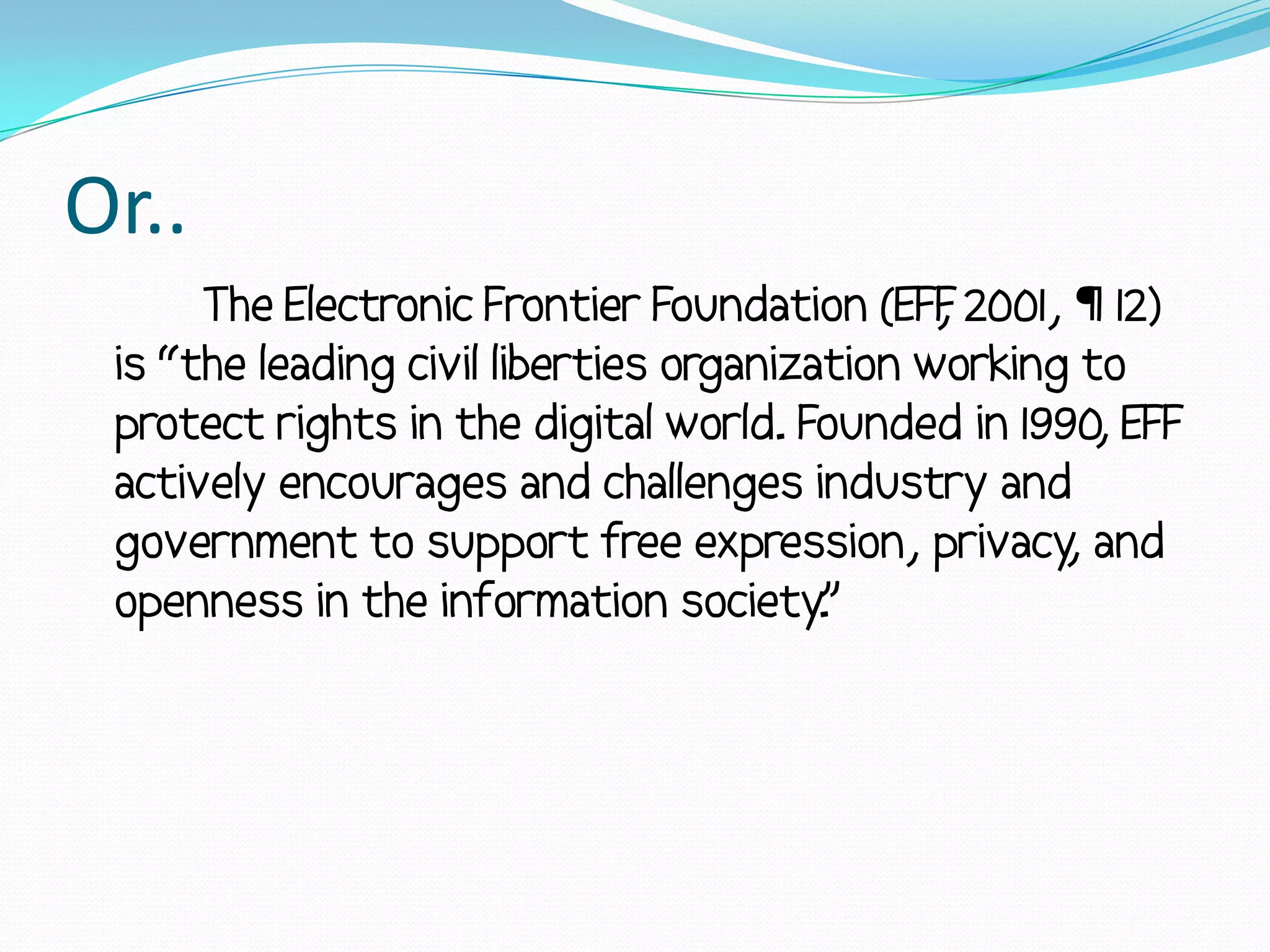
Or..
      The Electronic Frontier Foundation (EFF 2001, ¶ 12)
                                               ,
 is “the leading civil liberties organization working to
 protect rights in the digital world. Founded in 1990, EFF
 actively encourages and challenges industry and
 government to support free expression, privacy and  ,
 openness in the information society.    ”
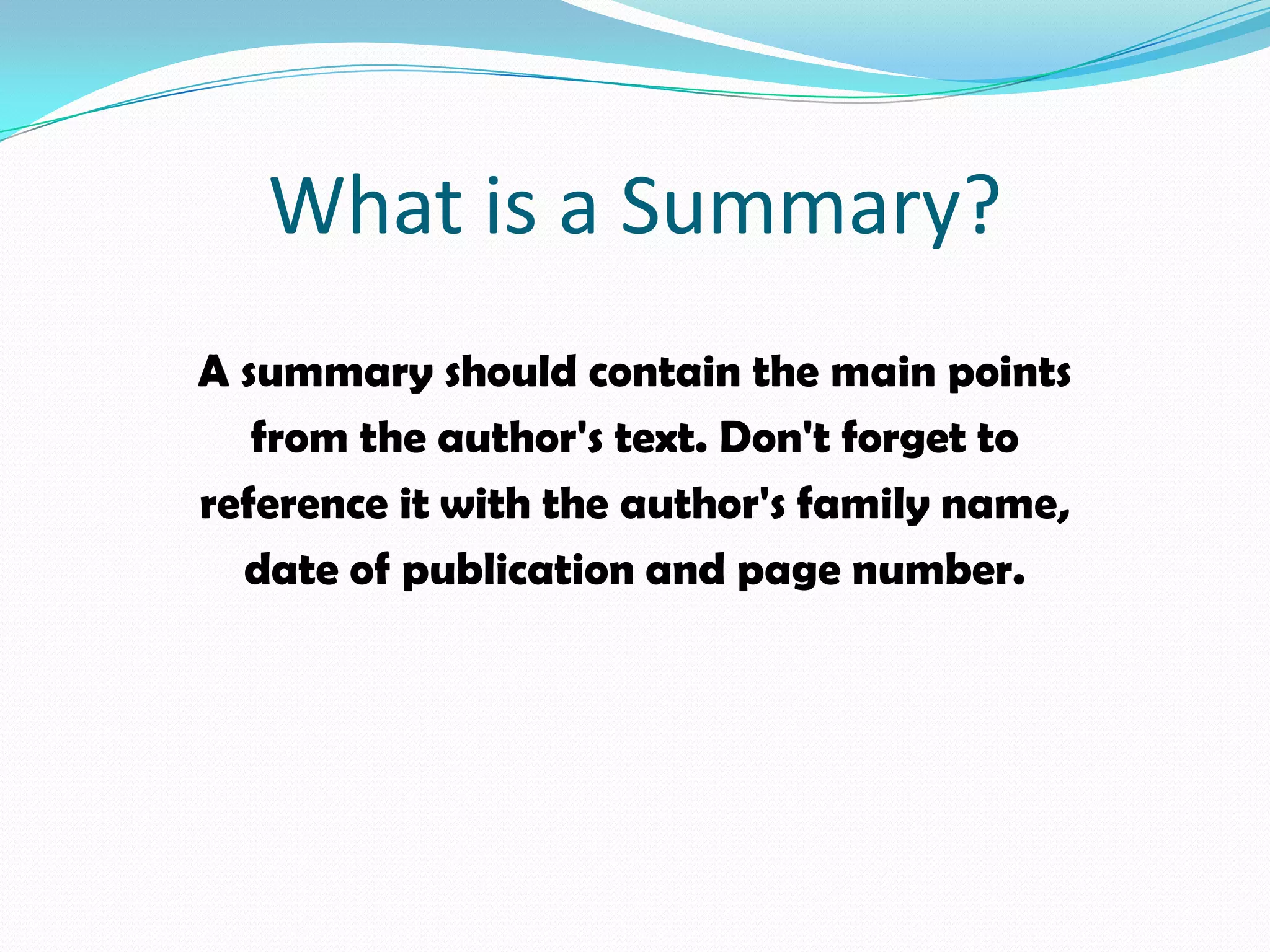
What is a Summary?
A summary should contain the main points
   from the author's text. Don't forget to
reference it with the author's family name,
  date of publication and page number.
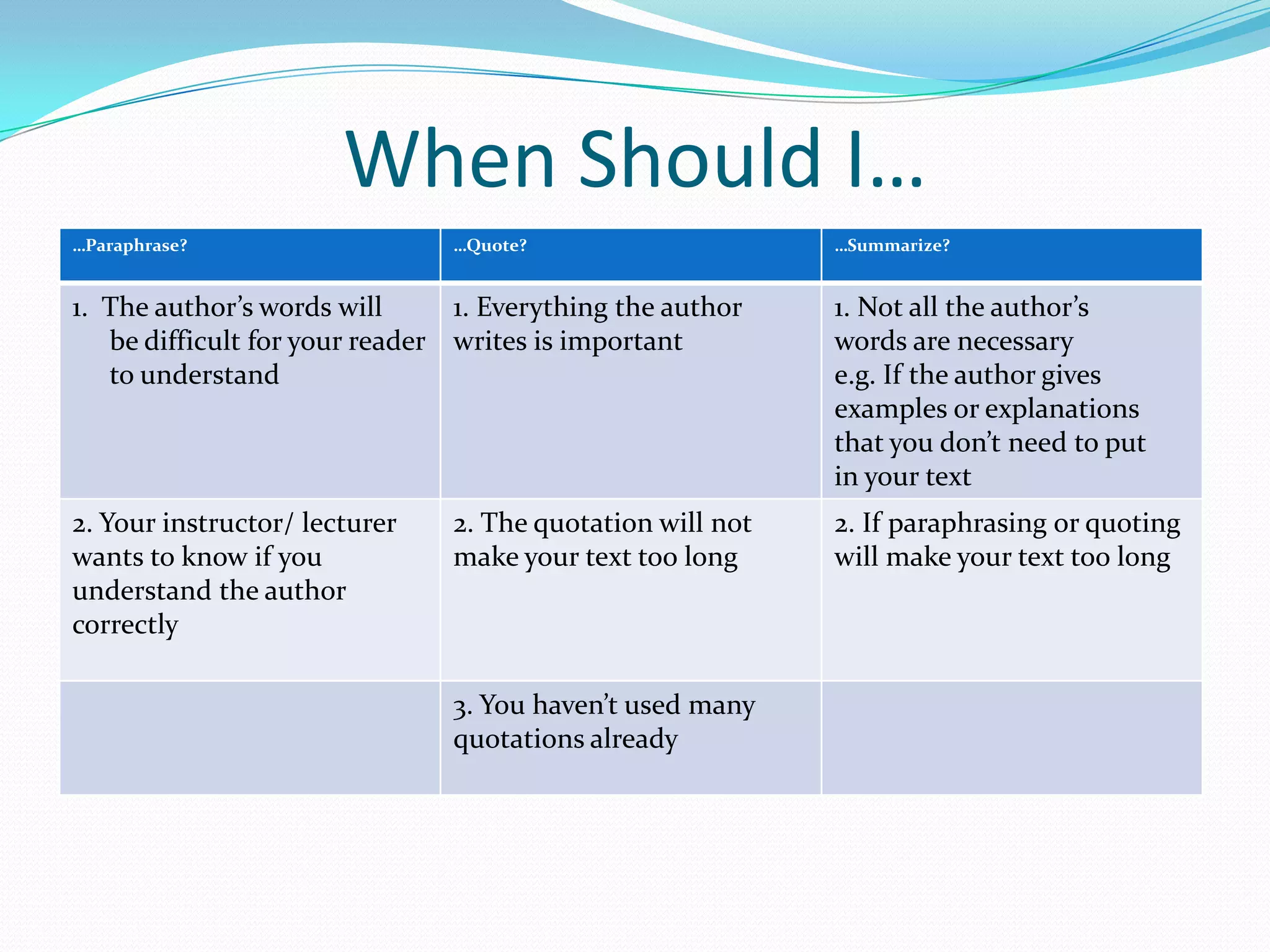
When Should I…
…Paraphrase?                   …Quote?                     …Summarize?


1. The author’s words will      1. Everything the author   1. Not all the author’s
   be difficult for your reader writes is important        words are necessary
   to understand                                           e.g. If the author gives
                                                           examples or explanations
                                                           that you don’t need to put
                                                           in your text
2. Your instructor/ lecturer   2. The quotation will not   2. If paraphrasing or quoting
wants to know if you           make your text too long     will make your text too long
understand the author
correctly

                               3. You haven’t used many
                               quotations already
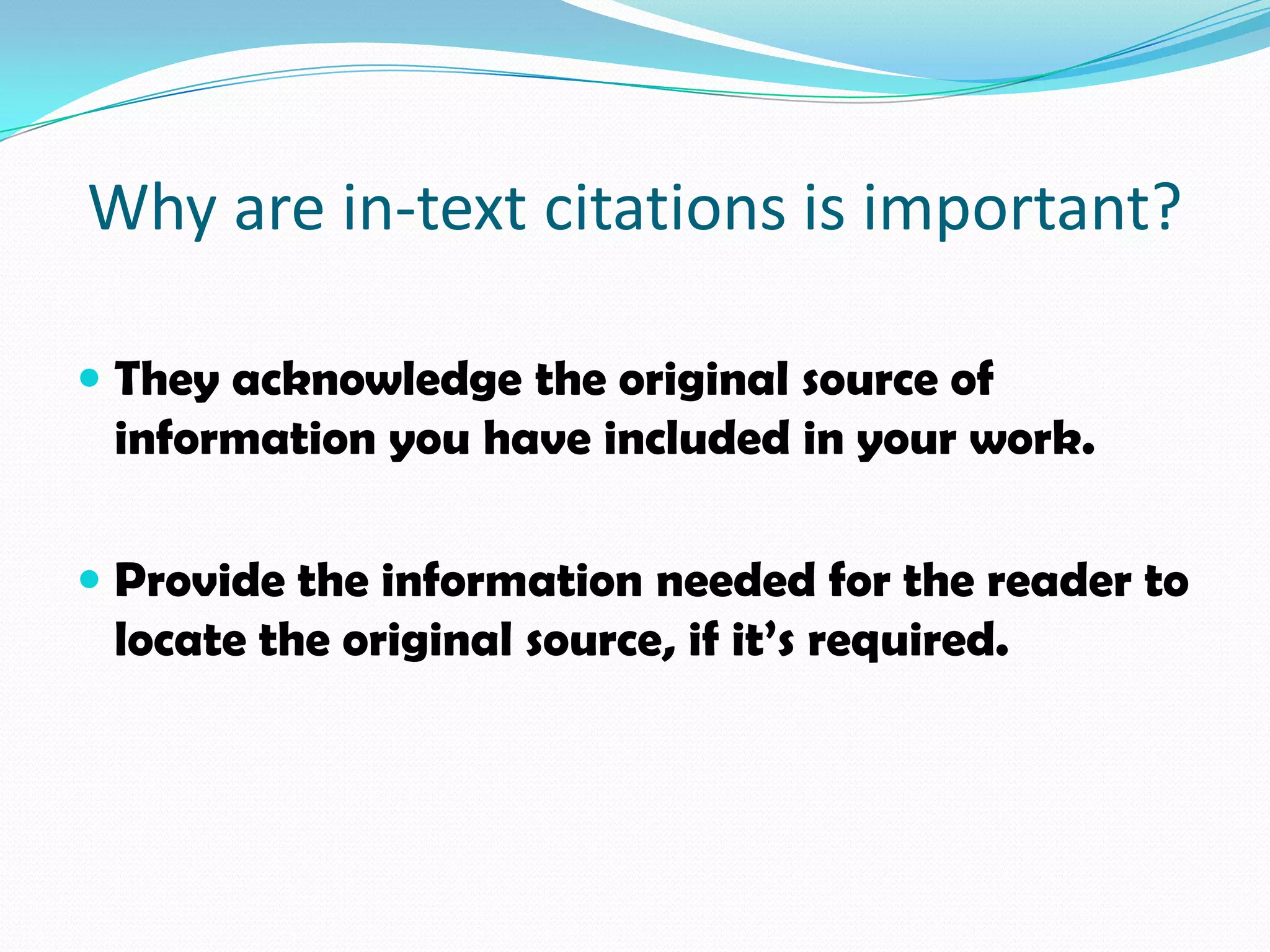
Common Knowledge
Things that are considered “common knowledge”
do not need to be cited.

Examples:
-Canadian Confederation began in the year 1867.
-John A. Macdonald was Canada’s first Prime
Minister.
-William Shakespeare was born in England in the
16th Century.
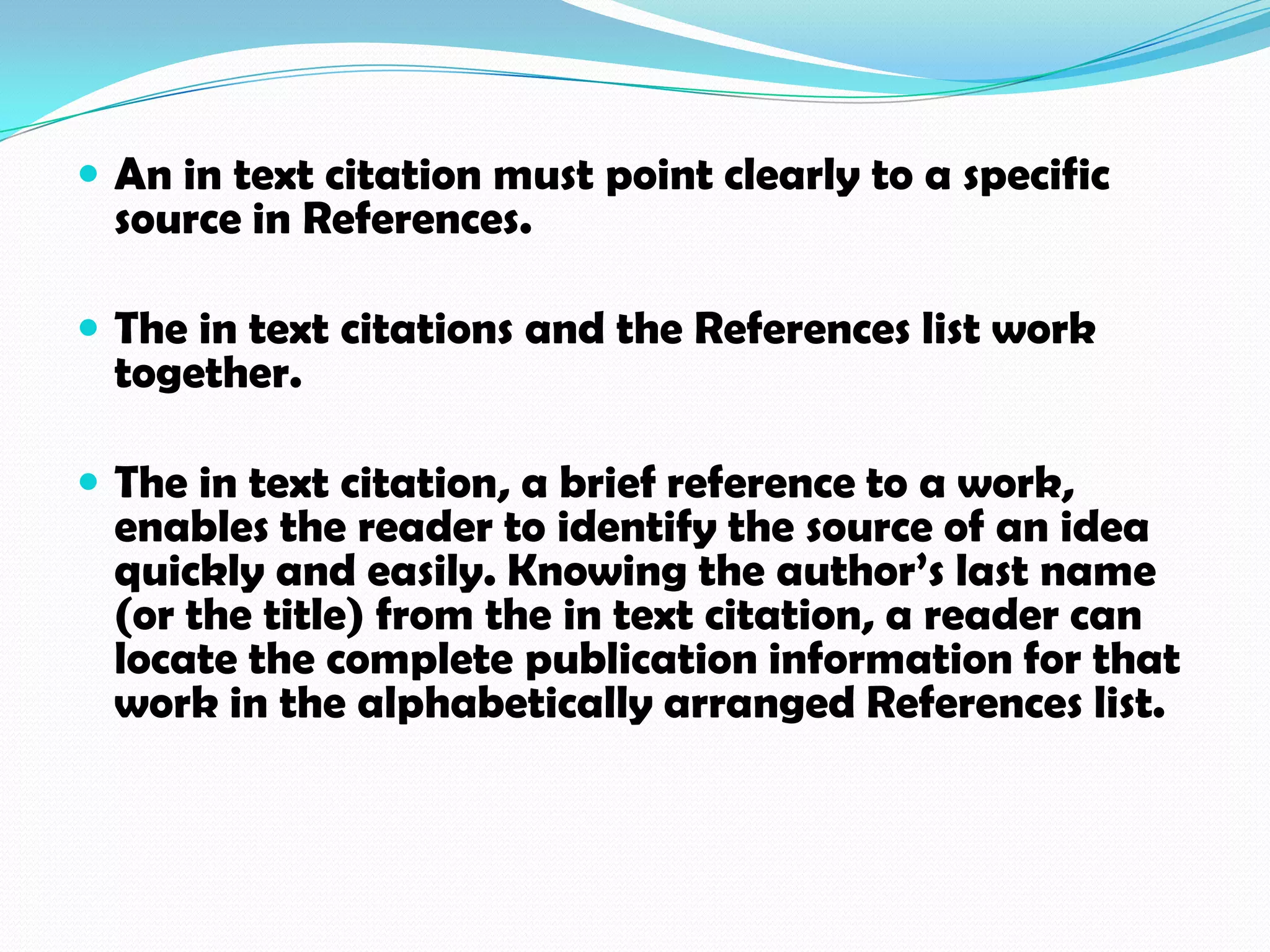
Why are in-text citations is important?

 They acknowledge the original source of
  information you have included in your work.

 Provide the information needed for the reader to
  locate the original source, if it’s required.
 An in text citation must point clearly to a specific
 source in References.

 The in text citations and the References list work
 together.

 The in text citation, a brief reference to a work,
 enables the reader to identify the source of an idea
 quickly and easily. Knowing the author’s last name
 (or the title) from the in text citation, a reader can
 locate the complete publication information for that
 work in the alphabetically arranged References list.
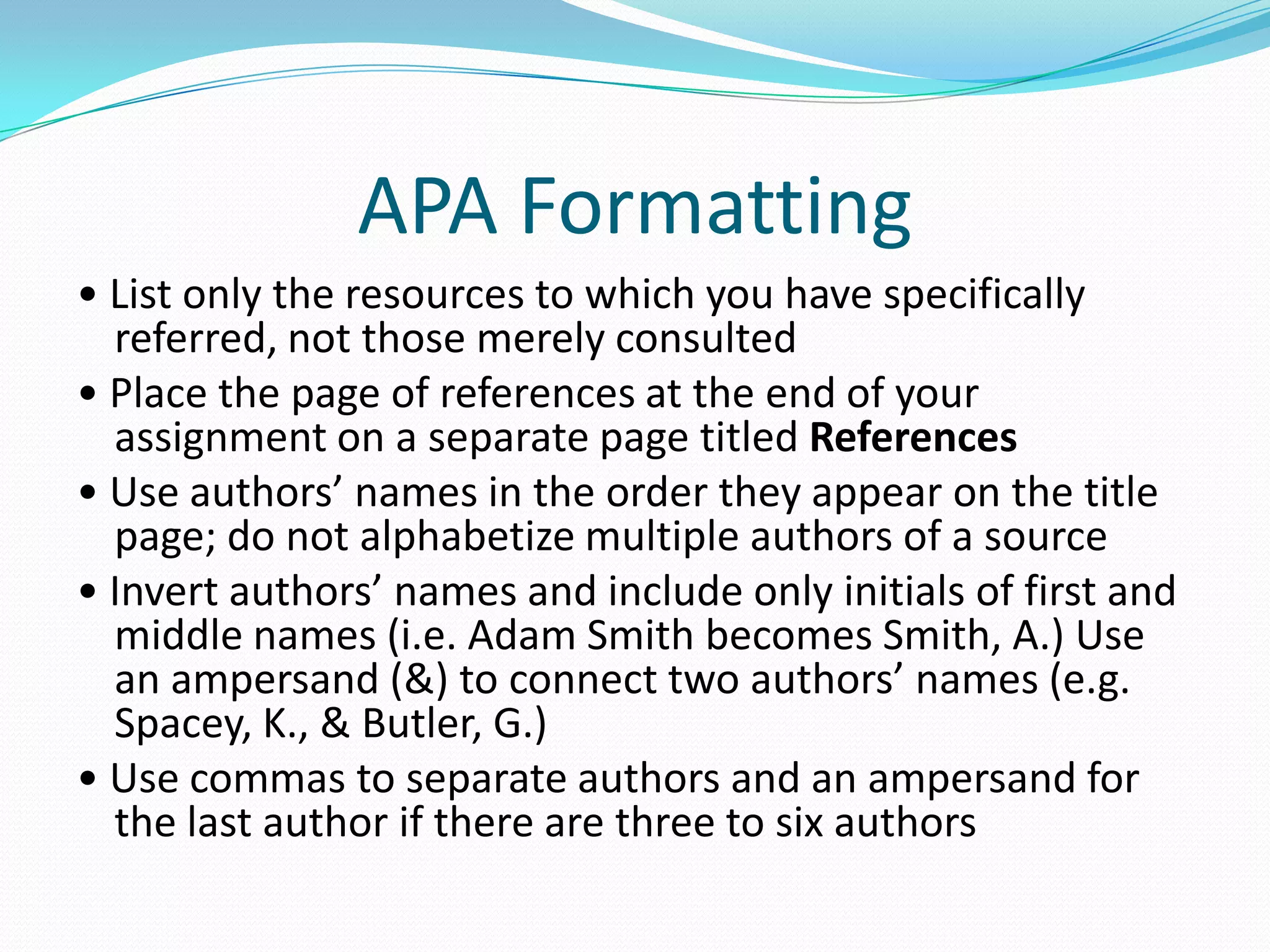
APA Formatting
• List only the resources to which you have specifically
  referred, not those merely consulted
• Place the page of references at the end of your
  assignment on a separate page titled References
• Use authors’ names in the order they appear on the title
  page; do not alphabetize multiple authors of a source
• Invert authors’ names and include only initials of first and
  middle names (i.e. Adam Smith becomes Smith, A.) Use
  an ampersand (&) to connect two authors’ names (e.g.
  Spacey, K., & Butler, G.)
• Use commas to separate authors and an ampersand for
  the last author if there are three to six authors
Formatting cont.
• List the first six authors and then et al. if there are more
  than six
• Begin the reference with the title of the work if no author
  is given
• Arrange the list alphabetically; if there is no author and
  the title begins with a, an, or the, alphabetize by the
  second word
• Begin each entry with a hanging indent (first line begins at
  the left margin and all other lines are indented ½ inch)
• Double space within and between entries in your list of
  references
• Capitalize only the first word in the title and the first word
  after a colon
 An in text citation must point clearly to a specific source
  in References.
 The in text citations and the References list work
  together.
 The in text citation, a brief reference to a work, enables
  the reader to identify the source of an idea quickly and
  easily. Knowing the author’s last name (or the title) from
  the in text citation, a reader can locate the complete
  publication information for that work in the
  alphabetically arranged References list.
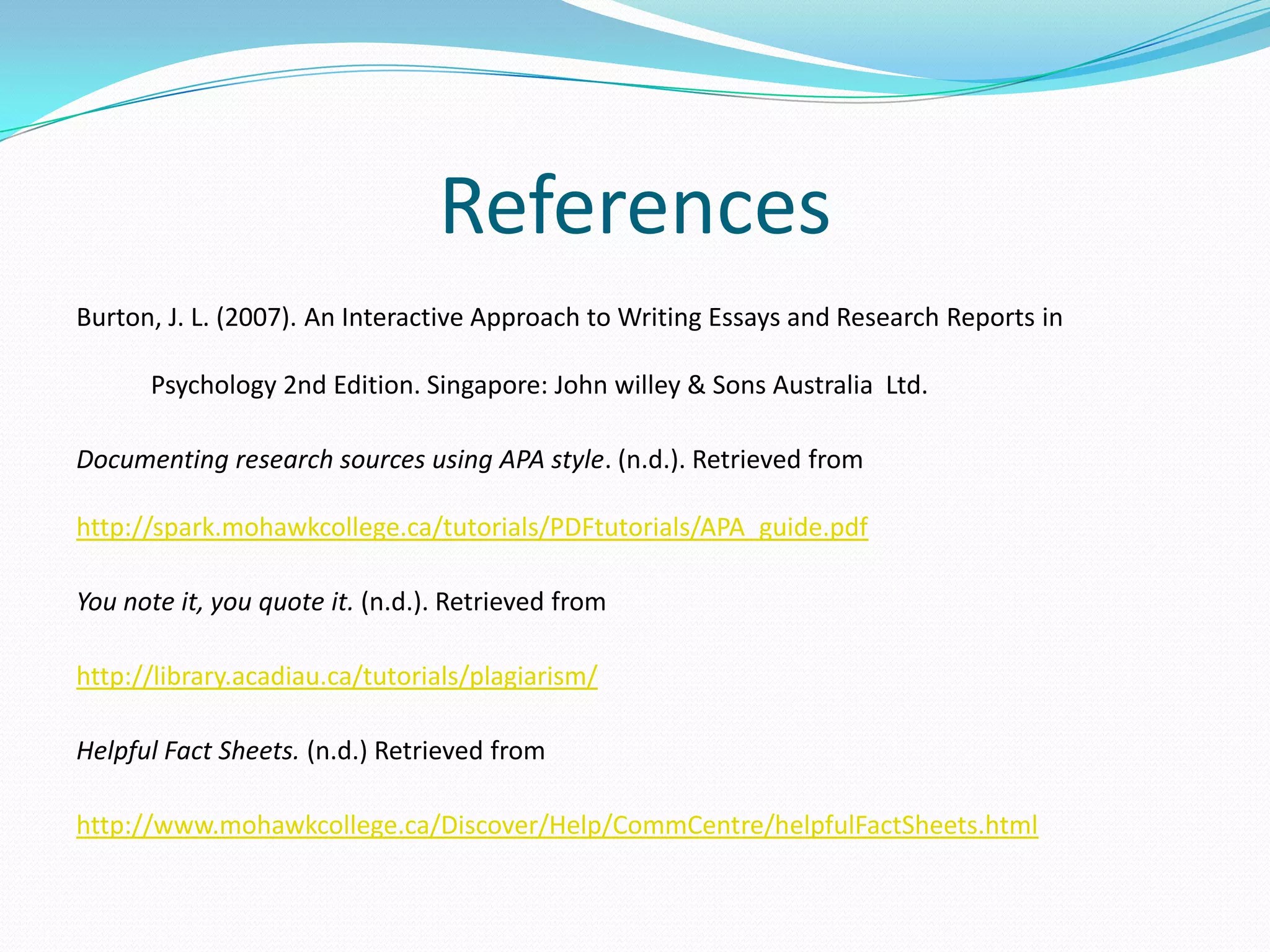
References
Burton, J. L. (2007). An Interactive Approach to Writing Essays and Research Reports in

      Psychology 2nd Edition. Singapore: John willey & Sons Australia Ltd.

Documenting research sources using APA style. (n.d.). Retrieved from

http://spark.mohawkcollege.ca/tutorials/PDFtutorials/APA_guide.pdf

You note it, you quote it. (n.d.). Retrieved from

http://library.acadiau.ca/tutorials/plagiarism/

Helpful Fact Sheets. (n.d.) Retrieved from

http://www.mohawkcollege.ca/Discover/Help/CommCentre/helpfulFactSheets.html

Apa citing, paraphrasing and quoting presentation

  • 2.
    Is This Plagiarism? Copying a direct quotation into your paper, placing quotation marks around it, and crediting the source. NO! This is not plagiarism.
  • 3.
    How About this? Takingsomeone’s ideas or words, putting them into your own words, and crediting the source. NO! This is not plagiarism. It’s Paraphrasing!
  • 5.
    What is paraphrasing Aparaphrase uses an author's idea, but expresses it in your own words, without the use of quotation marks. Just changing a few words from the original is plagiarism. Paraphrasing is permitted as long as you credit the source.
  • 6.
    Examples of Paraphrasing Theoriginal passage: Students frequently overuse direct quotation [when] taking notes, and as a result they overuse quotations in the final [research] paper. Probably only about 10% of your final manuscript should appear as directly quoted matter. Therefore, you should strive to limit the amount of exact transcribing of source materials while taking notes. Lester, James D. Writing Research Papers. 2nd ed. (1976): 46-47 A legitimate paraphrase: In research papers students often quote excessively, failing to keep quoted material down to a desirable level. Since the problem usually originates during note taking, it is essential to minimize the material recorded verbatim (Lester 46-47).
  • 7.
    Examples cont. An acceptablesummary: Students should take just a few notes in direct quotations from sources to help minimize the amount of quoted material in a research paper (Lester 46-47). A plagiarized version: Students often use too many direct quotations when they take notes, resulting in too many of them in the final research paper. In fact, probably only about 10% of the final copy should consist of directly quoted material. So it is important to limit the amount of source material copied while taking notes.
  • 8.
    The original passage: Studentsfrequently overuse direct quotation [when] taking notes, and as a result they overuse quotations in the final [research] paper. Probably only about 10% of your final manuscript should appear as directly quoted matter. Therefore, you should strive to limit the amount of exact transcribing of source materials while taking notes. Lester, James D. Writing Research Papers. 2nd ed. (1976): 46-47 A plagiarized version: Students often use too many direct quotations when they take notes, resulting in too many of them in the final research paper. In fact, probably only about 10% of the final copy should consist of directly quoted material. So it is important to limit the amount of source material copied while taking notes.
  • 9.
    What is Quoting? A quotation uses exactly the same words and puts them in quotation marks. - If the quotation is more than 2 lines you should put it in a separate paragraph and indent it from both sides. “Leprosy was eradicated in the west by the end of medieval times” (Foucault, 1999).
  • 10.
    1. Quotations offewer than 40 words enclose in double quotation marks. Sometimes the material you quote will itself contain text inside quotation marks. In this case, use single quotation marks within the double quotes. Example: Tehan (1993) argued that “short-term memory decreases with age” (p. 112). It has been noted in the literature that “manager role enactment is the ‘holy grail’ of communication” (Fox, 2001, p. 74)
  • 11.
    2. Quotations ofmore than 40 words A long quotation should be set off as a separate block of text, starting on a new line. The author and year of publication should be included in introductory sentence in your main text. The quoted block of text is intended five spaces from the left margin, in the same postion as a new paragraph. Example: Richardson (1969) described memory imagery as: The common and relatively familiar imaginary of everyday life. It may accompany the recall of events from the past, the ongoing thought processes of the present or the anticipatory...
  • 12.
    3. Quotations fromweb documents and web sites Use the author –date citation method already described. Include a page or paragraph number if available. If paragraph numbers are visible, use either the paragraph symbol (¶) or the abbreviation “para”. Example: The electronic Frontier Foundation (EFF 2001, para. 12) is “the , leading civil liberties organization working to protect rights in the digital world. Founded in 1990, EFF actively encourages and challenges industry and government to support free expression, privacy and openness in the information society. , ”
  • 13.
    Or.. The Electronic Frontier Foundation (EFF 2001, ¶ 12) , is “the leading civil liberties organization working to protect rights in the digital world. Founded in 1990, EFF actively encourages and challenges industry and government to support free expression, privacy and , openness in the information society. ”
  • 14.
    What is aSummary? A summary should contain the main points from the author's text. Don't forget to reference it with the author's family name, date of publication and page number.
  • 15.
    When Should I… …Paraphrase? …Quote? …Summarize? 1. The author’s words will 1. Everything the author 1. Not all the author’s be difficult for your reader writes is important words are necessary to understand e.g. If the author gives examples or explanations that you don’t need to put in your text 2. Your instructor/ lecturer 2. The quotation will not 2. If paraphrasing or quoting wants to know if you make your text too long will make your text too long understand the author correctly 3. You haven’t used many quotations already
  • 16.
    Common Knowledge Things thatare considered “common knowledge” do not need to be cited. Examples: -Canadian Confederation began in the year 1867. -John A. Macdonald was Canada’s first Prime Minister. -William Shakespeare was born in England in the 16th Century.
  • 17.
    Why are in-textcitations is important?  They acknowledge the original source of information you have included in your work.  Provide the information needed for the reader to locate the original source, if it’s required.
  • 18.
     An intext citation must point clearly to a specific source in References.  The in text citations and the References list work together.  The in text citation, a brief reference to a work, enables the reader to identify the source of an idea quickly and easily. Knowing the author’s last name (or the title) from the in text citation, a reader can locate the complete publication information for that work in the alphabetically arranged References list.
  • 19.
    APA Formatting • Listonly the resources to which you have specifically referred, not those merely consulted • Place the page of references at the end of your assignment on a separate page titled References • Use authors’ names in the order they appear on the title page; do not alphabetize multiple authors of a source • Invert authors’ names and include only initials of first and middle names (i.e. Adam Smith becomes Smith, A.) Use an ampersand (&) to connect two authors’ names (e.g. Spacey, K., & Butler, G.) • Use commas to separate authors and an ampersand for the last author if there are three to six authors
  • 20.
    Formatting cont. • Listthe first six authors and then et al. if there are more than six • Begin the reference with the title of the work if no author is given • Arrange the list alphabetically; if there is no author and the title begins with a, an, or the, alphabetize by the second word • Begin each entry with a hanging indent (first line begins at the left margin and all other lines are indented ½ inch) • Double space within and between entries in your list of references • Capitalize only the first word in the title and the first word after a colon
  • 21.
     An intext citation must point clearly to a specific source in References.  The in text citations and the References list work together.  The in text citation, a brief reference to a work, enables the reader to identify the source of an idea quickly and easily. Knowing the author’s last name (or the title) from the in text citation, a reader can locate the complete publication information for that work in the alphabetically arranged References list.
  • 22.
    References Burton, J. L.(2007). An Interactive Approach to Writing Essays and Research Reports in Psychology 2nd Edition. Singapore: John willey & Sons Australia Ltd. Documenting research sources using APA style. (n.d.). Retrieved from http://spark.mohawkcollege.ca/tutorials/PDFtutorials/APA_guide.pdf You note it, you quote it. (n.d.). Retrieved from http://library.acadiau.ca/tutorials/plagiarism/ Helpful Fact Sheets. (n.d.) Retrieved from http://www.mohawkcollege.ca/Discover/Help/CommCentre/helpfulFactSheets.html