CITATION PRACTICES WHY? WRITERS OR RESEARCHERS JOB: TO GET THE FACTS RIGHT TO TELL READERS WHERE THE FACTS C O ME FROM (Turabian 2007, 123)
FOUR REASONS FOR CITING YOUR SOURCES (Turabian 2007, 123-124): TO GIVE CREDIT. (REWARDING OWNERS OF SOURCES) TO ASSURE READERS ABOUT ACCURACY OF YOUR FACTS. (EARNING READERS’  TRUST) TO SHOW READERS THE REASERCH TRADITION THAT INFORMS YOUR WORK ( USING FACTS WHICH MIGHT SUPPORT, CONTRADICT, CORRECT, EXTEND). TO HELP READERS FOLLOW OR EXTEND YOUR RESEARCH (PERSUING OTHERS TO FOLLOW STEPS).
OTHER REASONS To indicate how the ideas in the paper are related to the work of others.  To avoid being a guilty of plagiarism (stealing and using the ideas or writings of another person as one’s own). Thus, Acknowledge in citations when ideas and language are taken from other writers.
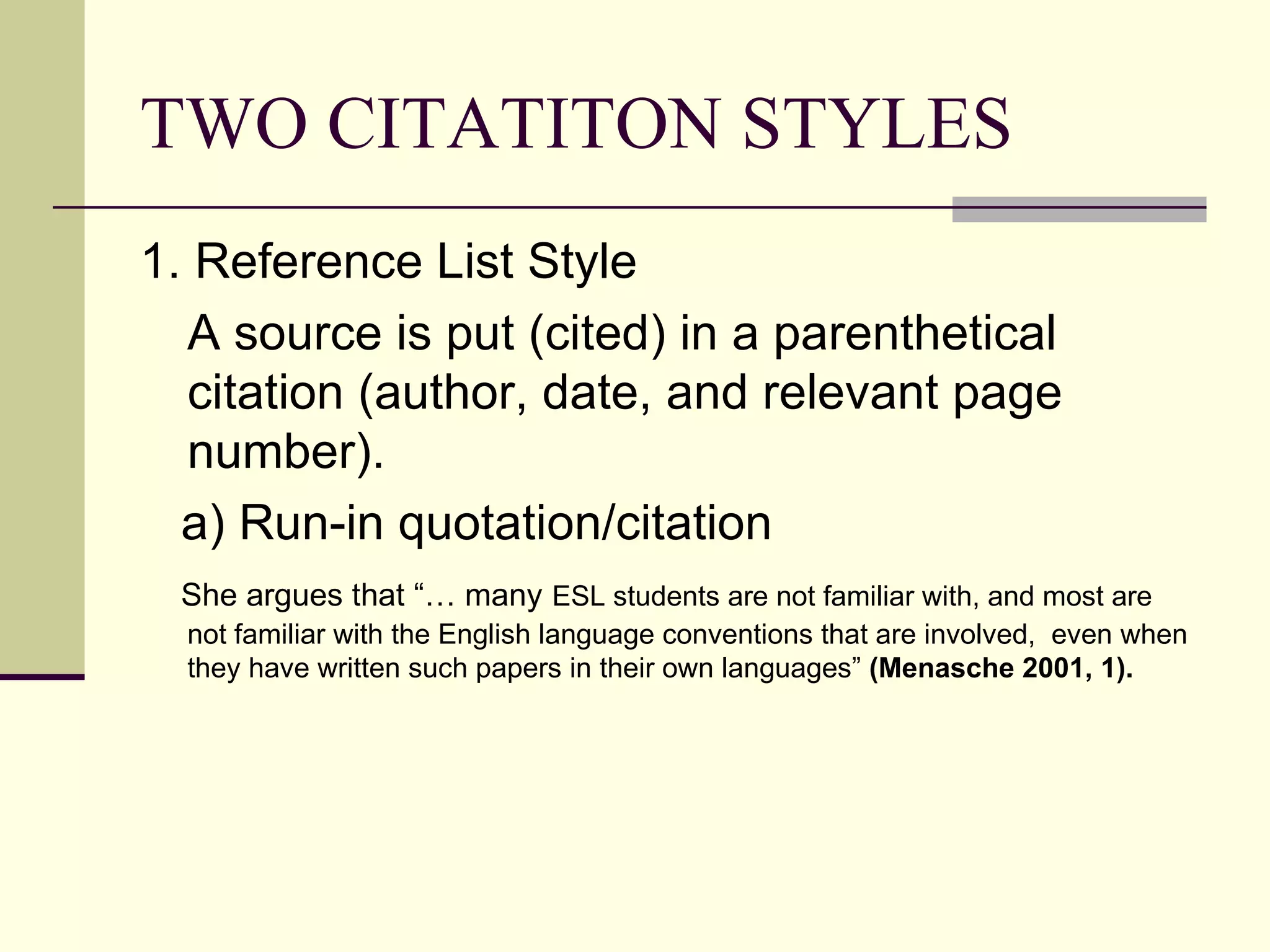
TWO CITATITON STYLES 1. Reference List Style A source is put (cited) in a parenthetical  citation (author, date, and relevant page number). a) Run-in quotation/citation She argues that “… many   ESL students are not familiar with, and most are not familiar with the English language conventions that are involved,  even when they have written such papers in their own languages”  (Menasche 2001, 1).
b) Block quotation/citation Writing academic genre in English is not easy for many ESL students.  Menasche (2001, 1)  states: It is an activity that many ESL students are not familiar with,  and most are not familiar with the English language  conventions that are involved,  even when they have written  such papers in their own languages. All this unfamiliar with  the English causes anxiety and stress in students beginning  program in which many such papers will be demanded of  them.
REFERENCE LIST References Menasche, Lionel. 2001.  Writing research paper . 2 nd  ed. Michigan: Michigan  Press.
2. Bibliography Style A source is cited by placing a superscript number at the end of the sentence (sometime after author name). a) Run-in quotation/citation Menache  argues that “… many ESL students are not familiar with, and most are not familiar with the English language conventions that are involved,  even when they have written such papers in their own languages.” 1
b) Block quotation/citation Writing academic genre in English is not easy for many ESL students.  Menasche  states: It is an activity that many ESL students are not familiar with,  and most are not familiar with the English language  conventions that are involved,  even when they have written  such papers in their own languages. All this unfamiliar with  the English causes anxiety and stress in students beginning  program in which many such papers will be demanded of  them. 1
Then cite the source (author, title, facts of publication, and relevant page number). Author   first name, last name Facts of publication   town, publisher,  date/year) The source is noted at the bottom of the page (footnotes) or in a list at the end of a paper (endnotes).
Footnotes 1 Lionel Menasche,  Writing a Research Paper . 2 nd  ed. (Michigan: Michigan Press, 2001),1.  Bibliography  Menasche, Lionel.  Writing a Research  Paper . 2 nd  ed. Michigan: Michigan  Press, 2001.
Reference List and Bibliography List Reference Vs. Bibliography a)  Use capitals at the beginning of the titles, sub-titles or names b) Place the date or year of publication R: Johns, Andrian. 1998.  The nature of the book: Print and  knowledge in the making . Chicago: Univ. of Chicago Press.  B:    Johns, Andrian.  The Nature of the Book: Print and  Knowledge in the Making . Chicago: Univ. of Chicago Press, 1998.
Reference  and  Bibliography Both R and B cover every source the writer/researcher cited in a note and sometimes others he or she consulted but did not cite.  Note: In articles, very often the writer only cites sources which are cited in a note.

Citation practices

  • 1.
    CITATION PRACTICES WHY?WRITERS OR RESEARCHERS JOB: TO GET THE FACTS RIGHT TO TELL READERS WHERE THE FACTS C O ME FROM (Turabian 2007, 123)
  • 2.
    FOUR REASONS FORCITING YOUR SOURCES (Turabian 2007, 123-124): TO GIVE CREDIT. (REWARDING OWNERS OF SOURCES) TO ASSURE READERS ABOUT ACCURACY OF YOUR FACTS. (EARNING READERS’ TRUST) TO SHOW READERS THE REASERCH TRADITION THAT INFORMS YOUR WORK ( USING FACTS WHICH MIGHT SUPPORT, CONTRADICT, CORRECT, EXTEND). TO HELP READERS FOLLOW OR EXTEND YOUR RESEARCH (PERSUING OTHERS TO FOLLOW STEPS).
  • 3.
    OTHER REASONS Toindicate how the ideas in the paper are related to the work of others. To avoid being a guilty of plagiarism (stealing and using the ideas or writings of another person as one’s own). Thus, Acknowledge in citations when ideas and language are taken from other writers.
  • 4.
    TWO CITATITON STYLES1. Reference List Style A source is put (cited) in a parenthetical citation (author, date, and relevant page number). a) Run-in quotation/citation She argues that “… many ESL students are not familiar with, and most are not familiar with the English language conventions that are involved, even when they have written such papers in their own languages” (Menasche 2001, 1).
  • 5.
    b) Block quotation/citationWriting academic genre in English is not easy for many ESL students. Menasche (2001, 1) states: It is an activity that many ESL students are not familiar with, and most are not familiar with the English language conventions that are involved, even when they have written such papers in their own languages. All this unfamiliar with the English causes anxiety and stress in students beginning program in which many such papers will be demanded of them.
  • 6.
    REFERENCE LIST ReferencesMenasche, Lionel. 2001. Writing research paper . 2 nd ed. Michigan: Michigan Press.
  • 7.
    2. Bibliography StyleA source is cited by placing a superscript number at the end of the sentence (sometime after author name). a) Run-in quotation/citation Menache argues that “… many ESL students are not familiar with, and most are not familiar with the English language conventions that are involved, even when they have written such papers in their own languages.” 1
  • 8.
    b) Block quotation/citationWriting academic genre in English is not easy for many ESL students. Menasche states: It is an activity that many ESL students are not familiar with, and most are not familiar with the English language conventions that are involved, even when they have written such papers in their own languages. All this unfamiliar with the English causes anxiety and stress in students beginning program in which many such papers will be demanded of them. 1
  • 9.
    Then cite thesource (author, title, facts of publication, and relevant page number). Author  first name, last name Facts of publication  town, publisher, date/year) The source is noted at the bottom of the page (footnotes) or in a list at the end of a paper (endnotes).
  • 10.
    Footnotes 1 LionelMenasche, Writing a Research Paper . 2 nd ed. (Michigan: Michigan Press, 2001),1. Bibliography Menasche, Lionel. Writing a Research Paper . 2 nd ed. Michigan: Michigan Press, 2001.
  • 11.
    Reference List andBibliography List Reference Vs. Bibliography a) Use capitals at the beginning of the titles, sub-titles or names b) Place the date or year of publication R: Johns, Andrian. 1998. The nature of the book: Print and knowledge in the making . Chicago: Univ. of Chicago Press. B: Johns, Andrian. The Nature of the Book: Print and Knowledge in the Making . Chicago: Univ. of Chicago Press, 1998.
  • 12.
    Reference and Bibliography Both R and B cover every source the writer/researcher cited in a note and sometimes others he or she consulted but did not cite. Note: In articles, very often the writer only cites sources which are cited in a note.