Derivatives Basic Concept Arihant Bhansali Neha Singhi & Company Mob+919831407321 Email: arihant@nehasinghi.com
Introduction Secondary market contributes significantly to the Indian financial market
Expansion- Variety of financial instruments vis-a-vis Scale of operations
Derivatives-a financial product becoming increasingly popular
Exchange traded financial derivatives were introduced in India in June 2000 at the two major stock exchanges, NSE and BSE
Derivative is…. A derivative is a financial instrument, whose value depends on the value of basic underlying variable
The value of derivative is linked to risk or volatility in either financial asset, transaction, market rate, or contingency, and creates a product
Underlying Assets T-Bill Interest Rates Index & Bonds Foreign Exchange Rate Crude Oil Precious Metals Agri Commodities Stocks
Features of Derivatives Traded on exchange
No compulsory physical trading of underlying assets
All transactions in derivatives take place in future specific date
Hedging Device-Reduces risk
Derivatives has low transaction cost
Derivatives are often leveraged, such that a small movement in the underlying value can cause a large difference in the value of the derivative.
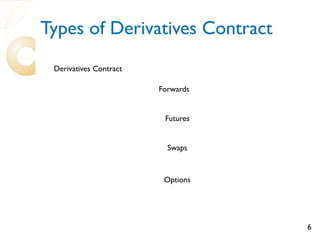
Types of Derivatives Contract Derivatives Contract Forwards Futures Swaps Options
Forwards A forward contract is a customized contract between two entities, where settlement takes place as a specific date in the future at predetermined price. Ex:  On 10th Novem,  Ram enters into an agreement to buy 100 kgs of wheat on 1st  May at Rs.10000 from Shyam, a farmer.  It is a case of a forward contract where Ram has to pay Rs.10000 on 1st May to Shyam and Shyam has to supply 100 kgs of wheat. Ram has taken a long position assuming the price of the wheat will rise in the future six months . Normally traded outside exchange
Futures A financial contract obligating the buyer to purchase an asset, (or the seller to sell an asset), such as a physical commodity or a financial instrument, at a predetermined future date and price.
Futures contracts detail the quality and quantity of the underlying asset; they are standardized to facilitate trading on a futures exchange.
Some futures contracts may call for physical delivery of the asset, while others are settled in cash. The futures markets are characterized by the ability to use very high leverage relative to stock markets.
Some of the most popular assets on which futures contracts are available are equity stocks, indices, commodities and currency.
Swaps   Swaps are private agreement between two parties to exchange cash flows in the future according to a pre-arranged formula.
They can be regarded as portfolio of forward contracts.
The two commonly used Swaps are- i)  Interest Rate Swaps:  -  A interest rate swap entails swapping only the interest related cash flows between the parties in the same currency. ii)  Currency Swaps:  -  A currency swap is a foreign exchange agreement between two parties to exchange a given amount of one currency for another and after a specified period of time, to give back the original amount swapped.

Derivatives basic concept

  • 1.
    Derivatives Basic ConceptArihant Bhansali Neha Singhi & Company Mob+919831407321 Email: arihant@nehasinghi.com
  • 2.
    Introduction Secondary marketcontributes significantly to the Indian financial market
  • 3.
    Expansion- Variety offinancial instruments vis-a-vis Scale of operations
  • 4.
    Derivatives-a financial productbecoming increasingly popular
  • 5.
    Exchange traded financialderivatives were introduced in India in June 2000 at the two major stock exchanges, NSE and BSE
  • 6.
    Derivative is…. Aderivative is a financial instrument, whose value depends on the value of basic underlying variable
  • 7.
    The value ofderivative is linked to risk or volatility in either financial asset, transaction, market rate, or contingency, and creates a product
  • 8.
    Underlying Assets T-BillInterest Rates Index & Bonds Foreign Exchange Rate Crude Oil Precious Metals Agri Commodities Stocks
  • 9.
    Features of DerivativesTraded on exchange
  • 10.
    No compulsory physicaltrading of underlying assets
  • 11.
    All transactions inderivatives take place in future specific date
  • 12.
  • 13.
    Derivatives has lowtransaction cost
  • 14.
    Derivatives are oftenleveraged, such that a small movement in the underlying value can cause a large difference in the value of the derivative.
  • 15.
    Types of DerivativesContract Derivatives Contract Forwards Futures Swaps Options
  • 16.
    Forwards A forwardcontract is a customized contract between two entities, where settlement takes place as a specific date in the future at predetermined price. Ex: On 10th Novem, Ram enters into an agreement to buy 100 kgs of wheat on 1st May at Rs.10000 from Shyam, a farmer. It is a case of a forward contract where Ram has to pay Rs.10000 on 1st May to Shyam and Shyam has to supply 100 kgs of wheat. Ram has taken a long position assuming the price of the wheat will rise in the future six months . Normally traded outside exchange
  • 17.
    Futures A financialcontract obligating the buyer to purchase an asset, (or the seller to sell an asset), such as a physical commodity or a financial instrument, at a predetermined future date and price.
  • 18.
    Futures contracts detailthe quality and quantity of the underlying asset; they are standardized to facilitate trading on a futures exchange.
  • 19.
    Some futures contractsmay call for physical delivery of the asset, while others are settled in cash. The futures markets are characterized by the ability to use very high leverage relative to stock markets.
  • 20.
    Some of themost popular assets on which futures contracts are available are equity stocks, indices, commodities and currency.
  • 21.
    Swaps Swaps are private agreement between two parties to exchange cash flows in the future according to a pre-arranged formula.
  • 22.
    They can beregarded as portfolio of forward contracts.
  • 23.
    The two commonlyused Swaps are- i) Interest Rate Swaps: - A interest rate swap entails swapping only the interest related cash flows between the parties in the same currency. ii) Currency Swaps: - A currency swap is a foreign exchange agreement between two parties to exchange a given amount of one currency for another and after a specified period of time, to give back the original amount swapped.