Objective
The student will be able to:
solve systems of equations using
elimination with multiplication.
Solving Systems of Equations
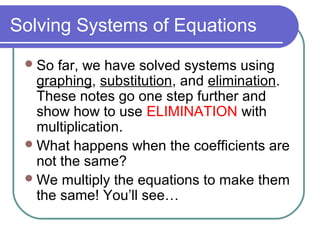
So far, we have solved systems using
graphing, substitution, and elimination.
These notes go one step further and
show how to use ELIMINATION with
multiplication.
What happens when the coefficients are
not the same?
We multiply the equations to make them
the same! You’ll see…
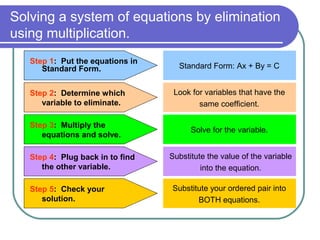
Solving a system of equations by elimination
using multiplication.
Step 1: Put the equations in
Standard Form.
Step 2: Determine which
variable to eliminate.
Step 3: Multiply the
equations and solve.
Step 4: Plug back in to find
the other variable.
Step 5: Check your
solution.
Standard Form: Ax + By = C
Look for variables that have the
same coefficient.
Solve for the variable.
Substitute the value of the variable
into the equation.
Substitute your ordered pair into
BOTH equations.
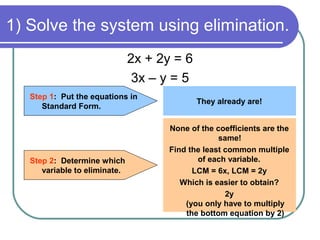
1) Solve the system using elimination.
2x + 2y = 6
3x – y = 5
Step 1: Put the equations in
Standard Form.
Step 2: Determine which
variable to eliminate.
They already are!
None of the coefficients are the
same!
Find the least common multiple
of each variable.
LCM = 6x, LCM = 2y
Which is easier to obtain?
2y
(you only have to multiply
the bottom equation by 2)
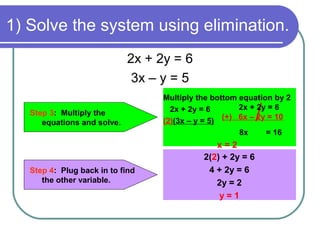
1) Solve the system using elimination.
Step 4: Plug back in to find
the other variable.
2(2) + 2y = 6
4 + 2y = 6
2y = 2
y = 1
2x + 2y = 6
3x – y = 5
Step 3: Multiply the
equations and solve.
Multiply the bottom equation by 2
2x + 2y = 6
(2)(3x – y = 5)
8x = 16
x = 2
2x + 2y = 6
(+) 6x – 2y = 10
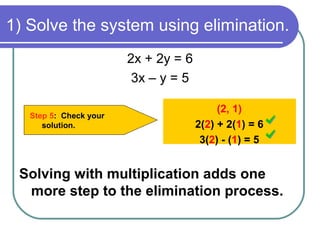
1) Solve the system using elimination.
Step 5: Check your
solution.
(2, 1)
2(2) + 2(1) = 6
3(2) - (1) = 5
2x + 2y = 6
3x – y = 5
Solving with multiplication adds one
more step to the elimination process.
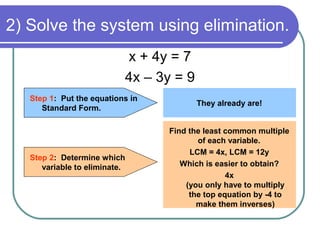
2) Solve the system using elimination.
x + 4y = 7
4x – 3y = 9
Step 1: Put the equations in
Standard Form.
They already are!
Step 2: Determine which
variable to eliminate.
Find the least common multiple
of each variable.
LCM = 4x, LCM = 12y
Which is easier to obtain?
4x
(you only have to multiply
the top equation by -4 to
make them inverses)
2) Solve the system using elimination.
x + 4y = 7
4x – 3y = 9
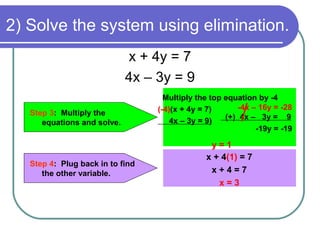
Step 4: Plug back in to find
the other variable.
x + 4(1) = 7
x + 4 = 7
x = 3
Step 3: Multiply the
equations and solve.
Multiply the top equation by -4
(-4)(x + 4y = 7)
4x – 3y = 9)
y = 1
-4x – 16y = -28
(+) 4x – 3y = 9
-19y = -19
2) Solve the system using elimination.
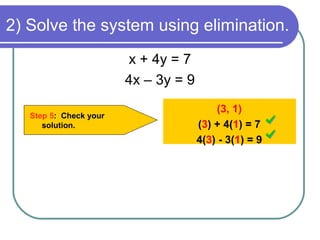
Step 5: Check your
solution.
(3, 1)
(3) + 4(1) = 7
4(3) - 3(1) = 9
x + 4y = 7
4x – 3y = 9
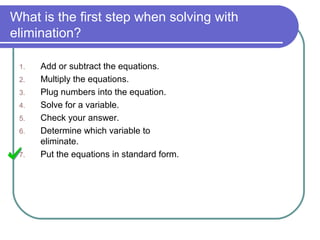
What is the first step when solving with
elimination?
1. Add or subtract the equations.
2. Multiply the equations.
3. Plug numbers into the equation.
4. Solve for a variable.
5. Check your answer.
6. Determine which variable to
eliminate.
7. Put the equations in standard form.
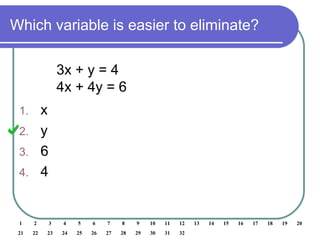
Which variable is easier to eliminate?
1 2 3 4 5 6 7 8 9 10 11 12 13 14 15 16 17 18 19 20
21 22 23 24 25 26 27 28 29 30 31 32
3x + y = 4
4x + 4y = 6
1. x
2. y
3. 6
4. 4
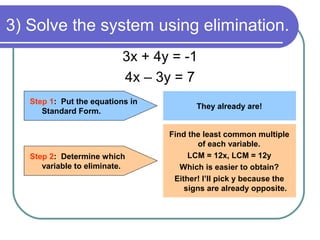
3) Solve the system using elimination.
3x + 4y = -1
4x – 3y = 7
Step 1: Put the equations in
Standard Form.
They already are!
Step 2: Determine which
variable to eliminate.
Find the least common multiple
of each variable.
LCM = 12x, LCM = 12y
Which is easier to obtain?
Either! I’ll pick y because the
signs are already opposite.
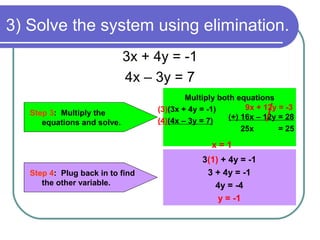
3) Solve the system using elimination.
3x + 4y = -1
4x – 3y = 7
Step 4: Plug back in to find
the other variable.
3(1) + 4y = -1
3 + 4y = -1
4y = -4
y = -1
Step 3: Multiply the
equations and solve.
Multiply both equations
(3)(3x + 4y = -1)
(4)(4x – 3y = 7)
x = 1
9x + 12y = -3
(+) 16x – 12y = 28
25x = 25
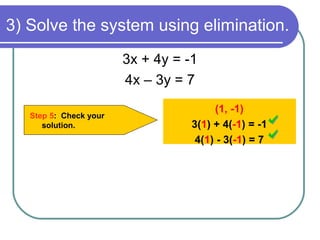
3) Solve the system using elimination.
Step 5: Check your
solution.
(1, -1)
3(1) + 4(-1) = -1
4(1) - 3(-1) = 7
3x + 4y = -1
4x – 3y = 7
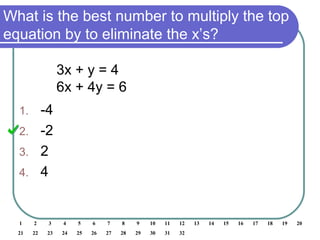
What is the best number to multiply the top
equation by to eliminate the x’s?
1 2 3 4 5 6 7 8 9 10 11 12 13 14 15 16 17 18 19 20
21 22 23 24 25 26 27 28 29 30 31 32
3x + y = 4
6x + 4y = 6
1. -4
2. -2
3. 2
4. 4
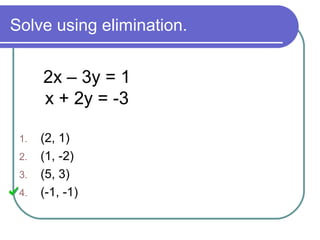
Solve using elimination.
2x – 3y = 1
x + 2y = -3
1. (2, 1)
2. (1, -2)
3. (5, 3)
4. (-1, -1)

Solve Systems By Elimination

  • 1.
    Objective The student willbe able to: solve systems of equations using elimination with multiplication.
  • 2.
    Solving Systems ofEquations So far, we have solved systems using graphing, substitution, and elimination. These notes go one step further and show how to use ELIMINATION with multiplication. What happens when the coefficients are not the same? We multiply the equations to make them the same! You’ll see…
  • 3.
    Solving a systemof equations by elimination using multiplication. Step 1: Put the equations in Standard Form. Step 2: Determine which variable to eliminate. Step 3: Multiply the equations and solve. Step 4: Plug back in to find the other variable. Step 5: Check your solution. Standard Form: Ax + By = C Look for variables that have the same coefficient. Solve for the variable. Substitute the value of the variable into the equation. Substitute your ordered pair into BOTH equations.
  • 4.
    1) Solve thesystem using elimination. 2x + 2y = 6 3x – y = 5 Step 1: Put the equations in Standard Form. Step 2: Determine which variable to eliminate. They already are! None of the coefficients are the same! Find the least common multiple of each variable. LCM = 6x, LCM = 2y Which is easier to obtain? 2y (you only have to multiply the bottom equation by 2)
  • 5.
    1) Solve thesystem using elimination. Step 4: Plug back in to find the other variable. 2(2) + 2y = 6 4 + 2y = 6 2y = 2 y = 1 2x + 2y = 6 3x – y = 5 Step 3: Multiply the equations and solve. Multiply the bottom equation by 2 2x + 2y = 6 (2)(3x – y = 5) 8x = 16 x = 2 2x + 2y = 6 (+) 6x – 2y = 10
  • 6.
    1) Solve thesystem using elimination. Step 5: Check your solution. (2, 1) 2(2) + 2(1) = 6 3(2) - (1) = 5 2x + 2y = 6 3x – y = 5 Solving with multiplication adds one more step to the elimination process.
  • 7.
    2) Solve thesystem using elimination. x + 4y = 7 4x – 3y = 9 Step 1: Put the equations in Standard Form. They already are! Step 2: Determine which variable to eliminate. Find the least common multiple of each variable. LCM = 4x, LCM = 12y Which is easier to obtain? 4x (you only have to multiply the top equation by -4 to make them inverses)
  • 8.
    2) Solve thesystem using elimination. x + 4y = 7 4x – 3y = 9 Step 4: Plug back in to find the other variable. x + 4(1) = 7 x + 4 = 7 x = 3 Step 3: Multiply the equations and solve. Multiply the top equation by -4 (-4)(x + 4y = 7) 4x – 3y = 9) y = 1 -4x – 16y = -28 (+) 4x – 3y = 9 -19y = -19
  • 9.
    2) Solve thesystem using elimination. Step 5: Check your solution. (3, 1) (3) + 4(1) = 7 4(3) - 3(1) = 9 x + 4y = 7 4x – 3y = 9
  • 10.
    What is thefirst step when solving with elimination? 1. Add or subtract the equations. 2. Multiply the equations. 3. Plug numbers into the equation. 4. Solve for a variable. 5. Check your answer. 6. Determine which variable to eliminate. 7. Put the equations in standard form.
  • 11.
    Which variable iseasier to eliminate? 1 2 3 4 5 6 7 8 9 10 11 12 13 14 15 16 17 18 19 20 21 22 23 24 25 26 27 28 29 30 31 32 3x + y = 4 4x + 4y = 6 1. x 2. y 3. 6 4. 4
  • 12.
    3) Solve thesystem using elimination. 3x + 4y = -1 4x – 3y = 7 Step 1: Put the equations in Standard Form. They already are! Step 2: Determine which variable to eliminate. Find the least common multiple of each variable. LCM = 12x, LCM = 12y Which is easier to obtain? Either! I’ll pick y because the signs are already opposite.
  • 13.
    3) Solve thesystem using elimination. 3x + 4y = -1 4x – 3y = 7 Step 4: Plug back in to find the other variable. 3(1) + 4y = -1 3 + 4y = -1 4y = -4 y = -1 Step 3: Multiply the equations and solve. Multiply both equations (3)(3x + 4y = -1) (4)(4x – 3y = 7) x = 1 9x + 12y = -3 (+) 16x – 12y = 28 25x = 25
  • 14.
    3) Solve thesystem using elimination. Step 5: Check your solution. (1, -1) 3(1) + 4(-1) = -1 4(1) - 3(-1) = 7 3x + 4y = -1 4x – 3y = 7
  • 15.
    What is thebest number to multiply the top equation by to eliminate the x’s? 1 2 3 4 5 6 7 8 9 10 11 12 13 14 15 16 17 18 19 20 21 22 23 24 25 26 27 28 29 30 31 32 3x + y = 4 6x + 4y = 6 1. -4 2. -2 3. 2 4. 4
  • 16.
    Solve using elimination. 2x– 3y = 1 x + 2y = -3 1. (2, 1) 2. (1, -2) 3. (5, 3) 4. (-1, -1)