A.Swamy Naidu (141FA08113)
DEPARTMENT OF MECHANICAL ENGINEERING
LARGE HADRON COLLIDER
CONTENTS :
 Introduction
 Aim
 Design
 Working
 Advantages
 Disadvantages
 References
INTRODUCTION :
WHAT IS LHC ?
The Large Hadron Collider (LHC) is the world’s largest and most
powerful particle accelerator. It first started up on 10 September 2008, and
remains the latest addition to CERN’s accelerator complex. The LHC consists
of a 27-kilometre ring of superconducting magnets with a number of
accelerating structures to boost the energy of the particles along the way.
 The Large Hadron Collider is Highest energy particle collider ever made, with the aim of
allowing physicists to test the predictions of different theories of particle
physics and high-energy physics.
 The LHC went live on 10 September 2008, and still on work till to date.
 It was built by the European Organization for Nuclear Research
(CERN near Geneva, Switzerland.)
 Experiment performed to recreate the conditions of BIG BANG.
THE AIM OF THE COLLIDER :
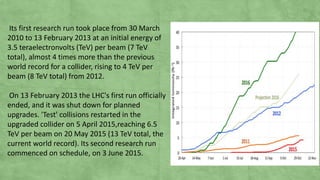
Its first research run took place from 30 March
2010 to 13 February 2013 at an initial energy of
3.5 teraelectronvolts (TeV) per beam (7 TeV
total), almost 4 times more than the previous
world record for a collider, rising to 4 TeV per
beam (8 TeV total) from 2012.
On 13 February 2013 the LHC's first run officially
ended, and it was shut down for planned
upgrades. 'Test' collisions restarted in the
upgraded collider on 5 April 2015,reaching 6.5
TeV per beam on 20 May 2015 (13 TeV total, the
current world record). Its second research run
commenced on schedule, on 3 June 2015.
CONSTRUCTION :
Magnetic field at 7 TeV: 8.33 Tesla
Operating temperature: 1.9 K
Number of magnets: ~9300
Number of main dipoles: 1232
Number of quadrupoles: ~858
Number of correcting magnets: ~6208
Number of RF cavities: 8 per beam;
Field strength at top energy ≈ 5.5 MV/m
Power consumption: ~120 MW
MACHINE LAYOUT :
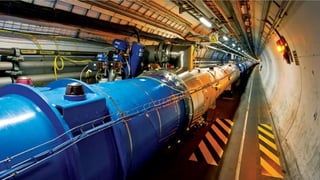
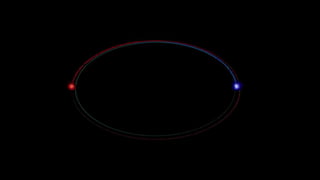
Inside the accelerator, two high-energy particle beams travel at close to the speed of light
before they are made to collide. The beams travel in opposite directions in separate beam
pipes – two tubes kept at ultrahigh vacuum. They are guided around the accelerator ring by a
strong magnetic field maintained by superconducting electromagnets. The electromagnets
are built from coils of special electric cable that operates in a superconducting state, efficiently
conducting electricity without resistance or loss of energy. This requires chilling the magnets
to -271.3°C – a temperature colder than outer space. For this reason, much of the accelerator
is connected to a distribution system of liquid helium, which cools the magnets, as well as to
other supply services.
 Protons were accelerated at the speed of 99.999% of light.
 They are processed in 4 cyclotrons and 5 stages.
 Two opposing particle beams of protons at up to 7 tera electron volts (7 TeV or 1.12 micro
joules) per nucleon, with energies to be doubled to around 14 TeV collision energy were
smashed in LHC machine.
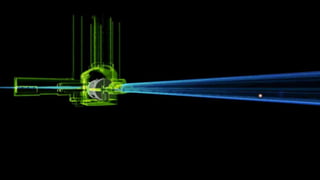
 The collision will produce energy 10,000 times hotter than the sun in the tiny space where
the particles meet. Over 600 collisions will occur each second.
OPERATION OF LHC :
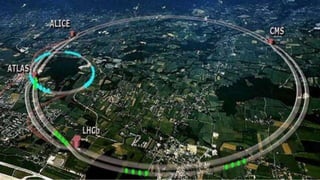
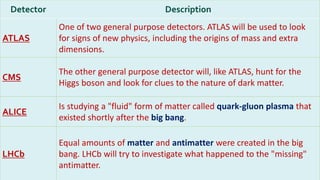
Detector Description
ATLAS
One of two general purpose detectors. ATLAS will be used to look
for signs of new physics, including the origins of mass and extra
dimensions.
CMS
The other general purpose detector will, like ATLAS, hunt for the
Higgs boson and look for clues to the nature of dark matter.
ALICE
Is studying a "fluid" form of matter called quark-gluon plasma that
existed shortly after the big bang.
LHCb
Equal amounts of matter and antimatter were created in the big
bang. LHCb will try to investigate what happened to the "missing"
antimatter.
2008 QUENCH INCIDENT :
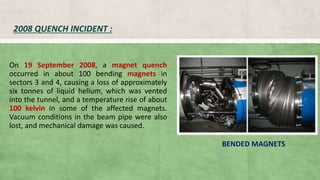
On 19 September 2008, a magnet quench
occurred in about 100 bending magnets in
sectors 3 and 4, causing a loss of approximately
six tonnes of liquid helium, which was vented
into the tunnel, and a temperature rise of about
100 kelvin in some of the affected magnets.
Vacuum conditions in the beam pipe were also
lost, and mechanical damage was caused.
BENDED MAGNETS
HERE ARE SOME QUESTIONS LHC ANSWERED :
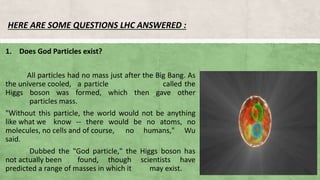
1. Does God Particles exist?
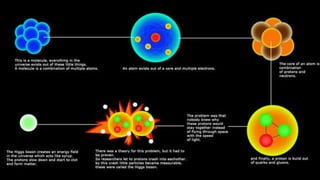
All particles had no mass just after the Big Bang. As
the universe cooled, a particle called the
Higgs boson was formed, which then gave other
particles mass.
"Without this particle, the world would not be anything
like what we know -- there would be no atoms, no
molecules, no cells and of course, no humans," Wu
said.
Dubbed the "God particle," the Higgs boson has
not actually been found, though scientists have
predicted a range of masses in which it may exist.
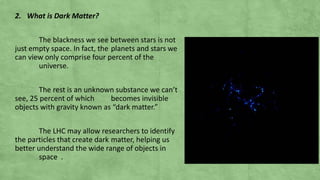
2. What is Dark Matter?
The blackness we see between stars is not
just empty space. In fact, the planets and stars we
can view only comprise four percent of the
universe.
The rest is an unknown substance we can’t
see, 25 percent of which becomes invisible
objects with gravity known as “dark matter.”
The LHC may allow researchers to identify
the particles that create dark matter, helping us
better understand the wide range of objects in
space .
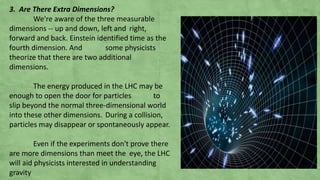
3. Are There Extra Dimensions?
We're aware of the three measurable
dimensions -- up and down, left and right,
forward and back. Einstein identified time as the
fourth dimension. And some physicists
theorize that there are two additional
dimensions.
The energy produced in the LHC may be
enough to open the door for particles to
slip beyond the normal three-dimensional world
into these other dimensions. During a collision,
particles may disappear or spontaneously appear.
Even if the experiments don't prove there
are more dimensions than meet the eye, the LHC
will aid physicists interested in understanding
gravity
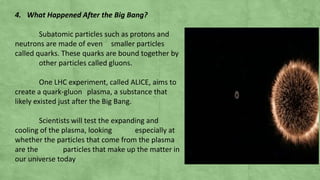
4. What Happened After the Big Bang?
Subatomic particles such as protons and
neutrons are made of even smaller particles
called quarks. These quarks are bound together by
other particles called gluons.
One LHC experiment, called ALICE, aims to
create a quark-gluon plasma, a substance that
likely existed just after the Big Bang.
Scientists will test the expanding and
cooling of the plasma, looking especially at
whether the particles that come from the plasma
are the particles that make up the matter in
our universe today
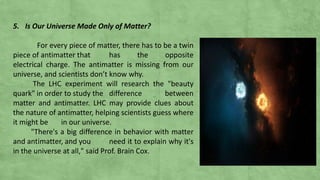
5. Is Our Universe Made Only of Matter?
For every piece of matter, there has to be a twin
piece of antimatter that has the opposite
electrical charge. The antimatter is missing from our
universe, and scientists don’t know why.
The LHC experiment will research the "beauty
quark" in order to study the difference between
matter and antimatter. LHC may provide clues about
the nature of antimatter, helping scientists guess where
it might be in our universe.
"There's a big difference in behavior with matter
and antimatter, and you need it to explain why it's
in the universe at all," said Prof. Brain Cox.
 Cancer therapy
 Manufacturing Processes
 Medical Instrumentation
 Industrial Imaging
 The world wide web
 Pattern recognition
APPLICATIONS IN VARIOUS FIELDS :
MERITS :
 Development in Quantum mechanics
 Searching for the source of dark matter. Searching for the cause of matter-
antimatter asymmetry in the universe.
 Measuring the size and structure of the proton.
 To study the Behavior of cosmic rays in atmosphere.
 The LHC uses 10,800 tons (9,798 metric tons) of liquid nitrogen to cool the magnets
down to 80 degrees Kelvin (-193.2 Celsius or -315.67 Fahrenheit).
 About 60 tons (54 metric tons) of liquid helium
 The Collider has about 9,300 magnets, which are super-cooled to -456.25 degrees
Fahrenheit.
 120 Megawatts – about as much as all of the homes in the neighbouring Swiss Canton
of Geneva.
 The Large Hadron Collider took total cost of about $4.75 billion.
 It’s life time is only 10 years after that we need to find a new collider to construct.
DEMERITS :
CONCLUSION :
The LHC is now in its final stage of installation and commissioning. A beam has already
been extracted from the SPS with the parameters needed to achieve design luminosity
and has been transported along the 2.6 km tunnel TI8 to the LHC injection point. The
stored energy in this beam at 7 TeV is two orders of magnitude higher than in any
previous machine and one of the biggest challenges will be to ensure that the machine
protection systems work with an extremely high degree of reliability in order to protect
both machine and detectors.
REFERENCES:
https://home.cern/topics/large-hadron-collider
https://en.wikipedia.org/wiki/Large_Hadron_Collider
https://home.cern/cern-people/updates/2016/12/lhc-report-far-
beyond-expectations
https://www.iop.org/publications/iop/archive/file_52154.pdf
http://www.nature.com/news/physics-paper-sets-record-with-
more-than-5-000-authors-1.17567
 Large Hadron Collider (LHC)

Large Hadron Collider (LHC)

  • 1.
    A.Swamy Naidu (141FA08113) DEPARTMENTOF MECHANICAL ENGINEERING LARGE HADRON COLLIDER
  • 2.
    CONTENTS :  Introduction Aim  Design  Working  Advantages  Disadvantages  References
  • 3.
    INTRODUCTION : WHAT ISLHC ? The Large Hadron Collider (LHC) is the world’s largest and most powerful particle accelerator. It first started up on 10 September 2008, and remains the latest addition to CERN’s accelerator complex. The LHC consists of a 27-kilometre ring of superconducting magnets with a number of accelerating structures to boost the energy of the particles along the way.
  • 4.
     The LargeHadron Collider is Highest energy particle collider ever made, with the aim of allowing physicists to test the predictions of different theories of particle physics and high-energy physics.  The LHC went live on 10 September 2008, and still on work till to date.  It was built by the European Organization for Nuclear Research (CERN near Geneva, Switzerland.)  Experiment performed to recreate the conditions of BIG BANG. THE AIM OF THE COLLIDER :
  • 5.
    Its first researchrun took place from 30 March 2010 to 13 February 2013 at an initial energy of 3.5 teraelectronvolts (TeV) per beam (7 TeV total), almost 4 times more than the previous world record for a collider, rising to 4 TeV per beam (8 TeV total) from 2012. On 13 February 2013 the LHC's first run officially ended, and it was shut down for planned upgrades. 'Test' collisions restarted in the upgraded collider on 5 April 2015,reaching 6.5 TeV per beam on 20 May 2015 (13 TeV total, the current world record). Its second research run commenced on schedule, on 3 June 2015.
  • 6.
    CONSTRUCTION : Magnetic fieldat 7 TeV: 8.33 Tesla Operating temperature: 1.9 K Number of magnets: ~9300 Number of main dipoles: 1232 Number of quadrupoles: ~858 Number of correcting magnets: ~6208 Number of RF cavities: 8 per beam; Field strength at top energy ≈ 5.5 MV/m Power consumption: ~120 MW
  • 7.
    MACHINE LAYOUT : Insidethe accelerator, two high-energy particle beams travel at close to the speed of light before they are made to collide. The beams travel in opposite directions in separate beam pipes – two tubes kept at ultrahigh vacuum. They are guided around the accelerator ring by a strong magnetic field maintained by superconducting electromagnets. The electromagnets are built from coils of special electric cable that operates in a superconducting state, efficiently conducting electricity without resistance or loss of energy. This requires chilling the magnets to -271.3°C – a temperature colder than outer space. For this reason, much of the accelerator is connected to a distribution system of liquid helium, which cools the magnets, as well as to other supply services.
  • 10.
     Protons wereaccelerated at the speed of 99.999% of light.  They are processed in 4 cyclotrons and 5 stages.  Two opposing particle beams of protons at up to 7 tera electron volts (7 TeV or 1.12 micro joules) per nucleon, with energies to be doubled to around 14 TeV collision energy were smashed in LHC machine.  The collision will produce energy 10,000 times hotter than the sun in the tiny space where the particles meet. Over 600 collisions will occur each second. OPERATION OF LHC :
  • 12.
    Detector Description ATLAS One oftwo general purpose detectors. ATLAS will be used to look for signs of new physics, including the origins of mass and extra dimensions. CMS The other general purpose detector will, like ATLAS, hunt for the Higgs boson and look for clues to the nature of dark matter. ALICE Is studying a "fluid" form of matter called quark-gluon plasma that existed shortly after the big bang. LHCb Equal amounts of matter and antimatter were created in the big bang. LHCb will try to investigate what happened to the "missing" antimatter.
  • 15.
    2008 QUENCH INCIDENT: On 19 September 2008, a magnet quench occurred in about 100 bending magnets in sectors 3 and 4, causing a loss of approximately six tonnes of liquid helium, which was vented into the tunnel, and a temperature rise of about 100 kelvin in some of the affected magnets. Vacuum conditions in the beam pipe were also lost, and mechanical damage was caused. BENDED MAGNETS
  • 16.
    HERE ARE SOMEQUESTIONS LHC ANSWERED : 1. Does God Particles exist? All particles had no mass just after the Big Bang. As the universe cooled, a particle called the Higgs boson was formed, which then gave other particles mass. "Without this particle, the world would not be anything like what we know -- there would be no atoms, no molecules, no cells and of course, no humans," Wu said. Dubbed the "God particle," the Higgs boson has not actually been found, though scientists have predicted a range of masses in which it may exist.
  • 18.
    2. What isDark Matter? The blackness we see between stars is not just empty space. In fact, the planets and stars we can view only comprise four percent of the universe. The rest is an unknown substance we can’t see, 25 percent of which becomes invisible objects with gravity known as “dark matter.” The LHC may allow researchers to identify the particles that create dark matter, helping us better understand the wide range of objects in space .
  • 19.
    3. Are ThereExtra Dimensions? We're aware of the three measurable dimensions -- up and down, left and right, forward and back. Einstein identified time as the fourth dimension. And some physicists theorize that there are two additional dimensions. The energy produced in the LHC may be enough to open the door for particles to slip beyond the normal three-dimensional world into these other dimensions. During a collision, particles may disappear or spontaneously appear. Even if the experiments don't prove there are more dimensions than meet the eye, the LHC will aid physicists interested in understanding gravity
  • 20.
    4. What HappenedAfter the Big Bang? Subatomic particles such as protons and neutrons are made of even smaller particles called quarks. These quarks are bound together by other particles called gluons. One LHC experiment, called ALICE, aims to create a quark-gluon plasma, a substance that likely existed just after the Big Bang. Scientists will test the expanding and cooling of the plasma, looking especially at whether the particles that come from the plasma are the particles that make up the matter in our universe today
  • 21.
    5. Is OurUniverse Made Only of Matter? For every piece of matter, there has to be a twin piece of antimatter that has the opposite electrical charge. The antimatter is missing from our universe, and scientists don’t know why. The LHC experiment will research the "beauty quark" in order to study the difference between matter and antimatter. LHC may provide clues about the nature of antimatter, helping scientists guess where it might be in our universe. "There's a big difference in behavior with matter and antimatter, and you need it to explain why it's in the universe at all," said Prof. Brain Cox.
  • 22.
     Cancer therapy Manufacturing Processes  Medical Instrumentation  Industrial Imaging  The world wide web  Pattern recognition APPLICATIONS IN VARIOUS FIELDS :
  • 23.
    MERITS :  Developmentin Quantum mechanics  Searching for the source of dark matter. Searching for the cause of matter- antimatter asymmetry in the universe.  Measuring the size and structure of the proton.  To study the Behavior of cosmic rays in atmosphere.
  • 24.
     The LHCuses 10,800 tons (9,798 metric tons) of liquid nitrogen to cool the magnets down to 80 degrees Kelvin (-193.2 Celsius or -315.67 Fahrenheit).  About 60 tons (54 metric tons) of liquid helium  The Collider has about 9,300 magnets, which are super-cooled to -456.25 degrees Fahrenheit.  120 Megawatts – about as much as all of the homes in the neighbouring Swiss Canton of Geneva.  The Large Hadron Collider took total cost of about $4.75 billion.  It’s life time is only 10 years after that we need to find a new collider to construct. DEMERITS :
  • 25.
    CONCLUSION : The LHCis now in its final stage of installation and commissioning. A beam has already been extracted from the SPS with the parameters needed to achieve design luminosity and has been transported along the 2.6 km tunnel TI8 to the LHC injection point. The stored energy in this beam at 7 TeV is two orders of magnitude higher than in any previous machine and one of the biggest challenges will be to ensure that the machine protection systems work with an extremely high degree of reliability in order to protect both machine and detectors.
  • 26.