What is the Large Hadron Collider?
•The LHC is a very large particle accelerator, roughly 17
miles long
•Its primary function is to use electric fields to force
charged particles to move at very high speeds and collide
them each other and there by create the early stages of
Big-Bang .
• It smashes protons moving at 99.999999% of the speed
of light into each other and so recreate conditions a
fraction of a second after the big bang.
Why do we want LHC?
• Questions that need to be answered:
– What is the Higgs Boson?
– How many dimensions are there in the universe?
– Is the string theory real?
– What is dark matter?
– What happened the instant after the Big Bang?
How LHC works?
•Forcing two beams of atomic particles to travel in
opposite directions.
•Once these beams reach their maximum speed,
forces them to collide in four places on their path.
•Collisions create new particles and energy, and
we use the detectors in the LHC to observe the
particle and energy
Higgs-Boson
•Right after the Big-Bang absolute symmetry of universe
shattered and a invisible energy switched on and it fills
entire universe
•This field selectively affects some of the fundamental
particle and causing them to get mass
•Protons interact strongly with this field and cause more
weight and electron interact less strongly and light
weight
•Photon not interacting with this field and no mass
•Particle which causes this field is Higgs-boson
•In LHC we are trying to create such a powerful
disturbance in Higgs field there by detect the Higgs-Boson
Higgs-Boson
•Life time of Higgs-Boson is 10-21 sec. , Until now we
don’t have any lab to detect it
•So in LHC we are trying to detect the particle which
produced by the decay of Higgs-Boson
•Out of thousands of Higgs decay there should be a
decay of photon which cane be measured in a detector
•In 2012 LHC scientists observed a Boson with energy of
125.3 GeV
How LHC works
•Trillions of H atom injects into a collider
•Every 1.2 sec. 1014 protons are accelerating
•Protons accelerate in large and large loops until they
are finally direct into a main way
•After 20 min. of acceleration each proton is moving
nearly the speed of light
•Finally we collide them head on
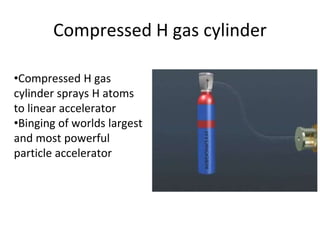
Compressed H gas cylinder
•Compressed H gas
cylinder sprays H atoms
to linear accelerator
•Binging of worlds largest
and most powerful
particle accelerator
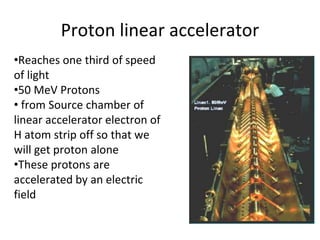
Proton linear accelerator
•Reaches one third of speed
of light
•50 MeV Protons
• from Source chamber of
linear accelerator electron of
H atom strip off so that we
will get proton alone
•These protons are
accelerated by an electric
field
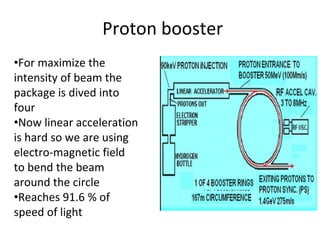
Proton booster
•For maximize the
intensity of beam the
package is dived into
four
•Now linear acceleration
is hard so we are using
electro-magnetic field
to bend the beam
around the circle
•Reaches 91.6 % of
speed of light
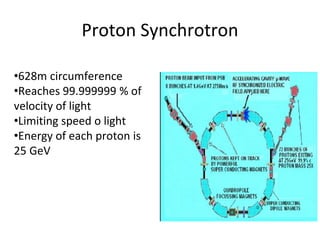
Proton Synchrotron
•628m circumference
•Reaches 99.999999 % of
velocity of light
•Limiting speed o light
•Energy of each proton is
25 GeV
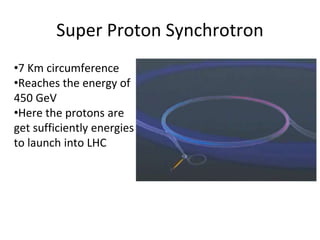
Super Proton Synchrotron
•7 Km circumference
•Reaches the energy of
450 GeV
•Here the protons are
get sufficiently energies
to launch into LHC
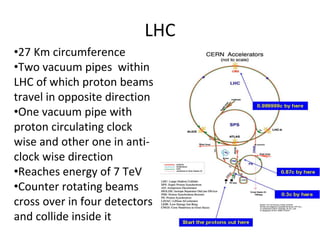
LHC
•27 Km circumference
•Two vacuum pipes within
LHC of which proton beams
travel in opposite direction
•One vacuum pipe with
proton circulating clock
wise and other one in anti-
clock wise direction
•Reaches energy of 7 TeV
•Counter rotating beams
cross over in four detectors
and collide inside it
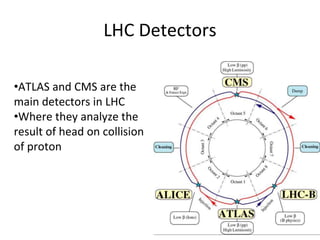
LHC Detectors
•ATLAS and CMS are the
main detectors in LHC
•Where they analyze the
result of head on collision
of proton
TO PINPOINT THE SMALLEST FRAGMENTS OF THE
UNIVERSE YOU HAVE TO BUILD THE BIGGEST
MACHINE IN THE WORLD.
10 YEAR
10 BILLION DOLLAR
TO FIND OUT FINITE PIECE OF COSMO
THANK YOU
Presented by
Muhammed Arshad T
CUTN

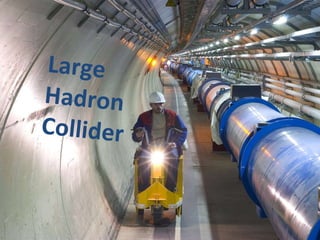
Large hadron collider

  • 2.
    What is theLarge Hadron Collider? •The LHC is a very large particle accelerator, roughly 17 miles long •Its primary function is to use electric fields to force charged particles to move at very high speeds and collide them each other and there by create the early stages of Big-Bang . • It smashes protons moving at 99.999999% of the speed of light into each other and so recreate conditions a fraction of a second after the big bang.
  • 3.
    Why do wewant LHC? • Questions that need to be answered: – What is the Higgs Boson? – How many dimensions are there in the universe? – Is the string theory real? – What is dark matter? – What happened the instant after the Big Bang?
  • 4.
    How LHC works? •Forcingtwo beams of atomic particles to travel in opposite directions. •Once these beams reach their maximum speed, forces them to collide in four places on their path. •Collisions create new particles and energy, and we use the detectors in the LHC to observe the particle and energy
  • 5.
    Higgs-Boson •Right after theBig-Bang absolute symmetry of universe shattered and a invisible energy switched on and it fills entire universe •This field selectively affects some of the fundamental particle and causing them to get mass •Protons interact strongly with this field and cause more weight and electron interact less strongly and light weight •Photon not interacting with this field and no mass •Particle which causes this field is Higgs-boson •In LHC we are trying to create such a powerful disturbance in Higgs field there by detect the Higgs-Boson
  • 6.
    Higgs-Boson •Life time ofHiggs-Boson is 10-21 sec. , Until now we don’t have any lab to detect it •So in LHC we are trying to detect the particle which produced by the decay of Higgs-Boson •Out of thousands of Higgs decay there should be a decay of photon which cane be measured in a detector •In 2012 LHC scientists observed a Boson with energy of 125.3 GeV
  • 7.
    How LHC works •Trillionsof H atom injects into a collider •Every 1.2 sec. 1014 protons are accelerating •Protons accelerate in large and large loops until they are finally direct into a main way •After 20 min. of acceleration each proton is moving nearly the speed of light •Finally we collide them head on
  • 8.
    Compressed H gascylinder •Compressed H gas cylinder sprays H atoms to linear accelerator •Binging of worlds largest and most powerful particle accelerator
  • 9.
    Proton linear accelerator •Reachesone third of speed of light •50 MeV Protons • from Source chamber of linear accelerator electron of H atom strip off so that we will get proton alone •These protons are accelerated by an electric field
  • 10.
    Proton booster •For maximizethe intensity of beam the package is dived into four •Now linear acceleration is hard so we are using electro-magnetic field to bend the beam around the circle •Reaches 91.6 % of speed of light
  • 11.
    Proton Synchrotron •628m circumference •Reaches99.999999 % of velocity of light •Limiting speed o light •Energy of each proton is 25 GeV
  • 12.
    Super Proton Synchrotron •7Km circumference •Reaches the energy of 450 GeV •Here the protons are get sufficiently energies to launch into LHC
  • 13.
    LHC •27 Km circumference •Twovacuum pipes within LHC of which proton beams travel in opposite direction •One vacuum pipe with proton circulating clock wise and other one in anti- clock wise direction •Reaches energy of 7 TeV •Counter rotating beams cross over in four detectors and collide inside it
  • 14.
    LHC Detectors •ATLAS andCMS are the main detectors in LHC •Where they analyze the result of head on collision of proton
  • 15.
    TO PINPOINT THESMALLEST FRAGMENTS OF THE UNIVERSE YOU HAVE TO BUILD THE BIGGEST MACHINE IN THE WORLD. 10 YEAR 10 BILLION DOLLAR TO FIND OUT FINITE PIECE OF COSMO THANK YOU Presented by Muhammed Arshad T CUTN