The Great Race:
Embedding Information Literacy
            into a
    New Core Curriculum


         Susan [Gardner] Archambault
        Head of Reference & Instruction
         Loyola Marymount University
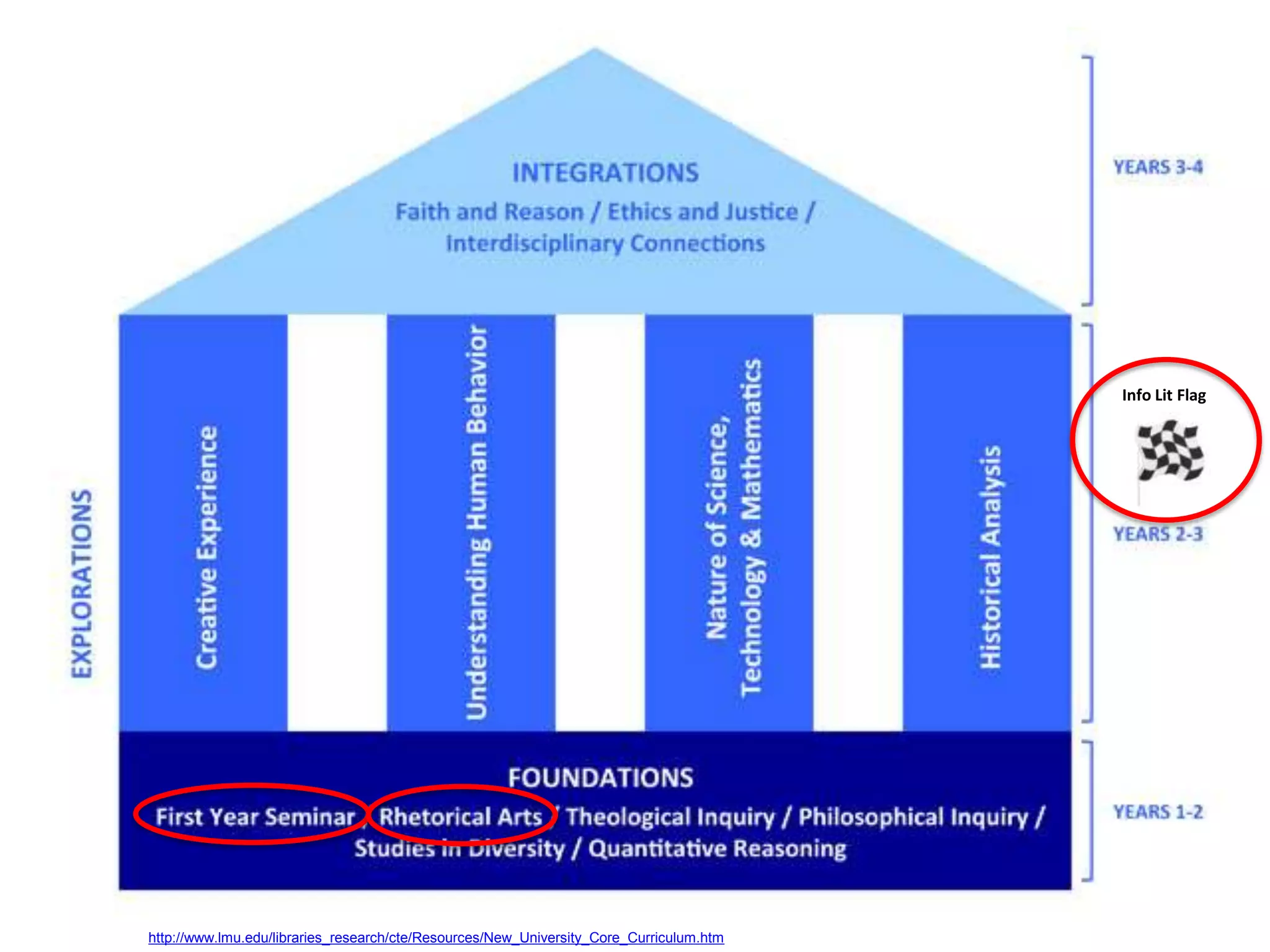
Info Lit Flag


http://www.lmu.edu/libraries_research/cte/Resources/New_University_Core_Curriculum.htm
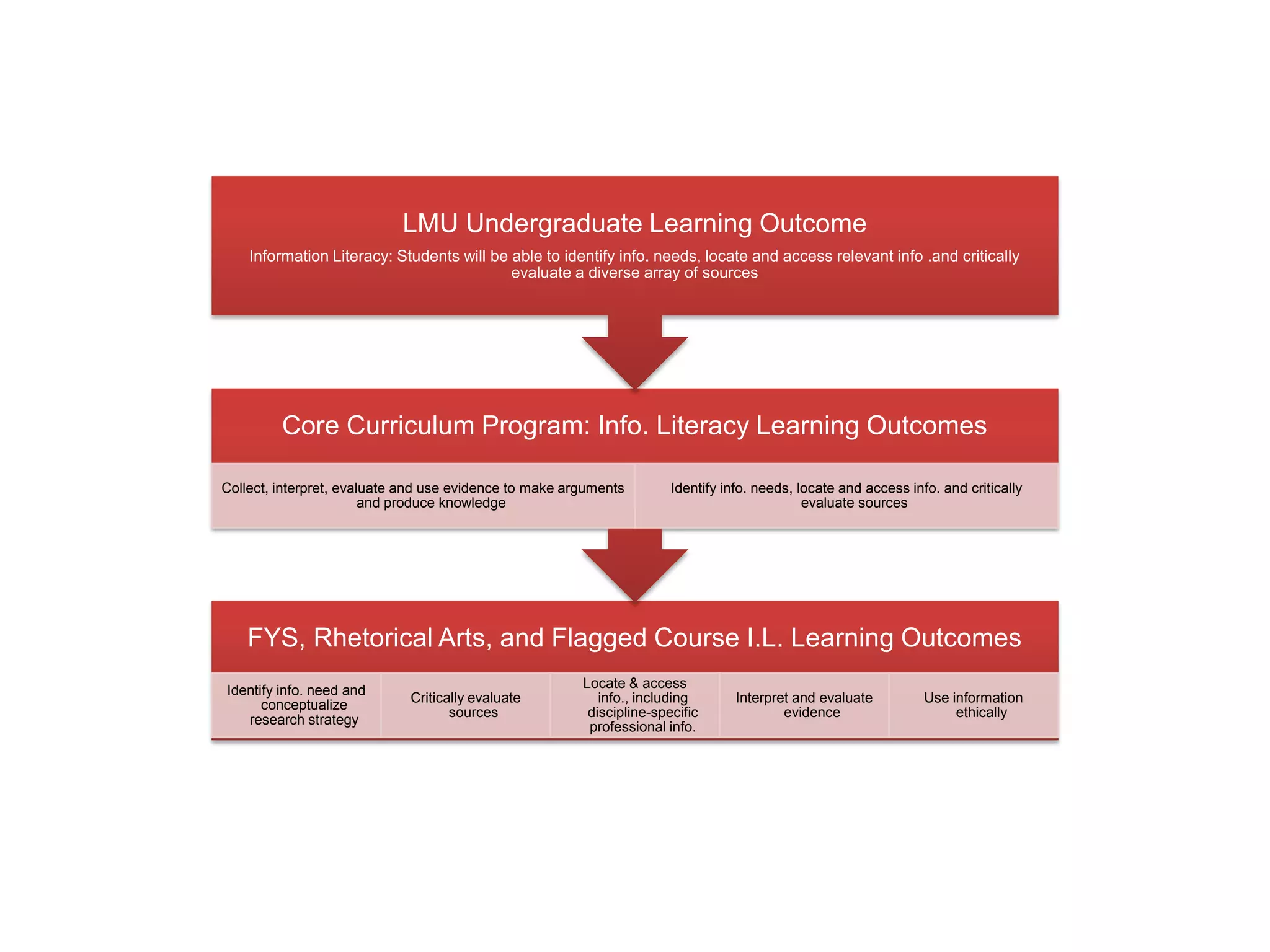
LMU Undergraduate Learning Outcome
    Information Literacy: Students will be able to identify info. needs, locate and access relevant info .and critically
                                           evaluate a diverse array of sources


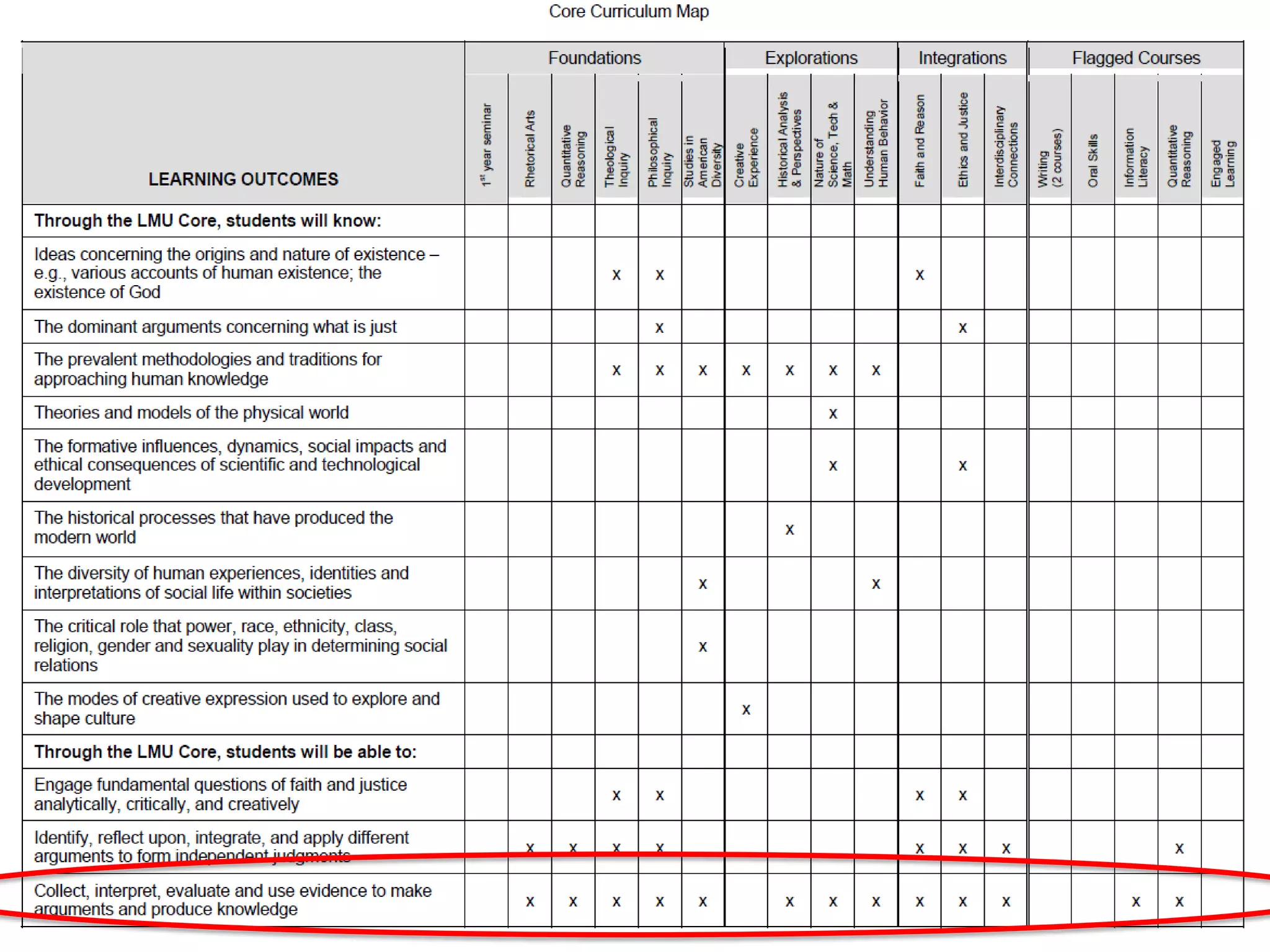
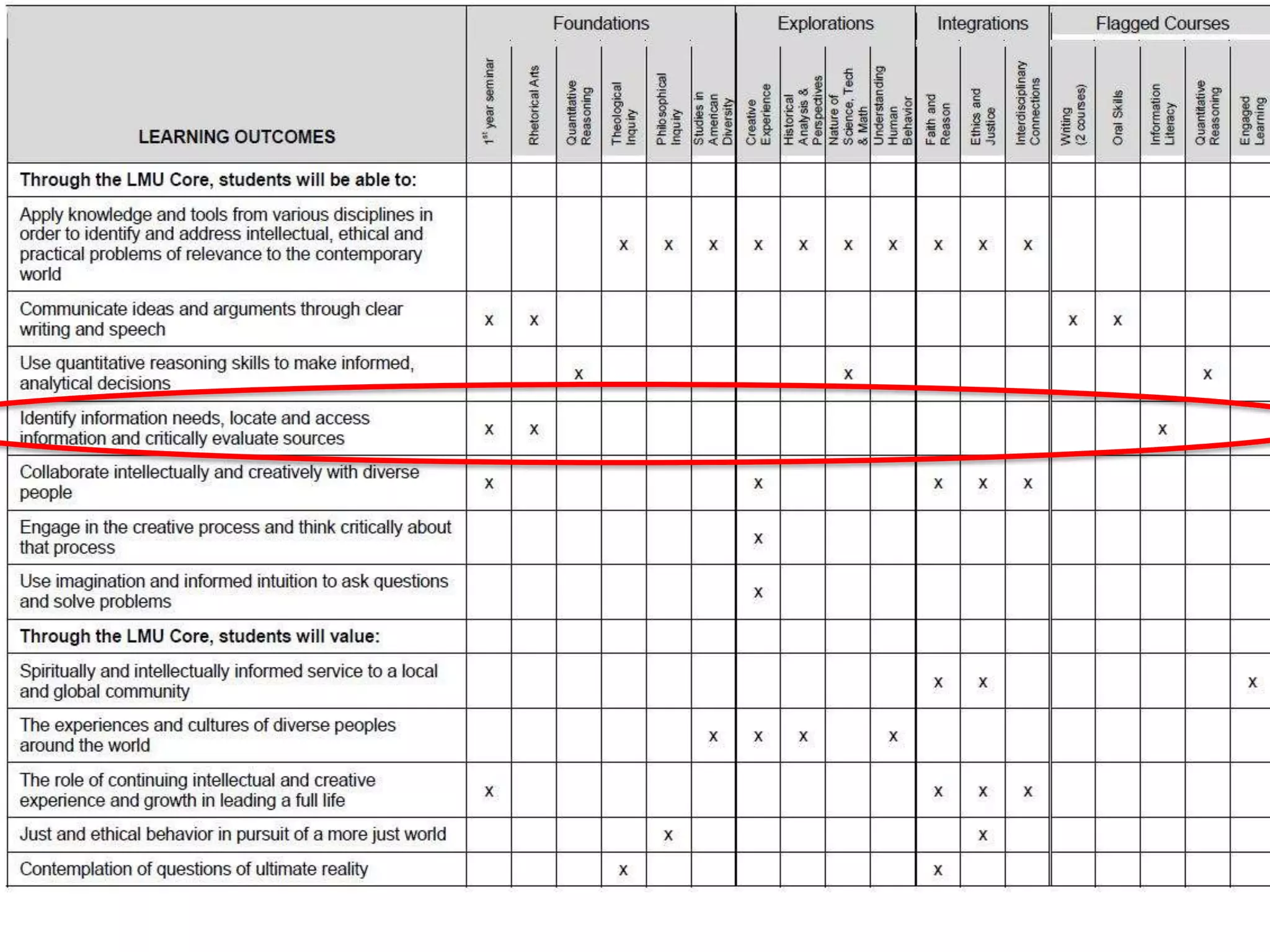
         Core Curriculum Program: Info. Literacy Learning Outcomes

Collect, interpret, evaluate and use evidence to make arguments        Identify info. needs, locate and access info. and critically
                        and produce knowledge                                                 evaluate sources


    FYS, Rhetorical Arts, and Flagged Course I.L. Learning Outcomes
                                                        Locate & access
Identify info. need and
                             Critically evaluate           info., including       Interpret and evaluate          Use information
      conceptualize
                                    sources              discipline-specific              evidence                     ethically
   research strategy
                                                         professional info.
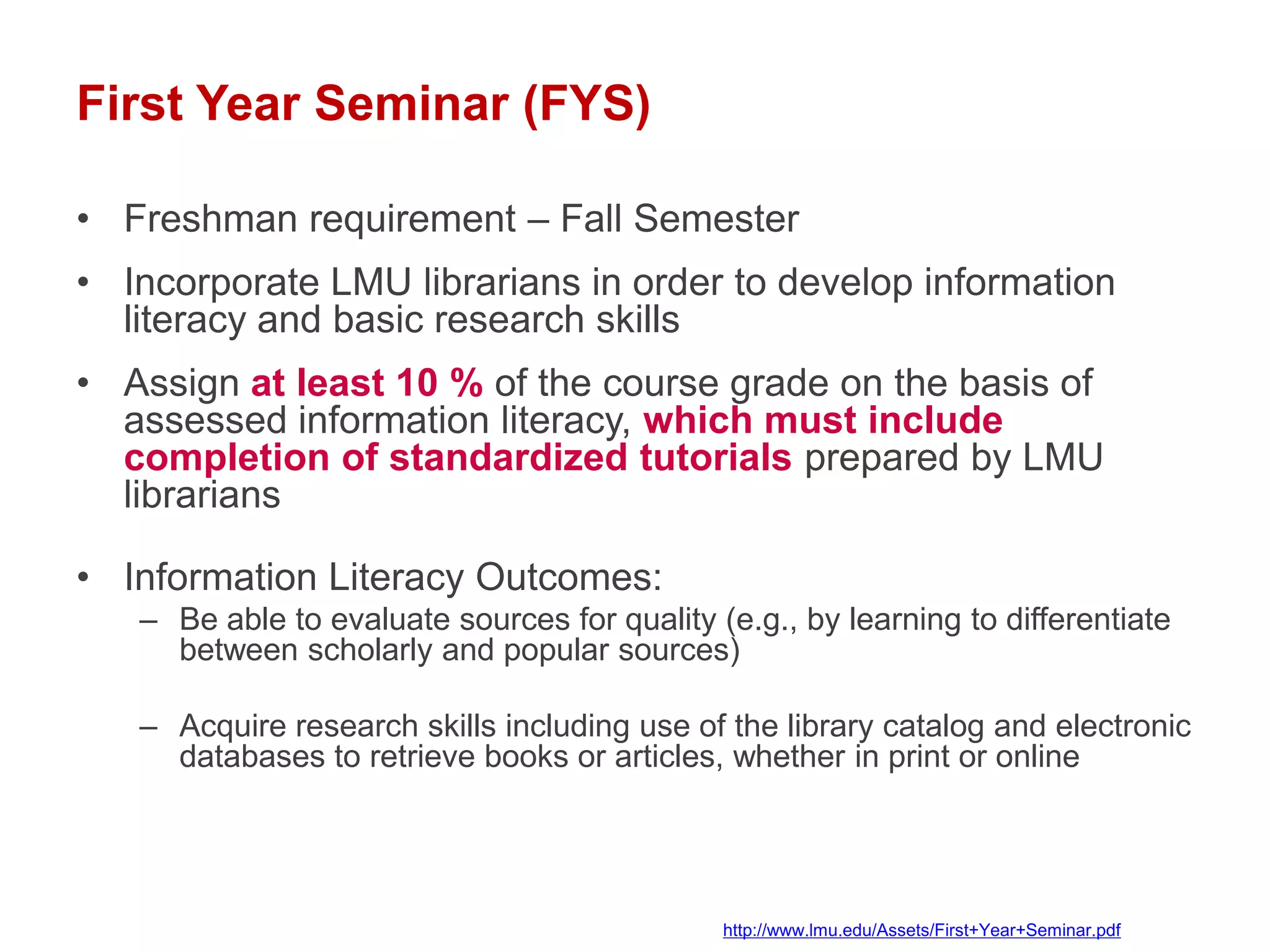
First Year Seminar (FYS)
• Freshman requirement – Fall Semester
• Incorporate LMU librarians in order to develop information
  literacy and basic research skills
• Assign at least 10 % of the course grade on the basis of
  assessed information literacy, which must include
  completion of standardized tutorials prepared by LMU
  librarians

• Information Literacy Outcomes:
   – Be able to evaluate sources for quality (e.g., by learning to differentiate
     between scholarly and popular sources)

   – Acquire research skills including use of the library catalog and electronic
     databases to retrieve books or articles, whether in print or online


                                              http://www.lmu.edu/Assets/First+Year+Seminar.pdf
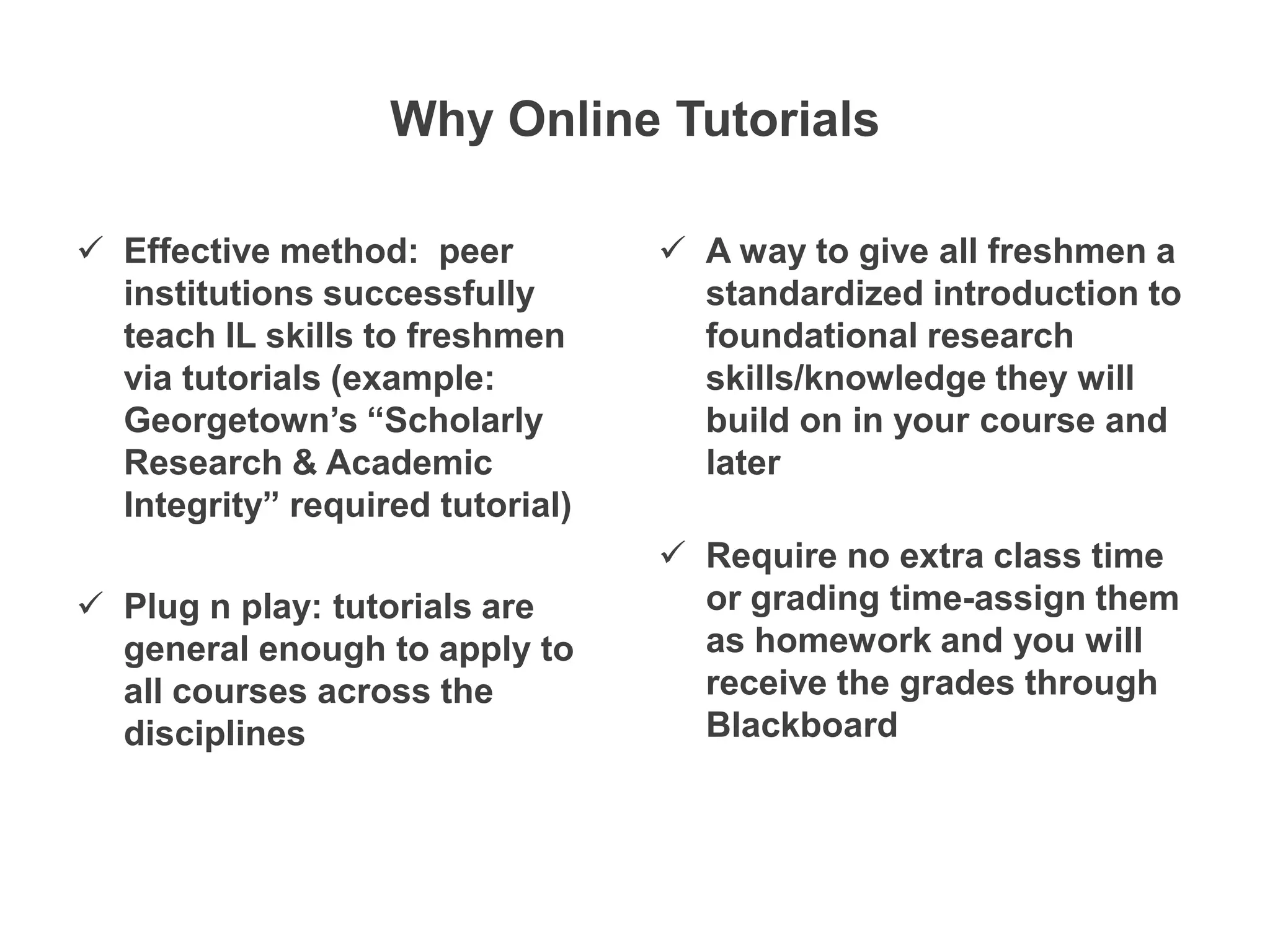
Why Online Tutorials

 Effective method: peer           A way to give all freshmen a
  institutions successfully         standardized introduction to
  teach IL skills to freshmen       foundational research
  via tutorials (example:           skills/knowledge they will
  Georgetown’s “Scholarly           build on in your course and
  Research & Academic               later
  Integrity” required tutorial)
                                   Require no extra class time
 Plug n play: tutorials are        or grading time-assign them
  general enough to apply to        as homework and you will
  all courses across the            receive the grades through
  disciplines                       Blackboard
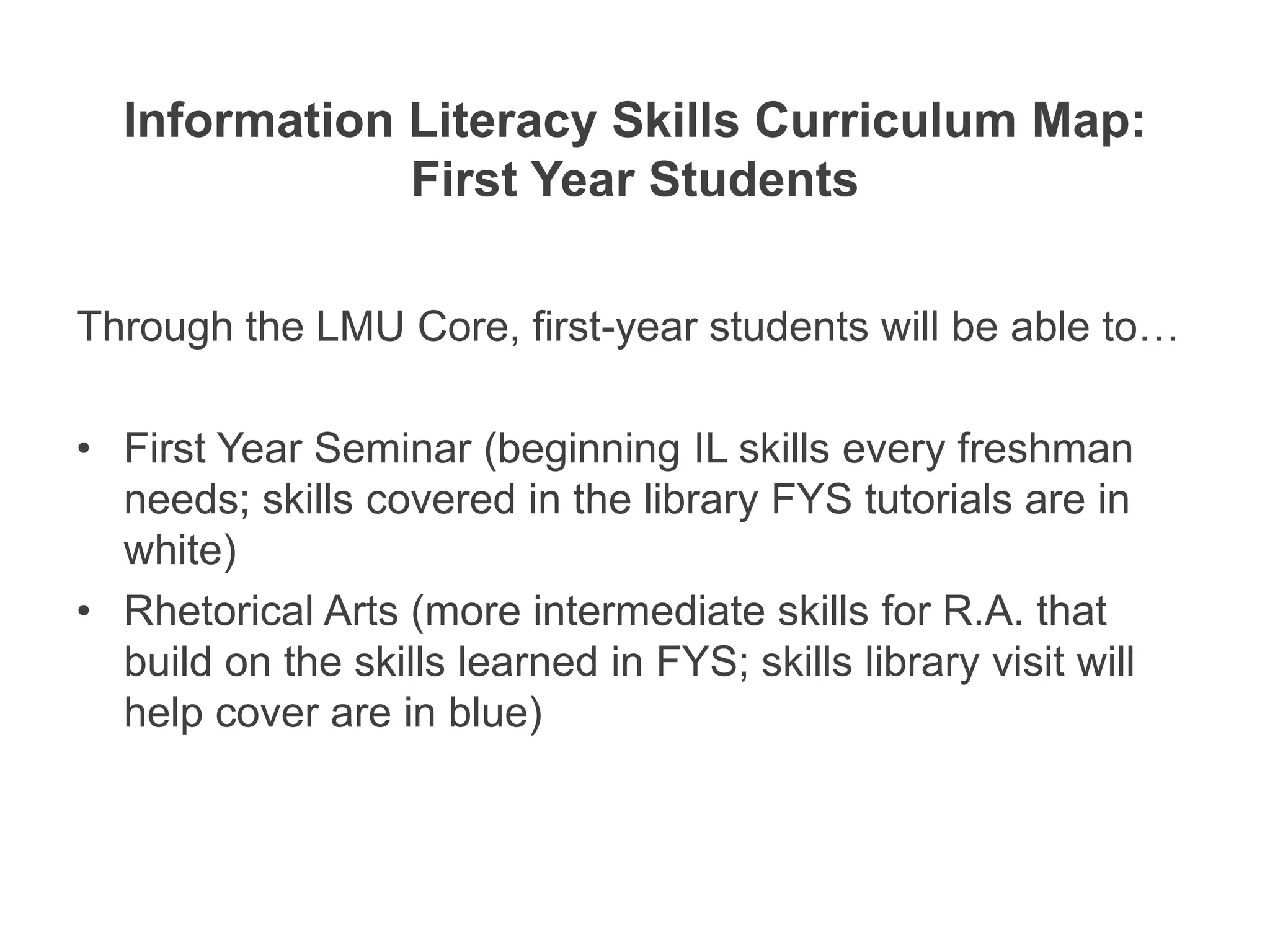
Information Literacy Skills Curriculum Map:
              First Year Students

Through the LMU Core, first-year students will be able to…

• First Year Seminar (beginning IL skills every freshman
  needs; skills covered in the library FYS tutorials are in
  white)
• Rhetorical Arts (more intermediate skills for R.A. that
  build on the skills learned in FYS; skills library visit will
  help cover are in blue)
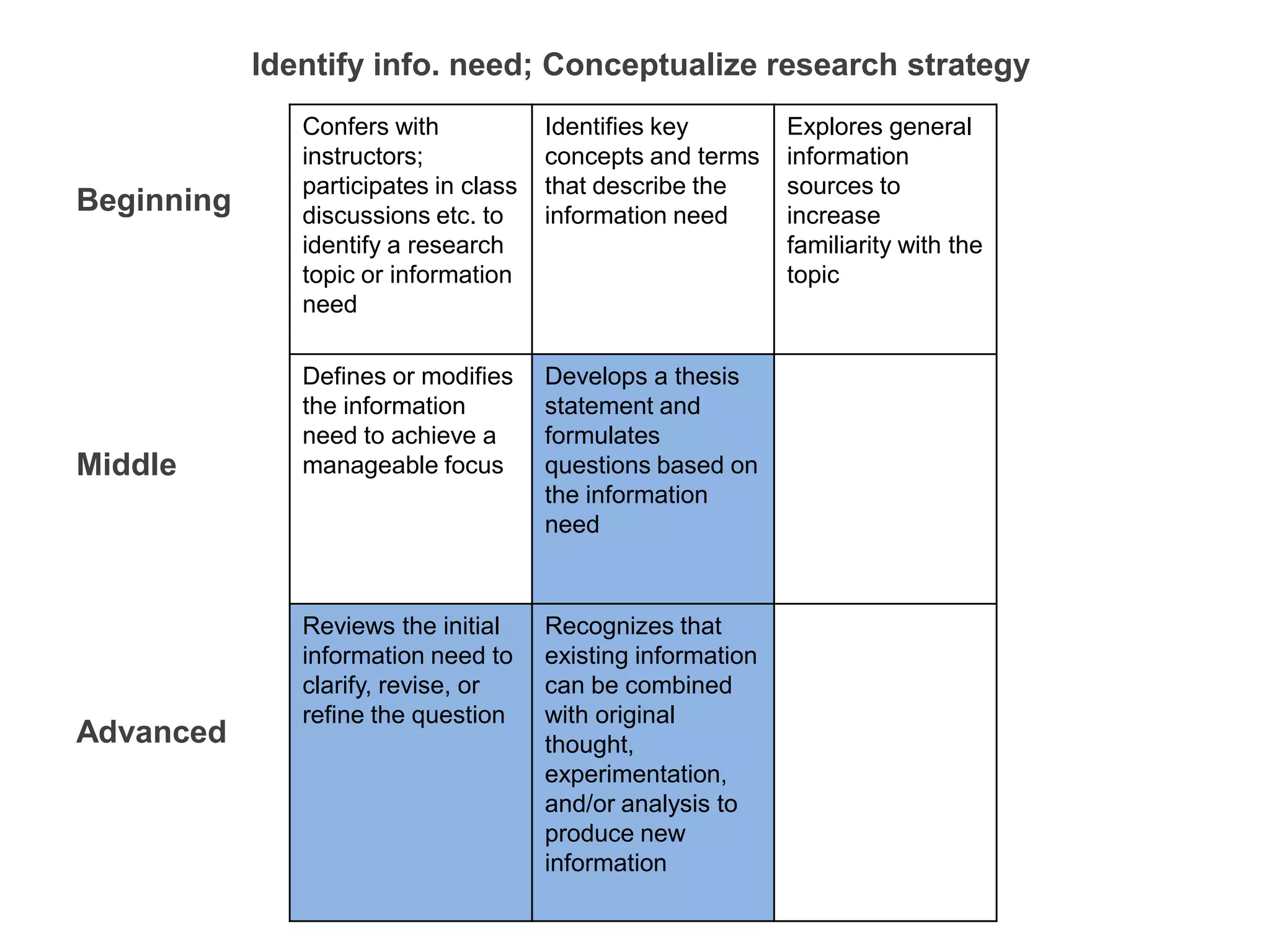
Identify info. need; Conceptualize research strategy
               Confers with            Identifies key         Explores general
               instructors;            concepts and terms     information
               participates in class   that describe the      sources to
Beginning      discussions etc. to     information need       increase
               identify a research                            familiarity with the
               topic or information                           topic
               need

               Defines or modifies     Develops a thesis
               the information         statement and
               need to achieve a       formulates
Middle         manageable focus        questions based on
                                       the information
                                       need


               Reviews the initial     Recognizes that
               information need to     existing information
               clarify, revise, or     can be combined
               refine the question     with original
Advanced                               thought,
                                       experimentation,
                                       and/or analysis to
                                       produce new
                                       information
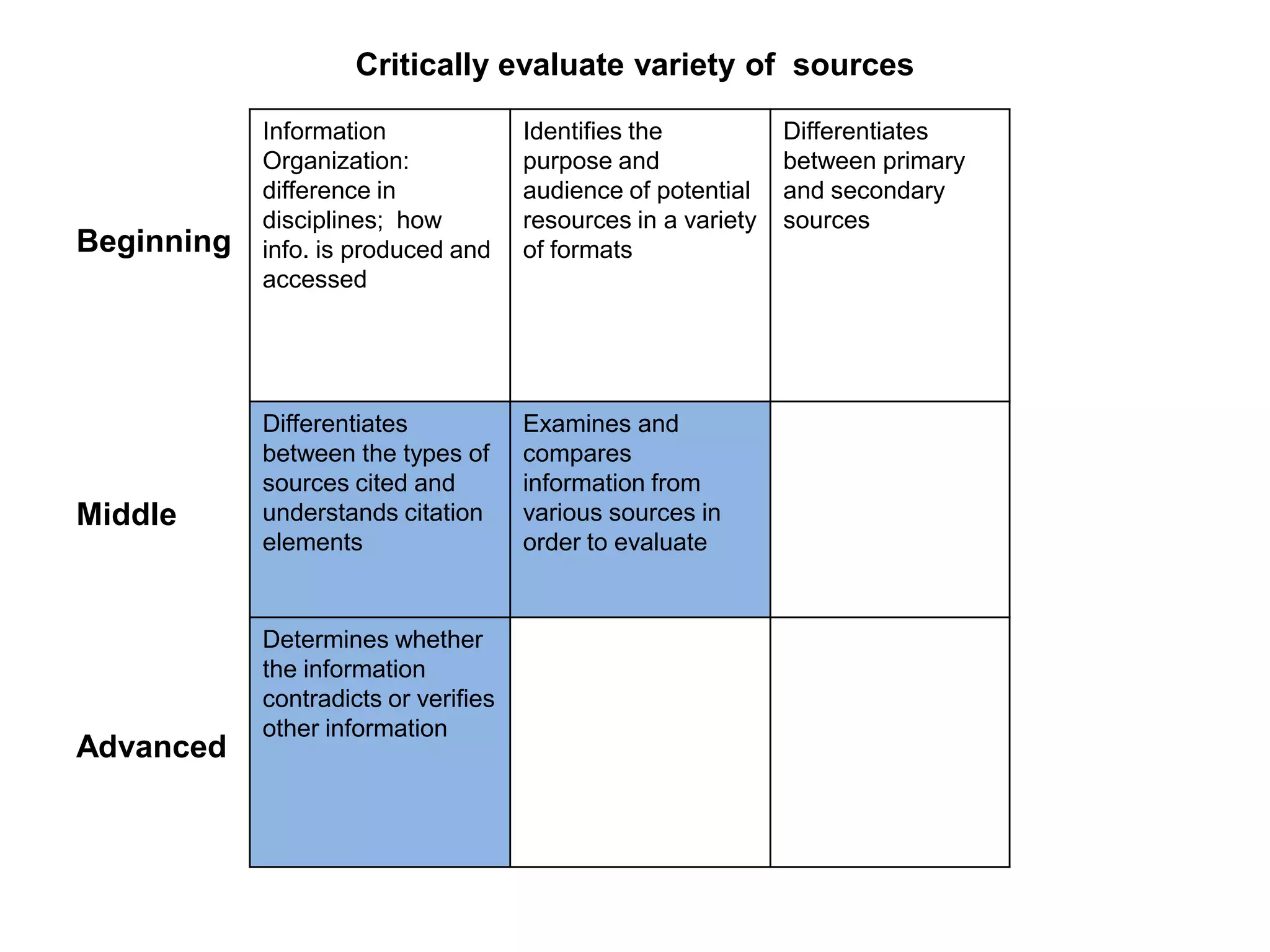
Critically evaluate variety of sources

            Information               Identifies the           Differentiates
            Organization:             purpose and              between primary
            difference in             audience of potential    and secondary
            disciplines; how          resources in a variety   sources
Beginning   info. is produced and     of formats
            accessed


            Differentiates            Examines and
            between the types of      compares
            sources cited and         information from
Middle      understands citation      various sources in
            elements                  order to evaluate


            Determines whether
            the information
            contradicts or verifies
            other information
Advanced
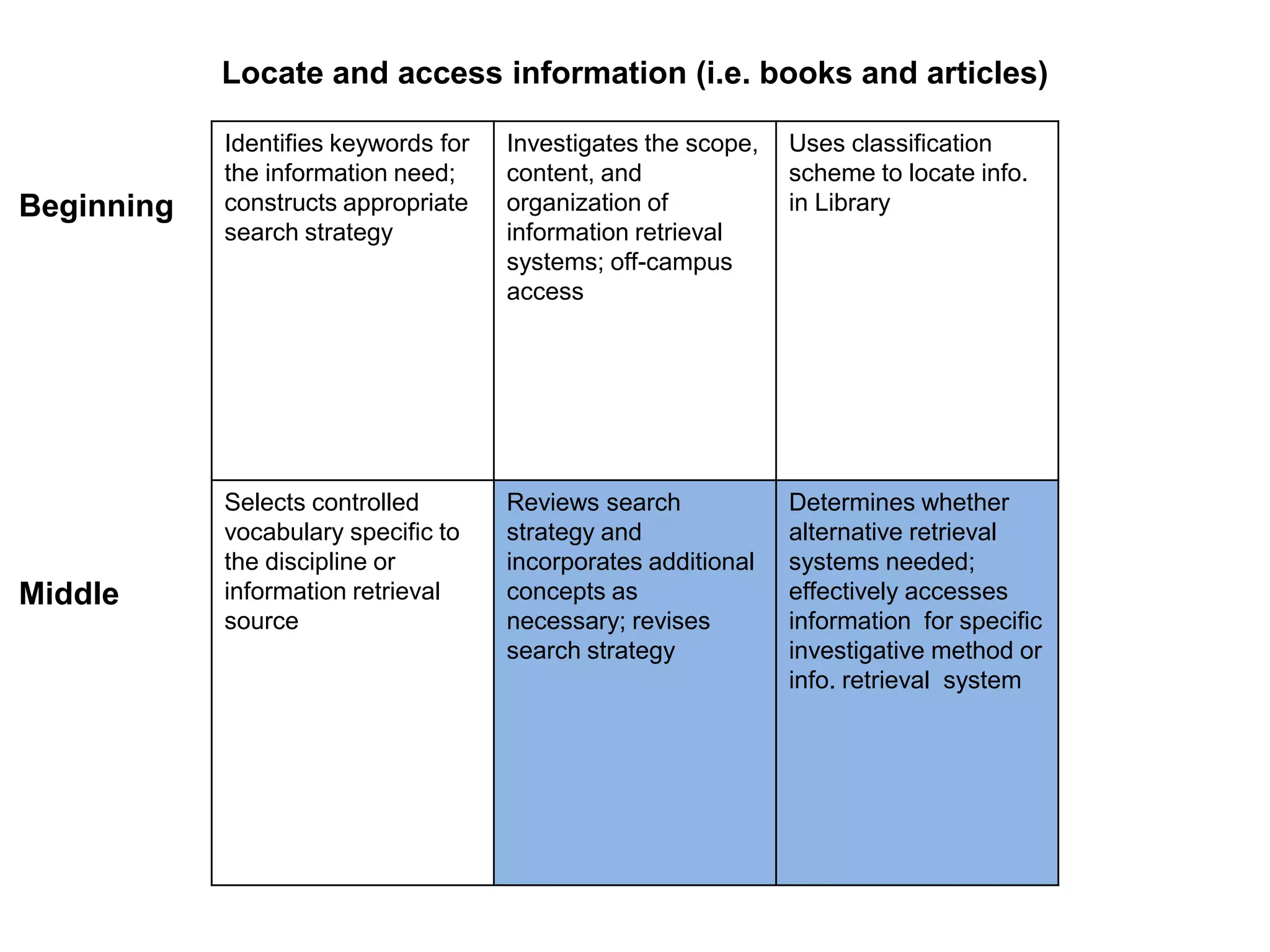
Locate and access information (i.e. books and articles)

            Identifies keywords for   Investigates the scope,   Uses classification
            the information need;     content, and              scheme to locate info.
Beginning   constructs appropriate    organization of           in Library
            search strategy           information retrieval
                                      systems; off-campus
                                      access


            Selects controlled        Reviews search            Determines whether
            vocabulary specific to    strategy and              alternative retrieval
            the discipline or         incorporates additional   systems needed;
Middle      information retrieval     concepts as               effectively accesses
            source                    necessary; revises        information for specific
                                      search strategy           investigative method or
                                                                info. retrieval system
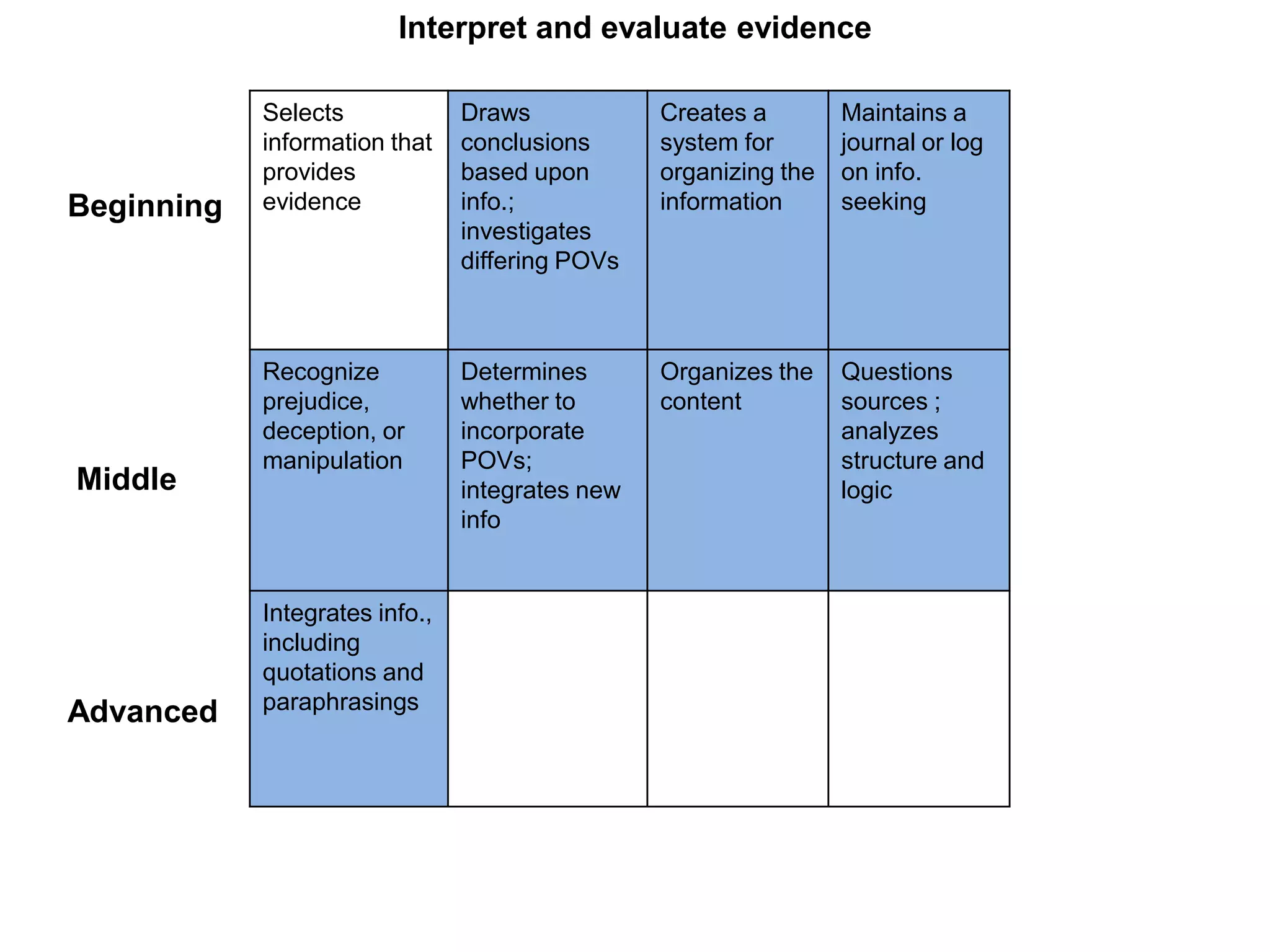
Interpret and evaluate evidence

            Selects             Draws            Creates a        Maintains a
            information that    conclusions      system for       journal or log
            provides            based upon       organizing the   on info.
Beginning   evidence            info.;           information      seeking
                                investigates
                                differing POVs


            Recognize           Determines       Organizes the    Questions
            prejudice,          whether to       content          sources ;
            deception, or       incorporate                       analyzes
            manipulation        POVs;                             structure and
Middle                          integrates new                    logic
                                info


            Integrates info.,
            including
            quotations and
Advanced    paraphrasings
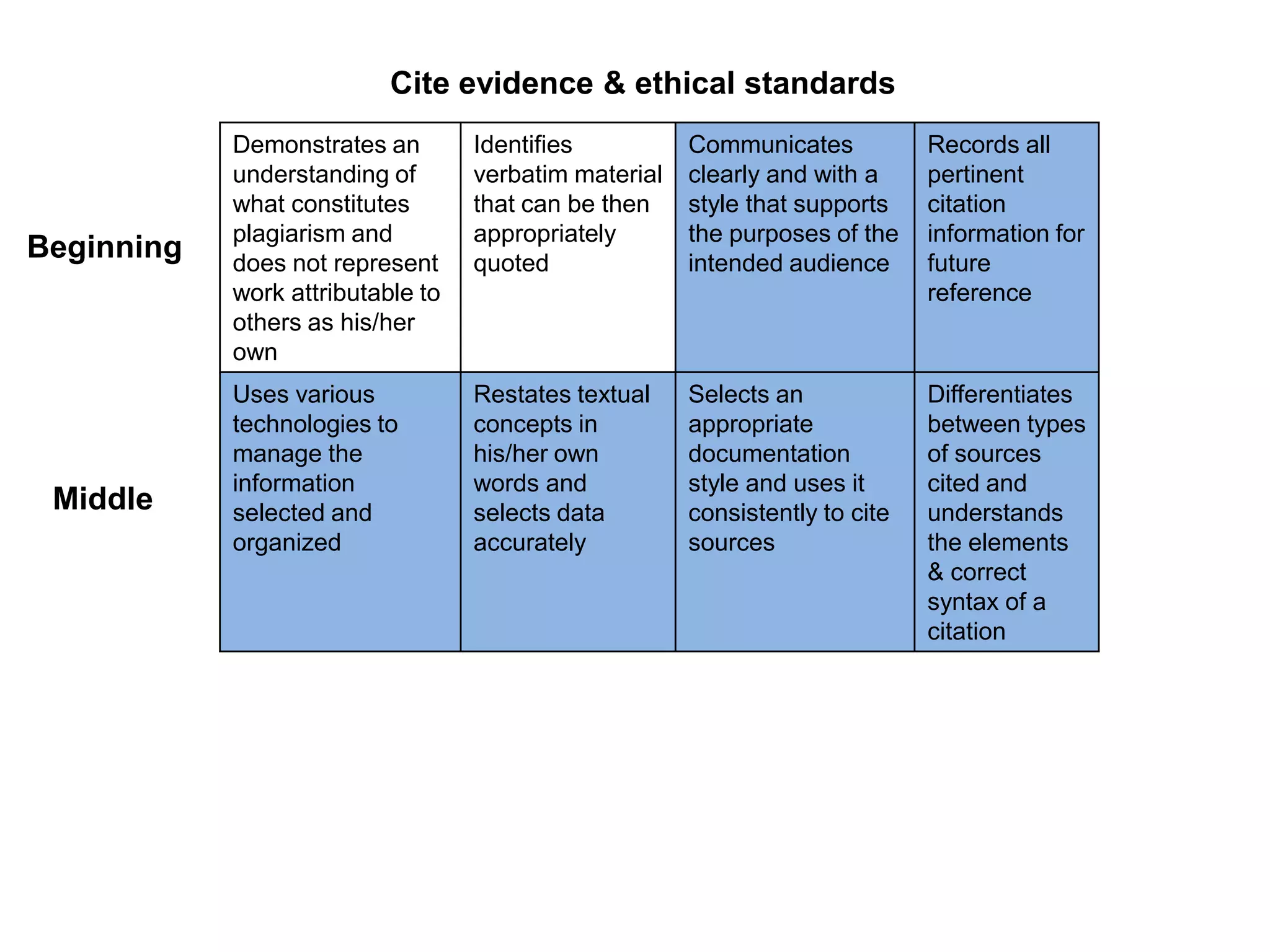
Cite evidence & ethical standards
            Demonstrates an        Identifies          Communicates           Records all
            understanding of       verbatim material   clearly and with a     pertinent
            what constitutes       that can be then    style that supports    citation
            plagiarism and         appropriately       the purposes of the    information for
Beginning   does not represent     quoted              intended audience      future
            work attributable to                                              reference
            others as his/her
            own
            Uses various           Restates textual    Selects an             Differentiates
            technologies to        concepts in         appropriate            between types
            manage the             his/her own         documentation          of sources
            information            words and           style and uses it      cited and
 Middle     selected and           selects data        consistently to cite   understands
            organized              accurately          sources                the elements
                                                                              & correct
                                                                              syntax of a
                                                                              citation
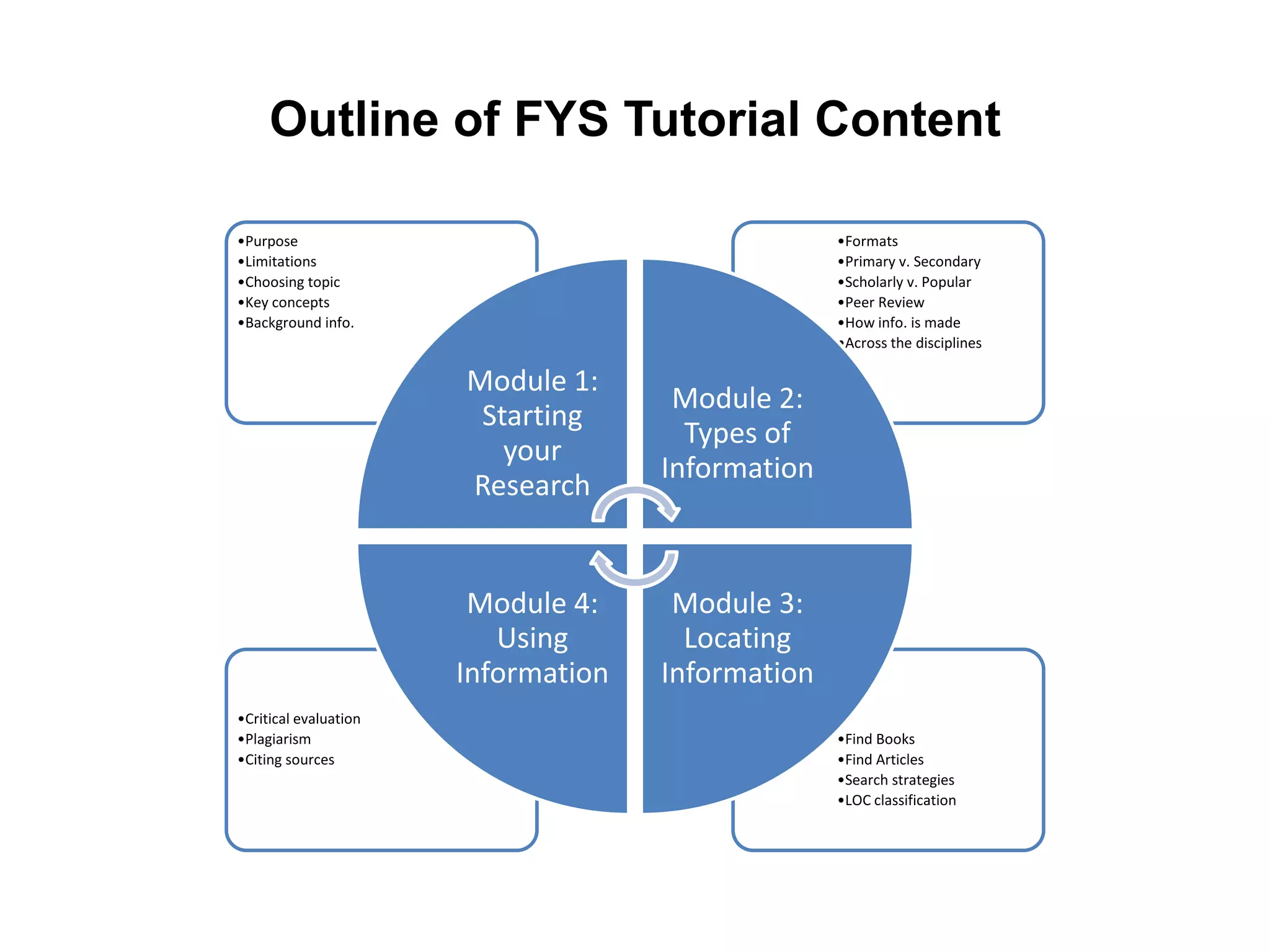
Outline of FYS Tutorial Content

•Purpose                                           •Formats
•Limitations                                       •Primary v. Secondary
•Choosing topic                                    •Scholarly v. Popular
•Key concepts                                      •Peer Review
•Background info.                                  •How info. is made
                                                   •Across the disciplines

                       Module 1:
                                      Module 2:
                        Starting
                                       Types of
                          your
                                     Information
                       Research


                        Module 4:     Module 3:
                          Using        Locating
                       Information   Information
•Critical evaluation
•Plagiarism                                        •Find Books
•Citing sources                                    •Find Articles
                                                   •Search strategies
                                                   •LOC classification
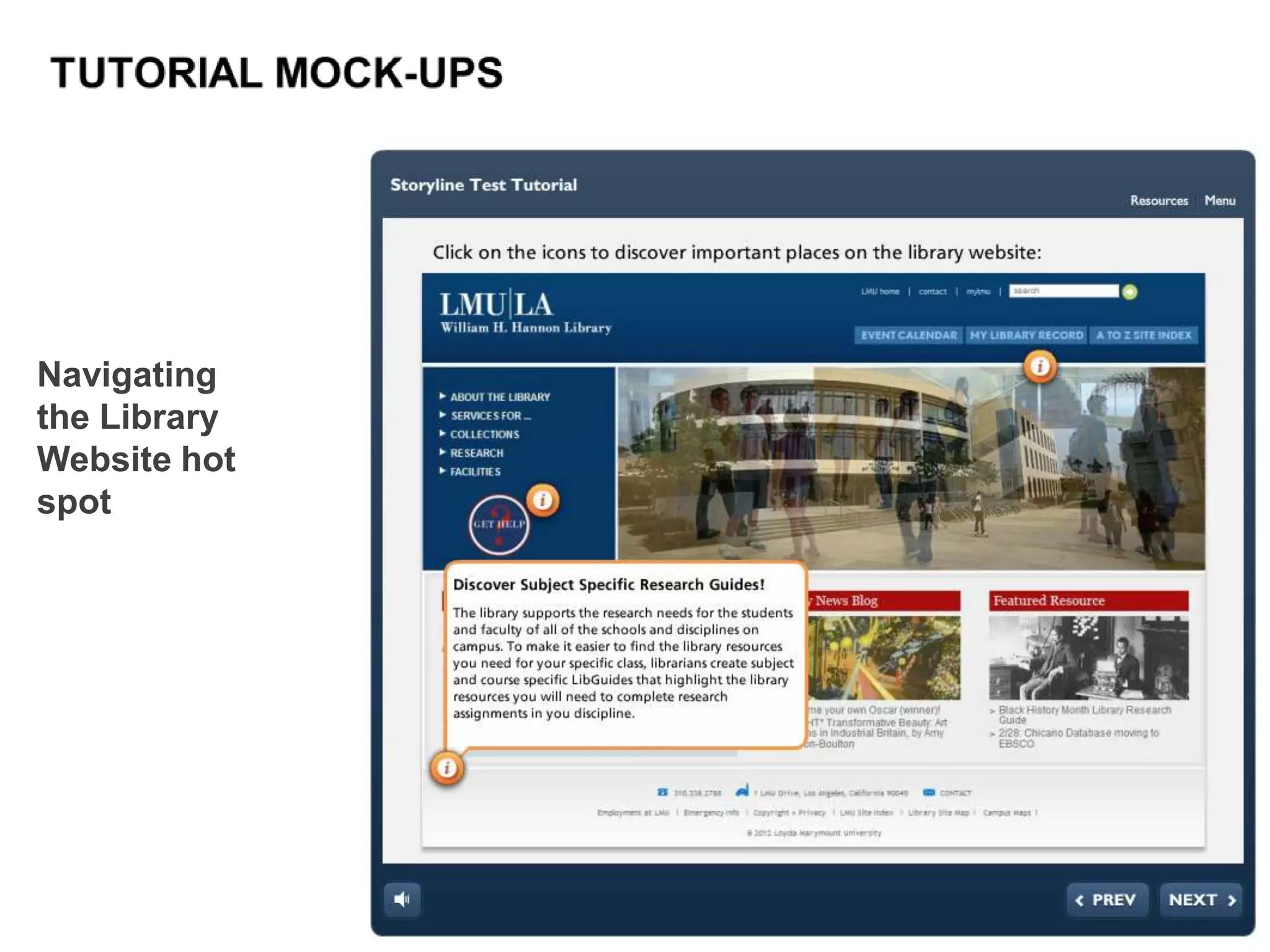
Navigating
the Library
Website hot
spot
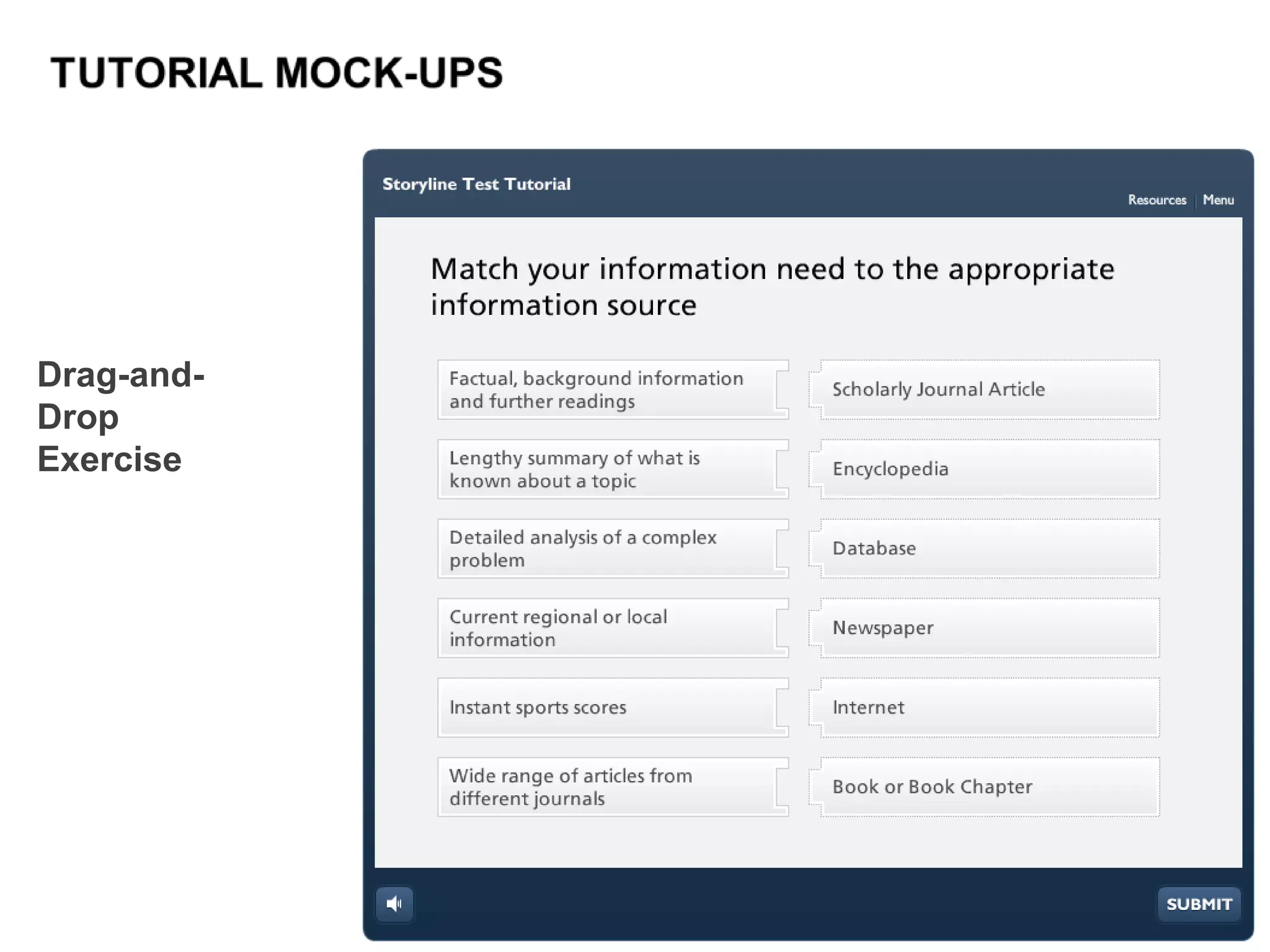
Drag-and-
Drop
Exercise
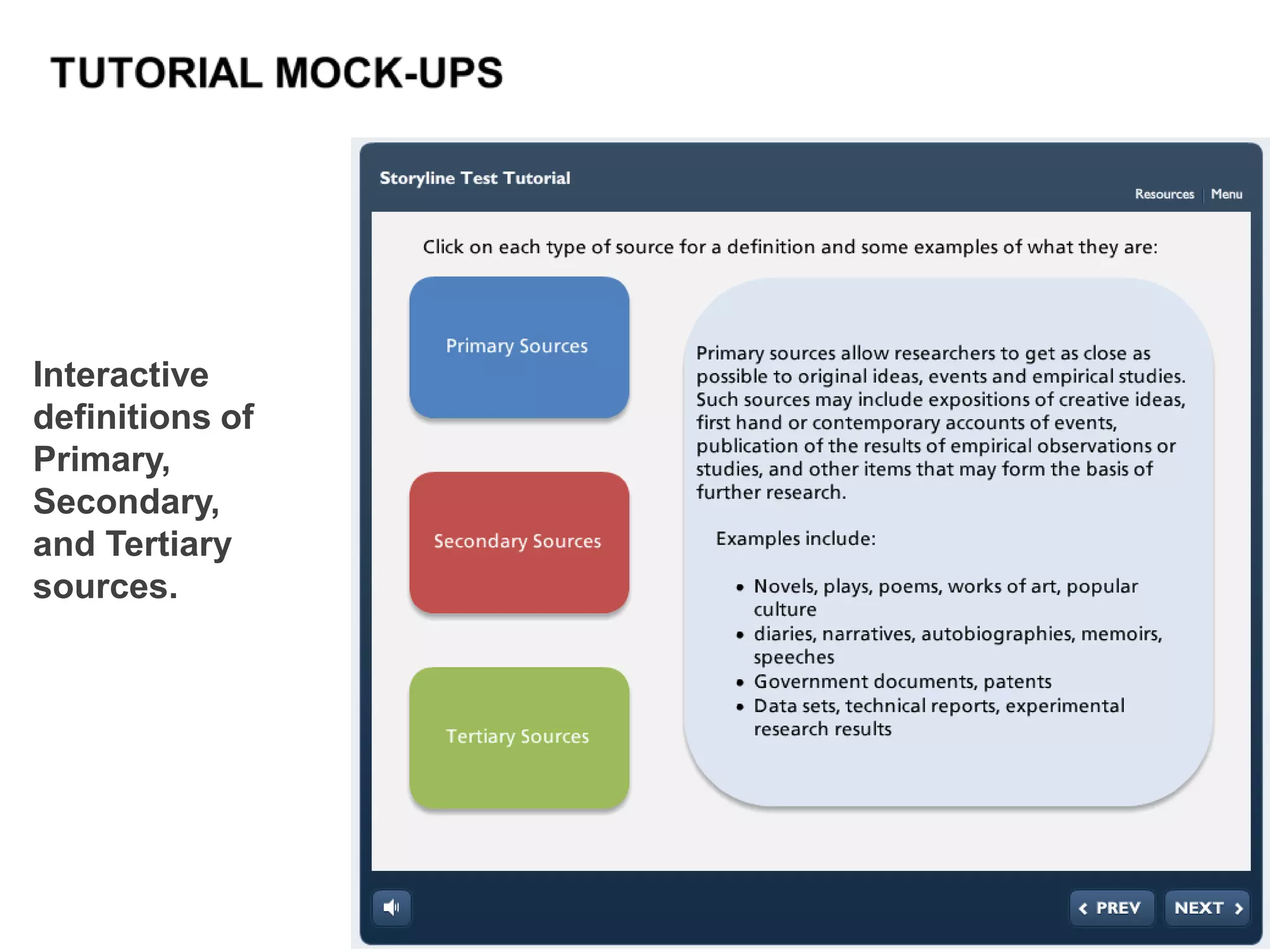
Interactive
definitions of
Primary,
Secondary,
and Tertiary
sources.
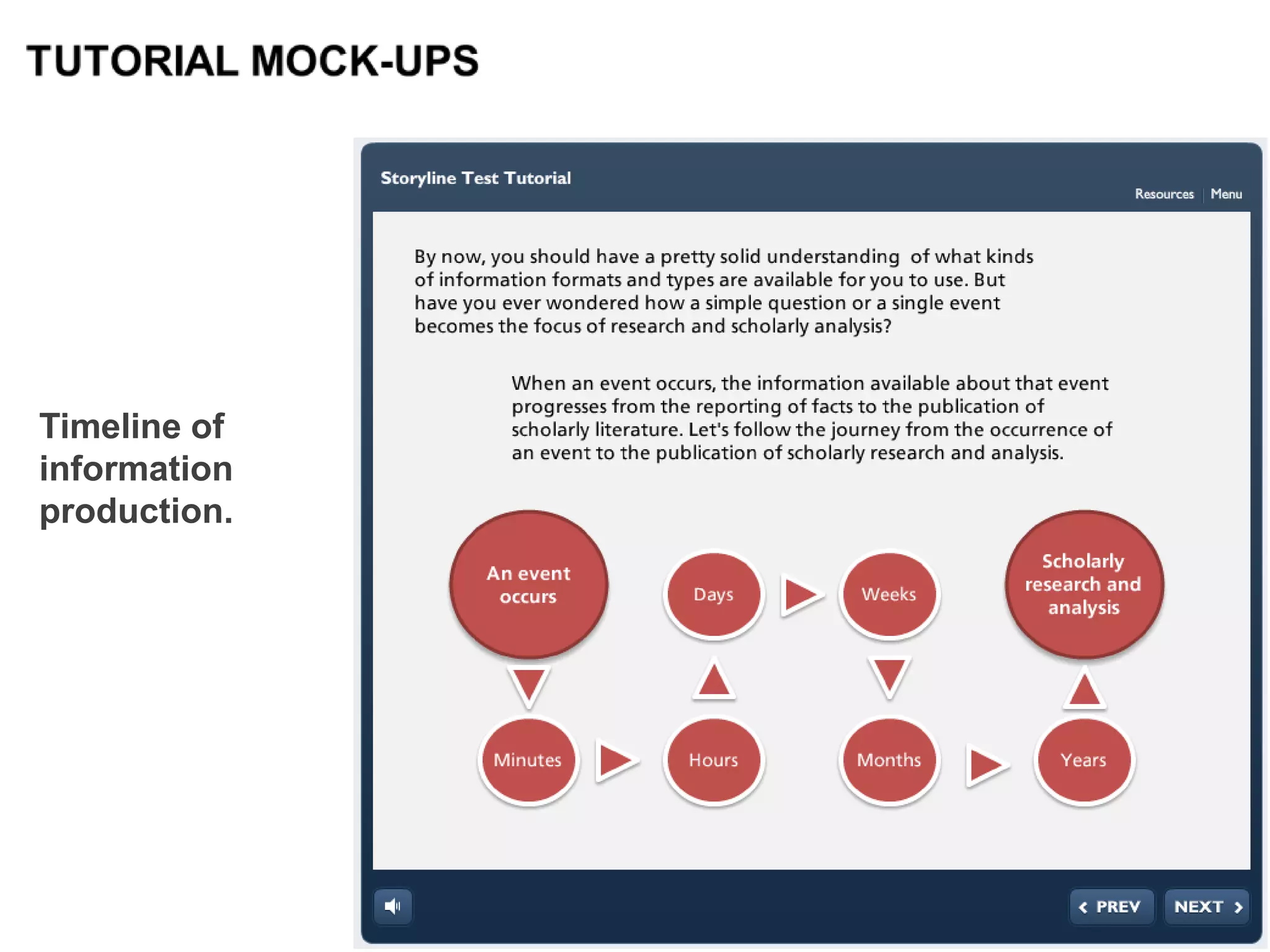
Timeline of
information
production.
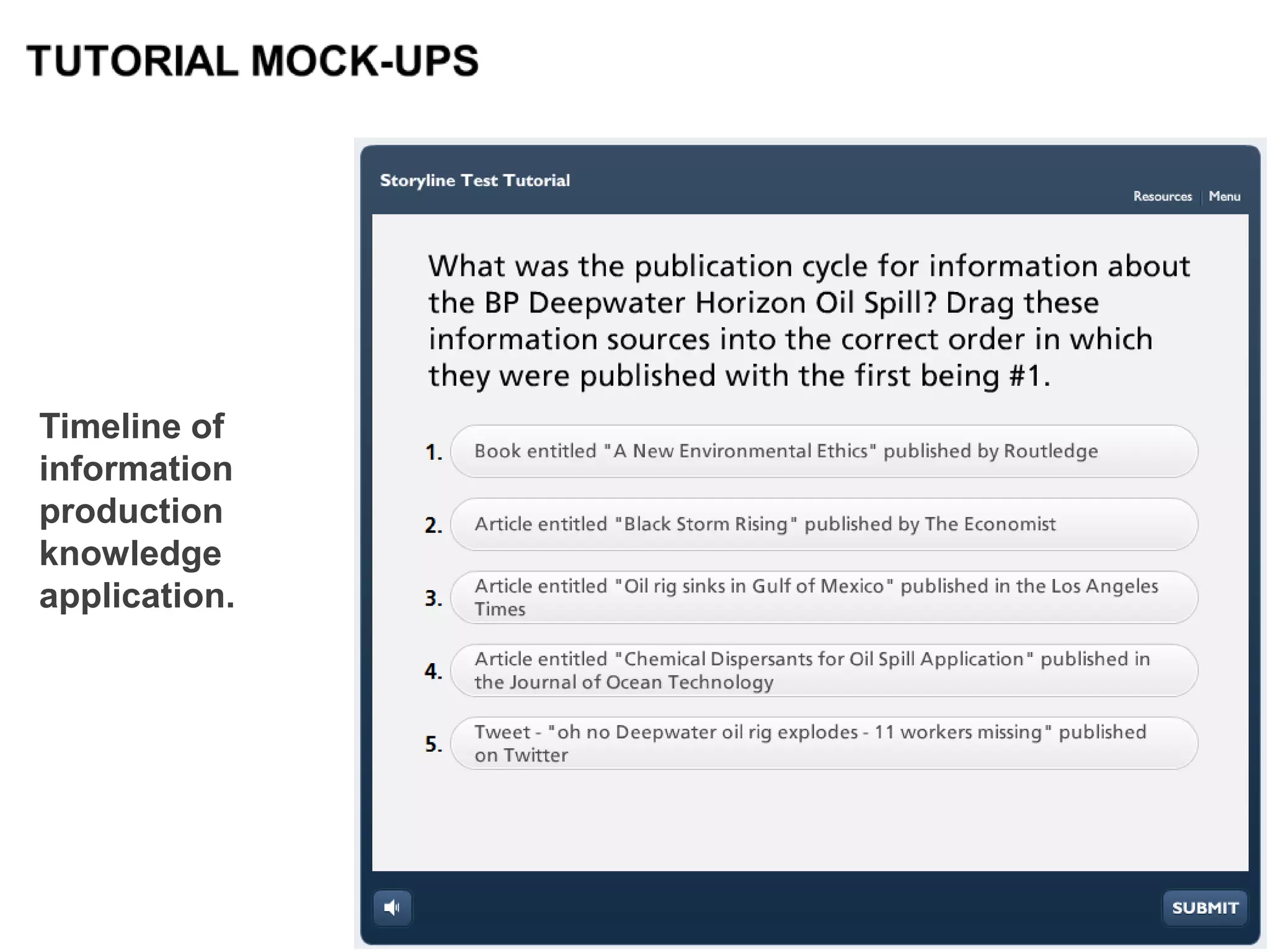
Timeline of
information
production
knowledge
application.
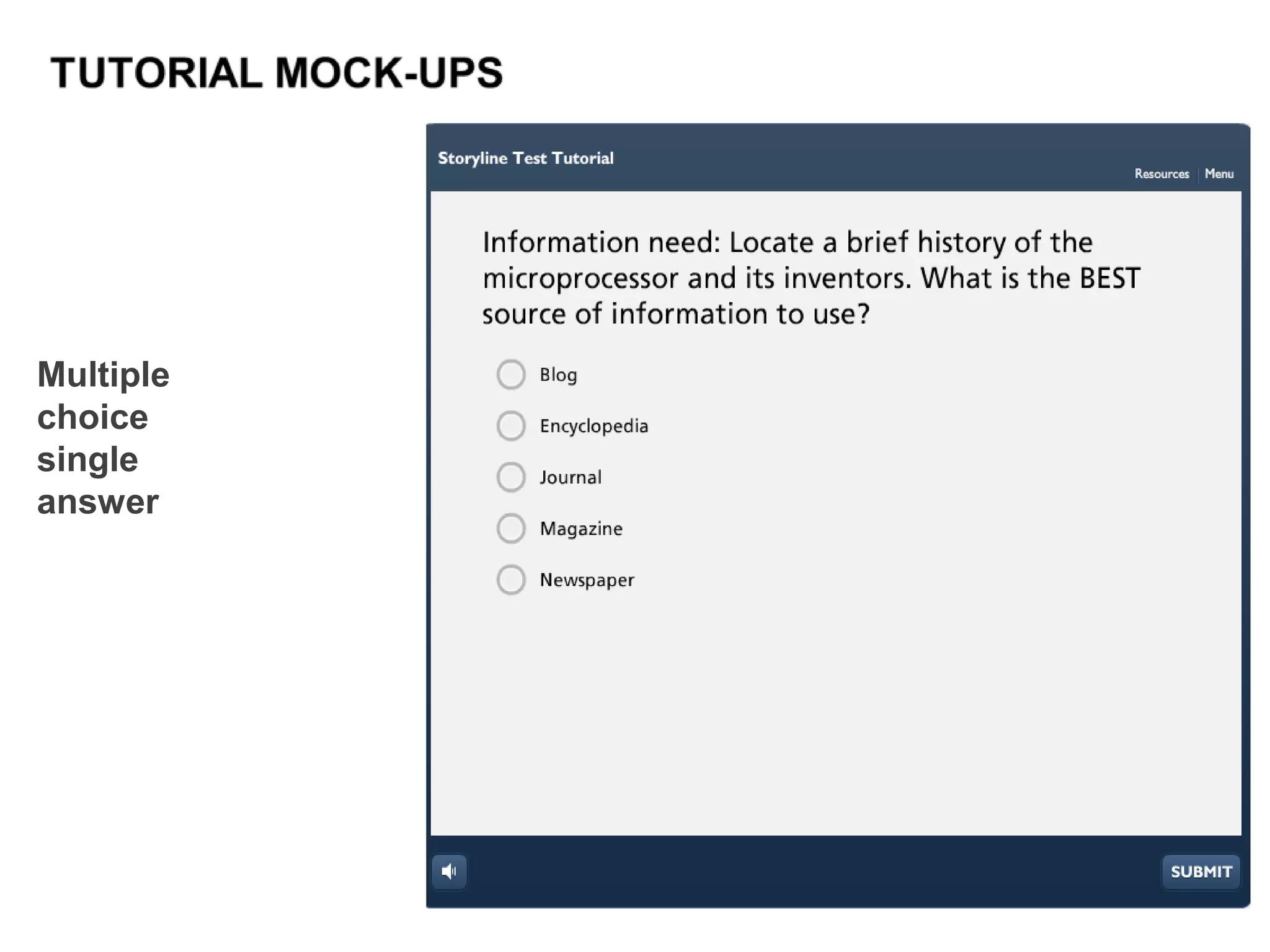
Multiple
choice
single
answer
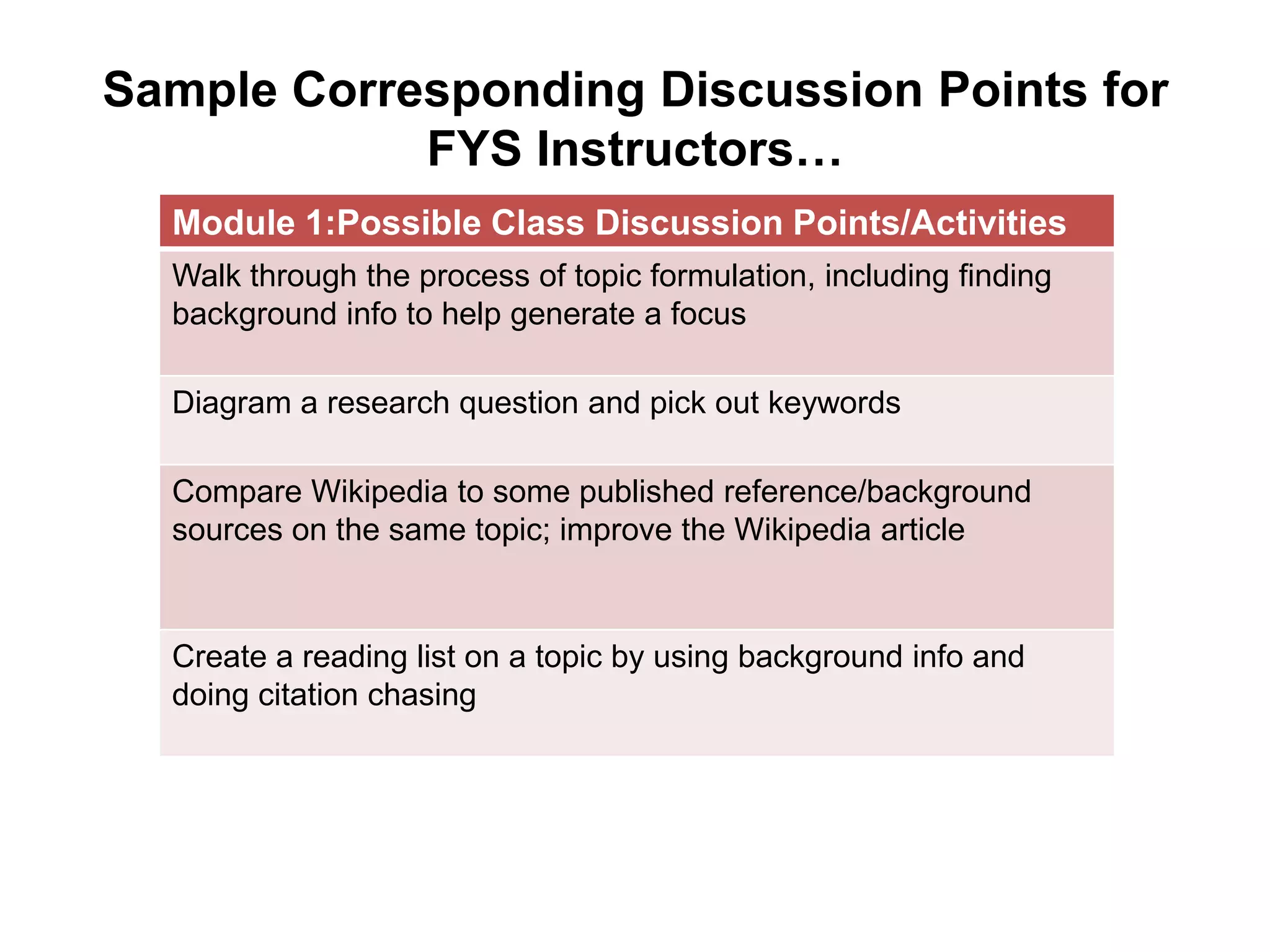
Sample Corresponding Discussion Points for
            FYS Instructors…
  Module 1:Possible Class Discussion Points/Activities
  Walk through the process of topic formulation, including finding
  background info to help generate a focus

  Diagram a research question and pick out keywords

  Compare Wikipedia to some published reference/background
  sources on the same topic; improve the Wikipedia article


  Create a reading list on a topic by using background info and
  doing citation chasing
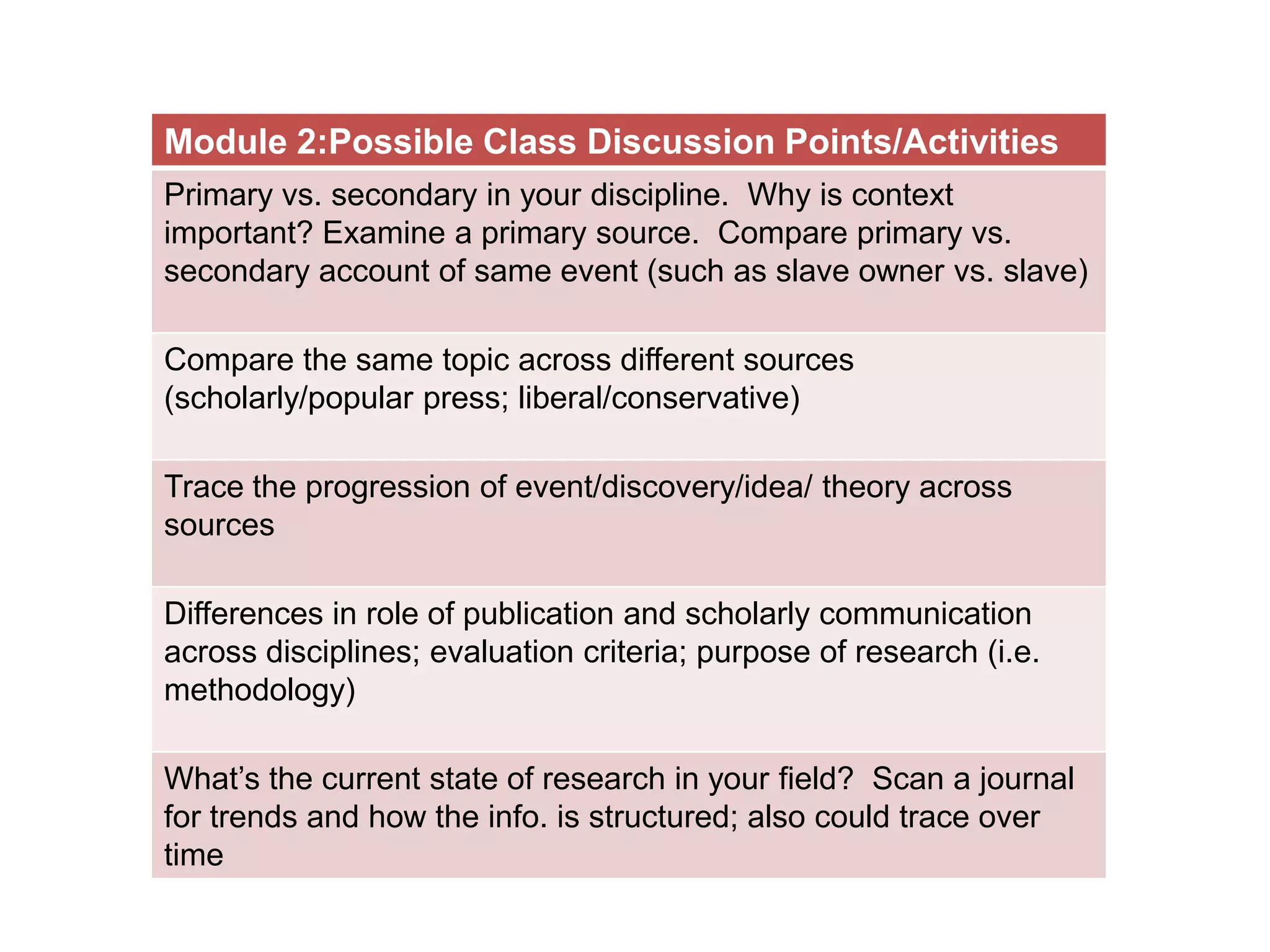
Module 2:Possible Class Discussion Points/Activities
Primary vs. secondary in your discipline. Why is context
important? Examine a primary source. Compare primary vs.
secondary account of same event (such as slave owner vs. slave)

Compare the same topic across different sources
(scholarly/popular press; liberal/conservative)

Trace the progression of event/discovery/idea/ theory across
sources

Differences in role of publication and scholarly communication
across disciplines; evaluation criteria; purpose of research (i.e.
methodology)

What’s the current state of research in your field? Scan a journal
for trends and how the info. is structured; also could trace over
time
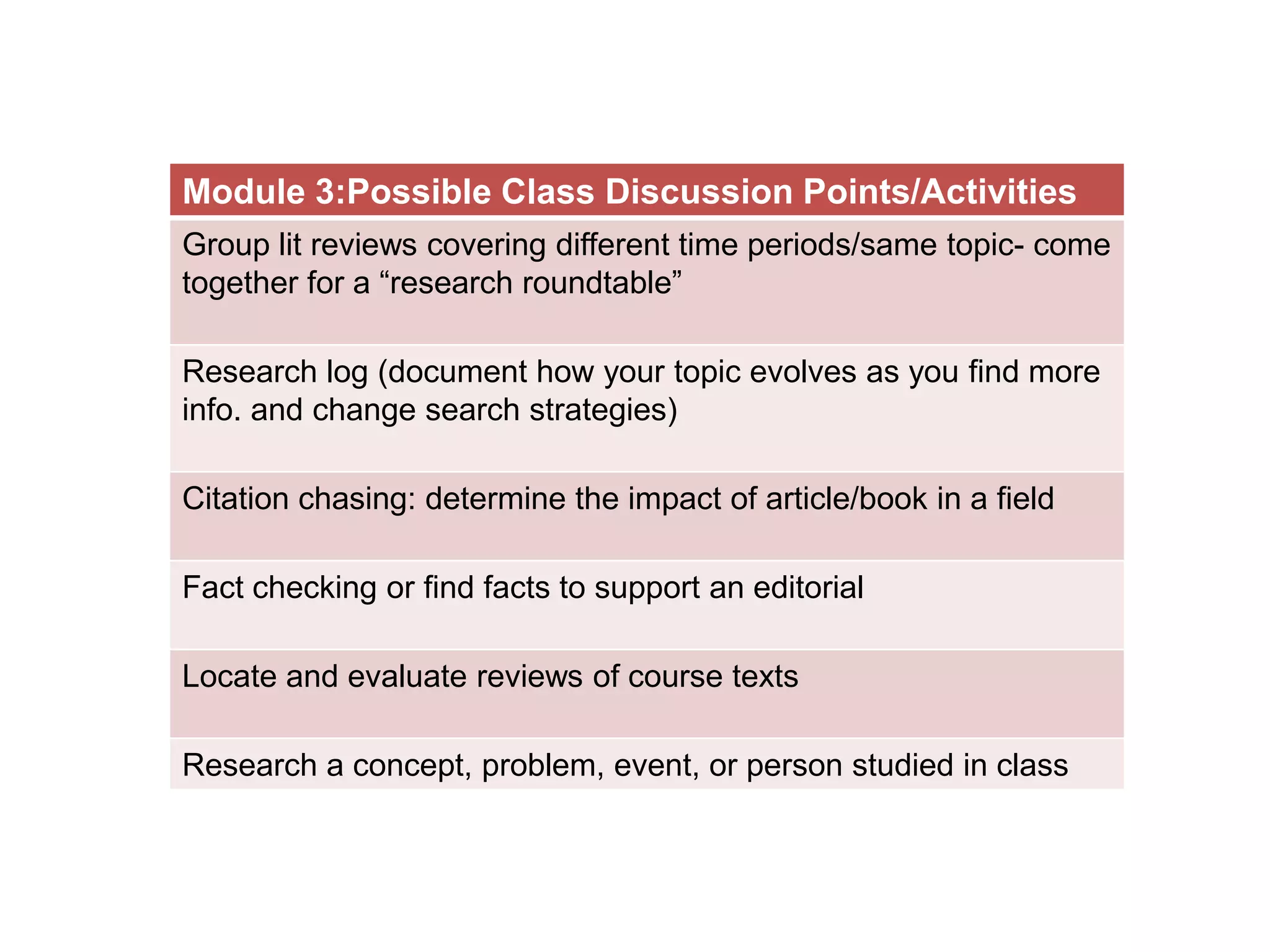
Module 3:Possible Class Discussion Points/Activities
Group lit reviews covering different time periods/same topic- come
together for a “research roundtable”

Research log (document how your topic evolves as you find more
info. and change search strategies)

Citation chasing: determine the impact of article/book in a field

Fact checking or find facts to support an editorial

Locate and evaluate reviews of course texts

Research a concept, problem, event, or person studied in class
Module 4:Possible Class Discussion Points/Activities
Examine sources and evaluate according to set criteria

Talk about the preferred documentation style in your discipline;
have students submit citations in that style

Annotated bibliography

Dissect and review the citations on course syllabi

Plagiarism and why it matters
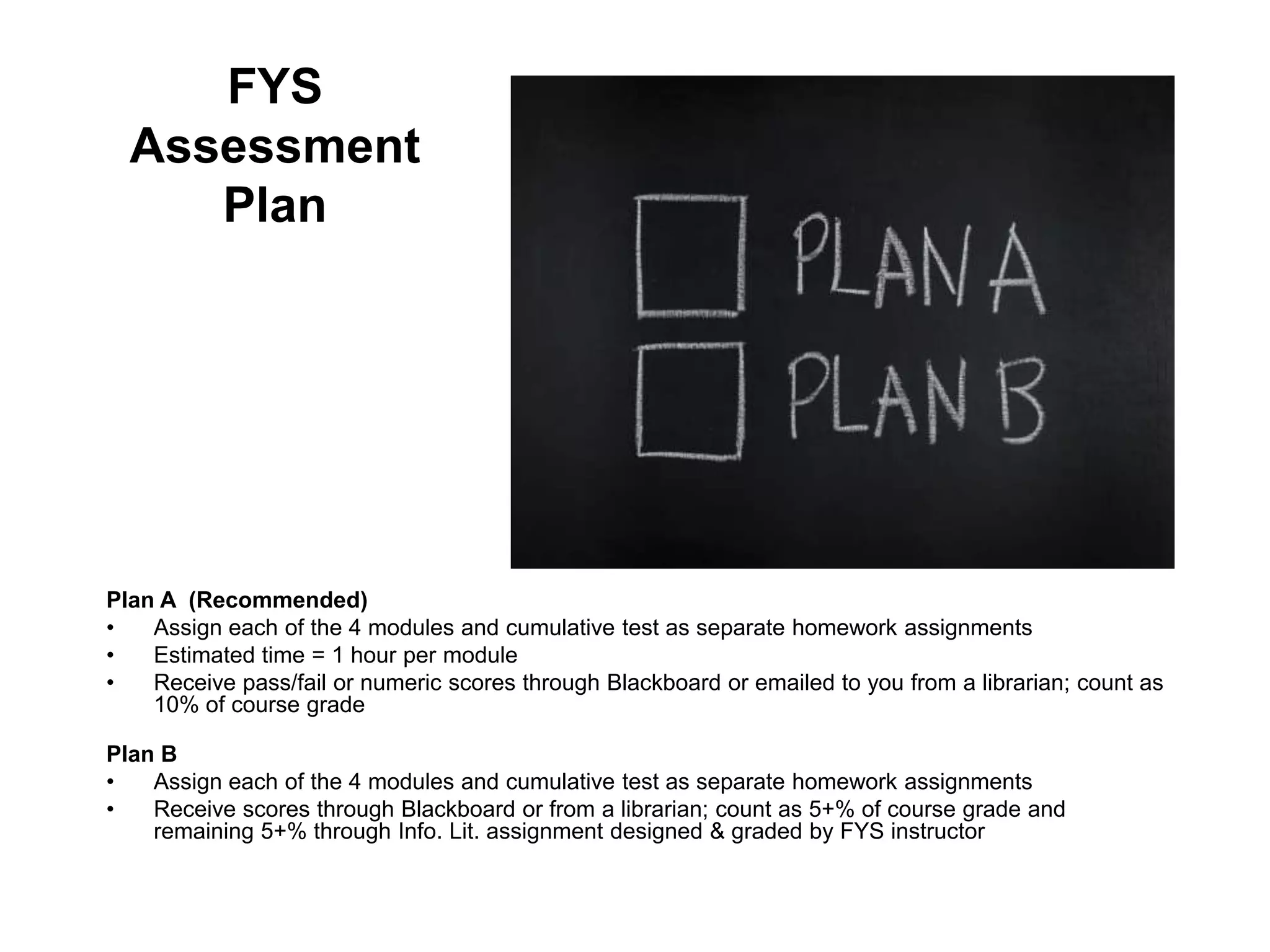
FYS
  Assessment
     Plan


Plan A (Recommended)
•   Assign each of the 4 modules and cumulative test as separate homework assignments
•   Estimated time = 1 hour per module
•   Receive pass/fail or numeric scores through Blackboard or emailed to you from a librarian; count as
    10% of course grade

Plan B
•   Assign each of the 4 modules and cumulative test as separate homework assignments
•   Receive scores through Blackboard or from a librarian; count as 5+% of course grade and
    remaining 5+% through Info. Lit. assignment designed & graded by FYS instructor
Rhetorical Arts (RA)

• Freshman requirement – Spring Semester
• Continue to develop the critical thinking, information literacy,
  and research skills begun in the First Year Seminar
• Assign at least 10 % of the final course grade on the basis
  of information literacy, with a librarian-led workshop and one
  or more course-integrated assignments
• Information Literacy Outcomes:
   -   Conceptualize an effective research strategy and then collect, interpret,
       evaluate and cite evidence in written and oral communication
   -   Distinguish between types of information resources and how these
       resources meet the needs of different levels of scholarship and different
       academic disciplines


                                                         http://www.lmu.edu/Assets/Rhetorical+Arts.pdf
R.A. Assignments Related to Info. Lit.

• Will include annotated bibliography, final paper, and oral
  presentations

• Will include “learning portfolio” emphasizing role of
  revisions in writing process

• Library will probably license NoodleTools, an integrated
  online suite of tools for building good research & writing
  habits, for use in Rhetorical Arts
Assessment of Rhetorical Arts

• Library                    • Final resource list
  tutorials/homework =         (annotated
  5% of course grade           bibliography) = 10% of
                               course grade
• Draft resource list = 5%
  of course grade            • Research quality/use =
                               part of final research
• Learning Portfolio will      paper grade
  include outlines and
  research notes
Information Literacy Flags

                                     • Faculty encouraged to consult
• All students must take one Info      with a librarian when designing
  Lit Flagged course before            Info Lit assignments
  graduating                         • Librarians can create a custom
• Any course at the 200 level or       LibGuide or research Guide for
  higher may meet a flagged            the course
  requirement                        • Rolling review process
• No course may carry more           • Suggested info. lit. learning
  than two flags                       outcomes related to:
• At least 10% of the total course     -selecting evidence
  grade must assess information        -finding &using professional
  literacy                             info.
                                       -source types
                                       -evaluating info.
Proposal Requirements


• All full time faculty members       • Once a course is approved by
  may propose a course for the          the Chair, Dean and Course
  new Core                              Approval Committees, that
• Chairs and Deans determine            course can be taught by any
  the feasibility of a course to be     qualified faculty member who
  offered                               is assigned by the Dean and/or
                                        Chair in the usual manner for
• Course proposals require the
                                        such assignments
  signature of the faculty
  member's Chair and Dean,
  prior to submission to the
  UCCC
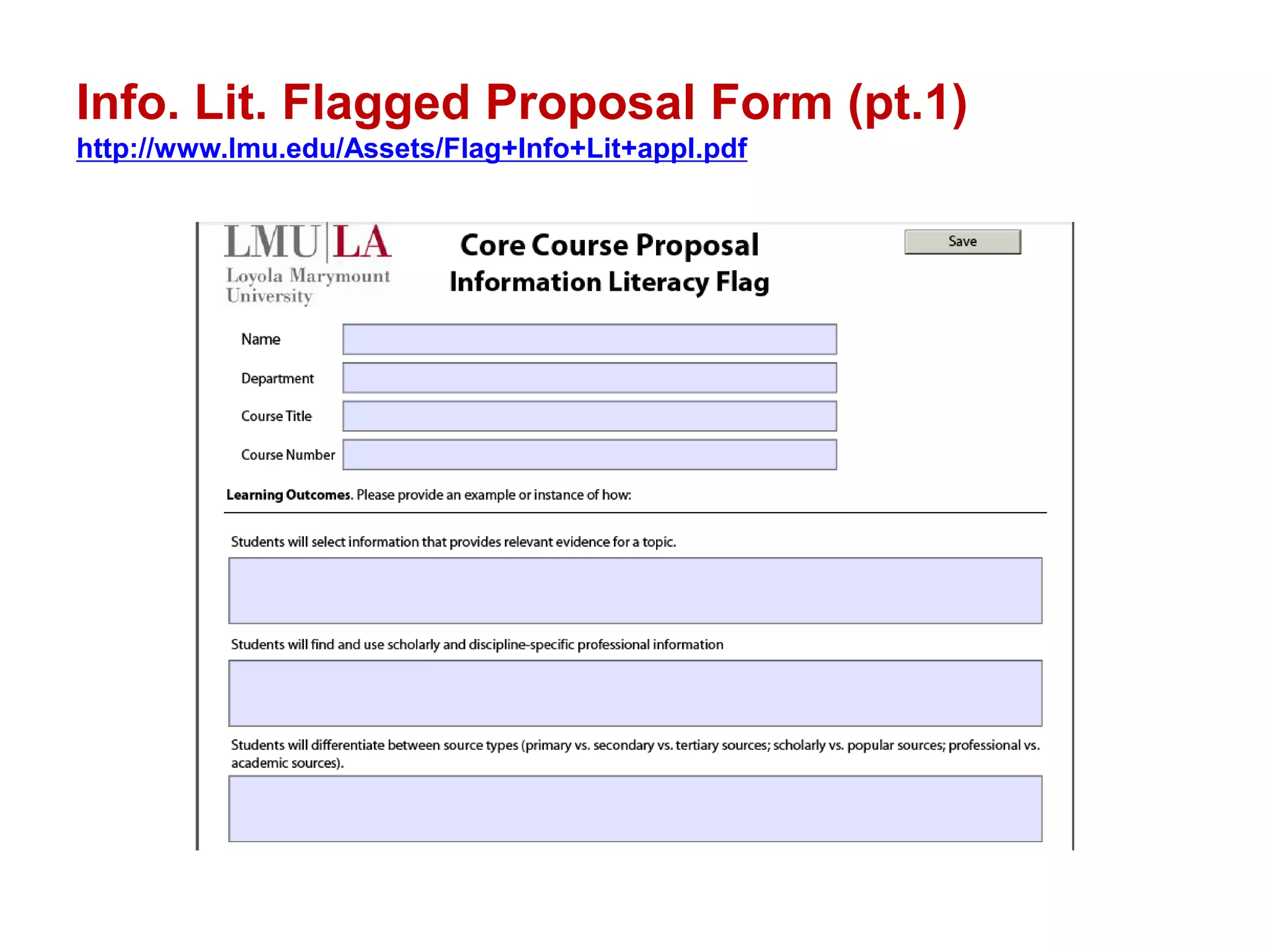
Info. Lit. Flagged Proposal Form (pt.1)
http://www.lmu.edu/Assets/Flag+Info+Lit+appl.pdf
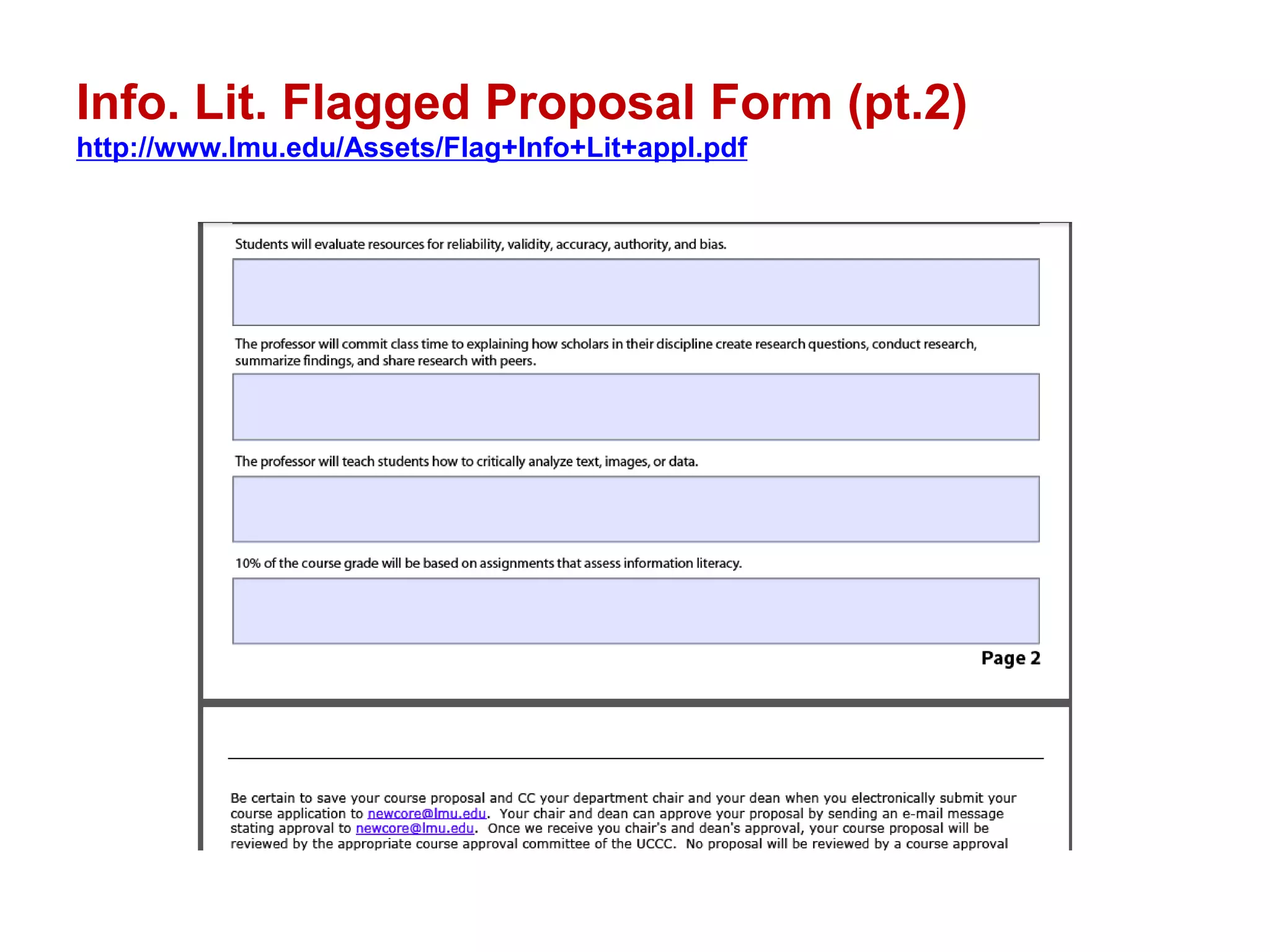
Info. Lit. Flagged Proposal Form (pt.2)
http://www.lmu.edu/Assets/Flag+Info+Lit+appl.pdf
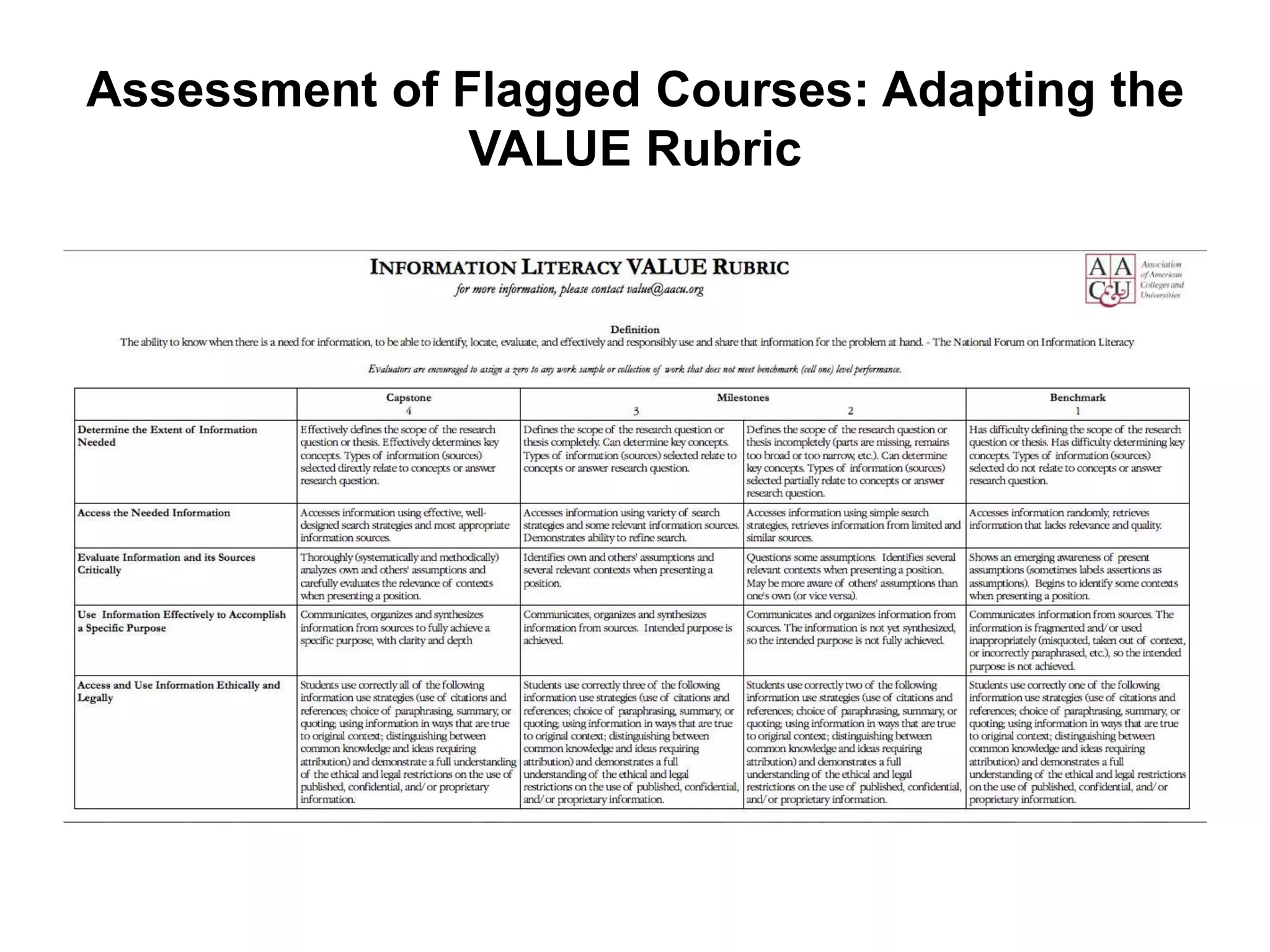
Assessment of Flagged Courses: Adapting the
               VALUE Rubric
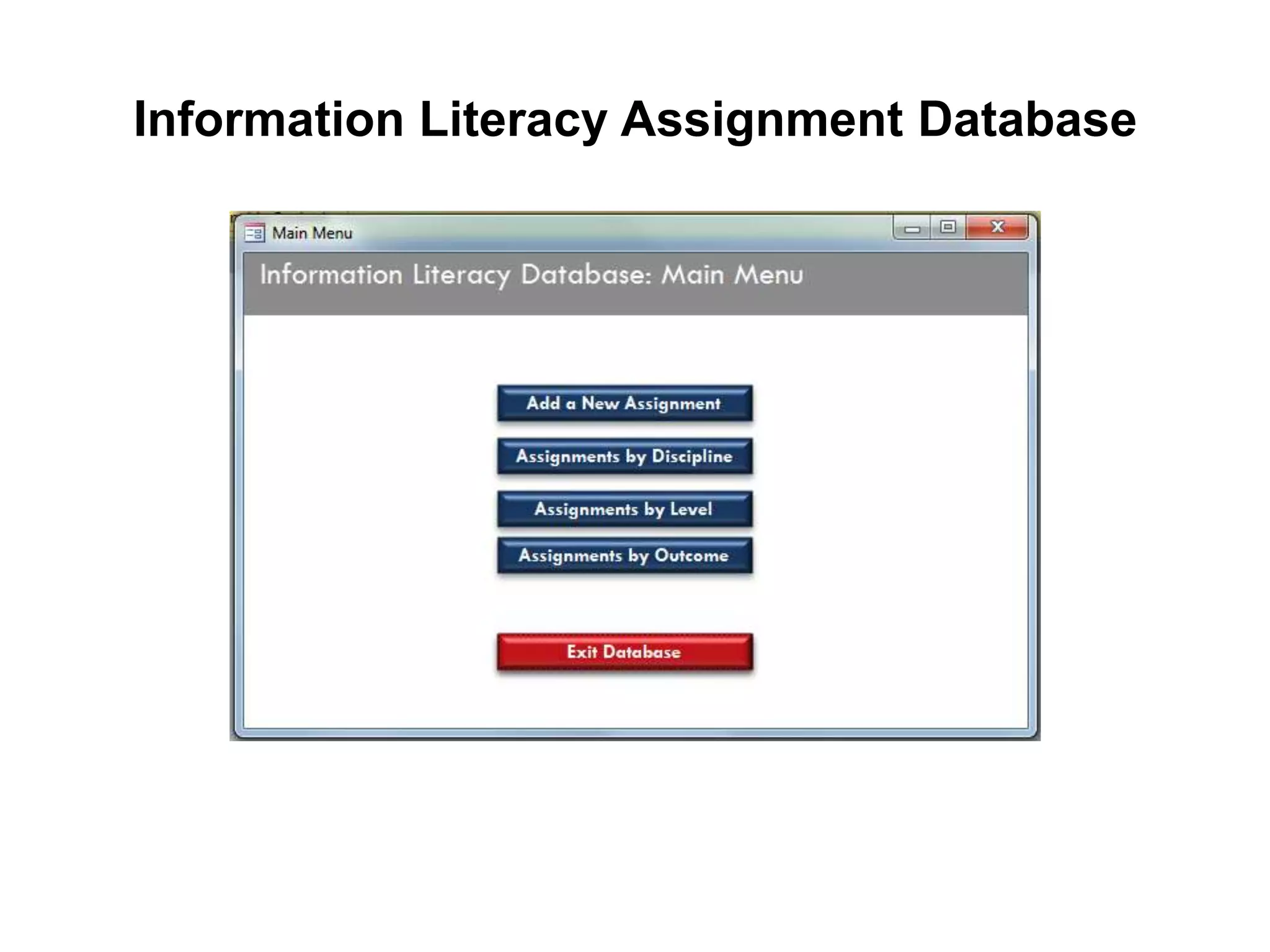
Information Literacy Assignment Database
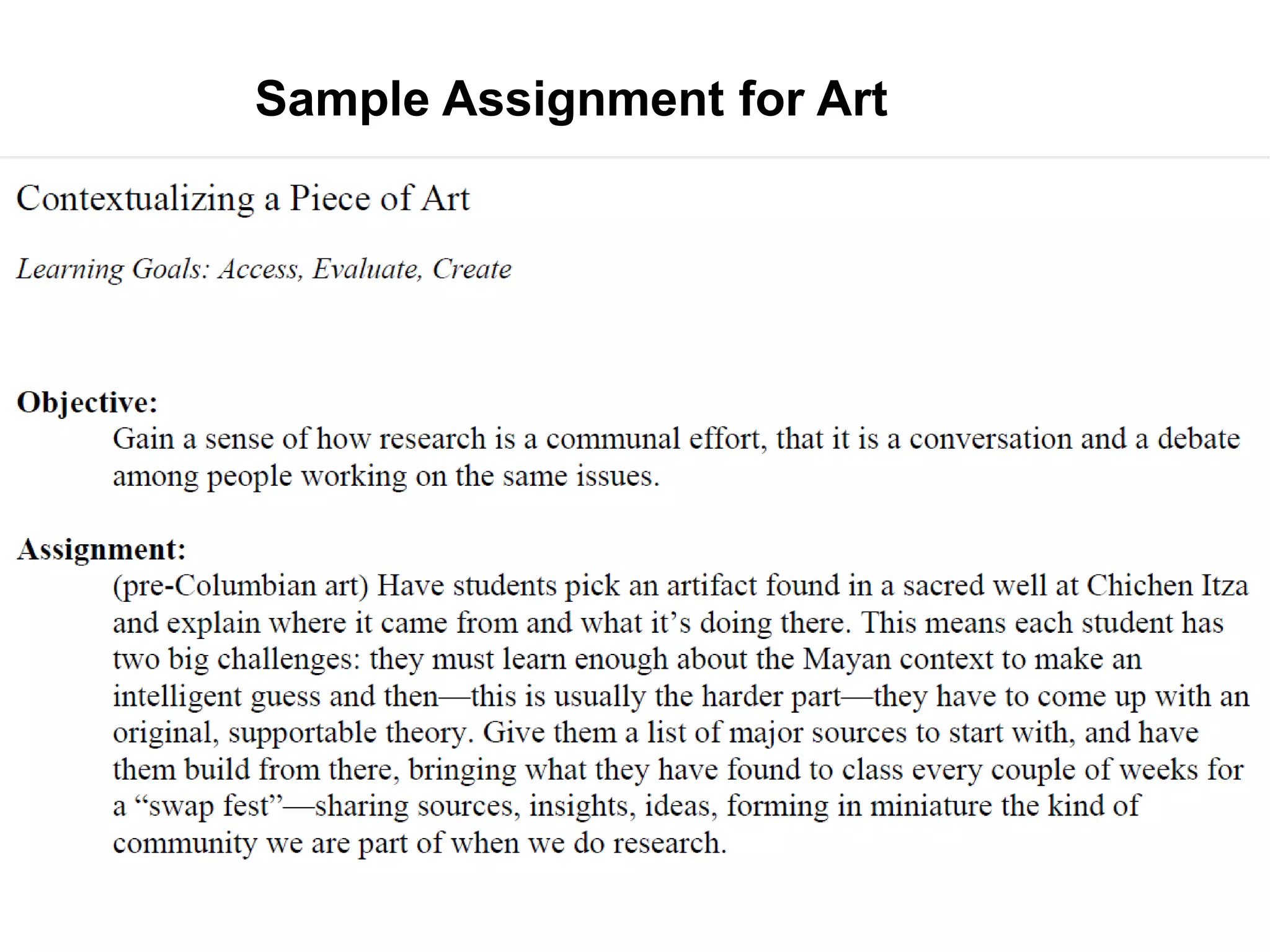
Sample Assignment for Art
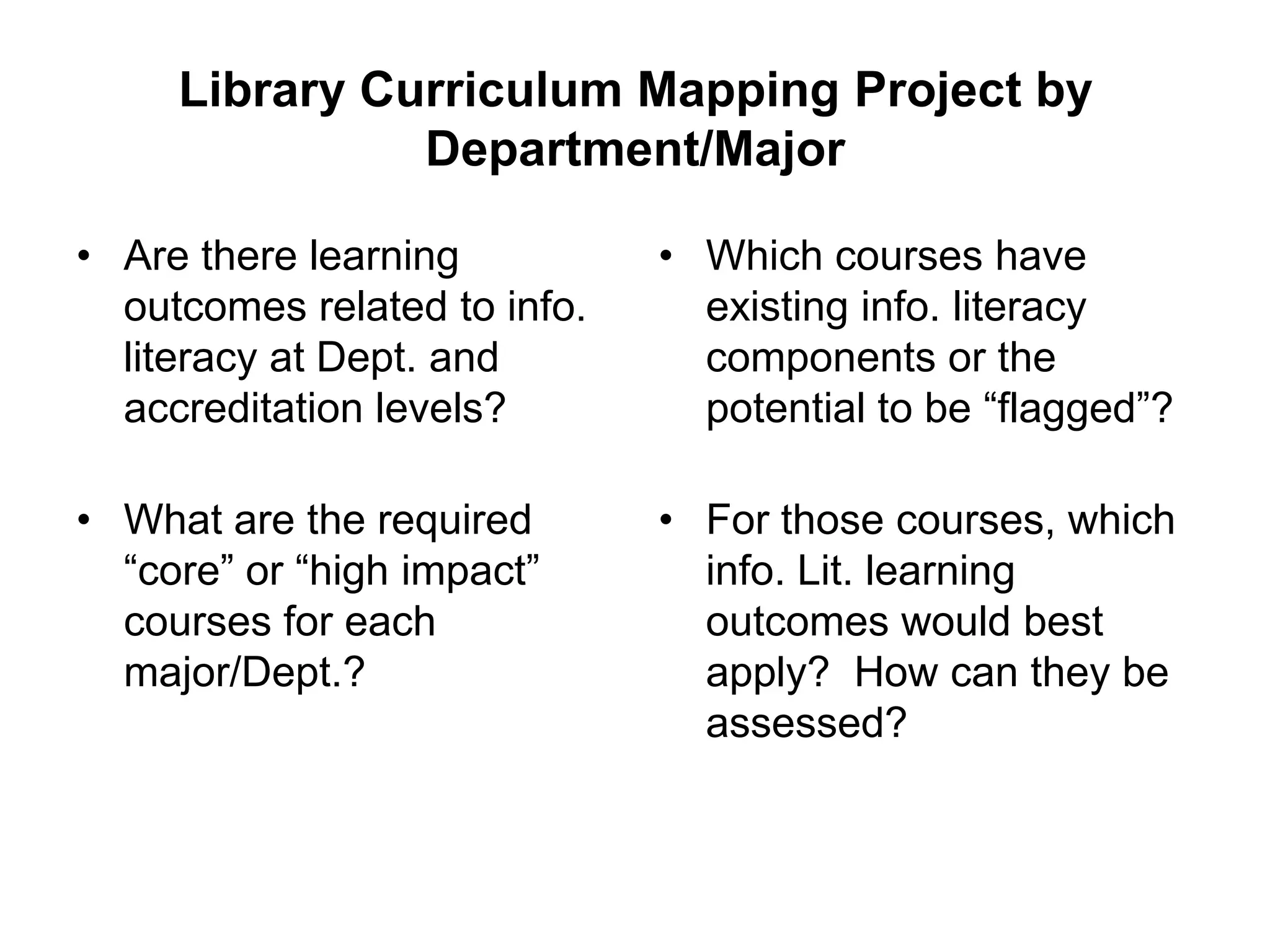
Library Curriculum Mapping Project by
               Department/Major

• Are there learning          • Which courses have
  outcomes related to info.     existing info. literacy
  literacy at Dept. and         components or the
  accreditation levels?         potential to be “flagged”?

• What are the required       • For those courses, which
  “core” or “high impact”       info. Lit. learning
  courses for each              outcomes would best
  major/Dept.?                  apply? How can they be
                                assessed?
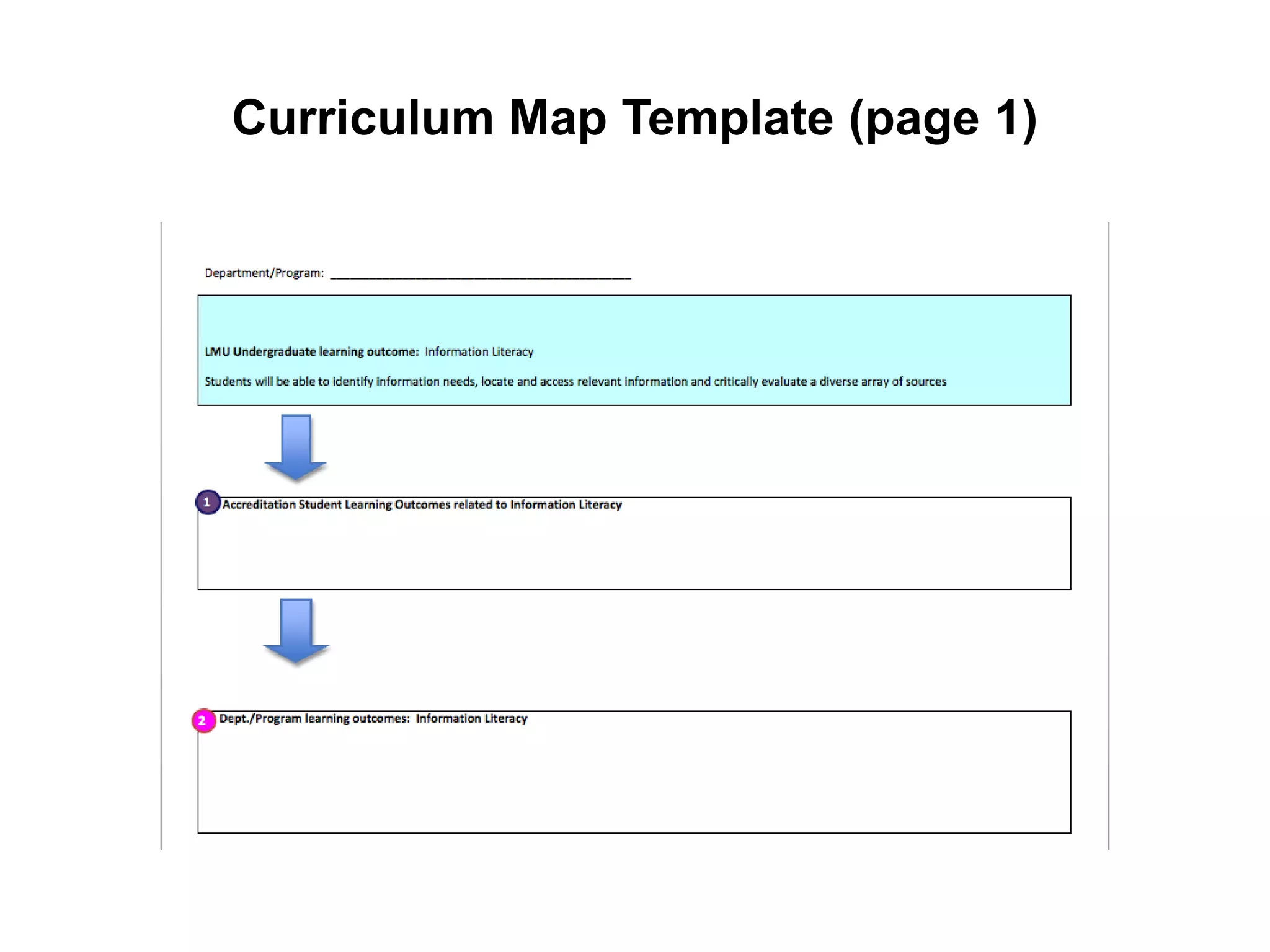
Curriculum Map Template (page 1)
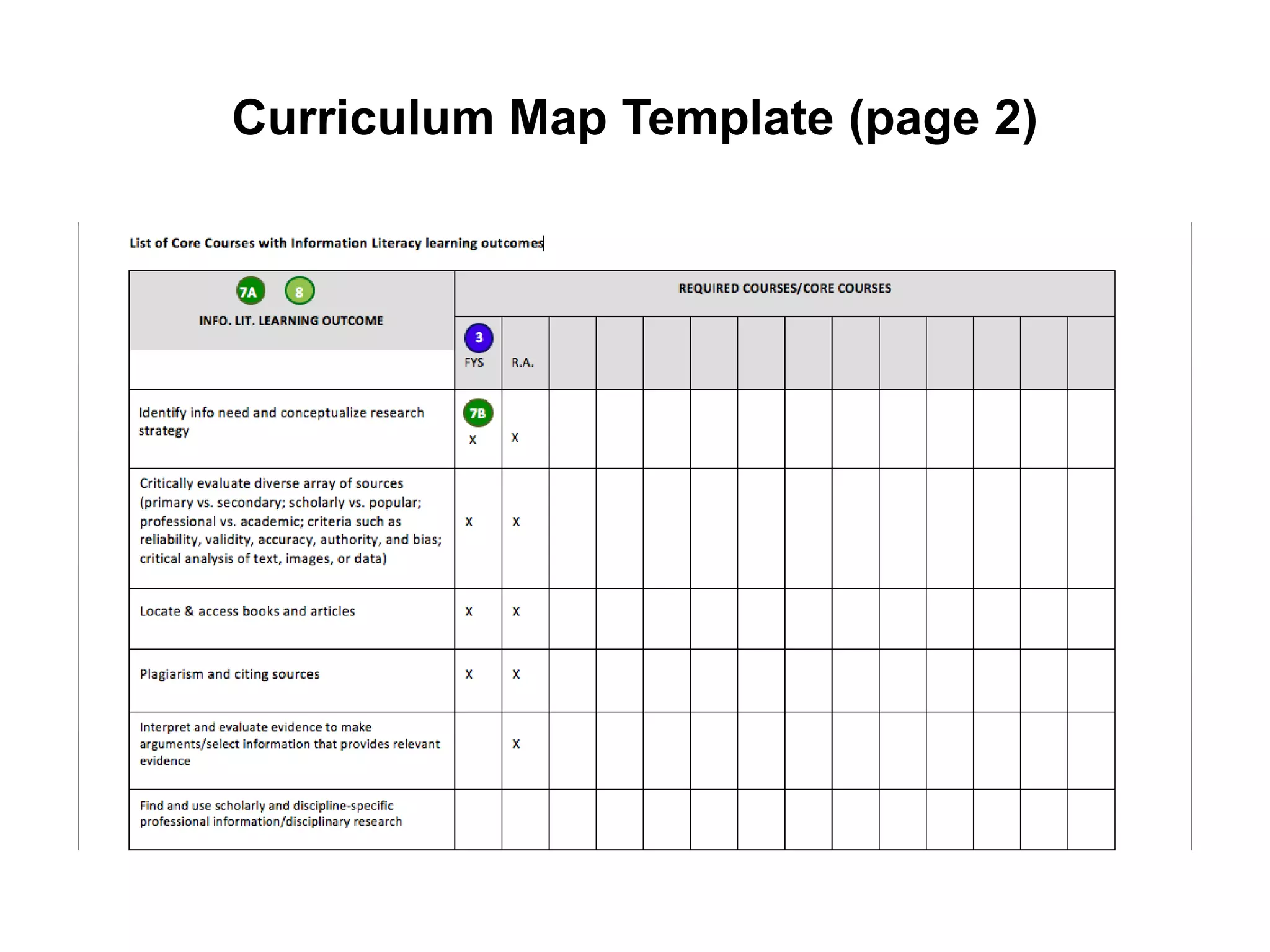
Curriculum Map Template (page 2)
Curriculum Map Template (page 3)
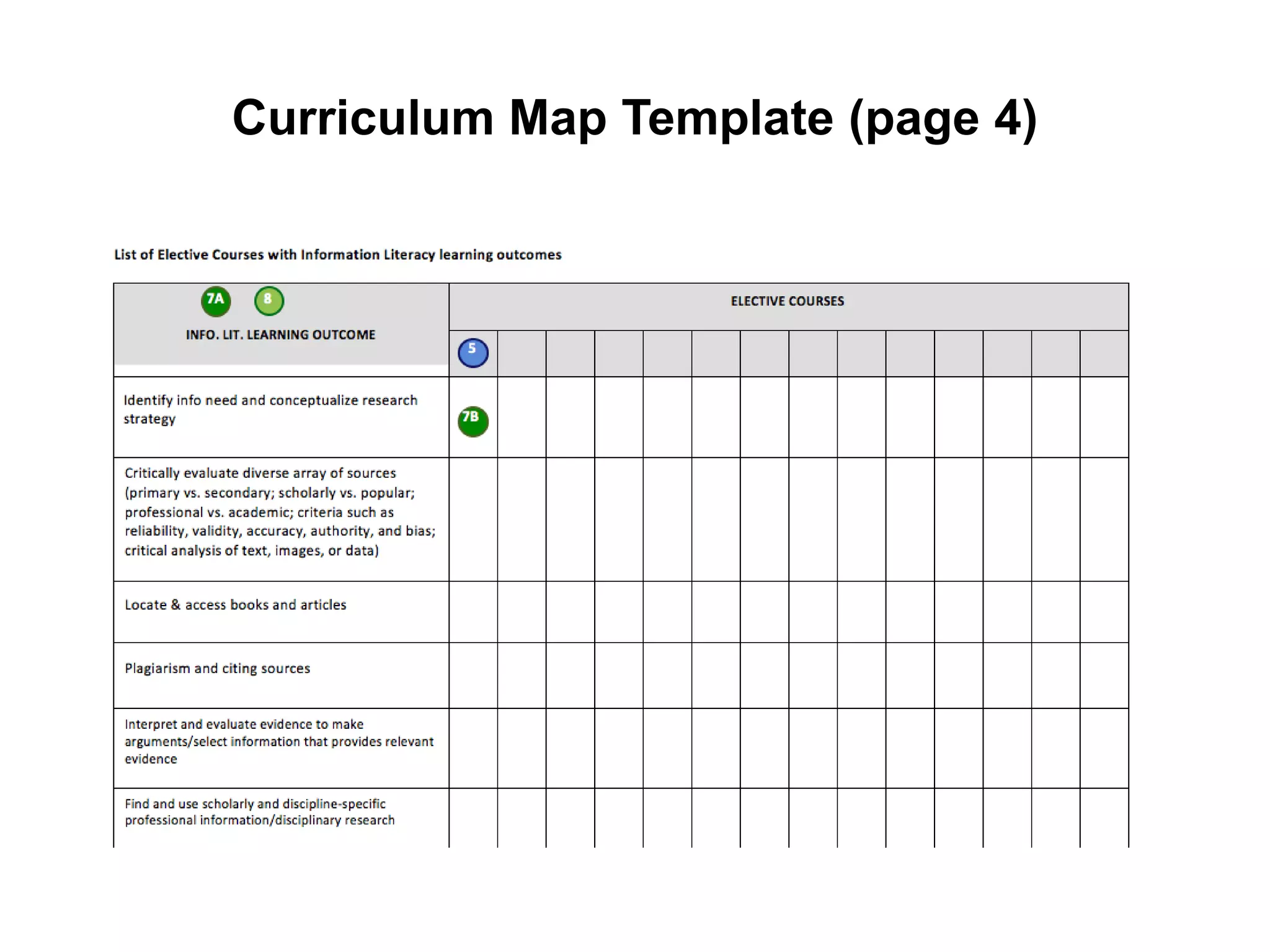
Curriculum Map Template (page 4)
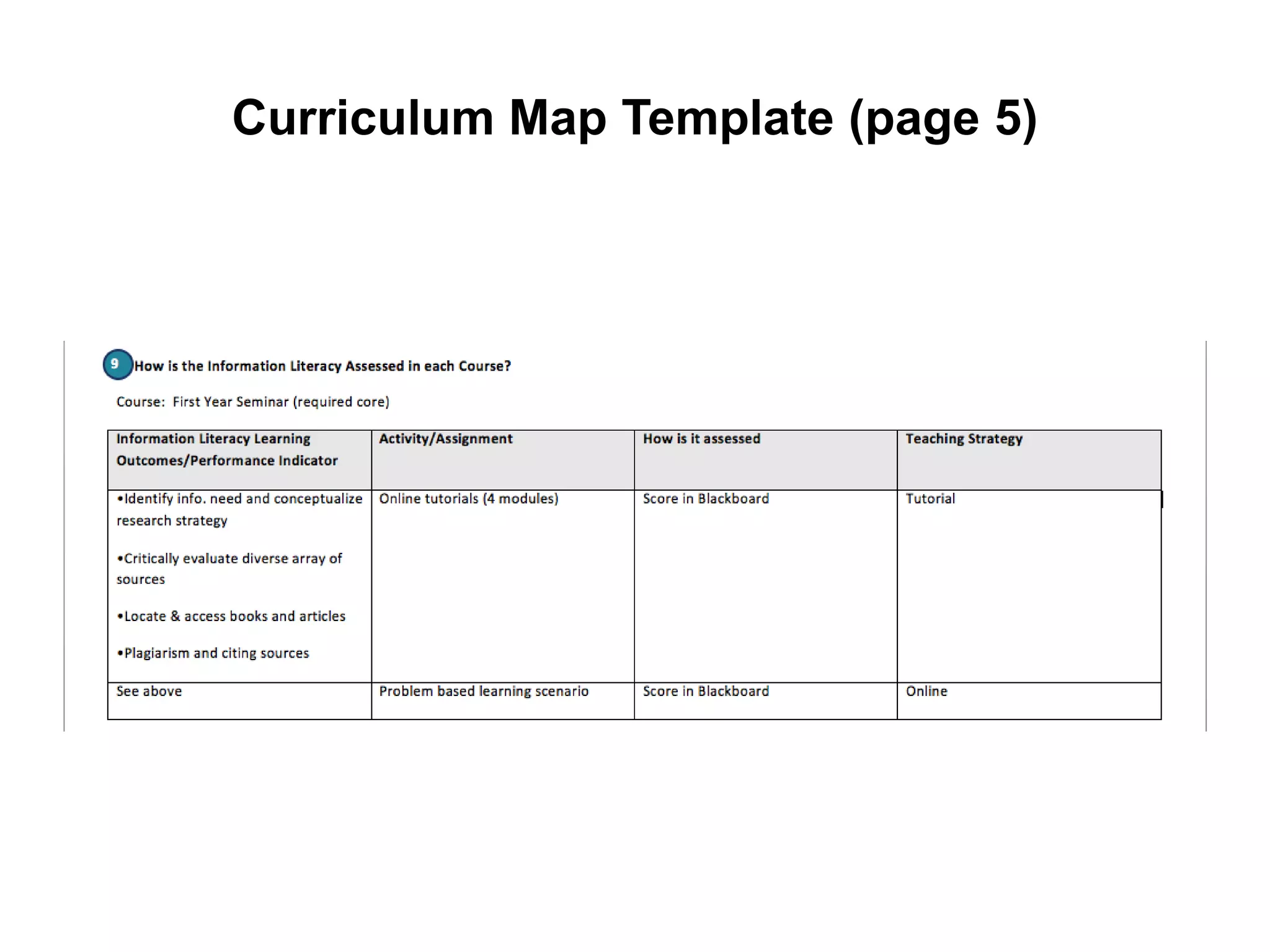
Curriculum Map Template (page 5)
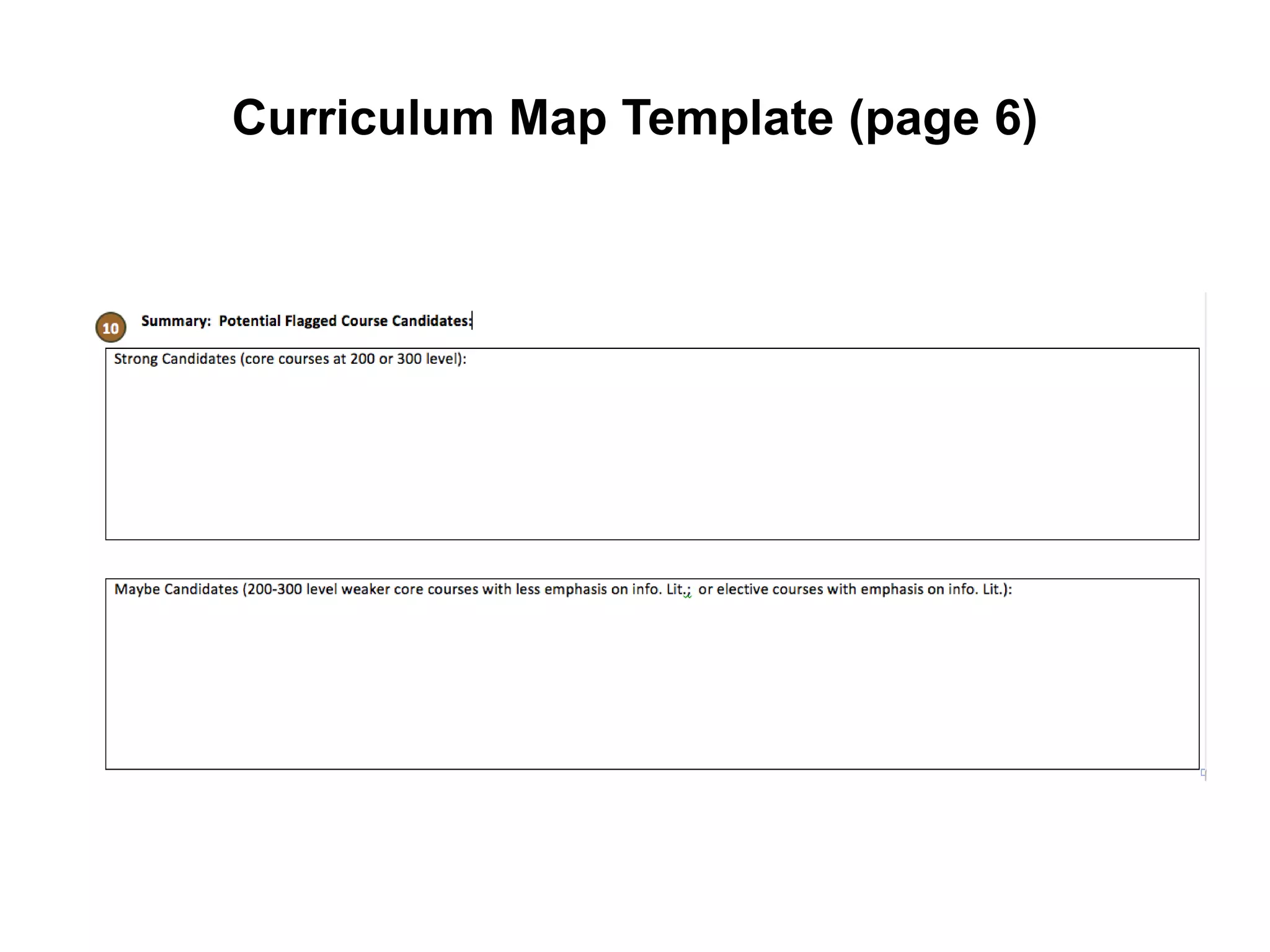
Curriculum Map Template (page 6)
Additional Information

• PPT Slides:
  http://bit.ly/wascinfolit


• Contact Information:
  Susan [Gardner]
  Archambault
  Email:
  susan.gardner@lmu.edu

The Great Race: Embedding Information Literacy into a New Core Curriculum

  • 1.
    The Great Race: EmbeddingInformation Literacy into a New Core Curriculum Susan [Gardner] Archambault Head of Reference & Instruction Loyola Marymount University
  • 2.
  • 5.
    LMU Undergraduate LearningOutcome Information Literacy: Students will be able to identify info. needs, locate and access relevant info .and critically evaluate a diverse array of sources Core Curriculum Program: Info. Literacy Learning Outcomes Collect, interpret, evaluate and use evidence to make arguments Identify info. needs, locate and access info. and critically and produce knowledge evaluate sources FYS, Rhetorical Arts, and Flagged Course I.L. Learning Outcomes Locate & access Identify info. need and Critically evaluate info., including Interpret and evaluate Use information conceptualize sources discipline-specific evidence ethically research strategy professional info.
  • 6.
    First Year Seminar(FYS) • Freshman requirement – Fall Semester • Incorporate LMU librarians in order to develop information literacy and basic research skills • Assign at least 10 % of the course grade on the basis of assessed information literacy, which must include completion of standardized tutorials prepared by LMU librarians • Information Literacy Outcomes: – Be able to evaluate sources for quality (e.g., by learning to differentiate between scholarly and popular sources) – Acquire research skills including use of the library catalog and electronic databases to retrieve books or articles, whether in print or online http://www.lmu.edu/Assets/First+Year+Seminar.pdf
  • 7.
    Why Online Tutorials Effective method: peer  A way to give all freshmen a institutions successfully standardized introduction to teach IL skills to freshmen foundational research via tutorials (example: skills/knowledge they will Georgetown’s “Scholarly build on in your course and Research & Academic later Integrity” required tutorial)  Require no extra class time  Plug n play: tutorials are or grading time-assign them general enough to apply to as homework and you will all courses across the receive the grades through disciplines Blackboard
  • 8.
    Information Literacy SkillsCurriculum Map: First Year Students Through the LMU Core, first-year students will be able to… • First Year Seminar (beginning IL skills every freshman needs; skills covered in the library FYS tutorials are in white) • Rhetorical Arts (more intermediate skills for R.A. that build on the skills learned in FYS; skills library visit will help cover are in blue)
  • 9.
    Identify info. need;Conceptualize research strategy Confers with Identifies key Explores general instructors; concepts and terms information participates in class that describe the sources to Beginning discussions etc. to information need increase identify a research familiarity with the topic or information topic need Defines or modifies Develops a thesis the information statement and need to achieve a formulates Middle manageable focus questions based on the information need Reviews the initial Recognizes that information need to existing information clarify, revise, or can be combined refine the question with original Advanced thought, experimentation, and/or analysis to produce new information
  • 10.
    Critically evaluate varietyof sources Information Identifies the Differentiates Organization: purpose and between primary difference in audience of potential and secondary disciplines; how resources in a variety sources Beginning info. is produced and of formats accessed Differentiates Examines and between the types of compares sources cited and information from Middle understands citation various sources in elements order to evaluate Determines whether the information contradicts or verifies other information Advanced
  • 11.
    Locate and accessinformation (i.e. books and articles) Identifies keywords for Investigates the scope, Uses classification the information need; content, and scheme to locate info. Beginning constructs appropriate organization of in Library search strategy information retrieval systems; off-campus access Selects controlled Reviews search Determines whether vocabulary specific to strategy and alternative retrieval the discipline or incorporates additional systems needed; Middle information retrieval concepts as effectively accesses source necessary; revises information for specific search strategy investigative method or info. retrieval system
  • 12.
    Interpret and evaluateevidence Selects Draws Creates a Maintains a information that conclusions system for journal or log provides based upon organizing the on info. Beginning evidence info.; information seeking investigates differing POVs Recognize Determines Organizes the Questions prejudice, whether to content sources ; deception, or incorporate analyzes manipulation POVs; structure and Middle integrates new logic info Integrates info., including quotations and Advanced paraphrasings
  • 13.
    Cite evidence &ethical standards Demonstrates an Identifies Communicates Records all understanding of verbatim material clearly and with a pertinent what constitutes that can be then style that supports citation plagiarism and appropriately the purposes of the information for Beginning does not represent quoted intended audience future work attributable to reference others as his/her own Uses various Restates textual Selects an Differentiates technologies to concepts in appropriate between types manage the his/her own documentation of sources information words and style and uses it cited and Middle selected and selects data consistently to cite understands organized accurately sources the elements & correct syntax of a citation
  • 14.
    Outline of FYSTutorial Content •Purpose •Formats •Limitations •Primary v. Secondary •Choosing topic •Scholarly v. Popular •Key concepts •Peer Review •Background info. •How info. is made •Across the disciplines Module 1: Module 2: Starting Types of your Information Research Module 4: Module 3: Using Locating Information Information •Critical evaluation •Plagiarism •Find Books •Citing sources •Find Articles •Search strategies •LOC classification
  • 16.
  • 17.
  • 18.
  • 19.
  • 20.
  • 21.
  • 22.
    Sample Corresponding DiscussionPoints for FYS Instructors… Module 1:Possible Class Discussion Points/Activities Walk through the process of topic formulation, including finding background info to help generate a focus Diagram a research question and pick out keywords Compare Wikipedia to some published reference/background sources on the same topic; improve the Wikipedia article Create a reading list on a topic by using background info and doing citation chasing
  • 23.
    Module 2:Possible ClassDiscussion Points/Activities Primary vs. secondary in your discipline. Why is context important? Examine a primary source. Compare primary vs. secondary account of same event (such as slave owner vs. slave) Compare the same topic across different sources (scholarly/popular press; liberal/conservative) Trace the progression of event/discovery/idea/ theory across sources Differences in role of publication and scholarly communication across disciplines; evaluation criteria; purpose of research (i.e. methodology) What’s the current state of research in your field? Scan a journal for trends and how the info. is structured; also could trace over time
  • 24.
    Module 3:Possible ClassDiscussion Points/Activities Group lit reviews covering different time periods/same topic- come together for a “research roundtable” Research log (document how your topic evolves as you find more info. and change search strategies) Citation chasing: determine the impact of article/book in a field Fact checking or find facts to support an editorial Locate and evaluate reviews of course texts Research a concept, problem, event, or person studied in class
  • 25.
    Module 4:Possible ClassDiscussion Points/Activities Examine sources and evaluate according to set criteria Talk about the preferred documentation style in your discipline; have students submit citations in that style Annotated bibliography Dissect and review the citations on course syllabi Plagiarism and why it matters
  • 26.
    FYS Assessment Plan Plan A (Recommended) • Assign each of the 4 modules and cumulative test as separate homework assignments • Estimated time = 1 hour per module • Receive pass/fail or numeric scores through Blackboard or emailed to you from a librarian; count as 10% of course grade Plan B • Assign each of the 4 modules and cumulative test as separate homework assignments • Receive scores through Blackboard or from a librarian; count as 5+% of course grade and remaining 5+% through Info. Lit. assignment designed & graded by FYS instructor
  • 27.
    Rhetorical Arts (RA) •Freshman requirement – Spring Semester • Continue to develop the critical thinking, information literacy, and research skills begun in the First Year Seminar • Assign at least 10 % of the final course grade on the basis of information literacy, with a librarian-led workshop and one or more course-integrated assignments • Information Literacy Outcomes: - Conceptualize an effective research strategy and then collect, interpret, evaluate and cite evidence in written and oral communication - Distinguish between types of information resources and how these resources meet the needs of different levels of scholarship and different academic disciplines http://www.lmu.edu/Assets/Rhetorical+Arts.pdf
  • 28.
    R.A. Assignments Relatedto Info. Lit. • Will include annotated bibliography, final paper, and oral presentations • Will include “learning portfolio” emphasizing role of revisions in writing process • Library will probably license NoodleTools, an integrated online suite of tools for building good research & writing habits, for use in Rhetorical Arts
  • 29.
    Assessment of RhetoricalArts • Library • Final resource list tutorials/homework = (annotated 5% of course grade bibliography) = 10% of course grade • Draft resource list = 5% of course grade • Research quality/use = part of final research • Learning Portfolio will paper grade include outlines and research notes
  • 30.
    Information Literacy Flags • Faculty encouraged to consult • All students must take one Info with a librarian when designing Lit Flagged course before Info Lit assignments graduating • Librarians can create a custom • Any course at the 200 level or LibGuide or research Guide for higher may meet a flagged the course requirement • Rolling review process • No course may carry more • Suggested info. lit. learning than two flags outcomes related to: • At least 10% of the total course -selecting evidence grade must assess information -finding &using professional literacy info. -source types -evaluating info.
  • 31.
    Proposal Requirements • Allfull time faculty members • Once a course is approved by may propose a course for the the Chair, Dean and Course new Core Approval Committees, that • Chairs and Deans determine course can be taught by any the feasibility of a course to be qualified faculty member who offered is assigned by the Dean and/or Chair in the usual manner for • Course proposals require the such assignments signature of the faculty member's Chair and Dean, prior to submission to the UCCC
  • 32.
    Info. Lit. FlaggedProposal Form (pt.1) http://www.lmu.edu/Assets/Flag+Info+Lit+appl.pdf
  • 33.
    Info. Lit. FlaggedProposal Form (pt.2) http://www.lmu.edu/Assets/Flag+Info+Lit+appl.pdf
  • 35.
    Assessment of FlaggedCourses: Adapting the VALUE Rubric
  • 36.
  • 38.
  • 39.
    Library Curriculum MappingProject by Department/Major • Are there learning • Which courses have outcomes related to info. existing info. literacy literacy at Dept. and components or the accreditation levels? potential to be “flagged”? • What are the required • For those courses, which “core” or “high impact” info. Lit. learning courses for each outcomes would best major/Dept.? apply? How can they be assessed?
  • 40.
  • 41.
  • 42.
  • 43.
  • 44.
  • 45.
  • 46.
    Additional Information • PPTSlides: http://bit.ly/wascinfolit • Contact Information: Susan [Gardner] Archambault Email: susan.gardner@lmu.edu

Editor's Notes

  • #3 13 courses/12 sci engFlagged Any course, not just a Core course, at the 200 level or higher may meet a flag requirement. Graduation 120 hours/3= 40 courses (13 core, 15 upper division courses )
  • #9 Outcomes = what will students know, do and value25 outcomes, assessment cycle