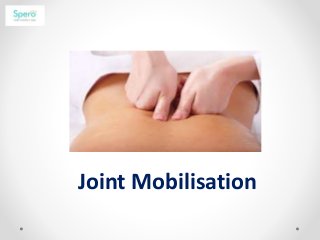
Joint Mobilisation
What Is Joint Mobilization?
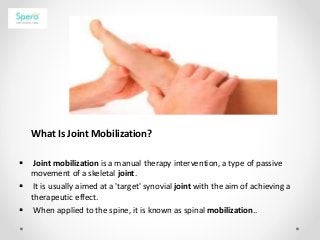
 Joint mobilization is a manual therapy intervention, a type of passive
movement of a skeletal joint.
 It is usually aimed at a 'target' synovial joint with the aim of achieving a
therapeutic effect.
 When applied to the spine, it is known as spinal mobilization..
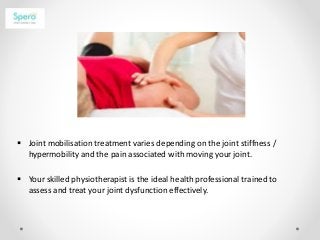
 Joint mobilisation treatment varies depending on the joint stiffness /
hypermobility and the pain associated with moving your joint.
 Your skilled physiotherapist is the ideal health professional trained to
assess and treat your joint dysfunction effectively.
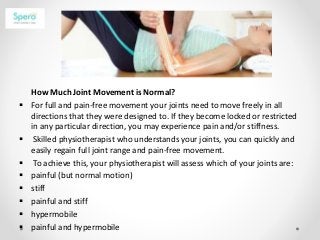
How Much Joint Movement is Normal?
 For full and pain-free movement your joints need to move freely in all
directions that they were designed to. If they become locked or restricted
in any particular direction, you may experience pain and/or stiffness.
 Skilled physiotherapist who understands your joints, you can quickly and
easily regain full joint range and pain-free movement.
 To achieve this, your physiotherapist will assess which of your joints are:
 painful (but normal motion)
 stiff
 painful and stiff
 hypermobile
 painful and hypermobile
What are Joint Mobilisation Techniques?
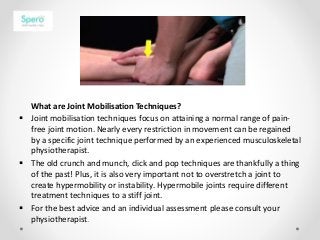
 Joint mobilisation techniques focus on attaining a normal range of pain-
free joint motion. Nearly every restriction in movement can be regained
by a specific joint technique performed by an experienced musculoskeletal
physiotherapist.
 The old crunch and munch, click and pop techniques are thankfully a thing
of the past! Plus, it is also very important not to overstretch a joint to
create hypermobility or instability. Hypermobile joints require different
treatment techniques to a stiff joint.
 For the best advice and an individual assessment please consult your
physiotherapist.
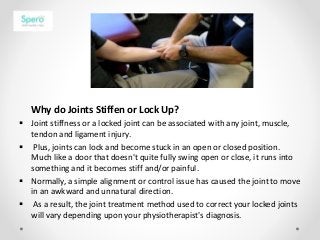
Why do Joints Stiffen or Lock Up?
 Joint stiffness or a locked joint can be associated with any joint, muscle,
tendon and ligament injury.
 Plus, joints can lock and become stuck in an open or closed position.
Much like a door that doesn't quite fully swing open or close, it runs into
something and it becomes stiff and/or painful.
 Normally, a simple alignment or control issue has caused the joint to move
in an awkward and unnatural direction.
 As a result, the joint treatment method used to correct your locked joints
will vary depending upon your physiotherapist's diagnosis.
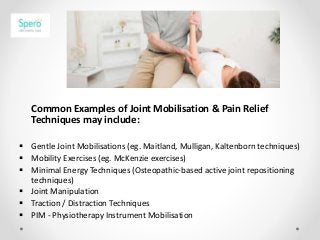
Common Examples of Joint Mobilisation & Pain Relief
Techniques may include:
 Gentle Joint Mobilisations (eg. Maitland, Mulligan, Kaltenborn techniques)
 Mobility Exercises (eg. McKenzie exercises)
 Minimal Energy Techniques (Osteopathic-based active joint repositioning
techniques)
 Joint Manipulation
 Traction / Distraction Techniques
 PIM - Physiotherapy Instrument Mobilisation
Why Spero?
Spero Healthcare has evolved around the idea of coexisting with
hospital and consultants for a patient who is ill enough to need
additional health care, but stable enough to be discharged from
the hospital. Understanding the current need and challenges
faced by the patient,
Spero healthcare have come up with systematic approach to
address all the above challenges by developing technology
solution, professional enhancement through training, integration
of services through dedicated healthcare management and
robust processes.
Services Offer
By Spero
• Physician (Doctor)assistant services
• Physiotherapy services
• Healthcare assistant services (24 Hours)
• Home Healthcare equipment
• Nurse Services
• Medical Transportation
• Respiratory Services
• Lab Service
Spero Healthcare
Office No.5 Bhosale House Apts, Karve Road.Pune-411004
WebSite
www.sperohealthcare.in

Joint mobilisation

  • 1.
  • 2.
    What Is JointMobilization?  Joint mobilization is a manual therapy intervention, a type of passive movement of a skeletal joint.  It is usually aimed at a 'target' synovial joint with the aim of achieving a therapeutic effect.  When applied to the spine, it is known as spinal mobilization..
  • 3.
     Joint mobilisationtreatment varies depending on the joint stiffness / hypermobility and the pain associated with moving your joint.  Your skilled physiotherapist is the ideal health professional trained to assess and treat your joint dysfunction effectively.
  • 4.
    How Much JointMovement is Normal?  For full and pain-free movement your joints need to move freely in all directions that they were designed to. If they become locked or restricted in any particular direction, you may experience pain and/or stiffness.  Skilled physiotherapist who understands your joints, you can quickly and easily regain full joint range and pain-free movement.  To achieve this, your physiotherapist will assess which of your joints are:  painful (but normal motion)  stiff  painful and stiff  hypermobile  painful and hypermobile
  • 5.
    What are JointMobilisation Techniques?  Joint mobilisation techniques focus on attaining a normal range of pain- free joint motion. Nearly every restriction in movement can be regained by a specific joint technique performed by an experienced musculoskeletal physiotherapist.  The old crunch and munch, click and pop techniques are thankfully a thing of the past! Plus, it is also very important not to overstretch a joint to create hypermobility or instability. Hypermobile joints require different treatment techniques to a stiff joint.  For the best advice and an individual assessment please consult your physiotherapist.
  • 6.
    Why do JointsStiffen or Lock Up?  Joint stiffness or a locked joint can be associated with any joint, muscle, tendon and ligament injury.  Plus, joints can lock and become stuck in an open or closed position. Much like a door that doesn't quite fully swing open or close, it runs into something and it becomes stiff and/or painful.  Normally, a simple alignment or control issue has caused the joint to move in an awkward and unnatural direction.  As a result, the joint treatment method used to correct your locked joints will vary depending upon your physiotherapist's diagnosis.
  • 7.
    Common Examples ofJoint Mobilisation & Pain Relief Techniques may include:  Gentle Joint Mobilisations (eg. Maitland, Mulligan, Kaltenborn techniques)  Mobility Exercises (eg. McKenzie exercises)  Minimal Energy Techniques (Osteopathic-based active joint repositioning techniques)  Joint Manipulation  Traction / Distraction Techniques  PIM - Physiotherapy Instrument Mobilisation
  • 8.
    Why Spero? Spero Healthcarehas evolved around the idea of coexisting with hospital and consultants for a patient who is ill enough to need additional health care, but stable enough to be discharged from the hospital. Understanding the current need and challenges faced by the patient, Spero healthcare have come up with systematic approach to address all the above challenges by developing technology solution, professional enhancement through training, integration of services through dedicated healthcare management and robust processes.
  • 9.
    Services Offer By Spero •Physician (Doctor)assistant services • Physiotherapy services • Healthcare assistant services (24 Hours) • Home Healthcare equipment • Nurse Services • Medical Transportation • Respiratory Services • Lab Service
  • 10.
    Spero Healthcare Office No.5Bhosale House Apts, Karve Road.Pune-411004 WebSite www.sperohealthcare.in