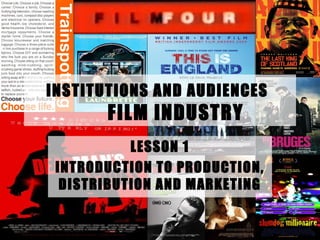
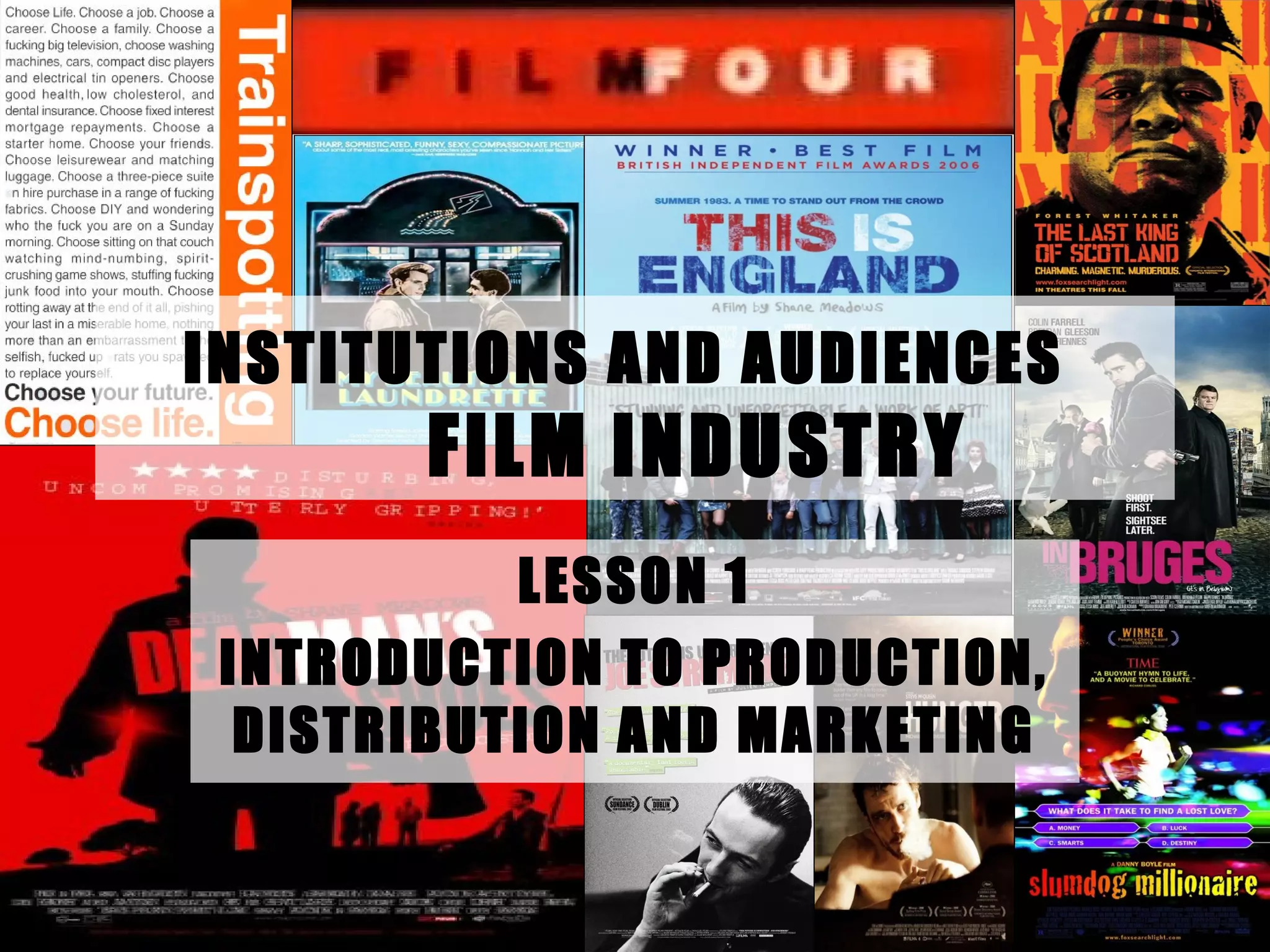
INSTITUTIONS AND AUDIENCES
FILM INDUSTRY
LESSON 1
INTRODUCTION TO PRODUCTION,
DISTRIBUTION AND MARKETING
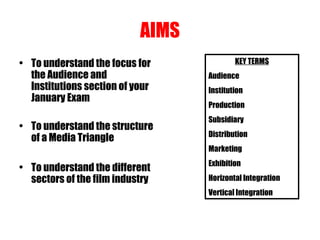
AIMS
• To understand the focus for
the Audience and
Institutions section of your
January Exam
• To understand the structure
of a Media Triangle
• To understand the different
sectors of the film industry
KEY TERMS
Audience
Institution
Production
Subsidiary
Distribution
Marketing
Exhibition
Horizontal Integration
Vertical Integration
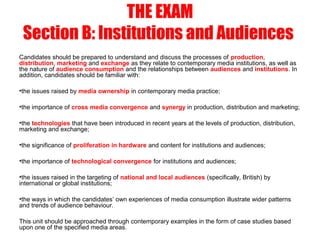
THE EXAM
Section B: Institutions and Audiences
Candidates should be prepared to understand and discuss the processes of production,
distribution, marketing and exchange as they relate to contemporary media institutions, as well as
the nature of audience consumption and the relationships between audiences and institutions. In
addition, candidates should be familiar with:
•the issues raised by media ownership in contemporary media practice;
•the importance of cross media convergence and synergy in production, distribution and marketing;
•the technologies that have been introduced in recent years at the levels of production, distribution,
marketing and exchange;
•the significance of proliferation in hardware and content for institutions and audiences;
•the importance of technological convergence for institutions and audiences;
•the issues raised in the targeting of national and local audiences (specifically, British) by
international or global institutions;
•the ways in which the candidates’ own experiences of media consumption illustrate wider patterns
and trends of audience behaviour.
This unit should be approached through contemporary examples in the form of case studies based
upon one of the specified media areas.
Film Four
• Trainspotting
• Looking for Eric
• Slumdog Millionaire
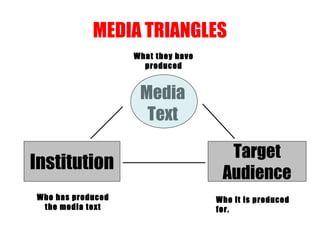
MEDIA TRIANGLES
Institution
Target
Audience
Media
Text
Who has produced
the media text
What they have
produced
Who it is produced
for.
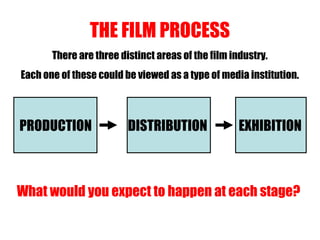
THE FILM PROCESS
PRODUCTION DISTRIBUTION EXHIBITION
There are three distinct areas of the film industry.
Each one of these could be viewed as a type of media institution.
What would you expect to happen at each stage?
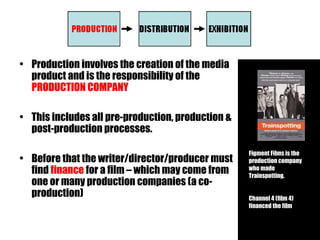
• Production involves the creation of the media
product and is the responsibility of the
PRODUCTION COMPANY
• This includes all pre-production, production &
post-production processes.
• Before that the writer/director/producer must
find finance for a film – which may come from
one or many production companies (a co-
production)
Figment Films is the
production company
who made
Trainspotting.
Channel 4 (film 4)
financed the film
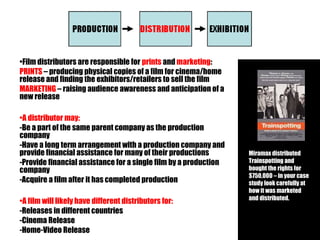
•Film distributors are responsible for prints and marketing:
PRINTS – producing physical copies of a film for cinema/home
release and finding the exhibitors/retailers to sell the film
MARKETING – raising audience awareness and anticipation of a
new release
•A distributor may:
-Be a part of the same parent company as the production
company
-Have a long term arrangement with a production company and
provide financial assistance for many of their productions
-Provide financial assistance for a single film by a production
company
-Acquire a film after it has completed production
•A film will likely have different distributors for:
-Releases in different countries
-Cinema Release
-Home-Video Release
Miramax distributed
Trainspotting and
bought the rights for
$750,000 – in your case
study look carefully at
how it was marketed
and distributed.
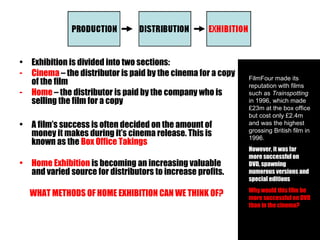
• Exhibition is divided into two sections:
- Cinema – the distributor is paid by the cinema for a copy
of the film
- Home – the distributor is paid by the company who is
selling the film for a copy
• A film’s success is often decided on the amount of
money it makes during it’s cinema release. This is
known as the Box Office Takings
• Home Exhibition is becoming an increasing valuable
and varied source for distributors to increase profits.
WHAT METHODS OF HOME EXHIBITION CAN WE THINK OF?
FilmFour made its
reputation with films
such as Trainspotting
in 1996, which made
ÂŁ23m at the box office
but cost only ÂŁ2.4m
and was the highest
grossing British film in
1996.
However, it was far
more successful on
DVD, spawning
numerous versions and
special editions
Why would this film be
more successful on DVD
than in the cinema?
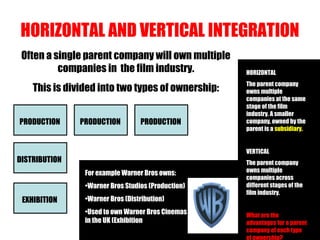
HORIZONTAL AND VERTICAL INTEGRATION
PRODUCTION
Often a single parent company will own multiple
companies in the film industry.
This is divided into two types of ownership:
PRODUCTION PRODUCTION
HORIZONTAL
The parent company
owns multiple
companies at the same
stage of the film
industry. A smaller
company, owned by the
parent is a subsidiary.
VERTICAL
The parent company
owns multiple
companies across
different stages of the
film industry.
What are the
advantages for a parent
company of each type
of ownership?
EXHIBITION
DISTRIBUTION
For example Walt Disney also owns:
•Miramax Films
•Hollywood Pictures
•Pixar Animation
For example Warner Bros owns:
•Warner Bros Studios (Production)
•Warner Bros (Distribution)
•Used to own Warner Bros Cinemas
in the UK (Exhibition
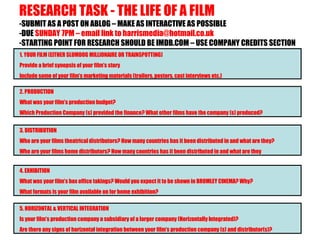
RESEARCH TASK - THE LIFE OF A FILM
-SUBMIT AS A POST ON ABLOG – MAKE AS INTERACTIVE AS POSSIBLE
-DUE SUNDAY 7PM – email link to harrismedia@hotmail.co.uk
-STARTING POINT FOR RESEARCH SHOULD BE IMDB.COM – USE COMPANY CREDITS SECTION
1. YOUR FILM (EITHER SLUMDOG MILLIONAIRE OR TRAINSPOTTING)
Provide a brief synopsis of your film’s story
Include some of your film’s marketing materials (trailers, posters, cast interviews etc.)
2. PRODUCTION
What was your film’s production budget?
Which Production Company (s) provided the finance? What other films have the company (s) produced?
3. DISTRIBUTION
Who are your films theatrical distributors? How many countries has it been distributed in and what are they?
Who are your films home distributors? How many countries has it been distributed in and what are they
4. EXHIBITION
What was your film’s box office takings? Would you expect it to be shown in BROMLEY CINEMA? Why?
What formats is your film available on for home exhibition?
5. HORIZONTAL & VERTICAL INTEGRATION
Is your film’s production company a subsidiary of a larger company (Horizontally Integrated)?
Are there any signs of horizontal integration between your film’s production company (s) and distributor(s)?
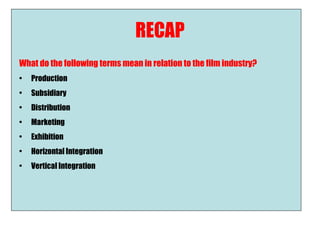
RECAP
What do the following terms mean in relation to the film industry?
• Production
• Subsidiary
• Distribution
• Marketing
• Exhibition
• Horizontal Integration
• Vertical Integration

Lesson One - Audience and Institutions

  • 1.
    INSTITUTIONS AND AUDIENCES FILMINDUSTRY LESSON 1 INTRODUCTION TO PRODUCTION, DISTRIBUTION AND MARKETING
  • 2.
    AIMS • To understandthe focus for the Audience and Institutions section of your January Exam • To understand the structure of a Media Triangle • To understand the different sectors of the film industry KEY TERMS Audience Institution Production Subsidiary Distribution Marketing Exhibition Horizontal Integration Vertical Integration
  • 3.
    THE EXAM Section B:Institutions and Audiences Candidates should be prepared to understand and discuss the processes of production, distribution, marketing and exchange as they relate to contemporary media institutions, as well as the nature of audience consumption and the relationships between audiences and institutions. In addition, candidates should be familiar with: •the issues raised by media ownership in contemporary media practice; •the importance of cross media convergence and synergy in production, distribution and marketing; •the technologies that have been introduced in recent years at the levels of production, distribution, marketing and exchange; •the significance of proliferation in hardware and content for institutions and audiences; •the importance of technological convergence for institutions and audiences; •the issues raised in the targeting of national and local audiences (specifically, British) by international or global institutions; •the ways in which the candidates’ own experiences of media consumption illustrate wider patterns and trends of audience behaviour. This unit should be approached through contemporary examples in the form of case studies based upon one of the specified media areas.
  • 4.
    Film Four • Trainspotting •Looking for Eric • Slumdog Millionaire
  • 5.
    MEDIA TRIANGLES Institution Target Audience Media Text Who hasproduced the media text What they have produced Who it is produced for.
  • 6.
    THE FILM PROCESS PRODUCTIONDISTRIBUTION EXHIBITION There are three distinct areas of the film industry. Each one of these could be viewed as a type of media institution. What would you expect to happen at each stage?
  • 7.
    • Production involvesthe creation of the media product and is the responsibility of the PRODUCTION COMPANY • This includes all pre-production, production & post-production processes. • Before that the writer/director/producer must find finance for a film – which may come from one or many production companies (a co- production) Figment Films is the production company who made Trainspotting. Channel 4 (film 4) financed the film
  • 8.
    •Film distributors areresponsible for prints and marketing: PRINTS – producing physical copies of a film for cinema/home release and finding the exhibitors/retailers to sell the film MARKETING – raising audience awareness and anticipation of a new release •A distributor may: -Be a part of the same parent company as the production company -Have a long term arrangement with a production company and provide financial assistance for many of their productions -Provide financial assistance for a single film by a production company -Acquire a film after it has completed production •A film will likely have different distributors for: -Releases in different countries -Cinema Release -Home-Video Release Miramax distributed Trainspotting and bought the rights for $750,000 – in your case study look carefully at how it was marketed and distributed.
  • 9.
    • Exhibition isdivided into two sections: - Cinema – the distributor is paid by the cinema for a copy of the film - Home – the distributor is paid by the company who is selling the film for a copy • A film’s success is often decided on the amount of money it makes during it’s cinema release. This is known as the Box Office Takings • Home Exhibition is becoming an increasing valuable and varied source for distributors to increase profits. WHAT METHODS OF HOME EXHIBITION CAN WE THINK OF? FilmFour made its reputation with films such as Trainspotting in 1996, which made £23m at the box office but cost only £2.4m and was the highest grossing British film in 1996. However, it was far more successful on DVD, spawning numerous versions and special editions Why would this film be more successful on DVD than in the cinema?
  • 10.
    HORIZONTAL AND VERTICALINTEGRATION PRODUCTION Often a single parent company will own multiple companies in the film industry. This is divided into two types of ownership: PRODUCTION PRODUCTION HORIZONTAL The parent company owns multiple companies at the same stage of the film industry. A smaller company, owned by the parent is a subsidiary. VERTICAL The parent company owns multiple companies across different stages of the film industry. What are the advantages for a parent company of each type of ownership? EXHIBITION DISTRIBUTION For example Walt Disney also owns: •Miramax Films •Hollywood Pictures •Pixar Animation For example Warner Bros owns: •Warner Bros Studios (Production) •Warner Bros (Distribution) •Used to own Warner Bros Cinemas in the UK (Exhibition
  • 11.
    RESEARCH TASK -THE LIFE OF A FILM -SUBMIT AS A POST ON ABLOG – MAKE AS INTERACTIVE AS POSSIBLE -DUE SUNDAY 7PM – email link to harrismedia@hotmail.co.uk -STARTING POINT FOR RESEARCH SHOULD BE IMDB.COM – USE COMPANY CREDITS SECTION 1. YOUR FILM (EITHER SLUMDOG MILLIONAIRE OR TRAINSPOTTING) Provide a brief synopsis of your film’s story Include some of your film’s marketing materials (trailers, posters, cast interviews etc.) 2. PRODUCTION What was your film’s production budget? Which Production Company (s) provided the finance? What other films have the company (s) produced? 3. DISTRIBUTION Who are your films theatrical distributors? How many countries has it been distributed in and what are they? Who are your films home distributors? How many countries has it been distributed in and what are they 4. EXHIBITION What was your film’s box office takings? Would you expect it to be shown in BROMLEY CINEMA? Why? What formats is your film available on for home exhibition? 5. HORIZONTAL & VERTICAL INTEGRATION Is your film’s production company a subsidiary of a larger company (Horizontally Integrated)? Are there any signs of horizontal integration between your film’s production company (s) and distributor(s)?
  • 12.
    RECAP What do thefollowing terms mean in relation to the film industry? • Production • Subsidiary • Distribution • Marketing • Exhibition • Horizontal Integration • Vertical Integration