risk stratification, prevention and 
management of leukemia relapse 
after HSCT 
Yu Wang 
Peking University People’s Hospital & 
Institute of Hematology
Contents 
1 
• Modified DLI 
2 
• t(8;21) 
3 
• Ph+ leukemia
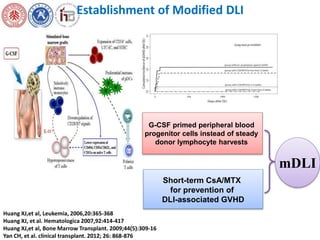
Establishment of Modified DLI 
G-CSF primed peripheral blood 
progenitor cells instead of steady 
donor lymphocyte harvests 
Short-term CsA/MTX 
for prevention of 
DLI-associated GVHD 
mDLI 
Huang XJ,et al, Leukemia, 2006,20:365-368 
Huang XJ, et al. Hematologica 2007,92:414-417 
Huang XJ,et al, Bone Marrow Transplant. 2009;44(5):309-16 
Yan CH, et al. clinical transplant. 2012; 26: 868-876
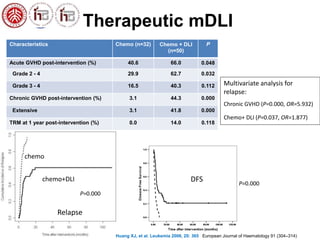
Therapeutic mDLI 
Multivariate analysis for 
relapse: 
Chronic GVHD (P=0.000, OR=5.932) 
Chemo+ DLI (P=0.037, OR=1.877) 
Characteristics Chemo (n=32) Chemo + DLI 
chemo+DLI 
Relapse 
chemo 
P=0.000 
(n=50) 
P 
Acute GVHD post-intervention (%) 40.6 66.0 0.048 
Grade 2 - 4 29.9 62.7 0.032 
Grade 3 - 4 16.5 40.3 0.112 
Chronic GVHD post-intervention (%) 3.1 44.3 0.000 
Extensive 3.1 41.8 0.000 
TRM at 1 year post-intervention (%) 0.0 14.0 0.118 
P=0.000 
DFS 
Huang XJ, et al. Leukemia 2006, 20: 365 European Journal of Haematology 91 (304–314)
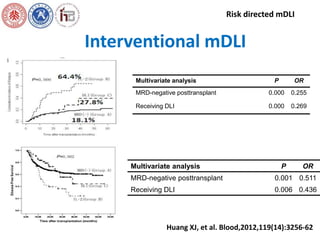
Risk directed mDLI 
Interventional mDLI 
Multivariate analysis P OR 
MRD-negative posttransplant 0.000 0.255 
Receiving DLI 0.000 0.269 
Multivariate analysis P OR 
MRD-negative posttransplant 0.001 0.511 
Receiving DLI 0.006 0.436 
Huang XJ, et al. Blood,2012,119(14):3256-62
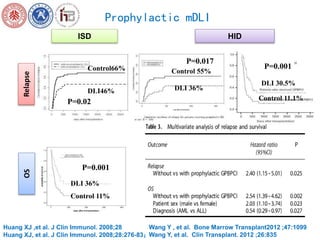
Prophylactic mDLI 
Control66% 
DLI46% 
P=0.02 
P=0.001 
DLI 36% 
Control 11% 
Huang XJ ,et al. J Clin Immunol. 2008;28 
Huang XJ, et al. J Clin Immunol. 2008;28:276-83; 
P=0.001 
DLI 30.5% 
Control 11.1% 
P=0.017 
Control 55% 
DLI 36% 
Wang Y , et al. Bone Marrow Transplant2012 ;47:1099 
Wang Y, et al. Clin Transplant. 2012 ;26:835 
OS Relapse 
ISD HID
Multi-Center Clinical Trials 
Xinqiao Hospital affiliated to 
Third Military Medical University 
Peking University 
People`s Hospital 
The First affiliated Hospital 
of Soochow University 
The First affiliated Hospital 
of Zhejiang University 
Nanfang Hospital 
Southern Medical University 
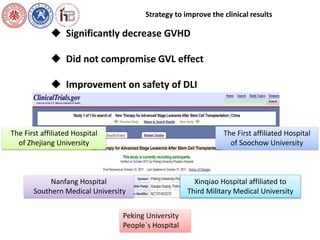
Strategy to improve the clinical results 
 Significantly decrease GVHD 
 Did not compromise GVL effect 
 Improvement on safety of DLI
Contents 
1 
• Modified DLI 
2 
• t(8;21) 
3 
• Ph+ leukemia
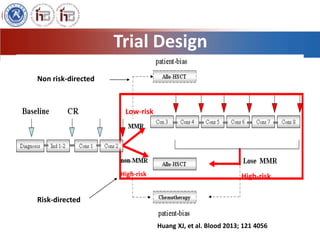
Trial Design 
Low-risk 
High-risk High-risk 
Non risk-directed 
Risk-directed 
Huang XJ, et al. Blood 2013; 121 4056
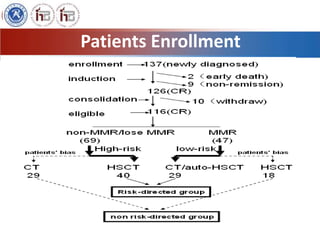
Patients Enrollment
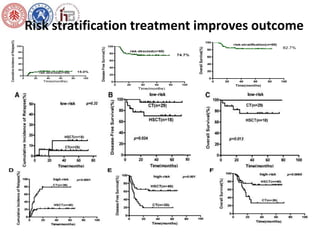
Risk stratification treatment improves outcome 
0 20 40 60 80 100 
100 
80 
60 
40 
20 
0 
risk-stratification(n=69) 
82.7% 
Time(months) 
Overall Survival(%)
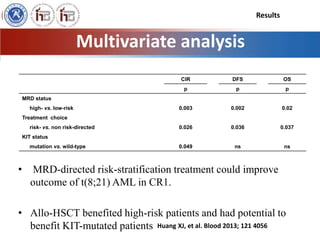
Multivariate analysis 
Results 
CIR DFS OS 
p p p 
MRD status 
high- vs. low-risk 0.003 0.002 0.02 
Treatment choice 
risk- vs. non risk-directed 0.026 0.036 0.037 
KIT status 
mutation vs. wild-type 0.049 ns ns 
• MRD-directed risk-stratification treatment could improve 
outcome of t(8;21) AML in CR1. 
• Allo-HSCT benefited high-risk patients and had potential to 
Huang XJ, et al. Blood 2013; 121 4056 
benefit KIT-mutated patients
RUNX1/RUNX1T1-based MRD-monitoring 
early after allogeneic transplantation 
rather than c-KIT mutations in adult t(8;21) AML 
allows further risk stratification 
Blood. 2014 Jul 31. pii: blood-2014-03-563403 
• MRD might be used to further distinguish 
between t(8;21)patients with low and high 
risks of relapse after allo-HSCT 
• the level of MRD in t (8; 21) AML guide post- 
HSCT therapy in the future
Results 
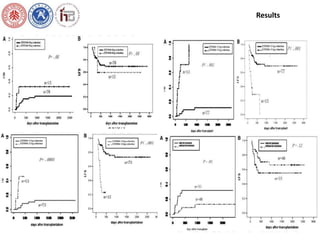
Impact of MRD at 1 month after SCT on outcomes 
CIR p=.02 
42.8% 
<3 log reduction n=7 
16.8% 
MRD positive post SCT p<.001 
<3 log reduction n=7 
85.7% 
44.7% 
>3 log reduction n=53 
LFS p>.05 
<3 log reduction n=7 
>3 log reduction n=53 
<3 log reduction n=7 
60.8% 
41.7% 
OS p>.05 
>3 log reduction n=53 
85.7% 
44.7% 
>3 log reduction n=53 
42.8% 
16.8% 
CIR p=.02
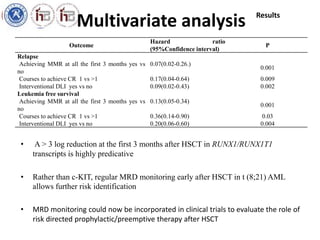
Multivariate analysis Results 
Outcome 
Hazard ratio 
(95%Confidence interval) 
P 
Relapse 
Achieving MMR at all the first 3 months yes vs 
no 
0.07(0.02-0.26.) 
0.001 
Courses to achieve CR 1 vs >1 0.17(0.04-0.64) 0.009 
Interventional DLI yes vs no 0.09(0.02-0.43) 0.002 
Leukemia free survival 
Achieving MMR at all the first 3 months yes vs 
0.13(0.05-0.34) 
0.001 
no 
Courses to achieve CR 1 vs >1 0.36(0.14-0.90) 0.03 
Interventional DLI yes vs no 0.20(0.06-0.60) 0.004 
• A > 3 log reduction at the first 3 months after HSCT in RUNX1/RUNX1T1 
transcripts is highly predicative 
• Rather than c-KIT, regular MRD monitoring early after HSCT in t (8;21) AML 
allows further risk identification 
• MRD monitoring could now be incorporated in clinical trials to evaluate the role of 
risk directed prophylactic/preemptive therapy after HSCT
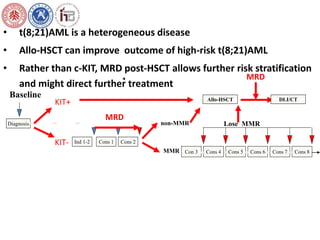
• t(8;21)AML is a heterogeneous disease 
• Allo-HSCT can improve outcome of high-risk t(8;21)AML 
• Rather than c-KIT, MRD post-HSCT allows further risk stratification 
MMR 
Allo-HSCT 
non-MMR 
Baseline 
Diagnosis Lose MMR 
Ind 1-2 Cons 1 Cons 2 
Con 3 Cons 4 Cons 5 Cons 6 Cons 7 Cons 8 
KIT-KIT+ 
Recommendation 
MRD 
MRD 
DLI/CT 
and might direct further treatment
Contents 
1 
• Modified DLI 
2 
• t(8;21) 
3 
• Ph+ leukemia
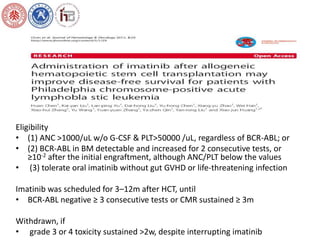
Eligibility 
• (1) ANC >1000/uL w/o G-CSF & PLT>50000 /uL, regardless of BCR-ABL; or 
• (2) BCR-ABL in BM detectable and increased for 2 consecutive tests, or 
≥10-2 after the initial engraftment, although ANC/PLT below the values 
• (3) tolerate oral imatinib without gut GVHD or life-threatening infection 
Imatinib was scheduled for 3–12m after HCT, until 
• BCR-ABL negative ≥ 3 consecutive tests or CMR sustained ≥ 3m 
Withdrawn, if 
• grade 3 or 4 toxicity sustained >2w, despite interrupting imatinib
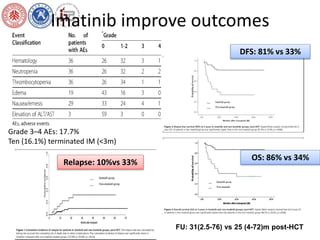
Imatinib improve outcomes 
Relapse: 10%vs 33% 
DFS: 81% vs 33% 
OS: 86% vs 34% 
FU: 31(2.5-76) vs 25 (4-72)m post-HCT 
Grade 3–4 AEs: 17.7% 
Ten (16.1%) terminated IM (<3m)
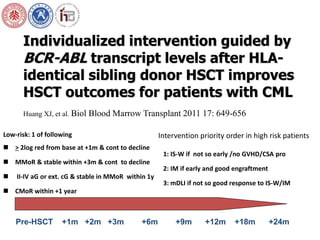
Individualized intervention guided by 
BCR-ABL transcript levels after HLA-identical 
sibling donor HSCT improves 
HSCT outcomes for patients with CML 
Huang XJ, et al. Biol Blood Marrow Transplant 2011 17: 649-656 
Low-risk: 1 of following 
 > 2log red from base at +1m & cont to decline 
 MMoR & stable within +3m & cont to decline 
 II-IV aG or ext. cG & stable in MMoR within 1y 
 CMoR within +1 year 
Intervention priority order in high risk patients 
1: IS-W if not so early /no GVHD/CSA pro 
2: IM if early and good engraftment 
3: mDLI if not so good response to IS-W/IM 
Pre-HSCT +1m +2m +3m +6m +9m +12m +18m +24m
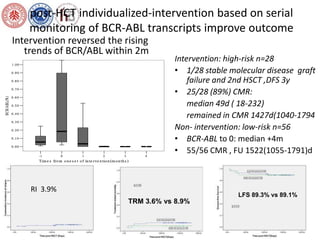
post-HCT individualized-intervention based on serial 
monitoring of BCR-ABL transcripts improve outcome 
Intervention reversed the rising 
trends of BCR/ABL within 2m 
-1 0 1 2 3 4 
1 .0 0 
0 .9 0 
0 .8 0 
0 .7 0 
0 .6 0 
0 .5 0 
0 .4 0 
0 .3 0 
0 .2 0 
0 .1 0 
0 .0 0 
BCR/ABL(%) 
Time s from o n e s e t o f in te rve n t io n (mo n th s ) 
Intervention: high-risk n=28 
• 1/28 stable molecular disease graft 
failure and 2nd HSCT ,DFS 3y 
• 25/28 (89%) CMR: 
median 49d ( 18-232) 
remained in CMR 1427d(1040-1794 
Non- intervention: low-risk n=56 
• BCR-ABL to 0: median +4m 
• 55/56 CMR , FU 1522(1055-1791)d 
RI 3.9% 
TRM 3.6% vs 8.9% 
LFS 89.3% vs 89.1%
Acknowledgements 
Stem cell collection center 
Hai-Yin Zheng 
Hong Xu 
Qing Zhao 
Su Wang 
Department of bone marrow transplant 
Xiao-Jun Huang 
Kai-Yan Liu 
Lan-Ping Xu 
Xiao-Hui Zhang 
Huan Chen Wei Han 
Yu-Hong Chen Feng-Rong Wang 
Jing-Zhi Wang Yu Wang 
Chen-Hua Yan Yuan-Yuan Zhang 
Yu Ji Yu-Qian Sun 
Laboratory of PUIH 
Dan Li 
Ya-Zhen Qin 
Yan-Rong Liu 
Yue-Yun Lai
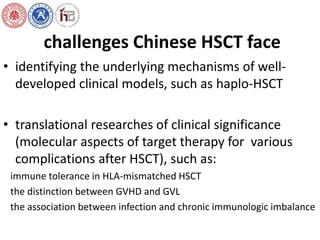
challenges Chinese HSCT face 
• identifying the underlying mechanisms of well-developed 
clinical models, such as haplo-HSCT 
• translational researches of clinical significance 
(molecular aspects of target therapy for various 
complications after HSCT), such as: 
immune tolerance in HLA-mismatched HSCT 
the distinction between GVHD and GVL 
the association between infection and chronic immunologic imbalance
need for a FACT-like accreditation program 
• Standardization of “best practice”: dissemination of 
techniques from major centers to smaller units 
• under well-developed registries: role in multi-center 
clinical trials and data management 
• Training: talented personnel/inspectors
meaningful international collaborations 
• Academic technique collaboration 
• Bench to bed practice: promote the connection 
between basic research and clinical practice 
• Training and visit

Risk Stratification for High Risk AML

  • 1.
    risk stratification, preventionand management of leukemia relapse after HSCT Yu Wang Peking University People’s Hospital & Institute of Hematology
  • 2.
    Contents 1 •Modified DLI 2 • t(8;21) 3 • Ph+ leukemia
  • 3.
    Establishment of ModifiedDLI G-CSF primed peripheral blood progenitor cells instead of steady donor lymphocyte harvests Short-term CsA/MTX for prevention of DLI-associated GVHD mDLI Huang XJ,et al, Leukemia, 2006,20:365-368 Huang XJ, et al. Hematologica 2007,92:414-417 Huang XJ,et al, Bone Marrow Transplant. 2009;44(5):309-16 Yan CH, et al. clinical transplant. 2012; 26: 868-876
  • 4.
    Therapeutic mDLI Multivariateanalysis for relapse: Chronic GVHD (P=0.000, OR=5.932) Chemo+ DLI (P=0.037, OR=1.877) Characteristics Chemo (n=32) Chemo + DLI chemo+DLI Relapse chemo P=0.000 (n=50) P Acute GVHD post-intervention (%) 40.6 66.0 0.048 Grade 2 - 4 29.9 62.7 0.032 Grade 3 - 4 16.5 40.3 0.112 Chronic GVHD post-intervention (%) 3.1 44.3 0.000 Extensive 3.1 41.8 0.000 TRM at 1 year post-intervention (%) 0.0 14.0 0.118 P=0.000 DFS Huang XJ, et al. Leukemia 2006, 20: 365 European Journal of Haematology 91 (304–314)
  • 5.
    Risk directed mDLI Interventional mDLI Multivariate analysis P OR MRD-negative posttransplant 0.000 0.255 Receiving DLI 0.000 0.269 Multivariate analysis P OR MRD-negative posttransplant 0.001 0.511 Receiving DLI 0.006 0.436 Huang XJ, et al. Blood,2012,119(14):3256-62
  • 6.
    Prophylactic mDLI Control66% DLI46% P=0.02 P=0.001 DLI 36% Control 11% Huang XJ ,et al. J Clin Immunol. 2008;28 Huang XJ, et al. J Clin Immunol. 2008;28:276-83; P=0.001 DLI 30.5% Control 11.1% P=0.017 Control 55% DLI 36% Wang Y , et al. Bone Marrow Transplant2012 ;47:1099 Wang Y, et al. Clin Transplant. 2012 ;26:835 OS Relapse ISD HID
  • 7.
    Multi-Center Clinical Trials Xinqiao Hospital affiliated to Third Military Medical University Peking University People`s Hospital The First affiliated Hospital of Soochow University The First affiliated Hospital of Zhejiang University Nanfang Hospital Southern Medical University Strategy to improve the clinical results  Significantly decrease GVHD  Did not compromise GVL effect  Improvement on safety of DLI
  • 8.
    Contents 1 •Modified DLI 2 • t(8;21) 3 • Ph+ leukemia
  • 9.
    Trial Design Low-risk High-risk High-risk Non risk-directed Risk-directed Huang XJ, et al. Blood 2013; 121 4056
  • 10.
  • 11.
    Risk stratification treatmentimproves outcome 0 20 40 60 80 100 100 80 60 40 20 0 risk-stratification(n=69) 82.7% Time(months) Overall Survival(%)
  • 12.
    Multivariate analysis Results CIR DFS OS p p p MRD status high- vs. low-risk 0.003 0.002 0.02 Treatment choice risk- vs. non risk-directed 0.026 0.036 0.037 KIT status mutation vs. wild-type 0.049 ns ns • MRD-directed risk-stratification treatment could improve outcome of t(8;21) AML in CR1. • Allo-HSCT benefited high-risk patients and had potential to Huang XJ, et al. Blood 2013; 121 4056 benefit KIT-mutated patients
  • 13.
    RUNX1/RUNX1T1-based MRD-monitoring earlyafter allogeneic transplantation rather than c-KIT mutations in adult t(8;21) AML allows further risk stratification Blood. 2014 Jul 31. pii: blood-2014-03-563403 • MRD might be used to further distinguish between t(8;21)patients with low and high risks of relapse after allo-HSCT • the level of MRD in t (8; 21) AML guide post- HSCT therapy in the future
  • 14.
    Results Impact ofMRD at 1 month after SCT on outcomes CIR p=.02 42.8% <3 log reduction n=7 16.8% MRD positive post SCT p<.001 <3 log reduction n=7 85.7% 44.7% >3 log reduction n=53 LFS p>.05 <3 log reduction n=7 >3 log reduction n=53 <3 log reduction n=7 60.8% 41.7% OS p>.05 >3 log reduction n=53 85.7% 44.7% >3 log reduction n=53 42.8% 16.8% CIR p=.02
  • 15.
    Multivariate analysis Results Outcome Hazard ratio (95%Confidence interval) P Relapse Achieving MMR at all the first 3 months yes vs no 0.07(0.02-0.26.) 0.001 Courses to achieve CR 1 vs >1 0.17(0.04-0.64) 0.009 Interventional DLI yes vs no 0.09(0.02-0.43) 0.002 Leukemia free survival Achieving MMR at all the first 3 months yes vs 0.13(0.05-0.34) 0.001 no Courses to achieve CR 1 vs >1 0.36(0.14-0.90) 0.03 Interventional DLI yes vs no 0.20(0.06-0.60) 0.004 • A > 3 log reduction at the first 3 months after HSCT in RUNX1/RUNX1T1 transcripts is highly predicative • Rather than c-KIT, regular MRD monitoring early after HSCT in t (8;21) AML allows further risk identification • MRD monitoring could now be incorporated in clinical trials to evaluate the role of risk directed prophylactic/preemptive therapy after HSCT
  • 16.
    • t(8;21)AML isa heterogeneous disease • Allo-HSCT can improve outcome of high-risk t(8;21)AML • Rather than c-KIT, MRD post-HSCT allows further risk stratification MMR Allo-HSCT non-MMR Baseline Diagnosis Lose MMR Ind 1-2 Cons 1 Cons 2 Con 3 Cons 4 Cons 5 Cons 6 Cons 7 Cons 8 KIT-KIT+ Recommendation MRD MRD DLI/CT and might direct further treatment
  • 17.
    Contents 1 •Modified DLI 2 • t(8;21) 3 • Ph+ leukemia
  • 18.
    Eligibility • (1)ANC >1000/uL w/o G-CSF & PLT>50000 /uL, regardless of BCR-ABL; or • (2) BCR-ABL in BM detectable and increased for 2 consecutive tests, or ≥10-2 after the initial engraftment, although ANC/PLT below the values • (3) tolerate oral imatinib without gut GVHD or life-threatening infection Imatinib was scheduled for 3–12m after HCT, until • BCR-ABL negative ≥ 3 consecutive tests or CMR sustained ≥ 3m Withdrawn, if • grade 3 or 4 toxicity sustained >2w, despite interrupting imatinib
  • 19.
    Imatinib improve outcomes Relapse: 10%vs 33% DFS: 81% vs 33% OS: 86% vs 34% FU: 31(2.5-76) vs 25 (4-72)m post-HCT Grade 3–4 AEs: 17.7% Ten (16.1%) terminated IM (<3m)
  • 20.
    Individualized intervention guidedby BCR-ABL transcript levels after HLA-identical sibling donor HSCT improves HSCT outcomes for patients with CML Huang XJ, et al. Biol Blood Marrow Transplant 2011 17: 649-656 Low-risk: 1 of following  > 2log red from base at +1m & cont to decline  MMoR & stable within +3m & cont to decline  II-IV aG or ext. cG & stable in MMoR within 1y  CMoR within +1 year Intervention priority order in high risk patients 1: IS-W if not so early /no GVHD/CSA pro 2: IM if early and good engraftment 3: mDLI if not so good response to IS-W/IM Pre-HSCT +1m +2m +3m +6m +9m +12m +18m +24m
  • 21.
    post-HCT individualized-intervention basedon serial monitoring of BCR-ABL transcripts improve outcome Intervention reversed the rising trends of BCR/ABL within 2m -1 0 1 2 3 4 1 .0 0 0 .9 0 0 .8 0 0 .7 0 0 .6 0 0 .5 0 0 .4 0 0 .3 0 0 .2 0 0 .1 0 0 .0 0 BCR/ABL(%) Time s from o n e s e t o f in te rve n t io n (mo n th s ) Intervention: high-risk n=28 • 1/28 stable molecular disease graft failure and 2nd HSCT ,DFS 3y • 25/28 (89%) CMR: median 49d ( 18-232) remained in CMR 1427d(1040-1794 Non- intervention: low-risk n=56 • BCR-ABL to 0: median +4m • 55/56 CMR , FU 1522(1055-1791)d RI 3.9% TRM 3.6% vs 8.9% LFS 89.3% vs 89.1%
  • 22.
    Acknowledgements Stem cellcollection center Hai-Yin Zheng Hong Xu Qing Zhao Su Wang Department of bone marrow transplant Xiao-Jun Huang Kai-Yan Liu Lan-Ping Xu Xiao-Hui Zhang Huan Chen Wei Han Yu-Hong Chen Feng-Rong Wang Jing-Zhi Wang Yu Wang Chen-Hua Yan Yuan-Yuan Zhang Yu Ji Yu-Qian Sun Laboratory of PUIH Dan Li Ya-Zhen Qin Yan-Rong Liu Yue-Yun Lai
  • 23.
    challenges Chinese HSCTface • identifying the underlying mechanisms of well-developed clinical models, such as haplo-HSCT • translational researches of clinical significance (molecular aspects of target therapy for various complications after HSCT), such as: immune tolerance in HLA-mismatched HSCT the distinction between GVHD and GVL the association between infection and chronic immunologic imbalance
  • 24.
    need for aFACT-like accreditation program • Standardization of “best practice”: dissemination of techniques from major centers to smaller units • under well-developed registries: role in multi-center clinical trials and data management • Training: talented personnel/inspectors
  • 25.
    meaningful international collaborations • Academic technique collaboration • Bench to bed practice: promote the connection between basic research and clinical practice • Training and visit