Gynecologic Oncology Unit
Domenica Lorusso
Milan - Italy
ESA NEL PAZIENTE
ONCOLOGICO
ANEMO 14
Strategie di Risparmio di Sangue
San Donato Milanese 07/03/2014
Prevalence of anaemia in cancer
 Anaemia is the most common haematological
disorder in patients with cancer
– approximately 20%–60% of patients with
cancer will have anaemia at presentation
 Treatment for cancer can induce or exacerbate
anaemia: the extent of this varies according to the
type of tumour and treatment
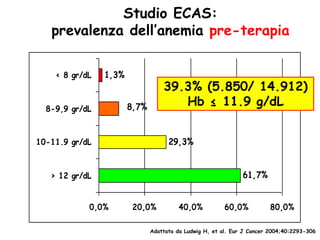
Studio ECAS:
prevalenza dell’anemia pre-terapia
Adattata da Ludwig H, et al. Eur J Cancer 2004;40:2293-306
61,7%
29,3%
1,3%
8,7%
0,0% 20,0% 40,0% 60,0% 80,0%
> 12 gr/dL
10-11.9 gr/dL
8-9,9 gr/dL
< 8 gr/dL
39.3% (5.850/ 14.912)
Hb ≤ 11.9 g/dL
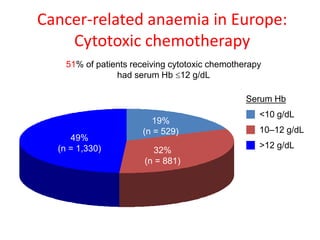
Cancer-related anaemia in Europe:
Cytotoxic chemotherapy
51% of patients receiving cytotoxic chemotherapy
had serum Hb 12 g/dL
49%
(n = 1,330)
19%
(n = 529)
32%
(n = 881)
Serum Hb
<10 g/dL
10–12 g/dL
>12 g/dL
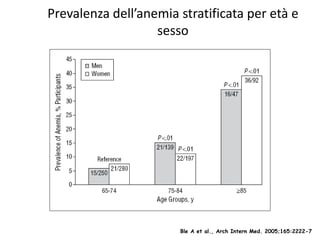
Prevalenza dell’anemia stratificata per età e
sesso
Ble A et al., Arch Intern Med. 2005;165:2222-7
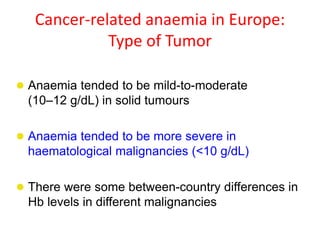
Cancer-related anaemia in Europe:
Type of Tumor
 Anaemia tended to be mild-to-moderate
(10–12 g/dL) in solid tumours
 Anaemia tended to be more severe in
haematological malignancies (<10 g/dL)
 There were some between-country differences in
Hb levels in different malignancies
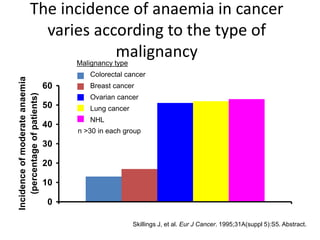
The incidence of anaemia in cancer
varies according to the type of
malignancy
0
10
20
30
40
50
60
Incidenceofmoderateanaemia
(percentageofpatients)
Skillings J, et al. Eur J Cancer. 1995;31A(suppl 5):S5. Abstract.
n >30 in each group
Malignancy type
Colorectal cancer
Breast cancer
Ovarian cancer
Lung cancer
NHL
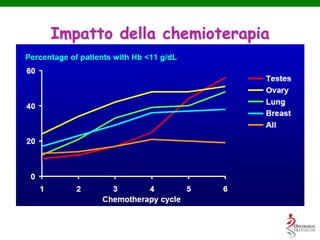
Impatto della chemioterapia
Barrett-Lee 2000 (adattata da Ludwig H. 2007)
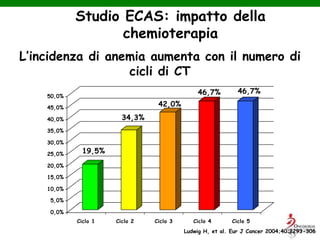
Studio ECAS: impatto della
chemioterapia
L’incidenza di anemia aumenta con il numero di
cicli di CT
19,5%
34,3%
42,0%
46,7% 46,7%
0,0%
5,0%
10,0%
15,0%
20,0%
25,0%
30,0%
35,0%
40,0%
45,0%
50,0%
Ciclo 1 Ciclo 2 Ciclo 3 Ciclo 4 Ciclo 5
Ludwig H, et al. Eur J Cancer 2004;40:2293-306
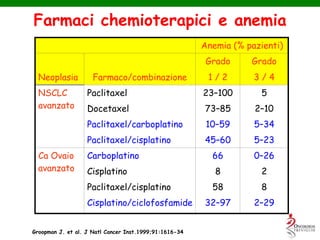
Groopman J. et al. J Natl Cancer Inst.1999;91:1616-34
Anemia (% pazienti)
Neoplasia Farmaco/combinazione
Grado
1 / 2
Grado
3 / 4
NSCLC
avanzato
Paclitaxel 23–100 5
Docetaxel 73–85 2–10
Paclitaxel/carboplatino 10–59 5–34
Paclitaxel/cisplatino 45–60 5–23
Ca Ovaio
avanzato
Carboplatino 66 0–26
Cisplatino 8 2
Paclitaxel/cisplatino 58 8
Cisplatino/ciclofosfamide 32–97 2–29
Farmaci chemioterapici e anemia
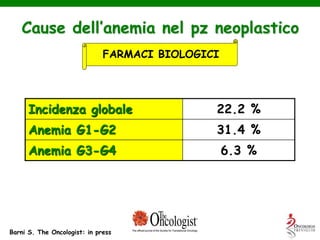
Cause dell’anemia nel pz neoplastico
FARMACI BIOLOGICI
Incidenza globale 22.2 %
Anemia G1-G2 31.4 %
Anemia G3-G4 6.3 %
Barni S. The Oncologist: in press
Causes of anaemia in patients with cancer:
Other treatment-related factors
 Radiotherapy
– has direct effects on bone marrow suppression
– can impair appetite and so reduce vital nutrient
uptake
– has been shown to induce or exacerbate anaemia
in 54% of patients with solid tumours1
 Anaemia may also result from blood loss due to
surgery
1Harrison L, et al. Semin Oncol. 2001;2(suppl 8):54-59.
Signs and symptoms of anaemia
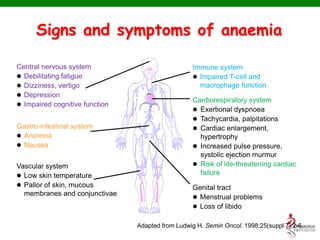
Central nervous system
 Debilitating fatigue
 Dizziness, vertigo
 Depression
 Impaired cognitive function
Immune system
 Impaired T-cell and
macrophage function
Cardiorespiratory system
 Exertional dyspnoea
 Tachycardia, palpitations
 Cardiac enlargement,
hypertrophy
 Increased pulse pressure,
systolic ejection murmur
 Risk of life-threatening cardiac
failure
Gastro-intestinal system
 Anorexia
 Nausea
Genital tract
 Menstrual problems
 Loss of libido
Vascular system
 Low skin temperature
 Pallor of skin, mucous
membranes and conjunctivae
Adapted from Ludwig H. Semin Oncol. 1998;25(suppl 7):2-6.
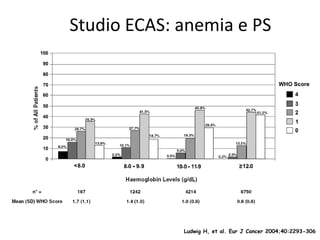
Studio ECAS: anemia e PS
Ludwig H, et al. Eur J Cancer 2004;40:2293-306
Anaemia adversely affects
quality of life (QOL)
 Fatigue is the most commonly reported clinical
manifestation of anaemia in patients with cancer
– 78% of patients with cancer suffer fatigue1
 Fatigue is not relieved by sleep or rest
 At Hb levels <12 g/dL, fatigue increases significantly
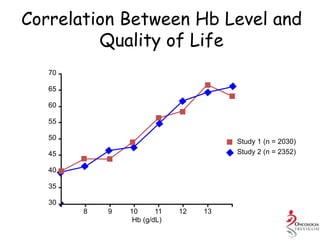
  Hb and  fatigue   QOL2

1Vogelzang N, et al. Semin Hematol. 1997;34 (suppl 2):4-12.
2Cella D. Semin Hematol. 1997;34 (suppl 2):13-19.
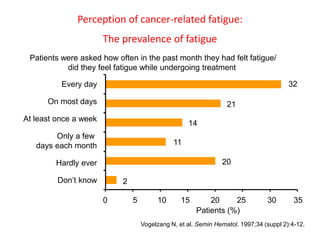
Perception of cancer-related fatigue:
The prevalence of fatigue
Every day
On most days
At least once a week
Only a few
days each month
Hardly ever
Don’t know
0 5 10 15 20 25 30 35
32
21
14
11
20
2
Patients (%)
Vogelzang N, et al. Semin Hematol. 1997;34 (suppl 2):4-12.
Patients were asked how often in the past month they had felt fatigue/
did they feel fatigue while undergoing treatment
Crawford J, et al. Cancer. 2002;15:888-895.
70
65
60
55
50
45
40
35
30
7
Hb (g/dL)
8 9 10 11 12 13 14
Study 1 (n = 2030)
Study 2 (n = 2352)
LASAScore(mm)
Study 1: r = 0.25
Study 2: r = 0.29
P < .01
Correlation Between Hb Level and
Quality of Life
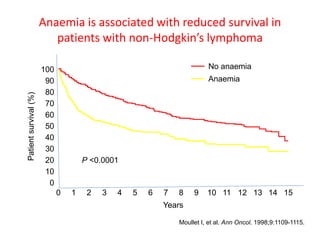
Anaemia is an adverse prognostic
factor in patients with cancer
 Increasing evidence suggests that anaemia adversely
affects survival in patients with cancer
 Anaemia and thrombocytopenia at diagnosis strongly
predicted for poor outcome in patients with chronic
lymphocytic leukaemia1
 Anaemia at diagnosis was an independent adverse
prognostic factor in patients with Hodgkin’s disease2
or NHL3
1Binet J, et al. Cancer. 1981;48:198-206.
2Hasenclever D, et al. N Engl J Med. 1998;339:1506-1514.
3Moullet I, et al. Ann Oncol. 1998;9:1109-1115.
Anaemia as an independent prognostic
factor: Literature review
 A literature review of 60 clinical studies assessed
the effects of anaemia on survival in patients with
a variety of solid tumours and haematological
malignancies1
 Anaemia increased the relative risk of death by
between 19% and 75%, depending on the
malignancy
1Caro J, et al. Cancer. 2001;91:2214-2221.
Anaemia is associated with reduced survival in
patients with non-Hodgkin’s lymphoma
Moullet I, et al. Ann Oncol. 1998;9:1109-1115.
100
90
80
70
60
50
40
30
20
10
0
Patientsurvival(%)
0 1 2 3 4 5 6 7 8 9 10 11 12 13 14 15
Years
P <0.0001
No anaemia
Anaemia
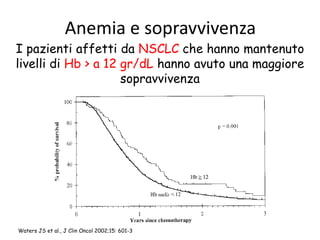
Anemia e sopravvivenza
I pazienti affetti da NSCLC che hanno mantenuto
livelli di Hb > a 12 gr/dL hanno avuto una maggiore
sopravvivenza
Waters JS et al., J Clin Oncol 2002;15: 601-3
Tumour hypoxia potentiates tumour
progression (cont’d)
 Hypoxia may stimulate tumour growth by induction of
– urokinase plasminogen activator (uPA)
• leads to degradation of the tumour extracellular
matrix and subsequent metastatis1
– vascular endothelial growth factor (VEGF) secretion
• promotes angiogenesis  tumour growth and
metastasis2
1Molls M. Proc 1st International Conference on Erythropoietin in Radiation
Oncology, Freiburg, Germany, June 1999.
2Dunst J, et al. Strahlenther Onkol. 1999;175:93-96.
Tumour hypoxia potentiates tumour
progression
 The impact of anaemia on the survival of patients with
cancer may be due to low tumour levels of oxygen
 Experimental data show that tumour hypoxia leads to
–  tumour invasiveness
–  metastatic potential
–  resistance to cancer therapy1
 Hypoxia may also promote the selection of aggressive
tumour phenotypes with reduced apoptotic potential
1Höckel M, et al. Cancer Res. 1999;59:4525-4528.
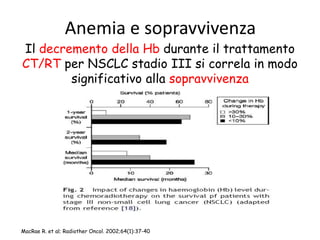
Anemia e sopravvivenza
Il decremento della Hb durante il trattamento
CT/RT per NSCLC stadio III si correla in modo
significativo alla sopravvivenza
MacRae R. et al; Radiother Oncol. 2002;64(1):37-40
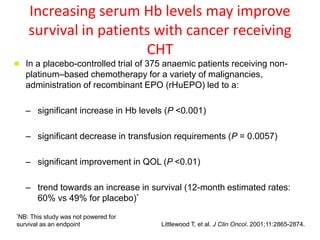
Increasing serum Hb levels may improve
survival in patients with cancer receiving
CHT
 In a placebo-controlled trial of 375 anaemic patients receiving non-
platinum–based chemotherapy for a variety of malignancies,
administration of recombinant EPO (rHuEPO) led to a:
– significant increase in Hb levels (P <0.001)
– significant decrease in transfusion requirements (P = 0.0057)
– significant improvement in QOL (P <0.01)
– trend towards an increase in survival (12-month estimated rates:
60% vs 49% for placebo)*
Littlewood T, et al. J Clin Oncol. 2001;11:2865-2874.
*NB: This study was not powered for
survival as an endpoint
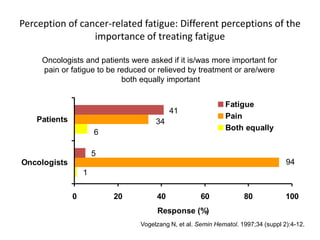
Perception of cancer-related fatigue: Different perceptions of the
importance of treating fatigue
0 20 40 60 80 100
Oncologists
Patients
Response (%)
Fatigue
Pain
Both equally
Oncologists and patients were asked if it is/was more important for
pain or fatigue to be reduced or relieved by treatment or are/were
both equally important
41
5
34
94
6
1
Vogelzang N, et al. Semin Hematol. 1997;34 (suppl 2):4-12.
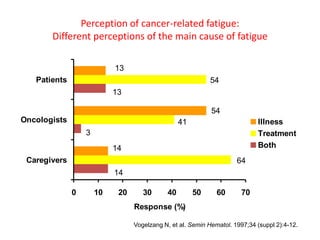
Perception of cancer-related fatigue:
Different perceptions of the main cause of fatigue
0 10 20 30 40 50 60 70
Caregivers
Oncologists
Patients
Response (%)
Illness
Treatment
Both
13
54
14
54
41
64
13
3
14
Vogelzang N, et al. Semin Hematol. 1997;34 (suppl 2):4-12.
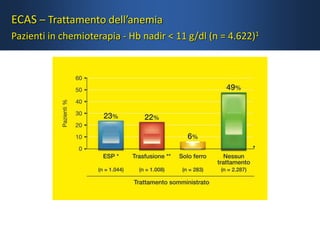
ECAS – Trattamento dell’anemia
Pazienti in chemioterapia - Hb nadir < 11 g/dl (n = 4.622)1
1. Ludwig H, et al. Eur J Cancer 2004;40:2293-2306
* Inclusi pazienti che ricevevano solo ESP, ESP + trasfusione, ESP + trasfusione + ferro;
** Inclusi pazienti che ricevevano solo trasfusione e trasfusione + ferro
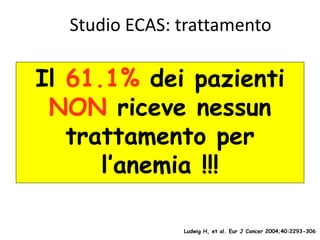
Studio ECAS: trattamento
Il 61.1% dei pazienti
NON riceve nessun
trattamento per
l’anemia !!!
Ludwig H, et al. Eur J Cancer 2004;40:2293-306
UK audit of RBC transfusions and anaemia
in patients with cancer (cont’d)
 Approximately one-third of patients required a RBC
transfusion
 The following factors were significantly associated
with a higher incidence of RBC transfusion
– pretreatment Hb <11 g/dL vs no anaemia
– lung/ovarian vs breast/testicular tumours
– metastatic vs non-metastatic disease
(for breast testicular and ovarian cancers)
Barrett-Lee P, et al. Br J Cancer. 2000;82:93-97.
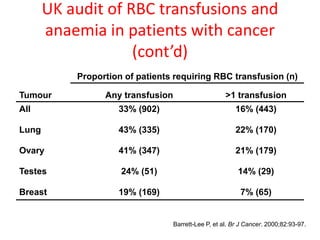
UK audit of RBC transfusions and
anaemia in patients with cancer
(cont’d)
Barrett-Lee P, et al. Br J Cancer. 2000;82:93-97.
Proportion of patients requiring RBC transfusion (n)
Tumour Any transfusion >1 transfusion
All 33% (902) 16% (443)
Lung 43% (335) 22% (170)
Ovary 41% (347) 21% (179)
Testes 24% (51) 14% (29)
Breast 19% (169) 7% (65)
RBC transfusions
 Until recently RBC transfusion was the therapy of choice for
symptomatic anaemia
 RBC transfusion is still appropriate for patients requiring
– rapid correction of Hb, eg, chronic symptomatic anaemia
– an increase in blood volume, eg, severe haemorrhage
However
 The effects of RBC transfusion are short-lived
 RBC transfusion does not address the underlying process of anaemia
Risks associated with RBC transfusion
 Serious adverse events
– transmission of infection
• viral, eg, hepatitis A, B, C; CMV, EBV
• bacterial
– acute and delayed haemolytic reactions
– immunosuppression
– transfusion-related acute lung injury
 Mild adverse events
– fever, urticaria
CMV = cytomegalovirus, EBV = Epstein-Barr virus
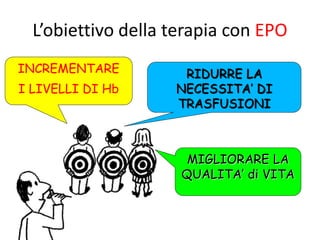
L’obiettivo della terapia con EPO
INCREMENTARE
I LIVELLI DI Hb
RIDURRE LA
NECESSITA’ DI
TRASFUSIONI
MIGLIORARE LA
QUALITA’ di VITA
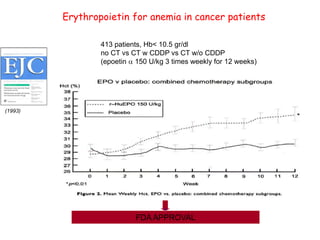
Erythropoietin for anemia in cancer patients
413 patients, Hb< 10.5 gr/dl
no CT vs CT w CDDP vs CT w/o CDDP
(epoetin  150 U/kg 3 times weekly for 12 weeks)
FDA APPROVAL
(1993)
• Treatment with ESA
– reduces transfusion requirement
– improves hematopoietic response
– provide clinically meaningful improvements in overall health
in patients receiving chemotherapy
Recombinant Human Erythropoietins and
Cancer Patients: Update Meta-Analysis of 57
Studies including 9353 Patients
Bohlius J. Et al. J Natl Cancer Inst. 2006
Bohlius J. Lancet 2009; 373: 1532–42
• 53 studi
• 13.933 pazienti
53 studi clinici randomizzati
N=13.933
Mortalità in studio
HR = 1.17 [95% CI, 1.06-1.30] p=0.003
Overall Survival
HR = 1.06 [95% CI, 1.00-1.12] p=0.0046
Nei pazienti anemici il trattamento con ESA
aumenta in modo statisticamente
significativo la mortalità e diminuisce la
sopravvivenza
Bohlius, Lancet 2009
Tutti i pazienti trattati con ESA
(popolazione globale anche fuori indicazione)
Alcuni studi hanno rilevato una tendenza verso una maggiore
sopravvivenza nel gruppo che riceveva ESA rispetto al gruppo placebo
(obiettivo secondario).
Si è quindi sviluppato un filone di ricerca indirizzato alla valutazione di
un possibile beneficio del trattamento con ESA in termini di
sopravvivenza
Razionale:
• la condizione anemica può peggiorare la prognosi del paziente
oncologico (ipo-ossigenazione tissutale ridurrebbe l’efficacia CHT/RT)
 Farmaci che riescono a incrementare i livelli di Hb potrebbero avere
un effetto benefico anche sui i livelli di ossigenazione tessutale,
aumentando quindi la risposta alla CHT/RT.
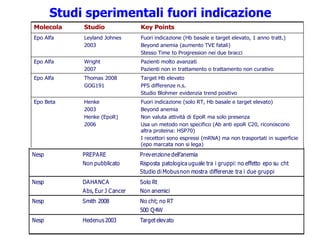
Studi sperimentali fuori indicazione
Riunione AM – 14 marzo 2007
Target Hb elevato
PFS differenze n.s.
Studio Blohmer evidenzia trend positivo
Thomas 2008
GOG191
Epo Alfa
Fuori indicazione (solo RT, Hb basale e target elevato)
Beyond anemia
Non valuta attività di EpoR ma solo presenza
Usa un metodo non specifico (Ab anti epoR C20, riconoscono
altra proteina: HSP70)
I recettori sono espressi (mRNA) ma non trasportati in superficie
(epo marcata non si lega)
Henke
2003
Henke (EpoR)
2006
Epo Beta
(solo polmone)
Sospeso l’arruolamento, non il trattamento (CERA x12 weeks)
Non pubblicatoCERA
Pazienti molto avanzati
Pazienti non in trattamento o trattamento non curativo
Wright
2007
Epo Alfa
Fuori indicazione (Hb basale e target elevato, 1 anno tratt.)
Beyond anemia (aumento TVE fatali)
Stesso Time to Progression nei due bracci
Leyland Johnes
2003
Epo Alfa
Key PointsStudioMolecola
Reactive Key Points
Molecola Studio Key Points
Nesp PREPARE
Non pubblicato
Prevenzione dell’anemia
Risposta patologica uguale tra i gruppi: no effetto epo su cht
Studio di Mobusnon mostra differenze tra i due gruppi
Nesp DAHANCA
Abs, Eur J Cancer
Solo Rt
Non anemici
Nesp Smith 2008 No cht; no RT
500 Q4W
Nesp Hedenus2003 Target elevato
Gli studi negativi sono fuori indicazione
Si tratta di 8 studi condotti in ambito sperimentale e al di
fuori delle indicazioni per una o più delle seguenti ragioni:
• Pazienti non anemici (elevati livelli di Hb basale ed elevato
target)
 Pazienti non in chemioterapia
Inoltre:
 Non tutti hanno l’outcome come obiettivo primario
 Molti sono stati interrotti e i risultati non possono essere
conclusivi
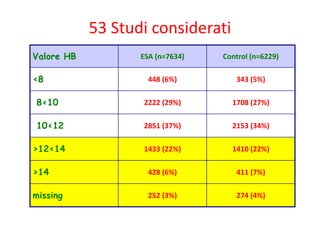
Valore HB ESA (n=7634) Control (n=6229)
<8 448 (6%) 343 (5%)
8<10 2222 (29%) 1708 (27%)
10<12 2851 (37%) 2153 (34%)
>12<14 1433 (22%) 1410 (22%)
>14 428 (6%) 411 (7%)
missing 252 (3%) 274 (4%)
53 Studi considerati
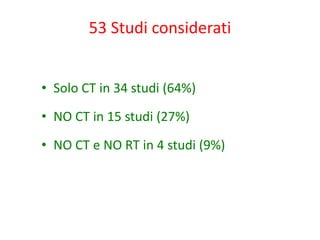
• Solo CT in 34 studi (64%)
• NO CT in 15 studi (27%)
• NO CT e NO RT in 4 studi (9%)
53 Studi considerati
38 studi clinici randomizzati
N=10.441
Mortalità in studio
HR = 1.10 [95% CI, 0.98-1.24] p=0.12
Overall Survival
HR = 1.04 [95% CI, 0.97-1.11] p=0.263
Nei pazienti anemici in CHT non esiste
differenza statisticamente significativa tra
il gruppo dei pt trattati e quello controllo
in termini di mortalità e sopravvivenza
Bohlius, Lancet 2009
Solo pt con anemia indotta da CHT
Autore Pt Tipo tumore Arms Commenti
Pronzato,
The Oncologist 2010
N=223 • Cancro alla mammella
(~50% in stadio avanzato)
• Anemia lieve (Hb ≤12.0
g/dL)
Epo alfa
vs
BSC
• Nessuna differenza statisticamente significativa nella
sopravvivenza
HR= 1,05 (CI 95% 0,58-1,92) p=0.86
Aapro,
JCO 2008
N=463 • Cancro alla mammella
metastatico
• Hb< 12,9 g/dl
Epo beta
vs
control
• Nessuna differenza statisticamente significativa:
- Sopravvivenza globale
HR=1.07 (95% CI, 0.87 -1.33) p =0.522
- Sopravvivenza libera da progressione malattia
HR=1.07 (95% CI, 0.89-1.30) p=0.488
Cantrell,
Cancer 2010
N=343 • Cancro all’ovaio ESA
vs
No ESA
• Analisi retrospettiva
• Le pazienti trattate con ESA avevano fattori prognostici
sfavorevoli (più anziani, stadio più avanzato di malattia, più
ipertese)
• Nessuna differenza statisticamente significativa:
- Sopravvivenza globale
OR=0.851 p=0.35
- Sopravvivenza libera da progressione malattia
OR=0.959 p=0.488
Blohmer,
JCO 2011
N=257 • Carcinoma cervicale in stadio
non avanzato
• Target Hb: 12,5-13.5 g/dl
ESA
vs
No ESA
• Nessuna differenza statisticamente significativa nella
sopravvivenza globale
HR: 0.88 [95% CI, 0.51-1.50], p=0,63
Stehman F,
Gynecologic Oncology
2012
N=1864 • Cancro ovarico epiteliale, alle
tube di falloppio o primario
peritoneale dopo chirurgia
• Stadio avanzato
ESA
vs
No ESA
• Nessuna differenza statisticamente significativa:
- Sopravvivenza globale
HR=0,989 [IC95% 0,849–1,15] p=0.892
- Sopravvivenza libera da progressione malattia
HR=1,06 [IC 95% 0,937–1,19] p=0.364
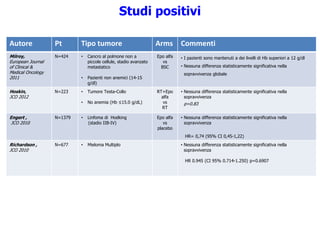
Studi positivi
Autore Pt Tipo tumore Arms Commenti
Milroy,
European Journal
of Clinical &
Medical Oncology
2011
N=424 • Cancro al polmone non a
piccole cellule, stadio avanzato
metastatico
• Pazienti non anemici (14-15
g/dl)
Epo alfa
vs
BSC
• I pazienti sono mantenuti a dei livelli di Hb superiori a 12 g/dl
• Nessuna differenza statisticamente significativa nella
sopravvivenza globale
Hoskin,
JCO 2012
N=223 • Tumore Testa-Collo
• No anemia (Hb ≤15.0 g/dL)
RT+Epo
alfa
vs
RT
• Nessuna differenza statisticamente significativa nella
sopravvivenza
p=0.83
Engert ,
JCO 2010
N=1379 • Linfoma di Hodking
(stadio IIB-IV)
Epo alfa
vs
placebo
• Nessuna differenza statisticamente significativa nella
sopravvivenza
HR= 0,74 (95% CI 0,45-1,22)
Richardson ,
JCO 2010
N=677 • Mieloma Multiplo • Nessuna differenza statisticamente significativa nella
sopravvivenza
HR 0.945 (CI 95% 0.714-1.250) p=0.6907
Studi positivi
Tonia, The Cochrane Collaboration 2012
Metanalisi Cochrane 2012
Sopravvivenza globale e mortalità
78 trials – 19.003 pazienti
Sopravvivenza globale: HR 1.05 [95% CI, 1.00-1.11]
Mortalità in studio: HR 1.17 [95% CI, 1.06-1.29]
Tonia, The Cochrane Collaboration 2012
Metanalisi Cochrane 2012
Riduzione del fabbisogno trasfusionale
57 trials – 15.877 pazienti
Riduzione fabbisogno trasfusionale: HR 0.65 [95% CI, 0.62-0.68]
OS sulla base dei livelli di Hb al basale
Se Hb basale<10 g/dl
HR=1.06 [95% CI, 0.96-1.17]
.
.
.
.
.
.
Tonia, The Cochrane Collaboration 2012
OS sulla base dei livelli di Hb al basale
Se Hb basale 10-12 g/dl
HR=1.01 [95% CI, 0.93-1.10]
.
.
.
.
.
.
Tonia, The Cochrane Collaboration 2012
OS sulla base dei livelli di Hb al basale
Se Hb basale >12 g/dl
HR=1.17 [95% CI, 1.06-1.29]
Tonia, The Cochrane Collaboration 2012
OS sulla base delle diverse terapie
Se pazieti in trattamento CHT
HR=1.04 [95% CI, 0.98-1.11]
Tonia, The Cochrane Collaboration 2012
OS sulla base delle diverse terapie
Se pazienti non in trattamento (RT/CHT)
HR=1.23 [95% CI, 1.04-1.45]
Tonia, The Cochrane Collaboration 2012
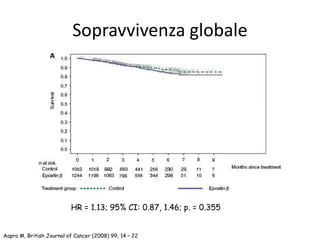
Aapro M. British Journal of Cancer (2008) 99, 14 – 22
Sopravvivenza globale
HR = 1.13; 95% CI: 0.87, 1.46; p. = 0.355
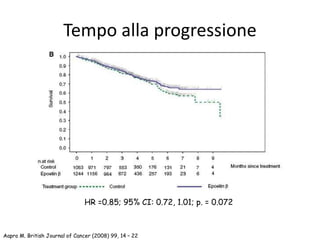
Tempo alla progressione
Aapro M. British Journal of Cancer (2008) 99, 14 – 22
HR =0.85; 95% CI: 0.72, 1.01; p. = 0.072
Tonia, The Cochrane Collaboration 2012
Metanalisi Cochrane 2012
Rischio di eventi tromboembolici
57 trials – 15.278 pazienti
TVE: HR 1.52 [95% CI, 1.33-1.73]
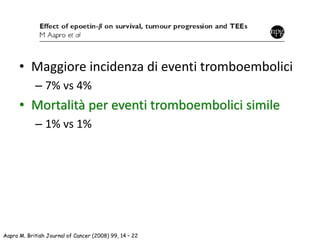
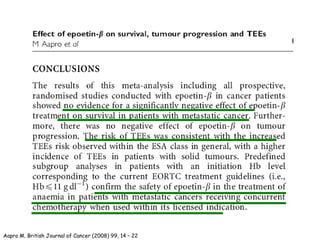
• Maggiore incidenza di eventi tromboembolici
– 7% vs 4%
• Mortalità per eventi tromboembolici simile
– 1% vs 1%
Aapro M. British Journal of Cancer (2008) 99, 14 – 22

Anemo 2014 - Lorusso - ESA nel paziente oncologico

  • 1.
    Gynecologic Oncology Unit DomenicaLorusso Milan - Italy ESA NEL PAZIENTE ONCOLOGICO ANEMO 14 Strategie di Risparmio di Sangue San Donato Milanese 07/03/2014
  • 2.
    Prevalence of anaemiain cancer  Anaemia is the most common haematological disorder in patients with cancer – approximately 20%–60% of patients with cancer will have anaemia at presentation  Treatment for cancer can induce or exacerbate anaemia: the extent of this varies according to the type of tumour and treatment
  • 3.
    Studio ECAS: prevalenza dell’anemiapre-terapia Adattata da Ludwig H, et al. Eur J Cancer 2004;40:2293-306 61,7% 29,3% 1,3% 8,7% 0,0% 20,0% 40,0% 60,0% 80,0% > 12 gr/dL 10-11.9 gr/dL 8-9,9 gr/dL < 8 gr/dL 39.3% (5.850/ 14.912) Hb ≤ 11.9 g/dL
  • 4.
    Cancer-related anaemia inEurope: Cytotoxic chemotherapy 51% of patients receiving cytotoxic chemotherapy had serum Hb 12 g/dL 49% (n = 1,330) 19% (n = 529) 32% (n = 881) Serum Hb <10 g/dL 10–12 g/dL >12 g/dL
  • 5.
    Prevalenza dell’anemia stratificataper età e sesso Ble A et al., Arch Intern Med. 2005;165:2222-7
  • 6.
    Cancer-related anaemia inEurope: Type of Tumor  Anaemia tended to be mild-to-moderate (10–12 g/dL) in solid tumours  Anaemia tended to be more severe in haematological malignancies (<10 g/dL)  There were some between-country differences in Hb levels in different malignancies
  • 7.
    The incidence ofanaemia in cancer varies according to the type of malignancy 0 10 20 30 40 50 60 Incidenceofmoderateanaemia (percentageofpatients) Skillings J, et al. Eur J Cancer. 1995;31A(suppl 5):S5. Abstract. n >30 in each group Malignancy type Colorectal cancer Breast cancer Ovarian cancer Lung cancer NHL
  • 8.
    Impatto della chemioterapia Barrett-Lee2000 (adattata da Ludwig H. 2007)
  • 9.
    Studio ECAS: impattodella chemioterapia L’incidenza di anemia aumenta con il numero di cicli di CT 19,5% 34,3% 42,0% 46,7% 46,7% 0,0% 5,0% 10,0% 15,0% 20,0% 25,0% 30,0% 35,0% 40,0% 45,0% 50,0% Ciclo 1 Ciclo 2 Ciclo 3 Ciclo 4 Ciclo 5 Ludwig H, et al. Eur J Cancer 2004;40:2293-306
  • 10.
    Groopman J. etal. J Natl Cancer Inst.1999;91:1616-34 Anemia (% pazienti) Neoplasia Farmaco/combinazione Grado 1 / 2 Grado 3 / 4 NSCLC avanzato Paclitaxel 23–100 5 Docetaxel 73–85 2–10 Paclitaxel/carboplatino 10–59 5–34 Paclitaxel/cisplatino 45–60 5–23 Ca Ovaio avanzato Carboplatino 66 0–26 Cisplatino 8 2 Paclitaxel/cisplatino 58 8 Cisplatino/ciclofosfamide 32–97 2–29 Farmaci chemioterapici e anemia
  • 11.
    Cause dell’anemia nelpz neoplastico FARMACI BIOLOGICI Incidenza globale 22.2 % Anemia G1-G2 31.4 % Anemia G3-G4 6.3 % Barni S. The Oncologist: in press
  • 12.
    Causes of anaemiain patients with cancer: Other treatment-related factors  Radiotherapy – has direct effects on bone marrow suppression – can impair appetite and so reduce vital nutrient uptake – has been shown to induce or exacerbate anaemia in 54% of patients with solid tumours1  Anaemia may also result from blood loss due to surgery 1Harrison L, et al. Semin Oncol. 2001;2(suppl 8):54-59.
  • 13.
    Signs and symptomsof anaemia Central nervous system  Debilitating fatigue  Dizziness, vertigo  Depression  Impaired cognitive function Immune system  Impaired T-cell and macrophage function Cardiorespiratory system  Exertional dyspnoea  Tachycardia, palpitations  Cardiac enlargement, hypertrophy  Increased pulse pressure, systolic ejection murmur  Risk of life-threatening cardiac failure Gastro-intestinal system  Anorexia  Nausea Genital tract  Menstrual problems  Loss of libido Vascular system  Low skin temperature  Pallor of skin, mucous membranes and conjunctivae Adapted from Ludwig H. Semin Oncol. 1998;25(suppl 7):2-6.
  • 14.
    Studio ECAS: anemiae PS Ludwig H, et al. Eur J Cancer 2004;40:2293-306
  • 15.
    Anaemia adversely affects qualityof life (QOL)  Fatigue is the most commonly reported clinical manifestation of anaemia in patients with cancer – 78% of patients with cancer suffer fatigue1  Fatigue is not relieved by sleep or rest  At Hb levels <12 g/dL, fatigue increases significantly   Hb and  fatigue   QOL2 1Vogelzang N, et al. Semin Hematol. 1997;34 (suppl 2):4-12. 2Cella D. Semin Hematol. 1997;34 (suppl 2):13-19.
  • 16.
    Perception of cancer-relatedfatigue: The prevalence of fatigue Every day On most days At least once a week Only a few days each month Hardly ever Don’t know 0 5 10 15 20 25 30 35 32 21 14 11 20 2 Patients (%) Vogelzang N, et al. Semin Hematol. 1997;34 (suppl 2):4-12. Patients were asked how often in the past month they had felt fatigue/ did they feel fatigue while undergoing treatment
  • 17.
    Crawford J, etal. Cancer. 2002;15:888-895. 70 65 60 55 50 45 40 35 30 7 Hb (g/dL) 8 9 10 11 12 13 14 Study 1 (n = 2030) Study 2 (n = 2352) LASAScore(mm) Study 1: r = 0.25 Study 2: r = 0.29 P < .01 Correlation Between Hb Level and Quality of Life
  • 18.
    Anaemia is anadverse prognostic factor in patients with cancer  Increasing evidence suggests that anaemia adversely affects survival in patients with cancer  Anaemia and thrombocytopenia at diagnosis strongly predicted for poor outcome in patients with chronic lymphocytic leukaemia1  Anaemia at diagnosis was an independent adverse prognostic factor in patients with Hodgkin’s disease2 or NHL3 1Binet J, et al. Cancer. 1981;48:198-206. 2Hasenclever D, et al. N Engl J Med. 1998;339:1506-1514. 3Moullet I, et al. Ann Oncol. 1998;9:1109-1115.
  • 19.
    Anaemia as anindependent prognostic factor: Literature review  A literature review of 60 clinical studies assessed the effects of anaemia on survival in patients with a variety of solid tumours and haematological malignancies1  Anaemia increased the relative risk of death by between 19% and 75%, depending on the malignancy 1Caro J, et al. Cancer. 2001;91:2214-2221.
  • 20.
    Anaemia is associatedwith reduced survival in patients with non-Hodgkin’s lymphoma Moullet I, et al. Ann Oncol. 1998;9:1109-1115. 100 90 80 70 60 50 40 30 20 10 0 Patientsurvival(%) 0 1 2 3 4 5 6 7 8 9 10 11 12 13 14 15 Years P <0.0001 No anaemia Anaemia
  • 21.
    Anemia e sopravvivenza Ipazienti affetti da NSCLC che hanno mantenuto livelli di Hb > a 12 gr/dL hanno avuto una maggiore sopravvivenza Waters JS et al., J Clin Oncol 2002;15: 601-3
  • 22.
    Tumour hypoxia potentiatestumour progression (cont’d)  Hypoxia may stimulate tumour growth by induction of – urokinase plasminogen activator (uPA) • leads to degradation of the tumour extracellular matrix and subsequent metastatis1 – vascular endothelial growth factor (VEGF) secretion • promotes angiogenesis  tumour growth and metastasis2 1Molls M. Proc 1st International Conference on Erythropoietin in Radiation Oncology, Freiburg, Germany, June 1999. 2Dunst J, et al. Strahlenther Onkol. 1999;175:93-96.
  • 23.
    Tumour hypoxia potentiatestumour progression  The impact of anaemia on the survival of patients with cancer may be due to low tumour levels of oxygen  Experimental data show that tumour hypoxia leads to –  tumour invasiveness –  metastatic potential –  resistance to cancer therapy1  Hypoxia may also promote the selection of aggressive tumour phenotypes with reduced apoptotic potential 1Höckel M, et al. Cancer Res. 1999;59:4525-4528.
  • 24.
    Anemia e sopravvivenza Ildecremento della Hb durante il trattamento CT/RT per NSCLC stadio III si correla in modo significativo alla sopravvivenza MacRae R. et al; Radiother Oncol. 2002;64(1):37-40
  • 25.
    Increasing serum Hblevels may improve survival in patients with cancer receiving CHT  In a placebo-controlled trial of 375 anaemic patients receiving non- platinum–based chemotherapy for a variety of malignancies, administration of recombinant EPO (rHuEPO) led to a: – significant increase in Hb levels (P <0.001) – significant decrease in transfusion requirements (P = 0.0057) – significant improvement in QOL (P <0.01) – trend towards an increase in survival (12-month estimated rates: 60% vs 49% for placebo)* Littlewood T, et al. J Clin Oncol. 2001;11:2865-2874. *NB: This study was not powered for survival as an endpoint
  • 26.
    Perception of cancer-relatedfatigue: Different perceptions of the importance of treating fatigue 0 20 40 60 80 100 Oncologists Patients Response (%) Fatigue Pain Both equally Oncologists and patients were asked if it is/was more important for pain or fatigue to be reduced or relieved by treatment or are/were both equally important 41 5 34 94 6 1 Vogelzang N, et al. Semin Hematol. 1997;34 (suppl 2):4-12.
  • 27.
    Perception of cancer-relatedfatigue: Different perceptions of the main cause of fatigue 0 10 20 30 40 50 60 70 Caregivers Oncologists Patients Response (%) Illness Treatment Both 13 54 14 54 41 64 13 3 14 Vogelzang N, et al. Semin Hematol. 1997;34 (suppl 2):4-12.
  • 28.
    ECAS – Trattamentodell’anemia Pazienti in chemioterapia - Hb nadir < 11 g/dl (n = 4.622)1 1. Ludwig H, et al. Eur J Cancer 2004;40:2293-2306 * Inclusi pazienti che ricevevano solo ESP, ESP + trasfusione, ESP + trasfusione + ferro; ** Inclusi pazienti che ricevevano solo trasfusione e trasfusione + ferro
  • 29.
    Studio ECAS: trattamento Il61.1% dei pazienti NON riceve nessun trattamento per l’anemia !!! Ludwig H, et al. Eur J Cancer 2004;40:2293-306
  • 30.
    UK audit ofRBC transfusions and anaemia in patients with cancer (cont’d)  Approximately one-third of patients required a RBC transfusion  The following factors were significantly associated with a higher incidence of RBC transfusion – pretreatment Hb <11 g/dL vs no anaemia – lung/ovarian vs breast/testicular tumours – metastatic vs non-metastatic disease (for breast testicular and ovarian cancers) Barrett-Lee P, et al. Br J Cancer. 2000;82:93-97.
  • 31.
    UK audit ofRBC transfusions and anaemia in patients with cancer (cont’d) Barrett-Lee P, et al. Br J Cancer. 2000;82:93-97. Proportion of patients requiring RBC transfusion (n) Tumour Any transfusion >1 transfusion All 33% (902) 16% (443) Lung 43% (335) 22% (170) Ovary 41% (347) 21% (179) Testes 24% (51) 14% (29) Breast 19% (169) 7% (65)
  • 32.
    RBC transfusions  Untilrecently RBC transfusion was the therapy of choice for symptomatic anaemia  RBC transfusion is still appropriate for patients requiring – rapid correction of Hb, eg, chronic symptomatic anaemia – an increase in blood volume, eg, severe haemorrhage However  The effects of RBC transfusion are short-lived  RBC transfusion does not address the underlying process of anaemia
  • 33.
    Risks associated withRBC transfusion  Serious adverse events – transmission of infection • viral, eg, hepatitis A, B, C; CMV, EBV • bacterial – acute and delayed haemolytic reactions – immunosuppression – transfusion-related acute lung injury  Mild adverse events – fever, urticaria CMV = cytomegalovirus, EBV = Epstein-Barr virus
  • 34.
    L’obiettivo della terapiacon EPO INCREMENTARE I LIVELLI DI Hb RIDURRE LA NECESSITA’ DI TRASFUSIONI MIGLIORARE LA QUALITA’ di VITA
  • 35.
    Erythropoietin for anemiain cancer patients 413 patients, Hb< 10.5 gr/dl no CT vs CT w CDDP vs CT w/o CDDP (epoetin  150 U/kg 3 times weekly for 12 weeks) FDA APPROVAL (1993)
  • 36.
    • Treatment withESA – reduces transfusion requirement – improves hematopoietic response – provide clinically meaningful improvements in overall health in patients receiving chemotherapy Recombinant Human Erythropoietins and Cancer Patients: Update Meta-Analysis of 57 Studies including 9353 Patients Bohlius J. Et al. J Natl Cancer Inst. 2006
  • 38.
    Bohlius J. Lancet2009; 373: 1532–42 • 53 studi • 13.933 pazienti
  • 39.
    53 studi clinicirandomizzati N=13.933 Mortalità in studio HR = 1.17 [95% CI, 1.06-1.30] p=0.003 Overall Survival HR = 1.06 [95% CI, 1.00-1.12] p=0.0046 Nei pazienti anemici il trattamento con ESA aumenta in modo statisticamente significativo la mortalità e diminuisce la sopravvivenza Bohlius, Lancet 2009 Tutti i pazienti trattati con ESA (popolazione globale anche fuori indicazione)
  • 40.
    Alcuni studi hannorilevato una tendenza verso una maggiore sopravvivenza nel gruppo che riceveva ESA rispetto al gruppo placebo (obiettivo secondario). Si è quindi sviluppato un filone di ricerca indirizzato alla valutazione di un possibile beneficio del trattamento con ESA in termini di sopravvivenza Razionale: • la condizione anemica può peggiorare la prognosi del paziente oncologico (ipo-ossigenazione tissutale ridurrebbe l’efficacia CHT/RT)  Farmaci che riescono a incrementare i livelli di Hb potrebbero avere un effetto benefico anche sui i livelli di ossigenazione tessutale, aumentando quindi la risposta alla CHT/RT.
  • 41.
    Studi sperimentali fuoriindicazione Riunione AM – 14 marzo 2007 Target Hb elevato PFS differenze n.s. Studio Blohmer evidenzia trend positivo Thomas 2008 GOG191 Epo Alfa Fuori indicazione (solo RT, Hb basale e target elevato) Beyond anemia Non valuta attività di EpoR ma solo presenza Usa un metodo non specifico (Ab anti epoR C20, riconoscono altra proteina: HSP70) I recettori sono espressi (mRNA) ma non trasportati in superficie (epo marcata non si lega) Henke 2003 Henke (EpoR) 2006 Epo Beta (solo polmone) Sospeso l’arruolamento, non il trattamento (CERA x12 weeks) Non pubblicatoCERA Pazienti molto avanzati Pazienti non in trattamento o trattamento non curativo Wright 2007 Epo Alfa Fuori indicazione (Hb basale e target elevato, 1 anno tratt.) Beyond anemia (aumento TVE fatali) Stesso Time to Progression nei due bracci Leyland Johnes 2003 Epo Alfa Key PointsStudioMolecola Reactive Key Points Molecola Studio Key Points Nesp PREPARE Non pubblicato Prevenzione dell’anemia Risposta patologica uguale tra i gruppi: no effetto epo su cht Studio di Mobusnon mostra differenze tra i due gruppi Nesp DAHANCA Abs, Eur J Cancer Solo Rt Non anemici Nesp Smith 2008 No cht; no RT 500 Q4W Nesp Hedenus2003 Target elevato
  • 42.
    Gli studi negativisono fuori indicazione Si tratta di 8 studi condotti in ambito sperimentale e al di fuori delle indicazioni per una o più delle seguenti ragioni: • Pazienti non anemici (elevati livelli di Hb basale ed elevato target)  Pazienti non in chemioterapia Inoltre:  Non tutti hanno l’outcome come obiettivo primario  Molti sono stati interrotti e i risultati non possono essere conclusivi
  • 43.
    Valore HB ESA(n=7634) Control (n=6229) <8 448 (6%) 343 (5%) 8<10 2222 (29%) 1708 (27%) 10<12 2851 (37%) 2153 (34%) >12<14 1433 (22%) 1410 (22%) >14 428 (6%) 411 (7%) missing 252 (3%) 274 (4%) 53 Studi considerati
  • 44.
    • Solo CTin 34 studi (64%) • NO CT in 15 studi (27%) • NO CT e NO RT in 4 studi (9%) 53 Studi considerati
  • 45.
    38 studi clinicirandomizzati N=10.441 Mortalità in studio HR = 1.10 [95% CI, 0.98-1.24] p=0.12 Overall Survival HR = 1.04 [95% CI, 0.97-1.11] p=0.263 Nei pazienti anemici in CHT non esiste differenza statisticamente significativa tra il gruppo dei pt trattati e quello controllo in termini di mortalità e sopravvivenza Bohlius, Lancet 2009 Solo pt con anemia indotta da CHT
  • 46.
    Autore Pt Tipotumore Arms Commenti Pronzato, The Oncologist 2010 N=223 • Cancro alla mammella (~50% in stadio avanzato) • Anemia lieve (Hb ≤12.0 g/dL) Epo alfa vs BSC • Nessuna differenza statisticamente significativa nella sopravvivenza HR= 1,05 (CI 95% 0,58-1,92) p=0.86 Aapro, JCO 2008 N=463 • Cancro alla mammella metastatico • Hb< 12,9 g/dl Epo beta vs control • Nessuna differenza statisticamente significativa: - Sopravvivenza globale HR=1.07 (95% CI, 0.87 -1.33) p =0.522 - Sopravvivenza libera da progressione malattia HR=1.07 (95% CI, 0.89-1.30) p=0.488 Cantrell, Cancer 2010 N=343 • Cancro all’ovaio ESA vs No ESA • Analisi retrospettiva • Le pazienti trattate con ESA avevano fattori prognostici sfavorevoli (più anziani, stadio più avanzato di malattia, più ipertese) • Nessuna differenza statisticamente significativa: - Sopravvivenza globale OR=0.851 p=0.35 - Sopravvivenza libera da progressione malattia OR=0.959 p=0.488 Blohmer, JCO 2011 N=257 • Carcinoma cervicale in stadio non avanzato • Target Hb: 12,5-13.5 g/dl ESA vs No ESA • Nessuna differenza statisticamente significativa nella sopravvivenza globale HR: 0.88 [95% CI, 0.51-1.50], p=0,63 Stehman F, Gynecologic Oncology 2012 N=1864 • Cancro ovarico epiteliale, alle tube di falloppio o primario peritoneale dopo chirurgia • Stadio avanzato ESA vs No ESA • Nessuna differenza statisticamente significativa: - Sopravvivenza globale HR=0,989 [IC95% 0,849–1,15] p=0.892 - Sopravvivenza libera da progressione malattia HR=1,06 [IC 95% 0,937–1,19] p=0.364 Studi positivi
  • 47.
    Autore Pt Tipotumore Arms Commenti Milroy, European Journal of Clinical & Medical Oncology 2011 N=424 • Cancro al polmone non a piccole cellule, stadio avanzato metastatico • Pazienti non anemici (14-15 g/dl) Epo alfa vs BSC • I pazienti sono mantenuti a dei livelli di Hb superiori a 12 g/dl • Nessuna differenza statisticamente significativa nella sopravvivenza globale Hoskin, JCO 2012 N=223 • Tumore Testa-Collo • No anemia (Hb ≤15.0 g/dL) RT+Epo alfa vs RT • Nessuna differenza statisticamente significativa nella sopravvivenza p=0.83 Engert , JCO 2010 N=1379 • Linfoma di Hodking (stadio IIB-IV) Epo alfa vs placebo • Nessuna differenza statisticamente significativa nella sopravvivenza HR= 0,74 (95% CI 0,45-1,22) Richardson , JCO 2010 N=677 • Mieloma Multiplo • Nessuna differenza statisticamente significativa nella sopravvivenza HR 0.945 (CI 95% 0.714-1.250) p=0.6907 Studi positivi
  • 48.
    Tonia, The CochraneCollaboration 2012 Metanalisi Cochrane 2012 Sopravvivenza globale e mortalità 78 trials – 19.003 pazienti Sopravvivenza globale: HR 1.05 [95% CI, 1.00-1.11] Mortalità in studio: HR 1.17 [95% CI, 1.06-1.29]
  • 49.
    Tonia, The CochraneCollaboration 2012 Metanalisi Cochrane 2012 Riduzione del fabbisogno trasfusionale 57 trials – 15.877 pazienti Riduzione fabbisogno trasfusionale: HR 0.65 [95% CI, 0.62-0.68]
  • 50.
    OS sulla basedei livelli di Hb al basale Se Hb basale<10 g/dl HR=1.06 [95% CI, 0.96-1.17] . . . . . . Tonia, The Cochrane Collaboration 2012
  • 51.
    OS sulla basedei livelli di Hb al basale Se Hb basale 10-12 g/dl HR=1.01 [95% CI, 0.93-1.10] . . . . . . Tonia, The Cochrane Collaboration 2012
  • 52.
    OS sulla basedei livelli di Hb al basale Se Hb basale >12 g/dl HR=1.17 [95% CI, 1.06-1.29] Tonia, The Cochrane Collaboration 2012
  • 53.
    OS sulla basedelle diverse terapie Se pazieti in trattamento CHT HR=1.04 [95% CI, 0.98-1.11] Tonia, The Cochrane Collaboration 2012
  • 54.
    OS sulla basedelle diverse terapie Se pazienti non in trattamento (RT/CHT) HR=1.23 [95% CI, 1.04-1.45] Tonia, The Cochrane Collaboration 2012
  • 55.
    Aapro M. BritishJournal of Cancer (2008) 99, 14 – 22 Sopravvivenza globale HR = 1.13; 95% CI: 0.87, 1.46; p. = 0.355
  • 56.
    Tempo alla progressione AaproM. British Journal of Cancer (2008) 99, 14 – 22 HR =0.85; 95% CI: 0.72, 1.01; p. = 0.072
  • 57.
    Tonia, The CochraneCollaboration 2012 Metanalisi Cochrane 2012 Rischio di eventi tromboembolici 57 trials – 15.278 pazienti TVE: HR 1.52 [95% CI, 1.33-1.73]
  • 58.
    • Maggiore incidenzadi eventi tromboembolici – 7% vs 4% • Mortalità per eventi tromboembolici simile – 1% vs 1% Aapro M. British Journal of Cancer (2008) 99, 14 – 22
  • 59.
    Aapro M. BritishJournal of Cancer (2008) 99, 14 – 22