MOOCS by Dr. Subir Maitra
Course Name: M.Com Year: First
Session: 2017-18
Paper- 1.3
Macroeconomics and Business Environment
Module: One
University of Calcutta
Department of Commerce
MOOCS by Dr. Subir Maitra, Associate Professor of Economics, HCC, subirmaitra.wixsite.com/moocs
General Equilibrium: Aspects of Closed
Economy--Commodity Market and Money
Market Equilibrium--IS-LM Approach.
LECTURE-9
IS-LM MODEL: COMMODITY MARKET AND MONEY MARKET
MOOCS by Dr. Subir Maitra, Associate Professor of Economics, HCC, subirmaitra.wixsite.com/moocs
Departure from Simple Keynesian Model:
• Simple Keynesian Model is one-sector model. It deals
only with the demand for output in the real sector i.e.
goods market.
• IS-LM model is a two-sector model, comprising of both
the real sector, the goods or commodity market and a
monetary sector or market for financial assets.
• In IS-LM model, the rate of interest and level of income
are jointly determined in simultaneous equilibrium in
two markets: one for commodities and the other
financial assets.
MOOCS by Dr. Subir Maitra, Associate Professor of Economics, HCC, subirmaitra.wixsite.com/moocs
Asset or Wealth Market
• In economics, assets are of two types—Physical and
Financial. In IS-LM only financial assets are considered.
• Two types of financial assets: (a) Money as non-interest
bearing liquid financial assets (M), (b) Government bonds as
interest bearing financial assets (B). Therefore,
W = M + B
• If someone holds money, return is zero; if he holds bonds,
he earns a positive return.
MOOCS by Dr. Subir Maitra, Associate Professor of Economics, HCC, subirmaitra.wixsite.com/moocs
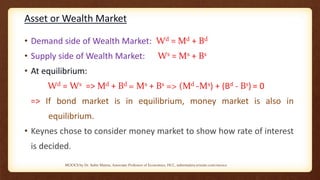
Asset or Wealth Market
• Demand side of Wealth Market: Wd = Md + Bd
• Supply side of Wealth Market: Ws = Ms + Bs
• At equilibrium:
Wd = Ws => Md + Bd = Ms + Bs => (Md -Ms) + (Bd - Bs) = 0
=> If bond market is in equilibrium, money market is also in
equilibrium.
• Keynes chose to consider money market to show how rate of interest
is decided.
MOOCS by Dr. Subir Maitra, Associate Professor of Economics, HCC, subirmaitra.wixsite.com/moocs
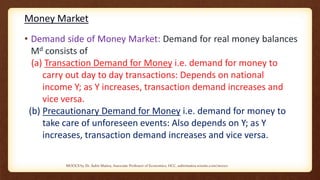
Money Market
• Demand side of Money Market: Demand for real money balances
Md consists of
(a) Transaction Demand for Money i.e. demand for money to
carry out day to day transactions: Depends on national
income Y; as Y increases, transaction demand increases and
vice versa.
(b) Precautionary Demand for Money i.e. demand for money to
take care of unforeseen events: Also depends on Y; as Y
increases, transaction demand increases and vice versa.
MOOCS by Dr. Subir Maitra, Associate Professor of Economics, HCC, subirmaitra.wixsite.com/moocs
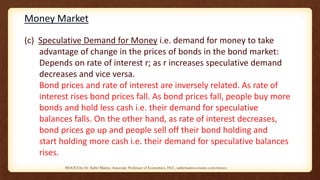
Money Market
(c) Speculative Demand for Money i.e. demand for money to take
advantage of change in the prices of bonds in the bond market:
Depends on rate of interest r; as r increases speculative demand
decreases and vice versa.
Bond prices and rate of interest are inversely related. As rate of
interest rises bond prices fall. As bond prices fall, people buy more
bonds and hold less cash i.e. their demand for speculative
balances falls. On the other hand, as rate of interest decreases,
bond prices go up and people sell off their bond holding and
start holding more cash i.e. their demand for speculative balances
rises.
MOOCS by Dr. Subir Maitra, Associate Professor of Economics, HCC, subirmaitra.wixsite.com/moocs
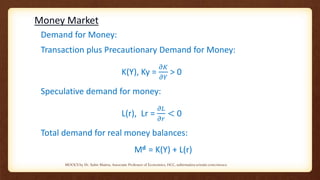
Money Market
Demand for Money:
Transaction plus Precautionary Demand for Money:
K(Y), Ky =
𝜕𝐾
𝜕𝑌
> 0
Speculative demand for money:
L(r), Lr =
𝜕𝐿
𝜕𝑟
< 0
Total demand for real money balances:
Md = K(Y) + L(r)
MOOCS by Dr. Subir Maitra, Associate Professor of Economics, HCC, subirmaitra.wixsite.com/moocs
Money Market
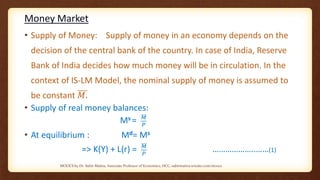
• Supply of Money: Supply of money in an economy depends on the
decision of the central bank of the country. In case of India, Reserve
Bank of India decides how much money will be in circulation. In the
context of IS-LM Model, the nominal supply of money is assumed to
be constant 𝑀.
• Supply of real money balances:
Ms = 𝑀
𝑃
• At equilibrium : Md= Ms
=> K(Y) + L(r) = 𝑀
𝑃
………………..……(1)
MOOCS by Dr. Subir Maitra, Associate Professor of Economics, HCC, subirmaitra.wixsite.com/moocs
Commodity Market
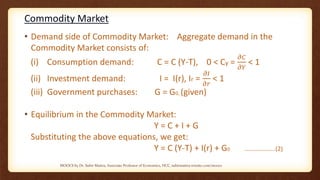
• Demand side of Commodity Market: Aggregate demand in the
Commodity Market consists of:
(i) Consumption demand: C = C (Y-T), 0 < Cy =
𝜕𝐶
𝜕𝑌
< 1
(ii) Investment demand: I = I(r), Ir =
𝜕𝐼
𝜕𝑟
< 1
(iii) Government purchases: G = G0, (given)
• Equilibrium in the Commodity Market:
Y = C + I + G
Substituting the above equations, we get:
Y = C (Y-T) + I(r) + G0 ………………..(2)
MOOCS by Dr. Subir Maitra, Associate Professor of Economics, HCC, subirmaitra.wixsite.com/moocs
General Equilibrium in Commodity and Money Markets:
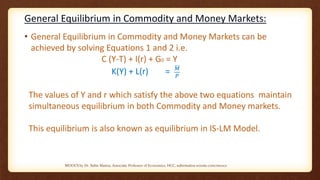
• General Equilibrium in Commodity and Money Markets can be
achieved by solving Equations 1 and 2 i.e.
C (Y-T) + I(r) + G0 = Y
K(Y) + L(r) = 𝑀
𝑃
The values of Y and r which satisfy the above two equations maintain
simultaneous equilibrium in both Commodity and Money markets.
This equilibrium is also known as equilibrium in IS-LM Model.
MOOCS by Dr. Subir Maitra, Associate Professor of Economics, HCC, subirmaitra.wixsite.com/moocs

IS-LM Model 1

  • 1.
    MOOCS by Dr.Subir Maitra Course Name: M.Com Year: First Session: 2017-18 Paper- 1.3 Macroeconomics and Business Environment Module: One University of Calcutta Department of Commerce MOOCS by Dr. Subir Maitra, Associate Professor of Economics, HCC, subirmaitra.wixsite.com/moocs
  • 2.
    General Equilibrium: Aspectsof Closed Economy--Commodity Market and Money Market Equilibrium--IS-LM Approach. LECTURE-9 IS-LM MODEL: COMMODITY MARKET AND MONEY MARKET MOOCS by Dr. Subir Maitra, Associate Professor of Economics, HCC, subirmaitra.wixsite.com/moocs
  • 3.
    Departure from SimpleKeynesian Model: • Simple Keynesian Model is one-sector model. It deals only with the demand for output in the real sector i.e. goods market. • IS-LM model is a two-sector model, comprising of both the real sector, the goods or commodity market and a monetary sector or market for financial assets. • In IS-LM model, the rate of interest and level of income are jointly determined in simultaneous equilibrium in two markets: one for commodities and the other financial assets. MOOCS by Dr. Subir Maitra, Associate Professor of Economics, HCC, subirmaitra.wixsite.com/moocs
  • 4.
    Asset or WealthMarket • In economics, assets are of two types—Physical and Financial. In IS-LM only financial assets are considered. • Two types of financial assets: (a) Money as non-interest bearing liquid financial assets (M), (b) Government bonds as interest bearing financial assets (B). Therefore, W = M + B • If someone holds money, return is zero; if he holds bonds, he earns a positive return. MOOCS by Dr. Subir Maitra, Associate Professor of Economics, HCC, subirmaitra.wixsite.com/moocs
  • 5.
    Asset or WealthMarket • Demand side of Wealth Market: Wd = Md + Bd • Supply side of Wealth Market: Ws = Ms + Bs • At equilibrium: Wd = Ws => Md + Bd = Ms + Bs => (Md -Ms) + (Bd - Bs) = 0 => If bond market is in equilibrium, money market is also in equilibrium. • Keynes chose to consider money market to show how rate of interest is decided. MOOCS by Dr. Subir Maitra, Associate Professor of Economics, HCC, subirmaitra.wixsite.com/moocs
  • 6.
    Money Market • Demandside of Money Market: Demand for real money balances Md consists of (a) Transaction Demand for Money i.e. demand for money to carry out day to day transactions: Depends on national income Y; as Y increases, transaction demand increases and vice versa. (b) Precautionary Demand for Money i.e. demand for money to take care of unforeseen events: Also depends on Y; as Y increases, transaction demand increases and vice versa. MOOCS by Dr. Subir Maitra, Associate Professor of Economics, HCC, subirmaitra.wixsite.com/moocs
  • 7.
    Money Market (c) SpeculativeDemand for Money i.e. demand for money to take advantage of change in the prices of bonds in the bond market: Depends on rate of interest r; as r increases speculative demand decreases and vice versa. Bond prices and rate of interest are inversely related. As rate of interest rises bond prices fall. As bond prices fall, people buy more bonds and hold less cash i.e. their demand for speculative balances falls. On the other hand, as rate of interest decreases, bond prices go up and people sell off their bond holding and start holding more cash i.e. their demand for speculative balances rises. MOOCS by Dr. Subir Maitra, Associate Professor of Economics, HCC, subirmaitra.wixsite.com/moocs
  • 8.
    Money Market Demand forMoney: Transaction plus Precautionary Demand for Money: K(Y), Ky = 𝜕𝐾 𝜕𝑌 > 0 Speculative demand for money: L(r), Lr = 𝜕𝐿 𝜕𝑟 < 0 Total demand for real money balances: Md = K(Y) + L(r) MOOCS by Dr. Subir Maitra, Associate Professor of Economics, HCC, subirmaitra.wixsite.com/moocs
  • 9.
    Money Market • Supplyof Money: Supply of money in an economy depends on the decision of the central bank of the country. In case of India, Reserve Bank of India decides how much money will be in circulation. In the context of IS-LM Model, the nominal supply of money is assumed to be constant 𝑀. • Supply of real money balances: Ms = 𝑀 𝑃 • At equilibrium : Md= Ms => K(Y) + L(r) = 𝑀 𝑃 ………………..……(1) MOOCS by Dr. Subir Maitra, Associate Professor of Economics, HCC, subirmaitra.wixsite.com/moocs
  • 10.
    Commodity Market • Demandside of Commodity Market: Aggregate demand in the Commodity Market consists of: (i) Consumption demand: C = C (Y-T), 0 < Cy = 𝜕𝐶 𝜕𝑌 < 1 (ii) Investment demand: I = I(r), Ir = 𝜕𝐼 𝜕𝑟 < 1 (iii) Government purchases: G = G0, (given) • Equilibrium in the Commodity Market: Y = C + I + G Substituting the above equations, we get: Y = C (Y-T) + I(r) + G0 ………………..(2) MOOCS by Dr. Subir Maitra, Associate Professor of Economics, HCC, subirmaitra.wixsite.com/moocs
  • 11.
    General Equilibrium inCommodity and Money Markets: • General Equilibrium in Commodity and Money Markets can be achieved by solving Equations 1 and 2 i.e. C (Y-T) + I(r) + G0 = Y K(Y) + L(r) = 𝑀 𝑃 The values of Y and r which satisfy the above two equations maintain simultaneous equilibrium in both Commodity and Money markets. This equilibrium is also known as equilibrium in IS-LM Model. MOOCS by Dr. Subir Maitra, Associate Professor of Economics, HCC, subirmaitra.wixsite.com/moocs