IS-LM Model
The Goods Market & the IS Curve
*The goods market is in equilibrium when
Output/ Income = Aggregate Demand
*At this point,
Saving = Investment
*Saving depends on the level of income
*It is directly related to income
*Investment depends on the rate of
interest
*It is inversely related to interest rate
*IS curve reflects the combination of the
interest rate & income
*So, Investment = Saving
I = S
*The goods market equilibrium is shown
by the IS curve
Derivation of IS Curve
*Diagram -
AD2
AD1
E1
E2
45O
Y1 Y2
IS
E1
E2
i2
i1
Y1 Y2
O
O
Real Income
Real Income
Aggregate
Demand
Aggregate
Demand
Interest
Rate
(A)
(B)
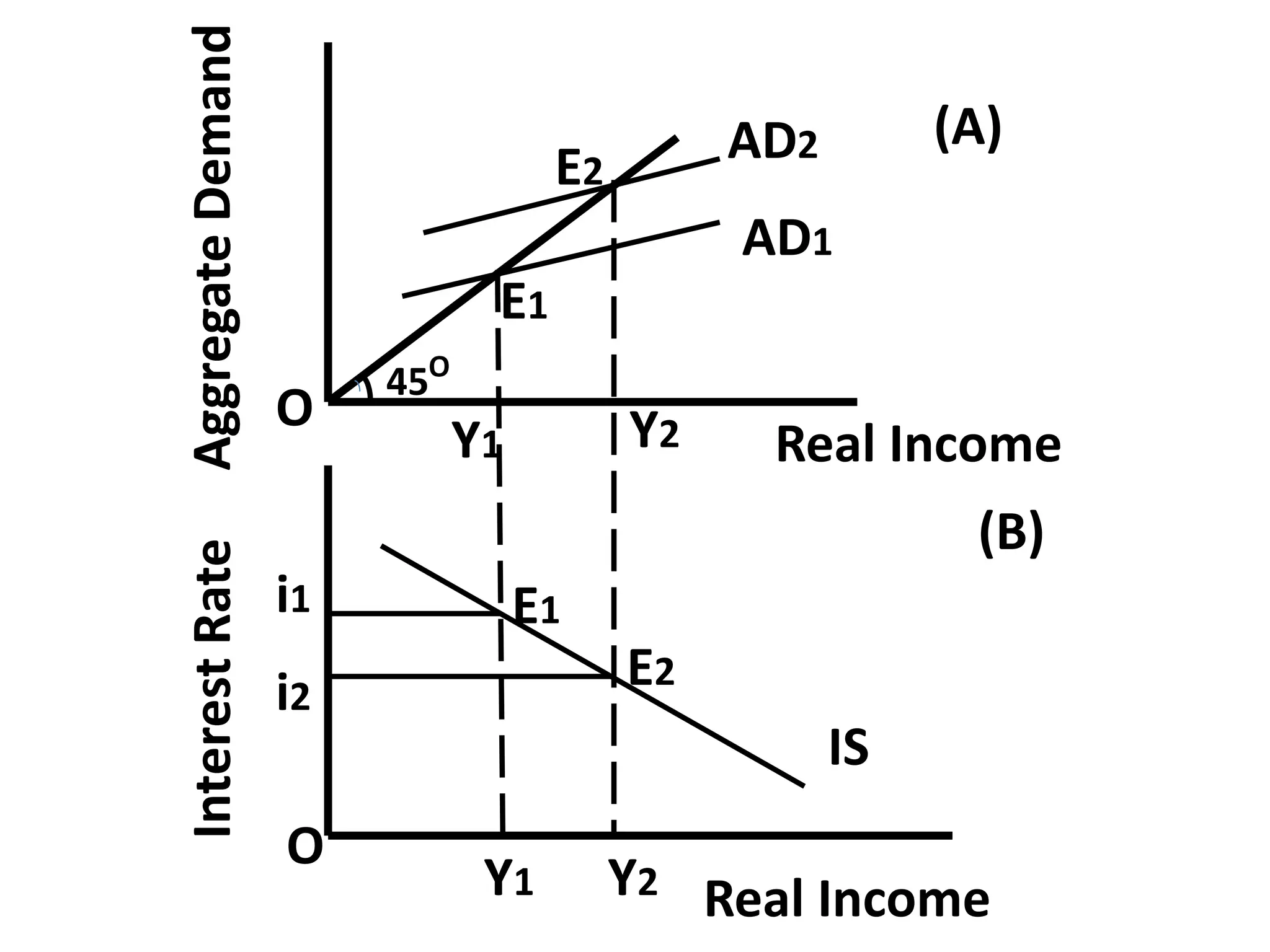
In this diagram-
*The given interest rate is - i1
*The aggregate demand curve AD1(part A)
intersects the 45 degree line at the point
E1
*It is an equilibrium point of goods
market
*Equilibrium income is Y1
*If the rate of interest falls to i2, aggregate
demand will rise
*The aggregate demand curve shifts
upwards to AD2
*The new equilibrium point is E2
*The equilibrium level of income rises to
Y2
*If we repeat this exercise for all
possible interest rates we can obtain a
series of combinations of interest rates
& levels of income at which the goods
market is in equilibrium
*By joining all these points in the B part of
Fig., we obtain the IS curve
*Thus, IS curve is the locus of pairs of
interest rates and levels of income
which are compatible with goods market
equilibrium
*The equilibrium is only on the IS curve
*Outside the IS curve, the goods market
is not in equilibrium
*Because at the right of the IS curve there
is excess supply in the goods market
*& the left of the IS curve there is excess
demand in the goods market
The Slope of IS Curve
*The IS curve slopes downwards
*Because a decrease in interest rate
increases investment
*Which shifts aggregate demand curve up
and rises the equilibrium income level
*The steepness of IS curve depends on the
sensitivity of investment spending and
autonomous consumption expenditure
to changes in interest rates
*If the investment spending and
autonomous consumption expenditure
are very sensitive to the interest rate,
then the change in interest rate will
produce a large change in aggregate
demand and it shows large change in
income level. In this case IS curve will
be flatter
*If the investment spending and
autonomous consumption expenditure
are not very sensitive to change in
interest rates then the IS curve will be
very steep
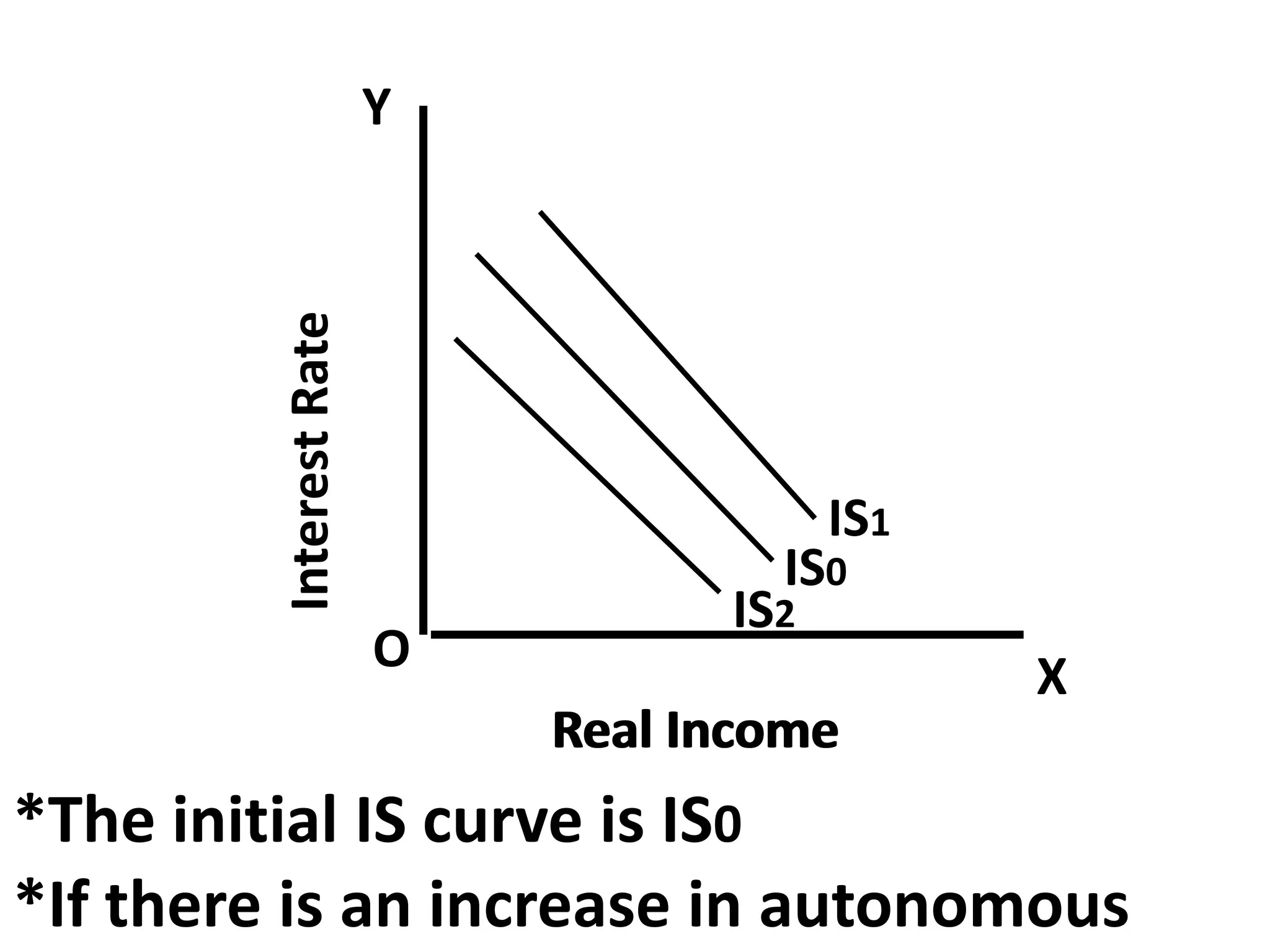
Shifts in IS Curve
*It is depend on –
1.Change in Govt. Spending –
 Increase in Govt. spending will shift the
IS curve to the right
 While a decrease in Govt. spending
shift the IS curve to the left
2.Change in Taxes –
 An increase in taxes will shift the IS
curve to the left
 While a decrease in taxes shift the IS
curve to the right
3.Autonomous Change in Investment –
 An increase in autonomous investment
will shift the IS curve to the right
 While a decrease in autonomous
investment will shift the IS curve to the
left
*Diagram -
IS1
IS0
IS2
O
Y
X
Real Income
Real Income
Interest
Rate
*The initial IS curve is IS0
*If there is an increase in autonomous
spending IS curve shifts right to IS1
*& if there is a fall in autonomous
spending IS curve shifts left to IS2
Money Market & Derivation of LM Curve
*The money market is concerned with
demand for and supply of money
*The demand for money depends on –
 Transaction
 Precautionary Lt & Lp or L1= f (Y)
 Positively related
 Speculative motives Ls or L2 = f(r)
 Negatively related
*Supply of money is controlled by the
Central Bank
*The money market is in equilibrium –
Demand for money = Supply of money
*The LM curve shows the combinations –
 Interest rate &
Income
*Diagram -
Y1
O
O X
Y
Y
X
E1
E2
i1
i2
i1
i2
LM
Y2
Interest
Rate
Real Income
Demand for &
Supply of Money
M
E2
E1
Interest
Rate
(B)
(A)
L1
L2
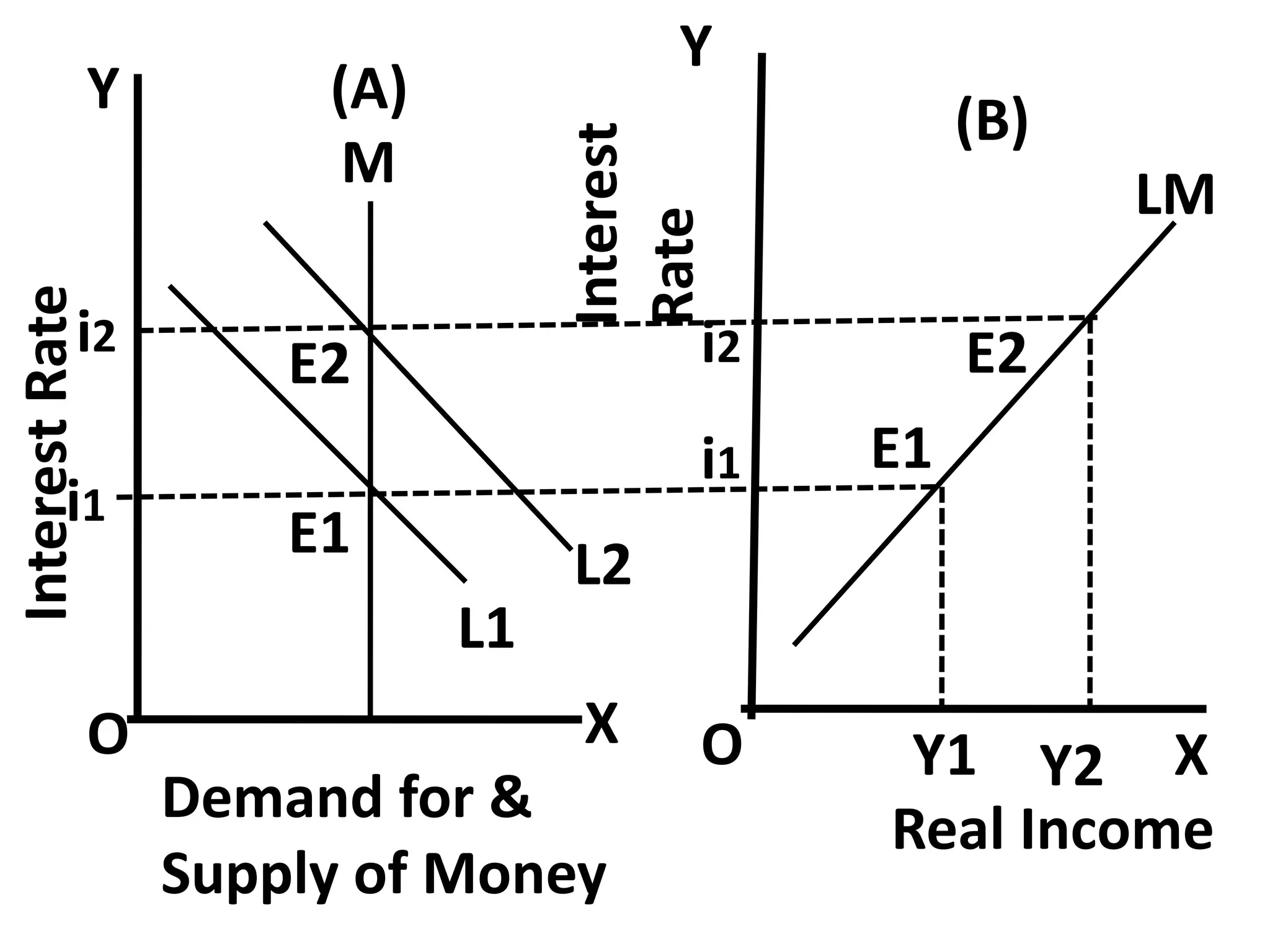
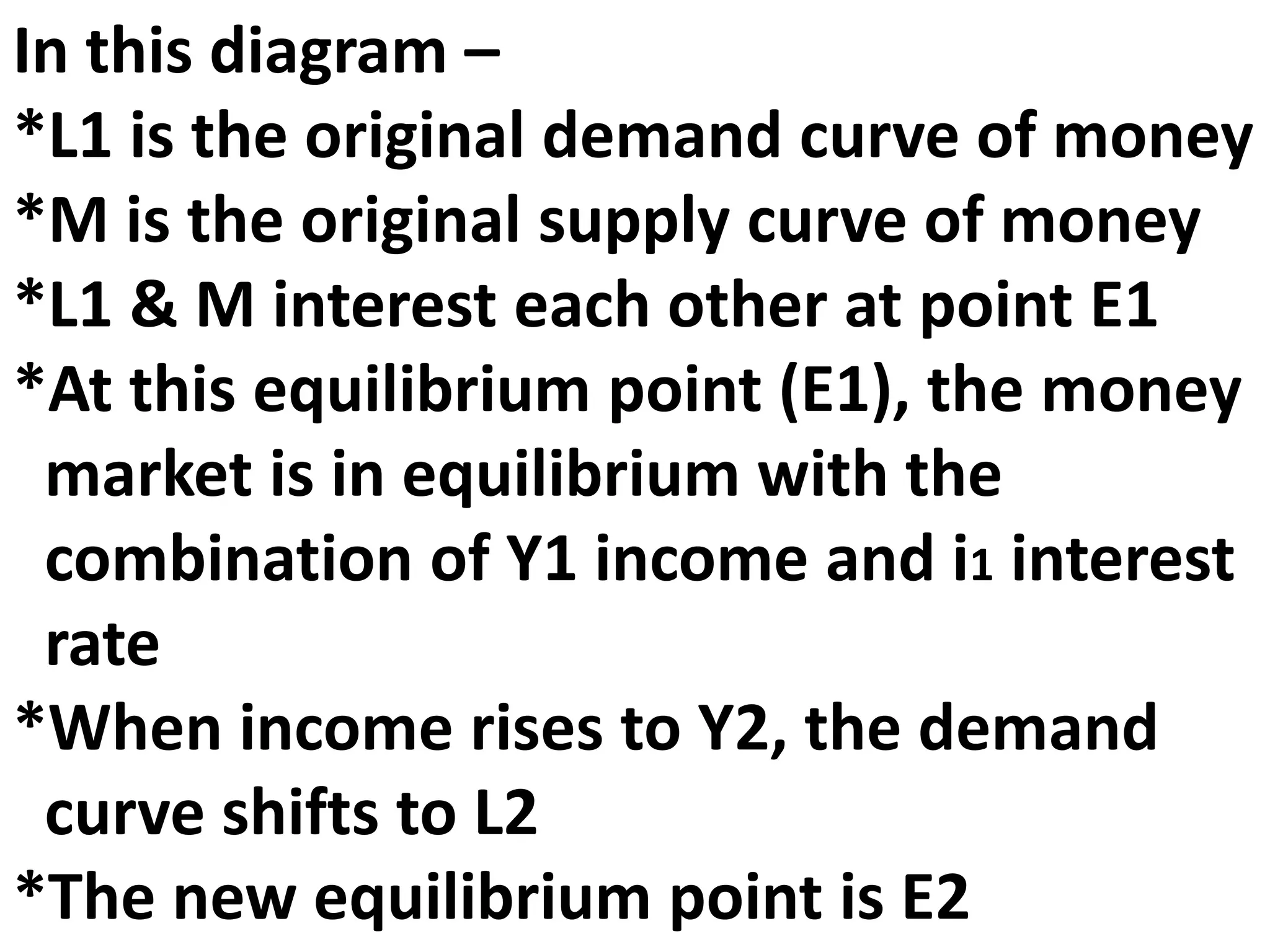
In this diagram –
*L1 is the original demand curve of money
*M is the original supply curve of money
*L1 & M interest each other at point E1
*At this equilibrium point (E1), the money
market is in equilibrium with the
combination of Y1 income and i1 interest
rate
*When income rises to Y2, the demand
curve shifts to L2
*The new equilibrium point is E2
*At this equilibrium point the money
market is in equilibrium with the
combination of Y2 income and i2 interest
rate
*In the (B) part of the diagram, we obtain
LM curve, by joining the equilibrium
points like E1 and E2
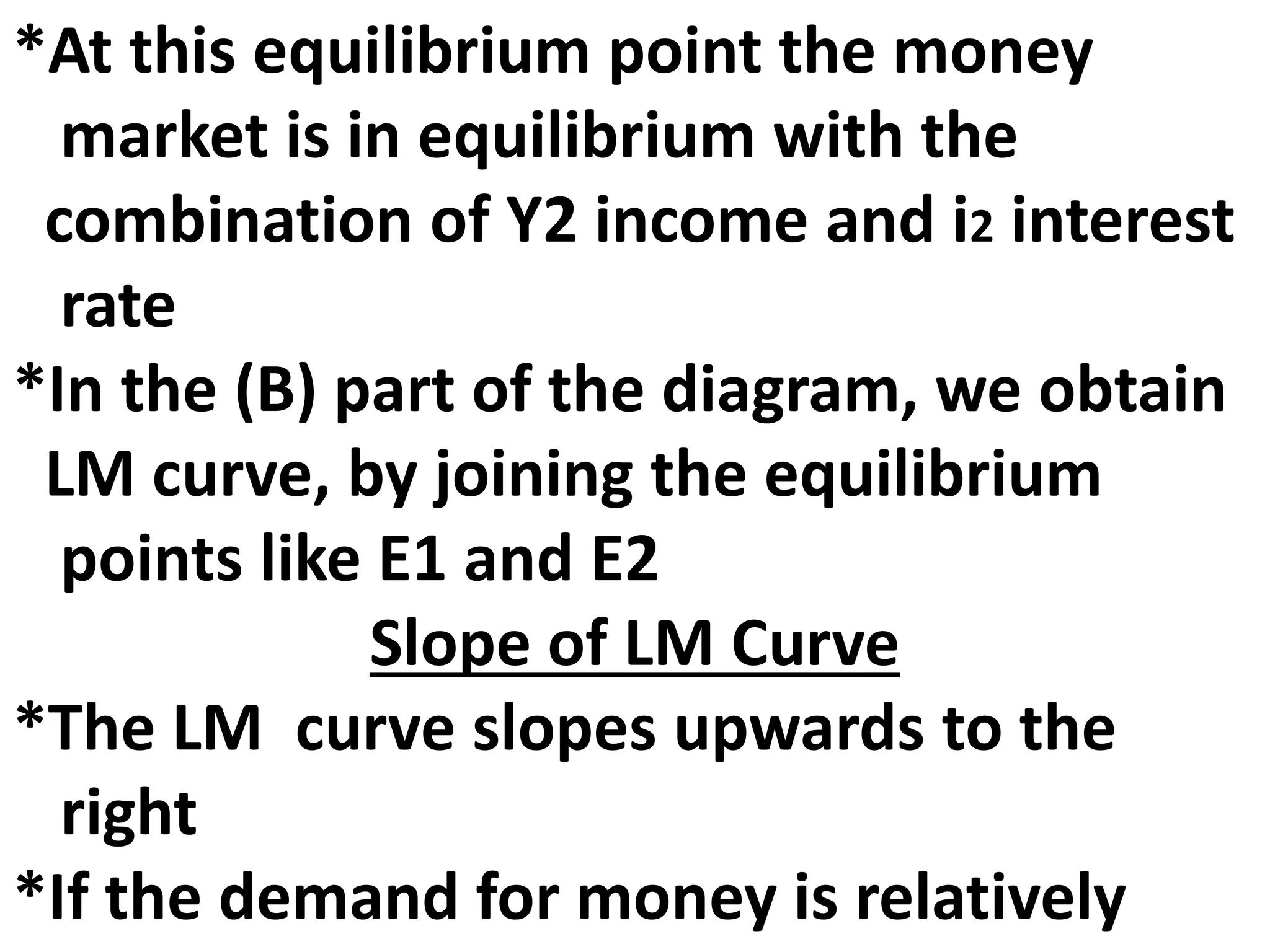
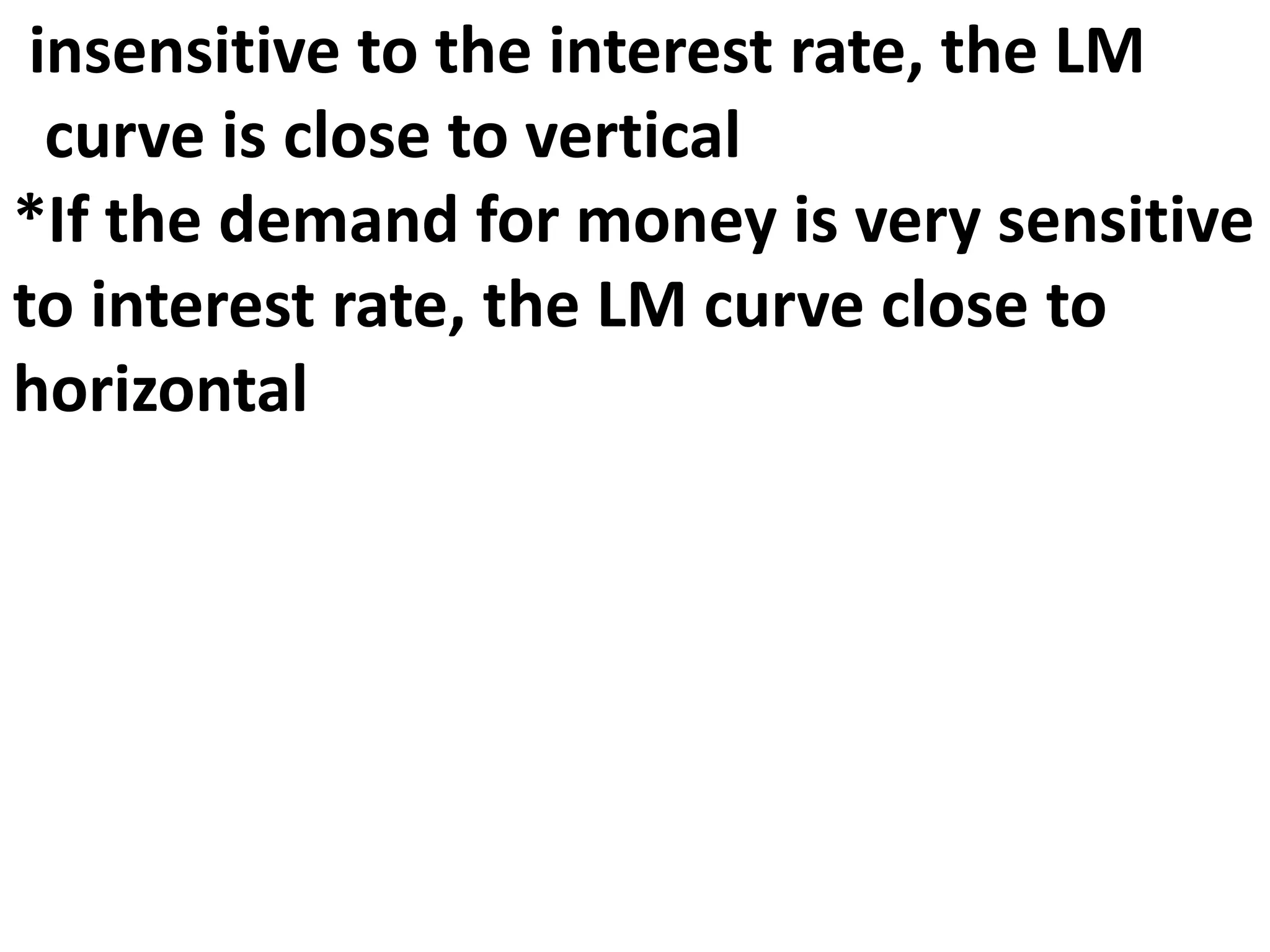
Slope of LM Curve
*The LM curve slopes upwards to the
right
*If the demand for money is relatively
insensitive to the interest rate, the LM
curve is close to vertical
*If the demand for money is very sensitive
to interest rate, the LM curve close to
horizontal

IS-LM Model For understanding the economy

  • 1.
    IS-LM Model The GoodsMarket & the IS Curve *The goods market is in equilibrium when Output/ Income = Aggregate Demand *At this point, Saving = Investment *Saving depends on the level of income *It is directly related to income *Investment depends on the rate of interest *It is inversely related to interest rate
  • 2.
    *IS curve reflectsthe combination of the interest rate & income *So, Investment = Saving I = S *The goods market equilibrium is shown by the IS curve Derivation of IS Curve *Diagram -
  • 3.
    AD2 AD1 E1 E2 45O Y1 Y2 IS E1 E2 i2 i1 Y1 Y2 O O RealIncome Real Income Aggregate Demand Aggregate Demand Interest Rate (A) (B)
  • 4.
    In this diagram- *Thegiven interest rate is - i1 *The aggregate demand curve AD1(part A) intersects the 45 degree line at the point E1 *It is an equilibrium point of goods market *Equilibrium income is Y1 *If the rate of interest falls to i2, aggregate demand will rise *The aggregate demand curve shifts
  • 5.
    upwards to AD2 *Thenew equilibrium point is E2 *The equilibrium level of income rises to Y2 *If we repeat this exercise for all possible interest rates we can obtain a series of combinations of interest rates & levels of income at which the goods market is in equilibrium *By joining all these points in the B part of Fig., we obtain the IS curve
  • 6.
    *Thus, IS curveis the locus of pairs of interest rates and levels of income which are compatible with goods market equilibrium *The equilibrium is only on the IS curve *Outside the IS curve, the goods market is not in equilibrium *Because at the right of the IS curve there is excess supply in the goods market *& the left of the IS curve there is excess demand in the goods market
  • 7.
    The Slope ofIS Curve *The IS curve slopes downwards *Because a decrease in interest rate increases investment *Which shifts aggregate demand curve up and rises the equilibrium income level *The steepness of IS curve depends on the sensitivity of investment spending and autonomous consumption expenditure to changes in interest rates *If the investment spending and
  • 8.
    autonomous consumption expenditure arevery sensitive to the interest rate, then the change in interest rate will produce a large change in aggregate demand and it shows large change in income level. In this case IS curve will be flatter *If the investment spending and autonomous consumption expenditure are not very sensitive to change in interest rates then the IS curve will be
  • 9.
    very steep Shifts inIS Curve *It is depend on – 1.Change in Govt. Spending –  Increase in Govt. spending will shift the IS curve to the right  While a decrease in Govt. spending shift the IS curve to the left 2.Change in Taxes –  An increase in taxes will shift the IS curve to the left
  • 10.
     While adecrease in taxes shift the IS curve to the right 3.Autonomous Change in Investment –  An increase in autonomous investment will shift the IS curve to the right  While a decrease in autonomous investment will shift the IS curve to the left *Diagram -
  • 11.
    IS1 IS0 IS2 O Y X Real Income Real Income Interest Rate *Theinitial IS curve is IS0 *If there is an increase in autonomous
  • 12.
    spending IS curveshifts right to IS1 *& if there is a fall in autonomous spending IS curve shifts left to IS2
  • 13.
    Money Market &Derivation of LM Curve *The money market is concerned with demand for and supply of money *The demand for money depends on –  Transaction  Precautionary Lt & Lp or L1= f (Y)  Positively related  Speculative motives Ls or L2 = f(r)  Negatively related *Supply of money is controlled by the Central Bank
  • 14.
    *The money marketis in equilibrium – Demand for money = Supply of money *The LM curve shows the combinations –  Interest rate & Income *Diagram -
  • 15.
    Y1 O O X Y Y X E1 E2 i1 i2 i1 i2 LM Y2 Interest Rate Real Income Demandfor & Supply of Money M E2 E1 Interest Rate (B) (A) L1 L2
  • 16.
    In this diagram– *L1 is the original demand curve of money *M is the original supply curve of money *L1 & M interest each other at point E1 *At this equilibrium point (E1), the money market is in equilibrium with the combination of Y1 income and i1 interest rate *When income rises to Y2, the demand curve shifts to L2 *The new equilibrium point is E2
  • 17.
    *At this equilibriumpoint the money market is in equilibrium with the combination of Y2 income and i2 interest rate *In the (B) part of the diagram, we obtain LM curve, by joining the equilibrium points like E1 and E2 Slope of LM Curve *The LM curve slopes upwards to the right *If the demand for money is relatively
  • 18.
    insensitive to theinterest rate, the LM curve is close to vertical *If the demand for money is very sensitive to interest rate, the LM curve close to horizontal